By The Wayland Post Staff
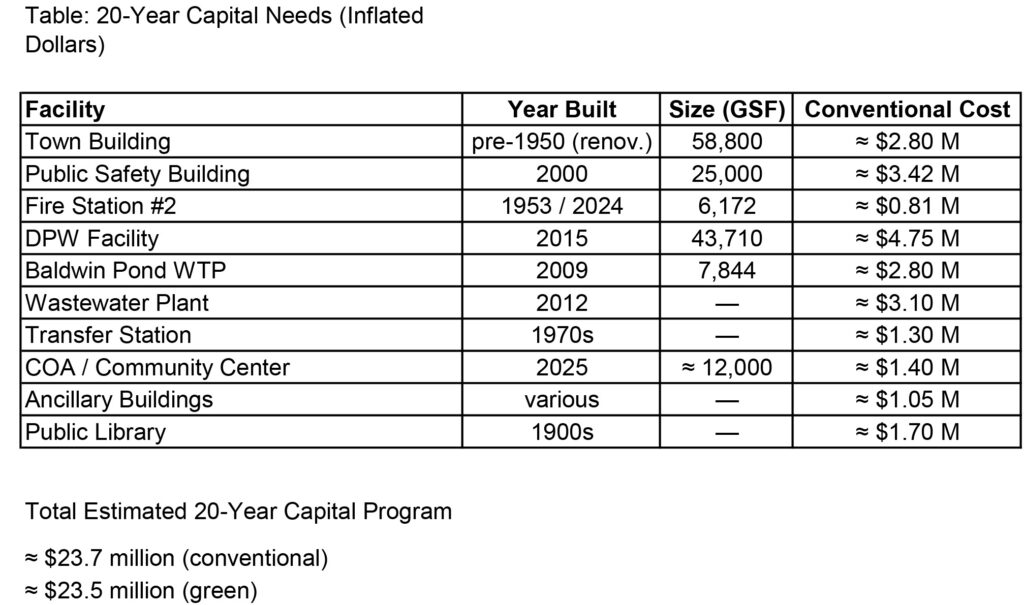
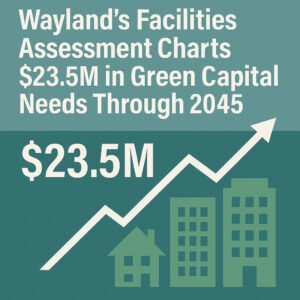
A comprehensive review of Wayland’s major public buildings projects to be nearly $23.5 million in capital expenses over the next two decades, according to the 2025 Green Capital Needs Assessment (GCNA) prepared by On-Site Insight/RECAP Real Estate Advisors. The study evaluated 10 town facilities, comparing conventional repairs with environmentally sustainable “green” options that improve efficiency, air quality, and durability.
Town Building Tops List for Modernization
The Town Building at 41 Cochituate Road, the town’s central administrative hub, was cited as needing the most complex modernization effort. Engineers found widespread heat loss, aging boilers, and poor insulation, especially in the east wing and gymnasium. Recommended upgrades include replacing the existing Weil-McLain boilers with condensing models exceeding 96% efficiency, installing variable-frequency-drive (VFD) pumps, hybrid electric water heaters, and sealing air leaks. If implemented, these measures could reduce annual energy costs by nearly 10%. The total 20-year projected cost is $2.8 million, the majority for mechanical and envelope restoration.
Public Safety Building Faces Flood Zone Risks
At 38 Cochituate Road, the combined fire and police headquarters, built in 2000, remains functional but sits in a flood-prone area near Mill Brook. The report calls for a structural study and roof replacement within the next decade. Energy systems are relatively modern, including condensing boilers and LED lighting, but engineers recommend adding VFD controls and replacing synthetic flooring with natural linoleum to lower life-cycle costs. The 20-year capital plan totals about $3.4 million.
DPW and Water Facilities Require Planned Mechanical Renewal
The Department of Public Works complex on River Road, completed in 2015, was rated in good condition but needs mechanical renewals and pavement rehabilitation. Planned HVAC replacements and resurfacing will total roughly $4.75 million over 20 years.
The Baldwin Pond Water Treatment Plant, built in 2009, is considered functionally obsolete due to PFAS contamination standards. Engineers recommend major reinvestment or decommissioning once the MWRA connection is complete. The facility’s high-efficiency pumps and boilers already meet “green” standards, yet it remains one of Wayland’s largest municipal carbon sources, releasing an estimated 1.76 million pounds of CO₂ annually. Total projected cost: $2.8 million.
Wastewater and Transfer Sites Emphasize Durability
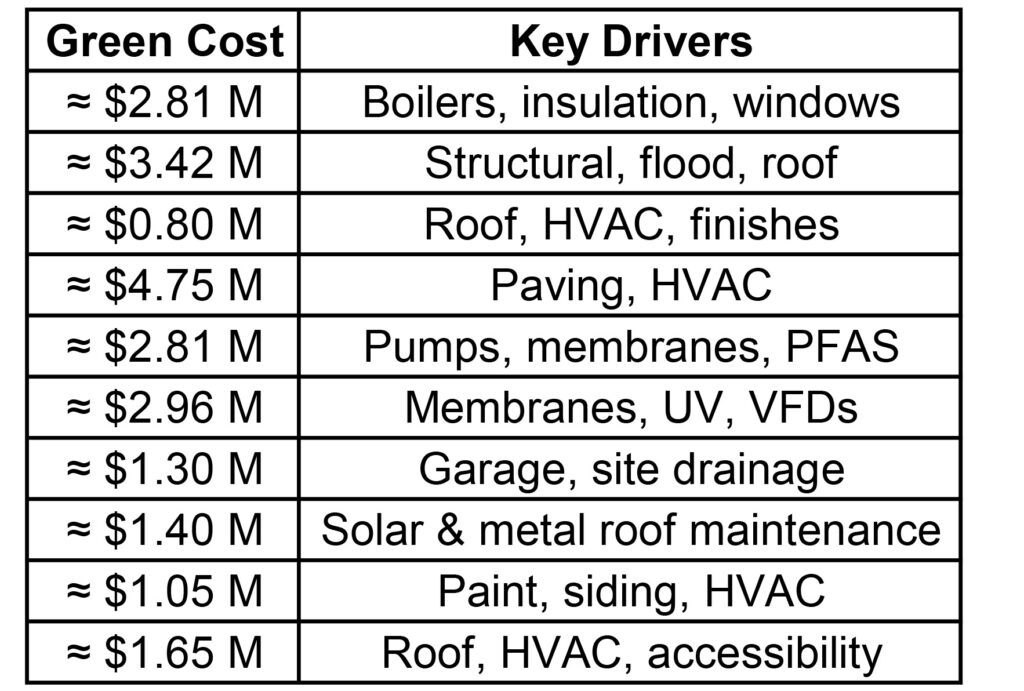
The Wastewater Treatment Plant, serving the Town Center district, operates efficiently but will require pump, blower, and membrane replacements within 10 to 15 years. The report estimates $3.1 million under conventional budgeting or $2.96 million using green upgrades that improve pump motor efficiency and lighting.
The Transfer Station’s garage and barn structures are nearing end of life, with a full rebuild planned by 2027. Stormwater improvements, repaving, and compactor replacement dominate the $1.3 million capital forecast.
New Council on Aging Building Sets Green Benchmark
Opened in 2025, the Council on Aging and Community Center at 8 Andrews Ave. is the town’s most energy-efficient facility. It features solar panels, R-60 insulation, heat pumps, energy-recovery ventilators, and drought-tolerant landscaping. Its projected 20-year maintenance cost is about $1.4 million, one of the lowest among all facilities, reflecting the town’s commitment to high-performance design.
Smaller Buildings Show Deferred Maintenance
Sixteen smaller sites, such as the Depot, Scout House, and Freight House, require roughly $1.05 million over 20 years for paint, siding, and heating system renewal. While most already use LED lighting, the report recommends linoleum flooring and composite trim for longer durability and lower emissions.
Library and Fire Station #2 Among the Best Performers
The Wayland Public Library’s assessment focuses on roof, HVAC, and accessibility improvements totaling about $1.7 million. Recommended green options include LED retrofits, low-VOC finishes, and VFD motor controls.
Fire Station #2, renovated in 2024, is among the town’s most efficient emergency facilities. The 6,172-square-foot station uses heat pumps, energy recovery ventilators, and LED lighting. Its 20-year capital plan totals about $812,000, slightly lower under the green scenario, covering roof and mechanical renewals in the next decade.
Townwide Green Strategy
Across all reports, engineers conclude that Wayland’s buildings are structurally sound but vary widely in mechanical condition and efficiency. Common priorities include installing variable-speed pumps and motors, phasing in condensing boilers and hybrid water heaters, adopting porous asphalt and recycled materials, and maintaining a coordinated replacement reserve to manage long-term costs.
While green options increase upfront investment in some cases, they reduce overall costs by about $200,000, or roughly 1 percent, over the 20-year horizon, largely through energy savings and extended material life.