By June Valliere
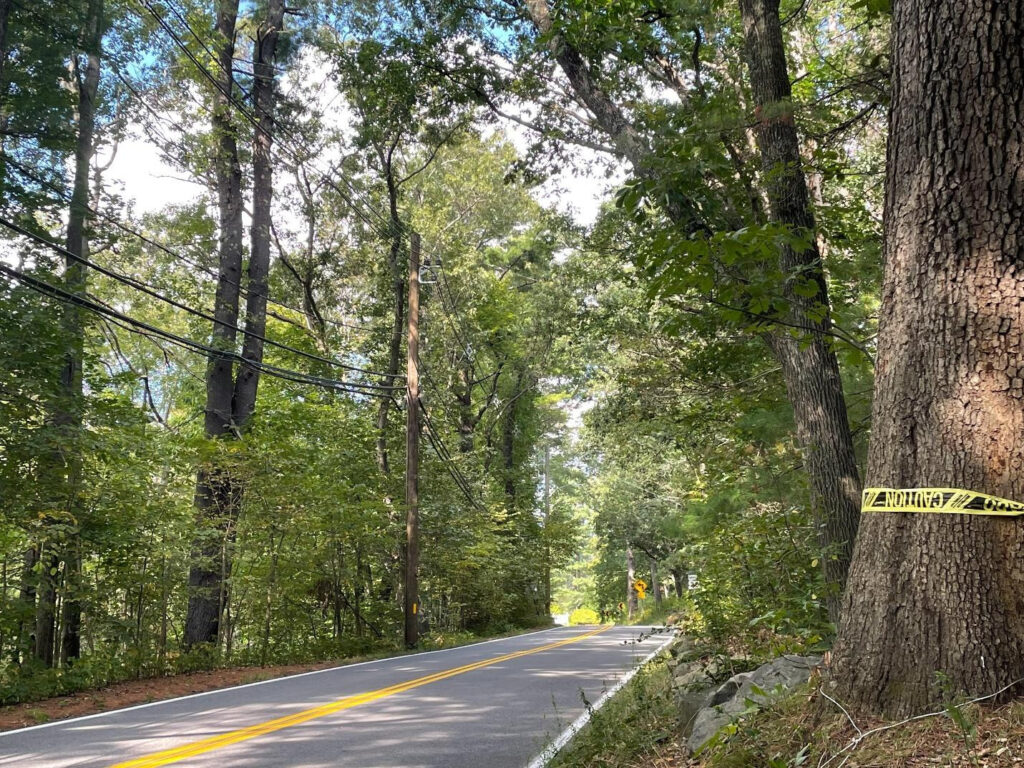
Photo of Rice Road, the Coptic Church is to the right, where the caution banner is located. Photo by J. Valliere
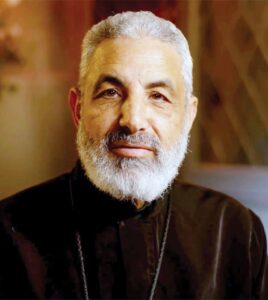
Thomas Kearns, president of Studio DSK Architects, gave an impassioned speech about community to more than 200 Wayland residents at the Nov. 12 Wayland Planning Board meeting.
The attendees, most from neighboring condominium associations Turkey Hill, Meadows, and the Fields, were at the meeting to learn more about the architectural changes and peer reviews on the St. Philopater Mercurius & St. Mina Coptic Church construction project. Many responded negatively to the speech, later expressing their objections at the public comment.
The plan is for a significantly larger church with a dome, two 100-foot towers, and four additional buildings.
After his speech, Shaun Landon, the DSK architect and the church’s landscape designer, reviewed the plans and presented updates. According to Kearns, the church will retain the towers and dome in its design because it is “authentic to its culture and religion”. He said the design has existed for over 200 years. He added that the First Parish Church on Boston Post Road has an 80- to 90-foot tower. However, he did not mention that the church is located in the town center and not near any residences. When Planning Board Vice Chair Robin Borgestedt mentioned this later in the meeting, the church’s attorney, Jonathan Silverstein, quickly responded that it had nothing to do with the Dover Amendment.
Landon said they made some changes to the church’s plans to address neighbor concerns and peer review findings by proposing to add 107 more six-foot cedar trees to the original plan along Rice Road. The lighting plan is dark sky compliant, and the lights will be timed to go off an hour after the last service. They added a sidewalk so hikers on the abutting conservation trails can continue walking on the trail, and they will be constructing a utility easement at the Fire Department’s request. Trees will remain as a 30-foot buffer between the church property and Turkey Hill Road.
Sean Malone, vice president of Oak Consulting Group, the church’s civil engineer, provided more details on septic and storm water. He explained how the storm water would be filtered and stated that the storm water runoff system complies with Massachusetts requirements and will not run into Rice Road. He said they incorporated the Health Department’s recommendations so the septic system will comply with Title 5.
Daniel Dumias of MDM Transportation Consultants, the church’s traffic engineer, reported that the expansion would not significantly impact the traffic on Rice Road, although they are more than doubling the number of parking spaces.
The town’s experts presented their peer review on construction plans and traffic. Bert Corey, a civil engineer from DGT Associates, said it was difficult to judge the scale and bulk of the project from walking the site. He suggested doing a balloon study to assess the impact of the towers’ height and placing stakes at the perimeter of each proposed building. According to Corey, that will help him assess the impact on the neighbors and Rice Road.
Corey said that they needed pre-treatment for clean water for the filtration system, a stress test to determine where the overflow goes. They also need to assess the erosion impact on stormwater runoff during different construction phases and the adequacy of the water supply for fire suppression. He added that the Board of Health is requiring a hydraulic study. Corey said that they could not complete the light study because not enough details were provided.
Kristen Braun from Deer Traffic criticized some portions of the church’s traffic expert. She said that a summer study was not representative of the total traffic impact during the year and it is difficult to assess traffic for three construction phases, which is projected to last seven years. She also said that the report did not discuss parking during construction, nor did it look at the impact of the ancillary facilities and she had some concerns about the turn out for delivery vehicles.
During the public comment, Turkey Hill resident Ken Bruss took umbrage at Kearns’s speech, stating that the only community that he was referring to was exclusively the church community, not its neighbors. Sylvia Diaz, another Turkey Hill resident, chastised the church’s representatives for not being transparent. And Kathy Steinberg quoted Emily Dickinson’s “Some Keep the Sabbath Going to Church,” a poem about trees and religion, stating that she saw her religion in nature, and with the church’s removal of over 500 hundred trees and changing a bucolic neighborhood, the church was not respecting her religion.
Attorney Dennis Murphy from Hill Law who is representing Turkey Hill and the Field Condo Associations, made a few comments: he applauded the balloon test; asked for more details regarding the gas easement located near Turkey Hill; expressed his clients’ concerns about harmony and scale of the project; and pointed out that although the church is adding some additional trees, they are still removing 770.. He requested that the church remove only the required trees during each phase rather than removing them at once. In reviewing the church’s attorney’s opinion on the Dover Amendment, Murphy said Silverstein only used case law that supported his arguments and failed to mention the Lasell University and Regis College cases regarding residences where Newton and Weston, respectively, won those cases.
Historian and neighbor Gretchen Schuler, reminded the Board about the history of the area and made an appeal to perpetuate the conservation, the history, and the scenic bylaw. She reminded the planning Board that before the three condo developments were built on Rice Road there was an agreement with the developers to set aside conservation land in perpetuity to protect the country nature.
The final meeting concluded with Anette Lewis, Planning Board chair, questioning the time frame for all three construction changes. She said approving a long-term project could be a problem as a.seven-year project would cause a big disruption to the community and regulatory issues. According to Lewis, a Wayland building permit is valid for one year from its issuance date, but work must commence within 180 days or the permit becomes invalid. If construction is suspended or abandoned for 180 days after it has started, the permit will also become invalid
Lewis noted several inconsistencies in the lot coverage and square footage between the application and the diagrams, and some were mislabeled. She advised the architects to fix the discrepancies before the next meeting. Since additional work needs to be completed by both the town officials and church representatives, the Town’s approval deadline was extended to Dec. 30.