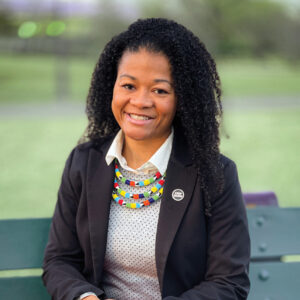
When Dr. Eden-Reneé Hayes was in kindergarten, all of her classmates were like her — Black. Until one day, when a white girl enrolled in her class, and young Eden-Reneé overheard a conversation that rattled her to her core.
In what they believed was a private moment, faculty were discussing how best to ensure the new student’s inclusion. Horrified, it occurred to Eden-Reneé for the very first time that another child might not have friends because of her skin color.
She promised herself that the little white girl would have at least one friend in school — a promise that became the catalyst for a passion that would define her life’s work. Now a strategist and executive coach based in Wayland, Hayes brings her mission to the community through facilitating what she calls a “brave space.”
Last summer, Hayes found time between her work as a social psychologist and independent consultant to lead a public reading of Frederick Douglass’s “What to the Slave is the Fourth of July?” With such a high impact, it became a series: “Conversations for Change,” which was sponsored by Wayland Free Public Library, the Wayland Museum and Historical Society, and the Wayland Human Rights, Diversity, Equity and Inclusion Committee (HRDEIC).
“There may be national division, but that’s happening among our neighbors,” Hayes said. “So instead of just trying to push everything off to what’s happening in the rest of the world, outside of us, or even what’s happening in Boston, what can we be doing in Wayland? How is it that we can be a model for everyone else?”
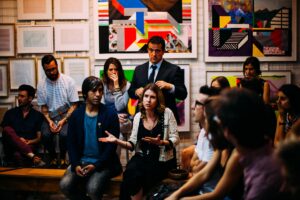
From holding workshops with local police departments to facilitating conversations in collaboration with the Wayland Museum, Hayes calls on the community’s willingness to listen and discuss actionable methodology when experiencing or witnessing hate crimes.
In one meeting, a film connecting the Holocaust to India’s caste system and deep-seated hierarchies in the United States laid the groundwork for discussions about personal responsibility and the reality of systemic inequity. In another, the Wayland Museum provided artifacts including playbills from minstrel shows that were once held in a Wayland church along with an Uncle Mose doll — the Aunt Jemima doll’s lesser-known counterpart — tangibly grounding a discussion about the harmful stereotypes that have long plagued Black history.
“There are so many different people within our community,” Dr. Hayes said. “To learn more about a completely different country, and how our same issues play out similarly and differently elsewhere. And knowing that we can talk about what that means for Wayland specifically, because despite having a very liberal, very blue state, we still have things that we need to grapple with and that we need to do a much better job on.”
Resonating with her own life’s work, Dr. Hayes calls Martin Luther King Jr. Day, an “excellent day for service and connection.” And this year in particular, she’s found herself reflecting on the loneliness epidemic afflicting so many demographics. Remembering that the holiday should be a reminder to connect with and serve the community every day of the year.
“Wayland can be a place where people keep to their own groups, and we need to do a better job of realizing the bubble that we’re in, and trying to see outside of that bubble,” Hayes said. “We need to do a better job of collaborating with our Boston-based friends. We need to do a better job of recognizing what our norms are, and proactively educating ourselves, our children and each other about differences, so that when issues arise, we already have a baseline of knowledge and a methodology of how to collaborate and move forward.”
Through public speaking engagements, consulting, work with the Wayland Freedom Team, and now the Conversations for Change series at the library, Hayes is committed to connecting Wayland through its differences, citing history that is “sometimes hurtful, but always necessary,” in conversations that are “sometimes difficult, but always important.”
“Trying to evaluate yourself and your deeds in terms of how history would paint you and what you’re doing, is, in my opinion, really good framing for all of us to have,” Dr. Hayes said. “I want to be on the right side of history, and use that [evaluation] as a measure of what I’m doing with my time and how I’m perpetuating or going against these elements of inequality. How is it that I can do better in my household and when engaging with places outside of my household?”