When Wayland residents first heard about upgrading their water meters nearly a decade ago, the project was introduced with promises of transparency, efficiency, and customer choice. However, the rollout of automated water meters was not the initial opt-in process suggested to residents. Instead, the town has moved forward with mandatory enrollment.
Water meter replacements have a lengthy history in Wayland. They were initially framed as necessary infrastructure upgrades to modernize outdated, inefficient, and labor-intensive analog meters. The process began in earnest in April 2015 at the Annual Town Meeting, when residents approved an allocation of $200,000 to replace aging water meters. This funding addressed the increasing inefficiencies of the existing metering infrastructure, characterized by frequent manual reads prone to human error.
The commitment continued into 2016, with another $200,000 allocation specifically earmarked as “Completion of Water Meter Replacement.” These back-to-back appropriations signaled the town’s intent to fully transition from analog to more efficient metering technologies.
In 2018, Wayland sought a significant step forward by proposing a comprehensive $920,000 water meter replacement program. Despite town officials’ arguments emphasizing operational savings and improved accuracy, residents at the 2018 Town Meeting rejected the substantial budget increase.
However, the issue resurfaced in April 2019 at the Annual Town Meeting with a renewed focus on automatic meter reading (AMR) systems. Town officials presented the AMR proposal as a necessary adaptation to state regulatory standards mandating quarterly or monthly meter readings. The 2019 proposal indicated automatic enrollment, with residents retaining the option to “opt-out” at around $20 per manual read.
In 2020, Wayland allocated $1.3 million in capital funds explicitly earmarked for automated water meters, further confirming the town’s commitment to automatic implementation. Town records from 2021 reveal that most of this funding remained unspent, signaling ongoing implementation challenges or delays.
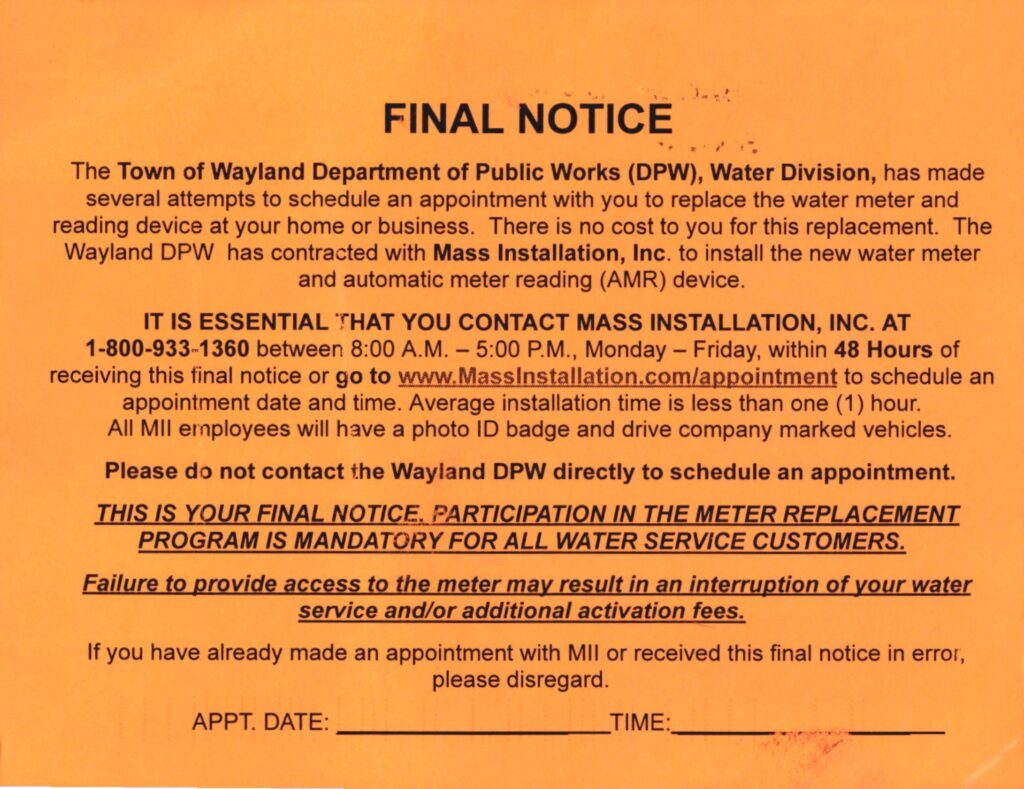
Currently, Wayland’s automated water meter replacement project is actively progressing with Mass Installation, Inc. (MII) of Norwood coordinating the installations. MII handles all scheduling and execution of meter replacements, sending postcards to residents with instructions on scheduling installations. Technicians from MII conduct the installations, typically taking 30-45 minutes per household, and water service is briefly interrupted for about 15 minutes during the procedure.
Participation in this program is mandatory, with no installation cost to residents. Using uniformed and ID-badged technicians along with clearly marked vehicles helps ensure residents’ safety and trust in the process.
Throughout the rollout, residents have been notified through multiple communications, including three separate postcards per household — each sent at a postage cost of $0.56, totaling approximately $8,400. Despite this significant expenditure in community outreach, the postcards’ messages have focused primarily on mandatory scheduling and logistics rather than explicitly detailing the consumer rights to opt out of AMR.
When asked, the representative of MII does not have a procedure to opt out of AMR, and they direct people to call the Wayland DPW. Unfortunately, the postcard sent to every user reads that water users should not contact the Wayland DPW, confusing residents. 67% of water users have responded to the meter replacement program participation request.
In 2019, the Board of Public Works discussed the right for users to opt out of AMR. Upon inquiry, Thomas Holder, director at the Department of Public Works, said that if residents wish to opt out of AMR, they need to call the DPW directly at 508-358-3672. The disadvantage to residents is that they would also be ineligible for abatements when water leaks cause unintended consequences, and there would be a per-read fee.