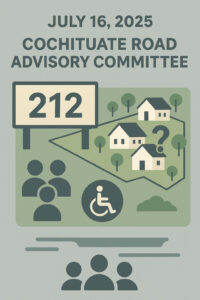
Members of the newly seated 212 Cochituate Road Advisory Committee opened their first meeting July 16 by revisiting a key assumption of the project voters endorsed at April’s Annual Town Meeting (ATM): that at least one affordable housing group home for adults with intellectual, developmental, and/or physical disabilities would be built on the four‑acre parcel seized by the town for back taxes.
Discussion centered on clarifying the vision for the site. Developer Mike Staiti, chair of the Municipal Affordable Housing Trust and a 21‑year resident, said the two‑unit concept “doesn’t reflect the property’s real capacity or the region’s urgent housing demand.”
“Why is our vision limited to two homes?” he asked. “As a friendly 40B, we could do a lot more. This site can support far more than two buildings with good separation and setbacks, and it’s a strong opportunity to add the affordable units Wayland still needs.”
For Staiti, the calculus is simple. “It’s tough to develop in Wayland,” he said. “When you have a high, dry, four‑acre site already in public hands, you don’t get many second chances.”
What was approved
In Article 30 at the ATM, voters transferred custody of 212 Cochituate Rd. from the tax‑title custodian to the Select Board, authorizing it to dispose of the land “for affordable housing, shared‑living housing for persons with disabilities and/or market‑rate housing.” An amendment adopted on the floor requires that affordable or shared‑living units accompany any market‑rate units. The article cleared the required two-thirds threshold with 73% support.
Although the warrant narrative said the site (zoned R‑60) could, as of right, be split into two house lots, it also acknowledged the Select Board could seek a comprehensive 40B permit for “multiple affordable units.”
Select Board member Tom Fay, chair of the eight‑member committee, reminded colleagues that the Select Board’s starting concept assumed two six‑to‑eight‑bedroom group homes for adults with intellectual or physical disabilities based on Town Planner Robert Hummel’s initial analysis. “The zoning permits only two homes,” Fay said, adding that Article 30 language had been presented to Town Meeting in that context.
Staiti countered that voters had not explicitly capped the project. “I don’t see ‘two buildings’ in the article,” he said, urging the panel to “let the data and the service providers drive the size” and keep options open for a larger, potentially mixed‑income plan that could leverage state subsidies and increase the town’s subsidized‑housing inventory.
Bill Adams, an abutter, emphasized the importance of neighbor engagement and transparency, noting local anxiety about property values and neighborhood character and saying some abutting residents were wondering if they should move.
John Thomas, a Housing Authority commissioner, and Katherine Provost, a member of the Housing Partnership and staff member for the Housing Authority, discussed how different types of disabilities correspond to different housing unit models. Building comprehensive housing for adults with intellectual, developmental, and/or physical disabilities is challenging because the needs of each individual determines the level of autonomy offered, the level of supervision, the need for up to 24/7 assistance staffing and units that have adaptive features such as physically accessible units tailored to mobility challenges.
Jean Milburn proposed exploring whether a day program facility could be included on the site to accommodate families who can provide housing but require daytime care options. John Thomas proposed auditing special‑education pipelines coming out of Wayland schools and neighboring towns to quantify prospective demand.
Committee members emphasized the importance of not pre-determining which model to pursue before consulting local management providers, such as Minuteman ARC, Charles River Associates and Roach Family Real Estate, and conducting a community needs assessment. The need to balance state policy preferences, such as avoiding institutional-style concentrations, with operational feasibility and individual care requirements was also discussed.
Next steps
The committee will compile a list of state agencies, nonprofit providers, and advocacy groups to brief members on management and staffing models, financing and resident eligibility. A written report with recommendations is due to the Select Board by February 15, 2026. Meetings will be scheduled through the fall, and Fay said the panel could still recommend a 40B approach if it proves to be the best option for both the neighborhood and prospective residents.
Wayland has just 10.29% of its housing stock on the state’s Subsidized Housing Inventory, just above the 10% goal that limits Chapter 40B override projects. Boosting unit count at 212 Cochituate could move the dial while creating long-promised supportive housing for adults who often age out of services at 22.