By Wayland staff reports

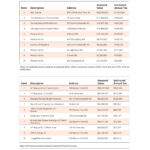
Wayland’s Open Capital project ledger as of Oct. 31, 2025, shows 144 active accounts spread across multiple fiscal years, with a combined remaining balance of about $21.1 million. The ledger captures project descriptions, funding sources, departmental ownership, and unspent balances, and provides a snapshot of the town’s current capital posture as it enters the second half of fiscal 2025.
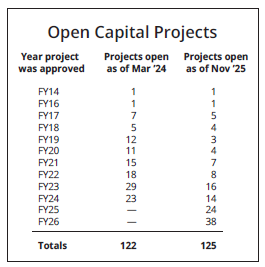
The summary table shows the significant progress made in close outs since the first list of open capital projects was assembled in March 2024 by the Town Manager’s office. The list tracks completed but not off the books projects as well as ongoing projects with appropriated funds not started or put on pause. With each Annual Town Meeting, newly approved projects are added to the open capital list. Thirty eight new projects were added in FY26 to the 87 open projects before 2025 ATM. 125 projects remain in progress as of Dec. 1.
Facilities-related accounts represent the largest share of remaining funds, totaling approximately $7.87 million across dozens of projects. The Facilities Department is associated with older accounts dating back more than a decade as well as more recent appropriations for HVAC upgrades, flooring replacements, and building system repairs. Balances among these projects vary widely, with some accounts holding only a few hundred dollars while others retain six-figure amounts, reflecting a mix of near-completion items and longer-term projects still underway.
The Department of Public Works (DPW) appears to be the next-largest category, with roughly $2.97 million in remaining balances. DPW-related entries span feasibility studies, roadway improvements, water and drainage work, heavy equipment purchases, and multi-year infrastructure efforts. Many DPW accounts trace back to Town Meeting appropriations across several fiscal cycles, indicating the department’s multiyear workload and the extended timelines often associated with engineering, procurement, and construction.
School-department projects account for about $350,000, according to the dataset. These include building improvements such as flooring, safety items, and aging capital repairs at several school buildings. While these balances are significantly smaller than those in the Facilities or DPW categories, the accounts show that several school-related capital lines remain partially open as the fiscal year progresses.
The Fire Department accounts show approximately $246,000 in remaining capital funds. These entries include vehicle- and equipment-related appropriations, consistent with the department’s cyclical replacement schedule and the high cost of specialized fire apparatus. The data reflects that some of these balances may be tied to procurement lead times, which have lengthened in recent years for public-safety equipment.
Information technology accounts, categorized as Town IT, collectively hold about $14,800. These involve software, hardware, and infrastructure modernization initiatives. The relatively smaller balances suggest that IT capital accounts tend to be shorter duration items, often closed out within one or two budget cycles as technology purchases are completed.
Recreation has the smallest identifiable balance at $161, which appears to be the remainder of an older capital line. The “DEPT” category, listed as a placeholder for some entries, shows no remaining balance.
Among all departments, the dataset includes accounts originating in fiscal years as early as FY14 and running through FY25, demonstrating how long some capital appropriations can remain open, especially when tied to design feasibility, long procurement processes, or external regulatory requirements. Several accounts show minimal funds remaining, indicating that closeout activity is ongoing but not yet reflected in the October ledger.
The funding sources listed in the spreadsheet include Town Capital (Fund 40), School Capital (Fund 41), and other designated capital funds. Many projects reflect standard General Fund borrowing or cash appropriations approved at Annual or Special Town Meeting sessions. In some cases, the data shows that multiple-year appropriations for recurring needs, such as building maintenance or infrastructure repair, continue to accumulate unspent balances while projects progress toward completion.
Project descriptions in the dataset range from feasibility studies and engineering designs to large capital replacements. The inconsistency in detail across entries suggests that the data is pulled from a working internal ledger rather than a fully standardized reporting format, although the account numbers and fiscal-year identifiers remain consistent throughout the document.
Overall, the spreadsheet indicates that Wayland is carrying a large number of active capital lines, many of which span years and hold substantial balances. The financial totals reflect both ongoing project work and outstanding commitments that have not yet been expended. The distribution of balances across departments underscores the scale of Facilities and DPW needs relative to the rest of the municipal structure, as well as the long-term nature of capital implementation in a small town.