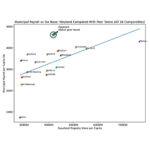


When discussing the fact that a small percentage of property owners in town pay a majority of the taxes collected, Finance Director Brian Keveny pointed to little new growth and budget cuts.
“Like any town, Wayland has to find a solution to addressing increased costs. The town is looking at an override to Proposition 2½, and if there is no new growth or budget cuts, residents will be looking at overrides year after year,” said Keveny.
Proposition 2½ is a 1980 Massachusetts law that limits municipal property tax levies. It caps annual levy increases at 2.5% of the prior year’s limit plus new growth and restricts total levies to 2.5% of a community’s total taxable property value.
Keveny was responding to a recent Wayland Post story explaining how 20 property owners fund $1 out of every $25 spent by the town. He said he could not comment on the newspaper’s analysis, but he responded to questions regarding the composition of the top taxpayers and projects that could reduce property taxes.
Town Center is the only commercial business out of the top seven taxpayers. The others are: Alta Oxbow, The Residence at Paine, Commonwealth Residences, Carriage House at Lee’s Farm, Sunrise of Wayland, which are all residential. These top taxpayers provide a stable tax base and the town is not reliant on a single large business.
Commercial base is key
Property taxes are generally higher in towns or cities with a small commercial base. Because commercial properties such as office buildings, retail, and factories often generate a significant share of tax revenue without requiring substantial public services, the absence of this sector shifts the tax burden to residential property owners.
Having large commercial businesses pay taxes in a town is generally seen as a vital source of local revenue, but whether it is “better” depends on the balance between tax income and the costs of servicing those businesses. While they often support public services such as schools and public safety, they can also impose fiscal strain if they have higher public service needs, such as road maintenance or increased police demand, which offset their tax contributions.
Jane Jacobs, an influential urban planner, and other economists recommend that municipalities take a balanced approach that combines a strong local business sector with larger commercial enterprises while avoiding overreliance on tax incentives to attract major corporations.
A similar argument could be applied to residential-type businesses dominating the tax rolls. While they generate more tax revenue, those large entities also use additional services. Children are living at Alta Oxbow, and school records indicate that while student enrollment is declining at schools across the district, there was a modest increase in enrollment at Claypit School. He also said the town has seen a notable rise in emergency fire calls due to the growth of assisted living facilities.
10th-highest in tax measure
The state ranked Wayland as the 10th-highest municipality for single-family property tax bills, trailing Weston, Brookline, Lincoln, Wellesley, Concord, Lexington, Belmont, and Dover. This is based on the combined high values of the towns’ homes and the tax rate. The Mass. Department of Revenue Division of Land Services ranked Wayland’s tax rate as #71 out of 352 communities. The tax rate is higher than its neighbors: Framingham (11.83%), Lincoln (12.31%), Wellesley (10.17%), Weston (10.88%), and Natick (12.17%). When there is a substantial increase in property values in one year, some towns reduce the tax rate.
How the tax rate affects the median taxpayer depends on how the properties are assessed, according to the Institute of Housing Studies. Their nationwide research showed that less expensive homes are often overassessed relative to their market value, while more expensive homes are underassessed. This can result in owners of lower-valued homes paying an effective tax rate higher than owners of expensive homes.
Keveny admitted that Wayland has difficulty attracting new commercial or residential growth because the town is built out and there is limited usable space remaining due to wetlands. Adding building extensions, filling vacant buildings, and granting incentives to improve home and business values along Route 20 could increase property values and generate additional taxes, but the impact would not be significant, he said.
To affect the tax bills, he said, there needs to be new growth with owners constructing new buildings. For example, the town is already collecting taxes on the Terrain property in the former Whole Foods building. He said if St. Anne’s residences and the proposed development at the former Mahoney’s are approved, that would help the tax base.
However, the new proposed construction at Veritas and Carroll schools and the Coptic Church will not. Although they will add strain on town resources, they will not pay taxes on their new buildings because they are nonprofits.
PILOT agreements
Keveny noted that Town Manager Michael McCall has proposed a PILOT (payment in lieu of taxes) arrangement to the Select Board. PILOT payments are voluntary or negotiated payments made by tax-exempt organizations (nonprofits, universities, hospitals, federal agencies, etc.) to local governments. These payments help municipalities recoup lost property tax revenue for services such as police, fire, and infrastructure, ensuring tax-exempt entities contribute to the community. Other Massachusetts towns that are either considering or collecting PILOT agreements are Andover, Concord, Groton, Northampton, and Somerville.
The Economic Development Committee presented its plan for new growth to the Select Board this year. They are proposing new townhouse developments in a few locations around town and a Town Center expansion by allowing more rental units above the commercial buildings and reducing the number of parking spaces.
Keveny said town officials are considering other areas to increase growth and reduce taxes, such as building on Holiday Road and selling the Town Hall Building. Condos or houses could be built at these two locations. The town owns a plot of land on Holiday Road, which is currently under the jurisdiction of the school committee. If Town Hall is sold, he said the school administration could relocate to one of the schools, which is what many towns do. Wayland could also rent space in the town center for the town administration, Keveny said.
None of these ideas has been approved. Keveny agreed that these are long-term plans. And it will be many years before these projects will reduce homeowners’ property taxes, if approved.