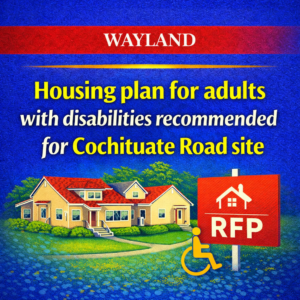
The 212 Cochituate Road Advisory Committee has recommended that the Select Board issue a Request for Proposals (RFP) to redevelop the town-owned property at 212 Cochituate Road for residential use serving adults with disabilities.
The RFP followed a six-month review that concluded the four-acre site is suitable for clustered, multi-building housing in a neighborhood-scale setting.
In its final report that was due to the Select Board on Feb. 15, the committee advised proceeding with a competitive RFP process consistent with authorization granted at the 2025 Annual Town Meeting, where voters supported evaluating reuse of the former single-family residence site for affordable housing, shared living housing and/or market-rate housing that creates affordable units. The parcel, located in an R-60 residential zoning district, currently contains a demolished single-family structure and is surrounded by seven residential abutters.
The committee was charged with reviewing the feasibility of disposition or reuse of the site, recommending an appropriate process for information gathering and reporting back with guidance for a potential RFP. Members included select board appointees and representatives from the Municipal Housing Trust Fund and the Wayland Housing Authority, with Town Planner Robert Hummel serving ex officio.
The committee focused on the documented shortage of affordable and accessible housing for adults with disabilities. Citing statewide data, the report notes that approximately 787,000 Massachusetts residents, or 11.5% of the population, live with a disability. More than 25,000 individuals eligible for services from the Massachusetts Department of Developmental Services currently live with family caregivers rather than in permanent housing. The state has roughly 10,755 accessible affordable rental units, of which approximately 6,200 are deeply affordable to households with rent tied to income.
1,000+ with disabilities in town
Locally, the committee estimated that Wayland’s population of about 14,000 includes roughly 1,100 to 1,200 residents 22 years old and older living with a disability. Using a conservative planning assumption that 3–6% of adults with disabilities may seek supportive housing over time, the report projects that 10 to 20 individuals could need such housing over a 10-year period, with cumulative need reaching approximately 25 to 35 residents over 20 years under a stock-and-flow model.
The committee also examined regional demand within a 15-mile radius, encompassing an estimated population of 400,000 residents. It cited estimates of 24,000 to 30,000 adults with disabilities ages 22 to 65 in that region, with 700 to 1,500 individuals potentially seeking supportive housing over time and an estimated 30 to 50 new individuals needing supportive housing each year.
Based on testimony from housing developers, service providers, state officials, educators and residents, between August 2025 and February 2026, the committee evaluated development models ranging from small homes with continuous support serving about 10 residents, to clustered residential buildings with optional programming space serving approximately 24 to 36 residents.
Lower-density, house-scale models would preserve more open space but serve fewer residents, while clustered multi-building approaches would accommodate a larger number of residents while maintaining a residential scale.
In a minority opinion dated Jan. 28, 2026, a member wrote that while the majority sought to preserve a relatively low residential density on the site, zoning in an R60 district could reasonably accommodate housing for a substantially greater number of adults with disabilities while maintaining compatibility with surrounding residential character.
Raising the point that prioritizing minimal scale over housing capacity constitutes a value-based policy choice, the member urged the Select Board to give careful consideration to alternatives that maximize housing opportunity on the publicly owned parcel.
The report emphasizes that housing and services are often delivered through separate funding streams and organizations. The committee recommends that any proposals distinguish between ownership and management of housing and of the provision of services.
Aging parents with children with intellectual and developmental disabilities (IDD) are looking for “forever homes” that can handle a 50- to 60-year commitment for placement, so financially stable models are a concern.
The report urges that any development be financially viable over the long term without ongoing municipal operating subsidies and that the town does not own, operate or directly manage the housing, in order to limit long-term financial and regulatory exposure.
To ensure alignment with local and state housing policy, the committee recommends that proposals include units eligible under the state’s Subsidized Housing Inventory (SHI) where applicable and reflect the town’s Housing Production Plan and equity commitments.
Equity gap
The report states that housing for adults with disabilities represents a critical equity gap in Wayland’s current housing stock and identifies the site as a rare opportunity to address that need consistent with fair housing law. Adding sufficient units to the town’s SHI could help preserve the Safe Harbor Status from unfriendly 40B affordable housing developments.
Residential facilities for the care of people with disabilities can be considered an educational use under the Dover Amendment. Approval of a Sec. 40B comprehensive permit by the Board of Zoning Appeals could also supersede certain local zoning restrictions if certain affordability criteria are met.
The committee’s recommendations call for preserving flexibility in site configuration, emphasizing residential character through building scale, massing and setbacks, requiring ecologically sensitive landscaping practices and encouraging innovative but feasible models that balance neighborhood compatibility with capacity to serve residents.
It further recommends an open and transparent review process with opportunities for public presentation and feedback before the Select Board designates a preferred proposal.
The report concludes that issuance of a well-structured RFP would allow the town to evaluate specific development proposals and determine a path forward that balances housing need, neighborhood context and stewardship of public land.
To view the final report, visit tinyurl.com/212CochituateRpt.