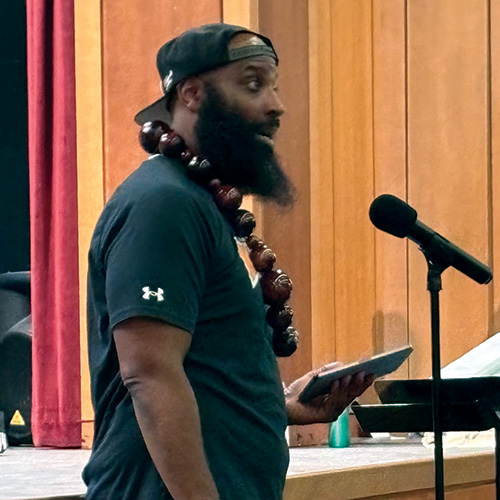

“Whose house? Our house!” chanted jamele adams, poet and educator, along with Wayland High School scholars.
This back-and-forth refrain, along with music and laughter, reverberated from the auditorium on March 5 and kicked off back-to-back assemblies in which students presented and participated in activities aimed at growing and healing.
adams (who does not use capitalization in his name) briefly described the LIT (Love, Inclusion and Trust) Equity Framework and how this “Our House” assembly was a way of working together to accept each other’s differences and to become united as a community. He emphasized the importance of the work and said success would depend heavily on everyone working together and taking responsibility for their actions.
“LIT lives here with us, not just today,” he reminded the students. For the next hour, adams stepped aside and turned the focus toward the talent of the WHS student volunteer performers. Principal Mizoguchi proudly described these high scholars as very brave.
“Students were given one simple prompt for their presentations today: to create something that represented what LIT meant to them personally. They were given no other information or constraints,” she said. Their creations came alive in songs, poems, speeches, narratives and artwork that were showcased throughout the assemblies.
The student band Vagabond, along with solo trumpeter Ayehu Million was the first group introduced by adams. They exploded onto the stage and belted out the tune “I Will Survive” while audience members sang along, cheered, and applauded.
Other acts included singing, reading poetry, and painting. Student Maya Pereira delivered powerful words that described the hurt and pain people experience when confronted with harsh words and racial slurs. ”Everyone wears a crown. Make sure yours is authentic,” she said.
Another poignant narrative was delivered by Sophia Nguyen, who traced the history of the METCO program, offered thanks, and described her personal journey and successes as a METCO student in the district.
After each presentation, adams praised the performers. At one point, he circulated through the auditorium and took multiple selfies in all of the seating sections.
adams insisted that each and every student must take accountability to make love, inclusion and trust a reality at WHS and took steps to show them how to do it. He modeled a technique that focused on making strong connections and another that taught the students how to be an upstander for others when they witnessed a racial slur or other hurtful situation.
In one demonstration, he asked the audience for a simple topic and they chose shoes. Then, adams and a student volunteer had a quiet conversation about shoes. At the end of the conversation, the two revealed what they had learned about each other and discovered that they even shared certain things in common. He used the acronym MOO – my history, our lives, our future as a way of getting to know others and teaching others about their histories. The activity was powerful as it depicted how two different people who just met might not initially realize that they are more alike than anticipated.
Interrupt, question, educate
He also taught them a technique called IQE — interrupt, question, and educate. This technique gave students the power of speaking up when experiencing someone using a racial slur, a discriminatory remark, or an unkind utterance. It empowered students to help educate the offender. adams encouraged them to speak up and reminded them to contact a teacher or administrator if they did not feel comfortable speaking to the accuser themselves.
In closing, adams projected two accountability creeds. The first was created by the football team. adams explained that the team had been doing a lot of work together based on the LIT framework after the fall incident in the boys’ locker room that evoked great pain in the community and generated the immediate need for education and change.
Next, he projected the LIT commitment statement created for the entire WHS community.
“We are Wayland High School. Warriors of love, inclusion and trust. We lift each other up. Everyone has an equal chance to succeed together. Through education and initiating vulnerable topics, with a willingness to talk about things others won’t, we will lead by example. I will pick you up when you are down and together we will fly.”
adams said the group who crafted the creed considered using “we” rather than “I” in the last line to keep it streamlined throughout. It was ultimately decided that the final “I” should stay to emphasize the personal accountability of every student.
Students had the chance to use their individual talents to unlock what LIT meant to them. Through art, songs, music, and poems, it delivered and modeled this message that while we are different, we are all equally important. adams and the students demonstrated a dedication to hard work for change; to work as teammates to write a new chapter; and to make love, inclusion, and trust genuine components of WHS as the community continues to heal.