

Wayland’s physical growth is constrained by limited undeveloped land. Most sites with straightforward development conditions have already been built, leaving redevelopment of previously used parcels as the primary path for new housing or tax base. These sites typically carry environmental, infrastructure, and regulatory constraints that shape both cost and feasibility.
In this context, development viability depends less on theoretical zoning capacity and more on the cost and risk of site preparation. Projects must absorb significant “first costs” including remediation, demolition, grading, and infrastructure installation before construction can begin. These upfront costs are often the determining factor in whether a project moves forward.
A joint presentation to the Economic Development Committee and Finance Committee on Nov. 17, 2025, described the River’s Edge parcel prior to redevelopment as a municipally controlled site with contamination, no water or sewer connections, and multiple legacy uses, including a septage facility and police firing range. The site was characterized as effectively unmarketable without substantial investment. The discussion framed a broader constraint common to built-out communities: available land exists, but it is encumbered and requires capital-intensive repositioning before it becomes viable for development.
Site conditions and pre-development costs
The River’s Edge site (now Alta Oxbow) illustrates the typical redevelopment profile. The parcel had multiple prior municipal uses, including a septage treatment facility, a firing range, and material stockpiles. These uses created environmental and physical constraints that required investigation, permitting, and remediation prior to construction.
Public records document asbestos-related cleanup and other compliance-driven costs. These are not discretionary expenditures; they are prerequisite investments required to convert a non-performing asset into a buildable site.
The Town’s approach focused on reducing early-stage uncertainty. According to Rebecca Stanizzi, Chair of the Economic Development Committee, “We got like three or $350,000… to really look at the site, all the due diligence, all the environmental… so that we had every single piece of information we could possibly have for a developer.”
From a developer perspective, this type of pre-development work reduces entitlement and construction risk, but it does not eliminate cost. Instead, it shifts risk visibility earlier in the process. The project structure ultimately allocated remediation and site work to the developer.
The final project structure placed responsibility for remediation and site work on the developer. Project summaries indicate that approximately $6 million in cleanup and preparation costs were absorbed within the transaction, alongside roughly $2.7 million in net proceeds to the town. The project also incorporated external funding, including a $3 million wastewater-related grant, and leveraged town resources.
This reflects a standard redevelopment model: land value is residual, determined after accounting for the cost of making the site buildable.
The River’s Edge Housing Overlay District (REHOD) established a site-specific zoning framework intended to support redevelopment. It allowed multifamily housing subject to defined parameters, including unit limits, height standards, and affordability requirements.
The primary function of the overlay was to create a predictable permitting pathway. Economic Development Committee discussions emphasized that zoning adds value when it reduces entitlement uncertainty when developers can clearly understand what is allowed and what approvals will be granted if requirements are met. In constrained suburban markets, this predictability often matters more than maximum allowable density.
Feasibility adjustments and variances
Despite the overlay framework, the approved project required modifications through the Zoning Board of Appeals based on economic hardship. The final development exceeded the original unit cap (218 units versus 190) and included adjustments to all three building heights to greater than 50 feet.
ZBA findings and Planning Board discussions cite common redevelopment constraints, including wetlands, buffer zones, grading challenges, and excavation requirements. These conditions increased project costs and reduced site efficiency.
Committee discussions also highlighted financing realities: lenders require projects to meet minimum return thresholds, which are driven by total development cost. As fixed costs rise particularly for land preparation, structured parking, and infrastructure projects often require increased unit counts to remain financially viable. In this context, unit count becomes a financing variable rather than solely a planning decision.
Because affordability requirements were structured as a percentage of total units, the increase in unit count directly increased the number of affordable units, from approximately 48 to 55.
This reflects a common dynamic in inclusionary zoning frameworks: affordability output scales with total project size. As a result, feasibility-driven increases in density can expand programmatic outcomes without additional public subsidy.
Design, cost, and operational constraints
Project design decisions were influenced by cost considerations and subsequently evaluated through regulatory review. Elevator configuration provides one example.
A 2019 Fire Chief memorandum and Planning staff recommendations raised concerns about elevator capacity and accessibility. Elevator systems represent a significant capital and operating cost. The final design incorporated one elevator per approximately 70-unit building, reflecting a balance between cost efficiency and regulatory input.
This illustrates a recurring pattern: initial project designs are optimized for cost, while review processes introduce safety, accessibility, and operational requirements that can increase overall project expense.
Fiscal outcomes and asset value
Following completion, Alta Oxbow significantly increased assessed value and tax revenue. Town materials attribute a substantial portion of recent “new growth” under Proposition 2½ to the project.
Economic Development Committee presentations indicate annual tax revenue in the range of approximately $1.1 million to $1.5 million. The property was later sold for roughly $98 million after stabilization, followed by reassessment to reflect market value.
This aligns with a typical multifamily development lifecycle: construction, lease-up, stabilization, sale to long-term investors, and subsequent reassessment at full market value.
From a municipal finance perspective, such projects can produce meaningful increases in tax revenue. However, these gains occur as discrete events tied to individual developments.
Redevelopment as a system constraint
In built-out communities, each redevelopment project is site-specific, capital-intensive, and time-consuming. There is no continuous supply of low-cost, easily developable land. As a result, growth occurs in episodic increments rather than steady, predictable increases.
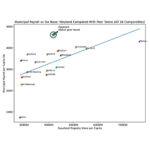
Comparisons to peer communities suggest that Wayland’s baseline growth rate may lag areas with more readily developable land or less constrained sites, reinforcing the structural limits imposed by redevelopment conditions.
Key takeaways
Alta Oxbow demonstrates a consistent pattern in built-out suburban markets. Land availability alone is not the limiting factor; site condition and cost structure are. Pre-development costs, particularly environmental remediation and infrastructure, often dominate project economics. Zoning creates value when it provides predictability. Unit count is frequently driven by financing thresholds tied to fixed costs. Design evolves through an interaction between cost optimization and regulatory requirements. Fiscal impacts can be significant but occur as discrete events rather than continuous trends.
In this framework, redevelopment is the process of converting constrained, previously used land into financeable projects. What ultimately gets built is determined by the interaction between site conditions, capital requirements, and regulatory structure.