
Select Board members voted Jan. 14 to advance a package of proposed 2026 Annual Town Meeting warrant articles that would broaden the allowable window for scheduling Annual Town Meeting, transfer funds into the FY26 fire payroll budget ahead of an unresolved contract decision, seek a state-approved process for “green burials” on private land, fund early site analysis of the town-owned 25 Holiday Road parcel, and create a new bylaw section clarifying that site plan approvals may be appealed directly to court under state zoning law.
Changing Town Meeting start
The board first voted 4-0 to submit Article CC, which would amend Town Code Section 36-1 to expand the annual town meeting start window from between April 1 and May 15 to between March 15 and June 1, inclusive, while keeping the existing requirement that the annual town election occur within seven days but no fewer than two days before annual town meeting. Members said the change was intended to provide more flexibility amid limited venue availability and scheduling conflicts, while noting that future boards would still weigh other considerations when setting dates.
Town Manager Michael McCall told the board that the finance director had advised preparing transfer authority related to a pending fire union contract outcome. For Article AA, the board submitted a proposal to transfer $500,000 from the Reserve for Salary Adjustment account to the FY2026 Fire Payroll Budget under Massachusetts General Laws Chapter 40, Section 5. The packet described the transfer as a vehicle to support future expenses related to the fire union contract that had not yet been settled and stated that the fund-to-fund transfer would not require an increase in taxation.
Central Rail Trail
The board then discussed Article Y, a previously inserted warrant article tied to the Massachusetts Central Rail Trail segment planned between Sudbury and the library area. Board member Tom Fay said the Department of Conservation and Recreation was working with the Massachusetts Department of Environmental Protection and that construction was not expected to start until at least 2027, but both temporary construction and permanent land easements needed to be procured in advance.
Attorney Katharine Klein of KP Law joined the discussion and said DCR had asked the town to take responsibility for acquiring certain temporary construction easem

ents associated with the project, including on property recently acquired by NP Wayland, LLC at Town Center and on additional private properties. Klein said NP Wayland preferred dealing directly with the town because the town was already positioned to acquire a permanent easement there for the shared-use path.
Fay raised concerns about potential town cost exposure and the risk that legal and appraisal work performed by the town might not satisfy state requirements for MassDOT, even if reimbursement were promised. McCall agreed state agency processes could be difficult, citing prior back-and-forth with DCR on other items.
After discussion, the board voted to amend the Article Y draft to add authority for the Select Board to acquire additional temporary construction easements, with members emphasizing that any expanded scope could later be reduced before the warrant goes to print if the town did not receive acceptable commitments on reimbursement. Fay and Klein were tasked to produce a redlined version and supporting explanation for the warrant materials.
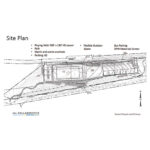
Under the Article Y language, the town would authorize the Select Board to acquire a permanent easement through the Town Center area for a shared-use path as part of the Rail Trail and to enter into an agreement with DCR for construction, operation, and maintenance responsibilities. The article also would transfer custody of certain Town Center parcels to the Select Board and authorize the Select Board to convey temporary easements on those parcels to DCR for construction purposes, and to execute documents and agreements needed to carry out the article.
Green burials on private land
The board voted to submit Article BB, a home rule petition aimed at avoiding delays when families request “green burials” on private land. McCall described a 2025 case in which local boards raised no objections, but town counsel advised that state law required the matter to go before town meeting; because the town holds one annual town meeting per year, the family faced a long delay.
Article BB proposes that the town accept the provisions of General Laws Chapter 114, Section 34, to authorize the Select Board — subject to Board of Health approval of the location — to grant permission for burial on land not already used or appropriated for burial, except for tombs on private land for exclusive family use. Whitney asked whether the legislature had approved similar petitions for other communities; McCall said he was not aware and would follow up.
Orchard Lane School parcel
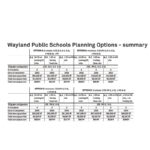
The board submitted Article DD seeking an appropriation of $200,000 for studies, planning, and analyses to determine whether town-owned land at 25 Holiday Road could be suitable for potential sale, redevelopment, or other uses. The work would be directed by the Select Board and would evaluate a “variety of potential uses,” including but not limited to recreation, town use, and development of affordable and market-rate housing.
The 2025 budget task force stated that Wayland new growth ranked 310th out of 351 communities in the commonwealth and recommended exploration of options to increase new growth. It describes the 25 Holiday Road parcel as 13.72 acres currently held in the care and custody of the School Committee, with the Select Board seeking site analysis before pursuing any transfer or development proposal.
Board member Anne Brensley questioned whether $200,000 was too high for early viability work, while Carol Martin and Fay said the number was intended as a starting point and could be refined before town meeting as scope and funding sources were clarified. Whitney suggested adjusting the article title to emphasize “preliminary design and engineering,” arguing that early concept work and alternatives could be needed to support public discussion even if the town were not the eventual developer.
Planning Board appeals
The board then took up Article FF, Planning Board Appeals, which it voted 3-0-1 to submit, with board member Bill Whitney abstaining. McCall said the proposal arose after a gap between a site plan approval and issuance of a building permit on a large project, leaving abutters without an early, clear mechanism to seek review while other permits allowed certain work to proceed.
The draft language would amend Town Code Chapter 198 by inserting a new Section 198-610 stating that any person aggrieved by a Planning Board decision on site plan approval may appeal to a court of competent jurisdiction in accordance with General Laws Chapter 40A, Section 17. Brensley said her concern was whether adopting the change amid ongoing controversies could be framed as targeting Dover Amendment-type projects, while McCall said the provision would apply generally to site plan approvals, not a specific applicant. Whitney, liaison to the Planning Board, would seek input from the chair as the Select Board continues its review of the warrant language.
Stormwater grant
On Jan. 5, the Select board directed the town manager to proceed with a Stormwater Asset Management Planning grant totaling approximately $207,000, including the $124,170 Clean Water Trust grant agreement with the balance funded from free cash, but the board requested additional reporting on project timing and long-term cost implications.
For a Jan. 14 consent calendar item regarding the same grant agreement, Whitney asked whether the grant reimbursement schedule implied a protracted project timeline or a reimbursement process stretched over time. McCall said he would consult Department of Public Works Director Tom Holder and report back at the next meeting.