
When inspectors from the Massachusetts Department of Transportation (MassDOT) rated the deck of Sherman’s Bridge in “severe” condition in early 2025, the warning carried a narrow set of choices. The bridge, which spans the Sudbury River at the Wayland–Sudbury line, remained open and safe for travel, but MassDOT made clear that continued deterioration would trigger either a defined rehabilitation project or eventual closure under federal bridge inspection rules.

For Wayland Director of Public Works Tom Holder, the finding marked the point at which incremental maintenance could no longer continue indefinitely. For roughly 15 years, Wayland and Sudbury had alternated replacing sections of the wooden driving deck each summer at a cost of about $10,000 per year. That work had kept the bridge operational but once a bridge component is repeatedly rated “severe” under the National Bridge Inspection Standards, the regulatory framework no longer allows routine patch-and-replace as a long-term solution.
Holder recently sat down with the Wayland Post editorial staff to discuss Sherman’s Bridge as well as other DPW projects.
MassDOT’s inspection program accelerated the bridge to a six-month review cycle, transforming what residents often viewed as discretionary maintenance into a time-limited rehabilitation obligation. Holder said MassDOT inspectors warned that, without a defined plan, the agency could require the bridge’s closure, a step that would disrupt emergency response routes, school transportation and daily traffic between Route 20, Route 117 and Route 126.
The decision-making process has since drawn intense public attention. The resulting debate has revealed not only differing views on traffic, safety and historic character, but also the strain that modern infrastructure standards place on small municipal departments operating under state and federal oversight.
Rehabilitation, not replacement
From the outset, Holder and town engineers have framed the project as rehabilitation rather than replacement. The work focuses on replacing the deteriorated deck and addressing localized substructure issues identified during a July 2025 underwater inspection, which found rot in one timber pile and failing steel fasteners securing timber bracing. The bridge’s timber stringers, which run parallel to traffic and transfer loads to the supports, were found to be in satisfactory condition and slated to remain.
“The structure itself is staying,” Holder said during the sit-down at the DPW office. “This is a deck repair with some substructure fixes, not a full rebuild.”
That distinction matters both legally and financially. Under Massachusetts municipal practice, repairs that maintain an existing structure generally fall within the authority of town staff and boards, while projects that materially expand or redesign infrastructure typically require Town Meeting approval and a voter appropriation. The current project does not widen the bridge, add new lanes or change its load rating.
State funding scheduling
By late summer 2025, MassDOT offered in-kind support tied to the agency’s fiscal-year timing and contractor availability. Under the offer, MassDOT would purchase approximately $325,000 worth of glulam decking materials and provide its on-call contractor to install the deck and railings. The total project cost was estimated at just over $1 million, with remaining expenses split between Wayland and Sudbury.
Both town managers signed a Sept. 15, 2025 letter to MassDOT stating that the project “represents a significant savings for both towns and a rare opportunity to complete a major infrastructure project with minimal direct local taxpayer burden.” Without the state’s contribution, Wayland’s share alone would have approached $500,000.
The funding came with one overriding constraint: MassDOT was prepared to support a rehabilitation that met its bridge specifications, not a redesign that expanded the scope of work. Proposals to widen the bridge, add a second pedestrian walkway or fundamentally alter its footprint would have required new engineering reviews, expanded permitting and years of additional approvals, steps incompatible with both the inspection timeline and the agency’s procurement schedule.
The project team targeted summer of 2026 for construction to minimize disruption to Lincoln-Sudbury school transportation routes that rely heavily on the bridge. That schedule required early commitment so glulam panels and custom railings could be fabricated in time.
Neighborhood traffic fears
For many residents, however, the technical framing has been overshadowed by concerns about traffic. Sherman’s Bridge connects two narrow, tree-lined residential roads – Lincoln Road and Shermans Bridge Road – that were never designed for commuter through-traffic. Navigation apps such as Waze have increasingly routed drivers through the area to bypass congestion on larger roads, a trend residents say has brought faster speeds, heavier vehicles and safety risks for pedestrians and cyclists.
Some residents argue that the bridge’s deteriorated deck has acted as an informal traffic-calming measure, discouraging cut-through traffic. They fear that a smoother, rehabilitated surface will invite more vehicles and higher speeds.
Holder said the project does not increase the bridge’s capacity or change its posted speed limits, which are set by roadway classification rather than deck condition. The bridge already carries school buses and heavy vehicles and has no weight restriction, a fact that complicates calls to post lower limits as a traffic-management tool.
Traffic concerns, while widely shared, fall largely outside the scope of what the rehabilitation project can address. Changes to traffic patterns, enforcement or roadway design would require separate studies and approvals.
Historic character
Another persistent theme has been preserving the bridge’s historic identity. Sherman’s Bridge traces its origins as a river crossing to around 1740, but the existing structure is a modern reconstruction completed in 1991–92 that reflects successive earlier builds rather than preserving original materials. That nuance has been lost in some public debate, where references to an “original” 18th-century bridge have fueled fears of loss of its wooden traditional design.
The rehabilitation plan employs a glulam wood deck and maintains the existing footprint, but it incorporates modern safety hardware required under today’s standards. That includes crash-tested barriers rated under the federal Manual for Assessing Safety Hardware, or MASH, framework. On the north pedestrian side, the barrier is designed to meet TL1 standards, while the south side uses a more robust TL2 system appropriate for vehicle impacts at moderate speeds.
Some residents have pushed for an all-natural timber solution, but engineers concluded that steel backed solid wood could not meet current crash-testing requirements for bridge barriers. Glulam, short for glued laminated timber, was selected because it is an engineered wood product approved by MassDOT and capable of integrating with crash-tested systems while maintaining a timber appearance.
Douglas fir-larch glulam is the default option that meets MassDOT standards, with Alaska yellow cedar also approved in certain systems. Color matching and long-term weathering have been raised as aesthetic concerns, which project engineers say can be addressed through material selection and finishes.
Asphalt, walkways and clarifications
Public confusion has also arisen from early design concepts that included an asphalt wearing surface over the glulam deck. After a three-and-a-half-hour public forum on Oct. 9, attended by roughly 41 households, residents objected to asphalt and to early designs that narrowed the pedestrian walkway and introduced taller barriers.
On Oct. 30, the project team posted revised plans and an expanded FAQs stating that asphalt was no longer proposed over the structure, acknowledging that the change could reduce the deck’s service life but it was better aligned with public feedback. The revised cross-section retained two, 10-foot travel lanes and a five-foot walkway meeting ADA and Architectural Access Board requirements, while lowering the walkway separation barrier to below knee height.
Despite those revisions, lingering references to asphalt on some project pages have continued to fuel confusion, an issue Holder acknowledged.
Calls for a second walkway or a cantilevered path have also persisted. Holder said such an addition would fall outside the scope of a deck rehabilitation and would require new easements, including federal approvals, potentially taking years. The current project does not preclude a future walkway, but it cannot accommodate one within the present regulatory and funding constraints.
The debate has repeatedly returned to claims of a 1971 agreement tied to land takings and road straightening on the Wayland side of the bridge. Some residents have asserted that the agreement restricted future changes or barred the use of state funds.
Holder said the towns conducted an exhaustive review of Select Board and road commissioner records and consulted town counsel. No written or executed agreement was found. Maurice Stauffer, who participated in discussions at the time, confirmed that the understanding was verbal. Legal counsel advised that, in the absence of a written agreement, no binding conditions apply.
Workload and the human dimension
As technical questions multiplied, so did the workload. Holder estimated he has handled roughly 100 emails related to the bridge, many repeating the same claims even after responses were posted. He said public records requests alone have consumed more than 24 hours of staff time.
Wayland’s Department of Public Works manages 20-25 concurrent projects, including the $38 million MWRA water connection, with nearly 50 employees and no dedicated public outreach staff. The bridge project’s intensity has forced staff to balance routine operations with an unusually high level of scrutiny.
Holder said criticism is an expected part of public service, but some commentary crossed into personal attacks, prompting Town Manager Michael McCall to reinforce the town’s public code of conduct.
Evolving standards, fixed choices
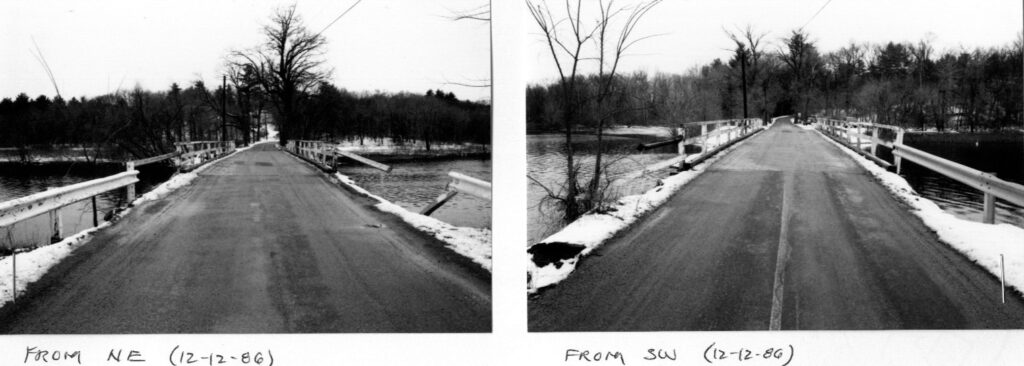
At a Dec. 9, meeting of the Sudbury Historical Commission, Sudbury DPW Director Tina Rivard presented updated plans and historic context showing that earlier versions of the bridge included steel approach guardrails alongside wooden elements. Using archival photos and a 1986 inspection report predating the 1991–92 reconstruction, Rivard framed the current project as another iteration in a long history of change rather than a break from tradition.
Rivard echoed Holder’s explanation of crash-test requirements and confirmed that existing steel-backed timber guardrails on the north side would remain in place “as is,”and that the “project limits stay the same,” countering claims that guardrails would encroach on river access areas. In accordance with MassDOT bridge standards, the existing steel-backed timber wood guardrails on the south side are to be replaced with a short transitional W-steel rail due to the bridge’s wingwall design and current crash test regulations.
Questions about color matching and a fourth handrail on the south non-walkway side impeding the view were referred back to the project team for further refinement. Rivard confirmed that a timber wearing surface was being discussed with MassDOT but was not yet depicted in the rendering shown that night.
For Holder, the project underscores that reality: what might have been acceptable in 1971, or even in 1992, no longer passes review for safety risks. “The bridge needs repair. The funding window is finite, and delay carries its own risks.”
The project timeline places final plans in early 2026 and targets construction for summer or fall 2026, with work expected to take three to six months with a buffer for weather or site conditions.
For residents, Sherman’s Bridge remains a highly valued touchstone for the neighborhood. For town staff, it has become a case study in how human attachment, technical standards and fiscal opportunity collide.