
Every fall, as the Select Board sets the tax rate, thousands of property tax bills quietly power nearly every public service in Wayland, from classroom lights to plowed roads.
For fiscal year 2026, the town adopted a uniform property tax rate of $14.83 per $1,000 of assessed value. That rate produces a total property tax levy of $91.8 million, which in turn supports a total municipal budget, the “amount to be raised” of just over $122.1 million after accounting for state aid and other revenues.
Behind those numbers are individual addresses. And a small group of properties, residential and commercial, together account for a meaningful share of the town’s revenue.
Largest residential contributor
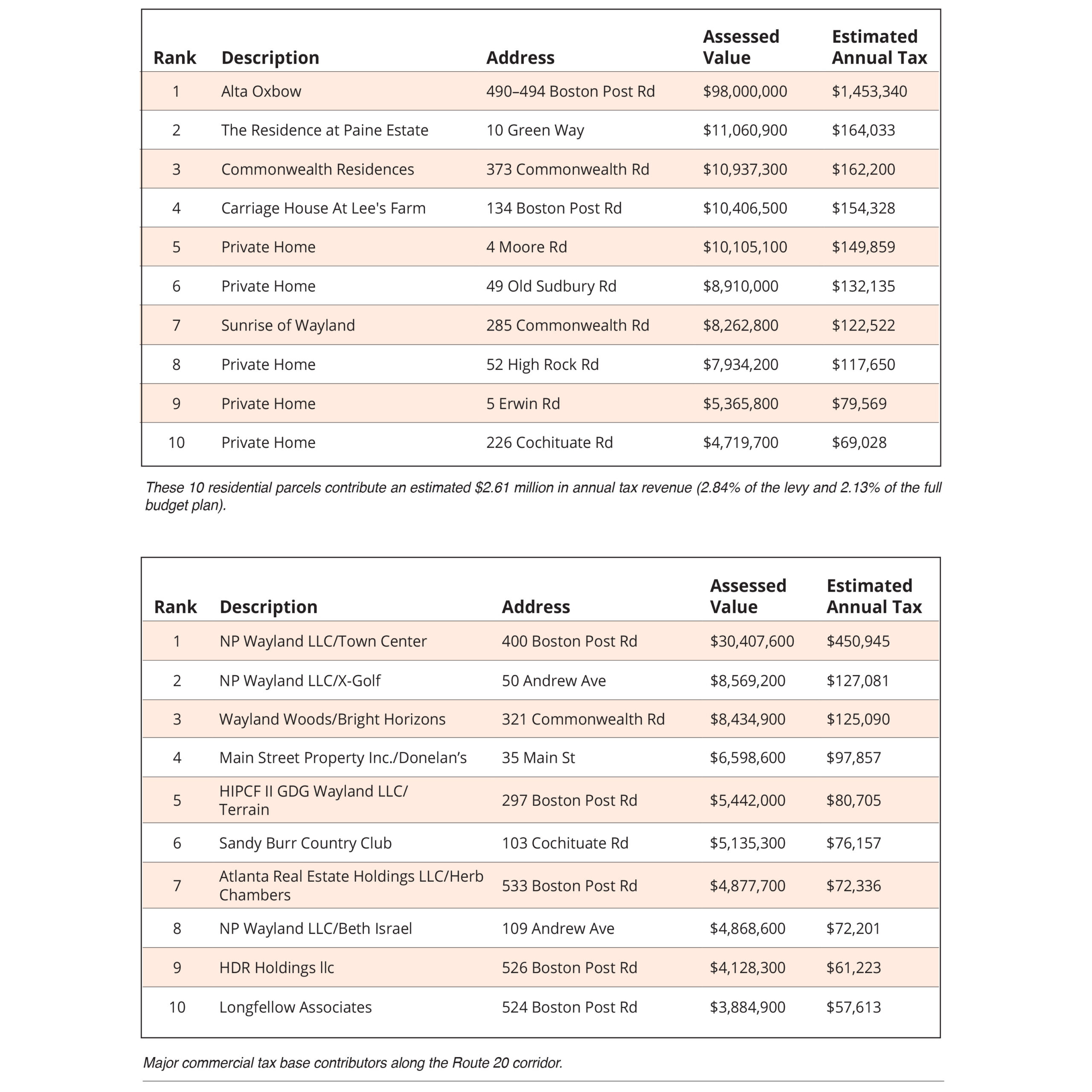
The single largest residential taxpayer in Wayland for FY26 is 490–494 Boston Post Road (Oxbow Wayland), a multifamily residential property assessed at $98 million.
At the current tax rate, that property generates approximately $1.45 million in annual property taxes. Put another way, that one parcel alone contributes 1.58% of the entire town property tax levy and covers roughly 1.2% of Wayland’s total municipal budget. Its annual tax payment is roughly equivalent to the salary and benefits of more than a dozen teachers or multiple public safety positions.
The remaining nine highest-value residential parcels — primarily large homes and multifamily properties — together add another $1.15 million in annual tax payments.
Combined, the top 10 residential properties contribute about $2.6 million, or 2.8% of the total property tax levy.
The rest of the top residential properties read like a tour of Wayland’s most valuable addresses. Together, these ten residential parcels contribute an estimated $2,605,665 in annual tax, 2.838% of the levy and 2.134% of the full budget plan.
In a town where nearly 96% of the levy comes from residential property, these top addresses are small but significant pillars of the funding base.
Commercial anchors
On the commercial side, the largest single contributor is 400 Boston Post Road, part of Wayland Town Center.
Assessed at approximately $30.4 million, it pays about $451,000 in annual property taxes — that’s nearly half a million dollars flowing into the town each year from one commercial parcel.
Together, the top 10 commercial properties contribute roughly $1.22 million, or about 1.3% of the total levy.
Add the top 10 residential and top 10 commercial properties together, and the total is approximately $3.83 million in annual property taxes.That equals 4.17% of the entire property tax levy or about 3.1% of the town’s full FY26 budget.
To make that tangible: $3.8 million roughly equals the annual operating cost of a small elementary school building. It exceeds the town’s overlay allowance for abatements. It represents more than the full annual capital allocation for several mid-sized infrastructure projects. And yet, it comes from just 20 parcels out of thousands.
Stability and risk
Wayland’s tax structure is broad-based and overwhelmingly residential. No single commercial or industrial taxpayer dominates the rolls. That creates stability compared with communities dependent on one large corporate campus or utility plant.
But the numbers also highlight something else: concentration exists at the margins. A 10% assessment reduction on the largest residential parcel would reduce its annual tax bill by roughly $145,000. That would not destabilize the town, but it would be noticeable.
Similarly, a $1 change in the tax rate per $1,000 would change that same parcel’s bill by $98,000. In municipal finance, those shifts are absorbed across the entire tax base. Still, the top properties matter.
Property tax bills are rarely celebrated. They arrive four times a year, unadorned and often unwelcome. But collectively, they fund:
- Wayland Public Schools
- Police and fire operations
- DPW maintenance
- Debt service on capital projects
- Library services
- Recreation programs
- Administrative operations
The largest taxpayers, residential and commercial alike, form part of the quiet backbone of that system. They do not set policy. They do not vote. They simply appear as assessed values on a valuation roll. But in FY26, 20 addresses together will fund nearly one dollar out of every 25 the town spends. In a community built on a wide and stable tax base, that is both a modest share and a meaningful one.