


In 2025, the Planning Board navigated complex and often competing considerations, weighing the concerns of taxpaying residents seeking to preserve the town’s pastoral neighborhoods alongside nonprofit organizations asserting that the Dover Amendment limits the town’s authority over certain large development projects.
Neighbors living near Veritas Christian Academy, the Carroll School, and the St. Philopater & St. Mina Coptic Orthodox Church—three large-scale projects subject to the Dover Amendment—have suggested that clearer guidance and additional procedural support for Planning Board members could strengthen the review process when considering applications from nonprofit institutions represented by counsel experienced in Dover Amendment law.
The Dover Amendment is a Massachusetts law that protects land uses primarily for religious and nonprofit educational activities from restrictive local zoning regulations. The law allows nonprofit entities to bypass rules that might prevent them from establishing or expanding facilities, but the amendment states they are still subject to reasonable limits on bulk, height, setbacks, and parking. However, these organizations sometimes seek exceptions even to the outlined limits, asserting that they conflict with their religious or educational needs.
Veritas project
An appeal was filed by abutter Adam Mascari on Dec. 5 with the Zoning Board of Appeals on the Veritas project, which the Planning Board approved with conditions in April 2025. The building permit was issued Oct. 30 to the VCA, which is located at 162-172 Cochituate Road.
Mascari said he and his neighbors believe the town could benefit from clearer guardrails to better protect taxpayers and to support the Planning Board’s review process. He said that, in his view, the board would be better served with additional tools to help frame key questions when
applicants are represented by experienced legal counsel. Mascari also said that
questions about the scale of the project did not appear to be fully explored
during public hearings and that there was uncertainty within Town Hall about how his subsequent appeal should be handled.
Veritas sought approval to renovate its existing buildings and construct a new middle school building totaling 7,000 square feet on 10.5 acres. The Carroll School proposes to increase enrollment from 50 to 250 students by replacing two of its smaller buildings with a two-story academic building on a footprint of 47,506 square feet, which would sit on 11.4 acres. And the Coptic Church plans to replace its current church with a Diocese Center, comprising a significantly larger church with two 100-foot towers, a school, a youth center, senior housing, and an administrative building that would include a conference center and housing for visiting dignitaries on a 5.5-acre plot.
Veritas Christian Academy neighbors raised environmental and site impact concerns, including issues with the aquifer, the proposed septic system (high water table and nitrogen sensitivity) and stormwater management. Carroll School area residents objected due to concerns about increased traffic in an already heavily trafficked area, limited parking, loss of neighborhood character in a historic area, and safety worries for children. Neighbors near the Coptic Church project on Rice Road protested the towers, the project’s bulk on a designated scenic road, which entails cutting down 700 trees. They also expressed concerns about pedestrian safety on Rice Road, which is narrow and has no sidewalks.
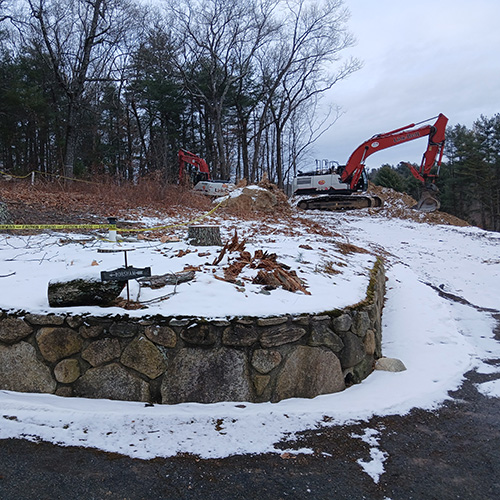
The VCA construction project, which is currently under appeal, is part of a proposed “Veritas Village” campus, a multi-building phased project designed to create a permanent home for the K-8 Veritas Christian Academy. The plan features smaller, village-style schoolhouses that blend with the natural setting, with current construction focusing on middle school facilities and site improvements such as driveways.
The approved phase includes existing and proposed new VCA buildings used to educate students in grades 6–8. There are three proposed buildings: a science, technology, engineering, art, and math (STEM) building; a building for sixth- and seventh-graders; and a building for eighth-graders.
According to town records, the Planning Board approval followed extensive peer reviews and public hearings in late 2024 and early 2025, with the board finding “the project aligned with the institution’s educational use and zoning objectives,” despite requests for waivers on certain regulations.
The approval acknowledged the VCA’s Dover project status, subject to specific conditions and granting relief on certain height and site elements, balancing its educational needs with town regulations. Meeting notes indicate that the VCA may have used the Dover Amendment to gain approvals for necessary site features that might otherwise have been denied by framing them as incidental or necessary to their core educational function.
Waivers the VCA requested are: building height of 39 feet, which exceeds the maximum town height of 35 feet for buildings, due to HVAC needs, and solar panel optimization; relief for specific grading and stone wall details; an exception to the off-street parking facility requirement to be landscaped; and modifications to stormwater systems.
While not technically issuing a waiver, the board accepted updated civil plans in March 2025 for stormwater design modifications that changed catch basin locations and roadway grading to address peer review concerns regarding groundwater mounding.
Questions about Veritas
Some residents continue to question the Planning Board’s decision to approve the Veritas project and whether the school’s builders are complying with all town regulations. According to neighbors, the town issued a building permit that appears to be broader than what the Planning Board approved. They said the permit allows clearing, grading, septic construction, and supporting infrastructure that matches the footprint of a larger campus because the septic system is sized for more than 400 people, which conflicts with the approximately 100-person phase one program that the planning board approved.
Neighbors also said the traffic study evaluated only the smaller program and did not model cumulative impacts on the five-way intersection. They alleged there are potential Zoning Board violations of the Aquifer Protection Overlay District (APOD) and inconsistencies between the Planning Board’s final plan set and the work authorized under the building permit.
Clerical error?
Mascari said he filed an appeal with the town clerk and the building commissioner on Nov. 18 after receiving a letter from the school’s attorney advising him and his neighbors that the building permit was issued on Oct. 30, asking them to sign off on it. He said the letter advised them if they did not agree with the Planning Board’s decision, they should file an appeal with the town.
According to Mascari, when he did not receive an acknowledgement of his appeal and, concerned about the 20-day deadline to file, he followed up with building commissioner Nathan Maltinsky, who said the letter should not have been sent and that it was a clerical error. Mascari said there also appeared to be confusion among Town Hall staff on how to handle his appeal, and members from different departments did not appear to be talking to each other.
Town Planner Robert Hummel said Mascari needed to send the appeal to the town clerk, which he had. Town Manager Michael McCall talked to him but did not provide any answers. Mascari said the town finally responded to his request with 500 documents, which were overwhelming.
However, receiving no response to his original request for an appeal, other than the documents, and concerned about deadlines, he filed his December appeal for the constructive denial of the zoning enforcement request. The appeal outlines three core issues: unresolved APOD compliance concerns, including cut and fill of 6 to 14 feet; groundwater determinations made outside the appropriate season; and the absence of required permeability testing. It alleges that the building permit scope appears to support a substantially larger campus than reviewed and approved, and material hydrologic and environmental analyses submitted to the Planning Board before its packet deadline were never included in the administrative record or reviewed by the town’s peer reviewer.
In Massachusetts, towns are legally obligated to process and act upon planning board appeal requests within strict statutory timelines. While the law focuses on action rather than a simple “acknowledgment” of receipt, failing to respond or hold a hearing within these periods often results in a “constructive grant,” meaning the appeal is automatically decided in the petitioner’s favor.
Under Massachusetts law (M.G.L. c. 40A), towns are obligated to follow specific procedures when an appeal request for a Planning Board decision is filed, which includes acknowledging and processing the request according to statutory timelines and public record requirements.
Overview of the obligations
Filing and acknowledgment: The appeal must be filed with the city or town clerk within a strict 20-day appeal period after the Planning Board’s decision is filed in the clerk’s office. The town clerk is the official point of contact for receiving the appeal paperwork.
Public record: The Planning Board is required to create a detailed record of its proceedings and decisions, which must be filed with the town clerk and become a public record.
Notice and process: While notices of decisions on subdivision plans may not be sent to all abutters, the law requires specific notices for special permit decisions. When an appeal is filed, a copy of the complaint must be given to the town clerk.
Jurisdiction: Appeals from a Planning Board decision are typically made to the Superior Court or the Land Court. The town is a party to this legal action, and the relevant board or officer is provided legal counsel.
Timelines for action: If a board fails to take “final action” within the prescribed time limits, the application may be considered “constructively approved.”
The Veritas Zoning Board of Appeals hearing is scheduled for Jan. 13. The final decision on the Coptic Church expansion was deferred to Feb. 13, and the Carroll School approval is scheduled for the end of January.
In 2018, Wayland tried to create Article 14, part of the zoning bylaws, a site plan review for religious and educational uses, but the Attorney General disapproved it. The goal was to give the Planning Board more oversight, preventing impacts from large facilities. The attorney general at the time said Article 14 imposed overly broad restrictions because it gave the planning board “too much unfettered discretion by allowing vague reasonable regulations for zoning without clear criteria, making it difficult for developers to know the rules.”
Although Framingham’s Article 20 of its zoning bylaw does not provide specifics regarding Dover Amendment exceptions, it has a more detailed process requiring the applicant to request a written determination from the building commissioner of whether the provisions apply to the Dover Amendment before filing an application for site plan review with the planning board.
As town officials continue to review 2026 nonprofit projects, residents in all three neighborhoods are concerned about the impact of these large building projects and are struggling to understand what the planning board is exempting under the Dover Amendment.
Unlike Framingham, which requires builders to specify Dover Amendment exceptions to the building commissioner before the site plan is considered by the planning board, Wayland does not have that requirement. The Dover Amendment uses some general terms such as bulk and reasonable regulations which are left to open interpretation but town counsel was not present at any meetings.
The town has established designated scenic roads, conservation land and strict rules for residential buildings to protect the town’s aesthetic but taxpayers are trying to understand if the same rules apply to nonprofits and if not, why not.
The Dover Amendment and the Planning Board’s decisions


Latest from Blog

Meals on Wheels Menus
Current Meals on Wheels Menus powered by Springwell Looking for this month’s Meals on Wheels menus? Springwell posts updated menus each month, including standard meals, medically tailored menus, and community dining site

Anne Mendler, 95
Obituary published on Legacy.com by Hamel-Lydon Chapel & Cremation Service of Massachusetts on Feb. 8, 2026. Anne Raeder Mendler was born in Boston on May 5, 1930. She was born on her

Brian McHale, 68
Obituary published on Legacy.com by South Carolina Cremation Society – West Columbia on Feb. 9, 2026. Brian McHale, 68, passed away peacefully on January 30, 2026, at his home in Gaston, South

Barbara Greene Age 103
DAVIS, Barbara Greene Age 103, longtime Lincoln resident, died peacefully, on February 6, 2026. Wife of the late Ronald C. Davis. Survived by five children, Kirk Davis and his late wife, Donna

Chris E. Applin, 77
Chris E. Applin, 77, passed away on Feb. 8, 2026, at his home. He was a lifelong Wayland resident. Chris honorably served his country during the Vietnam War until his honorable discharge

Trudy Loveland Conover, 87
Trudy Loveland Conover, 87, passed away peacefully on Feb. 10, 2026, in Wheeling, W.V. Trudy was an active member of the Wheeling Red Hat Society, the Wilderness League of Ohio County, the

FinCom member: budget article has issues
To the Editor, I write to note a couple of corrections to your recent article, “Overdue school budget complicates life for FinCom.” First, the headline is misleading. My comments at the Feb.

Clarification on tax abatement item
In the story headlined “Property tax abatement forms due by Feb. 3” that appeared in In the Jan. 23 edition of the Wayland Post, the deadline date may have been unclear.The information

Wayland vet helps stray dogs and cats in Myanmar
One would be hard-pressed not to be aware of the group of monks that recently completed a 15-week journey across the United States to promote peace.The Theravada Buddhist monks started in their

Wayland Post marks its first birthday
One year ago this month, the Wayland Post published its first edition. With it, the Post helped fill the widening local news gap as regional newspapers reduced coverage of small-town government.The nonprofit