
For much of the past quarter century, leadership of the Wayland Police Department followed a steady pattern marked by long tenures and internal succession. That pattern shifted abruptly in the early 2020s, when a short-lived permanent appointment gave way to scandal, extended interim leadership, and a reset that town officials have since described as necessary to restore stability and public confidence.
From 2001-2017, the department was led by Robert Irving, who became Wayland’s ninth police chief in September 2001 after a law-enforcement career in Connecticut. His tenure concluded with a planned retirement in September 2017, and his departure was publicly framed as routine and well-earned, with no significant controversies reported during his time as chief.
Irving was succeeded by Patrick Swanick, a longtime Wayland officer who was sworn in as chief in October 2017. Swanick had served the department for roughly three decades, beginning as a 911 dispatcher and advancing through the ranks to lieutenant and then chief. His tenure lasted about three years and ended with his retirement in late 2020. As with Irving, Swanick’s departure was orderly and did not involve public disciplinary issues, but it triggered the town’s first police-chief search in nearly two decades.
Following Swanick’s retirement, Sean Gibbons was appointed interim chief on Nov. 30, 2020. Gibbons, a lieutenant who had joined Wayland police in 2002 after earlier service with the Los Angeles Police Department and the Sturbridge Police Department, led the department during a yearlong professional search process. In December 2021, the Select Board voted unanimously to appoint him permanent chief, making him the town’s 11th police chief.
That appointment unraveled quickly. In March 2022, less than three months after Gibbons was sworn in as permanent chief, the town placed him on administrative leave after two members of the department raised sexual misconduct complaints. An independent investigation found that Gibbons had violated the department’s sexual harassment policies by engaging in consensual sexual relationships with subordinate employees years earlier, in 2003 and 2010, when he held lower ranks. The investigation also documented admissions by Gibbons regarding off-duty alcohol abuse and prior incidents of driving under the influence.
In December 2022, Gibbons reached a settlement agreement with the town under which he resigned effective Dec. 20, 2022, and the town paid out the remainder of his employment contract through January 2024. In public statements, Gibbons acknowledged “profoundly poor judgment” in his past conduct but asserted that the timing of the complaints was retaliatory, following a contentious internal promotion process. His departure marked one of the most disruptive episodes in the department’s modern history.
In the wake of that resignation, the town turned to Edward Burman, an external hire brought on earlier in 2022 as a lieutenant after decades of service in Ashland and Framingham. Burman was appointed acting chief in April 2022 and later described facing a choice between serving as a short-term placeholder or committing to longer-term leadership during a period of institutional strain. He remained in the acting role for more than a year while the town conducted a careful vetting process and was formally appointed permanent chief in December 2023.
During Burman’s tenure, the department focused on rebuilding trust and modernizing operations. Under his leadership, Wayland police implemented body-worn cameras, upgraded internal technology, and expanded community-oriented initiatives, including the creation of the Wayland Freedom Team to address bias and hate incidents. Town officials consistently characterized Burman’s leadership as calm and professional, crediting him with guiding the department out of the instability that followed the 2022 scandal. Burman retired on Dec. 19, 2025, concluding a 32-year law-enforcement career.
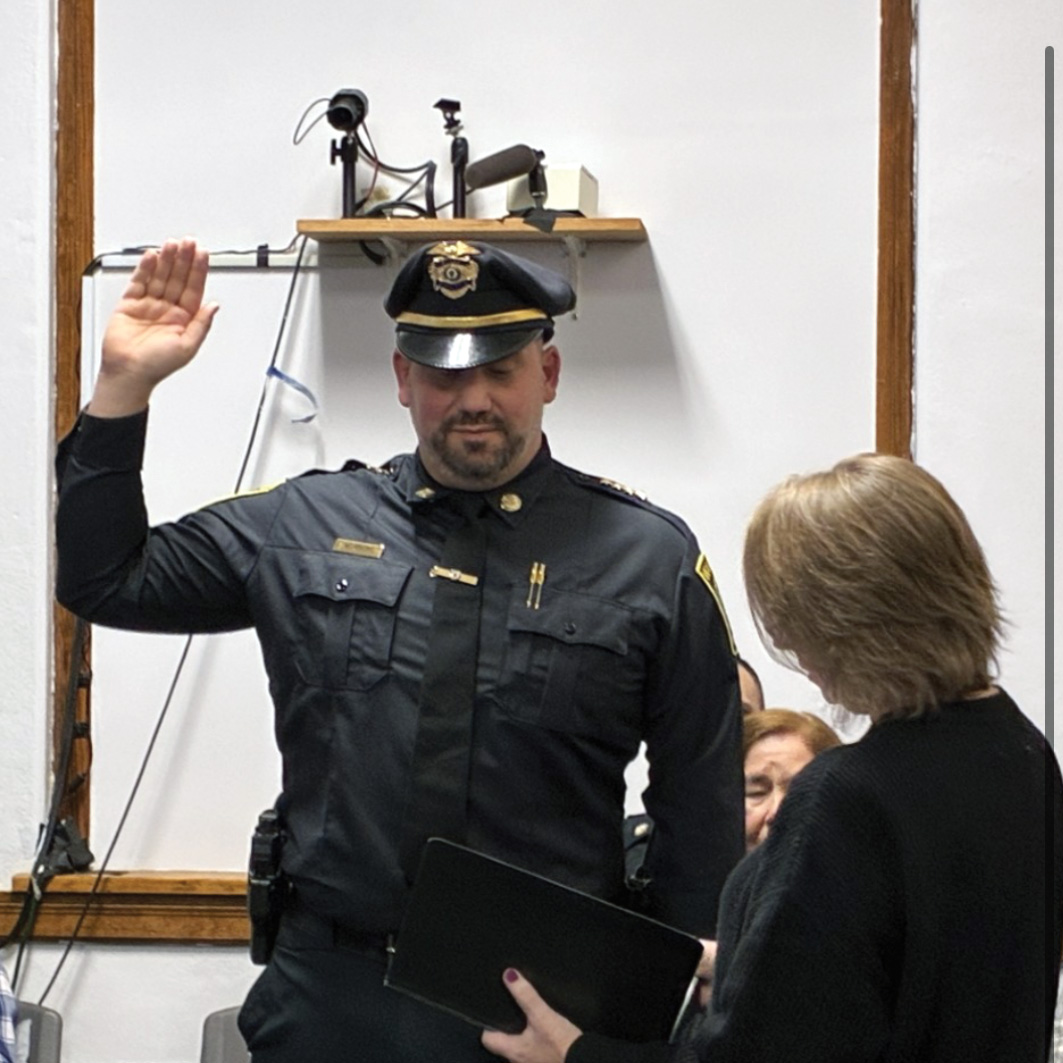
Following Burman’s retirement, Mark Hebert, then a lieutenant and second-in-command, was sworn in as acting police chief on Dec. 20, 2025. Hebert, a veteran of the department, is leading Wayland police on an interim basis while the Select Board and Town Manager begin the search for the next permanent chief. Town officials have described the current arrangement as transitional, with an emphasis on continuity and day-to-day stability.
Internal or external candidates?
Wayland’s recent experience highlights broader questions faced by municipalities when selecting police leadership, particularly whether to promote from within or conduct an external search.
Internal promotions can reinforce morale and continuity, especially in departments with strong leadership pipelines, but they may also limit an organization’s ability to break from entrenched practices or internal rivalries.
Interim appointments, while often necessary, introduce additional complexities. Acting chiefs may have limited authority to implement long-term reforms, and prolonged interim periods can create uncertainty among rank-and-file officers about the department’s future direction. Wayland experienced extended interim leadership twice in recent years, first during the 2020–2021 search and again following the 2022 resignation, underscoring both the stabilizing role interim chiefs can play and the organizational strain that can accompany lengthy transitions.
External searches can bring new perspectives and signal change, particularly after a crisis, but they often involve longer timelines, higher costs, and an adjustment period for both the chief and the department.
One additional challenge towns face during leadership transitions is what happens when an interim or acting chief is not selected as the permanent chief and must return to a lower rank. Moving a senior officer from a temporary top leadership role back into the rank-and-file can create internal strain, both for the individual and for the department. Officers who recently reported to that person may struggle with the sudden shift in authority, while the returning officer may find it difficult to resume prior duties after having exercised department-wide command. Management experts note that without clear expectations and role definition, such transitions can undermine morale and blur lines of accountability.
These dynamics are particularly sensitive in departments with multiple qualified senior officers. When more than one lieutenant is viewed as a potential successor, the designation of an acting or interim chief can unintentionally signal favoritism or pre-judgment in what is supposed to be an open hiring process. Officers who are not selected for the interim role may feel sidelined, while those placed in the role may later find themselves in an awkward position if they are passed over for the permanent appointment.
To address this, municipalities often separate two distinct functions: interim command authority and long-term succession planning. One approach is to explicitly define the acting chief as a caretaker with limited scope, while simultaneously identifying a clear second-in-command or operations lead who is not necessarily positioned as a presumptive successor. This allows daily operations to remain stable without prematurely elevating one internal candidate above others competing for the permanent role.
Some departments formalize this structure by assigning a deputy chief or designated lieutenant with operational oversight, even if that position is temporary or rotating. Others rely on civilian oversight, such as the town manager, to communicate clearly that interim assignments do not imply outcomes. Transparent communication about evaluation criteria, timelines, and reporting relationships is widely cited as critical to preventing resentment and maintaining cohesion.
In towns like Wayland, where the department has experienced extended interim leadership periods in recent years, these considerations take on added importance. How leadership roles are structured during the search process can shape internal morale long after a permanent chief is appointed, influencing retention, promotion dynamics, and trust within the organization. As the town evaluates candidates for its next police chief, officials will likely weigh not only who leads the department next, but how to manage succession and command structure in a way that preserves stability across the ranks.
As Wayland begins another search for permanent police leadership, town officials are again balancing those considerations. The department’s recent history, spanning long-term stability, abrupt disruption, and gradual recovery, has shaped expectations around transparency, accountability, and the importance of selecting a chief aligned with the community’s needs at this moment in time.