The town has received a matching grant of $884,000 in September from the state to help complete rehabilitation work on the Snake Brook Dam, which has been listed in poor condition since September 2021, when Hurricane Ida dumped almost 5 inches of rain in 24 hours, causing overtopping of the dam by up to two inches along the crest.
At the time, emergency personnel cleared the spillway of debris and mobilized sandbags to install along the low areas of the crest, which was effective in avoiding excessive damage and the probability of embankment failure, but repairs were clearly indicated.
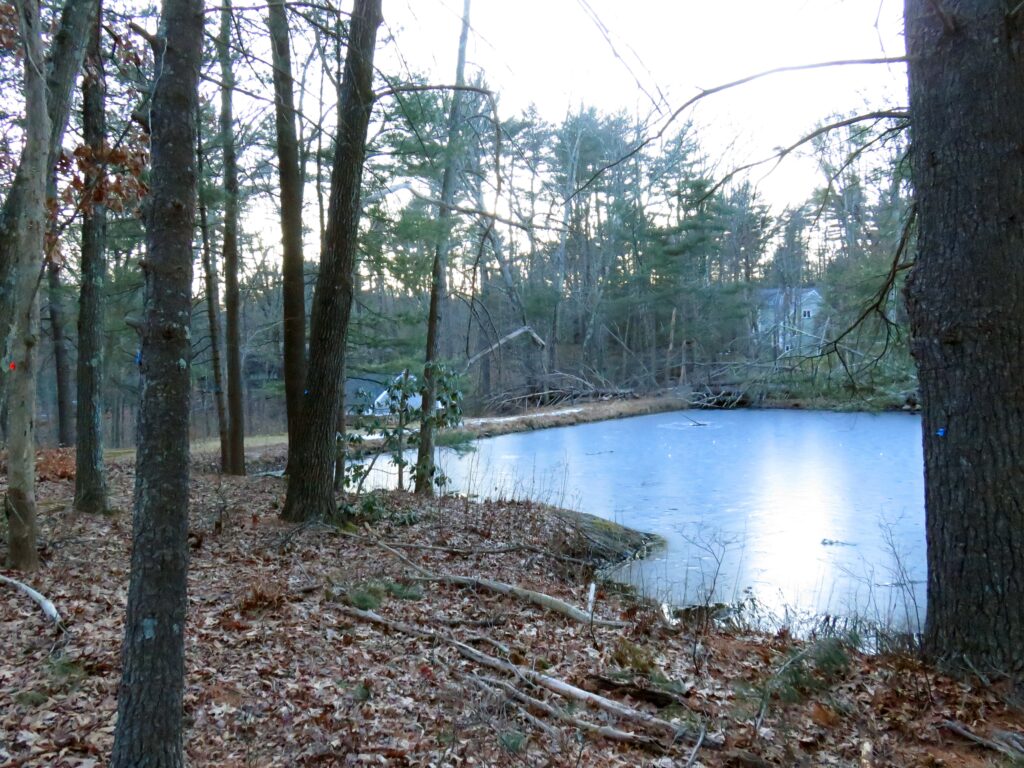
Snake Brook runs along the southeastern boundary of Loker Elementary School, which is 0.4 mile downstream and 30 feet lower in elevation than the dam, before continuing to run under Route 30. The 150-year-old dam holds back water along Snake Brook to form the Old Wayland Reservoir and is part of the Hamlen Woods Conservation Area located at 80–90 Rice Road.
The dam impoundment (the amount of water it holds back) has an estimated maximum storage capacity of 55 acre-feet or roughly 17.9 million gallons. It’s classified as an intermediate-sized Significant Class II hazard potential structure by the Office of Dam Safety, meaning that in the event of dam failure, significant damage and potential complete washout of downstream structures and impacted roadways are predicted.
The Massachusetts Executive Office of Energy and Environmental Affairs (EOEEA) granted over $10.9 million to 23 municipalities and nonprofit organi-zations to make long-overdue repairs and take down outdated structures that put homes, roads and neighborhoods at risk.
The EOEEA dam repair program will match costs up to 75%. The town requested a $1.96 million matching grant for construction costs and received 45%, or $884,000.
Tangled history of fund-seeking
The Conservation Department has applied eight times for grants to complete funding for the work. The costs have been broken out in multiple ways, depending on the grant requirements regarding how to pay for rehabilitation design work, permitting, bidding, and construction, as well as meeting timing requirements, which makes tracing the cost escalation complicated. See the Finance Committee’s historical summary up to the 2019 Annual Town Meeting warrant for Article 23 at tinyurl.com/wpbrookdam.
In 2022, the ATM appropriated $900,000 in the capital budget for rehabilitation, with an anticipated project cost of $1.9 million. There was anticipation of further funds for construction from a FEMA grant that was administered through Massachusetts Environmental Policy Act Hazard Mitigation Grant Program.
By March 2023, the project cost was estimated at $2.2 million, while dam inspections were conducted quarterly. The town secured the required 25% matching funds for the FEMA grant with an obligated federal American Rescue Plan Act (ARPA) funding set aside, which must be used by December 2026.
From the $4.1 million in ARPA funds that remained unallocated, the Select Board voted in 2023 to expend $650,000 (later reduced to $580,000) to fund the $1.3 million project shortfall from the original 2022 capital appropriation. For approved ARPA fund requests on 2/6/23, see page 6 in tinyurl.com/wparpapacket.
The most recent FEMA grant application is still pending. The town requested $1.4 million towards the proposed construction cost of $2.54 million. The grant process was about 95% complete as of January 2025 but stalled at the federal level. The town went ahead and proceeded with a new construction bid as of Sept. 25, 2025, with an estimated contract value of $2.2 million.
The deadline of December 2026 for using ARPA-obligated funds will determine if the FEMA hazard mitigation money comes through in time before the town has to use approximately $1.4 million in funding from its real estate receipts account to cover the current shortfall. Sufficient funds must be secured to sign the rehabilitation contract before commencing work. The total mitigation cost estimated was $2.96 million as of July 2024 by the engineering consultant Pare Corp.
Conservation breeding season restrictions are in place due to the presence of the northern long-eared bat, a NHESP Priority Habitat of a Rare Species, which also is driving the construction schedule to finish and meet the 2026 ARPA deadline.
The Office of Dam inspections classed the dam’s overall condition as “fair” in 1999, 2012 and 2017 but “poor” in 2021. That 2021 classification triggered the town to contract with the Pare Corp. to develop a scope of work to address known deficiencies at the dam. The design work was completed in April 2020 and the necessary permitting with six federal and state agencies has been completed.
While the town has a maintenance and construction easement, public access to the dam and historic stone masonry gatehouse is available from the Hamlen Woods trail along the western side of the impoundment.
Snake Brook was dammed in colonial times, rebuilt in 1878 and upgraded in 1907. However, its role in supplying water for Cochituate Village ended in 1929.