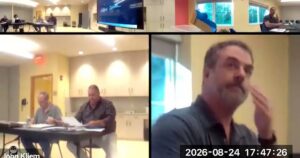
The Planning Board and Conservation Commission met jointly Dec. 3 to review peer comments on the St. Philopater Mercurius & St. Mina Coptic Church and Carroll School construction projects. The Planning Board also met separately with church representatives to discuss additional issues. The meeting concluded with an abbreviated discussion of proposed zoning amendments related to the MBTA Communities Law and the town’s accessory dwelling unit bylaw.
Town peer reviewers and Planning Board members said they had limited time to review updated materials from the Church because several responses were submitted shortly before the meeting. Discussion focused on revisions related to septic design, stormwater management, and lighting, as well as preliminary peer review findings.
Bert Corey, a civil engineer with DGT Associates serving as a town peer reviewer, said his review was preliminary due to the timing of the submissions. Corey said it remained difficult to assess the project’s overall massing and its height in relation to surrounding properties because a balloon study and site staking had not been conducted. Church representatives said they would not perform those studies, citing cost concerns and the absence of a regulatory requirement.
Corey said many stormwater maintenance issues appeared to have been addressed but said additional analysis was needed, including a stress test of the proposed filtration system in the event of failure. The applicant said it would not conduct that test, stating it was not required by regulation.
Planning Board Chair Anette Lewis read a statement from Kristen Braun of Chappell Engineering Associates, the town’s traffic peer reviewer, who said she had not had sufficient time to complete a written report. Braun’s statement raised questions about the timing of the applicant’s traffic study, noting it did not include periods of heavier traffic such as during the school year or summer camp sessions. She also cited concerns about box truck movements on Rice Road, proposed curb line modifications, and overflow parking plans that referenced use of town and school parking lots without town approval.
Lewis said Town Counsel had previously advised that if the project sought protection under the Dover Amendment based on housing, housing criteria would need to be provided. Church attorney Jonathan Silverstein disagreed but presented criteria at the meeting, stating that proposed housing would be limited to individuals age 55 and older who are unable to transport themselves, are regular church attendees, and would not park a vehicle on site.
Audience members reacted audibly, and several later raised questions during public comment about transportation access on Rice Road. A church congregant who lives in Framingham accused some attendees of being disrespectful and said she believed opposition to the project was related to the race of church members.
During public comment, several neighbors said the church has the right to expand but asked the applicant to reconsider the height and scale of the proposal. The church plans to replace its existing building with a larger church featuring two 100-foot towers and a campus including a Sunday school, youth athletic center, administrative building with housing for church dignitaries, senior apartments, and a soccer field on approximately 5.5 acres.
Lewis questioned a banner displayed on the church building that depicts a smaller project. Deacon George Ghaly said he was not involved with earlier proposals and said the earlier design no longer meets the church’s needs. Lewis also said residents had reported that other Egyptian Orthodox churches in Massachusetts are smaller and do not include towers of similar height.
Lewis said the applicant was unable to identify on-site boundaries during site walks and again requested staking to show building footprints and roadway relationships. Ghaly said additional staking would require hiring a surveyor and declined, citing cost. Vice Chair Robin Borgestedt said the proposal seeks relief from height limits for the towers. Lewis said providing additional visual information would assist both the board and the public in understanding the layout. Ghaly said the church had made concessions related to lighting and landscaping and later agreed to place cones to indicate driveway locations and traffic flow.
Lewis also said submitted plans were difficult to interpret because they lacked clear measurements. She requested a phased construction plan showing what would be completed in each phase. Church representatives agreed to provide that information. The project proposes three construction phases over seven to 10 years.
Lewis said approval from the Department of Public Works would be required for tree removal on town land and asked whether the design would change if approval were denied. No response was given. There was a prior town decision denying a sidewalk request on Rice Road due to scenic road protections.
Conservation Commission Vice Chair Shannon Fischer said the commission had not received the peer review materials prior to the meeting and said the commission generally relies on peer recommendations for stormwater. Several members expressed concern about the proposed removal of approximately 500 trees and the project’s impact on site topography. Members also questioned parking counts, which Lewis and Silverstein said are dictated by zoning requirements. Review of the peer comments and responses was continued to Dec. 17.
Carroll School
Conservation Administrator Linda Hansen said limited wetlands work was proposed for the Carroll School project but said she had concerns about stormwater management. Sean Malone of Oak Consulting Group, the school’s civil engineer, presented revisions made in response to peer review comments, including additional soil testing and changes to the filtration system.
Jason Kreil, the town’s peer reviewer, cited remaining concerns regarding compliance with state stormwater standards, groundwater mounding analysis, and potential impacts on existing drainage. John Chessia, representing abutters, said the filtration system is located within 15 feet of the septic system and raised concerns about flooding. Malone said he would review snow storage and management with the school administration. Engineers agreed to coordinate further and return to the Conservation Commission Jan. 9.
MBTA Communities zoning amendment
Lewis said the board received a request to increase building height from 35 to 50 feet and density from 32 to 33 units per acre for a property on Route 20 near the Sudbury line. She said Town Planner Robert Hummel confirmed with the state that the modification would be permitted. Planning Board member Larry Kiernan raised questions about potential impacts on fire department equipment. Members agreed to research outstanding questions and continue discussion at the Dec. 10 meeting.
Accessory dwelling units
Vice Chair Robin Borgestedt reviewed proposed changes to the ADU bylaw, including an owner-occupancy requirement and a possible increase in maximum unit size to 900 square feet. She suggested replacing the existing bylaw with a new version drafted by Hummel. Further discussion is scheduled for Dec. 10.
Lewis said a joint public hearing on both zoning amendments is scheduled for Jan. 7.