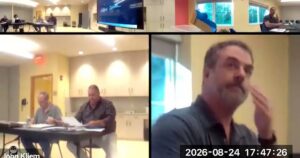
The Planning Board on Jan. 28 continued its public hearing on the Carroll School site plan at 37–45 Waltham Road to Feb. 25 after extended deliberations focused on stormwater modeling, traffic impacts, septic system revisions, proposed conditions of approval, and neighborhood concerns.
Jason Kreil of ECT, the town’s peer reviewer, reported that the applicant had submitted responses to prior peer review comments addressing traffic, septic and stormwater issues, though not all responses had yet been formalized in a consolidated peer review letter. He said traffic comments were largely resolved following submission of an amended traffic impact analysis and a turning movement plan requested at the prior meeting.
Kreil characterized the applicant’s traffic model as conservative and noted that queues identified at Waltham Road and Route 126 reflected worst-case conditions, with some intersections already operating at failing levels of service under existing conditions.
Ken Cram, an engineer from Fuss & O’Neill, testified that the traffic analysis examined three peak periods: the morning peak, afternoon school dismissal, and the roadway system’s evening peak, which coincides with after-school activities. He said projections were based on observed traffic at the school’s Lincoln campus and reflected a redistribution of trips rather than an expansion of athletic programs.
Board member Robin Borgestedt questioned whether the analysis adequately accounted for visiting spectators during after-school sports and whether future queuing could require mitigation. Cram said signalization was unlikely to meet MassDOT warrant thresholds and cautioned against part-time signal operation due to safety risks.
Kreil said the applicant proposed a $5,000 contribution, to be paid before issuance of a certificate of occupancy, to fund potential future traffic monitoring or minor mitigation such as counts or signage.
Board members questioned what could be accomplished with that amount and raised concerns about the town’s ability to manage and deploy such funds, citing uncertainty over whether similar funds from earlier approvals had ever been used.
On septic issues, Kreil reported that revised calculations corrected errors in field dimensions, seasonal high groundwater separation and wastewater flow assumptions. He said the revised design met the required five-foot separation following adjustments requested by the Board of Health.
Kreil also raised unresolved questions regarding potential undocumented roof drains from an existing building that may discharge to subsurface dry wells. He said the applicant proposed further investigation during construction, with protections to be enforced through Board of Health conditions.
The most extensive discussion centered on stormwater management and groundwater mounding. Kreil explained that the applicant used separate models for surface stormwater and groundwater mounding, with outputs from one informing the other. He said the approach was theoretically sound but described it as unorthodox and said ECT could not guarantee outcomes due to uncertainties about how multiple infiltration basins might interact over time.
Sean Malone, P.E. from Oak Consulting, testified that the applicant followed standard engineering practice by using a HydroCAD model for stormwater and a separate mounding analysis because estimated seasonal high groundwater provided less than four feet of separation, triggering MassDEP stormwater standards. He said conservative assumptions were used and that modeled drain-down times were well under the 72-hour standard.
Lewis pressed the applicant to explain why a single integrated model was not used. She expressed concern that the analysis differed from approaches typically presented to the board. Kreil said HydroCAD was standard for most projects but that questions remained about time-dependent interactions between basins and whether infiltration could be impeded long enough to violate drain-down requirements.
Attorney Dan Hill, counsel for the abutters, argued that groundwater rising into infiltration chambers was a red flag and said MassDEP standards do not allow systems to function as detention basins once infiltration is impeded. He urged further analysis and noted that the Conservation Commission was also reviewing stormwater impacts.
Hill also criticized the lack of proposed traffic mitigation despite modeling that showed significant increases in queuing.
The board then turned to a detailed, line-by-line discussion of proposed conditions of approval submitted by the applicant and redlined by Hill. Much of the discussion focused on enforceability under the Dover Amendment, clarity of language, and whether certain provisions exceeded the board’s regulatory authority. Lewis repeatedly emphasized the need for conditions to be understandable, enforceable by future boards and consistent with zoning law.
Specific issues included limitations on use of a rear access driveway, with board members suggesting that vehicle restrictions be defined by gross vehicle weight rather than vague references to “heavy equipment.” Conditions addressing future reviews of traffic and parking operations prompted debate over whether the Planning Board would have authority to impose changes following such a review.
Snow storage emerged as a point of contention, with Lewis expressing concern that off-site trucking might be impractical during major storms and abutters objecting to heavy equipment operating near residential properties.
The board also reviewed conditions related to exterior storage, lighting, hours of operation, special event notifications, construction management and stormwater discharge. Borgestedt reported that the Design Review Board had raised concerns about the visibility of 25-foot light poles above buffer plantings, even if photometric standards were met. Proia said the applicant’s lighting consultant would revisit the design.
Throughout the discussion, Lewis stated that the board was not seeking to dilute agreements reached between the school and neighbors but needed to ensure that any conditions incorporated into a formal decision were legally sound and administratively workable.
Several residents expressed frustration that conditions negotiated in good faith might be pared back, while board members reiterated that some commitments fell outside Planning Board jurisdiction and could not be enforced through a site plan decision.
Lewis confirmed that the peer reviewer would issue a formal written report addressing outstanding stormwater issues and that the applicant would have an opportunity to respond. Town Planner Robert Hummel advised that the statutory decision deadline was Feb. 27 and that additional time would be required.
The board voted to continue the public hearing on Feb. 25.