Public comment dominated the Board of Public Works meeting Nov. 18 as 10 residents from both Wayland and Lincoln urged the board and Department of Public Works Director Tom Holder to slow traffic on Sherman’s Bridge, preserve its historic setting, and clarify the long-term implications of using glulam decking in MassDOT’s proposed rehabilitation.


Residents said the bridge’s surface, guardrail placement, and rising vehicle speeds remain safety concerns. Henry White of Lincoln Road said speed data show half of drivers exceed the posted limit and recommended the board set a goal of reducing average speeds to 20 mph to extend the deck’s lifespan.
Several speakers, including Alisa Carter of Sherman Bridge Road, questioned the long-term maintenance costs of glulam, an engineered wood of glue laminated lumber, and asked why no full wood-only deck estimate had been publicly presented.
Cyclists also raised safety issues. Andy Nirenberg of Oxbow Road said the uneven deck ejects water bottles and jolts riders. He asked whether a narrow, smooth riding path could be added parallel to the roadway.

Gretchen Schuler noted she had submitted preservation letters during the bridge’s 1990s redesign, and she still supported preserving the historic landscape, design and setting of the Sherman Bridge, and that priority should guide final design choices even though the actual materials are no longer historic.
Holder outlined revisions made since the Oct. 9 workshop, including removal of a top protective asphalt layer on the gulam deck, maintaining the five-foot sidewalk, and significantly lowering the barrier separating the walkway from the roadway. He said the bridge cannot structurally accept a crash-tested rail on the outer sidewalk edge, so the barrier will remain between the driving surface and the walkway. MassDOT concurs with this proposed design.
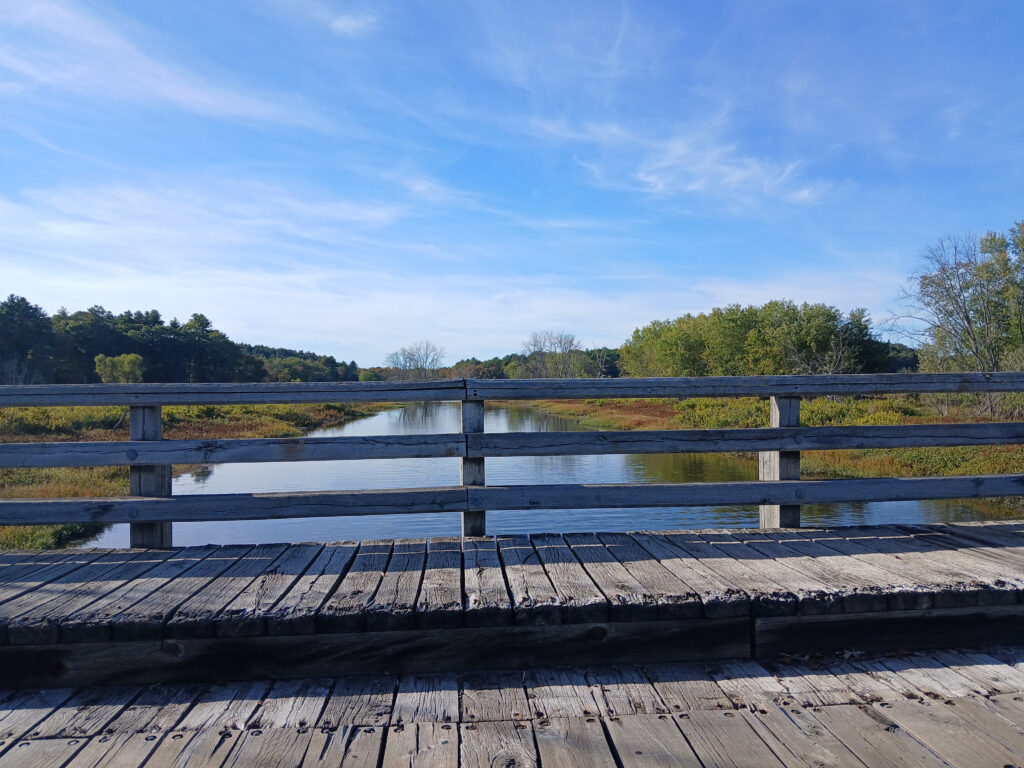
For each approach guardrail on the (north) walkway side of the bridge, MassDOT will allow steel backed wooden guard rails that are similar to what’s there currently. However, on the south side of the bridge edge that has no walkway, MassDOT still plans to install treated metal guard rails at both approaches. The rest of the bridge from abutment to abutment is going to be wood.
MassDOT confirmed in writing that it concurs with the revised design and will purchase and install all engineered wood materials, including glulam panels and rails, at a value “in excess of a million dollars.” Holder said remaining work — paving approaches and adding treated metal guardrails opposite the sidewalk — would cost each town no more than $50,000, out of s state Chapter 90 funds.
Permitting continues with state and federal agencies, and town managers Michael McCall and Andy Sheehan jointly notified MassDOT by letter that both towns intend to advance the project for construction in late 2026. The DPW is still evaluating a potential timber wear layer and will provide additional information on environmental impacts of glulam adhesives.
Water Liens and AMI Enforcement
The board voted 5-0 to send $60,513 in unpaid water and wastewater charges to the Board of Assessors for lien placement on third-quarter tax bills.
The board also voted 5-0 to authorize certified-mail letters to about 100 non-responsive households that have not scheduled AMI meter installations despite three prior contact attempts. The letter cites town authority under Massachusetts General Law to access meters and impose fees for non-compliance.
The new quarterly billing remains on track to begin in January 2026, with full implementation by June. A public-facing postcard explaining the transition will be mailed shortly after the holidays.
Water Enterprise Fund
Holder reported that this year seven unplanned equipment failures, due to aging at the 15-year-old Baldwin Pond and Happy Hollow well pumps, are not PFAS (Per- and Polyfluoroalkyl Substances) related. Repairs have resulted in roughly $70,000 in expenses since July and required activation of the MWRA emergency interconnection on Nov. 7. All town wells need to be maintained until the switch to MWRA occurs in four years.
The first MWRA invoice for emergency connection water is expected to be also roughly $70,000 so year-to-date expenses have temporarily exceeded revenues due to billing timing.
Member Judy Ling asked about the volume of town water produced vs. water purchased. Unaccounted for water is now down into the single digits with the installation of the new AMI meters but has raised the per-capita per day usage to the high 60s gpd, but below the 65-gallon MWRA requirement to demonstrate proper usage control according to Holder.
Transfer Station Operations and Facility Study
DPW Superintendent Joe Doucette said transfer station revenues are slightly below projections and tipping fees continue rising. The Transfer Station may need to use retained earnings later this year.
The transfer station facilities and operations study on whether a town-wide pickup service makes more sense than maintaining the transfer station will be rebid as a Request For Proposal (RFP) after procurement staff determined the project exceeds Request For Qualifications (RFQ) legal value threshold. A cross-functional working group will review and prioritize proposals for technical quality and then costs once submitted.
FY27 Capital Plan
The board voted 5-0 to support the DPW’s FY27 capital recommendations with two changes: removing $4.5 million associated with $2.0 million high school wastewater Title 5 re-design, and $2.5 million baseball field renovation work from the DPW budget which will be done concurrently given the placement of the leaching field.
The board felt the debt service was a school budget item more appropriately handled through Facilities. Holder stated the high school wastewater will continue to be hauled away weekly, until the project finishes roughly mid-year 2027, from the 2012 wastewater treatment plant that has not operated for years.
The vote also moves the transfer station garage replacement to FY28 or FY29 pending results of the operational study. Holder said certain equipment purchases — such as a John Deere loader and F-550 dump body — require earlier replacement due to mechanical failure.
The capital plan includes $1.2 million to replace the aging Dudley Road water main, which has been experiencing frequent breaks. Holder said the project cannot be deferred despite ongoing MWRA construction planning.
MWRA Town Meeting Preparation
The Select Board is scheduled to open the annual warrant Dec. 1 and close it by Jan. 15. The Board of Public Works voted 5-0 to seek Select Board co-sponsorship of the MWRA construction article that they will draft. Additional board meetings were scheduled for Jan. 6 and tentatively Jan. 20 to finalize article language. Public outreach on the project is expected early next spring.