By Veronica Hernandez

The idea for a George Washington Highway dates back to 1913, when the Sons of the American Revolution proposed marking the actual roads Washington used during his travels. The concept resurfaced in 1932, when Congress considered establishing a route from Washington, D.C., to Cambridge, Mass., following Washington’s documented journeys in 1775, when he took command of the Continental Army, and in 1789, when he toured New England as the newly inaugurated president.
Even before Congress debated the matter, Connecticut and Massachusetts had already agreed to create a regional George Washington Highway from New York City to Boston, following the same two historic routes. Connecticut’s portion was never completed, but Massachusetts finished its segment.
According to the Worcester Telegram, Massachusetts installed 22 bronze plaques. The Massachusetts Department of Transportation later confirmed that the George Washington Memorial Highway was officially designated in 1932 as part of the state’s bicentennial observances. These plaques were placed along what is now the Boston Post Road (Route 20) that Washington actually traveled, creating a historically accurate auto trail through the Commonwealth.
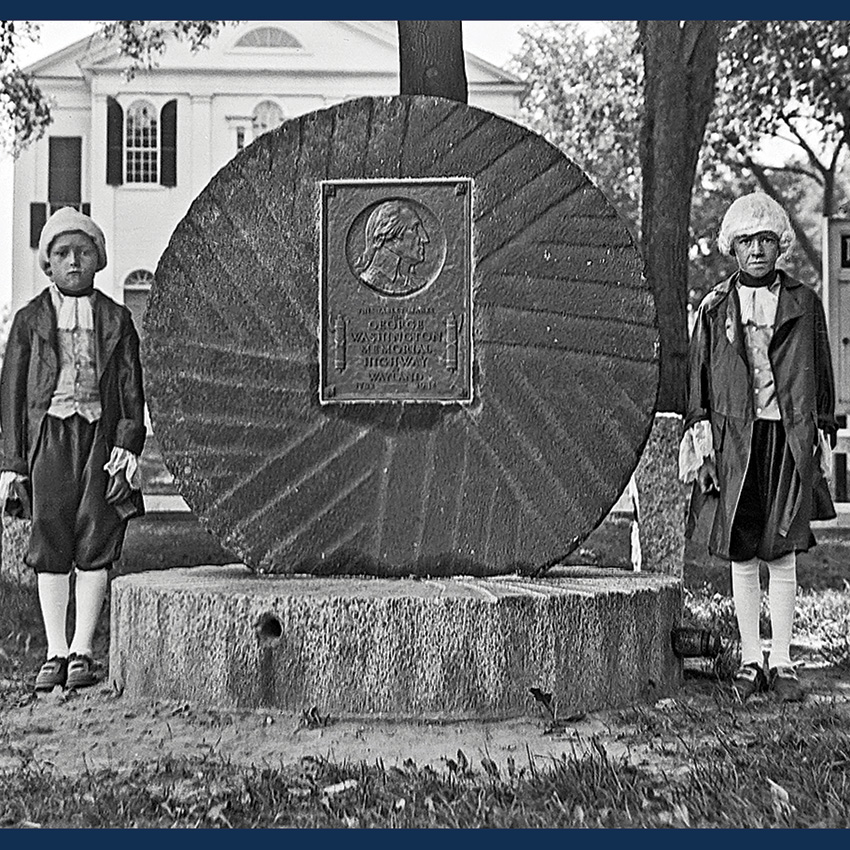
The dedication events included a festive community gala. People of all ages dressed in colonial garb and gathered along the roadside for the moment when George Washington would ride into town on a white horse, accompanied by a Native American figure and military attendants. This reenactment was part of a larger parade that traveled from Agawam to Cambridge, stopping briefly in each community to acknowledge the newly installed markers of the George Washington Memorial Highway.
In the heart of bustling Wayland Center, two old mill wheels stand together — one resting solidly on the earth, the other rising upright — with the engraving, “This tablet marks the George Washington Memorial Highway at Wayland 1732–1932.”
The lower wheel came from Henry Ford, a gift from a man who understood the power of industry and memory. The upright wheel came from the Rice Mill, donated by Nellie Rutter Rice Fiske. Nellie was born on April 22, 1856, the daughter of George A. and Harriet G. (Rutter) Rice. She grew up on her Rice grandparents’ farm on Rice Road, where various Rutter relatives often lived with the family throughout her childhood.
Nellie Rutter Rice was a direct descendant of the town founder, Deacon Edmund Rice, and his wife Thomasine Frost.
Her lineage is filled with prominent early Wayland names — Rutter, Heard, Cutting, Maynard, Noyes, Fiske, Brown, Sawin, Stone, Loker, Whitney, and Moore. It was her proud Wayland heritage that inspired her love of history and her desire to share it with the community.
Nellie became a schoolteacher and continued to live at home throughout her adult life. On Aug. 20, 1890, at the age of 34, she married 54-year-old David Fuller Fiske. David had been born a Fuller but was later legally adopted into the Fiske family. He served as a deputy sheriff of Middlesex County.
They lived a life of service — David to the county, Nellie to her town. David died on Jan. 20, 1913, and is buried in North Cemetery in Natick.
As regent of the Wayside Inn Chapter of the Daughters of the American Revolution, Nellie became a force of local history. She ensured that the Knox Trail and George Washington markers were placed in Wayland and organized the celebrations, gathering Massachusetts dignitaries and townspeople to witness the events. So when the George Washington Highway marker was unveiled in 1932 — resting on the two mill wheels that symbolized both industry and local heritage — it was largely due to Nellie’s influence. She died on April 25, 1935, and is buried in Lakeview Cemetery in Wayland.
Today, the wheels remain — solid, weathered, and quietly expressive. They honor Washington’s route and they honor Nellie, whose dedication ensured that Wayland’s history would be remembered.
Kay Gardner-Westcott is curator at Wayland Museum & Historical Society.