By Jack Schwed

A Feb. 11 guest speaker at Temple Shir Tikva pointed to a common thread running through many of the challenges currently facing the Jewish community: fracture and isolation.
“For me, one of the deepest, deepest ideas in Torah, in Judaism, is our interconnection,” said Rabbi Sharon Cohen Anisfeld, president of Hebrew College. “We are interconnected as human beings. We are interconnected as Jews. We are interconnected as inhabitants of the earth. And there are so many things that are tearing at that sense of interconnection.”
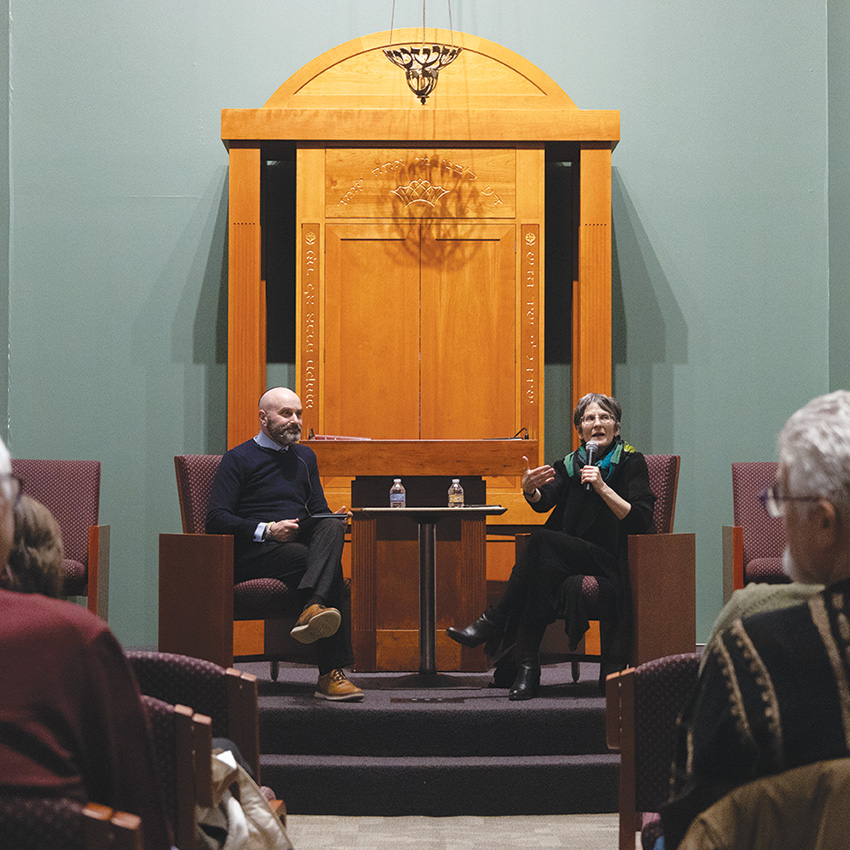
Anisfeld joined Shir Tikva’s Senior Rabbi, Danny Burkeman, to share her journey and insights as a leading local Jewish figure for the temple’s third event in its Boston Jewish Leaders Speaker Series. The temple previously hosted Rabbi Marc Baker, president and CEO of Combined Jewish Philanthropies in January, as well as Jeremy Burton, CEO of the Jewish Community Relations Council in December.
Burkeman said in an interview that the goal of the speaker series is to encourage a variety of Jewish leaders from Boston to share their stories with the local community because otherwise, they sometimes “don’t make it as far as MetroWest.”
“We consider ourselves a partner in the greater Boston Jewish community, and want to be engaged with these institutions that are doing amazing work,” Burkeman said. “Welcoming Rabbi Anisfeld as the leader of Hebrew College, which is an important part of the Boston landscape, just felt like a wonderful opportunity.”
Burkeman also said both institutions are connected, as there have been Hebrew College students who served as rabbinic interns at the temple.
Anisfeld added in an interview that Hebrew College’s Miller Center for Interreligious Learning, which opened in 2016, was named by Dan Miller, a member of Temple Shir Tikva, in memory of his wife, Betty Ann Greenbaum Miller.
She noted there are also Wayland community members taking classes at the Newton-based Hebrew College and even some on the school’s board of trustees.
Addressing the crowd, Anisfeld said there are many factors contributing to the “fracture” that currently exists within the Jewish community.
“There are just such profound and growing ideological, political divisions,” she said. “The Jewish community is part of that. We’re not immune [to] that.”
These deepening divides, she said, have caused two major issues to manifest.
The first, Anisfeld said, is that some Jewish people are dehumanizing others within the community for being “on the other side of the divide.” For example, she said that there is a growing rift between older adults and teenagers in terms of their relationships to Israel.
“For the older generation, [they have] a very strong sense of history and memory, having grown up really feeling so connected to Israel,” she said. “Then [there’s] young adult kids who have grown up in a very different historical context, and who have only known a Netanyahu government, and who have seen the failure of various peace processes.”
Anisfeld said Hebrew College created a course within the Miller Center to help tighten this gap by inviting parents to deepen their understanding of both their kids’ perspective on Israel and their own.
The other issue facing the Jewish community, she said during the event, is an increase in hate, intolerance, and antisemitism.
In Wayland, the police reported two antisemitic incidents from January 2024 to February 2026, according to Sgt. Tim Henderson, civil rights officer for the Wayland Police Department.
While he is unsure of the exact date, Henderson wrote that a hate crime involving antisemitism and threats occurred via email.
Another antisemitic incident occurred in March 2025 when someone painted a swastika on a community pool building in Wayland.
An earlier incident in 2023, in which the same symbol was spray-painted multiple times on a main road, led to the formation of the Wayland Community Action Network (WaylandCAN), said Allison Kates, the organization’s co-director.
“A group of people came together because we wanted to ‘be the change,’” Kates said. “We do not aim to combat antisemitism in particular, but to make Wayland a place where everyone feels safe and welcome.”
The group has since then organized community-wide meetings and rallies and is now fundraising for a “Mural of Hope” on the wall where the 2025 graffiti incident occurred, she wrote.
Matt Langweber, a 73-year-old Wayland resident who attended the speaker event, said one of the “great things about Wayland” is how religious institutions acknowledge that it is important for them to embrace one another amid these challenging times.
Burkeman said the temple has a “lovely relationship” with the other faith communities in town, including the Islamic center and the various churches.
“The challenge for us in Wayland is how we can truly come together and support one another in meaningful ways so that we don’t just have to respond to the next incident, but that we can be ahead of it, so that there isn’t another incident,” he said.