dave.watkins@waylandpost.org

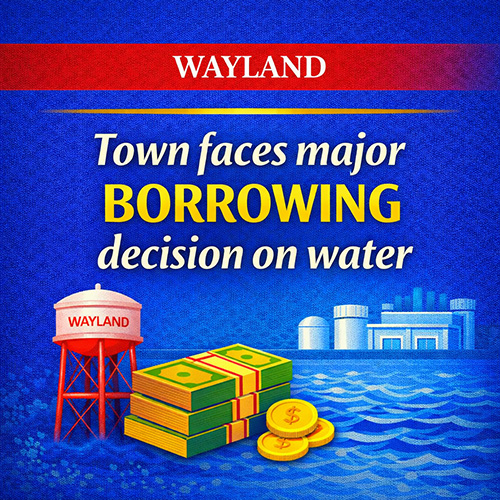
Town officials are moving forward with a major long-term water supply project expected to require roughly $38.6 million in borrowing, while simultaneously confronting uncertainty over financing and the potential impact on water rates.
The project includes connecting Wayland to the Massachusetts Water Resources Authority (MWRA) system, upgrading the Happy Hollow water treatment facility, and installing related infrastructure such as new water mains. Town boards have been discussing the proposal across multiple meetings over the past year.
Finance Director Brian Keveny recently confirmed the updated cost estimate during a March 2 Finance Committee meeting. The town had expected to finance much of the project through the state’s Drinking Water State Revolving Fund (SRF) program, which provides no-interest loans for eligible infrastructure projects.
However, town officials recently learned the project was not included in the 2026 SRF loan program, creating a major change in the financing outlook. At a March 10 Board of Public Works meeting, DPW Director Tom Holder explained the situation.
“Last July of 2025, the town submitted an application to the Clean Water Trust for consideration of a 0% interest loan … we predicted that our submitted ranking would be 500 points,” Holder said. “We learned that Wayland was not included in the 2026 loan program … rather than the predicted 500 points, we were ranked at 200.”
Town officials are now preparing a formal appeal.
“We will submit a written appeal of this ranking, as well as provide testimony at a hearing,” Holder said, adding that conversations with state officials “lead us to believe that we do have a chance at a successful appeal.”
Because the appeal outcome remains uncertain, town officials are now modeling how the project could be financed through traditional municipal bonds if the SRF funding is not restored.
Finance Committee member Carl Barnes said the change has made earlier financial projections unreliable.
“The State Revolving Fund passed over our application … so what will happen, is it would be put out, but none of the terms of bonds [are] done right now,” Barnes said during the March 2 Finance Committee meeting.
“We could fund it over 20 years, we could fund it over 30 years … All the information I was trying to give to the folks about what it would look like on the water bills is just out the window. You can’t tell anything right now.”
Barnes added that the town may not know the final financing structure for some time. “We can’t know that right now. We might know it in six weeks; I don’t know that we will.”
Borrowing scenarios
Town staff have been modeling borrowing scenarios using approximately 4% interest, a standard planning assumption used in other major municipal projects. Keveny said that estimate has historically proven conservative.
“When we’ve done this before with other projects like the library, high school field, COA, [- Hilltop [Securities, the town financial consultants] has always used the 4% figure,” he said during the March 10 Board of Public Works meeting. “Right now, if we issue bonds today, we’d probably be around 3 ½%. So, it’s worked out well in the past.”
Board of Public Works Chair George Uveges noted that longer borrowing terms could increase overall costs.
“If you go to the 30-year timetable, it would be more expensive, most likely, than the 25 or 20,” Uveges said. “People want to get a better return for going out farther.”
‘We should not delay’
Despite the financing uncertainty, Holder said delaying the project could create serious risks for the town’s water supply.
“We need to advance this project on schedule now… we have impending PFAS regulations,” he said. “Delaying it a year will prevent us from meeting those regulations.”
Holder added that existing local water sources already face capacity limitations. “Happy Hollow is at half capacity. Baldwin Pond is at half capacity,” he said. “If we do not get this project started and completed by 2029, we truly risk not being able to provide potable drinking water to the town. So when asked, I will say that we should not delay or defer this project based upon the news of this loan program.”
Debate over who pays
The financing discussion has also prompted debate over whether the project should be paid through water rates, property taxes, or a combination of both. Select Board Chair Carol Martin previously said the town’s proposal aimed to avoid charging residents twice.
“This proposal does not entail taxing [the] taxpayer paying twice, once in the water rates and once on the general fund level,” Martin said during a Dec. 1 Select Board meeting. “We’re not including the excluded debt in the tax, it’s being funded once just in the water.”
But she also acknowledged equity concerns if the cost were shifted to property taxes. “One of the concerns about funding through the real estate taxes is that each person would be paying the same amount for the construction costs. We’re not sure that someone using the tier one level should pay the same amount as someone who’s using tier four.”
Town Manager Michael McCall also raised questions about balancing fairness and taxpayer fatigue.
“I could think of scenarios… a senior who owns a larger house doesn’t use a lot of water versus a younger family in a small cape,” McCall said during a June 30 joint meeting. “There’s an equity issue.”
He added that the town must also consider residents’ tolerance for new taxes. “I get selfishly concerned about how many things may be hitting on the tax side of the equation … whether residents may be concerned about fatigue when they see all these things coming on their taxes.”
Potential impact on water rates
If the full borrowing were placed on the water enterprise fund, water rates could increase significantly over the coming years. Uveges said earlier projections suggested the change could be substantial. “If you’re looking for water rates to fund that service, you’re looking at a 74% increase in rates versus what you have today,” he said. “Which I’m sure will get a lot of people’s attention.”
Finance Committee member William Huss said the town also needs to communicate the project’s purpose clearly when discussing rate impacts. “I think it makes sense to talk about the rate increase in general terms,” Huss said. “They’re voting on whether they’re going to have water and meet the state regulations.”
Still, some committee members said uncertainty about the final financing plan makes it difficult for voters to fully evaluate the proposal.
“I look for a little bit more certainty in the projections,” Hoxha said. “You do need clean water, but I would personally struggle with… you can’t tell me how much … and you can’t prepare the public for what’s actually going to happen.”
Town officials also warned that current financial models show potential funding gaps that must still be resolved.
“If you take a look at the top line … no matter which plan you go with, it would appear that you don’t have enough cash to make the payment,” Keveny said during the March 10 BoPW discussion. “You do see that there’s a significant shortfall in cash, no matter which option you go with. So it’s an unsolved problem right now.”
As planning continues, officials say they will pursue the SRF appeal while preparing for a potential bond financing scenario.
Barnes urged town boards to communicate the situation clearly before Town Meeting.
“When we understood that the debt would be funded from the SRF with a 0% loan, FinCom voted unanimously to support it,” Barnes said. “When that disappeared … the vote changed dramatically.”
“It’s a big number,”and we can’t tell them right now how we’re going to finance it.
Responsibility for planning and financing the water project is shared among several town officials and boards, each with different roles in the process.
Under Wayland’s Town Manager form of government, the Town Manager’s office is responsible for coordinating major capital projects and presenting financing plans to elected officials and Town Meeting. The Town Manager works with the Finance Director and department heads to develop borrowing strategies and ensure projects fit within the town’s financial policies.
The Finance Director and Treasurer are responsible for modeling debt scenarios, advising on bond structures, and ensuring the town can meet its debt obligations while staying within municipal debt guidelines.
The Department of Public Works, led by the DPW Director, manages the technical side of the project, including engineering work, regulatory compliance, and applications for outside funding such as State Revolving Fund loans.
Policy decisions about how to finance the project, whether through water rates, property taxes, or a combination are made by the Select Board, which oversees the Town Manager and sets overall policy direction.
The Finance Committee serves as an independent fiscal oversight body, reviewing financial assumptions and making recommendations to Town Meeting.
Ultimately, Town Meeting voters must authorize the borrowing, providing the final approval required for the project to proceed.
Because the project depends on multiple boards and administrative offices, decisions about financing and rate impacts have evolved over time as new information such as the unexpected SRF loan ranking has emerged.