
September 9, 2025 – Capital Improvement Planning Committee – Video & Transcript
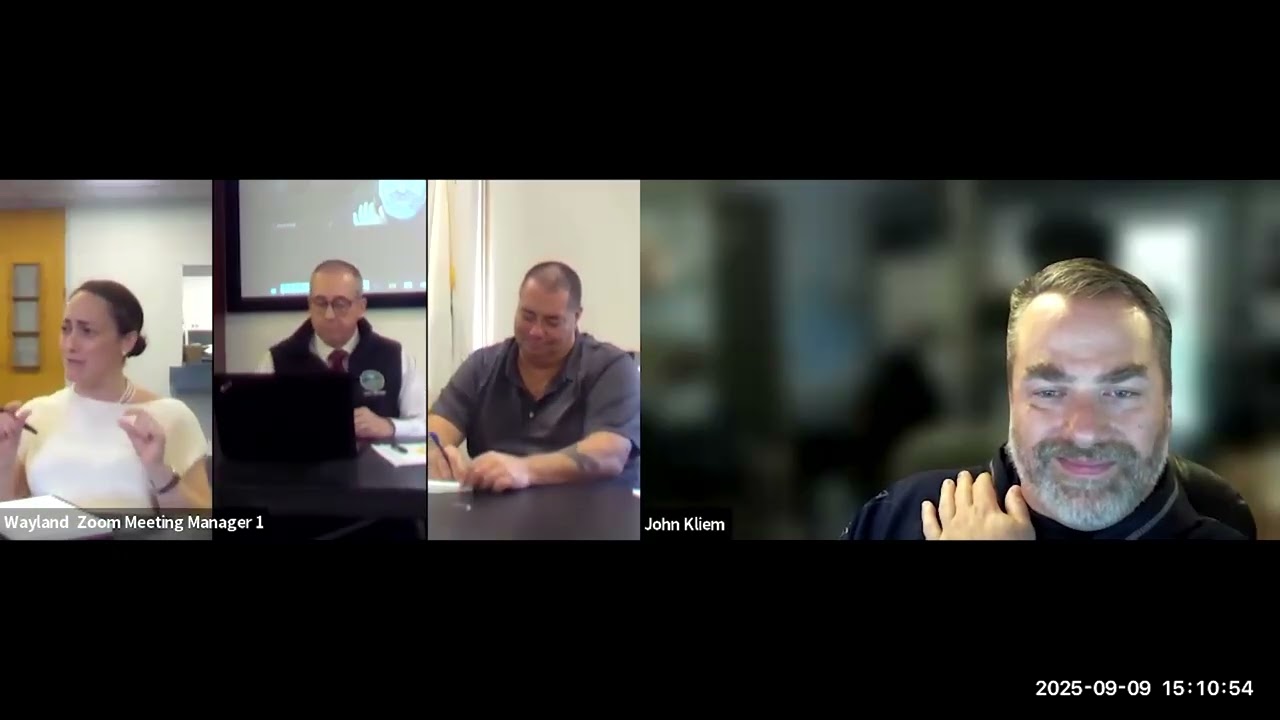
September 9, 2025 - Capital Improvement Planning Committee
Michael McCall: Good afternoon,
everyone. I'm Town Manager Mike
McCall, and we're going to be
calling to order our meeting
this afternoon, inaugural
meeting of our capital planning,
capital planning improvement
committee, which was approved by
our town meeting last spring and
ultimately approved by the
Attorney General's office today.
This is something that I know
some members of the Select Board
and others on staff have been
looking forward to having this
committee come together. We last
couple of years have had some
working groups relative to the
budget and looking at long term
capital planning, and this was
one of the desired outcomes of
that meeting as well. Under for
those of you who know, yes, sir,
Brian O'Herlihy: Before you get
too far now we're in an open
session. Should you be? Are you
the one at the moment that has
to read the statement and review
the agenda?
Michael McCall: It has been a
while since I chaired the
committee seated, but I
appreciate that. Let me I can
pull the right up here. It's
okay,
Kelly Lappin: Brian put that in
form of a question, but it was
really frustrating.
Michael McCall: Okay, this meeting today's meeting of the capital planning improvement committee is being held in person and hybrid pursuant to the the acts of 2025, chapter two and other statues. This meeting will be conducted via remote means, in accordance with approachable law. This meeting may be recorded, which may be available to the public on WayCAM As soon as practical after this meeting, when required by law or allowed by the chair or the person acting internally elected chair, persons wishing to provide public comment or otherwise participate in the meeting may do so remotely by accessing the meeting remotely as known and above, we request public comment be limited to two persons per person, so that know if there's anybody wishes to provide public comment. Brian O'Herlihy: I'm sorry, did you say John is not able to participate? Michael McCall: I did send him the link, so I will go around and say who's in attendance. Well, Kelsi looks to anybody online Kelsi Power-Spirlet: I think it is actually himself. So, Michael McCall: John, awesome. Brian O'Herlihy: I assume John was there when we started.
Kelsi Power-Spirlet: Yep, and there's nobody else sweet. Michael McCall: So members of the committee that are in the room, Brian O'Herlihy, Kelly Lappin, Liz Lusky, I don't have Bradford Carver: Brad Carver the other , your name please. Michael McCall: Brad Carver, and online, we have John Kleim. There are ex officio members in the room, myself, Michael McCall, Town Manager, Brian Keveny our finance director is here. We're also accompanied by our assistant town manager, Kelsi Power-Spirlet and I do know in the audience we have Michael Fay, who's our Facilities director, and our Select Board Chair, Carol Martin, and there's anybody Brian O'Herlihy: is the is Michael an ex officio member as well? Carol Martin: Yes, Unknown: you are okay.
Michael McCall: Bye, yeah, so many of you probably know the Town Manager Act makes me responsible for the preparation of the operating budget and the capital budget in it's often the case in cities and towns. It's usually the town manager working with finance director to put it together in my last community that had been the case until we brought forward a similar proposal to create a capital planning, capital planning improvement committee. And so here my thought, in speaking with members of the Select Board and our working group last year, was to behoove us to have a group of dedicated volunteers from the community with different expertise to take a second look at the five year capital plan and help us put together the the capital plan for the upcoming fiscal year as to work as well as to work on the five year capital plan. But ultimately, the goals is to start looking at years from five up to 20, you know, in the background. So I like to think of it as being an air traffic control. You've got the immediate ones- that's year one, and the ones that are in close proximity, but you have to think about those ones that are way out starting to come in. I also felt that this committee could be help, be a gatekeeper for some of the many other capital related projects that come to our attention, that some of you know right now, a proposal came forward to the Town to look at potentially acquiring 14 West plain Street. And I thought this committee might be a good resource to weigh in on issues like that for the Select Board, so also provide some level of advisory opinion to me to share with the Select Board when, when issues like that come up, where we have opportunities that to to do a project or to acquire something that otherwise might be in a capital plan, but comes up on short notice. So I thought there's benefits to that as well. Unknown: And similarly, we have community preservation projects that come through that don't always get passed through my office, sometimes people come in and ask for money for projects that ultimately use staff resources to maintain and to contribute to. And I thought some of those that if they're going to involve either matching funds or resources from the town, might be something that I would look to this committee to to weigh in on as well. Like you know, we've had some folks that have wanted to make improvements, say on the Cochituate Ball Fields, and whether or not we that's a project that we should do, oftentimes we get a donation, or we get someone to ask for CPC money, but it's something that's then going to require maintenance oper and facilities to maintain our DPW. And is that something that we should bring into the fold, because it's competing with some of the projects that we already have in our current fiscal year plan, or a five year capital credit? So that was some of the thought process of all this, I know most of you submitted your paperwork to the respective boards for your appointments. I didn't know if you wanted to introduce yourself, because this is being televised and some people may not know who you are, and so that might be good if we just go around the room. Those of you who are volunteers, who've been appointed, just state your name why you're interested, and I can start with Liz, because she's right here. Elizabeth Lusky: Yeah. Good afternoon, everyone. Liz, Lusky, first time volunteering in Wayland, but have volunteered in other capacities in Massachusetts for a period of time prior to having kids. Some of my kids are a little bit older. Said out loud, I'm dating myself, but have a little bit more time and capacity to help out. So just looking to get engaged and involved in my community. So that's
Kelly Lappin: Kelly, opine, this is not my first foray into Town volunteering. I did six years in terms on finance committee, and was very involved in capital when it came to evaluating it with the finance committee in order to put together the budget that went to Town meeting. I have a background in finance, specifically I'm a pension actuary. So that's the area I hope to bring to the group. Bradford Carver: Brad Carver, been a Wayland resident since 1993 I've been involved in a couple different town boards or commissions. I was talking to Brian before about when the public safety building had some issues. I got involved. Then I got involved on the early stages of the high school trying to decide whether to build a new high school or tear down the existing one. I'm currently on the Historical Commission, and my background is law. I'm a litigation attorney that concentrates in construction. So thank you. Brian O'Herlihy: Brian O'Herlihy, I'm a 42 year resident of Wayland, retired. I volunteered in town now 25 years and I'm the school committee's designee, and hopefully Kelly and I, we both served on the finance committee together for a couple years, and I think she understated the value she brought to the capital review, and she also forgot to mention, she was chair Kelly Lappin: I am the Finance Committee designee Brian O'Herlihy: I think you also served on the working group that led to this committee. So anyway, hopefully the two of us can bring some institutional knowledge for the other three members. So thank you. Michael McCall: John online, John Kliem: yes, good afternoon. Well, my name is John Kleim. I apologize. I have the flu today, so I'm not there with you. I. I this is my first time serving on a committee. I've been in town for about nine years now, and similar, my kids are at a reasonable age to participate more. well, they have lots of sports. It was a good time to get involved the Capital Planning Committee aligns nicely what I've done at my prior roles at Fortune 500 companies, doing capital long term planning. So it seemed like a exciting time to get involved and help out where I can.
Unknown: Thank you. And in addition, as town manager, I want to be involved, and I'm one of the ex officio members. Michael, you just let people know what your title is and what you're doing. Michael Faia: Director of Buildings and Facilities for the town of Wayland. I'm fairly new. I was on the original committee to put this committee together, and I bring years of construction and facilities knowledge to the table. So hopefully that will help Kelsi Power-Spirlet: I'm Kelsi Powers-Spirlet. I'm the assistant town manager. And traditionally, the assisting and managing the capital budget has fallen under the assistant town manager. So I hope that some of my knowledge, although I've been in the position for about a year now, I can hope to help to support this committee with background information and administrative support and logistic support. Brian Keveny: So I'm Brian Keveny. I've been in finance director for 13 years, CPA, 56 year resident of Arlington. I should try to get on the capital planning committee in Arlington. And my wife wouldn't let me. because I mean Wayland Town so she says, when I retire, I can join their capital planning committee. Unknown: So there are other two, according to our charge, two other ex officio members, the schools finance director and operational director, as well as the Director of Public Works, who couldn't be here today, but I think some of these people will come from time to time. Hopefully we can get as many people as possible as we future. The next thing on the agenda was just to review the charge and the Capital Improvement Planning committee's charge is that they are responsible for the planning and subsequently recommending to the town manager a capital improvement programming, program, identifying the town's future capital projects, programs, improvements and acquisitions having a useful life greater than five years and it cost at least $25,000 the committee shall study current and long term proposed capital projects and improvements involving non recurring tangible projects and assets. Committee is also charged with developing a long range capital plan of at least five years. And the committee shall prepare annually a capital plan, recommending a capital improvement budget for the next fiscal year. Questions, comments, concerns about that. Elizabeth Lusky: Clarifying question, yes, I know earlier you had mentioned we'll be reviewing, writing suggestions, weighing in, and the charter says developing so is it? Was it really just assessing a list that we pulled together and asking questions to kind of rack and stack or so? Unknown: I think we're supposed to discuss a little about that in item 6, 7 but to your point, there's essentially a queue that's been going the projects get in and they slide over, generally, what's in the five year capital plan slides over in, the ones at the front of the queue getting to that one year capital plan. But from time to time, you do have things that emergencies may come up, may want to shift that generally, the procedure here is not to try and change the order, so to evaluate the ones that are going to get to the queue, if there has to be any reordering, to make recommendations. So the way code and Town Manager Act is written, I still make recommendations, and the Finance Committee ultimately votes on the recommendations that I make. But the last couple of years before I've been here, and I think the years leading up, and a lot of the actual preparation, the budget and the capital plan, comes really from the finance director and the person sitting in my office, and then the Finance Committee weighs in on it, makes recommendations based on what we've proposed. That's how it's been working to date. So we wanted Brian and I, the finance director, had talked about having this additional group that could be focused on looking at that five year capital plan. But of, in each year department heads submit new capital requests, where they would fit? Would they go at the end of the queue? Would any of them slot in elsewhere? Again, a different priority? So that's where this the value of this committee would need to be that board making those recommendations that we would hopefully incorporate right into our proposal that we then submit to the Select Board and finance committee. So any other questions? So moving not as good as the chair. No, I'm Brian Keveny: so Michael, So to be a little clearer on the question, so you may or may not have seen the Excel file that was sent out, but that's what I've been building for the last six, seven years around that time frame. The past four years of already approved capital items, that have already been submitted by departments, and they went through a review process and they made it into the plan. Right now it doesn't have the fifth year. So what typically is going to happen is that there's going to be requests given out to department heads to submit their fifth year and give us their five year capital plan. It should be, what's already in the plan. We take those two documents and we just basically true up the five year program. So my reason, is this group is going to decide the fifth year and maybe more, because the Town really lacks. five years is very small, and it really needs to extend more than probably 10 years. Is that the code that's 10, 5 years is that the charge five? And we have 5, but in the long range capital working group we talked about that, we really started, we need to start looking at years 5 through 20, right? So it probably would be a good idea to do the five year and really do a 10 year, because what we're looking at on the town side is the real possibility, or the reality that the town is going to have to do many years of override votes to balance the budget. In a key piece of the forecast, that we use, is the capital that's in this plan that we've already ran debt service, and it's already mapped into our forecast, so four years of the debt service that's in that plan that was sent to you today, is already in our forecast, and we're projecting that, that will be used to project out our for-forecast lead. And Brian has been participating in that group too. So I said along the really, really important that the town nails down a real solid five year plan and 10 because we need to know the cost of the debt service in projecting overrides. Now you have a plan that already has four years. I would suggest go through it and get an idea of- it's an Excel file that came from only seven years ago when I did this, I looked at a whole bunch of different towns and what Excel files they use, and I kind of like Wakefield had this one, Wilmington, to me, it worked good. So this, this format is what we've used in the last seven years. So you can either continue this format or come up with another format, and we'll get into revenues and stuff later. But when you take a look at the file, you'll see, it's already projects out what projects we're going to do and when and how we're going to pay for it. And as you get to the next year, things change, because when these departments come in, they're going to say, you know, the product that I wanted in 2000 next year, a half a million. I don't want anymore, but I want this $2 million dollar one. And what happens is it wreaks havoc on our forecast. So we can't, can't continue . Or we we have to discourage people coming in with catastrophic changes to the plan, the plan is not set in stone, but it's pretty much set in stone. You don't want to deviate from it, because what happens year after years. And you'll see when we go through it, when we ask the departments for their capital, and it's very soon, it's September, we usually ask in October to submit the capital. Michael will send out a guideline. Just submit the capital. What happens is they'll submit a CIP form for what's what they want for next year, and that should be within the plant, and then they're going to give an Excel file what they want to do over the next five years. We may ask them to do 10 years. That's probably what I would recommend, really, to do 10 years. But they're going to submit this stuff, and you'll see that they'll be asking for things that they, they didn't ask for -for the very first time. And for like, for example, there's discussions about a building down the street, what Street is it Carol? Carol Martin: West Point, Brian Keveny: West plain. Okay, that's so it's around $1.5 million. That's not even in the plan, and if they wanted to do it next year. That. And that's 1.5 million. That would be, you know, usually it's with principal and interest. It's like 10%. so that's, that's $150,000 that we haven't even accounted for. So you'll see the importance of, you know, being firm with discouraging changes, because it has a ripple effect on everything. So I think the fifth year is going to be done. and that's the easiest year, as you'll see. The other the other years, they have funding sources. They have the products, and probably good idea to bring in the departments and and go through them with the committee and explain what they want to do over the next five years to get an idea of how it all works, because the capital plan ties to the forecast, and we need to have a forecast so we can go to the residents and say, we need an override of or not, and how much is the override? So it's it's critical that we have that basis. Kelly Lappin: So I have a slightly different opinion than Brian. I do agree adding the fifth years as a piece of what needs to be done, but scrutiny over the first four years is also necessary, because of. if we don't have the scrutiny over the first four years up front, when these changes come in, it becomes chaos to figure out, well, why is the thing that you're coming with now more important than the thing that you asked for for this this coming year, a year ago? Did priorities really change that much? And sometimes, yes, sometimes it's sorry- the boiler broke at the Middle School, and that has to that has to move ahead. But that's not always the case, and so having that scrutiny over at least the first time around, when we, when we look at those first five years, why are they in that year? Are they in that year because they're absolutely necessary that year. Are they in that year because that's when we had room in, you know, debt is that what? Getting that scrutiny over that so that we can do a better job as the changes come of deciding, Yeah, that one's gotta flip with this other one or not has to happen as well. So it's adding the fifth year, but it's it's getting really, really down in the dirt on, why those first four years are what they are, and whether or not there's any flexibility in what those, what the things that would need to be flexible should be, because we've had, every single year, we have a combination of things that come up. that are gotta do it at the boiler. And we have things that come up of. like, I really like this idea, let's, let's do this, right. Or things like might be like the West Plain, it's an opportunity to some, right? It's not going to come up, it gets sold, it's not going to come up again, evaluate it and figure out what to do with it. So I think it's both adding and the scrutiny. And then I agree with Michael, equally important is knowing what the horizon looks like, because I think a lot of our issues have come from not having good visibility beyond what's in the immediate landing zone. So Unknown: since we skip ahead item number seven, we can come back to this. I would really like to go back to item number five so that someone else could referee, and that would be to pick officers. Here we discussed. It's listed as picking a Chair and Vice Chair. Mr. O'Herlihy, he has graciously offered to do minutes, probably so he could get out of being the chair. Brian O'Herlihy: Not true. Michael McCall: So thankless job? Yeah, they're all really jobs. So I guess I would open the floor for nominations for a chair. See who would like to be chair of the capital planning committee Elizabeth Lusky: I'm gonna ask some more questions. What is the responsibility of the chair versus the Vice Chair? Just so we know what we're signing up for. Unknown: So I'm chairing various committees, typically the chairs, the person who's going to put together the agenda, pick the meeting dates, ensure that it's published, and then actually run, facilitate the meeting. And we'll probably be the spokesperson. if there's going to be correspondence between this committee and the board the public or the Select Board my office, they would be most likely person, unless otherwise designated, to an individual member, to be signing anything, you know, a Memorandum of sorts, Vice Chair, typically in most boards is the person who seconds votes, but also is there to fill in for the chair. The chair is not able to fulfill their duties if they're absent that day, usually the vice chair will sit in run the meeting, but oftentimes, you know. On my experience on most boards chair ask for a motion. Usually the vice chair is the person often seconds it for purposes of discussion, unless there's somebody on the committee who's actually advocating for a particular motion they want to second motion.
Elizabeth Lusky: Okay, I don't think I'm the best person for the chair, since this is my first, first bite at the apple, but certainly I could support as the vice chair that helped us at all.
Unknown: Yeah, I feel a little uncomfortable. The committee is fascinating. It's going to be interesting. But for me, with my background. I 'd think for me a very large learning curve, and I'm not sure it makes me feel comfortable leading discussions about topics that I'm not completely conversant in. That makes sense and the field is narrowing. It's someone's face going Brian Keveny: until we go run broad paper scissors. Unknown: John, you have any thoughts for a chair? I mean somewhere John Kliem: that went out, I've never done it before, so we're willing to bear with it. Or why not? Unknown: I'll I just, I just finished up on the Finance Committee, and I was Vice Chair, and I was probably doing more of the chair duties than the chair was doing. Chair was running the meetings, but I was doing the rest of the agenda setting, dates and all of that stuff. And that's a lot of work, particularly for anybody that works, and so it was helpful for our chair to have me being willing to do that. So happens, I also kept the minutes, so it was an extra load. So I'm not overly anxious to sort of put that same load on myself. Brian O'Herlihy: Again, logic would suggest that Kelly has, you know, the most experience of all of us vis a vis the capital in the background, and worked on the working group. I'm also sympathetic the fact that Kelly works, and it is a lot of work, and as I look forward another lot of times, the vice chair will be kind of a hopefully chair and waiting and so you know whether there's some basis on which one of the three Select Board appointees could carry some of the extra load that would normally go with the chair, with some support, perhaps from me, quick flip, Kelly and she kind of knows stuff and where to direct us, if she was willing, kind of take the helm, at least for this year, and then hopefully a year from now, whoever was vice chair will feel comfortable and conversant that they would be willing to take it on unless Kelly is still here after a one year term runs out. But I mean, I think the only two people fairly could probably do it in a new committee like this would be Kelly or myself, and Kelly, you're showing your opportunity to wiggle out of it. Michael McCall: Was that a nomination in there. Unknown: I'm happy to nominate Kelly, but only after she acknowledges that she reluctantly would accept the nomination, could I make a suggestion, and you have, perhaps even for six months. You don't want to do a full term. Do co chairs, so other committees have done it to help the burden. Kelly Lappin: Yeah, one person isn't responsible for that. I don't know. I don't know. I have sometimes I think co chair makes it even harder. Yeah, for the coordination. But my issue, and Brian suspects it knows it right as I work far more than full time, and so some of the logistics stuff has to get done right on a schedule for to meet the deadline to get the agenda set. So I do get a little concerned about being able to do that, timely. I'm willing. I can't believe I'm saying this out loud. I am willing to chair with support, right? So if somebody is willing to vice chair and help share that some of that logistical burden, right? I'm more than happy to help guide the discussion and lead the meetings. And I can, you know, I can do some of getting stuff in, but I also have to make sure my job gets done as well. So I can do that. I have a one year term. I don't necessarily anticipate continuing beyond that year. So if it would be important that whoever's vice chair is considering, you know, stepping into the chair role, hopefully a year later. So I'm willing to do it for a year, but Unknown: so that's how I nominate Kelly Lapin is chair, and is there a second for that? Bradford Carver: second. So general
Michael McCall: I nominated, Brad seconded. Brian O'Herlihy: For purpose of discussion, while I think hopefully one of the other three will voice an interest in being Vice Chair, even if hopefully someone does, I'm I'm also happy, if need be assist with the agenda logistics, just because I've just gone through that for a year and but I also think whoever's vice chair is probably good training to kind of go through that process. It's not it's really not that difficult, but if you're working full time and there are time deadlines, it's important that stuff's getting done. So, you know, looking at the other three, if I may, go make a motion for Vice Chair. Unknown: The motion has been seconded is there any discussion on that first? Anybody else want to weigh in on the discussion about the nomination for Kelly Lappin to be chair, Seeing and hearing none. I'll do a roll call vote. Liz, Elizabeth Lusky: yes. Unknown: Brad Bradford Carver: yes. Unknown: Brian, Brian O'Herlihy: yes. Unknown: June, John, John, I'm sorry. John Kliem: yes Unknown: And Kelly, Kelly Lappin: yeah. Brian O'Herlihy: Thank you Kelly. Michael McCall: Unanimous. John Kliem: Thank you Kelly. Unknown: I will make a motion for vice chair and the other three. I think Michael McCall: so. Technically, she's in charge of the meeting. Brian O'Herlihy: Oh Okay
Kelly Lappin: Yes, recognizing Carol Martin from boards last night. Carol Martin: Thank you. Unknown: Like, well, Carol Martin: member the Select Board, but we have done that share as their share is a really given. You know, more of some duties the Vice Chair, because I think it's, it's a waste. So, of course, it would be better for the whole year, and then they come in and so more involvement in the development of the agendas and other things so Kelly Lappin: Understood. Thank you, Carol. All right, so then, I why don't we open up discussion on Vice Chair? Any Unknown: Yeah, I would normally say of the other three of you that a point have an actual interest, and you should speak up and asking anybody speaking up. I would just note that I think of the three of you, Brad, you're the only one that's actually have volunteer experience in town. I think there's some value to that in terms of Open Meeting Law and process and seeing how meetings are run. And I think you're retired, so not to say you don't have lots of other things going so unless the other two, you know, really have desire to do it, I'd be inclined to nominate Brad. But again, I don't want to do that if someone else has a real interest in or you really don't want to take that on. No, thank you. I don't, I don't initially mind throwing my hat in the ring on it, you know, unless Liz or John have an interest, I know you guys have, I think, more direct experience with finance, with planning than I do, but, but I'm, I'm certainly willing to to learn to do it.
I'm here for three years, so I'm okay this year, I'll just observed and absorbed like a sponge. And you know, if this is coming up again in a year, then there's another opportunity to have that discussion. Kelly Lappin: So John thoughts, John Kliem: agree, yeah. I mean, I don't, I don't know it well enough to be that effective in the first year, but we can support and share the workload however possible, so
Unknown: I'll move it. We nominate Brad Carver as the vice chair. We have a second? Elizabeth Lusky: second Unknown: second from Liz. Go by Liz alright discussion on Brad as vice chair, seeing none to a roll call vote. We start with John, John Kliem: yeah.
Kelly Lappin: Brian, Brian O'Herlihy: yes Kelly Lappin: Liz Elizabeth Lusky: Yes. Kelly Lappin: Brad, Bradford Carver: yes.
Kelly Lappin: Kelly, yes. Brian O'Herlihy: Thank you, Brad. Unknown: Thank you, Brad.
Kelly Lappin: Okay, and I apologize, but I can't get into the agenda right now. So kind of hard to chair the meeting, but let me try. Unknown: after the officers, Kelly Lappin: perfect Unknown: item number six was the discussion of timelines and reporting to the town manager and for Town meeting warrants. So I guess that's something that Brian and I can talk about a little bit given the discussions we have our budget working meeting tomorrow. There's some members of the Finance Committee, Mr. O'Herlihy. He's on we've been talking about some strategies to the board of selectmen, or the Select Board, I should say, relative to trying to avoid an operating overridem in 2027 despite our best efforts, the numbers aren't breaking in our favor. So it may be more likely than not , that we wind up asking as a working group for an override to the board of selectmen. That being the case, I think I'm going to send out my budget letter a little earlier, Brian Keveny and I didn't get to meet today, but I was thinking that I may try and get it out in the next week or so, asking the department heads to submit their budgets as well as their CIP requests, so that we have a better handle on any potential ask that we have to make to the Select Board, but I will leave it to Brian to ask typically, when he needs the five year plan and the actual capital plan for the fiscal year, FY27 based on your timeline, where would you typically work as community to make a recommendation to the two of us. Well, I would probably just do a budget guideline for the capital first. joint one. I think the, where are we September 9? I would say maybe, if we get it out in a week, the guideline on the capital, maybe by October 15, they submit the information, and I think then we line up, then they come in and present to the committee what they want to do. And then I think they really have up until, this committee would have up a long window of time to do this Brian O'Herlihy: early December. Brian Keveny: That's too early. I mean, I would probably give the committee until when they have to, they have to come up with a five year plan. What they do is not going to affect fiscal 27 that's that was done a year ago, the debt service. It's really going to affect 28,29,30 I would think if they, if they come up with a five year, you know, add the fifth year and true up, and then the first four. I'm almost trying to give it maybe the end of January, finish that and do a presentation of that. And then, to you, it goes to you first, right? And then, and then Kelly Lappin: it goes, you gotta work backwards, right? When does FinCom need it? Michael McCall: Yeah, and get something Unknown: isn't going to change it. I mean, it's, it's going to come, probably complete. I think December is too early. You should give the something to the Select Board, the FinCom right around the end of the year, well before we used to do the capital until in February and March, and like 12 years ago, we moved into the fall, just to get the capital off the plate. Uh, FinCom and everybody, before you get into jerry and they switch to the budget. They're not dealing with the operating budget. So I think another month is worthy of Kelly Lappin: Brian. Unknown: I believe the bylaw requires that we complete our work. I'm not saying that's realistic for this year, but we were required to clear work and provide a recommendation by October 15, correct. Carol Martin: I think its Oct Brian Unknown: what it says on the bio. And so this year, obviously that's not going to happen. But the reason I'm raising that is for what you're saying, Brian, looking forward, a year from now, you won't be able to, you know, follow your normal sort of timing that used to follow to get the FinCom something in, you know, late December, early January. This group's, you know, and arguably, this group will have been meeting throughout the- am correct? Carol Martin: sorry, I'm just going to Brian here, because he's looking for 60 at 16. Unknown: So this group will have been meeting, you know, throughout the year, versus the Finance Committee, who traditionally works with capital budget for a month six weeks press time. So a year from now. Presumably there, there'd be more planning that have been done versus right now, will be kind of a sprint, to have at least three of the five of us get up to speed on the first four years of the plan and then try to figure out what belongs in the fifth year of the plan. But that's still going to require a sprint and and so, you know, I just want to make clear that whatever we do this year shouldn't become precedent, because we won't be able to comply with by law, and it's going to be very different next year to meet that deadline in terms what department heads are asked to and when, because it sounds like you're going to have to probably push that, you know, until just after the fiscal year ends, to be able to start accumulating the information in time to have this group at least have a month. Elizabeth Lusky: So a couple of clarifying questions, when is our fiscal calendar, or When's our fiscal year beginning in July, one to June 30. Okay? And so that point, I would think, yeah, the budget request the departments we're saying are going to go out, typically October ish, maybe or September this year. We would essentially bring that in. roughly what is the cycle for when we would have, or what we would have to review, you know, the list and come up with, you know, we'll say year five, and then out years beyond that, real time. So we might not have Andrews Unknown: committee might need, you know, I did it, because I'm working here all day. I can get what department heads and do it. But if you're coming in, in meeting for two hours. I mean, you probably need two months. I think this this year is an anomaly, because of this October 15 date. Once you finally get a budget up and running, you can meet year round. And you know, this can really be started next July to meet that October 15 date. This October 15 date is like tomorrow, yeah. And so there's no way you're going to hit that. So I think you need at least two months to meet with all the department heads understand the revenue constraints fit into a five year plan. There are going to be changes. They're going to come in with some new stuff. And no, "I gotta have it next year." Particularly the school, you know, they're famous for that. And I think, I think for this year, I forgot about this. I think this year we really got to give them until Thanksgiving. Even if you meet every single week, I would suspect you're going to meet every two weeks. You know, in a cycle, maybe, I guess. I think once you go to a one time, you'll, you'll catch up the second time and the third time, yeah, that's right. In reality, if a five year plan is actually working, all you really don't bring in the last year, the out here and trueing things up. So I think once you give, I would give at least Thanksgiving. At least Thanksgiving. John Kliem: Is there any benefit to asking them for any more immediate requests in a shorter timeline and giving them more time on the five year, just to make sure there's no surprises? Because it seems like waiting that much time for a full five year, but they already know in the next two, three years, they have a change. I assume they would know that now versus a longer term plan, right? So is there a benefit in breaking that up so we can kind of work through it, instead of waiting for the entire thing to come to us to have to kind of then work through it? Unknown: I don't, I don't think, I don't think I heard. meaning if, if we know there's changes to the one year, right? Which I would imagine most of the departments know right now, what they are thinking about might need to be changed for the one year, right, getting that as early as possible. But you're, I mean, right now, what Brian outlined was they're going to send out budget guidelines a week, roughly a week from now, right? Request the departments are going to get back by October 15, is that what I heard you say? before we reveal this, but that's, that's not even, right? That's not even a month for them to turn around stuff. So they don't know that you're going to get it too much faster than that, right? Brian Keveny: I think we asked them to submit by the I think it's enough time, because, Unknown: right? They are not going to get it faster. You're not, you're not going to be able to get it pulled in a whole lot faster than that, even if we had time to break it up, right? Do one year, and then do the remaining four, it's not going to get done that much faster than October 15, and then we still need to balance it, yeah, them submitting their request, and then we still need to evaluate it. Brian Keveny: So we have to build a 50, you know, Kelly Lappin: yeah, right. But I think there's plenty for us to do, given this the first year, there's plenty for us to do, just getting acclimated. To what's existing in the plan, so that when that information comes into the departments, we're ready to go with it. I don't know that we're gonna be able to do it much faster than October 15, given the time constraint we have right now. So I don't know how that works in terms of complying with by law that isn't really feasible to comply with, but I wouldn't see us being able to turn anything around without at least a month right to turn it around from the time that the departments come into office, Brian Keveny: I think a month is pretty, pretty fast to turn it Kelly Lappin: around. Yeah, right. Great. Yeah. In my in my head, I thought December 15, because I was stuck on the old the budget. Unknown: I mean, I think for this first year, you gotta give you guys enough time to just get this, this first year done, and then get caught up on the bylaw the next year. I think what we did last year for the Finance Committee, where a lot of this activity took place, since we had three new members. was we started in September looking at the four years of the previous five year plan. Kelly's point -so that when information started coming in all we had to focus on and answering questions quickly for the new members of kind of, what are these things? Why are they there? As Kelly said earlier, getting down weeds. So then when the request came in, we then hopefully focus on any proposed changes to those first four years. And then the last thing we were doing is focusing on the fifth year that was getting added in. And so, okay, hopefully there won't be significant variations over what was in the next four years, but three days committee, it wasn't a year that there weren't a number of things moving around, and then there's unknown things out there that we only know when the requests come in. Brian O'Herlihy: So I think Kelly, if, if we would committee, could commit to meet at least a couple times if you're going to have to obviously review this stuff on their own, it's always good thing that people. it's daunting to look at Brian's spreadsheets when they show up, because there's many, many tabs and there's lots of detail. And obviously it'll be easier for Kelly and I, because we live with that document. But for the rest of you, your eyes are in a glaze over, and so you're going to have to commit find time outside the meeting to review at least the relevant parts of it. When you then come to the meeting, we can respond to questions that members have and be waiting for whatever that date is, October 15, or the following week or two, for the changes. And then that's what we laser focus on. As John suggesting may not be a bad idea to least in the request, see if it's possible to get the responders to ship in year one, fiscal 27 in two weeks, with the rest to follow by October 15, something like that, is because that'll flush out any real, near term surprises that but. Unknown: that seems reasonable to me. I mean, ultimately, if Brian's going to issue the ,well, you're going to issue the guide, are you going to issue the guideline Michael to the departments that would be the request. is that they have four weeks to respond if they could focus on your one first and that in within a couple weeks, and then follow up with the rest. We'd appreciate it. for the rest of the committee, I think, I recommendation on homework right for the committee number one, pull up the warrant. There's copies of it, probablyprobably out in the front hall, if you like printed or if you like printed, or you can pull it up on the town's website and read the finance report and the capital section, sort of that section cover to cover, because that's going to give you the same presentation that went to town residents, right? And summaries of what the of what the capital plan was, what the request for year one, this, this current fiscal year, were, so I think that's a good place to start. The next place will be reviewing the spreadsheet. Kelly Lappin: There's actually Brian's spreadsheet, and I have my own spreadsheet as well. I want to give a look and make sure it's what, what finally, since I wasn't on FinCom anymore, if it's where they finally landed. But I'll pull a few things out of there for a little bit more detailed look. Those would be sort of the three pieces of homework I would spend time on, between now and our next meeting, to get yourself acclimated, and then hopefully we can get some information on on what the year one changes are, so we can start evaluating that, evaluating that. Unknown: So quick follow up question to save me stuff I did, start reviewing the Excel spreadsheet that was sent out. So presumably, that's your file, Brian. But so when there's like, big binary changes, I think was like the water department out in year 2030, or something, as a big spike, it like jumps, if I wanted to, you know, understand what was the driver behind that change. Would the warrant be the best place to go in those out years, or the details wouldn't be in there, probably where Tom Holder meets with you. He can explain right there. Jump. I mean, they're moving to the MWRA. Yeah, there's a lot of, there's a lot of construction, right there needs to be, believe, the existing system, new water tank, water mains, yeah. Elizabeth Lusky: And, I mean, I'm just, it's one of those where I'm like, okay, you know, obviously something's happening, and it was approved previously, so it's probably good things there. But just trying to educate myself Brian O'Herlihy: on, there is a, there is five years worth of detail, CIP information and spreadsheet that is, think it's on the website, on the FinCom web page. Kelly Lappin: It is. It's in the spreadsheet that I mentioned that I'm Brian O'Herlihy: looking at a number you can then go look at this spreadsheet. Maybe that's what you're going to circulate. Unknown: Yeah, that's what I envision circulating. But I would also say, sort of, to those of you are new, first, I would lay out all your questions, and I would guess, and I want to avoid open meeting law violations here, so not sending it out to the whole group to answer questions back and forth via email. But certainly we can all have our questions ready for the next meeting and in between, like as long as you stick to just one of us, right? I'm happy since I have probably the capital plan in ingrained inside of my eyelids. You can just give me a call and I'll I can talk you through the big stuff, like the water, what's going on with water, and then we can develop the detailed questions to bring tom Tom Holder in. But like the main story there is, connecting to the MWRA is what's causing that expect. I just reiterate, John, this is important. When emails go out, they have to be very limited in in members sending them out, and no members should be responding to an email that includes other a quorum of the rest of the members. So when in doubt just don't respond, or if really now you could just direct your question to the chair, but you have to be careful, because sometimes Brian will send out an email, or I might send out the draft minutes ahead of the meeting, which you're allowed to do, and ask you to review them so they come to the meeting and provide any edits at the meeting. Sometimes people will just hit Reply All instinctively or not knowing they've done it, and you just have to be careful. Brian O'Herlihy: So typically, I've gotten the habit, if I had send like the minutes out, Kelly sent an email out today in the same sentence as at the bottom of it, please do not reply all this email so that we don't have a technical violation. So you probably hear me from time to time raising these Open Meeting Law questions just because we really need to comply. Want to comply. And for those of you that haven't volunteered before. It's just a little bit cumbersome, because you want to ask your questions and be prepared. But unfortunately, Open Meeting Law is such that you're kind of confined as to exactly how and when you could do some of that. So that's my day one advertisement. Unknown: The other way, I tend to wait to deal with this so that we avoid that it's to BCC everybody, so that just put an email who it went to. But when you BCC that way, they can't hit Reply All by accident or instinctually have it go to everybody. Okay, I think we have a decent handle on timeline that's going to probably float. But I would also ask, I understand what the bylaw says and where we're shooting for in the future. But Michael, I think we need from you, right? The working back working by law says October 15, and if that's fine and good, and you know, you don't need anything before then going forward, we're good, but I just want to make sure you've got time right, because ultimately, we're making a recommendation to you, and then you're going to FinCom Correct?
Okay, Michael McCall: I will work with Brian Kelly Lappin: okay, Brian O'Herlihy: it wouldn't be bad for the record. I think my recollection is this issue came up because of the delay. We have to wait for the Attorney General to prove the bylaw that it was going to be unlikely that we could meet that deadline in the first year. It wouldn't be bad if you could send an email to the Chair saying, I understand that the bylaw requires you to have something to me by October 15. But given where we are this year, as long as you can accommodate me by doing such and such and then obviously next year, hope it won't be an issue. This will be two months, you know, starting two months earlier. Okay, so Okay, any more by large question, Kelly, either you or the town manager or attendee in the audience might know so in the by law itself, there's several references to different places, capital projects and capital improvements, and they're not, they're not consistently used in all places. And the one place that I believe was put in the bylaws as a way to control last minute requests. Unknown: Maybe one of the reasons is that no request for capital improvement appropriation shall be voted on a town meeting without it first having been reviewed by capital planning committee, and it uses capital improvement appropriation doesn't reference capital project appropriation. So my question was, Do either of you recall, in the discussion or debate on bylaw language, you know, use the building that you referenced earlier as an example? I, as an accountant, CPA, I wouldn't view it, if you acquire an existing building. I wouldn't view that as a capital improvement. If we buy raw land in some of this, we want to build that building on the raw land, building would be a capital improvement. Raw land would be a capital project. Mind you. CPA, view of it, but I don't, I don't want to draw that distinction. That's not one that scrutiny. Yeah. Case here, um, so because we were borrowing and editing on the fly, we had a good group of people, and we would make edits, and people might not have Yeah, said, Oh, you we serve in here, and somebody say a capital project, and probably didn't catch Kelly Lappin: we debated a lot of words. I don't remember us debating that different. Unknown: So in that context, then, just so we're clear, you did address the possibility of Michael to in addition to town and school capital projects, improvements that there might be, I don't know if you suggested maybe all situations, or there might be some situations where CPA projects might fall within the purview of this committee, such that they couldn't go to town meeting, without going we don't need an answer today, just I think we need to think about it. Brian O'Herlihy: Same with the enterprise funds, the Water Enterprise Fund, the Wastewater Enterprise fund. So for example, the $38 million long term water project that will be coming to town meeting in the spring. Does that need to be reviewed at this committee? And this committee needs to know it says we have to approve it or just review it, but it's been considered by this committee. Does that need to come a project like this, that it's an enterprise fund project, does that have to come before this committee? So I just need, I want to be sure that we're sure what what our authority is or isn't, what our responsibility is or isn't. Because probably those two projects, one for sure, is coming to town meeting and wouldn't typically be in the capital plan, it probably come forward as a separate article. And I don't know about the building discussion, Unknown: we can always get clarification Town Counsel, but I know one of the other things we thought about was, if an individual petitioner or a board of committee before their own article, that would be another way to catch it so that it didn't go before Town meeting without some type of review. So if somebody put something in the capital plan, our normal process, let's say I recall the intent being we may not be able right, but it may not prevent a committee from being able to bring a project, but that it at least, would ask that it come through so that you see it right and be able to opine on it. That's how I recalled it. But there were some because we talked about the fact we couldn't, we couldn't stop certain things, right? You couldn't stop a petitioner's article You can't stopr a petitioner's article, town counsel said, but Select Board could stop a article from a committee or board by not putting it in warrant Kelly Lappin: correct. Brian O'Herlihy: So, so I don't, I don't think my, my sense was we couldn't require a non board. committee are Petitioner from having to come before the committee. Kelly Lappin: Petitioner, for sure, Brian O'Herlihy: but the other boards and clean are expected, even if they try to go around the process of the capital planning process, they're expected and the filers, because they have their phone and put it before this committee. But we don't, we don't have the ability to say we've been saying we we recommend or don't recommend, I suppose, right? Kelly Lappin: But then ultimately, it's the Select Board that could say it never went before, it was didn't go before, or it didn't get recommended by it. So it leaves it to the Select Board. Brian O'Herlihy: And if it's a Select Board article, Brian Keveny: glad you said that Brian O'Herlihy: it's got to come before here, but they control whether, Kelly Lappin: yeah, they can. They can go against the recommendation, Unknown: I just make sure we have the plan versus all the what we've been spending time on. Then there's capital projects and possibly capital improvements that actually get put an award under a separate article, Kelly Lappin: understood Brian O'Herlihy: the size or Kelly Lappin: I think we're going to ask Brian that that we get clarification from town counsel. Yeah, and enough on that for today, because I do know we're now doing a great job this first meeting. Is chair. We're way behind Unknown: one clarification. This is really simple. What is the name of our committee that the appointment letter says it's Capital Improvement Planning Committee. We started the meeting today, starting into capital planning improvement committee. So what is the name of our committee? It's Capital Improvement Planning Committee. Capital, okay, capital, yeah, capital improvement, okay, the CIPC, okay, okay, so I'm going to move on. The next item was upcoming capital projects discussion about standing and upcoming capital projects was your vision there, Michael, because I know you put the agenda together to discuss what you already know about that's coming up, where, where the status of existing projects. So we worked on this. We weren't together. I, Kelsi and I put together some ideas. Wasn't sure if we would get you the spreadsheet in advance so that maybe we just have a high level overview of it. They got out this afternoon, but it was really a placeholder, so if we wanted to have a discussion about it, so I didn't have anything yet, okay to talk about happy to answer any questions. So I'm I think because people didn't have a chance to look at it, I think it makes sense for everybody to do that homework. I suggested there's one other thing I think that's not in there that we need for homework, which is the status of all the
capital projects, and not that that necessarily affects the new ones directly, but indirectly. It does, because if part of our evaluation of projects needs to be not only financial resources, but physical town resources, staff resources, to the projects, and that has to include an understanding of where all the things that have already been approved are in their life cycle, what resources they're using when we expect them to be completed. Kelly Lappin: So I know that's something. we've and I don't because I've been out of FinCom for a year I don't know where it landed, but I know it's something we started to make progress on. If you can share whatever the latest on that is with the committee, I appreciate it, because I think that's another item that's helpful for every committee members benefits. We've been in different places at different points in time in terms of how much of the stuff the town has already approved, what where it is, in terms of being done, we were way behind when I first came on FinCom. Lot of work was done to get caught up, and then Covid happened, and that threw a lot of projects into a delay for myriad of reasons, and so, you know, staff has been working hard to get things moving and closed out. So that's another piece of our evaluation. Is when we look at projects on the docket that we're going to approve, particularly for year one, are we approving projects that can move forward, or are we approving projects that aren't going to, you know, aren't going to move for a couple years because we're too busy finishing the stuff that's already in the docket, and that becomes important in terms of the financial resources are limited. We don't want to so we want to tie up financial resources ahead of the project actually being able to be done.
John Kliem: So do we do a true up on that annually or not at all? Is it kind of how often does that happen? Unknown: It, going forward? I think the anticipation was it would be trued up, not just annually at least, but continually right? But it's a work in progress at all times. Okay? Right as things are getting finished, it's being updated. So live, live document. How do we see other resources, the non expense side of it? How do we see the like, the FTE requirements? Is that somewhere else, or is that not planned? I would say that's more of like a kind of like an oral report sort of thing. And so I don't know if there's necessarily documents, but that's more of like fact finding from going to different departments that are championing those projects and just asking, what are the resources being taken by individual projects? So the opportunity as we send out the request for the long term planning for next year that we ask them to show bottleneck run planning, or something like just to say resources for the project they're asking for in their area. Yeah, it's a very good suggestion, John, I would tell you, I think there's probably work to be done on the information that we do request for capital projects. The CIP form needs an overhaul, for sure, and that's something we need to be adding, is clear understanding of the resources needed. Where those resources are coming from, right, whether they're internal, whether they're external, project managers and and also a sticking point over the years, what the ongoing needs are to operate, maintain, right going forward. And so some, some you think are pretty easy, right, that what they're going to need, and other things you know, use the example of this, the Community Center, the Council on Aging Community Center, right? One of the budgetary needs that had to be added into the budget as a result of that project upon completion, was that it needed, needs janitors, right? So I'm sure it probably needs more than that, but that wasn't there. But that aspect of the project as well. Not just what does it take to build it out or improve it? What does it take to actually operate?
John Kliem: We have the form? Can we send it out? Just for a quick review, before you send it out, Kelly Lappin: I can send out. I have an old one. Brian, it hasn't changed, has it? Brian Keveny: CIP, no. So that form has been it's kind of consistent with other towns. Has been changed. Watkins put in that expandable window and gives back and then you have the hidden columns that tie into the warrant. You know, they, there's a Michael McCall: most of which I don't they don't need Unknown: to drag it out. It's more of a, you know, we're asking everyone to touch it. Now it's, when do you think if this is approved, when would you plan to start it? You had the resources? Have you accounted for tariffs and inflation? I mean, those are the things I want to know if we're about to I don't know if we can always account for fluctuations in go into this
inflation. I mean, we do factor it in year over year. But one of the two things I want to mention, or three, actually, first one, Brad, I read the first line of the charge, and it calls it the capital planning improvement committee. So I was reading verbatim, and then the second line calls it to the Capital Improvement Planning Committee. So I'll have to get But a couple things, you know, the ex officio members include I'll have to get that fixed.
Michael, who's here, and Tom Holder, who's our DEP W director, and they've been leading the charge, along with the assistance of our assistant town manager, Kelsi, empowered to knock off those projects. And Kelsi has been working on maintaining the list through a third party software tool called Easy CIP, couple of things that we've worked on since right around the time Michael showed up, we're doing things. He's using a work order system that happened in here that's helping us to plan how we're using our resources. We commissioned a study with a third party to look at all of our facilities, a company called Onsite Insight. They were just coming back and doing some last minute work for us. They were out of the COA, the Council on Aging building, but they're going to give us our final report of all the building assessments. They looked at the envelopes and the buildings, the mechanicals inside, so we'll have an idea that we can look at and help us with that five year plan. In that five to 20 years, we also partnered with the schools to do an operation review of certain departments. One was facilities, and there was some internal departments. IT, human resources. We haven't received the final copy, but that's something that Michael's working on. There was, there was, you know, the structure inside of our facilities was not ideal when I arrived and when Michael arrived, we had the ability to share some resources with the school, and we're going to capitalize on that. And. And that's going to happen a lot with Michael working partnership with business office upstairs, so that we can work on these things in a more cost, effective and efficient manner going forward. But there was some organized chaos when we first showed up here, because there was people reporting to town and school, and it wasn't clear the hierarchy. And so he's working on that that will help us address, you know, a lot of these projects going forward, and tackle that backlog. So we've been working on these planning documents and having these outside reviews to help us reorganize inside so we can tackle a lot of these things. And it's because we've got a lot of good hires that have come out of the last few years that helping us do that.
John Kliem: So are we able to reach out to some of those people directly just to have some certain questions? Obviously, not in the group setting. Are we allowed to go directly to and have some conversations with them. Unknown: Yes, I I've always taken a position in the towns that I've worked in. It is never a problem asking staff questions and information. It's when people ask, try and ask them to to do tasks that's usually where I'd ask, come back for me, not that I think you would, but if you said, Hey, I think you should take project A over project D, and vice versa, and then I might say, run that through me, and then I'll have a conversation with Michael. But if you need information about certain projects, I wouldn't have a problem through reaching to key contacts sent out just so we don't have to someone to out
reach out to them. If you put together a list, John, of people, we can get you their email addresses. Kelly Lappin: Yeah, you should just, you should work through me as chair if you, if you want to reach out to somebody, just so that we're controlling the flow of information, I don't want to have three from people reaching out to Michael on the same stuff. We try and consolidate. Sure. Okay, all right, I want to talk about a couple of logistics things. So I'm on topic eight, which is topics not reasonably anticipated by the chair. Since I wasn't chair 48 hours ago, I wasn't reasonably interested. Unknown: Yeah, so rule number one. If you haven't already, you should be getting a town email, hopefully when you got sworn in by the town clerk. Everybody, everyone has, everybody's got their Town email. Please refrain from using personal email when you're doing business for the committee. It just it makes it much easier. If there's an open meeting, any sort of a request for information that it's in your town email. Brian O'Herlihy: Brian, just trying to provide helpful information at the outset here. So when you get on your town email, those that haven't been on before town system, in terms of storing messages, defaults to the so called conversations. And I know in the finance committee people were telling me they weren't getting my emails. I couldn't figure out why. And when it's stores in the conversation mode, it gets buried in a string of emails. So you can go in and I'll find email I send to the Finance Committee and send it to the rest of you. You can check the box to keep your file your inbox or your files chronologically, which I find are easier when you're looking for something. So I just, I'll forward an email, if that's okay with the chair. I can send it to you, and you can, Kelly Lappin: yeah, you can send it to me, and I'll send it out. That's one good tip. The other one is that there's another setting, and it's in the instructions that you would have gotten from the town, on your email, on focused emails, it tends the system, if you don't turn it off, tends to take things like zoom meetings and throw them in up in other so you won't see them in your in your inbox, they'll be in a folder called other you can turn that off. I recommend turning that off, or you'll miss the the meeting invites frequently. And then my question for Michael or Kelsi, Brian O'Herlihy: one more email. Yeah, helpful. Then and again, it's up to you. I have all my town email forwarding to my personal email because I don't want to necessarily have to go in all the time checking my town email, and so I'm constantly getting whatever hits my town email hits my personal email. So occasionally I might send something out with my personal email, but I always put a CC to my town email because the objective is to have all your emails saved on the panel server. But again, you can do whatever you want, but I'm just telling you over the years it's it's proven helpful. Unknown: I. On favorite. Kelly Lappin: My other question for either Kelsi or Michael is, I don't know if things have changed. I see Copilots in here now, so I know there's been some improvement in this. But is there any there didn't used to be? Maybe there still isn't. Maybe it's an open meeting law thing, a way to store, have a repository of files in the system, so that we're not living constantly in email forwards, right? So that we can have a folder of documents.
Unknown: We can talk to our new IT director to see if we could create something Kelly Lappin: we don't have it for any new SharePoint for what are the other committees do, Unknown: the Select uses Dropbox for their packets and such, but not our repository necessarily of information. It's more to transmit, or rather large packets because, you know, they can be up to 200 pages and three emails. So there's a school user about Kelsi Power-Spirlet: Google. They're on Google platforms, yes, and we're on Microsoft. Michael McCall: But I think the default with the Microsoft SharePoint create store stuff so we can find out the best, so that, yes, you're not emailing and re emailing yourself the same PDF 10 times. Yeah. Unknown: And also, when you email the updated version of the file, we can keep the current version of the right so that no one's out of sync on what the current version is, all right, if you can get back to me on that, that'd be helpful, because I've always been a frustration of mine on Town committees. Okay? And so the last thing I want to talk about, at least that I have, and then I'll ask the rest of you, is meeting times. Carol Martin: So not Unknown: a surprise, my preference is not to do them in the middle of the day, but at the same time, we have ex officio members, who are members of staff. So I don't want to always be asking them to be here in the evening, either. So are there like, kind of a shoulder time today? A personally, I had a meeting by 530 didn't know how we were going to be here, but I was looking for something folks needed to day for folks, unless we want to meet on Mondays, when we don't have select boarding meetings, because staff here until seven on Mondays. But that may not work for everybody FinCom meets on Mondays as well. But you know, if you did Mondays at five o'clock, it might not clash. Other things. The other the other issue, when we are finding the FinCom, there's correct me wrong color. There's limited slots for hybrid meetings. Yeah, we can only hold Kelsi Power-Spirlet: three consequent like three hybrid meetings that are running at the same Unknown: and there's only three days of the week that we can do them. One day, Brian O'Herlihy: Monday, Tuesday, Wednesday, Kelly Lappin: Monday, Tuesday.Wednesday That's when we have our zoom coordinator, Brian O'Herlihy: just throw that out there.
Unknown: Okay, so I'm going to ask committee members if you have any preference or restrictions on dates and times so you do Brian O'Herlihy: whatever is fine with everybody else. What I'll say about staff is that odds are I'm usually here after four o'clock. So I don't mind attending if you pick a Tuesday or Wednesday, but I may not tell the other ex officio members, they have to be here at every meeting if you're going to be covered facilities or something. I might say, then we'll go ahead and ask him to show but I have no problem. 10 minutes Michael Faia: time to start a problem. So Bradford Carver: I can be flexible. I don't prefer Mondays. I prefer to stay away from Mondays, but, but I can be flexible. Elizabeth Lusky: I prefer to have it after, after hours, so five o'clock or after, yep, John,
Kelly Lappin: that's my preference. But Monday, Monday's the tough one, because Unknown: if, if no, just anyone out there, if you're trying to get more staff so we're staying low, I would say we try and get those selective we want to bring in so you're not bringing same staff. Monday is the test paper. But I could do that. That's That's not we ended up into account our our attendance at Select Board meetings as well on Mondays. That just might be a but Kelly Lappin: if we did Monday select boards, usually at 763, right? So what if we did like Monday? If everybody's okay with a Monday at five, which I don't that's not my preferred. My preferred is later, but I can do Monday at five at least gets it a little bit closer for staff. Michael Faia: Tuesday, my tmdcs are Tuesdays at seven, so it's seven o'clock that way after
Elizabeth Lusky: that seven also probably Carol Martin: works better Brian O'Herlihy: if you did Tuesday or Wednesday hybrid and you schedule the meetings, schedule a bunch of them ahead of time, at least staff wouldn't necessarily physically have to be here. They could, Kelly Lappin: they could do from home. You said pnbc is on Tuesday, Michael Faia: but that's sporadic at this point, big projects, so start up again. But I can, it's, it's a Kelly Lappin: moveable I'm gonna, I'm gonna say standing Tuesday at seven, if we can do that. And then Michael, to the extent we need to have staff in, we can always do pick, like I'm off that like to do staff, and we can certainly have folks participate in hybrid. Sorry, before Elizabeth Lusky: we say that your Tuesday meeting that's standing is Greg Lusky in that? Okay, so I can't do that because that's my husband and somebody has to do. But if you have to go at that meeting, then maybe we're fine anyway. Kelly Lappin: So, but is pmbc a particular is it every other week? Is it a month? Michael Faia: It's once a month, sporadic at this point, so we don't have anything big enough for them to actually weigh in, because we could do Kelly Lappin: Tuesdays, Tuesdays at seven, but take a look at that and make sure we're not coinciding with computer safe, yeah,
Brian Keveny: Tuesday at five, so people are waiting three hours. Any person Tuesday at five, we're
Kelly Lappin: Yeah. The problem is, my day is not usually over, but like, I can make it feel the difference and say six, yeah, we can compromise and do six. Okay, we're
going to try that we can always adjust if needed. And let's since today is Tuesday, let's do the first one two weeks from today, February
Carol Martin: 23 you can can't do Kelly Lappin: that. No, it's fresh or something. Oh, yeah, it is, yeah,
Unknown: okay.
Kelly Lappin: No, we could do, I could do next week? I mean, just to get us going. Unknown: Yeah, the problem is, is that we already have three zoom vibrant meetings, starting at six o'clock on 16th of I because I pulled it up the minute, because I just Bradford Carver: want to make sure it's just, but if everybody's here, does that matter? Unknown: If everyone's in person, that's fine. We can find you. I can probably find your room, yeah, because one of this is zoom only, so John Kliem: next Tuesday, Unknown: being here since 7am like, you know, ends at four. So similar people. The benefit of hybrid is, if you're having staff member come back in, Kelly Lappin: they can join right. What about Wednesday? The 17th, Unknown: at six, you could do six, yeah. So everybody check their calendars Elizabeth Lusky: Wednesday, the six, seven times and 17, yeah. Kelly Lappin: At six at work, yeah. Kelsi Power-Spirlet: Yep, it works. Okay, let's Bradford Carver: try that. In case you want to schedule a couple more beyond that, just to then start with our calendars and Brian Keveny: things. Yeah, Kelly Lappin: let's go back to let's see if we can do so Tuesday the 30. I'm Yeah. Tuesday September 30. Unknown: Council that, Tuesday September 30. Otherwise, yep, wide open, Tuesday September 30. Michael Faia: Okay, six, Carol Martin: 930 and six. Kelly Lappin: All right, let's start with that. Anybody and so I'm gonna go around the room about anything else you want to raise Bradford Carver: it. Thank you. Liz, Unknown: awesome. John, Brian, anybody on staff? Brian, Kelsi, Amanda, we can do I'm just trying to be mindful of their time too.
When we build agendas, maybe have any items that require some of the staff or the ex officiant members to your input, put those towards the front of the agenda. Yeah, I'm sorry I do have one quick follow up. So do we agree that the two Wednesday the 17th is that in person or hybrid? Hybrid perfect.
Kelly Lappin: I would want to always be hybrid, because I never know when Carol Martin: something might come up. Bradford Carver: So that one shall use the expectation, then everybody Kelly Lappin: will be hybrid, which is, I prefer to come in personally, because I think it's easier to talk, but I like to leave the hybrid option open. So that, folks, I mean, I travel for work, sometimes it just doesn't. Sometimes you have a kid at home and you can't leave. Carol Martin: So, yeah, up.
Kelsi Power-Spirlet: All right, Kelly Lappin: I get a motion to adjourn, Unknown: so moved second
Kelly Lappin: Yes, roll call vote to adjourn. Brian, yes. Tom, yes. Liz, yes. Brad, yes. Kelly, yes, we are adjourned at 429, I.
Michael McCall: Okay, this meeting today's meeting of the capital planning improvement committee is being held in person and hybrid pursuant to the the acts of 2025, chapter two and other statues. This meeting will be conducted via remote means, in accordance with approachable law. This meeting may be recorded, which may be available to the public on WayCAM As soon as practical after this meeting, when required by law or allowed by the chair or the person acting internally elected chair, persons wishing to provide public comment or otherwise participate in the meeting may do so remotely by accessing the meeting remotely as known and above, we request public comment be limited to two persons per person, so that know if there's anybody wishes to provide public comment. Brian O'Herlihy: I'm sorry, did you say John is not able to participate? Michael McCall: I did send him the link, so I will go around and say who's in attendance. Well, Kelsi looks to anybody online Kelsi Power-Spirlet: I think it is actually himself. So, Michael McCall: John, awesome. Brian O'Herlihy: I assume John was there when we started.
Kelsi Power-Spirlet: Yep, and there's nobody else sweet. Michael McCall: So members of the committee that are in the room, Brian O'Herlihy, Kelly Lappin, Liz Lusky, I don't have Bradford Carver: Brad Carver the other , your name please. Michael McCall: Brad Carver, and online, we have John Kleim. There are ex officio members in the room, myself, Michael McCall, Town Manager, Brian Keveny our finance director is here. We're also accompanied by our assistant town manager, Kelsi Power-Spirlet and I do know in the audience we have Michael Fay, who's our Facilities director, and our Select Board Chair, Carol Martin, and there's anybody Brian O'Herlihy: is the is Michael an ex officio member as well? Carol Martin: Yes, Unknown: you are okay.
Michael McCall: Bye, yeah, so many of you probably know the Town Manager Act makes me responsible for the preparation of the operating budget and the capital budget in it's often the case in cities and towns. It's usually the town manager working with finance director to put it together in my last community that had been the case until we brought forward a similar proposal to create a capital planning, capital planning improvement committee. And so here my thought, in speaking with members of the Select Board and our working group last year, was to behoove us to have a group of dedicated volunteers from the community with different expertise to take a second look at the five year capital plan and help us put together the the capital plan for the upcoming fiscal year as to work as well as to work on the five year capital plan. But ultimately, the goals is to start looking at years from five up to 20, you know, in the background. So I like to think of it as being an air traffic control. You've got the immediate ones- that's year one, and the ones that are in close proximity, but you have to think about those ones that are way out starting to come in. I also felt that this committee could be help, be a gatekeeper for some of the many other capital related projects that come to our attention, that some of you know right now, a proposal came forward to the Town to look at potentially acquiring 14 West plain Street. And I thought this committee might be a good resource to weigh in on issues like that for the Select Board, so also provide some level of advisory opinion to me to share with the Select Board when, when issues like that come up, where we have opportunities that to to do a project or to acquire something that otherwise might be in a capital plan, but comes up on short notice. So I thought there's benefits to that as well. Unknown: And similarly, we have community preservation projects that come through that don't always get passed through my office, sometimes people come in and ask for money for projects that ultimately use staff resources to maintain and to contribute to. And I thought some of those that if they're going to involve either matching funds or resources from the town, might be something that I would look to this committee to to weigh in on as well. Like you know, we've had some folks that have wanted to make improvements, say on the Cochituate Ball Fields, and whether or not we that's a project that we should do, oftentimes we get a donation, or we get someone to ask for CPC money, but it's something that's then going to require maintenance oper and facilities to maintain our DPW. And is that something that we should bring into the fold, because it's competing with some of the projects that we already have in our current fiscal year plan, or a five year capital credit? So that was some of the thought process of all this, I know most of you submitted your paperwork to the respective boards for your appointments. I didn't know if you wanted to introduce yourself, because this is being televised and some people may not know who you are, and so that might be good if we just go around the room. Those of you who are volunteers, who've been appointed, just state your name why you're interested, and I can start with Liz, because she's right here. Elizabeth Lusky: Yeah. Good afternoon, everyone. Liz, Lusky, first time volunteering in Wayland, but have volunteered in other capacities in Massachusetts for a period of time prior to having kids. Some of my kids are a little bit older. Said out loud, I'm dating myself, but have a little bit more time and capacity to help out. So just looking to get engaged and involved in my community. So that's
Kelly Lappin: Kelly, opine, this is not my first foray into Town volunteering. I did six years in terms on finance committee, and was very involved in capital when it came to evaluating it with the finance committee in order to put together the budget that went to Town meeting. I have a background in finance, specifically I'm a pension actuary. So that's the area I hope to bring to the group. Bradford Carver: Brad Carver, been a Wayland resident since 1993 I've been involved in a couple different town boards or commissions. I was talking to Brian before about when the public safety building had some issues. I got involved. Then I got involved on the early stages of the high school trying to decide whether to build a new high school or tear down the existing one. I'm currently on the Historical Commission, and my background is law. I'm a litigation attorney that concentrates in construction. So thank you. Brian O'Herlihy: Brian O'Herlihy, I'm a 42 year resident of Wayland, retired. I volunteered in town now 25 years and I'm the school committee's designee, and hopefully Kelly and I, we both served on the finance committee together for a couple years, and I think she understated the value she brought to the capital review, and she also forgot to mention, she was chair Kelly Lappin: I am the Finance Committee designee Brian O'Herlihy: I think you also served on the working group that led to this committee. So anyway, hopefully the two of us can bring some institutional knowledge for the other three members. So thank you. Michael McCall: John online, John Kliem: yes, good afternoon. Well, my name is John Kleim. I apologize. I have the flu today, so I'm not there with you. I. I this is my first time serving on a committee. I've been in town for about nine years now, and similar, my kids are at a reasonable age to participate more. well, they have lots of sports. It was a good time to get involved the Capital Planning Committee aligns nicely what I've done at my prior roles at Fortune 500 companies, doing capital long term planning. So it seemed like a exciting time to get involved and help out where I can.
Unknown: Thank you. And in addition, as town manager, I want to be involved, and I'm one of the ex officio members. Michael, you just let people know what your title is and what you're doing. Michael Faia: Director of Buildings and Facilities for the town of Wayland. I'm fairly new. I was on the original committee to put this committee together, and I bring years of construction and facilities knowledge to the table. So hopefully that will help Kelsi Power-Spirlet: I'm Kelsi Powers-Spirlet. I'm the assistant town manager. And traditionally, the assisting and managing the capital budget has fallen under the assistant town manager. So I hope that some of my knowledge, although I've been in the position for about a year now, I can hope to help to support this committee with background information and administrative support and logistic support. Brian Keveny: So I'm Brian Keveny. I've been in finance director for 13 years, CPA, 56 year resident of Arlington. I should try to get on the capital planning committee in Arlington. And my wife wouldn't let me. because I mean Wayland Town so she says, when I retire, I can join their capital planning committee. Unknown: So there are other two, according to our charge, two other ex officio members, the schools finance director and operational director, as well as the Director of Public Works, who couldn't be here today, but I think some of these people will come from time to time. Hopefully we can get as many people as possible as we future. The next thing on the agenda was just to review the charge and the Capital Improvement Planning committee's charge is that they are responsible for the planning and subsequently recommending to the town manager a capital improvement programming, program, identifying the town's future capital projects, programs, improvements and acquisitions having a useful life greater than five years and it cost at least $25,000 the committee shall study current and long term proposed capital projects and improvements involving non recurring tangible projects and assets. Committee is also charged with developing a long range capital plan of at least five years. And the committee shall prepare annually a capital plan, recommending a capital improvement budget for the next fiscal year. Questions, comments, concerns about that. Elizabeth Lusky: Clarifying question, yes, I know earlier you had mentioned we'll be reviewing, writing suggestions, weighing in, and the charter says developing so is it? Was it really just assessing a list that we pulled together and asking questions to kind of rack and stack or so? Unknown: I think we're supposed to discuss a little about that in item 6, 7 but to your point, there's essentially a queue that's been going the projects get in and they slide over, generally, what's in the five year capital plan slides over in, the ones at the front of the queue getting to that one year capital plan. But from time to time, you do have things that emergencies may come up, may want to shift that generally, the procedure here is not to try and change the order, so to evaluate the ones that are going to get to the queue, if there has to be any reordering, to make recommendations. So the way code and Town Manager Act is written, I still make recommendations, and the Finance Committee ultimately votes on the recommendations that I make. But the last couple of years before I've been here, and I think the years leading up, and a lot of the actual preparation, the budget and the capital plan, comes really from the finance director and the person sitting in my office, and then the Finance Committee weighs in on it, makes recommendations based on what we've proposed. That's how it's been working to date. So we wanted Brian and I, the finance director, had talked about having this additional group that could be focused on looking at that five year capital plan. But of, in each year department heads submit new capital requests, where they would fit? Would they go at the end of the queue? Would any of them slot in elsewhere? Again, a different priority? So that's where this the value of this committee would need to be that board making those recommendations that we would hopefully incorporate right into our proposal that we then submit to the Select Board and finance committee. So any other questions? So moving not as good as the chair. No, I'm Brian Keveny: so Michael, So to be a little clearer on the question, so you may or may not have seen the Excel file that was sent out, but that's what I've been building for the last six, seven years around that time frame. The past four years of already approved capital items, that have already been submitted by departments, and they went through a review process and they made it into the plan. Right now it doesn't have the fifth year. So what typically is going to happen is that there's going to be requests given out to department heads to submit their fifth year and give us their five year capital plan. It should be, what's already in the plan. We take those two documents and we just basically true up the five year program. So my reason, is this group is going to decide the fifth year and maybe more, because the Town really lacks. five years is very small, and it really needs to extend more than probably 10 years. Is that the code that's 10, 5 years is that the charge five? And we have 5, but in the long range capital working group we talked about that, we really started, we need to start looking at years 5 through 20, right? So it probably would be a good idea to do the five year and really do a 10 year, because what we're looking at on the town side is the real possibility, or the reality that the town is going to have to do many years of override votes to balance the budget. In a key piece of the forecast, that we use, is the capital that's in this plan that we've already ran debt service, and it's already mapped into our forecast, so four years of the debt service that's in that plan that was sent to you today, is already in our forecast, and we're projecting that, that will be used to project out our for-forecast lead. And Brian has been participating in that group too. So I said along the really, really important that the town nails down a real solid five year plan and 10 because we need to know the cost of the debt service in projecting overrides. Now you have a plan that already has four years. I would suggest go through it and get an idea of- it's an Excel file that came from only seven years ago when I did this, I looked at a whole bunch of different towns and what Excel files they use, and I kind of like Wakefield had this one, Wilmington, to me, it worked good. So this, this format is what we've used in the last seven years. So you can either continue this format or come up with another format, and we'll get into revenues and stuff later. But when you take a look at the file, you'll see, it's already projects out what projects we're going to do and when and how we're going to pay for it. And as you get to the next year, things change, because when these departments come in, they're going to say, you know, the product that I wanted in 2000 next year, a half a million. I don't want anymore, but I want this $2 million dollar one. And what happens is it wreaks havoc on our forecast. So we can't, can't continue . Or we we have to discourage people coming in with catastrophic changes to the plan, the plan is not set in stone, but it's pretty much set in stone. You don't want to deviate from it, because what happens year after years. And you'll see when we go through it, when we ask the departments for their capital, and it's very soon, it's September, we usually ask in October to submit the capital. Michael will send out a guideline. Just submit the capital. What happens is they'll submit a CIP form for what's what they want for next year, and that should be within the plant, and then they're going to give an Excel file what they want to do over the next five years. We may ask them to do 10 years. That's probably what I would recommend, really, to do 10 years. But they're going to submit this stuff, and you'll see that they'll be asking for things that they, they didn't ask for -for the very first time. And for like, for example, there's discussions about a building down the street, what Street is it Carol? Carol Martin: West Point, Brian Keveny: West plain. Okay, that's so it's around $1.5 million. That's not even in the plan, and if they wanted to do it next year. That. And that's 1.5 million. That would be, you know, usually it's with principal and interest. It's like 10%. so that's, that's $150,000 that we haven't even accounted for. So you'll see the importance of, you know, being firm with discouraging changes, because it has a ripple effect on everything. So I think the fifth year is going to be done. and that's the easiest year, as you'll see. The other the other years, they have funding sources. They have the products, and probably good idea to bring in the departments and and go through them with the committee and explain what they want to do over the next five years to get an idea of how it all works, because the capital plan ties to the forecast, and we need to have a forecast so we can go to the residents and say, we need an override of or not, and how much is the override? So it's it's critical that we have that basis. Kelly Lappin: So I have a slightly different opinion than Brian. I do agree adding the fifth years as a piece of what needs to be done, but scrutiny over the first four years is also necessary, because of. if we don't have the scrutiny over the first four years up front, when these changes come in, it becomes chaos to figure out, well, why is the thing that you're coming with now more important than the thing that you asked for for this this coming year, a year ago? Did priorities really change that much? And sometimes, yes, sometimes it's sorry- the boiler broke at the Middle School, and that has to that has to move ahead. But that's not always the case, and so having that scrutiny over at least the first time around, when we, when we look at those first five years, why are they in that year? Are they in that year because they're absolutely necessary that year. Are they in that year because that's when we had room in, you know, debt is that what? Getting that scrutiny over that so that we can do a better job as the changes come of deciding, Yeah, that one's gotta flip with this other one or not has to happen as well. So it's adding the fifth year, but it's it's getting really, really down in the dirt on, why those first four years are what they are, and whether or not there's any flexibility in what those, what the things that would need to be flexible should be, because we've had, every single year, we have a combination of things that come up. that are gotta do it at the boiler. And we have things that come up of. like, I really like this idea, let's, let's do this, right. Or things like might be like the West Plain, it's an opportunity to some, right? It's not going to come up, it gets sold, it's not going to come up again, evaluate it and figure out what to do with it. So I think it's both adding and the scrutiny. And then I agree with Michael, equally important is knowing what the horizon looks like, because I think a lot of our issues have come from not having good visibility beyond what's in the immediate landing zone. So Unknown: since we skip ahead item number seven, we can come back to this. I would really like to go back to item number five so that someone else could referee, and that would be to pick officers. Here we discussed. It's listed as picking a Chair and Vice Chair. Mr. O'Herlihy, he has graciously offered to do minutes, probably so he could get out of being the chair. Brian O'Herlihy: Not true. Michael McCall: So thankless job? Yeah, they're all really jobs. So I guess I would open the floor for nominations for a chair. See who would like to be chair of the capital planning committee Elizabeth Lusky: I'm gonna ask some more questions. What is the responsibility of the chair versus the Vice Chair? Just so we know what we're signing up for. Unknown: So I'm chairing various committees, typically the chairs, the person who's going to put together the agenda, pick the meeting dates, ensure that it's published, and then actually run, facilitate the meeting. And we'll probably be the spokesperson. if there's going to be correspondence between this committee and the board the public or the Select Board my office, they would be most likely person, unless otherwise designated, to an individual member, to be signing anything, you know, a Memorandum of sorts, Vice Chair, typically in most boards is the person who seconds votes, but also is there to fill in for the chair. The chair is not able to fulfill their duties if they're absent that day, usually the vice chair will sit in run the meeting, but oftentimes, you know. On my experience on most boards chair ask for a motion. Usually the vice chair is the person often seconds it for purposes of discussion, unless there's somebody on the committee who's actually advocating for a particular motion they want to second motion.
Elizabeth Lusky: Okay, I don't think I'm the best person for the chair, since this is my first, first bite at the apple, but certainly I could support as the vice chair that helped us at all.
Unknown: Yeah, I feel a little uncomfortable. The committee is fascinating. It's going to be interesting. But for me, with my background. I 'd think for me a very large learning curve, and I'm not sure it makes me feel comfortable leading discussions about topics that I'm not completely conversant in. That makes sense and the field is narrowing. It's someone's face going Brian Keveny: until we go run broad paper scissors. Unknown: John, you have any thoughts for a chair? I mean somewhere John Kliem: that went out, I've never done it before, so we're willing to bear with it. Or why not? Unknown: I'll I just, I just finished up on the Finance Committee, and I was Vice Chair, and I was probably doing more of the chair duties than the chair was doing. Chair was running the meetings, but I was doing the rest of the agenda setting, dates and all of that stuff. And that's a lot of work, particularly for anybody that works, and so it was helpful for our chair to have me being willing to do that. So happens, I also kept the minutes, so it was an extra load. So I'm not overly anxious to sort of put that same load on myself. Brian O'Herlihy: Again, logic would suggest that Kelly has, you know, the most experience of all of us vis a vis the capital in the background, and worked on the working group. I'm also sympathetic the fact that Kelly works, and it is a lot of work, and as I look forward another lot of times, the vice chair will be kind of a hopefully chair and waiting and so you know whether there's some basis on which one of the three Select Board appointees could carry some of the extra load that would normally go with the chair, with some support, perhaps from me, quick flip, Kelly and she kind of knows stuff and where to direct us, if she was willing, kind of take the helm, at least for this year, and then hopefully a year from now, whoever was vice chair will feel comfortable and conversant that they would be willing to take it on unless Kelly is still here after a one year term runs out. But I mean, I think the only two people fairly could probably do it in a new committee like this would be Kelly or myself, and Kelly, you're showing your opportunity to wiggle out of it. Michael McCall: Was that a nomination in there. Unknown: I'm happy to nominate Kelly, but only after she acknowledges that she reluctantly would accept the nomination, could I make a suggestion, and you have, perhaps even for six months. You don't want to do a full term. Do co chairs, so other committees have done it to help the burden. Kelly Lappin: Yeah, one person isn't responsible for that. I don't know. I don't know. I have sometimes I think co chair makes it even harder. Yeah, for the coordination. But my issue, and Brian suspects it knows it right as I work far more than full time, and so some of the logistics stuff has to get done right on a schedule for to meet the deadline to get the agenda set. So I do get a little concerned about being able to do that, timely. I'm willing. I can't believe I'm saying this out loud. I am willing to chair with support, right? So if somebody is willing to vice chair and help share that some of that logistical burden, right? I'm more than happy to help guide the discussion and lead the meetings. And I can, you know, I can do some of getting stuff in, but I also have to make sure my job gets done as well. So I can do that. I have a one year term. I don't necessarily anticipate continuing beyond that year. So if it would be important that whoever's vice chair is considering, you know, stepping into the chair role, hopefully a year later. So I'm willing to do it for a year, but Unknown: so that's how I nominate Kelly Lapin is chair, and is there a second for that? Bradford Carver: second. So general
Michael McCall: I nominated, Brad seconded. Brian O'Herlihy: For purpose of discussion, while I think hopefully one of the other three will voice an interest in being Vice Chair, even if hopefully someone does, I'm I'm also happy, if need be assist with the agenda logistics, just because I've just gone through that for a year and but I also think whoever's vice chair is probably good training to kind of go through that process. It's not it's really not that difficult, but if you're working full time and there are time deadlines, it's important that stuff's getting done. So, you know, looking at the other three, if I may, go make a motion for Vice Chair. Unknown: The motion has been seconded is there any discussion on that first? Anybody else want to weigh in on the discussion about the nomination for Kelly Lappin to be chair, Seeing and hearing none. I'll do a roll call vote. Liz, Elizabeth Lusky: yes. Unknown: Brad Bradford Carver: yes. Unknown: Brian, Brian O'Herlihy: yes. Unknown: June, John, John, I'm sorry. John Kliem: yes Unknown: And Kelly, Kelly Lappin: yeah. Brian O'Herlihy: Thank you Kelly. Michael McCall: Unanimous. John Kliem: Thank you Kelly. Unknown: I will make a motion for vice chair and the other three. I think Michael McCall: so. Technically, she's in charge of the meeting. Brian O'Herlihy: Oh Okay
Kelly Lappin: Yes, recognizing Carol Martin from boards last night. Carol Martin: Thank you. Unknown: Like, well, Carol Martin: member the Select Board, but we have done that share as their share is a really given. You know, more of some duties the Vice Chair, because I think it's, it's a waste. So, of course, it would be better for the whole year, and then they come in and so more involvement in the development of the agendas and other things so Kelly Lappin: Understood. Thank you, Carol. All right, so then, I why don't we open up discussion on Vice Chair? Any Unknown: Yeah, I would normally say of the other three of you that a point have an actual interest, and you should speak up and asking anybody speaking up. I would just note that I think of the three of you, Brad, you're the only one that's actually have volunteer experience in town. I think there's some value to that in terms of Open Meeting Law and process and seeing how meetings are run. And I think you're retired, so not to say you don't have lots of other things going so unless the other two, you know, really have desire to do it, I'd be inclined to nominate Brad. But again, I don't want to do that if someone else has a real interest in or you really don't want to take that on. No, thank you. I don't, I don't initially mind throwing my hat in the ring on it, you know, unless Liz or John have an interest, I know you guys have, I think, more direct experience with finance, with planning than I do, but, but I'm, I'm certainly willing to to learn to do it.
I'm here for three years, so I'm okay this year, I'll just observed and absorbed like a sponge. And you know, if this is coming up again in a year, then there's another opportunity to have that discussion. Kelly Lappin: So John thoughts, John Kliem: agree, yeah. I mean, I don't, I don't know it well enough to be that effective in the first year, but we can support and share the workload however possible, so
Unknown: I'll move it. We nominate Brad Carver as the vice chair. We have a second? Elizabeth Lusky: second Unknown: second from Liz. Go by Liz alright discussion on Brad as vice chair, seeing none to a roll call vote. We start with John, John Kliem: yeah.
Kelly Lappin: Brian, Brian O'Herlihy: yes Kelly Lappin: Liz Elizabeth Lusky: Yes. Kelly Lappin: Brad, Bradford Carver: yes.
Kelly Lappin: Kelly, yes. Brian O'Herlihy: Thank you, Brad. Unknown: Thank you, Brad.
Kelly Lappin: Okay, and I apologize, but I can't get into the agenda right now. So kind of hard to chair the meeting, but let me try. Unknown: after the officers, Kelly Lappin: perfect Unknown: item number six was the discussion of timelines and reporting to the town manager and for Town meeting warrants. So I guess that's something that Brian and I can talk about a little bit given the discussions we have our budget working meeting tomorrow. There's some members of the Finance Committee, Mr. O'Herlihy. He's on we've been talking about some strategies to the board of selectmen, or the Select Board, I should say, relative to trying to avoid an operating overridem in 2027 despite our best efforts, the numbers aren't breaking in our favor. So it may be more likely than not , that we wind up asking as a working group for an override to the board of selectmen. That being the case, I think I'm going to send out my budget letter a little earlier, Brian Keveny and I didn't get to meet today, but I was thinking that I may try and get it out in the next week or so, asking the department heads to submit their budgets as well as their CIP requests, so that we have a better handle on any potential ask that we have to make to the Select Board, but I will leave it to Brian to ask typically, when he needs the five year plan and the actual capital plan for the fiscal year, FY27 based on your timeline, where would you typically work as community to make a recommendation to the two of us. Well, I would probably just do a budget guideline for the capital first. joint one. I think the, where are we September 9? I would say maybe, if we get it out in a week, the guideline on the capital, maybe by October 15, they submit the information, and I think then we line up, then they come in and present to the committee what they want to do. And then I think they really have up until, this committee would have up a long window of time to do this Brian O'Herlihy: early December. Brian Keveny: That's too early. I mean, I would probably give the committee until when they have to, they have to come up with a five year plan. What they do is not going to affect fiscal 27 that's that was done a year ago, the debt service. It's really going to affect 28,29,30 I would think if they, if they come up with a five year, you know, add the fifth year and true up, and then the first four. I'm almost trying to give it maybe the end of January, finish that and do a presentation of that. And then, to you, it goes to you first, right? And then, and then Kelly Lappin: it goes, you gotta work backwards, right? When does FinCom need it? Michael McCall: Yeah, and get something Unknown: isn't going to change it. I mean, it's, it's going to come, probably complete. I think December is too early. You should give the something to the Select Board, the FinCom right around the end of the year, well before we used to do the capital until in February and March, and like 12 years ago, we moved into the fall, just to get the capital off the plate. Uh, FinCom and everybody, before you get into jerry and they switch to the budget. They're not dealing with the operating budget. So I think another month is worthy of Kelly Lappin: Brian. Unknown: I believe the bylaw requires that we complete our work. I'm not saying that's realistic for this year, but we were required to clear work and provide a recommendation by October 15, correct. Carol Martin: I think its Oct Brian Unknown: what it says on the bio. And so this year, obviously that's not going to happen. But the reason I'm raising that is for what you're saying, Brian, looking forward, a year from now, you won't be able to, you know, follow your normal sort of timing that used to follow to get the FinCom something in, you know, late December, early January. This group's, you know, and arguably, this group will have been meeting throughout the- am correct? Carol Martin: sorry, I'm just going to Brian here, because he's looking for 60 at 16. Unknown: So this group will have been meeting, you know, throughout the year, versus the Finance Committee, who traditionally works with capital budget for a month six weeks press time. So a year from now. Presumably there, there'd be more planning that have been done versus right now, will be kind of a sprint, to have at least three of the five of us get up to speed on the first four years of the plan and then try to figure out what belongs in the fifth year of the plan. But that's still going to require a sprint and and so, you know, I just want to make clear that whatever we do this year shouldn't become precedent, because we won't be able to comply with by law, and it's going to be very different next year to meet that deadline in terms what department heads are asked to and when, because it sounds like you're going to have to probably push that, you know, until just after the fiscal year ends, to be able to start accumulating the information in time to have this group at least have a month. Elizabeth Lusky: So a couple of clarifying questions, when is our fiscal calendar, or When's our fiscal year beginning in July, one to June 30. Okay? And so that point, I would think, yeah, the budget request the departments we're saying are going to go out, typically October ish, maybe or September this year. We would essentially bring that in. roughly what is the cycle for when we would have, or what we would have to review, you know, the list and come up with, you know, we'll say year five, and then out years beyond that, real time. So we might not have Andrews Unknown: committee might need, you know, I did it, because I'm working here all day. I can get what department heads and do it. But if you're coming in, in meeting for two hours. I mean, you probably need two months. I think this this year is an anomaly, because of this October 15 date. Once you finally get a budget up and running, you can meet year round. And you know, this can really be started next July to meet that October 15 date. This October 15 date is like tomorrow, yeah. And so there's no way you're going to hit that. So I think you need at least two months to meet with all the department heads understand the revenue constraints fit into a five year plan. There are going to be changes. They're going to come in with some new stuff. And no, "I gotta have it next year." Particularly the school, you know, they're famous for that. And I think, I think for this year, I forgot about this. I think this year we really got to give them until Thanksgiving. Even if you meet every single week, I would suspect you're going to meet every two weeks. You know, in a cycle, maybe, I guess. I think once you go to a one time, you'll, you'll catch up the second time and the third time, yeah, that's right. In reality, if a five year plan is actually working, all you really don't bring in the last year, the out here and trueing things up. So I think once you give, I would give at least Thanksgiving. At least Thanksgiving. John Kliem: Is there any benefit to asking them for any more immediate requests in a shorter timeline and giving them more time on the five year, just to make sure there's no surprises? Because it seems like waiting that much time for a full five year, but they already know in the next two, three years, they have a change. I assume they would know that now versus a longer term plan, right? So is there a benefit in breaking that up so we can kind of work through it, instead of waiting for the entire thing to come to us to have to kind of then work through it? Unknown: I don't, I don't think, I don't think I heard. meaning if, if we know there's changes to the one year, right? Which I would imagine most of the departments know right now, what they are thinking about might need to be changed for the one year, right, getting that as early as possible. But you're, I mean, right now, what Brian outlined was they're going to send out budget guidelines a week, roughly a week from now, right? Request the departments are going to get back by October 15, is that what I heard you say? before we reveal this, but that's, that's not even, right? That's not even a month for them to turn around stuff. So they don't know that you're going to get it too much faster than that, right? Brian Keveny: I think we asked them to submit by the I think it's enough time, because, Unknown: right? They are not going to get it faster. You're not, you're not going to be able to get it pulled in a whole lot faster than that, even if we had time to break it up, right? Do one year, and then do the remaining four, it's not going to get done that much faster than October 15, and then we still need to balance it, yeah, them submitting their request, and then we still need to evaluate it. Brian Keveny: So we have to build a 50, you know, Kelly Lappin: yeah, right. But I think there's plenty for us to do, given this the first year, there's plenty for us to do, just getting acclimated. To what's existing in the plan, so that when that information comes into the departments, we're ready to go with it. I don't know that we're gonna be able to do it much faster than October 15, given the time constraint we have right now. So I don't know how that works in terms of complying with by law that isn't really feasible to comply with, but I wouldn't see us being able to turn anything around without at least a month right to turn it around from the time that the departments come into office, Brian Keveny: I think a month is pretty, pretty fast to turn it Kelly Lappin: around. Yeah, right. Great. Yeah. In my in my head, I thought December 15, because I was stuck on the old the budget. Unknown: I mean, I think for this first year, you gotta give you guys enough time to just get this, this first year done, and then get caught up on the bylaw the next year. I think what we did last year for the Finance Committee, where a lot of this activity took place, since we had three new members. was we started in September looking at the four years of the previous five year plan. Kelly's point -so that when information started coming in all we had to focus on and answering questions quickly for the new members of kind of, what are these things? Why are they there? As Kelly said earlier, getting down weeds. So then when the request came in, we then hopefully focus on any proposed changes to those first four years. And then the last thing we were doing is focusing on the fifth year that was getting added in. And so, okay, hopefully there won't be significant variations over what was in the next four years, but three days committee, it wasn't a year that there weren't a number of things moving around, and then there's unknown things out there that we only know when the requests come in. Brian O'Herlihy: So I think Kelly, if, if we would committee, could commit to meet at least a couple times if you're going to have to obviously review this stuff on their own, it's always good thing that people. it's daunting to look at Brian's spreadsheets when they show up, because there's many, many tabs and there's lots of detail. And obviously it'll be easier for Kelly and I, because we live with that document. But for the rest of you, your eyes are in a glaze over, and so you're going to have to commit find time outside the meeting to review at least the relevant parts of it. When you then come to the meeting, we can respond to questions that members have and be waiting for whatever that date is, October 15, or the following week or two, for the changes. And then that's what we laser focus on. As John suggesting may not be a bad idea to least in the request, see if it's possible to get the responders to ship in year one, fiscal 27 in two weeks, with the rest to follow by October 15, something like that, is because that'll flush out any real, near term surprises that but. Unknown: that seems reasonable to me. I mean, ultimately, if Brian's going to issue the ,well, you're going to issue the guide, are you going to issue the guideline Michael to the departments that would be the request. is that they have four weeks to respond if they could focus on your one first and that in within a couple weeks, and then follow up with the rest. We'd appreciate it. for the rest of the committee, I think, I recommendation on homework right for the committee number one, pull up the warrant. There's copies of it, probablyprobably out in the front hall, if you like printed or if you like printed, or you can pull it up on the town's website and read the finance report and the capital section, sort of that section cover to cover, because that's going to give you the same presentation that went to town residents, right? And summaries of what the of what the capital plan was, what the request for year one, this, this current fiscal year, were, so I think that's a good place to start. The next place will be reviewing the spreadsheet. Kelly Lappin: There's actually Brian's spreadsheet, and I have my own spreadsheet as well. I want to give a look and make sure it's what, what finally, since I wasn't on FinCom anymore, if it's where they finally landed. But I'll pull a few things out of there for a little bit more detailed look. Those would be sort of the three pieces of homework I would spend time on, between now and our next meeting, to get yourself acclimated, and then hopefully we can get some information on on what the year one changes are, so we can start evaluating that, evaluating that. Unknown: So quick follow up question to save me stuff I did, start reviewing the Excel spreadsheet that was sent out. So presumably, that's your file, Brian. But so when there's like, big binary changes, I think was like the water department out in year 2030, or something, as a big spike, it like jumps, if I wanted to, you know, understand what was the driver behind that change. Would the warrant be the best place to go in those out years, or the details wouldn't be in there, probably where Tom Holder meets with you. He can explain right there. Jump. I mean, they're moving to the MWRA. Yeah, there's a lot of, there's a lot of construction, right there needs to be, believe, the existing system, new water tank, water mains, yeah. Elizabeth Lusky: And, I mean, I'm just, it's one of those where I'm like, okay, you know, obviously something's happening, and it was approved previously, so it's probably good things there. But just trying to educate myself Brian O'Herlihy: on, there is a, there is five years worth of detail, CIP information and spreadsheet that is, think it's on the website, on the FinCom web page. Kelly Lappin: It is. It's in the spreadsheet that I mentioned that I'm Brian O'Herlihy: looking at a number you can then go look at this spreadsheet. Maybe that's what you're going to circulate. Unknown: Yeah, that's what I envision circulating. But I would also say, sort of, to those of you are new, first, I would lay out all your questions, and I would guess, and I want to avoid open meeting law violations here, so not sending it out to the whole group to answer questions back and forth via email. But certainly we can all have our questions ready for the next meeting and in between, like as long as you stick to just one of us, right? I'm happy since I have probably the capital plan in ingrained inside of my eyelids. You can just give me a call and I'll I can talk you through the big stuff, like the water, what's going on with water, and then we can develop the detailed questions to bring tom Tom Holder in. But like the main story there is, connecting to the MWRA is what's causing that expect. I just reiterate, John, this is important. When emails go out, they have to be very limited in in members sending them out, and no members should be responding to an email that includes other a quorum of the rest of the members. So when in doubt just don't respond, or if really now you could just direct your question to the chair, but you have to be careful, because sometimes Brian will send out an email, or I might send out the draft minutes ahead of the meeting, which you're allowed to do, and ask you to review them so they come to the meeting and provide any edits at the meeting. Sometimes people will just hit Reply All instinctively or not knowing they've done it, and you just have to be careful. Brian O'Herlihy: So typically, I've gotten the habit, if I had send like the minutes out, Kelly sent an email out today in the same sentence as at the bottom of it, please do not reply all this email so that we don't have a technical violation. So you probably hear me from time to time raising these Open Meeting Law questions just because we really need to comply. Want to comply. And for those of you that haven't volunteered before. It's just a little bit cumbersome, because you want to ask your questions and be prepared. But unfortunately, Open Meeting Law is such that you're kind of confined as to exactly how and when you could do some of that. So that's my day one advertisement. Unknown: The other way, I tend to wait to deal with this so that we avoid that it's to BCC everybody, so that just put an email who it went to. But when you BCC that way, they can't hit Reply All by accident or instinctually have it go to everybody. Okay, I think we have a decent handle on timeline that's going to probably float. But I would also ask, I understand what the bylaw says and where we're shooting for in the future. But Michael, I think we need from you, right? The working back working by law says October 15, and if that's fine and good, and you know, you don't need anything before then going forward, we're good, but I just want to make sure you've got time right, because ultimately, we're making a recommendation to you, and then you're going to FinCom Correct?
Okay, Michael McCall: I will work with Brian Kelly Lappin: okay, Brian O'Herlihy: it wouldn't be bad for the record. I think my recollection is this issue came up because of the delay. We have to wait for the Attorney General to prove the bylaw that it was going to be unlikely that we could meet that deadline in the first year. It wouldn't be bad if you could send an email to the Chair saying, I understand that the bylaw requires you to have something to me by October 15. But given where we are this year, as long as you can accommodate me by doing such and such and then obviously next year, hope it won't be an issue. This will be two months, you know, starting two months earlier. Okay, so Okay, any more by large question, Kelly, either you or the town manager or attendee in the audience might know so in the by law itself, there's several references to different places, capital projects and capital improvements, and they're not, they're not consistently used in all places. And the one place that I believe was put in the bylaws as a way to control last minute requests. Unknown: Maybe one of the reasons is that no request for capital improvement appropriation shall be voted on a town meeting without it first having been reviewed by capital planning committee, and it uses capital improvement appropriation doesn't reference capital project appropriation. So my question was, Do either of you recall, in the discussion or debate on bylaw language, you know, use the building that you referenced earlier as an example? I, as an accountant, CPA, I wouldn't view it, if you acquire an existing building. I wouldn't view that as a capital improvement. If we buy raw land in some of this, we want to build that building on the raw land, building would be a capital improvement. Raw land would be a capital project. Mind you. CPA, view of it, but I don't, I don't want to draw that distinction. That's not one that scrutiny. Yeah. Case here, um, so because we were borrowing and editing on the fly, we had a good group of people, and we would make edits, and people might not have Yeah, said, Oh, you we serve in here, and somebody say a capital project, and probably didn't catch Kelly Lappin: we debated a lot of words. I don't remember us debating that different. Unknown: So in that context, then, just so we're clear, you did address the possibility of Michael to in addition to town and school capital projects, improvements that there might be, I don't know if you suggested maybe all situations, or there might be some situations where CPA projects might fall within the purview of this committee, such that they couldn't go to town meeting, without going we don't need an answer today, just I think we need to think about it. Brian O'Herlihy: Same with the enterprise funds, the Water Enterprise Fund, the Wastewater Enterprise fund. So for example, the $38 million long term water project that will be coming to town meeting in the spring. Does that need to be reviewed at this committee? And this committee needs to know it says we have to approve it or just review it, but it's been considered by this committee. Does that need to come a project like this, that it's an enterprise fund project, does that have to come before this committee? So I just need, I want to be sure that we're sure what what our authority is or isn't, what our responsibility is or isn't. Because probably those two projects, one for sure, is coming to town meeting and wouldn't typically be in the capital plan, it probably come forward as a separate article. And I don't know about the building discussion, Unknown: we can always get clarification Town Counsel, but I know one of the other things we thought about was, if an individual petitioner or a board of committee before their own article, that would be another way to catch it so that it didn't go before Town meeting without some type of review. So if somebody put something in the capital plan, our normal process, let's say I recall the intent being we may not be able right, but it may not prevent a committee from being able to bring a project, but that it at least, would ask that it come through so that you see it right and be able to opine on it. That's how I recalled it. But there were some because we talked about the fact we couldn't, we couldn't stop certain things, right? You couldn't stop a petitioner's article You can't stopr a petitioner's article, town counsel said, but Select Board could stop a article from a committee or board by not putting it in warrant Kelly Lappin: correct. Brian O'Herlihy: So, so I don't, I don't think my, my sense was we couldn't require a non board. committee are Petitioner from having to come before the committee. Kelly Lappin: Petitioner, for sure, Brian O'Herlihy: but the other boards and clean are expected, even if they try to go around the process of the capital planning process, they're expected and the filers, because they have their phone and put it before this committee. But we don't, we don't have the ability to say we've been saying we we recommend or don't recommend, I suppose, right? Kelly Lappin: But then ultimately, it's the Select Board that could say it never went before, it was didn't go before, or it didn't get recommended by it. So it leaves it to the Select Board. Brian O'Herlihy: And if it's a Select Board article, Brian Keveny: glad you said that Brian O'Herlihy: it's got to come before here, but they control whether, Kelly Lappin: yeah, they can. They can go against the recommendation, Unknown: I just make sure we have the plan versus all the what we've been spending time on. Then there's capital projects and possibly capital improvements that actually get put an award under a separate article, Kelly Lappin: understood Brian O'Herlihy: the size or Kelly Lappin: I think we're going to ask Brian that that we get clarification from town counsel. Yeah, and enough on that for today, because I do know we're now doing a great job this first meeting. Is chair. We're way behind Unknown: one clarification. This is really simple. What is the name of our committee that the appointment letter says it's Capital Improvement Planning Committee. We started the meeting today, starting into capital planning improvement committee. So what is the name of our committee? It's Capital Improvement Planning Committee. Capital, okay, capital, yeah, capital improvement, okay, the CIPC, okay, okay, so I'm going to move on. The next item was upcoming capital projects discussion about standing and upcoming capital projects was your vision there, Michael, because I know you put the agenda together to discuss what you already know about that's coming up, where, where the status of existing projects. So we worked on this. We weren't together. I, Kelsi and I put together some ideas. Wasn't sure if we would get you the spreadsheet in advance so that maybe we just have a high level overview of it. They got out this afternoon, but it was really a placeholder, so if we wanted to have a discussion about it, so I didn't have anything yet, okay to talk about happy to answer any questions. So I'm I think because people didn't have a chance to look at it, I think it makes sense for everybody to do that homework. I suggested there's one other thing I think that's not in there that we need for homework, which is the status of all the
capital projects, and not that that necessarily affects the new ones directly, but indirectly. It does, because if part of our evaluation of projects needs to be not only financial resources, but physical town resources, staff resources, to the projects, and that has to include an understanding of where all the things that have already been approved are in their life cycle, what resources they're using when we expect them to be completed. Kelly Lappin: So I know that's something. we've and I don't because I've been out of FinCom for a year I don't know where it landed, but I know it's something we started to make progress on. If you can share whatever the latest on that is with the committee, I appreciate it, because I think that's another item that's helpful for every committee members benefits. We've been in different places at different points in time in terms of how much of the stuff the town has already approved, what where it is, in terms of being done, we were way behind when I first came on FinCom. Lot of work was done to get caught up, and then Covid happened, and that threw a lot of projects into a delay for myriad of reasons, and so, you know, staff has been working hard to get things moving and closed out. So that's another piece of our evaluation. Is when we look at projects on the docket that we're going to approve, particularly for year one, are we approving projects that can move forward, or are we approving projects that aren't going to, you know, aren't going to move for a couple years because we're too busy finishing the stuff that's already in the docket, and that becomes important in terms of the financial resources are limited. We don't want to so we want to tie up financial resources ahead of the project actually being able to be done.
John Kliem: So do we do a true up on that annually or not at all? Is it kind of how often does that happen? Unknown: It, going forward? I think the anticipation was it would be trued up, not just annually at least, but continually right? But it's a work in progress at all times. Okay? Right as things are getting finished, it's being updated. So live, live document. How do we see other resources, the non expense side of it? How do we see the like, the FTE requirements? Is that somewhere else, or is that not planned? I would say that's more of like a kind of like an oral report sort of thing. And so I don't know if there's necessarily documents, but that's more of like fact finding from going to different departments that are championing those projects and just asking, what are the resources being taken by individual projects? So the opportunity as we send out the request for the long term planning for next year that we ask them to show bottleneck run planning, or something like just to say resources for the project they're asking for in their area. Yeah, it's a very good suggestion, John, I would tell you, I think there's probably work to be done on the information that we do request for capital projects. The CIP form needs an overhaul, for sure, and that's something we need to be adding, is clear understanding of the resources needed. Where those resources are coming from, right, whether they're internal, whether they're external, project managers and and also a sticking point over the years, what the ongoing needs are to operate, maintain, right going forward. And so some, some you think are pretty easy, right, that what they're going to need, and other things you know, use the example of this, the Community Center, the Council on Aging Community Center, right? One of the budgetary needs that had to be added into the budget as a result of that project upon completion, was that it needed, needs janitors, right? So I'm sure it probably needs more than that, but that wasn't there. But that aspect of the project as well. Not just what does it take to build it out or improve it? What does it take to actually operate?
John Kliem: We have the form? Can we send it out? Just for a quick review, before you send it out, Kelly Lappin: I can send out. I have an old one. Brian, it hasn't changed, has it? Brian Keveny: CIP, no. So that form has been it's kind of consistent with other towns. Has been changed. Watkins put in that expandable window and gives back and then you have the hidden columns that tie into the warrant. You know, they, there's a Michael McCall: most of which I don't they don't need Unknown: to drag it out. It's more of a, you know, we're asking everyone to touch it. Now it's, when do you think if this is approved, when would you plan to start it? You had the resources? Have you accounted for tariffs and inflation? I mean, those are the things I want to know if we're about to I don't know if we can always account for fluctuations in go into this
inflation. I mean, we do factor it in year over year. But one of the two things I want to mention, or three, actually, first one, Brad, I read the first line of the charge, and it calls it the capital planning improvement committee. So I was reading verbatim, and then the second line calls it to the Capital Improvement Planning Committee. So I'll have to get But a couple things, you know, the ex officio members include I'll have to get that fixed.
Michael, who's here, and Tom Holder, who's our DEP W director, and they've been leading the charge, along with the assistance of our assistant town manager, Kelsi, empowered to knock off those projects. And Kelsi has been working on maintaining the list through a third party software tool called Easy CIP, couple of things that we've worked on since right around the time Michael showed up, we're doing things. He's using a work order system that happened in here that's helping us to plan how we're using our resources. We commissioned a study with a third party to look at all of our facilities, a company called Onsite Insight. They were just coming back and doing some last minute work for us. They were out of the COA, the Council on Aging building, but they're going to give us our final report of all the building assessments. They looked at the envelopes and the buildings, the mechanicals inside, so we'll have an idea that we can look at and help us with that five year plan. In that five to 20 years, we also partnered with the schools to do an operation review of certain departments. One was facilities, and there was some internal departments. IT, human resources. We haven't received the final copy, but that's something that Michael's working on. There was, there was, you know, the structure inside of our facilities was not ideal when I arrived and when Michael arrived, we had the ability to share some resources with the school, and we're going to capitalize on that. And. And that's going to happen a lot with Michael working partnership with business office upstairs, so that we can work on these things in a more cost, effective and efficient manner going forward. But there was some organized chaos when we first showed up here, because there was people reporting to town and school, and it wasn't clear the hierarchy. And so he's working on that that will help us address, you know, a lot of these projects going forward, and tackle that backlog. So we've been working on these planning documents and having these outside reviews to help us reorganize inside so we can tackle a lot of these things. And it's because we've got a lot of good hires that have come out of the last few years that helping us do that.
John Kliem: So are we able to reach out to some of those people directly just to have some certain questions? Obviously, not in the group setting. Are we allowed to go directly to and have some conversations with them. Unknown: Yes, I I've always taken a position in the towns that I've worked in. It is never a problem asking staff questions and information. It's when people ask, try and ask them to to do tasks that's usually where I'd ask, come back for me, not that I think you would, but if you said, Hey, I think you should take project A over project D, and vice versa, and then I might say, run that through me, and then I'll have a conversation with Michael. But if you need information about certain projects, I wouldn't have a problem through reaching to key contacts sent out just so we don't have to someone to out
reach out to them. If you put together a list, John, of people, we can get you their email addresses. Kelly Lappin: Yeah, you should just, you should work through me as chair if you, if you want to reach out to somebody, just so that we're controlling the flow of information, I don't want to have three from people reaching out to Michael on the same stuff. We try and consolidate. Sure. Okay, all right, I want to talk about a couple of logistics things. So I'm on topic eight, which is topics not reasonably anticipated by the chair. Since I wasn't chair 48 hours ago, I wasn't reasonably interested. Unknown: Yeah, so rule number one. If you haven't already, you should be getting a town email, hopefully when you got sworn in by the town clerk. Everybody, everyone has, everybody's got their Town email. Please refrain from using personal email when you're doing business for the committee. It just it makes it much easier. If there's an open meeting, any sort of a request for information that it's in your town email. Brian O'Herlihy: Brian, just trying to provide helpful information at the outset here. So when you get on your town email, those that haven't been on before town system, in terms of storing messages, defaults to the so called conversations. And I know in the finance committee people were telling me they weren't getting my emails. I couldn't figure out why. And when it's stores in the conversation mode, it gets buried in a string of emails. So you can go in and I'll find email I send to the Finance Committee and send it to the rest of you. You can check the box to keep your file your inbox or your files chronologically, which I find are easier when you're looking for something. So I just, I'll forward an email, if that's okay with the chair. I can send it to you, and you can, Kelly Lappin: yeah, you can send it to me, and I'll send it out. That's one good tip. The other one is that there's another setting, and it's in the instructions that you would have gotten from the town, on your email, on focused emails, it tends the system, if you don't turn it off, tends to take things like zoom meetings and throw them in up in other so you won't see them in your in your inbox, they'll be in a folder called other you can turn that off. I recommend turning that off, or you'll miss the the meeting invites frequently. And then my question for Michael or Kelsi, Brian O'Herlihy: one more email. Yeah, helpful. Then and again, it's up to you. I have all my town email forwarding to my personal email because I don't want to necessarily have to go in all the time checking my town email, and so I'm constantly getting whatever hits my town email hits my personal email. So occasionally I might send something out with my personal email, but I always put a CC to my town email because the objective is to have all your emails saved on the panel server. But again, you can do whatever you want, but I'm just telling you over the years it's it's proven helpful. Unknown: I. On favorite. Kelly Lappin: My other question for either Kelsi or Michael is, I don't know if things have changed. I see Copilots in here now, so I know there's been some improvement in this. But is there any there didn't used to be? Maybe there still isn't. Maybe it's an open meeting law thing, a way to store, have a repository of files in the system, so that we're not living constantly in email forwards, right? So that we can have a folder of documents.
Unknown: We can talk to our new IT director to see if we could create something Kelly Lappin: we don't have it for any new SharePoint for what are the other committees do, Unknown: the Select uses Dropbox for their packets and such, but not our repository necessarily of information. It's more to transmit, or rather large packets because, you know, they can be up to 200 pages and three emails. So there's a school user about Kelsi Power-Spirlet: Google. They're on Google platforms, yes, and we're on Microsoft. Michael McCall: But I think the default with the Microsoft SharePoint create store stuff so we can find out the best, so that, yes, you're not emailing and re emailing yourself the same PDF 10 times. Yeah. Unknown: And also, when you email the updated version of the file, we can keep the current version of the right so that no one's out of sync on what the current version is, all right, if you can get back to me on that, that'd be helpful, because I've always been a frustration of mine on Town committees. Okay? And so the last thing I want to talk about, at least that I have, and then I'll ask the rest of you, is meeting times. Carol Martin: So not Unknown: a surprise, my preference is not to do them in the middle of the day, but at the same time, we have ex officio members, who are members of staff. So I don't want to always be asking them to be here in the evening, either. So are there like, kind of a shoulder time today? A personally, I had a meeting by 530 didn't know how we were going to be here, but I was looking for something folks needed to day for folks, unless we want to meet on Mondays, when we don't have select boarding meetings, because staff here until seven on Mondays. But that may not work for everybody FinCom meets on Mondays as well. But you know, if you did Mondays at five o'clock, it might not clash. Other things. The other the other issue, when we are finding the FinCom, there's correct me wrong color. There's limited slots for hybrid meetings. Yeah, we can only hold Kelsi Power-Spirlet: three consequent like three hybrid meetings that are running at the same Unknown: and there's only three days of the week that we can do them. One day, Brian O'Herlihy: Monday, Tuesday, Wednesday, Kelly Lappin: Monday, Tuesday.Wednesday That's when we have our zoom coordinator, Brian O'Herlihy: just throw that out there.
Unknown: Okay, so I'm going to ask committee members if you have any preference or restrictions on dates and times so you do Brian O'Herlihy: whatever is fine with everybody else. What I'll say about staff is that odds are I'm usually here after four o'clock. So I don't mind attending if you pick a Tuesday or Wednesday, but I may not tell the other ex officio members, they have to be here at every meeting if you're going to be covered facilities or something. I might say, then we'll go ahead and ask him to show but I have no problem. 10 minutes Michael Faia: time to start a problem. So Bradford Carver: I can be flexible. I don't prefer Mondays. I prefer to stay away from Mondays, but, but I can be flexible. Elizabeth Lusky: I prefer to have it after, after hours, so five o'clock or after, yep, John,
Kelly Lappin: that's my preference. But Monday, Monday's the tough one, because Unknown: if, if no, just anyone out there, if you're trying to get more staff so we're staying low, I would say we try and get those selective we want to bring in so you're not bringing same staff. Monday is the test paper. But I could do that. That's That's not we ended up into account our our attendance at Select Board meetings as well on Mondays. That just might be a but Kelly Lappin: if we did Monday select boards, usually at 763, right? So what if we did like Monday? If everybody's okay with a Monday at five, which I don't that's not my preferred. My preferred is later, but I can do Monday at five at least gets it a little bit closer for staff. Michael Faia: Tuesday, my tmdcs are Tuesdays at seven, so it's seven o'clock that way after
Elizabeth Lusky: that seven also probably Carol Martin: works better Brian O'Herlihy: if you did Tuesday or Wednesday hybrid and you schedule the meetings, schedule a bunch of them ahead of time, at least staff wouldn't necessarily physically have to be here. They could, Kelly Lappin: they could do from home. You said pnbc is on Tuesday, Michael Faia: but that's sporadic at this point, big projects, so start up again. But I can, it's, it's a Kelly Lappin: moveable I'm gonna, I'm gonna say standing Tuesday at seven, if we can do that. And then Michael, to the extent we need to have staff in, we can always do pick, like I'm off that like to do staff, and we can certainly have folks participate in hybrid. Sorry, before Elizabeth Lusky: we say that your Tuesday meeting that's standing is Greg Lusky in that? Okay, so I can't do that because that's my husband and somebody has to do. But if you have to go at that meeting, then maybe we're fine anyway. Kelly Lappin: So, but is pmbc a particular is it every other week? Is it a month? Michael Faia: It's once a month, sporadic at this point, so we don't have anything big enough for them to actually weigh in, because we could do Kelly Lappin: Tuesdays, Tuesdays at seven, but take a look at that and make sure we're not coinciding with computer safe, yeah,
Brian Keveny: Tuesday at five, so people are waiting three hours. Any person Tuesday at five, we're
Kelly Lappin: Yeah. The problem is, my day is not usually over, but like, I can make it feel the difference and say six, yeah, we can compromise and do six. Okay, we're
going to try that we can always adjust if needed. And let's since today is Tuesday, let's do the first one two weeks from today, February
Carol Martin: 23 you can can't do Kelly Lappin: that. No, it's fresh or something. Oh, yeah, it is, yeah,
Unknown: okay.
Kelly Lappin: No, we could do, I could do next week? I mean, just to get us going. Unknown: Yeah, the problem is, is that we already have three zoom vibrant meetings, starting at six o'clock on 16th of I because I pulled it up the minute, because I just Bradford Carver: want to make sure it's just, but if everybody's here, does that matter? Unknown: If everyone's in person, that's fine. We can find you. I can probably find your room, yeah, because one of this is zoom only, so John Kliem: next Tuesday, Unknown: being here since 7am like, you know, ends at four. So similar people. The benefit of hybrid is, if you're having staff member come back in, Kelly Lappin: they can join right. What about Wednesday? The 17th, Unknown: at six, you could do six, yeah. So everybody check their calendars Elizabeth Lusky: Wednesday, the six, seven times and 17, yeah. Kelly Lappin: At six at work, yeah. Kelsi Power-Spirlet: Yep, it works. Okay, let's Bradford Carver: try that. In case you want to schedule a couple more beyond that, just to then start with our calendars and Brian Keveny: things. Yeah, Kelly Lappin: let's go back to let's see if we can do so Tuesday the 30. I'm Yeah. Tuesday September 30. Unknown: Council that, Tuesday September 30. Otherwise, yep, wide open, Tuesday September 30. Michael Faia: Okay, six, Carol Martin: 930 and six. Kelly Lappin: All right, let's start with that. Anybody and so I'm gonna go around the room about anything else you want to raise Bradford Carver: it. Thank you. Liz, Unknown: awesome. John, Brian, anybody on staff? Brian, Kelsi, Amanda, we can do I'm just trying to be mindful of their time too.
When we build agendas, maybe have any items that require some of the staff or the ex officiant members to your input, put those towards the front of the agenda. Yeah, I'm sorry I do have one quick follow up. So do we agree that the two Wednesday the 17th is that in person or hybrid? Hybrid perfect.
Kelly Lappin: I would want to always be hybrid, because I never know when Carol Martin: something might come up. Bradford Carver: So that one shall use the expectation, then everybody Kelly Lappin: will be hybrid, which is, I prefer to come in personally, because I think it's easier to talk, but I like to leave the hybrid option open. So that, folks, I mean, I travel for work, sometimes it just doesn't. Sometimes you have a kid at home and you can't leave. Carol Martin: So, yeah, up.
Kelsi Power-Spirlet: All right, Kelly Lappin: I get a motion to adjourn, Unknown: so moved second
Kelly Lappin: Yes, roll call vote to adjourn. Brian, yes. Tom, yes. Liz, yes. Brad, yes. Kelly, yes, we are adjourned at 429, I.