
August 18, 2025 – School Committee – Video & Transcript
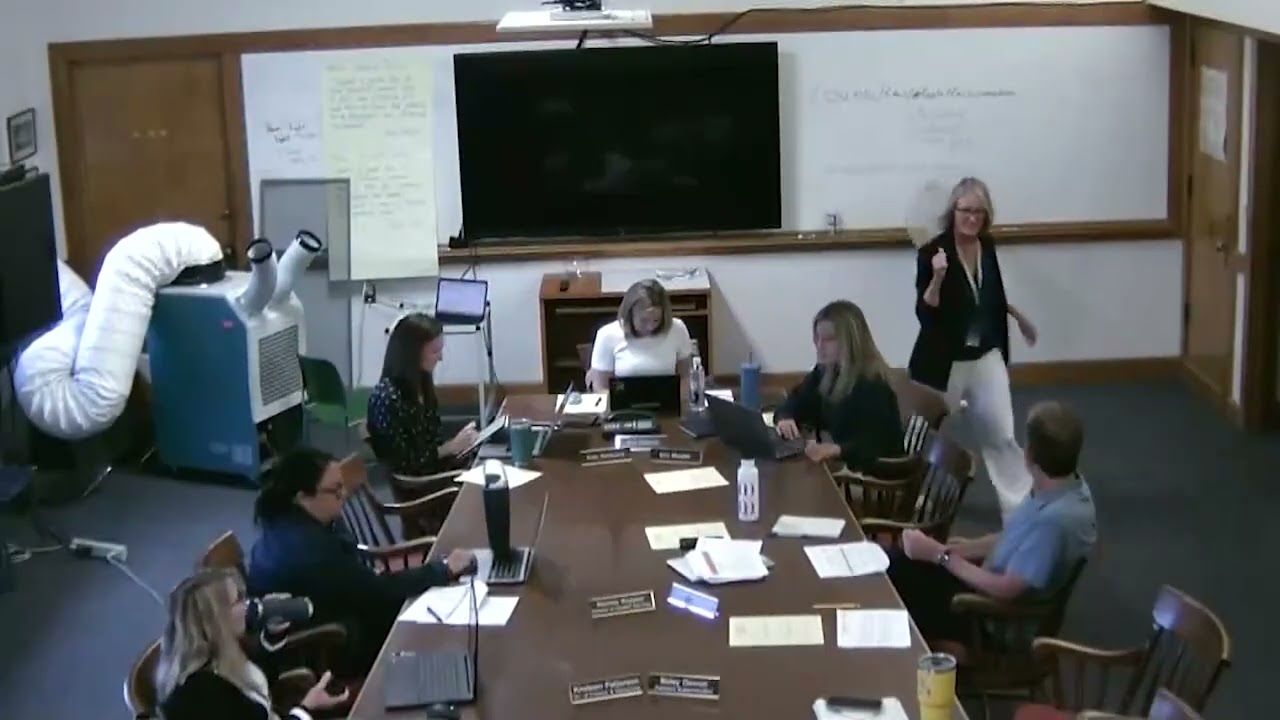
August 18, 2025 - School Committee
Erin Gibbons: Uh. welcome to
Wayland school committee meeting
on August 18. 2025. at 6:11pm.
we have um three of our school
committee members participating
in person. We have one school
committee member who is absent.
Christina Rodrigo. and we have
Betsy call in participating via
phone. Betsy. can you just
confirm you can hear us?
Betsy Cullen: Yes. I can. Thank
you. Erin.
Erin Gibbons: okay. and can
everybody hear her? Yes.
We have David Fleishman. Betsy Garvon. Bonnie and Kirstine.
Welcome to your first official meeting. and we are being recorded by WayCAM. Okay. Unknown: so we don't have
Erin Gibbons: anybody here for public comment. and nobody around the table would like to make public comment. Correct. Correct. Fabulous. Okay. With that. We want to jump right into 3.1 the post administrative council retreat. David Fleishman: Update. yes. good evening. everybody. This summer is almost over. not yet for our students little over a week to go and look forward to seeing our staff next Tuesday. hope to welcome them. So it was a few weeks ago we have a retreat. a leadership retreat every summer. where we focus on four important areas. Number one is team building. We always have new members of our team. This year. it was actually a small number compared to the past couple of years. It was just Kirstine. our director of finance and operations. and our happy hollow assistant principal. Donna Krekorian. So that was it. Everybody was back. and when we introduced ourselves. nobody had the first name of interim. which was the first in a few years. which is really good. So we focus on team building. We focus on leadership and learning. which we spend a lot of time on. That's the one thing we all have in common. The title of our retreat actually was leading in turbulent times. That was the theme. because we were certainly in turbulent times. and which puts additional pressures and stress on leaders. And then we spent a lot of time with what we're going to talk about next. reflecting on our goals and developing our goals for the next year. as well as developing our opening messages. You know. the start of school year is so important. and it's so unique being in education. It's the only field. really. where every I have worked outside of education. actually. just before I came here. And you know. you don't have that start in every career as those you know don't work in education. which is really unique. So really having a really good. positive opening and thinking about our messaging connected to our goals is really important. and we look forward to doing that next Tuesday. We're meeting with the principals tomorrow morning to talk about our opening in this this room about 26 hours from now. So we're. we're in good shape. The retreat was super helpful in terms of thinking about strategies we use to work with team members. reflecting on. you know. in this current environment. what are the pressures we face? Given just it's a really unique time. polarizing time. turbulent time. what are the implications for schools. implications for for leaders. and how we really bring people together and focus and address both the academic and social emotional needs of our students. and think about how to work with our adults. which is important part of the logic as well. So that was. that was our retreat in July at UMass Mount Ida. We enjoy going there very much for the second consecutive year. UMass Mount Ida. I might as well plug UMass. because they're good to us. Voted number one food in the country for colleges. and we very much benefit from that. At our retreat. we do plenty of exercise. You know. as you can imagine. we don't allow. I don't encourage. eating without lots of fitness. So we have people playing pickleball late in the day for the fall. First time as well. So that was. that was good. We had. we had fun and got a lot of good work done. Erin Gibbons: Do you do a like post retreat survey? David Fleishman: We do. as a matter of fact. we do evaluations. which we're happy to share with you. As a matter of fact we do. We do all our professional development. It's really important that we do evaluations and get feedback. So we're happy to share that as well. I mean. if we're going to spend. you know. two long days of our administrators time. if you think about that. in the middle of the summer. that's something that we really want to get feedback on. structure and all that. So we do. and we're. we're happy to share that great Erin Gibbons: okay. what did you think of your first retreat? Kirstie. it was Unknown: fabulous. I continue to express how great it was and how thorough and really far reaching and getting to be able to know my fellow colleagues. It was a great experience. It's good to hear. Erin Mueller: I think I'd like to share. And I asked. I asked the person if it was okay to share this that last year. these retreats do seem to be quite memorable among the staff. And one person mentioned that you offered a mini retreat last year because. as you mentioned. there were so many new administrators that you leverage that time to help set context and provide a little bit of background information and help prepare them. So when they entered the room at the retreat. they felt. you know. very comfortable and able to kind of jump in. And it's nice to hear that we had two new faces. and it sounds like you probably brought them in as well. And just in general. the feedback was. they're memorable. and then the team and the staff really enjoy them. So thank you for doing it. Thank you for all taking the time. It is probably two very long days. and much appreciated it has David Fleishman: been it's really important that remember we're in the business of learning. and we have to remember that our leaders who provide some of the work learning for our staff. and that's one of our goals as well. Aaron. is that some of the leadership work we do at the retreat. we then see implemented at our at the school level in terms of some of the practices. So we look forward to seeing some of that people take that and as a matter of fact. Kirstein had a retreat after our two day retreat. kirsteen had a retreat with her. My team operations team took some of the work we did last year and which we shared with her as part of the context setting at the start Unknown: team building and. you know. strategic goals for the year and just getting to know each other's work style. So I'm sorry this David Fleishman: group knows the best of me exercise. Which Kirsten did? We? Did have our school committee? Folks? Great. One of our one of our favorites. It's why I can never email Ronnie after nine o'clock.
Unknown: These are responsive. yes.
Betsy Cullen: these are things we learned Erin Gibbons: that's great. awesome. Betsy. since you're on the phone. I just want to give you the opportunity to ask some sessions or give any input. since you can't really see the visual cues right on the table. if you wanted to. Does
anybody have anything else on that? I
Erin Mueller: Okay. let's see that machines taking over your space. Did
Ronnie Kessler: not want to be in this room last week. I heard Unknown: it was a little
warm. So crazy. I buddy
behind me. Well. that was behind me. Oh. really. and I made them take it out.
pick it up first.
I Is it this? Yeah. you're not okay. Which is
David Fleishman: great. I'll give a real context while we're getting set up in terms of goals. So we worked on our goals at the retreat in teams. and then we worked Betsy and I worked after the retreat to kind of put them together and think about how we can integrate them all in terms of the goals. You all have seen our goals before. just just a little bit of context. Setting number one. not all the goals are new. As a school district have new goals every year. Is very hard for our staff. And you know. I'll give examples. If you think about our Student Services goals. we were clear a couple of years ago that we were going to make progress on goals over several years. We also need to think about pacing goals for our staff. which is really. really important so that they're realistic. Something else that's really important to note about goals. that time is such a factor in our work. and that what you see on the goals is where we expect to spend time this year. And we talk about time. We're talking about department meetings. faculty meetings. after school meetings. internal meetings. meetings with multiple stakeholders. There are some goals that were achieved last year. and there are some that are ongoing. and then. you know. we'll see some some new goals. There's plenty of work that is not listed here. but we really thought about where are we going to spend some time this year. given our we think about our capacity. We think about what are real needs of the district? What are needs of our students? What are needs of our staff? How do we partner with our with our community in new ways? So that's kind of the overview. And Aaron. I'm happy to stop at different times. or if people just want to jump in. whatever works. I mean. I like this more conversational. I don't like to talk for more than 10 minutes in a row. and so if anyone could cut me off before 10 minutes. or we'll figure out how to do that. because this might take a little longer. but I want to try to stay. stay global. So the first part. in terms of academic achievement. I want to talk about goals that will be at all levels in the coming year. We also work in teams. of course. at the retreat. So we have some goals that are specific to elementary. Certainly. we're going to talk about literacy. which is largely Elementary. We'll get to that in a second. but first in terms of broad goals. and some of these. for example. our portrait of a learner. which is what we talked about. a little bit about this table. as we think about our changing world. what our students are entering? The world they're entering. It isn't just AI that's one factor among many. What are the skills and experiences that kids are going to need. students going to need going forward. and where are we as a school district in providing that right now. what needs to be refined. what needs to change. this is a wonderful opportunity to also engage our community members. We plan to have some community meetings to get community feedback. speak some people in some different fields. and this could be we're working on the timing. We actually had a meeting today about this. It may be that this year. we collect a lot of the data. and next year. early in the year. develop kind of a plan to address that data. But certainly the data collection is really important. We think this is a really good way to engage our stakeholders this year. every year. we like a different focus with our stakeholders. So we'll be announcing. probably by the end of September. early October. some meetings to gather feedback about the Wayland public schools. about where people think. where we are in the work we're doing. and only the changing world and priorities. And will will gather a lot of that data and have a time frame. probably. probably in the fall last year. And again. I'm going to talk about areas that we're going to focus on. District wide. last year. our elementary educators had a wonderful professional development session with a renowned expert in the area of executive function. Sarah ward. Sarah has been doing this work for a long time. and it was one of those sessions where not only was there a high level of engagement. but immediately our elementary educators were implementing practices next week. next day in their classrooms. And it was incredible. Incredibly successful. The feedback was really positive. and the feedback was and again. Aaron. there were evaluations the same way there are with our summer retreat. Bring Sarah back because the practice. classroom practices are so important. the decision made as well. If we're bringing Sarah back. it would be wonderful to have consistent practices throughout the district. around executive function. So this year. Sarah will be working with educators across the district an executive function. Again. the goal is when there are classroom observations. to see some of those practices implemented consistently across the board. So I'm just going to point to kind of what we expect in terms of measure next. you heard an excellent presentation last spring from Sarah Sontag on elementary literacy. So this goal will not be a surprise. The goal is by May we want to determine you heard last May Betsy and the team gave an excellent presentation on elementary SEL curriculum after doing a thorough review. So what we're expecting is the same in terms of literacy. with a report based on educator feedback. student learning measures. there will be piloting from December to June. Remember. we talked about the piloting last year. and what was wonderful about the presentation last year. if you remember. in SEO. there was it was unanimous. That doesn't always happen. So we can't promise that. What we can promise is that we will have a very thorough review of literacy. materials. current practices. materials. and have a presentation to You in May.
So next. in terms of math. of course. this is an ongoing goal in terms of bridges. implementing all components of the third edition. the tier one and two levels. some of the concepts you can see there. and again. we will be focused on student progress. on bridges and formative assessments. Donna Gregorian. who's our assistant principal at Happy hollow. will also function as our elementary math coordinator in science. So that'll be a dual role. which we really hopeful. We haven't had that role filled in a while. so that'll be really good in terms of her leadership. She has a really strong background in coaching. We have an excellent new math coach at Happy hollow. actually. where Donna will be housed. but certainly she'll be working on all three elementary schools. Last year. you heard Deborah Romeo. Romeo talk about accountable talk. where students are going to be encouraged to speak with evidence about their learning across disciplines. something that administrators are committed to. You know. we think about students don't have as many opportunities as sometimes out of school to talk to the technology. which we'll talk about later. So encouraging students to have thorough discourse with evidence will be an important goal at the middle school. That's an ongoing goal that just started last year. that will continue this year. At the high school. the instructional leadership team. and when we think about initiatives at a high school. they begin with the department heads and others on the instructional leadership team to spend time learning about MTSS. universal design for learning. They're going to build an MTSS team and take a look at their current systems. Michaela Cohen. their excellent student services administrator with a lot of expertise in this area will play a major leadership role. And again. the goal is to strengthen the capacity and instructional leadership team who can then work with the rest of the faculty. And also. I should ask if my colleagues want to jump in on anything on this one. Betsy. please jump in and things I miss Unknown: on the MTSS. yeah. David Fleishman: anything on here that I if I'm Kate Sambuco: all right. David. yes. How would you so I'm looking to how all these could be measured. How would you measure. like. an increased capacity? What does that mean for you in this specific David Fleishman: no high school goal? It's really about so it starts with leadership in terms of the capacity of leaders. And Betsy is going to actually spend more time. Betsy and I were talking about this. So Betsy has served in terms of our own leadership capacity. Kate Betsy has really served as the elementary math coordinator of two years. So. So Don is going to take that over. which is going to give Betsy more time to work at the high school with the team. So that's going to be a bit of a leadership. I'm just giving that in terms of context. because we haven't as much capacity here because of the elementary demand. Betsy Gavron: So we just met with the with the high school team we can have ago. and they had spent the spring doing using the Department of Education's MTSS sort of readiness there's. there's a very long survey that has multiple components of it. And Michaela had met and did this survey with every single department head to sort of see where the readiness is what and to help to prioritize. So based on that. I think there's. there's a lot of room for growth in the leadership capacity in that. I just took an I had taken an UDL course. an MTSS course a few years ago. and I just took another one this summer. So I'll work pretty closely with Michaela in planning the work with our instructional leadership team. and so that they'll they'll be more skilled in and have a greater repertoire of strategies in terms of planning to make the learning really accessible. removing barriers wherever possible. So that's that will be the focus with the leadership team. and then then how do they bring that to their staff is the next step. Yeah. thank you. Yes. we've done a lot of MTSS work at the elementary levels and and that's pretty typical across school districts. I just got an assistant superintendents mail like. does anybody have a good high school model that they're willing to share because they're the structures are there. but the sort of owning of instructional practices around lesson designs are is just a little bit different at the high school level.
David Fleishman: So I mentioned AI earlier. We're now. you know. AI is still I did a fair amount of reading on AI this summer. AI is still. isn't in its infancy. We're talking about third year. So. you know. in this piece I read this summer. some of the questions were. which we start thinking about. It's like. what's our job as educators in a world disrupted by AI. and I think the jury's still out. and there's lots of discussion about. what should our role be as educators. and there's no magic formula right now. a lot of it is about just experimenting. thinking about. how can our students think more deeply? Using ai. ai can also help students think less deeply depending on how it's used. I really have to frame it that way. because that's just true. And how can AI help educators become better designers and facilitators of learning? Is another so there's a lot of it's so new. I remember when I was bringing students to a college library. when the internet was starting. we didn't have any idea how to use it. and it took a long time to figure it out. But we certainly want people piloting. implementing and this is kind of a time to experiment. but it's also time to experiment with our instructional technology specialist Wayland benefits from having instructional technology specialist in each building that in every district does who have really developed some expertise in this area. And what we want to do is really also create guidelines for what's appropriate use for students in figuring this out. And this is a collective effort. There's certainly a lot of attention on this right now. But again. I stress it's still in its infancy. When you think about how long this might be here and how it will shift. I Erin Gibbons: have a question. Yeah. backing up just a second. sure. Can you explain to me a little more about how the accountable talk at the middle school level ties back to the Academic Achievement Goal. because I would think that would tie more to the belonging
Betsy Gavron: really. about using academic language in discourse so they release. they read a book. I'm gonna forget the title right now. but it really talked about purposeful use of student talk across four different areas. One is around sort of belonging. connection. all of those pieces. and the other. Other areas are really around being able to sort of explain yourself well and make make arguments that are grounded in in evidence from text and evidence from a whole range of things. So really using talk for specific purposes. but it and the role that talk plays before you write. right before you're able to write well. you need to be able to sort of speak it well and and talk through those ideas you. In good strong talk makes your writing better. Erin Gibbons: So I'm coming back also to like measurability. How do we measure that? I understand we measure. yes. teachers are doing more PLC against it. But how do we measure kids using it more to increase their ability to support their thoughts in writing and in talk. Betsy Gavron: So I think you know the best way to do it is. are you seeing it when you're in classroom? Are you seeing teachers using the strategies that they learned last year to allow kids to sort of facilitate those kind of conversations and opportunities for conversations that are meaningful and needy. And then does that. I mean. then does it lead to better writing? Right? Like. it's hard to measure tightly in the way that we'd love to. but I think you know. are we seeing kids speaking more with purpose in classrooms which David Fleishman: are there. and also the our administrative administrators. and Deborah is a very strong instructional leader. and Courtney will spend a lot of time in their reflections with educators on this very topic as well.
Erin Gibbons: I guess no. do you mind if I just finish that one thought? Betsy. Betsy Cullen: it's a follow up on this. so we might be having the same thought. So you go for me. Okay.
Erin Gibbons: so I guess when I look at school goal area. one academic achievement. I see that as something we can really ground in data to measure it. not to undercut at all that you were just describing. But I feel like we could maybe put that somewhere else. where there i We might not need to. or want to see. like. hard data to back it up. I just that's hard for me. I'm having a hard time really tying that one to actual messaging Betsy Gavron: when you're in classrooms. I mean. you can certainly see classrooms where where the talk is is really purposeful and the level of discourse right? Kids can use all kinds of. you know. building on that idea and just the ways in which they're they're relating to. it looks qualitatively different in just different spaces. yes. so sort of increasing the quantity and the quality of the discourse is the goal. which is. again. talk is talk is harder to measure. David Fleishman: right then MCAT. I mean. MCAS data is different and obviously more measurable. I'm trying to think of another data point that's more measurable. Betsy question i readied. I'm trying to think of data can Betsy Cullen: I ask? Because I was thinking this. So first. I just want to level set. because we've talked a lot about the book accountable. and this notion of accountable talk in the middle school curriculum and teaching strategies around students expressive abilities to engage in talk and evidentiary support their positioning. and then have that translate to writing. Those are two separate things. right? We're using this capital a comical word in a few different schema. maybe. And I just want to make sure I am talking correctly. that these are two totally separate categorical Unknown: ideas. Erin Gibbons: I think. yes. least that's what I am understanding of Betsy. I
I mean. short answer is. yes. they're they're two different. Betsy Cullen: They're totally different. And then the second question is. why shouldn't we be playing this to gains in effective lighting? Right? That the Gabriel say is that if you can talk it. it will improve how you write it. right? So why aren't we tying the academic achievement gain through deployment and investment in this strategy to student improvement gains in effective Erin Gibbons: writing. right? And I that's basically you're saying the same thing that I was saying in maybe a more articulate way. because you're more articulate than I am. And I'm not sure what the answer is there. like. how do you but it's not really my job to solve that. I guess. So
Kate Sambuco: recently. went through last year's goals. and I compared last year's goals. To this year's goal. That I'm always looking for data. because we that's how we measure right? Every goal. I said. what kind of data could we find to to show progress or need for improvement? So this is a tricky one. but if there's. well. that's tricky. right? David Fleishman: I mean. I was thinking about writing. this is a trickier one than writing Patsy. Erin Gibbons: And I also think that I certainly appreciate that many of these goals are carry forward goals. and they're sort of like a benchmark for each year. I just don't see the benchmark here that we can kind of say. okay. and we've now. we're going to push it forward. understanding that there is. like. objective or subjective. really. like viewing that you could say. Oh yeah. you know. Deborah went in and she saw this classroom. and she saw that these. these classes. were really more engaging. And then. you know. it translated to the writing grades in English for that cohort that. you know. improved. or we saw him. you know. grades rise over the course of the year. but. um.
Betsy Cullen: freshman English teachers are seeing massive changes in how writers are entering high Betsy Gavron: school. So it might be interesting to sort of have a subset of the curriculum leaders come in in the spring and sort of talk about. you know. the ways in which these strategies have impacted. you know. the work that they're seeing from kids. I wonder if that would be a useful it'd Kate Sambuco: be helpful to hear that. because in the absence of concrete qualitative data that need something.
Erin Mueller: And I guess to piggyback on that. I think as long as I've been in the district. there's always been a focus on writing in the middle school. right? The Writing Center has always been a focus. and bridging that elementary school learner and writer into a high school reader. writer. literacy student. There's always this. this gap. And I think when my kids were in middle school or the oldest. there was a focus on like thoughtful debate and educated debate from the social studies class and the history class. Are we now kind of shifting that thoughtful debate into more of the social situations. like. what is that? Is that. what we're shifting here? David Fleishman: That question makes sense.
Erin Gibbons: Yeah. this is got. I think was the difference that Betsy was talking trying to get at. okay. basically. like. there's that separation of like being or holding accountable in your talk and then having like accountable discussions with the class that makes them root their. you know. statements or hypothesis in actual like evidence to build out support for their thoughts and ideas. which I think is Unknown: how and connects to your writing. right. right? Erin Gibbons: Which is what this David Fleishman: is support. yeah. and your questions. your questions are really good. and we can go back kind of to the middle school team and the curriculum leaders and think more deeply about this. because it's a very important goal. and your question about measurement is a challenge. It's not a reason not to have a goal because it is so important in this environment. but it's also worth thinking about what else we can do to measure and talk to the curriculum leaders about it. because they're certainly going to spend time on it based on the need that they see. and maybe Erin Gibbons: it's fleshing out what accountable talk looks like here. you know. versus like. accountable talk and more of a social type of setting just for the lay person. Betsy Gavron: Yes. I have the four just in another document. I'd have to look it up. but I'm projecting right now. so I can't pull it right the second. Erin Gibbons: yeah. so that that might help too to that's David Fleishman: helpful. we will get back. That's super helpful. Good Erin Mueller: questions. and Betsy is right. It's the lower case accountable versus the upper case accountable. I think that's throwing us all a little Unknown: bit. Yeah. yeah. yeah. okay. Did you
skip over the Yeah? Co teaching? No. we're getting to right now. Oh. okay. Betsy Cullen: so a little bit about
Wonderful to hear about the engagement and how positive the educators received their presentation last year. can you just share for the committee a little more insight into how we're going to see proof of concept of the increased adoption of these strategies. as we sort of. you know. repeat and expand our educators access to her classroom. you know. strategies and skills. And then I'm curious if this is the right way for me to think about it. But is there a future state where you might come to us and say. These are the student centered goal K through 12. around executive function that we as a district aspire to? And at this. Grade level students should be able to plan time. manage long term assignments. project. plan independently 20% of the time. 50% of the time. 80% of the time. like I just executive function. I think is a area of development and sort of opportunity and candidly. challenge that I hear from parents a lot. and I think some of my colleagues on the committee do as well. And I'm just curious how we think about where we need to march toward in future state. I think what you're including here as a goal is great next step. but like. where do we envision us as a district having accountable student centered goals around executive function development so that all of our students can succeed as well. How do we think about building Unknown: that architecture?
Kate Sambuco: And that might link back to your work in universal design. right? Because there's sometimes an assumption that executive function is just for one student. but it's really for all students. David Fleishman: right. which is why this is in general ed. very specifically the executive function and not special ed. because this should be for all students in terms of strategy. I just want Unknown: to be clear about again. in special ed. it shows up in special ed David Fleishman: differently. but this is also a general ed because the practices. all students benefit from these kind of tier one practices. so that that was the thinking behind it. Ronnie Kessler: go ahead lane. And I think you know from I've heard Sarah word many times. and it was nice to have a refresher again this year. I do think some of this is also about educating families on what is and is not developmentally appropriate for kids and what they are capable of doing developmentally. So I don't know if you've ever heard her speak. but it's very eye opening to say what we're expecting our kids to do is sit for 30 minutes and listen to a lesson when that's not the attention span of a child until. you know. a certain age. So I think that this is also executive functioning. also in some of the work that you know I'm doing in terms of my goal. as well as around kind of coming up with a list. not of just the skills. but also how they build on each other. and when you can see it. because I don't think it's fair to be holding kids to a standard that they're not developmentally ready to meet. and then saying. Oh. they need a goal in that area. on an IEP when developmentally they're not their brains aren't there. So I think it's around educating our staff and our families and our kids and all three is important. and to make sure that we're all on the same page and understanding the developmental levels and how they progress. Erin Gibbons: So should this tie back to. like a community focused goal I'm thinking. Kate Sambuco: or should we have a community book discussion or a community talk around I mean. CPAC has done this many times. Should. but CPAC is so narrow. I'm saying. Should this be something? We work on it this year with our educators and families. and then we take it farther. David Fleishman: right? I mean. we purposely made it general ed. which is not usually the way. you know. this was based. again. feedback we've gotten from families. as Betsy was saying as well. to make this a General. General Ed goal. as opposed to just a special ed go. So that is. that is a shift. because we think the strategies implemented will benefit everybody. and that's what lane is Ronnie Kessler: talking and they really. you know. in terms of. like. how it's measurable. it's very much. you know. Sarah Ward. we did a. you know. very excited to have her back. because we did the kind of like. it was like she was talking a mile a minute. And. I mean. but still. literally. you walked into classrooms the next day. and you saw her strategies. like she had this one around. don't just say. Go get your folders. but like point to So kids are seeing where they need to go. I happen to be observing in a classroom the next day and literally saw it. the teacher using it. So I do think that that is an area that we can see implementation pretty readily. you know. do done. I forget what it is. It's ready. Do done. That's. you know. something you can see. she's very much against. like. checklists. you know. and that's something that we often put in for kids. is checklist. And she's like. No. that's not. And she gives kind of other avenues to kind of get at that same goal of being able to keep kids on track. And I saw that in classrooms. So I think principals. curriculum leaders going through the classrooms and doing their observations and their walk throughs. you will see these things again. We know. in terms of just learning. kids are going to have to do this. it's not something that's just going to say. going to say. like. they're going to learn it one day and be like. Oh. great. I'm proficient. This is going to be generalization. Is obviously the last piece. But I do think it is something that is measurable. just in seeing it in classrooms and then talking to staff around. you know what? Because that is something we also. From Teachers quite a bit around. you know. attention and organization and looking for more tools. I know at Happy hollow. for instance. we ordered a bunch of materials for the guy. for the school counselors. and through Sarah Ward's cognitive connections that they can start implementing and even reinforcing in their small groups. So trying to hit it from a lot of different angles. does that answer any of your Erin Gibbons: questions? So I think that even there. like. I'm hearing ways that you could benchmark and like. show. like. to me. that's data. right? If you have 95% of all teachers have implemented Executive Session. Executive Session. executive functioning tools to help improve students. Right by it doesn't even have to be a buy. but like are using these from the PLC. And you know. 90% of the teachers are reporting that students are they're feeling like students are reaping the benefits of this. or whatever it is. And then maybe. you know. there is a piece in the community section that ties back to it. that there's at least some sort of communications that are going home. or some sort of. like. something that's done it back to school night. around executive functioning and like. tips and tricks. and maybe it is. don't make a checklist. Make this or but I think those are measurable. at least. like. those are things that you can say. Yes. we did this. even if you can't tie it back to. you know. a test score for a student. Betsy Gavron: little things they could do at home. Sarah was big. Like. what does. what does done look like? You know. you take your picture of your child who's already with all the things in their backpack. instead of making a list of all the things they need to do. they mentally prepare. like. what did you need to put in here? How much time did that take you all of those pieces. which are strategies that families can also implement. She does a beautiful Ronnie Kessler: she does a family. families. yeah. which we've done through C back. But again. that was the first time I Unknown: saw her. This Betsy Cullen: is so broad.
Ronnie Kessler: yeah. I do think it's 100% I think. and I think it is really eye opening for all parents to really see that developmental level piece. David Fleishman: And we know when our educators and our parents are learning the same. there's a much better opportunity for reinforcement. because this is unique. that we're taken to a larger level. beyond special ed. So we can take a look at the measurement again. to think about percentages. But certainly. you know the follow up principals were in classrooms and district administrators shortly thereafter. and saw the practices being implemented. which is the goal. Now. it's good. of course. hard to do. because the more you go to scale. but we really want to make that happen at all. at all levels. Erin Mueller: Yeah. Betsy. to your point earlier. it seems as though this could be. there could be a K to 12 vision with with these strategies. I mean. can't you all see that? I mean. just like. it is. no. I understand. Like. I can. I can see. I can now see that. Thank you for doing this. It feels like we're bringing back. like. the kid. right? We get to. like. focus on kids. being kids. and learning as kids. and learning all those critical things that we kind of forgot about him as kids. Like. sometimes I look at my 10 year old. I'm like. let's go. We got to go to football. We got to do. do this. we got to do that. And then. like he's done. he really just wants to sit down and play with. you know. play video games. or go outside and play and like you kind of. we all have to remind ourselves. and this effort feels like we're doing that. So thank Betsy Gavron: you. She's very clear. like they cannot developmentally plan for two weeks from now that that time frame is not something that they can wrap their heads around Erin Mueller: their world is now. right. the next two hours or whatever. Unknown: and it's way shorter than you think. Ronnie Kessler: The eye opening. yeah. David Fleishman: all right. so co teaching will kick off in about nine days. Ronnie had some professional development this summer. as a matter of fact. for our co teaching teams. this is general education. of course. because co teaching is in the general education classroom. the role of the special educator is different. There's tremendous collaboration. of course. and there's a lot of partnering and curriculum work. working together when. when co teaching is really working. You walk into a classroom and you don't know who the general ed teacher is and who the special ed teachers. That's that doesn't happen. but that's. that's what we would aspire to. And all students get what they need. academically and social. emotionally and certainly. you know. in terms. Terms of the achievement over time. our special education students are not you know. the grades look very different because students they're with a special education teacher and a special education teaching assistant all day in the classroom. So that certainly are there opportunities to look at data throughout the year and compare how we're doing. and it's going to be at all three all three schools. different grade configurations at each school. for a range of reasons. you also always need a cohort in the grouping factors is important. Erin Gibbons: What does that look like from a benchmark perspective at the end of this year to decide if we're going to keep going next year. Ronnie Kessler: So it's a couple of things. I think. in terms of the staff. you know. we have really good energy around it. It's very excited. We have the professional development two days. and then they also had another day to work with their teams. And they there's. you know. we have kind of. like a list of concerns or questions or and I talked about. kind of midway through the year. and then at the end of the year. having. bringing them all back together to talk about. kind of what's working and what's not working. and what. you know. this is your partnership. Like I always say is a marriage. but it's. you know. takes time to get to know each other. You're living together. you're you know. So to have kind of a mid year and an end of the year check in. we have a drive. a Google Drive for CO teachers. so they can share the resources we spent a lot of time around lesson planning and and what that looks like. And so resources to share. I think in terms of. you know. our basic progress monitoring that we do. I'm interested to see the growth that students make in comparing that to the growth previously. And then also. I'm interested to see the students perspective. You know. obviously first grade might be a little when they don't really have anything else. But. you know. a fourth and fifth grade. we can kind of get that student perspective as well parent perspective. But I think it's it's also what it looks like in September is going to be a lot different than what looks like in June as they teachers meld and kind of learn each other style. But I'm planning on. like two times to kind of check in and see how it's going. And also just monitor the growth of kids and the team chairs or special administrators. Naomi. and then we have Debbie Dixon doing the other two schools will really be closely monitoring at the IEP meetings as well around student growth and also monitoring the cohort. like as students become eligible. are there students who benefit from it? Are there students who've made a lot of progress and no longer need it? So that cohort. you know. not throughout the year. will be stagnant. but the following year would potentially change and be flexible. So that's also something that we'll be monitoring. Erin Gibbons: Can we bake in there some sort of. like. regular reporting on. like. almost quick check ins with like. or mid year with students families teachers. and. like. end of year. student families. teachers. just to kind of see. Ronnie Kessler: yeah. I forgot to also mention that we're working with aspire. and they're going to be coming monthly to kind of give us an outside perspective. kind of observe. doing some observations of different classes. and then giving feedback on what they're seeing and where we can grow. And I think that feedback will also be helpful. because it's an outside perspective. kind of giving. you know. from the outside. and they do this when a lot of other districts as well. So I think that's important. But yeah. we can certainly put in those Erin Gibbons: measurement. I just think it would be really helpful for everybody. right? Like. for those that are super supportive of it. yes. reaffirmed thoughts and feelings. For those that question it. hopefully it will reaffirm that this was the right decision. And if not look we can say it's not working in our district. and that's okay. Like. however. it turns out. I just think it's helpful to back up our decisions with something that's rooted in something tangible. instead of just getting the. you know. the word escape in my brain right now. it's Been going too long.
Subjective. no. but similar. no. candid. no. anecdotal. Unknown: anecdotal. thank you. Anecdotal feedback.
Erin Gibbons: I just feel like it. It's not like questioning what you guys are doing and. Really just giving us all something to point to that is tangible to provide. versus oh well. this is just best practice. Well. and look at the strides that have happened over the course of the year. Yes. parents are happy. There's no. you know. we're not going to make everybody happy 100% of the time. but I just think it's helpful. Ronnie Kessler: Yeah. I think so there's a. you know. something with the principals and the special ed measures. we can work together to kind of see the best way to measure it and develop. you know. and then be able to report that out. Kate Sambuco: In the spring. we heard a lot of staff enthusiasm. which was nice. yeah. over the summer. I've heard a lot of family enthusiasm. Good to hear. Erin Gibbons: It's exciting to see it. yeah. I mean. Ronnie Kessler: all new initiatives are. you know. come with a lot of it was. it was great to have everyone together. because I we spend some time with all the staff being like. Okay. well. what are your concern. you know. and. and then. you know what one person's concern was. another person didn't. So they were able to. kind of give them that feed. you know. talk to each other. We are able to. we were able to find money to give. get. buy some furniture for the room so that we can really have those small groups. So we got. you know. the kidney tables and some flexible seating. so the teachers feel good about that. that they have what they need in order to make it effective. Unknown: It's awesome. Good. great.
David Fleishman: All right. we talked about
so belonging. and. you know. we talked at the retreat a little bit. But. you know. in our current environment. belonging is a big issue depending. you know. if we think about immigrant students and students just being fearful of going to you know. in some cases. families rise in anti semitism. We know there's other issues that we face kind of in terms of belonging. and it's really important that we create inclusive and environments. And we talked a little bit about the concept of warm demanding. which is that you know. certainly want to hold very high expectations. but provide the right supports necessary for all students will continue. And you learned something last year about the restorative practices as well. which will will continue. and we will have our you heard. I know last year. Caroline Chithra was with Caroline. and who else was? Diversity. Equity belong one of the other facilitators. Elena Getty. Elena right was here talking about their work at the levels. That was a pilot year. One. we're happy to announce that we have a third year of funding in this area. which we just received last week. so that'll help us in terms of our professional development and building capacity. It's nice there's a lot of funding being withheld right now. I don't have to tell some of you. but this is one area. because it's state funding that we are able to continue and win a competitive grant. Erin Gibbons: So with that in mind. and I don't want to sound insensitive. however. is there any thought to potentially changing what we're using terminology wise. for Caroline's title. any of the language in here. David Fleishman: it's certainly something we talk you know. So here's what I would say. Aaron. I appreciate the question. You know. our Secretary of Education. Pat Tutwiler has talked. as has Governor Healy about in Massachusetts. stay the course. and we are a state that supports this work. We encourage you to do this work. I actually. even this morning. just had an exchange with our Secretary about this very issue. So you know. we're confident in the work. Our state supports this work. and so as long as our state leaders support this work and encourage us to do it. they're encouraging us to have this as part of our district goals. So that's what I would say. I think it very much depends in terms of education right now. You know. education is a state function and a local responsibility. and right now. our state leaders are certainly saying. keep doing this work. We want to and I talk about this next week. We want to make sure our students we're raising students who are empathetic. who are thoughtful. who are prepared to engage in a. Society. you know. in a democratic society. so that that's where we are. We'll certainly let you know if anything shifts. But that's what we're hearing from our state leaders. who. you know. we don't. we don't get a lot of federal funding. I think the attention is largely on higher education for the most part in non profits. So good question.
Erin Gibbons: Second comment is. I'm wondering if we should have a strategic action and or an outcome or measurement that reflects staff sense of an administration sense of belonging. and
David Fleishman: that's really. really important as well. Erin Gibbons: because we do include staff at the goal area. but not in David Fleishman: the chairs. That's very helpful. We'll add so last year. we initiated a non discrimination protocol. and that was a real focus. as you know. and a new initiative. And so we have analyzed the data. We had 81 incidents. We'll share the data at an upcoming meeting. I think that also should inform our practice in terms of what we do. Again. we're one district. but we do have data which we've collected. so we'll have presentation on that. in terms of our data. and what are the implications for our work? I think it's. you know. it's one. It was important to have a full year worth of data. but folks are using the protocol. We have lots of training on it. I think we talked a lot last year about why it's so important to handle these well and thoroughly. I mean. that was part of why we read the book accountable when rolling this out. because we know what happens when districts don't handle these incidents well. So we'll stay tuned on that. We'll report on that later on the fall. Sarah. Erin Gibbons: go ahead. I was just going to say. is there a way to flesh out these bullets to more closely align with the reporting data. like really tease them out a little bit more in the goal section. Yep. you're talking about like. it says. use patterns and trends identified through our non discrimination protocol reporting to target interventions accordingly. I'm just wondering if that could be a little bit more fleshed out.
And I know you guys are turning this around in a short amount of time. So I appreciate that. and I
Erin Mueller: do that. And I guess along the same lines. are there any goals or objectives of the grant that we need to meet that should be included as any of that called out or specific targets we need to meet with the the language in the grant. Betsy Gavron: in terms of so I think a lot of our the funding that we had earmarked is for some it for training. A lot of training for staff around continued restorative circle practices. We had two sessions this year. So we had a tier two training in June and a tier one training in June. And there were. there's more interest to do more training. so that's where a bunch of money is going.
David Fleishman: All right. we will shift to social. emotional.
So our next goal is pre K to five. implementing the way finder curriculum with fidelity. which you heard about last spring from the team again first year. and you can see there in terms of measurements resulting in reduction of office referrals. So there is something that is measured in every school. Yeah. I will caution it. of course. takes time. but there's a lot of support for the new curriculum. It was very much needed. and obviously. you know. families will hear more about over the course of the year. I know there's meetings coming up. Betsy Gavron: Yeah. I just met with at a pre meeting this morning. It'll be a training on the 27th our first day back the Wednesday. second day back for teachers and and then their first super Wednesday will be really devoted to that work with the entire elementary team in pre K.
Kate Sambuco: So way finder is K through five. pre K Unknown: through five. piloted. K through five. Pre K is jumping in. Kate Sambuco: What are we doing in the middle school? I mean. I know middle schoolers are just angels. But like. what kind of curriculum do we have? How does it align with way finder? How do they work together? What are we what do we have going on there right now. Betsy Gavron: So they have tag our teacher advisory group that meets every every Wednesday. So they have more homegrown curriculum. sort of developed around belonging. empathy. respect and trust. the four kind of values that they work through to develop and nurture there. whether they're interested in sort of seeing how successful it is in the elementary schools. and whether that would be a good match for what they're doing. I think they're leaning in the direction of the super store circle practices in tag is what they're focused on. And I know that the administrators are going to be sort of traveling from tag to tag to sort of model some of these practices. because they've all gone through two rounds of training in it to begin to think about the ways in which they use that with students for community building. So that's the direction I know Alison was interested in looking at at Wayfinders and going on a visit to see like they use it at the high school level in Natick. and seeing what that looks like. They also have a portrait of a learner. sort of component that they're just rolling out this coming year. I spoke with Erica down at our mas conference. She showed me a little bit of it. But you can really. once you've developed your portrait of a learner. there's a way to sort of align with collecting sort of evidence around some of the different capacities that you're working towards. sort of over time. So if you decide to do it pre K through 12. you can kind of pull those through lines. And even if you did it in different places. you could still gather evidence and data around those pieces. So certainly not. not going there right away. but we're investigating. We also want to see how it rolls out. Good Kate Sambuco: to know that the restorative practices is happening in tag. and I don't think that's maybe reflected in the goals. So I was Betsy Gavron: just saying this sure school goals. they're sort of is certainly in their school goal. I mean. every school has. you know. a whole list of things too. We can't pull them all into the district. so we kind of David Fleishman: that's helpful. So when our principals come to visit Fay. like later on November. you'll see their school goals. And what we kind of did was we have kind of broader language or brand new initiatives. They're going to get a lot of attention. like this one. but certainly in the middle school goals. which they worked on at the retreat. There's the tag goal there. Unknown: yes. and focus on those circle practices.
David Fleishman: All right. Should we just
Unknown: one quick
Betsy Cullen: notice we captured the revised cell phone policies about the middle school and high school. We talked about this before. Can we just update these to make sure that we are carrying that K through 12? But I know we did update the language and the family acknowledgements around devices at the elementary level. I just was Unknown: hoping we could reflect that in there as well. That's so the elementary is still no devices as it was before. included. including here. Betsy Cullen: yeah. in terms of consistency. because we did make changes around getting families. you know. updating their policy handbook and giving families to families and acknowledge no devices. and if there was going to be an exception to that. So I just saw it in both middle school and high school. called out specifically in this goal area. And my people can certainly disagree with me. My personal request would be that we have it reflected by something that's top of mind. and in service of social emotional development taken from the district
Kate Sambuco: and the table above. just quickly. what is the new high school attendance policy? So it says. implement new Wayland high school attendance policy. Betsy Gavron: So. So in previous years. they had had a if you're absent. like eight or more times in a quarter. you can be at risk of getting it after the class. failing the class. And rather than they're changing it the attendance policy to be based around the number of credits you get. So if you're if you get four credits for an English class and you're absent a certain number of times. you may lose credits.
We've worked on that with our school counsel over the course of this year. All right. I
David Fleishman: so Student Services. This is about program expansion from really 11th grade in terms of language base. This is strengthening Wayland high schools capacity language. we have an excellent middle school special education teacher who's moving to the high school. who has really strong background in this area to add to the team and the capacity. So we're excited about that. And Ronnie mentioned last spring. of course 18 to 22 year olds who will be able to serve in districts. These are students who would formally send out. but we have the capacity. and we have the van. That is the key. of course. because we want students having rich experiences in the community in terms of work and life skills. That's the goal. So that's that's pretty exciting down the road. Who knows? We may be able to take students from other places. but we don't do that in the first year of programs. We get programs together and then see if we can be people in kirstein's world really like that. You know. if you never get students to come in because we tuition them in. And Ronnie. you want to talk a little bit more about you started too. But we have the executive function because it's different in the Student Services goal than it is for the gen ed goals. just to be clear. Ronnie Kessler: Yeah. I mean. on many IEPs there are executive functioning goals. there are a lot of students. Elementary Secondary. who do get support in executive functioning and in hearing from parents and educators that you know. the curriculum and the measurability of that is often very challenging and the consistency and the kind of vertical alignment of that. So as we. you know. increase our capacity as a whole. in terms of our general education capacity. I also wanted to focus as the Special Education capacity. because there are. although. you know. there's a developmental level. There are students who have a disability and do require more intensive support in this area in order to make effective progress. And you know. we started last year. Sorry. I'm hearing a buzzing on the table. We started last year where our middle and high school teachers received training on a curriculum we started to implement that this summer. our high school teachers worked to even refine that even more and our middle school 6/6. grade as well. to refine that even more. So it's about so this. the focus of this goal is kind of to take that broader one and make sure that we're focusing on it in terms of special education as well. Because although it impacts everyone. it does impact a subset of students more. It has a bigger impact and making sure we're really providing quality instruction. data driven instruction. and we're measuring that that progress. and seeing the generalization Right? Like the whole goal of executive functioning is to be able to generalize those skills. So that is how it kind of meets that Academic Achievement Goal. Because we want to see the generalization in the general education classrooms. but we need the teachers in the general education classrooms to know how to support so it's kind of all interconnected. but we wanted a goal to focus and student services on it as well. Erin Gibbons: Is there a way that we can duplicate the progress monitoring tools that you develop there back into the Yeah? Ronnie Kessler: I mean. I think ultimately. yes. they would probably be modified. It a little bit. but. yeah. I. you know. I hate this phrase. but work smarter. So if we're. if we're doing it. let's. you know. it's like UDL. if it's working for students with disabilities. it can work for many students. A lot of this is just around accommodations. You know. Betsy was saying. in terms of. like a long term project. right? Like an accommodation is really to break that up and to really make it visual. Well. I'm sure there's everyone can benefit. and that's an important skill to teach students. especially as they go to college and they're not going to have they need to know so that they first. we need to break it up for them. then we need to teach them how to break it up for themselves. and that takes time. but eventually. that's the goal for students. so that when they get to college. they can manage these long term assignments. So yes. we can certainly.
Erin Mueller: So we'll. we'll be providing a little bit a lot more executive functioning support in gen ed. and then they'll almost double down in special education. It's going to follow kind of the same pathway with maybe strengthening some of those approaches. but they. I'm assuming. they're all completely aligned and dovetailed together. Ronnie Kessler: Yeah. And then also. you know. certain kids struggle in different areas more than others. and not every student with a disability. You know. there are some students with disabilities who have no executive functioning. Executive functioning. right difficulties at all. or. you know. more organized and have more skill level than. you know. myself. So we want to just make sure that we're really in terms of this goal. meeting the individual needs of the students and making sure that it's impacting them. You know. if it's a student who has difficulty with that long term planning that they're able to really. they're hearing the same message in math. They're hearing the same messages in science and social studies. And getting the same tools. It doesn't help to get a tool in math and then it's a completely different tool in social studies. Now I'm learning to it's. you know. so make sure that we have that uniform and that's work. uniform. consistency. Thank you.
David Fleishman: All right. community. two areas. In the coming year. we hope to engage families. I already mentioned portra of a learner. having some feedback sessions. which we're looking forward to. as well as engaging families in our facilities master plan. As a matter of fact. today was the deadline for our firms applying to for facilities master plans. and we're delighted. We had a very deadline was noon. We had 311 o'clock. and we've doubled that by noon. Okay. if you don't think people work hard till the end. So we're really excited about that. And you know. part of the process will be engaging the community. We have an excellent facilities master plan team made up of Betsy calling and a number of community members are excited. So we'll be announcing in the fall. when we'll engage the community that'll be later on during the during the winter. So those are our two areas. We think we have two excellent areas in order to engage the community this this fall. We also will have some new tools. Everyone got some power school information recently. there is a tool. We'll also be implementing parent square for two way multilingual communication. and we're going to transition to a new website. I want to thank Jenkins for all her PowerSchool work. our technology director. that has been just a huge lift.
Erin Mueller: Thank you. John.
Unknown: And David Fleishman: operational goals. the first one is the long term facilities plan. as I just mentioned. we're on our way to hiring a design and engineering firm. We will have a team evaluating proposals in the next couple of weeks. and the whole committee will review that. and then it's really about engaging the community in the process. and. of course. sharing. you know. a range of options with the school committee later on in the school year. and we'll certainly update the school committee as we go. We hope. at our meeting on September 10. to share a draft now. Aaron. we can review this draft of all the meetings for. like. almost the whole year. We've started mapping that out. because we have a lot of kind of standing topics we'll need this will certainly be one another topic that certainly we've spent a lot of time on this summer in terms of meeting with our town colleagues. is financial planning. given that the town is approaching the levy. Limit both short and longer term planning. A final decision will probably made by mid September about next steps there in terms of the shorter term. shorter term plan.
Erin Gibbons: I have a request. Yes. I want to add a call. David Fleishman: Absolutely okay. I just also just. just before we go. I do have to add this goal. because I will be in trouble if I don't. We have a new technology leader in the town and working closely integrating our team with fair. So these are really an important goal. We have two new. excellent leaders in this area as we think about just integration of systems and technology cyber security. I just want to acknowledge our goal is to have a really well coordinated school and town technology plan. That's just important. So I don't want to leave that off. Sorry about that. That's Erin Gibbons: okay. everybody. Go ahead. I want you to take that and duplicate it. to be collaborate with town facilities to improve alignment on shared building infrastructure. water infrastructure. service to our buildings. And I can't speak to what the situation was before I got on to the school committee. but I can say that I know there was a real breakdown in communication and shared efforts around facilities on the town side and the school side. and we'll leave that there. but I think we have the right people in place and a much more team focused team here that can achieve a much better plan of action for addressing our building principals needs. I would love for them to not have to worry so much about. like the day to day of those things. that'd David Fleishman: be fabulous. We were happy to have a goal. and I think we have a lot of people are really committed. Present company included Unknown: very specific on this goal. yes. so just a little bit about David Fleishman: Kirstine is going to report on her findings of her entry plan. if that to look forward to later on in the fall. Part of our entry plan has been meeting with all the principals asking about facilities needs. as well as meeting with Mike Faia intro public buildings. So when I met with Kirsten to talk about her goals and her in the first year. this goal was on. There. so you and I are the same page. Awesome. Erin Gibbons: Yeah. I think there's great staff across the board. and I just think it's maximizing communication. strengths. needs. abilities. etc. I am sure you are well positioned to excel and exceed this goal high Unknown: expectations. I really hope that I can get there. but that's every every effort definitely is part of this entry plan and what we've been communicating and working towards. So David Fleishman: I think mirroring what we just put for technology. it's like a good analogy. We wanted to state that so it's actually quite similar. The needs are similar. yeah. yep.
Betsy Cullen: So was it all that? All David Fleishman: right. happy to do that. Okay. thank you. Erin Gibbons: Betsy. Did you have anything you wanted to add on any of those? Sorry. Betsy Cullen: no. thank you. My last appreciate it and agree performance. both the technology and facilities for submissions. David Fleishman: Thank you. awesome. We will make our adjustments based on feedback.
Unknown: Short order. awesome. okay. okay. all
David Fleishman: right. oh. Aaron. because of the time pressures that some of our colleagues are under this evening. Erin Gibbons: I was just going to say. please feel free. I didn't know if Kirsten just had anything she wanted to highlight on the Consent Agenda. Not
Unknown: the agenda. just the committee's appointments for the newly David Fleishman: developed town capital. Erin Gibbons: Yep. that's on our perfect and there was one David Fleishman: other committee. It's the Erin Gibbons: Capital Improvement Planning Committee. and there's also the. well. we talked about it before. but we'll get there. Okay.
Unknown: Okay. thank you. Can I leave this to you? Sure? You
take a quick break.
Ronnie Kessler: No. it's for our idea grant. Oh. okay. that we got. I just have to submit this. Okay.
Unknown: Thank you. Thanks.
Erin Gibbons: Betsy. everybody's just kind of taking a quick bathroom break. and people are departing. Okay? I
Unknown: It always do.
Erin Gibbons: Let's see. I think I may take the consent agenda out of order. So if you have thoughts. I don't know if you want to take a quick Betsy Cullen: look at it while
Erin Gibbons: people are kind of not at the table. Betsy Cullen: Thank you. I have I had time before and I didn't have any questions. What
Kate Sambuco: was this she's going to she doesn't sorry. Erin Mueller: since this is the time we're looking at Christine's consent agenda. Erin Gibbons: I mean. we should just take it out of
Betsy Cullen: administrative point for me. I was used to
seeing meetings past AP for approval. and it shows us the change since last period. I didn't see that this time. I assumed that was because it was the first time we were seeing payments. I thought. I guess it wasn't. Because anyway. I'd really like to see those change since last period of change that was going to be permanent going forward. if there's reason.
Erin Gibbons: I would encourage you to send a direct email. and if you wouldn't mind copying me to Kirstine and just asking that question. and then I can make sure that the rest of the committee gets an answer. I hmm.
Unknown: he doesn't. Dale. oh. Dale AP. person. Erin Gibbons: okay. and copy. Dale. good. A coach as well.
G. G. u. d. e. J. K. O. went to Erin Mueller: school with their kids. Who's gonna say? How do you know.
Erin Gibbons: with that I would entertain a motion?
Erin Mueller: I'll make a motion to approve the Consent Agenda. Second. Erin Gibbons: okay. on No. okay. yes. Erin Yes. Betsy. yes. Erin Gibbons. yes. okay. I Erin Mueller: do we need Christine for the drafting of the annual report? Okay? Do. Oh. no. I think
Erin Gibbons: it was just lunch.
Unknown: Thank you kindly.
Betsy Cullen: I don't remember how you do this. Does somebody find somebody or we just record that I approved? No. you'll Erin Gibbons: go on the vote. but I'm not going to have you sign. because we only need three of us. Perfect. Hand them back over to Diane now so I won't forget them. And if you guys want to kick off 4.1 please feel free. Erin Mueller: Okay. 4.1 the 2024. 2025. Interim Superintendent annual evaluation. Hi. David. So it was just anecdotally great to hear there's a lot of overlap with last year's goals into this year's goals. I think a lot of the feedback that we have translates into some of the forward progress emotion that you're that you're making in 2025 so I'll set a little context here for you. The School Committee conducted. Dr Fleischman interest interim superintendents. annual review for the 2024 2025 school year. based on the DESE standards and prior practice by the school committee speaking directly with each of the district leaders and district administration team. The School Committee conducted more than a dozen interviews to evaluate both the district goals and the individual goals under your guidance. David. and if it sounds good to everybody. you all have in your folder the cumulative responses from each of these goals. both district wide and individual. to read. as well as a summary report for your just review and consideration. But I've taken a moment just to kind of summarize what some of those highlights are. so we don't have to go into them here at the table. but I'll read kind of that summary. If that sounds good to everybody. Over the course of the year. we've seen the district goals and David's individual goals come together under a clear and cohesive direction. You've established yourself as a strong. competent and visible leader who successfully reset the tone of our district. Your leadership is marked by both approachability and a willingness to engage staff. students and the community at all levels. including those difficult but necessary conversations that are helping to move our district forward. One of the district's priorities has been creating that space for an open dialog around challenging topics and bringing those topics to the forefront rather than allowing them to remain on addressed. This approach has helped. helped us to normalize productive and sometimes difficult discussions as part of our culture. Alongside this. David has consistently emphasized the importance of accountability at all levels and models how to confront resistance to change in a constructive and forward looking way across students and staff alike. And again. we saw that kind of reflected in your goals going forward. so we thought that was great. Through your leadership. the district is steadily developing and implementing the structures and tools needed to strengthen data decision making. data driven decision making. and these tools are improving our day to day operations. but will also shape our long term vision that connects the work across all the grade levels. By cultivating a genuine K to 12 perspective. David is helping the district to see itself as one cohesive system. rather than a collection of separate schools. The combination of vision setting. accountability and a cultural shift is laying the groundwork for our meaningful and lasting progress in Wayland. Through the school committee's observations. our interviews with district leaders and community member discussions. it is observed that the district is positioned to continue making gains and student achievement. professional collaboration and community trust. So again. I've shared the DEP personalized feedback with everybody in the collective interview. So if you want to see that unit shared in your folder. and at this point. what we typically do is open up for discussion on questions from you and questions from the committee. and then we will formulate the official response and ratings of the committee
Erin Gibbons: sound good to everybody. Do you Erin Mueller: have any questions for us? David Fleishman: No. that's helpful feedback. And I mean. I learned a lot from feedback. I thought our discussion earlier was super helpful in terms of getting feedback on goals. and as we try to refine goals. I thought that was really good example of school committee feedback. because I benefit a lot from that. as we all do. and we'll share it with our with our team members. No. I think that's helpful. And I think. you know. building a team you talked earlier about the retreat. I mean building a strong team is. Characterized by trust and open and honest communication and stability. That's one of our real goals. What I've noticed now is that we now have a more stable leadership team where we're able actually to follow through on goals. One of the real challenges in districts when there's not consistent leaders the goals. it's very hard to have consistent goals. and I think that's why I'm really hopeful. thanks to the really excellent team i i work with. Because this is. this is this is true teamwork that we that we need. So Unknown: thank you. excellent. Erin Mueller: So Aaron. do we want to go through any of these district goals here and share any comments or feedback? Or do you guys want to discuss your questions? Erin Gibbons: I leave that up to you guys. and just kind of how you guys want to discuss it. And if people have questions after seeing it. after reviewing it. I
Erin Mueller: I just. do you guys have questions? I mean. so for each of the goals. David. we gathered comments and feedback. areas of strength. areas for growth. Does he eventually see this. or do we share any of this. just at the table. right? Erin Gibbons: Yeah. we can do this is kind of like a funky one. because we did it sort of like in anticipation of doing one that complies with the DESE standards for next year. But it's like in the middle right now.
David Fleishman: like I benefit a lot from feedback. and what I tried to do is build it in so I can get feedback as I go from my colleagues in terms of areas of growth. because we all need to kind of improve. and that's why it's really helpful. I think some of the interviews that you do. I actually try to do the same. because oftentimes the best feedback we get is from checking with other people in the 360s and how we're doing. and that's really. really valuable. And I also think the context changes. which is why it's important to keep doing because what I realize is districts change issues happen. And so I appreciate what you do. because I think you modeling. You're like. kind of modeling. What I try to do. too is. which is get feedback. Like. when I talk to the new administrators. I tell them. you know. in the middle of the year. I'm going to do check ins. and then at the end of the year. because we don't always get like. I mean. you observe me in certain contexts. but not others. and that's my own experience with the people I work with. I can do observations. but I don't get to hear from people they work with most closely. which in some ways is the most for all of us who work is the most valuable feedback
Erin Mueller: that's safe. I Betsy. do we still have her? No. that's okay. Um. do Erin Gibbons: you want to give any feedback or sorry. no. go ahead. Aaron. I was just gonna say. Do you want to give any feedback? Do you have things you want to specifically call out for David? Do you have any thoughts on? Other than just what we're sharing verbally around the table. what we might want to provide. David.
Betsy Cullen: so there is a summary document that goes goal by goal. and I'm sort of trying to compile feedback. tried to reflect the composite. if you will. of all the committee members individual input. as well as that anonymized feedback. And to create one. definitely create that five factor waiting store vote for the district goals and also for big individual goals. And we had enough. we had enough observations of the people that were interviewed that we had sort of a bell curve of radius. And so we had food in that population where the large. the lion share. the top of that bell curve was in terms of where the average verbal improvement. whether it was some progress. not significant progress. So happy to pick through those. if it's helpful at the table. what we must blow and as we saw. the intent to discuss at the table was a final sort of proficiency around the four model competencies. Administrator competencies would definitely identify as the comments. So we can do that together. We certainly did gather input around those. But I think ultimately. great evaluation standards definitely intends for the committee to do things for the public. On like this that we could pick through. David. if it's helpful. and share with you for each goal. sort of. where the ratings fell. and a few areas of continued sort of where readings were. and then areas of continued opportunity that the feedback as the interview took. if folks very happy to do that. I think the document. the following document. is the well intended for the committee to review. And so I think there was also a decision anyway. for the committee to share with David. I thought he didn't appreciate seeing that positive feedback
Erin Mueller: as well. Yeah. I was thinking the same thing. Betsy. so Betsy Cullen: do you want me to take us through just a few highlights of that? It looks like. David. you're in the document. But I'm also happy in the public forum to take a few minutes Erin Mueller: to jump because it's in the folder.
Erin Gibbons: She thought the D was David. but it's you Diane in the document. Can he not see her? Right now? He's not sure. Unknown: Okay. David. I'm Erin Mueller: sharing it with you. David. well. thank you Erin Gibbons: so you have access. Excellent.
David Fleishman: There it is. yep.
Erin Gibbons: So we should be opening it either momentarily or right now. Betsy. if you want to kick off the discussion.
Betsy Cullen: So taking us through the district specific goals. the committee gave feedback and interviewed. as I said. other stakeholders. including your request. your direct reports. and that's all of the central office staff in the goal of academic achievement. Feedback was consistent but significant progress on that emphasis in terms of what we were looking at. more focus indicators around curriculum and data informed decision making. You will be very proud to hear that you observed as student learning being the North Star that you approach for leadership. You're highly visible in schools and in buildings. approachable and supportive. It is recognized throughout the feedback we received that you and assistant superintendent Jailyn work as a very strong team. and that's the USC partner. gathered a lot of instructional work and close collaboration with David areas of growth that we did here. And I think it's very encouraging that we heard a lot of consistency in areas of continued opportunity with corporations. where we can continue to get better around increasing data use and analysis. particularly at the middle and high school levels. So we heard a lot of praise for the work we've done to leverage more data driven decision making. particularly monitoring of student progress at the elementary level. and the desire to see if we can continue and expand on those trends in the other grades. It's nice to see the goal of our reading in the 2526 goals because adopting and tracking consistent reading instructions and making sure that we're focusing on literacy adoption and make particular transitions between elementary and middle and middle high schools that most students are getting sort of lost or detected early on. that was feedback that we earned as an area we can continue to hone our skills and get better at holding our staff to consistent high performance damages and balancing the need for autonomy with also a need for greater predictability and consistency in the district K through 12 is recognized as an opportunity for challenge and sort of evolution. as the ocean of the district comes under your purview. and as we get to a more solid footing. I think. as we saw that sort of tone has shifted. and that we've course corrected. a general sense of positivity. and I think also looking to really hard transition across all school buildings or something that we heard in feedback. I'll just say that overall. You were viewed as making strong and visible progress with next level focus on deeper data driven improvement. tighter accountability and equitable. high quality instruction for every student. And I think that that summary statement was a really nice way to end the 2425 Unknown: year old school. So. Kate Sambuco: I think I was really pleased to see the areas for growth do mirror the goals. David Fleishman: Yeah. that's what actually is I'm trying to do. So that's helpful. Erin Mueller: You'll see that a lot. Betsy. do you want to alternate or do you want Betsy Cullen: to keep going? If all of it doesn't bother you. all that you can't see me. I'm happy to just about Erin Gibbons: I just wanted to it's totally fine if you want to keep doing it. Betsy. I just wanted to chime in on this one is that I really think that two of the most frequent words that I can use to describe where the community on a whole would like to see growth. not just in you. but in the district At a whole. as a whole is consistency and accountability for all members of the community across the district. at all school levels. for all students. for all staff. So I think those are. those are the two things that I just like hear over and over again. and actually have used it in my own conversations when speaking to you know. administrators as a community member and not as school committee chair and Even as school committee chair around this table. So I think those are two things that I just would call out. It's here. but those are. like. definitely themes that can be applied across. like. every goal. every every venture. So I just wanted to add that. Erin Mueller: And Erin even that second bullet. adapting and tracking consistent. take out reading instruction and ensuring smoother transitions from middle to high school. I heard a lot of talk at the table tonight with the district goals and how some of the things we're implementing will help that transition along. We hear that too. I hear that often also.
Erin Gibbons: And I think when it comes to holding staff to higher performance standards. balancing recognition of teacher strengths with greater and greater accountability. I think that even just comes back to holding all staff to a consistent standard at the very least. And I do think that some of these things. and I apologize because this probably goes across the entire evaluation and not just specific to the school. but I think that you may have felt a little bit handicapped by the fact that your interim for some parts of this year and prior to that. and so I'm hopeful. and I did see. and I think we all saw you make change that wasn't necessarily always. you know. the Wayland way. but is the way that we should be moving. And so I hope that you feel empowered and emboldened and supported by all of us around the table on the entire community to really step in and and own the role. because you are no question. hands down. no longer an interim. no longer acting. and we're looking forward to that too. So I do want to acknowledge that. because I feel like that's a change. That's a shift for you. David Fleishman: Think about July. yeah. it is a different role. Erin Gibbons: yeah. So just acknowledging that for you. Okay. I'm done babbling. Kate Sambuco: That's great. That's great.
Erin Mueller: And you're right. that did kind of fold across the entire evaluation. Yeah. that's worth saying.
Unknown: Go ahead. That's sure. Area Betsy Cullen: two. belonging and equity. Say repeatedly. this is work that will never be done. which would always be a goal. This is the one area where we had sort of mixed feedback. but generally consistency in recognizing that there was progress made here and that we were moving in the right direction. And so I think that is really needed to our ears. This is the one goal. and you'll see a reflection of we really sort of had folks that between Sun progress and significant progress here. but we. Basically the authenticity with which you approach this work. phrases like he walks the talk at really seeing you lean into difficult conversations. Modeling that for other district leaders. were areas that came up repeatedly in the feedback that we received. which is really a credit to your
courage and conviction to this important work and to continue. and I think we heard that tonight. as we also saw the goals for next year. particularly that were identified were the introduction of community engagement around first anxious generation. And then. of course. our community wide and administration led code board honorable being your lossless in timeliness and communication in response to incidents of hate bias that we suffered in the district. and also really championing the DEP lead teacher work and encouraging us to seek funding for this important work. to continue teaching. and really championing it not as a nice to have. but as it must have within the district. I think areas of growth and opportunity. to me. really to be summed up as just the importance of doing more of this and to continue steadfastly with the work that that started this year. Any
comments or questions? No that?
Erin Gibbons: No. I kind of addressed this one around the goals in general. I don't have any other additional feedback there. Okay.
Betsy Cullen: great awareness. Again. consistent feedback. significant progress that's been made this year. Things that were caused out. called out specifically were again. community book discussions around the interest generation. accountability. which really brought into the spotlight some challenging areas of adolescent. mental elephant wellness. the impact of technology use. and also issues of equity and inclusion. and then the obviously social emotional learning curriculum are the case in size level. also recognized as a major one. coupled with the investment and excitement of the educators for adoption of late night or heading into this coming school year. areas of growth were really just a continuation looking at classroom practices and what we're doing with Middle and High School in future years. and how are we connecting some of these really important topics that we're seeing impacting adolescent mental health and wellbeing with what we're doing in the classroom. So I think certainly our wellness curriculum has tie ins there. Those are other areas of opportunity that we can explore in the coming years. around how to connect what's happening in our buildings and classrooms to some of those important impacts on our students and the other grades on the upper grades. and we'll say another thing to you. David is credited with make student Well being a visible district priority. with clear progress at the elementary level and strong community engagement. Betsy.
Erin Mueller: do you want to take a drink of water? And I'll jump into four. Four. How are you doing? Okay. and Goal number four. student services. I think this one we all took a step back and and re read it several times. because. again. the work here is never done. But the bottom line is that the goal is establishing and refining the district. District protocols. procedures and structures rated related to special education. So unanimously. there was just the feeling that significant progress had been made there. across the board. across every interview. that we are strengthening Student Services and working very closely with Ronnie Kessler and team to do that. And you know. super Assistant Superintendent Gavron. and we are really kind of digging in and getting to the benefit of improving that infrastructure for our special education. and we're starting to see that better outcomes for students and educators alike. So the shift to the building level special education administrators was highlighted as a major victory in the district. and again. supporting the staff and families has really provided that clear point of contact. contact that everybody had really been looking for and lacking. So thank you for bringing that to the table. They felt that the willingness to confront those problems directly refresh things like training and support for families is very. Clear and evident and much appreciated. Let's see here. obviously extending some of our programming. such as language based program through grade 11 was a victor I saw today. even going up through 12. So we're seeing that infrastructure and the constant review and evaluation and building it's ongoing effort. and it is seen along with the launch of the high school transition Life Skills Program for this coming fall. and preparing to roll out those co taught classrooms. which Ronnie spoke a bit about earlier. And we see that in our goals for next year. some areas for growth include the monitoring. and I think we talk a lot about that. How are we tracking trending and analyzing what we're doing and how we're how we're succeeding at that? And we want to see the impact of those recently implemented changes to be sure that they're achieving their goals. We think we're on the right path. Let's. let's prove it to ourselves that we are and find ways to continue to grow and maintain the consistency across it's easy to put it in. and we're seeing the stability of managing and monitoring it. but we want to see that consistency move forward and progress and then obviously translate down. down to the students. We believe that this positions us for long term success. And again. that was unanimous across the board. Everybody felt that we were well positioned to continue to grow in this area. But like others. the work is just never done. right? They overall. they felt your leadership in this area was proactive. collaborative and solution oriented. and we all feel we are in good position to move forward.
Kate Sambuco: The one goal area where I reviewed the goals from last year. I looked at the goals for this year. I looked through everyone's feedback. and I thought. whoa. It was incredibly proactive. I had a reaction of. Wow. this is big movement. So kudos to everyone involved in making this happen. because there was significant change. Just great. This is David Fleishman: a lot of team. a lot of teamwork in this goal. And I think the pacing has been. you know. I think even when we started. we said this was going to be a multi year effort. and then every year we're adding steps deliberately. and I think that's working because they're getting implemented. But it doesn't happen overnight. I hope you're noticing it every year. We're we're doing certain things differently. This might Kate Sambuco: be a goal area sometimes that feels slower than others. So I think it's positive that there's visible progress. I think families are seeing progress. and we can see the change. So I think it's a good thing Erin Gibbons: that personally would have rated you exceeded. On this one. I was just gonna say that 100% honest. like. I would put that as exceeded. because I think that that's. this is one area where. over. you know. yes. you stabilized. but also made so much significant progress. Like. to me. it's above and beyond. Kate Sambuco: It is very tangible. Yes. very tangible. yeah. Erin Mueller: And honestly. just going to comment Betsy Cullen: that this actually came in as met. and I would plus long changing that to exceed it. I fully support that. And there were certainly some feedback that ran across all of those. But I agree the momentum here on the beach. execution this year has been very aggressive. And I Erin Gibbons: think I was going to say that candidly. this area was so painfully in need of you to come in and put your thumb in and stop the bleeding. and you did such a fantastic job at assembling the right people. which I think is really inherent in your job. is to know where to go and who to hire. because if you don't have those people in place. you can't make the progress that you did. that all of you did. So I think. one. that's huge. and then two. to actually have made such a ginormous shift with the right people and the right planning that you were able to put in place to make such a positive impact in the past year is hit it out of the park. Thank you. It's the team David Fleishman: members deserve really a lot of credit. I think putting together the team. as you were saying. Aaron. and adjusting the team. like having Debbie come back in a certain role. that's such a big part of my job. actually. Erin Gibbons: it is truly like hiring is putting the David Fleishman: teams together. and that's why we're really hopeful in the coming year. with Debbie working with Naomi. and some of the co teaching and the commitment and the teamwork. it's a real credit. And I think. you know. Know. we're optimistic about the future too. especially. as you say. we gradually plan which is the way to the way to do it. Yeah. Erin Gibbons: Do you guys mind if I update this while I'm sitting here and we get exceeded. and we'll. Betsy Cullen: we'll score below. Erin Mueller: but I think there was kind of exceeded met significant progress. And the fear is we want the moment. Everybody wants the momentum to keep going. right? Like we don't want to ever be fully met or exceeded. because such great progress is being made all the time. But I think it's fair over this year. Erin Gibbons: right? Because there's always room to improve. but you can do that in next year's goals. Yes. right? Yes. David Fleishman: So we're going into new areas with with next year's goals. I mean. even piloting. you know. executive function in general education. that's something that's not usually done. It's more in special education. But we think. based on the feedback that we've heard and the way we pilot it with elementary that. we think so this is. again. this is all new. But then Ronnie is specifically working. which is the way really it should be. She's doing specialized training. executive function. but yet at the general edge. So right. yeah. there's a we. that's why we're going to take it up. Well. I always think you should have goals in this area. because it symbolizes that we always need to improve. Kate Sambuco: I think we've sat around this table and talked about different topics and said it would be nice if Wayland was a leader in X. Y and Z. I think we can say we're making steps. This is leadership in this area. So it's great.
Erin Mueller: Completely agree. All right. you changed it. yeah. Betsy. do I want to keep going. or do you want to flip it back.
Okay. community. ensuring communication is timely. responsive and inclusive of families and staff. to increase access. involvement. connectedness and trust. So again. unanimous across the district. we felt that you had thoughtful approach to Communication and Community Engagement. Leading the community book discussions. accountable and anxious generation really helped to introduce some of those difficult discussions and have community engagement around it. We saw initiatives such as the cell phone Working Group and facilities master planning. portraits of a learner. demonstrating your commitment to engaging stakeholders in those priorities that serve our students best. You have you recognize that there that our Boston based families need different levels of communication. You know. students are boarding busses at 5am there. they need communication on weather protocols. maybe the night before. a bit earlier in the morning. and just. you know. basic things like that. we've seen you go above and beyond to help communicate in ways that the recipient of that information receives the information in a timely fashion and the way they need it. and areas for growth expanding those communication strategies to make sure all families are receiving that information a way that they can parent David Fleishman: square in terms of. I hope you know. like. we agree. yeah. yep. Erin Mueller: So we're seeing that. We're seeing that those. those changes David through multiple channels. people want to receive information in different ways. Just the exploration of that is helpful enhance it. Let's see what else we have. Overall. Everyone felt that your approach to communication is viewed as transparent and timely and appropriately balanced. We understand that that is a balance. and it is a juggle. and we appreciate your thoughtfulness and in your responses. you with that level of response. you've created a lot of trust in the community and engagement. and we. you know. challenge you to continue to strengthen that. A few quotes from our evaluators that really demonstrated this was he's very visible and builds relationships one on one with families and community members. He's going to events. sports and engages with the districts. Districts. this is a Betsy word. extracurricularly and not just within the school day or building. You're incredibly responsive to leaders in our district struggling with issues and willing to get involved if needed. You're very smart and solution oriented. So those are just a few of the anecdotes and quotes from from the those that we've interviewed when I liked this one. spending time with the staff is an organic impulse from you. You're willing to communicate. and you want people to resolve things themselves. But if you need to get involved. you do. and that's those are things that we are hoping to see and received great feedback on. Anything to add. guys. I Erin Gibbons: would just add. with respect to communication with the community. I really appreciate that you're not just sending extra communications to send communications. I think you're extremely thoughtful about what. When and what and to whom. and so I really appreciate that that you do know like when you need to. and I think that that's well received in the community as well. David Fleishman: I've learned this era that in my role. because people get so much communication from the school. that it can be too much. and I stick to. like. certain concrete issues to communicate about at the district. and I find that they get read more and I get a better response. versus. like. kind of just operational issues. And so if you think that works in Wayland. every community is different. That's helpful feedback Erin Gibbons: for me. I think that. again. it also speaks to how far the district and community has come in their trust of you that they're not demanding more frequent communication. and that I think there is a level of respect for when a communication comes. it's something that's meaningful and purposeful. So at least that's my feeling. and I certainly appreciate that. And I think it speaks to. you know. good Juju in the community for you. that's helpful feedback. Thank you.
Betsy Cullen: This is one that I actually would have said met to progress that I face the general swell of positivity in response to your approach to community engagement. Communication has been a real seismic shift. Community Building.
Erin Gibbons: wholeheartedly. Oh. I just deleted it. You want me to answer David Fleishman: anyone? This is an area where I benefit from your feedback. And so. you know. this year. I've identified facilities which I think is a real need in the community. and portrait of a learner to get people involved in the education. So that's but we're totally open your last year I had something different. But every year. I choose a couple of topics that are meaty. that we want to do together. and I appreciate any feedback that you have. because you know the community so well. But I wanted to put them in the goals and get your feedback. because we know how important this goal is. Erin Mueller: I mean. personally. those two encapsulate everything that's on everyone's minds. You know. how are we advancing our students to the next generation of the workforce and learners? And they're doing better aging buildings. Personally. I think this is where all members of this community to suspend our money and our investment. our tax dollars. and those are the you know. where students are being educated is really at the forefront of what we all care about. right? You were going to say something
Erin Gibbons: and how they're being educated exactly the whole human that we're pushing out into the world Erin Mueller: with the portrait of the learner. right? Let's look at those people we're sending out and again Erin Gibbons: that they're getting a consistent message from the district on what we expect of them. So Okay. I just changed that to Matt Betsy Perfect. Thank you. Okay. Erin Mueller: this is a good table to be at now. when you say them out loud. right? You
Betsy Cullen: the final district goal was around operational improvements focused on management operations. The feedback from all interviews in the community collectively was towards this goal. the district continues to strive for progress in long range planning. obviously the adoption towards the end of the year of our planning group and the continued goal focus area around this in 2526 these are continued focus on this. But really. particularly. you're headed in the right direction. Under your leadership. you are noted for bringing experience. creativity. knowledge and intelligence. You were called out for building a phenomenal relationship with the town around financial planning and budgeting. and that that is seen as making creating momentum and change your experience and knowledge of budgeting and creative solutioning was called out by stakeholders. That's really. Be creating some of that least friction in budget seasons that the district has seen in recent years. So congratulations and kudos to you for that. I think areas of continued growth that came out were. in some respects. around ongoing. sort of day to day maintenance. and I also did some of the feedback here was a bit mixed. It may depend on stakeholders. because one of the interviewers shared that you are quick to respond. If you know of an issue. the response is immediate and that speed only happens. Quote. under really good leadership. End quote. things don't linger. It helps people to feel heard and respected and that you set yourself apart. There were some comments around facilities fixes taking longer than people would like. and so that's just something that we can continue to work on today. better at and I am confident that that's already top of mind for you and mercy.
Erin Gibbons: And I think some of that may be and it might just be you kind of reinforcing it with Kirstine and also with Michael. Michael. because some of it. I think. is truly like a lack of understanding of really. whose wheelhouse it falls in.
And I think that also then extends just because the high school is a kind of funky animal in and of itself. who's responsible for what there so I think clear lines delineating like clear lines of responsibility will go a long way. And then I think that if we can get the day to day custodial facilities piece also more on par that will take a big. like. chunk of time. and like a relief off of the Building Principles. David Fleishman: that's very helpful. and I think important to put in a goal. And also. you know. as I think of my goals this year. you know. with Susan's departure. Susan I worked very well together on both financial and operational issues. and that really helped in a lot of ways. in terms of building partnerships. And she understood the value of relationships. and it's really important we continue that. So that's something I'm working with. with Christine on. particularly around like. you know. the budget process. that we've gotten good feedback from our colleagues around the budget process in the district. and it's very important we continue that. that it goes smoothly. and that's all Trust is everything when it comes to that work. Erin Gibbons: Yeah. and I think again. that speaks to a lot of the stabilization that you've been able to create. because that was one of the things that was really broken. was the
teamwork between school and town side. and the trust there. And I think that's something you've definitely been able to rebuild. David Fleishman: Susan deserves a lot of credit. too. but you
she was it's so much of this is teamwork. and we were able to work together because we understand the trust with in town relationships is everything in terms of moving forward. And I think that is true in facilities and in finance. and we're at a time now we're actually Erin Gibbons: they go hand in hand. Yeah. absolutely.
Erin Mueller: Individual goals. Betsy. or is there anything we want to talk about collectively on the district side. we've gone through each of the district goals. Aaron. do you like the scoring there as significant progress on operational I could have Erin Gibbons: gone with Matt. because I think there was a lot of improvement. Where I got hung up is that it was focused on provide sustainable and up to date learning environments. which he's definitely made significant progress against. Part of it he was held up by the school committee. So M to learn. and it's also that's very specific. I know where I think on the broader aspect. it's definitely met. So you're working Erin Mueller: on it. I put that out to the table so motion. I mean. these things take time. We took the average of. kind of where everybody scored. Erin Gibbons: yeah. okay. I mean. I don't. I hope that David's not taking offense to any of this as to be that I. So you know. nothing's on. Matt. let's Erin Mueller: start with an individual goal where you exceeded the expectation. Why don't we do that. where you created the condition structures and collaborative support for Wayland school and district leaders to actualize their goals and school improvement plans. In general. we we observed. heard and. you know. garnered the feedback that you excel in creating conditions and structures in the collaborative environment necessary for school district leaders and students to. you know. learn and succeed in their roles as educators and learners. We recognize that last year. there was a tremendous amount of new district leaders and members of our team. You prioritized getting to know them. you know. providing them that context. that background information. giving space to learn and grow. while establishing really strong structures for that relationship building going forward. such as your retreats. which we heard more about today. we received really great feedback on those which continue to provide trust and collaboration across members of the team. So as Aaron is saying. you've created this environment where people feel. you know. safe to discuss. discuss feedback and grow grow as a team and educators. we heard things time and time again that. you know. your boots on the ground. Presence in school is very strong. and that builds a lot of trust across the district. The administrators in our schools feel very supported by you. They feel empowered and they're. you know. always willing to come to you and you offer them that feedback that they need. And we would like to see you continue to unify the leaders across the buildings. hold them accountable. provide that district flight leadership team and define a clear K through 12 vision. which we heard a lot about tonight. So we felt you exceeded that goal this year. By we. we mean everybody. everybody. collectively. Bets you want me to keep going. or do you want to jump in? Yeah. I can jump Betsy Cullen: in. But your individual goal that you establish on the second goal is to engage staff and families to continue to ensure access and relevant connectedness and trust. to make sure communication is kind of clear all the input that we received about your performance this past school year. you met. If that exceeded this. you place high priority on engaging staff. families and a wider community to build access involved in connectedness and trust. You clearly focused on communication to ensure that it was clear. consistent. inclusive and responsive to situations. especially in Congress. people perceived as being of crisis. And I think what was appreciated is that your thoughtfulness in knowing the audience to which you are communicating at any point in time. especially when that involves students in making sure that your communication is age appropriate and that it really enforces our shared district values. Staff and families consistently describe you as approachable. purposeful and supportive. which I feel Unknown: is meaningful to me and thank you again. Directly.
Betsy Cullen: all right? And the third goal is to cultivate an inclusive cultural belonging and opportunity for all students. staff and families. so they feel recognized and valued members of our school community again. feedback was that you met that inclusion goal. recognizing. as we already talked about tonight. the work order would be done. you model inclusivity in your leadership. style. your daily actions. and staff and families consistently highlight your relational leadership. your ability to know people personally. to be curious about them. listen deeply and invite others into all the work you don't shy away from challenges are seen as somebody who tries to
Unknown: bring others to the table to help solve problems. So solve
problems. Erin Mueller: Yeah. we can add the opportunities for growth. given that this is also next year's district goal. Unknown: I thought Erin Mueller: one area. an important area of growth. is continuing to support new leaders and staff who may may face resistance to change and share clear expectations. Erin talked a lot about that. and that's among staff. It's among students. families. etc. with stronger culture build. culture building and continued leadership development so that all men. Members of the Wayland school community feel recognized. valued and part of this unified. forward looking district. And again. work is never done. but that's an area of focus that was called out. I Kate Sambuco: think that's a really important one. because we had such a new team last year. but so much trust has been built. We also have a district with people have been here for a really long time. So there's a juxtaposition there between. what did you say. like the Wayland way versus the maybe the new way. or the way that we need to go. And I really want to make sure that we support this new team so they keep that trust and keep building that momentum. And really want to be here versus feeling discouraged. Erin Mueller: right? And to add to that. Kate. I think. you know. by being inclusive. we often. I think. expect people to kind of conform to the Wayland way. to the way that we're doing things. when. in reality. we really need to accept the differences and include the differences and learn. learn from those and embrace them. and that's different. I think those are two different things. and it's a work in Kate Sambuco: progress. But change is hard. and you have to be very vulnerable. right? Yes. talked about that before. So this is an important
Erin Mueller: one. okay. individual goal number four. or Did anybody have any questions on that? I should pause. Okay. Individual goal number four. address the challenging fiscal and facilities issues that currently exist in the district by partnering with both the school committee and town leaders. Aaron just said it. you have really brought all sides of our leadership together and sitting at a unified table. which has really helped to move these things forward. You're dedicated to addressing the fiscal and facilities challenges by building very collaborative relationships. As it says here.
it's been noted in quotes that the relationship between the town and the schools is better than they've ever seen it. creating your study and thoughtful approach to problem solving. which was a challenge in the past. and you've you've overcome that for us throughout the budget process. You balance fiscal responsibility with our educational priorities. ensuring that the decisions were very collaborative. transparent. And I mean. I can't. like. underscore these enough the transparency and minimally disruptive. disruptive to student learning. You were very consistent and clear in your communication. and. you know. with staff. family members and across the community. and you really were thoughtful and understanding what those trade offs were. and you you clearly laid those out for us and for other members of the community. and that was a difficult thing to do. and appreciated. You've been recognized for your strategic management. your innovation and your your nurturing of your partnerships and your relationships here at the table again with town officials across the schools and the town. which was greatly needed and appreciated. we look forward to continued progress that is built on sustaining these relationships and leveraging the Master Plan advisory group to help develop These long term solutions and help continue to ensure is that the right word both financial stability and high quality facilities for our students and staff. Erin Gibbons: I'd give that an exceed. That's just my personal chime in on that one as well. Because I think while there's always like we want that to continue. I really do feel like that's been completely exceeded.
Erin Mueller: We've heard that you've exceeded expectations. and people feel very lucky to work with you. Thank you. Let's change it. Erin. that must be fun. Okay? And so then the grid. the DEP. see grid. the overall evaluator assessment. This is what we purposely left blank. because this is what we understand is decided by the committee at the table. And then if you read below. there's just a little bit more comments and feedback which really summarizes what we talked about or things that that didn't necessarily fit in there. We hear things like. I think tremendous progress has been made this year. Anytime I face a dilemma. David's exceptionally strong. trustworthy thought partner. it makes being a principal less lonely. We hear that's a lonely. lonely position since your arrival. this person felt positive and supported. They're learning and growing. which is exciting but hard. the challenges are meaningful and normal. not tumultuous. Late for that word for me to get out.
Erin Gibbons: All right. so do we want to move to the model standards and setting those ratings? Yes. as a Erin Mueller: group. we do. do we want to ask David if he has any questions before we start that? Do we want to do that at the end? Erin Gibbons: I feel like it's been pretty inclusive. But would you like to add anything? David Fleishman: Yeah. no. this is helpful. and I'm matching it to the goal process about like for the next year. because this is very helpful feedback. I think you were saying. Kate. a bunch of them do line up like for next year. which is what I'm really thinking about. both when we've done our district goals. and then in September. when I do my individual goals. This is like. very good feedback in thinking about next steps. particularly. you know. kind of the balance between. kind of stabilizing and then moving forward. And. you know. finding that a lot of this job is about balance. you know. even the fiscal goal about. you know. I want to have fiscal responsibility and move forward. And. like. striking that balance as we plan is really important. So this is. like. well framed for me to help me my own goal. So I thank you for that great.
Erin Mueller: Thank you. Let's grid. Erin Gibbons: Okay. so instructional leadership district goals one. three and four are what tie to that Betsy Cullen: academic achievement at some social emotional curriculum and student Erin Gibbons: services. So it was significant progress on number one. number two. just so I'm just going to put them all here. I'm going to go with significant progress there too. Erin Mueller: And four is exceeded. I
Erin Gibbons: If anybody can chime in. I don't have to be though. I said. anybody feel free to chime in. I'm just making a note to myself on Betsy Cullen: Oh. I would say. given the success for him and they exceeded meeting the goal of student services In a year where you were in an interim capacity.
Kate Sambuco: Anybody else that one? I agree.
Erin Mueller: I agree. too.
I'll update it right now. Okay. although trying to figure out how to fill in the little box. yeah. it's not a drop down.
She's playing X. yeah. I mean. I was just going to give a word or something. okay. Erin Gibbons: management and operations. which is six. Erin Mueller: six. an individual four and Erin Gibbons: six is significant progress. and four is exceeded. I Unknown: think Erin Gibbons: I'd go with an exemplary there as well. Kate Sambuco: especially because we were torn on that six. yeah. the
Erin Mueller: feeling there and it was just the wording on the six that we were torn on. wasn't it? Unknown: Yeah.
Erin Mueller: you can't. we can't do that in one year. Yeah. I'm fine with exemplary too. I think it warrants. the feedback warrants and the progress warrants exemplary. Betsy Cullen: uncomfortable. I would sort of split between that. I think. contextually and very comfortable. defensive. Erin Gibbons: okay. family and community engagement. I would go with proficient Betsy Cullen: A second tip. Do?
Erin Gibbons: I agree that way. Yep. agreed. Professional culture. So two. one and three. that is a tricky one. I think
that's probably go with the exemplary. There's an exceeded a met. and a significant progress. which falls with the district. The two individuals go with exceeded and met. But I'm happy to go and listen otherwise.
Unknown: I hope that performance against this standard has been incorporated. given 50%
Betsy Cullen: new leaders Unknown: and the feedback that we heard.
Erin Mueller: I agree. I do okay. Unknown: there you go. Congratulations. David. David Fleishman: thank you for your thank you very. Good feedback. Appreciate it. Erin Gibbons: Do you want me to Unknown: save this Erin Mueller: in a PDF? Erin Gibbons: Yeah. should I like me to do that? Updating the date. 818. 25
Unknown: should I mean to do it? Sure. Go ahead. Erin Mueller: You updated the date. All right. I'll toss that in our folder. Erin Gibbons: Fabulous
Betsy Cullen: working dogs already replaced. just so there's no confusion in Erin Mueller: the folder. We sure can I'll remove all of those
Betsy Cullen: and put in on a PDF that we Unknown: can't remove document.
Erin Gibbons: Okay. okay. just make a new copy and make it final. All set.
Erin Mueller: It's been added in a PDF.
Unknown: Okay.
Erin Gibbons: all right. congratulations. Welcome to a team you can stop. I will have my goals for David Fleishman: you in because I always wait to. you know. we talk about district goals and then feedback from you. So I will have it either on the 10th of the 21 of the other. I'll get it in September. We're going to map out our meeting schedule. so I'll make sure time for that. Thank you. Thank you.
Erin Gibbons: So. all right. I'm hoping we can kind of briefly four point not to rush anyone. Betsy.
Betsy Cullen: I thought you might be Erin Gibbons: okay. So 4.2 2025. annual report. I think I did the last one. It's very templatized. It's easy to do. I'm fine with doing it. It needs to be submitted by the end of September. right? Yes. I thought so if you want. I'm happy to just make the draft and get it over to you guys before middle of September. and then we can get it submitted. Erin Mueller: Okay. does that work? Okay. that's great. Aaron. Thank you. Erin Gibbons: Aaron will draft and send. Aaron G will draft and send. Okay. Unknown: I so Erin Gibbons: I will plan to have that so that I can executive function myself.
Yeah. I'll try and have it for 910. if not for 924. it's okay. very templatized. So. okay. great.
Erin Mueller: Thank you. Jeannie and Susan probably. Unknown: hmm. for helping Erin Mueller: to create that template.
Erin Gibbons: It's the town they only accept certain and it's very fiscal focus. Okay. 4.3 so I just wanted to discuss. I know we talked. About this. I know there are emails that went back and forth. Did we get any?
Erin Mueller: No. we can resend it. Erin Gibbons: Okay. I'm wondering if. now that it's a little bit later in the does anyone know of anybody that might be specifically interested? Erin Mueller: Is this for the audit committee or Unknown: no. the capital we're Erin Mueller: looking for two. Yeah. but you're talking about capital. yeah.
Kate Sambuco: Just could we ask. like. our PTOs. who have started sending out communications for Yeah? Erin Gibbons: I mean. we can only get what we can get. so. yeah. see if we can get any. But I'm wondering if there's anyone that's anyways. I think I would say. think about it. See if you can reach out to anybody specifically and see if they're interested. That you think of when's your next long range building Planning Committee meeting. David Fleishman: we're gonna schedule that. Erin Gibbons: Okay? I'm asking because I'm wondering if. at the next one. you guys could put a plug in to say. hey. if there are other people that you people might know that would be interested in
Betsy Cullen: starting on David Fleishman: this targeting. Yeah. right. I think I'm pretty sure. I just want to make sure there was another meeting when not everybody could make the August. We're doing a Zoom meeting. August 26 at seven. So I will make a note. there's two meetings Betsy. then there's another one. as you know. Betsy Cullen: Yeah. there's an earlier one this week that I saw her to get David Fleishman: right? That's 7pm so we'll ask for one member. Erin Gibbons: Yeah. it's just one. They can't be a member of any other committee or board that's going to make any capital requests or suggestions to this committee. Okay. we will David Fleishman: bet. So you'll be at that meeting too. right?
Betsy Cullen: If we both say we're going to do David Fleishman: it. one of us will do it. and we're going to do that meeting remotely. Betsy. okay. I'm pretty sure Christina have to talk about that just to make sure we can get people because it's actually the day before school starts. So people may be out buying the last pair of new shoes.
Erin Mueller: And Aaron we is it worth checking in with the Select Board to see if they have I Erin Gibbons: think I did that okay. and I that's what I was searching for. But was Erin Mueller: anybody else? Erin Gibbons: Can we post that again. Diane as well. and put it out in school Unknown: messenger to all families in the district? It was like 2700 Erin Gibbons: people. just a tough time of year. I feel like. which is what's hard?
Yeah. I mean. I think we can try and put in. like. the town manager's monthly thing. and I think Unknown: Jailyn Put it in. I think yes. I asked her to. and she said she would. Yeah. Erin Mueller: Is it worth posting on like community forum or anywhere there Facebook? Unknown: And are you talking about the audit? I don't need Erin Gibbons: we need both. So I don't think Unknown: I only did the audit right. Erin Mueller: I think. no. I thought you had already done capital planning. Unknown: I only sent one message. and I believe that was the audit Erin Mueller: committee. We didn't do capital planning also before that. Aaron. Erin Gibbons: capital planning happened before that. I did. but audit committee that one also ready for that too. Erin Mueller: That also happened in July. But. yeah. I thought the capital planning happened well before Unknown: it was. it went with
Erin Gibbons: the the big building one it was.
Erin Mueller: I remember that a while ago. Let's. I'm gonna see if I can find it. Yes. we Erin Gibbons: need to get people for both.
There's less restriction on the audit committee.
Unknown: I. Campus is basically the same. or just adding on the Capital Planning Committee. Kate Sambuco: Yeah. the audit committee was in the town newsletter on August 4. Capital was Erin Mueller: not No. it wasn't
Erin Gibbons: no. but they Jailyn was putting things on the website about the Tom. website about CIPC.
Unknown: She was looking for things for September. I
Erin Mueller: saw that come out. Erin Gibbons: It doesn't really matter. because we didn't get any responses. So we just need to send someone to be interested. Erin Mueller: yeah. for both Erin Gibbons: of those seats. and it should be two different people. So Erin Mueller: want me to send Diane a new post? I'll send you a new post paper. All
Erin Gibbons: right? All right. I'm tasking you with getting those plastered everywhere and trying to find people. All right. All right. You were voluntary find Erin Mueller: someone great. Erin Gibbons: Okay. those are the two we got worried about. And then the 4.4 that was kind of just to be a discussion on the table to see if we thought we should update what was available on the website to go back to 2010 to when the laws changed. And that doesn't have to be a timely thing. because it's not a compliance thing. It was just a thought. I
Unknown: Okay.
Erin Gibbons: okay. we already did the consent agenda for oh one absent. And are there any matters not reasonably anticipated by the chair? Oh. David Fleishman: Aaron. one thing I wanted to invite you all to was our opening meeting for faculty and staff. Very nice. upbeat event. Love to see school committee members there if you're able. It is next Tuesday. Erin Gibbons: Are you looking for me to talk at it? Are you okay? David Fleishman: Be great. or. you know. we're optimistic about the year. It's love to have you all. It's if you arrive. it's eight o'clock breakfast. 7:45 and eight and then 8:15 will kick off. We'll be out of there by 9:15 at the school. So we'll run on time. We'll study some student music. Okay. some remarks. So love to have you there. Erin Gibbons: Do I have a choice? No. I'm kidding. Unknown: Well. I mean. I take Yes. okay. Betsy Cullen: think about that.
Unknown: Yeah. oh. I know we're not going to tell you either. Erin Mueller: Had to be there. Erin Gibbons: All right. anybody have that was a matter than antic. Anybody else have anything else? Betsy. Betsy Cullen: I'm good. Thank you. Erin Mueller: Hope you feel better. David Fleishman: Feel better. Betsy. Betsy Cullen: oh. thank you. Okay. I'm Erin Mueller: gonna make a motion to adjourn. Sure.
Erin Gibbons: Erin. yes. Erin Betsy Cullen: Yes. Betsy. yes. okay. Unknown: we are adjourned at 852.
We have David Fleishman. Betsy Garvon. Bonnie and Kirstine.
Welcome to your first official meeting. and we are being recorded by WayCAM. Okay. Unknown: so we don't have
Erin Gibbons: anybody here for public comment. and nobody around the table would like to make public comment. Correct. Correct. Fabulous. Okay. With that. We want to jump right into 3.1 the post administrative council retreat. David Fleishman: Update. yes. good evening. everybody. This summer is almost over. not yet for our students little over a week to go and look forward to seeing our staff next Tuesday. hope to welcome them. So it was a few weeks ago we have a retreat. a leadership retreat every summer. where we focus on four important areas. Number one is team building. We always have new members of our team. This year. it was actually a small number compared to the past couple of years. It was just Kirstine. our director of finance and operations. and our happy hollow assistant principal. Donna Krekorian. So that was it. Everybody was back. and when we introduced ourselves. nobody had the first name of interim. which was the first in a few years. which is really good. So we focus on team building. We focus on leadership and learning. which we spend a lot of time on. That's the one thing we all have in common. The title of our retreat actually was leading in turbulent times. That was the theme. because we were certainly in turbulent times. and which puts additional pressures and stress on leaders. And then we spent a lot of time with what we're going to talk about next. reflecting on our goals and developing our goals for the next year. as well as developing our opening messages. You know. the start of school year is so important. and it's so unique being in education. It's the only field. really. where every I have worked outside of education. actually. just before I came here. And you know. you don't have that start in every career as those you know don't work in education. which is really unique. So really having a really good. positive opening and thinking about our messaging connected to our goals is really important. and we look forward to doing that next Tuesday. We're meeting with the principals tomorrow morning to talk about our opening in this this room about 26 hours from now. So we're. we're in good shape. The retreat was super helpful in terms of thinking about strategies we use to work with team members. reflecting on. you know. in this current environment. what are the pressures we face? Given just it's a really unique time. polarizing time. turbulent time. what are the implications for schools. implications for for leaders. and how we really bring people together and focus and address both the academic and social emotional needs of our students. and think about how to work with our adults. which is important part of the logic as well. So that was. that was our retreat in July at UMass Mount Ida. We enjoy going there very much for the second consecutive year. UMass Mount Ida. I might as well plug UMass. because they're good to us. Voted number one food in the country for colleges. and we very much benefit from that. At our retreat. we do plenty of exercise. You know. as you can imagine. we don't allow. I don't encourage. eating without lots of fitness. So we have people playing pickleball late in the day for the fall. First time as well. So that was. that was good. We had. we had fun and got a lot of good work done. Erin Gibbons: Do you do a like post retreat survey? David Fleishman: We do. as a matter of fact. we do evaluations. which we're happy to share with you. As a matter of fact we do. We do all our professional development. It's really important that we do evaluations and get feedback. So we're happy to share that as well. I mean. if we're going to spend. you know. two long days of our administrators time. if you think about that. in the middle of the summer. that's something that we really want to get feedback on. structure and all that. So we do. and we're. we're happy to share that great Erin Gibbons: okay. what did you think of your first retreat? Kirstie. it was Unknown: fabulous. I continue to express how great it was and how thorough and really far reaching and getting to be able to know my fellow colleagues. It was a great experience. It's good to hear. Erin Mueller: I think I'd like to share. And I asked. I asked the person if it was okay to share this that last year. these retreats do seem to be quite memorable among the staff. And one person mentioned that you offered a mini retreat last year because. as you mentioned. there were so many new administrators that you leverage that time to help set context and provide a little bit of background information and help prepare them. So when they entered the room at the retreat. they felt. you know. very comfortable and able to kind of jump in. And it's nice to hear that we had two new faces. and it sounds like you probably brought them in as well. And just in general. the feedback was. they're memorable. and then the team and the staff really enjoy them. So thank you for doing it. Thank you for all taking the time. It is probably two very long days. and much appreciated it has David Fleishman: been it's really important that remember we're in the business of learning. and we have to remember that our leaders who provide some of the work learning for our staff. and that's one of our goals as well. Aaron. is that some of the leadership work we do at the retreat. we then see implemented at our at the school level in terms of some of the practices. So we look forward to seeing some of that people take that and as a matter of fact. Kirstein had a retreat after our two day retreat. kirsteen had a retreat with her. My team operations team took some of the work we did last year and which we shared with her as part of the context setting at the start Unknown: team building and. you know. strategic goals for the year and just getting to know each other's work style. So I'm sorry this David Fleishman: group knows the best of me exercise. Which Kirsten did? We? Did have our school committee? Folks? Great. One of our one of our favorites. It's why I can never email Ronnie after nine o'clock.
Unknown: These are responsive. yes.
Betsy Cullen: these are things we learned Erin Gibbons: that's great. awesome. Betsy. since you're on the phone. I just want to give you the opportunity to ask some sessions or give any input. since you can't really see the visual cues right on the table. if you wanted to. Does
anybody have anything else on that? I
Erin Mueller: Okay. let's see that machines taking over your space. Did
Ronnie Kessler: not want to be in this room last week. I heard Unknown: it was a little
warm. So crazy. I buddy
behind me. Well. that was behind me. Oh. really. and I made them take it out.
pick it up first.
I Is it this? Yeah. you're not okay. Which is
David Fleishman: great. I'll give a real context while we're getting set up in terms of goals. So we worked on our goals at the retreat in teams. and then we worked Betsy and I worked after the retreat to kind of put them together and think about how we can integrate them all in terms of the goals. You all have seen our goals before. just just a little bit of context. Setting number one. not all the goals are new. As a school district have new goals every year. Is very hard for our staff. And you know. I'll give examples. If you think about our Student Services goals. we were clear a couple of years ago that we were going to make progress on goals over several years. We also need to think about pacing goals for our staff. which is really. really important so that they're realistic. Something else that's really important to note about goals. that time is such a factor in our work. and that what you see on the goals is where we expect to spend time this year. And we talk about time. We're talking about department meetings. faculty meetings. after school meetings. internal meetings. meetings with multiple stakeholders. There are some goals that were achieved last year. and there are some that are ongoing. and then. you know. we'll see some some new goals. There's plenty of work that is not listed here. but we really thought about where are we going to spend some time this year. given our we think about our capacity. We think about what are real needs of the district? What are needs of our students? What are needs of our staff? How do we partner with our with our community in new ways? So that's kind of the overview. And Aaron. I'm happy to stop at different times. or if people just want to jump in. whatever works. I mean. I like this more conversational. I don't like to talk for more than 10 minutes in a row. and so if anyone could cut me off before 10 minutes. or we'll figure out how to do that. because this might take a little longer. but I want to try to stay. stay global. So the first part. in terms of academic achievement. I want to talk about goals that will be at all levels in the coming year. We also work in teams. of course. at the retreat. So we have some goals that are specific to elementary. Certainly. we're going to talk about literacy. which is largely Elementary. We'll get to that in a second. but first in terms of broad goals. and some of these. for example. our portrait of a learner. which is what we talked about. a little bit about this table. as we think about our changing world. what our students are entering? The world they're entering. It isn't just AI that's one factor among many. What are the skills and experiences that kids are going to need. students going to need going forward. and where are we as a school district in providing that right now. what needs to be refined. what needs to change. this is a wonderful opportunity to also engage our community members. We plan to have some community meetings to get community feedback. speak some people in some different fields. and this could be we're working on the timing. We actually had a meeting today about this. It may be that this year. we collect a lot of the data. and next year. early in the year. develop kind of a plan to address that data. But certainly the data collection is really important. We think this is a really good way to engage our stakeholders this year. every year. we like a different focus with our stakeholders. So we'll be announcing. probably by the end of September. early October. some meetings to gather feedback about the Wayland public schools. about where people think. where we are in the work we're doing. and only the changing world and priorities. And will will gather a lot of that data and have a time frame. probably. probably in the fall last year. And again. I'm going to talk about areas that we're going to focus on. District wide. last year. our elementary educators had a wonderful professional development session with a renowned expert in the area of executive function. Sarah ward. Sarah has been doing this work for a long time. and it was one of those sessions where not only was there a high level of engagement. but immediately our elementary educators were implementing practices next week. next day in their classrooms. And it was incredible. Incredibly successful. The feedback was really positive. and the feedback was and again. Aaron. there were evaluations the same way there are with our summer retreat. Bring Sarah back because the practice. classroom practices are so important. the decision made as well. If we're bringing Sarah back. it would be wonderful to have consistent practices throughout the district. around executive function. So this year. Sarah will be working with educators across the district an executive function. Again. the goal is when there are classroom observations. to see some of those practices implemented consistently across the board. So I'm just going to point to kind of what we expect in terms of measure next. you heard an excellent presentation last spring from Sarah Sontag on elementary literacy. So this goal will not be a surprise. The goal is by May we want to determine you heard last May Betsy and the team gave an excellent presentation on elementary SEL curriculum after doing a thorough review. So what we're expecting is the same in terms of literacy. with a report based on educator feedback. student learning measures. there will be piloting from December to June. Remember. we talked about the piloting last year. and what was wonderful about the presentation last year. if you remember. in SEO. there was it was unanimous. That doesn't always happen. So we can't promise that. What we can promise is that we will have a very thorough review of literacy. materials. current practices. materials. and have a presentation to You in May.
So next. in terms of math. of course. this is an ongoing goal in terms of bridges. implementing all components of the third edition. the tier one and two levels. some of the concepts you can see there. and again. we will be focused on student progress. on bridges and formative assessments. Donna Gregorian. who's our assistant principal at Happy hollow. will also function as our elementary math coordinator in science. So that'll be a dual role. which we really hopeful. We haven't had that role filled in a while. so that'll be really good in terms of her leadership. She has a really strong background in coaching. We have an excellent new math coach at Happy hollow. actually. where Donna will be housed. but certainly she'll be working on all three elementary schools. Last year. you heard Deborah Romeo. Romeo talk about accountable talk. where students are going to be encouraged to speak with evidence about their learning across disciplines. something that administrators are committed to. You know. we think about students don't have as many opportunities as sometimes out of school to talk to the technology. which we'll talk about later. So encouraging students to have thorough discourse with evidence will be an important goal at the middle school. That's an ongoing goal that just started last year. that will continue this year. At the high school. the instructional leadership team. and when we think about initiatives at a high school. they begin with the department heads and others on the instructional leadership team to spend time learning about MTSS. universal design for learning. They're going to build an MTSS team and take a look at their current systems. Michaela Cohen. their excellent student services administrator with a lot of expertise in this area will play a major leadership role. And again. the goal is to strengthen the capacity and instructional leadership team who can then work with the rest of the faculty. And also. I should ask if my colleagues want to jump in on anything on this one. Betsy. please jump in and things I miss Unknown: on the MTSS. yeah. David Fleishman: anything on here that I if I'm Kate Sambuco: all right. David. yes. How would you so I'm looking to how all these could be measured. How would you measure. like. an increased capacity? What does that mean for you in this specific David Fleishman: no high school goal? It's really about so it starts with leadership in terms of the capacity of leaders. And Betsy is going to actually spend more time. Betsy and I were talking about this. So Betsy has served in terms of our own leadership capacity. Kate Betsy has really served as the elementary math coordinator of two years. So. So Don is going to take that over. which is going to give Betsy more time to work at the high school with the team. So that's going to be a bit of a leadership. I'm just giving that in terms of context. because we haven't as much capacity here because of the elementary demand. Betsy Gavron: So we just met with the with the high school team we can have ago. and they had spent the spring doing using the Department of Education's MTSS sort of readiness there's. there's a very long survey that has multiple components of it. And Michaela had met and did this survey with every single department head to sort of see where the readiness is what and to help to prioritize. So based on that. I think there's. there's a lot of room for growth in the leadership capacity in that. I just took an I had taken an UDL course. an MTSS course a few years ago. and I just took another one this summer. So I'll work pretty closely with Michaela in planning the work with our instructional leadership team. and so that they'll they'll be more skilled in and have a greater repertoire of strategies in terms of planning to make the learning really accessible. removing barriers wherever possible. So that's that will be the focus with the leadership team. and then then how do they bring that to their staff is the next step. Yeah. thank you. Yes. we've done a lot of MTSS work at the elementary levels and and that's pretty typical across school districts. I just got an assistant superintendents mail like. does anybody have a good high school model that they're willing to share because they're the structures are there. but the sort of owning of instructional practices around lesson designs are is just a little bit different at the high school level.
David Fleishman: So I mentioned AI earlier. We're now. you know. AI is still I did a fair amount of reading on AI this summer. AI is still. isn't in its infancy. We're talking about third year. So. you know. in this piece I read this summer. some of the questions were. which we start thinking about. It's like. what's our job as educators in a world disrupted by AI. and I think the jury's still out. and there's lots of discussion about. what should our role be as educators. and there's no magic formula right now. a lot of it is about just experimenting. thinking about. how can our students think more deeply? Using ai. ai can also help students think less deeply depending on how it's used. I really have to frame it that way. because that's just true. And how can AI help educators become better designers and facilitators of learning? Is another so there's a lot of it's so new. I remember when I was bringing students to a college library. when the internet was starting. we didn't have any idea how to use it. and it took a long time to figure it out. But we certainly want people piloting. implementing and this is kind of a time to experiment. but it's also time to experiment with our instructional technology specialist Wayland benefits from having instructional technology specialist in each building that in every district does who have really developed some expertise in this area. And what we want to do is really also create guidelines for what's appropriate use for students in figuring this out. And this is a collective effort. There's certainly a lot of attention on this right now. But again. I stress it's still in its infancy. When you think about how long this might be here and how it will shift. I Erin Gibbons: have a question. Yeah. backing up just a second. sure. Can you explain to me a little more about how the accountable talk at the middle school level ties back to the Academic Achievement Goal. because I would think that would tie more to the belonging
Betsy Gavron: really. about using academic language in discourse so they release. they read a book. I'm gonna forget the title right now. but it really talked about purposeful use of student talk across four different areas. One is around sort of belonging. connection. all of those pieces. and the other. Other areas are really around being able to sort of explain yourself well and make make arguments that are grounded in in evidence from text and evidence from a whole range of things. So really using talk for specific purposes. but it and the role that talk plays before you write. right before you're able to write well. you need to be able to sort of speak it well and and talk through those ideas you. In good strong talk makes your writing better. Erin Gibbons: So I'm coming back also to like measurability. How do we measure that? I understand we measure. yes. teachers are doing more PLC against it. But how do we measure kids using it more to increase their ability to support their thoughts in writing and in talk. Betsy Gavron: So I think you know the best way to do it is. are you seeing it when you're in classroom? Are you seeing teachers using the strategies that they learned last year to allow kids to sort of facilitate those kind of conversations and opportunities for conversations that are meaningful and needy. And then does that. I mean. then does it lead to better writing? Right? Like. it's hard to measure tightly in the way that we'd love to. but I think you know. are we seeing kids speaking more with purpose in classrooms which David Fleishman: are there. and also the our administrative administrators. and Deborah is a very strong instructional leader. and Courtney will spend a lot of time in their reflections with educators on this very topic as well.
Erin Gibbons: I guess no. do you mind if I just finish that one thought? Betsy. Betsy Cullen: it's a follow up on this. so we might be having the same thought. So you go for me. Okay.
Erin Gibbons: so I guess when I look at school goal area. one academic achievement. I see that as something we can really ground in data to measure it. not to undercut at all that you were just describing. But I feel like we could maybe put that somewhere else. where there i We might not need to. or want to see. like. hard data to back it up. I just that's hard for me. I'm having a hard time really tying that one to actual messaging Betsy Gavron: when you're in classrooms. I mean. you can certainly see classrooms where where the talk is is really purposeful and the level of discourse right? Kids can use all kinds of. you know. building on that idea and just the ways in which they're they're relating to. it looks qualitatively different in just different spaces. yes. so sort of increasing the quantity and the quality of the discourse is the goal. which is. again. talk is talk is harder to measure. David Fleishman: right then MCAT. I mean. MCAS data is different and obviously more measurable. I'm trying to think of another data point that's more measurable. Betsy question i readied. I'm trying to think of data can Betsy Cullen: I ask? Because I was thinking this. So first. I just want to level set. because we've talked a lot about the book accountable. and this notion of accountable talk in the middle school curriculum and teaching strategies around students expressive abilities to engage in talk and evidentiary support their positioning. and then have that translate to writing. Those are two separate things. right? We're using this capital a comical word in a few different schema. maybe. And I just want to make sure I am talking correctly. that these are two totally separate categorical Unknown: ideas. Erin Gibbons: I think. yes. least that's what I am understanding of Betsy. I
I mean. short answer is. yes. they're they're two different. Betsy Cullen: They're totally different. And then the second question is. why shouldn't we be playing this to gains in effective lighting? Right? That the Gabriel say is that if you can talk it. it will improve how you write it. right? So why aren't we tying the academic achievement gain through deployment and investment in this strategy to student improvement gains in effective Erin Gibbons: writing. right? And I that's basically you're saying the same thing that I was saying in maybe a more articulate way. because you're more articulate than I am. And I'm not sure what the answer is there. like. how do you but it's not really my job to solve that. I guess. So
Kate Sambuco: recently. went through last year's goals. and I compared last year's goals. To this year's goal. That I'm always looking for data. because we that's how we measure right? Every goal. I said. what kind of data could we find to to show progress or need for improvement? So this is a tricky one. but if there's. well. that's tricky. right? David Fleishman: I mean. I was thinking about writing. this is a trickier one than writing Patsy. Erin Gibbons: And I also think that I certainly appreciate that many of these goals are carry forward goals. and they're sort of like a benchmark for each year. I just don't see the benchmark here that we can kind of say. okay. and we've now. we're going to push it forward. understanding that there is. like. objective or subjective. really. like viewing that you could say. Oh yeah. you know. Deborah went in and she saw this classroom. and she saw that these. these classes. were really more engaging. And then. you know. it translated to the writing grades in English for that cohort that. you know. improved. or we saw him. you know. grades rise over the course of the year. but. um.
Betsy Cullen: freshman English teachers are seeing massive changes in how writers are entering high Betsy Gavron: school. So it might be interesting to sort of have a subset of the curriculum leaders come in in the spring and sort of talk about. you know. the ways in which these strategies have impacted. you know. the work that they're seeing from kids. I wonder if that would be a useful it'd Kate Sambuco: be helpful to hear that. because in the absence of concrete qualitative data that need something.
Erin Mueller: And I guess to piggyback on that. I think as long as I've been in the district. there's always been a focus on writing in the middle school. right? The Writing Center has always been a focus. and bridging that elementary school learner and writer into a high school reader. writer. literacy student. There's always this. this gap. And I think when my kids were in middle school or the oldest. there was a focus on like thoughtful debate and educated debate from the social studies class and the history class. Are we now kind of shifting that thoughtful debate into more of the social situations. like. what is that? Is that. what we're shifting here? David Fleishman: That question makes sense.
Erin Gibbons: Yeah. this is got. I think was the difference that Betsy was talking trying to get at. okay. basically. like. there's that separation of like being or holding accountable in your talk and then having like accountable discussions with the class that makes them root their. you know. statements or hypothesis in actual like evidence to build out support for their thoughts and ideas. which I think is Unknown: how and connects to your writing. right. right? Erin Gibbons: Which is what this David Fleishman: is support. yeah. and your questions. your questions are really good. and we can go back kind of to the middle school team and the curriculum leaders and think more deeply about this. because it's a very important goal. and your question about measurement is a challenge. It's not a reason not to have a goal because it is so important in this environment. but it's also worth thinking about what else we can do to measure and talk to the curriculum leaders about it. because they're certainly going to spend time on it based on the need that they see. and maybe Erin Gibbons: it's fleshing out what accountable talk looks like here. you know. versus like. accountable talk and more of a social type of setting just for the lay person. Betsy Gavron: Yes. I have the four just in another document. I'd have to look it up. but I'm projecting right now. so I can't pull it right the second. Erin Gibbons: yeah. so that that might help too to that's David Fleishman: helpful. we will get back. That's super helpful. Good Erin Mueller: questions. and Betsy is right. It's the lower case accountable versus the upper case accountable. I think that's throwing us all a little Unknown: bit. Yeah. yeah. yeah. okay. Did you
skip over the Yeah? Co teaching? No. we're getting to right now. Oh. okay. Betsy Cullen: so a little bit about
Wonderful to hear about the engagement and how positive the educators received their presentation last year. can you just share for the committee a little more insight into how we're going to see proof of concept of the increased adoption of these strategies. as we sort of. you know. repeat and expand our educators access to her classroom. you know. strategies and skills. And then I'm curious if this is the right way for me to think about it. But is there a future state where you might come to us and say. These are the student centered goal K through 12. around executive function that we as a district aspire to? And at this. Grade level students should be able to plan time. manage long term assignments. project. plan independently 20% of the time. 50% of the time. 80% of the time. like I just executive function. I think is a area of development and sort of opportunity and candidly. challenge that I hear from parents a lot. and I think some of my colleagues on the committee do as well. And I'm just curious how we think about where we need to march toward in future state. I think what you're including here as a goal is great next step. but like. where do we envision us as a district having accountable student centered goals around executive function development so that all of our students can succeed as well. How do we think about building Unknown: that architecture?
Kate Sambuco: And that might link back to your work in universal design. right? Because there's sometimes an assumption that executive function is just for one student. but it's really for all students. David Fleishman: right. which is why this is in general ed. very specifically the executive function and not special ed. because this should be for all students in terms of strategy. I just want Unknown: to be clear about again. in special ed. it shows up in special ed David Fleishman: differently. but this is also a general ed because the practices. all students benefit from these kind of tier one practices. so that that was the thinking behind it. Ronnie Kessler: go ahead lane. And I think you know from I've heard Sarah word many times. and it was nice to have a refresher again this year. I do think some of this is also about educating families on what is and is not developmentally appropriate for kids and what they are capable of doing developmentally. So I don't know if you've ever heard her speak. but it's very eye opening to say what we're expecting our kids to do is sit for 30 minutes and listen to a lesson when that's not the attention span of a child until. you know. a certain age. So I think that this is also executive functioning. also in some of the work that you know I'm doing in terms of my goal. as well as around kind of coming up with a list. not of just the skills. but also how they build on each other. and when you can see it. because I don't think it's fair to be holding kids to a standard that they're not developmentally ready to meet. and then saying. Oh. they need a goal in that area. on an IEP when developmentally they're not their brains aren't there. So I think it's around educating our staff and our families and our kids and all three is important. and to make sure that we're all on the same page and understanding the developmental levels and how they progress. Erin Gibbons: So should this tie back to. like a community focused goal I'm thinking. Kate Sambuco: or should we have a community book discussion or a community talk around I mean. CPAC has done this many times. Should. but CPAC is so narrow. I'm saying. Should this be something? We work on it this year with our educators and families. and then we take it farther. David Fleishman: right? I mean. we purposely made it general ed. which is not usually the way. you know. this was based. again. feedback we've gotten from families. as Betsy was saying as well. to make this a General. General Ed goal. as opposed to just a special ed go. So that is. that is a shift. because we think the strategies implemented will benefit everybody. and that's what lane is Ronnie Kessler: talking and they really. you know. in terms of. like. how it's measurable. it's very much. you know. Sarah Ward. we did a. you know. very excited to have her back. because we did the kind of like. it was like she was talking a mile a minute. And. I mean. but still. literally. you walked into classrooms the next day. and you saw her strategies. like she had this one around. don't just say. Go get your folders. but like point to So kids are seeing where they need to go. I happen to be observing in a classroom the next day and literally saw it. the teacher using it. So I do think that that is an area that we can see implementation pretty readily. you know. do done. I forget what it is. It's ready. Do done. That's. you know. something you can see. she's very much against. like. checklists. you know. and that's something that we often put in for kids. is checklist. And she's like. No. that's not. And she gives kind of other avenues to kind of get at that same goal of being able to keep kids on track. And I saw that in classrooms. So I think principals. curriculum leaders going through the classrooms and doing their observations and their walk throughs. you will see these things again. We know. in terms of just learning. kids are going to have to do this. it's not something that's just going to say. going to say. like. they're going to learn it one day and be like. Oh. great. I'm proficient. This is going to be generalization. Is obviously the last piece. But I do think it is something that is measurable. just in seeing it in classrooms and then talking to staff around. you know what? Because that is something we also. From Teachers quite a bit around. you know. attention and organization and looking for more tools. I know at Happy hollow. for instance. we ordered a bunch of materials for the guy. for the school counselors. and through Sarah Ward's cognitive connections that they can start implementing and even reinforcing in their small groups. So trying to hit it from a lot of different angles. does that answer any of your Erin Gibbons: questions? So I think that even there. like. I'm hearing ways that you could benchmark and like. show. like. to me. that's data. right? If you have 95% of all teachers have implemented Executive Session. Executive Session. executive functioning tools to help improve students. Right by it doesn't even have to be a buy. but like are using these from the PLC. And you know. 90% of the teachers are reporting that students are they're feeling like students are reaping the benefits of this. or whatever it is. And then maybe. you know. there is a piece in the community section that ties back to it. that there's at least some sort of communications that are going home. or some sort of. like. something that's done it back to school night. around executive functioning and like. tips and tricks. and maybe it is. don't make a checklist. Make this or but I think those are measurable. at least. like. those are things that you can say. Yes. we did this. even if you can't tie it back to. you know. a test score for a student. Betsy Gavron: little things they could do at home. Sarah was big. Like. what does. what does done look like? You know. you take your picture of your child who's already with all the things in their backpack. instead of making a list of all the things they need to do. they mentally prepare. like. what did you need to put in here? How much time did that take you all of those pieces. which are strategies that families can also implement. She does a beautiful Ronnie Kessler: she does a family. families. yeah. which we've done through C back. But again. that was the first time I Unknown: saw her. This Betsy Cullen: is so broad.
Ronnie Kessler: yeah. I do think it's 100% I think. and I think it is really eye opening for all parents to really see that developmental level piece. David Fleishman: And we know when our educators and our parents are learning the same. there's a much better opportunity for reinforcement. because this is unique. that we're taken to a larger level. beyond special ed. So we can take a look at the measurement again. to think about percentages. But certainly. you know the follow up principals were in classrooms and district administrators shortly thereafter. and saw the practices being implemented. which is the goal. Now. it's good. of course. hard to do. because the more you go to scale. but we really want to make that happen at all. at all levels. Erin Mueller: Yeah. Betsy. to your point earlier. it seems as though this could be. there could be a K to 12 vision with with these strategies. I mean. can't you all see that? I mean. just like. it is. no. I understand. Like. I can. I can see. I can now see that. Thank you for doing this. It feels like we're bringing back. like. the kid. right? We get to. like. focus on kids. being kids. and learning as kids. and learning all those critical things that we kind of forgot about him as kids. Like. sometimes I look at my 10 year old. I'm like. let's go. We got to go to football. We got to do. do this. we got to do that. And then. like he's done. he really just wants to sit down and play with. you know. play video games. or go outside and play and like you kind of. we all have to remind ourselves. and this effort feels like we're doing that. So thank Betsy Gavron: you. She's very clear. like they cannot developmentally plan for two weeks from now that that time frame is not something that they can wrap their heads around Erin Mueller: their world is now. right. the next two hours or whatever. Unknown: and it's way shorter than you think. Ronnie Kessler: The eye opening. yeah. David Fleishman: all right. so co teaching will kick off in about nine days. Ronnie had some professional development this summer. as a matter of fact. for our co teaching teams. this is general education. of course. because co teaching is in the general education classroom. the role of the special educator is different. There's tremendous collaboration. of course. and there's a lot of partnering and curriculum work. working together when. when co teaching is really working. You walk into a classroom and you don't know who the general ed teacher is and who the special ed teachers. That's that doesn't happen. but that's. that's what we would aspire to. And all students get what they need. academically and social. emotionally and certainly. you know. in terms. Terms of the achievement over time. our special education students are not you know. the grades look very different because students they're with a special education teacher and a special education teaching assistant all day in the classroom. So that certainly are there opportunities to look at data throughout the year and compare how we're doing. and it's going to be at all three all three schools. different grade configurations at each school. for a range of reasons. you also always need a cohort in the grouping factors is important. Erin Gibbons: What does that look like from a benchmark perspective at the end of this year to decide if we're going to keep going next year. Ronnie Kessler: So it's a couple of things. I think. in terms of the staff. you know. we have really good energy around it. It's very excited. We have the professional development two days. and then they also had another day to work with their teams. And they there's. you know. we have kind of. like a list of concerns or questions or and I talked about. kind of midway through the year. and then at the end of the year. having. bringing them all back together to talk about. kind of what's working and what's not working. and what. you know. this is your partnership. Like I always say is a marriage. but it's. you know. takes time to get to know each other. You're living together. you're you know. So to have kind of a mid year and an end of the year check in. we have a drive. a Google Drive for CO teachers. so they can share the resources we spent a lot of time around lesson planning and and what that looks like. And so resources to share. I think in terms of. you know. our basic progress monitoring that we do. I'm interested to see the growth that students make in comparing that to the growth previously. And then also. I'm interested to see the students perspective. You know. obviously first grade might be a little when they don't really have anything else. But. you know. a fourth and fifth grade. we can kind of get that student perspective as well parent perspective. But I think it's it's also what it looks like in September is going to be a lot different than what looks like in June as they teachers meld and kind of learn each other style. But I'm planning on. like two times to kind of check in and see how it's going. And also just monitor the growth of kids and the team chairs or special administrators. Naomi. and then we have Debbie Dixon doing the other two schools will really be closely monitoring at the IEP meetings as well around student growth and also monitoring the cohort. like as students become eligible. are there students who benefit from it? Are there students who've made a lot of progress and no longer need it? So that cohort. you know. not throughout the year. will be stagnant. but the following year would potentially change and be flexible. So that's also something that we'll be monitoring. Erin Gibbons: Can we bake in there some sort of. like. regular reporting on. like. almost quick check ins with like. or mid year with students families teachers. and. like. end of year. student families. teachers. just to kind of see. Ronnie Kessler: yeah. I forgot to also mention that we're working with aspire. and they're going to be coming monthly to kind of give us an outside perspective. kind of observe. doing some observations of different classes. and then giving feedback on what they're seeing and where we can grow. And I think that feedback will also be helpful. because it's an outside perspective. kind of giving. you know. from the outside. and they do this when a lot of other districts as well. So I think that's important. But yeah. we can certainly put in those Erin Gibbons: measurement. I just think it would be really helpful for everybody. right? Like. for those that are super supportive of it. yes. reaffirmed thoughts and feelings. For those that question it. hopefully it will reaffirm that this was the right decision. And if not look we can say it's not working in our district. and that's okay. Like. however. it turns out. I just think it's helpful to back up our decisions with something that's rooted in something tangible. instead of just getting the. you know. the word escape in my brain right now. it's Been going too long.
Subjective. no. but similar. no. candid. no. anecdotal. Unknown: anecdotal. thank you. Anecdotal feedback.
Erin Gibbons: I just feel like it. It's not like questioning what you guys are doing and. Really just giving us all something to point to that is tangible to provide. versus oh well. this is just best practice. Well. and look at the strides that have happened over the course of the year. Yes. parents are happy. There's no. you know. we're not going to make everybody happy 100% of the time. but I just think it's helpful. Ronnie Kessler: Yeah. I think so there's a. you know. something with the principals and the special ed measures. we can work together to kind of see the best way to measure it and develop. you know. and then be able to report that out. Kate Sambuco: In the spring. we heard a lot of staff enthusiasm. which was nice. yeah. over the summer. I've heard a lot of family enthusiasm. Good to hear. Erin Gibbons: It's exciting to see it. yeah. I mean. Ronnie Kessler: all new initiatives are. you know. come with a lot of it was. it was great to have everyone together. because I we spend some time with all the staff being like. Okay. well. what are your concern. you know. and. and then. you know what one person's concern was. another person didn't. So they were able to. kind of give them that feed. you know. talk to each other. We are able to. we were able to find money to give. get. buy some furniture for the room so that we can really have those small groups. So we got. you know. the kidney tables and some flexible seating. so the teachers feel good about that. that they have what they need in order to make it effective. Unknown: It's awesome. Good. great.
David Fleishman: All right. we talked about
so belonging. and. you know. we talked at the retreat a little bit. But. you know. in our current environment. belonging is a big issue depending. you know. if we think about immigrant students and students just being fearful of going to you know. in some cases. families rise in anti semitism. We know there's other issues that we face kind of in terms of belonging. and it's really important that we create inclusive and environments. And we talked a little bit about the concept of warm demanding. which is that you know. certainly want to hold very high expectations. but provide the right supports necessary for all students will continue. And you learned something last year about the restorative practices as well. which will will continue. and we will have our you heard. I know last year. Caroline Chithra was with Caroline. and who else was? Diversity. Equity belong one of the other facilitators. Elena Getty. Elena right was here talking about their work at the levels. That was a pilot year. One. we're happy to announce that we have a third year of funding in this area. which we just received last week. so that'll help us in terms of our professional development and building capacity. It's nice there's a lot of funding being withheld right now. I don't have to tell some of you. but this is one area. because it's state funding that we are able to continue and win a competitive grant. Erin Gibbons: So with that in mind. and I don't want to sound insensitive. however. is there any thought to potentially changing what we're using terminology wise. for Caroline's title. any of the language in here. David Fleishman: it's certainly something we talk you know. So here's what I would say. Aaron. I appreciate the question. You know. our Secretary of Education. Pat Tutwiler has talked. as has Governor Healy about in Massachusetts. stay the course. and we are a state that supports this work. We encourage you to do this work. I actually. even this morning. just had an exchange with our Secretary about this very issue. So you know. we're confident in the work. Our state supports this work. and so as long as our state leaders support this work and encourage us to do it. they're encouraging us to have this as part of our district goals. So that's what I would say. I think it very much depends in terms of education right now. You know. education is a state function and a local responsibility. and right now. our state leaders are certainly saying. keep doing this work. We want to and I talk about this next week. We want to make sure our students we're raising students who are empathetic. who are thoughtful. who are prepared to engage in a. Society. you know. in a democratic society. so that that's where we are. We'll certainly let you know if anything shifts. But that's what we're hearing from our state leaders. who. you know. we don't. we don't get a lot of federal funding. I think the attention is largely on higher education for the most part in non profits. So good question.
Erin Gibbons: Second comment is. I'm wondering if we should have a strategic action and or an outcome or measurement that reflects staff sense of an administration sense of belonging. and
David Fleishman: that's really. really important as well. Erin Gibbons: because we do include staff at the goal area. but not in David Fleishman: the chairs. That's very helpful. We'll add so last year. we initiated a non discrimination protocol. and that was a real focus. as you know. and a new initiative. And so we have analyzed the data. We had 81 incidents. We'll share the data at an upcoming meeting. I think that also should inform our practice in terms of what we do. Again. we're one district. but we do have data which we've collected. so we'll have presentation on that. in terms of our data. and what are the implications for our work? I think it's. you know. it's one. It was important to have a full year worth of data. but folks are using the protocol. We have lots of training on it. I think we talked a lot last year about why it's so important to handle these well and thoroughly. I mean. that was part of why we read the book accountable when rolling this out. because we know what happens when districts don't handle these incidents well. So we'll stay tuned on that. We'll report on that later on the fall. Sarah. Erin Gibbons: go ahead. I was just going to say. is there a way to flesh out these bullets to more closely align with the reporting data. like really tease them out a little bit more in the goal section. Yep. you're talking about like. it says. use patterns and trends identified through our non discrimination protocol reporting to target interventions accordingly. I'm just wondering if that could be a little bit more fleshed out.
And I know you guys are turning this around in a short amount of time. So I appreciate that. and I
Erin Mueller: do that. And I guess along the same lines. are there any goals or objectives of the grant that we need to meet that should be included as any of that called out or specific targets we need to meet with the the language in the grant. Betsy Gavron: in terms of so I think a lot of our the funding that we had earmarked is for some it for training. A lot of training for staff around continued restorative circle practices. We had two sessions this year. So we had a tier two training in June and a tier one training in June. And there were. there's more interest to do more training. so that's where a bunch of money is going.
David Fleishman: All right. we will shift to social. emotional.
So our next goal is pre K to five. implementing the way finder curriculum with fidelity. which you heard about last spring from the team again first year. and you can see there in terms of measurements resulting in reduction of office referrals. So there is something that is measured in every school. Yeah. I will caution it. of course. takes time. but there's a lot of support for the new curriculum. It was very much needed. and obviously. you know. families will hear more about over the course of the year. I know there's meetings coming up. Betsy Gavron: Yeah. I just met with at a pre meeting this morning. It'll be a training on the 27th our first day back the Wednesday. second day back for teachers and and then their first super Wednesday will be really devoted to that work with the entire elementary team in pre K.
Kate Sambuco: So way finder is K through five. pre K Unknown: through five. piloted. K through five. Pre K is jumping in. Kate Sambuco: What are we doing in the middle school? I mean. I know middle schoolers are just angels. But like. what kind of curriculum do we have? How does it align with way finder? How do they work together? What are we what do we have going on there right now. Betsy Gavron: So they have tag our teacher advisory group that meets every every Wednesday. So they have more homegrown curriculum. sort of developed around belonging. empathy. respect and trust. the four kind of values that they work through to develop and nurture there. whether they're interested in sort of seeing how successful it is in the elementary schools. and whether that would be a good match for what they're doing. I think they're leaning in the direction of the super store circle practices in tag is what they're focused on. And I know that the administrators are going to be sort of traveling from tag to tag to sort of model some of these practices. because they've all gone through two rounds of training in it to begin to think about the ways in which they use that with students for community building. So that's the direction I know Alison was interested in looking at at Wayfinders and going on a visit to see like they use it at the high school level in Natick. and seeing what that looks like. They also have a portrait of a learner. sort of component that they're just rolling out this coming year. I spoke with Erica down at our mas conference. She showed me a little bit of it. But you can really. once you've developed your portrait of a learner. there's a way to sort of align with collecting sort of evidence around some of the different capacities that you're working towards. sort of over time. So if you decide to do it pre K through 12. you can kind of pull those through lines. And even if you did it in different places. you could still gather evidence and data around those pieces. So certainly not. not going there right away. but we're investigating. We also want to see how it rolls out. Good Kate Sambuco: to know that the restorative practices is happening in tag. and I don't think that's maybe reflected in the goals. So I was Betsy Gavron: just saying this sure school goals. they're sort of is certainly in their school goal. I mean. every school has. you know. a whole list of things too. We can't pull them all into the district. so we kind of David Fleishman: that's helpful. So when our principals come to visit Fay. like later on November. you'll see their school goals. And what we kind of did was we have kind of broader language or brand new initiatives. They're going to get a lot of attention. like this one. but certainly in the middle school goals. which they worked on at the retreat. There's the tag goal there. Unknown: yes. and focus on those circle practices.
David Fleishman: All right. Should we just
Unknown: one quick
Betsy Cullen: notice we captured the revised cell phone policies about the middle school and high school. We talked about this before. Can we just update these to make sure that we are carrying that K through 12? But I know we did update the language and the family acknowledgements around devices at the elementary level. I just was Unknown: hoping we could reflect that in there as well. That's so the elementary is still no devices as it was before. included. including here. Betsy Cullen: yeah. in terms of consistency. because we did make changes around getting families. you know. updating their policy handbook and giving families to families and acknowledge no devices. and if there was going to be an exception to that. So I just saw it in both middle school and high school. called out specifically in this goal area. And my people can certainly disagree with me. My personal request would be that we have it reflected by something that's top of mind. and in service of social emotional development taken from the district
Kate Sambuco: and the table above. just quickly. what is the new high school attendance policy? So it says. implement new Wayland high school attendance policy. Betsy Gavron: So. So in previous years. they had had a if you're absent. like eight or more times in a quarter. you can be at risk of getting it after the class. failing the class. And rather than they're changing it the attendance policy to be based around the number of credits you get. So if you're if you get four credits for an English class and you're absent a certain number of times. you may lose credits.
We've worked on that with our school counsel over the course of this year. All right. I
David Fleishman: so Student Services. This is about program expansion from really 11th grade in terms of language base. This is strengthening Wayland high schools capacity language. we have an excellent middle school special education teacher who's moving to the high school. who has really strong background in this area to add to the team and the capacity. So we're excited about that. And Ronnie mentioned last spring. of course 18 to 22 year olds who will be able to serve in districts. These are students who would formally send out. but we have the capacity. and we have the van. That is the key. of course. because we want students having rich experiences in the community in terms of work and life skills. That's the goal. So that's that's pretty exciting down the road. Who knows? We may be able to take students from other places. but we don't do that in the first year of programs. We get programs together and then see if we can be people in kirstein's world really like that. You know. if you never get students to come in because we tuition them in. And Ronnie. you want to talk a little bit more about you started too. But we have the executive function because it's different in the Student Services goal than it is for the gen ed goals. just to be clear. Ronnie Kessler: Yeah. I mean. on many IEPs there are executive functioning goals. there are a lot of students. Elementary Secondary. who do get support in executive functioning and in hearing from parents and educators that you know. the curriculum and the measurability of that is often very challenging and the consistency and the kind of vertical alignment of that. So as we. you know. increase our capacity as a whole. in terms of our general education capacity. I also wanted to focus as the Special Education capacity. because there are. although. you know. there's a developmental level. There are students who have a disability and do require more intensive support in this area in order to make effective progress. And you know. we started last year. Sorry. I'm hearing a buzzing on the table. We started last year where our middle and high school teachers received training on a curriculum we started to implement that this summer. our high school teachers worked to even refine that even more and our middle school 6/6. grade as well. to refine that even more. So it's about so this. the focus of this goal is kind of to take that broader one and make sure that we're focusing on it in terms of special education as well. Because although it impacts everyone. it does impact a subset of students more. It has a bigger impact and making sure we're really providing quality instruction. data driven instruction. and we're measuring that that progress. and seeing the generalization Right? Like the whole goal of executive functioning is to be able to generalize those skills. So that is how it kind of meets that Academic Achievement Goal. Because we want to see the generalization in the general education classrooms. but we need the teachers in the general education classrooms to know how to support so it's kind of all interconnected. but we wanted a goal to focus and student services on it as well. Erin Gibbons: Is there a way that we can duplicate the progress monitoring tools that you develop there back into the Yeah? Ronnie Kessler: I mean. I think ultimately. yes. they would probably be modified. It a little bit. but. yeah. I. you know. I hate this phrase. but work smarter. So if we're. if we're doing it. let's. you know. it's like UDL. if it's working for students with disabilities. it can work for many students. A lot of this is just around accommodations. You know. Betsy was saying. in terms of. like a long term project. right? Like an accommodation is really to break that up and to really make it visual. Well. I'm sure there's everyone can benefit. and that's an important skill to teach students. especially as they go to college and they're not going to have they need to know so that they first. we need to break it up for them. then we need to teach them how to break it up for themselves. and that takes time. but eventually. that's the goal for students. so that when they get to college. they can manage these long term assignments. So yes. we can certainly.
Erin Mueller: So we'll. we'll be providing a little bit a lot more executive functioning support in gen ed. and then they'll almost double down in special education. It's going to follow kind of the same pathway with maybe strengthening some of those approaches. but they. I'm assuming. they're all completely aligned and dovetailed together. Ronnie Kessler: Yeah. And then also. you know. certain kids struggle in different areas more than others. and not every student with a disability. You know. there are some students with disabilities who have no executive functioning. Executive functioning. right difficulties at all. or. you know. more organized and have more skill level than. you know. myself. So we want to just make sure that we're really in terms of this goal. meeting the individual needs of the students and making sure that it's impacting them. You know. if it's a student who has difficulty with that long term planning that they're able to really. they're hearing the same message in math. They're hearing the same messages in science and social studies. And getting the same tools. It doesn't help to get a tool in math and then it's a completely different tool in social studies. Now I'm learning to it's. you know. so make sure that we have that uniform and that's work. uniform. consistency. Thank you.
David Fleishman: All right. community. two areas. In the coming year. we hope to engage families. I already mentioned portra of a learner. having some feedback sessions. which we're looking forward to. as well as engaging families in our facilities master plan. As a matter of fact. today was the deadline for our firms applying to for facilities master plans. and we're delighted. We had a very deadline was noon. We had 311 o'clock. and we've doubled that by noon. Okay. if you don't think people work hard till the end. So we're really excited about that. And you know. part of the process will be engaging the community. We have an excellent facilities master plan team made up of Betsy calling and a number of community members are excited. So we'll be announcing in the fall. when we'll engage the community that'll be later on during the during the winter. So those are our two areas. We think we have two excellent areas in order to engage the community this this fall. We also will have some new tools. Everyone got some power school information recently. there is a tool. We'll also be implementing parent square for two way multilingual communication. and we're going to transition to a new website. I want to thank Jenkins for all her PowerSchool work. our technology director. that has been just a huge lift.
Erin Mueller: Thank you. John.
Unknown: And David Fleishman: operational goals. the first one is the long term facilities plan. as I just mentioned. we're on our way to hiring a design and engineering firm. We will have a team evaluating proposals in the next couple of weeks. and the whole committee will review that. and then it's really about engaging the community in the process. and. of course. sharing. you know. a range of options with the school committee later on in the school year. and we'll certainly update the school committee as we go. We hope. at our meeting on September 10. to share a draft now. Aaron. we can review this draft of all the meetings for. like. almost the whole year. We've started mapping that out. because we have a lot of kind of standing topics we'll need this will certainly be one another topic that certainly we've spent a lot of time on this summer in terms of meeting with our town colleagues. is financial planning. given that the town is approaching the levy. Limit both short and longer term planning. A final decision will probably made by mid September about next steps there in terms of the shorter term. shorter term plan.
Erin Gibbons: I have a request. Yes. I want to add a call. David Fleishman: Absolutely okay. I just also just. just before we go. I do have to add this goal. because I will be in trouble if I don't. We have a new technology leader in the town and working closely integrating our team with fair. So these are really an important goal. We have two new. excellent leaders in this area as we think about just integration of systems and technology cyber security. I just want to acknowledge our goal is to have a really well coordinated school and town technology plan. That's just important. So I don't want to leave that off. Sorry about that. That's Erin Gibbons: okay. everybody. Go ahead. I want you to take that and duplicate it. to be collaborate with town facilities to improve alignment on shared building infrastructure. water infrastructure. service to our buildings. And I can't speak to what the situation was before I got on to the school committee. but I can say that I know there was a real breakdown in communication and shared efforts around facilities on the town side and the school side. and we'll leave that there. but I think we have the right people in place and a much more team focused team here that can achieve a much better plan of action for addressing our building principals needs. I would love for them to not have to worry so much about. like the day to day of those things. that'd David Fleishman: be fabulous. We were happy to have a goal. and I think we have a lot of people are really committed. Present company included Unknown: very specific on this goal. yes. so just a little bit about David Fleishman: Kirstine is going to report on her findings of her entry plan. if that to look forward to later on in the fall. Part of our entry plan has been meeting with all the principals asking about facilities needs. as well as meeting with Mike Faia intro public buildings. So when I met with Kirsten to talk about her goals and her in the first year. this goal was on. There. so you and I are the same page. Awesome. Erin Gibbons: Yeah. I think there's great staff across the board. and I just think it's maximizing communication. strengths. needs. abilities. etc. I am sure you are well positioned to excel and exceed this goal high Unknown: expectations. I really hope that I can get there. but that's every every effort definitely is part of this entry plan and what we've been communicating and working towards. So David Fleishman: I think mirroring what we just put for technology. it's like a good analogy. We wanted to state that so it's actually quite similar. The needs are similar. yeah. yep.
Betsy Cullen: So was it all that? All David Fleishman: right. happy to do that. Okay. thank you. Erin Gibbons: Betsy. Did you have anything you wanted to add on any of those? Sorry. Betsy Cullen: no. thank you. My last appreciate it and agree performance. both the technology and facilities for submissions. David Fleishman: Thank you. awesome. We will make our adjustments based on feedback.
Unknown: Short order. awesome. okay. okay. all
David Fleishman: right. oh. Aaron. because of the time pressures that some of our colleagues are under this evening. Erin Gibbons: I was just going to say. please feel free. I didn't know if Kirsten just had anything she wanted to highlight on the Consent Agenda. Not
Unknown: the agenda. just the committee's appointments for the newly David Fleishman: developed town capital. Erin Gibbons: Yep. that's on our perfect and there was one David Fleishman: other committee. It's the Erin Gibbons: Capital Improvement Planning Committee. and there's also the. well. we talked about it before. but we'll get there. Okay.
Unknown: Okay. thank you. Can I leave this to you? Sure? You
take a quick break.
Ronnie Kessler: No. it's for our idea grant. Oh. okay. that we got. I just have to submit this. Okay.
Unknown: Thank you. Thanks.
Erin Gibbons: Betsy. everybody's just kind of taking a quick bathroom break. and people are departing. Okay? I
Unknown: It always do.
Erin Gibbons: Let's see. I think I may take the consent agenda out of order. So if you have thoughts. I don't know if you want to take a quick Betsy Cullen: look at it while
Erin Gibbons: people are kind of not at the table. Betsy Cullen: Thank you. I have I had time before and I didn't have any questions. What
Kate Sambuco: was this she's going to she doesn't sorry. Erin Mueller: since this is the time we're looking at Christine's consent agenda. Erin Gibbons: I mean. we should just take it out of
Betsy Cullen: administrative point for me. I was used to
seeing meetings past AP for approval. and it shows us the change since last period. I didn't see that this time. I assumed that was because it was the first time we were seeing payments. I thought. I guess it wasn't. Because anyway. I'd really like to see those change since last period of change that was going to be permanent going forward. if there's reason.
Erin Gibbons: I would encourage you to send a direct email. and if you wouldn't mind copying me to Kirstine and just asking that question. and then I can make sure that the rest of the committee gets an answer. I hmm.
Unknown: he doesn't. Dale. oh. Dale AP. person. Erin Gibbons: okay. and copy. Dale. good. A coach as well.
G. G. u. d. e. J. K. O. went to Erin Mueller: school with their kids. Who's gonna say? How do you know.
Erin Gibbons: with that I would entertain a motion?
Erin Mueller: I'll make a motion to approve the Consent Agenda. Second. Erin Gibbons: okay. on No. okay. yes. Erin Yes. Betsy. yes. Erin Gibbons. yes. okay. I Erin Mueller: do we need Christine for the drafting of the annual report? Okay? Do. Oh. no. I think
Erin Gibbons: it was just lunch.
Unknown: Thank you kindly.
Betsy Cullen: I don't remember how you do this. Does somebody find somebody or we just record that I approved? No. you'll Erin Gibbons: go on the vote. but I'm not going to have you sign. because we only need three of us. Perfect. Hand them back over to Diane now so I won't forget them. And if you guys want to kick off 4.1 please feel free. Erin Mueller: Okay. 4.1 the 2024. 2025. Interim Superintendent annual evaluation. Hi. David. So it was just anecdotally great to hear there's a lot of overlap with last year's goals into this year's goals. I think a lot of the feedback that we have translates into some of the forward progress emotion that you're that you're making in 2025 so I'll set a little context here for you. The School Committee conducted. Dr Fleischman interest interim superintendents. annual review for the 2024 2025 school year. based on the DESE standards and prior practice by the school committee speaking directly with each of the district leaders and district administration team. The School Committee conducted more than a dozen interviews to evaluate both the district goals and the individual goals under your guidance. David. and if it sounds good to everybody. you all have in your folder the cumulative responses from each of these goals. both district wide and individual. to read. as well as a summary report for your just review and consideration. But I've taken a moment just to kind of summarize what some of those highlights are. so we don't have to go into them here at the table. but I'll read kind of that summary. If that sounds good to everybody. Over the course of the year. we've seen the district goals and David's individual goals come together under a clear and cohesive direction. You've established yourself as a strong. competent and visible leader who successfully reset the tone of our district. Your leadership is marked by both approachability and a willingness to engage staff. students and the community at all levels. including those difficult but necessary conversations that are helping to move our district forward. One of the district's priorities has been creating that space for an open dialog around challenging topics and bringing those topics to the forefront rather than allowing them to remain on addressed. This approach has helped. helped us to normalize productive and sometimes difficult discussions as part of our culture. Alongside this. David has consistently emphasized the importance of accountability at all levels and models how to confront resistance to change in a constructive and forward looking way across students and staff alike. And again. we saw that kind of reflected in your goals going forward. so we thought that was great. Through your leadership. the district is steadily developing and implementing the structures and tools needed to strengthen data decision making. data driven decision making. and these tools are improving our day to day operations. but will also shape our long term vision that connects the work across all the grade levels. By cultivating a genuine K to 12 perspective. David is helping the district to see itself as one cohesive system. rather than a collection of separate schools. The combination of vision setting. accountability and a cultural shift is laying the groundwork for our meaningful and lasting progress in Wayland. Through the school committee's observations. our interviews with district leaders and community member discussions. it is observed that the district is positioned to continue making gains and student achievement. professional collaboration and community trust. So again. I've shared the DEP personalized feedback with everybody in the collective interview. So if you want to see that unit shared in your folder. and at this point. what we typically do is open up for discussion on questions from you and questions from the committee. and then we will formulate the official response and ratings of the committee
Erin Gibbons: sound good to everybody. Do you Erin Mueller: have any questions for us? David Fleishman: No. that's helpful feedback. And I mean. I learned a lot from feedback. I thought our discussion earlier was super helpful in terms of getting feedback on goals. and as we try to refine goals. I thought that was really good example of school committee feedback. because I benefit a lot from that. as we all do. and we'll share it with our with our team members. No. I think that's helpful. And I think. you know. building a team you talked earlier about the retreat. I mean building a strong team is. Characterized by trust and open and honest communication and stability. That's one of our real goals. What I've noticed now is that we now have a more stable leadership team where we're able actually to follow through on goals. One of the real challenges in districts when there's not consistent leaders the goals. it's very hard to have consistent goals. and I think that's why I'm really hopeful. thanks to the really excellent team i i work with. Because this is. this is this is true teamwork that we that we need. So Unknown: thank you. excellent. Erin Mueller: So Aaron. do we want to go through any of these district goals here and share any comments or feedback? Or do you guys want to discuss your questions? Erin Gibbons: I leave that up to you guys. and just kind of how you guys want to discuss it. And if people have questions after seeing it. after reviewing it. I
Erin Mueller: I just. do you guys have questions? I mean. so for each of the goals. David. we gathered comments and feedback. areas of strength. areas for growth. Does he eventually see this. or do we share any of this. just at the table. right? Erin Gibbons: Yeah. we can do this is kind of like a funky one. because we did it sort of like in anticipation of doing one that complies with the DESE standards for next year. But it's like in the middle right now.
David Fleishman: like I benefit a lot from feedback. and what I tried to do is build it in so I can get feedback as I go from my colleagues in terms of areas of growth. because we all need to kind of improve. and that's why it's really helpful. I think some of the interviews that you do. I actually try to do the same. because oftentimes the best feedback we get is from checking with other people in the 360s and how we're doing. and that's really. really valuable. And I also think the context changes. which is why it's important to keep doing because what I realize is districts change issues happen. And so I appreciate what you do. because I think you modeling. You're like. kind of modeling. What I try to do. too is. which is get feedback. Like. when I talk to the new administrators. I tell them. you know. in the middle of the year. I'm going to do check ins. and then at the end of the year. because we don't always get like. I mean. you observe me in certain contexts. but not others. and that's my own experience with the people I work with. I can do observations. but I don't get to hear from people they work with most closely. which in some ways is the most for all of us who work is the most valuable feedback
Erin Mueller: that's safe. I Betsy. do we still have her? No. that's okay. Um. do Erin Gibbons: you want to give any feedback or sorry. no. go ahead. Aaron. I was just gonna say. Do you want to give any feedback? Do you have things you want to specifically call out for David? Do you have any thoughts on? Other than just what we're sharing verbally around the table. what we might want to provide. David.
Betsy Cullen: so there is a summary document that goes goal by goal. and I'm sort of trying to compile feedback. tried to reflect the composite. if you will. of all the committee members individual input. as well as that anonymized feedback. And to create one. definitely create that five factor waiting store vote for the district goals and also for big individual goals. And we had enough. we had enough observations of the people that were interviewed that we had sort of a bell curve of radius. And so we had food in that population where the large. the lion share. the top of that bell curve was in terms of where the average verbal improvement. whether it was some progress. not significant progress. So happy to pick through those. if it's helpful at the table. what we must blow and as we saw. the intent to discuss at the table was a final sort of proficiency around the four model competencies. Administrator competencies would definitely identify as the comments. So we can do that together. We certainly did gather input around those. But I think ultimately. great evaluation standards definitely intends for the committee to do things for the public. On like this that we could pick through. David. if it's helpful. and share with you for each goal. sort of. where the ratings fell. and a few areas of continued sort of where readings were. and then areas of continued opportunity that the feedback as the interview took. if folks very happy to do that. I think the document. the following document. is the well intended for the committee to review. And so I think there was also a decision anyway. for the committee to share with David. I thought he didn't appreciate seeing that positive feedback
Erin Mueller: as well. Yeah. I was thinking the same thing. Betsy. so Betsy Cullen: do you want me to take us through just a few highlights of that? It looks like. David. you're in the document. But I'm also happy in the public forum to take a few minutes Erin Mueller: to jump because it's in the folder.
Erin Gibbons: She thought the D was David. but it's you Diane in the document. Can he not see her? Right now? He's not sure. Unknown: Okay. David. I'm Erin Mueller: sharing it with you. David. well. thank you Erin Gibbons: so you have access. Excellent.
David Fleishman: There it is. yep.
Erin Gibbons: So we should be opening it either momentarily or right now. Betsy. if you want to kick off the discussion.
Betsy Cullen: So taking us through the district specific goals. the committee gave feedback and interviewed. as I said. other stakeholders. including your request. your direct reports. and that's all of the central office staff in the goal of academic achievement. Feedback was consistent but significant progress on that emphasis in terms of what we were looking at. more focus indicators around curriculum and data informed decision making. You will be very proud to hear that you observed as student learning being the North Star that you approach for leadership. You're highly visible in schools and in buildings. approachable and supportive. It is recognized throughout the feedback we received that you and assistant superintendent Jailyn work as a very strong team. and that's the USC partner. gathered a lot of instructional work and close collaboration with David areas of growth that we did here. And I think it's very encouraging that we heard a lot of consistency in areas of continued opportunity with corporations. where we can continue to get better around increasing data use and analysis. particularly at the middle and high school levels. So we heard a lot of praise for the work we've done to leverage more data driven decision making. particularly monitoring of student progress at the elementary level. and the desire to see if we can continue and expand on those trends in the other grades. It's nice to see the goal of our reading in the 2526 goals because adopting and tracking consistent reading instructions and making sure that we're focusing on literacy adoption and make particular transitions between elementary and middle and middle high schools that most students are getting sort of lost or detected early on. that was feedback that we earned as an area we can continue to hone our skills and get better at holding our staff to consistent high performance damages and balancing the need for autonomy with also a need for greater predictability and consistency in the district K through 12 is recognized as an opportunity for challenge and sort of evolution. as the ocean of the district comes under your purview. and as we get to a more solid footing. I think. as we saw that sort of tone has shifted. and that we've course corrected. a general sense of positivity. and I think also looking to really hard transition across all school buildings or something that we heard in feedback. I'll just say that overall. You were viewed as making strong and visible progress with next level focus on deeper data driven improvement. tighter accountability and equitable. high quality instruction for every student. And I think that that summary statement was a really nice way to end the 2425 Unknown: year old school. So. Kate Sambuco: I think I was really pleased to see the areas for growth do mirror the goals. David Fleishman: Yeah. that's what actually is I'm trying to do. So that's helpful. Erin Mueller: You'll see that a lot. Betsy. do you want to alternate or do you want Betsy Cullen: to keep going? If all of it doesn't bother you. all that you can't see me. I'm happy to just about Erin Gibbons: I just wanted to it's totally fine if you want to keep doing it. Betsy. I just wanted to chime in on this one is that I really think that two of the most frequent words that I can use to describe where the community on a whole would like to see growth. not just in you. but in the district At a whole. as a whole is consistency and accountability for all members of the community across the district. at all school levels. for all students. for all staff. So I think those are. those are the two things that I just like hear over and over again. and actually have used it in my own conversations when speaking to you know. administrators as a community member and not as school committee chair and Even as school committee chair around this table. So I think those are two things that I just would call out. It's here. but those are. like. definitely themes that can be applied across. like. every goal. every every venture. So I just wanted to add that. Erin Mueller: And Erin even that second bullet. adapting and tracking consistent. take out reading instruction and ensuring smoother transitions from middle to high school. I heard a lot of talk at the table tonight with the district goals and how some of the things we're implementing will help that transition along. We hear that too. I hear that often also.
Erin Gibbons: And I think when it comes to holding staff to higher performance standards. balancing recognition of teacher strengths with greater and greater accountability. I think that even just comes back to holding all staff to a consistent standard at the very least. And I do think that some of these things. and I apologize because this probably goes across the entire evaluation and not just specific to the school. but I think that you may have felt a little bit handicapped by the fact that your interim for some parts of this year and prior to that. and so I'm hopeful. and I did see. and I think we all saw you make change that wasn't necessarily always. you know. the Wayland way. but is the way that we should be moving. And so I hope that you feel empowered and emboldened and supported by all of us around the table on the entire community to really step in and and own the role. because you are no question. hands down. no longer an interim. no longer acting. and we're looking forward to that too. So I do want to acknowledge that. because I feel like that's a change. That's a shift for you. David Fleishman: Think about July. yeah. it is a different role. Erin Gibbons: yeah. So just acknowledging that for you. Okay. I'm done babbling. Kate Sambuco: That's great. That's great.
Erin Mueller: And you're right. that did kind of fold across the entire evaluation. Yeah. that's worth saying.
Unknown: Go ahead. That's sure. Area Betsy Cullen: two. belonging and equity. Say repeatedly. this is work that will never be done. which would always be a goal. This is the one area where we had sort of mixed feedback. but generally consistency in recognizing that there was progress made here and that we were moving in the right direction. And so I think that is really needed to our ears. This is the one goal. and you'll see a reflection of we really sort of had folks that between Sun progress and significant progress here. but we. Basically the authenticity with which you approach this work. phrases like he walks the talk at really seeing you lean into difficult conversations. Modeling that for other district leaders. were areas that came up repeatedly in the feedback that we received. which is really a credit to your
courage and conviction to this important work and to continue. and I think we heard that tonight. as we also saw the goals for next year. particularly that were identified were the introduction of community engagement around first anxious generation. And then. of course. our community wide and administration led code board honorable being your lossless in timeliness and communication in response to incidents of hate bias that we suffered in the district. and also really championing the DEP lead teacher work and encouraging us to seek funding for this important work. to continue teaching. and really championing it not as a nice to have. but as it must have within the district. I think areas of growth and opportunity. to me. really to be summed up as just the importance of doing more of this and to continue steadfastly with the work that that started this year. Any
comments or questions? No that?
Erin Gibbons: No. I kind of addressed this one around the goals in general. I don't have any other additional feedback there. Okay.
Betsy Cullen: great awareness. Again. consistent feedback. significant progress that's been made this year. Things that were caused out. called out specifically were again. community book discussions around the interest generation. accountability. which really brought into the spotlight some challenging areas of adolescent. mental elephant wellness. the impact of technology use. and also issues of equity and inclusion. and then the obviously social emotional learning curriculum are the case in size level. also recognized as a major one. coupled with the investment and excitement of the educators for adoption of late night or heading into this coming school year. areas of growth were really just a continuation looking at classroom practices and what we're doing with Middle and High School in future years. and how are we connecting some of these really important topics that we're seeing impacting adolescent mental health and wellbeing with what we're doing in the classroom. So I think certainly our wellness curriculum has tie ins there. Those are other areas of opportunity that we can explore in the coming years. around how to connect what's happening in our buildings and classrooms to some of those important impacts on our students and the other grades on the upper grades. and we'll say another thing to you. David is credited with make student Well being a visible district priority. with clear progress at the elementary level and strong community engagement. Betsy.
Erin Mueller: do you want to take a drink of water? And I'll jump into four. Four. How are you doing? Okay. and Goal number four. student services. I think this one we all took a step back and and re read it several times. because. again. the work here is never done. But the bottom line is that the goal is establishing and refining the district. District protocols. procedures and structures rated related to special education. So unanimously. there was just the feeling that significant progress had been made there. across the board. across every interview. that we are strengthening Student Services and working very closely with Ronnie Kessler and team to do that. And you know. super Assistant Superintendent Gavron. and we are really kind of digging in and getting to the benefit of improving that infrastructure for our special education. and we're starting to see that better outcomes for students and educators alike. So the shift to the building level special education administrators was highlighted as a major victory in the district. and again. supporting the staff and families has really provided that clear point of contact. contact that everybody had really been looking for and lacking. So thank you for bringing that to the table. They felt that the willingness to confront those problems directly refresh things like training and support for families is very. Clear and evident and much appreciated. Let's see here. obviously extending some of our programming. such as language based program through grade 11 was a victor I saw today. even going up through 12. So we're seeing that infrastructure and the constant review and evaluation and building it's ongoing effort. and it is seen along with the launch of the high school transition Life Skills Program for this coming fall. and preparing to roll out those co taught classrooms. which Ronnie spoke a bit about earlier. And we see that in our goals for next year. some areas for growth include the monitoring. and I think we talk a lot about that. How are we tracking trending and analyzing what we're doing and how we're how we're succeeding at that? And we want to see the impact of those recently implemented changes to be sure that they're achieving their goals. We think we're on the right path. Let's. let's prove it to ourselves that we are and find ways to continue to grow and maintain the consistency across it's easy to put it in. and we're seeing the stability of managing and monitoring it. but we want to see that consistency move forward and progress and then obviously translate down. down to the students. We believe that this positions us for long term success. And again. that was unanimous across the board. Everybody felt that we were well positioned to continue to grow in this area. But like others. the work is just never done. right? They overall. they felt your leadership in this area was proactive. collaborative and solution oriented. and we all feel we are in good position to move forward.
Kate Sambuco: The one goal area where I reviewed the goals from last year. I looked at the goals for this year. I looked through everyone's feedback. and I thought. whoa. It was incredibly proactive. I had a reaction of. Wow. this is big movement. So kudos to everyone involved in making this happen. because there was significant change. Just great. This is David Fleishman: a lot of team. a lot of teamwork in this goal. And I think the pacing has been. you know. I think even when we started. we said this was going to be a multi year effort. and then every year we're adding steps deliberately. and I think that's working because they're getting implemented. But it doesn't happen overnight. I hope you're noticing it every year. We're we're doing certain things differently. This might Kate Sambuco: be a goal area sometimes that feels slower than others. So I think it's positive that there's visible progress. I think families are seeing progress. and we can see the change. So I think it's a good thing Erin Gibbons: that personally would have rated you exceeded. On this one. I was just gonna say that 100% honest. like. I would put that as exceeded. because I think that that's. this is one area where. over. you know. yes. you stabilized. but also made so much significant progress. Like. to me. it's above and beyond. Kate Sambuco: It is very tangible. Yes. very tangible. yeah. Erin Mueller: And honestly. just going to comment Betsy Cullen: that this actually came in as met. and I would plus long changing that to exceed it. I fully support that. And there were certainly some feedback that ran across all of those. But I agree the momentum here on the beach. execution this year has been very aggressive. And I Erin Gibbons: think I was going to say that candidly. this area was so painfully in need of you to come in and put your thumb in and stop the bleeding. and you did such a fantastic job at assembling the right people. which I think is really inherent in your job. is to know where to go and who to hire. because if you don't have those people in place. you can't make the progress that you did. that all of you did. So I think. one. that's huge. and then two. to actually have made such a ginormous shift with the right people and the right planning that you were able to put in place to make such a positive impact in the past year is hit it out of the park. Thank you. It's the team David Fleishman: members deserve really a lot of credit. I think putting together the team. as you were saying. Aaron. and adjusting the team. like having Debbie come back in a certain role. that's such a big part of my job. actually. Erin Gibbons: it is truly like hiring is putting the David Fleishman: teams together. and that's why we're really hopeful in the coming year. with Debbie working with Naomi. and some of the co teaching and the commitment and the teamwork. it's a real credit. And I think. you know. Know. we're optimistic about the future too. especially. as you say. we gradually plan which is the way to the way to do it. Yeah. Erin Gibbons: Do you guys mind if I update this while I'm sitting here and we get exceeded. and we'll. Betsy Cullen: we'll score below. Erin Mueller: but I think there was kind of exceeded met significant progress. And the fear is we want the moment. Everybody wants the momentum to keep going. right? Like we don't want to ever be fully met or exceeded. because such great progress is being made all the time. But I think it's fair over this year. Erin Gibbons: right? Because there's always room to improve. but you can do that in next year's goals. Yes. right? Yes. David Fleishman: So we're going into new areas with with next year's goals. I mean. even piloting. you know. executive function in general education. that's something that's not usually done. It's more in special education. But we think. based on the feedback that we've heard and the way we pilot it with elementary that. we think so this is. again. this is all new. But then Ronnie is specifically working. which is the way really it should be. She's doing specialized training. executive function. but yet at the general edge. So right. yeah. there's a we. that's why we're going to take it up. Well. I always think you should have goals in this area. because it symbolizes that we always need to improve. Kate Sambuco: I think we've sat around this table and talked about different topics and said it would be nice if Wayland was a leader in X. Y and Z. I think we can say we're making steps. This is leadership in this area. So it's great.
Erin Mueller: Completely agree. All right. you changed it. yeah. Betsy. do I want to keep going. or do you want to flip it back.
Okay. community. ensuring communication is timely. responsive and inclusive of families and staff. to increase access. involvement. connectedness and trust. So again. unanimous across the district. we felt that you had thoughtful approach to Communication and Community Engagement. Leading the community book discussions. accountable and anxious generation really helped to introduce some of those difficult discussions and have community engagement around it. We saw initiatives such as the cell phone Working Group and facilities master planning. portraits of a learner. demonstrating your commitment to engaging stakeholders in those priorities that serve our students best. You have you recognize that there that our Boston based families need different levels of communication. You know. students are boarding busses at 5am there. they need communication on weather protocols. maybe the night before. a bit earlier in the morning. and just. you know. basic things like that. we've seen you go above and beyond to help communicate in ways that the recipient of that information receives the information in a timely fashion and the way they need it. and areas for growth expanding those communication strategies to make sure all families are receiving that information a way that they can parent David Fleishman: square in terms of. I hope you know. like. we agree. yeah. yep. Erin Mueller: So we're seeing that. We're seeing that those. those changes David through multiple channels. people want to receive information in different ways. Just the exploration of that is helpful enhance it. Let's see what else we have. Overall. Everyone felt that your approach to communication is viewed as transparent and timely and appropriately balanced. We understand that that is a balance. and it is a juggle. and we appreciate your thoughtfulness and in your responses. you with that level of response. you've created a lot of trust in the community and engagement. and we. you know. challenge you to continue to strengthen that. A few quotes from our evaluators that really demonstrated this was he's very visible and builds relationships one on one with families and community members. He's going to events. sports and engages with the districts. Districts. this is a Betsy word. extracurricularly and not just within the school day or building. You're incredibly responsive to leaders in our district struggling with issues and willing to get involved if needed. You're very smart and solution oriented. So those are just a few of the anecdotes and quotes from from the those that we've interviewed when I liked this one. spending time with the staff is an organic impulse from you. You're willing to communicate. and you want people to resolve things themselves. But if you need to get involved. you do. and that's those are things that we are hoping to see and received great feedback on. Anything to add. guys. I Erin Gibbons: would just add. with respect to communication with the community. I really appreciate that you're not just sending extra communications to send communications. I think you're extremely thoughtful about what. When and what and to whom. and so I really appreciate that that you do know like when you need to. and I think that that's well received in the community as well. David Fleishman: I've learned this era that in my role. because people get so much communication from the school. that it can be too much. and I stick to. like. certain concrete issues to communicate about at the district. and I find that they get read more and I get a better response. versus. like. kind of just operational issues. And so if you think that works in Wayland. every community is different. That's helpful feedback Erin Gibbons: for me. I think that. again. it also speaks to how far the district and community has come in their trust of you that they're not demanding more frequent communication. and that I think there is a level of respect for when a communication comes. it's something that's meaningful and purposeful. So at least that's my feeling. and I certainly appreciate that. And I think it speaks to. you know. good Juju in the community for you. that's helpful feedback. Thank you.
Betsy Cullen: This is one that I actually would have said met to progress that I face the general swell of positivity in response to your approach to community engagement. Communication has been a real seismic shift. Community Building.
Erin Gibbons: wholeheartedly. Oh. I just deleted it. You want me to answer David Fleishman: anyone? This is an area where I benefit from your feedback. And so. you know. this year. I've identified facilities which I think is a real need in the community. and portrait of a learner to get people involved in the education. So that's but we're totally open your last year I had something different. But every year. I choose a couple of topics that are meaty. that we want to do together. and I appreciate any feedback that you have. because you know the community so well. But I wanted to put them in the goals and get your feedback. because we know how important this goal is. Erin Mueller: I mean. personally. those two encapsulate everything that's on everyone's minds. You know. how are we advancing our students to the next generation of the workforce and learners? And they're doing better aging buildings. Personally. I think this is where all members of this community to suspend our money and our investment. our tax dollars. and those are the you know. where students are being educated is really at the forefront of what we all care about. right? You were going to say something
Erin Gibbons: and how they're being educated exactly the whole human that we're pushing out into the world Erin Mueller: with the portrait of the learner. right? Let's look at those people we're sending out and again Erin Gibbons: that they're getting a consistent message from the district on what we expect of them. So Okay. I just changed that to Matt Betsy Perfect. Thank you. Okay. Erin Mueller: this is a good table to be at now. when you say them out loud. right? You
Betsy Cullen: the final district goal was around operational improvements focused on management operations. The feedback from all interviews in the community collectively was towards this goal. the district continues to strive for progress in long range planning. obviously the adoption towards the end of the year of our planning group and the continued goal focus area around this in 2526 these are continued focus on this. But really. particularly. you're headed in the right direction. Under your leadership. you are noted for bringing experience. creativity. knowledge and intelligence. You were called out for building a phenomenal relationship with the town around financial planning and budgeting. and that that is seen as making creating momentum and change your experience and knowledge of budgeting and creative solutioning was called out by stakeholders. That's really. Be creating some of that least friction in budget seasons that the district has seen in recent years. So congratulations and kudos to you for that. I think areas of continued growth that came out were. in some respects. around ongoing. sort of day to day maintenance. and I also did some of the feedback here was a bit mixed. It may depend on stakeholders. because one of the interviewers shared that you are quick to respond. If you know of an issue. the response is immediate and that speed only happens. Quote. under really good leadership. End quote. things don't linger. It helps people to feel heard and respected and that you set yourself apart. There were some comments around facilities fixes taking longer than people would like. and so that's just something that we can continue to work on today. better at and I am confident that that's already top of mind for you and mercy.
Erin Gibbons: And I think some of that may be and it might just be you kind of reinforcing it with Kirstine and also with Michael. Michael. because some of it. I think. is truly like a lack of understanding of really. whose wheelhouse it falls in.
And I think that also then extends just because the high school is a kind of funky animal in and of itself. who's responsible for what there so I think clear lines delineating like clear lines of responsibility will go a long way. And then I think that if we can get the day to day custodial facilities piece also more on par that will take a big. like. chunk of time. and like a relief off of the Building Principles. David Fleishman: that's very helpful. and I think important to put in a goal. And also. you know. as I think of my goals this year. you know. with Susan's departure. Susan I worked very well together on both financial and operational issues. and that really helped in a lot of ways. in terms of building partnerships. And she understood the value of relationships. and it's really important we continue that. So that's something I'm working with. with Christine on. particularly around like. you know. the budget process. that we've gotten good feedback from our colleagues around the budget process in the district. and it's very important we continue that. that it goes smoothly. and that's all Trust is everything when it comes to that work. Erin Gibbons: Yeah. and I think again. that speaks to a lot of the stabilization that you've been able to create. because that was one of the things that was really broken. was the
teamwork between school and town side. and the trust there. And I think that's something you've definitely been able to rebuild. David Fleishman: Susan deserves a lot of credit. too. but you
she was it's so much of this is teamwork. and we were able to work together because we understand the trust with in town relationships is everything in terms of moving forward. And I think that is true in facilities and in finance. and we're at a time now we're actually Erin Gibbons: they go hand in hand. Yeah. absolutely.
Erin Mueller: Individual goals. Betsy. or is there anything we want to talk about collectively on the district side. we've gone through each of the district goals. Aaron. do you like the scoring there as significant progress on operational I could have Erin Gibbons: gone with Matt. because I think there was a lot of improvement. Where I got hung up is that it was focused on provide sustainable and up to date learning environments. which he's definitely made significant progress against. Part of it he was held up by the school committee. So M to learn. and it's also that's very specific. I know where I think on the broader aspect. it's definitely met. So you're working Erin Mueller: on it. I put that out to the table so motion. I mean. these things take time. We took the average of. kind of where everybody scored. Erin Gibbons: yeah. okay. I mean. I don't. I hope that David's not taking offense to any of this as to be that I. So you know. nothing's on. Matt. let's Erin Mueller: start with an individual goal where you exceeded the expectation. Why don't we do that. where you created the condition structures and collaborative support for Wayland school and district leaders to actualize their goals and school improvement plans. In general. we we observed. heard and. you know. garnered the feedback that you excel in creating conditions and structures in the collaborative environment necessary for school district leaders and students to. you know. learn and succeed in their roles as educators and learners. We recognize that last year. there was a tremendous amount of new district leaders and members of our team. You prioritized getting to know them. you know. providing them that context. that background information. giving space to learn and grow. while establishing really strong structures for that relationship building going forward. such as your retreats. which we heard more about today. we received really great feedback on those which continue to provide trust and collaboration across members of the team. So as Aaron is saying. you've created this environment where people feel. you know. safe to discuss. discuss feedback and grow grow as a team and educators. we heard things time and time again that. you know. your boots on the ground. Presence in school is very strong. and that builds a lot of trust across the district. The administrators in our schools feel very supported by you. They feel empowered and they're. you know. always willing to come to you and you offer them that feedback that they need. And we would like to see you continue to unify the leaders across the buildings. hold them accountable. provide that district flight leadership team and define a clear K through 12 vision. which we heard a lot about tonight. So we felt you exceeded that goal this year. By we. we mean everybody. everybody. collectively. Bets you want me to keep going. or do you want to jump in? Yeah. I can jump Betsy Cullen: in. But your individual goal that you establish on the second goal is to engage staff and families to continue to ensure access and relevant connectedness and trust. to make sure communication is kind of clear all the input that we received about your performance this past school year. you met. If that exceeded this. you place high priority on engaging staff. families and a wider community to build access involved in connectedness and trust. You clearly focused on communication to ensure that it was clear. consistent. inclusive and responsive to situations. especially in Congress. people perceived as being of crisis. And I think what was appreciated is that your thoughtfulness in knowing the audience to which you are communicating at any point in time. especially when that involves students in making sure that your communication is age appropriate and that it really enforces our shared district values. Staff and families consistently describe you as approachable. purposeful and supportive. which I feel Unknown: is meaningful to me and thank you again. Directly.
Betsy Cullen: all right? And the third goal is to cultivate an inclusive cultural belonging and opportunity for all students. staff and families. so they feel recognized and valued members of our school community again. feedback was that you met that inclusion goal. recognizing. as we already talked about tonight. the work order would be done. you model inclusivity in your leadership. style. your daily actions. and staff and families consistently highlight your relational leadership. your ability to know people personally. to be curious about them. listen deeply and invite others into all the work you don't shy away from challenges are seen as somebody who tries to
Unknown: bring others to the table to help solve problems. So solve
problems. Erin Mueller: Yeah. we can add the opportunities for growth. given that this is also next year's district goal. Unknown: I thought Erin Mueller: one area. an important area of growth. is continuing to support new leaders and staff who may may face resistance to change and share clear expectations. Erin talked a lot about that. and that's among staff. It's among students. families. etc. with stronger culture build. culture building and continued leadership development so that all men. Members of the Wayland school community feel recognized. valued and part of this unified. forward looking district. And again. work is never done. but that's an area of focus that was called out. I Kate Sambuco: think that's a really important one. because we had such a new team last year. but so much trust has been built. We also have a district with people have been here for a really long time. So there's a juxtaposition there between. what did you say. like the Wayland way versus the maybe the new way. or the way that we need to go. And I really want to make sure that we support this new team so they keep that trust and keep building that momentum. And really want to be here versus feeling discouraged. Erin Mueller: right? And to add to that. Kate. I think. you know. by being inclusive. we often. I think. expect people to kind of conform to the Wayland way. to the way that we're doing things. when. in reality. we really need to accept the differences and include the differences and learn. learn from those and embrace them. and that's different. I think those are two different things. and it's a work in Kate Sambuco: progress. But change is hard. and you have to be very vulnerable. right? Yes. talked about that before. So this is an important
Erin Mueller: one. okay. individual goal number four. or Did anybody have any questions on that? I should pause. Okay. Individual goal number four. address the challenging fiscal and facilities issues that currently exist in the district by partnering with both the school committee and town leaders. Aaron just said it. you have really brought all sides of our leadership together and sitting at a unified table. which has really helped to move these things forward. You're dedicated to addressing the fiscal and facilities challenges by building very collaborative relationships. As it says here.
it's been noted in quotes that the relationship between the town and the schools is better than they've ever seen it. creating your study and thoughtful approach to problem solving. which was a challenge in the past. and you've you've overcome that for us throughout the budget process. You balance fiscal responsibility with our educational priorities. ensuring that the decisions were very collaborative. transparent. And I mean. I can't. like. underscore these enough the transparency and minimally disruptive. disruptive to student learning. You were very consistent and clear in your communication. and. you know. with staff. family members and across the community. and you really were thoughtful and understanding what those trade offs were. and you you clearly laid those out for us and for other members of the community. and that was a difficult thing to do. and appreciated. You've been recognized for your strategic management. your innovation and your your nurturing of your partnerships and your relationships here at the table again with town officials across the schools and the town. which was greatly needed and appreciated. we look forward to continued progress that is built on sustaining these relationships and leveraging the Master Plan advisory group to help develop These long term solutions and help continue to ensure is that the right word both financial stability and high quality facilities for our students and staff. Erin Gibbons: I'd give that an exceed. That's just my personal chime in on that one as well. Because I think while there's always like we want that to continue. I really do feel like that's been completely exceeded.
Erin Mueller: We've heard that you've exceeded expectations. and people feel very lucky to work with you. Thank you. Let's change it. Erin. that must be fun. Okay? And so then the grid. the DEP. see grid. the overall evaluator assessment. This is what we purposely left blank. because this is what we understand is decided by the committee at the table. And then if you read below. there's just a little bit more comments and feedback which really summarizes what we talked about or things that that didn't necessarily fit in there. We hear things like. I think tremendous progress has been made this year. Anytime I face a dilemma. David's exceptionally strong. trustworthy thought partner. it makes being a principal less lonely. We hear that's a lonely. lonely position since your arrival. this person felt positive and supported. They're learning and growing. which is exciting but hard. the challenges are meaningful and normal. not tumultuous. Late for that word for me to get out.
Erin Gibbons: All right. so do we want to move to the model standards and setting those ratings? Yes. as a Erin Mueller: group. we do. do we want to ask David if he has any questions before we start that? Do we want to do that at the end? Erin Gibbons: I feel like it's been pretty inclusive. But would you like to add anything? David Fleishman: Yeah. no. this is helpful. and I'm matching it to the goal process about like for the next year. because this is very helpful feedback. I think you were saying. Kate. a bunch of them do line up like for next year. which is what I'm really thinking about. both when we've done our district goals. and then in September. when I do my individual goals. This is like. very good feedback in thinking about next steps. particularly. you know. kind of the balance between. kind of stabilizing and then moving forward. And. you know. finding that a lot of this job is about balance. you know. even the fiscal goal about. you know. I want to have fiscal responsibility and move forward. And. like. striking that balance as we plan is really important. So this is. like. well framed for me to help me my own goal. So I thank you for that great.
Erin Mueller: Thank you. Let's grid. Erin Gibbons: Okay. so instructional leadership district goals one. three and four are what tie to that Betsy Cullen: academic achievement at some social emotional curriculum and student Erin Gibbons: services. So it was significant progress on number one. number two. just so I'm just going to put them all here. I'm going to go with significant progress there too. Erin Mueller: And four is exceeded. I
Erin Gibbons: If anybody can chime in. I don't have to be though. I said. anybody feel free to chime in. I'm just making a note to myself on Betsy Cullen: Oh. I would say. given the success for him and they exceeded meeting the goal of student services In a year where you were in an interim capacity.
Kate Sambuco: Anybody else that one? I agree.
Erin Mueller: I agree. too.
I'll update it right now. Okay. although trying to figure out how to fill in the little box. yeah. it's not a drop down.
She's playing X. yeah. I mean. I was just going to give a word or something. okay. Erin Gibbons: management and operations. which is six. Erin Mueller: six. an individual four and Erin Gibbons: six is significant progress. and four is exceeded. I Unknown: think Erin Gibbons: I'd go with an exemplary there as well. Kate Sambuco: especially because we were torn on that six. yeah. the
Erin Mueller: feeling there and it was just the wording on the six that we were torn on. wasn't it? Unknown: Yeah.
Erin Mueller: you can't. we can't do that in one year. Yeah. I'm fine with exemplary too. I think it warrants. the feedback warrants and the progress warrants exemplary. Betsy Cullen: uncomfortable. I would sort of split between that. I think. contextually and very comfortable. defensive. Erin Gibbons: okay. family and community engagement. I would go with proficient Betsy Cullen: A second tip. Do?
Erin Gibbons: I agree that way. Yep. agreed. Professional culture. So two. one and three. that is a tricky one. I think
that's probably go with the exemplary. There's an exceeded a met. and a significant progress. which falls with the district. The two individuals go with exceeded and met. But I'm happy to go and listen otherwise.
Unknown: I hope that performance against this standard has been incorporated. given 50%
Betsy Cullen: new leaders Unknown: and the feedback that we heard.
Erin Mueller: I agree. I do okay. Unknown: there you go. Congratulations. David. David Fleishman: thank you for your thank you very. Good feedback. Appreciate it. Erin Gibbons: Do you want me to Unknown: save this Erin Mueller: in a PDF? Erin Gibbons: Yeah. should I like me to do that? Updating the date. 818. 25
Unknown: should I mean to do it? Sure. Go ahead. Erin Mueller: You updated the date. All right. I'll toss that in our folder. Erin Gibbons: Fabulous
Betsy Cullen: working dogs already replaced. just so there's no confusion in Erin Mueller: the folder. We sure can I'll remove all of those
Betsy Cullen: and put in on a PDF that we Unknown: can't remove document.
Erin Gibbons: Okay. okay. just make a new copy and make it final. All set.
Erin Mueller: It's been added in a PDF.
Unknown: Okay.
Erin Gibbons: all right. congratulations. Welcome to a team you can stop. I will have my goals for David Fleishman: you in because I always wait to. you know. we talk about district goals and then feedback from you. So I will have it either on the 10th of the 21 of the other. I'll get it in September. We're going to map out our meeting schedule. so I'll make sure time for that. Thank you. Thank you.
Erin Gibbons: So. all right. I'm hoping we can kind of briefly four point not to rush anyone. Betsy.
Betsy Cullen: I thought you might be Erin Gibbons: okay. So 4.2 2025. annual report. I think I did the last one. It's very templatized. It's easy to do. I'm fine with doing it. It needs to be submitted by the end of September. right? Yes. I thought so if you want. I'm happy to just make the draft and get it over to you guys before middle of September. and then we can get it submitted. Erin Mueller: Okay. does that work? Okay. that's great. Aaron. Thank you. Erin Gibbons: Aaron will draft and send. Aaron G will draft and send. Okay. Unknown: I so Erin Gibbons: I will plan to have that so that I can executive function myself.
Yeah. I'll try and have it for 910. if not for 924. it's okay. very templatized. So. okay. great.
Erin Mueller: Thank you. Jeannie and Susan probably. Unknown: hmm. for helping Erin Mueller: to create that template.
Erin Gibbons: It's the town they only accept certain and it's very fiscal focus. Okay. 4.3 so I just wanted to discuss. I know we talked. About this. I know there are emails that went back and forth. Did we get any?
Erin Mueller: No. we can resend it. Erin Gibbons: Okay. I'm wondering if. now that it's a little bit later in the does anyone know of anybody that might be specifically interested? Erin Mueller: Is this for the audit committee or Unknown: no. the capital we're Erin Mueller: looking for two. Yeah. but you're talking about capital. yeah.
Kate Sambuco: Just could we ask. like. our PTOs. who have started sending out communications for Yeah? Erin Gibbons: I mean. we can only get what we can get. so. yeah. see if we can get any. But I'm wondering if there's anyone that's anyways. I think I would say. think about it. See if you can reach out to anybody specifically and see if they're interested. That you think of when's your next long range building Planning Committee meeting. David Fleishman: we're gonna schedule that. Erin Gibbons: Okay? I'm asking because I'm wondering if. at the next one. you guys could put a plug in to say. hey. if there are other people that you people might know that would be interested in
Betsy Cullen: starting on David Fleishman: this targeting. Yeah. right. I think I'm pretty sure. I just want to make sure there was another meeting when not everybody could make the August. We're doing a Zoom meeting. August 26 at seven. So I will make a note. there's two meetings Betsy. then there's another one. as you know. Betsy Cullen: Yeah. there's an earlier one this week that I saw her to get David Fleishman: right? That's 7pm so we'll ask for one member. Erin Gibbons: Yeah. it's just one. They can't be a member of any other committee or board that's going to make any capital requests or suggestions to this committee. Okay. we will David Fleishman: bet. So you'll be at that meeting too. right?
Betsy Cullen: If we both say we're going to do David Fleishman: it. one of us will do it. and we're going to do that meeting remotely. Betsy. okay. I'm pretty sure Christina have to talk about that just to make sure we can get people because it's actually the day before school starts. So people may be out buying the last pair of new shoes.
Erin Mueller: And Aaron we is it worth checking in with the Select Board to see if they have I Erin Gibbons: think I did that okay. and I that's what I was searching for. But was Erin Mueller: anybody else? Erin Gibbons: Can we post that again. Diane as well. and put it out in school Unknown: messenger to all families in the district? It was like 2700 Erin Gibbons: people. just a tough time of year. I feel like. which is what's hard?
Yeah. I mean. I think we can try and put in. like. the town manager's monthly thing. and I think Unknown: Jailyn Put it in. I think yes. I asked her to. and she said she would. Yeah. Erin Mueller: Is it worth posting on like community forum or anywhere there Facebook? Unknown: And are you talking about the audit? I don't need Erin Gibbons: we need both. So I don't think Unknown: I only did the audit right. Erin Mueller: I think. no. I thought you had already done capital planning. Unknown: I only sent one message. and I believe that was the audit Erin Mueller: committee. We didn't do capital planning also before that. Aaron. Erin Gibbons: capital planning happened before that. I did. but audit committee that one also ready for that too. Erin Mueller: That also happened in July. But. yeah. I thought the capital planning happened well before Unknown: it was. it went with
Erin Gibbons: the the big building one it was.
Erin Mueller: I remember that a while ago. Let's. I'm gonna see if I can find it. Yes. we Erin Gibbons: need to get people for both.
There's less restriction on the audit committee.
Unknown: I. Campus is basically the same. or just adding on the Capital Planning Committee. Kate Sambuco: Yeah. the audit committee was in the town newsletter on August 4. Capital was Erin Mueller: not No. it wasn't
Erin Gibbons: no. but they Jailyn was putting things on the website about the Tom. website about CIPC.
Unknown: She was looking for things for September. I
Erin Mueller: saw that come out. Erin Gibbons: It doesn't really matter. because we didn't get any responses. So we just need to send someone to be interested. Erin Mueller: yeah. for both Erin Gibbons: of those seats. and it should be two different people. So Erin Mueller: want me to send Diane a new post? I'll send you a new post paper. All
Erin Gibbons: right? All right. I'm tasking you with getting those plastered everywhere and trying to find people. All right. All right. You were voluntary find Erin Mueller: someone great. Erin Gibbons: Okay. those are the two we got worried about. And then the 4.4 that was kind of just to be a discussion on the table to see if we thought we should update what was available on the website to go back to 2010 to when the laws changed. And that doesn't have to be a timely thing. because it's not a compliance thing. It was just a thought. I
Unknown: Okay.
Erin Gibbons: okay. we already did the consent agenda for oh one absent. And are there any matters not reasonably anticipated by the chair? Oh. David Fleishman: Aaron. one thing I wanted to invite you all to was our opening meeting for faculty and staff. Very nice. upbeat event. Love to see school committee members there if you're able. It is next Tuesday. Erin Gibbons: Are you looking for me to talk at it? Are you okay? David Fleishman: Be great. or. you know. we're optimistic about the year. It's love to have you all. It's if you arrive. it's eight o'clock breakfast. 7:45 and eight and then 8:15 will kick off. We'll be out of there by 9:15 at the school. So we'll run on time. We'll study some student music. Okay. some remarks. So love to have you there. Erin Gibbons: Do I have a choice? No. I'm kidding. Unknown: Well. I mean. I take Yes. okay. Betsy Cullen: think about that.
Unknown: Yeah. oh. I know we're not going to tell you either. Erin Mueller: Had to be there. Erin Gibbons: All right. anybody have that was a matter than antic. Anybody else have anything else? Betsy. Betsy Cullen: I'm good. Thank you. Erin Mueller: Hope you feel better. David Fleishman: Feel better. Betsy. Betsy Cullen: oh. thank you. Okay. I'm Erin Mueller: gonna make a motion to adjourn. Sure.
Erin Gibbons: Erin. yes. Erin Betsy Cullen: Yes. Betsy. yes. okay. Unknown: we are adjourned at 852.