
September 16, 2025 – Board of Public Works – Video & Transcript
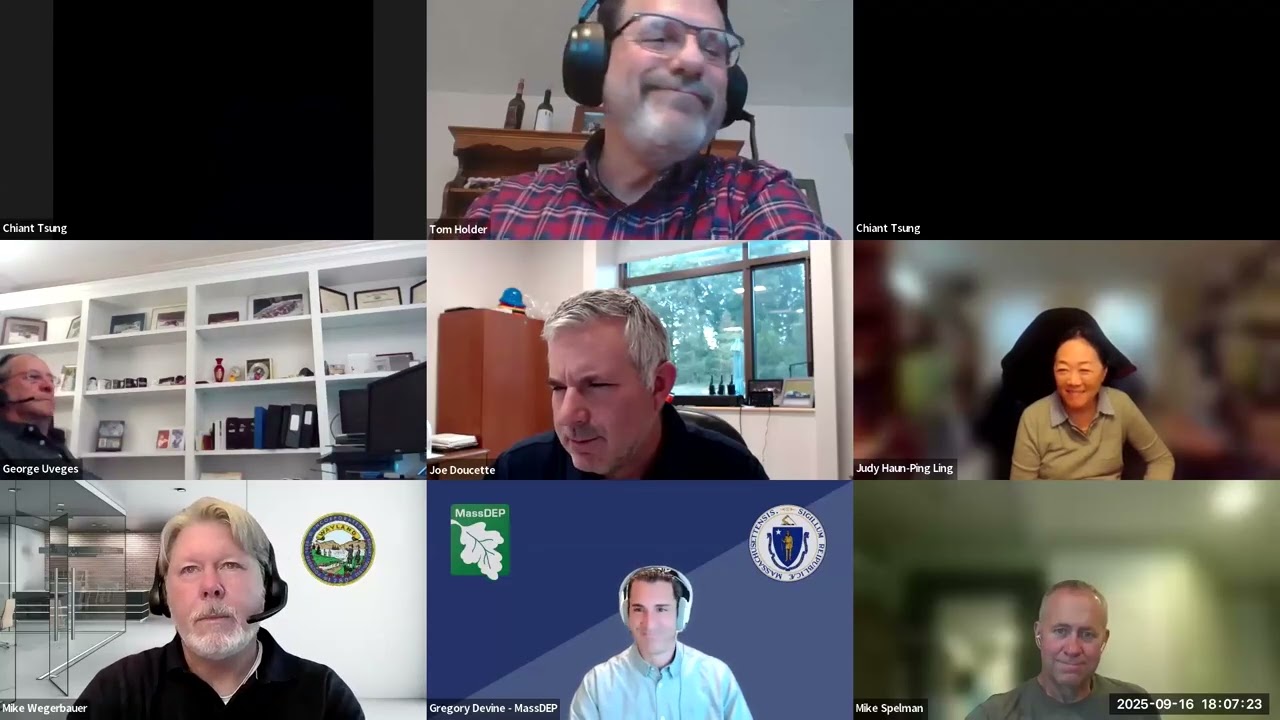
September 16, 2025 - Board of Public Works
George Uveges: Okay? It is six
o'clock. so I am going to call
the meeting to order. I'm going
to start by reading the
information on the agenda. right
below the agenda heading says
note items may not be discussed
in the order listed or at the
specific time. Estimated times
are approximate. All topics may
be subject to deliberation and
vote. In addition. the common
abbreviations. the B. O. W. P.
uses. DPW for the Department of
Public Works. MWRA. for
Massachusetts water resource
authority. and PFAS for poly
whatever that is. but it's
written out on the agenda. One
may watch or may participate
remotely with the meeting link
that can be found at and then
the link is there on the agenda.
Pursuant to chapter two of the
acts of 2025 the meeting will be
conducted via remote
participation. No in person
attendance by members of the
public will be permitted this
meeting may be recorded. which
will be made available to the
public on WayCAM as soon after
the meeting as practical. All
right. let's start with a roll
call. If we could. Mike
Spellman. I here. Mike
wakeebacker. here. Judy here. Ed
Yes. here. and myself here.
Okay. that's the opening we have
everybody in attendance.
Announcements? Anybody have
announcements?
Michael Wegerbauer: I just want
to go ahead.
Unknown: Sorry. The only
announcement I have is the grant
money that I mentioned last
time. My understanding is that
the town is not pursuing it.
However. it did bring up the
idea that. independent of any
kind of grant money. would be
nice to ask kleinfielder to look
into any kind of way to reduce
ongoing operating costs through.
I don't know. solar panels or
geothermal or something.
George Uveges: Okay. noted.
Mike. you had something?
Michael Wegerbauer: Yeah. I just
want to announce that we had met
with the Department of Revenue
to discuss the water enterprise
fund revenue and budgeting. and
we had a very good. quick
meeting. And I'm happy to give a
summary at some point.
George Uveges: We'll be talking
about that later. Yep. okay.
okay. Any other announcements?
Tom Holder: Just a real quick
one. real light duty. We have a
an employee that's retiring. Joe
How many years is Joey philippo.
I put
you on the spot. Anyway. We've got a long. long standing employee. graduate of Wayland High School. retiring after decades of service. so we're having a send off for him Thursday at noon at the DEP W so anybody that is in the area and is free during that time frame. please feel free to join us at the Public Works facility. George Uveges: Okay. thank you. Alright. open it up for public comment. You watching the hands. Joe Doucette: I just wanted to let you know that he was employed January 2004 was any started? So I just looked that up. good. George Uveges: So 24 years. very nice. Tom Holder: Okay. so I see Jeff Stein. so I'm going to allow him to speak. Jeff. are you there? Unknown: I am. Tom Holder: Can you hear me loud and clear? Michael Wegerbauer: Oh. good. Well. thank you. Then. I'm Jeff Stein. I live at 48 Sherman's Bridge Road in Wayland. I'm an architect past dean of the Boston architectural college. I can see Sherman's bridge from my house. and of course. I can hear it that. by the way. is a feature. not a problem. The sound of the bridge is part of the charm of this neighborhood and part of what makes this bridge a place. I just want to point out that working on a project like this is more complex than it might have been even a generation ago. especially for this project. your constituency is not just car commuters. landscapers with their extra wide trailers. school busses. It's bicyclists. motorcycles. pedestrians. people who are fishing. boaters. his. Historians. nature. photographers. tax paying neighbors. people have held weddings on this wooden bridge. We're all your clients. and you should know we need more than a fast. smooth driving lane with metal guard rails. Speed is already a problem on Sherman's Bridge Road. where there are regular car crashes on the road. but interestingly. not on the bumpy wooden bridge itself. The wooden bridge gives identity to a neighborhood that has grown up around it to this region of Wayland and Sudbury. and we'd like to preserve that identity and its place in our town's history. on a scenic road where commuters are already traveling way too fast. Asphalt on Gulam might not be the answer. I'm just saying.
George Uveges: Okay. thank you. Jeff. There is going to be a forum on Sherman bridge coming up. so I would encourage you to come to that forum. Michael Wegerbauer: Great. Thank you.
George Uveges: We have anybody else Tom Tom Holder: I see several people in attendance. but I don't see any more hands.
George Uveges: You're in attendance and would like to speak. please raise your hand. otherwise we will move on.
Tom Holder: Okay. here we go. I have Rebecca. Rebecca. you are on Unknown: Okay. Hi. I'm Rebecca Devine. I'm at 17 Hereford Road in Wayland. Just as a side note. I'm not related to Greg. as far as I know. but my family has been at this property since 1942 and so we have a long history at the bridge. I will say that. Well. I appreciate the wood bridge. I don't. unlike many of my neighbors. appreciate the noise of it. I have found in my many years living here. and my grandmother having lived here my entire life. that the bridge has not been well maintained as far as I'm concerned. in between seasons and Joe. maybe you could answer the question. Is it really that it alternates from one town to the other on maintenance every year. Or do you guys split the maintenance? Because it seems like every June the bridge is not maintained until it becomes the next fiscal fiscal year. I will agree with Jeff that there is too much speed. and we don't need it to be faster. but the maintenance has been atrocious since the built bridge was rebuilt in 1991 as far as I can tell.
Michael Wegerbauer: I think Joe. you can respond if You have an answer to the question about who is alternating? Joe Doucette: I want to say it was three or four years ago. or maybe longer than that. we had decided with Sudbury to the bridge. Instead of alternating back and forth. we've literally split the bridge in half. They take care of one half. We take care of the other half. We do maintain it approximately two times a year. it is becoming more and more difficult to maintain it. because the stringers have essentially turned into Swiss cheese. So as much as we attempt to maintain it and keep the boards in place. the Yeah. it's a kind of a losing battle. Unknown: And Joe one follow up on that. is it true that those boards come from one supplier only. and only one person can get them for you. Is that part of my understanding as to why it's been such an issue on maintenance? Joe Doucette: No. we've struggled to find suppliers because we do have to have them made in certain lengths. et cetera. We in the past few years have gone through a couple different vendors. But no. it's. it's not. it's not difficult to get a supplier. but it's not easy as well. It's. we've gone through a few and we currently do have a supplier form. Unknown: Okay. thanks. I think those are just some of the issues that may be helpful when you guys are doing your full meeting. Thank you. Joe. Thank you. Tom Holder: Tom anybody else I am looking and as of now. I do not see any other hands. George Uveges: All right. going once. going twice. nothing. Tom Holder: nothing. no. changes. George Uveges: Okay. let's close public comment and move into the status of the long term water supply project.
Tom Holder: It's all yours. Tom Sure. sure. to start off the conversation. we just see if I. I do see Greg Devine. no relation to Rebecca. Sure. so Greg has joined us tonight. Greg is employed by the mass DEP. and he works in the office that oversees the State Revolving Fund. So in knowing that there has been some periodic questions asked relative to the SRF program and how it relates to our financing of the MWRA project. I invited Greg to join us. He can provide you know a brief overview of the SRF funding program and entertain questions that board members may have. So with that. I would recognize Greg.
Unknown: Thank you. Tom appreciate you all inviting me here this evening. Happy to share a little bit about the program. about myself. I have been serving the SRF program in this capacity for about six years now. So I am the SRF Program Section Chief. responsible for projects in both the Northeast region in which the town of Wayland resides. as well as the western region. So in that capacity. we have overseen projects of all types. most recently. and obviously. we've dealt with quite a few projects that involve PFAS. or rather. the elimination. or at least the reduction thereof to the public's drinking water supply. So what I wanted to touch upon here are a couple of what I would say are benefits of utilizing the program and how it can be helpful to town and a community in terms of how it impacts rates and being able to move forward with the capital projects. but also speak to some of the upcoming milestones and just kind of a higher level timeline now that Tom and his team have you know. launched into this endeavor in terms of submitting to our program for consideration a two part capital project. So the SRF program blends money received from the federal government a corresponding state match as well as recycled funds in order to offer support for capital projects. And so with that. we are able to. on an annual basis. offer terms and conditions from a lending borrowing perspective that differ from a more traditional bond ban sort of scenario. and certainly quite different than what a commercial lending institution would offer. Our starting baseline interest rate is 2% so especially in this day and age. if you're tracking any of the mortgage rates. what have you. 2% significantly less. We have recognized the fact that the challenges of eliminating PFAS from raw water sources comes with a pretty high price tag. So what we've tried to do to better support communities in the effort to eliminate PFAS is to offer a reduction from the 2% down to a 0% borrowing capacity. So effectively. for every dollar borrowed toward your project. you pay back that $1 now I would be remiss to say that there aren't any fees or charges associated with this. There is. which is typical of most lending vehicles. and origination fee as well as an administrative fee. So these fees add up to about $5 per 1000 borrowed. and so your effective interest or any outside charges other than the principal on the loan would just be that administrative slash origination fee. So pretty. pretty small dollars. all things considered. the term of our loans typically start at 20 years. and so we ask for a corresponding useful life certificate from your design engineer of record to support and corroborate that the investment by yourself as the town as well as us. that the project in the associated infrastructure will be viable for at least 20 years. We can. at certain times. look beyond the 20 year term and go out as far as 30 years. With that 30 year we do make some market rate adjustments to cover the additional 10 years of repayment. And so of late. that has been in the range of about point four to point six add on to the baseline loan. So in this case. let's just effectively call the overall borrowing to be a somewhere about 75 basis points. or about three. Three quarters of a percentage point. just as a conservative target for borrowing. If we were to go beyond the 20 years. up to something in the 30 year neighborhood. the corresponding useful life certificate would have to correspond with that. because we'd want to make sure that the assets and the effort itself is covered. in fact. viable for that entire period of time during which there is a debt service or in a different way of repayment George Uveges: mode happening. Greg. one question. a little bit of confused in terms of the rates. One point you said 1.4 to 1.6 and then you said a point seven. five. Yeah. Unknown: George. let me clarify. 0.4 to 0.6 would be the ad on to the term note. if we went from 20 years to 30 years. thank you for clarifying. George Uveges: And is that for the full 30 years. or it's just that. just for the last 10 it Unknown: would be for the full 30 and so the amortization on that. And you know. we provide draft schedules would just be adjusted out across the course of two payments per year. January and July.
George Uveges: And is that principal and interest. or principal? And then to split the interest. Unknown: in the case of 0% it would almost effectively be mostly principal each time. So we could offer two courses of repayment. either a level debt service. meaning equal payments twice a year for the life of the loan. or a level principal where the interest will drop down in time. beginning with the highest interest payment on your first payment and then trickling down to zero. similar to what you see on a normal house or car loan. George Uveges: Okay. Fay. and we're just. we're looking at the cash flow impact of some of this. That's why I asked the Unknown: question. Sure. absolutely. And what we can do. if it is at all helpful to your conversation. is I can work with our financial counterparts at the Massachusetts clean water trust our financial arm. and have them put together a few tables. if that would be helpful for a visual and just to kind of review some of those numbers. rather than you all trying to project those out in your preferred financial software. George Uveges: Good. We appreciate that. okay. but that's very helpful. Yeah. Unknown: So. you know. really. the you know. the strength of the program is the fact that you know we can offer and lend to you at a point where. for the debt service incurred. there's not going to be a further surcharge onto the impact of the rates. right? And that's what we're really trying to target here. is recognizing that capital projects. just. you know. they scale to an extent. but not so much so that there's not an impact to your customers. And so we try to be somewhat sensitive to that in our approach. So that's yes. Judy. thank you. Is the rate locked in. it is okay. And what would determine. if it's a 20 year or 30 year. that would ultimately be the preference of you all as the owner. So you would at the time of permanent financing meeting. the project has been complete and that we're executing on a permanent loan. it would be structured based upon your input and decision at that George Uveges: time. Okay. in other words. what we apply for. right. right? Unknown: So the advantage of our programs. we have interim financing. So effectively. during the course of the construction project itself. you can borrow the money and pay all your bills. and at the time of project completion was when we would set in and lock in those terms for you. So effectively. you get the money upfront. and then we enter into debt service Once the project has completed. or in the course of a multi year project. we would try to target somewhere around the 50 or so percent mark to say we're going to lock you in an effective two years from now. you'll have to begin your repayment method so you have beneficial use of the very project before you start to incur those costs and recognize that debt service coming onto your books. George Uveges: But you're still paying the fee at that period of time. you're just not having to make a payment. Unknown: No. no. no. the fee. the fees and everything are deferred until the time of the project's completion in your first payment. right? George Uveges: But I understand that's the payment. But the question is. for that. let's say a project is two years. As we draw that money for the two years. there will be an interest that will be added on to the principal during that construction period. That's not free money. Unknown: It is free money up front. Yeah. So the. George Uveges: No. I'm talking about the payment. I understand we're not going to have to make a interest payment that the question is. is that there is no interest in my understanding correct charge during that two year period? That's correct. Unknown: That's correct. Yep. So the the interest is based. Upon the amount borrowed independent of the interim state. So whether you're utilizing a 14 month construction period or a 30 month construction period. that would be irrelevant. We are simply going to target the principal value borrowed independent of time. George Uveges: Okay. so the interest accrual doesn't start till the actual loan on after construction is occurred. That's correct. Yes. And what months did you say there were payments due Unknown: January and July? So we try to charge at the beginning of a fiscal year and then halfway through. so that you can try to forecast that as you go into your fiscal year projections and budget analysis. And as we approach the time of permanent financing. we would make sure that you're fully aware. We'd share with you those amortization schedules so that you're fully informed of what that first you know series of payments would be. Michael Wegerbauer: Okay? Good. Thank you very much. So sure thing only here. Greg and thank you for joining. We just want to confirm we would not be eligible for SRF if we were to construct in the flood zone. which is where the current facility stands. That's been our understanding. and we've made decisions based on that. If you have that answer Andy confirm that it'd be nice. but if not. that's okay. Unknown: There are avenues to say that work within a flood zone can be considered. provided that there are provisions to protect the critical features and functions therein and that were not negatively impacting said flood plain. right? So there. there are a couple of qualifiers to that understanding. and sometimes the effort to do that might not offset the value add of going through the program. Michael Wegerbauer: Yeah. it's not something we want to do just just trying to cross our t's and dot our eyes Unknown: understood. Great. awesome. So. if I may. I'm just going to touch upon timeline here a little bit. So we received. during our annual solicitation period this past summer. what we call a project evaluation form or PDF. And so in essence. that's an expression of interest for upcoming capital work that will be considered by the SRF program. So currently. we are in the process of reviewing and evaluating all of these expressions of interest that we have received across the state. and through that evaluation. we'll come up with a ranking based upon tiered scoring as to what we can and will fund in the upcoming calendar year. So that final deliverable to the public is called an intended use plan. So annually. our intended use plan catalogs and lists out all the projects that will be included and supported by SRF funding moving forward. So based upon historical timelines. we are targeting the issuance of a draft IUP list somewhere circa the end of the calendar year. likely maybe January of 2026 for the 2026 year. Okay. and following the presumption that the projects that were submitted make the list. we would then have a 18 month timeline from which the draft plan was published to when we would expect a the project to be underway. And so the end target date based upon that math. would be a contract award to a construction entity for the work. for the proposed work to occur no later than June. 30 of 2027. in the interim. we would look for A financial commitment from the town no later than June 30 of 2026. so effectively. what we're trying to do here is align our intended use plan to come out circa the time that you would advance warrant articles for consideration by your finance committees. and to make some sort of land agenda for your annual town meeting. by which you know that vote would then support the intended project. which is one of the commitments that we look to from a community in order to move forward on the the SRF program. The other milestone is typically fall of each calendar year. We get through June. we had a successful vote during the annual town meeting. Then the SRF loan application comes due in early October of that calendar year. and we start to get into the weeds of what we're looking for from an administrative and also a financial capacity in terms of do we. Have full rights to the parcel. or parcels or the project corridor. Have we done all of our external agency reviews and endangered species. natural heritage. any anything from mass historical. any impacts. to railroad corridors. MBTA. mass highway. DCR. etc. etc. So there's a pretty robust process there. and what that says that that's us up for is a successful procurement period at some time following the loan application. so that you can and your project team enter into the procurement process in accordance with mass general law. without any exceptions or flaws to that approach. Right? So in essence. our setup really protects you as the owner. And that's really what a lot of our checklists. what a lot of our deliverables are intended to do. is to protect you as owners. such that all of the intermediary steps are done in accordance with either the prevailing laws of Massachusetts and or the requirements of the SRF program. because. as you recall. we do collect monies. both federally and as a state match. and so with with that comes some requirements and regulations. So we try to have the T's and I's dotted in a sequential fashion. such that you're not overloaded with a large package. with the excitement of receiving a bid that's viable and wanting to move forward. So we kind of. you know. set things up across those 18 months from the draft IEP circa January of the year and the following June. George Uveges: Greg. one question going back to what you're talking about. the town commitment. we're going through a discussion now about whether it's going to be in water rates or real estate taxes or some combination. Does that matter to you at all in terms
Unknown: of the loan? Technically. no. We look. we look for the community to have a viable option for borrowing money against the SRF program. We do look that the water department is an enterprise fund where theoretically. the ability to pay for this comes via rates. However. there can be some conversation with the Clean Water trust as to how those payments are made. recognizing that oftentimes raising rates to match new debt service is not always the most viable solution. at least in the in the short term. right. having not raised rates preemptively. oftentimes. a reactionary rate increase might leave you with a slight gap In terms of your ability to make those payments.
Question. so I assume these are state funds and are not impacted by any matching funds from the federal government. Yes. No. not exactly. We do. We do rely on grants that come to us from the EPA. and then typically. there is a state match involved with the funding. So if for rough numbers. if we were to see. you know. a 20 or so. maybe 24% match to all federal funds at the state level that said. we do receive PFAS specific grant money on an annual basis. and so right now. we have in our possession grant monies that we can extend forward for the next calendar year. so we won't necessarily be immediately cut off should federal funding disappear. There's still other ways that we draw money in. both in terms of the state match. but also recycling funds coming in from older projects. right? We lend money out. it comes back. And so those three different streams. as we commingle them. do allow us to create a buffer to some of the ups and downs of funding streams as we go along. that could mean that in the future. we make some adjustments in terms of multi year projects. Maybe the commitment isn't in full in one fell swoop. So we offer the money to you in different tranches. But you know. as as it stands right now. our intent is to continue to fund projects to the maximum extent possible. And so it could be that we adjust it to say. Okay. if you have a $30 million project. we might only offer you $10 million in year number one. but then honor. you know. additional funding in a second year. as opposed to committing the full value of the projected cost upfront 30 million and deny several other projects the opportunity to proceed. And we look at the cash flow analysis and the intended burn rate so that you know there isn't a gap in the funding. but it's unlikely that in the first six to nine months there would be a $30 million draw. Work on a lot of our local. you know. PFAS driven projects. So it doesn't answer your question in full. but I don't have a crystal ball as to say. you know. how will Washington respond to different influences moving forward? But we're trying to guard against it. There's been a bit of austerity on our side in the last 18 months in anticipation of it. but as long as the money is there through continuing resolutions. we're going to continue getting it out on the street. George Uveges: just to build on Judy's comic. And I understand there. you know. who has a crystal ball comment. but is there any indication at this point from Washington that there's going to be a change in the funding under this program. Unknown: I think it depends on who you ask from Washington. That's a surprise. And again. not George. not to be cheeky. but I think that right now. we just have to understand that. you know. independent of politics. there are real needs here by everyone you know. whether it's to take a shower. have a cup of tea. Enjoy a cup of coffee. You know. there's a real value here to supporting the projects that we endeavor to complete. So I think that. independent of some of the ripples and waves that we're experiencing. will find a way of. you know. supporting the projects that we commit to. and we're only going to commit to those projects that we feel that we can fund. So let's say. for example. in the next four months. we get some big updates that will impact how we draft our intended use plan. So that. you know. we're making a commitment to maybe a few fewer projects. but those projects will be supported. Or we say. All right. folks. we're going to do. you know. some sort of crazy scenario where we're going to fund everything 50% year one and try to transfer the balance over. So again. this is me just kind of spit balling different possibilities that we could do in order to maintain that commitment. But we were not just going to go and say. oh. yeah. every everybody gets a treatment plant and then not be able to honor that commitment in the second year. should the funding streams kind of dry up? George Uveges: I understand. Thank you. Out of the number of projects that you have requests for funding. what's your normal percentage that you will say yes to? Unknown: Well. that number is decreasing for this very fact that we have inserted measures of austerity so the drinking water program is over prescribed on an annual basis. and not so much driven by the lack of money out of Washington. but more the. you know. very real need of a lot of PFAS and the remediation or elimination thereof. So I'd say that on the drinking water side of the of the faucet. We're probably trending around a 1/3 to 40% funding out of the total ask. But with that in mind. we're not necessarily receiving 100% of PFAS projects. booster pump stations. water storage tanks. water main replacement. so the full gamut of the distribution system. supply and treatment. So. you know. we try to prioritize and triage the projects that you know offer them the most value in terms of need basis. Are there great projects out there every year? You bet. do we? Do we cringe that we can't fund them all. sure. but we have to draw the last somewhere. okay? George Uveges: And if you. if you are not. not in that 1/3 or 40% is that a no forever. or is that you go back into the pool next year? Unknown: It's. it's a no for the for the calendar year and consideration. George Uveges: okay? So you can get. you might get it to next year. Unknown: you'd have to reapply. You simply copy and paste from the prior year and then kind of refresh that expression of interest. But yes. it would be considered without any sort of additional bias or any sort of prejudice toward it. It would be an objective review moving George Uveges: forward. Does it help if it's your second year. or is it irrelevant? Unknown: That's irrelevant. Okay. thank you.
Tom Holder: One question that's been posed Greg is. is there a principle forgiveness component to this? Unknown: There is principal forgiveness offered through the program the the town of Wayland. however. based upon our kind of economic and adjusted income models. doesn't necessarily qualify for any additional principal forgiveness. Now. that said. I don't want to you know. just throw out there a stinging rebuke in the arena of PFAS. we reduce the amount of principal forgiveness across the board. Why? Because you're already borrowing at 0% so there's already an economic advantage to having to deal with a more expensive topic. But in the case of Wayland. no. there wouldn't be any additional principal forgiveness offered. So.
George Uveges: Okay. thank you. Craig. is you Unknown: have more or do we? No. I want to be mindful of the time and again. I appreciate the opportunity to have this conversation with you all and hopefully answer a few questions and not leave more cause for concern or uncertainty as we navigate the process George Uveges: uncertainty and this kind of thing. I can't imagine anybody have questions. Judy. Mike. Mike. anything else? Michael Wegerbauer: Ed. I'm sorry. Just one nothing here. Thanks for your time. Gregory. if you were in a tight situation. and it sounds like PFAS might be somewhat prioritized over some other projects. but didn't have the full funding available. Would it? Would it be not you? You? Would you possibly come back to us with an option to fund a portion. because we have two major activities ongoing. coming up with the connection to the MWRA. as well as the plant construction? Unknown: Yeah. I mean that that's certainly in the cards. Mike. I think that whether it was one large project or a series of contracts. we would certainly try to find a way. And if there are other funding vehicles in play. we can certainly. you know. kind of CO fund a project. whether it's grant monies for design permitting or another sort of grant opportunity during the construction phase. We can. we can blend those streams together. George Uveges: Great are funded over the two years. as you talked about. right? Unknown: Yeah. so. you know. we look at the SRF program as kind of a. you know. financial safety net that you can insert different funding mechanisms throughout. And the advantages of our program are that. you know. we can be offer that interim financing package. so you can kind of. you know. triage through if certain funds need to be spent early or grant monies. or sun setting. you know. get that money inserted into the project early on. and then rely on us and. you know. the latter stages of a of a project. George Uveges: So Greg. I can guarantee you. we won't be shy about getting everything that qualifies under the program. Unknown: Nor should you be. You You have to respond back to your customer base. and you're right payer. so I would assume nothing less. Okay. George Uveges: Spellman. anything all good? Okay? Judy Ed. it's not all right. Tom. do you have anything that you want to add? Tom Holder: No. I do not. I very much appreciate Greg attending with us tonight. provided a lot of necessary information. and we'll we'll be talking soon. Greg. George Uveges: sure thing. We appreciate it. and we will follow up as other things come up. I can guarantee you. please do. Unknown: I'm here for just Michael Wegerbauer: that. Thank you. Thank you. Greg. Thank you. Thanks. Greg. George Uveges: Okay. we have three other topics under this listing. Tom Holder: Yep. I can take the next one. design impacts to project cost. As you know. we've just reached the 30% design milestone a month or two ago. We're now proceeding towards a 60% design threshold milestone. And to date. we are not aware of any issues that are before us that would cause the cost of the project to increase. There are. you know. a number of things that the MWRA is asking of us relative to the alignment of the transmission main. how we actually secure that. you know. the close proximity to the Haltman aqueduct. you know. has them paying very close attention to that. But even with those requests. we are still confident that we're maintaining the current cost projections.
George Uveges: Okay. questions by anybody? Okay. discussion of town funding options. Do you want to start Tom or you want me to start? Tom Holder: I think that that is a topic in other folks court George Uveges: nice punch. Okay. I understand I haven't been able to see the Select Board WayCAM from yesterday because it's not up yet. but Tom tells me they spent about an hour talking about this. The impact. or impression I get from both the Finance Committee and listening to people on the Select Board. Is there some discussion about. do you fund it all with real estate taxes. or do you split it between the two. between happy hollow and the MWRA? And what as we get down later into some of the slides that will be presented. you'll see the impact of that split. We've split our analysis into the three pieces being the new non MWRA. happy hollow. happy hollow and MWRA increases. I'm not sure that we will get a quick answer. They have said that they believe they have until December with the drafting of the warrant to make that decision. And if they do the one loan option. there's like two ways. one exempt borrowing in in total. and one where the Select Board can decide on a periodic. ie. annual or more basis. how much to cover in real estate taxes. that that decision is not there yet. so we're going to have to keep providing them information and having meetings until we Get to probably December. when an actual decision will be made. But at this point. I don't think that the Select Board has made any decision. They're still in a trying to gather information stage. They did vote down the peer review at two meetings ago. so that that prevents that project from slowing down what we're going through. And I think that's basically the total anybody have any questions I can try and answer. Tom can try and answer.
Okay. so the message is. stay tuned. We'll get back to you on that from the Select Board. Okay. review of happy hollow repairs. Tom Holder: Tom. yep. I'm going to hand that off to Don he's directly managing that effort. Don Millette: Hello. everybody. I'll keep it short so the we completed the second round of repairs on Friday afternoon. The glue set up over the weekend. my staff and I pressure tested and drew a bacteria sample yesterday. a few minutes ago. the test results came back negative for E coli. so we will be putting the system back into operation first thing tomorrow morning. George Uveges: good. and the cost is going to be within what we had from the in the excess capital funds from prior projects. So there's no hit. as I understand it. to the expenses for the year. correct? Okay. with that coming online. Do you have any idea when we're going to be able to cancel the watering band?
Don Millette: Good question. The state just ramped up our drought alert. so we are now in a. I believe it's a level two drought currently. right now. So I did not get a chance to look at the flow of the Sudbury river there before the meeting started. but I can follow up after this meeting with an answer on that. George Uveges: All right. would you let the board know on that? Yes. obviously. one of the questions is how much water we can be pumping and billing. I know that with it coming online. you'll be able to stop the emergency correct news. and Tom has assured us that that's not going to it's going to it's going to be expensive. but not put a large dent in the contingency. Tom. do you remember what you said the dollar amount that you think it's going to be? Tom Holder: We calculated back of the napkin about $2.300 a day. It's been operating for about three weeks. So you know. in the order of. yeah. 5050. George Uveges: grand. okay. okay. yeah. if you can let us know that. because obviously I'd like to just from the business side. the ability to start to pump some of that water would help in terms of meeting what we signed up for in terms of revenue. Yes. Fay. yes. So that being able to pump. Don Millette: yeah. yeah. So we'll be shutting that the MWRA connection off tomorrow. once happy is up and running. and then I have to reach out to the state to ask them to lift the emergency declaration. So. you know. there's a little bit of time there. but I will definitely follow up ASAP with an answer for you. George Uveges: Thank you very much. Anybody have questions Michael Wegerbauer: so don this was on for about three weeks. We were on we're using the emergency connection for about. Three weeks is that correct? Don Millette: Yes. The the first repair took place on September 5. so. yeah. yeah. about about three weeks. Cool. Michael Wegerbauer: We're about 80 cubic feet per second. Don Millette: Oh. cool. okay.
Michael Wegerbauer: I know that's very low. Don Millette: I believe our threshold is 74 I think is our trigger. so I just need to double check on that. But I believe that's the number. okay.
George Uveges: okay. Anything else for that section? All right. Tom the lead service pipe replacement program. Tom Holder: Just to provide a little bit of background. I'm sure the board members of some are familiar with what we call the lead and copper rule. and that's been a regulation that's been in place for from. you know. many years. and we've. you know. been performing sampling and analysis notification of folks that have homes that are built in particular periods of of time. that where lead solder may have been used. lead pipe may have been used as a result of. you know. the episode that occurred years ago in Flint. Michigan. the EPA and mass DEP now have the revised lead and copper rule. revised LCR. revised. And as part of that. we're required to do additional sampling. And if you recall. we had $139.000 grant from the state to perform a lead service line inventory. And that's all part of what is being called a lead service line replacement program. So we performed the inventory we have that. It's actually up on our website. We've got significant amount of information relative to that on our website. We've got a GIS layer that shows all of that. But the next steps that the water division and the town need to take is that we need to investigate a number of those lead service lines. geographic sampling of what the lead of what the service line material is. Once we affirm that we are required to replace any lead service that we own. any service lines that are unknown. and there is a possibility that it might be practical and feasible to assist homeowners with their side of things. So Kirsten Ryan with Kleinfelder is joining us tonight. I know that she had asked a colleague. Ajay to to join I see him here as well. So with that. I'd like to turn it over to Kirsten and Ajay to to offer up an overview of what I'm what I'm talking about. Kirsten Ryan: Thank you. Tom. hi everybody. Kirsten Ryan. project manager from Kleinfelder. here to give you an update on this program. Have a slide deck that I'm going to collaborate with. with Ajay Sharma. my colleague. and provide you that update. So let me get that going.
Unknown: I did this correctly. No. Kirsten Ryan: you're not seeing the right screen. Are you? Tom Holder: Well. we're seeing the presentation. It's not. it's not the slideshow format. but we can. we can see your screen which. which shows all the slides in left hand column in George Uveges: the you know. I think she just has to click on this. begin the slideshow. Unknown: You go. okay. Kirsten Ryan: always takes a second anyway. So. yeah. So Tom said this has been an ongoing project. I believe we started about two years ago. so kind of a slow and steady product progress. but we finished up. really. in the spring of this past of this year. So. so there's a lot of information here. and I'll try to. you know. go slow enough to explain. but not so. so slow that we're running over our time. Lot of acronyms as all these federal rules tend to be. It's a federal rule. the lead and copper rule. and it's got several versions. as Tom mentioned. the lead and copper rule originally was published in 1991 and then revised in 2021 to get to the LCR R. which were current. Only under right now. the LCR i is the lead and copper rule improvements that comes into effect in November 2027 and that is going to have profound implications for compliance with this. Going forward. it's it's a much more robust. So we're going to talk about that. So first I want to just talk about what we got done under this grant that Tom mentioned the overall program purpose of it's all about inventory. At this point. your service lines. This is what was required on the under the LCR are. you know. it's all about public health. really. at the end of the day. trying to identify if there are any lead or like containing service lines left in the ground. Most towns. including Wayland there. there aren't any. we have not found any lead lines in Wayland. What? We have a lot of incomplete information. so we're working to build that all out. So some there is a website that the town has up. It's got a lot of great information on it. and ways that people can check their own lines. which we'll talk about a little bit. So this grant was from mass DEP. We conducted really four tasks. record review and data screening. inventory development and GIS mapping. So the inventory is on the website. I would say it's complete as it needed to be for this grant. It's it's a work in progress. We'll talk about that. We did some public outreach and then put together a compliance plan. which we'll talk about going forward. So we looked a lot of historical records. all the tie cards. assessors database. we used a technique called optical character recognition. along with AI software to help get all those paper. handwritten records and try to review them quickly. And we also QE you see them manually by hand. Michael Wegerbauer: Can I ask yeah question. so. when we installed the new meters. Tom or Don were we able to review or Kirsten. were we able to review and see if there were lead lead piping being used. or is that not something that's visible when you're installing a meter? Kirsten Ryan: I mean. I could. so I know that was part of what the work for that contractor was asked to do. Yeah. I've seen a draft database. so I believe that it's still getting finalized. but that is definitely going to be very valuable information. That's going to be a great source of information to establish what the privately owned portion of the service line is and right? You know we have to the rule says you need to establish material for any any line that's older than 1986 has to be determined. And if it's unknown. then it's essentially treated as if it wasn't lead. So the map from this initial effort is on the website. interactive map.
And this is as of you know. last fall was the compliance deadline for getting that initial service line inventory. So you'll hear different. different terms. There's this phase of the project was the initial Service Inventory. as much as information as you could possibly get. By November 2024. was compiled. zero lead 12. what's called galvanized requiring replacement. This is when. if you have a galvanized pipe that you cannot prove. was never that there was never any lead upstream of it. then it's treated as if it may contain lead. because it could absorb lead over time. We also did review historical records from the town. but you know. back in the day people. it just wasn't tracked. You know. I know most communities. whenever they would find any. they would rip it out. and that's the case here. So we have about 42% of the system. probably less now. because this doesn't account for the meter replacement data. but as of last winter. about 42% still unknown. I mentioned the directed GIS map. You can go in for yourself and check what your property. what the data is showing right now. And we are encouraging folks to update on that information if you think it's an error. And I believe the next slide talks about public outreach. Yes. that's part of this. Was trying to ask residents to help out with the effort also. so that we didn't have to. you know. go poke around their basements. Nobody really likes people doing that. So we developed several materials. Um during the course of the project. and you may remember them. but last summer. we developed a postcard sort of explained how people could check their own service line. either by going and reporting it through a web link or using the QR code information on how to reduce your exposure to lead by running your cap. you know. just in case of the precaution. and we also that QR code pops up a web app that you can. you know. walks you through how to enter your information. So that's something that's still up and available and will remain so. you know. more public. more publicizing of that might be a good thing to do as part of a next phase when we see what. what data is still outstanding.
So kind of just summarizing a little bit of what I touched on here is those deliverables under the the LCR are we completed a last October. that initial Service Inventory. as I mentioned. then the public. we're required to. the town is required to send out notifications to anybody who had a lead galvanized requiring replacement or GRR or unknown service line. So. you know. as a precaution with health ways to protect yourself. if you might have a lead line. or if we're not sure what you have. So those things have all been checked off. The next thing is looking forward to this lcri And those compliance timelines. So by November 1 of 2027 is the next milestone in which you need to submit what's they're calling a baseline inventory. And why that. What that means is that forms the baseline from which your compliance plan for replacing any lead or GRR lines needs to start. and you need to replace 10% per year. So we're trying to get as many classified. The goal would be to try to get as many unknowns classified by that time. so that your replacement rate is more manageable. And Ajay is going to get into a little bit of weeds here with some of those requirements. George Uveges: Christian before. before we go. There just 111. comment. if I could. one of my concerns. and I've talked to Tom about this. is the cost to the town. for example. for any of the town buildings or schools that might have lead piping that needs to be replaced. or the lines that Are the town responsibility up to the users. residents section. and then the cost. if they decide to pay for or somehow come up with a funding program for residents that have it that's not built into the capital plan. And I think we need to start to make them aware of this potential. because it may impact what they're going to sign up to do on other things. So the sooner or the faster that we can get some of this information. even if we don't have a cost yet. but can at least identify those potential items. I think that would be a service to the town. so that we can start to get them to think about it. Because I can guarantee you. there probably isn't a lot of thought going into this right now in terms of the five year capital plan.
Kirsten Ryan: Yeah. I we have. we have put some thought towards that. We have some very high level estimates that we've been working with based on similar projects we're doing. lead service line replacements for the town of City of Somerville. for example. So we. I think. have enough information at this point to put ballpark numbers for your use. and that would be. as we get to later in the slide deck. sort of part of the plan going forward. right? Yeah. yeah. George Uveges: Because I think. you know. we have a obligation to start to get people to think about some of this. Yeah. absolutely. Kirsten Ryan: Thank you. Yeah. you're welcome. So. yeah. I'm gonna turn it over Jay to kind of get a little bit into the weeds about the requirements. I think he can probably keep it at a fairly high level. Unknown: But over to you. Ajay. thanks. Kirsten. yeah. I'm going to do my best here to keep it at a high level. The intent. really with this slide here is to just outline the number of requirements under the lcri. But my goal here is to just make this a little bit more digestible and then Kirsten. if you go over to the next George Uveges: slide. before you go off of that slide. sure. second Sure. The last box on the right hand side says sampling of secondary schools on request only are we going to make sure we sample all of our secondary schools so we're not leaving anybody out. Kirsten Ryan: Yeah. that's at your discretion. I mean. I think it's a great idea to do that. George Uveges: So Tom I can't commit for the town. but I would think that not to do that would raise reasonable questions. Let's put it that way. Tom Holder: yeah. we actually work with the facilities department right now in assisting them towards their sampling program. Okay? I
George Uveges: just would hate to have somebody look at that and say. Oh. we're not doing them all. Yep. yep. You don't care about my kids. Yeah. I understand 100%
Unknown: curious. If you wouldn't mind going to the next slide here. So. like I mentioned. the way to kind of make all of these different requirements digestible is breaking it down here into three phases. So. like. here's some just talk through phase one is everything up until July 1 of 2025. with the two major deliverables being the initial service line inventory that was submitted. as well as notifying any customer last November who had a lead GRR or unknown service line with a specific letter. So everything up to that point is completed. Now. what we're calling phase two is everything from now until 2027 again. November 1 2027. being the time. or the day. I should say that the LCR I officially goes into effect. So the way that we're or essentially what we're calling this. is a proactive compliance plan. And what we're recommending here for all these various bullets here in a phase two. in phase two. with the most important item being to eliminate unknowns and also replacing your known letter. grr service lines. But the heavy emphasis here is really on eliminating unknowns. and that'll be the first thing I talk through here. So Kirsten. I think we go to the next slide. I think it's just highlighted. There we go. and then the one after that. So how exactly do we plan to eliminate unknowns? Or let me start and back up here. Why are we planning to eliminate unknowns and replacing any known lead and gr service lines all before 2027 The goal here is really to take an administrative burden off of the town. like we had to do last November. of notifying every customer who had a lead GRR or unknown service line. if you no longer have any unknowns. no longer have any lead or gr service side service lines. you'll no longer need to continually send those notifications out. That is one of the things under this rule. is that as long as you continue to have a single unknown GRR or lead service lines. those notifications will need to continue to go out. In addition. one of the newer requirements of the lcri is also a brand new sampling protocol. so this will change how the sample is being taken. And not just that. but the lead action level exceedance will go down from 15 parts per billion down to 10. So with that new protocol in mind. there is a higher chance here of getting super close to that new action level exceedance. and ideally without any unknowns. any letter grrs. Even with the new sampling protocol. your likelihood of getting close to that lead. Action level exceedance is significantly reduced. And again. just emphasizing here. we're trying to reduce administrative the administrative burden on the town. because. again. the folks that such as the town. the folks that are going to be attending to the calls when those notifications go out. ongoing questions and concerns. that obviously takes a lot of resources and town staff to handle. George Uveges: Now. when you say town staff. are you really referring to Tom staff? Absolutely okay. I just want to make sure that we differentiate between what's going to fall on the water department and the other town. Because one of the obvious questions is. after we're through with the grant and we're into all these other costs. What is going to be the cost of the program? Who is going to bear that cost. ie water rates or the town. and what's the staffing level that's going to be required to do that? So we can build it into our financial forecast? Because my guess. remembering the model. None of this is in future cost for us. Is that correct? Tom Holder: Tom. yeah. we have not placed any. you know. cost placeholders in any of our budgets. whether it be operational or capital. for this program. So this. this will be something. as you mentioned. we will now be inserting. George Uveges: okay. and have to talk to Mike McCall in terms of how and what does he want. Does he want to put this in the water department or as a separate expense going forward. and who's going to pay? Whose dime is it coming from? Because this is not going to. This is not. I assume. a cheap process. It is not. And right now. as they're looking at the prop two and a half override. this is all going to be in addition to any costs that are currently out there.
Unknown: And I'll touch on some. uh. some of the specific ways that we're going to help provide that cost to George here in the coming slides. Kirsten Ryan: yeah. we'll talk about funding sources as well. Yeah. it's. it's not a real rosy picture at the moment. for George Uveges: funding for this. Why should this be different from anything else we're dealing Kirsten Ryan: with? And the PFAS is like kind of overshadowing this. even right on the on the larger should I go next slide? Ajay. yes. please. Unknown: Yep. So the question is. now. how exactly do you eliminate unknowns? And one of the most cost effective solutions. or approaches to this is using a predictive model and Kirsty. go to the next slide. Essentially what we're proposing here is using a predictive model to classify all your remaining unknowns. And all that would that would entail is essentially the unknowns. Right now. Kirsten. do you remember how many were on our first slide there? I don't. Okay. no worries. I think it was. it was above 1000 or so. Yeah. at least. And so if Kirsten Ryan: I can just interrupt this real quick. I just want to make sure people are aware that this methodology is one we've already been using. It's mass DEP accepts this methodology. You know. it's. it's not something that is like. unique to our approach. necessarily. or its industry. It's. it's pretty much become part of industry standard. right? Unknown: And the reason for that. and the reason why it's become an industry standard. it allows you to not have to dig up every single unknown location. The idea here. and again. being dictated by state guidance. is that based on the total number of services that the town has. that would include total being all of the known and unknown led Grr. the state guidance would then dictate a couple 100 locations that are randomly chosen in which you would need to know the material meaning that those would be the locations that you would go out and investigate. You would get the material information for. and then you would use that information to train the predictive model. And the idea here is that once that predictive model is trained. it's going to assign a probability of lead at all of the remaining unknowns. and depending on how much lead is found. So for for right now there. there hasn't been any lead found. However. this model would still treat the GRR that has been found as lead. and it will assign a probability. allowing us to prioritize inspections. again. with the goal that will not have to dig up every single unknown location in the town. George Uveges: Yeah. the answer your question. your unknowns are 20 200.2 100. Unknown: Perfect. Thank you. Any questions on this.
Kirsten Ryan: and then we'd use a random. randomized approach. so that's not biased. right. Unknown: correct. exactly the and the biases that that Kirsten is alluding to. we would want to make sure that the couple 100. and we're talking about three shy of 400 300 Yeah. 360 year ish locations. We want to make sure that all of those locations. for example. are preferentially homes that were built after 1986 or newer developments. We want to try to capture a good representative snapshot of the entire town. but only with just shy of 400 holes. Essentially. next slide. please. Pearson. and then. sorry. the one before that. It's a little delayed. What's that? The slide? Right. perfect. So again. eliminating unknowns here and then replacing any of the known lead that come up services. That's going to be a big emphasis here for phase two. that also tends to be the most expensive part of what we're proposing as part of phase two. And then the other components that we're going to be talking about is public outreach. and then sampling plan updates. Then I can go to the next slide here. Pearson. So public outreach. again. like I emphasized earlier. as long as a service in the town remains to be unknown. letter. grr. those notifications will continue need to go out. The state has also made some updates to that. so that'll include wanting to keep. or essentially keeping those notifications up to date before they go out to customers. And then. Kirsten Ryan: Essentially that deadline is coming up around again. So I think it's actually Unknown: it's December 31. of 2025 Yeah. Kirsten Ryan: So what you'll see at the end our plan in the near future is to update the inventory that exists as right now with what the information from the meter replacement program. and then those notifications will have to go out by the end of December based on that update. Unknown: Sorry. no. you're good. You're good. And then the next item. second bullet here. when services are inventoried using a. for example. vacuum excavation. any of those locations. and specifically the customers that live at those locations. they're going to need to receive a specific notification that has specific education materials about why this inventory and work is being done and ways to protect themselves. again. just being mandated by the regulation. So it has a lot of the same required language that the notifications last November had. In addition. the lcri does have additional requirements on if a lead. action level exceedance is ever met that notification form. But also need to have additional language. And then lastly. here there is a new Consumer Confidence Report regulation. So obviously that would necessitate going through that. seeing what's pertinent to lead and copper rule improvements. the new Reg. and making sure that that content is also updated in your wallet. water quality reports and then sampling plan updates. similar to what I mentioned earlier. not only is the protocol sampling going to change. however. there will also be new locations in which those samples need to be taken. So that is another thing that we'd be proposing is make sure your staff are trained and know how to take those samples with the new protocol in mind. and then helping to select those new locations. Next slide. please. Kirsten. And then the very last item here is the historical 90th percentile analysis. Basically. again. we just be taking a look at how your lead sample results have historically looked. Analyze it to make sure that you're not going to be in jeopardy when the new action level goes into play. And if need be. like I said. analyze that. perform a study. and again. with the new action level coming down from 15 parts billion down to 10. along with the new sampling protocol. there could be a higher likelihood if there still is any letter GRR in the system after 2027 of getting close to that action level. So that would be a part of what we'd be proposing here. And then next slide. please. Kirsten. so in terms of estimated costs. we'll go into a little bit more detail about what we're proposing as our next scope for this project. However. the one thing I did want to highlight there is just based on the current status of the inventory. And again. Mike. to your point earlier. this does not include any of the updates that would be made to the inventory based on the meter change our program. So current status wise. based on what we'd be looking at to replace any of the currently known gr service lines. as well as what we're projecting based on what we've seen so far of our encounter rate to lead and gr service lines. replacement total would come out to just shy of about million dollars. And George. to your point earlier. this is just very high level numbers. However. as part of our next scope. we are going to put together a more cohesive plan that will go into a little bit more detail to round out these numbers just a bit based on what we know and some of the existing clients that we support. George Uveges: Okay. quick question. This slide says it's starting in 228 the slide that you set out before said this amount is going to be before 2027 Correct? Unknown: Yeah. So that's this slide here. starting 2028 is the more accurate slide. This slide here. Kirsten Ryan: I think it might be up to the town how quickly you'd want to get into this like so you're not required to have everything replaced. I just want to make sure everybody's clear. You're not required to have all of those lines identified and replaced by 2028 or by 2027 it would be I it would be beneficial if it was. it was possible. you know. so that's why this is kind of a. like a more aspirational plan. But. you know. I think you. I think you can definitely accomplish the inventory being complete by November 2027. I. Yeah. so I guess I just don't. I just don't want to have expectations be too unrealistic. George Uveges: Okay. and the and the inventory is a 74.000 or is that not the inventory? Kirsten Ryan: Yes. it is. So this. this is quite different than some other communities. in that we understand that you have a vacuum excavator. and. you know. this assumes that the town is able to actually perform the physical work of of looking. you know. of uncovering the line so that we can identify it with our. you know. with some of our support. So. yeah. George Uveges: okay. so as you put your your cost sheet together. I think it would be beneficial to put. you know. the actual due dates that has to be done by such and such a date. Or you would do it between X and Y dates. so that people can better estimate when in the expenses are going to have to be taken care of. Unknown: Absolutely. Yeah. right. Yeah. And George. just to clarify your point there. yes. we would basically put together a cost with not just the required dates of when everything would need to get done. but also what we're making recommending as part of this proactive compliance plan. And we can differentiate the two. George Uveges: Yeah and Tom. I think you need to talk to Brian and find out if this kind of cost can be borrowed or has to be paid in the year. because you're just replacing something that you have and doing some a lot of inventory work. So I'm not sure that you could borrow for this. but we need to know one way or the other. It would be nice not to have that hit all in one year. But what the life is. and if it can be borrowed. is. is going to be the question for our investment bankers? Tom Holder: Yep. Good point. You know. we'll be working with Brian soon on this. So very good point.
Kirsten Ryan: Like curiously. yeah. so that having the. the your piece of equipment. to be able to do those. to dig those. you know. little holes. is going to save you. like. several million dollars. I mean. it is a lot of labor. though. so that is. like a consideration. um. you know. for the DEP w to be able to take that on. I think. you know. that's something to consider. Tom Holder: you know. So our intent is. you know. Don and myself and his team will be work working out a schedule so that we have enough coverage to to handle the stations. but then also assign two individuals to operate that factor truck and to be able to. you know. on a daily basis. make stops with that equipment and perform the vacuum excavation. So that's that's our intent. Kirsten Ryan: Yep. I think it's great. George Uveges: yeah. and that would be good because that's not an incremental expense that's already built into your labor structure.
Kirsten Ryan: So this graphic is a draft of. you know. kind of how we're trying to envision this playing out over time. You know. we're here. We're This is the inventory phase two that that we'd like to start on working with the DEP W to run our. you know. predictive model in the randomizer to establish this list of 361 locations that need to be excavated. preparing notifications for the homeowner to make sure they're They know what's happening. And then. you know. being able to. based on those results. revise that inventory again. and then revise the program cost estimates and apply for funding. So this is kind of how we're looking at it playing out. And then. you know. we have the year one replacement. starting. you know. in summer of 2028. I think might be a little. I don't know that it could be possible to accomplish that prior. you know. I think the other thing that the board and the town will need to think about is how to handle. how they want to handle the private side replacements that are required. because that could be. you know. a challenging thing to think through. George Uveges: especially if you have to go underneath the house or whatever to get to those pipes. Kirsten Ryan: Yeah. if it's a longer run. you know. if there's. I don't know. a stone wall or something there. There's different ways different communities have gone about it. The MWRA does have a program. you know. and you would. you know. we expect that you would become members sometime. you know. during 20. 2027 they do have a program that the financing terms are more favorable than the SRF program for service replacements. And you will find that the SRF funding requires a full replacement. You can't take SRF loan money to just replace the public side. You would need to replace the whole the whole side. So. you know. some communities have already doing it that way. Some have concerns about about that. So that's something we can we can continue the conversation around. And I'm sorry I should have explained the colors like the orange. Here are the deadlines. and this is that the deadlines where things kick in for the lcri. the sampling. the new sampling protocols kick in in January of 2028 as well. So.
okay. couple more slides. and then we'll be almost done here. So. you know. mentioned. vacuum excavation is very costly. so the town can perform that. which is wonderful. I touched upon SRF. They have they're currently offering loans. and unfortunately. not grants at this time to fund the type of inventory work that we're describing us as our immediate next steps. and they're available on a rolling basis that you know. knowing that the town has their own excavator. I don't think it's worth pursuing. you know. alone to get reimbursed for the effort. since it's. you know. relatively lower cost compared to a town that needed to hire an excavator for 300 locations. So there are construction loans available at this time for the replacement work. As I mentioned. those are also open on a rolling basis. so you don't have to wait for the typical SRF cycle. Again. mentioned that require full service replacement. However. you do need to appropriate the money locally. so you would have to get. you know. a warrant vote
in order to apply. So that's something to consider. and they do not. they do not fund the design of the replacement. you know. bid package design or bidding of a service replacement contract is not eligible. So there's another. you know. self funded thing to consider. George Uveges: Just have a little unclear the replacement activity. When would you say that would start? Kirsten Ryan: I think. I think in summer of 2028.
George Uveges: so about the same time as we'd be hitting them with the with the MWRA loan cost.
Tom Holder: and it requires. I mean. the lcri requires 10% per year. Is that the expectation? Yes. So. you know. Kirsten Ryan: assuming you have relatively few it is. You don't have to do it this way. You know. I think it's just. if it's feasible. it's desirable.
George Uveges: I'm just wondering what we're gonna be telling people as we go through. okay. okay.
Kirsten Ryan: we have prepared a task order to assist with this next phase we mentioned. I guess the other number was a little bit off. but anyway. our scope would include support for the inspection process the town. vacancing the public side. We would be usually utilizing the predictive modeling. you know. kind of guiding the town on the at list of addresses to investigate. updating the inventory. updating the GIS. submitting it to DEP. updating the GIS map. providing those required consumer notices. providing some content for the CCR. water quality report. disturbance notifications. really A lot of public outreach assistance we had also built in a couple more updates for the board and formalizing that clients plan and assistance with applying for a loan. George Uveges: and this would be physical 26 Project. correct. correct. Correct? And that is not in our current budget. right? Tom Holder: It would be under contracted services. George Uveges: I knew I understand where it'd be under. but that wasn't the question. Tom. Question is. do you have enough money in your budget to do this? And the other things you had planned.
Unknown: it will be. yeah.
George Uveges: So something said. get a gift. Okay.
Kirsten Ryan: Okay. lastly. let's see just wrapping up here. Yeah. I didn't. I don't know if there's this. I don't. I don't remember if you have a fall town 2025. town meeting that these are just questions for discussion. For that. you know. spring. obviously. I know you're putting in capital requests in the near term for the spring appropriation. So just it is an aggressive timeline that we laid out. and the cost would be rough approximations. But you know. the trade off of kind of delaying overall progress would be higher long term costs and regulatory burden. potentially and possible public concern. So these are just some things to consider. And I think that's all we have. Men. Tom Holder: As you can see. this is a significant issue. significant effort required. significant cost. You know. we wanted to get this information out to the board to to brief you on what this is all about. And so. you know. we'll be planning on how to pay for it. how to staff it. But it's not optional. So it's one of these things that we have to we have to figure out. Kirsten Ryan: well. I guess we probably should have mentioned that. You know. with the federal government changes. there was some thought that maybe that certain elements would be rolled back. or whatever. but they the Trump administration has a firm support for this rule. This they have come out and said the EPA has come out and said they are not going to roll this one back. Did I say that correctly? AJ. yeah. yeah. Unknown: And then we also know that the state. Massachusetts. is planning on also writing the same regulation into their own state regulations. and mass DEP could make some of these requirements a little bit more stringent. So we know. at a bare minimum. the LCR requirements established by the federal government need to be met.
Kirsten Ryan: Yeah. yeah. We did have an earlier slide that the replacements have all have to be done by 2037 so there is. there is quite a timeline in that helps. help cities where they have. you know. 1000s of these things to deal with. right? If there's a handful of them and it's feasible to just deal with them. You know. it's something to think about. so
George Uveges: a lot to take in. Kirsten Ryan: Yes. I know it's George Uveges: very informative. Okay. Tommy. if you go through this at all with Mike McCall Tom Holder: in passing. so he needs to have a better understanding of this as well.
George Uveges: Okay. questions by the board ADU. Unknown: So my understanding is that so far. we have found zero lead. Is that have Tom? I guess maybe there's a Tom question. have we looked at all of the municipal buildings. the school buildings? Is that in the zero?
Tom Holder: Now. I recall in the inventory. there were 12. What was the 12 that we had to do? You remember? What if you want Unknown: to see your locations? George Uveges: What is it about the galvanized?
Unknown: Yeah. the galvanized. right. damn. Are you asking where the GR locations were? Tom Holder: Yeah. I just and trying to was. I don't. I don't know. particularly. you know where these locations are. but Kirsten Ryan: I don't know off the top of my head about the schools. I mean. I just want to clarify. though. that we're talking about the the regulation covers the service. where it comes from. the meter. I mean. I'm sorry. from the street and to the house to the meter. It doesn't cover the premise plumbing. which is the plumbing internal to the building. George Uveges: but it does cover from the street to the house. Kirsten Ryan: Yes. that's service. Yeah. Unknown: okay. And there also would be. there may not be. there might be daycares. but on your existing lead and copper sampling plan. there would be a couple schools at least on that list and which samples are being taken. Is that right? Tom. Don Don Millette: Yeah. correct. So. so currently. right now. under the current rules. we're required to take two samples from two different schools. and we do it on a rotating basis. Typically. I'll. I'll rotate the town. Buildings. the town schools. and then I will have a separate list of rotating for the daycares in town. Unknown: And so far. we have not found lead. Is that correct? Correct? Don Millette: I mean. we've been sampling. you know. for lead and copper my entire career in the water industry. And. you know. like here in Wayland. you know. currently. right now. we. we have never violated the 90 percentile rule. So that means. you know. out of the the. I'm sorry. out of the 30 required samples that were required to take. you know. you basically figure out your 90th percentile. and that number cannot exceed the state and federal. you know. lead and copper level.
George Uveges: I am now confused. but that's okay.
Unknown: What I'm trying to figure out is that's a non answer to your question. Judy. are we going to have a really big problem? We're going to have a very small problem. And if all the municipal buildings and the daycares and schools are tested on a regular basis and they all pass muster. whatever the current rules are.
Don Millette: it's really these unknowns. Well. it's. it's. it's really the unknowns. you know. And and those unknowns are most likely going to be in the old. older areas of town where. you know. galvanized pipes were used. you know. like back in the day. you know. And those. those are the ones that we're going to have to investigate. George Uveges: Don you're testing. though. is that lead in the water? Or were you testing for lead pipes on the property? Don Millette: We we sample the water for for lead. am copper. George Uveges: So okay. but that's different. You know. if those pipes have not started to breach. you might not pick up anything. Don Millette: yeah. but this is all part of the same program. you know. yeah. it like Unknown: they correlate pretty much. George. yeah. if there was any lead pipes. those samples would most likely come back. But again. it's. it's the risk of the lower action level. And then. like. Don was saying. to calculate the 90th percentile. there's like. a whole new protocol that would get you might maybe closer to getting close to that lower action level. And that's where the Kirsten Ryan: risk. I mean. the town does implement corrosion control. and the new water facility will. you know. as well. So that's that's that's probably why you haven't exceeded anything. and in combination with there may perhaps not be any lead in the system. But I guess to your question. Judy. with six. about 60% of everything classified and only having found 11 or 12 so far. you know logic would dictate that. hopefully you're not going to triple or quadruple or have 10 times more. hopefully you're only going to maybe double that amount. Unknown: and that y'all are curious to the public facing map on the town website that'll show you Kirsten Ryan: actually got it up right now. Okay? I can show you.
We can see it here. okay. so. for example. the orange color is. is a galvanized and
Unknown: then if you zoom in. Kirsten Ryan: you gotta zoom in to like the individual. So this is Sherman Ridge Road. The customer owned side is galvanized. Unknown: And again. this is based on a very conservative. rightfully conservative assumption. in which. as you can see here. even though the system side of that service line was plastic. we can't prove that that galvanized service was ever downstream of any lead. And again. galvanized pipe ever. it was never. never. sorry. never downstream of any lead. And so we can't ever galvanize pipe typically would act as a sponge for lead. And that's the conservative approach. Is just getting it out of your system.
Kirsten Ryan: It tends to. when you're zoomed out. it blocks like several parcels at once. usually. Unknown: yeah. so if you see multiple points here. you can continue to zoom in. and that'll show you. and also mean that there's. there's multiple services going to that single. single property. George Uveges: yeah. the one that you just had up. did that say it was a government building?
Kirsten Ryan: It's not going to say at the 139 Boston pulse road. I don't know what George Uveges: it says. System. own material. government. Oh. galvanized. I'm sorry. yeah. Unknown: is there a call? Color for unknown. Kirsten Ryan: yeah. unknown is green. Unknown is green. yeah. non lead is like. we know it's not lead. okay? And if you click on it. and if there is information. it'll say copper or what have
Unknown: you. no. And then Judy on the unknown ones. we do have an option where. obviously. if the customer can help to identify what their material is. they can they can directly access their own inspection form and submit that information to us. Or if it's incorrect. they can also do that. Okay. thank you.
George Uveges: Okay. when we test the lead. do we also test the AC? Are
Kirsten Ryan: you asking us? No. we're not. We're not looking for that. I mean asbestos cement pipe. You mean. Unknown: yeah. the aspects month is worse than live. Kirsten Ryan: I don't. yeah. I don't know if the system has any water mains made of asbestos. Meant. I've never heard of service line made of asbestos cement Tom Holder: was Don still on. was I? Yeah. Don Millette: yeah. So we. we have less than a mile of of AC pipe in town. and we do sample. we for asbestos. I believe that's coming up later this year in the fourth quarter of our sampling plan. So we will be pulling a sample this year for that.
George Uveges: Okay. anything else we need these folks to go through to scare us? Oh. one more thing. I think I know the answer. but to any of the deadlines for the LCR Compliance would that affect any of our borrowing for the water supply project?
Unknown: So I guess you elaborate. Kirsten Ryan: that's a Tom question. Yeah.
Tom Holder: yeah. So if I understand the correct question correctly. does the results of our lead inventory and all of this work impact our ability to get the SRF funding? Yeah. is that what you're asking? Mike. yeah. I mean. and you know. and I'll answer this briefly. but then I might just kick it right back to to Kirsten. is that as part of the as part of the SRF funding program. we have to meet. you know. particular criteria. ensure that we're operating our water system properly. and the work that we've done. performing this inventory and embarking on phase two of The program. we are meeting all of the expected requirements. and we're on par with with what the expectations are to meet the lead and copper rule revised and improvement. So what we're doing will ensure that we're able to to meet the SRF requirements. Unknown: Okay? Thank you. Yeah. George Uveges: The only other impact it could have that I could see is if it was so huge. it would impact our ability to service this and the loans. And I don't see that coming out of here. I
Yeah. anything else anybody has? Okay. we thank you very much. Tom Holder: Thank you all thank you. All right. thanks. Kirsten. talk soon. George Uveges: Bye. Thank you. And Tom. have you signed up for the this proposal. the 70. whatever it is. $8.000
Tom Holder: I'm preparing to Yes. I have it in my desk. Okay.
George Uveges: all right. Next topic is the agenda. the water Enterprise Fund budget. funding motions. Mike. it's your motion. Did you want to start? Michael Wegerbauer: I can start. But I. I had mentioned to Tom that I have kind of a hard stop at 730 or at 740 so I'm not sure we'll be able to finish this tonight. I can. at least I did simplify the motions so I can share those. Is on my screen. If I can figure out how to do that. let's see.
So these motions are simply to ensure that we have a voice and how. how we're managing the water enterprise fund right now that I feel has been taken out of our bailiwick a little bit. and this is these two motions are basically just to firmly bring us back into the mix when it comes to making financial decisions about water enterprise fund. So the first is a motion to request that we designate retained earnings as a funding source for the operating budget in an amount equal to the contingency expense dollar amount. This is how it was designed years ago. This how we set it up with Louise plus any anticipated xx excess projection for retained earnings above the target we set at the beginning of the year. What this does is the deal ours main concern has been with our stated revenue budget in our in our operating budget article. and the reason it's been overstated is because we intended to use the retained earnings as a funding source for the contingency expense. That's how it was designed. So we've been overstating our revenue budget. And when we met with them. they really didn't have much of a problem with our balance. our retained earnings balance. they didn't mention that at all they had they said it was going to be a quick meeting. because we said Tom may or may not join he was on vacation. They said. Well. I think this is going to be very quick. I had sent them an overview of our rate setting process. including the amount of our expense savings each year for the past. I think. four years. and they noted that our expense savings was in line with our lower revenue. So they didn't have a problem with our rates. the rates that we set this year. So in any case. if we bring this back in line. as you can see here. from the outset. when we started. when we added the contingency expense line for every year that we had the contingency. contingency expense listed in our budget. we match that as using retained earnings as a funding source. So it's just to put that back in place. plus any projection where we might be above retained earnings. dor will be very happy. because our budget for water revenue will be lower and will likely hit that most of the time. So that's that's number one. Number two is. in more recent years. we found that finance staff. or FinCom. I'm not sure who. but they were. instead of borrowing for large capital acquisitions. they were putting that on water revenue. not even retained earnings. They were asking us to increase our revenue for that one year to pay for a capital expense. I don't think they understood how that would affect our ability to set rates. or the requirement it would put on us to set rates much higher in that year to cover a long term capital expense. So this makes sure that they would have to come to us to get our approval to use something other than debt or borrowing as a funding source. So none of this restricts restricts the town from choosing a path it just firmly puts back in play our decision making process and our approval and as water commissioners. this is our responsibility. So these are the two motions. I've simplified them a bit as I mentioned. I can answer any questions folks have. And because this. this needs to be sorted out before the warrant is approved. we've got some time. It's not as though this has to be decided tonight. and that's why we put it off a couple times because it's not super urgent. We've got a lot on our plate. Okay? George Uveges: Thank you. Mike. I mean. I sent out some information. Mike says it's a my opinion. but I look at it more as information. I like to. Go through. Can you turn off your sharing please.
Michael Wegerbauer: before we go into it? Does anyone have any questions about about that. or any comments? I know George is against it. so we're going to hear the cons. and I'm not sure why. why he's against it. but.
Unknown: okay.
George Uveges: I tried to go through and provide information in terms of what reality is versus some of the things that have been thrown around. The first big surprise that I got was in terms of the free cash required. Now the information that we had today will change this fiscal 29 with the MWRA in the RSF. because the timing is going to be different. So I don't think this increase is going to happen. but I'll have to go back and check. But the real issue is here. because
Michael Wegerbauer: free cash for the water Enterprise Fund. George Uveges: yes. yeah. free cash for the water Enterprise Fund. The issue is that we the way we have set up our fees. or our we call it the rates for the fees for the water usage. We've got that increase in 27 built throughout the year. But the problem is that will be borrowed as part of the town's borrowings. and we will have to make that principal payment in the fall. being. normally November of 26 which is fiscal 27 even though we've only collected four months worth of so we're going to have a shortfall that we have to cover. Now we haven't had that before. because our interest expense was not as large as the cash balance or free cash balance that we had. So we're able to cover those interest payments. But as you'll see on that sheet. the amount that we're going to have to fund. we will not have the cash collected from this. and we may have a problem of a shortfall and not be able to service that debt if we do not increase. let alone decrease. that amount of free cash. So that's the first issue. George. Michael Wegerbauer: Can we just clarify some terms? We have a fund balance. and we have retained earnings. and you're talking about free cash. which is something I hear in the town side of the of the budget. but I have never. we've never discussed that. At least I haven't. George Uveges: It's just another term for the cash balance. free cash. Michael Wegerbauer: if you remember the fund the fund balance. or the retained George Uveges: earnings fund balance. not talking about retained earnings at all. this is cash on hand. cash we have to cover the expenditures that we have throughout the year. Michael Wegerbauer: So what does this have to do with our ability to make these decisions? These are strictly to ensure that we get to weigh in on these decisions. It's simply stating clearly that we get to do our job what we were voted to do. George Uveges: No. it's not Mike. It is Mike. You're setting it the with the part of the part of the expenses be paid by retained earnings. but we are going to have enough retained earnings anyways. We've got to significantly increase the rates to cover this timing difference or cash flow difference in terms of your debt service payments. It doesn't recognize the reality of life. Michael Wegerbauer: Our retained earnings have gone up every year. George. every single year it is I have. okay. all right. I I do not have time at this point. That's why I said I'll start it. But I don't think we're going to decide it tonight. And I really asked the other board members if. if you could please look into this. And we are diametrically opposed on this. George and I. and to me. it seems straightforward. This is just giving us the ability to make decisions that we are authorized and responsible for making. George Uveges: It sends the wrong message. Mike. this is your sheet on retained earnings. and you'll see it's basically flat. We had one year where we had a good year because of covid. and build more water than we have in any of the other years. and that gave us a push. but basically your retained earnings and your cash balance is basically flat over that time period. There's no build. there's the numbers. Michael Wegerbauer: There is a build. I can share my screen with the numbers. but George Uveges: this is a sheet from the town. This is. My sheet. This is the information from the town. Michael Wegerbauer: I don't know what you're looking at. I don't see anything on the screen. Nothing out there. George. there's been nothing up there the whole time you've been talking so George Uveges: okay. we haven't done it should be Hold on. I've got it up on mine. So let me see what we got here. I
Michael Wegerbauer: Matt has shared what our retained earnings balance has been year after year. and it's increased. And everyone has that sheet. and it's shown an increase. So I'm not sure where you're getting this new information. but George Uveges: well. it went out to everybody. It was in their package. Michael Wegerbauer: okay. but we went through this model with with Matt for many meetings in a row. and it showed an increase in retained earnings. steady increase. So.
Unknown: So Mike. you can't stay right. so maybe we should move this. Michael Wegerbauer: I think. So. yeah. yeah. thank you. Judy. so George Uveges: luckily. that's
Michael Wegerbauer: okay. all right. So. yeah. I'll send out to Tom that the updated motions that I just read through. and we can look at it next meeting
tonight. right I am George Uveges: then I I think you need to stay and we need to talk about this right now. Michael Wegerbauer: We're short players. Mike. come on. The game must go on. George Uveges: Well. we all but the broken ribs are keeping me on the reserve list. Michael Wegerbauer: Yeah. hopefully you'll be back soon. Hopefully. Unknown: All right. good luck. Mike. but not too much. Thanks. Michael Wegerbauer: Thanks. Take care. Bye.
George Uveges: Just so that
Tom Holder: are you unable to share it? George. percent.
George Uveges: I'm having real problems just even staying on Zoom. so hold on. Got too many things anyways. in the pack. in the in the package. in the that you have the packet. there is a sheet that talks about retained earnings. okay? And I don't. does everybody have their print out from the package? Yeah. I have it open. Okay? You can see the there's two lines. One is your fund balance. okay. and the other is your retained earnings. And I apologize for some reason I can't get there on here. Tom Holder: is this the sheet that has the bar graph on the right top? George Uveges: Yes. it is. Okay. yep.
Unknown: Yeah. page 34
George Uveges: I don't have a page. I don't have the page numbers on here. but it's it says water enterprise fund beginning fund balance. Tom Holder: yes. that's the one. It's got a bar graph. yep. blue and red bars. yes. George Uveges: And you can see that the fund balance at the end of 20 was 1.000.005 and is 1.000.004 at the end of 25 so basically flat. your retained earnings is a million. Oh. 44 to million. 151. so it's up about $100.000 for five years. So that's what I'm talking about. I mean. it's been fairly flat. and the benefit came in 21 where we had the large increase. because you can see it went from one four to one eight in cash. and from one zero to one three. and that was the covid years. So you know. when we talk about it being built. that you know that's not what's happening. So I'm just trying to get the actual facts in this.
Tom Holder: Come on. We are seeing a screen. It's the Zoom invite I know
George Uveges: I apologize. this is not
Unknown: what I'm trying to do. Any
George Uveges: idea I do I have to leave the meeting and come back.
Tom Holder: I mean. We can hear and see you loud and clear. I just don't know if. if that. if the Zoom connection is prohibiting you from sharing a screen. George Uveges: Yeah. I have no idea. But anyway. so that's. that's the one. Now. the second thing is. you know. we talk about the fact that. you know our expenses are always underneath. are always less than the actual what's been budgeted. But if you take a look at the sheet that has the financial summary. you'll see that what it doesn't include is the encumbrances and liabilities. and that wipes out most of that difference so you don't have that. I think I can share maybe this one. Tom Holder: Yeah. this is the one that says financial summary in the top left.
George Uveges: Do you see that? Nothing yet. I
Unknown: I don't know.
Michael Wegerbauer: I give up. all right?
Tom Holder: Something's happening here. George Uveges: Yeah. I'm going crazy. I'm going out for a drink. Hold on.
Tom Holder: Now we have the acrobat reader screen. and you got more than I do. So. yeah. I just figured I'd let you know what we're seeing. I
George Uveges: I don't know if you have it. but it's came out in the packet from Anita on Friday. Unknown: It's page 36
I'm looking at something that says financial summary. Yep. I have to look at it sideways. Yeah. Did we lose George? Oh. there he is.
Maybe we should make this one of the first items for the next meeting. because we have other topics tonight. right? And George. we can't hear you. George. you're on mute.
George Uveges: The problem. we can do that. but people better understand that. The problem is we're sending a very mixed message to the board. a Select Board and the Finance Committee when we talk about these kinds of things at the same time. we're asking them to underwrite a lot of our cost. So we'll. we'll put this away. but please read the information that I've given you. look at the inserts. because what you're being told is not necessary. The facts in terms of. he doesn't have all the information. and I've shared it with him. but he doesn't want to recognize it. like the encumbrances and liabilities. the fact that. you know. we historically have not made our net number because of revenue shortfall. And I think Tom You told me that three last three years. we've used some of the contingency. which means. if you adopted his promotion. you would be reducing retained earnings for that. So just keep in mind that I am not a little bit opposed. but violently opposed to this. because it sends the wrong message and the information is not correct. That's why I talk about the timing and the appropriate reserve levels. Tom Holder: Can you see? Unknown: Oh. there it is.
Tom Holder: I know we're wrapping up the discussion. I. I just figured I I gave this a whirl. and so I was able to to find. I'm not sure if there's. if there's anything you wanted to recap. George. yeah. you George Uveges: can. Thank you very much. You can see here. here. we've lost money. We made money there. But if you see at the bottom of that schedule. that's because the town gave us. Or $200.000 for consulting fees that we had budgeted. So if it hadn't been for that. we would have had a loss. and we just basically broke even in 25 Tom does a good job if he sees the revenue shortfall. which is this line right here. where. what are you looking at? See it says revenue. Budget Variance. You can see that most of the years we are significantly short and making our revenue target right here. right the only time we didn't is in 21 where we had the actual results from the covid year. we'll pump more water than we have in any of the other years. So. you know. we just need. I mean. we. first of all. we have the right. okay. and no disagreement with Mike on that. We have the right at any time when we set the rates to go through and use retained earnings and put that into warrant. that's our right. but sending messages to the town in the Select Board that we're going to dictate it. versus doing anything on a consulting basis with them. especially with what we have coming forward to me. is just crazy. to put it bluntly. So I will get off my box soapbox. and there you go. Tom Holder: there was the other one you were referencing. Yes. George Uveges: you can see. this is the sheet. and you can see. this is your cash level. and this is your fund balance that I'm talking about that we need to have for cover the payment of the debt service when it comes it comes through. because we're on the water tower. it's a 26 expense. our first payment. it's going to be borrowed in 26 and and we're going to talk. when we get to a different section. about what we might be able to do. But that debt service is going to be in November of 27
November of 26 in fiscal 27 and we've only collected four months of the 12 months worth of the rate increase. so we've got to have enough cash to pay that debt service.
Tom Holder: And was this. this line in yellow George. which is the certified retained earnings. which you get from the finance department. Is this what you were referring to when. when Mike was still on the screen. when he was George Uveges: talking about. we build it each year? Yes. and that's not a build each year. And this is not my schedule. This is from the town. Unknown: So this goes to FY 25 and you were talking about FY 27 is that correct? George Uveges: Well. I'm talking about in 27 we need the cash to do the debt service. because there's a sheet in there. if you can find it like that. has the it's called free cash required.
Tom Holder: Which which screen are you talking about? George Uveges: George. I'm sorry it says should. should be free cash required. Tom Holder: Let me just see what encumbrances I'm going to scroll. Let me know if you there's a handful of here. Just stop me if you see the one that you're referring to.
George Uveges: it wasn't in the package that went out. Oh. I'm sorry. okay. yeah. it was in the one that I was been working on and finally got the information I needed. Tom Holder: Oh. the municipal account one. George Uveges: well. it was with that. but it's called free cash required. It was in the three that went out. Tom Holder: Yeah. I can
George Uveges: Tom sent those out today.
Tom Holder: Yeah. with me one minute here. I
uh. free cash analysis. George Uveges: yes. uh. free cash required. yeah. but the Tom Holder: yeah analysis. yeah. yep. I got it all right. Bear with me here.
George Uveges: I'm sorry. folks. that I got. I think I had too many things open. There's a problem. How about that? Yep. can you make that a little larger at all? Let's see. And if not. don't. okay. that's better. So what. what it is. is that we have got debt service. and we're the debt. We don't borrow it. The town borrows it. and we make the payment. They use our cash to make those payments. And when I talking to Brian. got some schedules for him. What happens is that you pay the principal and one interest. Payment in November or in the fall. and you make your second interest payment in the spring. So you've gotta have enough cash on hand to cover that. And so those two debt services is the 1.000.002 53. that's the cash that we have to have on hand. I'm sorry. that is the cash we have available. Let me see go back.
Okay. start. We need 2.2 million. You see under total right here. Yeah. right. no. up on top the under fiscal 27 go up to Oh. yep. got it. yep. yep. okay. and go right here. total. right there. Yeah. that's the quorum required. Out of that. we're going to have collected 756.000 and this is all work in process. I've sent it to Matt to look at. so don't view this as gospel. but the the information is the same. So we're going to collect 756.000 that means we need 1.000.002 in cash to cover it. We don't want to use all retainer and all free cash that we have and go to zero. So we have to have some amount. So I use 15% and that you can just adjust that to whatever you want. Means that we need $2 million roughly. of free cash. and we have 1.000.004 at 630. 24 so that would give us. we need an increase of about $600.000 so that's what we have to look at in terms of using that cash amount. We can't we can't just consider it as available for losses. because it also has to be used as cash to fund our operations. that's the message.
So please look at the sheets that were sent out for this. both in the packet and in the other three sheets. I've asked Tom if he could send that other three sheets out as a supplemental package. and we're going to work on that so that everybody has it. But that's the thought process. The second part of that the MWRA. I have to rework. because he gave us different information in terms of the timing of when those payments would be due versus the normal town debt.
All right. so apologize to my problems with the shares Guys. Tom Holder: yeah. we got through it. Unknown: No worries.
all right?
George Uveges: Okay. status of the capital project. I'm not even going to try. Tom. could you put that sheet up that did go out in the package. Tom Holder: in the in the packet? Yep. All right. Bear with me. It's going to take me in A moment to find it in.
George Uveges: I. if you can. we can just everybody has it. should have it as part of their package in front of them. So. yeah. Tom Holder: if you want to start talking about. I'm trying to shift gears and get that back up on my screen. George Uveges: Okay. talks about three. three areas of. actually four areas of new debt coming through. This is not dual source. net. This is all the column. if you remember. in terms of the model. it was called new debt. Other than dual source. you've got water mains. water tank. MWRA is. And other and this is what's driving those There you go. This is what's driving that increase in terms of the interest in interest expense. So there's two things to take away from this. One is that we've got risk. obviously. in terms of the any cost increases coming through on this that would drive up that interest. Interest expense. The interest rate that Matt used was 4% in 26 and 5% in 27 and on. So we possibly have some upside in the interest expense for that. But most of the dollars. as you'll see. are coming in in 26 the life of most of these items. because this does not include the equipment purchases. which he also has in there. is 20 years. So it'd be 20 year financing and equipment normally is five years. So the debt service in 26 of this is 1.2 million. I'm sorry. 27 because it's being borrowed in 26 and so the one of the things that we can look at. if we have any flexibility with the town. is the timing of when this is going to be borrowed. and if it could be pushed into the next year. That provides us a little bit of time to build up enough cash to help fund that as it comes due. Because again. this rate increases. You remember. is billed into 27 not 26 and so depending on when these are going to be done or paid. in 27 we will not have other than four months collected when the first payment has to be made. So that's part of the requirement in terms of the additional cash.
And when the you listen to. I don't know if anybody listens to the FinCom discussions. You know one of the FinCom members wanted to know why. what we do with the money? Because the water is free. and that's not a truism. This is where a lot of it goes.
Questions. you understand the point I'm making here? Do I need to clarify anything? No. it's all very clear to me. Judy.
Unknown: I'm getting tired. and this is all swimming in my head now. So okay. Is that making sense to me? George Uveges: Yeah. look at it this way. you got a credit card bill that's due on the 15th. but you don't get paid until the 30th. That's what. that's what we're talking about.
Unknown: So it looks like with it's 8 million in 2026 is that correct?
Tom Holder: You're looking at this figure right Michael Wegerbauer: here. right? Yes. yeah. And
George Uveges: the biggest part of that is the water tank. right? So if any of that can be pushed out a little bit. so we don't have to borrow the money in 26 and have the first payment in 27 it provides us more time. Tom Holder: But I think that that borrowing will be happening as early as November. because that project will begin in the spring and will be completed in the fall of calendar year 26 so I think that if that borrow occurs in November. I think the debt service will hit in fiscal 27 George Uveges: they borrow before when the project starts. Is that the idea? Tom Holder: Yeah. because we have to have. we have to have funds to be able to execute a contract. Okay. yeah. So it's either a ban or a borrow. And I know that Brian is doing a borrow in November. I believe that these items are loaded into that George Uveges: Okay. so that's why the first payment is going to be in November of 27 when we would only have. I'm sorry. November of 2626 2727 No. 2626 Tom Holder: next November. Yeah. yeah. calendar year 26 right. George Uveges: And we would only have collected four months of that increase at that point. So we have to have cash on hand to cover the other eight months until it's repaid over the year.
And that goes back to the prior comment about why we need free cash or cat cash balance. Okay. can I clarify anything? Or Judy looks like she's saying. What in the world is going on? Unknown: Yeah. I'm I'm a goner. sorry. Let's move on. I don't want to hold everyone George Uveges: up. All right. Well. if. So you look at this. and if we need to check. just give me a call. You and I can talk individually. We just can't get a group. Unknown: right? Gotcha?
Tom Holder: Okay. come for pizza on Thursday.
Unknown: Pizza and spreadsheets. Okay. there we go.
George Uveges: Okay. and the next one. I don't know if you can put it up. This is the schedule on that went out today on the potential impact of the water rate increases. water rate analysis. v6
and this is. this is a started with what Judy had asked for and then expanded on it. And basically this is what Mike McCall had asked for. saying. Okay. tell me for various users. what the impact is on the various levels of the user and what? So what we've done is that Tom people and Sarah did a great job in coming up with a number of accounts. total water Billings and average bills at the various dollar levels. Okay. that's the first three columns. Unknown: This one I get you should it's yours. Okay. George Uveges: And then we go through we get the impact of the rate increase for other debt service. happy hollow. MWRA in total. Because again. the finance committee wanted to get the breakdown between happy hollow and the MWRA versus having it combined. So we broke those out. and footnote B and C gives you the percentage of those. then that gives you the total increase. and then you get your projected average water rate bill. So for example. as a residential you have 85 accounts that have an average of $4.000 as a billing. contrasted to 2700 Dave. an average water bill of 271 on the top line. So the increase is $200 for the lowest level person. and 3000 Oh. 25 for the highest billing. taking the highest billing to 7100 and the smallest building to an average of 500 and then we do the same thing with commercial same thing with municipal buildings. And one of the things that's interesting on this one is and Tom and I have talked. I am a little suspicious about the municipal rates that are being used. because I'm sorry I'm not being built because it seems low to me. You know. there's only an only $7.000 water billings for a year for municipal water usage. So Tom is going to investigate why that is irrigation is about 27.000 for 21 irrigation sources. and Tom says that's because most of them don't work. So that's why that's lower. And then we have schools. which are 34.000 Which to me also seems a little bit low for 12 meters. you know. an average of $3.000
you know. you've got a lot of people that are more than that. just for their residents. and you've got a number of school buildings and students. So that's again. a question. And then we have some common meter accounts where they're tied in for condos or your housing authority. which is an FHA. and broke that out in terms of those. So that gives you your picture in terms of your averages for the different users. And then if you go. you go to the next page. Mike. and so with the next page is I just took those amounts to show the impact of the increases from these based on each type. for municipal. municipal irrigation schools. and in total. Because. again. this is something that is going to have to be paid for by the town as they go through. And you can see it's about a $51.000 increase in terms of their water Billings. And that's assuming that these numbers are right. which they may not be. I don't know. I'm just. shall we say. my suspicious is up. Tom Holder: and we will. we'll follow up and make certain that these are accurate. George Uveges: yeah. and this is information we've never had before. so and that avoided Judy for asking for it and for the work that Sarah did. Tom Holder: Yeah. it was. it was quite an effort to get those figures together. George Uveges: Yeah. If trigger. that's 10.000 billings that she had to sort through. because 5000 customers and two buildings a piece. And by the way. the total of that comes pretty close to our revenue for water usage. Remember that this is based on billings. and that's based on collections. It was actually closer than I thought it would be. Questions. this help you. is this what you think they're looking for? Anybody still waiting. That's good stuff. Yeah. no. still here. It's good stuff. I'll buy Sarah a slice of pizza on Thursday.
Unknown: Um. well. I'm with you. George in that I'm I find the numbers awfully low for the schools. Um. does seem a little strange. George Uveges: yeah. especially because schools are billed at Tier rates. I'm told. whereas municipal are only billed at tier one rates. no matter how much water they use. which is something that we need to take a look at. Tom Holder: But now that we have the format and she's got the formulas locked in now we can take a closer look at at the actual raw data and make some changes if we find some some things that are not reported quite right here. George Uveges: So I do software should help with that too. right? Unknown: So I assume that the municipal buildings in the schools also have the new meters. They do.
George Uveges: It's a matter. I think. of capturing those. First of all. is everything metered? Is the first question. And then second is. are those meters covering everything in the building. or are we getting the proper reads on those or something else going on. We don't. I don't know. We don't know. Tom Holder: Yeah. I mean. I can tell you that everything is metered. It is very likely. almost guaranteed. that the meters are located in a place whereby that's they're capturing all the consumption. I think it's going to wind up being. you know. data manipulation. When we take a look at. you know. where the raw data is coming from. George Uveges: let's not call it data manipulation. because that has a bad tone to Tom Holder: it. Yeah. not being a data analysis. yeah. George Uveges: the accumulation of the data. yeah. yep. And the the other thing on this and the rate impacts with the want to bring in here the dor that discussion. I think Brian was we can take that down. Thank you. Yep. Brian was very surprised and pleased at how it went. Basically. they said that they would. they understood what we were trying to do. And that was the new meters. and moving to a quarterly instead of annual billing to give us volume an increase in terms of the Billings. because by going to quarterly. you'll get one extra billing of a quarter in this fiscal year. Okay. and so that should give us a boost. Now how much of that boost is. I don't know. and I couldn't model it. but it should be significant. So we'll have to take a look at that. And while you know. we had a good meeting. they said. We hear you. but we don't. We try. We we're going to make sure that our trust is warranted. We're going to follow up with you in terms of how this goes. And so I've talked to Tom. and I think what we should do is have at each of our meetings a little financial summary of where we are in terms of the Billings and cost against budget to see that where we're trending. Because I think he's. I think I was told that the our total billing so far for the two months is only like $10.000 higher. Unknown: When does the quarterly Bill start? Tom Holder: You're jumping the gun. That's the next agenda item.
Unknown: Yeah. what I would I could tell Mike Spellman really wanted to know. I've got Tom Holder: the answer. January 1. George Uveges: Okay. that's. that's the target date. Yes. yeah. So we will see. But let us say that Mike. that Tom and I have had this discussion several times. That Fair. fair. Okay. any other questions on that? No. Unknown: So you said that the schools are paying the tiered rates. but the municipal or buildings are at the flat tier one. George Uveges: I believe that is true. right Tom Tom Holder: that that's the way it's. Things are set up currently. yes. Unknown: and the irrigation is at tier one. So not. not to be. you know. sketchy here. or anything. but if. if we at least build them at cost. how would that impact our rate increases in terms of residential? Would it? How much would we be able to not increase on residential if we get the municipal to pay at least. I don't know. cost of water? Well. they do Tom Holder: that. That tier one. George Uveges: $6 it cost is about 11. right? So. but the problem is that their volume is not that high. So even if you double it. I mean. you're talking about what. 7033 you're talking about $30.000
Unknown: Yeah. I'm surprised by how low it was. but I guess that's one of the things we want. Tom Holder: Yeah. okay. George Uveges: they are on the hunt. but one of the things I want to be careful of is nobody decides that this is a witch hunt because we don't think we're getting what we want. So we're looking for how we can punish them. That's not politically smart. and that's not what we're trying to do. We're just trying. at this stage. trying to understand and then see what makes sense for all users. Unknown: Right? Agreed?
George Uveges: All right. anything else on that set helpful? We'll. we'll. we'll keep trying to refine that. and we'll come back and Tom will start to present us with the actual results versus budget every month going forward. Unknown: Thank you very much. Really appreciate all the hard work. Tom please let Sarah know. Tom Holder: I will pass on. yeah. and this. and she's got support from from some of the others in the office as well. I'll let them all know. but yeah. George Uveges: tell her she they all get a big star. Okay. am I? Tom Holder: Am I? Yeah. So we are. Middle of September. We're about 88% complete. and that's based upon the number of meter installs. You know we are. as you'll look back on the progress reports each month. we're starting to slow down. The meter locations that we're currently having installed are the the more difficult ones we're having to. you know. reschedule. trying to seek opportunities to get into people's homes. you know. So this is. this is expected. It's pretty typical of a meter replacement program. It was forecasted that we would be significantly complete by October. completed with the project in December. So I I still feel we're in a good place. but that gives you a sense of of where we are with that. Bear with me as I look at the agenda some of the things that I was going to talk about. So the water usage trend I've been talking over the last couple of months in comparing the routes that we're billing and we're doing a comparison on what we've seen as water consumption back when we had the old meters installed. comparative to when the new meters are installed. and the first month was route one. we looked like we had about a 7% increase. Route two. which was in August. it looked about flat comparing 24 to 25 route five. that just went out. is a combination of commercial and residential looks like it may have actually decreased a bit. We were able to to get and compile these figures today. so we'll. we'll be taking a look at. you know. is there any particular things that occurred this year rather than last year? Are there. you know. commercial vacancies? Are there accounts that there's a reason why they would be lower. So we'll. we'll be taking a look at that. but it gives you a sense. It's not consistent. It's not. you know. we're seeing the same percentage increase each particular month. George Uveges: And we also have to keep in mind it depends on when those meters were swapped in exchange for the billing period. So for example. if your billing period was January to June on six months and you got a new meter installed in May. well. most of it billing water usage was from the old water meter. So that has an impact too. plus the the fact that we have the uh. Sprinkling band. which we had last year too. You know. we may have more compliance this year. Tom Holder: Who knows? Yeah. yeah. And. you know. as I've been providing these monthly update reports. you'll see each route how many meters are being replaced. you know. so it's not. it's not consistent. You know. the the installers are going from one route to the next as they progress through the program. So it's that also has an impact. And so it's not an apples to apples comparison. George Uveges: Yeah. we won't get a real read until we have a full billing cycle with the new meters. yep. Tom Holder: But I do understand. you know. we're trying to get a sense of. you know. because we were predicting. at least expecting. you know. a 6% increase overall. So just trying to get some affirmation that we can actually achieve that. but remains to be seen. George Uveges: Yeah. and what we may have to do as we take a look coming towards the end of the year. seeing how much of that we're actually getting. and an estimate of what we think will pick up from the going to semi annual Billings and the cash flow that we're going to need for debt service for the other debt and happy hollow. Do we need to look at a rate increase in January. I hope not. but it may be the only choice that we have. because we can't have more cash going out than we have cash in the bank.
Tom Holder: Yep. something to consider.
George Uveges: We'll make this real popular. but
Unknown: no Christmas parties for you.
George Uveges: Sorry. they just throw stuff at me. Anyways. the column headings when it says hold for Tom. what does that mean? Tom Holder: And I was hoping Don was able to stick with us for the remainder of the meeting. Was I think he had a better sense of that. I really. and I've worked with mass installation on on these columns and the figures that are actually in some some of them are actually populated. There's some redundancy on these things. but there really is no hold for town that would imply that we're holding them up that there's some things that we need to do that that is that's not the case. So I wouldn't. I wouldn't pay too much attention to that column. Okay. getting. getting back to. you know. Judy's question about the quarterly billing. you know. as you correctly stated. our target is January one. so that would be the. you know. the third quarter of this fiscal year. We've been working with staff. We've been working with Matt Abraham. trying to get an understanding of. you know. the revenue that would be expected as a result of making the transition to quarterly billing. some of the things that we need to contemplate and we have to work through in the coming months is. you know. selecting the particular routes that are going to be in each monthly bill. You know. we're going to likely have two routes within each month. So say. month of January would be routes one and five. February would be routes two and six. and then. you know. in March would be three and four. and then you would start again in April. one and five. So making those determinations. we also. when we set new rates. Munis has a proration capability whereby. you know. in July the bills go out. you know. 1/6 of the bill is the new rates. five. six is the old and then in the August bills. it's. you know. two. six are the new rates. and four. six of the old rates. that kind of a thing. So we have to work through that proration. We also have to figure in what we're calling a rate factor. We have to be mindful that if somebody the way that the semiannual billing went out. if they were to have a bill period that actually extended past the three months or the six months. that would cause them to be fall into a higher tier. you know. that wouldn't be acceptable. so we have to be mindful of that and and be able to implement. you know. what we're calling a rate factor. Obviously. the tier thresholds are going to be reduced in half. going from semiannual to quarterly. as well as the base charge. you know. would be. would be half. just like you do for commercial now. right? Exactly. commercial or quarterly. So it's so those things. So those are the. some of the considerations. all the things that we have to work out. But. you know. we've got. we got a couple of months to to work through it. That's why we're thinking January is a a. Solid target date. we should be able to get ourselves prepared and organized to have a relatively seamless transition. George Uveges: Yeah. the only. only feasible way you may be able to do it is after you issue the six month bill. then go to quarterly. Otherwise it may be too complicated for the user? Tom Holder: Yeah. yeah. Well. that's and that's why. and we got to obviously make certain that these considerations that I just listed out are. you know. how do I say implemented in munis. so that all of this. you know. is done correctly. George Uveges: Yep. it's the last thing we want is to implement this and then have a lot of billing errors. Tom Holder: Yeah. yeah. And. you know. obviously we're not the first. you know. municipal community to do this. There's a lot of experience out there. and so we're. you know. gathering that lesson. those lessons learned. George Uveges: Yep. Okay. Questions? Anybody? No. okay. Sherman bridge. Tom Holder: yeah. wanted to provide an update. I know we had a couple of folks you know under public comment voicing their concerns. Just gonna. you know. tonight. George Uveges: just. I think they're still on the line. She Tom Holder: they. they were patient enough. They stuck through beautiful Yeah. So I just. you know. a couple of talking points. just to give a kind of a broad overview of where we are with this. You know. we received bridge inspection reports for all the town bridges from MassDOT. Recent Sherman's bridge reports have indicated that the condition of the bridge is severe and that the repairs should be made a priority by the town mass.is now performing more frequent inspections due to the deteriorating condition of Sherman's bridge. as Joe had described earlier in the in the meeting. You know. town staff make frequent repairs to the bridge deck that involves the replacement of these these timber deck boards. as he explained. you know. these are special order. They're. you know. atypically sized. They're very large timber pieces. But. you know. we have the ability to get them. One of the primary issues that we're having right now is the fastening lag bolts which hold the deck boards in place. could no longer be anchored to the stringers underneath. They just. there's nothing left to bite. They've those boards have been replaced so many times. There are also a number of other required repair components that involve the in kind replacement of the wooden sidewalk that's there in place. the wooden rails that are. you know. included with the bridge edges. as well as repaired to a number of piles that are indicated in the most recent inspection report. the towns plural. Sudbury and Wayland have engaged the Engineering Corporation tech as well as capital strategic solutions To perform the design and public outreach activities to to assist with that. There was an intermunicipal agreement that that's been signed executed between Wayland and Sudbury. and that formalizes the shared project responsibilities. The one favorable item that we learned was that Mass DOT has offered to purchase the repair materials and perform much of the repair work within their contracted services arrangements that they have. The value of this is in the order of a million dollars. without which. you know. would be born by the respective towns the report. the proposed repairs are mindful to preserve. you know. the wooden historic appearance of much of the bridge. but the proposal does include Mass DOT recommended installation of an asphalt service. you know. to the bridge deck. And I. I know that's what folks have the most concern about. And so you know this will having an asphalt service. one of the one or two of the primary supporting factors of that is. is. in essence. it doubles the repair lifetime. and it provides for some conservation of entities that that we've learned from meeting with both the Conservation agents from Sudbury and Wayland. We have arranged because we understand that this is an important topic. and there are folks that are impassioned about this bridge. So we have arranged for a public forum that's scheduled for Wednesday. October 1. It'll be located at the Sudbury Community Center. whereby town officials and project engineers will provide an overview of the project and be able to hear public comments. So we're pleased to be able to do this. It's really a formal. Uh. opportunity for folks to appear. be heard. get their concerns played out. and we'll be able to answer questions and and have a much better understanding both sides us and the residents on. on. on what needs to be done there at the bridge. So I would encourage folks to to join us on October 1.
George Uveges: Okay. the comments about speeding across the bridge is that it is there a possibility of putting a speed bump in the beginning and end on each each side of the end. each end of the bridge. so that it slows people down. Tom Holder: So I mean. that has been a traffic. you know. kind of mitigation thought that we are not supportive of. We get periodic requests to install speed bumps. speed humps throughout town when folks are concerned about speed. and there are a number of logistical problems to equipment. to response times. to drainage aspects that cause us to we are not supportive of speed humps. but there are. you know. traffic mitigation ideas that could be implemented that would at least address that concern. George Uveges: When I used to travel to Europe. it was interesting. Their speed bumps. they they were. they could put out in the spring and take out for winter. and so it wasn't a problem with plows and those kinds of things that way. Tom Holder: Yeah. seeing that. yeah. I mean. I have. and we've actually in some communities that I've worked at. We've. we've tried them. and they've become problematic. the condition of them. that kind of they become. you know. pretty poor the condition of them and trying to manage and maintain and replace them. It's. it's. it's not that. George Uveges: not that practical. All right. so so much for my ideas and what I know. no. okay. where the Tom Holder: listening and hearing ideas is what this is all about? George Uveges: Yep. Okay. so that meeting is October 1. right? Yeah. Tom Holder: So I would encourage you know obviously residents that we've got a web page established Sudbury is actually hosting it on waylands. DEP W project page. Those you click on it. it brings you to the project web page. We have door hangers that are being distributed over the course of the next coming days. just advertising this forum. So we're doing as much as we can to advertise this and encourage participation. George Uveges: Good. Anybody have questions? Okay. slowly but surely. Tom Holder: what I would ask is that. you know. in the coming week. I'll pull the this board membership. because if we do have a quorum attending. I'll need to post it is a public meeting. Okay? Good thought. George Uveges: Transfer station.
Tom Holder: I'm going to defer to the DPW superintendent. You're up.
Joe Doucette: All right. Be easy. George. It's past my bedtime. You and me both. George Uveges: I'm drinking water so I so
everybody should add in their package the transfer statement. P L from last year. And I've asked. Tom. do you have the comparisons that are listed in the agenda. in the RFQ? So that's our items for this one. Tom Holder: So go for it. So Joe Doucette: it's pretty simplistic. It's just it. It showed what calendar date from the periods from six. 123. to 910. 23 listing in 2023 sticker sold. Was 1401. 2024 was 1504. George Uveges: I'm so we don't. we don't have this anywhere. Do we? Joe Doucette: This is information Anita provided to me today. George Uveges: Alright. so well. you talking about like is we thought we would have had. oh. I thought Joe Doucette: maybe that's what she had put in there. But. George Uveges: no. I don't think it went out. Got it. So what are we? We're having sticker sales. Joe Doucette: So these are full sticker sales. This does not include second stickers. trailers. etc. or replacements. These were just full sticker. Sales towed. Sold to. let's say residents. 2023 was. and this is to the date till September 10. just to give you an idea. George Uveges: So July one to September 10. June Joe Doucette: listed at six one. So Tom Holder: yeah. that's where we start. We start selling stickers for the next fiscal year on on June 1. that is correct. Joe Doucette: Okay. okay. so 1401 in 2023 1504 in 2024 and then this year we're 1264. ouch. Unknown: So it went up in 2020 it
Joe Doucette: actually went up in and now we're hit some reality. I think.
George Uveges: And what's. what's the price of a full price sticker. 200 so that's
Unknown: Roughly. what is it Joe Doucette: two. what is it 264.
Unknown: $52.000. $2.000.40
Joe Doucette: I see 48.000 but George Uveges: well. it's 1504 to 1264. right. Joe Doucette: correct. You're George Uveges: probably right. So
Joe Doucette: it's 240 stickers. Four 800 Yeah. 48.408
George Uveges: Yeah. 48.000 Joe Doucette: Yeah. 48 48.000 sorry.
George Uveges: and that should make life interesting. because. remember. we don't have a subsidy from the town this year. because the 50.000 that we got from them is for the consulting project.
Joe Doucette: We do. we do have the reserve fund. yep.
And we do. you know. obviously. I'm assuming you've talked with an either or what the value that is currently? It's $303.000 George Uveges: as of June 30. Yep. that was on the sheets he sent us. Yeah. Now. if we take a look at the results from last year. Our total revenue was the 554. 76 but in there. and I'm not sure the what the 75.000 transfer from the general fund. So that would be like I did this wrong.
So roughly about 475.000 of revenue. Our expenses were 513
so that's about a 40.000 hour loss. roughly. I'm doing this on the seat of my pants here. So. so that Joe Doucette: well she had for carryover budget of last year. going into this year. 44.400 deposit. That was in the positive. but that was included. like you said. the 75.000 included. George Uveges: yeah. I'm trying. because that's not reoccurring revenue. So if you take the 550 less than 75 is 475. 476.
Joe Doucette: and we did carry the George Uveges: encumbrances over too. Yep. that's. that's. that's an improvement. We. I appreciate that. And our expenses were 513 with the encumbrances.
and so we lost roughly $38.000
Unknown: what are tipping fees? What does that mean?
Joe Doucette: Go ahead. George. George Uveges: that's the cost to have it picked up and taken to the incinerator. right? Tom Holder: Those are just the disposal costs for both both recycling and trash. Okay?
George Uveges: So the problem is that if we lose the. The 48 I'm sure we've got some increase in expenses. We're gonna take a nice chunk out of the 300.000 because we'll be looking at a probably 80 to $100.000 loss. Joe Doucette: I think we'd be better obviously. looking at this after the first quarter ends. yeah. when we could sit down with you. or. you know. bring you in and sit down with Anita. and we'll go over the quarter quarter reports. George Uveges: And I think we should. every quarter present those to the board. because with the request for the consulting and the pressure we're going to get from the finance committee. Think it's important this board be informed about where we are as we go through
Joe Doucette: and just an update on the RFQ that that has been given to the changes you asked for have been included. and it's with the assistant town manager who's handling the procurement for that. So that's in her hands currently. Is that gone out for two people? It has not gone out yet. She's still editing it and just. you know. boiler plating the information. And I think we were going to discuss or have a committee formed or a group form to discuss that. once we have it. yep.
George Uveges: and you should make sure that there's somebody from the FinCom on that.
Tom Holder: Yeah. Do we want to talk a little bit about the membership. you know? And it's not on our agenda to vote or anything like that. But I just. I'm interested to hear. you know. obviously we can. you know. have associated staff be a part of it? Perhaps a member of the Board of Public Works. you're suggesting a member of the FinCom. I recall Klaus was relatively active at one point on this topic. whether or not there's a desire to have him. you know. on the selection committee. review committee. and then also if there's a kind of a body that is actually going to kind of work work through this with staff entirely up to but there's some. some thoughts anyway. because. you know. once. once this goes out. we're going to have a. you know. a deadline date of. probably. I know. three weeks to a month. George Uveges: Yeah. no. but I think. I think I would be asking. I think Klaus is a good idea. And I think somebody from FinCom. if they could appoint somebody. You may get some resistance there. and then somebody between Mr. Spellman and Judy from our board. and you know. somebody from your staff and Joe. probably five people.
Unknown: So what surprises me? You know. just. just as a balancing thing. I was talking to someone who was concerned about water rates going up. and I said. just as a ballpark figure. your average homeowner. we're probably looking at $400
in terms of the water rate increases. And I said. here's one way you can save about four to $500 is to stop using your trash pickup and use transfer station instead. And if you include the $200 a year cost to use black earth. which is part of your transfer station services. you would be saving even more money. And the answer I got back was. oh. but that's so much more. Like you complain about the amount of money that you don't want to be paying for clean water. but you you couldn't be bothered to take your old trash out. So. I mean. people wanted their cake and eat it too. So it's a little discouraging to me. yep. George Uveges: But you know. hopefully what will come out of this is somehow where we can tie the two in together. And. you know. there'll be things that the trash service won't take and I can understand I would. I have no desire to have to haul my trash down there on the Saturday when I'm out playing golf instead. But if there are things your trash company won't take. you know. putting something in so it works. so you could take it to the transfer station might be much more acceptable. because it's not like calling your uh rubbish. but yeah. you know. I think that's part of the change in the community in terms of what we were 30 years ago and what we are today. Mm.
Tom. does that answer your question? Is that Sure. between those two. somebody will volunteer? Oh. Mike's leaning forward. okay. thank you. Mike. absolutely. Unknown: I'll be there. Tell me when and where. Tom Holder: All right. well. I will. I will solicit participation from the other groups that you were referring to. and I can reach out to Klaus and see if that's something he'd be interested in joining. George Uveges: I think he's still on the audit committee. isn't he. I believe. So. yeah. so he could be their representative. because they're the ones that started this whole question. right? Okay. okay. so anything else on transfer station? Tom Holder: I think that's what we had planned. George Uveges: Okay. any board member concerns?
Unknown: None here. No.
George Uveges: all right. minutes. any changes to minutes?
Unknown: No. no.
George Uveges: Okay. the only thing that I had is on page four. It had under scope of work. under transfer station. You're going to follow up with Abby Shuto regarding a question of solar panels. Tom Holder: So it's really difficult to follow up with Abby chute. she left the town. but look. you know. but in knowing that. I heard back from Mike Faia. who was the facilities director. and they had solicited a proposal from Ty and bond to assist them with the evaluation of installing solar at the at the landfill. And apparently. that effort did not get a lot of traction. I'm not really sure how to how to characterize this. but there really hasn't been any further activity relative to investigating solar at the landfill. George Uveges: Okay. because I was thinking that also ties to Judy's comments about the solar at New happy hollow. Because if you can't get it there. you know may not be enough space and availability to make it worth somebody worthwhile to install
Unknown: geothermal. just to keep that in mind. especially with the new water treatment plant to lower operating costs. George Uveges: where would you get geothermal? Well. you're you Unknown: have to dig George Uveges: right? Well. yeah. but there has to be thermal underneath somewhere.
Unknown: I'm not the expert on it. but my understanding is that it's. it's readily available. I don't know Mike. Do you know
Mike? Do you know anything about geothermal? Kirsten Ryan: I know it's pretty much everywhere. Yeah. Unknown: it's. it's not. it's not rare. George Uveges: Could we do that as a transfer station? Do you think?
Tom Holder: Well. I think it's. I think it's generally used for. actually. the heating and cooling of a building. not so much if you're thinking about using it to run the compress. you know. the compactors and stuff. It's. it's just for climate control. really. you know. So there isn't a whole lot of that at the transfer station. Unknown: Okay. yeah. it sounds great. George Uveges: Use it for generating electricity. okay. well. something new. Talk to Kleinfelder and see how much money we have left in the budget. Because I'm sure. I don't think somebody is going to come out and pay for it and sell you the proceeds over and above their cost recovery. Tom Holder: I think. you know the way it works. I think the equipment. because I've. you know. don't have direct experience. but I've heard of others that you know. the the equipment that you would have within the building is pricey. but then you have to do kind of the the long term cost analysis to see whether or not the reduction in your heating costs. how long of a payback period that would be to offset the increased cost of the equipment so it's it's something we could certainly look at. yeah. George Uveges: including the debt service cost. Yeah. Okay. anything else on that?
Unknown: No. I. Yeah.
George Uveges: okay. In terms of the minutes. I'm sorry. not minutes. but the meeting dates. Tom Holder: Do you want to I'm sorry to interrupt George Uveges: a vote. yeah. yep. Can I get a thank you for keeping me out of trouble. which is a full time job in itself. Can I get a motion to approve the minutes. please So Judy seconded. Mike Spellman. seconds. roll call. vote. Judy aye. Mike Spellman. Aye aye. Ed aye. George I moved 400. I zero. okay. dates of the meetings. One of the questions that I asked is if we're going to have to add any meetings for the warrant article and the decision on the financing of the dual I'm sorry the new new debt. other than the dual sourcing. Do we think we're going to need to have another meeting between November 18 and December 16. Or can we wait on that? I'm just concerned that the warrant and everything else that goes with it is going to tie us up somewhat.
Tom Holder: I would. I would think. if you know. if we wanted to discuss this again at the October 21 meeting. I think that that. I don't think we'll have a better sense on what the the agenda load looks like for. you know. for the remaining meetings. and if we have to slip something in between. or if it's a joint meeting between Select Board and FinCom. like we've been doing. we could. we could slip something in? George Uveges: Yeah. I'm. I'm thinking that. and that's fine. I'm thinking we're going to have some significant discussion about the financing. and need to be tied in there before the war goes to press. Tom Holder: And that there's. you know. one other group that you've. you know. may or may not be following is that there has been a capital project committee formed. and they have begun meeting. and it's their mission to learn and vet capital projects and schedule them on a five year capital schedule. Yep. you know. So that'll be a stop that I'll be making talking about what we have planned and. you know. So I think that there
was response and some of their decisions will impact what our capital plan looks like. George Uveges: Yep. okay. and obviously they you need to bring them into the loop on the lead pipe discussion. correct. Okay. all right. so we'll leave it as is topics not reasonably anticipated. 48 hours ahead. Anybody have anything? Tom Holder: Staff have none? Unknown: None here. Nope. George Uveges: okay. Can I have a motion to adjourn. please? So move so Judy. moves. Ed. seconds. roll call. Vote Judy. yay. Mike. yes. Ed. Mike. yes. And George. yes. adjourn. Vote 400. thank you. And again. I apologize for the problems I had with the sharing the screen. Take care and I appreciate it. George. good night. Unknown: All right. Good night all.
you on the spot. Anyway. We've got a long. long standing employee. graduate of Wayland High School. retiring after decades of service. so we're having a send off for him Thursday at noon at the DEP W so anybody that is in the area and is free during that time frame. please feel free to join us at the Public Works facility. George Uveges: Okay. thank you. Alright. open it up for public comment. You watching the hands. Joe Doucette: I just wanted to let you know that he was employed January 2004 was any started? So I just looked that up. good. George Uveges: So 24 years. very nice. Tom Holder: Okay. so I see Jeff Stein. so I'm going to allow him to speak. Jeff. are you there? Unknown: I am. Tom Holder: Can you hear me loud and clear? Michael Wegerbauer: Oh. good. Well. thank you. Then. I'm Jeff Stein. I live at 48 Sherman's Bridge Road in Wayland. I'm an architect past dean of the Boston architectural college. I can see Sherman's bridge from my house. and of course. I can hear it that. by the way. is a feature. not a problem. The sound of the bridge is part of the charm of this neighborhood and part of what makes this bridge a place. I just want to point out that working on a project like this is more complex than it might have been even a generation ago. especially for this project. your constituency is not just car commuters. landscapers with their extra wide trailers. school busses. It's bicyclists. motorcycles. pedestrians. people who are fishing. boaters. his. Historians. nature. photographers. tax paying neighbors. people have held weddings on this wooden bridge. We're all your clients. and you should know we need more than a fast. smooth driving lane with metal guard rails. Speed is already a problem on Sherman's Bridge Road. where there are regular car crashes on the road. but interestingly. not on the bumpy wooden bridge itself. The wooden bridge gives identity to a neighborhood that has grown up around it to this region of Wayland and Sudbury. and we'd like to preserve that identity and its place in our town's history. on a scenic road where commuters are already traveling way too fast. Asphalt on Gulam might not be the answer. I'm just saying.
George Uveges: Okay. thank you. Jeff. There is going to be a forum on Sherman bridge coming up. so I would encourage you to come to that forum. Michael Wegerbauer: Great. Thank you.
George Uveges: We have anybody else Tom Tom Holder: I see several people in attendance. but I don't see any more hands.
George Uveges: You're in attendance and would like to speak. please raise your hand. otherwise we will move on.
Tom Holder: Okay. here we go. I have Rebecca. Rebecca. you are on Unknown: Okay. Hi. I'm Rebecca Devine. I'm at 17 Hereford Road in Wayland. Just as a side note. I'm not related to Greg. as far as I know. but my family has been at this property since 1942 and so we have a long history at the bridge. I will say that. Well. I appreciate the wood bridge. I don't. unlike many of my neighbors. appreciate the noise of it. I have found in my many years living here. and my grandmother having lived here my entire life. that the bridge has not been well maintained as far as I'm concerned. in between seasons and Joe. maybe you could answer the question. Is it really that it alternates from one town to the other on maintenance every year. Or do you guys split the maintenance? Because it seems like every June the bridge is not maintained until it becomes the next fiscal fiscal year. I will agree with Jeff that there is too much speed. and we don't need it to be faster. but the maintenance has been atrocious since the built bridge was rebuilt in 1991 as far as I can tell.
Michael Wegerbauer: I think Joe. you can respond if You have an answer to the question about who is alternating? Joe Doucette: I want to say it was three or four years ago. or maybe longer than that. we had decided with Sudbury to the bridge. Instead of alternating back and forth. we've literally split the bridge in half. They take care of one half. We take care of the other half. We do maintain it approximately two times a year. it is becoming more and more difficult to maintain it. because the stringers have essentially turned into Swiss cheese. So as much as we attempt to maintain it and keep the boards in place. the Yeah. it's a kind of a losing battle. Unknown: And Joe one follow up on that. is it true that those boards come from one supplier only. and only one person can get them for you. Is that part of my understanding as to why it's been such an issue on maintenance? Joe Doucette: No. we've struggled to find suppliers because we do have to have them made in certain lengths. et cetera. We in the past few years have gone through a couple different vendors. But no. it's. it's not. it's not difficult to get a supplier. but it's not easy as well. It's. we've gone through a few and we currently do have a supplier form. Unknown: Okay. thanks. I think those are just some of the issues that may be helpful when you guys are doing your full meeting. Thank you. Joe. Thank you. Tom Holder: Tom anybody else I am looking and as of now. I do not see any other hands. George Uveges: All right. going once. going twice. nothing. Tom Holder: nothing. no. changes. George Uveges: Okay. let's close public comment and move into the status of the long term water supply project.
Tom Holder: It's all yours. Tom Sure. sure. to start off the conversation. we just see if I. I do see Greg Devine. no relation to Rebecca. Sure. so Greg has joined us tonight. Greg is employed by the mass DEP. and he works in the office that oversees the State Revolving Fund. So in knowing that there has been some periodic questions asked relative to the SRF program and how it relates to our financing of the MWRA project. I invited Greg to join us. He can provide you know a brief overview of the SRF funding program and entertain questions that board members may have. So with that. I would recognize Greg.
Unknown: Thank you. Tom appreciate you all inviting me here this evening. Happy to share a little bit about the program. about myself. I have been serving the SRF program in this capacity for about six years now. So I am the SRF Program Section Chief. responsible for projects in both the Northeast region in which the town of Wayland resides. as well as the western region. So in that capacity. we have overseen projects of all types. most recently. and obviously. we've dealt with quite a few projects that involve PFAS. or rather. the elimination. or at least the reduction thereof to the public's drinking water supply. So what I wanted to touch upon here are a couple of what I would say are benefits of utilizing the program and how it can be helpful to town and a community in terms of how it impacts rates and being able to move forward with the capital projects. but also speak to some of the upcoming milestones and just kind of a higher level timeline now that Tom and his team have you know. launched into this endeavor in terms of submitting to our program for consideration a two part capital project. So the SRF program blends money received from the federal government a corresponding state match as well as recycled funds in order to offer support for capital projects. And so with that. we are able to. on an annual basis. offer terms and conditions from a lending borrowing perspective that differ from a more traditional bond ban sort of scenario. and certainly quite different than what a commercial lending institution would offer. Our starting baseline interest rate is 2% so especially in this day and age. if you're tracking any of the mortgage rates. what have you. 2% significantly less. We have recognized the fact that the challenges of eliminating PFAS from raw water sources comes with a pretty high price tag. So what we've tried to do to better support communities in the effort to eliminate PFAS is to offer a reduction from the 2% down to a 0% borrowing capacity. So effectively. for every dollar borrowed toward your project. you pay back that $1 now I would be remiss to say that there aren't any fees or charges associated with this. There is. which is typical of most lending vehicles. and origination fee as well as an administrative fee. So these fees add up to about $5 per 1000 borrowed. and so your effective interest or any outside charges other than the principal on the loan would just be that administrative slash origination fee. So pretty. pretty small dollars. all things considered. the term of our loans typically start at 20 years. and so we ask for a corresponding useful life certificate from your design engineer of record to support and corroborate that the investment by yourself as the town as well as us. that the project in the associated infrastructure will be viable for at least 20 years. We can. at certain times. look beyond the 20 year term and go out as far as 30 years. With that 30 year we do make some market rate adjustments to cover the additional 10 years of repayment. And so of late. that has been in the range of about point four to point six add on to the baseline loan. So in this case. let's just effectively call the overall borrowing to be a somewhere about 75 basis points. or about three. Three quarters of a percentage point. just as a conservative target for borrowing. If we were to go beyond the 20 years. up to something in the 30 year neighborhood. the corresponding useful life certificate would have to correspond with that. because we'd want to make sure that the assets and the effort itself is covered. in fact. viable for that entire period of time during which there is a debt service or in a different way of repayment George Uveges: mode happening. Greg. one question. a little bit of confused in terms of the rates. One point you said 1.4 to 1.6 and then you said a point seven. five. Yeah. Unknown: George. let me clarify. 0.4 to 0.6 would be the ad on to the term note. if we went from 20 years to 30 years. thank you for clarifying. George Uveges: And is that for the full 30 years. or it's just that. just for the last 10 it Unknown: would be for the full 30 and so the amortization on that. And you know. we provide draft schedules would just be adjusted out across the course of two payments per year. January and July.
George Uveges: And is that principal and interest. or principal? And then to split the interest. Unknown: in the case of 0% it would almost effectively be mostly principal each time. So we could offer two courses of repayment. either a level debt service. meaning equal payments twice a year for the life of the loan. or a level principal where the interest will drop down in time. beginning with the highest interest payment on your first payment and then trickling down to zero. similar to what you see on a normal house or car loan. George Uveges: Okay. Fay. and we're just. we're looking at the cash flow impact of some of this. That's why I asked the Unknown: question. Sure. absolutely. And what we can do. if it is at all helpful to your conversation. is I can work with our financial counterparts at the Massachusetts clean water trust our financial arm. and have them put together a few tables. if that would be helpful for a visual and just to kind of review some of those numbers. rather than you all trying to project those out in your preferred financial software. George Uveges: Good. We appreciate that. okay. but that's very helpful. Yeah. Unknown: So. you know. really. the you know. the strength of the program is the fact that you know we can offer and lend to you at a point where. for the debt service incurred. there's not going to be a further surcharge onto the impact of the rates. right? And that's what we're really trying to target here. is recognizing that capital projects. just. you know. they scale to an extent. but not so much so that there's not an impact to your customers. And so we try to be somewhat sensitive to that in our approach. So that's yes. Judy. thank you. Is the rate locked in. it is okay. And what would determine. if it's a 20 year or 30 year. that would ultimately be the preference of you all as the owner. So you would at the time of permanent financing meeting. the project has been complete and that we're executing on a permanent loan. it would be structured based upon your input and decision at that George Uveges: time. Okay. in other words. what we apply for. right. right? Unknown: So the advantage of our programs. we have interim financing. So effectively. during the course of the construction project itself. you can borrow the money and pay all your bills. and at the time of project completion was when we would set in and lock in those terms for you. So effectively. you get the money upfront. and then we enter into debt service Once the project has completed. or in the course of a multi year project. we would try to target somewhere around the 50 or so percent mark to say we're going to lock you in an effective two years from now. you'll have to begin your repayment method so you have beneficial use of the very project before you start to incur those costs and recognize that debt service coming onto your books. George Uveges: But you're still paying the fee at that period of time. you're just not having to make a payment. Unknown: No. no. no. the fee. the fees and everything are deferred until the time of the project's completion in your first payment. right? George Uveges: But I understand that's the payment. But the question is. for that. let's say a project is two years. As we draw that money for the two years. there will be an interest that will be added on to the principal during that construction period. That's not free money. Unknown: It is free money up front. Yeah. So the. George Uveges: No. I'm talking about the payment. I understand we're not going to have to make a interest payment that the question is. is that there is no interest in my understanding correct charge during that two year period? That's correct. Unknown: That's correct. Yep. So the the interest is based. Upon the amount borrowed independent of the interim state. So whether you're utilizing a 14 month construction period or a 30 month construction period. that would be irrelevant. We are simply going to target the principal value borrowed independent of time. George Uveges: Okay. so the interest accrual doesn't start till the actual loan on after construction is occurred. That's correct. Yes. And what months did you say there were payments due Unknown: January and July? So we try to charge at the beginning of a fiscal year and then halfway through. so that you can try to forecast that as you go into your fiscal year projections and budget analysis. And as we approach the time of permanent financing. we would make sure that you're fully aware. We'd share with you those amortization schedules so that you're fully informed of what that first you know series of payments would be. Michael Wegerbauer: Okay? Good. Thank you very much. So sure thing only here. Greg and thank you for joining. We just want to confirm we would not be eligible for SRF if we were to construct in the flood zone. which is where the current facility stands. That's been our understanding. and we've made decisions based on that. If you have that answer Andy confirm that it'd be nice. but if not. that's okay. Unknown: There are avenues to say that work within a flood zone can be considered. provided that there are provisions to protect the critical features and functions therein and that were not negatively impacting said flood plain. right? So there. there are a couple of qualifiers to that understanding. and sometimes the effort to do that might not offset the value add of going through the program. Michael Wegerbauer: Yeah. it's not something we want to do just just trying to cross our t's and dot our eyes Unknown: understood. Great. awesome. So. if I may. I'm just going to touch upon timeline here a little bit. So we received. during our annual solicitation period this past summer. what we call a project evaluation form or PDF. And so in essence. that's an expression of interest for upcoming capital work that will be considered by the SRF program. So currently. we are in the process of reviewing and evaluating all of these expressions of interest that we have received across the state. and through that evaluation. we'll come up with a ranking based upon tiered scoring as to what we can and will fund in the upcoming calendar year. So that final deliverable to the public is called an intended use plan. So annually. our intended use plan catalogs and lists out all the projects that will be included and supported by SRF funding moving forward. So based upon historical timelines. we are targeting the issuance of a draft IUP list somewhere circa the end of the calendar year. likely maybe January of 2026 for the 2026 year. Okay. and following the presumption that the projects that were submitted make the list. we would then have a 18 month timeline from which the draft plan was published to when we would expect a the project to be underway. And so the end target date based upon that math. would be a contract award to a construction entity for the work. for the proposed work to occur no later than June. 30 of 2027. in the interim. we would look for A financial commitment from the town no later than June 30 of 2026. so effectively. what we're trying to do here is align our intended use plan to come out circa the time that you would advance warrant articles for consideration by your finance committees. and to make some sort of land agenda for your annual town meeting. by which you know that vote would then support the intended project. which is one of the commitments that we look to from a community in order to move forward on the the SRF program. The other milestone is typically fall of each calendar year. We get through June. we had a successful vote during the annual town meeting. Then the SRF loan application comes due in early October of that calendar year. and we start to get into the weeds of what we're looking for from an administrative and also a financial capacity in terms of do we. Have full rights to the parcel. or parcels or the project corridor. Have we done all of our external agency reviews and endangered species. natural heritage. any anything from mass historical. any impacts. to railroad corridors. MBTA. mass highway. DCR. etc. etc. So there's a pretty robust process there. and what that says that that's us up for is a successful procurement period at some time following the loan application. so that you can and your project team enter into the procurement process in accordance with mass general law. without any exceptions or flaws to that approach. Right? So in essence. our setup really protects you as the owner. And that's really what a lot of our checklists. what a lot of our deliverables are intended to do. is to protect you as owners. such that all of the intermediary steps are done in accordance with either the prevailing laws of Massachusetts and or the requirements of the SRF program. because. as you recall. we do collect monies. both federally and as a state match. and so with with that comes some requirements and regulations. So we try to have the T's and I's dotted in a sequential fashion. such that you're not overloaded with a large package. with the excitement of receiving a bid that's viable and wanting to move forward. So we kind of. you know. set things up across those 18 months from the draft IEP circa January of the year and the following June. George Uveges: Greg. one question going back to what you're talking about. the town commitment. we're going through a discussion now about whether it's going to be in water rates or real estate taxes or some combination. Does that matter to you at all in terms
Unknown: of the loan? Technically. no. We look. we look for the community to have a viable option for borrowing money against the SRF program. We do look that the water department is an enterprise fund where theoretically. the ability to pay for this comes via rates. However. there can be some conversation with the Clean Water trust as to how those payments are made. recognizing that oftentimes raising rates to match new debt service is not always the most viable solution. at least in the in the short term. right. having not raised rates preemptively. oftentimes. a reactionary rate increase might leave you with a slight gap In terms of your ability to make those payments.
Question. so I assume these are state funds and are not impacted by any matching funds from the federal government. Yes. No. not exactly. We do. We do rely on grants that come to us from the EPA. and then typically. there is a state match involved with the funding. So if for rough numbers. if we were to see. you know. a 20 or so. maybe 24% match to all federal funds at the state level that said. we do receive PFAS specific grant money on an annual basis. and so right now. we have in our possession grant monies that we can extend forward for the next calendar year. so we won't necessarily be immediately cut off should federal funding disappear. There's still other ways that we draw money in. both in terms of the state match. but also recycling funds coming in from older projects. right? We lend money out. it comes back. And so those three different streams. as we commingle them. do allow us to create a buffer to some of the ups and downs of funding streams as we go along. that could mean that in the future. we make some adjustments in terms of multi year projects. Maybe the commitment isn't in full in one fell swoop. So we offer the money to you in different tranches. But you know. as as it stands right now. our intent is to continue to fund projects to the maximum extent possible. And so it could be that we adjust it to say. Okay. if you have a $30 million project. we might only offer you $10 million in year number one. but then honor. you know. additional funding in a second year. as opposed to committing the full value of the projected cost upfront 30 million and deny several other projects the opportunity to proceed. And we look at the cash flow analysis and the intended burn rate so that you know there isn't a gap in the funding. but it's unlikely that in the first six to nine months there would be a $30 million draw. Work on a lot of our local. you know. PFAS driven projects. So it doesn't answer your question in full. but I don't have a crystal ball as to say. you know. how will Washington respond to different influences moving forward? But we're trying to guard against it. There's been a bit of austerity on our side in the last 18 months in anticipation of it. but as long as the money is there through continuing resolutions. we're going to continue getting it out on the street. George Uveges: just to build on Judy's comic. And I understand there. you know. who has a crystal ball comment. but is there any indication at this point from Washington that there's going to be a change in the funding under this program. Unknown: I think it depends on who you ask from Washington. That's a surprise. And again. not George. not to be cheeky. but I think that right now. we just have to understand that. you know. independent of politics. there are real needs here by everyone you know. whether it's to take a shower. have a cup of tea. Enjoy a cup of coffee. You know. there's a real value here to supporting the projects that we endeavor to complete. So I think that. independent of some of the ripples and waves that we're experiencing. will find a way of. you know. supporting the projects that we commit to. and we're only going to commit to those projects that we feel that we can fund. So let's say. for example. in the next four months. we get some big updates that will impact how we draft our intended use plan. So that. you know. we're making a commitment to maybe a few fewer projects. but those projects will be supported. Or we say. All right. folks. we're going to do. you know. some sort of crazy scenario where we're going to fund everything 50% year one and try to transfer the balance over. So again. this is me just kind of spit balling different possibilities that we could do in order to maintain that commitment. But we were not just going to go and say. oh. yeah. every everybody gets a treatment plant and then not be able to honor that commitment in the second year. should the funding streams kind of dry up? George Uveges: I understand. Thank you. Out of the number of projects that you have requests for funding. what's your normal percentage that you will say yes to? Unknown: Well. that number is decreasing for this very fact that we have inserted measures of austerity so the drinking water program is over prescribed on an annual basis. and not so much driven by the lack of money out of Washington. but more the. you know. very real need of a lot of PFAS and the remediation or elimination thereof. So I'd say that on the drinking water side of the of the faucet. We're probably trending around a 1/3 to 40% funding out of the total ask. But with that in mind. we're not necessarily receiving 100% of PFAS projects. booster pump stations. water storage tanks. water main replacement. so the full gamut of the distribution system. supply and treatment. So. you know. we try to prioritize and triage the projects that you know offer them the most value in terms of need basis. Are there great projects out there every year? You bet. do we? Do we cringe that we can't fund them all. sure. but we have to draw the last somewhere. okay? George Uveges: And if you. if you are not. not in that 1/3 or 40% is that a no forever. or is that you go back into the pool next year? Unknown: It's. it's a no for the for the calendar year and consideration. George Uveges: okay? So you can get. you might get it to next year. Unknown: you'd have to reapply. You simply copy and paste from the prior year and then kind of refresh that expression of interest. But yes. it would be considered without any sort of additional bias or any sort of prejudice toward it. It would be an objective review moving George Uveges: forward. Does it help if it's your second year. or is it irrelevant? Unknown: That's irrelevant. Okay. thank you.
Tom Holder: One question that's been posed Greg is. is there a principle forgiveness component to this? Unknown: There is principal forgiveness offered through the program the the town of Wayland. however. based upon our kind of economic and adjusted income models. doesn't necessarily qualify for any additional principal forgiveness. Now. that said. I don't want to you know. just throw out there a stinging rebuke in the arena of PFAS. we reduce the amount of principal forgiveness across the board. Why? Because you're already borrowing at 0% so there's already an economic advantage to having to deal with a more expensive topic. But in the case of Wayland. no. there wouldn't be any additional principal forgiveness offered. So.
George Uveges: Okay. thank you. Craig. is you Unknown: have more or do we? No. I want to be mindful of the time and again. I appreciate the opportunity to have this conversation with you all and hopefully answer a few questions and not leave more cause for concern or uncertainty as we navigate the process George Uveges: uncertainty and this kind of thing. I can't imagine anybody have questions. Judy. Mike. Mike. anything else? Michael Wegerbauer: Ed. I'm sorry. Just one nothing here. Thanks for your time. Gregory. if you were in a tight situation. and it sounds like PFAS might be somewhat prioritized over some other projects. but didn't have the full funding available. Would it? Would it be not you? You? Would you possibly come back to us with an option to fund a portion. because we have two major activities ongoing. coming up with the connection to the MWRA. as well as the plant construction? Unknown: Yeah. I mean that that's certainly in the cards. Mike. I think that whether it was one large project or a series of contracts. we would certainly try to find a way. And if there are other funding vehicles in play. we can certainly. you know. kind of CO fund a project. whether it's grant monies for design permitting or another sort of grant opportunity during the construction phase. We can. we can blend those streams together. George Uveges: Great are funded over the two years. as you talked about. right? Unknown: Yeah. so. you know. we look at the SRF program as kind of a. you know. financial safety net that you can insert different funding mechanisms throughout. And the advantages of our program are that. you know. we can be offer that interim financing package. so you can kind of. you know. triage through if certain funds need to be spent early or grant monies. or sun setting. you know. get that money inserted into the project early on. and then rely on us and. you know. the latter stages of a of a project. George Uveges: So Greg. I can guarantee you. we won't be shy about getting everything that qualifies under the program. Unknown: Nor should you be. You You have to respond back to your customer base. and you're right payer. so I would assume nothing less. Okay. George Uveges: Spellman. anything all good? Okay? Judy Ed. it's not all right. Tom. do you have anything that you want to add? Tom Holder: No. I do not. I very much appreciate Greg attending with us tonight. provided a lot of necessary information. and we'll we'll be talking soon. Greg. George Uveges: sure thing. We appreciate it. and we will follow up as other things come up. I can guarantee you. please do. Unknown: I'm here for just Michael Wegerbauer: that. Thank you. Thank you. Greg. Thank you. Thanks. Greg. George Uveges: Okay. we have three other topics under this listing. Tom Holder: Yep. I can take the next one. design impacts to project cost. As you know. we've just reached the 30% design milestone a month or two ago. We're now proceeding towards a 60% design threshold milestone. And to date. we are not aware of any issues that are before us that would cause the cost of the project to increase. There are. you know. a number of things that the MWRA is asking of us relative to the alignment of the transmission main. how we actually secure that. you know. the close proximity to the Haltman aqueduct. you know. has them paying very close attention to that. But even with those requests. we are still confident that we're maintaining the current cost projections.
George Uveges: Okay. questions by anybody? Okay. discussion of town funding options. Do you want to start Tom or you want me to start? Tom Holder: I think that that is a topic in other folks court George Uveges: nice punch. Okay. I understand I haven't been able to see the Select Board WayCAM from yesterday because it's not up yet. but Tom tells me they spent about an hour talking about this. The impact. or impression I get from both the Finance Committee and listening to people on the Select Board. Is there some discussion about. do you fund it all with real estate taxes. or do you split it between the two. between happy hollow and the MWRA? And what as we get down later into some of the slides that will be presented. you'll see the impact of that split. We've split our analysis into the three pieces being the new non MWRA. happy hollow. happy hollow and MWRA increases. I'm not sure that we will get a quick answer. They have said that they believe they have until December with the drafting of the warrant to make that decision. And if they do the one loan option. there's like two ways. one exempt borrowing in in total. and one where the Select Board can decide on a periodic. ie. annual or more basis. how much to cover in real estate taxes. that that decision is not there yet. so we're going to have to keep providing them information and having meetings until we Get to probably December. when an actual decision will be made. But at this point. I don't think that the Select Board has made any decision. They're still in a trying to gather information stage. They did vote down the peer review at two meetings ago. so that that prevents that project from slowing down what we're going through. And I think that's basically the total anybody have any questions I can try and answer. Tom can try and answer.
Okay. so the message is. stay tuned. We'll get back to you on that from the Select Board. Okay. review of happy hollow repairs. Tom Holder: Tom. yep. I'm going to hand that off to Don he's directly managing that effort. Don Millette: Hello. everybody. I'll keep it short so the we completed the second round of repairs on Friday afternoon. The glue set up over the weekend. my staff and I pressure tested and drew a bacteria sample yesterday. a few minutes ago. the test results came back negative for E coli. so we will be putting the system back into operation first thing tomorrow morning. George Uveges: good. and the cost is going to be within what we had from the in the excess capital funds from prior projects. So there's no hit. as I understand it. to the expenses for the year. correct? Okay. with that coming online. Do you have any idea when we're going to be able to cancel the watering band?
Don Millette: Good question. The state just ramped up our drought alert. so we are now in a. I believe it's a level two drought currently. right now. So I did not get a chance to look at the flow of the Sudbury river there before the meeting started. but I can follow up after this meeting with an answer on that. George Uveges: All right. would you let the board know on that? Yes. obviously. one of the questions is how much water we can be pumping and billing. I know that with it coming online. you'll be able to stop the emergency correct news. and Tom has assured us that that's not going to it's going to it's going to be expensive. but not put a large dent in the contingency. Tom. do you remember what you said the dollar amount that you think it's going to be? Tom Holder: We calculated back of the napkin about $2.300 a day. It's been operating for about three weeks. So you know. in the order of. yeah. 5050. George Uveges: grand. okay. okay. yeah. if you can let us know that. because obviously I'd like to just from the business side. the ability to start to pump some of that water would help in terms of meeting what we signed up for in terms of revenue. Yes. Fay. yes. So that being able to pump. Don Millette: yeah. yeah. So we'll be shutting that the MWRA connection off tomorrow. once happy is up and running. and then I have to reach out to the state to ask them to lift the emergency declaration. So. you know. there's a little bit of time there. but I will definitely follow up ASAP with an answer for you. George Uveges: Thank you very much. Anybody have questions Michael Wegerbauer: so don this was on for about three weeks. We were on we're using the emergency connection for about. Three weeks is that correct? Don Millette: Yes. The the first repair took place on September 5. so. yeah. yeah. about about three weeks. Cool. Michael Wegerbauer: We're about 80 cubic feet per second. Don Millette: Oh. cool. okay.
Michael Wegerbauer: I know that's very low. Don Millette: I believe our threshold is 74 I think is our trigger. so I just need to double check on that. But I believe that's the number. okay.
George Uveges: okay. Anything else for that section? All right. Tom the lead service pipe replacement program. Tom Holder: Just to provide a little bit of background. I'm sure the board members of some are familiar with what we call the lead and copper rule. and that's been a regulation that's been in place for from. you know. many years. and we've. you know. been performing sampling and analysis notification of folks that have homes that are built in particular periods of of time. that where lead solder may have been used. lead pipe may have been used as a result of. you know. the episode that occurred years ago in Flint. Michigan. the EPA and mass DEP now have the revised lead and copper rule. revised LCR. revised. And as part of that. we're required to do additional sampling. And if you recall. we had $139.000 grant from the state to perform a lead service line inventory. And that's all part of what is being called a lead service line replacement program. So we performed the inventory we have that. It's actually up on our website. We've got significant amount of information relative to that on our website. We've got a GIS layer that shows all of that. But the next steps that the water division and the town need to take is that we need to investigate a number of those lead service lines. geographic sampling of what the lead of what the service line material is. Once we affirm that we are required to replace any lead service that we own. any service lines that are unknown. and there is a possibility that it might be practical and feasible to assist homeowners with their side of things. So Kirsten Ryan with Kleinfelder is joining us tonight. I know that she had asked a colleague. Ajay to to join I see him here as well. So with that. I'd like to turn it over to Kirsten and Ajay to to offer up an overview of what I'm what I'm talking about. Kirsten Ryan: Thank you. Tom. hi everybody. Kirsten Ryan. project manager from Kleinfelder. here to give you an update on this program. Have a slide deck that I'm going to collaborate with. with Ajay Sharma. my colleague. and provide you that update. So let me get that going.
Unknown: I did this correctly. No. Kirsten Ryan: you're not seeing the right screen. Are you? Tom Holder: Well. we're seeing the presentation. It's not. it's not the slideshow format. but we can. we can see your screen which. which shows all the slides in left hand column in George Uveges: the you know. I think she just has to click on this. begin the slideshow. Unknown: You go. okay. Kirsten Ryan: always takes a second anyway. So. yeah. So Tom said this has been an ongoing project. I believe we started about two years ago. so kind of a slow and steady product progress. but we finished up. really. in the spring of this past of this year. So. so there's a lot of information here. and I'll try to. you know. go slow enough to explain. but not so. so slow that we're running over our time. Lot of acronyms as all these federal rules tend to be. It's a federal rule. the lead and copper rule. and it's got several versions. as Tom mentioned. the lead and copper rule originally was published in 1991 and then revised in 2021 to get to the LCR R. which were current. Only under right now. the LCR i is the lead and copper rule improvements that comes into effect in November 2027 and that is going to have profound implications for compliance with this. Going forward. it's it's a much more robust. So we're going to talk about that. So first I want to just talk about what we got done under this grant that Tom mentioned the overall program purpose of it's all about inventory. At this point. your service lines. This is what was required on the under the LCR are. you know. it's all about public health. really. at the end of the day. trying to identify if there are any lead or like containing service lines left in the ground. Most towns. including Wayland there. there aren't any. we have not found any lead lines in Wayland. What? We have a lot of incomplete information. so we're working to build that all out. So some there is a website that the town has up. It's got a lot of great information on it. and ways that people can check their own lines. which we'll talk about a little bit. So this grant was from mass DEP. We conducted really four tasks. record review and data screening. inventory development and GIS mapping. So the inventory is on the website. I would say it's complete as it needed to be for this grant. It's it's a work in progress. We'll talk about that. We did some public outreach and then put together a compliance plan. which we'll talk about going forward. So we looked a lot of historical records. all the tie cards. assessors database. we used a technique called optical character recognition. along with AI software to help get all those paper. handwritten records and try to review them quickly. And we also QE you see them manually by hand. Michael Wegerbauer: Can I ask yeah question. so. when we installed the new meters. Tom or Don were we able to review or Kirsten. were we able to review and see if there were lead lead piping being used. or is that not something that's visible when you're installing a meter? Kirsten Ryan: I mean. I could. so I know that was part of what the work for that contractor was asked to do. Yeah. I've seen a draft database. so I believe that it's still getting finalized. but that is definitely going to be very valuable information. That's going to be a great source of information to establish what the privately owned portion of the service line is and right? You know we have to the rule says you need to establish material for any any line that's older than 1986 has to be determined. And if it's unknown. then it's essentially treated as if it wasn't lead. So the map from this initial effort is on the website. interactive map.
And this is as of you know. last fall was the compliance deadline for getting that initial service line inventory. So you'll hear different. different terms. There's this phase of the project was the initial Service Inventory. as much as information as you could possibly get. By November 2024. was compiled. zero lead 12. what's called galvanized requiring replacement. This is when. if you have a galvanized pipe that you cannot prove. was never that there was never any lead upstream of it. then it's treated as if it may contain lead. because it could absorb lead over time. We also did review historical records from the town. but you know. back in the day people. it just wasn't tracked. You know. I know most communities. whenever they would find any. they would rip it out. and that's the case here. So we have about 42% of the system. probably less now. because this doesn't account for the meter replacement data. but as of last winter. about 42% still unknown. I mentioned the directed GIS map. You can go in for yourself and check what your property. what the data is showing right now. And we are encouraging folks to update on that information if you think it's an error. And I believe the next slide talks about public outreach. Yes. that's part of this. Was trying to ask residents to help out with the effort also. so that we didn't have to. you know. go poke around their basements. Nobody really likes people doing that. So we developed several materials. Um during the course of the project. and you may remember them. but last summer. we developed a postcard sort of explained how people could check their own service line. either by going and reporting it through a web link or using the QR code information on how to reduce your exposure to lead by running your cap. you know. just in case of the precaution. and we also that QR code pops up a web app that you can. you know. walks you through how to enter your information. So that's something that's still up and available and will remain so. you know. more public. more publicizing of that might be a good thing to do as part of a next phase when we see what. what data is still outstanding.
So kind of just summarizing a little bit of what I touched on here is those deliverables under the the LCR are we completed a last October. that initial Service Inventory. as I mentioned. then the public. we're required to. the town is required to send out notifications to anybody who had a lead galvanized requiring replacement or GRR or unknown service line. So. you know. as a precaution with health ways to protect yourself. if you might have a lead line. or if we're not sure what you have. So those things have all been checked off. The next thing is looking forward to this lcri And those compliance timelines. So by November 1 of 2027 is the next milestone in which you need to submit what's they're calling a baseline inventory. And why that. What that means is that forms the baseline from which your compliance plan for replacing any lead or GRR lines needs to start. and you need to replace 10% per year. So we're trying to get as many classified. The goal would be to try to get as many unknowns classified by that time. so that your replacement rate is more manageable. And Ajay is going to get into a little bit of weeds here with some of those requirements. George Uveges: Christian before. before we go. There just 111. comment. if I could. one of my concerns. and I've talked to Tom about this. is the cost to the town. for example. for any of the town buildings or schools that might have lead piping that needs to be replaced. or the lines that Are the town responsibility up to the users. residents section. and then the cost. if they decide to pay for or somehow come up with a funding program for residents that have it that's not built into the capital plan. And I think we need to start to make them aware of this potential. because it may impact what they're going to sign up to do on other things. So the sooner or the faster that we can get some of this information. even if we don't have a cost yet. but can at least identify those potential items. I think that would be a service to the town. so that we can start to get them to think about it. Because I can guarantee you. there probably isn't a lot of thought going into this right now in terms of the five year capital plan.
Kirsten Ryan: Yeah. I we have. we have put some thought towards that. We have some very high level estimates that we've been working with based on similar projects we're doing. lead service line replacements for the town of City of Somerville. for example. So we. I think. have enough information at this point to put ballpark numbers for your use. and that would be. as we get to later in the slide deck. sort of part of the plan going forward. right? Yeah. yeah. George Uveges: Because I think. you know. we have a obligation to start to get people to think about some of this. Yeah. absolutely. Kirsten Ryan: Thank you. Yeah. you're welcome. So. yeah. I'm gonna turn it over Jay to kind of get a little bit into the weeds about the requirements. I think he can probably keep it at a fairly high level. Unknown: But over to you. Ajay. thanks. Kirsten. yeah. I'm going to do my best here to keep it at a high level. The intent. really with this slide here is to just outline the number of requirements under the lcri. But my goal here is to just make this a little bit more digestible and then Kirsten. if you go over to the next George Uveges: slide. before you go off of that slide. sure. second Sure. The last box on the right hand side says sampling of secondary schools on request only are we going to make sure we sample all of our secondary schools so we're not leaving anybody out. Kirsten Ryan: Yeah. that's at your discretion. I mean. I think it's a great idea to do that. George Uveges: So Tom I can't commit for the town. but I would think that not to do that would raise reasonable questions. Let's put it that way. Tom Holder: yeah. we actually work with the facilities department right now in assisting them towards their sampling program. Okay? I
George Uveges: just would hate to have somebody look at that and say. Oh. we're not doing them all. Yep. yep. You don't care about my kids. Yeah. I understand 100%
Unknown: curious. If you wouldn't mind going to the next slide here. So. like I mentioned. the way to kind of make all of these different requirements digestible is breaking it down here into three phases. So. like. here's some just talk through phase one is everything up until July 1 of 2025. with the two major deliverables being the initial service line inventory that was submitted. as well as notifying any customer last November who had a lead GRR or unknown service line with a specific letter. So everything up to that point is completed. Now. what we're calling phase two is everything from now until 2027 again. November 1 2027. being the time. or the day. I should say that the LCR I officially goes into effect. So the way that we're or essentially what we're calling this. is a proactive compliance plan. And what we're recommending here for all these various bullets here in a phase two. in phase two. with the most important item being to eliminate unknowns and also replacing your known letter. grr service lines. But the heavy emphasis here is really on eliminating unknowns. and that'll be the first thing I talk through here. So Kirsten. I think we go to the next slide. I think it's just highlighted. There we go. and then the one after that. So how exactly do we plan to eliminate unknowns? Or let me start and back up here. Why are we planning to eliminate unknowns and replacing any known lead and gr service lines all before 2027 The goal here is really to take an administrative burden off of the town. like we had to do last November. of notifying every customer who had a lead GRR or unknown service line. if you no longer have any unknowns. no longer have any lead or gr service side service lines. you'll no longer need to continually send those notifications out. That is one of the things under this rule. is that as long as you continue to have a single unknown GRR or lead service lines. those notifications will need to continue to go out. In addition. one of the newer requirements of the lcri is also a brand new sampling protocol. so this will change how the sample is being taken. And not just that. but the lead action level exceedance will go down from 15 parts per billion down to 10. So with that new protocol in mind. there is a higher chance here of getting super close to that new action level exceedance. and ideally without any unknowns. any letter grrs. Even with the new sampling protocol. your likelihood of getting close to that lead. Action level exceedance is significantly reduced. And again. just emphasizing here. we're trying to reduce administrative the administrative burden on the town. because. again. the folks that such as the town. the folks that are going to be attending to the calls when those notifications go out. ongoing questions and concerns. that obviously takes a lot of resources and town staff to handle. George Uveges: Now. when you say town staff. are you really referring to Tom staff? Absolutely okay. I just want to make sure that we differentiate between what's going to fall on the water department and the other town. Because one of the obvious questions is. after we're through with the grant and we're into all these other costs. What is going to be the cost of the program? Who is going to bear that cost. ie water rates or the town. and what's the staffing level that's going to be required to do that? So we can build it into our financial forecast? Because my guess. remembering the model. None of this is in future cost for us. Is that correct? Tom Holder: Tom. yeah. we have not placed any. you know. cost placeholders in any of our budgets. whether it be operational or capital. for this program. So this. this will be something. as you mentioned. we will now be inserting. George Uveges: okay. and have to talk to Mike McCall in terms of how and what does he want. Does he want to put this in the water department or as a separate expense going forward. and who's going to pay? Whose dime is it coming from? Because this is not going to. This is not. I assume. a cheap process. It is not. And right now. as they're looking at the prop two and a half override. this is all going to be in addition to any costs that are currently out there.
Unknown: And I'll touch on some. uh. some of the specific ways that we're going to help provide that cost to George here in the coming slides. Kirsten Ryan: yeah. we'll talk about funding sources as well. Yeah. it's. it's not a real rosy picture at the moment. for George Uveges: funding for this. Why should this be different from anything else we're dealing Kirsten Ryan: with? And the PFAS is like kind of overshadowing this. even right on the on the larger should I go next slide? Ajay. yes. please. Unknown: Yep. So the question is. now. how exactly do you eliminate unknowns? And one of the most cost effective solutions. or approaches to this is using a predictive model and Kirsty. go to the next slide. Essentially what we're proposing here is using a predictive model to classify all your remaining unknowns. And all that would that would entail is essentially the unknowns. Right now. Kirsten. do you remember how many were on our first slide there? I don't. Okay. no worries. I think it was. it was above 1000 or so. Yeah. at least. And so if Kirsten Ryan: I can just interrupt this real quick. I just want to make sure people are aware that this methodology is one we've already been using. It's mass DEP accepts this methodology. You know. it's. it's not something that is like. unique to our approach. necessarily. or its industry. It's. it's pretty much become part of industry standard. right? Unknown: And the reason for that. and the reason why it's become an industry standard. it allows you to not have to dig up every single unknown location. The idea here. and again. being dictated by state guidance. is that based on the total number of services that the town has. that would include total being all of the known and unknown led Grr. the state guidance would then dictate a couple 100 locations that are randomly chosen in which you would need to know the material meaning that those would be the locations that you would go out and investigate. You would get the material information for. and then you would use that information to train the predictive model. And the idea here is that once that predictive model is trained. it's going to assign a probability of lead at all of the remaining unknowns. and depending on how much lead is found. So for for right now there. there hasn't been any lead found. However. this model would still treat the GRR that has been found as lead. and it will assign a probability. allowing us to prioritize inspections. again. with the goal that will not have to dig up every single unknown location in the town. George Uveges: Yeah. the answer your question. your unknowns are 20 200.2 100. Unknown: Perfect. Thank you. Any questions on this.
Kirsten Ryan: and then we'd use a random. randomized approach. so that's not biased. right. Unknown: correct. exactly the and the biases that that Kirsten is alluding to. we would want to make sure that the couple 100. and we're talking about three shy of 400 300 Yeah. 360 year ish locations. We want to make sure that all of those locations. for example. are preferentially homes that were built after 1986 or newer developments. We want to try to capture a good representative snapshot of the entire town. but only with just shy of 400 holes. Essentially. next slide. please. Pearson. and then. sorry. the one before that. It's a little delayed. What's that? The slide? Right. perfect. So again. eliminating unknowns here and then replacing any of the known lead that come up services. That's going to be a big emphasis here for phase two. that also tends to be the most expensive part of what we're proposing as part of phase two. And then the other components that we're going to be talking about is public outreach. and then sampling plan updates. Then I can go to the next slide here. Pearson. So public outreach. again. like I emphasized earlier. as long as a service in the town remains to be unknown. letter. grr. those notifications will continue need to go out. The state has also made some updates to that. so that'll include wanting to keep. or essentially keeping those notifications up to date before they go out to customers. And then. Kirsten Ryan: Essentially that deadline is coming up around again. So I think it's actually Unknown: it's December 31. of 2025 Yeah. Kirsten Ryan: So what you'll see at the end our plan in the near future is to update the inventory that exists as right now with what the information from the meter replacement program. and then those notifications will have to go out by the end of December based on that update. Unknown: Sorry. no. you're good. You're good. And then the next item. second bullet here. when services are inventoried using a. for example. vacuum excavation. any of those locations. and specifically the customers that live at those locations. they're going to need to receive a specific notification that has specific education materials about why this inventory and work is being done and ways to protect themselves. again. just being mandated by the regulation. So it has a lot of the same required language that the notifications last November had. In addition. the lcri does have additional requirements on if a lead. action level exceedance is ever met that notification form. But also need to have additional language. And then lastly. here there is a new Consumer Confidence Report regulation. So obviously that would necessitate going through that. seeing what's pertinent to lead and copper rule improvements. the new Reg. and making sure that that content is also updated in your wallet. water quality reports and then sampling plan updates. similar to what I mentioned earlier. not only is the protocol sampling going to change. however. there will also be new locations in which those samples need to be taken. So that is another thing that we'd be proposing is make sure your staff are trained and know how to take those samples with the new protocol in mind. and then helping to select those new locations. Next slide. please. Kirsten. And then the very last item here is the historical 90th percentile analysis. Basically. again. we just be taking a look at how your lead sample results have historically looked. Analyze it to make sure that you're not going to be in jeopardy when the new action level goes into play. And if need be. like I said. analyze that. perform a study. and again. with the new action level coming down from 15 parts billion down to 10. along with the new sampling protocol. there could be a higher likelihood if there still is any letter GRR in the system after 2027 of getting close to that action level. So that would be a part of what we'd be proposing here. And then next slide. please. Kirsten. so in terms of estimated costs. we'll go into a little bit more detail about what we're proposing as our next scope for this project. However. the one thing I did want to highlight there is just based on the current status of the inventory. And again. Mike. to your point earlier. this does not include any of the updates that would be made to the inventory based on the meter change our program. So current status wise. based on what we'd be looking at to replace any of the currently known gr service lines. as well as what we're projecting based on what we've seen so far of our encounter rate to lead and gr service lines. replacement total would come out to just shy of about million dollars. And George. to your point earlier. this is just very high level numbers. However. as part of our next scope. we are going to put together a more cohesive plan that will go into a little bit more detail to round out these numbers just a bit based on what we know and some of the existing clients that we support. George Uveges: Okay. quick question. This slide says it's starting in 228 the slide that you set out before said this amount is going to be before 2027 Correct? Unknown: Yeah. So that's this slide here. starting 2028 is the more accurate slide. This slide here. Kirsten Ryan: I think it might be up to the town how quickly you'd want to get into this like so you're not required to have everything replaced. I just want to make sure everybody's clear. You're not required to have all of those lines identified and replaced by 2028 or by 2027 it would be I it would be beneficial if it was. it was possible. you know. so that's why this is kind of a. like a more aspirational plan. But. you know. I think you. I think you can definitely accomplish the inventory being complete by November 2027. I. Yeah. so I guess I just don't. I just don't want to have expectations be too unrealistic. George Uveges: Okay. and the and the inventory is a 74.000 or is that not the inventory? Kirsten Ryan: Yes. it is. So this. this is quite different than some other communities. in that we understand that you have a vacuum excavator. and. you know. this assumes that the town is able to actually perform the physical work of of looking. you know. of uncovering the line so that we can identify it with our. you know. with some of our support. So. yeah. George Uveges: okay. so as you put your your cost sheet together. I think it would be beneficial to put. you know. the actual due dates that has to be done by such and such a date. Or you would do it between X and Y dates. so that people can better estimate when in the expenses are going to have to be taken care of. Unknown: Absolutely. Yeah. right. Yeah. And George. just to clarify your point there. yes. we would basically put together a cost with not just the required dates of when everything would need to get done. but also what we're making recommending as part of this proactive compliance plan. And we can differentiate the two. George Uveges: Yeah and Tom. I think you need to talk to Brian and find out if this kind of cost can be borrowed or has to be paid in the year. because you're just replacing something that you have and doing some a lot of inventory work. So I'm not sure that you could borrow for this. but we need to know one way or the other. It would be nice not to have that hit all in one year. But what the life is. and if it can be borrowed. is. is going to be the question for our investment bankers? Tom Holder: Yep. Good point. You know. we'll be working with Brian soon on this. So very good point.
Kirsten Ryan: Like curiously. yeah. so that having the. the your piece of equipment. to be able to do those. to dig those. you know. little holes. is going to save you. like. several million dollars. I mean. it is a lot of labor. though. so that is. like a consideration. um. you know. for the DEP w to be able to take that on. I think. you know. that's something to consider. Tom Holder: you know. So our intent is. you know. Don and myself and his team will be work working out a schedule so that we have enough coverage to to handle the stations. but then also assign two individuals to operate that factor truck and to be able to. you know. on a daily basis. make stops with that equipment and perform the vacuum excavation. So that's that's our intent. Kirsten Ryan: Yep. I think it's great. George Uveges: yeah. and that would be good because that's not an incremental expense that's already built into your labor structure.
Kirsten Ryan: So this graphic is a draft of. you know. kind of how we're trying to envision this playing out over time. You know. we're here. We're This is the inventory phase two that that we'd like to start on working with the DEP W to run our. you know. predictive model in the randomizer to establish this list of 361 locations that need to be excavated. preparing notifications for the homeowner to make sure they're They know what's happening. And then. you know. being able to. based on those results. revise that inventory again. and then revise the program cost estimates and apply for funding. So this is kind of how we're looking at it playing out. And then. you know. we have the year one replacement. starting. you know. in summer of 2028. I think might be a little. I don't know that it could be possible to accomplish that prior. you know. I think the other thing that the board and the town will need to think about is how to handle. how they want to handle the private side replacements that are required. because that could be. you know. a challenging thing to think through. George Uveges: especially if you have to go underneath the house or whatever to get to those pipes. Kirsten Ryan: Yeah. if it's a longer run. you know. if there's. I don't know. a stone wall or something there. There's different ways different communities have gone about it. The MWRA does have a program. you know. and you would. you know. we expect that you would become members sometime. you know. during 20. 2027 they do have a program that the financing terms are more favorable than the SRF program for service replacements. And you will find that the SRF funding requires a full replacement. You can't take SRF loan money to just replace the public side. You would need to replace the whole the whole side. So. you know. some communities have already doing it that way. Some have concerns about about that. So that's something we can we can continue the conversation around. And I'm sorry I should have explained the colors like the orange. Here are the deadlines. and this is that the deadlines where things kick in for the lcri. the sampling. the new sampling protocols kick in in January of 2028 as well. So.
okay. couple more slides. and then we'll be almost done here. So. you know. mentioned. vacuum excavation is very costly. so the town can perform that. which is wonderful. I touched upon SRF. They have they're currently offering loans. and unfortunately. not grants at this time to fund the type of inventory work that we're describing us as our immediate next steps. and they're available on a rolling basis that you know. knowing that the town has their own excavator. I don't think it's worth pursuing. you know. alone to get reimbursed for the effort. since it's. you know. relatively lower cost compared to a town that needed to hire an excavator for 300 locations. So there are construction loans available at this time for the replacement work. As I mentioned. those are also open on a rolling basis. so you don't have to wait for the typical SRF cycle. Again. mentioned that require full service replacement. However. you do need to appropriate the money locally. so you would have to get. you know. a warrant vote
in order to apply. So that's something to consider. and they do not. they do not fund the design of the replacement. you know. bid package design or bidding of a service replacement contract is not eligible. So there's another. you know. self funded thing to consider. George Uveges: Just have a little unclear the replacement activity. When would you say that would start? Kirsten Ryan: I think. I think in summer of 2028.
George Uveges: so about the same time as we'd be hitting them with the with the MWRA loan cost.
Tom Holder: and it requires. I mean. the lcri requires 10% per year. Is that the expectation? Yes. So. you know. Kirsten Ryan: assuming you have relatively few it is. You don't have to do it this way. You know. I think it's just. if it's feasible. it's desirable.
George Uveges: I'm just wondering what we're gonna be telling people as we go through. okay. okay.
Kirsten Ryan: we have prepared a task order to assist with this next phase we mentioned. I guess the other number was a little bit off. but anyway. our scope would include support for the inspection process the town. vacancing the public side. We would be usually utilizing the predictive modeling. you know. kind of guiding the town on the at list of addresses to investigate. updating the inventory. updating the GIS. submitting it to DEP. updating the GIS map. providing those required consumer notices. providing some content for the CCR. water quality report. disturbance notifications. really A lot of public outreach assistance we had also built in a couple more updates for the board and formalizing that clients plan and assistance with applying for a loan. George Uveges: and this would be physical 26 Project. correct. correct. Correct? And that is not in our current budget. right? Tom Holder: It would be under contracted services. George Uveges: I knew I understand where it'd be under. but that wasn't the question. Tom. Question is. do you have enough money in your budget to do this? And the other things you had planned.
Unknown: it will be. yeah.
George Uveges: So something said. get a gift. Okay.
Kirsten Ryan: Okay. lastly. let's see just wrapping up here. Yeah. I didn't. I don't know if there's this. I don't. I don't remember if you have a fall town 2025. town meeting that these are just questions for discussion. For that. you know. spring. obviously. I know you're putting in capital requests in the near term for the spring appropriation. So just it is an aggressive timeline that we laid out. and the cost would be rough approximations. But you know. the trade off of kind of delaying overall progress would be higher long term costs and regulatory burden. potentially and possible public concern. So these are just some things to consider. And I think that's all we have. Men. Tom Holder: As you can see. this is a significant issue. significant effort required. significant cost. You know. we wanted to get this information out to the board to to brief you on what this is all about. And so. you know. we'll be planning on how to pay for it. how to staff it. But it's not optional. So it's one of these things that we have to we have to figure out. Kirsten Ryan: well. I guess we probably should have mentioned that. You know. with the federal government changes. there was some thought that maybe that certain elements would be rolled back. or whatever. but they the Trump administration has a firm support for this rule. This they have come out and said the EPA has come out and said they are not going to roll this one back. Did I say that correctly? AJ. yeah. yeah. Unknown: And then we also know that the state. Massachusetts. is planning on also writing the same regulation into their own state regulations. and mass DEP could make some of these requirements a little bit more stringent. So we know. at a bare minimum. the LCR requirements established by the federal government need to be met.
Kirsten Ryan: Yeah. yeah. We did have an earlier slide that the replacements have all have to be done by 2037 so there is. there is quite a timeline in that helps. help cities where they have. you know. 1000s of these things to deal with. right? If there's a handful of them and it's feasible to just deal with them. You know. it's something to think about. so
George Uveges: a lot to take in. Kirsten Ryan: Yes. I know it's George Uveges: very informative. Okay. Tommy. if you go through this at all with Mike McCall Tom Holder: in passing. so he needs to have a better understanding of this as well.
George Uveges: Okay. questions by the board ADU. Unknown: So my understanding is that so far. we have found zero lead. Is that have Tom? I guess maybe there's a Tom question. have we looked at all of the municipal buildings. the school buildings? Is that in the zero?
Tom Holder: Now. I recall in the inventory. there were 12. What was the 12 that we had to do? You remember? What if you want Unknown: to see your locations? George Uveges: What is it about the galvanized?
Unknown: Yeah. the galvanized. right. damn. Are you asking where the GR locations were? Tom Holder: Yeah. I just and trying to was. I don't. I don't know. particularly. you know where these locations are. but Kirsten Ryan: I don't know off the top of my head about the schools. I mean. I just want to clarify. though. that we're talking about the the regulation covers the service. where it comes from. the meter. I mean. I'm sorry. from the street and to the house to the meter. It doesn't cover the premise plumbing. which is the plumbing internal to the building. George Uveges: but it does cover from the street to the house. Kirsten Ryan: Yes. that's service. Yeah. Unknown: okay. And there also would be. there may not be. there might be daycares. but on your existing lead and copper sampling plan. there would be a couple schools at least on that list and which samples are being taken. Is that right? Tom. Don Don Millette: Yeah. correct. So. so currently. right now. under the current rules. we're required to take two samples from two different schools. and we do it on a rotating basis. Typically. I'll. I'll rotate the town. Buildings. the town schools. and then I will have a separate list of rotating for the daycares in town. Unknown: And so far. we have not found lead. Is that correct? Correct? Don Millette: I mean. we've been sampling. you know. for lead and copper my entire career in the water industry. And. you know. like here in Wayland. you know. currently. right now. we. we have never violated the 90 percentile rule. So that means. you know. out of the the. I'm sorry. out of the 30 required samples that were required to take. you know. you basically figure out your 90th percentile. and that number cannot exceed the state and federal. you know. lead and copper level.
George Uveges: I am now confused. but that's okay.
Unknown: What I'm trying to figure out is that's a non answer to your question. Judy. are we going to have a really big problem? We're going to have a very small problem. And if all the municipal buildings and the daycares and schools are tested on a regular basis and they all pass muster. whatever the current rules are.
Don Millette: it's really these unknowns. Well. it's. it's. it's really the unknowns. you know. And and those unknowns are most likely going to be in the old. older areas of town where. you know. galvanized pipes were used. you know. like back in the day. you know. And those. those are the ones that we're going to have to investigate. George Uveges: Don you're testing. though. is that lead in the water? Or were you testing for lead pipes on the property? Don Millette: We we sample the water for for lead. am copper. George Uveges: So okay. but that's different. You know. if those pipes have not started to breach. you might not pick up anything. Don Millette: yeah. but this is all part of the same program. you know. yeah. it like Unknown: they correlate pretty much. George. yeah. if there was any lead pipes. those samples would most likely come back. But again. it's. it's the risk of the lower action level. And then. like. Don was saying. to calculate the 90th percentile. there's like. a whole new protocol that would get you might maybe closer to getting close to that lower action level. And that's where the Kirsten Ryan: risk. I mean. the town does implement corrosion control. and the new water facility will. you know. as well. So that's that's that's probably why you haven't exceeded anything. and in combination with there may perhaps not be any lead in the system. But I guess to your question. Judy. with six. about 60% of everything classified and only having found 11 or 12 so far. you know logic would dictate that. hopefully you're not going to triple or quadruple or have 10 times more. hopefully you're only going to maybe double that amount. Unknown: and that y'all are curious to the public facing map on the town website that'll show you Kirsten Ryan: actually got it up right now. Okay? I can show you.
We can see it here. okay. so. for example. the orange color is. is a galvanized and
Unknown: then if you zoom in. Kirsten Ryan: you gotta zoom in to like the individual. So this is Sherman Ridge Road. The customer owned side is galvanized. Unknown: And again. this is based on a very conservative. rightfully conservative assumption. in which. as you can see here. even though the system side of that service line was plastic. we can't prove that that galvanized service was ever downstream of any lead. And again. galvanized pipe ever. it was never. never. sorry. never downstream of any lead. And so we can't ever galvanize pipe typically would act as a sponge for lead. And that's the conservative approach. Is just getting it out of your system.
Kirsten Ryan: It tends to. when you're zoomed out. it blocks like several parcels at once. usually. Unknown: yeah. so if you see multiple points here. you can continue to zoom in. and that'll show you. and also mean that there's. there's multiple services going to that single. single property. George Uveges: yeah. the one that you just had up. did that say it was a government building?
Kirsten Ryan: It's not going to say at the 139 Boston pulse road. I don't know what George Uveges: it says. System. own material. government. Oh. galvanized. I'm sorry. yeah. Unknown: is there a call? Color for unknown. Kirsten Ryan: yeah. unknown is green. Unknown is green. yeah. non lead is like. we know it's not lead. okay? And if you click on it. and if there is information. it'll say copper or what have
Unknown: you. no. And then Judy on the unknown ones. we do have an option where. obviously. if the customer can help to identify what their material is. they can they can directly access their own inspection form and submit that information to us. Or if it's incorrect. they can also do that. Okay. thank you.
George Uveges: Okay. when we test the lead. do we also test the AC? Are
Kirsten Ryan: you asking us? No. we're not. We're not looking for that. I mean asbestos cement pipe. You mean. Unknown: yeah. the aspects month is worse than live. Kirsten Ryan: I don't. yeah. I don't know if the system has any water mains made of asbestos. Meant. I've never heard of service line made of asbestos cement Tom Holder: was Don still on. was I? Yeah. Don Millette: yeah. So we. we have less than a mile of of AC pipe in town. and we do sample. we for asbestos. I believe that's coming up later this year in the fourth quarter of our sampling plan. So we will be pulling a sample this year for that.
George Uveges: Okay. anything else we need these folks to go through to scare us? Oh. one more thing. I think I know the answer. but to any of the deadlines for the LCR Compliance would that affect any of our borrowing for the water supply project?
Unknown: So I guess you elaborate. Kirsten Ryan: that's a Tom question. Yeah.
Tom Holder: yeah. So if I understand the correct question correctly. does the results of our lead inventory and all of this work impact our ability to get the SRF funding? Yeah. is that what you're asking? Mike. yeah. I mean. and you know. and I'll answer this briefly. but then I might just kick it right back to to Kirsten. is that as part of the as part of the SRF funding program. we have to meet. you know. particular criteria. ensure that we're operating our water system properly. and the work that we've done. performing this inventory and embarking on phase two of The program. we are meeting all of the expected requirements. and we're on par with with what the expectations are to meet the lead and copper rule revised and improvement. So what we're doing will ensure that we're able to to meet the SRF requirements. Unknown: Okay? Thank you. Yeah. George Uveges: The only other impact it could have that I could see is if it was so huge. it would impact our ability to service this and the loans. And I don't see that coming out of here. I
Yeah. anything else anybody has? Okay. we thank you very much. Tom Holder: Thank you all thank you. All right. thanks. Kirsten. talk soon. George Uveges: Bye. Thank you. And Tom. have you signed up for the this proposal. the 70. whatever it is. $8.000
Tom Holder: I'm preparing to Yes. I have it in my desk. Okay.
George Uveges: all right. Next topic is the agenda. the water Enterprise Fund budget. funding motions. Mike. it's your motion. Did you want to start? Michael Wegerbauer: I can start. But I. I had mentioned to Tom that I have kind of a hard stop at 730 or at 740 so I'm not sure we'll be able to finish this tonight. I can. at least I did simplify the motions so I can share those. Is on my screen. If I can figure out how to do that. let's see.
So these motions are simply to ensure that we have a voice and how. how we're managing the water enterprise fund right now that I feel has been taken out of our bailiwick a little bit. and this is these two motions are basically just to firmly bring us back into the mix when it comes to making financial decisions about water enterprise fund. So the first is a motion to request that we designate retained earnings as a funding source for the operating budget in an amount equal to the contingency expense dollar amount. This is how it was designed years ago. This how we set it up with Louise plus any anticipated xx excess projection for retained earnings above the target we set at the beginning of the year. What this does is the deal ours main concern has been with our stated revenue budget in our in our operating budget article. and the reason it's been overstated is because we intended to use the retained earnings as a funding source for the contingency expense. That's how it was designed. So we've been overstating our revenue budget. And when we met with them. they really didn't have much of a problem with our balance. our retained earnings balance. they didn't mention that at all they had they said it was going to be a quick meeting. because we said Tom may or may not join he was on vacation. They said. Well. I think this is going to be very quick. I had sent them an overview of our rate setting process. including the amount of our expense savings each year for the past. I think. four years. and they noted that our expense savings was in line with our lower revenue. So they didn't have a problem with our rates. the rates that we set this year. So in any case. if we bring this back in line. as you can see here. from the outset. when we started. when we added the contingency expense line for every year that we had the contingency. contingency expense listed in our budget. we match that as using retained earnings as a funding source. So it's just to put that back in place. plus any projection where we might be above retained earnings. dor will be very happy. because our budget for water revenue will be lower and will likely hit that most of the time. So that's that's number one. Number two is. in more recent years. we found that finance staff. or FinCom. I'm not sure who. but they were. instead of borrowing for large capital acquisitions. they were putting that on water revenue. not even retained earnings. They were asking us to increase our revenue for that one year to pay for a capital expense. I don't think they understood how that would affect our ability to set rates. or the requirement it would put on us to set rates much higher in that year to cover a long term capital expense. So this makes sure that they would have to come to us to get our approval to use something other than debt or borrowing as a funding source. So none of this restricts restricts the town from choosing a path it just firmly puts back in play our decision making process and our approval and as water commissioners. this is our responsibility. So these are the two motions. I've simplified them a bit as I mentioned. I can answer any questions folks have. And because this. this needs to be sorted out before the warrant is approved. we've got some time. It's not as though this has to be decided tonight. and that's why we put it off a couple times because it's not super urgent. We've got a lot on our plate. Okay? George Uveges: Thank you. Mike. I mean. I sent out some information. Mike says it's a my opinion. but I look at it more as information. I like to. Go through. Can you turn off your sharing please.
Michael Wegerbauer: before we go into it? Does anyone have any questions about about that. or any comments? I know George is against it. so we're going to hear the cons. and I'm not sure why. why he's against it. but.
Unknown: okay.
George Uveges: I tried to go through and provide information in terms of what reality is versus some of the things that have been thrown around. The first big surprise that I got was in terms of the free cash required. Now the information that we had today will change this fiscal 29 with the MWRA in the RSF. because the timing is going to be different. So I don't think this increase is going to happen. but I'll have to go back and check. But the real issue is here. because
Michael Wegerbauer: free cash for the water Enterprise Fund. George Uveges: yes. yeah. free cash for the water Enterprise Fund. The issue is that we the way we have set up our fees. or our we call it the rates for the fees for the water usage. We've got that increase in 27 built throughout the year. But the problem is that will be borrowed as part of the town's borrowings. and we will have to make that principal payment in the fall. being. normally November of 26 which is fiscal 27 even though we've only collected four months worth of so we're going to have a shortfall that we have to cover. Now we haven't had that before. because our interest expense was not as large as the cash balance or free cash balance that we had. So we're able to cover those interest payments. But as you'll see on that sheet. the amount that we're going to have to fund. we will not have the cash collected from this. and we may have a problem of a shortfall and not be able to service that debt if we do not increase. let alone decrease. that amount of free cash. So that's the first issue. George. Michael Wegerbauer: Can we just clarify some terms? We have a fund balance. and we have retained earnings. and you're talking about free cash. which is something I hear in the town side of the of the budget. but I have never. we've never discussed that. At least I haven't. George Uveges: It's just another term for the cash balance. free cash. Michael Wegerbauer: if you remember the fund the fund balance. or the retained George Uveges: earnings fund balance. not talking about retained earnings at all. this is cash on hand. cash we have to cover the expenditures that we have throughout the year. Michael Wegerbauer: So what does this have to do with our ability to make these decisions? These are strictly to ensure that we get to weigh in on these decisions. It's simply stating clearly that we get to do our job what we were voted to do. George Uveges: No. it's not Mike. It is Mike. You're setting it the with the part of the part of the expenses be paid by retained earnings. but we are going to have enough retained earnings anyways. We've got to significantly increase the rates to cover this timing difference or cash flow difference in terms of your debt service payments. It doesn't recognize the reality of life. Michael Wegerbauer: Our retained earnings have gone up every year. George. every single year it is I have. okay. all right. I I do not have time at this point. That's why I said I'll start it. But I don't think we're going to decide it tonight. And I really asked the other board members if. if you could please look into this. And we are diametrically opposed on this. George and I. and to me. it seems straightforward. This is just giving us the ability to make decisions that we are authorized and responsible for making. George Uveges: It sends the wrong message. Mike. this is your sheet on retained earnings. and you'll see it's basically flat. We had one year where we had a good year because of covid. and build more water than we have in any of the other years. and that gave us a push. but basically your retained earnings and your cash balance is basically flat over that time period. There's no build. there's the numbers. Michael Wegerbauer: There is a build. I can share my screen with the numbers. but George Uveges: this is a sheet from the town. This is. My sheet. This is the information from the town. Michael Wegerbauer: I don't know what you're looking at. I don't see anything on the screen. Nothing out there. George. there's been nothing up there the whole time you've been talking so George Uveges: okay. we haven't done it should be Hold on. I've got it up on mine. So let me see what we got here. I
Michael Wegerbauer: Matt has shared what our retained earnings balance has been year after year. and it's increased. And everyone has that sheet. and it's shown an increase. So I'm not sure where you're getting this new information. but George Uveges: well. it went out to everybody. It was in their package. Michael Wegerbauer: okay. but we went through this model with with Matt for many meetings in a row. and it showed an increase in retained earnings. steady increase. So.
Unknown: So Mike. you can't stay right. so maybe we should move this. Michael Wegerbauer: I think. So. yeah. yeah. thank you. Judy. so George Uveges: luckily. that's
Michael Wegerbauer: okay. all right. So. yeah. I'll send out to Tom that the updated motions that I just read through. and we can look at it next meeting
tonight. right I am George Uveges: then I I think you need to stay and we need to talk about this right now. Michael Wegerbauer: We're short players. Mike. come on. The game must go on. George Uveges: Well. we all but the broken ribs are keeping me on the reserve list. Michael Wegerbauer: Yeah. hopefully you'll be back soon. Hopefully. Unknown: All right. good luck. Mike. but not too much. Thanks. Michael Wegerbauer: Thanks. Take care. Bye.
George Uveges: Just so that
Tom Holder: are you unable to share it? George. percent.
George Uveges: I'm having real problems just even staying on Zoom. so hold on. Got too many things anyways. in the pack. in the in the package. in the that you have the packet. there is a sheet that talks about retained earnings. okay? And I don't. does everybody have their print out from the package? Yeah. I have it open. Okay? You can see the there's two lines. One is your fund balance. okay. and the other is your retained earnings. And I apologize for some reason I can't get there on here. Tom Holder: is this the sheet that has the bar graph on the right top? George Uveges: Yes. it is. Okay. yep.
Unknown: Yeah. page 34
George Uveges: I don't have a page. I don't have the page numbers on here. but it's it says water enterprise fund beginning fund balance. Tom Holder: yes. that's the one. It's got a bar graph. yep. blue and red bars. yes. George Uveges: And you can see that the fund balance at the end of 20 was 1.000.005 and is 1.000.004 at the end of 25 so basically flat. your retained earnings is a million. Oh. 44 to million. 151. so it's up about $100.000 for five years. So that's what I'm talking about. I mean. it's been fairly flat. and the benefit came in 21 where we had the large increase. because you can see it went from one four to one eight in cash. and from one zero to one three. and that was the covid years. So you know. when we talk about it being built. that you know that's not what's happening. So I'm just trying to get the actual facts in this.
Tom Holder: Come on. We are seeing a screen. It's the Zoom invite I know
George Uveges: I apologize. this is not
Unknown: what I'm trying to do. Any
George Uveges: idea I do I have to leave the meeting and come back.
Tom Holder: I mean. We can hear and see you loud and clear. I just don't know if. if that. if the Zoom connection is prohibiting you from sharing a screen. George Uveges: Yeah. I have no idea. But anyway. so that's. that's the one. Now. the second thing is. you know. we talk about the fact that. you know our expenses are always underneath. are always less than the actual what's been budgeted. But if you take a look at the sheet that has the financial summary. you'll see that what it doesn't include is the encumbrances and liabilities. and that wipes out most of that difference so you don't have that. I think I can share maybe this one. Tom Holder: Yeah. this is the one that says financial summary in the top left.
George Uveges: Do you see that? Nothing yet. I
Unknown: I don't know.
Michael Wegerbauer: I give up. all right?
Tom Holder: Something's happening here. George Uveges: Yeah. I'm going crazy. I'm going out for a drink. Hold on.
Tom Holder: Now we have the acrobat reader screen. and you got more than I do. So. yeah. I just figured I'd let you know what we're seeing. I
George Uveges: I don't know if you have it. but it's came out in the packet from Anita on Friday. Unknown: It's page 36
I'm looking at something that says financial summary. Yep. I have to look at it sideways. Yeah. Did we lose George? Oh. there he is.
Maybe we should make this one of the first items for the next meeting. because we have other topics tonight. right? And George. we can't hear you. George. you're on mute.
George Uveges: The problem. we can do that. but people better understand that. The problem is we're sending a very mixed message to the board. a Select Board and the Finance Committee when we talk about these kinds of things at the same time. we're asking them to underwrite a lot of our cost. So we'll. we'll put this away. but please read the information that I've given you. look at the inserts. because what you're being told is not necessary. The facts in terms of. he doesn't have all the information. and I've shared it with him. but he doesn't want to recognize it. like the encumbrances and liabilities. the fact that. you know. we historically have not made our net number because of revenue shortfall. And I think Tom You told me that three last three years. we've used some of the contingency. which means. if you adopted his promotion. you would be reducing retained earnings for that. So just keep in mind that I am not a little bit opposed. but violently opposed to this. because it sends the wrong message and the information is not correct. That's why I talk about the timing and the appropriate reserve levels. Tom Holder: Can you see? Unknown: Oh. there it is.
Tom Holder: I know we're wrapping up the discussion. I. I just figured I I gave this a whirl. and so I was able to to find. I'm not sure if there's. if there's anything you wanted to recap. George. yeah. you George Uveges: can. Thank you very much. You can see here. here. we've lost money. We made money there. But if you see at the bottom of that schedule. that's because the town gave us. Or $200.000 for consulting fees that we had budgeted. So if it hadn't been for that. we would have had a loss. and we just basically broke even in 25 Tom does a good job if he sees the revenue shortfall. which is this line right here. where. what are you looking at? See it says revenue. Budget Variance. You can see that most of the years we are significantly short and making our revenue target right here. right the only time we didn't is in 21 where we had the actual results from the covid year. we'll pump more water than we have in any of the other years. So. you know. we just need. I mean. we. first of all. we have the right. okay. and no disagreement with Mike on that. We have the right at any time when we set the rates to go through and use retained earnings and put that into warrant. that's our right. but sending messages to the town in the Select Board that we're going to dictate it. versus doing anything on a consulting basis with them. especially with what we have coming forward to me. is just crazy. to put it bluntly. So I will get off my box soapbox. and there you go. Tom Holder: there was the other one you were referencing. Yes. George Uveges: you can see. this is the sheet. and you can see. this is your cash level. and this is your fund balance that I'm talking about that we need to have for cover the payment of the debt service when it comes it comes through. because we're on the water tower. it's a 26 expense. our first payment. it's going to be borrowed in 26 and and we're going to talk. when we get to a different section. about what we might be able to do. But that debt service is going to be in November of 27
November of 26 in fiscal 27 and we've only collected four months of the 12 months worth of the rate increase. so we've got to have enough cash to pay that debt service.
Tom Holder: And was this. this line in yellow George. which is the certified retained earnings. which you get from the finance department. Is this what you were referring to when. when Mike was still on the screen. when he was George Uveges: talking about. we build it each year? Yes. and that's not a build each year. And this is not my schedule. This is from the town. Unknown: So this goes to FY 25 and you were talking about FY 27 is that correct? George Uveges: Well. I'm talking about in 27 we need the cash to do the debt service. because there's a sheet in there. if you can find it like that. has the it's called free cash required.
Tom Holder: Which which screen are you talking about? George Uveges: George. I'm sorry it says should. should be free cash required. Tom Holder: Let me just see what encumbrances I'm going to scroll. Let me know if you there's a handful of here. Just stop me if you see the one that you're referring to.
George Uveges: it wasn't in the package that went out. Oh. I'm sorry. okay. yeah. it was in the one that I was been working on and finally got the information I needed. Tom Holder: Oh. the municipal account one. George Uveges: well. it was with that. but it's called free cash required. It was in the three that went out. Tom Holder: Yeah. I can
George Uveges: Tom sent those out today.
Tom Holder: Yeah. with me one minute here. I
uh. free cash analysis. George Uveges: yes. uh. free cash required. yeah. but the Tom Holder: yeah analysis. yeah. yep. I got it all right. Bear with me here.
George Uveges: I'm sorry. folks. that I got. I think I had too many things open. There's a problem. How about that? Yep. can you make that a little larger at all? Let's see. And if not. don't. okay. that's better. So what. what it is. is that we have got debt service. and we're the debt. We don't borrow it. The town borrows it. and we make the payment. They use our cash to make those payments. And when I talking to Brian. got some schedules for him. What happens is that you pay the principal and one interest. Payment in November or in the fall. and you make your second interest payment in the spring. So you've gotta have enough cash on hand to cover that. And so those two debt services is the 1.000.002 53. that's the cash that we have to have on hand. I'm sorry. that is the cash we have available. Let me see go back.
Okay. start. We need 2.2 million. You see under total right here. Yeah. right. no. up on top the under fiscal 27 go up to Oh. yep. got it. yep. yep. okay. and go right here. total. right there. Yeah. that's the quorum required. Out of that. we're going to have collected 756.000 and this is all work in process. I've sent it to Matt to look at. so don't view this as gospel. but the the information is the same. So we're going to collect 756.000 that means we need 1.000.002 in cash to cover it. We don't want to use all retainer and all free cash that we have and go to zero. So we have to have some amount. So I use 15% and that you can just adjust that to whatever you want. Means that we need $2 million roughly. of free cash. and we have 1.000.004 at 630. 24 so that would give us. we need an increase of about $600.000 so that's what we have to look at in terms of using that cash amount. We can't we can't just consider it as available for losses. because it also has to be used as cash to fund our operations. that's the message.
So please look at the sheets that were sent out for this. both in the packet and in the other three sheets. I've asked Tom if he could send that other three sheets out as a supplemental package. and we're going to work on that so that everybody has it. But that's the thought process. The second part of that the MWRA. I have to rework. because he gave us different information in terms of the timing of when those payments would be due versus the normal town debt.
All right. so apologize to my problems with the shares Guys. Tom Holder: yeah. we got through it. Unknown: No worries.
all right?
George Uveges: Okay. status of the capital project. I'm not even going to try. Tom. could you put that sheet up that did go out in the package. Tom Holder: in the in the packet? Yep. All right. Bear with me. It's going to take me in A moment to find it in.
George Uveges: I. if you can. we can just everybody has it. should have it as part of their package in front of them. So. yeah. Tom Holder: if you want to start talking about. I'm trying to shift gears and get that back up on my screen. George Uveges: Okay. talks about three. three areas of. actually four areas of new debt coming through. This is not dual source. net. This is all the column. if you remember. in terms of the model. it was called new debt. Other than dual source. you've got water mains. water tank. MWRA is. And other and this is what's driving those There you go. This is what's driving that increase in terms of the interest in interest expense. So there's two things to take away from this. One is that we've got risk. obviously. in terms of the any cost increases coming through on this that would drive up that interest. Interest expense. The interest rate that Matt used was 4% in 26 and 5% in 27 and on. So we possibly have some upside in the interest expense for that. But most of the dollars. as you'll see. are coming in in 26 the life of most of these items. because this does not include the equipment purchases. which he also has in there. is 20 years. So it'd be 20 year financing and equipment normally is five years. So the debt service in 26 of this is 1.2 million. I'm sorry. 27 because it's being borrowed in 26 and so the one of the things that we can look at. if we have any flexibility with the town. is the timing of when this is going to be borrowed. and if it could be pushed into the next year. That provides us a little bit of time to build up enough cash to help fund that as it comes due. Because again. this rate increases. You remember. is billed into 27 not 26 and so depending on when these are going to be done or paid. in 27 we will not have other than four months collected when the first payment has to be made. So that's part of the requirement in terms of the additional cash.
And when the you listen to. I don't know if anybody listens to the FinCom discussions. You know one of the FinCom members wanted to know why. what we do with the money? Because the water is free. and that's not a truism. This is where a lot of it goes.
Questions. you understand the point I'm making here? Do I need to clarify anything? No. it's all very clear to me. Judy.
Unknown: I'm getting tired. and this is all swimming in my head now. So okay. Is that making sense to me? George Uveges: Yeah. look at it this way. you got a credit card bill that's due on the 15th. but you don't get paid until the 30th. That's what. that's what we're talking about.
Unknown: So it looks like with it's 8 million in 2026 is that correct?
Tom Holder: You're looking at this figure right Michael Wegerbauer: here. right? Yes. yeah. And
George Uveges: the biggest part of that is the water tank. right? So if any of that can be pushed out a little bit. so we don't have to borrow the money in 26 and have the first payment in 27 it provides us more time. Tom Holder: But I think that that borrowing will be happening as early as November. because that project will begin in the spring and will be completed in the fall of calendar year 26 so I think that if that borrow occurs in November. I think the debt service will hit in fiscal 27 George Uveges: they borrow before when the project starts. Is that the idea? Tom Holder: Yeah. because we have to have. we have to have funds to be able to execute a contract. Okay. yeah. So it's either a ban or a borrow. And I know that Brian is doing a borrow in November. I believe that these items are loaded into that George Uveges: Okay. so that's why the first payment is going to be in November of 27 when we would only have. I'm sorry. November of 2626 2727 No. 2626 Tom Holder: next November. Yeah. yeah. calendar year 26 right. George Uveges: And we would only have collected four months of that increase at that point. So we have to have cash on hand to cover the other eight months until it's repaid over the year.
And that goes back to the prior comment about why we need free cash or cat cash balance. Okay. can I clarify anything? Or Judy looks like she's saying. What in the world is going on? Unknown: Yeah. I'm I'm a goner. sorry. Let's move on. I don't want to hold everyone George Uveges: up. All right. Well. if. So you look at this. and if we need to check. just give me a call. You and I can talk individually. We just can't get a group. Unknown: right? Gotcha?
Tom Holder: Okay. come for pizza on Thursday.
Unknown: Pizza and spreadsheets. Okay. there we go.
George Uveges: Okay. and the next one. I don't know if you can put it up. This is the schedule on that went out today on the potential impact of the water rate increases. water rate analysis. v6
and this is. this is a started with what Judy had asked for and then expanded on it. And basically this is what Mike McCall had asked for. saying. Okay. tell me for various users. what the impact is on the various levels of the user and what? So what we've done is that Tom people and Sarah did a great job in coming up with a number of accounts. total water Billings and average bills at the various dollar levels. Okay. that's the first three columns. Unknown: This one I get you should it's yours. Okay. George Uveges: And then we go through we get the impact of the rate increase for other debt service. happy hollow. MWRA in total. Because again. the finance committee wanted to get the breakdown between happy hollow and the MWRA versus having it combined. So we broke those out. and footnote B and C gives you the percentage of those. then that gives you the total increase. and then you get your projected average water rate bill. So for example. as a residential you have 85 accounts that have an average of $4.000 as a billing. contrasted to 2700 Dave. an average water bill of 271 on the top line. So the increase is $200 for the lowest level person. and 3000 Oh. 25 for the highest billing. taking the highest billing to 7100 and the smallest building to an average of 500 and then we do the same thing with commercial same thing with municipal buildings. And one of the things that's interesting on this one is and Tom and I have talked. I am a little suspicious about the municipal rates that are being used. because I'm sorry I'm not being built because it seems low to me. You know. there's only an only $7.000 water billings for a year for municipal water usage. So Tom is going to investigate why that is irrigation is about 27.000 for 21 irrigation sources. and Tom says that's because most of them don't work. So that's why that's lower. And then we have schools. which are 34.000 Which to me also seems a little bit low for 12 meters. you know. an average of $3.000
you know. you've got a lot of people that are more than that. just for their residents. and you've got a number of school buildings and students. So that's again. a question. And then we have some common meter accounts where they're tied in for condos or your housing authority. which is an FHA. and broke that out in terms of those. So that gives you your picture in terms of your averages for the different users. And then if you go. you go to the next page. Mike. and so with the next page is I just took those amounts to show the impact of the increases from these based on each type. for municipal. municipal irrigation schools. and in total. Because. again. this is something that is going to have to be paid for by the town as they go through. And you can see it's about a $51.000 increase in terms of their water Billings. And that's assuming that these numbers are right. which they may not be. I don't know. I'm just. shall we say. my suspicious is up. Tom Holder: and we will. we'll follow up and make certain that these are accurate. George Uveges: yeah. and this is information we've never had before. so and that avoided Judy for asking for it and for the work that Sarah did. Tom Holder: Yeah. it was. it was quite an effort to get those figures together. George Uveges: Yeah. If trigger. that's 10.000 billings that she had to sort through. because 5000 customers and two buildings a piece. And by the way. the total of that comes pretty close to our revenue for water usage. Remember that this is based on billings. and that's based on collections. It was actually closer than I thought it would be. Questions. this help you. is this what you think they're looking for? Anybody still waiting. That's good stuff. Yeah. no. still here. It's good stuff. I'll buy Sarah a slice of pizza on Thursday.
Unknown: Um. well. I'm with you. George in that I'm I find the numbers awfully low for the schools. Um. does seem a little strange. George Uveges: yeah. especially because schools are billed at Tier rates. I'm told. whereas municipal are only billed at tier one rates. no matter how much water they use. which is something that we need to take a look at. Tom Holder: But now that we have the format and she's got the formulas locked in now we can take a closer look at at the actual raw data and make some changes if we find some some things that are not reported quite right here. George Uveges: So I do software should help with that too. right? Unknown: So I assume that the municipal buildings in the schools also have the new meters. They do.
George Uveges: It's a matter. I think. of capturing those. First of all. is everything metered? Is the first question. And then second is. are those meters covering everything in the building. or are we getting the proper reads on those or something else going on. We don't. I don't know. We don't know. Tom Holder: Yeah. I mean. I can tell you that everything is metered. It is very likely. almost guaranteed. that the meters are located in a place whereby that's they're capturing all the consumption. I think it's going to wind up being. you know. data manipulation. When we take a look at. you know. where the raw data is coming from. George Uveges: let's not call it data manipulation. because that has a bad tone to Tom Holder: it. Yeah. not being a data analysis. yeah. George Uveges: the accumulation of the data. yeah. yep. And the the other thing on this and the rate impacts with the want to bring in here the dor that discussion. I think Brian was we can take that down. Thank you. Yep. Brian was very surprised and pleased at how it went. Basically. they said that they would. they understood what we were trying to do. And that was the new meters. and moving to a quarterly instead of annual billing to give us volume an increase in terms of the Billings. because by going to quarterly. you'll get one extra billing of a quarter in this fiscal year. Okay. and so that should give us a boost. Now how much of that boost is. I don't know. and I couldn't model it. but it should be significant. So we'll have to take a look at that. And while you know. we had a good meeting. they said. We hear you. but we don't. We try. We we're going to make sure that our trust is warranted. We're going to follow up with you in terms of how this goes. And so I've talked to Tom. and I think what we should do is have at each of our meetings a little financial summary of where we are in terms of the Billings and cost against budget to see that where we're trending. Because I think he's. I think I was told that the our total billing so far for the two months is only like $10.000 higher. Unknown: When does the quarterly Bill start? Tom Holder: You're jumping the gun. That's the next agenda item.
Unknown: Yeah. what I would I could tell Mike Spellman really wanted to know. I've got Tom Holder: the answer. January 1. George Uveges: Okay. that's. that's the target date. Yes. yeah. So we will see. But let us say that Mike. that Tom and I have had this discussion several times. That Fair. fair. Okay. any other questions on that? No. Unknown: So you said that the schools are paying the tiered rates. but the municipal or buildings are at the flat tier one. George Uveges: I believe that is true. right Tom Tom Holder: that that's the way it's. Things are set up currently. yes. Unknown: and the irrigation is at tier one. So not. not to be. you know. sketchy here. or anything. but if. if we at least build them at cost. how would that impact our rate increases in terms of residential? Would it? How much would we be able to not increase on residential if we get the municipal to pay at least. I don't know. cost of water? Well. they do Tom Holder: that. That tier one. George Uveges: $6 it cost is about 11. right? So. but the problem is that their volume is not that high. So even if you double it. I mean. you're talking about what. 7033 you're talking about $30.000
Unknown: Yeah. I'm surprised by how low it was. but I guess that's one of the things we want. Tom Holder: Yeah. okay. George Uveges: they are on the hunt. but one of the things I want to be careful of is nobody decides that this is a witch hunt because we don't think we're getting what we want. So we're looking for how we can punish them. That's not politically smart. and that's not what we're trying to do. We're just trying. at this stage. trying to understand and then see what makes sense for all users. Unknown: Right? Agreed?
George Uveges: All right. anything else on that set helpful? We'll. we'll. we'll keep trying to refine that. and we'll come back and Tom will start to present us with the actual results versus budget every month going forward. Unknown: Thank you very much. Really appreciate all the hard work. Tom please let Sarah know. Tom Holder: I will pass on. yeah. and this. and she's got support from from some of the others in the office as well. I'll let them all know. but yeah. George Uveges: tell her she they all get a big star. Okay. am I? Tom Holder: Am I? Yeah. So we are. Middle of September. We're about 88% complete. and that's based upon the number of meter installs. You know we are. as you'll look back on the progress reports each month. we're starting to slow down. The meter locations that we're currently having installed are the the more difficult ones we're having to. you know. reschedule. trying to seek opportunities to get into people's homes. you know. So this is. this is expected. It's pretty typical of a meter replacement program. It was forecasted that we would be significantly complete by October. completed with the project in December. So I I still feel we're in a good place. but that gives you a sense of of where we are with that. Bear with me as I look at the agenda some of the things that I was going to talk about. So the water usage trend I've been talking over the last couple of months in comparing the routes that we're billing and we're doing a comparison on what we've seen as water consumption back when we had the old meters installed. comparative to when the new meters are installed. and the first month was route one. we looked like we had about a 7% increase. Route two. which was in August. it looked about flat comparing 24 to 25 route five. that just went out. is a combination of commercial and residential looks like it may have actually decreased a bit. We were able to to get and compile these figures today. so we'll. we'll be taking a look at. you know. is there any particular things that occurred this year rather than last year? Are there. you know. commercial vacancies? Are there accounts that there's a reason why they would be lower. So we'll. we'll be taking a look at that. but it gives you a sense. It's not consistent. It's not. you know. we're seeing the same percentage increase each particular month. George Uveges: And we also have to keep in mind it depends on when those meters were swapped in exchange for the billing period. So for example. if your billing period was January to June on six months and you got a new meter installed in May. well. most of it billing water usage was from the old water meter. So that has an impact too. plus the the fact that we have the uh. Sprinkling band. which we had last year too. You know. we may have more compliance this year. Tom Holder: Who knows? Yeah. yeah. And. you know. as I've been providing these monthly update reports. you'll see each route how many meters are being replaced. you know. so it's not. it's not consistent. You know. the the installers are going from one route to the next as they progress through the program. So it's that also has an impact. And so it's not an apples to apples comparison. George Uveges: Yeah. we won't get a real read until we have a full billing cycle with the new meters. yep. Tom Holder: But I do understand. you know. we're trying to get a sense of. you know. because we were predicting. at least expecting. you know. a 6% increase overall. So just trying to get some affirmation that we can actually achieve that. but remains to be seen. George Uveges: Yeah. and what we may have to do as we take a look coming towards the end of the year. seeing how much of that we're actually getting. and an estimate of what we think will pick up from the going to semi annual Billings and the cash flow that we're going to need for debt service for the other debt and happy hollow. Do we need to look at a rate increase in January. I hope not. but it may be the only choice that we have. because we can't have more cash going out than we have cash in the bank.
Tom Holder: Yep. something to consider.
George Uveges: We'll make this real popular. but
Unknown: no Christmas parties for you.
George Uveges: Sorry. they just throw stuff at me. Anyways. the column headings when it says hold for Tom. what does that mean? Tom Holder: And I was hoping Don was able to stick with us for the remainder of the meeting. Was I think he had a better sense of that. I really. and I've worked with mass installation on on these columns and the figures that are actually in some some of them are actually populated. There's some redundancy on these things. but there really is no hold for town that would imply that we're holding them up that there's some things that we need to do that that is that's not the case. So I wouldn't. I wouldn't pay too much attention to that column. Okay. getting. getting back to. you know. Judy's question about the quarterly billing. you know. as you correctly stated. our target is January one. so that would be the. you know. the third quarter of this fiscal year. We've been working with staff. We've been working with Matt Abraham. trying to get an understanding of. you know. the revenue that would be expected as a result of making the transition to quarterly billing. some of the things that we need to contemplate and we have to work through in the coming months is. you know. selecting the particular routes that are going to be in each monthly bill. You know. we're going to likely have two routes within each month. So say. month of January would be routes one and five. February would be routes two and six. and then. you know. in March would be three and four. and then you would start again in April. one and five. So making those determinations. we also. when we set new rates. Munis has a proration capability whereby. you know. in July the bills go out. you know. 1/6 of the bill is the new rates. five. six is the old and then in the August bills. it's. you know. two. six are the new rates. and four. six of the old rates. that kind of a thing. So we have to work through that proration. We also have to figure in what we're calling a rate factor. We have to be mindful that if somebody the way that the semiannual billing went out. if they were to have a bill period that actually extended past the three months or the six months. that would cause them to be fall into a higher tier. you know. that wouldn't be acceptable. so we have to be mindful of that and and be able to implement. you know. what we're calling a rate factor. Obviously. the tier thresholds are going to be reduced in half. going from semiannual to quarterly. as well as the base charge. you know. would be. would be half. just like you do for commercial now. right? Exactly. commercial or quarterly. So it's so those things. So those are the. some of the considerations. all the things that we have to work out. But. you know. we've got. we got a couple of months to to work through it. That's why we're thinking January is a a. Solid target date. we should be able to get ourselves prepared and organized to have a relatively seamless transition. George Uveges: Yeah. the only. only feasible way you may be able to do it is after you issue the six month bill. then go to quarterly. Otherwise it may be too complicated for the user? Tom Holder: Yeah. yeah. Well. that's and that's why. and we got to obviously make certain that these considerations that I just listed out are. you know. how do I say implemented in munis. so that all of this. you know. is done correctly. George Uveges: Yep. it's the last thing we want is to implement this and then have a lot of billing errors. Tom Holder: Yeah. yeah. And. you know. obviously we're not the first. you know. municipal community to do this. There's a lot of experience out there. and so we're. you know. gathering that lesson. those lessons learned. George Uveges: Yep. Okay. Questions? Anybody? No. okay. Sherman bridge. Tom Holder: yeah. wanted to provide an update. I know we had a couple of folks you know under public comment voicing their concerns. Just gonna. you know. tonight. George Uveges: just. I think they're still on the line. She Tom Holder: they. they were patient enough. They stuck through beautiful Yeah. So I just. you know. a couple of talking points. just to give a kind of a broad overview of where we are with this. You know. we received bridge inspection reports for all the town bridges from MassDOT. Recent Sherman's bridge reports have indicated that the condition of the bridge is severe and that the repairs should be made a priority by the town mass.is now performing more frequent inspections due to the deteriorating condition of Sherman's bridge. as Joe had described earlier in the in the meeting. You know. town staff make frequent repairs to the bridge deck that involves the replacement of these these timber deck boards. as he explained. you know. these are special order. They're. you know. atypically sized. They're very large timber pieces. But. you know. we have the ability to get them. One of the primary issues that we're having right now is the fastening lag bolts which hold the deck boards in place. could no longer be anchored to the stringers underneath. They just. there's nothing left to bite. They've those boards have been replaced so many times. There are also a number of other required repair components that involve the in kind replacement of the wooden sidewalk that's there in place. the wooden rails that are. you know. included with the bridge edges. as well as repaired to a number of piles that are indicated in the most recent inspection report. the towns plural. Sudbury and Wayland have engaged the Engineering Corporation tech as well as capital strategic solutions To perform the design and public outreach activities to to assist with that. There was an intermunicipal agreement that that's been signed executed between Wayland and Sudbury. and that formalizes the shared project responsibilities. The one favorable item that we learned was that Mass DOT has offered to purchase the repair materials and perform much of the repair work within their contracted services arrangements that they have. The value of this is in the order of a million dollars. without which. you know. would be born by the respective towns the report. the proposed repairs are mindful to preserve. you know. the wooden historic appearance of much of the bridge. but the proposal does include Mass DOT recommended installation of an asphalt service. you know. to the bridge deck. And I. I know that's what folks have the most concern about. And so you know this will having an asphalt service. one of the one or two of the primary supporting factors of that is. is. in essence. it doubles the repair lifetime. and it provides for some conservation of entities that that we've learned from meeting with both the Conservation agents from Sudbury and Wayland. We have arranged because we understand that this is an important topic. and there are folks that are impassioned about this bridge. So we have arranged for a public forum that's scheduled for Wednesday. October 1. It'll be located at the Sudbury Community Center. whereby town officials and project engineers will provide an overview of the project and be able to hear public comments. So we're pleased to be able to do this. It's really a formal. Uh. opportunity for folks to appear. be heard. get their concerns played out. and we'll be able to answer questions and and have a much better understanding both sides us and the residents on. on. on what needs to be done there at the bridge. So I would encourage folks to to join us on October 1.
George Uveges: Okay. the comments about speeding across the bridge is that it is there a possibility of putting a speed bump in the beginning and end on each each side of the end. each end of the bridge. so that it slows people down. Tom Holder: So I mean. that has been a traffic. you know. kind of mitigation thought that we are not supportive of. We get periodic requests to install speed bumps. speed humps throughout town when folks are concerned about speed. and there are a number of logistical problems to equipment. to response times. to drainage aspects that cause us to we are not supportive of speed humps. but there are. you know. traffic mitigation ideas that could be implemented that would at least address that concern. George Uveges: When I used to travel to Europe. it was interesting. Their speed bumps. they they were. they could put out in the spring and take out for winter. and so it wasn't a problem with plows and those kinds of things that way. Tom Holder: Yeah. seeing that. yeah. I mean. I have. and we've actually in some communities that I've worked at. We've. we've tried them. and they've become problematic. the condition of them. that kind of they become. you know. pretty poor the condition of them and trying to manage and maintain and replace them. It's. it's. it's not that. George Uveges: not that practical. All right. so so much for my ideas and what I know. no. okay. where the Tom Holder: listening and hearing ideas is what this is all about? George Uveges: Yep. Okay. so that meeting is October 1. right? Yeah. Tom Holder: So I would encourage you know obviously residents that we've got a web page established Sudbury is actually hosting it on waylands. DEP W project page. Those you click on it. it brings you to the project web page. We have door hangers that are being distributed over the course of the next coming days. just advertising this forum. So we're doing as much as we can to advertise this and encourage participation. George Uveges: Good. Anybody have questions? Okay. slowly but surely. Tom Holder: what I would ask is that. you know. in the coming week. I'll pull the this board membership. because if we do have a quorum attending. I'll need to post it is a public meeting. Okay? Good thought. George Uveges: Transfer station.
Tom Holder: I'm going to defer to the DPW superintendent. You're up.
Joe Doucette: All right. Be easy. George. It's past my bedtime. You and me both. George Uveges: I'm drinking water so I so
everybody should add in their package the transfer statement. P L from last year. And I've asked. Tom. do you have the comparisons that are listed in the agenda. in the RFQ? So that's our items for this one. Tom Holder: So go for it. So Joe Doucette: it's pretty simplistic. It's just it. It showed what calendar date from the periods from six. 123. to 910. 23 listing in 2023 sticker sold. Was 1401. 2024 was 1504. George Uveges: I'm so we don't. we don't have this anywhere. Do we? Joe Doucette: This is information Anita provided to me today. George Uveges: Alright. so well. you talking about like is we thought we would have had. oh. I thought Joe Doucette: maybe that's what she had put in there. But. George Uveges: no. I don't think it went out. Got it. So what are we? We're having sticker sales. Joe Doucette: So these are full sticker sales. This does not include second stickers. trailers. etc. or replacements. These were just full sticker. Sales towed. Sold to. let's say residents. 2023 was. and this is to the date till September 10. just to give you an idea. George Uveges: So July one to September 10. June Joe Doucette: listed at six one. So Tom Holder: yeah. that's where we start. We start selling stickers for the next fiscal year on on June 1. that is correct. Joe Doucette: Okay. okay. so 1401 in 2023 1504 in 2024 and then this year we're 1264. ouch. Unknown: So it went up in 2020 it
Joe Doucette: actually went up in and now we're hit some reality. I think.
George Uveges: And what's. what's the price of a full price sticker. 200 so that's
Unknown: Roughly. what is it Joe Doucette: two. what is it 264.
Unknown: $52.000. $2.000.40
Joe Doucette: I see 48.000 but George Uveges: well. it's 1504 to 1264. right. Joe Doucette: correct. You're George Uveges: probably right. So
Joe Doucette: it's 240 stickers. Four 800 Yeah. 48.408
George Uveges: Yeah. 48.000 Joe Doucette: Yeah. 48 48.000 sorry.
George Uveges: and that should make life interesting. because. remember. we don't have a subsidy from the town this year. because the 50.000 that we got from them is for the consulting project.
Joe Doucette: We do. we do have the reserve fund. yep.
And we do. you know. obviously. I'm assuming you've talked with an either or what the value that is currently? It's $303.000 George Uveges: as of June 30. Yep. that was on the sheets he sent us. Yeah. Now. if we take a look at the results from last year. Our total revenue was the 554. 76 but in there. and I'm not sure the what the 75.000 transfer from the general fund. So that would be like I did this wrong.
So roughly about 475.000 of revenue. Our expenses were 513
so that's about a 40.000 hour loss. roughly. I'm doing this on the seat of my pants here. So. so that Joe Doucette: well she had for carryover budget of last year. going into this year. 44.400 deposit. That was in the positive. but that was included. like you said. the 75.000 included. George Uveges: yeah. I'm trying. because that's not reoccurring revenue. So if you take the 550 less than 75 is 475. 476.
Joe Doucette: and we did carry the George Uveges: encumbrances over too. Yep. that's. that's. that's an improvement. We. I appreciate that. And our expenses were 513 with the encumbrances.
and so we lost roughly $38.000
Unknown: what are tipping fees? What does that mean?
Joe Doucette: Go ahead. George. George Uveges: that's the cost to have it picked up and taken to the incinerator. right? Tom Holder: Those are just the disposal costs for both both recycling and trash. Okay?
George Uveges: So the problem is that if we lose the. The 48 I'm sure we've got some increase in expenses. We're gonna take a nice chunk out of the 300.000 because we'll be looking at a probably 80 to $100.000 loss. Joe Doucette: I think we'd be better obviously. looking at this after the first quarter ends. yeah. when we could sit down with you. or. you know. bring you in and sit down with Anita. and we'll go over the quarter quarter reports. George Uveges: And I think we should. every quarter present those to the board. because with the request for the consulting and the pressure we're going to get from the finance committee. Think it's important this board be informed about where we are as we go through
Joe Doucette: and just an update on the RFQ that that has been given to the changes you asked for have been included. and it's with the assistant town manager who's handling the procurement for that. So that's in her hands currently. Is that gone out for two people? It has not gone out yet. She's still editing it and just. you know. boiler plating the information. And I think we were going to discuss or have a committee formed or a group form to discuss that. once we have it. yep.
George Uveges: and you should make sure that there's somebody from the FinCom on that.
Tom Holder: Yeah. Do we want to talk a little bit about the membership. you know? And it's not on our agenda to vote or anything like that. But I just. I'm interested to hear. you know. obviously we can. you know. have associated staff be a part of it? Perhaps a member of the Board of Public Works. you're suggesting a member of the FinCom. I recall Klaus was relatively active at one point on this topic. whether or not there's a desire to have him. you know. on the selection committee. review committee. and then also if there's a kind of a body that is actually going to kind of work work through this with staff entirely up to but there's some. some thoughts anyway. because. you know. once. once this goes out. we're going to have a. you know. a deadline date of. probably. I know. three weeks to a month. George Uveges: Yeah. no. but I think. I think I would be asking. I think Klaus is a good idea. And I think somebody from FinCom. if they could appoint somebody. You may get some resistance there. and then somebody between Mr. Spellman and Judy from our board. and you know. somebody from your staff and Joe. probably five people.
Unknown: So what surprises me? You know. just. just as a balancing thing. I was talking to someone who was concerned about water rates going up. and I said. just as a ballpark figure. your average homeowner. we're probably looking at $400
in terms of the water rate increases. And I said. here's one way you can save about four to $500 is to stop using your trash pickup and use transfer station instead. And if you include the $200 a year cost to use black earth. which is part of your transfer station services. you would be saving even more money. And the answer I got back was. oh. but that's so much more. Like you complain about the amount of money that you don't want to be paying for clean water. but you you couldn't be bothered to take your old trash out. So. I mean. people wanted their cake and eat it too. So it's a little discouraging to me. yep. George Uveges: But you know. hopefully what will come out of this is somehow where we can tie the two in together. And. you know. there'll be things that the trash service won't take and I can understand I would. I have no desire to have to haul my trash down there on the Saturday when I'm out playing golf instead. But if there are things your trash company won't take. you know. putting something in so it works. so you could take it to the transfer station might be much more acceptable. because it's not like calling your uh rubbish. but yeah. you know. I think that's part of the change in the community in terms of what we were 30 years ago and what we are today. Mm.
Tom. does that answer your question? Is that Sure. between those two. somebody will volunteer? Oh. Mike's leaning forward. okay. thank you. Mike. absolutely. Unknown: I'll be there. Tell me when and where. Tom Holder: All right. well. I will. I will solicit participation from the other groups that you were referring to. and I can reach out to Klaus and see if that's something he'd be interested in joining. George Uveges: I think he's still on the audit committee. isn't he. I believe. So. yeah. so he could be their representative. because they're the ones that started this whole question. right? Okay. okay. so anything else on transfer station? Tom Holder: I think that's what we had planned. George Uveges: Okay. any board member concerns?
Unknown: None here. No.
George Uveges: all right. minutes. any changes to minutes?
Unknown: No. no.
George Uveges: Okay. the only thing that I had is on page four. It had under scope of work. under transfer station. You're going to follow up with Abby Shuto regarding a question of solar panels. Tom Holder: So it's really difficult to follow up with Abby chute. she left the town. but look. you know. but in knowing that. I heard back from Mike Faia. who was the facilities director. and they had solicited a proposal from Ty and bond to assist them with the evaluation of installing solar at the at the landfill. And apparently. that effort did not get a lot of traction. I'm not really sure how to how to characterize this. but there really hasn't been any further activity relative to investigating solar at the landfill. George Uveges: Okay. because I was thinking that also ties to Judy's comments about the solar at New happy hollow. Because if you can't get it there. you know may not be enough space and availability to make it worth somebody worthwhile to install
Unknown: geothermal. just to keep that in mind. especially with the new water treatment plant to lower operating costs. George Uveges: where would you get geothermal? Well. you're you Unknown: have to dig George Uveges: right? Well. yeah. but there has to be thermal underneath somewhere.
Unknown: I'm not the expert on it. but my understanding is that it's. it's readily available. I don't know Mike. Do you know
Mike? Do you know anything about geothermal? Kirsten Ryan: I know it's pretty much everywhere. Yeah. Unknown: it's. it's not. it's not rare. George Uveges: Could we do that as a transfer station? Do you think?
Tom Holder: Well. I think it's. I think it's generally used for. actually. the heating and cooling of a building. not so much if you're thinking about using it to run the compress. you know. the compactors and stuff. It's. it's just for climate control. really. you know. So there isn't a whole lot of that at the transfer station. Unknown: Okay. yeah. it sounds great. George Uveges: Use it for generating electricity. okay. well. something new. Talk to Kleinfelder and see how much money we have left in the budget. Because I'm sure. I don't think somebody is going to come out and pay for it and sell you the proceeds over and above their cost recovery. Tom Holder: I think. you know the way it works. I think the equipment. because I've. you know. don't have direct experience. but I've heard of others that you know. the the equipment that you would have within the building is pricey. but then you have to do kind of the the long term cost analysis to see whether or not the reduction in your heating costs. how long of a payback period that would be to offset the increased cost of the equipment so it's it's something we could certainly look at. yeah. George Uveges: including the debt service cost. Yeah. Okay. anything else on that?
Unknown: No. I. Yeah.
George Uveges: okay. In terms of the minutes. I'm sorry. not minutes. but the meeting dates. Tom Holder: Do you want to I'm sorry to interrupt George Uveges: a vote. yeah. yep. Can I get a thank you for keeping me out of trouble. which is a full time job in itself. Can I get a motion to approve the minutes. please So Judy seconded. Mike Spellman. seconds. roll call. vote. Judy aye. Mike Spellman. Aye aye. Ed aye. George I moved 400. I zero. okay. dates of the meetings. One of the questions that I asked is if we're going to have to add any meetings for the warrant article and the decision on the financing of the dual I'm sorry the new new debt. other than the dual sourcing. Do we think we're going to need to have another meeting between November 18 and December 16. Or can we wait on that? I'm just concerned that the warrant and everything else that goes with it is going to tie us up somewhat.
Tom Holder: I would. I would think. if you know. if we wanted to discuss this again at the October 21 meeting. I think that that. I don't think we'll have a better sense on what the the agenda load looks like for. you know. for the remaining meetings. and if we have to slip something in between. or if it's a joint meeting between Select Board and FinCom. like we've been doing. we could. we could slip something in? George Uveges: Yeah. I'm. I'm thinking that. and that's fine. I'm thinking we're going to have some significant discussion about the financing. and need to be tied in there before the war goes to press. Tom Holder: And that there's. you know. one other group that you've. you know. may or may not be following is that there has been a capital project committee formed. and they have begun meeting. and it's their mission to learn and vet capital projects and schedule them on a five year capital schedule. Yep. you know. So that'll be a stop that I'll be making talking about what we have planned and. you know. So I think that there
was response and some of their decisions will impact what our capital plan looks like. George Uveges: Yep. okay. and obviously they you need to bring them into the loop on the lead pipe discussion. correct. Okay. all right. so we'll leave it as is topics not reasonably anticipated. 48 hours ahead. Anybody have anything? Tom Holder: Staff have none? Unknown: None here. Nope. George Uveges: okay. Can I have a motion to adjourn. please? So move so Judy. moves. Ed. seconds. roll call. Vote Judy. yay. Mike. yes. Ed. Mike. yes. And George. yes. adjourn. Vote 400. thank you. And again. I apologize for the problems I had with the sharing the screen. Take care and I appreciate it. George. good night. Unknown: All right. Good night all.