
September 10, 2025 – Conservation Commission – Video & Transcript
September 10, 2025 - Conservation Commission
Sean Fair: Okay. let's play. All
right. seeing we've got a
quorum. It is 631 like to begin
the Conservation Commission
meeting for Wednesday. September
10. 2025. notices and agendas
being posted at least 48 hours
in advance of the meetings.
excluding Saturday. Sundays and
legal holidays. One may watch.
may watch. may participate
remotely with a meeting link
that can be found the following
link. pursuant to chapter two
the acts of 2012 2025 this main
will be conducted by remote
means. in accordance with
applicable law. This meeting may
be recorded to be made available
to the public and WayCAM as soon
after the meeting. That is
practical. With that said. looks
like we got Linda at Town
building. I see Barbara. how
Luke Legere at least opine and
Sean Fisher and myself. Sean
down remote with that. let's
begin the public hearing. This
is one. a 108 Lakeshore. Drive
DEP file number 322. dash. 1042.
is the continued Notice of
Intent file pursuant to waylands
wetlands and water resource
protection Bylaw and the
Wetlands Protection Act
submitted by Melissa Haley for
the prior unpermitted renovation
work and completion of said work
at 108 Lakeshore drive and
Wayland mass proposed work isn't
within 100 feet of Delta pond.
and the property is shown on
assessors map. 40 6b parcel. 35
Linda Hansen: Linda. the
applicant has requested to
continue to the next meeting.
Unknown: You do?
Sean Fair: Uh. Luke. would you
like to
Luke Legere: make? Yeah. sorry.
Linda. is that going to be
October one. Well. Emily. it's
the
Linda Hansen: 24th isn't it?
Yeah.
Sean Fair: 920. 24th
Unknown: okay.
Luke Legere: yes. I move that we continue the hearing under both the state act on chapter 194. to September. 24 after 6:30pm
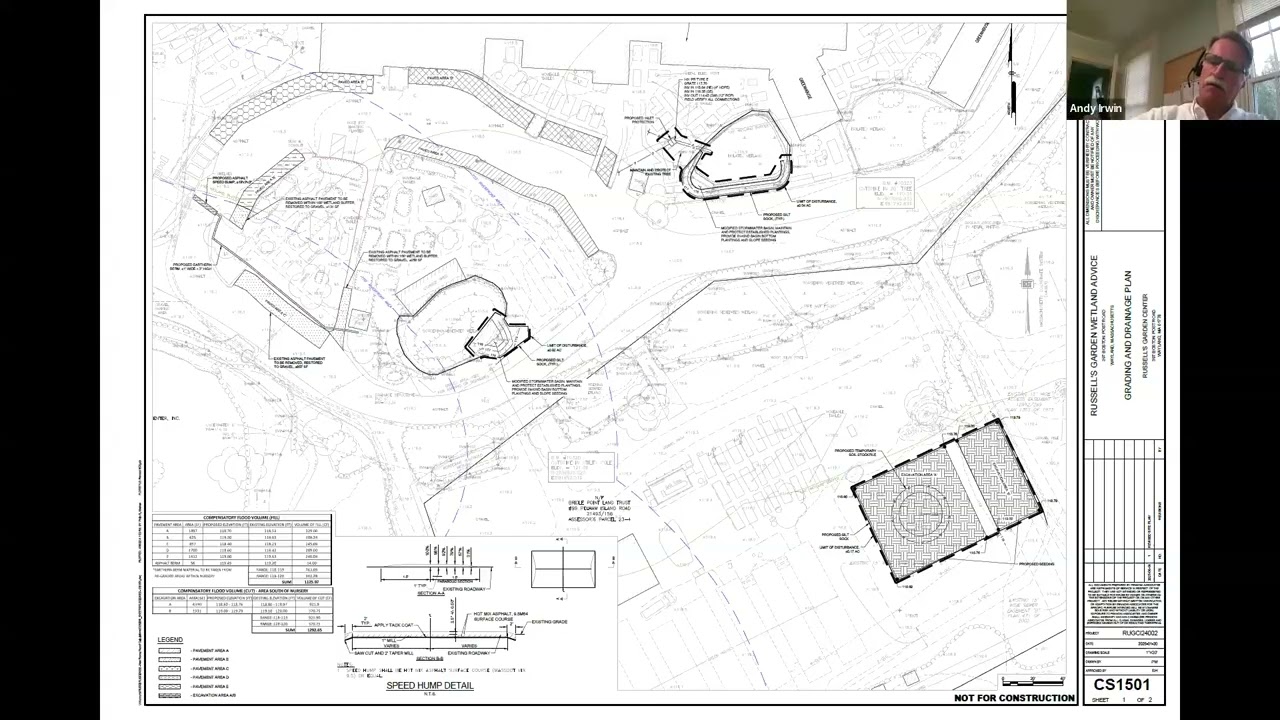
Sean Fair: Thank you. Luke. do I second? Thank you. Babs. quick roll call. please. Shannon Fisher. yes. Luke Legere. yes. Barbara Howell. yes. Lisa Aubin. yes. And Sean fair. yes. thank you. Linda. Okay. on to 1b this is 397. Boston Post Road. It's known as Russell's DEP file number 322. dash. 1048. it's a continued notes of intent file pursuant to waylands wetlands and water resource protection Bylaw and the wells protection accident by Dan Sean for the after the fact of paving work and installation of stormwater management at 397. Boston Post Road and 99 Pelham Island Road and Wayland mass. the proposed work is with a 200 foot riverfront area under foot buffer zone of our boring. vegetative wetlands property has shown assessors. Map. 23 parcel. 004. and 015. Linda. I'll Linda Hansen: pass it off to Andy Irwin. I think who's representing the client on this project? Andy Irwin: Yes. good evening. Andy Irwin. 73 plain Road. Wayland. representing Russell's garden center. At our last meeting. we were asked to meet with Linda and go over what options we could consider to improve our plan. And we had that meeting. we listened. and we've submitted a revised design package. I could share my screen if they want me to show you the highlights of that. if I can figure out how to share. Is it under the More Emily.
Linda Hansen: you just if you move your curse around at the bottom. Andy Irwin: Sure. there we go. Yeah. so and sure people are seeing my screen now. yes. sir. okay with the plan. Namely. the plan is to reduce the total amount of paving. In particular. we have taken areas here on the western side. what was referred to as area B. and we've taken the areas within the 100 foot riverfront area and reverting those to pervious surface. so that includes the portion of Area B. all of this Parking Area C. we have also taken an area that was not part of the finding as far as work without a approval. but pavement that had been installed long. Long ago. and a portion of this walkway through the nursery area. approaching. but not quite all the way up to the 100 foot river front zone. changing that from pervious. impervious to previous surface. The other feature of our change was to make sure that we increased our collection of storm water to the treatment basin. And for that. we're installing a diversion berm across the driveway here on the left hand. West hand western side. left hand side of the screen. and that it will be a paved berm. sloped so that we can not kill cars. but gives us the containment of water. and it's on existing impervious. So we're adding no impervious with that installation. And then we have. you see this line here? This is be a small earthen berm. It's only need to be a few inches in terms of just making an affirmative collection of the water towards the treatment basement over here behind the nursery in the center. The modification of the basin is as it was. in terms of providing the adequate rate and quantity controls back to pre existing conditions. We have no significant change here in the we call the potting basin over more to the right. where we can have some water that sheds off that way. So we have no rate and quantity increase with that portion of runoff. And similarly. we had. over here to the right. the compensatory flood storage volume. So for the accounting of the areas by interval. we are providing full and in excess flood storage volume for that which was filled with the paving. we presented a complete. a updated hydraulic report. I don't know. Does anybody wants to go through all of that? I'll leave it if there are questions. But that is the nature of our project to restore conditions here at Russell's garden center. Sean Fair: Thank you. Appreciate it. Linda. start with you. please. You're on mute. by the way. just in case. Linda Hansen: Linda. no. A few questions regarding the riverfront alterations. So in the previous submittal. you had 200 or 2963 square feet of riverfront alterations. and 988 of that was in the first 100 feet. And your narrative says that capture you're talking now you're capturing drainage from 2600 13.000 square feet. So is that? Is that the operation in the 200 foot riverfront area? Andy Irwin: Then. yes. Linda Hansen: Okay. so why did that go up from the previous Andy Irwin: with the berm that goes across the driveway making making sure that we were catching portions on the pavement that increased our catchment area.
Linda Hansen: okay. but it catchment area. but not necessarily impervious area. correct? Andy Irwin: We're getting additional flow that's coming off of the potting area here further to the west. Okay. that now gets captured and and collected. But our. our alteration of the inner. inner 100 foot riparian zone is now reduced to where we are adding no new impervious. okay? Inner riparian zone. okay? And in fact. we are giving an additional area. And pardon me. oh. I just can't read it as far as two. It
Unknown: I think you just muted yourself. Well. you just Sean Fair: muted yourself there. Andy.
Andy Irwin: okay. so we pardon me. so we have actually reduced and an additional 250 square feet of pervious area in the inner riparian zone with the proposed plan. Linda Hansen: Well. for permitting purpose. can I get a final value of the total riverfront alteration? Then. is that? Because what you're giving me here is 2613 that used. You're calling that the drainage area. yes. but what. what I'm going to need for the permit is. is River. total riverfront alteration. which now looks like it's all outside. It's in the 100 to 200 foot area. right? Yes. okay. because I don't see that in here. unless I miss that. Andy Irwin: I will integrate that area for you. And okay. Linda Hansen: and then and more on numbers in one section of your report. you state that. let's see this is under water quality. Yes. you say you modified stormwater basin would be constructed and will raise the elevation from 115 to 116 and we'll have an approximate storage of 1032 cubic feet. Is that an additional volume? Because. then. because earlier you say in page. what is it? One that the nursery storage basin will increase from approximately 7300 to 8100. and the greenhouse will increase from 3600 to 4450. but that's. is that. again. what you're presenting in one is just? Is that an increase. or is that the total? Andy Irwin: I think so. Part of that is the total as far as the areas of those basins. So
Linda Hansen: what you have in four does not necessarily match what you have on page one. So that's why I just. I was just asking. Okay.
Andy Irwin: I do not have that number at my fingertips. That's all I can. Certainly follow up with you on that. And that basically areas the change versus the total of the basins. Yep.
Unknown: Okay. Linda. anything else. Linda Hansen: yeah. I mean. I. I've looked at your. your flood. compensatory flood. compensatory flood. volume. But again. without. I. you know. I just. I guess I. it looks good. I didn't get. I didn't have a chance to do really in depth review of that. But as far as I can tell. that's that should be good again. We. you know. I'm not looking at the hydro cat at this point because I the ability to do that. Andy Irwin: But we have provided the incremental quantities. as far as the compensatory flood storage areas and volumes over here on the left of the page. Linda Hansen: yes. it's in the narrative also. okay.
Sean Fair: Linda. from your end. I'm good commission. thoughts. comments. questions.
Luke Legere: concerns. Yes. I'll jump in. I appreciate the reduction in the impervious certainly. anytime we're talking storm water. I guess you know. Linda. I just want to make sure you're comfortable with what you're seeing. That it all I think it all makes sense. It doesn't seem like this is a massive new stormwater management system or anything like that. but just make sure you're comfortable with this. Wouldn't want to have a peer review or anything like that? Linda Hansen: Well. we did vote to have a peer review for the last meeting. and then they made these changes. So I think that that's a decision the Conservation Commission still needs to make about pursuing a peer review. I mean. from what I can tell. I guess Andy can weigh in this too. It looks like it's designed for a 10 year storm. It has the capacity for a 10 year storm. The beside. other than that. I think everything would probably discharge to the pond. that small pond on the east. or the west of the of the parking area. is that correct? Andy Irwin: That is. there is portion that will discharge there. I will note that that pond is not the river itself. We pointed out that that that is a an isolated water body that doesn't have a direct connection to the low flow channel of the stream. There was someone had asked that question. and I covered that in my narrative.
Luke Legere: And I'm assuming Linda. forgetting this off the top of my head. I'm looking in the materials now. but this is all previously degraded riverfront. We're talking about here. yeah. being familiar with the site. I imagine that would have to be the case. Yeah. Linda Hansen: My calculation is it's about 60. Five to 69% altered already the riverfront area. existing buildings and parking areas and everything. So it's. it's really not changing that much. I mean the by obviously adding. adding pavement changes things. but it's already been degraded with. you know. as a gravel parking area prior to that. Unknown: So. yeah. historically. right?
Luke Legere: Okay. yeah. I don't really have any other questions beyond that. I guess maybe it's just worth the commission considering whether we still think a peer review is necessary. or if we're comfortable with with this ourselves. right? Sean Fair: So let's come back to that real quick. the peer review piece. commission. Anybody else have any thoughts. comments. questions. concerns. before we circle back to that question and bring that up?
Unknown: We're good. I Shannon Fischer: think so. I think the only thing I want to just make sure doesn't get fall completely off the radar is that. I think in one of the first iterations of the plans. There was a seed mix proposed. and it had some non native seeds in there. And I think we just want to make sure that whatever is put down is is going to be native. especially on that. you know. anywhere we're planting new to to catch water.
Linda Hansen: Okay. Oh. I do have one last thing. I didn't notice this before. Andy. but you say no changes were made to EDA two or PDA two. Can you point that out in the plan? Because I must be blind. but I didn't see that letter that's on the first page of the letter. It is. I
Andy Irwin: uh. this was the existing drainage Linda Hansen: area. You're referring to drainage Okay. yeah. Andy Irwin: So those are the drainage areas. As far as drainage area. this was existing. and if you notice the area on the left increases. that's the surface area that is increased in terms of catchment with this.
Linda Hansen: Okay. no. it just says changes were made to this. and I didn't know what you would refer to those Okay. existing and versus the proposed. I get it. Andy Irwin: Okay. sorry for all the scrolling there. people. Nope. you're good. Fish. Sean Fair: Anything else. we're good to go back. circle back to Luke. So now we need to talk about. do we need a peer reviews of Linda? I guess I'll start with you. just on your overall thoughts. comments. opinions on that. and then we can kind of kick off the mission. Linda Hansen: I mean. I think we had a productive meeting. Andy and I did. and he did address all my concerns and pulled everything out of the 100 feet. which I think is important. I think that's one area that. you know. the state really wants us to protect the riverfront. and he's picking up. he's picking up a lot of the runoff from that again. I just don't have the ability to review a hydro CAD plan because I just don't have the software. I don't have the background for this. the engineering. you know. background for this. So it's up to the Commission decide whether or not they feel that's important to have that reviewed. Sean Fair: Got it? Thank you. Commission ever kind of know what we're being asked or think about real quick. And if there are no question about that. I'll speak last we build a thought comment concerned on whether or not we would like to see a peer review on that.
Luke Legere: Well. I guess I'm somewhat on the fence. I think. you know. as I alluded to earlier. I think the changes that have been made are certainly for the better. I feel a lot more comfortable with what we're looking at now than what had been proposed previously. But to Linda's point. you know. I think when. when we start getting into heavy duty engineering. given the proximity to the river. I guess I'm. I don't. I don't want to be overly harsh in terms of requiring a peer review. but I also want to make sure everything's going to work the way it's designed and supposed to. And I just doesn't seem like there's anybody on our side of the table who's able to really definitively weigh in on that. so I'm tending to lean in favor of having this peer reviewed. but curious to hear what everyone else thinks. Unknown: Okay. thanks. Luke. Thoughts. Shannon Fischer: I think I'm really with Luke. I'm on the fence like these are good changes. but this is so far outside of the area certainly my expertise to to know for sure where the where the waters are going. Yeah. I'm with Luke. Andy Irwin: May I just offer some commentary. just in terms of observation. That these basins are existing. we are adding a very. relatively percentage wise. small area of impervious to this area. It's not like we're doing a new development with. you know. new stormwater basins. And will they work to that extent. you know. the proportion of increase to these basins as you look at relative to the percentage of impervious increase it. it's in that magnitude that just in terms of. I'm not telling you not. but I'm just saying we're giving that area. we're giving that treatment with what we're doing. So from that standpoint. it is. in proportion. not as drastic as many other sites where we're having a new development with. well. what and how will the runoff work? This is runoff that has been basically flowing through this path. We're just making the additional accommodation for rate with the additional size of the basin and in the degree of infiltration in those basins as well in terms of retention.
Sean Fair: Thanks. Commission. Other thoughts or before I plan.
Luke Legere: got okay. I appreciate those comments. Thank you. Mr. When I think it kind of it sort of back to my original point there. I don't. don't want to make a mountain out of Mohawk with this. but I also just want to make sure we're getting it right. so I still sort of landing in the same place. Yep. Shannon Fischer: Is there a middle ground of like. no. a quick review that just kind of checks things. but isn't a huge. expensive affair. Like. is there a way that we could get the review and not add a ton of expense and time? Sean Fair: I mean. at this point. if we not to weigh in. yeah. but if we were to give them a ask for a peer review. we're asking that peer review to design something for us from score Azure. It's Hey. check our math. Here we go. Is there anything we're missing? So in terms of time for peer review. I wouldn't imagine it wouldn't be as much as some of our other things we've asked to have reviewed or designed or whatever else. That's Linda. is that fair? You're on mute. Linda. you're talking speaking.
Linda Hansen: I mean. typically. our scope. so we're always. you know. compliance with the chapter 193 bylaw. which is our stormwater bylaw. You know that we. that we use. you know. that's. that's everybody has to comply with who's doing stormwater management. But you know. you know. we can. we can scale down the scope a little bit to say. just. just take a look at the calculations and tell me if business is going to work right. Sean Fair: Yep. Anybody else in the Commission have any thoughts before I went? So I guess I I'm with Luke and Shannon. and especially Shannon. the most recent point is. I don't want this to be a ton of work. I don't want to be arduous. Just a real quick check our math with such a nice resource right there. I'd hate to have a whoops of Daisy. We missed math mistake like. you know. a year from now. so I'd be in favor to have a quick as possible peer review. just to make sure we're on the same page. If we get that kind of helps solidify our thoughts on our end. So that's kind of where I am. So base commission. Any other thoughts. comments. thoughts. opinions. concerns. Before we go to vote on this. look for Unknown: being being new. You know. I would like to take the more conservative route. So since several of you are saying it might be good to have a peer review. and if it can be ratcheted down. I think that would be good. And I. even though this is my first official meeting. I've dialed into a few of the previous meetings where Russell says presented. and I I can see that they've been working very closely with Linda and coming back with them with solutions. So. you know. we appreciate the cooperation. but I would agree. I think if we can do a ratcheted down peer review. that sounds good. Awesome. Sean Fair: Thanks. Lisa. Okay. So that's where we're looking. or leaning commission looking. then for a motion to that effect.
Luke Legere: So just. I think we had. Linda. you said this earlier. I think too. right. we had. we had previously voted to have this peer reviewed? Yes. So do we need another vote? Do you need us to vote just to limit. to try to limit the scope to as narrow a review as possible? Linda Hansen: Well. not necessarily. I mean. I can work with Andy offline just coming up with a sort of a ratcheted down scope of work and maybe elicit potential peer reviewers and see if they have. A conflict of interest with any of them and and then we can move forward at that point. Sean Fair: So. so we're looking for that is usually looking for. basically a motion to continue. In the meantime. work with Andy to get the peer review started. Does that make sense? Yeah. So make sure you're what motion looking for. So we're looking for a motion to continuance. and you work with Andy the period. Got it Luke Legere: Okay. all right. We. I guess the question is. Mr. Irwin. do you want us to continue this to the next meeting. which is only a couple weeks out? It seems unrealistic to me that this Andy Irwin: I was. I was going to ask Linda's thoughts about the timing of getting such a review limited though it may be. my sense has been that the reviewing firms have been very busy. such that one meeting out would probably not give us enough time. Linda Hansen: Yeah. we have the meeting schedule a little bit condensed this month to two weeks. because normally do three weeks because of holidays. we were trying to. you know. you know. schedule things so that we're missing Thanksgiving and Columbus and all these other weeks and school vacations and stuff. Andy Irwin: So then in October. the Emily. Linda Hansen: When's our meeting in October.
Unknown: give me a second.
Carole Plumb: I think it's the Unknown: second week in Linda Hansen: October. I should have it here too. So. Unknown: October 8. October 8.
Luke Legere: Okay. October 8. Does that sound reasonable? Mr. Andy Irwin: Owen. let me just I don't know. I'm not I can't see if Tim and Dan are on. Unknown: yeah. we're here. That works for me. Does that work for you? Checking. okay. perfect. Yeah. looks like I'm open. Andy Irwin: Okay. that works for us. Thank you. So with that. to allow the commission to do the conduct the peer review. we're okay with the continuance to the October 8 meeting. Luke Legere: Okay. thank you very much. Then I would move that we continue this hearing to October eight after 6:30pm
Sean Fair: Thank you. Luke. To hear a second. Thank you. Babs. Roll call. please. Shannon Fisher. yes. Luke Legere. yes. Barbara Howell. yes. Lisa Auburn. yes. by the way. Jenny Brown came on the middle of this as well. Jenny Brown. yes. thank you. And Sean fair is a yes. all set. Thanks. folks. We'll see you in a couple few weeks. Okay. thank you. You got it.
Unknown: Okay. moving along Sean Fair: onto 1c this is 169 rice road. Linda. do we have a DEP number here? I do not. Carole Plumb: There is. it's 1053. Linda Hansen: oh. it just came on. Okay. yep. 53 Sean Fair: Okay. so this is 169 rice road DEP file number 322. dash. 1053. this is a Notice of Intent file pursuant to Wayland wetlands and water resource protection by law and the Wetlands Protection Act submitted by Saint fellow patter. Saint mercurious and Saint Mina Coptic. or Orthodox Church for the work at 169 rice road and Wayland mass. The proposed work includes a demolition of existing church and construction of three new buildings. parking surfaces. a courtyard. a sports field and storm water management systems. The project is in with a 200 foot riverfront area and the 100 foot buffer zone of a boarding vegetative wetlands property is shown on assessors map 40 parcel 08. Linda. Linda Hansen: I believe we have Andrew presenting for the for the applicant. Is that correct? Unknown: Yes. it is correct. And actually. before I kick this off. we have quite a few members of the project team who I believe are on this call as attendees. if we would be able to promote them to panelists. We have our architects. our engineers. our landscape architects. everybody's with us to present their pieces. okay?
Linda Hansen: SEAN MALONE is one of them. Is Unknown: that right? Yep. SEAN MALONE is our engineer. We have. Can you move this over? It might be easiest if they raise their hands. because they actually Linda Hansen: have quite a few of them. Yeah? What they raise their hands might be easier. Yeah. yeah. Unknown: instead of making you play name tag. thank you. Yeah. Do
Sean Fair: I miss anybody? I.
Linda Hansen: There's somebody called SP I don't
Sean Fair: see anybody with their hands in there. Missing anybody.
Unknown: I'm Sean lane and representing DSK. the architects. text.
Sean Fair: Okay. we all set everybody else needs to be on on here. Unknown: Andrew. I believe so it looks like we have people from all parties here. So if there's anybody else. they can raise their hands. But I believe we're good to go. Um. I believe it was Sean Lennon. intent just to kick this off briefly. and then we'll all be happy to share our pieces with the Commission. Yeah. Good evening. everybody. I'm Sean lane and from Studio DSK. and just want to thank you for the opportunity to present the project. I wanted to present our team who is joining us tonight. I have Andrew. of course. from Goddard. I have Sean Malone from Oak consulting. and then also Naomi Cottrell and Caitlyn vend van de meelb from Crowley. Cottrell landscape architects.
our goal with the design of the project has been basically to create a campus that reflects the traditions of the Coptic Orthodox Church. and we wanted to be sensitive to the surrounding neighborhood and the landscape. As you may know about this site. it slopes from Rice road up to Turkey Hill. And what we've done is we've tucked essentially three buildings into the hillside. And the first building. which will be in a phased construction. it will be the church. There is a second building that should follow about three to five years after. which is essentially a recreational building with classrooms in it at one end. and then the there is a another annex to that. which also has classrooms and a senior housing portion in the third building would be the diocese building.
The design that we have come up with essentially works with the topography in that it sits in against the hillside. and it does have some. some tall towers on the church. which we were trying to be sensitive to the Turkey Hill neighborhood by keeping it at the lowest point when the site's complete. Basically. we want it to feel like it is. It's been there. and in that it fits in and compliments. you know. the architecture. We realize that there's a stream on the opposite side of of rice road. and the setbacks reach across the road. and we do have parking that sits in the setback area. We have maintained the the trees that are in that zone. and we have shifted the driveway there is. there are two driveways off of rice road right now. One is a two way that is considered the main driveway. And I believe that's 28 feet wide. There was a driveway off of the existing property onto Turkey Hill. That one has been eliminated. and it has been moved over to the north end of rice road on the site. And that is a one way. It's for exiting the property. and you can only turn right out of that. heading north on on rice road. That's essentially it. I would like to turn it over to Andrew to essentially go over the wetlands. and if we have any other questions. I'm available to to answer.
Perfect. Thank you. Sean. can the commission see my screen? Okay. yes. perfect. So what we see here. I'll start off with the existing conditions plan that was filed as part of the Notice of Intent. So as Sean has described. this property is currently in use and developed as as the Orthodox Church. This lot is about five and a half acres. so the the bottom half is is fully developed. As noted. there are three driveway entrances that come in from Rice road. There's existing parking our church building. And a playground at present. and the remainder of the lot slopes up gradient toward Turkey Hill Road. So we have no wetland resource areas that are actually present on this lot itself. Most notable that the commission would have seen in the Notice of Intent filing. when you review the maps of the property. there is a map potential vernal pool that comes up in the area of my cursor here. actually directly adjacent to where you guys would see test bed 11. It was mapped as a potential vernal pool on the the aerial photography by mass mapper. So May of this year. during vernal pool season. our wetland scientists went up to the property just to take a look at it. We confirmed that in this area there are actually no wetland resource areas at all. It continues to slope up gradient right off the parking lot all the way up. There's no evidence of hydro soils. leaf standing. certainly no vernal pool activity. Our best guess is that there's a shadow that can be seen on the aerial and that can get picked up at times as a potential vernal pool. So we did submit a report to the commission that assessed that area and made sure that that was discussed. The resource areas that we do have are all across the street. so rice road bisects the property from the resource areas. Once you cross over rice road from our property. it becomes a very steep slope. So we have quite a steep embankment that changes at least 10 feet in grade. And right at the toe of a slope is a border and vegetative wetland system. And further interior to that is a perennial stream known as snakebrook. So because these resource areas are across the street. the bylaw no disturb zones under Chapter 194 do not reach this property. And neither does the 100 foot inner riparian zone that we could see on my cursor right here. It ends through rice road before it reaches our subject site. And so what we are dealing with on this property is the 100 foot buffer zone that we see on my cursor here that clips the edges of the property and the 200 foot riverfront area that comes through portions of the existing parking lot and some of the driveway entrances. So I will give a brief overview of the proposed conditions of the project. I know Sean did a good job explaining in a bit more detail the intentions of the project. but the project intends to propose three new buildings through an expanded redevelopment that redevelops portions of the site that are currently developed. as well as expanding the development up into the hillside of the property. So the intent is to construct three new buildings on the property through a three phase development plan with new driveways. parking surfaces. a sports field. courtyard and a stormwater management system. So as Sean had mentioned. this is phased through three phases. So phase one consists of all of the work that is within the 100 foot riverfront area. or the 100 foot buffer zone and the 200 foot riverfront area. So phase one includes building a. which is the new church building itself. the reworking of the parking surfaces. utilities. stormwater management. the athletic field. septic so the main site work. the main infrastructure and building a. all are under phase one. Phase Two includes the construction of Building B that we see here that's to be used for a proposed Youth Center. Sunday school and senior housing. That building is located outside of the 100 foot buffer zone and the 200 foot riverfront area. as can be seen. And phase three is the construction of Building C. which is intended to be used as the diocese center. and it's also outside of all of the jurisdictional buffer zones and the riverfront area for the property. So as we had outlined. we are proposing to construct new driveway entrances into the property. reducing from the three that come in and exit from various sides to two. So this figure that we see here was included as part of the Notice of Intent. And what it does is it highlights all the existing impervious surface cover within the riverfront area and the newly proposed and so it helps us come up with our riverfront area graphics. And so what we are determined was that this yields about a 913 square feet of increase of impervious surfaces within the riverfront area. it doesn't move closer than existing conditions. because rice road bisects the property. and we have existing driveways that come from Rice road. We aren't moving any closer to the river. but there is an increase in the impervious surface footprint within the riverfront area. and so under riverfront redevelopment standards. we would have to provide mitigation attitude one ratio for doing so. And so as part of the Notice of Intent. the Commission received an invasive species and mitigation planting plan that Goddard prepared. So what we had done is. because this lot is primarily developed within the riverfront area. under 310. CMR. 10. five. 8g we looked for off site opportunities to restore the riverfront area. and we found about a 4000 square foot section up gradient of the river itself. consisting of the wetlands in the buffer zone where it's pretty densely vegetated with invasive species. primarily species like glossy buckthorn. oriental bittersweet species of that nature. And we propose to hand remove those species and replant them with native. Vegetation. So that 4000 square feet is a bit over a four to one ratio of mitigation to the increase in impervious surfaces that are generated by the project. So at a high level. that's the overview of the project. We also have our engineer Sean Malone. and we have our landscape architects as well. who are going to discuss their pieces. So I'm happy to kick it over now to Sean to discuss the stormwater side of the project. All right. thank you. Andrew. and let me see if I can share my screen here.
Okay. I'll be brief. Just wanted to give everyone a brief rundown of the storm water and what we were looking at on site and what we're proposing to deal with the storm water. Currently. the site sheds down to Rice road. and we identified three kind of distinct sub catchments. This first sub catchment draining over towards the entrance from Turkey Hill Road. which then flows to this catch basin in rice road. a second sub catchment that flows down the center of the site. down the main entrance to this catch basin. And then there's a high point in rice road about here. where it splits north and south. so a third sub catchment goes to the south into this catch basin here. So what we wanted to do is to make sure that we design a storm water system so as not to increase the flow to any any of these catch basins. So the overall site proposes approximately three acres of new impervious area. And what this plan shows is the post development sub catchments. And as you can see. there's several. We have three in the pre development. and we have about. I think. 10 or 12 in the post development here. So what this represents is where we've broken into smaller drainage areas where they're picked up by deep some catch basin basin to provide pre treatment. And then all of this area. with the some small exceptions I'll point out in a moment. drain to a subsurface infiltration area underneath the sports field. this proposed sports field here. and second subsurface infiltration area underneath the parking lot here. and what these areas are going to consist of is large diameter. two foot or three foot. perforated HP. HDP pipe surrounded in stone. And to ensure that these systems would work. we did about 14 test pits out there. We dovetailed this with the test pits we did for the new septic system. and we found that the soils in these areas are nice gravels. very coarse sands. All the perk tests that we did out there were. I think. three or four minutes or less. Some were less than two minutes per inch. So we're going to be able to drain these this site and the new impervious to these infiltration areas and get that storm water back into the ground. The only areas that I mentioned that are not being captured by this new storm water system is this area here. three A. which is existing wooded area that's remaining. This area three or two a. which is same situation. existed wooded area to remain. and then the area of the grass sports field. So the net effect of all this is we're going to see a net reduction in both the rate and the volume of stormwater to Rice road. And this reduction is going to be significant. We're looking at 75 to 85% reduction in the rate and volume of stormwater coming off this site. So we also have included in our submission. construction. erosion. sedimentation controls. We have a erosion control notes and details sheet. so we think that we meet all of the requirements of the chapter 193 with this storm water and sedimentation control plan. With that. I'd like to turn it over to Caitlin and Naomi to talk a little bit about the landscaping and trees on site.
Hi. I'm Caitlin with credit cultural and let me just share my screen. You. Okay. so I'm just going to talk about the planting plan. This line is showing the 200 foot buffer for the riparian zone. and you'll see that the largest density of plants is within that zone. We're following the requirements of chapter 194 and meeting those requirements primarily through large deciduous shrubs as well as evergreen trees and large canopy trees. We think that this will help to buffer the development from this road. as well as help with any runoff that occurs as far as the rest of the site that is under Chapter 193 and we are actually exceeding the requirements. As far as planting. we're strategically having the planting primarily their canopy. trees along the perimeter. as well as shrubs along some of these steeper slopes on the edges. in order to help with erosion. And in general. we're just trying to block the building as much as we can from any of the adjacent sites. You'll see that in our submission. we have numerous tables showing how we're calculating all the tree replacement requirements. And I can answer any questions on that if you have them. But all of our replacements are all native plants. and. yeah. that's about it.
Sean Fair: Okay? Thank you. Um. Luna. we'll start with you. please.
Unknown: Linda. you're muted. You're on mute. Still on mute.
Linda Hansen: Oh. mouse is not working. sorry. beginning with this site inspection report. Do you have a wetland report. or is it just just a site inspection report. Unknown: So at this point there is just a site inspection report. The off site wetlands were delineated by dillis and Roy. who did the survey and wetlands work on the off site portions. So we can reach out to them to provide a report. and if the commission wants. we can also. if that's not available. we can come up with an additional one. but at this point we just have the site inspection report for what's actually report for what's actually on Linda Hansen: our property. Yeah. there's no dates here when. when the wetland was delineated. or the riverfront was and that's that's important to know whether or not it was. you know what time of year. when. if there was a drought. things like that. Okay? Because I'm seeing that anywhere. I guess I'm missing it. Unknown: It may not be on the plans. and we can have that added. It was this spring. because they did it around the same time as we inspected the the potential run pool area. but we can absolutely have that added to the plans and request that the report be given to the Commission as well. Linda Hansen: Okay. so then I have a question about the butter notification. You have a letter in here for a better notification. You know. the standard template that we have. typically. I'm looking for it. and I don't know was that sent out. because what we received was something completely different. Was just more a letter from the church saying. Dear community members. Welcome. Please come. you know. and with a meeting date of September 3. is that was that something different? Unknown: Yes. that would be a different notification that they had sent out to members. The notification of butters that you see there was sent out by by our office. and we have sent over the scans today. So yes. two different notifications. that both were received by by everyone in in just to clarify. Linda. I think that second notification that you were referring to was something the church reached out to the community members to introduce the project. And they did that. I think it was last week they met with their their neighbors. Linda Hansen: Okay? We did not get notification. So. so I missed. I'm guessing they. I mean. you sent me the receipts that you sent these out. It looks like they were done on August 27 but it's kind of odd that we didn't conservation. did not get there about a notification. Unknown: So. yeah. you do. I'll. I'll check into that.
Linda Hansen: See what else under. under table as part of your narrative. we talk about the wetlands or the different regulations. you state that there's a 913 square foot increase on page. let me think page 13 at the bottom. the project will result in a 900 square foot increase in impervious as a result. Yes. that is. I'm assuming you're talking in the riverfront Unknown: Yes. within the riverfront area itself. just for that was for wetlands jurisdiction. Chapter 194. would have a much different measurement. Or 193 I should say. I apologize. Linda Hansen: yeah. But then on the Notice of Intent. on page three. you say the increase is 753 Yes. it is.
Unknown: It is 913 within the riverfront area. So we'll make sure we clarify that. Linda Hansen: Okay. so what is the percent of alteration in the riverfront area? Then
Unknown: I can see if we have that on the plans. I'm not sure if we have the total riverfront area coverage on site calculated. It may be within that graphic I shared earlier. I'll take a look right now. And if we. if we don't have that available right now. then that's a calculation that we can absolutely provide to the commission. Okay? Linda Hansen: And one last thing is used an old bylaw filing fee for chapter 194 that's been since updated. I think was that last year. So I'm not sure where this came from. but all the new information should be on our website. Perfect. Unknown: Yeah. I think we had another project with you guys today that triggered that as well. And I think because we work with you guys a lot. we have databases of a bunch of the towns and their old files. so we'll just have to update that. So I apologize if that was an old Linda Hansen: one. Yeah. okay. because that that that that won't be accurate. Unknown: Yes. yeah. exactly. So we'll more view that with you. and I'll make sure you have everything updated. Linda Hansen: Okay? And
again. with Unknown: where was. Can you.
Linda Hansen: can you give me the numbers again. for the stormwater. for the replacement? Is there a table that was done at some point? Is that on the plan. I think Unknown: it might have been on the schedule that Caitlin had pulled up Linda Hansen: the landscape plan.
Unknown: Yep. just Linda Hansen: want to make sure the numbers match. because the numbers in here say something of 400 and some trees. Is that right? I will let
Unknown: our landscape architects confirm. I believe that there was somewhere around. like you said. 400 removed from the site in total. much less within the buffer zone. And then they detailed compliance with chapter 194 and chapter 193 replanting in their landscape schedule. Shannon Fischer: I think it's closer to 500 something Linda Hansen: trees. is it? Yeah. I thought. so. um. so. yeah. yeah. those are retaining walls in the back. And I mean. because it looks like you're doing some substantial grading. right in order to to take the slope out. Unknown: yes. there'll be retaining walls that actually constitute the building foundations back there on the east side. Okay. okay. and part of that is a requirement from the fire department to have a fire lane around the back of the building. So that's requiring us to moderate the slopes in the back a little bit. Linda Hansen: And did you have you? Have you received any approvals from the Board of Health for the septic system? Unknown: No. we've just made that formal submission this week. so we expect there will be a few weeks before. um. we get any comments back from Darren. Linda Hansen: Okay. Oh. it's good planting plan. okay. yeah. because I think. I mean. we're talking about doing a peer review. a joint peer review. with the planning board. conservation and Board of Health. and I don't know when. what the how the timing should work for that. it's always good to see if the Board of Health has any changes to the septic system. because that might modify. you know. locations of things. And I'm not sure what the planning board is discussing. either. So at some point. I guess we should. probably should get together to figure out the timing on that. Sean Fair: But so when real quick to hop in. help me understand that the playing board and and Board of Health just got the submission as well. So this is not been approved or amended at all by them. this plan that we're looking at right now. Linda Hansen: Yeah. I think the Board of Health just either received it. I think it received it Luke Legere: today. right? Or. Yeah. yesterday. I think. yeah. but Unknown: they haven't really had a chance to look at it. But to your question. Mr. Chair. yes. you guys are have kind of been our first stop. The way that schedules have worked out. We haven't had a formal discussion with the planning board yet. Linda Hansen: I thought they were meeting tonight to discuss something. Was that just to take a. Vote in the peer review? No. I don't know. Okay. well. I saw they were meeting tonight. and I thought that was on the. on the. on the agenda. So. okay. Sean Fair: Luke. I guess to that point and I'll shut up. I guess I'm missing. How do we conservation have a peer review if we don't know what the final. I mean. I can't imagine what we're looking at now is going to be anywhere. It's gonna be amended somehow before it comes to us. So I guess the peer review. are we saying? What inland. in your mind. if. what would we what would we would be approving today. if the Board of Health is just looking at it like we're authorizing you to work with the board of health and planning to get a peer reviewed for us to then take a look at and then modify again. Linda Hansen: so the peer review conservation would be strictly stormwater review. And that's planning board. I think we need the same thing. They would need a stormwater review for part of their site plan review. Again. the plan is on vacation this week. so I haven't had really had the ability to speak with them about the process. but I think at some point we do need to have that conversation about what the process and timing of that's going to be. And I mean. the scope of work. I think. has been decided. However. I again. you know. if there's. if there's any changes to the septic. or the location of the septic. or anything else that could also change the location of the storm water management systems. you know. you know. they're all intertwined in this. So maybe the best thing to do is wait for the town planner to get back and we can figure out what the process is. At this point. it's just a matter of taking a vote that we would. you know. we're. we'd like to pursue a stormwater peer review for this project under for conservation.
Sean Fair: I mean. I guess just. it just seems early in the process. We've never done this before. this early. where we're Board of Health. US and Tom planning get all the same. That's what vote would you like us to get? To give you is. in the next month. start up peer review on a plan that we haven't
Linda Hansen: seen well. I mean. again. we have a plan. It's just a matter of whether or not Sean Fair: we've never seen it before. like the board of Board of Health. with this many trees going down. this much storm water. that much impervious. and it's most septic. I can pretty much guarantee what we're looking at now is gonna have to change again. not without even seeing what zoning or playing and Board of Health is gonna do. So this is. it's unusual. I guess I'm curious why we are the first stop. if nothing else. we gotten. So again. commission. weigh in. I feel like I'm I guess I'm confused. Why so many unanswered things? What are we actually voting on today? Luke Legere: I mean. I understand what you're getting at Sean. I think maybe another way to say this. So the way I'm thinking of this is. it's a. we're looking at basically a hypothetical project right now. which is surely going to change. So I guess. I guess if the well. and with that said. clearly. this is going to need a peer review. right. clearly. So I guess it's going to be a matter of expense for the applicant. because that's probably going to be an awfully expensive peer review. because it's probably gonna have to be multiple rounds of review. would be my expectation. But So at any rate. yeah. I hear you. Sean. I guess. but I also hear what Linda saying. I it does seem like ultimately. the vote tonight is just going to be to authorize Linda to work with planning and Board of Health on getting a peer review. We'll be looking at storm water. and then we go from there. But I certainly take your points that it seems like a very early it seems like we're looking at a project that's not really quite ready for prime time yet. I guess is the way I'm looking at it. Sean Fair: Right as always. much more eloquently put than I thank Linda Hansen: you. Luke. when is your first time planning board? Is that? Is that us in October? Sean Fair: Sorry. second. Linda. is your. is your Linda Hansen: hearing with the planning board scheduled for October at some point?
Unknown: Yes. we are on for October 15 is when we go before planning board. Linda Hansen: Okay. again. the Commission can take a vote tonight to engage a peer reviewer for the storm water review. and then it won't be until after the planning board meets that we probably come up with a the process that we're going to follow for that I mean. if they again after their first hearing. if they have a number of questions or concerns or there's modifications that need to be done. there's no real reason to do a peer review immediately until the commission and Planning Board have seen revised plans. And that holds true also for Board of Health. if they have some changes that. Need to be made based on. you know. their original plans. I mean. that's how I look at it. I don't know how the other boys are going to look at it. you know. I don't know if they they're going to need that information in order to suggest revisions to the plans. I don't. I don't really know how they work so. but it doesn't make sense for us to really engage anything at this point. other than take a vote and then wait until the planning board meets on October 15. Does that make sense? Sean Fair: No. I'll go back to I hear what you're asking and No. we've never done this. so I'm clear and make sure the applicant understands whatever I'm we're gonna have to see this thing again before we ask for a peer review work. So again. I don't understand why we're we have multiple peer reviews. If we're saying. Well. we're technically not going to even engage in peer review for someone. why are we here?
Unknown: I'm happy to kind of just jump. So yeah. the questions are fair. right? I mean. there's a lot of boards that have to go through something like this. So as a team. like this. so as a team. we were targeting the next filing deadline for each board. And the way they work out. Sometimes it gives an interesting situation because of the scale of this project. right? It's a large project that has Wetlands Protection Act. and it has chapter 194. 193. Planning Board of Health. There's a lot of boards that need to see this project. have the time to digest it. review it. We felt. as a project team. it makes the most sense that once we have at least what we believe is a final design. to file it with the boards. to allow you guys time to review it. We fully understand that when you go through these processes. these things can absolutely change. But this is the current design that we have. You know. we've come up with a design that makes sense architecturally from a stormwater perspective. so we know that we have to go through the process with all the boards. but it makes the most sense for us to at least engage the Commission on the process now begin to review it and take feedback as we go. because any one of these boards could have questions. modifications. depending on different local bylaws. policies. different things like that. So we understand that we are not asking you guys to run right into something and act as this is the final design. But from our side of things. it's helpful for us to start to get feedback from each board weeks. We like the idea of the peer review going simultaneously. because stormwater is going to be through planning and the commission. So I think if we start to go out to peer reviewers and approve that at least it helps us begin to prep for the peer review process. So that's the intent behind it. Certainly understand the Commission's questions. and I think you know the the thought of taking a vote to peer view this project helps us just get the next step to move forward. We can talk between the different meetings as of when we do that. but it's helpful for us to at least get this project in front of the commission begin to discuss it. take some feedback and set up our process with everybody. Sean Fair: Yeah. thanks. Andrew. I appreciate that. I'm confused. Didn't someone to say you guys are in front of the planning board on the 15th of October. right next. next Planning Board meeting for y'all. Unknown: that is correct. we we have been given by planning board that date as the hearing. Sean Fair: So we've got two meetings in between then. right? So why are we meeting now to wait to hear what the planning board says. Start a review process so I hear what you're saying. but so I'll go back to you. Linda. I don't understand why we're here right now. Linda Hansen: Again. they submitted. We have to hold a hearing within 21 dates. And so. you know. this is. this is a process we have to follow. So again. we don't have to get started on any peer review. I do worry about the Board of Health if there's any changes. I mean. maybe that's a peer review to start with. a groundwater mounting peer and the scope of work that the Board of Health has put together for the peer review. I mean. that could change things. you know. locations and stuff. So. you know. maybe again. this might be a different process. Here we might be. you know. second. third in line as far as stormwater goes for peer review. And that's something that a discussion we have to have is. you know. how we're gonna. how we're gonna. how we're gonna do this. Sean Fair: you know. second. second or third is not first. No. it's not until the planning board says. here's what we're gonna have them do. and this is gonna change what you all are seeing. what. what are we voting again? So we can Linda Hansen: wait to vote. Sean. we can wait to vote if you want. Well. that's my Sean Fair: Yeah. so I'll this is not. this is first time we've ever done this is a highly unusual process. but this. this. this part of us. front of everybody else for a peer review that that we don't know we're peer reviewing yet. technically. other than the fact that. yeah. there's gonna be a stormwater peer review. So question I Shannon Fischer: was going to say. like. I I mean. I certainly hope we see changes. I don't even like. I don't think I would even want to vote on a peer review right now. the number of trees that are the number of mature native trees that are slated to come down. is so egregious and reprehensible. I. Certainly hope that that we see changes. I mean. this is an Aston they're proposing to clear cut and DeForest acres of land. And I don't even see that there was an attempt to save any of these trees. except for that small little token pocket down front. I mean. it's. it's really hard to look at this. I I would certainly hope that we see some serious changes going forward. And I would. I wouldn't mind holding off on the peer review for those reasons. Unknown: Yeah. put a parking garage in to save the trees you don't have. There's a lot of changes. And on the next plans that we get. we require the data. and that's missing again.
They must read the rules. because they asked for a waiver for something else. but then they don't give us the datum.
Shannon Fischer: Gotcha. yep. Thank you. yeah. a parking garage. or stack some of the buildings. Or instead of having another field. which Wayland has plenty of fields. have an outdoor classroom. Teach children to appreciate nature. instead of stripping it away. it's their the natural legacy that they'll need to have a good future anyway. So there's many changes that could be made to make this an actually environmentally sensitive project. which it certainly isn't right now.
Sean Fair: Okay. thank you. Jen and Barbara. Anybody else thoughts in the commission? Luke Legere: I just want to echo Shannon and Barbara's comments. I'm. you know. really sort of at a loss for words. Honestly. looking at this design. the amount of trees that are coming down there's not like there's barely a square foot that's not developed here. and there's massive amounts of parking. It appears to me. I just. I agree with Shannon and Barbara entirely. It seems like there's a better way to design this to be able to save some trees and some of the natural environment. and it doesn't really appear to me that that there was even an attempt to do that. based on what I'm looking at here. So I I guess at the end of the day. you know. I heard what the applicant said in response to your question. Sean. it's their prerogative. obviously. to file in whatever order they choose.
I'm sort of agnostic. I guess. I don't really have a problem with voting tonight to authorize Linda to work with the other departments and boards on a comprehensive. collaborative peer review whenever that happens. But I also agree with what I think most of us are saying. that it doesn't seem like that's going to happen really. very soon. So I guess. I I. I guess. in my view. I'd sort of put it back to the applicant. If they want us to take that vote tonight. I'd make a motion for it. But it does seem like it's a little premature. Is just my observation. That kind of goes back to what I was saying if what I was saying before. It just seems like it's going to be an incredibly expensive undertaking. It's. I suppose it's the applicants money. so it's their decision. but it isn't the way I'd do it if I was on their side of the table. But that's I'm not. So that's where I'm at. Shannon Fischer: Can I add a sort of a bigger picture thing. like 500 trees proposed to come down here. We just. like the the Caritas project is what another 300 trees someone cut down. We've had two different people who cut down 50 trees. I think. give or take on their properties. Like this is how towns lose their tree canopy. Like this is how it happens. 100 500 trees. at a time. And these are really important natural resources. And these are also homes for many. many creatures that just happen to not be human. but still have value.
Okay. thank you. Unknown: I just to that point. because I noticed the same thing. And again. being new. you know. but it was obvious to me. too. that the whole. the entire five acres are being developed. And so one thing I noticed. just as a comment. is in the Notice of Intent memo section 2.6 the number of trees to be replaced. I think we're actually using the chapter numbers 193 and 194 three and 194 because it doesn't tie to the count of native plantings to be replaced on. I think sheet l 401. and the other thing that just stood out to me is there are replacement plantings. And I know it's allowed in the regulations. but considering it's over 500 trees coming down. the predominance of the replacement plantings are native shrubs. right? And those are wonderful to have. but it's inordinate the amount of trees that are coming down and then replacing them with shrubs. So hopefully. over time. there's some. you know. ways. as someone mentioned. I think it was Barbara like a garage. Or something else where we don't have to clear cut everything. we can save some of the existing trees. But I. I noticed it as well. but I wanted to point out that discrepancy in the documentation for for now. And I think. and I could be wrong. So this might be a question for Linda. but I was looking at the requirements on our website for. you know. number of shrubs for trees removed. And I just think on the chapter 193 for medium trees. DBH. 11 to 20 inches. it's showing four shrubs for every five trees. But I thought it was four shrubs for every three trees in the regulation. So I just I noticed that as well. And again. we're probably very early on. but having everything. I'm a finance person. I'm a numbers person. so having things tie back is something that I'm always looking for. Sean Fair: And you know. Lisa. we actually passed before you got on a couple of months updated on the 183 a one to one replacement. So really. so what time? Different place than tonight. but definitely point taken. And so I last thing. I'd say that we can vote as we have talked all night. Luke. I'm with you. You know. if. on one hand. if the app can wants to do it. but again. it's why not do every meeting like this? Hey. Linda. at some point you're gonna want a storm water versus it's always. here's what's before us. We know what we're asked. being asked to permit exactly. because it's gone through all the siphons on us. It complies. Now have a storm water. right? And so if we want to say. Great. do a storm water now. that's not gonna happen for another three meetings that we're gonna be in. Okay? But you when we get our final Alright. here's what the final plan is going to be. We need another storm water and so that's why I want to make sure we're not going to be up against this. We already did a storm water review once upon a time. right? And so I'd much rather continue this do our normal way. and just continue the hearing. And then when we get Linda. you can talk with the planning board. They're well aware of her regulations. It's not a big surprise. And Board of Health. and once we get their meeting. we'll know we'll have a little more knowledge of what we're actually doing. versus giving Linda do whatever. So that would be my preference. but I definitely understand what we're look what you're saying to the applicant. but why continue this hearing? I still understand why we're being asked to authorize this so far ahead of rally. We're not we're not even there yet. So that'd be my thought.
Unknown: if I may quick question. Linda. what is the what is the next commission hearing after October 15. Linda Hansen: Oh. I have to go check. Let me check. Luke Legere: I thought October 8 was our next. We were the 20 I think we're the 24th and then the October 8. I believe we're the next. yeah. Sean Fair: the one after the eighth is 29th the 29th Linda Hansen: 29th the ninth. Okay? I mean. we can continue to the eighth and find out. I mean. by that point. I hopefully will have discussions with the planning board. and then Board of Health might have it reviewed by then. and that we can go back and decide what. you know. if we want to modify the scope. if we want to move forward. that kind of thing. Sean Fair: So by the eighth. that's going to happen the October 8. You said. yeah. Linda Hansen: yeah. I mean. I think by that point we should probably know more about. especially about the Board of Health Review. and I would have discussions with the planner. town planner. to find out exactly what direction. how. how they plan on managing the peer reviews for for the board. for the site plan review. Okay. can Sean Fair: I just. oh. go ahead. I was just Shannon Fischer: gonna say. there's a comment in. in the in the chat. there's a and a butter who wants to say something. but can't stay on past eight. So it's hoping to jump in. yeah. Sean Fair: Well. yeah. I just wanna make sure. We'll go this first before we open it up. All right. Last thing. so basically. we're saying maybe continue to the eighth. and we'll know more information by then. and we what we're peer reviewing. possibly. yep. Unknown: And I would add. if we haven't gotten anywhere by that eighth. we can just do a quick continue to the 29th and pick it up then. Okay. Sean Fair: okay. All right. push anything else before I as someone who wants to make a comment. okay. let's see Carol Wolf.
Linda Hansen: She's on Carol. You can unmute yourself Sean Fair: here. I'll unmute you.
Unknown: Yes. I could unmute myself. There you go. I don't know if you have video on me. Please Linda Hansen: introduce yourself. Sorry. Unknown: I'm Carol Woolf. I live at 10 Brandywine in Turkey. la village. I. I'm actually in a three way text right now with a number of other residents. and many of us have been talking about what's happening here and been very concerned. Honestly. we weren't quite sure how or which meetings or how to raise issues with the town and the different committees. because there's. as you all have pointed out so well. there's so many different committees and different pieces to this project. and it's such a huge project. So basically. we just wanted to say that we had many. many concerns about it. and we want to make sure part of that discussion going forward. I don't know that it's appropriate for us to say anything more detailed about conservation issues. I think you guys have done an excellent job of doing it. Linda Hansen: So Carol. let me suggest that if you guys are working together as a group. that you put together a comment letter. and that's something that you could share with all the different boards. myself. with conservation. with planning and even board health. And that would get distributed to everybody. We get distributed to all the members here and the planning board members. and that might be the most effective way. if you your thoughts together and put together a comment letter with all your concerns in it. Unknown: Okay. we can do that. It'll be at whatever point in time we finish it obviously will be based on the information we have at that time. I mean. tonight's meeting was very enlightening. and we learn new things even now. although we've been all over all of the plans and that none of us are experts in these areas. obviously. Linda Hansen: no. you can. you can. you can start with the original plans that we have in front of us. right? Because that's what we're looking at also. you know. that's what we have to comment on. And from that point. there might be revisions made. and then you'll have another opportunity later on. if you want to make change. you know that comments to a revised plan. or comments to. you know. something happening. Board of Health. or whatever. you know this is going to be. you know. it's. it's not as it's not a static process. It's going to be fairly well. you know. fast moving type thing. So. Okay. understood. Unknown: Can you just tell me who I should send it to? We should send it to you. Linda Hansen: Can you can email me and I can send you a distribution list. So if you send it to [email protected] Yep. Then I can. I can give you a list of of who I mean. I could fire back the different email distribution lists that you can send it to. Okay. okay. Unknown: Emily. can you just confirm that's the same address I've been sending notes to you that you've been responding to so kindly. Yep. that's the same one. Okay. it's a shared app. So much I'm done. Thank you. Thanks. Carol. Sean Fair: Appreciate it. Couple more. Hands up. Meyer. Dana.
Unknown: Hi. can you hear Sean Fair: me? Yes. ma'am. hi. Unknown: it's actually Heather. Dana. we Heather. and Meyer is my husband. We are residents on Christina in Turkey Hill. You know. I just want to make a couple of comments. and really want to echo Shannon. because I agree with her that taking down 500 trees is deforestation. And I'd like to remind everybody that rice road is designated as a scenic Road in our community. And the reason all the residents on rice Road. all the main stone condo residents. why do we live here? We live here because it's a bucolic. quiet. tranquil environment. And while I have no objection to the Church and its religious values. I object to the plan and the implementation of those and think. just think that this was. you've got everybody on rice road screaming about the Dover amendment. and I've done my research and realize that the Conservation Committee doesn't. it doesn't necessarily apply that you have to apply those rules because it has to do with zoning. which is why this meeting is premature. I agree with Sean that there should have been planning board. health board. and all these other committees. First. you've put the cart in front of the horse. And lastly. you know you've got. I don't know how many people live here between one end of rice road to the other. including all the main stone condos. You wait a week to notify a butters when two years ago you were in court trying to get access to move those the graves. So this is a plan that you've had in action for a very long time. and you've had plenty of opportunity to reach out and have community meetings. If you look at Somerville. Cambridge. any of the major cities in our in our state. they hold community meetings where the public is invited from the beginning. So. To let them know what's going on. and I suggest that maybe it was fear on your part that you did not engage your community first. It's deceptive. And last comment. because I've heard it twice now. and my husband said it last night. You've got the church built into the hillside. The hillside is only 30 feet high. What do you do about the 90 foot tower that's going to come up above that hill? No mention of how you're going to ameliorate that. especially after you take down 500 trees. So I'm done. I spoke my piece. I think I represent everybody at Main stone. and and. and all the people who own houses on rice road. And I certainly hope that the health board. the planning board and this respected Conservation Committee take all of these things into consideration within your guidelines and what you have control over. Thank you. Thanks. Sean Fair: Eleanor. Uh. I see one more hand. Sylvia Diaz.
Unknown: yes. Can you hear me? Yes. Ma'am. all right. Thank you. Yeah. I want to thank the committee here. Shannon. Lisa. Luke and Barbara. who noticed the absurd number of trees that are going to be knocked down. And then. as you see on the plan. a lot of trees. If we between the church entrance and the rice road. a lot of trees are going to be knocked down. and just on each side. only. like six are going to be planted. That's just ridiculous. And but the other thing I really. I've always wanted to know. and it does pertain to the the the Conservation Committee. and it doesn't but I've always had. I've had a question when we went. I went to last week's meeting. They say the steeple or the or the towers. right? It's going to be 30 358 feet. But what I want to know. because that depends on the grade and knee and all that. how? What does that equate to number of stories? Is it a five story building. six story building. 10 or whatever? Can the architect answer Linda Hansen: that? Well. Sylvia. that's. that's really not in the Conservation Commission's purview. That's not in our jurisdiction. I would. if I were you. could you save that question for the planning board that would be within there. Unknown: I have them right here. Linda. I mean. it's and it's been hard to get a hold of them. I've been waiting to get this question answered for a week Sean Fair: now. right? But we have to keep it related to conservation issues. Okay. fine. unfortunately. Unknown: So thanks. Sean Fair: Well. thank you. Thanks. So we appreciate it. Well. see it one more. Beth Raynor.
Unknown: Hi. Thanks so much. I'm at eight. Christina Turkey. Hill village. and I just wanted to choose two statements. and thank you all for listening. The first is that it's hard to tell from the way that the plans that you're seeing from the architect are laid out. But when they talk about the back side of the property going up the hill. those are actually our properties that abut that. So we are at the back. We are at the top of the hill. At least some of us. some of us go up Turkey Hill. but some of us are sitting so that those parking lots will be our new backyard. those asphalt surfaces will become our new backyard. where we have woodland at this time. there doesn't appear to be a buffer between us and the and the asphalt that I could identify. because they're going right to the to the property lines. And again. that may not directly be conservation. but maybe somewhat. I my next question. again. I'm not knowledgeable. so I apologize if this is not in your purview. not in your wheelhouse. but I'm wondering. where does the tree Warden get involved in this process. and is that having to do with you or the planning board.
Linda Hansen: with the town just has a contract tree warden. So I typically. if we have questions about the tree. the health of the tree. it's. it's the applicant's responsibility to submit an arborist report to show us if some of these trees need to come down because of the health of them. we would probably not engage a tree warden at our expense for this. Okay? Thank you. Thanks. Sean Fair: Beth. yeah. did I miss anybody? Everybody? His hands. Okay. Commission. last comments. thoughts before we move for a motion. Shannon Fischer: Here just a couple quick comments. Um. one I think that. um. other towns use tree wardens a little bit differently. So there that could be part of where that comes up. But for for like Beth and Sylvia. some of those questions we've seen letters from abutters that go out to the multiple departments. like. like. our first like. one of the first residents said that she wanted to do. And so that list will be coming from Emily and. you know. adding a lot of those comments in there. sort of as a group of a butters could help get some of those answered. You know. if we're not able to answer them here.
Unknown: Thank you very much. We appreciate it because. you know. we're trying with very short notice. As Heather mentioned. we really were just notified within a 10 days of all of this. Linda Hansen: Did you receive in a better list. a better notice? Unknown: Then we received something from the church. As you you pointed out at the beginning that we received something from the church with less than a week of time. As I recall. one of my neighbors could. could correct me. I was on vacation during the meeting. I did request. and they had a link. and they had an email that that you could request if you couldn't be at the meeting. Information I have not ever received any information. although I did email them. So as I under. as I recall. it was less than a week's notice for the meeting. Linda Hansen: We should have also received a notification to a butters letter that was separate from the church with a separate from the church letterhead that would have come from. where from God or consulting? Unknown: Okay. about the meeting tonight. I did receive that a couple of days ago. Okay. all right. so within a few days of this meeting. yes. I'm sorry. yes. Linda Hansen: just checking. Thank you.
Unknown: Christian. Anything else Shannon Fischer: there? Another hand raised. Sean Fair: Sylvia. That's. I think she's.
Unknown: I think she raised her hand again. maybe. Sean Fair: oh. raising again. Sylvia. Sylvia. you're on
Unknown: mute. You can now. I know you can hear me. I think. I don't think everybody got this second a butter email from or letter from Goddard. I don't think everybody got the first one. either. as far as I've been told. I don't have. But. for example. the second one from Goddard I didn't get. And I live on Brandywine. which is pretty close. I don't know how close you have to be to the church project to be considered on a butter you know. I don't know if the top of the hill at Turkey. At turkey. Hill got them or not. but I did not get this. this notice for this meeting and and so I just wanted to clarify that. And one question for the that it does pertain is. you said they're going to knock down 500 trees. and they're proposing to replace it with how many. but not all of them are trees. some of them are shrubs. right? And so how many trees and shrubs.
Linda Hansen: I think? Quote me. if I'm wrong or right. I thought I saw 68 trees. Is that correct? Unknown: There was more than that. I think
trees and the rest were shrubs and Okay. and. and how many are shrubs? I
uh. several 100 it looks like yeah. I'll let our landscape architects jump in on that one. I do want to just quickly address the the about a notification comment. because that's certainly important to make sure. So I do just want to pull up my screen real quick just to make sure that we can show Sylvia. I just do want to confirm that there was one sent your way. I have your address here. and it was sent out on August 27 and seventh. I don't know what may have happened with the postal system if you did not receive it. I do apologize. and I'm glad you were able to make it tonight. Just for the Commission's knowledge. I do want to make sure that they they know that these were sent out and time stamped August 27 just for compliance purposes. Thank you. of course. No. I'm glad you guys were able to make it tonight. Yes. thank you. I heard it through the brief line. so that's fine. good. yes. Barbara. Barbara page. Oh. they don't number the pages. Oh. yeah. here it is on page seven. guarded. It says. Is in total. the project requires removal of 38 trees within the riverfront and 493 trees from the remainder of the site.
Thanks. Barbara. that's what they said. yep. I mean. I Shannon Fischer: does the rest of that sentence tie into Lisa's catch about Yeah. the it's not 94 and 193 that's this the bylaws that got typo in. yeah. Sean Fair: yeah. okay. okay. We got two really quick. quick comments here. Helen. Helen Walker. believe it was yes. Unknown: Helene. thank you. I just wanted to say that I am feeling much better. I live on 13 Brandywine in Turkey Hill. so I am very close invisibility to what would become a parking lot. and the loss of the trees was very painful for me to read about. and I wanted to thank you. because I think you're taking a lot of care. and I really appreciated a lot of your comments. and I'm leaving tonight with less anxiety that I arrived. So thank you very much. Excellent. Sean Fair: Appreciate it. I see Sherry Unknown: make sure
you didn't activate your Gary. Yes. Can you hear me? Yes. okay. I live also on Christina 10. Christina right at the top of the hill. and the project will greatly impact my my home and but I did want to just ask a question. I almost did not open this Goddard consulting letter because I had no idea that there was an it was about the church or being out of butter. And I I just don't understand why there was nothing on the envelope. even about what it was for. what was going to be on the inside. I don't know if that's an a weird question or not. but like I said. I someone said. Did you get the butter letter? I said. I don't think so. And then I just looked through my mail. and I just think it's odd that we get something from a consulting company instead of from the church or the town or somebody
Sean Fair: Gotcha. Yeah. that's typically how it comes out. Unfortunately. it doesn't kind of official there. Unknown: Thank you for the clarification to the butters. I would just jump in quick. So it's. it's a regulation under the Wetlands Protection Act that anytime a wetlands permit is filed. a butter is within it's typically 100 feet. Get notified. and we must do that by either certified mail or certificate of mailing. So it comes as a very formal envelope that you'll see timestamp from the post office. So it. it comes a little cryptic and strange. It's because we just have to send them out and we have to show and we have to show timestamp and prove that we we notified of butters. So it's a. it's a strange process. So again. I'm. I am glad that everybody saw it. and you know. we appreciate all of your comments.
Sean Fair: Thanks. Sherry. thank you. Did I get every looks like Meyer. I think it was Heather. Was the one. Yep. So you. you. you Unknown: asked me. I just have a quick question for the Conservation Committee. because my understanding is that tree cutting by an applicant is subject to the Conservation Commission's review if it falls within one of the three protected areas. you know. a jurisdictional wetland. a buffer zone that was mentioned the 100 feet or 200 for a river. or any other area specified in a local wetlands. protection by law. if the applicant has met those requirements. what ability does the Conservation Committee have to make decisions about the tree cutting. Sean Fair: not to simplify storm water. okay. when you remove trees. you remove sponges from the ground. which changes hydrology sometimes. and run off and storm water. all that stuff. Unknown: All right. thank you. That was very helpful. Thank you. You're welcome.
Sean Fair: I think I have everybody. yes. okay. Commission. we were finalizing any comments before a motion. Anybody. anybody else. so. so I think we for. I think we released. chatted about making a motion for continuance to October 8. and that way we'll get have some more information on how this is proceeding and what may. may or not be required that we're chatting about commission. Luke Legere: That was my understanding Sean and I also understood we're not vote. In for a peer review tonight. We're going to just continue to the eighth. and we'll talk about that on the eighth or at the next meeting after that. So I mean. maybe it's worth just having the applicant confirm what you and I think we understood. Unknown: I can confirm that we are amenable to that here in the Commission's comments. That works for us. Luke Legere: Okay. thank you. Perfect. Yeah. I guess my just final comment. then before any sort of emotion shot. I think just kind of two things sort of obvious. I suspect. to the applicant team that you've heard from a number of members of the Commission and the public. is the tree removal. I would really encourage the applicant team. There's a lot of brain power here tonight. I would encourage you to put that to use. trying to find ways to design this so that you're you're really saving some trees and same with the mitigation planting. The shrubs are all well and good. but what's coming back in really isn't. in my view. anyways. an adequate replacement for what's being proposed for removal. So that's I would just say that in the other comment I would make. just based on what we heard from the residents. is it doesn't sound to me. and maybe I'm mistaken. It doesn't sound to me like there was really any outreach or communication with the neighbors. And I think that's worth something. you know. that's something that's worth the applicant team really seriously considering is trying to have a meeting with the neighbors and those who are living nearby who are going to be most affected. I'll just say. in my experience. it may save you a lot of headache and heartache down the line if you're able to talk with them and hear their concerns and try your best to address them. It just doesn't sound like that really happened again. maybe I misunderstand. I would just offer those two sort of big picture comments.
Unknown: Thank you. Luke bales. Christian.
Sean Fair: yeah. I'll wrap up. I could agree more with Luke. So let's get let's see where kind of things land over the next few weeks. But yeah. through that being said. So with that. can you continue once then for October 8. sometime after 630 Luke Legere: please. So moved Sean Fair: Thank you. Luke. To hear a second. Second. Okay. Shannon. Roll call. please. Shannon Fisher. yes. Luke Legere. yes. Barbara Howell. yes. Lisa opine. yes. Jenny Brown. yes. Sean fair. yes. All right. we'll see you folks in a few weeks. Unknown: All right. Thank you very much. Thank you. uh.
Sean Fair: uh onto 1d this is 13 Charena Road DEP file number 322. dash. 1041. continued Notice of Intent file pursuant to waylands wetlands and water resource protection Bylaw and the Wetlands Protection Act available submitted by Cara Carol Seto Patricia Laza Wicke for the demolition of existing house and development of a free house subdivision at 13 Charena Road and Wayland mass the product is shown on assessors map 38 block 157 is located within 100 foot buffer zone of a boring vegetated wetland. Linda. Linda. you're on mute.
Linda Hansen: I believe we have Kevin O'Leary and the applicant on to discuss whatever new information they submitted. I have a progress print from was it September 3. who received it? Was that? Is that all we got? Kevin.
Kevin O'Leary: yeah. the treat for the subdivision roadway.
excuse me. With me is Carol and Mark Seto in the same room. sitting behind me. and we submitted a revised tree removal plan. and I could share screen to show it. and this is on the subdivision roadway. and also Sean. if appropriate. I'd like to also discuss. at some point. I maybe during the same hearing. is the lot a one or one cedar wood Lane RDA. that's in front of the commission too. because there's some intertwining components to it. But in regards to the cedar wood Lane infrastructure. construction. roadway drainage. Okay to share screen please? Yeah.
These plans visible on your screens. Sean Fair: your email. Oh. no. not the plan. No. just your your desktop. I'm sorry. Unknown: I. Try it again.
Now. is it visible? No?
Visible now. yes. yep. okay. thank you. Kevin O'Leary: On the left is the the tree plan that was submitted and we had a site walk on August 27 at the property. and we walked down in this general area. this plan. I'm going to just increase it a little bit so you can see it better. Unknown: Yes. I think I am.
Kevin O'Leary: So this is a plan that's been submitted to the commission. And we walked down into this area. and we got stopped by a bee's nest in the ground. So we turned around and came back out and walked up in this area. Here's the existing house. and we viewed or looked at these trees. and then kind of looked back in the cul de sac area and discussed the tree removal. Since that time. we had put together another plan. just going to scroll to it. because the commission had a lot of concerns about the tree removal. and it was a significant amount of work that they were requesting in regards to the removal of the trees. So we cut back the line. and now the tree removal line. or a limit of work that's L. O. W. in this area comes around and connects back in this approximate location. So you can see that we're removing. or proposing to remove. significantly less number of trees. I think the I think we're reducing it almost in half the number of trees to be removed. And you can see that I've removed the x's from the trees over here. I have not filled out or done the tree counting analysis on this portion of the plan. because we wanted to get an understanding with the Commission of the goal of what they want to see on the plan. or what analysis they want to perform. When we submitted the plan. I had assumed that about 50% of the trees were in significantly poor health. and it didn't seem justified to provide replacement plantings for the trees that were more than half dead. I used a 50% estimate on the tree life. Basically. of all the trees were taken down. we're only going to replace 50% of them. So now that we're reducing the tree removal in approximately half. a little bit more than half. I believe. 28 inside the 100 foot. and 14. I'm sorry. 17 inside the 100 foot and 28 outside the 100 foot buffer zone. So we'd like to be able to proceed with the Commission with this new information. But you know. a lot of these trees. as you can see. many of these trees would have to take down to put the road in. So we'd like to. you know. see how the commission feels about not replacing some of these trees. or still using the 50% rule for the trees are in poor health. So I'd like to hear any commission comments about that. so we can proceed at some point to finalize this.
Sean Fair: Linda commission. Thoughts compared to the site walk when. Linda Hansen: um. yeah. I mean. I didn't. I didn't record all the different trees that were dead or disease. I'm just. I'm basing it on. on Kevin's plan. I only see 140 dimension tree was dead. Then there was another one here. where this the infiltration unit is. is. says dead on it. But the rest of them. I can't confirm what the health of those are. I mean. we did again. You know. we were kind of stopped because of the bees nest. And. you know. the the discussion we had was. why are all the trees getting taken down? A lot a four in other areas outside the where the the road and the infiltration are. are being proposed? It seems a little bit premature to do that. So. I mean. I'm not. I don't think doing a blanket. okay. we're going to cut it down to 50% is. is just doesn't seem like a good decision to make. right at this point. when I'm not. I'm not 100% clear what. how? What the hell that these are.
Kevin O'Leary: Sorry. say it again. Linda. you're not sure about what Linda Hansen: Well. I mean. you're doing this. this coming up with this. this 50% rule. I don't know where that comes from. I mean. we don't. we don't have a good understanding with the health of all the trees that you're planning to remove are. Kevin O'Leary: So you don't have a good plan that tells you which ones we want to take Linda Hansen: down. No. the 50 the ones that are. Are this 50% rule you're coming up with because some of them are diseased or dying or dead. I don't know how you came up with that. because. again. I only see two on here that say they're dead. Kevin O'Leary: Well. we we walked it with an arbor says. Yes. you know. walked over this property. and you submitted a letter that supports the 50% estimate of the health of the trees that are on the property at the site walk. And we know that the standing dead trees should come off the plan. Or. you know. we're not providing replacement plantings dead trees. but of the ones of the live trees on the property. there are some that are more than 50% dead. There are some that are less than 50% dead. We pick 50 based on our observations in site walks? Linda Hansen: Well. I'll let Shannon weigh in on that one. She probably took better notes than I did at the site walk. Shannon Fischer: Then I'm not sure I'm ready to speak about about that. I know that we saw some trees that that looked like they were in good health and just needed some of the invasive pressure to be taken off of them. and I want to so have the things like the island this been are they on this map? Because we talked about how those needed to come down. But. you know. they had previously been on here. I don't know if they're still on here. I think we want to get those off for sure. I. I don't know. isn't something kind of like dead or not dead. I don't know about the 50% half dead. mostly dead. kind of thing. but I know we saw some trees that just needed some love and care and some invasive pressure to be removed. And we those were being considered. you know. to be taken down because of that. but we didn't necessarily think they had to be. But. you know. I don't know.
Kevin O'Leary: well. is there. is there a percentage that the commission is comfortable with that we can. you know. use to go forward with this just. you know. trying to move this thing ahead. And I And sorry. go ahead. Shannon Fischer: I was just gonna say commission. Have we done this before. where we say. okay. take 50% off the top because of this. Like. that's not really a thing we do. I mean. don't you just replace the tree. I mean. why wouldn't you want some beautiful trees to help mitigate some of this? So I don't know.
Unknown: We haven't said 50%
Linda Hansen: Well. I thought. I thought the purpose of the site visit was to remove all the Norway. Norway maples and the Tree of Heaven off the plan and anything that's dead. right? And have a revised plan that shows just the mature. live trees. you know. that are. that are not invasive. right?
Shannon Fischer: That was what I thought. Because we pointed out the Atlantis. we pointed out the Norway's. We saw the invasive bugs on the Atlantis like. you know that those shouldn't be on there. right? Or are they? I'm not. I'm not sure. Kevin O'Leary: What are the trees that you're mentioning are in discussion. if they're over the Yeah. all the trees are located. I think we just used. you know. four inches in diameter. at breast height. and located them and plotted them. right? Shannon Fischer: But part of the reason we had the site visit was because you were saying. Oh. well. some of the trees that we've marked are invasive and some of them are native. And we that became a little unclear. because obviously we wouldn't need replacement for invasives. And so we went there and we saw kind of. you know. the natives. the invasives. the trees that were healthy and just needed an invasive removal. right? So I'm with Linda. The point was kind of to re figure this tree map. if I understand. if I remember. Linda Hansen: the point was to subtract the invasives off this. this whole list off this. of this plan. So. I mean. I did. you know. I made notes on my on my site. on the My reduced plan. I have that identified some of the trees. but I we didn't go through and identify every single one of them on here.
Shannon Fischer: Yeah. I think an arborist would want to be because we. you know. we could only go so deep in there at that point. Linda Hansen: And again. we didn't have to go so deep. because I just chose not to take down all those trees and unlock for a just the ones that will be impacted by the roadway and this and the Storm. Storm. storm water system. But of those trees. how many of those are invasive or Nate or Norway Maples or Tree of Heaven that we have no interest in counting. you know? So I thought that again. I thought that was the point of the sidewalk. just to reduce your the number of trees you're taking down by eliminating all the invasives
and the dead for that matter.
Luke Legere: Sorry. just so not necessarily trees they're removing. but trees. Shown as being removed. On the plan. yeah. still be removing. They'd be removing the invasives. Linda Hansen: Ideally. we're not going to use them as for there's no reason to compensate. I just Luke Legere: wanted to make sure I understand. yeah. yeah. Sean Fair: And so I guess to Luke points of Kevin. are you saying? Are you asking. instead of. instead of actually counting. invasive. versus dying. versus dead versus alive. Are you asking us to say. well. just. let's call it 50% to make it like easy or Mike. where are we getting the 50% from? I'm confused. Kevin O'Leary: Well. it's from the site visits and examinations of the trees with the arborist. Because there's a percentage of trees that are healthy. and there's a percentage that are. you know. in very poor and declining health. And we didn't. we didn't think that we should be replacing trees that were. you know. more than 50% dead. and that's how we came up with it.
Shannon Fischer: But we're saying you might have a way to reduce it by by removing any invasives that are counted on this compensation. So we. we were hoping that the arborist could identify which trees on this map slated for removal are things like Norway maple or Tree of Heaven. and you could remove those. and then they wouldn't go towards compensation. But you know. certainly. please. please do remove all of the Atlantis that would that would be preferable. but you don't need to compensate for those. right? No. we were just talking different. different wavelengths. Kevin O'Leary: Well. if we. let's say we take. let's say we remove the invasive species. and then we still have a stand of. I don't know. you know. 50 trees. And let's say you have those 50 trees. is 50% of them are dead or dying. have very little vegetation or getting strangled by the invasive weeds we are. We is the intent. I mean. to replace that tree in the full spirit of the mitigation requirements. That's what I'm that's what I was getting at. is that it doesn't seem just to me to replace a tree that's significantly declined in health with a healthy tree. It seems like it's. you know. way too conservative. I think that's why. Sorry. go ahead. Shannon Fischer: I'm sorry. I didn't mean to step on you. No. that's right. I was just saying. I think we saw some trees that you know had invasive pressures. But if you just remove those invasive pressures. which would be good to do anyway. the tree would probably flourish.
Sean Fair: And I guess here to answer your question. yeah. if a tree is dead. that wouldn't you know that wouldn't count either. I guess. right? And maybe I'm missing kind of where you all miss each other. I think maybe the question is. okay. that's alive. that's dead. What is this? Is that go towards the alive. Do you have to compensate? And so if there are in this hypothetical 50 stand of trees. 15 or 10 of which are this hypothetical. could go either. either way. Is that kind of what we're getting down to. like. what are. what are those numbers? Kevin O'Leary: Yeah. yeah. Generally. I mean. some of the trees. you know. in the in the winter months. when there's no foliage. they appear to be dead. In the summer months. they have a very small or a limited canopy. even though they're. you know. for instance. 10 or 12 or 14 inches in diameter. So they're. you know. to me. that's a significantly declined health tree. and it doesn't seem right to have to replace that. you know. using the diameter of it. you know. and sticking it through the tree mitigation requirements. That's what I'm getting at. Is. is a significant number of trees that. you know. fall into that category. And I. I thought 50% was a. you know. a reasonable estimate of it. and the arborist agreed with me. So if the commission is not comfortable with 50% is there a another percentage of the commission is comfortable with. Sean Fair: yep. so I make for my own edification. So that same story. Kevin. you're saying arborist said 50% of this last 50 stand of trees that were kind of. you know. hypothetically. talking about 25 are this hype? Are this could be dead. could be alive. but probably dead. 25 are healthy. Those should be replaced. The other 25 are are not replaceable. Is that kind of Kevin O'Leary: what you're saying? Right? Yes. in a very general sense. yes. right. yeah. God. okay. Linda Hansen: but I don't see that in the report. though. Kevin. I mean. the report doesn't say anything about 50% Mr. Craig's report. Kevin O'Leary: yes. the first the first report. it does. He made a common first report. one of the two reports that he submitted. I think in the closing paragraph. he said he supports the use of the 50% declining health tree.
Shannon Fischer: So a tree can look like it's in declining health because it's got a blanket of bittersweet on it. but then you you take that down. you flail mode. or something like that. cut and paste those bittersweet stumps. Yeah. and all that tree. you can have a new lease on life. It's not necessarily just because it looks crappy with a blanket of bittersweet on it. Doesn't mean that it. you know. it's necessarily right for removal it. it may very well still have a lot of life in it if you just remove those terrible pressures on it. right? Kevin O'Leary: But that's part of the problem is. is there's so much pressure. and it's not realistic to think you're going to go on and cut the bit of sweet and then go out there. whatever. two or three times a year and Dave it with the poison to keep it from reoccurring. That there's too much of that on site. I mean. these trees are getting strangled from the ground up. and it's my understanding. also in the average report. that a lot of the trees have diseases or insects that are working against their life or against their remaining life.
Luke Legere: I was just gonna say. I'll just sort of cut to the chase. From my perspective on this. I like the idea of what I understood we were doing initially. right going out there. figuring out what the invasives are and not requiring mitigation for those. I'm not at all comfortable with this 50% rule idea. It just seems like something we've not done before. It seems subjective. it seems imprecise. So I'm not in favor of that. So I guess you know. I heard Mr. O'Leary sort of asking off the top. I think. more than anything. for some guidance. that's my two cents.
Unknown: Gotcha. Thanks. Luke. Linda Hansen: Anyone else? Just for clarification. I have two reports from April 8 from curry small those the only two I have. I don't know if there's another one that states 50% rule. but I don't. I don't see anywhere in either one of these that there's any. any mention of 50% Unknown: so. you know. it's. Shannon Fischer: it also seems like an odd like. like. I don't know if we want to set that precedent. say we want to take down. like. the example. we just had 500 trees. But don't worry. some of them are dead and dying. so maybe we'll just compensate. You know. playing with percentages gets a little weird. And it's not like it's actually a good thing to go after those invasives. Like. I don't think it's that hot. like it's a thing that people do. You flail. mow it down. you paint those stumps. you see what comes up. And a lot of times. you know. you can. you can. you know. go after the invasives that come back up after you've painted those thicker stumps. and then. you know. but sometimes some good things come back too. So it kind of gives the landscape a new a new lease on life. So I don't think it's necessarily like. if you can get a flammable down there. I don't know it's that it's the end of the world. but anyway. Unknown: I should. I should stop talking. Kevin O'Leary: No. keep going. Shannon. the I have the two obvious letters in front of me. which have been submitted to the commission. And the first letter. unfortunately. they both dated April 8. but they're a couple months apart. He Miss dated or used the incorrect data on the second letter. which I think was sometime in June. No. it's anyway. on the initial letter dated April. 8. third paragraph down. he says the majority of the trees are in extremely poor health. poor condition. In health. They've been overgrown by bittersweet. Those are multi flora and grape and have been killed by the overgrowth of these plants. Many of the trees have broken tops due to the weight of the vines on the dead trees. Most are most of the white ash are dead or have decay. Ash yellows was detected on one of the dead ash trees. Ash yellows is a micro Plaza like organism that has no effective cure known. no effective. known cure. is assumed that these may be the reason for the decline. as well as other factors. There are no wonderful plant specimens be found on the plot. and the plot is considered to be good for firewood only. It's normally suggested that a forest stand be thinned out by removing diseased and structurally damaged trees. but if that occurred. it would be clear cut once again. which in this forest stand assessment should be done. This would be an opportunity to call invasive species and replant with native species. Pictures of the forest and are supplied on pages two through four. and it goes on. There's another several pages on June 12. his second letter. and this is had a little bit of the willow tree information down near the start of the roadway. And on the last page. page seven. the second to last paragraph. He says. or he writes that he goes. I also think Kevin O'Leary was rather conservative in his assessment of the remaining trees on the property. Most of the trees are flawed in some way or broken. Eradication of invasive species will be a challenge once you dig into the soil. this will expose what's called the seed bank. This is where seeds from the invasives have gone dormant. and once the site is disrupted. they will germinate. So his. his statement that says he he thinks that I was conservative. He's referring to my 50% estimate on the health of the remaining health of the the trees on the property. Yeah. That's my basis for saying 50% is from the site walks. It's supported by a licensed arborist.
Unknown: Thanks. Kevin Christian thoughts. Shannon Fischer: I mean. if you're flail. if you're flail mowing. especially. you know. maybe when the ground is frozen. you're not going to disturb the soil. so that that's not necessary. You know. just saying that's not a guarantee. if that's how you if you choose a different route to go after invasives. But I'm really. I'm interested in what the rest of the commission has to say.
Sean Fair: So. yeah. So I'll go back. since that's a tough precedent. so I need to be a little more. you know. specific. not saying that the numbers don't actually come out that way or but it's just a tough. tough precedent to set of a ballpark. Here's what we think. So I guess I'll reiterating somewhat of what Sean Luke said. a little bit. even if it does end up being this casual number. anybody else? Commission. Barbara. maybe thoughts.
Unknown: Noise. so. Sean Fair: Commission. what would we think? What would be best way to proceed here? Give them some some guidance. next steps.
Luke Legere: I'm not really sure what. what more to add to what I said before. I think. yeah. in my view. a tree is dead or it's not dead. I just. I'm not comfortable getting into this. Well. it's half dead. So let's count half of them. I just. like I said before. I think that's just impressive. Imprecise. I think it's too subjective. And I agree with Shannon. I think it's just setting a really dangerous precedent. So I'm. you know. I'm fine with removing invasives and not requiring mitigation. If we can get an arborist report telling us with certainty these trees are dead. then great. But short of that. I'm. I'm not comfortable adopting Unknown: this 50% rule medication on
Sean Fair: 45 besides that. they have a variable. Yeah. I agree. Unknown: And most right so in one and most is one to one. You take one Linda Hansen: day. I count 40 trees in that section that aren't dead identified as dead. So again. a good portion of those could be invasive. But unless we know that number. it's it's kind of hard for us to make a decision. I The way I see Unknown: it. but you cannot. Linda Hansen: Barbara. sorry. Kevin. could you mute yourself? Unknown: I'm trying to that's like. this a radio is some Sean Fair: Oh no. yeah. Kevin's talking. Yeah. Kevin was talking somebody. That's what? Yes. we were hearing Barbara wasn't the radio. So sorry. So we're all sounds like doing the same feedback. then fair. Okay. so is that? Let me. Let me put on Kevin's that help you. I can continue this. Then to the next 24th what on your end would you like to do? Unknown: I'll just say I just had a comment that. So just again. because I'm kind of new to the commission. but it sounds like what we're saying is for at least the invasives. if they're like Norway maples. for example. if those are being removed. we're saying those don't have to be replaced. But what we're talking about is trees that may be dying may not be. they just might need to be given a chance. So I would agree with that Luke said in Shannon. if. if. if. they may be unhealthy. but they still have a chance to five unless. if they're dead. they're dead. but if they're there's possibilities to be alive. I say we try to save them. I think the fact that we're already compensating and saying. if they're invasive trees. we don't have to do a replacement. But keep in mind that. you know. even though they're invasive. they still provide. you know. Storm. what. runoff control. they still provide filtration. they still provide shade. So by making that concession. I think we're already. Uh. being kind. Gotcha. Thanks. Lisa.
Sean Fair: so next steps on. this would be. I'm assuming. a continuation. um. Alex. I'll leave it up to applicant on the 24th of September. the eighth of October. in terms of what time is easiest. what comes next? But I guess Kevin. you have a feel for which one of those is probably Kevin O'Leary: better for y'all. I don't think we're going to have much progress on the tree count issue before the 24th we can try. if we don't have a lot of progress. we can just go on another continuance from that. I would say. continue to the 24th and we'll at least report to the Commission progress. Okay.
Sean Fair: can I get a motion for a continuance to September 24 sometime after 630 Luke Legere: please. So moved. Sean Fair: Thank you. Luke. Do I hear a second second? Thank you. That was Jenny that time. Uh. Roll call. please. Shannon Fisher. yes. Luke Legere. yes. Barbara Howell. yes. Lisa opine. yes. Jenny Brown. yes. And Sean fair. yes. thank you. I think Kevin say right there we got you coming next public meeting. This is for two. A. whoops. drop my screen. There we go. For two. A. again. 13 Streeter road lot. A. one. dash. D. Dash 1044. it's continuing request for determination file pursuant to waylands wetlands and water resource protection by law and the Wetlands Protection Act submitted by Carol set off for the demolition existing single family house and construction of a five bedroom single family home and associated utilities. including a driveway. walkway. septic system and a storm water management system at lot one. a of the 13 Charena Road subdivision. Wayland. mass. the product is shown on assessors map 38 lot 157. and is located within 100 foot buffer zone. excuse me. of a boring. vegetative wetland. Linda Hansen: Linda. we received. DDT is peer review response on September 3. I believe that's part of your package. There's still a few questions highlighted on here. especially on the attachment. Haven't responded today. which you guys have not seen. So I do have some. yeah. I still think there's some open questions that need to be addressed on this one. So and Carol and I had a lot of back and forth on the easements. the way the deeds were written. And I did. just for clarification. I went to our town or our town surveyor. who did not. did not think there was any drainage easement written into the deed. So I'm not sure if you guys are still proposing to drain your water into US Fish and Wildlife land. but I. I'm happy to take it to town council. but that was mine. and the town surveyors read an interpretation of the deed that there is no drainage easement to allow you to to discharge your driveway water into US Fish and Wildlife land.
Kevin O'Leary: the Linda. I think what what you're referring to. I'm a little bit familiar with it. but it's into an existing head wall. There's an existing drain pipe that comes from the driveway on the private way and goes to a head wall. It's on the north side of the driveway and is located at the pull the plans up and stuff. but located on the Fish and Wildlife land. which was property formerly owned by the owners of 13 Charena. Carol Seto. who is here with me. is looked into this more or greater than me to greater depth. But generally. the the owners. the previous owners of 13 Charena. reserve the right to that easement. So I'm not clear what language you or the town surveyor is hedging for to say it's. it's not applicable. but it's. there's a there's a drainage easement laid out on the record survey plans for the property. And I reviewed the very briefly. reviewed the associated document with it. It looked in order. but I didn't look at it in detail. So could you give a little bit more why you think it's not applicable? Linda Hansen: Well. I'm looking for the Dean language. I can't pull it up right now. I don't have it immediately in front of me. Where it went. I just went through this whole stack looking for your tree plan that I thought. You had submitted. So I think I messed everything up. But it said something about may be discharged with. you know. under anyway. I can't even quote that. but I'm happy. I mean. if. if. if we want to get clarification on that. I guess the best way to do that is to ask our town council for 100% clarification on it. But again. you know that I the discharge. I If you're going to discharge water. it's going to be from the private way. What you're you're proposing is discharging the the runoff from the entire driveway. from the barn. into the street and then into us. Fish and Wildlife land. and I again. the way I read the deed. It doesn't
Kevin O'Leary: it's okay to share screen. I kept the sub the plan that shows the plot of these. And if that'll be a help. I
Linda Hansen: it says. reserving to take water and repair and maintain the pipes to the present well on the premises. And again. this. this is a deed for 13. A Charena. okay. your deed is for 13. Unknown: Go back to the first easement. I don't Linda Hansen: think we need to have that discussion tonight. I would. I'm more than happy to take it to our town council for their their opinion. But I am concerned that that's. I'm not sure that is you have the right to do that. so Unknown: do not share it. yes.
Sean Fair: So I guess there's something y'all. y'all want to send our town council just get official opinion. Yeah. Linda Hansen: I mean. we should take this offline. It's not worth having a discussion here tonight. because I think it's. again. it requires probably a legal interpretation for this. So I just don't want us to approve something if we don't. if we don't have a full understanding what the easement is and whether or not they have the right to discharge onto somebody else's property Sean Fair: between now next meeting. then you'll work with our town council. Linda Hansen: Yeah. no. that's fine. We can do that Unknown: in this still a determination. Evan.
do you want to
show that? And then two? One. Sean Fair: okay. mission. Any other thoughts. comments. concerns on this one. I can't get this in the way. This is. I agree with Luke Legere: Linda. I think we need I think it makes sense to just have this. have town council look. and we can reconvene on this next time. Seems. seems too thorny. No way. I don't think we're going to resolve this tonight. I sure.
Sean Fair: So. yes. then same thing continue. Unknown: Then excuse me. 20. can I? Can I offer some information? Sure. Go ahead. Okay. so I have forwarded to Linda from my attorney. the Eastman that was provided by the previous owner. the Hager family. back in 1965 when they own the parcel of land that include the part that was later so to us. Fish and Wildlife at that point. there was a drainage easement and also a conservation easement. And I have provided to Linda those documents and the plan they were in the town. Town clerk's office there was 1965 and in 1966 behavior built the private road. as well as the House and the well. 1968 he divided up. he took a parcel of the land where the well is located. and then sold it to US Fish and Wildlife. In that particular deed that Linda was referencing has the language that said. the grand tour reserve the right to take water and to access the well. as well as reserve the right for drainage and easement. So basically. there's like two documents that we need to look at. The first one is the drainage easement and conservation easement in 1965 and it has been kept in the town clerk's office when the grand tour owned the entire. Parcel. including us. fish and wildlife. Then the second document we need to look at is the D that later on showing they specifically call out a further reservation that they reserve the right for the existing well. because at that point. the well was built in 1967 prior to the first Eastman that was granted in 1965 and in that the D. the later D. had the two language in there to talk about reserving the right for the Eastman and the well.
Sean Fair: gotcha. Thank you. So. I mean. yeah. so I think just having our attorney sign off either way. just so we can make a decision that they can back. But so. I mean. what is there any issue getting that between now and 24th I'm assuming? Linda Hansen: I don't think so. I don't think so.
Sean Fair: Commission. are we good with continuing to the 24th
so is there anything else?
Luke Legere: Yeah. I think we have to Unknown: my feeling good. Kevin O'Leary: Well. the if I could talk please. I'm sorry. the the drainage easement is it serves or it's connected to drain in holes and catch basins existing in Charena in the private way of Charena Road. or for 13 Charena Road lot a One with the request for the termination of applicability
doesn't have an increase in flow in post development conditions to those drainage structures. So it's it's unjust to hold up processing the request of the termination of applicability for lot. a one on a drainage easement that's not even on the project site. and we're not draining. we're showing the reduction of runoff at the lot line. So it feels like we're getting dragged backwards with this issue that isn't directly connected to Lot. a one. Luke Legere: Well. if I so. I think there. This isn't the only issue. though. Mr. Earlier. if I'm not mistaken. I think you know. as Linda was saying off the top. we're there's still the peer review. And I there have been comments back and forth. but I haven't had a chance to review those. I think we said we got them today. I don't recall seeing them in the packet. So unless I misunderstood something there. I have seen everything. I think we're going to be we would need to continue anyhow. So I don't you know. the idea that. like. we're holding it up just because of this one issue I don't think is correct. Kevin O'Leary: Well. I it's. it's an issue that's not directly connected to this. to the RDA that it's. it serves the subdivision Road. which is the prior hearing. Linda Hansen: But Kevin. I'm looking at your plan that says lot one cedar wood Lane dated August. We received it August 4. 2025. and you have a drainage going right into us. Fish and Wildlife right there. So how is that not related to this project? Okay. all the driveway runoff from the barn. and you're sending it to what you said. some some Kevin O'Leary: catch basins are shown. The catch patients are shown on the subdivision plan. That's been part of the that's the Notice of Intent filing. Linda Hansen: But you're also proposing to take the entire barn. barn driveway runoff and send it in there too. And I think you only have. if you have any drainage rights. it's only for the private road. you know. And that's. that's what I want clarification Kevin O'Leary: on. Okay? It's not just for the private road. it's for the entire property. Linda Hansen: Well. let's get clarification on that. Kevin O'Leary: Okay. but in addition to Linda the the hydrological analysis for lot. a one doesn't increase the flow off the lot of lot. A one. yes. it does drain into the private road and down to the existing catch basins. which then flow into drain manholes. into that existing head wall. but it's not an increase in flow. Linda Hansen: Okay. I but I think I would like some clarity on on the right to drain onto somebody else's property. Okay?
Unknown: What do you mean by somebody else? Sean Fair: So I mean. I also agree with Luke. we just we would have to continue this either way. We're just getting information we haven't seen yet. So we can kind of do a two for one. for next. on The 24th Kevin O'Leary: right and on DG T's comments from I think it was September 3. and I wrote a response and submitted it today. or emailed it to Linda Fay all of their all the information that DGT References. In that September 3 that the data they're looking for is attainable. It can be provided. and it's. you know. it'll show reductions in flows post development flows. We just. you know. haven't had time to prepare all the detail that may be required. We keep giving them information to say. Okay. we're. you know. our curve numbers are amenable to less flow. And they say. Okay. well. do the drawn out analysis give us all the. you know. multiple storm events or. you know. it's just. it's. it's a maddening Paper Chase So. but. you know. we're showing a decrease in impervious area on the post development conditions for lot. a one. So. you know. just. it just makes sense that it's. you know. a reduction in flow. But that's what we've been able to analyze and and respond with to the Commission on the DGT comments. Linda Hansen: Let's have the Commission have a look at those. Unknown: Okay. perfect. Sure. Sean Fair: Alright. So can you motion? I think if we're all good for continuance. then actually we're no no motion. Sorry. we're public meeting. So I guess I will just kick this then to the 24th and we'll get our attorneys thoughts and be ready to rock and roll. and then we go that commission. Yes. awesome. All right. so we'll. I'll see you here in a few weeks. Then. Kevin. All right. thank you. Unknown: Thanks guys. You're welcome. Okay. there
Sean Fair: three a chapter 193 tree replacement. Let me not kick this one off. Linda Hansen: Did we vote? We're just going to continue. Sean Fair: Barbara continue. Barbara didn't Unknown: vote to continue. Say. again. you didn't call for a vote to continue. Sean Fair: It's public. It's a public meeting for a request for determination. Unknown: Always a public meeting.
Sean Fair: I Barbara. I forgive you. It's your first week here.
Well. I'm a someone things flagging me here one second Linda Hansen: they're asking about public comment on 13. Sean Fair: Charena. why can't I see that? All I see is. who is? Her hand up.
Linda Hansen: No. I think it's chat. okay.
Sean Fair: Oh. in the chat got. yeah. Connie. so she and attendee one second.
Unknown: Connie. you there? Yes. I am. Can you hear me? I can start with that. Yes. please. Thank you very much. I'm at 19 Charena Road. Connie. asking regarding the trees and the drainage. I would encourage the commission toward conservatism regarding the removal and replacement of trees. It's not just a stand of trees. It's uphill from a sensitive waterway. There's a flooding concern. given all the hard scape development and now five large buildings and driveways. etc. So Lisa. thank you for calling out that. although invasive. and definitely for trees that are less than 100% healthy. they are still absorbing and slowing rain water and improving soil infiltration. And so. you know. I just continue to be worried as downhill from this development. and really the lowest property in the area about the flooding. It seems like this project continues to grow. and the concern for the trees is is something I wanted to register. Thank you. Sean Fair: Thanks. Scott. Appreciate it. I see nobody else. Okay. so 193 let me kick this off. Sure. Linda Hansen: Yesterday. I had a phone call with Emily cherbo from time bond. who is right drafting our revisions to the chapter 193 regulations. She wanted a little bit more guidance on the tree replacement requirements. because basically most of the comments. many of the comments we received. were regarding. you know. the tree removal. tree compensation section. And so I think we all understand that the original guidance that we. Received back like five years ago is probably fairly unsatisfactory. As far as you know. one you can take down five trees and replace with one or something like that. Shannon did a great analysis and pulled up some of the other neighboring towns recently. What was that? Maybe a year ago now. I guess. or less. And so you know. on a regional basis. towns. Wellesley. Concord. Lexington. what's the other one? Missing one? Newton? Newton. yes. that's right. They're all doing a much more robust tree requirement to preserve the canopy and all these other things. So I think historically. we discuss about doing a one to one replacement. which is one inch to one inch. right? And I then I think Shannon and I might have had an offline discussion about that at some point. thinking that maybe what we're asking is a little too much. and it's. you know. and we're going to carefully consider the comments that were submitted for the chapter 193 regulations. And maybe it makes sense more of a two to one. So two inches removed. one inch replaced. And so she's again. this is. this is a discussion. just to give Emily cherbo some guidance of how what we want to see in the draft regulations. which we would like to be. we'd really like them to be a. not maybe a final version. but probably closer to final than anything we've had so far. And what she's also done is completely. I think she's rearranged most of the regulations. you know. just she's reorganized everything. So this is and we should be seeing that shortly. but I just didn't know if we wanted to open up this discussion. Does is the commission comfortable with the discussion that Shannon and I had recently. or maybe a month or so ago. about proposing a two inch to one inch replacement for trees and and with some. you know. consideration of putting in shrubs where it's appropriate. or maybe where it's might be a better fit for the for the property. you know. allowing at least some flexibility. Maybe so was everybody
Luke Legere: think. sorry. at least I didn't mean to Yeah. but no. you're I defer to Shannon and all things tree and vegetation.
Linda Hansen: the queen of trees. That was Unknown: gonna be my next question. because it came up. you know. obviously earlier today is. you know. is it a tree for a tree? A shrub for a shrub? So. if it's. the general rule is. you know. it's. you know. one inch for every two inches for a tree. you know. subject to consideration by the Conservation Commission. right where shrubs might be appropriate. But I think. certainly we probably all agree in. you know. the proposal we saw for rice road and the in the church. like just clear cutting all the trees and replacing most of them with shrubs is just not really the spirit of that. Linda Hansen: So. no. I can. I can send along the information that Shannon sent a while ago. You know. they the the other communities make a really strong argument for. you know. preserving the tree Canva canopy and the values of trees. And I think. I think it's important as to to sort of regulate more on a regional basis. You know. we don't want to be an outlier. necessarily. like what everybody else is doing. And I think I like the idea of of. you know. making this more of a sort of a bigger community effort. So what do you think? Unknown: Just a quick question. Linda. when you said. you know. we could allow shrubs or have some flexibility as we see fit. Will there be. like. guidelines to go along with that? Or do you see those discussions happening during Conservation Commission. like during hearings? Linda Hansen: Oh. I think we should really have some guidelines in that. I mean. right now. I think it's a little bit too generous for for shrubs. We're the Conservation Department here. Are in favor of shrub planting just because they do provide. often. fruit and food for the winter. for birds. So it's and. you know. so does poison ivy for that matter. But I don't think a lot of people want. we can't be suggesting that we plant that. I guess. But. you know. I think. I think we should have some guidance in there regarding shrubs. And. you know. that's. that's something that we could. we can discuss when we go through the public hearing to adopt the regulations. you know. maybe coming up with some final numbers. But I think what we really need to the decision we meet need to make tonight. and I don't think we need to take a vote. We just have to be in agreement with do we want to have a little bit more robust tree compensation than we originally proposed five years ago. which was the. you know. I think we. Like I said. I think we all think is inadequate at this point. Sean Fair: So. so two thoughts. One is to be very clear. We we're not. we can't keep picking this can. right? So be very clear. I'm calling for a vote. if not. next week on the eighth. We're not dilly dallying over it. So I want all final answers. and now this should have been done a year ago. frankly. and so not interested in that's my first comment. We're not kicking this can. so we're coming to a vote next time. regardless of where things are. second is. I'm okay with we want to be like our regions. but we can't say that in one breath then say our regions are Wellesley. Newton and Cambridge. Those are people trying. I don't I we are Wayland. We are basically our river runs right on the western side of our border. We should be more canopy than Wellesley and Natick and game. I don't care what they do. right. what Tom Weston does. right? Tell me what Sudbury does. Those are our regions. and that's and they're a one to one. So again. if we're thinking about scaling it back. and let's be very clear. we heard from eight people four times a piece for a 13.000 person town. we did not get feedback. Let's be very clear who were capitulating To what end. So if we're me. no. we're a one to one. And if you want to. you know. talk about maybe losing that for some some examples. I'd be open to that this town is. you give an inch. they'll take a mile. If it's there. no one's going to like what we come up with. They're going to not like it regardless. one to one to one. a two to one. so let's not kid ourselves that this is gonna be. Oh. great. ConCom up the best thing ever. Let's. let's all adopt it. People aren't gonna like it. Let's be very Luke Legere: clear you're not expecting a parade. Sean Fair: It'll be. it'd be the same voices who don't like it before. You know. shocker. right? So I'm over that part already. but if we're doing a region. town of town. then our then we need to look at what was Weston. Concord. Sudbury. do? Those are our regions? Not. So let's be careful what we're how we're doing that. and what that looks like. And so whatever answers we give. and I'm happy to consider the two to one on one and discuss it. Unknown: Look at Lincoln. What's say. again. Barbara. we should look at Lincoln. Sean Fair: Lincoln exactly right. Actually. lovely. wooded farming communities with a little bit of a tiny downtown call. We have a downtown question. I was gonna say concrete Shannon Fischer: is excellent on this. Concord has some very strong rules. and they have it baked into their their construction is tree protection with the with the goal of not taking down trees. I actually don't know that Lincoln is that robust like we may be able to we may be kind of leading the charge here. I think we'd have to go back and look at their things again. But Lincoln. but Concord and Lexington certainly are excellent. yeah. Newton too. though. yeah. Newton. but Newton's a city. You're the leader. right? Linda Hansen: Like he tells river running through it too. So. you know. they do have a rivering environment also. if you wanted to make those comparisons. Shannon Fischer: So I mean Newton. if you take down like a like. it goes up incrementally. So like it starts at one to one. but when you start taking down. like a legacy tree. it's three to one. You plant three inches for every inch removed when you're taking down. like a 40 inch diameter tree. but then. like the other time. but like. Concord is great. Lexington is great. but I think we have to double check what Lincoln is doing. But you know. Sean Fair: yeah. so Sean. so most of those. other than the one you just mentioned that with a graduating scale of legacy trees and ratios changing. Aren't most of those kind of like a one to one. So if we just said we're we'll do a one to one replacement. And when obviously cases like this come before us. okay. well maybe that's. you know. maybe we can be a little flexible here. That's a legacy tree on So. so I just caution us we're doing a lot of work for a regulation that we basically all adopt. And said we like this a few months ago. for a handful of people saying the same thing multiple times. right? And so let's make sure that the tail is not wagging the dog here a bit. That'd be my only thought. And if that means we have to take future fights on. We save too many trees. I'll fight that all day long. They're gonna say that there's regardless of our ratios. that we give them. So let's just be very clear on the outcome of this. Unknown: I have a question on that. So just again. because I'm new to this. and I actually dialed into one of those public hearings. are you saying you only got a few number of comments on the draft. and it was people more against having more strict rules. Sean Fair: We got. we'll say a handful. say 10 or less. comments from the same with the same kind of thing. right? So we didn't get 50. 100 comments from all over the board. It was a very right. Unknown: It's just interesting. like you. Think about what happened tonight with rice road and all of the neighbors that were like. This is why we live here. you know. And that's what I talked about when I joined the commission with the slug. This is why I lived. you know. it's just. I'm not familiar with how we get the word out. I forget where I saw it. if it was just in our Wayland newspaper. But. you know. there's a whole bunch of people that were on the call tonight that would probably love to see these more strict guidelines in place. you know. so it's. it's too bad we're not seeing those type of people come out and provide those comments. But you know. from my perspective. you know. I'd love to have more. I know we'll have a fight on our hands. but you know. to have it down in writing is just much more powerful. because right now it just. it seems like there's very confusing. It's. you know. number of inches in different categories. and it can be shrubs or trees. So I do like where we're going in is my general comment. Shannon Fischer: and I will add one more. And this is mostly just to. just to. like. lay it all out. I believe that one of the four towns that I'd put in that original table that I gave to Linda is using a point five. So it's using the the one inch removed point five replaced. or two inches removed one replace. So I believe one of those. those is so that's not completely out of left field. and I'm just saying that. So. like. all the cards are on the table. Yeah. I can't remember which one. right?
Sean Fair: Yeah. so. so. yeah. I'm. I'm. I'm okay if we want to discuss changing it. but make sure we're. we're. in my opinion. changing it for the right reasons versus Oh. we heard feedback. not really. not statistically. Statisticians say. No. you didn't right. 13.000 people. 10 saying things is not statistically relevant. And so I'd go with what Lisa said. Anecdotally. I've been doing chair now for eight years. I know what people what drives people they hate seeing trees removed. It's just they don't. No one's gonna come to a meeting where we're talking about regulations. They will come when the butter says we're gonna take down trees in your backyard. right? So that's motivational factors of where we are as human beings right now aside. that's kind of how I how I judge our feedback on what we're doing. is when push comes to shove. what people and so that's my anecdotal. But I'd say more maybe relevant than handful people chiming in constantly. So that said. Linda. your ask is whatever we discuss here is being put in this final version that they're working on so we can finally pass this thing in a few weeks. So let's be very directive what we're asking them to do. So we're not doing this again in two weeks. then again in two weeks. right? So let's just be very directive what we're asking them for. or not for. to change thoughts. Do we on tree in particular? Do we want to keep it at one to one. which we have? Do we want to see if to go to two to one? Do we want to give a shrubs don't count. or shrubs count for a different ratio. or it's a four to one on a shrub? Or if we commission. can say what let's let's get as specific as we can. so we can just pass whatever they give to give us back for a draft. Luke Legere: I mean. my two cents. I think you've heard me say this more than once. I just like the idea of discretion. right? So. like my preference is we set pretty tough standards. which I think is what we're talking about here. but we also give ourselves the discretion to have a little flexibility in there. So taking like trees versus shrubs. for example. you know. we're starting from a baseline of trees. but we also have the discretion to allow for some shrubs to take the place of those trees in appropriate circumstances where that's. you know. something that we think makes sense based on the project that's in front of us. Because no. no two are the same. right? No two properties are the same. no two proposals are the same. So. you know. I that's sort of where I'm at. I guess I'm would lean a little bit more towards maybe sticking with what we had. but allowing ourselves the flexibility to be a little less less heavy handed. You know. as we see fit. I'm Linda Hansen: also thinking of something that we can achieve. you know. I mean. I don't want every. every commission hearing or meeting to turn into a battle. you know. about how many trees have to be replaced. how many trees have to be compensated for? And. you know. we have quite a few. Know. a lot of South Wayland is very small lots. It's going to be hard to achieve some of this. you know. one to one. I think. And that's. that's again. where you're saying that. you know. we have to have some discretion and flexibility. But at the starting point. Mean. I think that's. you know. we have to come up with something that's achievable and reasonable. You know that? I think that's what I'm looking for. Luke Legere: Yeah. that's a good point. Linda. yeah. So I guess I'm. you know. I'm comfortable sort of backing to. back to the point we made off the top. It sounds like you and Shannon had some discussions. and sort of came to an agreement amongst yourselves that maybe backing off the one to one was okay. and I'm comfortable with that. but I think my comments a moment ago still apply. I just I like the idea of giving ourselves a little flexibility within the regs to tailor whatever we're requiring to the lot and the project that we're looking at that given night. Unknown: right? Either one? Oh. sorry. Sean. sorry. Just curious. Luke. how would we write in that flexibility? Luke Legere: Yeah. so there's. you know. there's different ways we could do it. right? Jenny. like you could allow for waivers. right? We could grant waivers. or we could just say something along the lines of. you know. thou shalt do two to one. unless. in the opinion of the commission. you know. and to your point earlier. general. we need some. I think. pretty clear guidelines on like. how many shrubs equal a tree. right. for example. But unless. in the opinion of the commission. shrubs are an adequate replacement. you know. something along those just. just so that it's kind of clear. like. to Linda's point. I think. a moment ago. or maybe sort of what she was getting at. like. we've got our baseline that we're starting from. This is what we're required. This is we're going to require generally. So we're not every single time haggling over it well. you know. this is. this is a negotiation. Let's talk. It's like. no. here's what we're going to require. If you have legitimate reasons for why we should waive those requirements. or why we should allow shrubs instead of trees. present them to us. and we'll consider those. That's so it's totally doable. I think there's a couple of different ways to skin the cat.
Sean Fair: It's so. yeah. so I'd add to that. I guess be a little contra in there. When we do a one to one or two to one. it's not gonna make one ounce of difference of how many means we talk about trees. what counts. We'll do that regardless of ratios. It's not gonna make one ounce of difference what ratio we use something to always want to push back. Well. you say it's a two to one. but what if we gave you so we're going to. every time we talk to applicants with negotiation. why don't we start with a one to one. if we all want a and believe we came to Wayland for a wooded area start there. they're going to squawk and cry into it and play The same games we get to play with every applicant. and just play those games with a stronger hand. right? So. you know. I think. why would we handicap ourselves going into and I agree with with what Luke said. And Jenny. let's get I'm all about waivers. I don't want things that come before us. like the process supposed to be so Linda and applicant can. can solve most of things on their own without ever having to come to us. But when it does come to us. I want the firepower. as it were. or the ability to say. no. no. hold on. Here's what the regulations say. We'll work with this. but here's our standard. right? They're going to push back in the sand regardless. And so yeah. again. I can be I can be. I can be convinced off the one to one. but I haven't heard any of the reasons we're considering it. Not one will be solved by changing our ratios from one to one to two to one. They're all going to exist the exact same way. the exact same amount of time. We're gonna be having this discussion with every applicant we come across. So I go back to. I'd rather have that heavier hand. as it were. with with. again. with not my knowledge. but the knowledge of people we come across. they live in Wayland. To be have a wooded. shaded. tree driven area. Let's have that in our in our pocket and and again. we are well within our border town. What they're doing anyways. And so again. we're not being radical. We're being very transparent. We're making the process easier. I'm happy to defend this to the hilt if we went to one to one with anybody working. So that's kind of my my thought. I don't see why we do it based on what we're talking about. Shannon Fischer: I can be walked back from the point five to one if you know that's. that's what folks were. or want that that was sort of an appeasement move on. On my end. I'm obviously in favor of tree canopy. And I think. based on. you know. some of the last few meetings. we can all see why this is essential. So if. if that's the the sense of the rest of the commission. I'm happy to turn back to One to One?
Unknown: Yeah. I pointed this out when I gave comments to it like. right? The few years ago. the town declared a climate emergency. and yet they want to clear cut 500 trees from property. And trees are. you know. they're not just important for water. they are important for Sean. Shade their point. They're important for carbon sequestration. I mean. it is. It's one thing that we can do to help. So. you know. and I think Sean to your point. it's negotiation. one on one. If you started off a higher point. you're more likely to end where you want to be. So. you know? Why not? I mean. I'm. I'm new to this. I'm probably going to regret it. but. yeah. one to one. why not start? There other towns have done it. Linda Hansen: It will say everybody should be assigned the reading from Wayland Post this week. right? Shannon. what's that? There's an article in Wayland Post this week about trees. you know. and Shannon Fischer: see what. where did it fall on it? Huh. what was. what was it on? Linda Hansen: So it was a retired writer from Nova who went to a talk from a retired test professor. and sort of summarize that. There's a couple of quotes from me. He interviewed us too. here in the office. and it's just. you know. it's real. It's a real. It's exactly what we're talking about. We got to save canopy. you know. 100% we have to save canopy. Shannon Fischer: So I have to read that. I'm got slammed with work this week. so it'll be. it'll be nice to see that piece. And I'll say. like. on the super hot days we had this summer. and we had a lot the difference between standing in the sun and one walking under a tree is is significant. Like. it makes a difference. I can't wait to read that article. Unknown: you know. So. like. if you ever like hiking. like main stone farm and you go into the parking lot. you have to walk through the meadow first before you get into the woods. and as soon as you get into the woods. and that's what my husband and I do on hot days. yep. Sean Fair: And also just make sure we're all tracking we're I've been banging this drum now for God knows how many years. we will have a tree bank set up. right? And basically what it is is a we can't place replace all trees. You need to just based on one to one. We'll do this. but we'll buy these or go to a tree bank that we. the commission. can either go. So not only is a standard set for what we're going to be negotiating. but talking about homeowners and again. helping them through. you know. but also it's for the bigger projects that right? And so if canopy covers what we're actually trying to do in Wayland. I'll go less beat one more time. having a better ratio of one to one for not just the the projects. but for any future tree bank that is. that is next on this. It's coming very quickly. I think would also help as a baseline for that that we can use always negotiate from so to get that horse one more time. but I think we stay at one to one and kind of all right. And last thing real quick on. just so Linda can give them so we come back with a final draft one to one ratio on the tree versus shrub versus hedge or whatever. Do we want to leave it very open language. where it's a we're talking about trees right now. and if and when they can't we. or Linda. if it doesn't. ever gets to us. we'll discuss what maybe an appropriate replacement. shrub wise versus trees. Or do we want to put in a ratio right now. where to afford? What do we How? How much do we want to give that directive so we can pass this next time. and I also never think through the shrubs next time. how open do we want to keep this?
Linda Hansen: I think we should put some guidelines down. and we have them now already. you know. some. some just rough guidelines for replacing trees shrub. you know. replacing trees with shrubs. So we can come up with some the same. you know. same ratio. same ratio. yeah. Shannon Fischer: venture the same like. maybe a legacy tree. like a really. like a mature tree. 25 inches larger like that. That shouldn't be replaced with just shrubs like that. That's worth treating like we're talking to smaller trees Linda Hansen: for that. smaller trees. yes.
Sean Fair: Okay. Any other feedback for Linda to give? Give them on on this so we can get this thing passed.
Unknown: Cool. Oh. sorry. I just one more thought. because it came up today. and again. maybe we don't write this in but the topic had come up with. is it Charena? Charena Road. Karina. You know. dead trees. invasive trees? Do we need to replace those? And this is something that could come up. because. unfortunately. there's bittersweet choking trees everywhere. and trees that look dead. but they still have some life in them. And you know. again. we can't write into this regulation and keep it simple and try to you. To try to address every single possible scenario. But has this. my question to you guys is. Has this come up before. like. do I need to replace this dead tree? Do I need to replace. you know. this Norway maple? Should we have some just general language about that? Like. subject to review. but that's something that I would think would come up quite a bit. Linda Hansen: Oh. yeah. I mean. again. that's. that's Sean's comment about. you know. give them an inch. they'll take a mile. So we have to be pretty careful with that. I don't want to regulate dead trees. I don't want to regulate Norway or Maples or a Tree of Heaven. But I think our purpose here is to regulate and manage tree. you know. a healthy tree canopy. And so. I mean. I think we should keep that. that narrow focus. at least. and not start branching out. And I mean. again. I don't consider a tree that has bittersweet on it dead. It's if it has a canopy. it's still alive. you know. So I. you know. I don't. I'm not. I'm not swayed by that argument. Let's just say that so Shannon Fischer: I know I like I've spoken with an arborist who does a lot of native restoration. And you know. you flail Mo. you do it when the ground is frozen. It's not going to disrupt things as much. You paint the thicker stumps of the bittersweet with Triclopyr. You see what comes up like it. It takes a cycler too. but the tree can absolutely come back from that. Linda Hansen: Yep. All right. let's move on here. Sean Fair: Yeah. oh. we got one quick raise hand. Someone raise a hand. One second. make sure it's not for this. Unknown: Vanessa. Hi. can you hear me? Yes. I'll keep this quick. because I know it's late and you guys want to go to bed. I kind of just identify yourself. please. Oh yeah. yes. Sorry. I should know this by now. Vanessa. Jason. 11. Charena. I actually have. like. a random comment that has nothing to do. I mean. you guys know I love trees. but that has nothing to do with 193 and I was just kind of. um. is it okay if I say something. or does it have to relate to that good? Yep. Okay. I just wanted to let you guys know I tried to get in touch with the town manager. but his email bounced back to me twice. So I figured. well. I was fair. I would say something. but there is a pretty hardy patch of Japanese knotweed on the conservation trails. actually. like. right on the other side of 13 Charena. is that? So could we. like do something about that? Or do you guys. like care about those things? Because it's. it was there last year. and I didn't say anything. and now it's like doubled in size. Linda Hansen: Well. let me just say that you're probably never going to win. win the fight with Japanese knotweed. However. you know. we. I don't. I don't permit invasive removal. I don't think we should be permitting invasive removal. We should encourage it. And and all the. all the places. workshops I've been and. you know. with discussion about how to eradicate that. I think the one thing that was people had some success with is mowing it like it's grass. You know. don't let the thing grow at all. Don't let any energy go down into the root system. You know. no photosynthesis all. Just keep mowing it and mowing it and mowing it and mowing it all summer and. you know. you just weakening it. is what you're doing. And I mean. it might pop up somewhere else. but. I mean. the other methods for like putting eye drop. you know. eye drop by eye drop. it herbicide into each each stock is just way too time consuming and possible. basically. But. you know. I've done that in my neighborhood. I just. I pull. I pull a lot of stuff. I mow it all down. And. you know. it's the plot has very much diminished from what it was years ago. But again. it's. it's. you know. you gotta. you gotta. you have to do something you can manage. you know. something. something that's not super. super time consuming. Shannon Fischer: So is this. Unknown: just to be clear. it's on. it's on conservation land. It's not on my property. So I didn't know if that was something that I don't know who maintains the it's right. that's like. basically right on one of the trails where on greenways. yeah. on greenways. it's. it's like. so random. I don't know if maybe there was. like. some clippings or something that got there from. you know. one time. but it's like. in a really random spot. and it hasn't spread too far yet. so I thought maybe it was worth mentioning. But yeah. it's on one of the greenways trails. It's like on the other side of 13 Charena. where the neighborhood. like. kind of where you guys were doing your site visit? It's right up there. Yeah. Linda Hansen: Sadly. that's most that's owned by the Select Board. So the Conservation Commission doesn't mean. oh. okay. so that's svt. I'm not sure they do much in that area. either they're they're focusing their efforts on the other side of greenways. And so we maintain 1200 acres. We really can't take on somebody else's property. Unknown: Okay. I'm sorry. I thought that was in your jurisdiction.
Linda Hansen: That goes back to Sean. I think is asked a number of times. I want you to just give it to conservation to manage. you know. and but I think they're holding out for maybe they want to develop it. I don't know. but. Sean Fair: but Vanessa. if you don't mind. send to the Select Board. you say. Hey. your patch of greenways needs some some updating. and see if that that may help spur some Linda Hansen: things. But. yeah. okay. the whole property is nothing but buckthorn at this point. I'm well aware.
Unknown: Yeah. okay. so Wayland Select Board would be the person. Yeah. interesting. Okay. thank you. I didn't know that. I'm sorry. Sean Fair: I appreciate it. Unknown: All right. good night. guys.
Sean Fair: Okay. so we have 193 set to go. 3b vote to appoint chair and vice chair positions. So I think I've spoken to most or all of you. Here's kind of where we landed this. This is for realsies. This time I said I wouldn't do this again. But
there's we talked about implementing a system. right? And so I think I've been chair house coming to my eighth year. way too long. right? Should only be a year or two. So we thought maybe having kind of like a musical chairs and kind of ascending up. right? You become Vice Chair. Kind of get your feet wet next year. your chair. you roll off. back in line. and we kind of have this automotive assembly line kind of thing going and again. I'll let Shannon speak for herself. but I said I would sit one more time as chair for another year. so Shannon can kind of possibly sit as vice chair. learn the ropes. see all that kind of fun stuff. with the intent that next year. again. typically this happens at the end of June. right? Is when that technically should happen. We're late for whole host reasons. And then Shannon would take over chair and move up. And so a is that. for those who I spoke with. is that what we discussed. spoke with. does idea sound good to everybody? Any violent objections. any moat. and we'll start there. and we'll wait for the motions. But thoughts on that system? Luke Legere: Yeah. that's. sounds like what we talked about. Sean. I think that makes sense. It's only fair nobody should have to do this for a decade.
Shannon Fischer: Yeah. I'd ask you to clue me in a little bit. like. you know. like. loop me in on what you're doing a little bit as you do this so I can see what what you do. Sean Fair: Yeah. you mean like. during the week when I'm not. yeah. Shannon Fischer: when you're cheering. like. tell me you know the like. let me know if I'm taking on the Vice Chair. I should know all the ins and outs. and then Luke gets to be vice chair after me.
Sean Fair: Okay. so yes. Shannon. your point. I'm happy Unknown: to the vice chair doesn't automatically. has never automatically gone up to chair. right? Sean Fair: Yeah. 100% right. Barbara. I guess my thinking is and for those newbies. My predecessor. Sherry. had done it for for several years before I was asked to kind of do that. And so if. again. no one's gonna ever have a gun to their head. right? So never want to make someone do anything. But if we know. it's my opinion. if people coming to this commission board know. hey. typically this how it goes. newbies gotta get several years to get their drink from the fire hydrant of information before they're asked to do anything of significance that way. at least speaking selfishly. saying this. you know as well. too. Barbara. it's nice to know. okay. there's a light in the tunnel. and I'm not going to get. you know. leave another year stuck in that spot. necessarily. without people having the skills release. understanding what goes on. And so again. the intent is. that's the but no one's gonna have a gun to their head once get kicked off if they don't. But that's. Unknown: does she want it? Who? Sean Fair: Shannon? Shannon. oh. yeah. Jenny. speak. yeah. yeah. Shannon Fischer: Want is a strong word. but I'll take it off. Yeah. Sean Fair: Does anybody. by the way. anybody want this chair? Maybe. if that's the case. let's end this conversation right now. We can just Unknown: go put us to bed to be vice Sean Fair: Yeah. yes. you know. yeah. She I spoke about that. Yeah. This is not. Not throwing anybody. But I guess for. I guess for the rest of us. other than Shannon myself. does that sound like a decent system where next June. in theory. will be voting for Shannon to be chair. I get to go sit in the back of the bus for a little bit. and someone else gets moved into vice and that. So I guess are we all okay with that system in theory. hopefully in practice. but in theory. we'll green like that. and then we'll start with who wants to be nominated for this year. and go Luke Legere: from there. I like it. okay? Sean Fair: So I guess I'm not gonna make the most we would in theory that if we're doing that. make the motion for Shannon to be vice me to stay as chair. That system be implemented moving forward. Is that? Thank you. Luke. Do I hear a second or objections Unknown: that can think it Sean Fair: sounds like Jenny. okay. I guess for we'll go for a roll call. Then Shannon Fisher. yes. Luke was here. yes. Barb Howell. yes. Lisa opine. yes. Jenny Brown. yes. and Sean fair is a yes. Okay. Shan. hop in the seat. Goose. here we go. Public comment. I think we got them all double check. We'll go to that. Oh. I see a hand up. All right. sorry. Carry my screen over here. Carole. one second. Carole. you there? Carole Plumb: I am here. and I have just the comment of. do you have a date set for when the Snake Brook Dam repairs are actually going to start? Or do we have to wait for the money to actually show up in the account? Linda Hansen: No. we don't have a date. We still have to go out to bid. Carole. um. you know. there were some of us are optimistic that there's. you know. the FEMA money still coming. and there's a couple of us that are probably pretty pessimistic that that we're never going to see that money. I did let the Commission know last week that we did receive an $884.000 grant from the Office of Dam safety. and that was meant to be the match for the FEMA grant. And I have a meeting tomorrow to discuss this with town manager and the finance director of how we're going to proceed with this. because I think we really need to get started. I am sort of lost all. you know. hope that we're ever going to see any FEMA money. I mean. based on all the news. it sounds like that whole budget has been overspent already. So I. you know. I just really don't. I think Michael is going to try to have one more call with FEMA. just to see if. you know. there's even a slightest bit of hope of getting the funding. But I. it's. it's. I'm probably pessimistic camp. so Carole Plumb: yeah. no. I'm. you know where I stand on this whole thing. So I think I will check in with you and see how it goes tomorrow. I need to show up at a Select Board meeting and remind them what they promised. I'm more than happy to do that. because I really agree with you that I don't think we're going to see that money coming. That's just asking too much. All right. thank you. It's getting pedal. Linda Hansen: I think that was really good news that we did. I never expected to get the money from office of dam safety for $884.000 so that does you know that puts a big dent in the 1.4 million that you know we were hoping to get from FEMA. so
Sean Fair: we'll see love it when I find $800.000 finding my jeans pockets all the time. Linda Hansen: All right. moving on. Sean Fair: Where are we on to five A approving minutes. Babs. how are we feeling for the August 20 minutes. You good. Barbara. you have your vote of approval for the Linda Hansen: minutes. but she provided comments Tom today. so yeah. Okay. Sean Fair: Anybody else have any thoughts? Comments? That's good. So do approve with uh. Barbara's amendments. So moved Thank you. Luke. do I hear a second?
Unknown: Second? Sean Fair: Think I heard Shannon roll call please? Luke Legere. yes. Janet Fisher. yes. Barbara Howell. yes. Jenny Brown. yes. Lisa opine. yes. And Sean fair. yes. thank you. Anything else? Linda on your docket? Oh. no. why do I talk around a little bit? I mean. no. I really want to go Linda Hansen: to bed. No stories. Want to be here any longer. Sean Fair: So all right with that. Thank you. All kind of quick motion to adjourn. So moved Thank you. Luke 12 seconds. I heard somebody a second. Who's that? Who's Barbara? Barbara. Thanks. Barbara. Last roll call tonight. Luke Legere. yes. Shannon Fisher. yes. Barbara. Howell. yes. Jenny Brown. yes. Lisa opine. yes. John Frazier. Yes. awesome. Thanks. guys. Take care. Bye.
Luke Legere: yes. I move that we continue the hearing under both the state act on chapter 194. to September. 24 after 6:30pm
Sean Fair: Thank you. Luke. do I second? Thank you. Babs. quick roll call. please. Shannon Fisher. yes. Luke Legere. yes. Barbara Howell. yes. Lisa Aubin. yes. And Sean fair. yes. thank you. Linda. Okay. on to 1b this is 397. Boston Post Road. It's known as Russell's DEP file number 322. dash. 1048. it's a continued notes of intent file pursuant to waylands wetlands and water resource protection Bylaw and the wells protection accident by Dan Sean for the after the fact of paving work and installation of stormwater management at 397. Boston Post Road and 99 Pelham Island Road and Wayland mass. the proposed work is with a 200 foot riverfront area under foot buffer zone of our boring. vegetative wetlands property has shown assessors. Map. 23 parcel. 004. and 015. Linda. I'll Linda Hansen: pass it off to Andy Irwin. I think who's representing the client on this project? Andy Irwin: Yes. good evening. Andy Irwin. 73 plain Road. Wayland. representing Russell's garden center. At our last meeting. we were asked to meet with Linda and go over what options we could consider to improve our plan. And we had that meeting. we listened. and we've submitted a revised design package. I could share my screen if they want me to show you the highlights of that. if I can figure out how to share. Is it under the More Emily.
Linda Hansen: you just if you move your curse around at the bottom. Andy Irwin: Sure. there we go. Yeah. so and sure people are seeing my screen now. yes. sir. okay with the plan. Namely. the plan is to reduce the total amount of paving. In particular. we have taken areas here on the western side. what was referred to as area B. and we've taken the areas within the 100 foot riverfront area and reverting those to pervious surface. so that includes the portion of Area B. all of this Parking Area C. we have also taken an area that was not part of the finding as far as work without a approval. but pavement that had been installed long. Long ago. and a portion of this walkway through the nursery area. approaching. but not quite all the way up to the 100 foot river front zone. changing that from pervious. impervious to previous surface. The other feature of our change was to make sure that we increased our collection of storm water to the treatment basin. And for that. we're installing a diversion berm across the driveway here on the left hand. West hand western side. left hand side of the screen. and that it will be a paved berm. sloped so that we can not kill cars. but gives us the containment of water. and it's on existing impervious. So we're adding no impervious with that installation. And then we have. you see this line here? This is be a small earthen berm. It's only need to be a few inches in terms of just making an affirmative collection of the water towards the treatment basement over here behind the nursery in the center. The modification of the basin is as it was. in terms of providing the adequate rate and quantity controls back to pre existing conditions. We have no significant change here in the we call the potting basin over more to the right. where we can have some water that sheds off that way. So we have no rate and quantity increase with that portion of runoff. And similarly. we had. over here to the right. the compensatory flood storage volume. So for the accounting of the areas by interval. we are providing full and in excess flood storage volume for that which was filled with the paving. we presented a complete. a updated hydraulic report. I don't know. Does anybody wants to go through all of that? I'll leave it if there are questions. But that is the nature of our project to restore conditions here at Russell's garden center. Sean Fair: Thank you. Appreciate it. Linda. start with you. please. You're on mute. by the way. just in case. Linda Hansen: Linda. no. A few questions regarding the riverfront alterations. So in the previous submittal. you had 200 or 2963 square feet of riverfront alterations. and 988 of that was in the first 100 feet. And your narrative says that capture you're talking now you're capturing drainage from 2600 13.000 square feet. So is that? Is that the operation in the 200 foot riverfront area? Andy Irwin: Then. yes. Linda Hansen: Okay. so why did that go up from the previous Andy Irwin: with the berm that goes across the driveway making making sure that we were catching portions on the pavement that increased our catchment area.
Linda Hansen: okay. but it catchment area. but not necessarily impervious area. correct? Andy Irwin: We're getting additional flow that's coming off of the potting area here further to the west. Okay. that now gets captured and and collected. But our. our alteration of the inner. inner 100 foot riparian zone is now reduced to where we are adding no new impervious. okay? Inner riparian zone. okay? And in fact. we are giving an additional area. And pardon me. oh. I just can't read it as far as two. It
Unknown: I think you just muted yourself. Well. you just Sean Fair: muted yourself there. Andy.
Andy Irwin: okay. so we pardon me. so we have actually reduced and an additional 250 square feet of pervious area in the inner riparian zone with the proposed plan. Linda Hansen: Well. for permitting purpose. can I get a final value of the total riverfront alteration? Then. is that? Because what you're giving me here is 2613 that used. You're calling that the drainage area. yes. but what. what I'm going to need for the permit is. is River. total riverfront alteration. which now looks like it's all outside. It's in the 100 to 200 foot area. right? Yes. okay. because I don't see that in here. unless I miss that. Andy Irwin: I will integrate that area for you. And okay. Linda Hansen: and then and more on numbers in one section of your report. you state that. let's see this is under water quality. Yes. you say you modified stormwater basin would be constructed and will raise the elevation from 115 to 116 and we'll have an approximate storage of 1032 cubic feet. Is that an additional volume? Because. then. because earlier you say in page. what is it? One that the nursery storage basin will increase from approximately 7300 to 8100. and the greenhouse will increase from 3600 to 4450. but that's. is that. again. what you're presenting in one is just? Is that an increase. or is that the total? Andy Irwin: I think so. Part of that is the total as far as the areas of those basins. So
Linda Hansen: what you have in four does not necessarily match what you have on page one. So that's why I just. I was just asking. Okay.
Andy Irwin: I do not have that number at my fingertips. That's all I can. Certainly follow up with you on that. And that basically areas the change versus the total of the basins. Yep.
Unknown: Okay. Linda. anything else. Linda Hansen: yeah. I mean. I. I've looked at your. your flood. compensatory flood. compensatory flood. volume. But again. without. I. you know. I just. I guess I. it looks good. I didn't get. I didn't have a chance to do really in depth review of that. But as far as I can tell. that's that should be good again. We. you know. I'm not looking at the hydro cat at this point because I the ability to do that. Andy Irwin: But we have provided the incremental quantities. as far as the compensatory flood storage areas and volumes over here on the left of the page. Linda Hansen: yes. it's in the narrative also. okay.
Sean Fair: Linda. from your end. I'm good commission. thoughts. comments. questions.
Luke Legere: concerns. Yes. I'll jump in. I appreciate the reduction in the impervious certainly. anytime we're talking storm water. I guess you know. Linda. I just want to make sure you're comfortable with what you're seeing. That it all I think it all makes sense. It doesn't seem like this is a massive new stormwater management system or anything like that. but just make sure you're comfortable with this. Wouldn't want to have a peer review or anything like that? Linda Hansen: Well. we did vote to have a peer review for the last meeting. and then they made these changes. So I think that that's a decision the Conservation Commission still needs to make about pursuing a peer review. I mean. from what I can tell. I guess Andy can weigh in this too. It looks like it's designed for a 10 year storm. It has the capacity for a 10 year storm. The beside. other than that. I think everything would probably discharge to the pond. that small pond on the east. or the west of the of the parking area. is that correct? Andy Irwin: That is. there is portion that will discharge there. I will note that that pond is not the river itself. We pointed out that that that is a an isolated water body that doesn't have a direct connection to the low flow channel of the stream. There was someone had asked that question. and I covered that in my narrative.
Luke Legere: And I'm assuming Linda. forgetting this off the top of my head. I'm looking in the materials now. but this is all previously degraded riverfront. We're talking about here. yeah. being familiar with the site. I imagine that would have to be the case. Yeah. Linda Hansen: My calculation is it's about 60. Five to 69% altered already the riverfront area. existing buildings and parking areas and everything. So it's. it's really not changing that much. I mean the by obviously adding. adding pavement changes things. but it's already been degraded with. you know. as a gravel parking area prior to that. Unknown: So. yeah. historically. right?
Luke Legere: Okay. yeah. I don't really have any other questions beyond that. I guess maybe it's just worth the commission considering whether we still think a peer review is necessary. or if we're comfortable with with this ourselves. right? Sean Fair: So let's come back to that real quick. the peer review piece. commission. Anybody else have any thoughts. comments. questions. concerns. before we circle back to that question and bring that up?
Unknown: We're good. I Shannon Fischer: think so. I think the only thing I want to just make sure doesn't get fall completely off the radar is that. I think in one of the first iterations of the plans. There was a seed mix proposed. and it had some non native seeds in there. And I think we just want to make sure that whatever is put down is is going to be native. especially on that. you know. anywhere we're planting new to to catch water.
Linda Hansen: Okay. Oh. I do have one last thing. I didn't notice this before. Andy. but you say no changes were made to EDA two or PDA two. Can you point that out in the plan? Because I must be blind. but I didn't see that letter that's on the first page of the letter. It is. I
Andy Irwin: uh. this was the existing drainage Linda Hansen: area. You're referring to drainage Okay. yeah. Andy Irwin: So those are the drainage areas. As far as drainage area. this was existing. and if you notice the area on the left increases. that's the surface area that is increased in terms of catchment with this.
Linda Hansen: Okay. no. it just says changes were made to this. and I didn't know what you would refer to those Okay. existing and versus the proposed. I get it. Andy Irwin: Okay. sorry for all the scrolling there. people. Nope. you're good. Fish. Sean Fair: Anything else. we're good to go back. circle back to Luke. So now we need to talk about. do we need a peer reviews of Linda? I guess I'll start with you. just on your overall thoughts. comments. opinions on that. and then we can kind of kick off the mission. Linda Hansen: I mean. I think we had a productive meeting. Andy and I did. and he did address all my concerns and pulled everything out of the 100 feet. which I think is important. I think that's one area that. you know. the state really wants us to protect the riverfront. and he's picking up. he's picking up a lot of the runoff from that again. I just don't have the ability to review a hydro CAD plan because I just don't have the software. I don't have the background for this. the engineering. you know. background for this. So it's up to the Commission decide whether or not they feel that's important to have that reviewed. Sean Fair: Got it? Thank you. Commission ever kind of know what we're being asked or think about real quick. And if there are no question about that. I'll speak last we build a thought comment concerned on whether or not we would like to see a peer review on that.
Luke Legere: Well. I guess I'm somewhat on the fence. I think. you know. as I alluded to earlier. I think the changes that have been made are certainly for the better. I feel a lot more comfortable with what we're looking at now than what had been proposed previously. But to Linda's point. you know. I think when. when we start getting into heavy duty engineering. given the proximity to the river. I guess I'm. I don't. I don't want to be overly harsh in terms of requiring a peer review. but I also want to make sure everything's going to work the way it's designed and supposed to. And I just doesn't seem like there's anybody on our side of the table who's able to really definitively weigh in on that. so I'm tending to lean in favor of having this peer reviewed. but curious to hear what everyone else thinks. Unknown: Okay. thanks. Luke. Thoughts. Shannon Fischer: I think I'm really with Luke. I'm on the fence like these are good changes. but this is so far outside of the area certainly my expertise to to know for sure where the where the waters are going. Yeah. I'm with Luke. Andy Irwin: May I just offer some commentary. just in terms of observation. That these basins are existing. we are adding a very. relatively percentage wise. small area of impervious to this area. It's not like we're doing a new development with. you know. new stormwater basins. And will they work to that extent. you know. the proportion of increase to these basins as you look at relative to the percentage of impervious increase it. it's in that magnitude that just in terms of. I'm not telling you not. but I'm just saying we're giving that area. we're giving that treatment with what we're doing. So from that standpoint. it is. in proportion. not as drastic as many other sites where we're having a new development with. well. what and how will the runoff work? This is runoff that has been basically flowing through this path. We're just making the additional accommodation for rate with the additional size of the basin and in the degree of infiltration in those basins as well in terms of retention.
Sean Fair: Thanks. Commission. Other thoughts or before I plan.
Luke Legere: got okay. I appreciate those comments. Thank you. Mr. When I think it kind of it sort of back to my original point there. I don't. don't want to make a mountain out of Mohawk with this. but I also just want to make sure we're getting it right. so I still sort of landing in the same place. Yep. Shannon Fischer: Is there a middle ground of like. no. a quick review that just kind of checks things. but isn't a huge. expensive affair. Like. is there a way that we could get the review and not add a ton of expense and time? Sean Fair: I mean. at this point. if we not to weigh in. yeah. but if we were to give them a ask for a peer review. we're asking that peer review to design something for us from score Azure. It's Hey. check our math. Here we go. Is there anything we're missing? So in terms of time for peer review. I wouldn't imagine it wouldn't be as much as some of our other things we've asked to have reviewed or designed or whatever else. That's Linda. is that fair? You're on mute. Linda. you're talking speaking.
Linda Hansen: I mean. typically. our scope. so we're always. you know. compliance with the chapter 193 bylaw. which is our stormwater bylaw. You know that we. that we use. you know. that's. that's everybody has to comply with who's doing stormwater management. But you know. you know. we can. we can scale down the scope a little bit to say. just. just take a look at the calculations and tell me if business is going to work right. Sean Fair: Yep. Anybody else in the Commission have any thoughts before I went? So I guess I I'm with Luke and Shannon. and especially Shannon. the most recent point is. I don't want this to be a ton of work. I don't want to be arduous. Just a real quick check our math with such a nice resource right there. I'd hate to have a whoops of Daisy. We missed math mistake like. you know. a year from now. so I'd be in favor to have a quick as possible peer review. just to make sure we're on the same page. If we get that kind of helps solidify our thoughts on our end. So that's kind of where I am. So base commission. Any other thoughts. comments. thoughts. opinions. concerns. Before we go to vote on this. look for Unknown: being being new. You know. I would like to take the more conservative route. So since several of you are saying it might be good to have a peer review. and if it can be ratcheted down. I think that would be good. And I. even though this is my first official meeting. I've dialed into a few of the previous meetings where Russell says presented. and I I can see that they've been working very closely with Linda and coming back with them with solutions. So. you know. we appreciate the cooperation. but I would agree. I think if we can do a ratcheted down peer review. that sounds good. Awesome. Sean Fair: Thanks. Lisa. Okay. So that's where we're looking. or leaning commission looking. then for a motion to that effect.
Luke Legere: So just. I think we had. Linda. you said this earlier. I think too. right. we had. we had previously voted to have this peer reviewed? Yes. So do we need another vote? Do you need us to vote just to limit. to try to limit the scope to as narrow a review as possible? Linda Hansen: Well. not necessarily. I mean. I can work with Andy offline just coming up with a sort of a ratcheted down scope of work and maybe elicit potential peer reviewers and see if they have. A conflict of interest with any of them and and then we can move forward at that point. Sean Fair: So. so we're looking for that is usually looking for. basically a motion to continue. In the meantime. work with Andy to get the peer review started. Does that make sense? Yeah. So make sure you're what motion looking for. So we're looking for a motion to continuance. and you work with Andy the period. Got it Luke Legere: Okay. all right. We. I guess the question is. Mr. Irwin. do you want us to continue this to the next meeting. which is only a couple weeks out? It seems unrealistic to me that this Andy Irwin: I was. I was going to ask Linda's thoughts about the timing of getting such a review limited though it may be. my sense has been that the reviewing firms have been very busy. such that one meeting out would probably not give us enough time. Linda Hansen: Yeah. we have the meeting schedule a little bit condensed this month to two weeks. because normally do three weeks because of holidays. we were trying to. you know. you know. schedule things so that we're missing Thanksgiving and Columbus and all these other weeks and school vacations and stuff. Andy Irwin: So then in October. the Emily. Linda Hansen: When's our meeting in October.
Unknown: give me a second.
Carole Plumb: I think it's the Unknown: second week in Linda Hansen: October. I should have it here too. So. Unknown: October 8. October 8.
Luke Legere: Okay. October 8. Does that sound reasonable? Mr. Andy Irwin: Owen. let me just I don't know. I'm not I can't see if Tim and Dan are on. Unknown: yeah. we're here. That works for me. Does that work for you? Checking. okay. perfect. Yeah. looks like I'm open. Andy Irwin: Okay. that works for us. Thank you. So with that. to allow the commission to do the conduct the peer review. we're okay with the continuance to the October 8 meeting. Luke Legere: Okay. thank you very much. Then I would move that we continue this hearing to October eight after 6:30pm
Sean Fair: Thank you. Luke. To hear a second. Thank you. Babs. Roll call. please. Shannon Fisher. yes. Luke Legere. yes. Barbara Howell. yes. Lisa Auburn. yes. by the way. Jenny Brown came on the middle of this as well. Jenny Brown. yes. thank you. And Sean fair is a yes. all set. Thanks. folks. We'll see you in a couple few weeks. Okay. thank you. You got it.
Unknown: Okay. moving along Sean Fair: onto 1c this is 169 rice road. Linda. do we have a DEP number here? I do not. Carole Plumb: There is. it's 1053. Linda Hansen: oh. it just came on. Okay. yep. 53 Sean Fair: Okay. so this is 169 rice road DEP file number 322. dash. 1053. this is a Notice of Intent file pursuant to Wayland wetlands and water resource protection by law and the Wetlands Protection Act submitted by Saint fellow patter. Saint mercurious and Saint Mina Coptic. or Orthodox Church for the work at 169 rice road and Wayland mass. The proposed work includes a demolition of existing church and construction of three new buildings. parking surfaces. a courtyard. a sports field and storm water management systems. The project is in with a 200 foot riverfront area and the 100 foot buffer zone of a boarding vegetative wetlands property is shown on assessors map 40 parcel 08. Linda. Linda Hansen: I believe we have Andrew presenting for the for the applicant. Is that correct? Unknown: Yes. it is correct. And actually. before I kick this off. we have quite a few members of the project team who I believe are on this call as attendees. if we would be able to promote them to panelists. We have our architects. our engineers. our landscape architects. everybody's with us to present their pieces. okay?
Linda Hansen: SEAN MALONE is one of them. Is Unknown: that right? Yep. SEAN MALONE is our engineer. We have. Can you move this over? It might be easiest if they raise their hands. because they actually Linda Hansen: have quite a few of them. Yeah? What they raise their hands might be easier. Yeah. yeah. Unknown: instead of making you play name tag. thank you. Yeah. Do
Sean Fair: I miss anybody? I.
Linda Hansen: There's somebody called SP I don't
Sean Fair: see anybody with their hands in there. Missing anybody.
Unknown: I'm Sean lane and representing DSK. the architects. text.
Sean Fair: Okay. we all set everybody else needs to be on on here. Unknown: Andrew. I believe so it looks like we have people from all parties here. So if there's anybody else. they can raise their hands. But I believe we're good to go. Um. I believe it was Sean Lennon. intent just to kick this off briefly. and then we'll all be happy to share our pieces with the Commission. Yeah. Good evening. everybody. I'm Sean lane and from Studio DSK. and just want to thank you for the opportunity to present the project. I wanted to present our team who is joining us tonight. I have Andrew. of course. from Goddard. I have Sean Malone from Oak consulting. and then also Naomi Cottrell and Caitlyn vend van de meelb from Crowley. Cottrell landscape architects.
our goal with the design of the project has been basically to create a campus that reflects the traditions of the Coptic Orthodox Church. and we wanted to be sensitive to the surrounding neighborhood and the landscape. As you may know about this site. it slopes from Rice road up to Turkey Hill. And what we've done is we've tucked essentially three buildings into the hillside. And the first building. which will be in a phased construction. it will be the church. There is a second building that should follow about three to five years after. which is essentially a recreational building with classrooms in it at one end. and then the there is a another annex to that. which also has classrooms and a senior housing portion in the third building would be the diocese building.
The design that we have come up with essentially works with the topography in that it sits in against the hillside. and it does have some. some tall towers on the church. which we were trying to be sensitive to the Turkey Hill neighborhood by keeping it at the lowest point when the site's complete. Basically. we want it to feel like it is. It's been there. and in that it fits in and compliments. you know. the architecture. We realize that there's a stream on the opposite side of of rice road. and the setbacks reach across the road. and we do have parking that sits in the setback area. We have maintained the the trees that are in that zone. and we have shifted the driveway there is. there are two driveways off of rice road right now. One is a two way that is considered the main driveway. And I believe that's 28 feet wide. There was a driveway off of the existing property onto Turkey Hill. That one has been eliminated. and it has been moved over to the north end of rice road on the site. And that is a one way. It's for exiting the property. and you can only turn right out of that. heading north on on rice road. That's essentially it. I would like to turn it over to Andrew to essentially go over the wetlands. and if we have any other questions. I'm available to to answer.
Perfect. Thank you. Sean. can the commission see my screen? Okay. yes. perfect. So what we see here. I'll start off with the existing conditions plan that was filed as part of the Notice of Intent. So as Sean has described. this property is currently in use and developed as as the Orthodox Church. This lot is about five and a half acres. so the the bottom half is is fully developed. As noted. there are three driveway entrances that come in from Rice road. There's existing parking our church building. And a playground at present. and the remainder of the lot slopes up gradient toward Turkey Hill Road. So we have no wetland resource areas that are actually present on this lot itself. Most notable that the commission would have seen in the Notice of Intent filing. when you review the maps of the property. there is a map potential vernal pool that comes up in the area of my cursor here. actually directly adjacent to where you guys would see test bed 11. It was mapped as a potential vernal pool on the the aerial photography by mass mapper. So May of this year. during vernal pool season. our wetland scientists went up to the property just to take a look at it. We confirmed that in this area there are actually no wetland resource areas at all. It continues to slope up gradient right off the parking lot all the way up. There's no evidence of hydro soils. leaf standing. certainly no vernal pool activity. Our best guess is that there's a shadow that can be seen on the aerial and that can get picked up at times as a potential vernal pool. So we did submit a report to the commission that assessed that area and made sure that that was discussed. The resource areas that we do have are all across the street. so rice road bisects the property from the resource areas. Once you cross over rice road from our property. it becomes a very steep slope. So we have quite a steep embankment that changes at least 10 feet in grade. And right at the toe of a slope is a border and vegetative wetland system. And further interior to that is a perennial stream known as snakebrook. So because these resource areas are across the street. the bylaw no disturb zones under Chapter 194 do not reach this property. And neither does the 100 foot inner riparian zone that we could see on my cursor right here. It ends through rice road before it reaches our subject site. And so what we are dealing with on this property is the 100 foot buffer zone that we see on my cursor here that clips the edges of the property and the 200 foot riverfront area that comes through portions of the existing parking lot and some of the driveway entrances. So I will give a brief overview of the proposed conditions of the project. I know Sean did a good job explaining in a bit more detail the intentions of the project. but the project intends to propose three new buildings through an expanded redevelopment that redevelops portions of the site that are currently developed. as well as expanding the development up into the hillside of the property. So the intent is to construct three new buildings on the property through a three phase development plan with new driveways. parking surfaces. a sports field. courtyard and a stormwater management system. So as Sean had mentioned. this is phased through three phases. So phase one consists of all of the work that is within the 100 foot riverfront area. or the 100 foot buffer zone and the 200 foot riverfront area. So phase one includes building a. which is the new church building itself. the reworking of the parking surfaces. utilities. stormwater management. the athletic field. septic so the main site work. the main infrastructure and building a. all are under phase one. Phase Two includes the construction of Building B that we see here that's to be used for a proposed Youth Center. Sunday school and senior housing. That building is located outside of the 100 foot buffer zone and the 200 foot riverfront area. as can be seen. And phase three is the construction of Building C. which is intended to be used as the diocese center. and it's also outside of all of the jurisdictional buffer zones and the riverfront area for the property. So as we had outlined. we are proposing to construct new driveway entrances into the property. reducing from the three that come in and exit from various sides to two. So this figure that we see here was included as part of the Notice of Intent. And what it does is it highlights all the existing impervious surface cover within the riverfront area and the newly proposed and so it helps us come up with our riverfront area graphics. And so what we are determined was that this yields about a 913 square feet of increase of impervious surfaces within the riverfront area. it doesn't move closer than existing conditions. because rice road bisects the property. and we have existing driveways that come from Rice road. We aren't moving any closer to the river. but there is an increase in the impervious surface footprint within the riverfront area. and so under riverfront redevelopment standards. we would have to provide mitigation attitude one ratio for doing so. And so as part of the Notice of Intent. the Commission received an invasive species and mitigation planting plan that Goddard prepared. So what we had done is. because this lot is primarily developed within the riverfront area. under 310. CMR. 10. five. 8g we looked for off site opportunities to restore the riverfront area. and we found about a 4000 square foot section up gradient of the river itself. consisting of the wetlands in the buffer zone where it's pretty densely vegetated with invasive species. primarily species like glossy buckthorn. oriental bittersweet species of that nature. And we propose to hand remove those species and replant them with native. Vegetation. So that 4000 square feet is a bit over a four to one ratio of mitigation to the increase in impervious surfaces that are generated by the project. So at a high level. that's the overview of the project. We also have our engineer Sean Malone. and we have our landscape architects as well. who are going to discuss their pieces. So I'm happy to kick it over now to Sean to discuss the stormwater side of the project. All right. thank you. Andrew. and let me see if I can share my screen here.
Okay. I'll be brief. Just wanted to give everyone a brief rundown of the storm water and what we were looking at on site and what we're proposing to deal with the storm water. Currently. the site sheds down to Rice road. and we identified three kind of distinct sub catchments. This first sub catchment draining over towards the entrance from Turkey Hill Road. which then flows to this catch basin in rice road. a second sub catchment that flows down the center of the site. down the main entrance to this catch basin. And then there's a high point in rice road about here. where it splits north and south. so a third sub catchment goes to the south into this catch basin here. So what we wanted to do is to make sure that we design a storm water system so as not to increase the flow to any any of these catch basins. So the overall site proposes approximately three acres of new impervious area. And what this plan shows is the post development sub catchments. And as you can see. there's several. We have three in the pre development. and we have about. I think. 10 or 12 in the post development here. So what this represents is where we've broken into smaller drainage areas where they're picked up by deep some catch basin basin to provide pre treatment. And then all of this area. with the some small exceptions I'll point out in a moment. drain to a subsurface infiltration area underneath the sports field. this proposed sports field here. and second subsurface infiltration area underneath the parking lot here. and what these areas are going to consist of is large diameter. two foot or three foot. perforated HP. HDP pipe surrounded in stone. And to ensure that these systems would work. we did about 14 test pits out there. We dovetailed this with the test pits we did for the new septic system. and we found that the soils in these areas are nice gravels. very coarse sands. All the perk tests that we did out there were. I think. three or four minutes or less. Some were less than two minutes per inch. So we're going to be able to drain these this site and the new impervious to these infiltration areas and get that storm water back into the ground. The only areas that I mentioned that are not being captured by this new storm water system is this area here. three A. which is existing wooded area that's remaining. This area three or two a. which is same situation. existed wooded area to remain. and then the area of the grass sports field. So the net effect of all this is we're going to see a net reduction in both the rate and the volume of stormwater to Rice road. And this reduction is going to be significant. We're looking at 75 to 85% reduction in the rate and volume of stormwater coming off this site. So we also have included in our submission. construction. erosion. sedimentation controls. We have a erosion control notes and details sheet. so we think that we meet all of the requirements of the chapter 193 with this storm water and sedimentation control plan. With that. I'd like to turn it over to Caitlin and Naomi to talk a little bit about the landscaping and trees on site.
Hi. I'm Caitlin with credit cultural and let me just share my screen. You. Okay. so I'm just going to talk about the planting plan. This line is showing the 200 foot buffer for the riparian zone. and you'll see that the largest density of plants is within that zone. We're following the requirements of chapter 194 and meeting those requirements primarily through large deciduous shrubs as well as evergreen trees and large canopy trees. We think that this will help to buffer the development from this road. as well as help with any runoff that occurs as far as the rest of the site that is under Chapter 193 and we are actually exceeding the requirements. As far as planting. we're strategically having the planting primarily their canopy. trees along the perimeter. as well as shrubs along some of these steeper slopes on the edges. in order to help with erosion. And in general. we're just trying to block the building as much as we can from any of the adjacent sites. You'll see that in our submission. we have numerous tables showing how we're calculating all the tree replacement requirements. And I can answer any questions on that if you have them. But all of our replacements are all native plants. and. yeah. that's about it.
Sean Fair: Okay? Thank you. Um. Luna. we'll start with you. please.
Unknown: Linda. you're muted. You're on mute. Still on mute.
Linda Hansen: Oh. mouse is not working. sorry. beginning with this site inspection report. Do you have a wetland report. or is it just just a site inspection report. Unknown: So at this point there is just a site inspection report. The off site wetlands were delineated by dillis and Roy. who did the survey and wetlands work on the off site portions. So we can reach out to them to provide a report. and if the commission wants. we can also. if that's not available. we can come up with an additional one. but at this point we just have the site inspection report for what's actually report for what's actually on Linda Hansen: our property. Yeah. there's no dates here when. when the wetland was delineated. or the riverfront was and that's that's important to know whether or not it was. you know what time of year. when. if there was a drought. things like that. Okay? Because I'm seeing that anywhere. I guess I'm missing it. Unknown: It may not be on the plans. and we can have that added. It was this spring. because they did it around the same time as we inspected the the potential run pool area. but we can absolutely have that added to the plans and request that the report be given to the Commission as well. Linda Hansen: Okay. so then I have a question about the butter notification. You have a letter in here for a better notification. You know. the standard template that we have. typically. I'm looking for it. and I don't know was that sent out. because what we received was something completely different. Was just more a letter from the church saying. Dear community members. Welcome. Please come. you know. and with a meeting date of September 3. is that was that something different? Unknown: Yes. that would be a different notification that they had sent out to members. The notification of butters that you see there was sent out by by our office. and we have sent over the scans today. So yes. two different notifications. that both were received by by everyone in in just to clarify. Linda. I think that second notification that you were referring to was something the church reached out to the community members to introduce the project. And they did that. I think it was last week they met with their their neighbors. Linda Hansen: Okay? We did not get notification. So. so I missed. I'm guessing they. I mean. you sent me the receipts that you sent these out. It looks like they were done on August 27 but it's kind of odd that we didn't conservation. did not get there about a notification. Unknown: So. yeah. you do. I'll. I'll check into that.
Linda Hansen: See what else under. under table as part of your narrative. we talk about the wetlands or the different regulations. you state that there's a 913 square foot increase on page. let me think page 13 at the bottom. the project will result in a 900 square foot increase in impervious as a result. Yes. that is. I'm assuming you're talking in the riverfront Unknown: Yes. within the riverfront area itself. just for that was for wetlands jurisdiction. Chapter 194. would have a much different measurement. Or 193 I should say. I apologize. Linda Hansen: yeah. But then on the Notice of Intent. on page three. you say the increase is 753 Yes. it is.
Unknown: It is 913 within the riverfront area. So we'll make sure we clarify that. Linda Hansen: Okay. so what is the percent of alteration in the riverfront area? Then
Unknown: I can see if we have that on the plans. I'm not sure if we have the total riverfront area coverage on site calculated. It may be within that graphic I shared earlier. I'll take a look right now. And if we. if we don't have that available right now. then that's a calculation that we can absolutely provide to the commission. Okay? Linda Hansen: And one last thing is used an old bylaw filing fee for chapter 194 that's been since updated. I think was that last year. So I'm not sure where this came from. but all the new information should be on our website. Perfect. Unknown: Yeah. I think we had another project with you guys today that triggered that as well. And I think because we work with you guys a lot. we have databases of a bunch of the towns and their old files. so we'll just have to update that. So I apologize if that was an old Linda Hansen: one. Yeah. okay. because that that that that won't be accurate. Unknown: Yes. yeah. exactly. So we'll more view that with you. and I'll make sure you have everything updated. Linda Hansen: Okay? And
again. with Unknown: where was. Can you.
Linda Hansen: can you give me the numbers again. for the stormwater. for the replacement? Is there a table that was done at some point? Is that on the plan. I think Unknown: it might have been on the schedule that Caitlin had pulled up Linda Hansen: the landscape plan.
Unknown: Yep. just Linda Hansen: want to make sure the numbers match. because the numbers in here say something of 400 and some trees. Is that right? I will let
Unknown: our landscape architects confirm. I believe that there was somewhere around. like you said. 400 removed from the site in total. much less within the buffer zone. And then they detailed compliance with chapter 194 and chapter 193 replanting in their landscape schedule. Shannon Fischer: I think it's closer to 500 something Linda Hansen: trees. is it? Yeah. I thought. so. um. so. yeah. yeah. those are retaining walls in the back. And I mean. because it looks like you're doing some substantial grading. right in order to to take the slope out. Unknown: yes. there'll be retaining walls that actually constitute the building foundations back there on the east side. Okay. okay. and part of that is a requirement from the fire department to have a fire lane around the back of the building. So that's requiring us to moderate the slopes in the back a little bit. Linda Hansen: And did you have you? Have you received any approvals from the Board of Health for the septic system? Unknown: No. we've just made that formal submission this week. so we expect there will be a few weeks before. um. we get any comments back from Darren. Linda Hansen: Okay. Oh. it's good planting plan. okay. yeah. because I think. I mean. we're talking about doing a peer review. a joint peer review. with the planning board. conservation and Board of Health. and I don't know when. what the how the timing should work for that. it's always good to see if the Board of Health has any changes to the septic system. because that might modify. you know. locations of things. And I'm not sure what the planning board is discussing. either. So at some point. I guess we should. probably should get together to figure out the timing on that. Sean Fair: But so when real quick to hop in. help me understand that the playing board and and Board of Health just got the submission as well. So this is not been approved or amended at all by them. this plan that we're looking at right now. Linda Hansen: Yeah. I think the Board of Health just either received it. I think it received it Luke Legere: today. right? Or. Yeah. yesterday. I think. yeah. but Unknown: they haven't really had a chance to look at it. But to your question. Mr. Chair. yes. you guys are have kind of been our first stop. The way that schedules have worked out. We haven't had a formal discussion with the planning board yet. Linda Hansen: I thought they were meeting tonight to discuss something. Was that just to take a. Vote in the peer review? No. I don't know. Okay. well. I saw they were meeting tonight. and I thought that was on the. on the. on the agenda. So. okay. Sean Fair: Luke. I guess to that point and I'll shut up. I guess I'm missing. How do we conservation have a peer review if we don't know what the final. I mean. I can't imagine what we're looking at now is going to be anywhere. It's gonna be amended somehow before it comes to us. So I guess the peer review. are we saying? What inland. in your mind. if. what would we what would we would be approving today. if the Board of Health is just looking at it like we're authorizing you to work with the board of health and planning to get a peer reviewed for us to then take a look at and then modify again. Linda Hansen: so the peer review conservation would be strictly stormwater review. And that's planning board. I think we need the same thing. They would need a stormwater review for part of their site plan review. Again. the plan is on vacation this week. so I haven't had really had the ability to speak with them about the process. but I think at some point we do need to have that conversation about what the process and timing of that's going to be. And I mean. the scope of work. I think. has been decided. However. I again. you know. if there's. if there's any changes to the septic. or the location of the septic. or anything else that could also change the location of the storm water management systems. you know. you know. they're all intertwined in this. So maybe the best thing to do is wait for the town planner to get back and we can figure out what the process is. At this point. it's just a matter of taking a vote that we would. you know. we're. we'd like to pursue a stormwater peer review for this project under for conservation.
Sean Fair: I mean. I guess just. it just seems early in the process. We've never done this before. this early. where we're Board of Health. US and Tom planning get all the same. That's what vote would you like us to get? To give you is. in the next month. start up peer review on a plan that we haven't
Linda Hansen: seen well. I mean. again. we have a plan. It's just a matter of whether or not Sean Fair: we've never seen it before. like the board of Board of Health. with this many trees going down. this much storm water. that much impervious. and it's most septic. I can pretty much guarantee what we're looking at now is gonna have to change again. not without even seeing what zoning or playing and Board of Health is gonna do. So this is. it's unusual. I guess I'm curious why we are the first stop. if nothing else. we gotten. So again. commission. weigh in. I feel like I'm I guess I'm confused. Why so many unanswered things? What are we actually voting on today? Luke Legere: I mean. I understand what you're getting at Sean. I think maybe another way to say this. So the way I'm thinking of this is. it's a. we're looking at basically a hypothetical project right now. which is surely going to change. So I guess. I guess if the well. and with that said. clearly. this is going to need a peer review. right. clearly. So I guess it's going to be a matter of expense for the applicant. because that's probably going to be an awfully expensive peer review. because it's probably gonna have to be multiple rounds of review. would be my expectation. But So at any rate. yeah. I hear you. Sean. I guess. but I also hear what Linda saying. I it does seem like ultimately. the vote tonight is just going to be to authorize Linda to work with planning and Board of Health on getting a peer review. We'll be looking at storm water. and then we go from there. But I certainly take your points that it seems like a very early it seems like we're looking at a project that's not really quite ready for prime time yet. I guess is the way I'm looking at it. Sean Fair: Right as always. much more eloquently put than I thank Linda Hansen: you. Luke. when is your first time planning board? Is that? Is that us in October? Sean Fair: Sorry. second. Linda. is your. is your Linda Hansen: hearing with the planning board scheduled for October at some point?
Unknown: Yes. we are on for October 15 is when we go before planning board. Linda Hansen: Okay. again. the Commission can take a vote tonight to engage a peer reviewer for the storm water review. and then it won't be until after the planning board meets that we probably come up with a the process that we're going to follow for that I mean. if they again after their first hearing. if they have a number of questions or concerns or there's modifications that need to be done. there's no real reason to do a peer review immediately until the commission and Planning Board have seen revised plans. And that holds true also for Board of Health. if they have some changes that. Need to be made based on. you know. their original plans. I mean. that's how I look at it. I don't know how the other boys are going to look at it. you know. I don't know if they they're going to need that information in order to suggest revisions to the plans. I don't. I don't really know how they work so. but it doesn't make sense for us to really engage anything at this point. other than take a vote and then wait until the planning board meets on October 15. Does that make sense? Sean Fair: No. I'll go back to I hear what you're asking and No. we've never done this. so I'm clear and make sure the applicant understands whatever I'm we're gonna have to see this thing again before we ask for a peer review work. So again. I don't understand why we're we have multiple peer reviews. If we're saying. Well. we're technically not going to even engage in peer review for someone. why are we here?
Unknown: I'm happy to kind of just jump. So yeah. the questions are fair. right? I mean. there's a lot of boards that have to go through something like this. So as a team. like this. so as a team. we were targeting the next filing deadline for each board. And the way they work out. Sometimes it gives an interesting situation because of the scale of this project. right? It's a large project that has Wetlands Protection Act. and it has chapter 194. 193. Planning Board of Health. There's a lot of boards that need to see this project. have the time to digest it. review it. We felt. as a project team. it makes the most sense that once we have at least what we believe is a final design. to file it with the boards. to allow you guys time to review it. We fully understand that when you go through these processes. these things can absolutely change. But this is the current design that we have. You know. we've come up with a design that makes sense architecturally from a stormwater perspective. so we know that we have to go through the process with all the boards. but it makes the most sense for us to at least engage the Commission on the process now begin to review it and take feedback as we go. because any one of these boards could have questions. modifications. depending on different local bylaws. policies. different things like that. So we understand that we are not asking you guys to run right into something and act as this is the final design. But from our side of things. it's helpful for us to start to get feedback from each board weeks. We like the idea of the peer review going simultaneously. because stormwater is going to be through planning and the commission. So I think if we start to go out to peer reviewers and approve that at least it helps us begin to prep for the peer review process. So that's the intent behind it. Certainly understand the Commission's questions. and I think you know the the thought of taking a vote to peer view this project helps us just get the next step to move forward. We can talk between the different meetings as of when we do that. but it's helpful for us to at least get this project in front of the commission begin to discuss it. take some feedback and set up our process with everybody. Sean Fair: Yeah. thanks. Andrew. I appreciate that. I'm confused. Didn't someone to say you guys are in front of the planning board on the 15th of October. right next. next Planning Board meeting for y'all. Unknown: that is correct. we we have been given by planning board that date as the hearing. Sean Fair: So we've got two meetings in between then. right? So why are we meeting now to wait to hear what the planning board says. Start a review process so I hear what you're saying. but so I'll go back to you. Linda. I don't understand why we're here right now. Linda Hansen: Again. they submitted. We have to hold a hearing within 21 dates. And so. you know. this is. this is a process we have to follow. So again. we don't have to get started on any peer review. I do worry about the Board of Health if there's any changes. I mean. maybe that's a peer review to start with. a groundwater mounting peer and the scope of work that the Board of Health has put together for the peer review. I mean. that could change things. you know. locations and stuff. So. you know. maybe again. this might be a different process. Here we might be. you know. second. third in line as far as stormwater goes for peer review. And that's something that a discussion we have to have is. you know. how we're gonna. how we're gonna. how we're gonna do this. Sean Fair: you know. second. second or third is not first. No. it's not until the planning board says. here's what we're gonna have them do. and this is gonna change what you all are seeing. what. what are we voting again? So we can Linda Hansen: wait to vote. Sean. we can wait to vote if you want. Well. that's my Sean Fair: Yeah. so I'll this is not. this is first time we've ever done this is a highly unusual process. but this. this. this part of us. front of everybody else for a peer review that that we don't know we're peer reviewing yet. technically. other than the fact that. yeah. there's gonna be a stormwater peer review. So question I Shannon Fischer: was going to say. like. I I mean. I certainly hope we see changes. I don't even like. I don't think I would even want to vote on a peer review right now. the number of trees that are the number of mature native trees that are slated to come down. is so egregious and reprehensible. I. Certainly hope that that we see changes. I mean. this is an Aston they're proposing to clear cut and DeForest acres of land. And I don't even see that there was an attempt to save any of these trees. except for that small little token pocket down front. I mean. it's. it's really hard to look at this. I I would certainly hope that we see some serious changes going forward. And I would. I wouldn't mind holding off on the peer review for those reasons. Unknown: Yeah. put a parking garage in to save the trees you don't have. There's a lot of changes. And on the next plans that we get. we require the data. and that's missing again.
They must read the rules. because they asked for a waiver for something else. but then they don't give us the datum.
Shannon Fischer: Gotcha. yep. Thank you. yeah. a parking garage. or stack some of the buildings. Or instead of having another field. which Wayland has plenty of fields. have an outdoor classroom. Teach children to appreciate nature. instead of stripping it away. it's their the natural legacy that they'll need to have a good future anyway. So there's many changes that could be made to make this an actually environmentally sensitive project. which it certainly isn't right now.
Sean Fair: Okay. thank you. Jen and Barbara. Anybody else thoughts in the commission? Luke Legere: I just want to echo Shannon and Barbara's comments. I'm. you know. really sort of at a loss for words. Honestly. looking at this design. the amount of trees that are coming down there's not like there's barely a square foot that's not developed here. and there's massive amounts of parking. It appears to me. I just. I agree with Shannon and Barbara entirely. It seems like there's a better way to design this to be able to save some trees and some of the natural environment. and it doesn't really appear to me that that there was even an attempt to do that. based on what I'm looking at here. So I I guess at the end of the day. you know. I heard what the applicant said in response to your question. Sean. it's their prerogative. obviously. to file in whatever order they choose.
I'm sort of agnostic. I guess. I don't really have a problem with voting tonight to authorize Linda to work with the other departments and boards on a comprehensive. collaborative peer review whenever that happens. But I also agree with what I think most of us are saying. that it doesn't seem like that's going to happen really. very soon. So I guess. I I. I guess. in my view. I'd sort of put it back to the applicant. If they want us to take that vote tonight. I'd make a motion for it. But it does seem like it's a little premature. Is just my observation. That kind of goes back to what I was saying if what I was saying before. It just seems like it's going to be an incredibly expensive undertaking. It's. I suppose it's the applicants money. so it's their decision. but it isn't the way I'd do it if I was on their side of the table. But that's I'm not. So that's where I'm at. Shannon Fischer: Can I add a sort of a bigger picture thing. like 500 trees proposed to come down here. We just. like the the Caritas project is what another 300 trees someone cut down. We've had two different people who cut down 50 trees. I think. give or take on their properties. Like this is how towns lose their tree canopy. Like this is how it happens. 100 500 trees. at a time. And these are really important natural resources. And these are also homes for many. many creatures that just happen to not be human. but still have value.
Okay. thank you. Unknown: I just to that point. because I noticed the same thing. And again. being new. you know. but it was obvious to me. too. that the whole. the entire five acres are being developed. And so one thing I noticed. just as a comment. is in the Notice of Intent memo section 2.6 the number of trees to be replaced. I think we're actually using the chapter numbers 193 and 194 three and 194 because it doesn't tie to the count of native plantings to be replaced on. I think sheet l 401. and the other thing that just stood out to me is there are replacement plantings. And I know it's allowed in the regulations. but considering it's over 500 trees coming down. the predominance of the replacement plantings are native shrubs. right? And those are wonderful to have. but it's inordinate the amount of trees that are coming down and then replacing them with shrubs. So hopefully. over time. there's some. you know. ways. as someone mentioned. I think it was Barbara like a garage. Or something else where we don't have to clear cut everything. we can save some of the existing trees. But I. I noticed it as well. but I wanted to point out that discrepancy in the documentation for for now. And I think. and I could be wrong. So this might be a question for Linda. but I was looking at the requirements on our website for. you know. number of shrubs for trees removed. And I just think on the chapter 193 for medium trees. DBH. 11 to 20 inches. it's showing four shrubs for every five trees. But I thought it was four shrubs for every three trees in the regulation. So I just I noticed that as well. And again. we're probably very early on. but having everything. I'm a finance person. I'm a numbers person. so having things tie back is something that I'm always looking for. Sean Fair: And you know. Lisa. we actually passed before you got on a couple of months updated on the 183 a one to one replacement. So really. so what time? Different place than tonight. but definitely point taken. And so I last thing. I'd say that we can vote as we have talked all night. Luke. I'm with you. You know. if. on one hand. if the app can wants to do it. but again. it's why not do every meeting like this? Hey. Linda. at some point you're gonna want a storm water versus it's always. here's what's before us. We know what we're asked. being asked to permit exactly. because it's gone through all the siphons on us. It complies. Now have a storm water. right? And so if we want to say. Great. do a storm water now. that's not gonna happen for another three meetings that we're gonna be in. Okay? But you when we get our final Alright. here's what the final plan is going to be. We need another storm water and so that's why I want to make sure we're not going to be up against this. We already did a storm water review once upon a time. right? And so I'd much rather continue this do our normal way. and just continue the hearing. And then when we get Linda. you can talk with the planning board. They're well aware of her regulations. It's not a big surprise. And Board of Health. and once we get their meeting. we'll know we'll have a little more knowledge of what we're actually doing. versus giving Linda do whatever. So that would be my preference. but I definitely understand what we're look what you're saying to the applicant. but why continue this hearing? I still understand why we're being asked to authorize this so far ahead of rally. We're not we're not even there yet. So that'd be my thought.
Unknown: if I may quick question. Linda. what is the what is the next commission hearing after October 15. Linda Hansen: Oh. I have to go check. Let me check. Luke Legere: I thought October 8 was our next. We were the 20 I think we're the 24th and then the October 8. I believe we're the next. yeah. Sean Fair: the one after the eighth is 29th the 29th Linda Hansen: 29th the ninth. Okay? I mean. we can continue to the eighth and find out. I mean. by that point. I hopefully will have discussions with the planning board. and then Board of Health might have it reviewed by then. and that we can go back and decide what. you know. if we want to modify the scope. if we want to move forward. that kind of thing. Sean Fair: So by the eighth. that's going to happen the October 8. You said. yeah. Linda Hansen: yeah. I mean. I think by that point we should probably know more about. especially about the Board of Health Review. and I would have discussions with the planner. town planner. to find out exactly what direction. how. how they plan on managing the peer reviews for for the board. for the site plan review. Okay. can Sean Fair: I just. oh. go ahead. I was just Shannon Fischer: gonna say. there's a comment in. in the in the chat. there's a and a butter who wants to say something. but can't stay on past eight. So it's hoping to jump in. yeah. Sean Fair: Well. yeah. I just wanna make sure. We'll go this first before we open it up. All right. Last thing. so basically. we're saying maybe continue to the eighth. and we'll know more information by then. and we what we're peer reviewing. possibly. yep. Unknown: And I would add. if we haven't gotten anywhere by that eighth. we can just do a quick continue to the 29th and pick it up then. Okay. Sean Fair: okay. All right. push anything else before I as someone who wants to make a comment. okay. let's see Carol Wolf.
Linda Hansen: She's on Carol. You can unmute yourself Sean Fair: here. I'll unmute you.
Unknown: Yes. I could unmute myself. There you go. I don't know if you have video on me. Please Linda Hansen: introduce yourself. Sorry. Unknown: I'm Carol Woolf. I live at 10 Brandywine in Turkey. la village. I. I'm actually in a three way text right now with a number of other residents. and many of us have been talking about what's happening here and been very concerned. Honestly. we weren't quite sure how or which meetings or how to raise issues with the town and the different committees. because there's. as you all have pointed out so well. there's so many different committees and different pieces to this project. and it's such a huge project. So basically. we just wanted to say that we had many. many concerns about it. and we want to make sure part of that discussion going forward. I don't know that it's appropriate for us to say anything more detailed about conservation issues. I think you guys have done an excellent job of doing it. Linda Hansen: So Carol. let me suggest that if you guys are working together as a group. that you put together a comment letter. and that's something that you could share with all the different boards. myself. with conservation. with planning and even board health. And that would get distributed to everybody. We get distributed to all the members here and the planning board members. and that might be the most effective way. if you your thoughts together and put together a comment letter with all your concerns in it. Unknown: Okay. we can do that. It'll be at whatever point in time we finish it obviously will be based on the information we have at that time. I mean. tonight's meeting was very enlightening. and we learn new things even now. although we've been all over all of the plans and that none of us are experts in these areas. obviously. Linda Hansen: no. you can. you can. you can start with the original plans that we have in front of us. right? Because that's what we're looking at also. you know. that's what we have to comment on. And from that point. there might be revisions made. and then you'll have another opportunity later on. if you want to make change. you know that comments to a revised plan. or comments to. you know. something happening. Board of Health. or whatever. you know this is going to be. you know. it's. it's not as it's not a static process. It's going to be fairly well. you know. fast moving type thing. So. Okay. understood. Unknown: Can you just tell me who I should send it to? We should send it to you. Linda Hansen: Can you can email me and I can send you a distribution list. So if you send it to [email protected] Yep. Then I can. I can give you a list of of who I mean. I could fire back the different email distribution lists that you can send it to. Okay. okay. Unknown: Emily. can you just confirm that's the same address I've been sending notes to you that you've been responding to so kindly. Yep. that's the same one. Okay. it's a shared app. So much I'm done. Thank you. Thanks. Carol. Sean Fair: Appreciate it. Couple more. Hands up. Meyer. Dana.
Unknown: Hi. can you hear Sean Fair: me? Yes. ma'am. hi. Unknown: it's actually Heather. Dana. we Heather. and Meyer is my husband. We are residents on Christina in Turkey Hill. You know. I just want to make a couple of comments. and really want to echo Shannon. because I agree with her that taking down 500 trees is deforestation. And I'd like to remind everybody that rice road is designated as a scenic Road in our community. And the reason all the residents on rice Road. all the main stone condo residents. why do we live here? We live here because it's a bucolic. quiet. tranquil environment. And while I have no objection to the Church and its religious values. I object to the plan and the implementation of those and think. just think that this was. you've got everybody on rice road screaming about the Dover amendment. and I've done my research and realize that the Conservation Committee doesn't. it doesn't necessarily apply that you have to apply those rules because it has to do with zoning. which is why this meeting is premature. I agree with Sean that there should have been planning board. health board. and all these other committees. First. you've put the cart in front of the horse. And lastly. you know you've got. I don't know how many people live here between one end of rice road to the other. including all the main stone condos. You wait a week to notify a butters when two years ago you were in court trying to get access to move those the graves. So this is a plan that you've had in action for a very long time. and you've had plenty of opportunity to reach out and have community meetings. If you look at Somerville. Cambridge. any of the major cities in our in our state. they hold community meetings where the public is invited from the beginning. So. To let them know what's going on. and I suggest that maybe it was fear on your part that you did not engage your community first. It's deceptive. And last comment. because I've heard it twice now. and my husband said it last night. You've got the church built into the hillside. The hillside is only 30 feet high. What do you do about the 90 foot tower that's going to come up above that hill? No mention of how you're going to ameliorate that. especially after you take down 500 trees. So I'm done. I spoke my piece. I think I represent everybody at Main stone. and and. and all the people who own houses on rice road. And I certainly hope that the health board. the planning board and this respected Conservation Committee take all of these things into consideration within your guidelines and what you have control over. Thank you. Thanks. Sean Fair: Eleanor. Uh. I see one more hand. Sylvia Diaz.
Unknown: yes. Can you hear me? Yes. Ma'am. all right. Thank you. Yeah. I want to thank the committee here. Shannon. Lisa. Luke and Barbara. who noticed the absurd number of trees that are going to be knocked down. And then. as you see on the plan. a lot of trees. If we between the church entrance and the rice road. a lot of trees are going to be knocked down. and just on each side. only. like six are going to be planted. That's just ridiculous. And but the other thing I really. I've always wanted to know. and it does pertain to the the the Conservation Committee. and it doesn't but I've always had. I've had a question when we went. I went to last week's meeting. They say the steeple or the or the towers. right? It's going to be 30 358 feet. But what I want to know. because that depends on the grade and knee and all that. how? What does that equate to number of stories? Is it a five story building. six story building. 10 or whatever? Can the architect answer Linda Hansen: that? Well. Sylvia. that's. that's really not in the Conservation Commission's purview. That's not in our jurisdiction. I would. if I were you. could you save that question for the planning board that would be within there. Unknown: I have them right here. Linda. I mean. it's and it's been hard to get a hold of them. I've been waiting to get this question answered for a week Sean Fair: now. right? But we have to keep it related to conservation issues. Okay. fine. unfortunately. Unknown: So thanks. Sean Fair: Well. thank you. Thanks. So we appreciate it. Well. see it one more. Beth Raynor.
Unknown: Hi. Thanks so much. I'm at eight. Christina Turkey. Hill village. and I just wanted to choose two statements. and thank you all for listening. The first is that it's hard to tell from the way that the plans that you're seeing from the architect are laid out. But when they talk about the back side of the property going up the hill. those are actually our properties that abut that. So we are at the back. We are at the top of the hill. At least some of us. some of us go up Turkey Hill. but some of us are sitting so that those parking lots will be our new backyard. those asphalt surfaces will become our new backyard. where we have woodland at this time. there doesn't appear to be a buffer between us and the and the asphalt that I could identify. because they're going right to the to the property lines. And again. that may not directly be conservation. but maybe somewhat. I my next question. again. I'm not knowledgeable. so I apologize if this is not in your purview. not in your wheelhouse. but I'm wondering. where does the tree Warden get involved in this process. and is that having to do with you or the planning board.
Linda Hansen: with the town just has a contract tree warden. So I typically. if we have questions about the tree. the health of the tree. it's. it's the applicant's responsibility to submit an arborist report to show us if some of these trees need to come down because of the health of them. we would probably not engage a tree warden at our expense for this. Okay? Thank you. Thanks. Sean Fair: Beth. yeah. did I miss anybody? Everybody? His hands. Okay. Commission. last comments. thoughts before we move for a motion. Shannon Fischer: Here just a couple quick comments. Um. one I think that. um. other towns use tree wardens a little bit differently. So there that could be part of where that comes up. But for for like Beth and Sylvia. some of those questions we've seen letters from abutters that go out to the multiple departments. like. like. our first like. one of the first residents said that she wanted to do. And so that list will be coming from Emily and. you know. adding a lot of those comments in there. sort of as a group of a butters could help get some of those answered. You know. if we're not able to answer them here.
Unknown: Thank you very much. We appreciate it because. you know. we're trying with very short notice. As Heather mentioned. we really were just notified within a 10 days of all of this. Linda Hansen: Did you receive in a better list. a better notice? Unknown: Then we received something from the church. As you you pointed out at the beginning that we received something from the church with less than a week of time. As I recall. one of my neighbors could. could correct me. I was on vacation during the meeting. I did request. and they had a link. and they had an email that that you could request if you couldn't be at the meeting. Information I have not ever received any information. although I did email them. So as I under. as I recall. it was less than a week's notice for the meeting. Linda Hansen: We should have also received a notification to a butters letter that was separate from the church with a separate from the church letterhead that would have come from. where from God or consulting? Unknown: Okay. about the meeting tonight. I did receive that a couple of days ago. Okay. all right. so within a few days of this meeting. yes. I'm sorry. yes. Linda Hansen: just checking. Thank you.
Unknown: Christian. Anything else Shannon Fischer: there? Another hand raised. Sean Fair: Sylvia. That's. I think she's.
Unknown: I think she raised her hand again. maybe. Sean Fair: oh. raising again. Sylvia. Sylvia. you're on
Unknown: mute. You can now. I know you can hear me. I think. I don't think everybody got this second a butter email from or letter from Goddard. I don't think everybody got the first one. either. as far as I've been told. I don't have. But. for example. the second one from Goddard I didn't get. And I live on Brandywine. which is pretty close. I don't know how close you have to be to the church project to be considered on a butter you know. I don't know if the top of the hill at Turkey. At turkey. Hill got them or not. but I did not get this. this notice for this meeting and and so I just wanted to clarify that. And one question for the that it does pertain is. you said they're going to knock down 500 trees. and they're proposing to replace it with how many. but not all of them are trees. some of them are shrubs. right? And so how many trees and shrubs.
Linda Hansen: I think? Quote me. if I'm wrong or right. I thought I saw 68 trees. Is that correct? Unknown: There was more than that. I think
trees and the rest were shrubs and Okay. and. and how many are shrubs? I
uh. several 100 it looks like yeah. I'll let our landscape architects jump in on that one. I do want to just quickly address the the about a notification comment. because that's certainly important to make sure. So I do just want to pull up my screen real quick just to make sure that we can show Sylvia. I just do want to confirm that there was one sent your way. I have your address here. and it was sent out on August 27 and seventh. I don't know what may have happened with the postal system if you did not receive it. I do apologize. and I'm glad you were able to make it tonight. Just for the Commission's knowledge. I do want to make sure that they they know that these were sent out and time stamped August 27 just for compliance purposes. Thank you. of course. No. I'm glad you guys were able to make it tonight. Yes. thank you. I heard it through the brief line. so that's fine. good. yes. Barbara. Barbara page. Oh. they don't number the pages. Oh. yeah. here it is on page seven. guarded. It says. Is in total. the project requires removal of 38 trees within the riverfront and 493 trees from the remainder of the site.
Thanks. Barbara. that's what they said. yep. I mean. I Shannon Fischer: does the rest of that sentence tie into Lisa's catch about Yeah. the it's not 94 and 193 that's this the bylaws that got typo in. yeah. Sean Fair: yeah. okay. okay. We got two really quick. quick comments here. Helen. Helen Walker. believe it was yes. Unknown: Helene. thank you. I just wanted to say that I am feeling much better. I live on 13 Brandywine in Turkey Hill. so I am very close invisibility to what would become a parking lot. and the loss of the trees was very painful for me to read about. and I wanted to thank you. because I think you're taking a lot of care. and I really appreciated a lot of your comments. and I'm leaving tonight with less anxiety that I arrived. So thank you very much. Excellent. Sean Fair: Appreciate it. I see Sherry Unknown: make sure
you didn't activate your Gary. Yes. Can you hear me? Yes. okay. I live also on Christina 10. Christina right at the top of the hill. and the project will greatly impact my my home and but I did want to just ask a question. I almost did not open this Goddard consulting letter because I had no idea that there was an it was about the church or being out of butter. And I I just don't understand why there was nothing on the envelope. even about what it was for. what was going to be on the inside. I don't know if that's an a weird question or not. but like I said. I someone said. Did you get the butter letter? I said. I don't think so. And then I just looked through my mail. and I just think it's odd that we get something from a consulting company instead of from the church or the town or somebody
Sean Fair: Gotcha. Yeah. that's typically how it comes out. Unfortunately. it doesn't kind of official there. Unknown: Thank you for the clarification to the butters. I would just jump in quick. So it's. it's a regulation under the Wetlands Protection Act that anytime a wetlands permit is filed. a butter is within it's typically 100 feet. Get notified. and we must do that by either certified mail or certificate of mailing. So it comes as a very formal envelope that you'll see timestamp from the post office. So it. it comes a little cryptic and strange. It's because we just have to send them out and we have to show and we have to show timestamp and prove that we we notified of butters. So it's a. it's a strange process. So again. I'm. I am glad that everybody saw it. and you know. we appreciate all of your comments.
Sean Fair: Thanks. Sherry. thank you. Did I get every looks like Meyer. I think it was Heather. Was the one. Yep. So you. you. you Unknown: asked me. I just have a quick question for the Conservation Committee. because my understanding is that tree cutting by an applicant is subject to the Conservation Commission's review if it falls within one of the three protected areas. you know. a jurisdictional wetland. a buffer zone that was mentioned the 100 feet or 200 for a river. or any other area specified in a local wetlands. protection by law. if the applicant has met those requirements. what ability does the Conservation Committee have to make decisions about the tree cutting. Sean Fair: not to simplify storm water. okay. when you remove trees. you remove sponges from the ground. which changes hydrology sometimes. and run off and storm water. all that stuff. Unknown: All right. thank you. That was very helpful. Thank you. You're welcome.
Sean Fair: I think I have everybody. yes. okay. Commission. we were finalizing any comments before a motion. Anybody. anybody else. so. so I think we for. I think we released. chatted about making a motion for continuance to October 8. and that way we'll get have some more information on how this is proceeding and what may. may or not be required that we're chatting about commission. Luke Legere: That was my understanding Sean and I also understood we're not vote. In for a peer review tonight. We're going to just continue to the eighth. and we'll talk about that on the eighth or at the next meeting after that. So I mean. maybe it's worth just having the applicant confirm what you and I think we understood. Unknown: I can confirm that we are amenable to that here in the Commission's comments. That works for us. Luke Legere: Okay. thank you. Perfect. Yeah. I guess my just final comment. then before any sort of emotion shot. I think just kind of two things sort of obvious. I suspect. to the applicant team that you've heard from a number of members of the Commission and the public. is the tree removal. I would really encourage the applicant team. There's a lot of brain power here tonight. I would encourage you to put that to use. trying to find ways to design this so that you're you're really saving some trees and same with the mitigation planting. The shrubs are all well and good. but what's coming back in really isn't. in my view. anyways. an adequate replacement for what's being proposed for removal. So that's I would just say that in the other comment I would make. just based on what we heard from the residents. is it doesn't sound to me. and maybe I'm mistaken. It doesn't sound to me like there was really any outreach or communication with the neighbors. And I think that's worth something. you know. that's something that's worth the applicant team really seriously considering is trying to have a meeting with the neighbors and those who are living nearby who are going to be most affected. I'll just say. in my experience. it may save you a lot of headache and heartache down the line if you're able to talk with them and hear their concerns and try your best to address them. It just doesn't sound like that really happened again. maybe I misunderstand. I would just offer those two sort of big picture comments.
Unknown: Thank you. Luke bales. Christian.
Sean Fair: yeah. I'll wrap up. I could agree more with Luke. So let's get let's see where kind of things land over the next few weeks. But yeah. through that being said. So with that. can you continue once then for October 8. sometime after 630 Luke Legere: please. So moved Sean Fair: Thank you. Luke. To hear a second. Second. Okay. Shannon. Roll call. please. Shannon Fisher. yes. Luke Legere. yes. Barbara Howell. yes. Lisa opine. yes. Jenny Brown. yes. Sean fair. yes. All right. we'll see you folks in a few weeks. Unknown: All right. Thank you very much. Thank you. uh.
Sean Fair: uh onto 1d this is 13 Charena Road DEP file number 322. dash. 1041. continued Notice of Intent file pursuant to waylands wetlands and water resource protection Bylaw and the Wetlands Protection Act available submitted by Cara Carol Seto Patricia Laza Wicke for the demolition of existing house and development of a free house subdivision at 13 Charena Road and Wayland mass the product is shown on assessors map 38 block 157 is located within 100 foot buffer zone of a boring vegetated wetland. Linda. Linda. you're on mute.
Linda Hansen: I believe we have Kevin O'Leary and the applicant on to discuss whatever new information they submitted. I have a progress print from was it September 3. who received it? Was that? Is that all we got? Kevin.
Kevin O'Leary: yeah. the treat for the subdivision roadway.
excuse me. With me is Carol and Mark Seto in the same room. sitting behind me. and we submitted a revised tree removal plan. and I could share screen to show it. and this is on the subdivision roadway. and also Sean. if appropriate. I'd like to also discuss. at some point. I maybe during the same hearing. is the lot a one or one cedar wood Lane RDA. that's in front of the commission too. because there's some intertwining components to it. But in regards to the cedar wood Lane infrastructure. construction. roadway drainage. Okay to share screen please? Yeah.
These plans visible on your screens. Sean Fair: your email. Oh. no. not the plan. No. just your your desktop. I'm sorry. Unknown: I. Try it again.
Now. is it visible? No?
Visible now. yes. yep. okay. thank you. Kevin O'Leary: On the left is the the tree plan that was submitted and we had a site walk on August 27 at the property. and we walked down in this general area. this plan. I'm going to just increase it a little bit so you can see it better. Unknown: Yes. I think I am.
Kevin O'Leary: So this is a plan that's been submitted to the commission. And we walked down into this area. and we got stopped by a bee's nest in the ground. So we turned around and came back out and walked up in this area. Here's the existing house. and we viewed or looked at these trees. and then kind of looked back in the cul de sac area and discussed the tree removal. Since that time. we had put together another plan. just going to scroll to it. because the commission had a lot of concerns about the tree removal. and it was a significant amount of work that they were requesting in regards to the removal of the trees. So we cut back the line. and now the tree removal line. or a limit of work that's L. O. W. in this area comes around and connects back in this approximate location. So you can see that we're removing. or proposing to remove. significantly less number of trees. I think the I think we're reducing it almost in half the number of trees to be removed. And you can see that I've removed the x's from the trees over here. I have not filled out or done the tree counting analysis on this portion of the plan. because we wanted to get an understanding with the Commission of the goal of what they want to see on the plan. or what analysis they want to perform. When we submitted the plan. I had assumed that about 50% of the trees were in significantly poor health. and it didn't seem justified to provide replacement plantings for the trees that were more than half dead. I used a 50% estimate on the tree life. Basically. of all the trees were taken down. we're only going to replace 50% of them. So now that we're reducing the tree removal in approximately half. a little bit more than half. I believe. 28 inside the 100 foot. and 14. I'm sorry. 17 inside the 100 foot and 28 outside the 100 foot buffer zone. So we'd like to be able to proceed with the Commission with this new information. But you know. a lot of these trees. as you can see. many of these trees would have to take down to put the road in. So we'd like to. you know. see how the commission feels about not replacing some of these trees. or still using the 50% rule for the trees are in poor health. So I'd like to hear any commission comments about that. so we can proceed at some point to finalize this.
Sean Fair: Linda commission. Thoughts compared to the site walk when. Linda Hansen: um. yeah. I mean. I didn't. I didn't record all the different trees that were dead or disease. I'm just. I'm basing it on. on Kevin's plan. I only see 140 dimension tree was dead. Then there was another one here. where this the infiltration unit is. is. says dead on it. But the rest of them. I can't confirm what the health of those are. I mean. we did again. You know. we were kind of stopped because of the bees nest. And. you know. the the discussion we had was. why are all the trees getting taken down? A lot a four in other areas outside the where the the road and the infiltration are. are being proposed? It seems a little bit premature to do that. So. I mean. I'm not. I don't think doing a blanket. okay. we're going to cut it down to 50% is. is just doesn't seem like a good decision to make. right at this point. when I'm not. I'm not 100% clear what. how? What the hell that these are.
Kevin O'Leary: Sorry. say it again. Linda. you're not sure about what Linda Hansen: Well. I mean. you're doing this. this coming up with this. this 50% rule. I don't know where that comes from. I mean. we don't. we don't have a good understanding with the health of all the trees that you're planning to remove are. Kevin O'Leary: So you don't have a good plan that tells you which ones we want to take Linda Hansen: down. No. the 50 the ones that are. Are this 50% rule you're coming up with because some of them are diseased or dying or dead. I don't know how you came up with that. because. again. I only see two on here that say they're dead. Kevin O'Leary: Well. we we walked it with an arbor says. Yes. you know. walked over this property. and you submitted a letter that supports the 50% estimate of the health of the trees that are on the property at the site walk. And we know that the standing dead trees should come off the plan. Or. you know. we're not providing replacement plantings dead trees. but of the ones of the live trees on the property. there are some that are more than 50% dead. There are some that are less than 50% dead. We pick 50 based on our observations in site walks? Linda Hansen: Well. I'll let Shannon weigh in on that one. She probably took better notes than I did at the site walk. Shannon Fischer: Then I'm not sure I'm ready to speak about about that. I know that we saw some trees that that looked like they were in good health and just needed some of the invasive pressure to be taken off of them. and I want to so have the things like the island this been are they on this map? Because we talked about how those needed to come down. But. you know. they had previously been on here. I don't know if they're still on here. I think we want to get those off for sure. I. I don't know. isn't something kind of like dead or not dead. I don't know about the 50% half dead. mostly dead. kind of thing. but I know we saw some trees that just needed some love and care and some invasive pressure to be removed. And we those were being considered. you know. to be taken down because of that. but we didn't necessarily think they had to be. But. you know. I don't know.
Kevin O'Leary: well. is there. is there a percentage that the commission is comfortable with that we can. you know. use to go forward with this just. you know. trying to move this thing ahead. And I And sorry. go ahead. Shannon Fischer: I was just gonna say commission. Have we done this before. where we say. okay. take 50% off the top because of this. Like. that's not really a thing we do. I mean. don't you just replace the tree. I mean. why wouldn't you want some beautiful trees to help mitigate some of this? So I don't know.
Unknown: We haven't said 50%
Linda Hansen: Well. I thought. I thought the purpose of the site visit was to remove all the Norway. Norway maples and the Tree of Heaven off the plan and anything that's dead. right? And have a revised plan that shows just the mature. live trees. you know. that are. that are not invasive. right?
Shannon Fischer: That was what I thought. Because we pointed out the Atlantis. we pointed out the Norway's. We saw the invasive bugs on the Atlantis like. you know that those shouldn't be on there. right? Or are they? I'm not. I'm not sure. Kevin O'Leary: What are the trees that you're mentioning are in discussion. if they're over the Yeah. all the trees are located. I think we just used. you know. four inches in diameter. at breast height. and located them and plotted them. right? Shannon Fischer: But part of the reason we had the site visit was because you were saying. Oh. well. some of the trees that we've marked are invasive and some of them are native. And we that became a little unclear. because obviously we wouldn't need replacement for invasives. And so we went there and we saw kind of. you know. the natives. the invasives. the trees that were healthy and just needed an invasive removal. right? So I'm with Linda. The point was kind of to re figure this tree map. if I understand. if I remember. Linda Hansen: the point was to subtract the invasives off this. this whole list off this. of this plan. So. I mean. I did. you know. I made notes on my on my site. on the My reduced plan. I have that identified some of the trees. but I we didn't go through and identify every single one of them on here.
Shannon Fischer: Yeah. I think an arborist would want to be because we. you know. we could only go so deep in there at that point. Linda Hansen: And again. we didn't have to go so deep. because I just chose not to take down all those trees and unlock for a just the ones that will be impacted by the roadway and this and the Storm. Storm. storm water system. But of those trees. how many of those are invasive or Nate or Norway Maples or Tree of Heaven that we have no interest in counting. you know? So I thought that again. I thought that was the point of the sidewalk. just to reduce your the number of trees you're taking down by eliminating all the invasives
and the dead for that matter.
Luke Legere: Sorry. just so not necessarily trees they're removing. but trees. Shown as being removed. On the plan. yeah. still be removing. They'd be removing the invasives. Linda Hansen: Ideally. we're not going to use them as for there's no reason to compensate. I just Luke Legere: wanted to make sure I understand. yeah. yeah. Sean Fair: And so I guess to Luke points of Kevin. are you saying? Are you asking. instead of. instead of actually counting. invasive. versus dying. versus dead versus alive. Are you asking us to say. well. just. let's call it 50% to make it like easy or Mike. where are we getting the 50% from? I'm confused. Kevin O'Leary: Well. it's from the site visits and examinations of the trees with the arborist. Because there's a percentage of trees that are healthy. and there's a percentage that are. you know. in very poor and declining health. And we didn't. we didn't think that we should be replacing trees that were. you know. more than 50% dead. and that's how we came up with it.
Shannon Fischer: But we're saying you might have a way to reduce it by by removing any invasives that are counted on this compensation. So we. we were hoping that the arborist could identify which trees on this map slated for removal are things like Norway maple or Tree of Heaven. and you could remove those. and then they wouldn't go towards compensation. But you know. certainly. please. please do remove all of the Atlantis that would that would be preferable. but you don't need to compensate for those. right? No. we were just talking different. different wavelengths. Kevin O'Leary: Well. if we. let's say we take. let's say we remove the invasive species. and then we still have a stand of. I don't know. you know. 50 trees. And let's say you have those 50 trees. is 50% of them are dead or dying. have very little vegetation or getting strangled by the invasive weeds we are. We is the intent. I mean. to replace that tree in the full spirit of the mitigation requirements. That's what I'm that's what I was getting at. is that it doesn't seem just to me to replace a tree that's significantly declined in health with a healthy tree. It seems like it's. you know. way too conservative. I think that's why. Sorry. go ahead. Shannon Fischer: I'm sorry. I didn't mean to step on you. No. that's right. I was just saying. I think we saw some trees that you know had invasive pressures. But if you just remove those invasive pressures. which would be good to do anyway. the tree would probably flourish.
Sean Fair: And I guess here to answer your question. yeah. if a tree is dead. that wouldn't you know that wouldn't count either. I guess. right? And maybe I'm missing kind of where you all miss each other. I think maybe the question is. okay. that's alive. that's dead. What is this? Is that go towards the alive. Do you have to compensate? And so if there are in this hypothetical 50 stand of trees. 15 or 10 of which are this hypothetical. could go either. either way. Is that kind of what we're getting down to. like. what are. what are those numbers? Kevin O'Leary: Yeah. yeah. Generally. I mean. some of the trees. you know. in the in the winter months. when there's no foliage. they appear to be dead. In the summer months. they have a very small or a limited canopy. even though they're. you know. for instance. 10 or 12 or 14 inches in diameter. So they're. you know. to me. that's a significantly declined health tree. and it doesn't seem right to have to replace that. you know. using the diameter of it. you know. and sticking it through the tree mitigation requirements. That's what I'm getting at. Is. is a significant number of trees that. you know. fall into that category. And I. I thought 50% was a. you know. a reasonable estimate of it. and the arborist agreed with me. So if the commission is not comfortable with 50% is there a another percentage of the commission is comfortable with. Sean Fair: yep. so I make for my own edification. So that same story. Kevin. you're saying arborist said 50% of this last 50 stand of trees that were kind of. you know. hypothetically. talking about 25 are this hype? Are this could be dead. could be alive. but probably dead. 25 are healthy. Those should be replaced. The other 25 are are not replaceable. Is that kind of Kevin O'Leary: what you're saying? Right? Yes. in a very general sense. yes. right. yeah. God. okay. Linda Hansen: but I don't see that in the report. though. Kevin. I mean. the report doesn't say anything about 50% Mr. Craig's report. Kevin O'Leary: yes. the first the first report. it does. He made a common first report. one of the two reports that he submitted. I think in the closing paragraph. he said he supports the use of the 50% declining health tree.
Shannon Fischer: So a tree can look like it's in declining health because it's got a blanket of bittersweet on it. but then you you take that down. you flail mode. or something like that. cut and paste those bittersweet stumps. Yeah. and all that tree. you can have a new lease on life. It's not necessarily just because it looks crappy with a blanket of bittersweet on it. Doesn't mean that it. you know. it's necessarily right for removal it. it may very well still have a lot of life in it if you just remove those terrible pressures on it. right? Kevin O'Leary: But that's part of the problem is. is there's so much pressure. and it's not realistic to think you're going to go on and cut the bit of sweet and then go out there. whatever. two or three times a year and Dave it with the poison to keep it from reoccurring. That there's too much of that on site. I mean. these trees are getting strangled from the ground up. and it's my understanding. also in the average report. that a lot of the trees have diseases or insects that are working against their life or against their remaining life.
Luke Legere: I was just gonna say. I'll just sort of cut to the chase. From my perspective on this. I like the idea of what I understood we were doing initially. right going out there. figuring out what the invasives are and not requiring mitigation for those. I'm not at all comfortable with this 50% rule idea. It just seems like something we've not done before. It seems subjective. it seems imprecise. So I'm not in favor of that. So I guess you know. I heard Mr. O'Leary sort of asking off the top. I think. more than anything. for some guidance. that's my two cents.
Unknown: Gotcha. Thanks. Luke. Linda Hansen: Anyone else? Just for clarification. I have two reports from April 8 from curry small those the only two I have. I don't know if there's another one that states 50% rule. but I don't. I don't see anywhere in either one of these that there's any. any mention of 50% Unknown: so. you know. it's. Shannon Fischer: it also seems like an odd like. like. I don't know if we want to set that precedent. say we want to take down. like. the example. we just had 500 trees. But don't worry. some of them are dead and dying. so maybe we'll just compensate. You know. playing with percentages gets a little weird. And it's not like it's actually a good thing to go after those invasives. Like. I don't think it's that hot. like it's a thing that people do. You flail. mow it down. you paint those stumps. you see what comes up. And a lot of times. you know. you can. you can. you know. go after the invasives that come back up after you've painted those thicker stumps. and then. you know. but sometimes some good things come back too. So it kind of gives the landscape a new a new lease on life. So I don't think it's necessarily like. if you can get a flammable down there. I don't know it's that it's the end of the world. but anyway. Unknown: I should. I should stop talking. Kevin O'Leary: No. keep going. Shannon. the I have the two obvious letters in front of me. which have been submitted to the commission. And the first letter. unfortunately. they both dated April 8. but they're a couple months apart. He Miss dated or used the incorrect data on the second letter. which I think was sometime in June. No. it's anyway. on the initial letter dated April. 8. third paragraph down. he says the majority of the trees are in extremely poor health. poor condition. In health. They've been overgrown by bittersweet. Those are multi flora and grape and have been killed by the overgrowth of these plants. Many of the trees have broken tops due to the weight of the vines on the dead trees. Most are most of the white ash are dead or have decay. Ash yellows was detected on one of the dead ash trees. Ash yellows is a micro Plaza like organism that has no effective cure known. no effective. known cure. is assumed that these may be the reason for the decline. as well as other factors. There are no wonderful plant specimens be found on the plot. and the plot is considered to be good for firewood only. It's normally suggested that a forest stand be thinned out by removing diseased and structurally damaged trees. but if that occurred. it would be clear cut once again. which in this forest stand assessment should be done. This would be an opportunity to call invasive species and replant with native species. Pictures of the forest and are supplied on pages two through four. and it goes on. There's another several pages on June 12. his second letter. and this is had a little bit of the willow tree information down near the start of the roadway. And on the last page. page seven. the second to last paragraph. He says. or he writes that he goes. I also think Kevin O'Leary was rather conservative in his assessment of the remaining trees on the property. Most of the trees are flawed in some way or broken. Eradication of invasive species will be a challenge once you dig into the soil. this will expose what's called the seed bank. This is where seeds from the invasives have gone dormant. and once the site is disrupted. they will germinate. So his. his statement that says he he thinks that I was conservative. He's referring to my 50% estimate on the health of the remaining health of the the trees on the property. Yeah. That's my basis for saying 50% is from the site walks. It's supported by a licensed arborist.
Unknown: Thanks. Kevin Christian thoughts. Shannon Fischer: I mean. if you're flail. if you're flail mowing. especially. you know. maybe when the ground is frozen. you're not going to disturb the soil. so that that's not necessary. You know. just saying that's not a guarantee. if that's how you if you choose a different route to go after invasives. But I'm really. I'm interested in what the rest of the commission has to say.
Sean Fair: So. yeah. So I'll go back. since that's a tough precedent. so I need to be a little more. you know. specific. not saying that the numbers don't actually come out that way or but it's just a tough. tough precedent to set of a ballpark. Here's what we think. So I guess I'll reiterating somewhat of what Sean Luke said. a little bit. even if it does end up being this casual number. anybody else? Commission. Barbara. maybe thoughts.
Unknown: Noise. so. Sean Fair: Commission. what would we think? What would be best way to proceed here? Give them some some guidance. next steps.
Luke Legere: I'm not really sure what. what more to add to what I said before. I think. yeah. in my view. a tree is dead or it's not dead. I just. I'm not comfortable getting into this. Well. it's half dead. So let's count half of them. I just. like I said before. I think that's just impressive. Imprecise. I think it's too subjective. And I agree with Shannon. I think it's just setting a really dangerous precedent. So I'm. you know. I'm fine with removing invasives and not requiring mitigation. If we can get an arborist report telling us with certainty these trees are dead. then great. But short of that. I'm. I'm not comfortable adopting Unknown: this 50% rule medication on
Sean Fair: 45 besides that. they have a variable. Yeah. I agree. Unknown: And most right so in one and most is one to one. You take one Linda Hansen: day. I count 40 trees in that section that aren't dead identified as dead. So again. a good portion of those could be invasive. But unless we know that number. it's it's kind of hard for us to make a decision. I The way I see Unknown: it. but you cannot. Linda Hansen: Barbara. sorry. Kevin. could you mute yourself? Unknown: I'm trying to that's like. this a radio is some Sean Fair: Oh no. yeah. Kevin's talking. Yeah. Kevin was talking somebody. That's what? Yes. we were hearing Barbara wasn't the radio. So sorry. So we're all sounds like doing the same feedback. then fair. Okay. so is that? Let me. Let me put on Kevin's that help you. I can continue this. Then to the next 24th what on your end would you like to do? Unknown: I'll just say I just had a comment that. So just again. because I'm kind of new to the commission. but it sounds like what we're saying is for at least the invasives. if they're like Norway maples. for example. if those are being removed. we're saying those don't have to be replaced. But what we're talking about is trees that may be dying may not be. they just might need to be given a chance. So I would agree with that Luke said in Shannon. if. if. if. they may be unhealthy. but they still have a chance to five unless. if they're dead. they're dead. but if they're there's possibilities to be alive. I say we try to save them. I think the fact that we're already compensating and saying. if they're invasive trees. we don't have to do a replacement. But keep in mind that. you know. even though they're invasive. they still provide. you know. Storm. what. runoff control. they still provide filtration. they still provide shade. So by making that concession. I think we're already. Uh. being kind. Gotcha. Thanks. Lisa.
Sean Fair: so next steps on. this would be. I'm assuming. a continuation. um. Alex. I'll leave it up to applicant on the 24th of September. the eighth of October. in terms of what time is easiest. what comes next? But I guess Kevin. you have a feel for which one of those is probably Kevin O'Leary: better for y'all. I don't think we're going to have much progress on the tree count issue before the 24th we can try. if we don't have a lot of progress. we can just go on another continuance from that. I would say. continue to the 24th and we'll at least report to the Commission progress. Okay.
Sean Fair: can I get a motion for a continuance to September 24 sometime after 630 Luke Legere: please. So moved. Sean Fair: Thank you. Luke. Do I hear a second second? Thank you. That was Jenny that time. Uh. Roll call. please. Shannon Fisher. yes. Luke Legere. yes. Barbara Howell. yes. Lisa opine. yes. Jenny Brown. yes. And Sean fair. yes. thank you. I think Kevin say right there we got you coming next public meeting. This is for two. A. whoops. drop my screen. There we go. For two. A. again. 13 Streeter road lot. A. one. dash. D. Dash 1044. it's continuing request for determination file pursuant to waylands wetlands and water resource protection by law and the Wetlands Protection Act submitted by Carol set off for the demolition existing single family house and construction of a five bedroom single family home and associated utilities. including a driveway. walkway. septic system and a storm water management system at lot one. a of the 13 Charena Road subdivision. Wayland. mass. the product is shown on assessors map 38 lot 157. and is located within 100 foot buffer zone. excuse me. of a boring. vegetative wetland. Linda Hansen: Linda. we received. DDT is peer review response on September 3. I believe that's part of your package. There's still a few questions highlighted on here. especially on the attachment. Haven't responded today. which you guys have not seen. So I do have some. yeah. I still think there's some open questions that need to be addressed on this one. So and Carol and I had a lot of back and forth on the easements. the way the deeds were written. And I did. just for clarification. I went to our town or our town surveyor. who did not. did not think there was any drainage easement written into the deed. So I'm not sure if you guys are still proposing to drain your water into US Fish and Wildlife land. but I. I'm happy to take it to town council. but that was mine. and the town surveyors read an interpretation of the deed that there is no drainage easement to allow you to to discharge your driveway water into US Fish and Wildlife land.
Kevin O'Leary: the Linda. I think what what you're referring to. I'm a little bit familiar with it. but it's into an existing head wall. There's an existing drain pipe that comes from the driveway on the private way and goes to a head wall. It's on the north side of the driveway and is located at the pull the plans up and stuff. but located on the Fish and Wildlife land. which was property formerly owned by the owners of 13 Charena. Carol Seto. who is here with me. is looked into this more or greater than me to greater depth. But generally. the the owners. the previous owners of 13 Charena. reserve the right to that easement. So I'm not clear what language you or the town surveyor is hedging for to say it's. it's not applicable. but it's. there's a there's a drainage easement laid out on the record survey plans for the property. And I reviewed the very briefly. reviewed the associated document with it. It looked in order. but I didn't look at it in detail. So could you give a little bit more why you think it's not applicable? Linda Hansen: Well. I'm looking for the Dean language. I can't pull it up right now. I don't have it immediately in front of me. Where it went. I just went through this whole stack looking for your tree plan that I thought. You had submitted. So I think I messed everything up. But it said something about may be discharged with. you know. under anyway. I can't even quote that. but I'm happy. I mean. if. if. if we want to get clarification on that. I guess the best way to do that is to ask our town council for 100% clarification on it. But again. you know that I the discharge. I If you're going to discharge water. it's going to be from the private way. What you're you're proposing is discharging the the runoff from the entire driveway. from the barn. into the street and then into us. Fish and Wildlife land. and I again. the way I read the deed. It doesn't
Kevin O'Leary: it's okay to share screen. I kept the sub the plan that shows the plot of these. And if that'll be a help. I
Linda Hansen: it says. reserving to take water and repair and maintain the pipes to the present well on the premises. And again. this. this is a deed for 13. A Charena. okay. your deed is for 13. Unknown: Go back to the first easement. I don't Linda Hansen: think we need to have that discussion tonight. I would. I'm more than happy to take it to our town council for their their opinion. But I am concerned that that's. I'm not sure that is you have the right to do that. so Unknown: do not share it. yes.
Sean Fair: So I guess there's something y'all. y'all want to send our town council just get official opinion. Yeah. Linda Hansen: I mean. we should take this offline. It's not worth having a discussion here tonight. because I think it's. again. it requires probably a legal interpretation for this. So I just don't want us to approve something if we don't. if we don't have a full understanding what the easement is and whether or not they have the right to discharge onto somebody else's property Sean Fair: between now next meeting. then you'll work with our town council. Linda Hansen: Yeah. no. that's fine. We can do that Unknown: in this still a determination. Evan.
do you want to
show that? And then two? One. Sean Fair: okay. mission. Any other thoughts. comments. concerns on this one. I can't get this in the way. This is. I agree with Luke Legere: Linda. I think we need I think it makes sense to just have this. have town council look. and we can reconvene on this next time. Seems. seems too thorny. No way. I don't think we're going to resolve this tonight. I sure.
Sean Fair: So. yes. then same thing continue. Unknown: Then excuse me. 20. can I? Can I offer some information? Sure. Go ahead. Okay. so I have forwarded to Linda from my attorney. the Eastman that was provided by the previous owner. the Hager family. back in 1965 when they own the parcel of land that include the part that was later so to us. Fish and Wildlife at that point. there was a drainage easement and also a conservation easement. And I have provided to Linda those documents and the plan they were in the town. Town clerk's office there was 1965 and in 1966 behavior built the private road. as well as the House and the well. 1968 he divided up. he took a parcel of the land where the well is located. and then sold it to US Fish and Wildlife. In that particular deed that Linda was referencing has the language that said. the grand tour reserve the right to take water and to access the well. as well as reserve the right for drainage and easement. So basically. there's like two documents that we need to look at. The first one is the drainage easement and conservation easement in 1965 and it has been kept in the town clerk's office when the grand tour owned the entire. Parcel. including us. fish and wildlife. Then the second document we need to look at is the D that later on showing they specifically call out a further reservation that they reserve the right for the existing well. because at that point. the well was built in 1967 prior to the first Eastman that was granted in 1965 and in that the D. the later D. had the two language in there to talk about reserving the right for the Eastman and the well.
Sean Fair: gotcha. Thank you. So. I mean. yeah. so I think just having our attorney sign off either way. just so we can make a decision that they can back. But so. I mean. what is there any issue getting that between now and 24th I'm assuming? Linda Hansen: I don't think so. I don't think so.
Sean Fair: Commission. are we good with continuing to the 24th
so is there anything else?
Luke Legere: Yeah. I think we have to Unknown: my feeling good. Kevin O'Leary: Well. the if I could talk please. I'm sorry. the the drainage easement is it serves or it's connected to drain in holes and catch basins existing in Charena in the private way of Charena Road. or for 13 Charena Road lot a One with the request for the termination of applicability
doesn't have an increase in flow in post development conditions to those drainage structures. So it's it's unjust to hold up processing the request of the termination of applicability for lot. a one on a drainage easement that's not even on the project site. and we're not draining. we're showing the reduction of runoff at the lot line. So it feels like we're getting dragged backwards with this issue that isn't directly connected to Lot. a one. Luke Legere: Well. if I so. I think there. This isn't the only issue. though. Mr. Earlier. if I'm not mistaken. I think you know. as Linda was saying off the top. we're there's still the peer review. And I there have been comments back and forth. but I haven't had a chance to review those. I think we said we got them today. I don't recall seeing them in the packet. So unless I misunderstood something there. I have seen everything. I think we're going to be we would need to continue anyhow. So I don't you know. the idea that. like. we're holding it up just because of this one issue I don't think is correct. Kevin O'Leary: Well. I it's. it's an issue that's not directly connected to this. to the RDA that it's. it serves the subdivision Road. which is the prior hearing. Linda Hansen: But Kevin. I'm looking at your plan that says lot one cedar wood Lane dated August. We received it August 4. 2025. and you have a drainage going right into us. Fish and Wildlife right there. So how is that not related to this project? Okay. all the driveway runoff from the barn. and you're sending it to what you said. some some Kevin O'Leary: catch basins are shown. The catch patients are shown on the subdivision plan. That's been part of the that's the Notice of Intent filing. Linda Hansen: But you're also proposing to take the entire barn. barn driveway runoff and send it in there too. And I think you only have. if you have any drainage rights. it's only for the private road. you know. And that's. that's what I want clarification Kevin O'Leary: on. Okay? It's not just for the private road. it's for the entire property. Linda Hansen: Well. let's get clarification on that. Kevin O'Leary: Okay. but in addition to Linda the the hydrological analysis for lot. a one doesn't increase the flow off the lot of lot. A one. yes. it does drain into the private road and down to the existing catch basins. which then flow into drain manholes. into that existing head wall. but it's not an increase in flow. Linda Hansen: Okay. I but I think I would like some clarity on on the right to drain onto somebody else's property. Okay?
Unknown: What do you mean by somebody else? Sean Fair: So I mean. I also agree with Luke. we just we would have to continue this either way. We're just getting information we haven't seen yet. So we can kind of do a two for one. for next. on The 24th Kevin O'Leary: right and on DG T's comments from I think it was September 3. and I wrote a response and submitted it today. or emailed it to Linda Fay all of their all the information that DGT References. In that September 3 that the data they're looking for is attainable. It can be provided. and it's. you know. it'll show reductions in flows post development flows. We just. you know. haven't had time to prepare all the detail that may be required. We keep giving them information to say. Okay. we're. you know. our curve numbers are amenable to less flow. And they say. Okay. well. do the drawn out analysis give us all the. you know. multiple storm events or. you know. it's just. it's. it's a maddening Paper Chase So. but. you know. we're showing a decrease in impervious area on the post development conditions for lot. a one. So. you know. just. it just makes sense that it's. you know. a reduction in flow. But that's what we've been able to analyze and and respond with to the Commission on the DGT comments. Linda Hansen: Let's have the Commission have a look at those. Unknown: Okay. perfect. Sure. Sean Fair: Alright. So can you motion? I think if we're all good for continuance. then actually we're no no motion. Sorry. we're public meeting. So I guess I will just kick this then to the 24th and we'll get our attorneys thoughts and be ready to rock and roll. and then we go that commission. Yes. awesome. All right. so we'll. I'll see you here in a few weeks. Then. Kevin. All right. thank you. Unknown: Thanks guys. You're welcome. Okay. there
Sean Fair: three a chapter 193 tree replacement. Let me not kick this one off. Linda Hansen: Did we vote? We're just going to continue. Sean Fair: Barbara continue. Barbara didn't Unknown: vote to continue. Say. again. you didn't call for a vote to continue. Sean Fair: It's public. It's a public meeting for a request for determination. Unknown: Always a public meeting.
Sean Fair: I Barbara. I forgive you. It's your first week here.
Well. I'm a someone things flagging me here one second Linda Hansen: they're asking about public comment on 13. Sean Fair: Charena. why can't I see that? All I see is. who is? Her hand up.
Linda Hansen: No. I think it's chat. okay.
Sean Fair: Oh. in the chat got. yeah. Connie. so she and attendee one second.
Unknown: Connie. you there? Yes. I am. Can you hear me? I can start with that. Yes. please. Thank you very much. I'm at 19 Charena Road. Connie. asking regarding the trees and the drainage. I would encourage the commission toward conservatism regarding the removal and replacement of trees. It's not just a stand of trees. It's uphill from a sensitive waterway. There's a flooding concern. given all the hard scape development and now five large buildings and driveways. etc. So Lisa. thank you for calling out that. although invasive. and definitely for trees that are less than 100% healthy. they are still absorbing and slowing rain water and improving soil infiltration. And so. you know. I just continue to be worried as downhill from this development. and really the lowest property in the area about the flooding. It seems like this project continues to grow. and the concern for the trees is is something I wanted to register. Thank you. Sean Fair: Thanks. Scott. Appreciate it. I see nobody else. Okay. so 193 let me kick this off. Sure. Linda Hansen: Yesterday. I had a phone call with Emily cherbo from time bond. who is right drafting our revisions to the chapter 193 regulations. She wanted a little bit more guidance on the tree replacement requirements. because basically most of the comments. many of the comments we received. were regarding. you know. the tree removal. tree compensation section. And so I think we all understand that the original guidance that we. Received back like five years ago is probably fairly unsatisfactory. As far as you know. one you can take down five trees and replace with one or something like that. Shannon did a great analysis and pulled up some of the other neighboring towns recently. What was that? Maybe a year ago now. I guess. or less. And so you know. on a regional basis. towns. Wellesley. Concord. Lexington. what's the other one? Missing one? Newton? Newton. yes. that's right. They're all doing a much more robust tree requirement to preserve the canopy and all these other things. So I think historically. we discuss about doing a one to one replacement. which is one inch to one inch. right? And I then I think Shannon and I might have had an offline discussion about that at some point. thinking that maybe what we're asking is a little too much. and it's. you know. and we're going to carefully consider the comments that were submitted for the chapter 193 regulations. And maybe it makes sense more of a two to one. So two inches removed. one inch replaced. And so she's again. this is. this is a discussion. just to give Emily cherbo some guidance of how what we want to see in the draft regulations. which we would like to be. we'd really like them to be a. not maybe a final version. but probably closer to final than anything we've had so far. And what she's also done is completely. I think she's rearranged most of the regulations. you know. just she's reorganized everything. So this is and we should be seeing that shortly. but I just didn't know if we wanted to open up this discussion. Does is the commission comfortable with the discussion that Shannon and I had recently. or maybe a month or so ago. about proposing a two inch to one inch replacement for trees and and with some. you know. consideration of putting in shrubs where it's appropriate. or maybe where it's might be a better fit for the for the property. you know. allowing at least some flexibility. Maybe so was everybody
Luke Legere: think. sorry. at least I didn't mean to Yeah. but no. you're I defer to Shannon and all things tree and vegetation.
Linda Hansen: the queen of trees. That was Unknown: gonna be my next question. because it came up. you know. obviously earlier today is. you know. is it a tree for a tree? A shrub for a shrub? So. if it's. the general rule is. you know. it's. you know. one inch for every two inches for a tree. you know. subject to consideration by the Conservation Commission. right where shrubs might be appropriate. But I think. certainly we probably all agree in. you know. the proposal we saw for rice road and the in the church. like just clear cutting all the trees and replacing most of them with shrubs is just not really the spirit of that. Linda Hansen: So. no. I can. I can send along the information that Shannon sent a while ago. You know. they the the other communities make a really strong argument for. you know. preserving the tree Canva canopy and the values of trees. And I think. I think it's important as to to sort of regulate more on a regional basis. You know. we don't want to be an outlier. necessarily. like what everybody else is doing. And I think I like the idea of of. you know. making this more of a sort of a bigger community effort. So what do you think? Unknown: Just a quick question. Linda. when you said. you know. we could allow shrubs or have some flexibility as we see fit. Will there be. like. guidelines to go along with that? Or do you see those discussions happening during Conservation Commission. like during hearings? Linda Hansen: Oh. I think we should really have some guidelines in that. I mean. right now. I think it's a little bit too generous for for shrubs. We're the Conservation Department here. Are in favor of shrub planting just because they do provide. often. fruit and food for the winter. for birds. So it's and. you know. so does poison ivy for that matter. But I don't think a lot of people want. we can't be suggesting that we plant that. I guess. But. you know. I think. I think we should have some guidance in there regarding shrubs. And. you know. that's. that's something that we could. we can discuss when we go through the public hearing to adopt the regulations. you know. maybe coming up with some final numbers. But I think what we really need to the decision we meet need to make tonight. and I don't think we need to take a vote. We just have to be in agreement with do we want to have a little bit more robust tree compensation than we originally proposed five years ago. which was the. you know. I think we. Like I said. I think we all think is inadequate at this point. Sean Fair: So. so two thoughts. One is to be very clear. We we're not. we can't keep picking this can. right? So be very clear. I'm calling for a vote. if not. next week on the eighth. We're not dilly dallying over it. So I want all final answers. and now this should have been done a year ago. frankly. and so not interested in that's my first comment. We're not kicking this can. so we're coming to a vote next time. regardless of where things are. second is. I'm okay with we want to be like our regions. but we can't say that in one breath then say our regions are Wellesley. Newton and Cambridge. Those are people trying. I don't I we are Wayland. We are basically our river runs right on the western side of our border. We should be more canopy than Wellesley and Natick and game. I don't care what they do. right. what Tom Weston does. right? Tell me what Sudbury does. Those are our regions. and that's and they're a one to one. So again. if we're thinking about scaling it back. and let's be very clear. we heard from eight people four times a piece for a 13.000 person town. we did not get feedback. Let's be very clear who were capitulating To what end. So if we're me. no. we're a one to one. And if you want to. you know. talk about maybe losing that for some some examples. I'd be open to that this town is. you give an inch. they'll take a mile. If it's there. no one's going to like what we come up with. They're going to not like it regardless. one to one to one. a two to one. so let's not kid ourselves that this is gonna be. Oh. great. ConCom up the best thing ever. Let's. let's all adopt it. People aren't gonna like it. Let's be very Luke Legere: clear you're not expecting a parade. Sean Fair: It'll be. it'd be the same voices who don't like it before. You know. shocker. right? So I'm over that part already. but if we're doing a region. town of town. then our then we need to look at what was Weston. Concord. Sudbury. do? Those are our regions? Not. So let's be careful what we're how we're doing that. and what that looks like. And so whatever answers we give. and I'm happy to consider the two to one on one and discuss it. Unknown: Look at Lincoln. What's say. again. Barbara. we should look at Lincoln. Sean Fair: Lincoln exactly right. Actually. lovely. wooded farming communities with a little bit of a tiny downtown call. We have a downtown question. I was gonna say concrete Shannon Fischer: is excellent on this. Concord has some very strong rules. and they have it baked into their their construction is tree protection with the with the goal of not taking down trees. I actually don't know that Lincoln is that robust like we may be able to we may be kind of leading the charge here. I think we'd have to go back and look at their things again. But Lincoln. but Concord and Lexington certainly are excellent. yeah. Newton too. though. yeah. Newton. but Newton's a city. You're the leader. right? Linda Hansen: Like he tells river running through it too. So. you know. they do have a rivering environment also. if you wanted to make those comparisons. Shannon Fischer: So I mean Newton. if you take down like a like. it goes up incrementally. So like it starts at one to one. but when you start taking down. like a legacy tree. it's three to one. You plant three inches for every inch removed when you're taking down. like a 40 inch diameter tree. but then. like the other time. but like. Concord is great. Lexington is great. but I think we have to double check what Lincoln is doing. But you know. Sean Fair: yeah. so Sean. so most of those. other than the one you just mentioned that with a graduating scale of legacy trees and ratios changing. Aren't most of those kind of like a one to one. So if we just said we're we'll do a one to one replacement. And when obviously cases like this come before us. okay. well maybe that's. you know. maybe we can be a little flexible here. That's a legacy tree on So. so I just caution us we're doing a lot of work for a regulation that we basically all adopt. And said we like this a few months ago. for a handful of people saying the same thing multiple times. right? And so let's make sure that the tail is not wagging the dog here a bit. That'd be my only thought. And if that means we have to take future fights on. We save too many trees. I'll fight that all day long. They're gonna say that there's regardless of our ratios. that we give them. So let's just be very clear on the outcome of this. Unknown: I have a question on that. So just again. because I'm new to this. and I actually dialed into one of those public hearings. are you saying you only got a few number of comments on the draft. and it was people more against having more strict rules. Sean Fair: We got. we'll say a handful. say 10 or less. comments from the same with the same kind of thing. right? So we didn't get 50. 100 comments from all over the board. It was a very right. Unknown: It's just interesting. like you. Think about what happened tonight with rice road and all of the neighbors that were like. This is why we live here. you know. And that's what I talked about when I joined the commission with the slug. This is why I lived. you know. it's just. I'm not familiar with how we get the word out. I forget where I saw it. if it was just in our Wayland newspaper. But. you know. there's a whole bunch of people that were on the call tonight that would probably love to see these more strict guidelines in place. you know. so it's. it's too bad we're not seeing those type of people come out and provide those comments. But you know. from my perspective. you know. I'd love to have more. I know we'll have a fight on our hands. but you know. to have it down in writing is just much more powerful. because right now it just. it seems like there's very confusing. It's. you know. number of inches in different categories. and it can be shrubs or trees. So I do like where we're going in is my general comment. Shannon Fischer: and I will add one more. And this is mostly just to. just to. like. lay it all out. I believe that one of the four towns that I'd put in that original table that I gave to Linda is using a point five. So it's using the the one inch removed point five replaced. or two inches removed one replace. So I believe one of those. those is so that's not completely out of left field. and I'm just saying that. So. like. all the cards are on the table. Yeah. I can't remember which one. right?
Sean Fair: Yeah. so. so. yeah. I'm. I'm. I'm okay if we want to discuss changing it. but make sure we're. we're. in my opinion. changing it for the right reasons versus Oh. we heard feedback. not really. not statistically. Statisticians say. No. you didn't right. 13.000 people. 10 saying things is not statistically relevant. And so I'd go with what Lisa said. Anecdotally. I've been doing chair now for eight years. I know what people what drives people they hate seeing trees removed. It's just they don't. No one's gonna come to a meeting where we're talking about regulations. They will come when the butter says we're gonna take down trees in your backyard. right? So that's motivational factors of where we are as human beings right now aside. that's kind of how I how I judge our feedback on what we're doing. is when push comes to shove. what people and so that's my anecdotal. But I'd say more maybe relevant than handful people chiming in constantly. So that said. Linda. your ask is whatever we discuss here is being put in this final version that they're working on so we can finally pass this thing in a few weeks. So let's be very directive what we're asking them to do. So we're not doing this again in two weeks. then again in two weeks. right? So let's just be very directive what we're asking them for. or not for. to change thoughts. Do we on tree in particular? Do we want to keep it at one to one. which we have? Do we want to see if to go to two to one? Do we want to give a shrubs don't count. or shrubs count for a different ratio. or it's a four to one on a shrub? Or if we commission. can say what let's let's get as specific as we can. so we can just pass whatever they give to give us back for a draft. Luke Legere: I mean. my two cents. I think you've heard me say this more than once. I just like the idea of discretion. right? So. like my preference is we set pretty tough standards. which I think is what we're talking about here. but we also give ourselves the discretion to have a little flexibility in there. So taking like trees versus shrubs. for example. you know. we're starting from a baseline of trees. but we also have the discretion to allow for some shrubs to take the place of those trees in appropriate circumstances where that's. you know. something that we think makes sense based on the project that's in front of us. Because no. no two are the same. right? No two properties are the same. no two proposals are the same. So. you know. I that's sort of where I'm at. I guess I'm would lean a little bit more towards maybe sticking with what we had. but allowing ourselves the flexibility to be a little less less heavy handed. You know. as we see fit. I'm Linda Hansen: also thinking of something that we can achieve. you know. I mean. I don't want every. every commission hearing or meeting to turn into a battle. you know. about how many trees have to be replaced. how many trees have to be compensated for? And. you know. we have quite a few. Know. a lot of South Wayland is very small lots. It's going to be hard to achieve some of this. you know. one to one. I think. And that's. that's again. where you're saying that. you know. we have to have some discretion and flexibility. But at the starting point. Mean. I think that's. you know. we have to come up with something that's achievable and reasonable. You know that? I think that's what I'm looking for. Luke Legere: Yeah. that's a good point. Linda. yeah. So I guess I'm. you know. I'm comfortable sort of backing to. back to the point we made off the top. It sounds like you and Shannon had some discussions. and sort of came to an agreement amongst yourselves that maybe backing off the one to one was okay. and I'm comfortable with that. but I think my comments a moment ago still apply. I just I like the idea of giving ourselves a little flexibility within the regs to tailor whatever we're requiring to the lot and the project that we're looking at that given night. Unknown: right? Either one? Oh. sorry. Sean. sorry. Just curious. Luke. how would we write in that flexibility? Luke Legere: Yeah. so there's. you know. there's different ways we could do it. right? Jenny. like you could allow for waivers. right? We could grant waivers. or we could just say something along the lines of. you know. thou shalt do two to one. unless. in the opinion of the commission. you know. and to your point earlier. general. we need some. I think. pretty clear guidelines on like. how many shrubs equal a tree. right. for example. But unless. in the opinion of the commission. shrubs are an adequate replacement. you know. something along those just. just so that it's kind of clear. like. to Linda's point. I think. a moment ago. or maybe sort of what she was getting at. like. we've got our baseline that we're starting from. This is what we're required. This is we're going to require generally. So we're not every single time haggling over it well. you know. this is. this is a negotiation. Let's talk. It's like. no. here's what we're going to require. If you have legitimate reasons for why we should waive those requirements. or why we should allow shrubs instead of trees. present them to us. and we'll consider those. That's so it's totally doable. I think there's a couple of different ways to skin the cat.
Sean Fair: It's so. yeah. so I'd add to that. I guess be a little contra in there. When we do a one to one or two to one. it's not gonna make one ounce of difference of how many means we talk about trees. what counts. We'll do that regardless of ratios. It's not gonna make one ounce of difference what ratio we use something to always want to push back. Well. you say it's a two to one. but what if we gave you so we're going to. every time we talk to applicants with negotiation. why don't we start with a one to one. if we all want a and believe we came to Wayland for a wooded area start there. they're going to squawk and cry into it and play The same games we get to play with every applicant. and just play those games with a stronger hand. right? So. you know. I think. why would we handicap ourselves going into and I agree with with what Luke said. And Jenny. let's get I'm all about waivers. I don't want things that come before us. like the process supposed to be so Linda and applicant can. can solve most of things on their own without ever having to come to us. But when it does come to us. I want the firepower. as it were. or the ability to say. no. no. hold on. Here's what the regulations say. We'll work with this. but here's our standard. right? They're going to push back in the sand regardless. And so yeah. again. I can be I can be. I can be convinced off the one to one. but I haven't heard any of the reasons we're considering it. Not one will be solved by changing our ratios from one to one to two to one. They're all going to exist the exact same way. the exact same amount of time. We're gonna be having this discussion with every applicant we come across. So I go back to. I'd rather have that heavier hand. as it were. with with. again. with not my knowledge. but the knowledge of people we come across. they live in Wayland. To be have a wooded. shaded. tree driven area. Let's have that in our in our pocket and and again. we are well within our border town. What they're doing anyways. And so again. we're not being radical. We're being very transparent. We're making the process easier. I'm happy to defend this to the hilt if we went to one to one with anybody working. So that's kind of my my thought. I don't see why we do it based on what we're talking about. Shannon Fischer: I can be walked back from the point five to one if you know that's. that's what folks were. or want that that was sort of an appeasement move on. On my end. I'm obviously in favor of tree canopy. And I think. based on. you know. some of the last few meetings. we can all see why this is essential. So if. if that's the the sense of the rest of the commission. I'm happy to turn back to One to One?
Unknown: Yeah. I pointed this out when I gave comments to it like. right? The few years ago. the town declared a climate emergency. and yet they want to clear cut 500 trees from property. And trees are. you know. they're not just important for water. they are important for Sean. Shade their point. They're important for carbon sequestration. I mean. it is. It's one thing that we can do to help. So. you know. and I think Sean to your point. it's negotiation. one on one. If you started off a higher point. you're more likely to end where you want to be. So. you know? Why not? I mean. I'm. I'm new to this. I'm probably going to regret it. but. yeah. one to one. why not start? There other towns have done it. Linda Hansen: It will say everybody should be assigned the reading from Wayland Post this week. right? Shannon. what's that? There's an article in Wayland Post this week about trees. you know. and Shannon Fischer: see what. where did it fall on it? Huh. what was. what was it on? Linda Hansen: So it was a retired writer from Nova who went to a talk from a retired test professor. and sort of summarize that. There's a couple of quotes from me. He interviewed us too. here in the office. and it's just. you know. it's real. It's a real. It's exactly what we're talking about. We got to save canopy. you know. 100% we have to save canopy. Shannon Fischer: So I have to read that. I'm got slammed with work this week. so it'll be. it'll be nice to see that piece. And I'll say. like. on the super hot days we had this summer. and we had a lot the difference between standing in the sun and one walking under a tree is is significant. Like. it makes a difference. I can't wait to read that article. Unknown: you know. So. like. if you ever like hiking. like main stone farm and you go into the parking lot. you have to walk through the meadow first before you get into the woods. and as soon as you get into the woods. and that's what my husband and I do on hot days. yep. Sean Fair: And also just make sure we're all tracking we're I've been banging this drum now for God knows how many years. we will have a tree bank set up. right? And basically what it is is a we can't place replace all trees. You need to just based on one to one. We'll do this. but we'll buy these or go to a tree bank that we. the commission. can either go. So not only is a standard set for what we're going to be negotiating. but talking about homeowners and again. helping them through. you know. but also it's for the bigger projects that right? And so if canopy covers what we're actually trying to do in Wayland. I'll go less beat one more time. having a better ratio of one to one for not just the the projects. but for any future tree bank that is. that is next on this. It's coming very quickly. I think would also help as a baseline for that that we can use always negotiate from so to get that horse one more time. but I think we stay at one to one and kind of all right. And last thing real quick on. just so Linda can give them so we come back with a final draft one to one ratio on the tree versus shrub versus hedge or whatever. Do we want to leave it very open language. where it's a we're talking about trees right now. and if and when they can't we. or Linda. if it doesn't. ever gets to us. we'll discuss what maybe an appropriate replacement. shrub wise versus trees. Or do we want to put in a ratio right now. where to afford? What do we How? How much do we want to give that directive so we can pass this next time. and I also never think through the shrubs next time. how open do we want to keep this?
Linda Hansen: I think we should put some guidelines down. and we have them now already. you know. some. some just rough guidelines for replacing trees shrub. you know. replacing trees with shrubs. So we can come up with some the same. you know. same ratio. same ratio. yeah. Shannon Fischer: venture the same like. maybe a legacy tree. like a really. like a mature tree. 25 inches larger like that. That shouldn't be replaced with just shrubs like that. That's worth treating like we're talking to smaller trees Linda Hansen: for that. smaller trees. yes.
Sean Fair: Okay. Any other feedback for Linda to give? Give them on on this so we can get this thing passed.
Unknown: Cool. Oh. sorry. I just one more thought. because it came up today. and again. maybe we don't write this in but the topic had come up with. is it Charena? Charena Road. Karina. You know. dead trees. invasive trees? Do we need to replace those? And this is something that could come up. because. unfortunately. there's bittersweet choking trees everywhere. and trees that look dead. but they still have some life in them. And you know. again. we can't write into this regulation and keep it simple and try to you. To try to address every single possible scenario. But has this. my question to you guys is. Has this come up before. like. do I need to replace this dead tree? Do I need to replace. you know. this Norway maple? Should we have some just general language about that? Like. subject to review. but that's something that I would think would come up quite a bit. Linda Hansen: Oh. yeah. I mean. again. that's. that's Sean's comment about. you know. give them an inch. they'll take a mile. So we have to be pretty careful with that. I don't want to regulate dead trees. I don't want to regulate Norway or Maples or a Tree of Heaven. But I think our purpose here is to regulate and manage tree. you know. a healthy tree canopy. And so. I mean. I think we should keep that. that narrow focus. at least. and not start branching out. And I mean. again. I don't consider a tree that has bittersweet on it dead. It's if it has a canopy. it's still alive. you know. So I. you know. I don't. I'm not. I'm not swayed by that argument. Let's just say that so Shannon Fischer: I know I like I've spoken with an arborist who does a lot of native restoration. And you know. you flail Mo. you do it when the ground is frozen. It's not going to disrupt things as much. You paint the thicker stumps of the bittersweet with Triclopyr. You see what comes up like it. It takes a cycler too. but the tree can absolutely come back from that. Linda Hansen: Yep. All right. let's move on here. Sean Fair: Yeah. oh. we got one quick raise hand. Someone raise a hand. One second. make sure it's not for this. Unknown: Vanessa. Hi. can you hear me? Yes. I'll keep this quick. because I know it's late and you guys want to go to bed. I kind of just identify yourself. please. Oh yeah. yes. Sorry. I should know this by now. Vanessa. Jason. 11. Charena. I actually have. like. a random comment that has nothing to do. I mean. you guys know I love trees. but that has nothing to do with 193 and I was just kind of. um. is it okay if I say something. or does it have to relate to that good? Yep. Okay. I just wanted to let you guys know I tried to get in touch with the town manager. but his email bounced back to me twice. So I figured. well. I was fair. I would say something. but there is a pretty hardy patch of Japanese knotweed on the conservation trails. actually. like. right on the other side of 13 Charena. is that? So could we. like do something about that? Or do you guys. like care about those things? Because it's. it was there last year. and I didn't say anything. and now it's like doubled in size. Linda Hansen: Well. let me just say that you're probably never going to win. win the fight with Japanese knotweed. However. you know. we. I don't. I don't permit invasive removal. I don't think we should be permitting invasive removal. We should encourage it. And and all the. all the places. workshops I've been and. you know. with discussion about how to eradicate that. I think the one thing that was people had some success with is mowing it like it's grass. You know. don't let the thing grow at all. Don't let any energy go down into the root system. You know. no photosynthesis all. Just keep mowing it and mowing it and mowing it and mowing it all summer and. you know. you just weakening it. is what you're doing. And I mean. it might pop up somewhere else. but. I mean. the other methods for like putting eye drop. you know. eye drop by eye drop. it herbicide into each each stock is just way too time consuming and possible. basically. But. you know. I've done that in my neighborhood. I just. I pull. I pull a lot of stuff. I mow it all down. And. you know. it's the plot has very much diminished from what it was years ago. But again. it's. it's. you know. you gotta. you gotta. you have to do something you can manage. you know. something. something that's not super. super time consuming. Shannon Fischer: So is this. Unknown: just to be clear. it's on. it's on conservation land. It's not on my property. So I didn't know if that was something that I don't know who maintains the it's right. that's like. basically right on one of the trails where on greenways. yeah. on greenways. it's. it's like. so random. I don't know if maybe there was. like. some clippings or something that got there from. you know. one time. but it's like. in a really random spot. and it hasn't spread too far yet. so I thought maybe it was worth mentioning. But yeah. it's on one of the greenways trails. It's like on the other side of 13 Charena. where the neighborhood. like. kind of where you guys were doing your site visit? It's right up there. Yeah. Linda Hansen: Sadly. that's most that's owned by the Select Board. So the Conservation Commission doesn't mean. oh. okay. so that's svt. I'm not sure they do much in that area. either they're they're focusing their efforts on the other side of greenways. And so we maintain 1200 acres. We really can't take on somebody else's property. Unknown: Okay. I'm sorry. I thought that was in your jurisdiction.
Linda Hansen: That goes back to Sean. I think is asked a number of times. I want you to just give it to conservation to manage. you know. and but I think they're holding out for maybe they want to develop it. I don't know. but. Sean Fair: but Vanessa. if you don't mind. send to the Select Board. you say. Hey. your patch of greenways needs some some updating. and see if that that may help spur some Linda Hansen: things. But. yeah. okay. the whole property is nothing but buckthorn at this point. I'm well aware.
Unknown: Yeah. okay. so Wayland Select Board would be the person. Yeah. interesting. Okay. thank you. I didn't know that. I'm sorry. Sean Fair: I appreciate it. Unknown: All right. good night. guys.
Sean Fair: Okay. so we have 193 set to go. 3b vote to appoint chair and vice chair positions. So I think I've spoken to most or all of you. Here's kind of where we landed this. This is for realsies. This time I said I wouldn't do this again. But
there's we talked about implementing a system. right? And so I think I've been chair house coming to my eighth year. way too long. right? Should only be a year or two. So we thought maybe having kind of like a musical chairs and kind of ascending up. right? You become Vice Chair. Kind of get your feet wet next year. your chair. you roll off. back in line. and we kind of have this automotive assembly line kind of thing going and again. I'll let Shannon speak for herself. but I said I would sit one more time as chair for another year. so Shannon can kind of possibly sit as vice chair. learn the ropes. see all that kind of fun stuff. with the intent that next year. again. typically this happens at the end of June. right? Is when that technically should happen. We're late for whole host reasons. And then Shannon would take over chair and move up. And so a is that. for those who I spoke with. is that what we discussed. spoke with. does idea sound good to everybody? Any violent objections. any moat. and we'll start there. and we'll wait for the motions. But thoughts on that system? Luke Legere: Yeah. that's. sounds like what we talked about. Sean. I think that makes sense. It's only fair nobody should have to do this for a decade.
Shannon Fischer: Yeah. I'd ask you to clue me in a little bit. like. you know. like. loop me in on what you're doing a little bit as you do this so I can see what what you do. Sean Fair: Yeah. you mean like. during the week when I'm not. yeah. Shannon Fischer: when you're cheering. like. tell me you know the like. let me know if I'm taking on the Vice Chair. I should know all the ins and outs. and then Luke gets to be vice chair after me.
Sean Fair: Okay. so yes. Shannon. your point. I'm happy Unknown: to the vice chair doesn't automatically. has never automatically gone up to chair. right? Sean Fair: Yeah. 100% right. Barbara. I guess my thinking is and for those newbies. My predecessor. Sherry. had done it for for several years before I was asked to kind of do that. And so if. again. no one's gonna ever have a gun to their head. right? So never want to make someone do anything. But if we know. it's my opinion. if people coming to this commission board know. hey. typically this how it goes. newbies gotta get several years to get their drink from the fire hydrant of information before they're asked to do anything of significance that way. at least speaking selfishly. saying this. you know as well. too. Barbara. it's nice to know. okay. there's a light in the tunnel. and I'm not going to get. you know. leave another year stuck in that spot. necessarily. without people having the skills release. understanding what goes on. And so again. the intent is. that's the but no one's gonna have a gun to their head once get kicked off if they don't. But that's. Unknown: does she want it? Who? Sean Fair: Shannon? Shannon. oh. yeah. Jenny. speak. yeah. yeah. Shannon Fischer: Want is a strong word. but I'll take it off. Yeah. Sean Fair: Does anybody. by the way. anybody want this chair? Maybe. if that's the case. let's end this conversation right now. We can just Unknown: go put us to bed to be vice Sean Fair: Yeah. yes. you know. yeah. She I spoke about that. Yeah. This is not. Not throwing anybody. But I guess for. I guess for the rest of us. other than Shannon myself. does that sound like a decent system where next June. in theory. will be voting for Shannon to be chair. I get to go sit in the back of the bus for a little bit. and someone else gets moved into vice and that. So I guess are we all okay with that system in theory. hopefully in practice. but in theory. we'll green like that. and then we'll start with who wants to be nominated for this year. and go Luke Legere: from there. I like it. okay? Sean Fair: So I guess I'm not gonna make the most we would in theory that if we're doing that. make the motion for Shannon to be vice me to stay as chair. That system be implemented moving forward. Is that? Thank you. Luke. Do I hear a second or objections Unknown: that can think it Sean Fair: sounds like Jenny. okay. I guess for we'll go for a roll call. Then Shannon Fisher. yes. Luke was here. yes. Barb Howell. yes. Lisa opine. yes. Jenny Brown. yes. and Sean fair is a yes. Okay. Shan. hop in the seat. Goose. here we go. Public comment. I think we got them all double check. We'll go to that. Oh. I see a hand up. All right. sorry. Carry my screen over here. Carole. one second. Carole. you there? Carole Plumb: I am here. and I have just the comment of. do you have a date set for when the Snake Brook Dam repairs are actually going to start? Or do we have to wait for the money to actually show up in the account? Linda Hansen: No. we don't have a date. We still have to go out to bid. Carole. um. you know. there were some of us are optimistic that there's. you know. the FEMA money still coming. and there's a couple of us that are probably pretty pessimistic that that we're never going to see that money. I did let the Commission know last week that we did receive an $884.000 grant from the Office of Dam safety. and that was meant to be the match for the FEMA grant. And I have a meeting tomorrow to discuss this with town manager and the finance director of how we're going to proceed with this. because I think we really need to get started. I am sort of lost all. you know. hope that we're ever going to see any FEMA money. I mean. based on all the news. it sounds like that whole budget has been overspent already. So I. you know. I just really don't. I think Michael is going to try to have one more call with FEMA. just to see if. you know. there's even a slightest bit of hope of getting the funding. But I. it's. it's. I'm probably pessimistic camp. so Carole Plumb: yeah. no. I'm. you know where I stand on this whole thing. So I think I will check in with you and see how it goes tomorrow. I need to show up at a Select Board meeting and remind them what they promised. I'm more than happy to do that. because I really agree with you that I don't think we're going to see that money coming. That's just asking too much. All right. thank you. It's getting pedal. Linda Hansen: I think that was really good news that we did. I never expected to get the money from office of dam safety for $884.000 so that does you know that puts a big dent in the 1.4 million that you know we were hoping to get from FEMA. so
Sean Fair: we'll see love it when I find $800.000 finding my jeans pockets all the time. Linda Hansen: All right. moving on. Sean Fair: Where are we on to five A approving minutes. Babs. how are we feeling for the August 20 minutes. You good. Barbara. you have your vote of approval for the Linda Hansen: minutes. but she provided comments Tom today. so yeah. Okay. Sean Fair: Anybody else have any thoughts? Comments? That's good. So do approve with uh. Barbara's amendments. So moved Thank you. Luke. do I hear a second?
Unknown: Second? Sean Fair: Think I heard Shannon roll call please? Luke Legere. yes. Janet Fisher. yes. Barbara Howell. yes. Jenny Brown. yes. Lisa opine. yes. And Sean fair. yes. thank you. Anything else? Linda on your docket? Oh. no. why do I talk around a little bit? I mean. no. I really want to go Linda Hansen: to bed. No stories. Want to be here any longer. Sean Fair: So all right with that. Thank you. All kind of quick motion to adjourn. So moved Thank you. Luke 12 seconds. I heard somebody a second. Who's that? Who's Barbara? Barbara. Thanks. Barbara. Last roll call tonight. Luke Legere. yes. Shannon Fisher. yes. Barbara. Howell. yes. Jenny Brown. yes. Lisa opine. yes. John Frazier. Yes. awesome. Thanks. guys. Take care. Bye.