
August 13, 2025 – ELVIS Committee – Video & Transcript
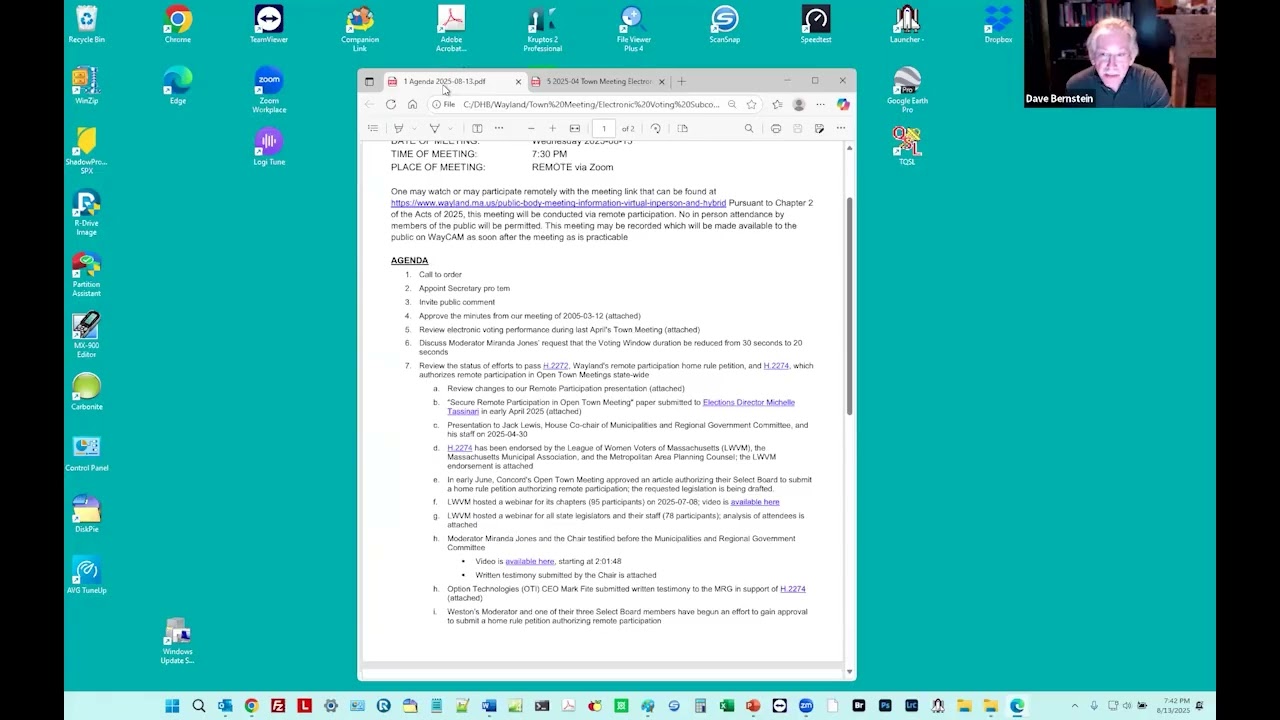
August 13, 2025 - ELVIS Committee
David Bernstein: So we have a
full agenda, so let's get
started. It's now 732 I hereby
call this meeting to order.
First order of business is to
appoint a a secretary. Pro Tom
Larry, can we impinge on you
again? Yes, sure. Thank you very
much, sir. Okay. Do we have any
public comment? Robbie, is there
anyone out there?
Unknown: I see no, but they're
with their hand raised. Okay.
David Bernstein: Is anyone on
the elbows committee or Miranda?
Anyone have public comment they
want to kick us off with I do
not. Okay. Alright. So that
being done, let's move to the
first item of the agenda, which
is to approve the minutes of our
last meeting, which was on 2005
312 so here they are,
Unknown: 25 312 Yep.
David Bernstein: Think that's
what it says. It does, yep. So
here's this, here's the minutes.
Boy, I can never find something
that will drag this. I'm not a
big fan of Windows 11 here.
Let's not put that in the
minutes anyway. So here are the
minutes courtesy of Larry. Does
anyone have any corrections that
need to be made to these
minutes? Anyone? I thought they
were pretty good myself, but all
right, in the absence of any
corrections. Is there a motion
to approve these minutes? So
moved, so Lynn. Lynn moved, and
John seconded. Anyone All in
favor? Aye, aye. Anyone opposed,
hearing nothing that will record
the boat as unanimous
Larry Krakauer: in the past,
we've on some technicality. You
thought we needed to poll
everyone. I'm perfectly happy to
do it this way, just it was
different the last time,
David Bernstein: I think we're
okay this way. I mean, if
somebody wants, if we have a non
unanimous vote, we'll take a
poll. How about that? But given
that no one is opposing, I don't
think we need to do that. Okay,
so that is now disposed of. So
the next item of business is to
review performance of electronic
voting during the last town
meeting. So I think that's right
there. Okay, so this is a
summary that I recorded. Don had
forecast 500 voters, recommended
600 handsets. His recommendation
was based on the fact that the
2023 town meeting attendance was
quite low, and a lot of the
responses came from people who
hadn't attended any the last
couple town meetings. Mike Faia,
our facilities director, ordered
500 handsets and five check in
stations. Oti, because several
of us were nervous, brought 300
extra handsets, and they set up
two base stations, but they had
a third ready to go if they
needed it. And so at one other
point, the check in staff was
issued a voter card for voting
in case we had insufficient
handsets. So a number of us were
just nervous that that the 500
handsets ordered weren't going
to be enough. Trudy, you know,
was prepared for that, in her
way. Oti brought extra handsets,
and what we ended up with was a
total of 480 people showing up
the first night. So we came
within 20 minutes or 20 people
of Don's original 500 forecast.
There were no failed handsets,
there were no voting problems,
but we were plagued by iPhone
hotspots activating, and I
actually tracked one down to the
person he lives in the street
next to us who did it, and I'm
going to seek him out before the
next town meeting, if he's
present, and let him know that
that's really not acceptable.
Because it wasn't just a matter
of having those hot spots be
active. Whenever I go around and
look for them, they'd get turned
off and then they'd get turned
back on again when I sat down.
So you know it was, it was
someone trying to get some work
done and conceal the fact that
they were disrupting our
meeting. The next night, we had
a peak attendance of 337 again,
no failed handsets, no voting
system problems, and so that was
a bit of an issue. But total
unique voters 597 and so as far
as I'm concerned, this is as
good as it gets.
Larry Krakauer: Dave, where the handset, sorry, the hot spots. Any problem? I that, you know, they everything was working fine. So even if the hot spots were there, were they causing difficulty, David Bernstein: the only way to know that would be to record the number of retries that are required every time there's communication between the base station and a handset, and unless we go bug out the oti folks about that, that it's, it's, it's problem. Larry Krakauer: Yeah, so we don't know that. There was certainly no difficulty at any level that you know caused us to notice problems. David Bernstein: No Correct. I Unknown: mean, a symptom of that, a symptom of a problem would be, you know, there'd be a longer delay in the response, correct, and we didn't see any of that, pretty much things were instantaneous, David Bernstein: right from our testing. But you know, when there's 500 handsets, you know, 10% of them could be having to retry twice, and we wouldn't know it. So I think our rule has to be that we just don't tolerate hot spots, because we don't know how many of them would be required to actually cause problems. And given, you know, given the susceptibility, I think we just have to stay on top of that. Okay, so total unique voters was 597 which is three less than what we tell everybody is our average for town meeting attendance in Wayland. So I thought that was pretty interesting. So that was the the summary of how the meetings went after the meeting, Miranda indicated that she would like to consider reducing the duration of voting from 30 Seconds to 20 seconds, and we discussed that with Mark fight, and he said it would be fine, so long as we didn't have more than 400 voters. So Miranda, did you want to comment on this? Miranda S. Jones: Yeah, so it's interesting seeing the statistics now that okay, we could have done that on the second night, but we and periodically through the first one we didn't have over 400 people, we could have, I just I feel like when I say the window is open, that we're all just eyeballing each other for a lot of too long a time period. It just seems like it takes the voting period is just too long. And then I asked Tom meeting, and it the majority seemed to agree that the 30 minutes seemed unneces. 30 seconds seems unnecessary. But obviously we have the technical issues that when we have over 400 people, we would have to keep it at 30 seconds. So I'm not, I'm not married to the concept of doing 20 seconds. What do you people think? Do you think we do it, as long as I know that I have fewer than 400 people in attendance, or fewer, fewer than 400 people registered voters, voting, that I do it, or you see it fraught with problems. Lynne Dunbrack: I can see on the first night, if you had a situation where the attendance fluctuated, so maybe at the beginning it was around, you know, at the 400 threshold where it was okay to do 20 seconds. And then, you know, now we have a big article that everybody's, you know, wants to weigh in on. So now, you know, there's many more attendees, so now we have to flip to 30. How long do we stay at? 30 seconds before we can flip back to 20? Because now people have gone home because they made their big vote. I think maybe on on the last day where, you know, we don't typically have those big or not usually have those big articles for voting. You know, it's a pretty standard amount of people who come and it's not fluctuating up and down. You could probably get away that my concern, I guess, where I'm going with this is my concern would be, if you were flipping between 20 and 30 because of fluctuation, whether that might confuse some voters. I mean, I know it's only 10 seconds, so it shouldn't be a big deal either way. But, Miranda S. Jones: yeah, no, I think Lynne Dunbrack: that would be my and I'm not. I can be convinced either way, but I that would be my one concern. Miranda S. Jones: Yeah, no, I, and I appreciate that. I, I I I think that if the town meeting knew that the issue is, there's a cap of 400 people, once there's 400 people, we have to go over to 30 seconds. As long as that was put out, made very, very public, then they would understand it. I guess my question then becomes is, am I able to know how many, how many handsets have been put out on every single warrant article? I mean, do we know that in real time? We do. We do so it is feasible for me to, you know, go through the first six, seven articles, doing it at 20 seconds, and then all of a sudden, somebody, I'm alerted on Article eight, we're up to, we're up to over 401 people. We have to convert to 30 seconds on and can oti go do the 20 to 32nd David Bernstein: I believe so exchange. Miranda S. Jones: I mean, so then it's feasible to do it. I just think the town, town meeting has to understand what what the issue is. And I think what you say, the threshold is 400 then they would appreciate it. So, I don't know. So I'm going to think about that a that. David Bernstein: And here's a suggestion for what we might try. Yep. Suppose we say that if at the beginning of the meeting there are 400 or fewer voters, we will start out with a 22nd voting window, and you the moderator, will announce that, yep, if at any time, do. During the meeting, the number of voters rises above 400 then the oti people will notify Elvis, and Elvis will come notify you, and you'll make an announcement that from now on, the voting window will be expanded to 30 seconds, okay, I would suggest that once the voting window expands to 30 seconds, it not be reduced again during that session. Okay, that's fair confuse people, yep. Okay. You know, as people get used to this, maybe later on, we can reduce it at the end of the meeting, if it's appropriate. But I would say to start, let's say we can start at 20 and raise it to 30, but once we get to 30, we keep it at 30 for the duration of the session. Miranda S. Jones: Okay, that's a fair compromise. I can see doing that I agree, because David Bernstein: that eliminates the problem Lin was concerned with. Yeah, Miranda S. Jones: no, I think that's, that's a good way of looking at it. Okay, okay, listen, I'm, I'm up for any suggestion, any and all suggestions about making Tom meeting move along more quickly and and to that end, there are a lot of other things being discussed about making that happen that don't necessarily involve Elvis. And if you want to hear about them, we can talk offline, but, but my goal is to get this done in one night, so it may not happen this next year. It may not happen the year after, but at some point it would be nice to routinely get it down to one night. One of the big ways of getting it done is by using utilizing the Consent Calendar and putting more articles on one consent calendar and getting a series of articles passed in one fell swoop. But we have to get the town used to it and that that comes with its own issues. So anyway, that's my goal. Is to make this more efficient. Okay, so David Bernstein: is everybody comfortable with the 20 to 30 proposal as a trial at the next town meeting? Unknown: Yes, yes. Sounds Larry Krakauer: like a simple proposal. I like it. There's really nothing rigid about this 400 threshold, right? This, this was, David Bernstein: well, it's oti. Miranda S. Jones: Okay, yeah.
David Bernstein: Mark likes it when we are consistent with his requirements. Okay, so I think we've disposed of items five and six. Let's now move on to remote participation, where we'll spend most of the time this evening. So the first thing I'd like to do is just remind everybody that there are two bills. 2272 is a home rule petition for Wayland alone that would allow us to do remote participation in our town meetings. 2274 is the same language, but statewide. Well, everybody in the state to be able to do this. So I want to start by going through our remote participation presentation, to which I've made updates here and there mostly is real feedback while giving it now. We talked about this, I think, at our meeting last March. So not all, not all the changes are new, but there's a couple of things I want to review here. So the first one is on slide six. So we have this depiction on slide five of what we have today, a voting system with an on premises set of handsets. It used to be that this just said voting system, which is inconsistent, because what we're really doing is we're expanding this to not just allow remote participants to vote, but to be able to listen and speak. So I named it the town meeting system. If somebody has a better name for that, that's fine with me. But just to differentiate from the fact that previously, it was just a voting system, and now with remote participation, it's full participation, with listening, speaking and voting, and the slide previously didn't wasn't consistent with that point. Any comments on that? Okay, if not moving on to Slide 12, there's Lucy. So this is, there's a couple points here. One is one of the moderators I presented to. Said, you know where you really should be able to show us who's speaking. So there now shows that a friend, Robert Smith, is speaking. You might ask, Well, how does that get in there? Well, this is a pretty good argument for an assistant moderator who, among other things, whenever somebody introduces themselves, enters that person's name into the system so that all the remote participants can see who it is, and it wouldn't be a bad idea if the video, whatever video was displaying on premises, showed the first thing. There's another point on this slide, and that is that some people saying, I think our moderator is one of them. I'd rather see town meeting video here. I'd rather that remote participants saw video and heard as well as heard audio. So I guess we could say that that would be an option, that each town could decide whether you know when we're there's discussion going on, do remote participants see transcribe text, or do they see video? Or maybe that should even be a per participant. Option where each remote participant can decide. Now, before we go too much further, there's one other data point. There is town meeting video broadcast on WayCAM In our case, but that broadcast has a 10 second delay, so I'm not sure that if what we ended up with was 10 second delayed video with real time audio that that would be very helpful. So I don't know that we can resolve this here, but there's the question of what gets displayed during discussion. Is it transcribe text, which a lot of people would find helpful? Is it real time audio and video that we somehow pipe? Or is it real time audio with video from WayCAM. All of those, I believe, are technically feasible. We just have to decide, you know, what we want. And my guess is no three towns are going to make the same decision, which means that whoever implements this software is going to have to cater to all of the options that people might want. Comments. Lynne Dunbrack: I have a comment, but it's not so much related to this as our prior conversation about the voting window, because the 10 second delay from WayCAM will impact that. But I don't want to derail the first David Bernstein: question. That's a That's a fair point. You could argue that 10 second delayed video would be counterproductive for exactly that reason. Yeah, that whatever's going on, you're 10 you're 10 seconds behind real time. Is that 10 Lynne Dunbrack: second delay? Just out of curiosity, is that 10 second delay in late in case someone uses one of
Miranda S. Jones: the seven words? George Carlin, Lynne Dunbrack: Carlin, thank you. I was like, Carlton came up first. And I was like, that's not David Bernstein: right, words none of us would ever use. Miranda S. Jones: Do you know how often I have to check myself? It is part of my vernacular on a daily basis. So, but for whatever reason, whenever I get in front of people like that, I don't, for some David Bernstein: reason, my guess is, in order to have 10 second delay video, waycamp has to have real time video, and then they put it through a 10 second delay. So it's possible, I imagine, that if we wanted to, we could get real time video and display and have that be piped out to the remote participants. I don't know what's involved in that, yeah, I Miranda S. Jones: don't know what sort of regulations there are with federal regulations in terms of broadcasting, and if there has to be, because of the because of the issue about things that are inappropriate to be broadcast, I really don't know what the town council maybe. David Bernstein: So some research that has to be done. There's a number of options. We have to decide which ones are ones that might be useful, and then which ones? You know, what do we have to do to do them? But I just thought is very, sort of a very interesting set of requirements that pop out of this one slide. But, Miranda S. Jones: but to lens point, if I if I may, though, I mean, I foresee, do you all foresee that if we were to have remote participation, and people are voting on their hands, on their either iPads or their cell phones. Do you think we will still be using the clickers for people who are in person? David Bernstein: I We certainly will the first time we ever try remote participation. Okay, over time, I would hope that we could get to the point where people on premises are using the same software on the same kinds of devices, whether they're their own smartphone or ones that oti brings brings up, right? I agree only. The only issue with that is we would go from trying to shut down WiFi hotspots to making sure that we have enough WiFi bandwidth in the room to handle all the handsets. Yeah, Unknown: Dave, go make a comment. Go right ahead. Alan, so if you transition to not using the clickers, doesn't that change the business model with oti that you we presently have, because they're priced based on clickers, yeah, and, and they also provide the show. So you can't cut them out by replacing the clickers, because you still need their services, David Bernstein: we would need to negotiate a new business model. Unknown: Okay? Well, that doesn't exist. I just wanted to point that out, David Bernstein: right? We won't need to do that right away, because, like I said, the first time, we're not going to change all the variables simultaneously. The first time we do this for real, it will be remote participants using smartphones and tablets, but the on premises people will continue to use clickers. And then as we get the remote participation stuff really working, and our confidence grows, then we can begin to investigate using the remote participant stuff on premises. And at that point, we'd have to have a discussion with whoever our supplier is, that you know, both parties are comfortable with, Miranda S. Jones: but to the point of the 10 second delay, I think as we once this passes, we will need to figure out, how do we do this? So everyone's voting, both those people in person and those people participating remotely. How are they starting the voting window at this. Same time? Yeah, and I don't know what the Don Schuler: answer, just one comment. Don't you think people will actually be watching the town meeting on their TV while they're actually doing some of the voting remotely? I mean, they may be watching it and say, Oh, now here comes the interesting part. Let me get on my, you know, pick up my
David Bernstein: they will understand that there's a 10 second delay. It'll be fine. But you know, if you're engaged, if you're going to speak, if you want to vote, you really have to be using your handset, otherwise, it'll be 10 seconds behind the times, Don Schuler: right? Well, yeah, you will. But I mean, I think people might be doing that anyway. They might be doing both, yeah, could fairly common situation. Or we David Bernstein: could have Wayland. We could have Wayland declared a a community that never uses bad words over the air. And we don't need a 10 second.
Miranda S. Jones: I'm not. I'm not signing that. So Larry Krakauer: okay, well, is this really over the air? I mean, this is all cable. David Bernstein: Well, it's over Wi Fi, so it is over the air, but I don't think that counts. Larry Krakauer: No, no, yeah, I don't you're not supposed to be in on the Wi Fi. David Bernstein: I think the only, the only destination that needs the 10 second delay for our legal purposes would be WayCAM. Larry Krakauer: Well, no, but that's the question I'm thinking in terms of WayCAM. Oh, it's not over the air either. It's it's on a cable system. Oh, that's David Bernstein: true, and it's not like you don't hear about broadcast. Yes, yeah. CC, right. But wait a second, we don't hear, we hear bad words on lots of things that come over the case Miranda S. Jones: we do on cable. That was the whole point of cable, right? David Bernstein: So the real question is, why does White cam need a 10 second delay? Miranda S. Jones: Yeah, it's good question, Unknown: yeah. And also not David Bernstein: the outcome I was expecting. Very cool. Unknown: I remember a seven second delay for the FCC. Anybody remember that? No,
David Bernstein: okay, well, that was productive. Miranda S. Jones: Okay, any other No, I'm in touch with WayCAM Because we're planning on doing a bunch of Tom meeting things, putting it up on the website, and making a series of videos to teach people about Tom meeting and maybe get them more interested in it. I'll ask them if they understand why there's a 10 second delay. Okay, if they've got, if they know the regulation behind it, if whatever it is, David Bernstein: yeah, that'd be great. Sure. Any other discussion about this slide? Okay, let's move on to Slide 17. So here some things got added. A this section up here tells the moderator whether or not any points of order have been raised, and the one below it tells the moderator whether or not a question has been called. I think we already discussed at our last meeting the need to have both local and remote people on the list in chronological order, so that hasn't changed, but it was very embarrassing. I spelled the last name of New Zealand's Prime Minister incorrectly, and I was correct, so that's now correct. Lynne Dunbrack: It's alright, Dave. It makes you feel any better. We had a guest vendor come in, potential client, or they may have been clients at the time, and we had dutifully named all of our conference rooms like capitals and big major cities, and Auckland was one of them, and we had it misspelled on the conference room. Well done. Our Kiwi guests were very quick to gently point out, in a very polite way that we misspelled it. Big City. Yeah, David Bernstein: yep. Not good. Okay, slide 21 so this is just the remote participants view of the speaker queue. And you know, it's just too bad we don't have any graphic designers in this team. We're good at everything except graphic design, so I've just got l's and R's in here to designate local and remote. Doubtless we could have some icons created that better illustrate that. But Lynne Dunbrack: so on on. The question here for Jacinda, is that calling the question or they have a point of order question. This is, David Bernstein: this is just she wants to ask a question. Oh, okay, Miranda S. Jones: that's more like point of order. But you know what? You raise a good point, which I discussed with Dave recently, and the software program could be created so that whatever the person is, is what, whatever their purpose is to speak, it can be ranked because moderators are supposed to, depending upon what the nature of the reason is for the person to be at the microphone, they have a certain ranking that moderators are supposed to adhere to, so that, for example, motions to terminate debate are ranked higher than other motions. For example, motions to amend and you could, and that's. In town meeting time, and you could build that into the software program so it actually takes, it could obviate the need to have that scrum in front of the moderators, you know, podium, because, you know, there's often people coming up saying, I want to do this, I want to do that, I want to speak. And so the moderator has to figure out who gets to talk next, and if they, if people, regardless of if they're at home or they're in person, if they log in, this is, this is me, and this is what I want to talk about. This is why I'm approaching I mean, the Pro and the con microphones are pretty easy, except what for the people who are in person, but the rest of it, you could have the software rank everybody for the moderator, which would make it more efficient? David Bernstein: Yep, and that could be, that could be set up so that each moderator could choose his or her own ranking, because they might not. Miranda S. Jones: That's the thing, Dave, is that moderators aren't supposed to Tom meeting time. Oh, really, a cover of Tom meeting time, it dictates what is well, then Don Schuler: the software will be easier. Yeah, I have a question, do you actually have multiple screens? Or what happens when you're looking at this and then you also want to hear what the person is saying? And David Bernstein: no, you only have one screen. And Don Schuler: as we envisioned it, if you just flip between David Bernstein: back to, you know, you'd go back to speaker or listen or whatever. I think you click return here to go back to that may not be the most well, Don Schuler: how about if you're, how about if you're, you're, you're listening to one of the people talking in the pro or con area. And then you decide I want to get on the list too
well. Then you stop hearing the person that that's talking. I David Bernstein: i assume the way this would work is that you, at all times hear Tom meeting audio, no matter what you're doing, unless you're speaking, okay, you'd have the audio. Yeah, you'd always have town meeting audio, but you wouldn't, you wouldn't Don Schuler: necessarily have the transcript into into text. David Bernstein: Now, you know, if we want to get sophisticated, we could say that, if the user has a tablet, we could, you know, divide it up into two vertical panes, so you could do two things at once. You could have, you know, one thing showing the speaker queue and the other one, but that other one showing a page like this, or the real time transcription. But I think that's, you know, that's an optimization to be considered later. Okay, but you're right. We have to make sure that when you're doing something other than listening to the current speaker and seeing that transcription, or seeing video, that when you go to other screens that you don't, you don't get disconnected from town meeting because you can't hear anything anymore. So that's an important point. Yeah, I don't think we ever specified it. So Lynne Dunbrack: for the for the in person, folks like Boris and Emmanuel. How did they? How do they register, register themselves on this queue? Is this David Bernstein: something that I think we talked about this. We talked about this at the last meeting. The low tech. There's a couple ways to do it. The low tech way is to post a person in a staff person at each microphone with a tablet, who, every time someone approaches the microphone, queries them for their name and enters that into the system right away, so that they're just there. The high tech way would be, you know, even with clickers, every the system knows that my handset, b4 71 is Dave Bernstein, so if we could change the clicker design so that if you push four, it means you want to speak in favor. If you push five, you want to speak against. If you push six, you want to ask a question, so your name would get entered into the queue that way. So somewhere in between those two extremes is what we'd end up doing. Got it and of course, it gets easy if everybody's using this application on premises, but that's not t equals zero, Miranda S. Jones: yeah, but you know what, Dave it just to that point, using a clicker, that four equals this five using one and two is easy enough. THE MODERATOR reminds people, but the other way wouldn't. However, what I would also say is this creates more accurate record for the town clerk when, when she's she's taking notes, and to have a listing of everybody who spoke is so much easier for her, too. Yep, just another benefit from David Bernstein: this. So at minimum, we just have to post a staff person in each microphone to record people's names as they approach the microphone. Yeah? So that that's a guaranteed, you know, we know we can make that work, yeah? Something better. We will. I agree with you that pushing buttons on the clicker not, ideally, not going to work, yeah, too complicated for people. Larry Krakauer: Well, actually, collecting names is not that easy. I mean, you know, people say their names, but really you'd almost have to stop them and ask them for spam. Selling in many cases true. David Bernstein: Well, maybe not Larry, because remember, only people who check in can speak. So the the tablets that people the staff uses could have a list of all legal speakers and just type in the first few letters of their name, and you've got it just like we is exactly like what we do when people check in now on the check in stations, so I think that can be facilitated.
Other Other questions on this slide, slide 21 or comments or suggestions. Okay, let's move on to Slide 26 Okay, so this is a list of things that I have accumulated. Some of them we've already discussed, showing the remote participants the name of the current speaker. A number of moderators pointed out that in their world, people can actually submit a text file with an amendment. So coming up with some way to support that. This would be trivial. If people were using desktops where they could prepare, you know, a text file or a Word document and send it. You know, if people are using their phones or tablets, they would somehow have to get their amendment into their phone or their tablet in order to be able to submit it. We have to think about how to, how to, how to come up, what way to support that we don't allow this, do we? Miranda,
Miranda S. Jones: I don't know. It's, it's so I'm debating this right now. I'm having an ongoing debate with Dennis Barry about changing the way we do amendments. So amendment has to, if it's more than 10 words, it has to be in writing, right? People bring amendments all the time to town meeting, emotions to amend the the article that's being presented. Sometimes do it. You know, you have to file amendment within 48 hours of Tom eating, or at least before, with within 48 hours of town meeting. And so all the amendments come beforehand. And so Dennis and I've been debating, should we think about doing something like that to make Tom meeting more efficient so people are more prepared so and but does that then deprive the ability to amend on the spot? Sometimes issues come up that maybe no one had thought about. So I don't know what the answer David Bernstein: you could argue that the need for an amendment doesn't become obvious until there's some discussion that reveals it that Miranda S. Jones: could have exactly No. I completely agree. And I can cite an example of one by law that we almost passed several years ago, and it had to do with sex offenders. And I remembered somebody. Everyone thought this. It was the chief of police brought it. Everyone thought this would be a no brainer article, and it was defeated because of the debate that flowed from it. And I don't remember if it was amended or not, but it's just things can change at Tom meeting that you don't you don't anticipate. David Bernstein: So the worst case here is that some remote participant has a brainstorm like that debate and wants to submit an amendment that's more than 10 words, yes. Miranda S. Jones: So we have to figure out how to how to factor that into the Yeah, into the software. Because if we are going to truly offer remote participation, then they need to be able to fully participate. We said this is not remote voting, so maybe remote voting might be one thing, but we're asking for remote participation, so they have to be able to figure out how to amend, if they so desire. And I don't know what the answer is to that, yeah, David Bernstein: just, I just an idea just popped into my head that the person could write their amendment on a piece of paper, you know, in their kitchen, and then have their camera take a picture of it Miranda S. Jones: and scan it in. Scan it? Yeah, the effect David Bernstein: it would have to do character recognition. You just have, I mean, you'd end up with that piece of paper in front of you, the moderator, and you could then read the amendment. Miranda S. Jones: But why couldn't? Why couldn't they, if they're if they're on their phones, why couldn't they type it in? Why couldn't there be some way it's just like you're typing a text message or an email David Bernstein: typing on a phone is not a skill that everybody has, but Lynne Dunbrack: there's voice recognition. Yeah, yeah, they would just have to hit Oh yeah. You know, yeah, when Miranda S. Jones: I taught my husband that a few years ago, it's changed his world. That's recognition, David Bernstein: yep. So that Lynne Dunbrack: actually gotten really good, because I have discovered that DEP, if I was texting with somebody, and then put my phone down, it will start to transcribe a phone meeting I'm on, Miranda S. Jones: yeah, yeah, if you mean, if you forget to shut off the microphone. So I put Lynne Dunbrack: that down, and I was like, Oh, my God, my my phone is typing and it is literally transcribing, Miranda S. Jones: yeah, what was being said? What's cool about that is, and actually really well, David Bernstein: what's cool is that that means that anytime anybody wants to make an amendment that could be captured, whether it's 10 words or or yep or not, and again, you're back to, you know, records for the town clerk, right? Yep. Unknown: Actually. Larry Krakauer: True. I use voice recognition all the time on texting, but I find I always have to edit, agreed. Well, not always, but often, if it's short and often, yes, yeah, David Bernstein: okay, well, that was productive. Okay. I love this one. Enable the moderator remote participants to sequence through multiple color schemes. You know, some people are color blind, so you have to be able to, you know, tolerate give people options there. We talked about this one at the last our last meeting, that if somebody who registered to participate remotely changed their mind and shows up on premises to allow them to check in and then instantly disable them from participating remotely for the remainder of that session. So twice, wouldn't Unknown: the software just do that? Yes, you would think so required, David Bernstein: but it's a requirement. So we want to, you know, want to capture it Lynne Dunbrack: just to play devil's advocate. What happens they come in, they do their big, big vote. You know, they come in to give and then they go home. So do we have the ability or people just decide to go home? Well, at 10, David Bernstein: I arbitrarily wrote it down as once you check in on premises, that's it for that session. You can't go back and remotely participate, just because I wanted to make sure there wasn't some hole where somebody could end up voting twice, we could certainly relax that if we were confident in the technology, Lynne Dunbrack: yup. Well, I'm just, I'm just thinking of like parents who might be able to come in for one vote, but then need to go home because they have to really care babysitter, you know, especially if you have a meeting that goes super David Bernstein: late. So the problem is, I mean, the work devil's advocate. You know, I I'm at on I've registered on premises. I'm checked in. I leave town meeting, but I don't check out somehow, and so the system still thinks I'm there, and then I go home and vote. I don't know, but that way I'm still not voting twice, Lynne Dunbrack: yeah, unless you've given your headset, your handset and slipped out now your proxy voting with yourself. It's just an interesting thing to think about, is what happens? Because that'll be the thing is, like someone will, you know, I can see the inevitable. It's 1030 I want, I need to go home. And really, yeah, David Bernstein: yeah. We should make it as flexible as we can, so long as we maintain the integrity of the system from a voting point of view, agreed. Okay, show the article, the current articles, time remaining, and the current speakers, time remaining. That's auto you know, the bigger point here is that moderators are pretty resistant to remote participation in general. You know, when Miranda tried talking to the mass moderators Association about this, he got a lot of negative feedback. I did.
Miranda S. Jones: It was not pretty. David Bernstein: Most of it comes down to inertia. I mean, they know how to do what they're doing. Now, this threatens to make their meetings much bigger and have to deal with people who aren't physically in front of them. Miranda S. Jones: Well, I also, I don't necessarily think that it was, I don't think it was necessarily that they were afraid of more people participating. I think it was that they would have to learn how to do it differently. And that's an and I you know, the moderators are a fairly diverse group. There's about 20% of them are women. I couldn't tell you what the ages, the ages are, but there's a lot of older men. Not that that's something negative, per se, but they also, but they seem to be very and, you know, I'm one of the older ones at 61 so, so, but, but my attitude is like the Tom wants us, we got to make this happen. But I always think change is a good thing. So, I mean, that's how progress happens. Nevertheless, some of them are stuck in the sort philosophically about, but Tom meeting is supposed to be all in one place, you know, on on the town green type of thing, and which is very archaic, that thinking, but, but I would say a majority of the people who aren't in the philosophical philosophical school are the ones that are afraid of the security of the vote and getting hacked and have not listened to Dave's presentation, and therefore are afraid because they haven't sat through this PowerPoint, and so they don't realize that a number of very smart people who are in this field have have Been looking at all these issues for several years now, and have come up with ways to combat the problems as the as they're presented. So anyway, so there's a there's a we don't have their we don't have the authority to that. We don't have their recommendation or support yet. But that doesn't mean it's not going to happen. And listen, we have a few towns that want to do it, and so that's what we're going that's how we're going forward. David Bernstein: So the point I was trying to make here is that anything we can do to make things easier for the moderator will help us, because it will, it will facilitate their being willing to give it a try and. And along the same lines, the moderator needs to be able to select the motion that will be the subject of the next vote. Make that easy to do. Miranda, the more, the more I think about this stuff, the more I think that remote participation, at least in a town like Wayland, is almost always going to require an assistant moderator to do some of these tasks. Miranda S. Jones: Yeah, I'm sure you, I'm sure you're probably right. You know, when we get it past Dave, then when we get the permission to be able David Bernstein: to well, and we'll be doing a ton of testing so we'll be able to see what Unknown: we're doing, yeah, David Bernstein: but you know, anyway, Miranda S. Jones: if any of you can think of who would like this job as assistant moderator, please let me know. Lynne Dunbrack: And honestly, I think some of this would help the in person people like, I think, because sometimes it is confusing when you're you know, on the gym floor or the field floor, like which, which amendment Are We Now voting for? Like voting for the first one or the second one. So, Miranda S. Jones: and that's on the moderator to be very clear as to what it is to make sure before people vote, that they know exactly what they're voting on, whether it's the main motion or one of the amendments or some ancillary motion. David Bernstein: Okay, any more comments on this slide? Any more additional requirements? Anyone's thought up while we were debating this? Okay, let's move on to Slide 29 so here, I'm not sure exactly what changed. This is the same audit table. We've already always had talked about the designated auditors. I think maybe it's this, and that's the idea that designated auditors don't Is it? Um, designated auditors don't report discrepancies by clicking the report discrepancy button the way that a non designated auditor would, they actually send a text, a text message to a moderator smartphone that's programmed to only accept messages from those designated auditors. So in security terms, it's an out of band report mechanism so that if a designated auditor sees a problem, the moderator hears about it without any Reliance or dependence on the voting system or the town meeting system at all. So it's just a technologically upgraded way of informing the moderator, because my recommendation would be, if even one designated auditor reports a discrepancy, that means we're, you know, somebody's twisting votes over the internet, and this just gives us a more reliable way of conveying that information. Any comments on that? Lynne Dunbrack: Yeah, I remember. So I was actually confused by this, mostly like, why was the that person called out for being a discrepancy? Like, I was looking at the chart going, it kind of looked like the other items. So, and maybe there's a detailed question you can answer offline. It's not, I don't want to derail I didn't David Bernstein: quite catch the question. Lynne Dunbrack: Lynn, so you go back one of the slides, I think it was, or maybe the build this one. No, no, it was the, yeah, that. So why? Why is that particular entry? I'm assuming that's called out as having a discrepancy, because it's, it's so David Bernstein: this is, this entry is highlighted because it's supposed to indicate that this the person whose shoulder we're looking over the remote participant. That's their secret voter code, yep, and they see that their vote was recorded Yes, and that's what tells them that their vote was recorded correctly. And if not, they push the report discrepancy button. Oh, Lynne Dunbrack: all right, so this is a self report by the by the meeting attendee, right? David Bernstein: And then the other thing here is that there's running totals of yeses and no's and there's, there should be a total line that shows the total yeses and no's, and the moderator announces the remote vote as well as the total vote. So everybody who's auditing, if they want to, can confirm that the arithmetic was done correctly, that what the moderators chose was the remote vote matches, which adds up at the bottom of the audit table. And since these are all running counts, it's easy to check the arithmetic,
Lynne Dunbrack: quick except for the total. Totals don't add up to all the yeses in the there's, well, David Bernstein: there's three yeses and there's four nos. And there they are, and you can see them. They're not the yes column increments every time there's a yes, and the no column increments every time there's a no, and the abstain column increments every time there's an abstain, so 341, is the total of that vote. Lynne Dunbrack: Okay, so you're not, you're not counting the the total of,
Unknown: I get it, I think I get it. Yeah. Lynne Dunbrack: So if you look at the if you're doing this as an Excel spreadsheet, you one would think. That the yes column would be the total of that which is more David Bernstein: than Oh, but we're doing it as a running count, so that people who don't have calculators in front of them can just follow along and say yep, every time there was a yes vote, every time there was a no vote, yep, the no column increased, and I can see the totals adding up to what the moderator ultimately announces, Lynne Dunbrack: I see. Okay, Don Schuler: so there's, so there's going to be a line here for every remote person or every person, yep, okay. David Bernstein: And you know, it's a scrollable table, and it's scrollable table, and I think, I think the way it will likely work is that you type in the first few letters of your voter code and that, you know, it narrows it down, and then you select it, and Lynne Dunbrack: it's going to validate that you and this, you and the code are equal, so that you couldn't just decide, I'm going to, like, fool around with This and click on anybody's David Bernstein: Well, I mean, clicking on this does nothing other than highlight the row that when you report a discrepancy, you're just reporting a discrepancy as as the owner of this remote participants device. It's not like you can report a fake a discrepancy from somebody else. If you click the Report discrepancy button, it's you who logged in here. Lynne Dunbrack: Oh, so it's highlighting you on the screen. Yes, David Bernstein: I just did that for presentation purposes. Lynne Dunbrack: Okay, so So you would, so you either only, you'd only see your own record. David Bernstein: Well, no, you'd see, because the system. You don't want the system to know who you are from a secret voter code point of view, correct. The system shows all the secret voter codes you scroll around or type in a few letters to find, to find yours, but, but that's just so you can see that your vote was correctly received. That's the only thing that does. The selection here has no impact on what happens if you click the Report discrepancy button, if you click the Report discrepancy button, if you're logged in here with the you know, the Lynn Dunbar username and password, then the discrepancy comes from Lynn Dunbar independent of what you did here. Okay, Lynne Dunbrack: and you can only report your own quote, your own discrepancy, and not all these other ones. Okay, David Bernstein: correct, correct. Don Schuler: But you said there's a limited number of auditing people, or what did they call them? Oh, designated. David Bernstein: Well, there can be as many as the moderator chooses to recruit. And I would argue that we want more rather than less, because the more of these there are the higher the fraction number of people that are auditing every single they're auditing their vote every single vote, but which means we have a better chance of detecting tamper. Unknown: But this table is not just the designated audience auditors. This is everyone who's voted right, and the designated auditors are basically, in some sense, just a minimum number of people who are going to audit it. And if everybody wants to designate themselves as being an auditor and check it, all the better, right? We David Bernstein: want many remote participants to audit their vote as possible. We want to encourage that, but we can't guarantee that they will. The designated auditors are people who the moderator knows and recruits who basically agree, yes, I will audit my vote every single time. Unknown: But the system doesn't know who they are. That's correct, and that's an important thing, because if the system knew who they were, it can make sure it doesn't screw their vote around, just everybody else's. Yep. David Bernstein: Yeah, good point. And that's how this out of band reporting system works, because the discrepancy report isn't conveyed by the by the system. It's conveyed completely independently of the of the town meeting system. Are you worried about? Say that there's 300 people remotely logged in, and everyone is is checking their vote. You know, some people could forget their vote, or something like that, and you might get a lot of people claiming there's a discrepancy, and there is, and that's another reason for having a designated auditors, there are going to be some members who will get confused and get the wrong line here or something, and we may get a few discrepancies that are noise. So that's why the distinction is a discrepancy from a designated auditor one, and we're done discrepancies from the general public in the absence of discrepancies. Here, you might, you know, be willing to tolerate a few, and testing will tell us how well this works. Unknown: But the same thing with handsets, the handset basically set, you know, at the end says you, you know, voted yes or whatever, and you're supposed to look at it and make sure it's right. And you know, you could say, well, 1000 people, 100 people, are going to say, Oh, I got it wrong. But the reality is, typically, the ones who come up and say they got it wrong are the ones, when you talk to them, who voted wrong. You know, they just did. They you said, I hit, you know, plus or whatever, and it didn't vote yes. So I don't think it's a historically, I don't think it's a problem. David Bernstein: You know, the testing will tell us, because we're going to test with high school kids, we're going to test with senior citizens, you know, before we do this live and we'll, we'll get some sense of how good are people at being able to do this, and how many bogus discrepancy reports do we get, Don Schuler: you know, with the handset, there was a couple times we did an audit, but everybody kind of trusted it after that, and nobody bothers to do what happened, you know, so, so I think it could be the same thing once, once people feel confident that it hasn't shown up, you know, after a Couple of town meetings, that they'll they'll be less checking going on once they feel right. Miranda S. Jones: That would be a mistake, though, agreed. You'd still want the designated David Bernstein: audit, no matter what these these, yeah, way as reliable auditors, but we always want some number of designated auditors. Okay? THE MODERATOR could encourage people to audit their vote. Yeah, okay. Unknown: On this slide, Larry Krakauer: I somehow this seems complicated. I mean, the or it the auditing is harder than just having your own handset and checking your vote. You've got to know how to look up your audit code. And so it takes very little to confuse people, in a way that seconds the importance of the designated auditors, right? They will know what they're doing. Most people probably will not and will just ignore this capability altogether. It's kind of confusing. David Bernstein: Well, you know, this is the heart of how we detect tampering with boats over the internet. So the good news is that it works. The bad news is that it may be too complicated for some people, and the question is, is there a better way to do it? I don't know of one. You know, if we come up with a better one, we should certainly consider it, but, but you know, to be able to have votes go over the internet and keep them private, remember, I mean, if you just have everybody's public votes were public, this would be trivial, because it would just say Dave Bernstein, yes, and everybody could see I voted yes. I could see I voted yes. But it's when you replace people's names with secret voter codes in order to maintain the privacy of the vote is what makes it, I think, more more complicated. Larry,
Larry Krakauer: yeah, yeah, I that's the importance of the designated auditors. Because, in some sense, people who are not designated auditors might not be doing this very much. So, so you need the designated I might say, I don't know whether this is any importance, but Miranda was talking about, you know, moderators, thinking about the good old days of small towns and everybody knows each other, and the traditional town meeting and so on. That you may recall, the traditional town meeting was why I was initially reluctant to consider secret votes. The traditional town meeting did not have secret votes. Stood up for what you were going to vote for, and let people see it. Miranda S. Jones: In this town,
Unknown: that's courage that you're putting on we put on other people that it's unfair. They just want to vote. They want to vote with their hearts, their minds and their pocketbooks. They don't they should not have to, quote, unquote, stand up and show their vote, because they could be harassed. David Bernstein: Larry's point, it wasn't that we should restore that. He's just pointing out that at the inception of town meeting, that's how it worked. Miranda S. Jones: Well, Dave and I raised this issue when we've we've done these presentations about Wayland was a very private vote for a long for a long time, and not all Tom meetings open. Tom meetings are like that. A lot of people do secret ballots, and we never did until electronic voting came. And then all of a sudden, we switched from a public vote to a very private vote, and the town has embraced that to the point where my first town meeting was a special town meeting when we had that one warrant article town meeting in December of 2023 and we did a secret ballot rather than going since we didn't, since the Select Board did not vote to have electronic voting, since there was just one more in Article, because it's so expensive, we had, rather than going back to the shout out vote that we used to do, we did a secret ballot, because everyone's gotten used to private voting and so, so I mean it, and that is the uniqueness of town meeting. Every town is a little bit different. How Tom meeting is done, and Wayland has changed. It has morphed over the last 14 years. With electronic voting. And this is yet another change, but the town wants it because, because it so more people can participate. Larry Krakauer: So I said clearly, it clearly is what people want. That's absolutely, yeah. David Bernstein: Any other comments on this slide? A good discussion. Alright, one, see, we're 20, so 41 so this is a point I want to make explicit here we have two pieces of legislation before the legislature, one a Home Rule petition. The other is statewide legalization. So everybody has endorsed the statewide bill. I'm getting ahead of myself, but the League of Women Voters, the mass Municipal Association, and so our position is, ideally, we'll get statewide approval. Short of statewide approval, we'd like to have at least Wayland and two other towns get approval so that we can get started on building software, because nobody's going to build the software until it's made legal. So this may be a little bit of a switch, where, in the past, we were kind of focused on our home rule petition, and then, oh yeah, there's the statewide bill as well. We're explicitly asking for the statewide bill first. Now that doesn't mean we're not going to test the hell out of this before. You know, we encourage anybody else to use it, but I just wanted to make that flip explicit here for everybody comments or questions. Okay, so 44 these are all the town that you guys know. This is all the towns we talked to. 44 is a summary of current legislation. So this is a little repetitious. 2272 is our home rule petition submitted by Representative Gentile, along with Representative Linsky, who's also a Wayland congressperson, and our senator Eldridge. HD 965, has to do with Lexington town meetings, which are representative. So it's not, has not, not relevant. 2274 is a statewide bill I was just talking about. We're now up to 10 co sponsors of that bill. The League of women's voters has jumped on this with both feet. They have run two different webinars for us, one for all league members, and a second one for all legislators, and we ended up with 100 people showing up at each one of those webinars. Nancy brumbach, who is the league's legislative director, has just been incredibly helpful, but she's put in tons of hours and tons of time and got lots of resources for us, and we have a lot to thank them for. The turning point was when they realized that our solution for conveying votes over the internet was indeed secure. That was for them. That was that was when the light bulb went on. Before that they just didn't trust it.
Something new, as of last week, Senator Barrett, who's a Senator for Concord, Weston Carlisle, has submitted a bill that is identical textually, to this statewide bill, but he submitted to the Senate. Senator Barrett is the assistant Senator Majority Leader. There's two of them, but he's one of them. So he is the first member of legislative leadership who has, in a high profile way, jumped on board of supporting what we're doing. And as best as I can figure out, it's legislative leadership that decides whether or not this committee, which is where our bill is right now, will either, you know, refer us for study, as has happened the last two legislative sessions, or will actually give us the go ahead to move move on, which would take our bill to the Ways and Means Committee, which is another story, all by itself. So this was a huge victory. I think a couple weeks ago, Miranda and I went into the state house, along with two people from Concord who we've been working with, and we presented to Senator Barrett. So he's seen this presentation we're looking at now. He reacted very positively, I think. And he has, you know, he's helping us as as much as we could ask. So I'm very happy about that these bills get into a cold, different, competing matter, and that is, they address not just town meetings, but public meetings. Public meetings are meetings governed by the Open Meeting Law. And the problem is that some of these bills want to make hybrid public meetings mandatory, and some of them want to make hybrid public meetings optional, and the League of women's voters wants them to be mandatory, and the Massachusetts Municipal Association wants them to be optional, because small towns can't necessarily afford it, and there's a debate between the House and the Senate. So we're basically done. King that set of disagreements, because the two bills we're pushing are statewide bills that only address how needed. Okay, anyway. Any comments about this or questions? Okay, so does anybody have a problem with me releasing this version of the presentation as a public document, so that it will go on our website, Towns website? So is there a motion to to make this public? Lynne Dunbrack: Any John can be moved, and I'll be second. David Bernstein: Okay. All in favor, aye. Aye. Any opposed hearing nothing, the vote will be recorded as unanimous. Thank you, everybody. I know that was a lot to go through, but we had to go through it. Okay? Don Schuler: I have one question. You know, you mentioned that if it's a represent representative town meeting. They actually do have a remote participation at this point. But David Bernstein: what do they have? It sounds like they I don't know. Do they have the capability to do debating and make amendments and everything like we were going to do for our voting? At least two towns have been using a combination of zoom and a product called V voter, which is made by oti, our friends oti. So they zoom for remote speaking and listening, and they use V voter for remote voting, and it's public voting. The problem is, and I've heard this both from I've heard it from the moderator of Plymouth, and I know it's a problem in Lexington, is that the 200 or so delegates, the people, the representatives who vote, get confused, having to switch between the two. So every time I do that presentation for somebody who's had that experience, they say, this is exactly what we need, because our representatives get confused having to move to separate applications when they want to vote or speak or listen. And I've actually heard from Mark fight that he feels the same way that you know, what we've developed here, this integrated town meeting system that just leads the remote participant through the steps is exactly what everybody needs, even representative town meeting. And my guess is you're going to see Mark moving in that direction at oti. It's to the point where, in Lexington, one of the Select Board members who evidently has a software background, basically wrote a remote participation application for representative town meeting, and they're using that in Lexington, and we might want to talk to him about that, just to get a sense for what he did. But any other questions before we move on? Okay, so the next thing, the next document, is this one. Yes, this one. No. Wrong place documents. The next document is this one. So one of the challenges we face, and we don't face it directly, is that we're told that the Secretary of State, Mr. Galvin, is not comfortable with using the Internet to convey votes, and that his discomfort is the reason that during the pandemic, remote participation in representative town meeting was made legal, but remote participation in open town meeting was not there's a woman who reports to the Secretary of State. She's the director of elections. Her name is Michelle passenari. We had some interaction with her many years ago having to do with check in at town meeting with electronic voting. So she's not a stranger. So we have tried hard to convince director test scenario and Secretary of State Galvin that that we can make town meet remote participation accurate and secure. And so, with some help from Larry and John last, last, last April, we wrote up. This is basically a text version of the presentation with a few slides in there, and you can see it was done before I changed this to town meeting system, so it's an interesting thing to read. You know, it shouldn't be any different than what the presentation is. The reason for bringing it up is we've yet to hear any response from either of them, we heard indirectly that director Tom gave this document to her, quote, cybersecurity team who has questions, but all of our attempts to get to be able to engage with them, to understand their questions, or to answer their questions, or to give them a presentation, have not succeeded. So. We've asked Senator Barrett we talked about before, who's evidently good friends with Mr. Galvin, to please intercede on our behalf and arrange for us to have a conversation. Still hasn't happened. So exactly how much resistance we're getting from this? I don't know. No one's ever come to us and said, Well, we passed this, except Secretary Galvin is peeing all over it. That's not we don't know that that's happening, but my view is that any opposition is bad opposition, and so we're just trying as hard as we can to get an opportunity to understand what their concerns are and address them, Miranda S. Jones: right? But also remembering that Secretary Galvin runs, he's in charge of the elections, this is, this is something completely different than town meeting, which is the legislative body for each individual town. So, so, so you think, okay, he runs elections. This really has nothing to do with Secretary Galvin. It really doesn't. The other thing is, the legislature isn't governed by Secretary Galvin. He's an elected official. He's very He's unique. He's in the executive branch of government. The legislature is the legislative branch. So in some respects, who cares what Secretary Galvin thinks it really doesn't matter. And also, my understanding is that not that many people in the state legislature particularly respect Secretary Galvin. So in some regards, I think we focus. We should focus more of our effort on on getting the people to focusing on our bills that are pending and trying to get support within the legislature, rather than Secretary Galvin, yes, it would be nice to have His blessing, but I don't know. Michelle test Mary, clearly, is avoiding us, yeah. Well, some respects, you David Bernstein: could, I don't. I don't disagree. I'm perhaps a little more, you know, trying Miranda S. Jones: to eliminate any and all obstacles, yeah, and I understand why, David Bernstein: yeah. So we're not spending any time on this. I mean, you know, we I ping them occasionally, but we're not doing anything other than trying to get time with Miranda S. Jones: them. Yeah, no, I understand it would be great to have His blessing, but, but I wouldn't. I just want David Bernstein: to keep everybody here informed of what's understandable. Yeah, so any questions about that one, alright, let's move on to item 7c so the end of last April, Miranda and I journeyed into the state house and we met with the co chair, the house, co chair of the municipalities and regional government committee, we presented the presentation you just saw, and the chair, Jack Lewis, and his staff, were very attentive. They gave us a full hour. They asked really good questions. They didn't tip their hand or anything. But I felt like we got a fair hearing, and I was really happy that we were able to do that. So that went well. I think I already mentioned this in item D, that the League of women's voters and the Massachusetts Municipal Association have, in fact, endorsed the this bill, H, 2274 which is the statewide bill. I don't know that we need to look at that endorsement. Keep bringing up the wrong folder here. Sorry. So here's the League of women's voters endorsement, endorsing age 2274 so the endorsements great, the help we're getting from Nancy brumbach is irreplaceable. She's just incredible. And we're we've learned a ton. I should also point out that rep Gentile has an assistant, a legislative assistant named Simon. Ravi Robbie Simon, and he's been also extremely helpful. He's put a ton of time into this. He's educated us, and he's advocating for us. So really, can't be unhappy with the support we're getting, comments or questions. Here's another really good thing. In early June, Concord town meeting approved an article asking the Select Board to file a Home Rule petition along the lines of waylands, that article passed the Select Board is in the process of writing up the legislation. As we speak, I already mentioned this, which is the League of Women Voters, held a webinar for their chapters. There were 95 people who participated. There's video, if you haven't looked at it, if you want to watch what Miranda and I basically do our dog and pony show, but it was very good, and we got some really good questions that were fun to answer. A couple of weeks later, the league hosted a webinar for all state legislators and their staff. I actually have an analysis of that of the attendees, so let's see, do I have that? Yes. Okay, so this is that there were 101 people who showed up for the for the legislative webinar. 78 of them actually attended, and 19 did not. And so there were several senators who. Spoke Senator Barrett and Senator Eldridge. There are several people who endorse Dave Kaufman is a legislative director of the mass Municipal Association. They carry a ton of weight. In this process, we had 25 legislators or legislative staff members, and interestingly, we had 42 people who weren't legislators, but were town clerks, were town managers or town administrators Select Board members. So somehow or another, the news of this webinar leaked out, and a lot of town people ended up participating. So again, we got some good questions, and it was all up. You know, thanks to the League of Women Voters that we got to speak directly to a lot of people who will make can make a difference in all this. Any questions about this? Okay, let me get back to the agenda. Okay, so then I guess this was last month or late last, late in July, Miranda I Tom Fay, a number of people testified before the municipal and regional government committee. When you testify, you get three minutes, but you can submit written testimony. And I submitted written testimony as did Miranda, as did Tom, the written testimony I submitted was a version of the document we sent to Director passenari And the Secretary of State. And the only reason I want to bring it up is that a couple months ago, on Wayland social media, I asked people if they felt disenfranchised by the lack of remote participation. And two people responded. They sent me notes. One was Alexandra puglio. Another was Heather Ryan and I decided to append a section to that document I spoke of called Voices of disenfranchised Wayland voters, in which I basically quoted what they said. You know, Alexandra, it cost her $150 just to go to town meeting one night because she had to get health care or child care for her children. And Heather has multiple sclerosis. She can't attend. She wants to, and I thought the passion of both of them wanting to attend, but being unable to, would hopefully have an impact on the committee. And then my closing line, we're not asking for money, we're just asking for permission. Hopefully that will help as well. Unknown: Yeah, hmm, David Bernstein: any comments or questions about this stuff?
Okay, I feel like I'm getting a degree in civics. So item h, this is pretty cool. I asked Mark fight to submit testimony to the committee, and he did so here's his testimony, in which he basically talks about what we're doing and why we're doing it, supports it, and makes the point that nobody's going to write the software until it's made legal. And that was the key message we wanted him to send, and he sent it so very happy with that. Mark has been very helpful in doing this. Any comments or questions about that? A possible third town for a Home Rule position is Weston. Weston's moderator, guy named rip Hastings is very supportive. There's three members of their Select Board. They only have three, and one of them is gung ho on remote participation and thinks at least one of the other one is as well. So they're moving towards getting a Home Rule petition. We'll probably have to go and present to them, but that seems to be working pretty well. So that's just a status report. So that completes a rather lengthy hour and 15 minute discussion of remote participation. Are there any comments or questions about any of this?
Lynne Dunbrack: No, I think we raised them through the course of the discussion. Good, okay, for myself, I should say, David Bernstein: anybody else? All right, so let's then move on to Item eight, which is the Elvis annual report. So let me bring that up. Everybody see that? Okay, yep, okay, so Trudy already submitted her correction, which is changing FY 2024 to FY 2025 The question is, is there anything else in here that needs to change? So does anybody have any comments?
Lynne Dunbrack: No comments David Bernstein: for me. Okay, Don John, yep.
Unknown: Larry seems good. David Bernstein: Okay. Do I have a motion to submit this report as written as the FY 2025, Elvis annual report. So second? Unknown: What was the second John? Was the second John? I. Okay, okay, David Bernstein: all in favor, aye, any opposed, hearing no opposition, we'll record the vote as unanimous. Okay, so believe it or not, that is our agenda. That was the last non public item on the agenda in the wrong place. Where is the agenda? There's the agenda. So Robbie, is there any one out there who members of the public that have hands raised for public comment? Oh, I see none. Okay. Anyone here want to make closing remarks? Alan, yeah, Unknown: yes, I would love it to thank you. First, I want to say that in seeing what Elvis has done with remote participation, I'm amazed, and I compliment you all. You've taken it to a place that honestly, I didn't think where it was going to go, but you're there, and I think that you're going to close the deal. So what I wanted to say tonight was really two things. One of the just make an announcement. The other ones, I wanted to tell you a little story, but I figured I saved the best for last and do it reverse order. I just think that during because of my own life and what's going on and things that I've decided to resign from Elvis, and so I've always kind of fantasized, if I was a professor, that I would be Professor Emeritus. Okay, so I figure I must be Elvis emeritus. Maybe you could, maybe you could think of me that way. All right. So the other thing I want to tell you is is always like stories of origin. So I'm proud to tell you that 14 years ago, and Miranda just bought up the 14 years that this was after I was a select man. I was unelected, by the way, okay, and an event occurred at a town meeting where we were at an auditory at the high school. My wife and I were there, and it was an article having to do with the town center. I didn't like the article, and my wife didn't either. So when it came time to vote no, and in those days we had no electronic voting, you would stand up for the No, you'd stand up for the Yes, right? So we stood up for the No, and as we're standing there, and you know, they have to count you, so you're standing there for quite a while, like, remember that, right? They go around the audience and check you off on a sheet of paper. So there was a colleague of mine, and I'll keep names out of it, who was on the board of selectmen, all right? And he was, like, making little sounds, and I turned around, and he's making head motions to me to sit down. Like, sit down. You could just imagine that somebody with their head motioning you to sit down. So I felt kind of uncomfortable about that. And when the vote was over, and my wife and I were going home, I said to my wife, why the bleep does anybody have to know how we're voting? And then I said, Well, why the bleep does anybody have to know how anybody's voting? So a couple days later, I was watching the TV, and I saw Who Wants to Be a Millionaire, the TV show. And of course, they have little clickers on them, where people they get audience participation. So I looked up the show where they did some research, and I found that the company who handled the clickers on that show was out of Orlando, Florida, and they were options technologies, interactive. So I started working with Mark fight, and was getting him to give me quotes, what it would take to buy a system. And we were up around $200,000 now I have to, I'm going to be very honest and tell and tell you that the powers to be did not want this. And it's a really simple principle, if you give people privacy, then you're giving them power and you're giving away power. So government tends not to want to give away its power. So the government of Wayland did not want us to have its power. And I don't want to go into all the stories, but it was very evident, and other people could probably support this, if they give you their stories, their versions of it. So by the end of it, I came to Mark and I said, Look, you've done dental shows, you've done Las Vegas. You've done all this other stuff, but you've never done a New England town meeting. And there's like 241 towns and cities in Massachusetts. Look at the opportunity. What I'm asking you, Mark is give us a free trial, just one. And I know that was not. Small ask that was a big ask. So he said, Let me think about it. And a few days later, he came back and he says, Yes, I'll do that. And he sends me a fax describing what he's going to do for Wayland. Now you know, you may know that once you put an article in, you're allowed to change your motion as long as the moderator think it's within scope. So everything is secret except Dave Bernstein No, and George Harris, my favorite attorney, no, because he wrote me a motion of 25 words or less that would do it legally. So I walk up to the microphone, and everybody thinks I'm about to make a motion for $200,000 and there's people on on the batters deck, ready to kill me. Okay? And all of a sudden, I do it 25 words or less, free trial next spring, costs nothing, and I hear this sound go over the audience. So Dave and I had it planned. He was going to be at the at the microphone, and I would walk to different points in the auditorium. Dave would point out that if I was right there at the front row, I'd have much more volume, and I would seem like more than one vote. And if I would walk back to this spot in the middle of the auditorium, then sound would drop over, drop off, one over. What is it r squared? Or one over R? R squared? Right? R1, over r. So the drop the sound would drop in half. And if I walk to the back of the auditorium, so we put on a little demonstration like that. No, went well. So when it came time to vote. I'm going to tell you that every person at that audience yelled yay, in favor of the free trial. Minus one, okay, because when it came to Nay, I got one no. So that was it. That was that was the how people wanted this. And the reason is, they wanted their privacy. Their government didn't want their privacy, but they wanted their privacy. So I say to you that they wanted their privacy from the beginning. They didn't have to be convinced of it. They had gone through Well, 400 years. Is that? How old this technology was of yelling at town meeting, but they had gone through at least a decade of being exposed with by their vote and feeling harassed. Well, if they work for the town of Wayland, by their jobs, if they had kids in school system, they had fear that their kids wouldn't be selected for a team or get special instructions these, I'm not making this up. These are stories that came to us. So anyway, it came in, and my theory was this, it's called the puppy dog theory. Once you take the puppy dog home from the from the store, you don't want to give the puppy dog back. All I wanted to do was get the clickers into their hands and let them feel the privacy. And they've never let it go for 14 years, not even we, when we fell flat on our faces due to Wi Fi interference or because there was people plotting to get more than one clicker for themselves to really torpedo this thing. We still stayed strong, and we rewrote the rules and made sure it wouldn't happen again. And here we are, 14 years later. And Dave tell me how many communities now? More David Bernstein: than 70. Miranda S. Jones: Yeah, might even me over 90 possibly. Unknown: Okay, so Miranda S. Jones: you started, you started a thing. Unknown: Yeah, it was a pebble in the pond, but you guys carried the ripples out to the way to the tidal wave. Okay, so here I am, Professor Elvis Emeritus, signing out. Okay, I'm sure we'll talk again. Have a nice night. All David Bernstein: right, thank you Alan. Thank you Alan. Thank you Alan. Thanks for all of it. Alan, Larry Krakauer: would not have happened without you. Yeah, thank Unknown: you. Thank you right. Bye, David Bernstein: bye. So obviously we're sad to that Alan has decided to retire, but that's his privilege. Miranda and I will start a recruiting drive to find someone who could take Alan's place. If you happen to know of anyone who would be a good candidate, please let us know, because we you know, but we will, we will go on and we will continue to carry the ball forward. So that's all I have. I think that's it for the meeting. Does anyone have any parting words? If not, thank you all for the time. This is a longer meeting than usual, hour and a half. But here we are at 857, I hereby declare the Meeting adjourned. Larry Krakauer: Do we need a motion to adjourn or not? You can make it. Larry, I. Okay, move we adjourn. David Bernstein: Second All in favor, aye, anyone opposed hearing nothing, the motion will be recorded as unanimous.
Larry Krakauer: Dave, where the handset, sorry, the hot spots. Any problem? I that, you know, they everything was working fine. So even if the hot spots were there, were they causing difficulty, David Bernstein: the only way to know that would be to record the number of retries that are required every time there's communication between the base station and a handset, and unless we go bug out the oti folks about that, that it's, it's, it's problem. Larry Krakauer: Yeah, so we don't know that. There was certainly no difficulty at any level that you know caused us to notice problems. David Bernstein: No Correct. I Unknown: mean, a symptom of that, a symptom of a problem would be, you know, there'd be a longer delay in the response, correct, and we didn't see any of that, pretty much things were instantaneous, David Bernstein: right from our testing. But you know, when there's 500 handsets, you know, 10% of them could be having to retry twice, and we wouldn't know it. So I think our rule has to be that we just don't tolerate hot spots, because we don't know how many of them would be required to actually cause problems. And given, you know, given the susceptibility, I think we just have to stay on top of that. Okay, so total unique voters was 597 which is three less than what we tell everybody is our average for town meeting attendance in Wayland. So I thought that was pretty interesting. So that was the the summary of how the meetings went after the meeting, Miranda indicated that she would like to consider reducing the duration of voting from 30 Seconds to 20 seconds, and we discussed that with Mark fight, and he said it would be fine, so long as we didn't have more than 400 voters. So Miranda, did you want to comment on this? Miranda S. Jones: Yeah, so it's interesting seeing the statistics now that okay, we could have done that on the second night, but we and periodically through the first one we didn't have over 400 people, we could have, I just I feel like when I say the window is open, that we're all just eyeballing each other for a lot of too long a time period. It just seems like it takes the voting period is just too long. And then I asked Tom meeting, and it the majority seemed to agree that the 30 minutes seemed unneces. 30 seconds seems unnecessary. But obviously we have the technical issues that when we have over 400 people, we would have to keep it at 30 seconds. So I'm not, I'm not married to the concept of doing 20 seconds. What do you people think? Do you think we do it, as long as I know that I have fewer than 400 people in attendance, or fewer, fewer than 400 people registered voters, voting, that I do it, or you see it fraught with problems. Lynne Dunbrack: I can see on the first night, if you had a situation where the attendance fluctuated, so maybe at the beginning it was around, you know, at the 400 threshold where it was okay to do 20 seconds. And then, you know, now we have a big article that everybody's, you know, wants to weigh in on. So now, you know, there's many more attendees, so now we have to flip to 30. How long do we stay at? 30 seconds before we can flip back to 20? Because now people have gone home because they made their big vote. I think maybe on on the last day where, you know, we don't typically have those big or not usually have those big articles for voting. You know, it's a pretty standard amount of people who come and it's not fluctuating up and down. You could probably get away that my concern, I guess, where I'm going with this is my concern would be, if you were flipping between 20 and 30 because of fluctuation, whether that might confuse some voters. I mean, I know it's only 10 seconds, so it shouldn't be a big deal either way. But, Miranda S. Jones: yeah, no, I think Lynne Dunbrack: that would be my and I'm not. I can be convinced either way, but I that would be my one concern. Miranda S. Jones: Yeah, no, I, and I appreciate that. I, I I I think that if the town meeting knew that the issue is, there's a cap of 400 people, once there's 400 people, we have to go over to 30 seconds. As long as that was put out, made very, very public, then they would understand it. I guess my question then becomes is, am I able to know how many, how many handsets have been put out on every single warrant article? I mean, do we know that in real time? We do. We do so it is feasible for me to, you know, go through the first six, seven articles, doing it at 20 seconds, and then all of a sudden, somebody, I'm alerted on Article eight, we're up to, we're up to over 401 people. We have to convert to 30 seconds on and can oti go do the 20 to 32nd David Bernstein: I believe so exchange. Miranda S. Jones: I mean, so then it's feasible to do it. I just think the town, town meeting has to understand what what the issue is. And I think what you say, the threshold is 400 then they would appreciate it. So, I don't know. So I'm going to think about that a that. David Bernstein: And here's a suggestion for what we might try. Yep. Suppose we say that if at the beginning of the meeting there are 400 or fewer voters, we will start out with a 22nd voting window, and you the moderator, will announce that, yep, if at any time, do. During the meeting, the number of voters rises above 400 then the oti people will notify Elvis, and Elvis will come notify you, and you'll make an announcement that from now on, the voting window will be expanded to 30 seconds, okay, I would suggest that once the voting window expands to 30 seconds, it not be reduced again during that session. Okay, that's fair confuse people, yep. Okay. You know, as people get used to this, maybe later on, we can reduce it at the end of the meeting, if it's appropriate. But I would say to start, let's say we can start at 20 and raise it to 30, but once we get to 30, we keep it at 30 for the duration of the session. Miranda S. Jones: Okay, that's a fair compromise. I can see doing that I agree, because David Bernstein: that eliminates the problem Lin was concerned with. Yeah, Miranda S. Jones: no, I think that's, that's a good way of looking at it. Okay, okay, listen, I'm, I'm up for any suggestion, any and all suggestions about making Tom meeting move along more quickly and and to that end, there are a lot of other things being discussed about making that happen that don't necessarily involve Elvis. And if you want to hear about them, we can talk offline, but, but my goal is to get this done in one night, so it may not happen this next year. It may not happen the year after, but at some point it would be nice to routinely get it down to one night. One of the big ways of getting it done is by using utilizing the Consent Calendar and putting more articles on one consent calendar and getting a series of articles passed in one fell swoop. But we have to get the town used to it and that that comes with its own issues. So anyway, that's my goal. Is to make this more efficient. Okay, so David Bernstein: is everybody comfortable with the 20 to 30 proposal as a trial at the next town meeting? Unknown: Yes, yes. Sounds Larry Krakauer: like a simple proposal. I like it. There's really nothing rigid about this 400 threshold, right? This, this was, David Bernstein: well, it's oti. Miranda S. Jones: Okay, yeah.
David Bernstein: Mark likes it when we are consistent with his requirements. Okay, so I think we've disposed of items five and six. Let's now move on to remote participation, where we'll spend most of the time this evening. So the first thing I'd like to do is just remind everybody that there are two bills. 2272 is a home rule petition for Wayland alone that would allow us to do remote participation in our town meetings. 2274 is the same language, but statewide. Well, everybody in the state to be able to do this. So I want to start by going through our remote participation presentation, to which I've made updates here and there mostly is real feedback while giving it now. We talked about this, I think, at our meeting last March. So not all, not all the changes are new, but there's a couple of things I want to review here. So the first one is on slide six. So we have this depiction on slide five of what we have today, a voting system with an on premises set of handsets. It used to be that this just said voting system, which is inconsistent, because what we're really doing is we're expanding this to not just allow remote participants to vote, but to be able to listen and speak. So I named it the town meeting system. If somebody has a better name for that, that's fine with me. But just to differentiate from the fact that previously, it was just a voting system, and now with remote participation, it's full participation, with listening, speaking and voting, and the slide previously didn't wasn't consistent with that point. Any comments on that? Okay, if not moving on to Slide 12, there's Lucy. So this is, there's a couple points here. One is one of the moderators I presented to. Said, you know where you really should be able to show us who's speaking. So there now shows that a friend, Robert Smith, is speaking. You might ask, Well, how does that get in there? Well, this is a pretty good argument for an assistant moderator who, among other things, whenever somebody introduces themselves, enters that person's name into the system so that all the remote participants can see who it is, and it wouldn't be a bad idea if the video, whatever video was displaying on premises, showed the first thing. There's another point on this slide, and that is that some people saying, I think our moderator is one of them. I'd rather see town meeting video here. I'd rather that remote participants saw video and heard as well as heard audio. So I guess we could say that that would be an option, that each town could decide whether you know when we're there's discussion going on, do remote participants see transcribe text, or do they see video? Or maybe that should even be a per participant. Option where each remote participant can decide. Now, before we go too much further, there's one other data point. There is town meeting video broadcast on WayCAM In our case, but that broadcast has a 10 second delay, so I'm not sure that if what we ended up with was 10 second delayed video with real time audio that that would be very helpful. So I don't know that we can resolve this here, but there's the question of what gets displayed during discussion. Is it transcribe text, which a lot of people would find helpful? Is it real time audio and video that we somehow pipe? Or is it real time audio with video from WayCAM. All of those, I believe, are technically feasible. We just have to decide, you know, what we want. And my guess is no three towns are going to make the same decision, which means that whoever implements this software is going to have to cater to all of the options that people might want. Comments. Lynne Dunbrack: I have a comment, but it's not so much related to this as our prior conversation about the voting window, because the 10 second delay from WayCAM will impact that. But I don't want to derail the first David Bernstein: question. That's a That's a fair point. You could argue that 10 second delayed video would be counterproductive for exactly that reason. Yeah, that whatever's going on, you're 10 you're 10 seconds behind real time. Is that 10 Lynne Dunbrack: second delay? Just out of curiosity, is that 10 second delay in late in case someone uses one of
Miranda S. Jones: the seven words? George Carlin, Lynne Dunbrack: Carlin, thank you. I was like, Carlton came up first. And I was like, that's not David Bernstein: right, words none of us would ever use. Miranda S. Jones: Do you know how often I have to check myself? It is part of my vernacular on a daily basis. So, but for whatever reason, whenever I get in front of people like that, I don't, for some David Bernstein: reason, my guess is, in order to have 10 second delay video, waycamp has to have real time video, and then they put it through a 10 second delay. So it's possible, I imagine, that if we wanted to, we could get real time video and display and have that be piped out to the remote participants. I don't know what's involved in that, yeah, I Miranda S. Jones: don't know what sort of regulations there are with federal regulations in terms of broadcasting, and if there has to be, because of the because of the issue about things that are inappropriate to be broadcast, I really don't know what the town council maybe. David Bernstein: So some research that has to be done. There's a number of options. We have to decide which ones are ones that might be useful, and then which ones? You know, what do we have to do to do them? But I just thought is very, sort of a very interesting set of requirements that pop out of this one slide. But, Miranda S. Jones: but to lens point, if I if I may, though, I mean, I foresee, do you all foresee that if we were to have remote participation, and people are voting on their hands, on their either iPads or their cell phones. Do you think we will still be using the clickers for people who are in person? David Bernstein: I We certainly will the first time we ever try remote participation. Okay, over time, I would hope that we could get to the point where people on premises are using the same software on the same kinds of devices, whether they're their own smartphone or ones that oti brings brings up, right? I agree only. The only issue with that is we would go from trying to shut down WiFi hotspots to making sure that we have enough WiFi bandwidth in the room to handle all the handsets. Yeah, Unknown: Dave, go make a comment. Go right ahead. Alan, so if you transition to not using the clickers, doesn't that change the business model with oti that you we presently have, because they're priced based on clickers, yeah, and, and they also provide the show. So you can't cut them out by replacing the clickers, because you still need their services, David Bernstein: we would need to negotiate a new business model. Unknown: Okay? Well, that doesn't exist. I just wanted to point that out, David Bernstein: right? We won't need to do that right away, because, like I said, the first time, we're not going to change all the variables simultaneously. The first time we do this for real, it will be remote participants using smartphones and tablets, but the on premises people will continue to use clickers. And then as we get the remote participation stuff really working, and our confidence grows, then we can begin to investigate using the remote participant stuff on premises. And at that point, we'd have to have a discussion with whoever our supplier is, that you know, both parties are comfortable with, Miranda S. Jones: but to the point of the 10 second delay, I think as we once this passes, we will need to figure out, how do we do this? So everyone's voting, both those people in person and those people participating remotely. How are they starting the voting window at this. Same time? Yeah, and I don't know what the Don Schuler: answer, just one comment. Don't you think people will actually be watching the town meeting on their TV while they're actually doing some of the voting remotely? I mean, they may be watching it and say, Oh, now here comes the interesting part. Let me get on my, you know, pick up my
David Bernstein: they will understand that there's a 10 second delay. It'll be fine. But you know, if you're engaged, if you're going to speak, if you want to vote, you really have to be using your handset, otherwise, it'll be 10 seconds behind the times, Don Schuler: right? Well, yeah, you will. But I mean, I think people might be doing that anyway. They might be doing both, yeah, could fairly common situation. Or we David Bernstein: could have Wayland. We could have Wayland declared a a community that never uses bad words over the air. And we don't need a 10 second.
Miranda S. Jones: I'm not. I'm not signing that. So Larry Krakauer: okay, well, is this really over the air? I mean, this is all cable. David Bernstein: Well, it's over Wi Fi, so it is over the air, but I don't think that counts. Larry Krakauer: No, no, yeah, I don't you're not supposed to be in on the Wi Fi. David Bernstein: I think the only, the only destination that needs the 10 second delay for our legal purposes would be WayCAM. Larry Krakauer: Well, no, but that's the question I'm thinking in terms of WayCAM. Oh, it's not over the air either. It's it's on a cable system. Oh, that's David Bernstein: true, and it's not like you don't hear about broadcast. Yes, yeah. CC, right. But wait a second, we don't hear, we hear bad words on lots of things that come over the case Miranda S. Jones: we do on cable. That was the whole point of cable, right? David Bernstein: So the real question is, why does White cam need a 10 second delay? Miranda S. Jones: Yeah, it's good question, Unknown: yeah. And also not David Bernstein: the outcome I was expecting. Very cool. Unknown: I remember a seven second delay for the FCC. Anybody remember that? No,
David Bernstein: okay, well, that was productive. Miranda S. Jones: Okay, any other No, I'm in touch with WayCAM Because we're planning on doing a bunch of Tom meeting things, putting it up on the website, and making a series of videos to teach people about Tom meeting and maybe get them more interested in it. I'll ask them if they understand why there's a 10 second delay. Okay, if they've got, if they know the regulation behind it, if whatever it is, David Bernstein: yeah, that'd be great. Sure. Any other discussion about this slide? Okay, let's move on to Slide 17. So here some things got added. A this section up here tells the moderator whether or not any points of order have been raised, and the one below it tells the moderator whether or not a question has been called. I think we already discussed at our last meeting the need to have both local and remote people on the list in chronological order, so that hasn't changed, but it was very embarrassing. I spelled the last name of New Zealand's Prime Minister incorrectly, and I was correct, so that's now correct. Lynne Dunbrack: It's alright, Dave. It makes you feel any better. We had a guest vendor come in, potential client, or they may have been clients at the time, and we had dutifully named all of our conference rooms like capitals and big major cities, and Auckland was one of them, and we had it misspelled on the conference room. Well done. Our Kiwi guests were very quick to gently point out, in a very polite way that we misspelled it. Big City. Yeah, David Bernstein: yep. Not good. Okay, slide 21 so this is just the remote participants view of the speaker queue. And you know, it's just too bad we don't have any graphic designers in this team. We're good at everything except graphic design, so I've just got l's and R's in here to designate local and remote. Doubtless we could have some icons created that better illustrate that. But Lynne Dunbrack: so on on. The question here for Jacinda, is that calling the question or they have a point of order question. This is, David Bernstein: this is just she wants to ask a question. Oh, okay, Miranda S. Jones: that's more like point of order. But you know what? You raise a good point, which I discussed with Dave recently, and the software program could be created so that whatever the person is, is what, whatever their purpose is to speak, it can be ranked because moderators are supposed to, depending upon what the nature of the reason is for the person to be at the microphone, they have a certain ranking that moderators are supposed to adhere to, so that, for example, motions to terminate debate are ranked higher than other motions. For example, motions to amend and you could, and that's. In town meeting time, and you could build that into the software program so it actually takes, it could obviate the need to have that scrum in front of the moderators, you know, podium, because, you know, there's often people coming up saying, I want to do this, I want to do that, I want to speak. And so the moderator has to figure out who gets to talk next, and if they, if people, regardless of if they're at home or they're in person, if they log in, this is, this is me, and this is what I want to talk about. This is why I'm approaching I mean, the Pro and the con microphones are pretty easy, except what for the people who are in person, but the rest of it, you could have the software rank everybody for the moderator, which would make it more efficient? David Bernstein: Yep, and that could be, that could be set up so that each moderator could choose his or her own ranking, because they might not. Miranda S. Jones: That's the thing, Dave, is that moderators aren't supposed to Tom meeting time. Oh, really, a cover of Tom meeting time, it dictates what is well, then Don Schuler: the software will be easier. Yeah, I have a question, do you actually have multiple screens? Or what happens when you're looking at this and then you also want to hear what the person is saying? And David Bernstein: no, you only have one screen. And Don Schuler: as we envisioned it, if you just flip between David Bernstein: back to, you know, you'd go back to speaker or listen or whatever. I think you click return here to go back to that may not be the most well, Don Schuler: how about if you're, how about if you're, you're, you're listening to one of the people talking in the pro or con area. And then you decide I want to get on the list too
well. Then you stop hearing the person that that's talking. I David Bernstein: i assume the way this would work is that you, at all times hear Tom meeting audio, no matter what you're doing, unless you're speaking, okay, you'd have the audio. Yeah, you'd always have town meeting audio, but you wouldn't, you wouldn't Don Schuler: necessarily have the transcript into into text. David Bernstein: Now, you know, if we want to get sophisticated, we could say that, if the user has a tablet, we could, you know, divide it up into two vertical panes, so you could do two things at once. You could have, you know, one thing showing the speaker queue and the other one, but that other one showing a page like this, or the real time transcription. But I think that's, you know, that's an optimization to be considered later. Okay, but you're right. We have to make sure that when you're doing something other than listening to the current speaker and seeing that transcription, or seeing video, that when you go to other screens that you don't, you don't get disconnected from town meeting because you can't hear anything anymore. So that's an important point. Yeah, I don't think we ever specified it. So Lynne Dunbrack: for the for the in person, folks like Boris and Emmanuel. How did they? How do they register, register themselves on this queue? Is this David Bernstein: something that I think we talked about this. We talked about this at the last meeting. The low tech. There's a couple ways to do it. The low tech way is to post a person in a staff person at each microphone with a tablet, who, every time someone approaches the microphone, queries them for their name and enters that into the system right away, so that they're just there. The high tech way would be, you know, even with clickers, every the system knows that my handset, b4 71 is Dave Bernstein, so if we could change the clicker design so that if you push four, it means you want to speak in favor. If you push five, you want to speak against. If you push six, you want to ask a question, so your name would get entered into the queue that way. So somewhere in between those two extremes is what we'd end up doing. Got it and of course, it gets easy if everybody's using this application on premises, but that's not t equals zero, Miranda S. Jones: yeah, but you know what, Dave it just to that point, using a clicker, that four equals this five using one and two is easy enough. THE MODERATOR reminds people, but the other way wouldn't. However, what I would also say is this creates more accurate record for the town clerk when, when she's she's taking notes, and to have a listing of everybody who spoke is so much easier for her, too. Yep, just another benefit from David Bernstein: this. So at minimum, we just have to post a staff person in each microphone to record people's names as they approach the microphone. Yeah? So that that's a guaranteed, you know, we know we can make that work, yeah? Something better. We will. I agree with you that pushing buttons on the clicker not, ideally, not going to work, yeah, too complicated for people. Larry Krakauer: Well, actually, collecting names is not that easy. I mean, you know, people say their names, but really you'd almost have to stop them and ask them for spam. Selling in many cases true. David Bernstein: Well, maybe not Larry, because remember, only people who check in can speak. So the the tablets that people the staff uses could have a list of all legal speakers and just type in the first few letters of their name, and you've got it just like we is exactly like what we do when people check in now on the check in stations, so I think that can be facilitated.
Other Other questions on this slide, slide 21 or comments or suggestions. Okay, let's move on to Slide 26 Okay, so this is a list of things that I have accumulated. Some of them we've already discussed, showing the remote participants the name of the current speaker. A number of moderators pointed out that in their world, people can actually submit a text file with an amendment. So coming up with some way to support that. This would be trivial. If people were using desktops where they could prepare, you know, a text file or a Word document and send it. You know, if people are using their phones or tablets, they would somehow have to get their amendment into their phone or their tablet in order to be able to submit it. We have to think about how to, how to, how to come up, what way to support that we don't allow this, do we? Miranda,
Miranda S. Jones: I don't know. It's, it's so I'm debating this right now. I'm having an ongoing debate with Dennis Barry about changing the way we do amendments. So amendment has to, if it's more than 10 words, it has to be in writing, right? People bring amendments all the time to town meeting, emotions to amend the the article that's being presented. Sometimes do it. You know, you have to file amendment within 48 hours of Tom eating, or at least before, with within 48 hours of town meeting. And so all the amendments come beforehand. And so Dennis and I've been debating, should we think about doing something like that to make Tom meeting more efficient so people are more prepared so and but does that then deprive the ability to amend on the spot? Sometimes issues come up that maybe no one had thought about. So I don't know what the answer David Bernstein: you could argue that the need for an amendment doesn't become obvious until there's some discussion that reveals it that Miranda S. Jones: could have exactly No. I completely agree. And I can cite an example of one by law that we almost passed several years ago, and it had to do with sex offenders. And I remembered somebody. Everyone thought this. It was the chief of police brought it. Everyone thought this would be a no brainer article, and it was defeated because of the debate that flowed from it. And I don't remember if it was amended or not, but it's just things can change at Tom meeting that you don't you don't anticipate. David Bernstein: So the worst case here is that some remote participant has a brainstorm like that debate and wants to submit an amendment that's more than 10 words, yes. Miranda S. Jones: So we have to figure out how to how to factor that into the Yeah, into the software. Because if we are going to truly offer remote participation, then they need to be able to fully participate. We said this is not remote voting, so maybe remote voting might be one thing, but we're asking for remote participation, so they have to be able to figure out how to amend, if they so desire. And I don't know what the answer is to that, yeah, David Bernstein: just, I just an idea just popped into my head that the person could write their amendment on a piece of paper, you know, in their kitchen, and then have their camera take a picture of it Miranda S. Jones: and scan it in. Scan it? Yeah, the effect David Bernstein: it would have to do character recognition. You just have, I mean, you'd end up with that piece of paper in front of you, the moderator, and you could then read the amendment. Miranda S. Jones: But why couldn't? Why couldn't they, if they're if they're on their phones, why couldn't they type it in? Why couldn't there be some way it's just like you're typing a text message or an email David Bernstein: typing on a phone is not a skill that everybody has, but Lynne Dunbrack: there's voice recognition. Yeah, yeah, they would just have to hit Oh yeah. You know, yeah, when Miranda S. Jones: I taught my husband that a few years ago, it's changed his world. That's recognition, David Bernstein: yep. So that Lynne Dunbrack: actually gotten really good, because I have discovered that DEP, if I was texting with somebody, and then put my phone down, it will start to transcribe a phone meeting I'm on, Miranda S. Jones: yeah, yeah, if you mean, if you forget to shut off the microphone. So I put Lynne Dunbrack: that down, and I was like, Oh, my God, my my phone is typing and it is literally transcribing, Miranda S. Jones: yeah, what was being said? What's cool about that is, and actually really well, David Bernstein: what's cool is that that means that anytime anybody wants to make an amendment that could be captured, whether it's 10 words or or yep or not, and again, you're back to, you know, records for the town clerk, right? Yep. Unknown: Actually. Larry Krakauer: True. I use voice recognition all the time on texting, but I find I always have to edit, agreed. Well, not always, but often, if it's short and often, yes, yeah, David Bernstein: okay, well, that was productive. Okay. I love this one. Enable the moderator remote participants to sequence through multiple color schemes. You know, some people are color blind, so you have to be able to, you know, tolerate give people options there. We talked about this one at the last our last meeting, that if somebody who registered to participate remotely changed their mind and shows up on premises to allow them to check in and then instantly disable them from participating remotely for the remainder of that session. So twice, wouldn't Unknown: the software just do that? Yes, you would think so required, David Bernstein: but it's a requirement. So we want to, you know, want to capture it Lynne Dunbrack: just to play devil's advocate. What happens they come in, they do their big, big vote. You know, they come in to give and then they go home. So do we have the ability or people just decide to go home? Well, at 10, David Bernstein: I arbitrarily wrote it down as once you check in on premises, that's it for that session. You can't go back and remotely participate, just because I wanted to make sure there wasn't some hole where somebody could end up voting twice, we could certainly relax that if we were confident in the technology, Lynne Dunbrack: yup. Well, I'm just, I'm just thinking of like parents who might be able to come in for one vote, but then need to go home because they have to really care babysitter, you know, especially if you have a meeting that goes super David Bernstein: late. So the problem is, I mean, the work devil's advocate. You know, I I'm at on I've registered on premises. I'm checked in. I leave town meeting, but I don't check out somehow, and so the system still thinks I'm there, and then I go home and vote. I don't know, but that way I'm still not voting twice, Lynne Dunbrack: yeah, unless you've given your headset, your handset and slipped out now your proxy voting with yourself. It's just an interesting thing to think about, is what happens? Because that'll be the thing is, like someone will, you know, I can see the inevitable. It's 1030 I want, I need to go home. And really, yeah, David Bernstein: yeah. We should make it as flexible as we can, so long as we maintain the integrity of the system from a voting point of view, agreed. Okay, show the article, the current articles, time remaining, and the current speakers, time remaining. That's auto you know, the bigger point here is that moderators are pretty resistant to remote participation in general. You know, when Miranda tried talking to the mass moderators Association about this, he got a lot of negative feedback. I did.
Miranda S. Jones: It was not pretty. David Bernstein: Most of it comes down to inertia. I mean, they know how to do what they're doing. Now, this threatens to make their meetings much bigger and have to deal with people who aren't physically in front of them. Miranda S. Jones: Well, I also, I don't necessarily think that it was, I don't think it was necessarily that they were afraid of more people participating. I think it was that they would have to learn how to do it differently. And that's an and I you know, the moderators are a fairly diverse group. There's about 20% of them are women. I couldn't tell you what the ages, the ages are, but there's a lot of older men. Not that that's something negative, per se, but they also, but they seem to be very and, you know, I'm one of the older ones at 61 so, so, but, but my attitude is like the Tom wants us, we got to make this happen. But I always think change is a good thing. So, I mean, that's how progress happens. Nevertheless, some of them are stuck in the sort philosophically about, but Tom meeting is supposed to be all in one place, you know, on on the town green type of thing, and which is very archaic, that thinking, but, but I would say a majority of the people who aren't in the philosophical philosophical school are the ones that are afraid of the security of the vote and getting hacked and have not listened to Dave's presentation, and therefore are afraid because they haven't sat through this PowerPoint, and so they don't realize that a number of very smart people who are in this field have have Been looking at all these issues for several years now, and have come up with ways to combat the problems as the as they're presented. So anyway, so there's a there's a we don't have their we don't have the authority to that. We don't have their recommendation or support yet. But that doesn't mean it's not going to happen. And listen, we have a few towns that want to do it, and so that's what we're going that's how we're going forward. David Bernstein: So the point I was trying to make here is that anything we can do to make things easier for the moderator will help us, because it will, it will facilitate their being willing to give it a try and. And along the same lines, the moderator needs to be able to select the motion that will be the subject of the next vote. Make that easy to do. Miranda, the more, the more I think about this stuff, the more I think that remote participation, at least in a town like Wayland, is almost always going to require an assistant moderator to do some of these tasks. Miranda S. Jones: Yeah, I'm sure you, I'm sure you're probably right. You know, when we get it past Dave, then when we get the permission to be able David Bernstein: to well, and we'll be doing a ton of testing so we'll be able to see what Unknown: we're doing, yeah, David Bernstein: but you know, anyway, Miranda S. Jones: if any of you can think of who would like this job as assistant moderator, please let me know. Lynne Dunbrack: And honestly, I think some of this would help the in person people like, I think, because sometimes it is confusing when you're you know, on the gym floor or the field floor, like which, which amendment Are We Now voting for? Like voting for the first one or the second one. So, Miranda S. Jones: and that's on the moderator to be very clear as to what it is to make sure before people vote, that they know exactly what they're voting on, whether it's the main motion or one of the amendments or some ancillary motion. David Bernstein: Okay, any more comments on this slide? Any more additional requirements? Anyone's thought up while we were debating this? Okay, let's move on to Slide 29 so here, I'm not sure exactly what changed. This is the same audit table. We've already always had talked about the designated auditors. I think maybe it's this, and that's the idea that designated auditors don't Is it? Um, designated auditors don't report discrepancies by clicking the report discrepancy button the way that a non designated auditor would, they actually send a text, a text message to a moderator smartphone that's programmed to only accept messages from those designated auditors. So in security terms, it's an out of band report mechanism so that if a designated auditor sees a problem, the moderator hears about it without any Reliance or dependence on the voting system or the town meeting system at all. So it's just a technologically upgraded way of informing the moderator, because my recommendation would be, if even one designated auditor reports a discrepancy, that means we're, you know, somebody's twisting votes over the internet, and this just gives us a more reliable way of conveying that information. Any comments on that? Lynne Dunbrack: Yeah, I remember. So I was actually confused by this, mostly like, why was the that person called out for being a discrepancy? Like, I was looking at the chart going, it kind of looked like the other items. So, and maybe there's a detailed question you can answer offline. It's not, I don't want to derail I didn't David Bernstein: quite catch the question. Lynne Dunbrack: Lynn, so you go back one of the slides, I think it was, or maybe the build this one. No, no, it was the, yeah, that. So why? Why is that particular entry? I'm assuming that's called out as having a discrepancy, because it's, it's so David Bernstein: this is, this entry is highlighted because it's supposed to indicate that this the person whose shoulder we're looking over the remote participant. That's their secret voter code, yep, and they see that their vote was recorded Yes, and that's what tells them that their vote was recorded correctly. And if not, they push the report discrepancy button. Oh, Lynne Dunbrack: all right, so this is a self report by the by the meeting attendee, right? David Bernstein: And then the other thing here is that there's running totals of yeses and no's and there's, there should be a total line that shows the total yeses and no's, and the moderator announces the remote vote as well as the total vote. So everybody who's auditing, if they want to, can confirm that the arithmetic was done correctly, that what the moderators chose was the remote vote matches, which adds up at the bottom of the audit table. And since these are all running counts, it's easy to check the arithmetic,
Lynne Dunbrack: quick except for the total. Totals don't add up to all the yeses in the there's, well, David Bernstein: there's three yeses and there's four nos. And there they are, and you can see them. They're not the yes column increments every time there's a yes, and the no column increments every time there's a no, and the abstain column increments every time there's an abstain, so 341, is the total of that vote. Lynne Dunbrack: Okay, so you're not, you're not counting the the total of,
Unknown: I get it, I think I get it. Yeah. Lynne Dunbrack: So if you look at the if you're doing this as an Excel spreadsheet, you one would think. That the yes column would be the total of that which is more David Bernstein: than Oh, but we're doing it as a running count, so that people who don't have calculators in front of them can just follow along and say yep, every time there was a yes vote, every time there was a no vote, yep, the no column increased, and I can see the totals adding up to what the moderator ultimately announces, Lynne Dunbrack: I see. Okay, Don Schuler: so there's, so there's going to be a line here for every remote person or every person, yep, okay. David Bernstein: And you know, it's a scrollable table, and it's scrollable table, and I think, I think the way it will likely work is that you type in the first few letters of your voter code and that, you know, it narrows it down, and then you select it, and Lynne Dunbrack: it's going to validate that you and this, you and the code are equal, so that you couldn't just decide, I'm going to, like, fool around with This and click on anybody's David Bernstein: Well, I mean, clicking on this does nothing other than highlight the row that when you report a discrepancy, you're just reporting a discrepancy as as the owner of this remote participants device. It's not like you can report a fake a discrepancy from somebody else. If you click the Report discrepancy button, it's you who logged in here. Lynne Dunbrack: Oh, so it's highlighting you on the screen. Yes, David Bernstein: I just did that for presentation purposes. Lynne Dunbrack: Okay, so So you would, so you either only, you'd only see your own record. David Bernstein: Well, no, you'd see, because the system. You don't want the system to know who you are from a secret voter code point of view, correct. The system shows all the secret voter codes you scroll around or type in a few letters to find, to find yours, but, but that's just so you can see that your vote was correctly received. That's the only thing that does. The selection here has no impact on what happens if you click the Report discrepancy button, if you click the Report discrepancy button, if you're logged in here with the you know, the Lynn Dunbar username and password, then the discrepancy comes from Lynn Dunbar independent of what you did here. Okay, Lynne Dunbrack: and you can only report your own quote, your own discrepancy, and not all these other ones. Okay, David Bernstein: correct, correct. Don Schuler: But you said there's a limited number of auditing people, or what did they call them? Oh, designated. David Bernstein: Well, there can be as many as the moderator chooses to recruit. And I would argue that we want more rather than less, because the more of these there are the higher the fraction number of people that are auditing every single they're auditing their vote every single vote, but which means we have a better chance of detecting tamper. Unknown: But this table is not just the designated audience auditors. This is everyone who's voted right, and the designated auditors are basically, in some sense, just a minimum number of people who are going to audit it. And if everybody wants to designate themselves as being an auditor and check it, all the better, right? We David Bernstein: want many remote participants to audit their vote as possible. We want to encourage that, but we can't guarantee that they will. The designated auditors are people who the moderator knows and recruits who basically agree, yes, I will audit my vote every single time. Unknown: But the system doesn't know who they are. That's correct, and that's an important thing, because if the system knew who they were, it can make sure it doesn't screw their vote around, just everybody else's. Yep. David Bernstein: Yeah, good point. And that's how this out of band reporting system works, because the discrepancy report isn't conveyed by the by the system. It's conveyed completely independently of the of the town meeting system. Are you worried about? Say that there's 300 people remotely logged in, and everyone is is checking their vote. You know, some people could forget their vote, or something like that, and you might get a lot of people claiming there's a discrepancy, and there is, and that's another reason for having a designated auditors, there are going to be some members who will get confused and get the wrong line here or something, and we may get a few discrepancies that are noise. So that's why the distinction is a discrepancy from a designated auditor one, and we're done discrepancies from the general public in the absence of discrepancies. Here, you might, you know, be willing to tolerate a few, and testing will tell us how well this works. Unknown: But the same thing with handsets, the handset basically set, you know, at the end says you, you know, voted yes or whatever, and you're supposed to look at it and make sure it's right. And you know, you could say, well, 1000 people, 100 people, are going to say, Oh, I got it wrong. But the reality is, typically, the ones who come up and say they got it wrong are the ones, when you talk to them, who voted wrong. You know, they just did. They you said, I hit, you know, plus or whatever, and it didn't vote yes. So I don't think it's a historically, I don't think it's a problem. David Bernstein: You know, the testing will tell us, because we're going to test with high school kids, we're going to test with senior citizens, you know, before we do this live and we'll, we'll get some sense of how good are people at being able to do this, and how many bogus discrepancy reports do we get, Don Schuler: you know, with the handset, there was a couple times we did an audit, but everybody kind of trusted it after that, and nobody bothers to do what happened, you know, so, so I think it could be the same thing once, once people feel confident that it hasn't shown up, you know, after a Couple of town meetings, that they'll they'll be less checking going on once they feel right. Miranda S. Jones: That would be a mistake, though, agreed. You'd still want the designated David Bernstein: audit, no matter what these these, yeah, way as reliable auditors, but we always want some number of designated auditors. Okay? THE MODERATOR could encourage people to audit their vote. Yeah, okay. Unknown: On this slide, Larry Krakauer: I somehow this seems complicated. I mean, the or it the auditing is harder than just having your own handset and checking your vote. You've got to know how to look up your audit code. And so it takes very little to confuse people, in a way that seconds the importance of the designated auditors, right? They will know what they're doing. Most people probably will not and will just ignore this capability altogether. It's kind of confusing. David Bernstein: Well, you know, this is the heart of how we detect tampering with boats over the internet. So the good news is that it works. The bad news is that it may be too complicated for some people, and the question is, is there a better way to do it? I don't know of one. You know, if we come up with a better one, we should certainly consider it, but, but you know, to be able to have votes go over the internet and keep them private, remember, I mean, if you just have everybody's public votes were public, this would be trivial, because it would just say Dave Bernstein, yes, and everybody could see I voted yes. I could see I voted yes. But it's when you replace people's names with secret voter codes in order to maintain the privacy of the vote is what makes it, I think, more more complicated. Larry,
Larry Krakauer: yeah, yeah, I that's the importance of the designated auditors. Because, in some sense, people who are not designated auditors might not be doing this very much. So, so you need the designated I might say, I don't know whether this is any importance, but Miranda was talking about, you know, moderators, thinking about the good old days of small towns and everybody knows each other, and the traditional town meeting and so on. That you may recall, the traditional town meeting was why I was initially reluctant to consider secret votes. The traditional town meeting did not have secret votes. Stood up for what you were going to vote for, and let people see it. Miranda S. Jones: In this town,
Unknown: that's courage that you're putting on we put on other people that it's unfair. They just want to vote. They want to vote with their hearts, their minds and their pocketbooks. They don't they should not have to, quote, unquote, stand up and show their vote, because they could be harassed. David Bernstein: Larry's point, it wasn't that we should restore that. He's just pointing out that at the inception of town meeting, that's how it worked. Miranda S. Jones: Well, Dave and I raised this issue when we've we've done these presentations about Wayland was a very private vote for a long for a long time, and not all Tom meetings open. Tom meetings are like that. A lot of people do secret ballots, and we never did until electronic voting came. And then all of a sudden, we switched from a public vote to a very private vote, and the town has embraced that to the point where my first town meeting was a special town meeting when we had that one warrant article town meeting in December of 2023 and we did a secret ballot rather than going since we didn't, since the Select Board did not vote to have electronic voting, since there was just one more in Article, because it's so expensive, we had, rather than going back to the shout out vote that we used to do, we did a secret ballot, because everyone's gotten used to private voting and so, so I mean it, and that is the uniqueness of town meeting. Every town is a little bit different. How Tom meeting is done, and Wayland has changed. It has morphed over the last 14 years. With electronic voting. And this is yet another change, but the town wants it because, because it so more people can participate. Larry Krakauer: So I said clearly, it clearly is what people want. That's absolutely, yeah. David Bernstein: Any other comments on this slide? A good discussion. Alright, one, see, we're 20, so 41 so this is a point I want to make explicit here we have two pieces of legislation before the legislature, one a Home Rule petition. The other is statewide legalization. So everybody has endorsed the statewide bill. I'm getting ahead of myself, but the League of Women Voters, the mass Municipal Association, and so our position is, ideally, we'll get statewide approval. Short of statewide approval, we'd like to have at least Wayland and two other towns get approval so that we can get started on building software, because nobody's going to build the software until it's made legal. So this may be a little bit of a switch, where, in the past, we were kind of focused on our home rule petition, and then, oh yeah, there's the statewide bill as well. We're explicitly asking for the statewide bill first. Now that doesn't mean we're not going to test the hell out of this before. You know, we encourage anybody else to use it, but I just wanted to make that flip explicit here for everybody comments or questions. Okay, so 44 these are all the town that you guys know. This is all the towns we talked to. 44 is a summary of current legislation. So this is a little repetitious. 2272 is our home rule petition submitted by Representative Gentile, along with Representative Linsky, who's also a Wayland congressperson, and our senator Eldridge. HD 965, has to do with Lexington town meetings, which are representative. So it's not, has not, not relevant. 2274 is a statewide bill I was just talking about. We're now up to 10 co sponsors of that bill. The League of women's voters has jumped on this with both feet. They have run two different webinars for us, one for all league members, and a second one for all legislators, and we ended up with 100 people showing up at each one of those webinars. Nancy brumbach, who is the league's legislative director, has just been incredibly helpful, but she's put in tons of hours and tons of time and got lots of resources for us, and we have a lot to thank them for. The turning point was when they realized that our solution for conveying votes over the internet was indeed secure. That was for them. That was that was when the light bulb went on. Before that they just didn't trust it.
Something new, as of last week, Senator Barrett, who's a Senator for Concord, Weston Carlisle, has submitted a bill that is identical textually, to this statewide bill, but he submitted to the Senate. Senator Barrett is the assistant Senator Majority Leader. There's two of them, but he's one of them. So he is the first member of legislative leadership who has, in a high profile way, jumped on board of supporting what we're doing. And as best as I can figure out, it's legislative leadership that decides whether or not this committee, which is where our bill is right now, will either, you know, refer us for study, as has happened the last two legislative sessions, or will actually give us the go ahead to move move on, which would take our bill to the Ways and Means Committee, which is another story, all by itself. So this was a huge victory. I think a couple weeks ago, Miranda and I went into the state house, along with two people from Concord who we've been working with, and we presented to Senator Barrett. So he's seen this presentation we're looking at now. He reacted very positively, I think. And he has, you know, he's helping us as as much as we could ask. So I'm very happy about that these bills get into a cold, different, competing matter, and that is, they address not just town meetings, but public meetings. Public meetings are meetings governed by the Open Meeting Law. And the problem is that some of these bills want to make hybrid public meetings mandatory, and some of them want to make hybrid public meetings optional, and the League of women's voters wants them to be mandatory, and the Massachusetts Municipal Association wants them to be optional, because small towns can't necessarily afford it, and there's a debate between the House and the Senate. So we're basically done. King that set of disagreements, because the two bills we're pushing are statewide bills that only address how needed. Okay, anyway. Any comments about this or questions? Okay, so does anybody have a problem with me releasing this version of the presentation as a public document, so that it will go on our website, Towns website? So is there a motion to to make this public? Lynne Dunbrack: Any John can be moved, and I'll be second. David Bernstein: Okay. All in favor, aye. Aye. Any opposed hearing nothing, the vote will be recorded as unanimous. Thank you, everybody. I know that was a lot to go through, but we had to go through it. Okay? Don Schuler: I have one question. You know, you mentioned that if it's a represent representative town meeting. They actually do have a remote participation at this point. But David Bernstein: what do they have? It sounds like they I don't know. Do they have the capability to do debating and make amendments and everything like we were going to do for our voting? At least two towns have been using a combination of zoom and a product called V voter, which is made by oti, our friends oti. So they zoom for remote speaking and listening, and they use V voter for remote voting, and it's public voting. The problem is, and I've heard this both from I've heard it from the moderator of Plymouth, and I know it's a problem in Lexington, is that the 200 or so delegates, the people, the representatives who vote, get confused, having to switch between the two. So every time I do that presentation for somebody who's had that experience, they say, this is exactly what we need, because our representatives get confused having to move to separate applications when they want to vote or speak or listen. And I've actually heard from Mark fight that he feels the same way that you know, what we've developed here, this integrated town meeting system that just leads the remote participant through the steps is exactly what everybody needs, even representative town meeting. And my guess is you're going to see Mark moving in that direction at oti. It's to the point where, in Lexington, one of the Select Board members who evidently has a software background, basically wrote a remote participation application for representative town meeting, and they're using that in Lexington, and we might want to talk to him about that, just to get a sense for what he did. But any other questions before we move on? Okay, so the next thing, the next document, is this one. Yes, this one. No. Wrong place documents. The next document is this one. So one of the challenges we face, and we don't face it directly, is that we're told that the Secretary of State, Mr. Galvin, is not comfortable with using the Internet to convey votes, and that his discomfort is the reason that during the pandemic, remote participation in representative town meeting was made legal, but remote participation in open town meeting was not there's a woman who reports to the Secretary of State. She's the director of elections. Her name is Michelle passenari. We had some interaction with her many years ago having to do with check in at town meeting with electronic voting. So she's not a stranger. So we have tried hard to convince director test scenario and Secretary of State Galvin that that we can make town meet remote participation accurate and secure. And so, with some help from Larry and John last, last, last April, we wrote up. This is basically a text version of the presentation with a few slides in there, and you can see it was done before I changed this to town meeting system, so it's an interesting thing to read. You know, it shouldn't be any different than what the presentation is. The reason for bringing it up is we've yet to hear any response from either of them, we heard indirectly that director Tom gave this document to her, quote, cybersecurity team who has questions, but all of our attempts to get to be able to engage with them, to understand their questions, or to answer their questions, or to give them a presentation, have not succeeded. So. We've asked Senator Barrett we talked about before, who's evidently good friends with Mr. Galvin, to please intercede on our behalf and arrange for us to have a conversation. Still hasn't happened. So exactly how much resistance we're getting from this? I don't know. No one's ever come to us and said, Well, we passed this, except Secretary Galvin is peeing all over it. That's not we don't know that that's happening, but my view is that any opposition is bad opposition, and so we're just trying as hard as we can to get an opportunity to understand what their concerns are and address them, Miranda S. Jones: right? But also remembering that Secretary Galvin runs, he's in charge of the elections, this is, this is something completely different than town meeting, which is the legislative body for each individual town. So, so, so you think, okay, he runs elections. This really has nothing to do with Secretary Galvin. It really doesn't. The other thing is, the legislature isn't governed by Secretary Galvin. He's an elected official. He's very He's unique. He's in the executive branch of government. The legislature is the legislative branch. So in some respects, who cares what Secretary Galvin thinks it really doesn't matter. And also, my understanding is that not that many people in the state legislature particularly respect Secretary Galvin. So in some regards, I think we focus. We should focus more of our effort on on getting the people to focusing on our bills that are pending and trying to get support within the legislature, rather than Secretary Galvin, yes, it would be nice to have His blessing, but I don't know. Michelle test Mary, clearly, is avoiding us, yeah. Well, some respects, you David Bernstein: could, I don't. I don't disagree. I'm perhaps a little more, you know, trying Miranda S. Jones: to eliminate any and all obstacles, yeah, and I understand why, David Bernstein: yeah. So we're not spending any time on this. I mean, you know, we I ping them occasionally, but we're not doing anything other than trying to get time with Miranda S. Jones: them. Yeah, no, I understand it would be great to have His blessing, but, but I wouldn't. I just want David Bernstein: to keep everybody here informed of what's understandable. Yeah, so any questions about that one, alright, let's move on to item 7c so the end of last April, Miranda and I journeyed into the state house and we met with the co chair, the house, co chair of the municipalities and regional government committee, we presented the presentation you just saw, and the chair, Jack Lewis, and his staff, were very attentive. They gave us a full hour. They asked really good questions. They didn't tip their hand or anything. But I felt like we got a fair hearing, and I was really happy that we were able to do that. So that went well. I think I already mentioned this in item D, that the League of women's voters and the Massachusetts Municipal Association have, in fact, endorsed the this bill, H, 2274 which is the statewide bill. I don't know that we need to look at that endorsement. Keep bringing up the wrong folder here. Sorry. So here's the League of women's voters endorsement, endorsing age 2274 so the endorsements great, the help we're getting from Nancy brumbach is irreplaceable. She's just incredible. And we're we've learned a ton. I should also point out that rep Gentile has an assistant, a legislative assistant named Simon. Ravi Robbie Simon, and he's been also extremely helpful. He's put a ton of time into this. He's educated us, and he's advocating for us. So really, can't be unhappy with the support we're getting, comments or questions. Here's another really good thing. In early June, Concord town meeting approved an article asking the Select Board to file a Home Rule petition along the lines of waylands, that article passed the Select Board is in the process of writing up the legislation. As we speak, I already mentioned this, which is the League of Women Voters, held a webinar for their chapters. There were 95 people who participated. There's video, if you haven't looked at it, if you want to watch what Miranda and I basically do our dog and pony show, but it was very good, and we got some really good questions that were fun to answer. A couple of weeks later, the league hosted a webinar for all state legislators and their staff. I actually have an analysis of that of the attendees, so let's see, do I have that? Yes. Okay, so this is that there were 101 people who showed up for the for the legislative webinar. 78 of them actually attended, and 19 did not. And so there were several senators who. Spoke Senator Barrett and Senator Eldridge. There are several people who endorse Dave Kaufman is a legislative director of the mass Municipal Association. They carry a ton of weight. In this process, we had 25 legislators or legislative staff members, and interestingly, we had 42 people who weren't legislators, but were town clerks, were town managers or town administrators Select Board members. So somehow or another, the news of this webinar leaked out, and a lot of town people ended up participating. So again, we got some good questions, and it was all up. You know, thanks to the League of Women Voters that we got to speak directly to a lot of people who will make can make a difference in all this. Any questions about this? Okay, let me get back to the agenda. Okay, so then I guess this was last month or late last, late in July, Miranda I Tom Fay, a number of people testified before the municipal and regional government committee. When you testify, you get three minutes, but you can submit written testimony. And I submitted written testimony as did Miranda, as did Tom, the written testimony I submitted was a version of the document we sent to Director passenari And the Secretary of State. And the only reason I want to bring it up is that a couple months ago, on Wayland social media, I asked people if they felt disenfranchised by the lack of remote participation. And two people responded. They sent me notes. One was Alexandra puglio. Another was Heather Ryan and I decided to append a section to that document I spoke of called Voices of disenfranchised Wayland voters, in which I basically quoted what they said. You know, Alexandra, it cost her $150 just to go to town meeting one night because she had to get health care or child care for her children. And Heather has multiple sclerosis. She can't attend. She wants to, and I thought the passion of both of them wanting to attend, but being unable to, would hopefully have an impact on the committee. And then my closing line, we're not asking for money, we're just asking for permission. Hopefully that will help as well. Unknown: Yeah, hmm, David Bernstein: any comments or questions about this stuff?
Okay, I feel like I'm getting a degree in civics. So item h, this is pretty cool. I asked Mark fight to submit testimony to the committee, and he did so here's his testimony, in which he basically talks about what we're doing and why we're doing it, supports it, and makes the point that nobody's going to write the software until it's made legal. And that was the key message we wanted him to send, and he sent it so very happy with that. Mark has been very helpful in doing this. Any comments or questions about that? A possible third town for a Home Rule position is Weston. Weston's moderator, guy named rip Hastings is very supportive. There's three members of their Select Board. They only have three, and one of them is gung ho on remote participation and thinks at least one of the other one is as well. So they're moving towards getting a Home Rule petition. We'll probably have to go and present to them, but that seems to be working pretty well. So that's just a status report. So that completes a rather lengthy hour and 15 minute discussion of remote participation. Are there any comments or questions about any of this?
Lynne Dunbrack: No, I think we raised them through the course of the discussion. Good, okay, for myself, I should say, David Bernstein: anybody else? All right, so let's then move on to Item eight, which is the Elvis annual report. So let me bring that up. Everybody see that? Okay, yep, okay, so Trudy already submitted her correction, which is changing FY 2024 to FY 2025 The question is, is there anything else in here that needs to change? So does anybody have any comments?
Lynne Dunbrack: No comments David Bernstein: for me. Okay, Don John, yep.
Unknown: Larry seems good. David Bernstein: Okay. Do I have a motion to submit this report as written as the FY 2025, Elvis annual report. So second? Unknown: What was the second John? Was the second John? I. Okay, okay, David Bernstein: all in favor, aye, any opposed, hearing no opposition, we'll record the vote as unanimous. Okay, so believe it or not, that is our agenda. That was the last non public item on the agenda in the wrong place. Where is the agenda? There's the agenda. So Robbie, is there any one out there who members of the public that have hands raised for public comment? Oh, I see none. Okay. Anyone here want to make closing remarks? Alan, yeah, Unknown: yes, I would love it to thank you. First, I want to say that in seeing what Elvis has done with remote participation, I'm amazed, and I compliment you all. You've taken it to a place that honestly, I didn't think where it was going to go, but you're there, and I think that you're going to close the deal. So what I wanted to say tonight was really two things. One of the just make an announcement. The other ones, I wanted to tell you a little story, but I figured I saved the best for last and do it reverse order. I just think that during because of my own life and what's going on and things that I've decided to resign from Elvis, and so I've always kind of fantasized, if I was a professor, that I would be Professor Emeritus. Okay, so I figure I must be Elvis emeritus. Maybe you could, maybe you could think of me that way. All right. So the other thing I want to tell you is is always like stories of origin. So I'm proud to tell you that 14 years ago, and Miranda just bought up the 14 years that this was after I was a select man. I was unelected, by the way, okay, and an event occurred at a town meeting where we were at an auditory at the high school. My wife and I were there, and it was an article having to do with the town center. I didn't like the article, and my wife didn't either. So when it came time to vote no, and in those days we had no electronic voting, you would stand up for the No, you'd stand up for the Yes, right? So we stood up for the No, and as we're standing there, and you know, they have to count you, so you're standing there for quite a while, like, remember that, right? They go around the audience and check you off on a sheet of paper. So there was a colleague of mine, and I'll keep names out of it, who was on the board of selectmen, all right? And he was, like, making little sounds, and I turned around, and he's making head motions to me to sit down. Like, sit down. You could just imagine that somebody with their head motioning you to sit down. So I felt kind of uncomfortable about that. And when the vote was over, and my wife and I were going home, I said to my wife, why the bleep does anybody have to know how we're voting? And then I said, Well, why the bleep does anybody have to know how anybody's voting? So a couple days later, I was watching the TV, and I saw Who Wants to Be a Millionaire, the TV show. And of course, they have little clickers on them, where people they get audience participation. So I looked up the show where they did some research, and I found that the company who handled the clickers on that show was out of Orlando, Florida, and they were options technologies, interactive. So I started working with Mark fight, and was getting him to give me quotes, what it would take to buy a system. And we were up around $200,000 now I have to, I'm going to be very honest and tell and tell you that the powers to be did not want this. And it's a really simple principle, if you give people privacy, then you're giving them power and you're giving away power. So government tends not to want to give away its power. So the government of Wayland did not want us to have its power. And I don't want to go into all the stories, but it was very evident, and other people could probably support this, if they give you their stories, their versions of it. So by the end of it, I came to Mark and I said, Look, you've done dental shows, you've done Las Vegas. You've done all this other stuff, but you've never done a New England town meeting. And there's like 241 towns and cities in Massachusetts. Look at the opportunity. What I'm asking you, Mark is give us a free trial, just one. And I know that was not. Small ask that was a big ask. So he said, Let me think about it. And a few days later, he came back and he says, Yes, I'll do that. And he sends me a fax describing what he's going to do for Wayland. Now you know, you may know that once you put an article in, you're allowed to change your motion as long as the moderator think it's within scope. So everything is secret except Dave Bernstein No, and George Harris, my favorite attorney, no, because he wrote me a motion of 25 words or less that would do it legally. So I walk up to the microphone, and everybody thinks I'm about to make a motion for $200,000 and there's people on on the batters deck, ready to kill me. Okay? And all of a sudden, I do it 25 words or less, free trial next spring, costs nothing, and I hear this sound go over the audience. So Dave and I had it planned. He was going to be at the at the microphone, and I would walk to different points in the auditorium. Dave would point out that if I was right there at the front row, I'd have much more volume, and I would seem like more than one vote. And if I would walk back to this spot in the middle of the auditorium, then sound would drop over, drop off, one over. What is it r squared? Or one over R? R squared? Right? R1, over r. So the drop the sound would drop in half. And if I walk to the back of the auditorium, so we put on a little demonstration like that. No, went well. So when it came time to vote. I'm going to tell you that every person at that audience yelled yay, in favor of the free trial. Minus one, okay, because when it came to Nay, I got one no. So that was it. That was that was the how people wanted this. And the reason is, they wanted their privacy. Their government didn't want their privacy, but they wanted their privacy. So I say to you that they wanted their privacy from the beginning. They didn't have to be convinced of it. They had gone through Well, 400 years. Is that? How old this technology was of yelling at town meeting, but they had gone through at least a decade of being exposed with by their vote and feeling harassed. Well, if they work for the town of Wayland, by their jobs, if they had kids in school system, they had fear that their kids wouldn't be selected for a team or get special instructions these, I'm not making this up. These are stories that came to us. So anyway, it came in, and my theory was this, it's called the puppy dog theory. Once you take the puppy dog home from the from the store, you don't want to give the puppy dog back. All I wanted to do was get the clickers into their hands and let them feel the privacy. And they've never let it go for 14 years, not even we, when we fell flat on our faces due to Wi Fi interference or because there was people plotting to get more than one clicker for themselves to really torpedo this thing. We still stayed strong, and we rewrote the rules and made sure it wouldn't happen again. And here we are, 14 years later. And Dave tell me how many communities now? More David Bernstein: than 70. Miranda S. Jones: Yeah, might even me over 90 possibly. Unknown: Okay, so Miranda S. Jones: you started, you started a thing. Unknown: Yeah, it was a pebble in the pond, but you guys carried the ripples out to the way to the tidal wave. Okay, so here I am, Professor Elvis Emeritus, signing out. Okay, I'm sure we'll talk again. Have a nice night. All David Bernstein: right, thank you Alan. Thank you Alan. Thank you Alan. Thanks for all of it. Alan, Larry Krakauer: would not have happened without you. Yeah, thank Unknown: you. Thank you right. Bye, David Bernstein: bye. So obviously we're sad to that Alan has decided to retire, but that's his privilege. Miranda and I will start a recruiting drive to find someone who could take Alan's place. If you happen to know of anyone who would be a good candidate, please let us know, because we you know, but we will, we will go on and we will continue to carry the ball forward. So that's all I have. I think that's it for the meeting. Does anyone have any parting words? If not, thank you all for the time. This is a longer meeting than usual, hour and a half. But here we are at 857, I hereby declare the Meeting adjourned. Larry Krakauer: Do we need a motion to adjourn or not? You can make it. Larry, I. Okay, move we adjourn. David Bernstein: Second All in favor, aye, anyone opposed hearing nothing, the motion will be recorded as unanimous.