
September 3, 2025 – Personnel Board – Video & Transcript
September 3, 2025 - Personnel Board
Maryanne Peabody: I will. oh.
thank you. I will call the
personnel board meeting of
Wednesday. September 3 to order.
and Paul Morenberg has agreed to
take the minutes. Thank you.
Paul. And umm. it's a hybrid.
No. it's totally zoom meeting
today. isn't it? Or are you
hybrid? Kate. oh. you're
Katherine Ryan: no. it's zoom.
Maryanne Peabody: zoom. okay.
And one may watch or may
participate remotely with the
meeting link that can be found
at https. colon. slash. slash.
backslash.
www.wayland.ma.us/public-body-meeting-information-virtual-in.person.
dash and dash hybrid. pursuant
to chapter two of the acts of
2023 this meeting is remote
session. and in accordance with
the applicable law. this meeting
is being recorded and will be
made available to the public on
WayCAM as soon after the meeting
as is practicable. In the
meeting room. we have board
members. Mary Ellen Castagno.
Tom Morenberg. Maryanne Peabody
myself. Kate Ryan. the HR
manager. and for the town of
Wayland. and the Zoom meeting
manager is Robbie. Are you? Is
Robbie here?
Robbie Bullard: Yes. I'm here.
Maryanne Peabody: Okay. Robbie.
and I'm blanking on your last
name. and I know it.
Robbie Bullard: Bullard.
Maryanne Peabody: yes. my my
daughter's friend last name. so
I always usually remember it. So
thank you. I will read the
agenda for the public call to
order announcement and public
comment. discussion and possible
vote on proposed changes to
Chapter 43 personnel bylaw. And
Trudy Reid is going to join us
for that portion. I believe.
discussion and possible vote to
approve the personnel board
annual report. if available. and
then a human resource Director's
Report with personnel board
questions and comments with an
update on the classification and
compensation study. We will then
have a discussion about the
personnel board setting a
regular. regularly scheduled
meeting monthly. We usually
change it every month. so I'd
like to have a discussion about
that. and then discussion and
approval of open session meeting
minutes of May 6. 2025. and June
11. 2025. is available. I do not
believe they're they're
available here. I know I will
have. I think I did the May
ones. Kate. I think so. Yeah.
yeah. I will have them available
at our next meeting. and then
personnel board members reports
and concerns topics not
reasonably anticipated. 48 hours
in advance. if any. we'll set
the next meeting date and
adjourn. I don't anticipate a
long meeting here. We have two
items that need to be completed
by the end of September. which
is a discussion regarding the
personnel bylaw. and then a
discussion of the annual report.
So if we can have the first
agenda item. announcements and
public comments. I have no
announcements. Kate. are there
any announcements?
Katherine Ryan: No. not right
now. not at this time.
Maryanne Peabody: I see you got
your haircut. it looks really nice.
Katherine Ryan: Thank you.
Maryanne Peabody: by the way. I
like that. And then. is the town
clerk available to meet with us?
Robbie Bullard: Yeah. I'll bring
her right now.
Unknown: Okay. thank you. hi.
Trudy. we can see that you're in
but we can't hear you yet.
Trudy Reid: How's this?
Maryanne Peabody: That sounds
great. Thank you. Trudy. Are we
going to see you now?
Trudy Reid: Oh. well. I'm
trying.
Maryanne Peabody: Okay. if not.
Trudy Reid: I'm not sure why.
but. I'm here
Unknown: um. okay. great. Thank
you. It's my understanding that
the town is having the bylaws
all recertified or recodified.
and I'm going to let Trudy tell
you about it. but the consultant
that she has used has made some
recommendations. and I don't
think this board will be
surprised by those
recommendations. because we also
recommended them the last go
around with this bylaw. But.
Trudy Why don't you give us a
little bit of background about
what it is you're doing for the
town and what you want us to
hear
Trudy Reid: so I apologize. I
don't know how to get my video
to work. So we are doing a
recodification of the entire set
of bylaws when General Code. who
is the vendor who currently host
the bylaws online. did a review.
Wayland has not done a complete
recodification in 20 plus years.
It may even be 25 so they took
several months. many months.
Their legal team looked at our
bylaws. compared them to state
by law. just to make sure that
we were at least at state
compliance. if not better. and
then they send all of that
information back to me.
So for the last several months.
I've been working with either
Department Head Staff or boards
and committee chairs to answer
their questions. So now we're
going through a review of our
own to see what we want to do
with those so for your section
on the personnel board bylaws.
there were four definitions. and
they suggested that we remove
them. because they're not
referenced anywhere else in the
personnel bylaws. and I can grab
it really quick. but I don't
have those four definitions in
front of me. I don't know if
somebody there does
Maryanne Peabody: well. So we
did get. we did get the first
page. Kate sent that to us as
redacted. and it's all redacted.
So it's not four definitions.
but all the definitions have
been redacted. so I don't know
is this.
Trudy Reid: let me I'm going to
grab my copy. Hold on for a sec
Maryanne Peabody: Okay. sure.
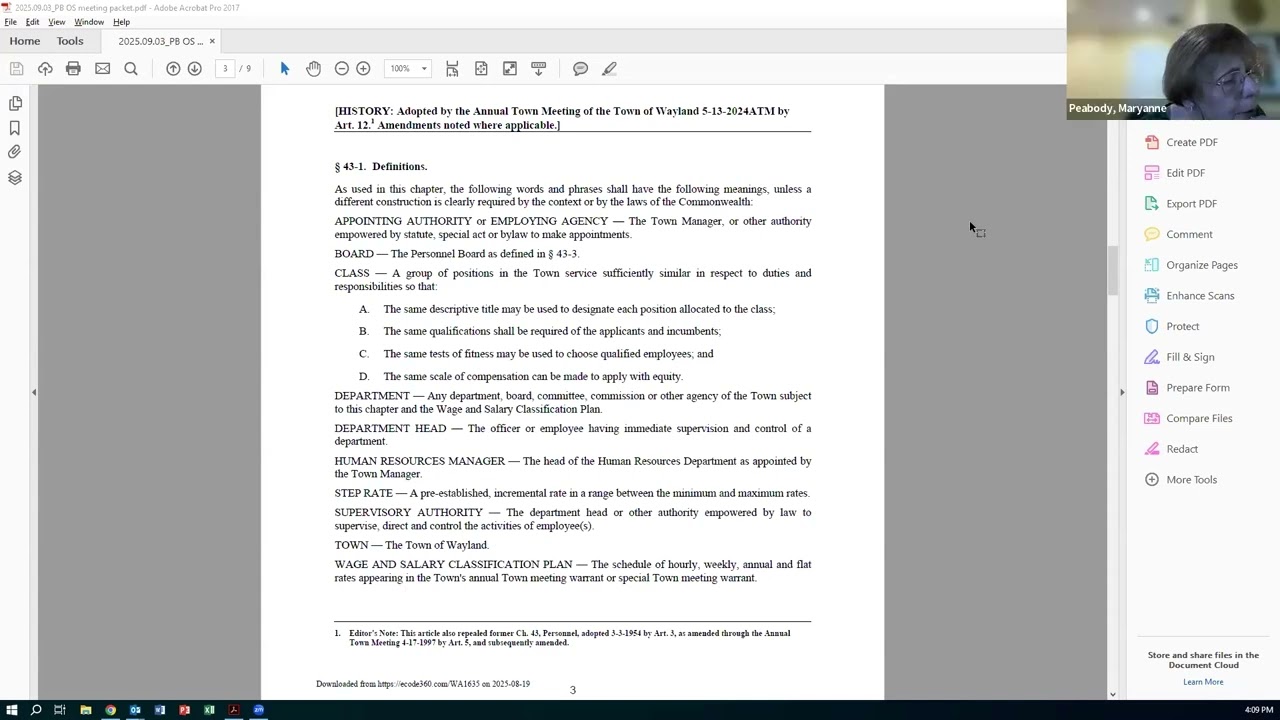
Katherine Ryan: I just shared my
screen. So this is the existing
bylaw definition section.
Paul Morenberg: And if I can interject. my recollection is. when we looked at this. our board felt the definition should be removed. I mean. this is. this was definitely discussed. I mean it. you know. because I don't. I don't think they're either all used or certainly not consistently used in other parts of our bylaw. I'm sorry. warrants much discussion. but I think the definition should be removed as well. Mary Ellen Castagno: But we had them removed. They were already moved. They were already redlined. Maryanne Peabody: Paul. so no. they didn't. they didn't get removed. right? Oh. we had suggested they be removed. but they didn't get removed. So Trudy. are you saying they're they're suggesting some of them be removed. or all of them? Trudy Reid: No. just four of them. The four is the appointing authority or Okay. agency. Okay. class. I can see that one right there on the first page. step. rate and supervisor authority. Those are the only four that they're recommending that they be removed because they are not used anywhere else within the bylaw. Unknown: Okay. but the other things- wage and salary classification plan town. Human Resources Manager. did you say oh? Department. Department Head. class we there's Oh. it's just not referred to. okay in the class. okay. In the bylaw. the word class does not appear in the classification system. Trudy Reid: That's what they're telling me. Yes. Maryanne Peabody: okay. Paul Morenberg: what was the second one after reporting authority? Trudy Reid: Class. oh. it says appointing authority or employing agency. right. right. which is the first one up there? Maryanne Peabody: Yeah. right. Because sometimes the appointing authority used to be a board. or it was a. you know. a town department that was doing that. And those things don't happen anymore.
Mary Ellen Castagno: Trudy will you repeat what they what. So there's you want. They want the appointing authority and employee agency removed. And then what were the other three? I'm sorry. Unknown: class. Mary Ellen Castagno: class. okay. Trudy Reid: separate. Mary Ellen Castagno: okay. Trudy Reid: and right under that supervisory authority. Mary Ellen Castagno: Okay. So then what happens to what we've redlined. Trudy Reid: I don't know when you redlined anything had did it go before town meeting? It did Maryanne Peabody: go before town meeting. but they did not take them out. Mary on they appeared. in total when we went to town meeting. The town. I guess it was probably the attorney for the town suggested they be left in. and we thought they should come out. but so this Mary Ellen Castagno: is fine. leave it in. leave them in. I'm just confused. Maryanne Peabody: so let me. let me just the definitions that Unknown: I'm sorry. So once I go through this initial review of everything that they have sent back to me. I will send it back to General code. At some point. our town counsel will. Get it before it goes to town meeting. and town meeting will have the final say in approving all of the recommend. recommended changes that we propose to them. There's going to be some sections of this bylaw that the entire section will be removed and replaced with an updated so some some bylaws only had one or two words to be removed or changed. Some bylaws will be removed completely and updated. So it will. it will be at the at a future town meeting. will have the final approval. Mary Ellen Castagno: Okay. Maryanne Peabody: asokay. and so we're just talking about removing those four definitions that you identified for yes. okay. Mary Ellen Castagno: and we'll get to see that before Tom meeting. Correct? I just want to be I just want to confirm that. Trudy Reid: maybe not as a I don't know the process. I don't know if they'll be sent back to boards and committees for review. but at some point you will get to see it. whether through the the warrant. or if I. if we need to send them back for any reason. Unknown: and the and the rest of the bylaw was as it was approved at town meeting. Is that the case? Um. yeah. that was the only thing they sent to me on your bylaw. Okay. those four definitions. Mary Ellen Castagno: Okay. so that's why I'm asking Maryanne. because Tom me. it would be important to see. you know. just exactly what it looks like when it's out and what we're going to see as the final product before we go to Tom meeting. I for my personal opinion. Tom meetings a little too late to see it for the first time. but I understand the timelines. Trudy. I'm just stating. you know. my comfort level. I could certainly bring it back to you with a revised version. so you have the final Maryanne Peabody: thank you. Great. I mean. Trudy Reid: you're counting on my memory to just remember to share it with you when it all comes back. which I'm happy to do. So I'm not saying I don't it's just trying to remember to do that Unknown: the time frame that it comes back to you truly. So then maybe we can. you know. put it in a future meeting so that we see it at that time. and we don't have to keep asking yeah. let me go back sometime tomorrow or next week. early next week. and look at my timeline. schedule that they have given to me. because all of this. I believe. needs to be back to General Code by within the next two or three weeks for their them to start the next process. Okay? And they're going to have this all completed by town meeting this year for the whole town? No. no. no. A future town meeting. I don't 27 or 28 but it will not be this town meeting. Okay? Maryanne Peabody: Thank you. So everyone's in agreement that those definitions come out. Is that okay? Paul Morenberg: Yeah. I mean. I think all. I think all definitions could come out. I don't think they really the ones that are still there add much. but. but Mary Ellen Castagno: if they want to leave it. Paul. it must be for a reason. Do you know what I'm saying? Paul Morenberg: No. it's fine. It's fine. Trudy. do we have the option to make our own suggestions? Absolutely. So one thing that you know. I think a couple members. or maybe our whole board. has been concerned about. is Section D. which I think would not change. the personal Board shall receive such reasonable assistance and information as it may require for the discharge of its duties. And that's really ambiguous. and we're not getting the assistance that we've would like. and particularly help with. like. you know. minute taking. So I don't know if that's something that you know could be added. that you know. such assistance you know may include. but it's not necessarily limited to minute taking assistance as needed.
Unknown: So I don't know. if you guys can just put that in writing to me. and I can include that if you can get it to me within the next week or so. I can include that with our when I send everything back. And just as a point of reference for today. I've gotta stop at 420 I have to get back to the Shore for a doctor's appointment. Oh. yeah. Maryanne Peabody: that's fine. Yeah. Paul Morenberg: we could follow up. Maryanne Peabody: Yeah. And I think that's a that's a town wide issue too. as well. So I think as far as getting software that actually works and can give us a download to help us in our in our minutes. is is something that we should be able as a town to do. since the software is available out there. we just don't Mary Ellen Castagno: right and have packets ready. And there's a lot of things that fall into that. But Trudy. I wanted to ask you another question. because when we got our package. it was a little confusing. There's a second page to these. to what we were given. and I don't see the second page. I only see it once. I think it was page five in our it was page five. If I think in ourpacket. let me just take a look at mine. My point is is that there were two pages and all we got was like one. We got the original and then we got this redacted one. and then the second page wasn't added. And I just want to make sure that that is included. because that's important Unknown: I don't know what was included in your packet. Mary Ellen Castagno: Okay. so the second one has nine through E. Unknown: The only thing that I gave to Kate was my .my page is 18 of 170 and it was section four. three. dash. one. definitions. And that's the only thing I gave to Kate. because that's the only thing that they asked me about from your board. Mary Ellen Castagno: Yes. ma'am. but there's two pages that go with that. I'm just wanted to make sure that we have. you know. that we have 9. 10. A. D and E. Trudy Reid: oh. I'm sure it's still there. That's just of that section. That's they only talked about the definition. so the rest of it stays. nothing else. Unknown: Okay. all right. it was Maryanne Peabody: but its the four that you've identified Trudy. Mary Ellen Castagno: Yes. okay. okay. just trying to be due diligence here. Thank you. Paul Morenberg: So quickly. quickly. I apologize if I'm messing this up. but it's Trudy Reid. right? R. e. i. d. yes. I thought that was right. So. and then. who is the vendor who's reviewing that? Who reviewed that? Unknown: It's General Code. and they currently host the e360 .Ecode 360 on the town's website for online bylaws. So every time a bylaw is changed to town meeting and accepted it go before it goes before the AGs office for approval. Once the AG has approved it. then I send all of those changes from town meeting to General Code. they upload it into the section called new laws. and then every six months or so. we go through a partial recodification. and they add those into the online document. Trudy Reid: So right now. if you went to the town's website and you looked up the the the the bylaws. you would see as a column on the left hand side. and it says new laws. and there should be 8 or 9 sitting there. and that is from this last town meeting. And we're about ready to move those into the document. because I have already told them to be to put them into the document. So that's the next step. just on what we did at this past town meeting. So this document. this whole document. goes through review every six to 12 months. But there are bylaws that have just been overlooked for one reason or another. because we've not made changes to those over the years. Paul Morenberg: Thank you.
Mary Ellen Castagno: Anything else before I have to sign off? This was exciting. Trudy Reid: Thank you. It is very exciting for me. I may have to extend my retirement date if it doesn't get before 2028. town meeting. Mary Ellen Castagno: Well. I can arrange for that Trudy. Trudy Reid: Okay. all right. So. yeah. So if you have any questions along the way. if you want me to put anything else that you'd like to have considered. feel free to send me something in writing. So and then I'll keep you guys updated on as we move through the process and when it when they do their next review. if there's any questions or concerns. Mary Ellen Castagno: Thank you very much. Trudy appreciate your time. Trudy Reid: Okay. thanks. You know where to find anything. Thank you.
Mary Ellen Castagno: So. Paul. I'll send you my suggestions. if you don't mind. and then we can. you can. Unknown: yeah. absolutely. Maryanne Peabody: yeah. I got knocked out. Mary Ellen Castagno: Oh. well. we don't want to do that. Marianne. Maryanne Peabody: all right. I'm sorry. Where are you? Go ahead.
Paul Morenberg: Mary Ellen was saying she's going to propose some language to clarify the Mary Ellen Castagno: assistance. Paul Morenberg: Yeah. the assistance. Maryanne Peabody: but that's already in the bylaw. Mary Ellen Castagno: No. we just spoke to her about that. Okay. what did she say . she said to send it along to her. Paul Morenberg: Yeah. I mean. it's. it's in the bylaw. if it doesn't say what the assistance is. And I personally feel like that the software is not good enough. I mean. I think I don't see why the town can't provide some assistance. I actually don't. It seems like a perfect part time job for a you know. a person who might be retired or or a stay at home mom who to could get a per diem or. you know. be a contractor and as needed. provide remote note taking. It for various boards and committees of the town. I think the town could afford it. I think would make our job lives easier. I think would make us more productive. Unknown: I agree. I agree in the day of AI. it should be real easy. Maryanne Peabody: Yeah. I think my perception is. yes. we need help. but I think it's easier to get software that can help every board at a cost of like. $20 Mary Ellen Castagno: a meeting. But Marianne. some boards do have a scribe. See. that's the whole thing. So some boards do. so we have to be all equal. right. yeah. Paul Morenberg: And why? Yeah. why not ask for it and let them say no. I mean. you know. like. it can't hurt to have that resource. And maybe with the software. we'll determine that we won't. we don't need it. or maybe it. or maybe it can be requested as needed. So like. for example. we have. you know. if. if we're comfortable with the software. you know. doing the note taking. maybe. you know. every third or fourth meeting. As Mary Ellen doesn't. you know. take notes. Say we could on on as needed. We could bring in someone so or if I'm scheduled for note taking and I can't do it because of my schedule. it seems like we should ask for it all the time. And then we can. you know. we either. either get it or we don't get it. and then we can take it from there. Unknown: Well. I. I. I. if you guys want to do that. I think want to write something up. I would agree with that. But I also feel like the software is so available that we really just need a concerted effort in town to make sure we have it and then it and it's there for us all. but. but that. you know. you both feel strongly about it. so put together some wording. and we can look at it our next meeting. but we need to get it to Trudy. I mean. that's changing a bylaw that's been that's changing a bylaw that's been voted on at Town meeting. So. I mean. certainly as they're cleaning up things or something. we certainly can ask Mary Ellen Castagno: it to be voted on again. though. Mary Ann. because we didn't see those changes. so it's going to be voted on again. It was already voted as a preliminary. per se. so I right. but she she invited us to do that. Maryanne Peabody: Okay. that's fine. So. so if you can go ahead. I'm sorry I was Paul Morenberg: going to say. even though. like. the software exists and is a good tool. I just want to point out. like this seems to be a constant. like. source of like. every single meeting is the are the last meet minutes available or not? Are we going to do that? You know. will it be the next meeting? Think of the greater like efficiency and bandwidth we would have if we were not charged with taking our own minutes. Maryanne Peabody: I will say that we got into difficulty. In the past. we had someone that were actually worked for the town that took minutes and that person did not take them properly. and then when we updated them. the updates never got there. Now that person is no longer with the town. but was. it was a it got us an open meeting law violation because of our minutes. and it took a year for us to figure it out. So I. you know. I. I do understand that we're still responsible. and if we have something that's it's easier to have software that's recording our voices and able to distinguish us. one from the other. and have one of us look at it. and to have somebody who is new to the process. doesn't understand the personnel issues in town. doesn't understand the things we work on as we do trying to take minutes. It's. it's. it's a difficulty. But you know. I'm. I'm supportive of trying to get it fixed. It's not that I'm not trying to get it fixed. but it's but. But having a human doesn't make it better than having an artificial intelligence software system that records our voices and can differentiate us one from the other. and some of those systems can. yeah. yeah. Paul Morenberg: but I. I respectfully disagree. I don't think having good software to distinguish between our voices is the is the problem. It's a good tool if you get get a better software application. But the challenge is. someone who can distill the minutes because you don't want to transcript someone who could distill the discussion into a brief summary. so that whoever is taking the minutes today me isn't. you know. partially in the meeting and partially on a keyboard for. Focusing on minute taking. and then we all because of that. it's it's sort of essential for us to either listen to the whole meeting again and or review the transcript. It's very time consuming. and a dedicated meeting minute taker with proper training could do a much better job. Maryanne Peabody: Okay. so who is going to Mary Ellen? Did you want to try some wording on that? Mary Ellen Castagno: Well. I'm going to send it to Paul. because Paul's probably better at wordsmith than I am. Unknown: Okay. and then. and then send it to me. and we can get it to. we can get it to truly. yeah. okay. And see. you know. but. but I do. I am sort of aware of the fact that we already voted on that at Town meeting. and the wording is as it is. But if you're going to be doing all of the bylaws. and some of the bylaws have significant rewrites in them. because they haven't done Mary Ellen Castagno: say that it needs it was vague. She did agree that it was vague. Marion. and I think that we were not to interrupt you or not with any any disrespect. I just think and I feel. listen. I'm speaking for myself that we were very rushed. We were very rushed at the end. And again. the things that I saw. the things that I thought went through. I know that what was in the warrant. But again. she said. if there was any clarification to do now is the time to do it? Okay? I think that she's very well aware of what was voted on. what wasn't voted on. and if that was an issue. she would have addressed it. Unknown: Okay. I agree. That's fine. So when do you think you guys could come up with something? Mary Ellen Castagno: I don't know. What do you think. Paul? Paul Morenberg: Tell me something you know by here Monday. and I'll turn it around right away. Maryanne Peabody: Okay. perfect. Thank you. And and then we can send it to her. And then we. if we want to vote on something as a board. we'll vote on it at a later time. Is that okay with you guys. but we just get her something Paul Morenberg: a night? Do we have a nine. eight thing. or is that not happening?
Maryanne Peabody: Um. no. no. not on the eighth. We're going to have a we have a we will have a meeting. because we have a here. a grievance hearing later in the month. Yeah. Okay. so I don't know what date I was kind of hoping. like after the 13th. either the the week of the 13th. What's the what are the last two weeks in September that we have? And we can talk about that when we get to the next meeting. Why don't Paul Morenberg: we? Well. we have a quorum. why don't we get through the rest of the business. and if we have. like. why don't we just try to do it now and just get it done it. I mean. I think we have an extra five or 10 minutes between the three of us. we can easily get done the wording now. yeah. when we get to board member concerns at the end of the meeting. okay. Maryanne Peabody: okay. that makes sense. All right. I just lost my pencil. Here we go. All right. yes. okay. okay. the next agenda item is a discussion and possible vote to approve the personnel board annual report. if available. And I sent out my first draft to you guys. I rethought some of it as well. but did you guys have a chance to look at it. and can I have some feedback from you both? Paul Morenberg: I read it. and I think it's perfect as is. and I would approve it. Okay. Unknown: I second that okay. The only thing I thought we should add was on the wage and salary survey and job classification study. We did the request for proposal last year. but I think we want to put a statement that this study will begin and will continue into the coming year. so that the town is aware that it is going to be ongoing. and Kate is going to give us an update on where it is and where they are now. So that's the only thing I would like to add to it. If that's okay with you guys. Sure. Sure. Okay. Thank you. And let's since you i with that change. I will change it and then send it into I think it's Jailyn Bratica needs it by the end of the month. Can I have a vote to approve the 2025. annual report of the Wayland Mary Ellen Castagno: so moved Unknown: Okay. Thank you. Okay. Thank you. Paul and so roll call vote. because we're on Zoom. Mary Ellen. Mary Ellen Castagno: yes. yes. Unknown: Paul. Paul Morenberg: yes. Maryanne Peabody: Maryanne. yes. Thank you. The next item is the human. Paul Morenberg: I'm sorry. Marianne. just just to clarify. because I might have been a little unclear. I'm going to say the motion was to approve the minutes as revised. By Maryanne is that fair? Unknown: The report? Mary Ellen Castagno: The report? Yeah. Paul Morenberg: yes. Okay. so we're. we're so you have that. you are the you can revise it as scribe and submit it. Unknown: Okay. and I'll send you a copy. just so you see it's only going to be that one change I think. okay. okay. The next item is Human Resources directors report with us having questions and comments. the update on classification and compensation study. And I think Kate's going to give us an update. and hopefully they've been busy. I think they've been meeting. Go ahead. Kate yeah. we've been very busy. The consultant has. so we finished all of our job analysis questionnaire. all all of our employees involved in this study completed their questionnaires. They were all interviewed or interviewed in groups. All of that was completed. I believe. back in end of July. and then the consultant has actually developed a first draft of a classification system to. you know. to sort of map out based on the JAQ the results of those. those questionnaires. where all of the our positions fall. So now we're in the in the part of the process where we're sort of fine tuning it to make sure that. you know. looking at job descriptions again. I'm going to be reaching out to department heads to make sure that they they feel they're classified appropriately. and that the changes to job descriptions are accurate. Katherine Ryan: So how it worked is the employee was able to provide changes or propose changes to their job description. and then the department head or their supervisor would review and either make comments or approve. you know. basically sign off on them. So there's been some comment back and forth. So we're we're just mapping out that that process we are still on track to be done final report by the end of October. So they have sent out the salary survey. The other piece of this is a salary survey. They have heard back. They've gotten data from almost every town. I believe. There were a couple that we didn't hear back from. which is. you know. it happens. that's understandable. so they're working on that piece now. okay. and that's. that's where we're at with that. Unknown: And so the supervisors of each department have seen the job descriptions for all of the positions that exist within their department.? Katherine Ryan: yanyes. yeah. Maryanne Peabody: okay. yep. and they had to sign off on them to say they agreed or disagreed in those conversation. Katherine Ryan: Yes. correct. Maryanne Peabody: Okay. any big surprises on any big changes that you see.
Unknown: not not yet. You know. there are a few positions that I think we're we have a few positions. both in the Council on Aging and in our Youth Services department. that require a licensed social worker. and so those are a little harder to place. so I think that needs some fine tuning. And then our school nurses. our community health nurses. our town employees. rather than school department employees. So we actually had to reach out to some school departments for salary data on those. and we did receive some salary data back on that. But I think those are. those are some areas that are like. I said. need. need some adjustment and fine tuning. Yeah. I think probably we're kind of aware of those at any rate. did you have a committee. or was it each department? Each the consultant worked with each classification of employee? Well. they they worked with each position so and the job analysis questionnaire is the JAQs went out to each individual in each position. We asked them to fill that out with the very they have five factors that they then grade or score. I should say. And then the employee had an opportunity to propose changes to the job description. Those all then went to the department head or supervisor to review. and they made comments. and then they came back to us. and then to the consultant. so they've looked at every single job and job description at this point. which is quite a few.
Maryanne Peabody: any questions from the board members. Unknown: I was just curious if anybody from the on any of the boards were able to come and observe. you know. when they were speaking to the different i. Uh. what do you call it? Departments? I think that that would be interesting. just to have a an idea of what the questions were and how they came upon. salaries that they did. I hope I'm making sense. I know that Maryanne's lived it. I haven't lived it.
So. I mean. at this point. the consultant is is working primarily through me. They have interviewed almost all of our employees who submitted JAQs. the the questionnaires. which include our department heads. so they they had an opportunity to discuss their own staff and positions as well. We haven't had a board involved in that process yet. but I it is my goal. and I think our we've. we've actually. I. you know. made it clear to our consultant that we would like them to present either preliminary or final findings to the Personnel Board. possibly the Select Board. It depends. I don't know who. who would like to be involved. but I. you know. we have to limit it. We can't do everyone. But I was thinking Personnel board and Select board. So yeah.
Mary Ellen Castagno: that would be wonderful. Kate. Maryanne Peabody: and when? When would you anticipate that? Kate. Katherine Ryan: well. we. like I said. we're on track to have a final report by the end of October. So. okay. I you know. I would guess early November. Okay. it's my my best guess. Maryanne Peabody: Okay. that sounds good. yeah. And so the salary survey. they're just waiting now for the information to come back from towns. and then they'll run it through their data. and they'll run the data that they got. Katherine Ryan: Yeah. they at this point. they've received all the data that I think that we're going to. that we're going to receive. and there were just a few towns. I think we sent it out to 15 or 16 towns. I can't remember the entire list. and there were a handful that didn't respond. which we expected. but they are actively working on the salary survey piece now. Unknown: Alright. that sounds good. Thank you. because I know there's some concern in. I know that the Finance Committee is concerned too. and we have to think through what the town how the town is going to roll out the data if there are changes. and which are the ones that we need to address first. And. okay. that sounds that sounds reasonable. Okay. And anyone else have any other questions? Paul. do you have any questions? No. okay. great. Okay. so there the minutes will be. I will have the others at our next meeting. As long as I have. I'm do them. which I think I will. depending on when we schedule our next meeting. The next item was personnel. board members. reports and concerns. Anyone have concerns. Paul Morenberg: You want to discuss the setting a regular meeting schedule or. Maryanne Peabody: Yes. I'm sorry I skipped that. That was the next agenda item. Yes. it we've been kind of just going along and scheduling it at the end of each meeting. But. you know. Kate and I were talking. it would be much simpler if we all knew it was going to be the first Monday of the of them every month. or the third Tuesday of the month. I don't really have. you know. I only have. like. one date that I can't do in the month. But if we could all agree on a date. It seems that we could plan better that way. If there are things that come up. that are emergencies that require a vote. or if we have something from like a union grievance. or something like that comes up. then we would call an extra meeting. but it will be easier than. you know. having to write to each other. you know. to have Kate send out something and wait for everybody to come back with a date and then get it back to everyone. If we just knew that it was going to be a standard set meeting time. What do you guys think? Paul Morenberg: Yeah. I would like that. I mean. Mondays and Tuesdays tend to be a little harder for me. So. and today is a Wednesday. So what about the first or second Wednesday of the month? Does that anybody have a conflict with that? And Kate. do you have a conflict with that? Unknown: I have a regularly scheduled meeting on the second Wednesday of every month. So I couldn't. I. unfortunately. couldn't do that. but I could do the first that would. that would work and then would we be able to get a room? That's the other thing. Katherine Ryan: Yeah. that's. that's not an issue. I think. I think we'll be fine there. Maryanne Peabody: and that's if we stick with our four o'clock time. right? Okay. so Paul Morenberg: I do the first Wednesday. I mean. obviously. Yeah. we What about. look to you know. conflicts that people have. but what a Mary Ellen. Mary Ellen Castagno: I'm fine with the first the October 1 is fine. My my calendar is clear. Maryanne Peabody: Yeah. I'm fine with the first Wednesday. That's no problem for me. We could just if. if that's a good date. Kate. we can just. Paul Morenberg: I will. I'm going to text or email Jill. Unknown: although it's Yom. Yom Kippur this year. Paul. oh. Paul Morenberg: okay. well. I mean subject to it could still be that. and then subject to changing. yeah. yeah. Maryanne Peabody: okay. okay. yes. yes. But October is October one is Yom Kippur. beginning at sundown. Well. we'll have to get it done quick.
Paul Morenberg: Well. actually. that you know what? That's true. though. That shouldn't be a problem if it's if the meeting is. you know. Maryanne Peabody: people aren't going some place for dinner or something on the road. right? But. yeah. we'll. we'll ask if none of us have conflicts. I guess that's okay. It's because it is before sundown. Uh. well. not in the middle of winter. Oh. yeah. it's only October. We have time on October. right? What time will? Mary Ellen Castagno: I think we can do it? We just have to talk fast. yeah. Maryanne Peabody: Okay. And then I would like to schedule the next meeting date. but we want to handle the the wording. Well. we can Mary Ellen Castagno: do that and send it to you. I don't know. Do we have time now. you said this? This is going to be nice. We do. I think Paul Morenberg: it'll take five minutes. Okay. Maryanne Peabody: alright. What does it say? As it is. Paul in the bylaw. it Paul Morenberg: says in section D. the Personnel Board shall receive such reasonable assistance and information as it may require for the discharge of its duties. And I would suggest you just sort of you add a second sentence and say reasonable assistance may include assistance in Minute taking by a town employee or consultant as needed or something.
Maryanne Peabody: And you was limited to minute taking no. we said. Yeah. Paul Morenberg: I mean. I mean. it could. I mean. I'm trying to think where else we could. I mean. you know. we we do. I mean. everything else we do. we need to do ourselves. We need to read things and research them. I don't. I don't know Mary Ellen Castagno: what I need. the packet. Paul. I need the written packet in advance. Yeah. Paul Morenberg: I mean. I think that. and I think that. I think you I think that's already happens. I mean. maybe that could be available earlier. if that's something you need earlier. but I'm not sure we need to specify that. Yeah. worked Mary Ellen Castagno: out. but okay. I just wanted to put it out there because.
Unknown: um. Paul Morenberg: I mean. you know. I mean. it could say. I mean. it could also include. could all. I mean. you could put photocopying and transmission of documents. but. I mean. I don't think. I think that's already happening. So. okay.
Maryanne Peabody: so you want to say reasonable assistance man Paul Morenberg: may include. we may include the minute taking. you say. services of a of a town employee or consultant to provide minute taking as needed. something like that. I mean. I can tweak that a little bit. but Maryanne Peabody: do would you want to include software there or not? Paul Morenberg: Yeah. we could just so reasonable assistance.
Stronger. but I think may would be more palatable. May include Maryanne Peabody: minute taking assistance by a tom. Include
include minute Paul Morenberg: taking may include
Unknown: distance Paul Morenberg: with Minute. Taking by a town employee or consultant. town employee or consultant and as well Unknown: as as needed.
Paul Morenberg: software. software. or applications. Maryanne Peabody: Yeah. because I think that's changing so fast that that's by the time this gets written that's really going to be the norm. right? So reasonable assistance may include minute taking assistance by a town employee. you want to say. contractor or consultant. What do you want to call Paul Morenberg: it? I said minute taking assistance by a town employee or consultant as well as um. Mary Ellen Castagno: Availability of the availability. Paul Morenberg: as well as the purchase or licensing needed of needed. needed software or applications. Maryanne Peabody: yeah. or even if we just said. or as well as Paul Morenberg: I as Maryanne Peabody: well as taking software applications. because I'm not sure Paul Morenberg: I would limit it to. what if. what if we needed an application to do something. like. to help with something else. like. you know. classification stuff or something. I mean. I won't necessarily limit. I mean. that's. I think that's the need we anticipate now. but there could be other needs as well as
as well as access to software. Or applications for minute taking or other you
Mary Ellen Castagno: don't want to take this offline. Paul. it's Paul Morenberg: no. I don't think so. I mean. I don't think it's that complicated. I just. I'd rather not if we take it offline and we have. then we have a problem. how to approve it. okay. all right. How
about okay? How about this? Reasonable assistance may include minute taking assistance by a town employee or consultant. as well as access to software applications. minute taking or other necessary functions Maryanne Peabody: as access what is going on here. I'm sorry.
Paul Morenberg: Reasonable assistance may include minute taking assistance by a town employee or consultant. as well as access to software or applications for minute taking or other necessary functions do
I mean. we could we could also even say. like. could we ever. could we ever need. like. access to databases or research. We could say. also access to.
Maryanne Peabody: well. I think. I think. I think if you just say access to software. applications for minute taking and other necessary functions. it would be things that we would need that will be under our purview. that we would and other boards would also probably want the same kind of thing. If they had something that they had to do. they would want access to it. I I think that kind of covers it as well as access to software. for applications. for minute taking or other necessary functions. Paul Morenberg: Okay. is that. Mary Ann. does that work for you? Mary Ellen Castagno: It works for me. It's fine. I'll just have to work with Mary Ann. because I don't get my pack at 72 hours before the meeting. and sometimes it's a back and forth. And if they're closed on Friday. it's a struggle. and I do need them in advance. but you don't have to put that in there. I'm just making it for the record. Paul Morenberg: I'm sure that. I'm sure that that can happen. And I'm Yeah. yeah. Mary Ellen Castagno: But that can go into the minutes. Paul. that's good enough. If it's. you know. if it's you know. for the minutes. so that it is memorialized. Paul Morenberg: Yeah. I'll put a note about that. because I didn't Mary Ellen Castagno: have to chase them. I should just get them automatically. But thank you. Paul Morenberg: Yeah. no. and I'm sure that's the intent. And occasionally there might be a glitch. but I have no doubt that's the that's the. And usual practice. Maryanne Peabody: and I think Kate and I work on the packet several weeks in advance. so we're hoping to be able to get it so that. so that it's available when Mary Ellen needs it. The problem usually occurs. I would say. during the summer. on Fridays. but I'm not sure that that's a problem when the town building is closed and we've got a tight time frame. But most of the time. I think you get it in. I get Mary Ellen Castagno: it. I have to kind of remind and chase. And in the past. it had been automatically done for me 72 hours in advance. and I could just go pick it up. So if I forget. or. you know. it's a Friday. and I'm not. you know. aware that they closed on Friday. That's when the you know. it causes an issue for me. I mean. Paul Morenberg: there can be. you know. I mean. there can be situations where things you know are still being. you know. developed a day or two before the meeting. So I'd hate to have a time standard. I'm sure that's the goal Mary Ellen Castagno: of the No no. I'm speaking out loud. I'm speaking out loud because Mary Ann. as she said. she has the agenda. She meets with her. you know. at least a week or so in advance. So. you know. just trying to assist with the process Maryanne Peabody: at all now. And I think for most boards. as long as we have an early meet. early in the week meeting. as long as people have the packet to read over the weekend. most boards. that's when they do it. But you know. sometimes. sometimes it's not so the fact that we've been meeting on Mondays usually gives us the weekend to read it. Mary Ellen Castagno: Yeah. so that's 72 hours before Marianne. but if see what I'm saying. But if it's a Wednesday. if it's a Wednesday. having it on Friday helps a lot. Paul Morenberg: I mean. I could also. you know. I mean. I don't know where you are. but we're all on Wayland. so. I mean. it's. I'm also more than happy to print Mary Ellen Castagno: it. Paul. you're not doing it. Thank you very much. I'm saying. I'm Paul Morenberg: saying. if there's a digital copy. on occasion. I'm more than happy to drop it off at your mailbox or whatever. or. I'm sure Mary Ann could do that. Maryanne Peabody: Yeah. I've offered to something. no.
Mary Ellen Castagno: but I appreciate the offer. but no. thank you. It can be done. And then I don't want to have to rely on somebody dropping it off. or remembering to drop it off. or that sort of thing. I think the way it is is fine. That's the way it was set up. It just needs to get back to a a regular routine of being done. you know. a regular cycle of being done without having to Paul Morenberg: I'm sure. I'm sure. I'm sure. I'm sure it will be so Okay. Thank you. Maryanne Peabody: Absolutely okay. And so Paul. I can read what I have here. but. but you're going to put it in the minutes. the the addition that we want to get to Trudy. and then I can send it to her. Is it reasonable? Paul Morenberg: I read it twice. and I think so I could just do a motion to I'll do that. and I'll just send you an email. So I'm going to. I move to that the Personnel Board approve the following revision to the chapter 43 minutes to say in section D after the first sentence that reasonable assistance may include minute taking assistance by a town employer consultant. as well as access To software applications for minute taking or other necessary functions. Maryanne Peabody: Yes. that's right. yes. Thank you. Perfect. All Paul Morenberg: right. Second. second. Maryanne Peabody: okay. our Roll Call. Vote. Paul. yes. yes. Mary Ellen. yes. Ma'am. Mary Ann. yes. Paul Morenberg: Okay. great. We just got some business done efficiently. okay. and then you'll send it to me. Maryanne Peabody: and that'll be fine. great. Okay. um. topics not reasonably anticipated. 48 hours in advance. if
Paul Morenberg: any. Maryanne Peabody: none by me. Mary Ellen. no next meeting date. We do have a union grievance to hear. and we need to get information. more information from the union. and we also need to schedule it with them. Kate. what do you think is a reasonable a reasonable time for that? Katherine Ryan: I believe we had discussed the week of September. 15. so the 16th or 17th? I can't remember if everyone was available at that that date. those dates. Mary Ellen Castagno: Let me look. Are you thinking the 15th? The 16th of the 17th? Katherine Ryan: Yes. of September. Mary Ellen Castagno: Let me look. I Unknown: And Maryanne Peabody: it probably we won't have much. I don't Maybe we'll have some policies to go over. but it's really it will take. probably. that will take a large portion of the meeting. and if we can have any personnel policies that we need to do. And I'll have the minutes at least from May. And Did. did you all do the June ones Kate. ? Katherine Ryan: I don't remember. Maryanne Peabody: I can I took hers for her. she was going to do May. And I think she took June with your mind. And then Paul is doing this one. Mary Ellen Castagno: So. so the 17th. at four o'clock will work for me. That's a Wednesday. If that works for others. Unknown: Paul. how about you? Paul Morenberg: I could do that.Yeah. I Maryanne Peabody: can do that as well. Kate. if that works for the Unknown: Union. I will reach out to them tonight. and I'll make sure that they can do that. Okay? And then we we would need more information from them than what they originally sent. but that will be fine Mary Ellen Castagno: I don't think we got anything. I think you were the only one Maryanne Peabody: that knew. yeah. yeah. Well. sometimes when they send me the stuff. they send me a lot of information. and sometimes they send me not a lot of information. but I do not have agreements. but we need more information. Okay. yeah. great. All right. Mary Ellen Castagno: Um. so we have that. and we also have October 1. correct? Paul Morenberg: Yeah. okay. while everybody is here. would. would. could we start a little earlier. like 3pm just because of the holiday? Sure. usually it'll be 4pm or four for October 1. Is that okay with UK? Mary Ellen Castagno: Because we can do it. sure. Okay. so. 3pm on October 1. great. perfect. Okay. I will do that. Paul Morenberg: and I'll email Jill. Okay.
Mary Ellen Castagno: Well. this was a very productive meeting. I have to say. yes. Well. it was. Maryanne Peabody: it was a short one. We just had two items that we needed to do by the end of December. Um. so then I would say. if Is there anything else. Kate. that you would want to add. or Katherine Ryan: no. I'm I'm good. Unknown: Kate. when does I'm sorry. I didn't mean to interrupt you. but when do they go back to regular hours at the town hall. Katherine Ryan: We it's this week. Okay. yes. okay. so we'll be in on Friday of this week. okay? Maryanne Peabody: And then there being no further business. May I have a motion to adjourn. So move okay. okay. so roll call vote. Mary Ellen. yes. Paul. Paul Morenberg: yes. Maryanne Peabody: Mary Ann. yes. and we are adjourning at 4:58pm.
by my clock. Anyways. hook.
Paul Morenberg: And if I can interject. my recollection is. when we looked at this. our board felt the definition should be removed. I mean. this is. this was definitely discussed. I mean it. you know. because I don't. I don't think they're either all used or certainly not consistently used in other parts of our bylaw. I'm sorry. warrants much discussion. but I think the definition should be removed as well. Mary Ellen Castagno: But we had them removed. They were already moved. They were already redlined. Maryanne Peabody: Paul. so no. they didn't. they didn't get removed. right? Oh. we had suggested they be removed. but they didn't get removed. So Trudy. are you saying they're they're suggesting some of them be removed. or all of them? Trudy Reid: No. just four of them. The four is the appointing authority or Okay. agency. Okay. class. I can see that one right there on the first page. step. rate and supervisor authority. Those are the only four that they're recommending that they be removed because they are not used anywhere else within the bylaw. Unknown: Okay. but the other things- wage and salary classification plan town. Human Resources Manager. did you say oh? Department. Department Head. class we there's Oh. it's just not referred to. okay in the class. okay. In the bylaw. the word class does not appear in the classification system. Trudy Reid: That's what they're telling me. Yes. Maryanne Peabody: okay. Paul Morenberg: what was the second one after reporting authority? Trudy Reid: Class. oh. it says appointing authority or employing agency. right. right. which is the first one up there? Maryanne Peabody: Yeah. right. Because sometimes the appointing authority used to be a board. or it was a. you know. a town department that was doing that. And those things don't happen anymore.
Mary Ellen Castagno: Trudy will you repeat what they what. So there's you want. They want the appointing authority and employee agency removed. And then what were the other three? I'm sorry. Unknown: class. Mary Ellen Castagno: class. okay. Trudy Reid: separate. Mary Ellen Castagno: okay. Trudy Reid: and right under that supervisory authority. Mary Ellen Castagno: Okay. So then what happens to what we've redlined. Trudy Reid: I don't know when you redlined anything had did it go before town meeting? It did Maryanne Peabody: go before town meeting. but they did not take them out. Mary on they appeared. in total when we went to town meeting. The town. I guess it was probably the attorney for the town suggested they be left in. and we thought they should come out. but so this Mary Ellen Castagno: is fine. leave it in. leave them in. I'm just confused. Maryanne Peabody: so let me. let me just the definitions that Unknown: I'm sorry. So once I go through this initial review of everything that they have sent back to me. I will send it back to General code. At some point. our town counsel will. Get it before it goes to town meeting. and town meeting will have the final say in approving all of the recommend. recommended changes that we propose to them. There's going to be some sections of this bylaw that the entire section will be removed and replaced with an updated so some some bylaws only had one or two words to be removed or changed. Some bylaws will be removed completely and updated. So it will. it will be at the at a future town meeting. will have the final approval. Mary Ellen Castagno: Okay. Maryanne Peabody: asokay. and so we're just talking about removing those four definitions that you identified for yes. okay. Mary Ellen Castagno: and we'll get to see that before Tom meeting. Correct? I just want to be I just want to confirm that. Trudy Reid: maybe not as a I don't know the process. I don't know if they'll be sent back to boards and committees for review. but at some point you will get to see it. whether through the the warrant. or if I. if we need to send them back for any reason. Unknown: and the and the rest of the bylaw was as it was approved at town meeting. Is that the case? Um. yeah. that was the only thing they sent to me on your bylaw. Okay. those four definitions. Mary Ellen Castagno: Okay. so that's why I'm asking Maryanne. because Tom me. it would be important to see. you know. just exactly what it looks like when it's out and what we're going to see as the final product before we go to Tom meeting. I for my personal opinion. Tom meetings a little too late to see it for the first time. but I understand the timelines. Trudy. I'm just stating. you know. my comfort level. I could certainly bring it back to you with a revised version. so you have the final Maryanne Peabody: thank you. Great. I mean. Trudy Reid: you're counting on my memory to just remember to share it with you when it all comes back. which I'm happy to do. So I'm not saying I don't it's just trying to remember to do that Unknown: the time frame that it comes back to you truly. So then maybe we can. you know. put it in a future meeting so that we see it at that time. and we don't have to keep asking yeah. let me go back sometime tomorrow or next week. early next week. and look at my timeline. schedule that they have given to me. because all of this. I believe. needs to be back to General Code by within the next two or three weeks for their them to start the next process. Okay? And they're going to have this all completed by town meeting this year for the whole town? No. no. no. A future town meeting. I don't 27 or 28 but it will not be this town meeting. Okay? Maryanne Peabody: Thank you. So everyone's in agreement that those definitions come out. Is that okay? Paul Morenberg: Yeah. I mean. I think all. I think all definitions could come out. I don't think they really the ones that are still there add much. but. but Mary Ellen Castagno: if they want to leave it. Paul. it must be for a reason. Do you know what I'm saying? Paul Morenberg: No. it's fine. It's fine. Trudy. do we have the option to make our own suggestions? Absolutely. So one thing that you know. I think a couple members. or maybe our whole board. has been concerned about. is Section D. which I think would not change. the personal Board shall receive such reasonable assistance and information as it may require for the discharge of its duties. And that's really ambiguous. and we're not getting the assistance that we've would like. and particularly help with. like. you know. minute taking. So I don't know if that's something that you know could be added. that you know. such assistance you know may include. but it's not necessarily limited to minute taking assistance as needed.
Unknown: So I don't know. if you guys can just put that in writing to me. and I can include that if you can get it to me within the next week or so. I can include that with our when I send everything back. And just as a point of reference for today. I've gotta stop at 420 I have to get back to the Shore for a doctor's appointment. Oh. yeah. Maryanne Peabody: that's fine. Yeah. Paul Morenberg: we could follow up. Maryanne Peabody: Yeah. And I think that's a that's a town wide issue too. as well. So I think as far as getting software that actually works and can give us a download to help us in our in our minutes. is is something that we should be able as a town to do. since the software is available out there. we just don't Mary Ellen Castagno: right and have packets ready. And there's a lot of things that fall into that. But Trudy. I wanted to ask you another question. because when we got our package. it was a little confusing. There's a second page to these. to what we were given. and I don't see the second page. I only see it once. I think it was page five in our it was page five. If I think in ourpacket. let me just take a look at mine. My point is is that there were two pages and all we got was like one. We got the original and then we got this redacted one. and then the second page wasn't added. And I just want to make sure that that is included. because that's important Unknown: I don't know what was included in your packet. Mary Ellen Castagno: Okay. so the second one has nine through E. Unknown: The only thing that I gave to Kate was my .my page is 18 of 170 and it was section four. three. dash. one. definitions. And that's the only thing I gave to Kate. because that's the only thing that they asked me about from your board. Mary Ellen Castagno: Yes. ma'am. but there's two pages that go with that. I'm just wanted to make sure that we have. you know. that we have 9. 10. A. D and E. Trudy Reid: oh. I'm sure it's still there. That's just of that section. That's they only talked about the definition. so the rest of it stays. nothing else. Unknown: Okay. all right. it was Maryanne Peabody: but its the four that you've identified Trudy. Mary Ellen Castagno: Yes. okay. okay. just trying to be due diligence here. Thank you. Paul Morenberg: So quickly. quickly. I apologize if I'm messing this up. but it's Trudy Reid. right? R. e. i. d. yes. I thought that was right. So. and then. who is the vendor who's reviewing that? Who reviewed that? Unknown: It's General Code. and they currently host the e360 .Ecode 360 on the town's website for online bylaws. So every time a bylaw is changed to town meeting and accepted it go before it goes before the AGs office for approval. Once the AG has approved it. then I send all of those changes from town meeting to General Code. they upload it into the section called new laws. and then every six months or so. we go through a partial recodification. and they add those into the online document. Trudy Reid: So right now. if you went to the town's website and you looked up the the the the bylaws. you would see as a column on the left hand side. and it says new laws. and there should be 8 or 9 sitting there. and that is from this last town meeting. And we're about ready to move those into the document. because I have already told them to be to put them into the document. So that's the next step. just on what we did at this past town meeting. So this document. this whole document. goes through review every six to 12 months. But there are bylaws that have just been overlooked for one reason or another. because we've not made changes to those over the years. Paul Morenberg: Thank you.
Mary Ellen Castagno: Anything else before I have to sign off? This was exciting. Trudy Reid: Thank you. It is very exciting for me. I may have to extend my retirement date if it doesn't get before 2028. town meeting. Mary Ellen Castagno: Well. I can arrange for that Trudy. Trudy Reid: Okay. all right. So. yeah. So if you have any questions along the way. if you want me to put anything else that you'd like to have considered. feel free to send me something in writing. So and then I'll keep you guys updated on as we move through the process and when it when they do their next review. if there's any questions or concerns. Mary Ellen Castagno: Thank you very much. Trudy appreciate your time. Trudy Reid: Okay. thanks. You know where to find anything. Thank you.
Mary Ellen Castagno: So. Paul. I'll send you my suggestions. if you don't mind. and then we can. you can. Unknown: yeah. absolutely. Maryanne Peabody: yeah. I got knocked out. Mary Ellen Castagno: Oh. well. we don't want to do that. Marianne. Maryanne Peabody: all right. I'm sorry. Where are you? Go ahead.
Paul Morenberg: Mary Ellen was saying she's going to propose some language to clarify the Mary Ellen Castagno: assistance. Paul Morenberg: Yeah. the assistance. Maryanne Peabody: but that's already in the bylaw. Mary Ellen Castagno: No. we just spoke to her about that. Okay. what did she say . she said to send it along to her. Paul Morenberg: Yeah. I mean. it's. it's in the bylaw. if it doesn't say what the assistance is. And I personally feel like that the software is not good enough. I mean. I think I don't see why the town can't provide some assistance. I actually don't. It seems like a perfect part time job for a you know. a person who might be retired or or a stay at home mom who to could get a per diem or. you know. be a contractor and as needed. provide remote note taking. It for various boards and committees of the town. I think the town could afford it. I think would make our job lives easier. I think would make us more productive. Unknown: I agree. I agree in the day of AI. it should be real easy. Maryanne Peabody: Yeah. I think my perception is. yes. we need help. but I think it's easier to get software that can help every board at a cost of like. $20 Mary Ellen Castagno: a meeting. But Marianne. some boards do have a scribe. See. that's the whole thing. So some boards do. so we have to be all equal. right. yeah. Paul Morenberg: And why? Yeah. why not ask for it and let them say no. I mean. you know. like. it can't hurt to have that resource. And maybe with the software. we'll determine that we won't. we don't need it. or maybe it. or maybe it can be requested as needed. So like. for example. we have. you know. if. if we're comfortable with the software. you know. doing the note taking. maybe. you know. every third or fourth meeting. As Mary Ellen doesn't. you know. take notes. Say we could on on as needed. We could bring in someone so or if I'm scheduled for note taking and I can't do it because of my schedule. it seems like we should ask for it all the time. And then we can. you know. we either. either get it or we don't get it. and then we can take it from there. Unknown: Well. I. I. I. if you guys want to do that. I think want to write something up. I would agree with that. But I also feel like the software is so available that we really just need a concerted effort in town to make sure we have it and then it and it's there for us all. but. but that. you know. you both feel strongly about it. so put together some wording. and we can look at it our next meeting. but we need to get it to Trudy. I mean. that's changing a bylaw that's been that's changing a bylaw that's been voted on at Town meeting. So. I mean. certainly as they're cleaning up things or something. we certainly can ask Mary Ellen Castagno: it to be voted on again. though. Mary Ann. because we didn't see those changes. so it's going to be voted on again. It was already voted as a preliminary. per se. so I right. but she she invited us to do that. Maryanne Peabody: Okay. that's fine. So. so if you can go ahead. I'm sorry I was Paul Morenberg: going to say. even though. like. the software exists and is a good tool. I just want to point out. like this seems to be a constant. like. source of like. every single meeting is the are the last meet minutes available or not? Are we going to do that? You know. will it be the next meeting? Think of the greater like efficiency and bandwidth we would have if we were not charged with taking our own minutes. Maryanne Peabody: I will say that we got into difficulty. In the past. we had someone that were actually worked for the town that took minutes and that person did not take them properly. and then when we updated them. the updates never got there. Now that person is no longer with the town. but was. it was a it got us an open meeting law violation because of our minutes. and it took a year for us to figure it out. So I. you know. I. I do understand that we're still responsible. and if we have something that's it's easier to have software that's recording our voices and able to distinguish us. one from the other. and have one of us look at it. and to have somebody who is new to the process. doesn't understand the personnel issues in town. doesn't understand the things we work on as we do trying to take minutes. It's. it's. it's a difficulty. But you know. I'm. I'm supportive of trying to get it fixed. It's not that I'm not trying to get it fixed. but it's but. But having a human doesn't make it better than having an artificial intelligence software system that records our voices and can differentiate us one from the other. and some of those systems can. yeah. yeah. Paul Morenberg: but I. I respectfully disagree. I don't think having good software to distinguish between our voices is the is the problem. It's a good tool if you get get a better software application. But the challenge is. someone who can distill the minutes because you don't want to transcript someone who could distill the discussion into a brief summary. so that whoever is taking the minutes today me isn't. you know. partially in the meeting and partially on a keyboard for. Focusing on minute taking. and then we all because of that. it's it's sort of essential for us to either listen to the whole meeting again and or review the transcript. It's very time consuming. and a dedicated meeting minute taker with proper training could do a much better job. Maryanne Peabody: Okay. so who is going to Mary Ellen? Did you want to try some wording on that? Mary Ellen Castagno: Well. I'm going to send it to Paul. because Paul's probably better at wordsmith than I am. Unknown: Okay. and then. and then send it to me. and we can get it to. we can get it to truly. yeah. okay. And see. you know. but. but I do. I am sort of aware of the fact that we already voted on that at Town meeting. and the wording is as it is. But if you're going to be doing all of the bylaws. and some of the bylaws have significant rewrites in them. because they haven't done Mary Ellen Castagno: say that it needs it was vague. She did agree that it was vague. Marion. and I think that we were not to interrupt you or not with any any disrespect. I just think and I feel. listen. I'm speaking for myself that we were very rushed. We were very rushed at the end. And again. the things that I saw. the things that I thought went through. I know that what was in the warrant. But again. she said. if there was any clarification to do now is the time to do it? Okay? I think that she's very well aware of what was voted on. what wasn't voted on. and if that was an issue. she would have addressed it. Unknown: Okay. I agree. That's fine. So when do you think you guys could come up with something? Mary Ellen Castagno: I don't know. What do you think. Paul? Paul Morenberg: Tell me something you know by here Monday. and I'll turn it around right away. Maryanne Peabody: Okay. perfect. Thank you. And and then we can send it to her. And then we. if we want to vote on something as a board. we'll vote on it at a later time. Is that okay with you guys. but we just get her something Paul Morenberg: a night? Do we have a nine. eight thing. or is that not happening?
Maryanne Peabody: Um. no. no. not on the eighth. We're going to have a we have a we will have a meeting. because we have a here. a grievance hearing later in the month. Yeah. Okay. so I don't know what date I was kind of hoping. like after the 13th. either the the week of the 13th. What's the what are the last two weeks in September that we have? And we can talk about that when we get to the next meeting. Why don't Paul Morenberg: we? Well. we have a quorum. why don't we get through the rest of the business. and if we have. like. why don't we just try to do it now and just get it done it. I mean. I think we have an extra five or 10 minutes between the three of us. we can easily get done the wording now. yeah. when we get to board member concerns at the end of the meeting. okay. Maryanne Peabody: okay. that makes sense. All right. I just lost my pencil. Here we go. All right. yes. okay. okay. the next agenda item is a discussion and possible vote to approve the personnel board annual report. if available. And I sent out my first draft to you guys. I rethought some of it as well. but did you guys have a chance to look at it. and can I have some feedback from you both? Paul Morenberg: I read it. and I think it's perfect as is. and I would approve it. Okay. Unknown: I second that okay. The only thing I thought we should add was on the wage and salary survey and job classification study. We did the request for proposal last year. but I think we want to put a statement that this study will begin and will continue into the coming year. so that the town is aware that it is going to be ongoing. and Kate is going to give us an update on where it is and where they are now. So that's the only thing I would like to add to it. If that's okay with you guys. Sure. Sure. Okay. Thank you. And let's since you i with that change. I will change it and then send it into I think it's Jailyn Bratica needs it by the end of the month. Can I have a vote to approve the 2025. annual report of the Wayland Mary Ellen Castagno: so moved Unknown: Okay. Thank you. Okay. Thank you. Paul and so roll call vote. because we're on Zoom. Mary Ellen. Mary Ellen Castagno: yes. yes. Unknown: Paul. Paul Morenberg: yes. Maryanne Peabody: Maryanne. yes. Thank you. The next item is the human. Paul Morenberg: I'm sorry. Marianne. just just to clarify. because I might have been a little unclear. I'm going to say the motion was to approve the minutes as revised. By Maryanne is that fair? Unknown: The report? Mary Ellen Castagno: The report? Yeah. Paul Morenberg: yes. Okay. so we're. we're so you have that. you are the you can revise it as scribe and submit it. Unknown: Okay. and I'll send you a copy. just so you see it's only going to be that one change I think. okay. okay. The next item is Human Resources directors report with us having questions and comments. the update on classification and compensation study. And I think Kate's going to give us an update. and hopefully they've been busy. I think they've been meeting. Go ahead. Kate yeah. we've been very busy. The consultant has. so we finished all of our job analysis questionnaire. all all of our employees involved in this study completed their questionnaires. They were all interviewed or interviewed in groups. All of that was completed. I believe. back in end of July. and then the consultant has actually developed a first draft of a classification system to. you know. to sort of map out based on the JAQ the results of those. those questionnaires. where all of the our positions fall. So now we're in the in the part of the process where we're sort of fine tuning it to make sure that. you know. looking at job descriptions again. I'm going to be reaching out to department heads to make sure that they they feel they're classified appropriately. and that the changes to job descriptions are accurate. Katherine Ryan: So how it worked is the employee was able to provide changes or propose changes to their job description. and then the department head or their supervisor would review and either make comments or approve. you know. basically sign off on them. So there's been some comment back and forth. So we're we're just mapping out that that process we are still on track to be done final report by the end of October. So they have sent out the salary survey. The other piece of this is a salary survey. They have heard back. They've gotten data from almost every town. I believe. There were a couple that we didn't hear back from. which is. you know. it happens. that's understandable. so they're working on that piece now. okay. and that's. that's where we're at with that. Unknown: And so the supervisors of each department have seen the job descriptions for all of the positions that exist within their department.? Katherine Ryan: yanyes. yeah. Maryanne Peabody: okay. yep. and they had to sign off on them to say they agreed or disagreed in those conversation. Katherine Ryan: Yes. correct. Maryanne Peabody: Okay. any big surprises on any big changes that you see.
Unknown: not not yet. You know. there are a few positions that I think we're we have a few positions. both in the Council on Aging and in our Youth Services department. that require a licensed social worker. and so those are a little harder to place. so I think that needs some fine tuning. And then our school nurses. our community health nurses. our town employees. rather than school department employees. So we actually had to reach out to some school departments for salary data on those. and we did receive some salary data back on that. But I think those are. those are some areas that are like. I said. need. need some adjustment and fine tuning. Yeah. I think probably we're kind of aware of those at any rate. did you have a committee. or was it each department? Each the consultant worked with each classification of employee? Well. they they worked with each position so and the job analysis questionnaire is the JAQs went out to each individual in each position. We asked them to fill that out with the very they have five factors that they then grade or score. I should say. And then the employee had an opportunity to propose changes to the job description. Those all then went to the department head or supervisor to review. and they made comments. and then they came back to us. and then to the consultant. so they've looked at every single job and job description at this point. which is quite a few.
Maryanne Peabody: any questions from the board members. Unknown: I was just curious if anybody from the on any of the boards were able to come and observe. you know. when they were speaking to the different i. Uh. what do you call it? Departments? I think that that would be interesting. just to have a an idea of what the questions were and how they came upon. salaries that they did. I hope I'm making sense. I know that Maryanne's lived it. I haven't lived it.
So. I mean. at this point. the consultant is is working primarily through me. They have interviewed almost all of our employees who submitted JAQs. the the questionnaires. which include our department heads. so they they had an opportunity to discuss their own staff and positions as well. We haven't had a board involved in that process yet. but I it is my goal. and I think our we've. we've actually. I. you know. made it clear to our consultant that we would like them to present either preliminary or final findings to the Personnel Board. possibly the Select Board. It depends. I don't know who. who would like to be involved. but I. you know. we have to limit it. We can't do everyone. But I was thinking Personnel board and Select board. So yeah.
Mary Ellen Castagno: that would be wonderful. Kate. Maryanne Peabody: and when? When would you anticipate that? Kate. Katherine Ryan: well. we. like I said. we're on track to have a final report by the end of October. So. okay. I you know. I would guess early November. Okay. it's my my best guess. Maryanne Peabody: Okay. that sounds good. yeah. And so the salary survey. they're just waiting now for the information to come back from towns. and then they'll run it through their data. and they'll run the data that they got. Katherine Ryan: Yeah. they at this point. they've received all the data that I think that we're going to. that we're going to receive. and there were just a few towns. I think we sent it out to 15 or 16 towns. I can't remember the entire list. and there were a handful that didn't respond. which we expected. but they are actively working on the salary survey piece now. Unknown: Alright. that sounds good. Thank you. because I know there's some concern in. I know that the Finance Committee is concerned too. and we have to think through what the town how the town is going to roll out the data if there are changes. and which are the ones that we need to address first. And. okay. that sounds that sounds reasonable. Okay. And anyone else have any other questions? Paul. do you have any questions? No. okay. great. Okay. so there the minutes will be. I will have the others at our next meeting. As long as I have. I'm do them. which I think I will. depending on when we schedule our next meeting. The next item was personnel. board members. reports and concerns. Anyone have concerns. Paul Morenberg: You want to discuss the setting a regular meeting schedule or. Maryanne Peabody: Yes. I'm sorry I skipped that. That was the next agenda item. Yes. it we've been kind of just going along and scheduling it at the end of each meeting. But. you know. Kate and I were talking. it would be much simpler if we all knew it was going to be the first Monday of the of them every month. or the third Tuesday of the month. I don't really have. you know. I only have. like. one date that I can't do in the month. But if we could all agree on a date. It seems that we could plan better that way. If there are things that come up. that are emergencies that require a vote. or if we have something from like a union grievance. or something like that comes up. then we would call an extra meeting. but it will be easier than. you know. having to write to each other. you know. to have Kate send out something and wait for everybody to come back with a date and then get it back to everyone. If we just knew that it was going to be a standard set meeting time. What do you guys think? Paul Morenberg: Yeah. I would like that. I mean. Mondays and Tuesdays tend to be a little harder for me. So. and today is a Wednesday. So what about the first or second Wednesday of the month? Does that anybody have a conflict with that? And Kate. do you have a conflict with that? Unknown: I have a regularly scheduled meeting on the second Wednesday of every month. So I couldn't. I. unfortunately. couldn't do that. but I could do the first that would. that would work and then would we be able to get a room? That's the other thing. Katherine Ryan: Yeah. that's. that's not an issue. I think. I think we'll be fine there. Maryanne Peabody: and that's if we stick with our four o'clock time. right? Okay. so Paul Morenberg: I do the first Wednesday. I mean. obviously. Yeah. we What about. look to you know. conflicts that people have. but what a Mary Ellen. Mary Ellen Castagno: I'm fine with the first the October 1 is fine. My my calendar is clear. Maryanne Peabody: Yeah. I'm fine with the first Wednesday. That's no problem for me. We could just if. if that's a good date. Kate. we can just. Paul Morenberg: I will. I'm going to text or email Jill. Unknown: although it's Yom. Yom Kippur this year. Paul. oh. Paul Morenberg: okay. well. I mean subject to it could still be that. and then subject to changing. yeah. yeah. Maryanne Peabody: okay. okay. yes. yes. But October is October one is Yom Kippur. beginning at sundown. Well. we'll have to get it done quick.
Paul Morenberg: Well. actually. that you know what? That's true. though. That shouldn't be a problem if it's if the meeting is. you know. Maryanne Peabody: people aren't going some place for dinner or something on the road. right? But. yeah. we'll. we'll ask if none of us have conflicts. I guess that's okay. It's because it is before sundown. Uh. well. not in the middle of winter. Oh. yeah. it's only October. We have time on October. right? What time will? Mary Ellen Castagno: I think we can do it? We just have to talk fast. yeah. Maryanne Peabody: Okay. And then I would like to schedule the next meeting date. but we want to handle the the wording. Well. we can Mary Ellen Castagno: do that and send it to you. I don't know. Do we have time now. you said this? This is going to be nice. We do. I think Paul Morenberg: it'll take five minutes. Okay. Maryanne Peabody: alright. What does it say? As it is. Paul in the bylaw. it Paul Morenberg: says in section D. the Personnel Board shall receive such reasonable assistance and information as it may require for the discharge of its duties. And I would suggest you just sort of you add a second sentence and say reasonable assistance may include assistance in Minute taking by a town employee or consultant as needed or something.
Maryanne Peabody: And you was limited to minute taking no. we said. Yeah. Paul Morenberg: I mean. I mean. it could. I mean. I'm trying to think where else we could. I mean. you know. we we do. I mean. everything else we do. we need to do ourselves. We need to read things and research them. I don't. I don't know Mary Ellen Castagno: what I need. the packet. Paul. I need the written packet in advance. Yeah. Paul Morenberg: I mean. I think that. and I think that. I think you I think that's already happens. I mean. maybe that could be available earlier. if that's something you need earlier. but I'm not sure we need to specify that. Yeah. worked Mary Ellen Castagno: out. but okay. I just wanted to put it out there because.
Unknown: um. Paul Morenberg: I mean. you know. I mean. it could say. I mean. it could also include. could all. I mean. you could put photocopying and transmission of documents. but. I mean. I don't think. I think that's already happening. So. okay.
Maryanne Peabody: so you want to say reasonable assistance man Paul Morenberg: may include. we may include the minute taking. you say. services of a of a town employee or consultant to provide minute taking as needed. something like that. I mean. I can tweak that a little bit. but Maryanne Peabody: do would you want to include software there or not? Paul Morenberg: Yeah. we could just so reasonable assistance.
Stronger. but I think may would be more palatable. May include Maryanne Peabody: minute taking assistance by a tom. Include
include minute Paul Morenberg: taking may include
Unknown: distance Paul Morenberg: with Minute. Taking by a town employee or consultant. town employee or consultant and as well Unknown: as as needed.
Paul Morenberg: software. software. or applications. Maryanne Peabody: Yeah. because I think that's changing so fast that that's by the time this gets written that's really going to be the norm. right? So reasonable assistance may include minute taking assistance by a town employee. you want to say. contractor or consultant. What do you want to call Paul Morenberg: it? I said minute taking assistance by a town employee or consultant as well as um. Mary Ellen Castagno: Availability of the availability. Paul Morenberg: as well as the purchase or licensing needed of needed. needed software or applications. Maryanne Peabody: yeah. or even if we just said. or as well as Paul Morenberg: I as Maryanne Peabody: well as taking software applications. because I'm not sure Paul Morenberg: I would limit it to. what if. what if we needed an application to do something. like. to help with something else. like. you know. classification stuff or something. I mean. I won't necessarily limit. I mean. that's. I think that's the need we anticipate now. but there could be other needs as well as
as well as access to software. Or applications for minute taking or other you
Mary Ellen Castagno: don't want to take this offline. Paul. it's Paul Morenberg: no. I don't think so. I mean. I don't think it's that complicated. I just. I'd rather not if we take it offline and we have. then we have a problem. how to approve it. okay. all right. How
about okay? How about this? Reasonable assistance may include minute taking assistance by a town employee or consultant. as well as access to software applications. minute taking or other necessary functions Maryanne Peabody: as access what is going on here. I'm sorry.
Paul Morenberg: Reasonable assistance may include minute taking assistance by a town employee or consultant. as well as access to software or applications for minute taking or other necessary functions do
I mean. we could we could also even say. like. could we ever. could we ever need. like. access to databases or research. We could say. also access to.
Maryanne Peabody: well. I think. I think. I think if you just say access to software. applications for minute taking and other necessary functions. it would be things that we would need that will be under our purview. that we would and other boards would also probably want the same kind of thing. If they had something that they had to do. they would want access to it. I I think that kind of covers it as well as access to software. for applications. for minute taking or other necessary functions. Paul Morenberg: Okay. is that. Mary Ann. does that work for you? Mary Ellen Castagno: It works for me. It's fine. I'll just have to work with Mary Ann. because I don't get my pack at 72 hours before the meeting. and sometimes it's a back and forth. And if they're closed on Friday. it's a struggle. and I do need them in advance. but you don't have to put that in there. I'm just making it for the record. Paul Morenberg: I'm sure that. I'm sure that that can happen. And I'm Yeah. yeah. Mary Ellen Castagno: But that can go into the minutes. Paul. that's good enough. If it's. you know. if it's you know. for the minutes. so that it is memorialized. Paul Morenberg: Yeah. I'll put a note about that. because I didn't Mary Ellen Castagno: have to chase them. I should just get them automatically. But thank you. Paul Morenberg: Yeah. no. and I'm sure that's the intent. And occasionally there might be a glitch. but I have no doubt that's the that's the. And usual practice. Maryanne Peabody: and I think Kate and I work on the packet several weeks in advance. so we're hoping to be able to get it so that. so that it's available when Mary Ellen needs it. The problem usually occurs. I would say. during the summer. on Fridays. but I'm not sure that that's a problem when the town building is closed and we've got a tight time frame. But most of the time. I think you get it in. I get Mary Ellen Castagno: it. I have to kind of remind and chase. And in the past. it had been automatically done for me 72 hours in advance. and I could just go pick it up. So if I forget. or. you know. it's a Friday. and I'm not. you know. aware that they closed on Friday. That's when the you know. it causes an issue for me. I mean. Paul Morenberg: there can be. you know. I mean. there can be situations where things you know are still being. you know. developed a day or two before the meeting. So I'd hate to have a time standard. I'm sure that's the goal Mary Ellen Castagno: of the No no. I'm speaking out loud. I'm speaking out loud because Mary Ann. as she said. she has the agenda. She meets with her. you know. at least a week or so in advance. So. you know. just trying to assist with the process Maryanne Peabody: at all now. And I think for most boards. as long as we have an early meet. early in the week meeting. as long as people have the packet to read over the weekend. most boards. that's when they do it. But you know. sometimes. sometimes it's not so the fact that we've been meeting on Mondays usually gives us the weekend to read it. Mary Ellen Castagno: Yeah. so that's 72 hours before Marianne. but if see what I'm saying. But if it's a Wednesday. if it's a Wednesday. having it on Friday helps a lot. Paul Morenberg: I mean. I could also. you know. I mean. I don't know where you are. but we're all on Wayland. so. I mean. it's. I'm also more than happy to print Mary Ellen Castagno: it. Paul. you're not doing it. Thank you very much. I'm saying. I'm Paul Morenberg: saying. if there's a digital copy. on occasion. I'm more than happy to drop it off at your mailbox or whatever. or. I'm sure Mary Ann could do that. Maryanne Peabody: Yeah. I've offered to something. no.
Mary Ellen Castagno: but I appreciate the offer. but no. thank you. It can be done. And then I don't want to have to rely on somebody dropping it off. or remembering to drop it off. or that sort of thing. I think the way it is is fine. That's the way it was set up. It just needs to get back to a a regular routine of being done. you know. a regular cycle of being done without having to Paul Morenberg: I'm sure. I'm sure. I'm sure. I'm sure it will be so Okay. Thank you. Maryanne Peabody: Absolutely okay. And so Paul. I can read what I have here. but. but you're going to put it in the minutes. the the addition that we want to get to Trudy. and then I can send it to her. Is it reasonable? Paul Morenberg: I read it twice. and I think so I could just do a motion to I'll do that. and I'll just send you an email. So I'm going to. I move to that the Personnel Board approve the following revision to the chapter 43 minutes to say in section D after the first sentence that reasonable assistance may include minute taking assistance by a town employer consultant. as well as access To software applications for minute taking or other necessary functions. Maryanne Peabody: Yes. that's right. yes. Thank you. Perfect. All Paul Morenberg: right. Second. second. Maryanne Peabody: okay. our Roll Call. Vote. Paul. yes. yes. Mary Ellen. yes. Ma'am. Mary Ann. yes. Paul Morenberg: Okay. great. We just got some business done efficiently. okay. and then you'll send it to me. Maryanne Peabody: and that'll be fine. great. Okay. um. topics not reasonably anticipated. 48 hours in advance. if
Paul Morenberg: any. Maryanne Peabody: none by me. Mary Ellen. no next meeting date. We do have a union grievance to hear. and we need to get information. more information from the union. and we also need to schedule it with them. Kate. what do you think is a reasonable a reasonable time for that? Katherine Ryan: I believe we had discussed the week of September. 15. so the 16th or 17th? I can't remember if everyone was available at that that date. those dates. Mary Ellen Castagno: Let me look. Are you thinking the 15th? The 16th of the 17th? Katherine Ryan: Yes. of September. Mary Ellen Castagno: Let me look. I Unknown: And Maryanne Peabody: it probably we won't have much. I don't Maybe we'll have some policies to go over. but it's really it will take. probably. that will take a large portion of the meeting. and if we can have any personnel policies that we need to do. And I'll have the minutes at least from May. And Did. did you all do the June ones Kate. ? Katherine Ryan: I don't remember. Maryanne Peabody: I can I took hers for her. she was going to do May. And I think she took June with your mind. And then Paul is doing this one. Mary Ellen Castagno: So. so the 17th. at four o'clock will work for me. That's a Wednesday. If that works for others. Unknown: Paul. how about you? Paul Morenberg: I could do that.Yeah. I Maryanne Peabody: can do that as well. Kate. if that works for the Unknown: Union. I will reach out to them tonight. and I'll make sure that they can do that. Okay? And then we we would need more information from them than what they originally sent. but that will be fine Mary Ellen Castagno: I don't think we got anything. I think you were the only one Maryanne Peabody: that knew. yeah. yeah. Well. sometimes when they send me the stuff. they send me a lot of information. and sometimes they send me not a lot of information. but I do not have agreements. but we need more information. Okay. yeah. great. All right. Mary Ellen Castagno: Um. so we have that. and we also have October 1. correct? Paul Morenberg: Yeah. okay. while everybody is here. would. would. could we start a little earlier. like 3pm just because of the holiday? Sure. usually it'll be 4pm or four for October 1. Is that okay with UK? Mary Ellen Castagno: Because we can do it. sure. Okay. so. 3pm on October 1. great. perfect. Okay. I will do that. Paul Morenberg: and I'll email Jill. Okay.
Mary Ellen Castagno: Well. this was a very productive meeting. I have to say. yes. Well. it was. Maryanne Peabody: it was a short one. We just had two items that we needed to do by the end of December. Um. so then I would say. if Is there anything else. Kate. that you would want to add. or Katherine Ryan: no. I'm I'm good. Unknown: Kate. when does I'm sorry. I didn't mean to interrupt you. but when do they go back to regular hours at the town hall. Katherine Ryan: We it's this week. Okay. yes. okay. so we'll be in on Friday of this week. okay? Maryanne Peabody: And then there being no further business. May I have a motion to adjourn. So move okay. okay. so roll call vote. Mary Ellen. yes. Paul. Paul Morenberg: yes. Maryanne Peabody: Mary Ann. yes. and we are adjourning at 4:58pm.
by my clock. Anyways. hook.