
October 6, 2025 – Select Board – Video & Transcript
October 6, 2025 - Select Board
Carol Martin: And good evening.
Carol Martin, chair of the
Select Board Following the
meeting left, Monday, October 6,
2025 it's a hybrid meeting.
Those of us in person are in the
Wayland town building, the
Select Board meeting room. One
may watch the meeting. Meeting
link on the public calendar,
also on our agenda, short to
chapter two on the acts of 2025
this meeting will be conducted
in person and bio remote needs
in accordance with applicable
this meeting may be recorded,
which will be made available to
the public on WayCAM as soon
after the meeting, as is
practiced when required by law
or allowed by the chair. Persons
wishing to provide public
comment or otherwise participate
in the meeting may do so in
person attendance or by
accessing the meeting remotely,
as noted above town calendar and
on the Select board agenda, we
request public comment be
limited to two minutes per
person, so when we review the
agenda, we're going to start
tonight with discussion review,
potential vote to approve an
electric vehicle, first light
duty vehicle policy, discussion
with economic development
committee representatives to
discuss review, improving
communications of potential
projects, including but not
limited Town Center amenities.
Follow that with a discussion
review of the DEP rec
classification, including but
not limited to preparation for
the special election ballot and
discussion review and potential
vote to approve the expansion on
advisory boards and committees
charge this discussion,
miscellaneous town properties of
possible warrant articles for
the 2026 annual county meeting,
approximately 8pm hopefully we
will have a vote to take
appointment confirmation to the
Miss Affordable Housing Trust.
Excuse me, and member of the
minister Affordable Housing
Trust representative to the 212
Cochituate road Advisory
Committee. That will be followed
by a discussion to identify
potential additional or new
revenue sources. The Town
manager's report, Consent
Calendar minutes of September 15
and September 24 2025 we'll
review correspondence have fear
select boards reports and
concerns. There are no topics
not reasonably anticipated by
the chair, 48 hours in advance,
and hopefully at 845 we will
adjourn. So my first question
is, are there any announcements
from the board? Speak to the
fast No, I don't think, please
Doug Levine: do. I caught the
tail end of Wayland Fest and
walked around and spoke with a
number of number of people at
the various tables, and was told
that it was an outstanding
success. The weather was
obviously perfect, but everybody
who pulled it together seemed to
have done so. Sean, mostly, we
were informed that there were
approximately 6000 people there.
So this seems to me like a
recipe for success and hope that
it continues in future years. I
also hope there were
representatives there from the
potential new owner of the town
center to see that our community
really comes together in a big
way
Carol Martin: before anyone else
speaks to that. Michael, we
planning on addressing this in
your town manager's report,
which madam Wayland fest. I
forgive you. Okay, so I'm, I'm
also going to say I went earlier
in the day and you couldn't get
appointments finished. I mean,
hello, but that little baby car
I have, I said, whoa. It was
awesome. It was just terrific.
The energy was fabulous. And a
lot of kudos go to a number of
people who put that together.
You know, the arts Wayland and
Chris, Chris Lenno, the rec
department, at the facilities
department, all the staff who've
done and Kelsi, Kelsi got a big
kudos from a couple folks while
I was standing there. So I want
to mention that there were just
unbelievable. I mean, did yours,
really and truly, was I know
I've skipped somebody, but
anyway, did you want to add
something?
Unknown: Tom, yeah, just thank
you, Said. Chris Reynolds,
Catherine Brenna, Chief Berman,
Janelle Mendler, DEP Suarez,
lots of people who I think were
instrumental in putting a lot of
hours in, and it's a great
event, and I hope it's an annual
event, and great for the
businesses I know that, but more
importantly, great for the
community to basically meet
community to basically meet each
other and increase their sense
of belong.
No, ditto everybody. What everybody said, The only thing that I would add is I would expand on what Tom just touched on that I did come, did go. Towards the end too, and the restaurants were packed. So just you know, when we're looking at this from approvals in the future on these types of project projects, we should bear in mind that there can be a good economic opportunity for the small businesses in the area. So it's not just about bringing everybody together, though that's amazing. It's also continuing the party. Carol Martin: Thank you. Alrighty. Thank Is there any public comments this evening? Unknown: We don't see any in the room. Do I have one on the Thank
you. Good evening, everyone. Richard Turner: Richard Turner call speaking, I echo what Doug said. I was up there myself at the festival, and myself and Paul Rufo marched in the parade, and then we Chris Brad keys asked us to stand up next to the stage. Why the national Lane Tom was being sung. The whole thing was well done. Well put together. I had no problem finding a parking space. Got up there earlier, like I got up there quite early, 10 o'clock in the morning. So everyone pulled together, pulled off. A great time. The other comment I have is we need to start thinking about Veterans Day ceremony on November 11, and I need somebody from this board to make a few opening remarks at the ceremony. Thank you, and that's all I have. Carol Martin: So Richard, I have this on my list tonight to talk so your timing is good. Thank you. Is there anybody else with public comment?
Okay, alrighty. Then, so now we're going to move to we're going to invite Michael Faia syllabus director and Olivia Blaney, our sustainability coordinator, we want to come up here. What they would like to do is this, is we're revisiting this. You could see this electric vehicle first policy last year, we asked for some revisions. I know Bill, as the liaison, worked on this. I know Doug has spent some time working on this. This should be in the packet. Yes, okay, okay, it's in our packet. Unknown: Let's see carving my reach. Do you want me to Michael or Carol Martin: Thank you. So this is Unknown: going to be Carol Martin: so very normal. So I believe also, let me just finish my copy
Unknown: of this policy my Carol Martin: slides, or do I have a second? Just hang on. Just one second. Please set up. What page Am I on this? It's right here. Those who are watching page five of the packet is the copy of the draft policy that we're going to be reviewing, and that was just handed out, so just not in addition to the packet. So the policy has been worked on, and I believe also that Lydia has some sides that she would like to show and speak to us first, afterwards, we will have some questions so Unknown: we able to get that slide,
dude and screen share? I can Dave can join. Sorry about that. I have Carol Martin: a hard time hearing vacuum with a fan, so I
Carole Plumb: um, is the link for this luck board meeting On the website? Unknown: Yeah, the home page.
You can
do new people, and there's nothing else. Thank you
so much. Yeah, to get that. Thank you. Bye.
Can you permit her to share? If
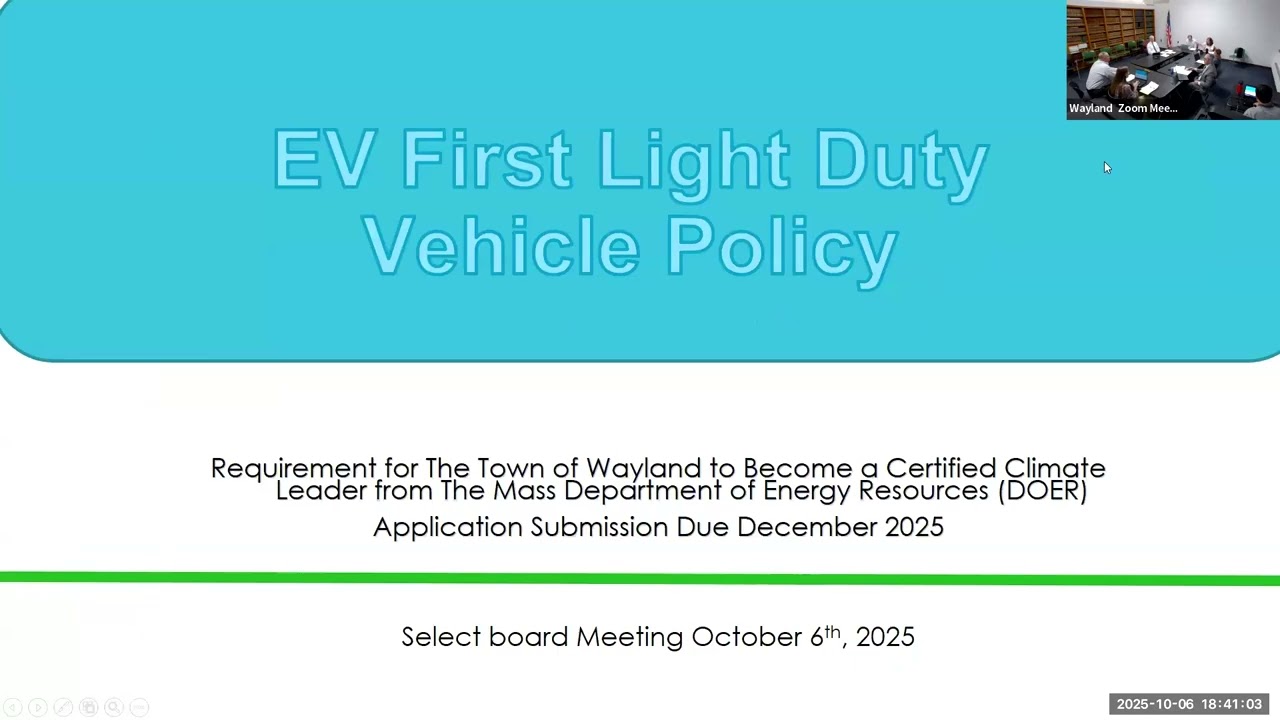
you can't share, Carole Plumb: okay, I'm able to I think, thank you perfect. Thank you. Tom Great. Thank you everyone, right? Carol Martin: Laura's yours, go ahead. Okay, so wait a second. Just one more thing I had. I'm not sure that you know everybody. So when I have the board introduce themselves, I don't still know Michael McCall: Michael. So Doug Levine: I am Doug Levine, Unknown: Darryl Martin and friends, and Carol Martin: my bill Whitney is is not tenants tonight, by the way. Okay, so, and he is your liaison, which I think you've already met him or spoken with him. So Olivia has inherited this project, literally. Abby left about two weeks ago, and so now she has very graciously agreed to come and present to us tonight so and she's put together these slides. As I said, yep. So my Carole Plumb: name is Olivia Blaney. I'm the Sustainability Coordinator for Wayland. I'm filling some pretty big shoes with Abby shoot accepting a different position, but I'm here to re present our EV first light duty vehicle policy to you all, and just to give you some context to what this policy would do for the town, and just a little background you might remember from when she last presented. So the EV first policy would allow Wayland to become a mass do we are certified climate leader and upon climate leader status, Wayland would be eligible for $150,000 in technical assistance and $1 million in capital funding for DEP carbonization and renewable energy projects. So before we dive in, super quick, thank you to the board for squeezing me. And I know you guys have a very busy schedule. This application is due in December, so I need a little time just to get everything together before I submit it. So I appreciate your time. So just to give you a little background on what a climate leader means, currently, the mass Doer has two classification tiers for towns and cities eligible for various funding opportunities. The less intense lower tier is a green community, and the higher, more intense tier would be climate leader status. Currently, Wayland is one of 298 out of 351 Massachusetts cities and towns classified as a green community. And since 2011 Wayland received $818,481 in total, and $686,706 in competitive grants from being a green community. So as of May 2025 there are only 19 mass communities to date currently certified as climate leader communities. So we have an opportunity to be one of the first cutting edge and leading communities by getting this climate leader certification. So to get certified as a climate leader with mass doer, there's six requirements. Wayland's currently met five of those six. The last is getting our EV first light duty vehicle policy passed by our Select Board. So this designation would recognize us taking forward thinking steps to reduce greenhouse gasses and send a strong message to our residents, business owners, neighboring towns, that Wayland is serious about leading on climate action in a practical and measurable way. So now I'll just go through like some background on what the EV first light duty vehicle policy would actually mean in practice. So our objectives for fleet electrification, we're going to focus solely on electrification of light duty vehicles. That's vehicles 8500 pounds and lighter. We're going to match vehicle replacements to operational needs. So we're going to look at specifically what is that department using their vehicle for? And what do we need that vehicle to perform? So the department can do what they need to do, optimize investment in local infrastructure and prepare for state regulations that would look like installing EV pumps at sites where electric vehicles are. And this would allow us to secure Climate Leaders funding, which we wouldn't have access to if we weren't classified as a climate leader. So what does EV first mean? Just to debunk the misconception that it means fully electric for every vehicle that the town's purchasing when it comes time to replace a vehicle, if a zero emission vehicle is available that can meet our operational needs, then the town would prioritize an EV purchase. But again, it doesn't necessarily mean we're only doing electric vehicles. So to go through the process of purchasing a new car, if we were to become Climate Leaders and pass. With the electric vehicle light duty first policy. We would go through these steps. We would consider the operational needs, functions such as daily range, towing capacity customizations. We would look at available EVs, what's available on the market right now when we're looking and we would look at charging and maintenance needs. Do we have adequate EV pumps available, and are we able to maintain those electric vehicles that we would, in theory, be buying prior and then when we're making our purchases and it's time to buy a new car in our town's fleet for a light duty purchase, we would start by looking at fully electric vehicles as our first option. If that doesn't make sense for that department, then we would look into plug in hybrids. If that doesn't make sense, we go down to battery and internal combustion hybrids. And then finally, we would look into our most, most efficient internal combustion engine vehicle, which is your typical gas powered car. So like I said before, we're not just getting EVs, it's more just we're going to really go through this list do our very best to be as efficient as possible. And if it's not going to work for the department's needs, then we're going to continue down the line until it makes sense for the town. So just to give you a little summary of what I said before, so our decisions are going to be made as we do now, accounting vehicles, age, mileage and condition. This does not mean if this was passed tomorrow, we're going out and only buying EVs. We're going to wait until it's time for the vehicle to be replaced. Like normal. This is only light duty vehicles. It's not emergency response vehicles, just light duty under 8500 pounds. And before an EV is purchased, we're making sure our operational needs are going to be met, accounting for availability of EVs at that time, charging hardware available and maintenance needs, as I mentioned before. And this is our last piece, the sixth piece of our puzzle before becoming a climate leader with mass d OER. And here is a list of our light duty vehicles in the fleet right now, the Ford ma key, and then the two Nissan LEAFs are already full EVs that we have, and that's in the packet too, if you want to look at that. And now, if anyone has any questions, Carol Martin: I had some questions because on the policies and how to structure the agenda item. So I reached out to Lillian. Both Michael and Lillian met with me last week, and I asked them to give us a sense of what we're talking you know, dollars wise and have you so this is the list of our current vehicles that as they would come up, we would consider them. This is the light duty group that we're talking about. I'm counting 14 vehicles, and I'm counting two already in the that are already three, no see, bad at math. So there are technically 11 vehicles over the next so many years that would be as they come up around they would, we would want to apply this policy, you know, to it so, and I appreciate you putting in that list. It gives us some some scope for it, because if it's a large capital request, we would probably have to consider sending it to the capital planning. All right, open up for questions. Who would like to start please Unknown: on that point, Madam Chair, either ADU, you have a sense of to the capital cost to establish the infrastructure to handle a full fleet electrical cars. If the town gets there at some point,
we'd have to split it up different buildings, as you can now Doug out there. It's it's not a small number. I don't disagree with you. Some of the buildings can handle much more than they already have. We have a good setup at the CLA the schools have plenty of power that infrastructure. We can support quite a few there, high school, middle school, they have some very good opportunities, especially with the solar so a monetary number, we can put that together. But so does that make sense to spread this out over a period of time? I think, with the list of the cars and the years that they become available, it's kind of it's naturally flow that Legere now the cars that are fully electric now you have any difficulties during the coldest, coldest days and getting started running. No, we haven't well last year. We didn't notice. My first year here, and we didn't have any troubles. None of us. We broke down. I know Nate drives his marquee every day to and from So, okay, another very reliable, surprising. That's all I have. Thank you, right? Carol Martin: So May I just follow up? I think what Tom's question was, how many vehicles would be eligible for replacement, say, Unknown: this year? My question would went to infrastructure, infrastructure, okay, otherwise, charging stations, right? How many will I go the cost? You answer that, Michael McCall: if I may. I'm sure there are grants opportunities still to get additional EV chargers out there, correct? Unknown: Yeah, yeah. And Carole Plumb: becoming a climate leader would make us eligible for those grants too. Carol Martin: And Doug, did you want to have a question? Unknown: So, um, but the grant, I looked up the grant, and the grants that I saw was up to 150,000 to hire those infrastructure developers and engineering designs and then million for the DEP carbonization seller grants. But those have already gone in in August, the first for 2025 right? So we would be looking at next year, Carole Plumb: yes, because we would the applications do in December, so we wouldn't get that classification until after we apply, yeah, Unknown: if this is on the chopping block, right from the Fed, just wondering, just so that, like, if we, unfortunately, if, like, you know, we just want, yeah, well, it could, it could be, it Could be that, I don't know sure what they're gonna cut next, but to have this in place, if things come back, it's, it's, we're already there. So and then the requirements there was, you had mentioned that we had all the requirements, except for one, which one was the one that we'd needed, the EV first, we have to pass that. Like just do that, are you concerned about the we have to use it first. You know, like, what are the excuses for getting out of like, the policy itself essentially said, zero, miss it. Emission vehicle must be purchased only, and the only outside that we saw, or that I read up on was essentially, like, really rare situations, like, you know, all of a sudden you have a vehicle that you're trying to, like a school bus or something, and they don't, they don't have them. That's not considered like duty, I think light duty Carol Martin: vehicles only. So this bus policy, since we saw, excuse me, since we saw it last has been clarified, because it's just the light duty vehicles this list that's here, all the vehicles that we have in town, Miss 14 that would be eligible for when we replaced them, not eligible. Doug Levine: We'd happy. I don't read that in the policy. This is first for compliance. It's like what is most financially feasible, so it doesn't seem like you have to go electric, is what they're explaining. If you look at this guideline page that they put out a couple years ago, it seems like there's a little flexibility here. Unknown: Municipality must purchase only zero emission vehicles for municipal use whenever such vehicles are commercially available and practical, and the only ones that I've read on that were not that did not fall under that scenario was when they were back ordered for them, or when they were very specific responses that vehicles that are in Play. Here are the light, light, light duty vehicles, as opposed to heavy vehicles, maybe vans or dump trucks or busses, first responding like, no, but I know, but it's saying purchase only. I don't think there's as much room as it might be to go down. You're talking about the actual policy itself, yeah, okay, well, that's what I read on the policy, maybe Carol Martin: in policy in the second here, just to that too, when it Unknown: come right back, well, it's just my notes so I can get the actual policy. Doug Levine: It says, well, exempt vehicles are not required at this time to meet the zero emission requirements. Exempt vehicle purchase should prioritize the most fuel efficient mile available and consider fuel reduction and emissions reduction technology such as diesel particle filters, etc. That's why, to me, it seems like there's Unknown: some wiggle room. I know I thought so too, until I looked it up. But I'm reading, maybe you guys have see a different thing in practice. Carole Plumb: Um, are you looking at ours online or someone else's? Because this is, like, specific to Wayland online looking okay, so they need these draft policy first. While we're at this, I'm Unknown: just looking at what it requires. And you're looking at the do er web page, yeah, in order to qualify for a climate industry looking at this one? Carol Martin: Yeah. Well, is anybody on this one like, Ma,
Unknown: this is what I research. Yeah. Doug Levine: What were you just reading? What? Where? Where it's like, there's no wiggle room. Unknown: It was within practice. So like, when I looked up, you know what? What is the real requirements to because they're kind of big, yeah? And it was like, this is, Doug Levine: like the first section is all about compliance, right? Yeah. And then I guess my question for Olivia is toward the end of the session. Action on compliance. It's specifically talking about exempt vehicles, and that's where there seems like there's wiggle room, where you don't have to go. EV only Do you know what it means when they're talking about exempt vehicles, Carole Plumb: that would look like, for example, we have, I'll go to our list here. Unknown: Is it Carol Martin: exempt light duty vehicles? You're talking about exempt vehicles in general, like snow Carole Plumb: plows and snow the only vehicles we're touching are light duty vehicles. So it's not plows, trucks, ambulances, none of that. If it's over 8500 pounds or an emergency response vehicle, it doesn't qualify for what this policy is talking about. We do have, for example, if you can look up on the list, the Ford transits. Those are like sprinter looking trucks that some of our maintenance guys use for an example. If that couldn't pull a certain didn't have the power we needed as an EV, we wouldn't have to purchase an EV. We would go through our flow. Unknown: She's talking exactly what I mentioned. It if it's not, if it's what you're looking for, cannot be found, then it gets ADU, and they can and you can ask for a very specific detail of what the child replace so, so like what she's saying, like the wind, the weight itself could vary. And then suppose you have a weight of 3800 you don't have to replace it, just because you found one for 3600 Doug Levine: but are you saying that you have to replace it
Carole Plumb: with an EV? We would start with the EV
Doug Levine: that's our goal, and you're saying it could be cost prohibitive to go the EV, that's your point, saying you have no wiggle room. And if you can buy an EV, you have to get the EV. Well, they think 17%
Unknown: but we're replacing, hopefully eventually we will be replacing all these because that's our goal, was to get as many electric vehicles possible, so we have three. Those three would be replaced with three more. Doug Levine: But yeah, forget replacing EVs. Talk about the gas ones when you when you have when it's time to replace a gas one, right? I hear Ian saying, You have no choice. You have to replace it with an EV. Is there wiggle room to go down that list? How do you start going down that list? Unknown: So it's the need. So if we have a small van and it needs to pull 2500 pounds, and the electric vehicle won't do that, we'll have to go to the next step, which could be a hybrid, which we have done, that's some of, most of our bands are hybrid. So that's how we see this happening. We would start electric first. If that doesn't work, then we would, we would have to move down the list to the next best thing, until we hit where it would work for everybody, by the 12 to 17% increase in cost. But then we do get these little benefits, tax benefits, but we're a town, so it doesn't really work the same, right? And then exactly what you just said, which is, but if the goal is to go there, that way, then you kind of, you have to kind of do it. And then you're in a perpetual though, because then the next time you replace you might Carol Martin: so I didn't pick you up on yet. I'll hop in here one second, so that I originally had issues when the policy came the first round, because it said all vehicles maybe first then I was speaking to Livia last week. She said, Oh, this is just light duty, which is what prompted me to then have this conversation with them and to just narrow it to these vehicles. The policy draft that we have still has a couple places where it says all vehicles. It needs to say, you know, that needs to be substituted purchase of light duty, municipal vehicles, that kind of thing. And I think that would be clearer. And then there's a sentence down here under exemptions that says these vehicles are exempted, and then Bev replace for mandatory bed replacement, but should explore sustainable options for feast. This is not part of this policy. These larger vehicles are not part of this policy. So that should explain that can apply to smaller vehicles as well. Carol, they're saying on the exemptions medium and heavy duty the first bullet, okay, yeah, so there's a couple things here that kind of still need to be worked out in the draft. I think that'll make it clearer. Unknown: The policy permits department heads to get an exemption from the town manager when appropriate, right? Yes, I think this policy was already approved by these, by the doer. It was,
Carol Martin: I think that we want to be to Anne's point where we want to. Many wants to speak, if I recognize you, after I finish my sentence, I think we also need to be mindful of what we are factually agreeing to, because I agree, once we agree with these are going to be in that the electric vehicle first policy, this is where these vehicles are going to be going, and they are. There was, I had this question. There was a big article in the globe that they have these vehicles are more expensive, which is why I wanted to know how many were coming up per year, because otherwise we might have to go back to the Capital Group and also, and I don't know if it affects us, but the average person is finding their insurance is much higher to ensure these cars. So you sure this was a person? Michael Faia wanted to speak much and the Unknown: action mobilization plan leave this one
by approved. In other words, when the OER was approached, they said, the policy is it approved?
Carole Plumb: I also don't know the answer. I'm kind of stepping in suddenly, but I can email you guys and let you know once I figure that out. Unknown: For flexible, Carole Plumb: yeah, yeah, the camp plan that you're talking about, the Select Board approved that. That's a town recognized plan, and one of the things the camp plan does call for is going fully electric in the fleet. This is definitely more focused than that. That's a very broad goal, but the town of Wayland is mimicking the state's carbon neutrality goals. So by 2050 they want to be Wayland wants to be carbon neutral. So this would get us eventually it's going to have to give either we're going to do it or, you know, I don't know,
Carol Martin: on the camp plan, I'm going to say this the 90th time, when we approve that. I also asked to have the 23 items put into timelines, or when they would be and the, you know, protected, projected cost. This is about the third, third year I've been asking this. I might get it yet. So, Michael, I'm sorry you wanted to speak. I'm sorry. Michael McCall: No, I all I wanted to add is I do think that we need to move forward with this type of policy for the reasons Blaney indicated, but I don't think it's consistent with what Governor Baker signed on to, the decarbonization plan and our own camp and being good stewards of the community. You know, they do cost a little bit more some of these vehicles, though, then you're not paying for the gasoline usage. There are trade offs, and there is a suggested timeline on that. Climate Leaders guidance, I think, starting this year for light vehicles, they're recommending try and have 5% of your fleet, and it increases year over year as we move to 2035 and ultimately 2050 so I do agree, Madam Chair, there are a couple of places, as you indicated, in the bank under additional considerations, were talked about all vehicles and maybe a couple things for clarity. But I think it's something that could be cleaned up and endorsed by this board. We're already using these. I see them every day. The last communities I worked in, we got as many charges as we could. We encouraged our community members to use them. That's also part of the camp. So putting the charging stations out not only benefits our employees, but the community as a whole. Carol Martin: What I want to suggest is, I think this, we need a few edits. Maybe also Mr. Whitney is the liaison for the ECC, and I think it would be appropriate, especially where we worked on this, that we wait to take a vote in our next meeting when it comes. Do you think we could make a couple edits here and then have a revised Would that be okay? Do you want to add anything? No, everybody, everybody, come on down before or not. Unknown: It'd be great to know what the dealer really did approve this, because that's a big deal, because it means that we whatever language we have in here, if it's more broad, then you know their guide, their guidance packet. We have a good argument. I would Carol Martin: be disappointed this one to the Dory before it came to us, because I think we should also get to Unknown: speak. No, I'm not sure I agree with that, rather than come to us and say, hey, it's packaged. Carol Martin: Yeah, but I think we do need we've got some mixing match May I will sort it out. I'm happy to help you. If you want some help on that for the 20, Carole Plumb: yeah, we'll definitely reach out, because that's, I hear you. That's a good point. And we'll, we'll let you guys know about the status of that. Um, is there any other section that really was blaring to anyone besides additional policy considerations, reach out to you. Okay, perfect. Thank you so much. Doug Levine: I just had one, final question. When I was reading through the guidance, and I can't remember if you mentioned this or not, or I didn't hear you, the schools have to sign off on their fleet as well. Is that separate policy, or that will be part of this? Carole Plumb: The schools, like some of them, have smaller like Ford Focuses or some. Like that, they would be considered. But other vehicles, like busses. There is a couple vehicles here, food service that those are, like the Ford transits, like I was talking about, they're in the school's fleet, but nothing larger, like a bus isn't right into this Doug Levine: category, like you sent on page 11. There's no there are no school service. School? Carole Plumb: Yeah, that's how this list is taken from Maya. So that's how they list the names
Carol Martin: on our side, versus Unknown: the food service vehicle part of the town Carol Martin: budget. First is school with it. I think they think it's in the school, but I think one point here is that we probably need to run this by this, although I think Dr fleischen has seen, yeah, that's right, he's seen him. Okay, so, like I'm saying, why don't we thank everybody for their time night, and we'll make a few edits. We'll bring it back at the next meeting. I'll put it on my list here. How does that sound perfect? Thank you very much. Thank you to you Unknown: done. What am I doing here?
Carol Martin: Okay, so our next agenda,
Unknown: Thank you, Jen, thank you. Nice Carol Martin: to meet you all. Yes, you did an admirable job saying how this person inherited this life two weeks. Thank you so agenda, Item number four is to discuss with the Economic Development Committee members to discuss, review, improving communication, potential projects, including, but not limited to the town center communities. We are inviting Dave bilari and Katie Harris of the E to join us before you that David Vallari: she's helping us out. So sorry. You talked about doing the thumb drive. You know, Carol Martin: very funny. Before we do that, I want to make sure that I took the attendance of the room, because it's been a rather busy night tonight, or in the room with me, I have mister Fay, Mister lane, Miss friends, Lee and myself. Mister Whitney is not going to join us. Is not joining us tonight. And we're also joined town manager Michael McCall and our in town manager Kelsi power. So I was spirlett, sorry anyway, who there's plenty of room for at the table, if she would like to join us. Alright, so now we are on the item number four. This is on what page in the packet 16? Okay, so first of all, I want to thank David and Katie for coming, and I want to thank David for reaching out to me back, I think, in August, as a new member. He wanted to know, you know, what was the process, you know, for putting together proposals and coming before the Select Board, so we would have good communication. And you'll notice part of the agenda item tonight says that, you know, one of the things we're trying to do is improve our communication with our advisory committees. And David was actually giving me the inspiration of how to start doing that after we talked a couple times. I you know, we need to be clearer, and we hopefully are. That's a future agenda item for tonight, and I have reached out to your chair to come and join us on November 3, maybe as a committee, or even just yourself as we roll out how we're going to hopefully improve our communication. So thank you, sir. So you know everybody. Are you okay to know everybody? Okay, great. The floor is yours. Unknown: Are you able to pull up the PowerPoint press? Yeah, we'll see if
David Vallari: we can get ourselves back on track. Time wise for you, because I think you wanted us done 720 so we'll do our best to pull this one. Don't worry a little bit. We'll be fast later. Okay, so thanks again for being here. Dave Valerie, Katie Harris, obviously. So members of the EDC, we passed this out September the fourth for review and comment and got some feedback. And then today is really about trying to continue that discussion. And we want to be very clear with this. This is a proposal idea. It is not, you know, trying to come out with final, final results and say this is what we should do in any way. It's just a discussion point, and that's what we were going for. We're talking about, really, three parcels of land here. We did put the gist labels in for clarity there, if any, if there's any concerns, open them up. Divide into, really two sections, though there's a small rectangular section to the left hand side, really, in front of the COA, and then the larger one with the paths carved through it in front of the businesses there. Please go ahead. Carol Martin: I know someone knows how to do. Is it possible to make that a full screen?
So no, thank you.
David Vallari: If you sorry, control minus you might be able to bounce the hair or pinch Unknown: me. Nobody else, nobody Carol Martin: else nobody else can see it okay, Unknown: we're still sharing. We're still sharing. Carol Martin: I think so. Does everybody think that's better? David Vallari: We'll talk through it either way. Right? So imaginations are key from a conceptual layout, or maybe if we just go one slide up. I apologize. I want to make the request here very clear. As we're coming into this, right, all we're looking to do is say, can we move forward and have additional discussions here? We know there's some sticking points with regards to the Raytheon previous site activity and the Aul in place. And so really it's, can we work through you guys, with the town manager's office and the health health board to screen those concerns, really, and say, Do we have any limitations to doing a playground? Do we have any limitations to revamping the site in any way? Since we did construction in 2015, timeframe, it's largely been empty. I think we all know that, like Wayland Fest was a wonderful, you know, energizing community base. There, you saw how well we can use this property or this area if we concentrate and focus as a town. And so what we sat together as the EDC and decided was maybe we can use the template that other towns are using already. And you look at what we're doing in this, this very high level proposal, and nothing's groundbreaking in any way. It's you look at any playgrounds or parks that are at the ends of bike paths or at the starts of them, the great gathering points, there's town plazas or shopping plazas that have done the same template, really with a lot of success, right? So it's just, it's not new in any way, but we as Wayland have some additional concerns that we'd want to address first, which is, can we put a splash pad on this site with the previous activity? And you know, is that just a total no go, because if it is, let's not spend town resources talking about it. So what we'll do is we'll do a very high level, top down view of what we think could work from a proposal standpoint. And then I'm going to pass it to Katie. She'll go through some examples of like, pretty parks that represent that. And then we'll hit some numbers at the end. Michael McCall: So if we could jump to slide two, please,
David Vallari: conceptual layout, really starting from left to right. Gene Millburn, for example, is a huge proponent of this one. And with the community center coming in, they actually put in a water line right at the edge of that parking lot as it quarters the green space. So we have the ability and the infrastructure kind of set up in order to put some pollinator gardens in, some nice plantings, you know, perhaps a pathway in the middle with some benches to read on. And then as we kind of go towards the main site, I think we can all agree, like the way the paths were drawn up is very intricate, and it's nice, so you want to work around that. Let's not fix what's what's not broken, right? We kind of build in into the empty space in the middle. And perhaps we can do on the hillscape, a little amphitheater seating that you can use for the summer concert series, school events, plays, music events, and then you have pavilion canopy picnic tables that give you a little reprieve, because it's a hot site in the sun, place to eat and gather. And then in the dashed line, there could be, you know, around that will be a play game, potentially. So I'll pass it to Katie, and she'll kind of go through a few other Unknown: Yeah, you can go down, yeah. So just to re reiterate what David said, this is just an idea, just spitballing here with some ideas that we've come up with based on the existing space that's already there, some amphitheater seating, which could be nice for rec, rec department to use for something like what happened this past weekend, music, school plays, award ceremonies, maybe for sports. Award ceremonies for sports. We think that we heard that the town has a stage, so maybe that stage is set up for the summer, or maybe it's set up for a concert series, something like that. And I think what's really nice about this too, is that there's a pavilion. So if you go to the town center space now, there is near fairies, there is a somewhat shaded area. But what's nice about this is that the pavilion provides shade for people to eat on a week like this. Where it's really beautiful and sunny, so you can get some shade, have a sandwich to meet people for a picnic shelter from the sun. And I also think it provides people, you know, maybe you can get a pizza from Jailyn and then walk over and then sit under the pavilion. And also provide something for the employees that work in town center to take advantage of so again, it's nothing grand. It's nothing super big, but it's just kind of nice for the space itself and taking advantage of some of the natural features that are already there. Carol Martin: You can go down to the next slide. Unknown: Again, just ideas. As far as the playground, we like the idea. Have to stick to it of something feeling kind of natural. So the stepping stones to the upper right slide, slide, the kids can use those to walk on, but it kind of creates this nice natural barrier. We've gotten some quotes from the same company. These are the park in West and I don't know if you guys have ever been there, but it's just like a very visually nice park. It doesn't feel like it's too loud. It's not like crazy colors, and it just fits into the environment really nicely. Yeah, I um, yeah, it fits into the landscape. This is beaver Brook, yeah. So this is a little bit more of a step up, I guess you would say, because of the water features. And with this playground, and with other playgrounds, like the previous slide, there tend to be a couple areas of for different ages. So you might have one area where kids from, say, ages two to five to play, and then there's a nearby area for kids of, you know, from five to 10 years old. The other thing about these playgrounds, and the the plan that we have, in general, is that it's accessible to all ages, so it's right near the community center. So this doesn't necessarily have to be a space that's just intended for kids. It's intergenerational, accessible to everybody, all
David Vallari: right, so we'll jump into a little bit of math here, and this was a request that we had coming in. So if anyone isn't in love with the math, feel free to, you know, tell us so, and we'll revise it. I think it's a big discussion point of really, as the EDC, what does this mean, and why are you bringing it to the Select Board here? So what we've done is we've broken it up into three categories. Really have commercial appraisal values, residential appraisal values, and then meals tax supplement from commercial appraisal that's like the most clear direct benefit that we would see. Generally. Our town is 100 and $60 million worth of commercial value, and one and a half percent of our 4% commercial base is the town center plaza. So one and a half or 4% three eights. Three eights of 160 is 60 million. There's a typo on that slide. It says 50. It should be 60 for the first number 60, and then 15 million, roughly, from the gist database, puts you the rest of the route, 24 or like CVS down. So what you want to look at with a project like this is what's the potential uplift that we see as a community? You get increased foot traffic, better dwell time, all that, and generally, national parks associations put that number somewhere between eight and 20% when you have such a direct Plaza like this. I said that's just way too aggressive. Let's you know, meter that down. Everyone in Wayland has nice backyards. They're already kind of enjoying it. And so how much you know, do we need to play that number up? And so we'll go conservatively with 3% so 75,000,003% into our tax rate, you see a potential uplift here of those businesses in their appraised value of $35,000 um, the same math, really on the residential side. But really what we were focusing on is, on the left, you see more or less a workable map of what's walkable in Wayland, based on sidewalks we have and infrastructure we have. We know that there's like route 20 beautification efforts and planning boards working a lot of that. So that makes that era even easier to access in the future. But in there, you have about 250 homes, and assuming an appraisal value of about a million, you do the same math out and you're around $40,000 of appraisal value. The numbers there, instead of using a 3% number, residential we found tends to be more near two to 5% and so we said, let's just even go lower than that. Let's go 1% and that averages out. When you think about it, you've got those 40 town homes or 80 town homes between the two town center sites, they're going to see the most uplift. There's no question about that. So maybe they're seeing more like four or 5% true valuation. And everyone else in that larger circle gets half a percent or so and it levels. So those are the more significant numbers. I think meals tax always comes up like, how much can that provide for us? And just because of the raw value that we as a town have on Meals tax, it's only point seven 5% we did about 300,000 last year. You do that backwards, you get 40 million to how much are we really going to say this? This project does. It's insubstantial, insignificant to scale, but maybe it pays for mowing, you know, or something of the sorts,
from a cost and funding standpoint. So we set this up, really as a summary cost and funding is the first and foremost question. We know we have serious challenges as a town right now on budget. We're not trying to make it worse. We promise, um, the the point Katie was making, I think, is the right one, is that nothing here needs to be grand or, you know, the playground mecca of the area, for Wayland to have a benefit here, we just need something that provides people the excuse to come together, spend a little time, get a coffee, get a bagel, you know, go with your kids and shop a little bit and divide and conquer, And so you have low costs that we could estimate based on, you know, what's available online, how much it takes to do a pavilion and picnic tables, how much it takes to do amphitheater seating, which is really just railroad ties cut into the hill. It's not too fancy. And then you get into the more complicated costs of the playground and the splash pad, and that's where things start to get a little bit more fuzzy. And we would need more help from the departments here to give more accurate estimates. I know the playground behind us here in the town building. I think we estimated $400,000 for that one, and I believe some of it comes from the complexities of how close it is to the water. But you look at this, and what we did is, she mentioned, is, reached out to comp and playgrounds and said, Hey, how much does this cost to install? And we took a reasonable approximation, you put in about a capacity for a 60 person system without having to excavate and do a lot of work. And it's about $100,000 and splash pads, that cost is really variable. You have two types of splash pad systems, recirculating and non recirculating, most likely, with the Raytheon constraints that we have on that site from the past, you'd be in recirculating territory, which means water filtration systems, chlorination systems in place such that the water is used as a closed loop and gets fed back in. You're not letting that seep through groundwater, potentially contaminating anything. Funding is really like the biggest topic here, probably, but our goal would be to minimize the town's financial contribution, and so much of this can be done in a phased manner. I mean, we're talking about projects that are all kind of separate in a way you can structure them as such financially, if that fits the bill, CPA funding would potentially be an avenue. And those applications do mid November, and then local business outreach. I think we've all talked about this one and other people have said it that now is a great time to really engage with the new town owners and say, you know, you are the New Town Center Plaza owner. This has a huge benefit to you, but also us. Would you like to partner on this? And I think that's where the town manager's office and select board would be more the appropriate personnel to have that discussion than us. Unknown: I already have great good to hear, David Vallari: and then we'll also hit this point lanes and park that we showed in Weston. When they did that in 2017 they raised, as a community, $116,500 directly, just for that. So it is very possible to engage a community like this. For projects such as this, we'll skip the case studies in interest of time. We have the summaries on the top left the finances. There are some indirect or non quantified financial points that we didn't or economic points that we didn't hit on. Really, you have some commercial vacancies, and this would be a great opportunity for someone to say, put in an ice cream shop that supplements what chocolate therapy is already doing. And, you know, fill in that extra space. And once you get that, you've got more momentum in that town center, more reason for people to hang around and spend time there. So I think we'll stop talking there and hear, hear your guys thoughts and opinions, Unknown: and thanks for the time. Yeah, Carol Martin: thank you for coming and talking to us, and thank you for including an economic benefit. I know the last time that ADU see came before us, that was one thing. Said, you know, when you come forward proposals, we'd like to see the economic benefit to the town, and you've done that. So we appreciate that. Questions from the board, sir, comments and Unknown: questions. First of all, I want to compliment your committee on the what information you provide in the town website. It is very informative for people to go to that website and see what's going on with different businesses in town. I think it's good to keep you up to speed now to town manager's comment about meeting with the current, soon to be new owner. Seems to me that meeting with you folks and town manager and then would be helpful. I suspect that this is not their first rodeo, and they have, they have contacts the professionals who could look at your presentation and look at that town green. So you know what. This would work. This wouldn't work in addition and maybe things that they want to accomplish that they're going to pay for, that that's one suggestion I Michael McCall: got in so like board member Fay, I think they are open to doing something, because we talked about some of the things that didn't happen while Zurich was here, including using some of that shared streets grant money. They were excited to hear about that they want to do some of these things. And one of the things they talked about was maybe working with the town to put something on that lower pool that you had in that earlier slide, so that it's right at the end of Alyssa Avenue, at corner of Andrew, so that if they had that open streets, they could see the playground. It didn't. We didn't get into this flash pad, but they are open. And think about doing something that'll be mutually beneficial for the community.
Unknown: And Miss Harris, you mentioned the stage. You know, as I understand it, town hasn't purchased a stage yet for but we have budgeted for it, and then the money for it. The trick is to find the stage that works best in Wayland and and and person on that search, and he's, he's keeps an eye out the from Florida to Maine. David Vallari: He's looking for stages with the marketplace, Unknown: it's good to find something. So that's all I have. Thanks for the work.
So awesome. Thank you for putting this together. I think we all probably look at that space and would love to see a ton of stuff get done. The only comment that I'd make, I think you guys are just asking, essentially, just almost permission, like, Hey, can we use the town's resources like Michael, valuable resources like Michael, to kind of just vet this out and do some due diligence. And I feel very comfortable doing that. The only thing that I would say is that when I look at this, and I look at your presentation, and I really absorb it, and I think about trying to actually get this done and having it be something that actually happens, I really don't see the path for the splash pad personally, just I'm just looking at the cost of it compared to some of the other aspects of it, And what I don't want to happen right now we have, there's a lot of people who are coming to each of us individually, talking about costs of things, and I just feel like it'll become one of those things where it'll get negative attention, just because they'll look at that and say, this is over half a million dollars, like, What it but you know, you look at 175,000 you go 75 in with, with the talent, the owners, and then you fundraise. This could be done in a year. So I would just say, I guess for my own personal I would really love to see if you guys could just meet me somewhere on that and just say, Okay, let's see what this looks like. Also, when, when you went to the event on Saturday, there were so many tables and setups that might be just doing the ton, yeah, and I love the EDC, but they go for the full Sunday with the whipped cream and the candy and the cherries and stuff. And I'm just thinking that I would love to see this happen. And I think you have, like, a really clear path of getting it done, getting a ton of support, getting funding without the splash problem. David Vallari: Yeah, I think we're obviously totally agreeable to that, and it's not really us that matters. It's kind of what the town people say and are interested in and engaged about. And I think we would absolutely be a proponent of separating things out, phasing them so that, you know, if it's just bite size, we do that 175 fundraise the rest, and then sit on a five year capital plan, or 10 year capital plan better for, you know, doing a splash pad type of activity. You know, there's maybe potentially. For that if you want to go down that road as a town. But that's not necessarily for us to say or guide that direction of I think the towns and the places we've seen that have taken the action to slowly do the splash pad, they've seen a lot of benefit from it. So there's value in it, but it just, you know, if it's a hard bill to swallow, because we got some really tough bills to pay right now, then Unknown: I think the other thing to note too is just talking with some people around town, the EDC may not be the appropriate group to make this happen like I know the rec department is the Department of the town that tends to execute the playgrounds. And so obviously, if there is a department or departments in town that handle these types of things like we understand that you think it makes more sense that you guys do it, because I think you need to have an economic development, economic benefit. We're happy. We're happy to meet with Michael and parse out, Carol Martin: sorry. The board's asking questions for sorry, having a hard time maintaining I need something. Mr. Levine, please. Doug Levine: I love all of this as well, and I was thinking, along the same lines as Anne, about phasing it. I can tell you, I served on ADC 10 years ago, and there was conversation at meetings, then about a playground at Town Center. I think there's always clamoring for playground at time. Playground makes so much sense, right? And I love the other three ideas. I've heard pros and cons about the splash pad. So I would, I would almost think of that as phase two. But of course, it depends so much on funding. So I was thinking, you know, if money was no object and we can have all of these things, would we want to pursue all of these things? And I people were explaining some of the cons to me about the splash pad and how often can it be used in a given year, and, of course, the AOL restrictions, but, but that said a question from Michael, actually, if they were able to get some of this through just with private funding, What would the town meeting vote be? Would we need a town meeting vote to raise some of this? What would that article look like? Is it because anything you do on town on land, even if you're not paying it, it's almost like accepting a gift. Or is that select Word only? Or do you need Tom meeting approval? Michael McCall: Check compound question, Unknown: multiple parts. Michael McCall: Interesting thing you mentioned playground. And I we have to go back, I think, look at the Acts chapter 347, the acts 2008, that created the vote of Public Works Department. Because I want to say, under Massachusetts General law, the Recreation Commission oversees playgrounds versus public works. That does a lot of the other DEP W related things. Doug Levine: But they would have to present an article. Well, Michael McCall: there's couple things here we would probably based on prior experience trying to work with the owners of the property over there, work with them, one, if we want to do it in partnership. And I think it's great that when those folks came in the other day and they were interested in doing something like that, because you want to see the buy in. We do own this, I think under the way the most recent Aul, which is accessory use limitation document that's recorded the Registry of Deeds, we would have to get some opinion of no risk relative to the type of recreation that you want to put over there. Now, I would check with Town Council. I don't know that it would need a town meeting vote. It's it's town land, and select board is usually custodians of townland. You need permission to sell land, right? But I don't think this would be any different if we decided to put a structure, say on this, yeah, I would always double check with them first. If there were monies donated, you'd probably have to accept those on Mass General law as a gift. Doug Levine: Does the town have to do that? Or just the Select Board to accept Michael McCall: the gift? The Select Board accepts gifts on behalf of other departments, and I think the Recreation Commission could accept them as well. And I think you authorized the expenditure of those that any border Commission can accept them, but you authorize the expenditure, and that that came up previously with the last. Library where they they were given gifts, but they had to come selected. Doug Levine: I'm just thinking, because some of the businesses, maybe, if not all the business, will be excited about this concept, as well as the new owner of Town Center. And maybe this isn't a tremendous amount of money, especially just if we're talking the pavilion, picnic tables, the amphitheater, and then maybe a playground for $1,000
Michael McCall: the phasing would be one thing, and then looking at what the you know, there may not be a lot of operational costs for one item, but if you started getting multiple items and there are, each one of those components could trigger an opinion from an LSP, because as soon as you dig in the ground, or obviously, well, I would assume we wouldn't want to use groundwater for this, we would use water, but then somebody's going to have to maintain that circulation system. And if you erect some type of structure, I think you still have to go back to those folks, and I always question the board. We have limited green space, so this, you know, maybe you work with them and do the one playground in that corner and see how it goes, but make sure that you get adequate buy in from the owner before you do it, and if it winds up being a playground, probably have to eat at some point with the Recreation Commission to talk about them and rec managing this as well. Carol Martin: So a lot of little things that I think. Lisa, yes, okay, so I'm going to speak some once upon a time, Oh, Tom will remember this. It was discussion that we would get this piece of land and put a gazebo on this property that folks could use for a number of many ideas, many ideas, right? This is, I have to just say this, because this is the be the devil's advocate. This is Tom land. And so the cost really is not only just the items, but it's also the cost of giving up that the opportunity cost of giving up, up the land. So, and I do want to know those it does say labor is not included. Of course, labor is very expensive, although, to David's point, he thought maybe, if we were phasing things in, when we discussed that perhaps we could maybe get some of the labor done internally on some of these things. But I do think we need a plan. You know, on this, I personally am in favor of the the the business owner of contributing to this. I will tell you, I do know the numbers on the playgrounds. This was 400,000 we have, I think, 12 or 13 playgrounds in town, and they one gets done every two years. So they're on a 2830, year cycle. The beach was recently done. And of course, there's no landscaping because it's on the Sean, per se. I think that was 250 or 275,000 so My one concern about the playground is, particularly if it's a town on playground, is that it's not consistent with and I'm wondering if the wreck would raise this question with the amenities and the scope and the shape and the whatever of our other playgrounds. And so that would be a question that I would, I want to, want to reconcile in my mind you know on that, so yes, Miss Kelsi, come up here now. Thank you. Unknown: Thank you. Just quickly to add to that, because I was in some discussions with the Eliza Norton Foundation and the Recreation Director around renovating the Cochituate ball field and the price ranges for revamping their playground, redoing, redoing that basketball court that's there, doing a little bit of upgrades to the ball field itself, and then reconfiguring the parking was between $1.8 million and about $2 million All in. And just to keep in mind, any town property, any renovations that happen, it doesn't matter the dollar amount. It can be $1 prevail wage. And prevailing wage was in effect. So that's something you have to keep in mind. Is anything that is being renovated on town, and regardless of the price point, prevailing wage matters. So that does drive up the sickness. Mr. Michael McCall: McCall sure to get some of these ideas out. But one of the things that and I made mention Select Board Member Fay in the phone was to avoid liability, the insurance and all these things. When the new owners came in and were excited about this, one thing, I thought of, what if we swap some lands so we have our wastewater facility in the back, and they wanted a portion of that front corner of the green. What if we traded some of the land? Let them build their own playground, they assume some of the liability, and we get some additional. Lane in the back that we could use if we needed for future expansion of our facility. I didn't bring it up at the time, but these are the types of things that I think we could be creative about what we do. And I'm sure we're going to meet again with these folks, but Carol Martin: so and now, may I mention, and now we're going to tell me, I'm a lane swap. Unknown: I think your question is really just whether we're okay with that starting this due diligence. Carol Martin: Yeah, no, I think that's my next point. So let's go into what will we think with the next steps. I mean, it sounds to me, and if the board's in agreement that Michael might reach out to the owners again and have kind of a conversation to see what he thinks. And Does that sound about right? Doug Levine: Yeah, we need to answer the Aul. I think that's step one, or we're all wasting Carol Martin: it well. I think we need to also know if this is on whose land and who's what, what the partnership would look like. I think so, Unknown: if I so would, just because you are bringing up creating more of a process for how we interact with these types of situations, right? So they're essentially pushing to us with an idea, asking, Is it okay for them to do what a due diligence? So what do you want our response? Do you want our responses to be detailed and be like you can look at this and answer these questions, or is it okay to essentially say yes, you may start putting due diligence together and come back. Carol Martin: So if you read the revised charges and look by that, it says that the select Form will determine next steps after consulting with the town manager. So we're consulting with Michael what he thinks the next steps up. Okay, so detailed it right? Because we, one of the things we are trying to avoid is having several people reaching out to the, you know, the LSPs and town council and whatever. This is a very expensive propositions. When this happens, and Michael is the one that we we've delegated that authority to to be in control of those budgets, and so we're trying to make sure we are aware of who's being reaching out. So I think that the next step would be for Michael to tell us what he thinks should be the next step at the moment. Unknown: But I do think if it all comes together, that not out of the realm to have a warrant article in the spring, including the idea of talking of lane that that those stars align, you know, as liaison to the UC I'm happy to stay in communication with you. I'll stay in communication with time management chair, and let's see what progress we can make and and then I'll report the board, and when appropriate, we've had to come back. So can you say that again? I was just trying to arrange this up for what we're writing, though, Carol Martin: right? So, Michael, are you good with that? Michael McCall: Well, I just want to make some general comments, and I don't want to get ahead of item number six, but I think you know, the having the board be supportive initiative is good, because oftentimes some of the board advisory boards will come and ask me, and I said, Really, you're an advisory board. You should go to the Select Board, share your idea. If they if the Select Board buys in, then I have no problem. You know, working with my staff, I just want to make sure that there is that support from this board before we do reach out to say, town council or some of the engineering staff when we do these things, just so that we're not spending a lot of time going in different directions. I want to make sure it's something that this board's in in concurrence with. And I guess I'd be remiss if I didn't mention, you know, where does capital planning come in? And you know, when we have this, depending on what you do, it's it may not be a large project, but when we have larger capital projects, if we're spending money and doing things, those tend to fall in our five year capital plan. This is something that at some point gets referred to them say, where do we want to is this a high priority? Do we want to move it up? Do we want to just put it in at the end of the five year plan and let it work its way down? I guess it will depend upon the size and scope and the type of the project, but it need to be fair to some of the other projects that have been advanced by other departments and boards in the town as well. So that's Unknown: true. It depends on the flexibility and desire of the new owner, and depends on the appetite of the DEP board to based on some of this, or all of it, select board will evaluate how each project furthers the board's goals and objectives, provide guidance and determine appropriate next steps. So we determine the next steps. We determine. So what do you want to Carol Martin: determine? I know we just did determine. I thought we just, we have Michael reach out to the owner. Was nobody agreeing. But no, no, I thought, That's right. There was agreement on that. And I'm sorry I missed it. I just Unknown: joined Sydney. I reach out to the owners to start that conversation. We have a meeting with the members of the EDC, and I'm happy to be part of it, if that discussion seems wise, and then I'll report back to the board on where things are going, and maybe the board will want to be to see back here. And I'd like to see this. I'd like to see this, this project and this playground Lord in a Tom and fashion, so that we can do, possibly, if needed, do something a Tom you. Okay, so perspective warrant should be submitted to support prior to Carol Martin: October dinner again, please. Just
Kelsi Power-Spirlet: trying to, I'm just trying to, like, actually realize this, right? So I'm seeing if it works, right? So does that feel fine, and that might be time to be off. So then that's just good for us to know, right? So, like, if you're bringing as a committee projects, you know, there needs to be enough time between that, if you're making this year, because you have it, the article has to come by October 31
Carol Martin: Okay, well, this is a thing we're putting in place, and October 31 is in two weeks. So it's probably the little flexibility this year. But the concept is, we don't want to be receiving articles in January like we did that to do, right? So we can put any day we want in Unknown: there, but it could also go the other way. Feature, you can ask that these types of projects get brought to this Select Board by a certain day, right? So that it works. I'm just trying to utilize you. And I spoke about this. This this is a big deal. Like we're we get inundated by the same stuff. We get pieces of information, and then we come and it. I think it does hold up some projects. So if we have this process that you put together, it really works. Carol Martin: It's awesome. I think also we have to factor in. What Michael mentioned is, is that, and others, even the committee members, have mentioned, there's a lot of capital projects out there a lot of finances. Just because we like this idea, it doesn't mean it's necessarily going to be before Tom, maybe next year. So they might be very much way in advance for Michael McCall: the Faia, really, along the timeline of the new owner. They maybe that's really the key. Yeah, they were excited to hear about that grant that grant that hadn't been used. Now, it took a long time to get a draft agreement with Zurich about the use of that. And I explained how, how that came about, and they said they weren't too worried about it. So they may be very eager. They may want to get that pedestrian zone up and running first and then complement it with this. So I think in terms of first steps, talk to them and find out their timeline. And then I think the second consideration would be,
what if any thing we have to do in terms of looking at the ADU well, to ensure that project or any additional amenities we put there are consistent with no risk. And I think once you have at least those two down, then you can start to make decisions about what we want to do with these folks. So we would know they're interested. We know we're capable of doing it. Okay now, how do we slot it in? How do we pay for it? How do we maintain it that we ask those Carol Martin: questions? Oh, I am going to service that. It's a good thing. Mr. Whitney is not here tonight. He would be giving me the look I am now 40. How many minutes? Okay, but I'm just being said sorry, before you, before you leave, so one
appreciate you coming. No, I think we're wrapping this unless anyone and the board has anything else to say, I think we're good. Thank you very much. Thank you. Thanks, Kate. What I have now I've added this, obviously, to my direct gender list for another, another meeting for Michael to report back to us. And at that point we get that info, then we'll, we'll develop the next steps, and I'm sure that will involve the committee, and I'm sure Tom as your liaison, will keep you informed as to what information we have found. Does that sound great? Sounds great? Thanks. Thank you. Thank you, right. So I think the next item actually is discuss and review the DEP classification, but not limited to preparation for the special election ballot. So since we voted this, I have spoken to the Finance Committee and gotten a confirmation. They're actually meeting tonight. They're putting together their their recommendation and their presentation. They will come and present to us on Monday, October 20, then, according to the policy, assuming that we continue to go forward with this. We need to meet, have at least one meeting before we vote the actual date to go forward. The town clerk has actually recommended that we look at December 11 in between the holidays and she she would like 45 days. I think the board has expressed an interest in having as much time as possible, because we want to have a strong communication with the residents to understand, you know, what we are trying to recover. So my suggestion is going to be, we meet on the 20th we're going to talk about this tonight. But for framework wise, please use the calendars and see if you're available on Thursday, October 23 for a quick one agenda item meeting, which will be day or night in the morning or it's up, whatever you all want, bands, Unknown: that process gets done, right? So they have to apply for the bands or put them in place. The bands is different than that, yeah, okay. Give me a second. Okay, but one of the concerns had been, what happens if, if this were not to get approved, but we went forward with the bans we were because then there was a very high likelihood that we would receive we would still have an over right? So I'm just asking, Do we care whether this the answer to whether it got approved or not at a special election, whether that was approved or not before or after we could have stopped the ban from going forward. Carol Martin: So we're having the meeting with the bond Council, I believe, tomorrow, Unknown: or meeting
Carol Martin: last week. This is in play. This train hasn't had to do it. It's over. So I think that is Mr. Tom and Michael. You can correct. They're doing the band tomorrow, I Michael McCall: believe. So when they came up with everybody was okay with that. When they came up with these strategies back in beginning, middle of July and early August, they were hoping we could have a special election in in November that would still be after everything, the wheels had started in motion, assuming the Board approved the borrowing and the bands. Unknown: So that process takes time you can pull out of the bands before.
Michael McCall: I don't think so. I think the Unknown: really I've done bands. We should just, I don't. If nobody cares, then it's I just Carol Martin: wanted to give the timeline that I'm working on at the moment, everybody look at their calendars to see what they think about safe,
Doug Levine: new. Late morning and afternoon.
Carol Martin: Okay, so I think that Michael, on the 24/3
because you thought the 24th worst case, I could probably do a remote. No, what's your you're good on the 23rd Anna, you put your calendar too, please 11, because even if we change robots, at least we get this structure set up. Unknown: I do love another 23rd
Carol Martin: that is my What about you? We do 11? Unknown: Never know. Lemon on the 23rd do not we will be remote. Everyone. How long do you think it'll be? Carol Martin: It should be one agenda item, agenda half an hour? Yes, yes. Agenda Item, one item. Agenda is always in the back of somehow seem to morph. But my goal would be in an hour, right? Just to set the election date. Does that work just one hour? Yes, please. It should be less 11 to 12. Okay, as low as short as possible, exactly my lie. DEP, alright, so this is just sort of, I'm giving you, like an overview of what's where we're going to let the size of now I'm going to turn this over to Michael, who's working on the communications and the preparation. We need to put together some materials to that's going to be going off to the board. And we also are going to need on the day of the 23rd the exact wording that's for the motion that we will be voting, that we will that will appear on the ballot. So anyway, you have the floor, sir, that Michael McCall: language will likely be identical to the language that Select Board Member Fay used the other week, because I had sought that from Council. I will make sure that we have that for the board in advance. Okay, but I just wanted to mention was the, as you indicated, madam chair the clerk had identified Thursday, December 11, is the best candidate for a special election. She was factoring in the Thanksgiving holidays. Some of the ARPA was coming up about a week later. So wanted to get it in and not only take those. Of these into consideration. But if we went any later, we'd be getting too close to the end of the year where we had to get our preliminary budget in. And then you also have some residents that do leave town at certain times of year. Carol Martin: We think we've I didn't hear any issues with December 11, Michael McCall: but what I want to say is she's already worked out a timeline for me so that if we did the 11th, it would be a last day to register for vote on or about December 1, we'd have to post the notice on December 4, and then she will come back to us after probably the night of November 3. The registrars are going to have a meeting at six o'clock. So I'm thinking we can put something on our agenda. We have a meeting on November 3 to talk about early voting, because the clerk's office suggested save some additional monies, they may look at having a slightly different voting hours, but to offset that, have two days of early voting and mail, mail in voting for everybody, so that anybody who's traveling could accommodate it, so we would have a couple of votes after the fact to talk about early voting, we also have To the Select Board has to vote on having police presence the days of the polls. So there's a couple things we will have to do on third, even though we would be voting voting on the 23rd to set the date and the language on the ballot, we would have to have a couple additional votes on the third Carol Martin: If so, I kind of that's all details outlined. So that's that plan. Anne's researching about the bands, right? Unknown: No, Michael said that because what we're issuing the bonds, there's no getting around. Carol Martin: That's my understanding. Okay, so let's go to the next item. I think the next item that we really need to talk about here is, I think the next item we really need to talk about here is the communication that's going out to the residents. What? What is our plan to communicate to the residents? What are we sending out? What are we doing? What's it going to say? And I really think we need to look at this
also. I think on the ballot, we also thought we were going to add in an explanation underneath one more question. So I think we really need to be looking at some of this general and what order to Unknown: to work together to simplify the complexity of what's being asked? Carol Martin: Yeah, I think we want to be really, really clear with what it is we're doing. It's not I think there's ways, like the board members, that we really need to declare into what we're trying to accomplish. I think we looked up and it is allowed to have a paragraph underneath that woman language. Is this something we are still considering?
Unknown: I think a lot of it to be helpful, maybe with a chart. If that's helpful to explain what we're doing, the charts on the second page. My opinion, a draft of this should be done by by the 20s, by our meeting later this month, 23rd Carol Martin: first meeting on the 20th is a regular meeting, and then on the 23rd will just be the after we get the presentation from the finance committee on the 20th The policy says we'll wait one week, one meeting, one meeting before we vote which would be the 25 Unknown: zero draft of what we send out, what the truth do it by letter, by the 23rd would be great, and that should be my opinion review by town council manager, Kevin, at least, maybe Chair of the Finance Committee, and some people who
say, yeah, it's a good idea. It makes sense to you. It's a good idea. But when you say the 23rd June being just getting a copy, not the 20th to 20th. 23rd 23rd we're only having a one hour meeting Doug Levine: that's trying to not have we get the draft. Well, we don't discuss, we Unknown: don't discuss it, and they're going to move it to the third. We'll discuss Doug Levine: it on the 20. Unknown: We'll discuss it on the 20. I don't think it's not a lot of time for the 23rd
Michael McCall: it's nice. I'll be hitting on this tomorrow Unknown: to make our lives easier and figured out by the 20th. Michael McCall: No, no, this is something we don't have a lot of time. On Wednesday, we're meeting with our budget committee. I imagine this will be bulk of our discussion will be how to proceed with this. So there you have a lay folks at that meeting as well. I will reach out Town Council. I've already spoken to Attorney Murray previously about the process, the language. And so now that we had the conditional vote the other week, and we know you're going to vote on the 23rd I think we can really start working. There should be something, an informational page on our website, perhaps a question and answer session that could be run. I could have some staff do it, but the end of the day, we always have to be careful, because you're not supposed to be campaigning. It's very clear in the proposition two and a half guidelines about that we cannot be perceived to be sending, sending Tom resources, campaigning one way or the other, but we can provide information, and I will look at, you know, whether there's a mailing or other information that can be provided, and what wording could go on about Unknown: you want to just devote the one hour at least so, because the only other agenda item on your list is to, like, confirm the date I mentioned. Carol Martin: That's what we think now, because, trust me, stuff we'll hop in that has to get done. Michael, when do you think we would be able to review this draft and maybe these Q A FAQs? Is that we want to look at that on the 20th or do you want to wait until it's really the 23rd Michael McCall: you and I will be having an agenda meeting next week. Will we? Yes, yes. Let's I'll give you an update at the agenda meeting. How's that? Let's see how far I move. Happy to help you. Just need some help there. But all right, so now we'll need a day or two show me. Well, it takes a day or two to get a response some from our council. They do represent other players, if they're in trial, as Select Board Member Fay would know, you know, often preoccupied, so sometimes they have to apologize and say, I'll get back to you. And you Carol Martin: know, tomorrow, I think if we're going to be doing a lot of this in November 3, we may, we're going to have to look at some things on November 3 here. All right, so the next item, everyone's all set with that. Okay, great. Thank you. So let's look at the next one, which is we started this last week, and then so we would take the we had put this together as a rules and the responsibilities of advisory committees. This actual, by the way, I do want to mention she did last time. This is actually one of our Select Board objective for this year, and that is, you know, as part of implementing the town manager act that, you know, that we look at, you know, committees in general, in town and so, like, it's really streamlining annual town meeting and reviewing roles and responsible town boards and committees. This is actually one of our one of our objectives. So there you go. And I think last week, the suggestion, which was a good one, was random, then have two separate documents. We kind of just take this, the responsibilities that we were looking at, put them as an expanded charge. So this is what we've come up with on this. I don't know if this is what you were envisioning, but I think we're getting closer here.
Unknown: So my memory of what instigated probably not the right word of this discussion was concerned that five through committees who do things without our knowledge, without our blessing, because we're the ones that have created advisory committees. So in my opinion, what my vision here was one paragraph, and the latest version is short on the last one, which is great. I'd love this to be one paragraph the end of each Advisory Committee's draft and our vote and our Board of vote, we vote that. So I love the first paragraph and second paragraph. Few type of that, that's, that's, that's, that's the it's not beside the point that I can discuss. I can discuss, discuss that with the chair later. The second line of the third paragraph is that something that's already part of Select Board policy or not necessarily. Carol Martin: You know what? I don't know that any of this is policy, select border. Otherwise it's just sort of things that have occurred. So the goal here was to take a big sweep include everything that's going on. Because there are some committees who want to do this. I think the Select Board has felt, in some instances that it would be easier for us to start with a clean slate, rather than Fay a complete draft. So. Unknown: Article, and we're going one article. Is it my understanding that the advisory committees do not sponsor one article rather than select work, right? Carol Martin: So they're giving them to us in January, you know, with a due date two weeks later, and now we're having to spend while we're trying to get ready for the Tom meeting and ramping up big budget season. What have you now, we're having to try and evaluate an article. So the goal there was to kind of put some just there was October 15. And the last draft I went to October 31 this is, you know, so I don't, you know. I have no editorial criteria, per se. I think there were a couple items I think you've hit the summary on the head. We're trying to have improve our communication. I think we have as a board not communicated fully accurately recently, all of the above. And therefore, there are things going that we feel we would like to have a different process. It's up to us to communicate that. Unknown: So the only thing well, we just tried to put it in process right? And it worked relatively well. The deadlines were tough because of situations like this that are going to come up. So just food for thought on that, but I knew where you were going with a lot of this, because a lot of this addresses issues that we've had so like people utilizing Council, but there was no real clear path on how you use Council, and then who the heck brings the warrant? One thing I would wonder and suggest, as just an open idea, is in seeing what just happened today. You know what? I don't know if this happened behind the scenes. I know that I was contacted about this playground idea, but like, if there that real one contact liaison is the one to invite, you know works with you to get them on the agenda, because they've already identified that these this could meet the objectives. I don't know how many of you guys had already been contacted by the ADU? See, I think that was probably all of us. I don't know if that's what we're trying to avoid. I'm just putting it out there that, you know, I think we were all contacted. I don't mind that, but I'm just putting it out there as we could make it a little bit more streamlined if we chose to, and have really the liaison be the only one who can really bring the projects, because they see something, opine, just put in it. I don't even know how I feel about myself. Carol Martin: So I would like to recognize Michael, because this obviously also impacts staff. It's really, I think that's, you know, us, we kind of, you know, we live with it, what? But I'm going to see this because I want, I want Mr. Fay not to give me the bad look when we run late tonight, what we call the first two paragraphs, and then we take the last sentence about the interviewing and put that in the end on that second paragraph, we did have an instance where our committee interviewed folks and said, You can't enter. We went to interview someone else, and then there was an issue why we were interviewing other candidates. Unknown: There's not a policy. It's not in line with our objective. I guess it was. Carol Martin: These are policy. This is our rules. Doug Levine: But before you go to Michael, I wanted to say that I feel very uncomfortable with the last phrase of the last sentence of the second paragraph. I think it is appropriate that these advisory boards receive permission to consult with paid professionals. I feel like it is far too great of a chilling effect to say that they can't speak with other boards, committees or commissions. I think if the intent is to not have them appear formally before another board, committee or commission. That makes sense, but for them to not speak to other volunteers, it's like patriarch
Carol Martin: but again, to Anne's point, I was grabbing issues that have occurred. So the question then becomes, how do we phrase it to resolve it? Because, you know, I have Doug Levine: to have a sentence that say that until the Select Board is essentially on board with a concept, they should not be formally presenting to another board or Unknown: committee, which makes sense. Doug Levine: But I think we do want them to have Unknown: the title question, like no name, or the AU question. Those are all things that other boards would probably answer immediately, even see if it was feasible. So I think it's people a lot of times, to just be communicate like that, openly, zip. Difference between speaking up with town volunteer speaking of border committee, that's, I think, a distinction. Go ahead, if you don't have the approval of the stock board, you want to go in front of board and start sharing ideas. I don't even necessarily blessed by our board. That's we're trying to avoid. Doug Levine: It like, I just feel like you could read this in different ways. You know,
Unknown: you can make it any way we want. Michael, would Carol Martin: you like to opine here, or kelsigus? They're downwind from this, believe me, I Michael McCall: don't want to dissuade any of the advisory boards from you know, fleshing out their ideas. What I do want to ensure, as I indicated before, is that they, they do come to this board and say, Listen, we, we've met as an advisory board. We've come up with this idea. We think it's really great. We would like your endorsement before we go to the town manager and to all of his staff.
Unknown: But do you envision that being to the liaison or to the whole board? First, the Michael McCall: advisory board could work it through their liaison, but more often and not, to date, what happens is I learn about some of these projects from my department head and say, hey, you know anything about this? Because, you know, two or three people come to me in a week and say, Hey, so and so is from such and such a committee is here this week, asking me and then asking me and asking me, and then occasionally I'll get a department head say I was asked if I could call town council on their behalf or something, because under our existing Select Board Policy, which is under review right now in the town manager act, I'm responsible for broadly in Section five, subsection F, overseeing day to day operations, including personnel, financial matters and legal matters. And so it's always been understood that nobody in this building is calling town council without checking with me. I had one of our ADU boards on the phone last Friday, just asking, you know, they call me and said, Okay, if we nine out of 10 times, I'm gonna say not a problem. But you know, we just don't watch the wild wild west with people just calling, you know, up an engineering company or an LSP attorney. I understand your point about that, that last phrase boards or commissions, but select Word member Fay is point you don't want somebody showing up. You're watching a meeting at home, recognition or something else, and there's one of your advisory committees saying, Hey, we're we've got this plan Unknown: stories, yes, I think to all of us, how do you guys feel about the idea of more? How do you Michael, how do you feel about doing the consultants and engineers will be granted by the board appropriate? And then, as a separate line, do access to boards, committees and their commissions. Commissions will be granted by the liaison, so essentially, the liaison would have an understanding of what was happening. Carol Martin: So I just do you have you ever seem to have a
never, really good idea what you think they should look like? Would you like to take a stab here? Thank you. Michael McCall: Interesting. I think Carol Martin: this is an interesting, wonderful discussion. I think this is something that we all want to accomplish, but in a nice manner. You know, like I said, we we've allowed this to created this problem by default, so it's our responsibility to solve it, and we don't want to discourage folks because they're voluntary, noi, but at the same time, we don't want to laugh. We don't want to actually, when they reach out to all these different boys simultaneously, it does bottleneck things sex kind of because it's so so we're trying to have forward progression here. How's that sound? In my Unknown: opinion, it's nice problem I have. There's so many communities that would love to have people, Michael McCall: right? You know, too Unknown: involved. Yeah, Carol Martin: right. All right, even, thank you. And so we're not going to end up doing no no. And also, I want to wait till Bill, do you think you have that ready for the next meeting? Tom, thank you, sir. I knew it. That's why I asked the question I knew the answer to. All right, I think now I think I'm going to turn this over now. Number seven, right to Michael. This is a discussion of miscellaneous on properties and possible warrant article 2026, and this is on page 20. 430, packet, yes. Michael McCall: Thank you. Thank you. Michael, thank you. Madam Chair, some towns kind of have this in the back pocket as a standard article. I get calls, as I may have told you, individually, from time to time, some people just call up and say, I have but town property, and sometimes out of hand, I can just say the town's not going to be interested. There's a Paper Street I've mentioned several times down near the chateau. It's called pond Street. We own about five paper lots. Somebody might say. You, what do you call them? What lots paper? Well, we own a lot, but there's a Paper Street. We don't we there's no real access at this point, but the town owns and somebody made a butt one in the middle of five contiguous lots and wants to buy the one. And I would just say, I'm sorry I couldn't do that. I'm not going to break up these contiguous lots, but the one in your pack is really an example. I've been approached by one of the butters asking if we would sell it. I've talked to some folks at DEP W they have no use for it on our Wayland GIS, it says it is owned by the highway department. I'd have to look to see whether the Board of Public Works would have to sign off on it. But we could make some money, not a lot of money, but you could put this up, typically, depending upon how we took a tax title, or otherwise, like if we would, we could auction this off. We need authorization, typically, from Tom. May we do it? It can be a housekeeping article, or if we have the luxury of time, we might be able to get somebody to go around and look to see if we have other parcels. And when I spoke to the highway department, as you can see, this is on a corner over near Dudley Road. It doesn't have access to the pond, it doesn't have access anything else. We'd have to do a little research. But from time to time, it's a way to know, help the neighbors. It takes something off of our roles that could be developed. I know one of the butters wanted to put an out building on it, if possible, so it would generate some level of taxes. You'd get a one time sale of real estate. So when they first approached me last year, I said, Well, I'll just put a list of potential warrant articles for this year. This probably needs a little bit more research, but I just think something, if we have some time my staff or even our engineering department, if they identify something like this, we should put them on a list and take care of them on an annual basis. Unknown: So I drove by the property yesterday, and it's small. It's point two acres. It's general Road, somewhat of a view of the water, I think, but I can see where one of the photos, like buy it, the only DEP W's already answered the question, the only I can think of is some town use procedure, water related issue, concerning, concerning the pond, right? But if they don't think it's not long time, so I'm not sure it's practical, pumping water up so they don't use short I have no problem. You know, approved an auction for that town meeting via approval. But I suspect this property is one of few in the rap report that was completed several years ago. So to your point, you know, maybe we can look at all the properties to see what do, what we think Michael McCall: this is really just to bring up as a potential idea for a warrant article. And you know, it improves the quality of life for some of those folks. If we don't need it, it's a win. Win. They can develop it. We get a little real estate. They enhance their property. We get some money offers. So, and that's a good suggestion. So I will remember Fay to go through some of those other parcels. Carol Martin: So I'm not we have great idea. Absolutely, we have identified Kelsi Canberra virus. We have identified a number of articles that we would like to bring Tom meeting, and starting on November 3, we're going to start talking a little bit about some of this, because the because not sure, like, like, a is coming up, all these wonderful ideas, and we're all saying, Yes, I'm not sure how far we'll get with this, but we'll give we'll see so and then So, having said that, sometimes Kelsi, we could add that to the list of potential articles. Thank you, all right, and no other comments or comments on that, then let's move to number eight. I'd like to take a motion please, to confirm the appointment of Brian bosser to the 212 Cochituate road Advisory Committee. And he has been appointed by the municipal authority of Housing Trust Fund board, and his term is going to expire on February 28 2026 thank you and for the discussion. Okay, all those in favor say aye, and carries four zero see how fast we got. Alright, the next one is Michael asked Doug and I to put this on to the agenda, so I will turn the floor over to him, but it's selling
Unknown: land. Well, Carol Martin: this thing is so long tonight I'm going live. Alright? So it's just. Those who are listening at home, it's identifying discuss potential additional or new revenue sources. I suspect we'll have this on here a number of times, but we just, we're just starting to roll it out, so I'm going to turn the floor over to Michael. He'll give us some thoughts. And if anyone has ideas where we're rolling I Michael McCall: don't have too many specific ones, but I did want to make the board aware, several people have asked last couple months, I've started to look in how to do a payment rule of taxes program, and I think no better time than right now, where we have several of our large, larger tax exempt organizations looking to expand.
Unknown: I've been Michael McCall: looking at how trying to find out how other towns have done it, and that was an abutting community that's looking into this. They're going to share with me their draft policy that they're working on with their Select Board. I've worked the assessor to identify some of our parcels in town that we would want to approach. It's not a lot of them, but there's a it's couple dozen, and I want to put together a letter, but what I garnered from my peers is that they think there should be a one on one conversation, generally, from someone like the town manager to each one of them, not just a, you know, form letter in the mail, but sit down. I had the opportunity to speak to one of the folks that's expanding, and I did bring it up. But I know people are concerned about taxes in this town, and when we have some of these nonprofits that want to expand, it does put a some there. I should say there is some impact on our services. If people are going to expand and have a campus and housing school, or they have an existing school, you know, if there's issues, we're going to have to run our EMS, they're going to cross our roads. So there's some wear and tear. So I am working with my peers on how to approach this. As I may have said to some of you, individually, there's kind of a you need to come up with a Goldilocks type of number where you don't ask for too little too much, because you probably get one good opportunity to have that conversation. So that's what I'm trying to get from my peers. But I want to start reaching out to some of these folks and talking to them about helping us out, especially the situation we're in. We all want to be good neighbors. We all want to be participants in the community. And there's a time where I think some of them should help out if, especially if they're expanding, they have that the resources to expand, maybe they have some resources to help contribute. So, you know, I mentioned the other about, you know, looking for some of the small parcels to sell off these. These aren't big ideas. They are novel ideas. But I think they're things that we haven't been doing, that we should just start. But I think the pilot is, it's is timely. And I know my other communities that are in a similar situation to us, where they're they're having problems with Proposition two and a half, and they're running out of levy capacity. They're starting to talk about Carol Martin: doing this type of program. I have to just, if you don't mind me hopping in first, away. Thank you. This is so near and dear to my heart for years. You know, it's the, is it the Dover amendment is maybe the right word. It was set up with noble, noble thoughts by the legislature, you know, because for religious organizations and exempting but now we're, you know, we've got, we're running schools, and we're utilizing services and, you know, so if we're not able to succeed Michael on a straight pilot program, one thought I had, by the way, is, since I'm total popped in, I'm all the way in, now, would be, do we establish a non profit fee for police and fire calls, that kind of thing. Or do we have a road maintenance fee? Because, I mean, can we do that? Look at you guys, the three of you. Can we do that legally? Can we establish a road? No, it's going to look at you. Then I'm already paying a police and fire service call, something that everybody would be charged, Unknown: being charged by everybody Carol Martin: else we are. We're being charged. Unknown: We're being an existing tax not stop with the nonprofits. Let's go anyway. Carol Martin: I'm just thinking what you know. So what's interesting on this, too, I might want to just throw in here, is that I participated in the Michael did two. In the meeting the other day at the staffing survey, a consultant came in, and one of the interesting things that's coming out is that more and more, and we heard this when Mill Creek was trying to come in, and then there's these buildings now that are becoming large and four or five stories. And remember, Mill Creek had the proposal, fire actually came in and said, I don't think we have a fire truck or a ladder truck, I guess is the right word, to reach a fourth floor. And they were looking at whatever the height was, we couldn't and so these are expenses that we're going to be incurring. And so how do we, how do we deal with those kinds of things? You know, these additional differences, and when they add so many other, whatever there's units or whatever we're we're going to have to increase staff. So I think that there was somebody. But anyway, can I ask my Doug Levine: question? Sure. So Michael, sorry to keep putting on this agenda. Item is about additional or new revenue sources, and I've been trying to get my mind around this revenue source well, and I don't quite understand it, but I've been looking at some presentations, and it's specifically around foundation funding for the schools. And I'm understanding that there was some enrollment update that we were to receive in early October, which is where we are now, and obviously we made the shift from half day to full day kindergarten, and we're paying for that. Is there a chance that we could be looking at an additional stream of several $100,000 if we hit that threshold this year? Michael McCall: If we would go back to the foundation formula community, yes, we would get additional chapter 70 monies, and that was at the time the schools approached us, almost 1824, months ago, we were still Foundation. And then during the process of going to the full day k we slid back into a minimum ad community. I'll confess I don't fully understand DEP formula. They said there's a multitude of factors. It's not just enrollment, it's the economy, it's inflation. There's a variety of things. But when our enrollment does go up, that is one of the factors that drives it. Yeah, I can talk with the DR Fleishman and Christine Patterson, the business manager over there, if they do have to, as you said, submit those enrollment numbers, usually a month into the school year. So yeah, Doug Levine: I spoke with the Chair of the School Committee as the liaison to the school committee, and she represented that from fiscal year 25 to fiscal year 26 we did get some additional funding to the tune of about $400,000 but I think we were going to try to determine this year, are we going from minimum aid to Foundation? And I thought that was a timeline that we were looking at within these last few days we're waiting for, for this enrollment numbers for this October 1. So I'd be curious about that, because that would obviously impact us in a big way.
Unknown: Tom Mayland on the topic of a pilot program, I would just ask that if you explore it, that there'd be a formula that would be appropriately applied to any nonprofit or other organization that you want to approach, so that it would Be fair, and whether it be religious or otherwise. And I'll just say this, you know, power programs, I think, started two or three decades ago. I know city of Boston explored. I haven't had any personal experience, but I will say this, that there are some Charena, there are some nonprofits that call themselves nonprofits, but not necessarily nonprofits. I doubt there any of the host in this community, but I just wanted to make that comment. And finally, Tom nonprofit brings so much value to a community that we appreciate that and that that fact can't be appreciated. Michael McCall: You make no mistake about it, this is not to be punitive. You know, we're there to help those folks in their time of need, and we're running into a situation where it's going to get a little bumpy for us in the next couple of years. So if they have an opportunity to help us reciprocate. That's what we're looking to do. And by all means, as I said, I talked to one of my peers in another community, and they actually developed a policy, and they're supposed to send it to me, which I would like to share with the board, that we could spell out a formula and things like that, and then we could tell. Are two nonprofit that comes in. And to your point, you know, communities don't function without them as partners. And I'm sure most, not all of us here volunteer at once, locally, or in my case, in my hometown,
we can't function without them. Unknown: So I have an idea that is a win win. In my opinion, we just educate people that the ADU, it can be an extension of their existing home. Lot of people don't understand that. So you could have a wet bar, you know, in this little extra area. And there's a lot of people who are buying renovating in in Wayland. So if you essentially just educate them and educate everybody, it may, in fact, induce people to go ahead and expand or build a little bigger, and that increases assess values, which increases taxes, and people are happy because they are building bigger homes than they originally thought they could. So when they buy a lot, or when they buy a tear down, or when they renovate, they all of a sudden can have a bigger home than they expected. Carol Martin: Oh, since Anne has brought that up, maybe I can hop in with something that we have been approached by. The Planning Board is holding a farm on the ADU on November 12. And then when I was asked if the board would consider code, it's co sponsoring the forum, and I had said, Miss, maybe they come and speak to us, since you're speaking to this meeting now, or it is thinking they are willing to do that, or that that will have the person come and speak to us briefly on the 20th about supporting this forum about the ADU. Unknown: Yes, let's educate build bigger houses, more Carol Martin: since the real estate development. Unknown: But it's, it's a win, win, because everybody will be happy because it's not more kids, you know, good. Carol Martin: I have a couple little opinion items, but what I know on the we looked at fees, and we upped a lot of fees. I'm not sure if we ever did the Board of Health fees. I know we're waiting to hit on them. Did we? So could we possibly do that those because the fees are the gift that keeps on giving. Because every year,
Unknown: Cheryl, you're like taxes and like students. Carol Martin: I don't know anyway, I'm sure we're going to revisit this again. So thank you for some ideas. All right, so let's move on to the town manager's report.
Michael McCall: Too many people for once Lane chair.
Unknown: So
Michael McCall: first things first. My office hours will be on Tuesday because of the holiday. So Tuesday, October 14, from 5:30pm 6:30pm right here in the Select Board meeting, the health department's going to have two vaccine clinics this. The first one is going to be on October 15, from three to 7pm in the large hearing room. That's a Wednesday, and that's for residents and non residents that are 60 plus years of age. The second one will be for residents and non residents that are at least 12 years of age or older, and that would be Wednesday, October 22 from 3pm to 7pm in the large hearing room as well, right here in the town offices. Just I got a couple ideas that I want to talk to you about under our recap. First, I'll just let you know that I did speak with mister Gould again, and he said that after we read some of the materials, we do not need to fill out our Phase Two comprehensive site plan for the MCP, the Massachusetts contingency plan prior to November 1 of this year, which he previously thought. You may recall, he had said he thought we would have to file a notice of delay. It turns out, we have until November 1 of 2026 so he will not be filing a notice of delay. He will just carry on. As previously indicated, there is a forum at the Fairbanks community center in Sudbury later this week, it is for Sherman's Bridge Road. I believe it starts at 630 I know that I will be in attendance with Tom holder and some of his staff and my counterpart, as well as Tom holders counterparts in Sudbury to answer questions about the proposed repairs that are coming in from MA. Vot. And the only other thing that I wanted to call to the board's attention is future meeting locations as well as Office Hours. Excuse me, building hours here at the town hall. I've had Michael Faia in our new IT director working on security updates to this building. And one of the things that I've had a couple of concerns about we we've had a couple of minor incidents where I've had to ask the Wayland police come over here. I think I would like to start closing the building at four o'clock when we close, and then only opening the building up 15 minutes or so before meetings start, to minimize the opportunity for people that come and wander in the building. Oftentimes, if we're having a particular meeting, the liaisons to those boards may just be one individual and maybe some of our female staff, and there's been a couple of times where I've told that they're not comfortable. A lot of other communities do that, where they lock the building when it closes at the end of business day and do not open it. One of the things my staff did remind me is that the council on aging community center was set up to host meetings. We have state of the art equipment over there. Some of the meeting rooms are larger, new, newer facility, and that perhaps we should take some of our meetings over there from time to time in some of the other working committee should do that as well. But this is not in any way, shape or form, to diminish anybody's access to this building. But I think when the building is closed at four o'clock, it should be closed and only open up when we're having public meetings in the evening. So to minimize anybody who may walk through here, we've been making changes slowly. You've seen in the lobby, we've started putting down roll down desks, kind of like a roll down desk in the old days, in some of these gates, not because I think that there's a real problem Wayland, but you start to see more and more. Just had a person the other day wander onto the property who raised some concerns and to make people feel safe and secure in the building, I want to take those steps, not just for staff, but our residents and guests, and that's where we're upgrading our cameras and door locks, and it's not to spy on people. It's really there to in case there's a problem with the transaction or an incident. I think the best offense is a great defense, and having these things in place. Many other town halls have them. It's just a thought I have, and I just want to share that with you before I make any major changes.
Carol Martin: Thank you. All right, do I have a motion for consent calendar? Unknown: Please approve the Consent Calendar for funding. October, 60,025 Carol Martin: Thank you. Any further discussion? All those in favor say, Aye. Aye. Motion passes four zero minutes of September 15 and the 24th do we want to put them in the same motion? Doug Levine: Yeah, please. I move that the Board approve the minutes from September 15, 2025, September 24 2025, is as amended, Second. Carol Martin: Thank you. Okay. Do we have any edits on September 15
Unknown: that the second page on the top there is m Kier join the meeting in person and I and Gandhi is spelled, incorrectly spelled, what? Incorrectly G, A n, h, d, I, and it's G, A N, D, H, I, oh, up in the title, not in the appointee, right in the first paragraph. And here, joined the meeting in person, and I found deep Carol Martin: learning. Thank you. Good job. Anything else on that page? Oh, under a 6w Whitney moved blah, blah, blah on the agenda to include that link, to link bill, sorry. It says instead of Brown, young, I would rather I don't like the word instead of because it's a person like Philip Penny rather than, does that sound nice
on a seven? I'm going to throw in this and say, says emotion. But we did discuss. Is after reviewing in the brief discussion, making minor edits the board, you know Bill Whitney moved blah, blah, blah,
did we have a vote on number eight discussion and review the trail, real trail on the historic signs.
ADU, we just okay that anybody else have any edits as we're going on?
Oh, on 813, the very last sentence where it says, See Martin table the vote until the next meeting when the board could consult with finance director B County and Mr. Fay, actually, I think it was Mr. Fay would be present. We do like your consultations, but we actually were looking forward to your presence, and I think that's all I have. Anybody else have anything for that? All right, all right. September 24
under the school committee, where it says the board met jointly with the school committee in its it's open session, and it says less than a quorum, we just say, and finance committee members and three members of the Finance Committee, Christine Patterson. Her name is Christine. It's K, I, R, S, T, E, E, N, yeah.
And at the end of that paragraph, where it says that school committee and finance committee members left the meeting, I don't have anything else. Does anyone else have anything? All right, any further discussion? All those in favor, aye, say, aye, abstain. Sorry on both of them, yes. So the motion carries, 4013, no. 301, same, right? Yeah, our correspondence, any anything of correspondence, right? Then let's move to select those reports or concerns. Did you want to start Unknown: in? I'm concerned people aren't building big enough houses. I see that if they can under ADU,
Carol Martin: all set. Thank you both. Unknown: Will it soon, our board will discuss a potential Task Force consuming Luke one.
Carol Martin: Yay. May I show you something Unknown: on every agenda?
Carol Martin: It's coming by. We've had a few time sensitive items, noi or anything else that, right? I have a couple I want to say that I am very thrilled to say that we are now, please, on every other week schedule again, starting next in the next meeting, except that I had it in the 21st also, we would like to add in December 15. Please look at your calendars and see if that works. Richard, Richard Charena had reached out to me, and we are looking for a volunteer to be the speaker to do the opening remarks for the Veterans Day. I know Tom has done it. I think Bill Jailyn, that's veteran stays
Michael McCall: somebody Tuesday. Carol Martin: Thank you. We have a volunteer if you Unknown: don't, if you want to do it. Great.
Carol Martin: Richard ConCom back to Michael McCall: it's usually 1111. Try and kick it off. Unknown: It's a nice ceremony. It really is. Yeah, usually the glow of the times and the poster there too. Madam Chair. Going back to scheduling. I already have number 15 on my calendar for a meeting. Carol Martin: That's good to hear, guess what? All. Right, I forgot to mention last week that when we finalize the financial policies, that actually is part of our objective. Number five for this year was to finalize financial policies in regards to select board manuals. So that was a big one. Done. Thank you, Michael and Kelsi and staff and everyone. And was terrific job. Big job. On the 20th we're going to be, obviously, meeting with the finance committee. They're going to give us a recommendation regarding the debt exclusion. We are going to have the next meeting. Which is our continuation of the equity audit. That's that discussion. Sure we have a hearing, because they have those all the time as well, and we will revisit this electric vehicle like duty push policy, among other things. I just like to give you a little thumbs up. Having said all that I will take a motion to adjourn at 8:45am, Doug Levine: I on time? So moved. Second, Unknown: second, another.
No, ditto everybody. What everybody said, The only thing that I would add is I would expand on what Tom just touched on that I did come, did go. Towards the end too, and the restaurants were packed. So just you know, when we're looking at this from approvals in the future on these types of project projects, we should bear in mind that there can be a good economic opportunity for the small businesses in the area. So it's not just about bringing everybody together, though that's amazing. It's also continuing the party. Carol Martin: Thank you. Alrighty. Thank Is there any public comments this evening? Unknown: We don't see any in the room. Do I have one on the Thank
you. Good evening, everyone. Richard Turner: Richard Turner call speaking, I echo what Doug said. I was up there myself at the festival, and myself and Paul Rufo marched in the parade, and then we Chris Brad keys asked us to stand up next to the stage. Why the national Lane Tom was being sung. The whole thing was well done. Well put together. I had no problem finding a parking space. Got up there earlier, like I got up there quite early, 10 o'clock in the morning. So everyone pulled together, pulled off. A great time. The other comment I have is we need to start thinking about Veterans Day ceremony on November 11, and I need somebody from this board to make a few opening remarks at the ceremony. Thank you, and that's all I have. Carol Martin: So Richard, I have this on my list tonight to talk so your timing is good. Thank you. Is there anybody else with public comment?
Okay, alrighty. Then, so now we're going to move to we're going to invite Michael Faia syllabus director and Olivia Blaney, our sustainability coordinator, we want to come up here. What they would like to do is this, is we're revisiting this. You could see this electric vehicle first policy last year, we asked for some revisions. I know Bill, as the liaison, worked on this. I know Doug has spent some time working on this. This should be in the packet. Yes, okay, okay, it's in our packet. Unknown: Let's see carving my reach. Do you want me to Michael or Carol Martin: Thank you. So this is Unknown: going to be Carol Martin: so very normal. So I believe also, let me just finish my copy
Unknown: of this policy my Carol Martin: slides, or do I have a second? Just hang on. Just one second. Please set up. What page Am I on this? It's right here. Those who are watching page five of the packet is the copy of the draft policy that we're going to be reviewing, and that was just handed out, so just not in addition to the packet. So the policy has been worked on, and I believe also that Lydia has some sides that she would like to show and speak to us first, afterwards, we will have some questions so Unknown: we able to get that slide,
dude and screen share? I can Dave can join. Sorry about that. I have Carol Martin: a hard time hearing vacuum with a fan, so I
Carole Plumb: um, is the link for this luck board meeting On the website? Unknown: Yeah, the home page.
You can
do new people, and there's nothing else. Thank you
so much. Yeah, to get that. Thank you. Bye.
Can you permit her to share? If
you can't share, Carole Plumb: okay, I'm able to I think, thank you perfect. Thank you. Tom Great. Thank you everyone, right? Carol Martin: Laura's yours, go ahead. Okay, so wait a second. Just one more thing I had. I'm not sure that you know everybody. So when I have the board introduce themselves, I don't still know Michael McCall: Michael. So Doug Levine: I am Doug Levine, Unknown: Darryl Martin and friends, and Carol Martin: my bill Whitney is is not tenants tonight, by the way. Okay, so, and he is your liaison, which I think you've already met him or spoken with him. So Olivia has inherited this project, literally. Abby left about two weeks ago, and so now she has very graciously agreed to come and present to us tonight so and she's put together these slides. As I said, yep. So my Carole Plumb: name is Olivia Blaney. I'm the Sustainability Coordinator for Wayland. I'm filling some pretty big shoes with Abby shoot accepting a different position, but I'm here to re present our EV first light duty vehicle policy to you all, and just to give you some context to what this policy would do for the town, and just a little background you might remember from when she last presented. So the EV first policy would allow Wayland to become a mass do we are certified climate leader and upon climate leader status, Wayland would be eligible for $150,000 in technical assistance and $1 million in capital funding for DEP carbonization and renewable energy projects. So before we dive in, super quick, thank you to the board for squeezing me. And I know you guys have a very busy schedule. This application is due in December, so I need a little time just to get everything together before I submit it. So I appreciate your time. So just to give you a little background on what a climate leader means, currently, the mass Doer has two classification tiers for towns and cities eligible for various funding opportunities. The less intense lower tier is a green community, and the higher, more intense tier would be climate leader status. Currently, Wayland is one of 298 out of 351 Massachusetts cities and towns classified as a green community. And since 2011 Wayland received $818,481 in total, and $686,706 in competitive grants from being a green community. So as of May 2025 there are only 19 mass communities to date currently certified as climate leader communities. So we have an opportunity to be one of the first cutting edge and leading communities by getting this climate leader certification. So to get certified as a climate leader with mass doer, there's six requirements. Wayland's currently met five of those six. The last is getting our EV first light duty vehicle policy passed by our Select Board. So this designation would recognize us taking forward thinking steps to reduce greenhouse gasses and send a strong message to our residents, business owners, neighboring towns, that Wayland is serious about leading on climate action in a practical and measurable way. So now I'll just go through like some background on what the EV first light duty vehicle policy would actually mean in practice. So our objectives for fleet electrification, we're going to focus solely on electrification of light duty vehicles. That's vehicles 8500 pounds and lighter. We're going to match vehicle replacements to operational needs. So we're going to look at specifically what is that department using their vehicle for? And what do we need that vehicle to perform? So the department can do what they need to do, optimize investment in local infrastructure and prepare for state regulations that would look like installing EV pumps at sites where electric vehicles are. And this would allow us to secure Climate Leaders funding, which we wouldn't have access to if we weren't classified as a climate leader. So what does EV first mean? Just to debunk the misconception that it means fully electric for every vehicle that the town's purchasing when it comes time to replace a vehicle, if a zero emission vehicle is available that can meet our operational needs, then the town would prioritize an EV purchase. But again, it doesn't necessarily mean we're only doing electric vehicles. So to go through the process of purchasing a new car, if we were to become Climate Leaders and pass. With the electric vehicle light duty first policy. We would go through these steps. We would consider the operational needs, functions such as daily range, towing capacity customizations. We would look at available EVs, what's available on the market right now when we're looking and we would look at charging and maintenance needs. Do we have adequate EV pumps available, and are we able to maintain those electric vehicles that we would, in theory, be buying prior and then when we're making our purchases and it's time to buy a new car in our town's fleet for a light duty purchase, we would start by looking at fully electric vehicles as our first option. If that doesn't make sense for that department, then we would look into plug in hybrids. If that doesn't make sense, we go down to battery and internal combustion hybrids. And then finally, we would look into our most, most efficient internal combustion engine vehicle, which is your typical gas powered car. So like I said before, we're not just getting EVs, it's more just we're going to really go through this list do our very best to be as efficient as possible. And if it's not going to work for the department's needs, then we're going to continue down the line until it makes sense for the town. So just to give you a little summary of what I said before, so our decisions are going to be made as we do now, accounting vehicles, age, mileage and condition. This does not mean if this was passed tomorrow, we're going out and only buying EVs. We're going to wait until it's time for the vehicle to be replaced. Like normal. This is only light duty vehicles. It's not emergency response vehicles, just light duty under 8500 pounds. And before an EV is purchased, we're making sure our operational needs are going to be met, accounting for availability of EVs at that time, charging hardware available and maintenance needs, as I mentioned before. And this is our last piece, the sixth piece of our puzzle before becoming a climate leader with mass d OER. And here is a list of our light duty vehicles in the fleet right now, the Ford ma key, and then the two Nissan LEAFs are already full EVs that we have, and that's in the packet too, if you want to look at that. And now, if anyone has any questions, Carol Martin: I had some questions because on the policies and how to structure the agenda item. So I reached out to Lillian. Both Michael and Lillian met with me last week, and I asked them to give us a sense of what we're talking you know, dollars wise and have you so this is the list of our current vehicles that as they would come up, we would consider them. This is the light duty group that we're talking about. I'm counting 14 vehicles, and I'm counting two already in the that are already three, no see, bad at math. So there are technically 11 vehicles over the next so many years that would be as they come up around they would, we would want to apply this policy, you know, to it so, and I appreciate you putting in that list. It gives us some some scope for it, because if it's a large capital request, we would probably have to consider sending it to the capital planning. All right, open up for questions. Who would like to start please Unknown: on that point, Madam Chair, either ADU, you have a sense of to the capital cost to establish the infrastructure to handle a full fleet electrical cars. If the town gets there at some point,
we'd have to split it up different buildings, as you can now Doug out there. It's it's not a small number. I don't disagree with you. Some of the buildings can handle much more than they already have. We have a good setup at the CLA the schools have plenty of power that infrastructure. We can support quite a few there, high school, middle school, they have some very good opportunities, especially with the solar so a monetary number, we can put that together. But so does that make sense to spread this out over a period of time? I think, with the list of the cars and the years that they become available, it's kind of it's naturally flow that Legere now the cars that are fully electric now you have any difficulties during the coldest, coldest days and getting started running. No, we haven't well last year. We didn't notice. My first year here, and we didn't have any troubles. None of us. We broke down. I know Nate drives his marquee every day to and from So, okay, another very reliable, surprising. That's all I have. Thank you, right? Carol Martin: So May I just follow up? I think what Tom's question was, how many vehicles would be eligible for replacement, say, Unknown: this year? My question would went to infrastructure, infrastructure, okay, otherwise, charging stations, right? How many will I go the cost? You answer that, Michael McCall: if I may. I'm sure there are grants opportunities still to get additional EV chargers out there, correct? Unknown: Yeah, yeah. And Carole Plumb: becoming a climate leader would make us eligible for those grants too. Carol Martin: And Doug, did you want to have a question? Unknown: So, um, but the grant, I looked up the grant, and the grants that I saw was up to 150,000 to hire those infrastructure developers and engineering designs and then million for the DEP carbonization seller grants. But those have already gone in in August, the first for 2025 right? So we would be looking at next year, Carole Plumb: yes, because we would the applications do in December, so we wouldn't get that classification until after we apply, yeah, Unknown: if this is on the chopping block, right from the Fed, just wondering, just so that, like, if we, unfortunately, if, like, you know, we just want, yeah, well, it could, it could be, it Could be that, I don't know sure what they're gonna cut next, but to have this in place, if things come back, it's, it's, we're already there. So and then the requirements there was, you had mentioned that we had all the requirements, except for one, which one was the one that we'd needed, the EV first, we have to pass that. Like just do that, are you concerned about the we have to use it first. You know, like, what are the excuses for getting out of like, the policy itself essentially said, zero, miss it. Emission vehicle must be purchased only, and the only outside that we saw, or that I read up on was essentially, like, really rare situations, like, you know, all of a sudden you have a vehicle that you're trying to, like a school bus or something, and they don't, they don't have them. That's not considered like duty, I think light duty Carol Martin: vehicles only. So this bus policy, since we saw, excuse me, since we saw it last has been clarified, because it's just the light duty vehicles this list that's here, all the vehicles that we have in town, Miss 14 that would be eligible for when we replaced them, not eligible. Doug Levine: We'd happy. I don't read that in the policy. This is first for compliance. It's like what is most financially feasible, so it doesn't seem like you have to go electric, is what they're explaining. If you look at this guideline page that they put out a couple years ago, it seems like there's a little flexibility here. Unknown: Municipality must purchase only zero emission vehicles for municipal use whenever such vehicles are commercially available and practical, and the only ones that I've read on that were not that did not fall under that scenario was when they were back ordered for them, or when they were very specific responses that vehicles that are in Play. Here are the light, light, light duty vehicles, as opposed to heavy vehicles, maybe vans or dump trucks or busses, first responding like, no, but I know, but it's saying purchase only. I don't think there's as much room as it might be to go down. You're talking about the actual policy itself, yeah, okay, well, that's what I read on the policy, maybe Carol Martin: in policy in the second here, just to that too, when it Unknown: come right back, well, it's just my notes so I can get the actual policy. Doug Levine: It says, well, exempt vehicles are not required at this time to meet the zero emission requirements. Exempt vehicle purchase should prioritize the most fuel efficient mile available and consider fuel reduction and emissions reduction technology such as diesel particle filters, etc. That's why, to me, it seems like there's Unknown: some wiggle room. I know I thought so too, until I looked it up. But I'm reading, maybe you guys have see a different thing in practice. Carole Plumb: Um, are you looking at ours online or someone else's? Because this is, like, specific to Wayland online looking okay, so they need these draft policy first. While we're at this, I'm Unknown: just looking at what it requires. And you're looking at the do er web page, yeah, in order to qualify for a climate industry looking at this one? Carol Martin: Yeah. Well, is anybody on this one like, Ma,
Unknown: this is what I research. Yeah. Doug Levine: What were you just reading? What? Where? Where it's like, there's no wiggle room. Unknown: It was within practice. So like, when I looked up, you know what? What is the real requirements to because they're kind of big, yeah? And it was like, this is, Doug Levine: like the first section is all about compliance, right? Yeah. And then I guess my question for Olivia is toward the end of the session. Action on compliance. It's specifically talking about exempt vehicles, and that's where there seems like there's wiggle room, where you don't have to go. EV only Do you know what it means when they're talking about exempt vehicles, Carole Plumb: that would look like, for example, we have, I'll go to our list here. Unknown: Is it Carol Martin: exempt light duty vehicles? You're talking about exempt vehicles in general, like snow Carole Plumb: plows and snow the only vehicles we're touching are light duty vehicles. So it's not plows, trucks, ambulances, none of that. If it's over 8500 pounds or an emergency response vehicle, it doesn't qualify for what this policy is talking about. We do have, for example, if you can look up on the list, the Ford transits. Those are like sprinter looking trucks that some of our maintenance guys use for an example. If that couldn't pull a certain didn't have the power we needed as an EV, we wouldn't have to purchase an EV. We would go through our flow. Unknown: She's talking exactly what I mentioned. It if it's not, if it's what you're looking for, cannot be found, then it gets ADU, and they can and you can ask for a very specific detail of what the child replace so, so like what she's saying, like the wind, the weight itself could vary. And then suppose you have a weight of 3800 you don't have to replace it, just because you found one for 3600 Doug Levine: but are you saying that you have to replace it
Carole Plumb: with an EV? We would start with the EV
Doug Levine: that's our goal, and you're saying it could be cost prohibitive to go the EV, that's your point, saying you have no wiggle room. And if you can buy an EV, you have to get the EV. Well, they think 17%
Unknown: but we're replacing, hopefully eventually we will be replacing all these because that's our goal, was to get as many electric vehicles possible, so we have three. Those three would be replaced with three more. Doug Levine: But yeah, forget replacing EVs. Talk about the gas ones when you when you have when it's time to replace a gas one, right? I hear Ian saying, You have no choice. You have to replace it with an EV. Is there wiggle room to go down that list? How do you start going down that list? Unknown: So it's the need. So if we have a small van and it needs to pull 2500 pounds, and the electric vehicle won't do that, we'll have to go to the next step, which could be a hybrid, which we have done, that's some of, most of our bands are hybrid. So that's how we see this happening. We would start electric first. If that doesn't work, then we would, we would have to move down the list to the next best thing, until we hit where it would work for everybody, by the 12 to 17% increase in cost. But then we do get these little benefits, tax benefits, but we're a town, so it doesn't really work the same, right? And then exactly what you just said, which is, but if the goal is to go there, that way, then you kind of, you have to kind of do it. And then you're in a perpetual though, because then the next time you replace you might Carol Martin: so I didn't pick you up on yet. I'll hop in here one second, so that I originally had issues when the policy came the first round, because it said all vehicles maybe first then I was speaking to Livia last week. She said, Oh, this is just light duty, which is what prompted me to then have this conversation with them and to just narrow it to these vehicles. The policy draft that we have still has a couple places where it says all vehicles. It needs to say, you know, that needs to be substituted purchase of light duty, municipal vehicles, that kind of thing. And I think that would be clearer. And then there's a sentence down here under exemptions that says these vehicles are exempted, and then Bev replace for mandatory bed replacement, but should explore sustainable options for feast. This is not part of this policy. These larger vehicles are not part of this policy. So that should explain that can apply to smaller vehicles as well. Carol, they're saying on the exemptions medium and heavy duty the first bullet, okay, yeah, so there's a couple things here that kind of still need to be worked out in the draft. I think that'll make it clearer. Unknown: The policy permits department heads to get an exemption from the town manager when appropriate, right? Yes, I think this policy was already approved by these, by the doer. It was,
Carol Martin: I think that we want to be to Anne's point where we want to. Many wants to speak, if I recognize you, after I finish my sentence, I think we also need to be mindful of what we are factually agreeing to, because I agree, once we agree with these are going to be in that the electric vehicle first policy, this is where these vehicles are going to be going, and they are. There was, I had this question. There was a big article in the globe that they have these vehicles are more expensive, which is why I wanted to know how many were coming up per year, because otherwise we might have to go back to the Capital Group and also, and I don't know if it affects us, but the average person is finding their insurance is much higher to ensure these cars. So you sure this was a person? Michael Faia wanted to speak much and the Unknown: action mobilization plan leave this one
by approved. In other words, when the OER was approached, they said, the policy is it approved?
Carole Plumb: I also don't know the answer. I'm kind of stepping in suddenly, but I can email you guys and let you know once I figure that out. Unknown: For flexible, Carole Plumb: yeah, yeah, the camp plan that you're talking about, the Select Board approved that. That's a town recognized plan, and one of the things the camp plan does call for is going fully electric in the fleet. This is definitely more focused than that. That's a very broad goal, but the town of Wayland is mimicking the state's carbon neutrality goals. So by 2050 they want to be Wayland wants to be carbon neutral. So this would get us eventually it's going to have to give either we're going to do it or, you know, I don't know,
Carol Martin: on the camp plan, I'm going to say this the 90th time, when we approve that. I also asked to have the 23 items put into timelines, or when they would be and the, you know, protected, projected cost. This is about the third, third year I've been asking this. I might get it yet. So, Michael, I'm sorry you wanted to speak. I'm sorry. Michael McCall: No, I all I wanted to add is I do think that we need to move forward with this type of policy for the reasons Blaney indicated, but I don't think it's consistent with what Governor Baker signed on to, the decarbonization plan and our own camp and being good stewards of the community. You know, they do cost a little bit more some of these vehicles, though, then you're not paying for the gasoline usage. There are trade offs, and there is a suggested timeline on that. Climate Leaders guidance, I think, starting this year for light vehicles, they're recommending try and have 5% of your fleet, and it increases year over year as we move to 2035 and ultimately 2050 so I do agree, Madam Chair, there are a couple of places, as you indicated, in the bank under additional considerations, were talked about all vehicles and maybe a couple things for clarity. But I think it's something that could be cleaned up and endorsed by this board. We're already using these. I see them every day. The last communities I worked in, we got as many charges as we could. We encouraged our community members to use them. That's also part of the camp. So putting the charging stations out not only benefits our employees, but the community as a whole. Carol Martin: What I want to suggest is, I think this, we need a few edits. Maybe also Mr. Whitney is the liaison for the ECC, and I think it would be appropriate, especially where we worked on this, that we wait to take a vote in our next meeting when it comes. Do you think we could make a couple edits here and then have a revised Would that be okay? Do you want to add anything? No, everybody, everybody, come on down before or not. Unknown: It'd be great to know what the dealer really did approve this, because that's a big deal, because it means that we whatever language we have in here, if it's more broad, then you know their guide, their guidance packet. We have a good argument. I would Carol Martin: be disappointed this one to the Dory before it came to us, because I think we should also get to Unknown: speak. No, I'm not sure I agree with that, rather than come to us and say, hey, it's packaged. Carol Martin: Yeah, but I think we do need we've got some mixing match May I will sort it out. I'm happy to help you. If you want some help on that for the 20, Carole Plumb: yeah, we'll definitely reach out, because that's, I hear you. That's a good point. And we'll, we'll let you guys know about the status of that. Um, is there any other section that really was blaring to anyone besides additional policy considerations, reach out to you. Okay, perfect. Thank you so much. Doug Levine: I just had one, final question. When I was reading through the guidance, and I can't remember if you mentioned this or not, or I didn't hear you, the schools have to sign off on their fleet as well. Is that separate policy, or that will be part of this? Carole Plumb: The schools, like some of them, have smaller like Ford Focuses or some. Like that, they would be considered. But other vehicles, like busses. There is a couple vehicles here, food service that those are, like the Ford transits, like I was talking about, they're in the school's fleet, but nothing larger, like a bus isn't right into this Doug Levine: category, like you sent on page 11. There's no there are no school service. School? Carole Plumb: Yeah, that's how this list is taken from Maya. So that's how they list the names
Carol Martin: on our side, versus Unknown: the food service vehicle part of the town Carol Martin: budget. First is school with it. I think they think it's in the school, but I think one point here is that we probably need to run this by this, although I think Dr fleischen has seen, yeah, that's right, he's seen him. Okay, so, like I'm saying, why don't we thank everybody for their time night, and we'll make a few edits. We'll bring it back at the next meeting. I'll put it on my list here. How does that sound perfect? Thank you very much. Thank you to you Unknown: done. What am I doing here?
Carol Martin: Okay, so our next agenda,
Unknown: Thank you, Jen, thank you. Nice Carol Martin: to meet you all. Yes, you did an admirable job saying how this person inherited this life two weeks. Thank you so agenda, Item number four is to discuss with the Economic Development Committee members to discuss, review, improving communication, potential projects, including, but not limited to the town center communities. We are inviting Dave bilari and Katie Harris of the E to join us before you that David Vallari: she's helping us out. So sorry. You talked about doing the thumb drive. You know, Carol Martin: very funny. Before we do that, I want to make sure that I took the attendance of the room, because it's been a rather busy night tonight, or in the room with me, I have mister Fay, Mister lane, Miss friends, Lee and myself. Mister Whitney is not going to join us. Is not joining us tonight. And we're also joined town manager Michael McCall and our in town manager Kelsi power. So I was spirlett, sorry anyway, who there's plenty of room for at the table, if she would like to join us. Alright, so now we are on the item number four. This is on what page in the packet 16? Okay, so first of all, I want to thank David and Katie for coming, and I want to thank David for reaching out to me back, I think, in August, as a new member. He wanted to know, you know, what was the process, you know, for putting together proposals and coming before the Select Board, so we would have good communication. And you'll notice part of the agenda item tonight says that, you know, one of the things we're trying to do is improve our communication with our advisory committees. And David was actually giving me the inspiration of how to start doing that after we talked a couple times. I you know, we need to be clearer, and we hopefully are. That's a future agenda item for tonight, and I have reached out to your chair to come and join us on November 3, maybe as a committee, or even just yourself as we roll out how we're going to hopefully improve our communication. So thank you, sir. So you know everybody. Are you okay to know everybody? Okay, great. The floor is yours. Unknown: Are you able to pull up the PowerPoint press? Yeah, we'll see if
David Vallari: we can get ourselves back on track. Time wise for you, because I think you wanted us done 720 so we'll do our best to pull this one. Don't worry a little bit. We'll be fast later. Okay, so thanks again for being here. Dave Valerie, Katie Harris, obviously. So members of the EDC, we passed this out September the fourth for review and comment and got some feedback. And then today is really about trying to continue that discussion. And we want to be very clear with this. This is a proposal idea. It is not, you know, trying to come out with final, final results and say this is what we should do in any way. It's just a discussion point, and that's what we were going for. We're talking about, really, three parcels of land here. We did put the gist labels in for clarity there, if any, if there's any concerns, open them up. Divide into, really two sections, though there's a small rectangular section to the left hand side, really, in front of the COA, and then the larger one with the paths carved through it in front of the businesses there. Please go ahead. Carol Martin: I know someone knows how to do. Is it possible to make that a full screen?
So no, thank you.
David Vallari: If you sorry, control minus you might be able to bounce the hair or pinch Unknown: me. Nobody else, nobody Carol Martin: else nobody else can see it okay, Unknown: we're still sharing. We're still sharing. Carol Martin: I think so. Does everybody think that's better? David Vallari: We'll talk through it either way. Right? So imaginations are key from a conceptual layout, or maybe if we just go one slide up. I apologize. I want to make the request here very clear. As we're coming into this, right, all we're looking to do is say, can we move forward and have additional discussions here? We know there's some sticking points with regards to the Raytheon previous site activity and the Aul in place. And so really it's, can we work through you guys, with the town manager's office and the health health board to screen those concerns, really, and say, Do we have any limitations to doing a playground? Do we have any limitations to revamping the site in any way? Since we did construction in 2015, timeframe, it's largely been empty. I think we all know that, like Wayland Fest was a wonderful, you know, energizing community base. There, you saw how well we can use this property or this area if we concentrate and focus as a town. And so what we sat together as the EDC and decided was maybe we can use the template that other towns are using already. And you look at what we're doing in this, this very high level proposal, and nothing's groundbreaking in any way. It's you look at any playgrounds or parks that are at the ends of bike paths or at the starts of them, the great gathering points, there's town plazas or shopping plazas that have done the same template, really with a lot of success, right? So it's just, it's not new in any way, but we as Wayland have some additional concerns that we'd want to address first, which is, can we put a splash pad on this site with the previous activity? And you know, is that just a total no go, because if it is, let's not spend town resources talking about it. So what we'll do is we'll do a very high level, top down view of what we think could work from a proposal standpoint. And then I'm going to pass it to Katie. She'll go through some examples of like, pretty parks that represent that. And then we'll hit some numbers at the end. Michael McCall: So if we could jump to slide two, please,
David Vallari: conceptual layout, really starting from left to right. Gene Millburn, for example, is a huge proponent of this one. And with the community center coming in, they actually put in a water line right at the edge of that parking lot as it quarters the green space. So we have the ability and the infrastructure kind of set up in order to put some pollinator gardens in, some nice plantings, you know, perhaps a pathway in the middle with some benches to read on. And then as we kind of go towards the main site, I think we can all agree, like the way the paths were drawn up is very intricate, and it's nice, so you want to work around that. Let's not fix what's what's not broken, right? We kind of build in into the empty space in the middle. And perhaps we can do on the hillscape, a little amphitheater seating that you can use for the summer concert series, school events, plays, music events, and then you have pavilion canopy picnic tables that give you a little reprieve, because it's a hot site in the sun, place to eat and gather. And then in the dashed line, there could be, you know, around that will be a play game, potentially. So I'll pass it to Katie, and she'll kind of go through a few other Unknown: Yeah, you can go down, yeah. So just to re reiterate what David said, this is just an idea, just spitballing here with some ideas that we've come up with based on the existing space that's already there, some amphitheater seating, which could be nice for rec, rec department to use for something like what happened this past weekend, music, school plays, award ceremonies, maybe for sports. Award ceremonies for sports. We think that we heard that the town has a stage, so maybe that stage is set up for the summer, or maybe it's set up for a concert series, something like that. And I think what's really nice about this too, is that there's a pavilion. So if you go to the town center space now, there is near fairies, there is a somewhat shaded area. But what's nice about this is that the pavilion provides shade for people to eat on a week like this. Where it's really beautiful and sunny, so you can get some shade, have a sandwich to meet people for a picnic shelter from the sun. And I also think it provides people, you know, maybe you can get a pizza from Jailyn and then walk over and then sit under the pavilion. And also provide something for the employees that work in town center to take advantage of so again, it's nothing grand. It's nothing super big, but it's just kind of nice for the space itself and taking advantage of some of the natural features that are already there. Carol Martin: You can go down to the next slide. Unknown: Again, just ideas. As far as the playground, we like the idea. Have to stick to it of something feeling kind of natural. So the stepping stones to the upper right slide, slide, the kids can use those to walk on, but it kind of creates this nice natural barrier. We've gotten some quotes from the same company. These are the park in West and I don't know if you guys have ever been there, but it's just like a very visually nice park. It doesn't feel like it's too loud. It's not like crazy colors, and it just fits into the environment really nicely. Yeah, I um, yeah, it fits into the landscape. This is beaver Brook, yeah. So this is a little bit more of a step up, I guess you would say, because of the water features. And with this playground, and with other playgrounds, like the previous slide, there tend to be a couple areas of for different ages. So you might have one area where kids from, say, ages two to five to play, and then there's a nearby area for kids of, you know, from five to 10 years old. The other thing about these playgrounds, and the the plan that we have, in general, is that it's accessible to all ages, so it's right near the community center. So this doesn't necessarily have to be a space that's just intended for kids. It's intergenerational, accessible to everybody, all
David Vallari: right, so we'll jump into a little bit of math here, and this was a request that we had coming in. So if anyone isn't in love with the math, feel free to, you know, tell us so, and we'll revise it. I think it's a big discussion point of really, as the EDC, what does this mean, and why are you bringing it to the Select Board here? So what we've done is we've broken it up into three categories. Really have commercial appraisal values, residential appraisal values, and then meals tax supplement from commercial appraisal that's like the most clear direct benefit that we would see. Generally. Our town is 100 and $60 million worth of commercial value, and one and a half percent of our 4% commercial base is the town center plaza. So one and a half or 4% three eights. Three eights of 160 is 60 million. There's a typo on that slide. It says 50. It should be 60 for the first number 60, and then 15 million, roughly, from the gist database, puts you the rest of the route, 24 or like CVS down. So what you want to look at with a project like this is what's the potential uplift that we see as a community? You get increased foot traffic, better dwell time, all that, and generally, national parks associations put that number somewhere between eight and 20% when you have such a direct Plaza like this. I said that's just way too aggressive. Let's you know, meter that down. Everyone in Wayland has nice backyards. They're already kind of enjoying it. And so how much you know, do we need to play that number up? And so we'll go conservatively with 3% so 75,000,003% into our tax rate, you see a potential uplift here of those businesses in their appraised value of $35,000 um, the same math, really on the residential side. But really what we were focusing on is, on the left, you see more or less a workable map of what's walkable in Wayland, based on sidewalks we have and infrastructure we have. We know that there's like route 20 beautification efforts and planning boards working a lot of that. So that makes that era even easier to access in the future. But in there, you have about 250 homes, and assuming an appraisal value of about a million, you do the same math out and you're around $40,000 of appraisal value. The numbers there, instead of using a 3% number, residential we found tends to be more near two to 5% and so we said, let's just even go lower than that. Let's go 1% and that averages out. When you think about it, you've got those 40 town homes or 80 town homes between the two town center sites, they're going to see the most uplift. There's no question about that. So maybe they're seeing more like four or 5% true valuation. And everyone else in that larger circle gets half a percent or so and it levels. So those are the more significant numbers. I think meals tax always comes up like, how much can that provide for us? And just because of the raw value that we as a town have on Meals tax, it's only point seven 5% we did about 300,000 last year. You do that backwards, you get 40 million to how much are we really going to say this? This project does. It's insubstantial, insignificant to scale, but maybe it pays for mowing, you know, or something of the sorts,
from a cost and funding standpoint. So we set this up, really as a summary cost and funding is the first and foremost question. We know we have serious challenges as a town right now on budget. We're not trying to make it worse. We promise, um, the the point Katie was making, I think, is the right one, is that nothing here needs to be grand or, you know, the playground mecca of the area, for Wayland to have a benefit here, we just need something that provides people the excuse to come together, spend a little time, get a coffee, get a bagel, you know, go with your kids and shop a little bit and divide and conquer, And so you have low costs that we could estimate based on, you know, what's available online, how much it takes to do a pavilion and picnic tables, how much it takes to do amphitheater seating, which is really just railroad ties cut into the hill. It's not too fancy. And then you get into the more complicated costs of the playground and the splash pad, and that's where things start to get a little bit more fuzzy. And we would need more help from the departments here to give more accurate estimates. I know the playground behind us here in the town building. I think we estimated $400,000 for that one, and I believe some of it comes from the complexities of how close it is to the water. But you look at this, and what we did is, she mentioned, is, reached out to comp and playgrounds and said, Hey, how much does this cost to install? And we took a reasonable approximation, you put in about a capacity for a 60 person system without having to excavate and do a lot of work. And it's about $100,000 and splash pads, that cost is really variable. You have two types of splash pad systems, recirculating and non recirculating, most likely, with the Raytheon constraints that we have on that site from the past, you'd be in recirculating territory, which means water filtration systems, chlorination systems in place such that the water is used as a closed loop and gets fed back in. You're not letting that seep through groundwater, potentially contaminating anything. Funding is really like the biggest topic here, probably, but our goal would be to minimize the town's financial contribution, and so much of this can be done in a phased manner. I mean, we're talking about projects that are all kind of separate in a way you can structure them as such financially, if that fits the bill, CPA funding would potentially be an avenue. And those applications do mid November, and then local business outreach. I think we've all talked about this one and other people have said it that now is a great time to really engage with the new town owners and say, you know, you are the New Town Center Plaza owner. This has a huge benefit to you, but also us. Would you like to partner on this? And I think that's where the town manager's office and select board would be more the appropriate personnel to have that discussion than us. Unknown: I already have great good to hear, David Vallari: and then we'll also hit this point lanes and park that we showed in Weston. When they did that in 2017 they raised, as a community, $116,500 directly, just for that. So it is very possible to engage a community like this. For projects such as this, we'll skip the case studies in interest of time. We have the summaries on the top left the finances. There are some indirect or non quantified financial points that we didn't or economic points that we didn't hit on. Really, you have some commercial vacancies, and this would be a great opportunity for someone to say, put in an ice cream shop that supplements what chocolate therapy is already doing. And, you know, fill in that extra space. And once you get that, you've got more momentum in that town center, more reason for people to hang around and spend time there. So I think we'll stop talking there and hear, hear your guys thoughts and opinions, Unknown: and thanks for the time. Yeah, Carol Martin: thank you for coming and talking to us, and thank you for including an economic benefit. I know the last time that ADU see came before us, that was one thing. Said, you know, when you come forward proposals, we'd like to see the economic benefit to the town, and you've done that. So we appreciate that. Questions from the board, sir, comments and Unknown: questions. First of all, I want to compliment your committee on the what information you provide in the town website. It is very informative for people to go to that website and see what's going on with different businesses in town. I think it's good to keep you up to speed now to town manager's comment about meeting with the current, soon to be new owner. Seems to me that meeting with you folks and town manager and then would be helpful. I suspect that this is not their first rodeo, and they have, they have contacts the professionals who could look at your presentation and look at that town green. So you know what. This would work. This wouldn't work in addition and maybe things that they want to accomplish that they're going to pay for, that that's one suggestion I Michael McCall: got in so like board member Fay, I think they are open to doing something, because we talked about some of the things that didn't happen while Zurich was here, including using some of that shared streets grant money. They were excited to hear about that they want to do some of these things. And one of the things they talked about was maybe working with the town to put something on that lower pool that you had in that earlier slide, so that it's right at the end of Alyssa Avenue, at corner of Andrew, so that if they had that open streets, they could see the playground. It didn't. We didn't get into this flash pad, but they are open. And think about doing something that'll be mutually beneficial for the community.
Unknown: And Miss Harris, you mentioned the stage. You know, as I understand it, town hasn't purchased a stage yet for but we have budgeted for it, and then the money for it. The trick is to find the stage that works best in Wayland and and and person on that search, and he's, he's keeps an eye out the from Florida to Maine. David Vallari: He's looking for stages with the marketplace, Unknown: it's good to find something. So that's all I have. Thanks for the work.
So awesome. Thank you for putting this together. I think we all probably look at that space and would love to see a ton of stuff get done. The only comment that I'd make, I think you guys are just asking, essentially, just almost permission, like, Hey, can we use the town's resources like Michael, valuable resources like Michael, to kind of just vet this out and do some due diligence. And I feel very comfortable doing that. The only thing that I would say is that when I look at this, and I look at your presentation, and I really absorb it, and I think about trying to actually get this done and having it be something that actually happens, I really don't see the path for the splash pad personally, just I'm just looking at the cost of it compared to some of the other aspects of it, And what I don't want to happen right now we have, there's a lot of people who are coming to each of us individually, talking about costs of things, and I just feel like it'll become one of those things where it'll get negative attention, just because they'll look at that and say, this is over half a million dollars, like, What it but you know, you look at 175,000 you go 75 in with, with the talent, the owners, and then you fundraise. This could be done in a year. So I would just say, I guess for my own personal I would really love to see if you guys could just meet me somewhere on that and just say, Okay, let's see what this looks like. Also, when, when you went to the event on Saturday, there were so many tables and setups that might be just doing the ton, yeah, and I love the EDC, but they go for the full Sunday with the whipped cream and the candy and the cherries and stuff. And I'm just thinking that I would love to see this happen. And I think you have, like, a really clear path of getting it done, getting a ton of support, getting funding without the splash problem. David Vallari: Yeah, I think we're obviously totally agreeable to that, and it's not really us that matters. It's kind of what the town people say and are interested in and engaged about. And I think we would absolutely be a proponent of separating things out, phasing them so that, you know, if it's just bite size, we do that 175 fundraise the rest, and then sit on a five year capital plan, or 10 year capital plan better for, you know, doing a splash pad type of activity. You know, there's maybe potentially. For that if you want to go down that road as a town. But that's not necessarily for us to say or guide that direction of I think the towns and the places we've seen that have taken the action to slowly do the splash pad, they've seen a lot of benefit from it. So there's value in it, but it just, you know, if it's a hard bill to swallow, because we got some really tough bills to pay right now, then Unknown: I think the other thing to note too is just talking with some people around town, the EDC may not be the appropriate group to make this happen like I know the rec department is the Department of the town that tends to execute the playgrounds. And so obviously, if there is a department or departments in town that handle these types of things like we understand that you think it makes more sense that you guys do it, because I think you need to have an economic development, economic benefit. We're happy. We're happy to meet with Michael and parse out, Carol Martin: sorry. The board's asking questions for sorry, having a hard time maintaining I need something. Mr. Levine, please. Doug Levine: I love all of this as well, and I was thinking, along the same lines as Anne, about phasing it. I can tell you, I served on ADC 10 years ago, and there was conversation at meetings, then about a playground at Town Center. I think there's always clamoring for playground at time. Playground makes so much sense, right? And I love the other three ideas. I've heard pros and cons about the splash pad. So I would, I would almost think of that as phase two. But of course, it depends so much on funding. So I was thinking, you know, if money was no object and we can have all of these things, would we want to pursue all of these things? And I people were explaining some of the cons to me about the splash pad and how often can it be used in a given year, and, of course, the AOL restrictions, but, but that said a question from Michael, actually, if they were able to get some of this through just with private funding, What would the town meeting vote be? Would we need a town meeting vote to raise some of this? What would that article look like? Is it because anything you do on town on land, even if you're not paying it, it's almost like accepting a gift. Or is that select Word only? Or do you need Tom meeting approval? Michael McCall: Check compound question, Unknown: multiple parts. Michael McCall: Interesting thing you mentioned playground. And I we have to go back, I think, look at the Acts chapter 347, the acts 2008, that created the vote of Public Works Department. Because I want to say, under Massachusetts General law, the Recreation Commission oversees playgrounds versus public works. That does a lot of the other DEP W related things. Doug Levine: But they would have to present an article. Well, Michael McCall: there's couple things here we would probably based on prior experience trying to work with the owners of the property over there, work with them, one, if we want to do it in partnership. And I think it's great that when those folks came in the other day and they were interested in doing something like that, because you want to see the buy in. We do own this, I think under the way the most recent Aul, which is accessory use limitation document that's recorded the Registry of Deeds, we would have to get some opinion of no risk relative to the type of recreation that you want to put over there. Now, I would check with Town Council. I don't know that it would need a town meeting vote. It's it's town land, and select board is usually custodians of townland. You need permission to sell land, right? But I don't think this would be any different if we decided to put a structure, say on this, yeah, I would always double check with them first. If there were monies donated, you'd probably have to accept those on Mass General law as a gift. Doug Levine: Does the town have to do that? Or just the Select Board to accept Michael McCall: the gift? The Select Board accepts gifts on behalf of other departments, and I think the Recreation Commission could accept them as well. And I think you authorized the expenditure of those that any border Commission can accept them, but you authorize the expenditure, and that that came up previously with the last. Library where they they were given gifts, but they had to come selected. Doug Levine: I'm just thinking, because some of the businesses, maybe, if not all the business, will be excited about this concept, as well as the new owner of Town Center. And maybe this isn't a tremendous amount of money, especially just if we're talking the pavilion, picnic tables, the amphitheater, and then maybe a playground for $1,000
Michael McCall: the phasing would be one thing, and then looking at what the you know, there may not be a lot of operational costs for one item, but if you started getting multiple items and there are, each one of those components could trigger an opinion from an LSP, because as soon as you dig in the ground, or obviously, well, I would assume we wouldn't want to use groundwater for this, we would use water, but then somebody's going to have to maintain that circulation system. And if you erect some type of structure, I think you still have to go back to those folks, and I always question the board. We have limited green space, so this, you know, maybe you work with them and do the one playground in that corner and see how it goes, but make sure that you get adequate buy in from the owner before you do it, and if it winds up being a playground, probably have to eat at some point with the Recreation Commission to talk about them and rec managing this as well. Carol Martin: So a lot of little things that I think. Lisa, yes, okay, so I'm going to speak some once upon a time, Oh, Tom will remember this. It was discussion that we would get this piece of land and put a gazebo on this property that folks could use for a number of many ideas, many ideas, right? This is, I have to just say this, because this is the be the devil's advocate. This is Tom land. And so the cost really is not only just the items, but it's also the cost of giving up that the opportunity cost of giving up, up the land. So, and I do want to know those it does say labor is not included. Of course, labor is very expensive, although, to David's point, he thought maybe, if we were phasing things in, when we discussed that perhaps we could maybe get some of the labor done internally on some of these things. But I do think we need a plan. You know, on this, I personally am in favor of the the the business owner of contributing to this. I will tell you, I do know the numbers on the playgrounds. This was 400,000 we have, I think, 12 or 13 playgrounds in town, and they one gets done every two years. So they're on a 2830, year cycle. The beach was recently done. And of course, there's no landscaping because it's on the Sean, per se. I think that was 250 or 275,000 so My one concern about the playground is, particularly if it's a town on playground, is that it's not consistent with and I'm wondering if the wreck would raise this question with the amenities and the scope and the shape and the whatever of our other playgrounds. And so that would be a question that I would, I want to, want to reconcile in my mind you know on that, so yes, Miss Kelsi, come up here now. Thank you. Unknown: Thank you. Just quickly to add to that, because I was in some discussions with the Eliza Norton Foundation and the Recreation Director around renovating the Cochituate ball field and the price ranges for revamping their playground, redoing, redoing that basketball court that's there, doing a little bit of upgrades to the ball field itself, and then reconfiguring the parking was between $1.8 million and about $2 million All in. And just to keep in mind, any town property, any renovations that happen, it doesn't matter the dollar amount. It can be $1 prevail wage. And prevailing wage was in effect. So that's something you have to keep in mind. Is anything that is being renovated on town, and regardless of the price point, prevailing wage matters. So that does drive up the sickness. Mr. Michael McCall: McCall sure to get some of these ideas out. But one of the things that and I made mention Select Board Member Fay in the phone was to avoid liability, the insurance and all these things. When the new owners came in and were excited about this, one thing, I thought of, what if we swap some lands so we have our wastewater facility in the back, and they wanted a portion of that front corner of the green. What if we traded some of the land? Let them build their own playground, they assume some of the liability, and we get some additional. Lane in the back that we could use if we needed for future expansion of our facility. I didn't bring it up at the time, but these are the types of things that I think we could be creative about what we do. And I'm sure we're going to meet again with these folks, but Carol Martin: so and now, may I mention, and now we're going to tell me, I'm a lane swap. Unknown: I think your question is really just whether we're okay with that starting this due diligence. Carol Martin: Yeah, no, I think that's my next point. So let's go into what will we think with the next steps. I mean, it sounds to me, and if the board's in agreement that Michael might reach out to the owners again and have kind of a conversation to see what he thinks. And Does that sound about right? Doug Levine: Yeah, we need to answer the Aul. I think that's step one, or we're all wasting Carol Martin: it well. I think we need to also know if this is on whose land and who's what, what the partnership would look like. I think so, Unknown: if I so would, just because you are bringing up creating more of a process for how we interact with these types of situations, right? So they're essentially pushing to us with an idea, asking, Is it okay for them to do what a due diligence? So what do you want our response? Do you want our responses to be detailed and be like you can look at this and answer these questions, or is it okay to essentially say yes, you may start putting due diligence together and come back. Carol Martin: So if you read the revised charges and look by that, it says that the select Form will determine next steps after consulting with the town manager. So we're consulting with Michael what he thinks the next steps up. Okay, so detailed it right? Because we, one of the things we are trying to avoid is having several people reaching out to the, you know, the LSPs and town council and whatever. This is a very expensive propositions. When this happens, and Michael is the one that we we've delegated that authority to to be in control of those budgets, and so we're trying to make sure we are aware of who's being reaching out. So I think that the next step would be for Michael to tell us what he thinks should be the next step at the moment. Unknown: But I do think if it all comes together, that not out of the realm to have a warrant article in the spring, including the idea of talking of lane that that those stars align, you know, as liaison to the UC I'm happy to stay in communication with you. I'll stay in communication with time management chair, and let's see what progress we can make and and then I'll report the board, and when appropriate, we've had to come back. So can you say that again? I was just trying to arrange this up for what we're writing, though, Carol Martin: right? So, Michael, are you good with that? Michael McCall: Well, I just want to make some general comments, and I don't want to get ahead of item number six, but I think you know, the having the board be supportive initiative is good, because oftentimes some of the board advisory boards will come and ask me, and I said, Really, you're an advisory board. You should go to the Select Board, share your idea. If they if the Select Board buys in, then I have no problem. You know, working with my staff, I just want to make sure that there is that support from this board before we do reach out to say, town council or some of the engineering staff when we do these things, just so that we're not spending a lot of time going in different directions. I want to make sure it's something that this board's in in concurrence with. And I guess I'd be remiss if I didn't mention, you know, where does capital planning come in? And you know, when we have this, depending on what you do, it's it may not be a large project, but when we have larger capital projects, if we're spending money and doing things, those tend to fall in our five year capital plan. This is something that at some point gets referred to them say, where do we want to is this a high priority? Do we want to move it up? Do we want to just put it in at the end of the five year plan and let it work its way down? I guess it will depend upon the size and scope and the type of the project, but it need to be fair to some of the other projects that have been advanced by other departments and boards in the town as well. So that's Unknown: true. It depends on the flexibility and desire of the new owner, and depends on the appetite of the DEP board to based on some of this, or all of it, select board will evaluate how each project furthers the board's goals and objectives, provide guidance and determine appropriate next steps. So we determine the next steps. We determine. So what do you want to Carol Martin: determine? I know we just did determine. I thought we just, we have Michael reach out to the owner. Was nobody agreeing. But no, no, I thought, That's right. There was agreement on that. And I'm sorry I missed it. I just Unknown: joined Sydney. I reach out to the owners to start that conversation. We have a meeting with the members of the EDC, and I'm happy to be part of it, if that discussion seems wise, and then I'll report back to the board on where things are going, and maybe the board will want to be to see back here. And I'd like to see this. I'd like to see this, this project and this playground Lord in a Tom and fashion, so that we can do, possibly, if needed, do something a Tom you. Okay, so perspective warrant should be submitted to support prior to Carol Martin: October dinner again, please. Just
Kelsi Power-Spirlet: trying to, I'm just trying to, like, actually realize this, right? So I'm seeing if it works, right? So does that feel fine, and that might be time to be off. So then that's just good for us to know, right? So, like, if you're bringing as a committee projects, you know, there needs to be enough time between that, if you're making this year, because you have it, the article has to come by October 31
Carol Martin: Okay, well, this is a thing we're putting in place, and October 31 is in two weeks. So it's probably the little flexibility this year. But the concept is, we don't want to be receiving articles in January like we did that to do, right? So we can put any day we want in Unknown: there, but it could also go the other way. Feature, you can ask that these types of projects get brought to this Select Board by a certain day, right? So that it works. I'm just trying to utilize you. And I spoke about this. This this is a big deal. Like we're we get inundated by the same stuff. We get pieces of information, and then we come and it. I think it does hold up some projects. So if we have this process that you put together, it really works. Carol Martin: It's awesome. I think also we have to factor in. What Michael mentioned is, is that, and others, even the committee members, have mentioned, there's a lot of capital projects out there a lot of finances. Just because we like this idea, it doesn't mean it's necessarily going to be before Tom, maybe next year. So they might be very much way in advance for Michael McCall: the Faia, really, along the timeline of the new owner. They maybe that's really the key. Yeah, they were excited to hear about that grant that grant that hadn't been used. Now, it took a long time to get a draft agreement with Zurich about the use of that. And I explained how, how that came about, and they said they weren't too worried about it. So they may be very eager. They may want to get that pedestrian zone up and running first and then complement it with this. So I think in terms of first steps, talk to them and find out their timeline. And then I think the second consideration would be,
what if any thing we have to do in terms of looking at the ADU well, to ensure that project or any additional amenities we put there are consistent with no risk. And I think once you have at least those two down, then you can start to make decisions about what we want to do with these folks. So we would know they're interested. We know we're capable of doing it. Okay now, how do we slot it in? How do we pay for it? How do we maintain it that we ask those Carol Martin: questions? Oh, I am going to service that. It's a good thing. Mr. Whitney is not here tonight. He would be giving me the look I am now 40. How many minutes? Okay, but I'm just being said sorry, before you, before you leave, so one
appreciate you coming. No, I think we're wrapping this unless anyone and the board has anything else to say, I think we're good. Thank you very much. Thank you. Thanks, Kate. What I have now I've added this, obviously, to my direct gender list for another, another meeting for Michael to report back to us. And at that point we get that info, then we'll, we'll develop the next steps, and I'm sure that will involve the committee, and I'm sure Tom as your liaison, will keep you informed as to what information we have found. Does that sound great? Sounds great? Thanks. Thank you. Thank you, right. So I think the next item actually is discuss and review the DEP classification, but not limited to preparation for the special election ballot. So since we voted this, I have spoken to the Finance Committee and gotten a confirmation. They're actually meeting tonight. They're putting together their their recommendation and their presentation. They will come and present to us on Monday, October 20, then, according to the policy, assuming that we continue to go forward with this. We need to meet, have at least one meeting before we vote the actual date to go forward. The town clerk has actually recommended that we look at December 11 in between the holidays and she she would like 45 days. I think the board has expressed an interest in having as much time as possible, because we want to have a strong communication with the residents to understand, you know, what we are trying to recover. So my suggestion is going to be, we meet on the 20th we're going to talk about this tonight. But for framework wise, please use the calendars and see if you're available on Thursday, October 23 for a quick one agenda item meeting, which will be day or night in the morning or it's up, whatever you all want, bands, Unknown: that process gets done, right? So they have to apply for the bands or put them in place. The bands is different than that, yeah, okay. Give me a second. Okay, but one of the concerns had been, what happens if, if this were not to get approved, but we went forward with the bans we were because then there was a very high likelihood that we would receive we would still have an over right? So I'm just asking, Do we care whether this the answer to whether it got approved or not at a special election, whether that was approved or not before or after we could have stopped the ban from going forward. Carol Martin: So we're having the meeting with the bond Council, I believe, tomorrow, Unknown: or meeting
Carol Martin: last week. This is in play. This train hasn't had to do it. It's over. So I think that is Mr. Tom and Michael. You can correct. They're doing the band tomorrow, I Michael McCall: believe. So when they came up with everybody was okay with that. When they came up with these strategies back in beginning, middle of July and early August, they were hoping we could have a special election in in November that would still be after everything, the wheels had started in motion, assuming the Board approved the borrowing and the bands. Unknown: So that process takes time you can pull out of the bands before.
Michael McCall: I don't think so. I think the Unknown: really I've done bands. We should just, I don't. If nobody cares, then it's I just Carol Martin: wanted to give the timeline that I'm working on at the moment, everybody look at their calendars to see what they think about safe,
Doug Levine: new. Late morning and afternoon.
Carol Martin: Okay, so I think that Michael, on the 24/3
because you thought the 24th worst case, I could probably do a remote. No, what's your you're good on the 23rd Anna, you put your calendar too, please 11, because even if we change robots, at least we get this structure set up. Unknown: I do love another 23rd
Carol Martin: that is my What about you? We do 11? Unknown: Never know. Lemon on the 23rd do not we will be remote. Everyone. How long do you think it'll be? Carol Martin: It should be one agenda item, agenda half an hour? Yes, yes. Agenda Item, one item. Agenda is always in the back of somehow seem to morph. But my goal would be in an hour, right? Just to set the election date. Does that work just one hour? Yes, please. It should be less 11 to 12. Okay, as low as short as possible, exactly my lie. DEP, alright, so this is just sort of, I'm giving you, like an overview of what's where we're going to let the size of now I'm going to turn this over to Michael, who's working on the communications and the preparation. We need to put together some materials to that's going to be going off to the board. And we also are going to need on the day of the 23rd the exact wording that's for the motion that we will be voting, that we will that will appear on the ballot. So anyway, you have the floor, sir, that Michael McCall: language will likely be identical to the language that Select Board Member Fay used the other week, because I had sought that from Council. I will make sure that we have that for the board in advance. Okay, but I just wanted to mention was the, as you indicated, madam chair the clerk had identified Thursday, December 11, is the best candidate for a special election. She was factoring in the Thanksgiving holidays. Some of the ARPA was coming up about a week later. So wanted to get it in and not only take those. Of these into consideration. But if we went any later, we'd be getting too close to the end of the year where we had to get our preliminary budget in. And then you also have some residents that do leave town at certain times of year. Carol Martin: We think we've I didn't hear any issues with December 11, Michael McCall: but what I want to say is she's already worked out a timeline for me so that if we did the 11th, it would be a last day to register for vote on or about December 1, we'd have to post the notice on December 4, and then she will come back to us after probably the night of November 3. The registrars are going to have a meeting at six o'clock. So I'm thinking we can put something on our agenda. We have a meeting on November 3 to talk about early voting, because the clerk's office suggested save some additional monies, they may look at having a slightly different voting hours, but to offset that, have two days of early voting and mail, mail in voting for everybody, so that anybody who's traveling could accommodate it, so we would have a couple of votes after the fact to talk about early voting, we also have To the Select Board has to vote on having police presence the days of the polls. So there's a couple things we will have to do on third, even though we would be voting voting on the 23rd to set the date and the language on the ballot, we would have to have a couple additional votes on the third Carol Martin: If so, I kind of that's all details outlined. So that's that plan. Anne's researching about the bands, right? Unknown: No, Michael said that because what we're issuing the bonds, there's no getting around. Carol Martin: That's my understanding. Okay, so let's go to the next item. I think the next item that we really need to talk about here is, I think the next item we really need to talk about here is the communication that's going out to the residents. What? What is our plan to communicate to the residents? What are we sending out? What are we doing? What's it going to say? And I really think we need to look at this
also. I think on the ballot, we also thought we were going to add in an explanation underneath one more question. So I think we really need to be looking at some of this general and what order to Unknown: to work together to simplify the complexity of what's being asked? Carol Martin: Yeah, I think we want to be really, really clear with what it is we're doing. It's not I think there's ways, like the board members, that we really need to declare into what we're trying to accomplish. I think we looked up and it is allowed to have a paragraph underneath that woman language. Is this something we are still considering?
Unknown: I think a lot of it to be helpful, maybe with a chart. If that's helpful to explain what we're doing, the charts on the second page. My opinion, a draft of this should be done by by the 20s, by our meeting later this month, 23rd Carol Martin: first meeting on the 20th is a regular meeting, and then on the 23rd will just be the after we get the presentation from the finance committee on the 20th The policy says we'll wait one week, one meeting, one meeting before we vote which would be the 25 Unknown: zero draft of what we send out, what the truth do it by letter, by the 23rd would be great, and that should be my opinion review by town council manager, Kevin, at least, maybe Chair of the Finance Committee, and some people who
say, yeah, it's a good idea. It makes sense to you. It's a good idea. But when you say the 23rd June being just getting a copy, not the 20th to 20th. 23rd 23rd we're only having a one hour meeting Doug Levine: that's trying to not have we get the draft. Well, we don't discuss, we Unknown: don't discuss it, and they're going to move it to the third. We'll discuss Doug Levine: it on the 20. Unknown: We'll discuss it on the 20. I don't think it's not a lot of time for the 23rd
Michael McCall: it's nice. I'll be hitting on this tomorrow Unknown: to make our lives easier and figured out by the 20th. Michael McCall: No, no, this is something we don't have a lot of time. On Wednesday, we're meeting with our budget committee. I imagine this will be bulk of our discussion will be how to proceed with this. So there you have a lay folks at that meeting as well. I will reach out Town Council. I've already spoken to Attorney Murray previously about the process, the language. And so now that we had the conditional vote the other week, and we know you're going to vote on the 23rd I think we can really start working. There should be something, an informational page on our website, perhaps a question and answer session that could be run. I could have some staff do it, but the end of the day, we always have to be careful, because you're not supposed to be campaigning. It's very clear in the proposition two and a half guidelines about that we cannot be perceived to be sending, sending Tom resources, campaigning one way or the other, but we can provide information, and I will look at, you know, whether there's a mailing or other information that can be provided, and what wording could go on about Unknown: you want to just devote the one hour at least so, because the only other agenda item on your list is to, like, confirm the date I mentioned. Carol Martin: That's what we think now, because, trust me, stuff we'll hop in that has to get done. Michael, when do you think we would be able to review this draft and maybe these Q A FAQs? Is that we want to look at that on the 20th or do you want to wait until it's really the 23rd Michael McCall: you and I will be having an agenda meeting next week. Will we? Yes, yes. Let's I'll give you an update at the agenda meeting. How's that? Let's see how far I move. Happy to help you. Just need some help there. But all right, so now we'll need a day or two show me. Well, it takes a day or two to get a response some from our council. They do represent other players, if they're in trial, as Select Board Member Fay would know, you know, often preoccupied, so sometimes they have to apologize and say, I'll get back to you. And you Carol Martin: know, tomorrow, I think if we're going to be doing a lot of this in November 3, we may, we're going to have to look at some things on November 3 here. All right, so the next item, everyone's all set with that. Okay, great. Thank you. So let's look at the next one, which is we started this last week, and then so we would take the we had put this together as a rules and the responsibilities of advisory committees. This actual, by the way, I do want to mention she did last time. This is actually one of our Select Board objective for this year, and that is, you know, as part of implementing the town manager act that, you know, that we look at, you know, committees in general, in town and so, like, it's really streamlining annual town meeting and reviewing roles and responsible town boards and committees. This is actually one of our one of our objectives. So there you go. And I think last week, the suggestion, which was a good one, was random, then have two separate documents. We kind of just take this, the responsibilities that we were looking at, put them as an expanded charge. So this is what we've come up with on this. I don't know if this is what you were envisioning, but I think we're getting closer here.
Unknown: So my memory of what instigated probably not the right word of this discussion was concerned that five through committees who do things without our knowledge, without our blessing, because we're the ones that have created advisory committees. So in my opinion, what my vision here was one paragraph, and the latest version is short on the last one, which is great. I'd love this to be one paragraph the end of each Advisory Committee's draft and our vote and our Board of vote, we vote that. So I love the first paragraph and second paragraph. Few type of that, that's, that's, that's, that's the it's not beside the point that I can discuss. I can discuss, discuss that with the chair later. The second line of the third paragraph is that something that's already part of Select Board policy or not necessarily. Carol Martin: You know what? I don't know that any of this is policy, select border. Otherwise it's just sort of things that have occurred. So the goal here was to take a big sweep include everything that's going on. Because there are some committees who want to do this. I think the Select Board has felt, in some instances that it would be easier for us to start with a clean slate, rather than Fay a complete draft. So. Unknown: Article, and we're going one article. Is it my understanding that the advisory committees do not sponsor one article rather than select work, right? Carol Martin: So they're giving them to us in January, you know, with a due date two weeks later, and now we're having to spend while we're trying to get ready for the Tom meeting and ramping up big budget season. What have you now, we're having to try and evaluate an article. So the goal there was to kind of put some just there was October 15. And the last draft I went to October 31 this is, you know, so I don't, you know. I have no editorial criteria, per se. I think there were a couple items I think you've hit the summary on the head. We're trying to have improve our communication. I think we have as a board not communicated fully accurately recently, all of the above. And therefore, there are things going that we feel we would like to have a different process. It's up to us to communicate that. Unknown: So the only thing well, we just tried to put it in process right? And it worked relatively well. The deadlines were tough because of situations like this that are going to come up. So just food for thought on that, but I knew where you were going with a lot of this, because a lot of this addresses issues that we've had so like people utilizing Council, but there was no real clear path on how you use Council, and then who the heck brings the warrant? One thing I would wonder and suggest, as just an open idea, is in seeing what just happened today. You know what? I don't know if this happened behind the scenes. I know that I was contacted about this playground idea, but like, if there that real one contact liaison is the one to invite, you know works with you to get them on the agenda, because they've already identified that these this could meet the objectives. I don't know how many of you guys had already been contacted by the ADU? See, I think that was probably all of us. I don't know if that's what we're trying to avoid. I'm just putting it out there that, you know, I think we were all contacted. I don't mind that, but I'm just putting it out there as we could make it a little bit more streamlined if we chose to, and have really the liaison be the only one who can really bring the projects, because they see something, opine, just put in it. I don't even know how I feel about myself. Carol Martin: So I would like to recognize Michael, because this obviously also impacts staff. It's really, I think that's, you know, us, we kind of, you know, we live with it, what? But I'm going to see this because I want, I want Mr. Fay not to give me the bad look when we run late tonight, what we call the first two paragraphs, and then we take the last sentence about the interviewing and put that in the end on that second paragraph, we did have an instance where our committee interviewed folks and said, You can't enter. We went to interview someone else, and then there was an issue why we were interviewing other candidates. Unknown: There's not a policy. It's not in line with our objective. I guess it was. Carol Martin: These are policy. This is our rules. Doug Levine: But before you go to Michael, I wanted to say that I feel very uncomfortable with the last phrase of the last sentence of the second paragraph. I think it is appropriate that these advisory boards receive permission to consult with paid professionals. I feel like it is far too great of a chilling effect to say that they can't speak with other boards, committees or commissions. I think if the intent is to not have them appear formally before another board, committee or commission. That makes sense, but for them to not speak to other volunteers, it's like patriarch
Carol Martin: but again, to Anne's point, I was grabbing issues that have occurred. So the question then becomes, how do we phrase it to resolve it? Because, you know, I have Doug Levine: to have a sentence that say that until the Select Board is essentially on board with a concept, they should not be formally presenting to another board or Unknown: committee, which makes sense. Doug Levine: But I think we do want them to have Unknown: the title question, like no name, or the AU question. Those are all things that other boards would probably answer immediately, even see if it was feasible. So I think it's people a lot of times, to just be communicate like that, openly, zip. Difference between speaking up with town volunteer speaking of border committee, that's, I think, a distinction. Go ahead, if you don't have the approval of the stock board, you want to go in front of board and start sharing ideas. I don't even necessarily blessed by our board. That's we're trying to avoid. Doug Levine: It like, I just feel like you could read this in different ways. You know,
Unknown: you can make it any way we want. Michael, would Carol Martin: you like to opine here, or kelsigus? They're downwind from this, believe me, I Michael McCall: don't want to dissuade any of the advisory boards from you know, fleshing out their ideas. What I do want to ensure, as I indicated before, is that they, they do come to this board and say, Listen, we, we've met as an advisory board. We've come up with this idea. We think it's really great. We would like your endorsement before we go to the town manager and to all of his staff.
Unknown: But do you envision that being to the liaison or to the whole board? First, the Michael McCall: advisory board could work it through their liaison, but more often and not, to date, what happens is I learn about some of these projects from my department head and say, hey, you know anything about this? Because, you know, two or three people come to me in a week and say, Hey, so and so is from such and such a committee is here this week, asking me and then asking me and asking me, and then occasionally I'll get a department head say I was asked if I could call town council on their behalf or something, because under our existing Select Board Policy, which is under review right now in the town manager act, I'm responsible for broadly in Section five, subsection F, overseeing day to day operations, including personnel, financial matters and legal matters. And so it's always been understood that nobody in this building is calling town council without checking with me. I had one of our ADU boards on the phone last Friday, just asking, you know, they call me and said, Okay, if we nine out of 10 times, I'm gonna say not a problem. But you know, we just don't watch the wild wild west with people just calling, you know, up an engineering company or an LSP attorney. I understand your point about that, that last phrase boards or commissions, but select Word member Fay is point you don't want somebody showing up. You're watching a meeting at home, recognition or something else, and there's one of your advisory committees saying, Hey, we're we've got this plan Unknown: stories, yes, I think to all of us, how do you guys feel about the idea of more? How do you Michael, how do you feel about doing the consultants and engineers will be granted by the board appropriate? And then, as a separate line, do access to boards, committees and their commissions. Commissions will be granted by the liaison, so essentially, the liaison would have an understanding of what was happening. Carol Martin: So I just do you have you ever seem to have a
never, really good idea what you think they should look like? Would you like to take a stab here? Thank you. Michael McCall: Interesting. I think Carol Martin: this is an interesting, wonderful discussion. I think this is something that we all want to accomplish, but in a nice manner. You know, like I said, we we've allowed this to created this problem by default, so it's our responsibility to solve it, and we don't want to discourage folks because they're voluntary, noi, but at the same time, we don't want to laugh. We don't want to actually, when they reach out to all these different boys simultaneously, it does bottleneck things sex kind of because it's so so we're trying to have forward progression here. How's that sound? In my Unknown: opinion, it's nice problem I have. There's so many communities that would love to have people, Michael McCall: right? You know, too Unknown: involved. Yeah, Carol Martin: right. All right, even, thank you. And so we're not going to end up doing no no. And also, I want to wait till Bill, do you think you have that ready for the next meeting? Tom, thank you, sir. I knew it. That's why I asked the question I knew the answer to. All right, I think now I think I'm going to turn this over now. Number seven, right to Michael. This is a discussion of miscellaneous on properties and possible warrant article 2026, and this is on page 20. 430, packet, yes. Michael McCall: Thank you. Thank you. Michael, thank you. Madam Chair, some towns kind of have this in the back pocket as a standard article. I get calls, as I may have told you, individually, from time to time, some people just call up and say, I have but town property, and sometimes out of hand, I can just say the town's not going to be interested. There's a Paper Street I've mentioned several times down near the chateau. It's called pond Street. We own about five paper lots. Somebody might say. You, what do you call them? What lots paper? Well, we own a lot, but there's a Paper Street. We don't we there's no real access at this point, but the town owns and somebody made a butt one in the middle of five contiguous lots and wants to buy the one. And I would just say, I'm sorry I couldn't do that. I'm not going to break up these contiguous lots, but the one in your pack is really an example. I've been approached by one of the butters asking if we would sell it. I've talked to some folks at DEP W they have no use for it on our Wayland GIS, it says it is owned by the highway department. I'd have to look to see whether the Board of Public Works would have to sign off on it. But we could make some money, not a lot of money, but you could put this up, typically, depending upon how we took a tax title, or otherwise, like if we would, we could auction this off. We need authorization, typically, from Tom. May we do it? It can be a housekeeping article, or if we have the luxury of time, we might be able to get somebody to go around and look to see if we have other parcels. And when I spoke to the highway department, as you can see, this is on a corner over near Dudley Road. It doesn't have access to the pond, it doesn't have access anything else. We'd have to do a little research. But from time to time, it's a way to know, help the neighbors. It takes something off of our roles that could be developed. I know one of the butters wanted to put an out building on it, if possible, so it would generate some level of taxes. You'd get a one time sale of real estate. So when they first approached me last year, I said, Well, I'll just put a list of potential warrant articles for this year. This probably needs a little bit more research, but I just think something, if we have some time my staff or even our engineering department, if they identify something like this, we should put them on a list and take care of them on an annual basis. Unknown: So I drove by the property yesterday, and it's small. It's point two acres. It's general Road, somewhat of a view of the water, I think, but I can see where one of the photos, like buy it, the only DEP W's already answered the question, the only I can think of is some town use procedure, water related issue, concerning, concerning the pond, right? But if they don't think it's not long time, so I'm not sure it's practical, pumping water up so they don't use short I have no problem. You know, approved an auction for that town meeting via approval. But I suspect this property is one of few in the rap report that was completed several years ago. So to your point, you know, maybe we can look at all the properties to see what do, what we think Michael McCall: this is really just to bring up as a potential idea for a warrant article. And you know, it improves the quality of life for some of those folks. If we don't need it, it's a win. Win. They can develop it. We get a little real estate. They enhance their property. We get some money offers. So, and that's a good suggestion. So I will remember Fay to go through some of those other parcels. Carol Martin: So I'm not we have great idea. Absolutely, we have identified Kelsi Canberra virus. We have identified a number of articles that we would like to bring Tom meeting, and starting on November 3, we're going to start talking a little bit about some of this, because the because not sure, like, like, a is coming up, all these wonderful ideas, and we're all saying, Yes, I'm not sure how far we'll get with this, but we'll give we'll see so and then So, having said that, sometimes Kelsi, we could add that to the list of potential articles. Thank you, all right, and no other comments or comments on that, then let's move to number eight. I'd like to take a motion please, to confirm the appointment of Brian bosser to the 212 Cochituate road Advisory Committee. And he has been appointed by the municipal authority of Housing Trust Fund board, and his term is going to expire on February 28 2026 thank you and for the discussion. Okay, all those in favor say aye, and carries four zero see how fast we got. Alright, the next one is Michael asked Doug and I to put this on to the agenda, so I will turn the floor over to him, but it's selling
Unknown: land. Well, Carol Martin: this thing is so long tonight I'm going live. Alright? So it's just. Those who are listening at home, it's identifying discuss potential additional or new revenue sources. I suspect we'll have this on here a number of times, but we just, we're just starting to roll it out, so I'm going to turn the floor over to Michael. He'll give us some thoughts. And if anyone has ideas where we're rolling I Michael McCall: don't have too many specific ones, but I did want to make the board aware, several people have asked last couple months, I've started to look in how to do a payment rule of taxes program, and I think no better time than right now, where we have several of our large, larger tax exempt organizations looking to expand.
Unknown: I've been Michael McCall: looking at how trying to find out how other towns have done it, and that was an abutting community that's looking into this. They're going to share with me their draft policy that they're working on with their Select Board. I've worked the assessor to identify some of our parcels in town that we would want to approach. It's not a lot of them, but there's a it's couple dozen, and I want to put together a letter, but what I garnered from my peers is that they think there should be a one on one conversation, generally, from someone like the town manager to each one of them, not just a, you know, form letter in the mail, but sit down. I had the opportunity to speak to one of the folks that's expanding, and I did bring it up. But I know people are concerned about taxes in this town, and when we have some of these nonprofits that want to expand, it does put a some there. I should say there is some impact on our services. If people are going to expand and have a campus and housing school, or they have an existing school, you know, if there's issues, we're going to have to run our EMS, they're going to cross our roads. So there's some wear and tear. So I am working with my peers on how to approach this. As I may have said to some of you, individually, there's kind of a you need to come up with a Goldilocks type of number where you don't ask for too little too much, because you probably get one good opportunity to have that conversation. So that's what I'm trying to get from my peers. But I want to start reaching out to some of these folks and talking to them about helping us out, especially the situation we're in. We all want to be good neighbors. We all want to be participants in the community. And there's a time where I think some of them should help out if, especially if they're expanding, they have that the resources to expand, maybe they have some resources to help contribute. So, you know, I mentioned the other about, you know, looking for some of the small parcels to sell off these. These aren't big ideas. They are novel ideas. But I think they're things that we haven't been doing, that we should just start. But I think the pilot is, it's is timely. And I know my other communities that are in a similar situation to us, where they're they're having problems with Proposition two and a half, and they're running out of levy capacity. They're starting to talk about Carol Martin: doing this type of program. I have to just, if you don't mind me hopping in first, away. Thank you. This is so near and dear to my heart for years. You know, it's the, is it the Dover amendment is maybe the right word. It was set up with noble, noble thoughts by the legislature, you know, because for religious organizations and exempting but now we're, you know, we've got, we're running schools, and we're utilizing services and, you know, so if we're not able to succeed Michael on a straight pilot program, one thought I had, by the way, is, since I'm total popped in, I'm all the way in, now, would be, do we establish a non profit fee for police and fire calls, that kind of thing. Or do we have a road maintenance fee? Because, I mean, can we do that? Look at you guys, the three of you. Can we do that legally? Can we establish a road? No, it's going to look at you. Then I'm already paying a police and fire service call, something that everybody would be charged, Unknown: being charged by everybody Carol Martin: else we are. We're being charged. Unknown: We're being an existing tax not stop with the nonprofits. Let's go anyway. Carol Martin: I'm just thinking what you know. So what's interesting on this, too, I might want to just throw in here, is that I participated in the Michael did two. In the meeting the other day at the staffing survey, a consultant came in, and one of the interesting things that's coming out is that more and more, and we heard this when Mill Creek was trying to come in, and then there's these buildings now that are becoming large and four or five stories. And remember, Mill Creek had the proposal, fire actually came in and said, I don't think we have a fire truck or a ladder truck, I guess is the right word, to reach a fourth floor. And they were looking at whatever the height was, we couldn't and so these are expenses that we're going to be incurring. And so how do we, how do we deal with those kinds of things? You know, these additional differences, and when they add so many other, whatever there's units or whatever we're we're going to have to increase staff. So I think that there was somebody. But anyway, can I ask my Doug Levine: question? Sure. So Michael, sorry to keep putting on this agenda. Item is about additional or new revenue sources, and I've been trying to get my mind around this revenue source well, and I don't quite understand it, but I've been looking at some presentations, and it's specifically around foundation funding for the schools. And I'm understanding that there was some enrollment update that we were to receive in early October, which is where we are now, and obviously we made the shift from half day to full day kindergarten, and we're paying for that. Is there a chance that we could be looking at an additional stream of several $100,000 if we hit that threshold this year? Michael McCall: If we would go back to the foundation formula community, yes, we would get additional chapter 70 monies, and that was at the time the schools approached us, almost 1824, months ago, we were still Foundation. And then during the process of going to the full day k we slid back into a minimum ad community. I'll confess I don't fully understand DEP formula. They said there's a multitude of factors. It's not just enrollment, it's the economy, it's inflation. There's a variety of things. But when our enrollment does go up, that is one of the factors that drives it. Yeah, I can talk with the DR Fleishman and Christine Patterson, the business manager over there, if they do have to, as you said, submit those enrollment numbers, usually a month into the school year. So yeah, Doug Levine: I spoke with the Chair of the School Committee as the liaison to the school committee, and she represented that from fiscal year 25 to fiscal year 26 we did get some additional funding to the tune of about $400,000 but I think we were going to try to determine this year, are we going from minimum aid to Foundation? And I thought that was a timeline that we were looking at within these last few days we're waiting for, for this enrollment numbers for this October 1. So I'd be curious about that, because that would obviously impact us in a big way.
Unknown: Tom Mayland on the topic of a pilot program, I would just ask that if you explore it, that there'd be a formula that would be appropriately applied to any nonprofit or other organization that you want to approach, so that it would Be fair, and whether it be religious or otherwise. And I'll just say this, you know, power programs, I think, started two or three decades ago. I know city of Boston explored. I haven't had any personal experience, but I will say this, that there are some Charena, there are some nonprofits that call themselves nonprofits, but not necessarily nonprofits. I doubt there any of the host in this community, but I just wanted to make that comment. And finally, Tom nonprofit brings so much value to a community that we appreciate that and that that fact can't be appreciated. Michael McCall: You make no mistake about it, this is not to be punitive. You know, we're there to help those folks in their time of need, and we're running into a situation where it's going to get a little bumpy for us in the next couple of years. So if they have an opportunity to help us reciprocate. That's what we're looking to do. And by all means, as I said, I talked to one of my peers in another community, and they actually developed a policy, and they're supposed to send it to me, which I would like to share with the board, that we could spell out a formula and things like that, and then we could tell. Are two nonprofit that comes in. And to your point, you know, communities don't function without them as partners. And I'm sure most, not all of us here volunteer at once, locally, or in my case, in my hometown,
we can't function without them. Unknown: So I have an idea that is a win win. In my opinion, we just educate people that the ADU, it can be an extension of their existing home. Lot of people don't understand that. So you could have a wet bar, you know, in this little extra area. And there's a lot of people who are buying renovating in in Wayland. So if you essentially just educate them and educate everybody, it may, in fact, induce people to go ahead and expand or build a little bigger, and that increases assess values, which increases taxes, and people are happy because they are building bigger homes than they originally thought they could. So when they buy a lot, or when they buy a tear down, or when they renovate, they all of a sudden can have a bigger home than they expected. Carol Martin: Oh, since Anne has brought that up, maybe I can hop in with something that we have been approached by. The Planning Board is holding a farm on the ADU on November 12. And then when I was asked if the board would consider code, it's co sponsoring the forum, and I had said, Miss, maybe they come and speak to us, since you're speaking to this meeting now, or it is thinking they are willing to do that, or that that will have the person come and speak to us briefly on the 20th about supporting this forum about the ADU. Unknown: Yes, let's educate build bigger houses, more Carol Martin: since the real estate development. Unknown: But it's, it's a win, win, because everybody will be happy because it's not more kids, you know, good. Carol Martin: I have a couple little opinion items, but what I know on the we looked at fees, and we upped a lot of fees. I'm not sure if we ever did the Board of Health fees. I know we're waiting to hit on them. Did we? So could we possibly do that those because the fees are the gift that keeps on giving. Because every year,
Unknown: Cheryl, you're like taxes and like students. Carol Martin: I don't know anyway, I'm sure we're going to revisit this again. So thank you for some ideas. All right, so let's move on to the town manager's report.
Michael McCall: Too many people for once Lane chair.
Unknown: So
Michael McCall: first things first. My office hours will be on Tuesday because of the holiday. So Tuesday, October 14, from 5:30pm 6:30pm right here in the Select Board meeting, the health department's going to have two vaccine clinics this. The first one is going to be on October 15, from three to 7pm in the large hearing room. That's a Wednesday, and that's for residents and non residents that are 60 plus years of age. The second one will be for residents and non residents that are at least 12 years of age or older, and that would be Wednesday, October 22 from 3pm to 7pm in the large hearing room as well, right here in the town offices. Just I got a couple ideas that I want to talk to you about under our recap. First, I'll just let you know that I did speak with mister Gould again, and he said that after we read some of the materials, we do not need to fill out our Phase Two comprehensive site plan for the MCP, the Massachusetts contingency plan prior to November 1 of this year, which he previously thought. You may recall, he had said he thought we would have to file a notice of delay. It turns out, we have until November 1 of 2026 so he will not be filing a notice of delay. He will just carry on. As previously indicated, there is a forum at the Fairbanks community center in Sudbury later this week, it is for Sherman's Bridge Road. I believe it starts at 630 I know that I will be in attendance with Tom holder and some of his staff and my counterpart, as well as Tom holders counterparts in Sudbury to answer questions about the proposed repairs that are coming in from MA. Vot. And the only other thing that I wanted to call to the board's attention is future meeting locations as well as Office Hours. Excuse me, building hours here at the town hall. I've had Michael Faia in our new IT director working on security updates to this building. And one of the things that I've had a couple of concerns about we we've had a couple of minor incidents where I've had to ask the Wayland police come over here. I think I would like to start closing the building at four o'clock when we close, and then only opening the building up 15 minutes or so before meetings start, to minimize the opportunity for people that come and wander in the building. Oftentimes, if we're having a particular meeting, the liaisons to those boards may just be one individual and maybe some of our female staff, and there's been a couple of times where I've told that they're not comfortable. A lot of other communities do that, where they lock the building when it closes at the end of business day and do not open it. One of the things my staff did remind me is that the council on aging community center was set up to host meetings. We have state of the art equipment over there. Some of the meeting rooms are larger, new, newer facility, and that perhaps we should take some of our meetings over there from time to time in some of the other working committee should do that as well. But this is not in any way, shape or form, to diminish anybody's access to this building. But I think when the building is closed at four o'clock, it should be closed and only open up when we're having public meetings in the evening. So to minimize anybody who may walk through here, we've been making changes slowly. You've seen in the lobby, we've started putting down roll down desks, kind of like a roll down desk in the old days, in some of these gates, not because I think that there's a real problem Wayland, but you start to see more and more. Just had a person the other day wander onto the property who raised some concerns and to make people feel safe and secure in the building, I want to take those steps, not just for staff, but our residents and guests, and that's where we're upgrading our cameras and door locks, and it's not to spy on people. It's really there to in case there's a problem with the transaction or an incident. I think the best offense is a great defense, and having these things in place. Many other town halls have them. It's just a thought I have, and I just want to share that with you before I make any major changes.
Carol Martin: Thank you. All right, do I have a motion for consent calendar? Unknown: Please approve the Consent Calendar for funding. October, 60,025 Carol Martin: Thank you. Any further discussion? All those in favor say, Aye. Aye. Motion passes four zero minutes of September 15 and the 24th do we want to put them in the same motion? Doug Levine: Yeah, please. I move that the Board approve the minutes from September 15, 2025, September 24 2025, is as amended, Second. Carol Martin: Thank you. Okay. Do we have any edits on September 15
Unknown: that the second page on the top there is m Kier join the meeting in person and I and Gandhi is spelled, incorrectly spelled, what? Incorrectly G, A n, h, d, I, and it's G, A N, D, H, I, oh, up in the title, not in the appointee, right in the first paragraph. And here, joined the meeting in person, and I found deep Carol Martin: learning. Thank you. Good job. Anything else on that page? Oh, under a 6w Whitney moved blah, blah, blah on the agenda to include that link, to link bill, sorry. It says instead of Brown, young, I would rather I don't like the word instead of because it's a person like Philip Penny rather than, does that sound nice
on a seven? I'm going to throw in this and say, says emotion. But we did discuss. Is after reviewing in the brief discussion, making minor edits the board, you know Bill Whitney moved blah, blah, blah,
did we have a vote on number eight discussion and review the trail, real trail on the historic signs.
ADU, we just okay that anybody else have any edits as we're going on?
Oh, on 813, the very last sentence where it says, See Martin table the vote until the next meeting when the board could consult with finance director B County and Mr. Fay, actually, I think it was Mr. Fay would be present. We do like your consultations, but we actually were looking forward to your presence, and I think that's all I have. Anybody else have anything for that? All right, all right. September 24
under the school committee, where it says the board met jointly with the school committee in its it's open session, and it says less than a quorum, we just say, and finance committee members and three members of the Finance Committee, Christine Patterson. Her name is Christine. It's K, I, R, S, T, E, E, N, yeah.
And at the end of that paragraph, where it says that school committee and finance committee members left the meeting, I don't have anything else. Does anyone else have anything? All right, any further discussion? All those in favor, aye, say, aye, abstain. Sorry on both of them, yes. So the motion carries, 4013, no. 301, same, right? Yeah, our correspondence, any anything of correspondence, right? Then let's move to select those reports or concerns. Did you want to start Unknown: in? I'm concerned people aren't building big enough houses. I see that if they can under ADU,
Carol Martin: all set. Thank you both. Unknown: Will it soon, our board will discuss a potential Task Force consuming Luke one.
Carol Martin: Yay. May I show you something Unknown: on every agenda?
Carol Martin: It's coming by. We've had a few time sensitive items, noi or anything else that, right? I have a couple I want to say that I am very thrilled to say that we are now, please, on every other week schedule again, starting next in the next meeting, except that I had it in the 21st also, we would like to add in December 15. Please look at your calendars and see if that works. Richard, Richard Charena had reached out to me, and we are looking for a volunteer to be the speaker to do the opening remarks for the Veterans Day. I know Tom has done it. I think Bill Jailyn, that's veteran stays
Michael McCall: somebody Tuesday. Carol Martin: Thank you. We have a volunteer if you Unknown: don't, if you want to do it. Great.
Carol Martin: Richard ConCom back to Michael McCall: it's usually 1111. Try and kick it off. Unknown: It's a nice ceremony. It really is. Yeah, usually the glow of the times and the poster there too. Madam Chair. Going back to scheduling. I already have number 15 on my calendar for a meeting. Carol Martin: That's good to hear, guess what? All. Right, I forgot to mention last week that when we finalize the financial policies, that actually is part of our objective. Number five for this year was to finalize financial policies in regards to select board manuals. So that was a big one. Done. Thank you, Michael and Kelsi and staff and everyone. And was terrific job. Big job. On the 20th we're going to be, obviously, meeting with the finance committee. They're going to give us a recommendation regarding the debt exclusion. We are going to have the next meeting. Which is our continuation of the equity audit. That's that discussion. Sure we have a hearing, because they have those all the time as well, and we will revisit this electric vehicle like duty push policy, among other things. I just like to give you a little thumbs up. Having said all that I will take a motion to adjourn at 8:45am, Doug Levine: I on time? So moved. Second, Unknown: second, another.