
October 8, 2025 – Conservation Commission – Video & Transcript
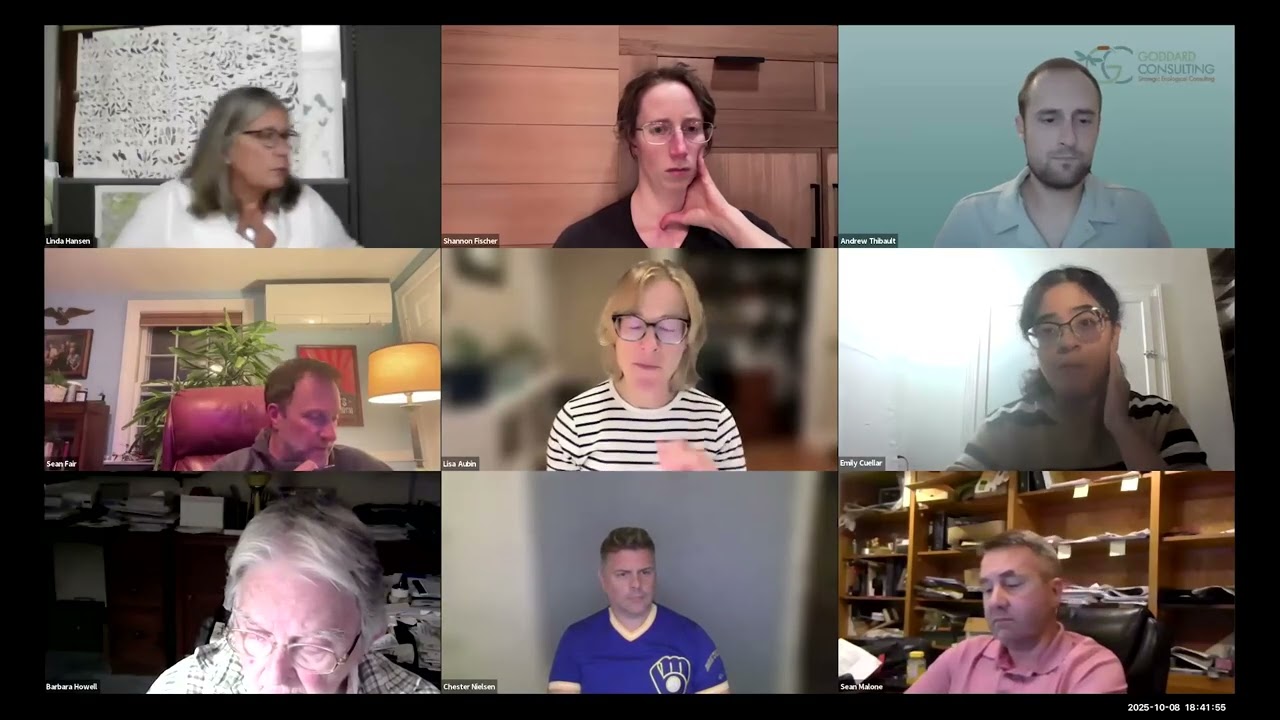
October 8, 2025 - Conservation Commission
Sean Fair: Alright, seeing that
631 and we do have a quorum to
begin the Conservation
Commission meeting for
Wednesday, October 8, 2025
notices and agendas will be
posted at least 48 hours in
advance of meetings, excluding
Saturday, Sundays and legal
holidays. One may watch or may
participate remotely with a
meeting link that can be found
the following link and pursuant
to chapter two, the acts of
2025, this meeting will be
conducted by remote means, in
accordance with applicable law.
This meeting may be recorded
made available to the public on
WayCAM as soon after the
meeting. That is practical. With
that, we got Linda at Town
building. We got Lisa Aubin,
Barbara hollow, Shannon Fisher,
myself and Luke Legere all
dialing in remotely. Emily is
dialing remotely as well. Emily,
right with that said, let's open
the public hearings. This is
gonna be for one, a 397, Boston
Post Road, also known as
Russell's DEP file number 322,
dash, 1048, this is a continued
Notice of Intent file pursuant
to wayland's wetlands and water
resource protection Bylaw and
the wetland Protection Act
submitted by Dan skihan for the
after the fact paving work and
installation of a storm water
management at 397, Boston Post
Road and 99 Pelham Island Road
and Wayland mass. Proposed work
is with 200 foot riverfront
area, 100 foot buffer zone of
boarding, vegetated wetland
property shown on assessor's
map. 30, sorry assessor's map.
23, parcel, 004, and 015, Linda,
Linda Hansen: so we just
received the peer review results
today from dylis and Roy. I sent
them to the applicant and the
engineer, and they would like to
continue and have the ability to
comment and reply to the peer
review the
Sean Fair: 20 what's our next meeting? 2929 is that, when they want to for Linda, next one? Yes, okay, Luke Legere: I move that we continue the hearing to October 29 after 630 Unknown: under both, right under both. Yes, sir, perfect. You'll hear a second. Second. Sean Fair: Make this sound like Shannon Roll call, please. Shannon Fisher, yep. Luke Legere, yes. Barbara Holl, yes. Lisa ARPA, yes. Sean fairs, yes. Thank you, folks. Okay, on to 1b this is 169 rice road DEP file number 322, dash, 1053, it's also continued Notice of Intent follow pursuant to wayland's wetlands and water resource protection Bylaw and the wetland Protection Act submitted by Saint Philip editors and Saint Mina Coptic Orthodox Church for the work at 169 rice road and Wayland mass. The proposed work includes the demolition of existing church and construction of three new buildings, parking services, a courtyard, sports field and storm water management systems. The project is in with a 200 foot riverfront area and 100 foot buffers on a boring, vegetative Wayland property is shown on assessor's map, 40, parcel 08, Linda, I Linda Hansen: believe we have the applicants team here to give us an update.
Unknown: We do. Hi everyone. For the record, my name is Andrew Tebow, wetland scientist with Goddard consulting. The updates actually won't come from me tonight. They'll come from the remainder of the team. Linda, similar to last time the majority of the project team is on this as attendees, I'm going to have them raise their hands if you don't mind, promoting them as panelists, and then Sean land and will be happy to kick this off for us. Thank
I'll give a minute for them to come in. Thank you for doing that. Sure.
Good evening. Can everybody hear me? Yep. Okay, great. So since our last meeting on the 10th of September, we provided additional information, both requested and voluntary from Goddard. We provided the wetlands border report in updated data sheets. We've also provided updated planting plan, which shows the existing trees to remain at the perimeter as well as the surrounding vegetation. We've updated the lighting study with proposed foot candles on the site and the surrounding the building. And lastly, we've provided a site section that cuts through the entire site, that basically runs east, west, and it's looking at the site from the south. So we understand that since the last meeting, there's been communication between the Conservation Commission the Board of Health. Of Design Review Board, DEP w in the planning department. And what we're hoping for this evening and requesting is for the commission to vote to allow the st flipper project to proceed with the peer review process.
That's that's where we stand.
Linda Hansen: Sean, my understanding is that the planning board is taking the lead on the peer review. They're the ones who received the quotes from with and the scope of work was, was a joint effort by all the lane use departments. So that way, the Cochituate is only doing one peer review, as opposed to multiple, you know, by each of department itself. So the stormwater peer review is included in, I believe. Wait, who's doing this now? ECT, is it ECT doing this one Unknown: that sounds that sounds, yeah, we've spoken with with Robert, and yes, we understand that the proposals have been presented to the client, and they have actually accepted that and made the payment for that. There's also a traffic peer review as well, and I believe that's in the process as well, yeah. Linda Hansen: So that was my understanding, that once, once the money, the funding, is received, the peer review will move forward. Okay, so I don't, I don't think there's any more input that we need to provide for that it's just a matter of waiting for them to finish the the peer review process. Unknown: I'm sorry, that's my misunderstanding. I thought that we needed the approval from the Conservation Commission.
Linda Hansen: So we did not. Did we not take a vote the last time?
Unknown: I'll jump in quickly. This is Andrew with Goddard. So we did not. We were last with you guys about a month ago. We had introduced the project at that time, but we had continued the meeting out until tonight, with the intention at the time of our original presentation, it sounded like the planning department, the Conservation Commission, hadn't, hadn't had enough time to correspond back and forth, so we never took an official vote to proceed with peer review. If it's occurring jointly, that's great. We just want to make sure the commission has the opportunity to make sure that we're ready to proceed with the peer review. Linda Hansen: You know, I know my notes say that the commission was in favor of a peer review. Again, I guess it's kind of redundant for us to vote on that, since it's already in progress and that and that the planning board is taking the lead on that, since they also need storm water for the site plan review, if you want us to, I'm sure the commission is happy to take a vote on that,
Unknown: as long as we have your long as it's on the meeting minutes, we have the paper trail that we are pursuing peer review, and it's occurring jointly, we just want to make sure that we're on the same page. So that's a good way Sean Fair: to proceed. Okay, so you don't need about that one day, right? You're already doing this with planning. Linda Hansen: Yeah, planning board is taking the lead on this one. So because they have a greater scope of work, they've included conservation for storm water, and they've also included the health department for any of their whatever their scope of work was for that, I'm not sure what that is so. And in addition to that, planning board will have a needs of traffic studies. So that's done, that's being done separately. Sean Fair: So okay, so we only think for now, then depends what it's what continuation till after the till we get the actual plans with the peer review. Unknown: Yeah, we'll Linda Hansen: have to get some input. We're going to need a response from the peer reviewer. And I think it's important for the the Coptic church to go through the planning board process also, because if there's going to be any design changes, it will probably be through their process. And process, not necessarily through ours. So I don't know at some point, I think that's next week. Is that Unknown: correct? That is correct. Okay, Sean Fair: so between that Board of Health meeting, sorry, planning meeting, next week and our peer review is the 29th too short a window for the continuation, or is that what's the next continuation? Then do you think, based on what we're at, what we're looking at, scope
Unknown: wise, I would think that we would need to get comments back from our peer reviewer, and I'm not sure how long that's going to take, and we can be in communication with the planning board in regards to the comments that we get back, so we can try to get on the the next scheduled meeting after we receive those comments, and are able to receive. On to them. Sean Fair: Okay, to read against for now, we have to pick a date. We say the 29th in the worst case scenario, if they continue, you'll let Linda know in advance. Does that sound right? Unknown: That sounds good to us. Okay? Because Linda Hansen: then the next meeting after that is November 19. So put that on your schedule. So if we, if we don't have all the material ready for the our next hearing date, then we'll then the following hearing date would be November 19.
Unknown: And I'm sorry, what was the next 129? Thank you. Sean Fair: Commission members. Any thoughts, comments, concerns? No. Luke Legere: I think as long as Linda is satisfied with the scope of the peer review, I have nothing to add. Love it. Okay. Sean Fair: So let's then we'll look under both for continuation, sometime after 630 on the October 29 please. So moved. Thank you. Luke, do I hear a second? Second sound like Babs Roll call, please? Shannon Fisher, yes. Luke jeer, Unknown: yes. Sean Fair: Barbara Hall, yeah, I think I saw Jenny Brown. Come in. Sorry. Hi, Jenny. Jenny Brown, yes, please. Aubin, yes, and Sean fair as a yes. All right, we'll see you folks in a few weeks. Unknown: Thank you commission. Thank you. Thank you. All right, on to 1c Sean Fair: this is 11. Cameron road DEP file number 322, dash, 1054, that's also continued Notice of Intent felt pursuant to Wayland wetlands and water resource protection by law and the weather protection act submitted by ADU mwrato for the construction of an addition to a single family home in 11 Cameron road and Wayland mass property is shown on assessor's map, 38 parcel 149, and is located within 100 feet of bordering vegetated wet Linda Unknown: um, I believe Andrew is doing this one also, right? I am. So we can jump right into this one. All right, up into it. Awesome. Thank you guys. If I have permission to share my screen, I'll pull it up and I'll I'll run through what we got for you. Please see.
Can you guys see the screen right here. Sean Fair: It's black right now, but something's about to come out.
Unknown: Yep, there's Perfect. Thank you. So this is the original site plan submitted. I'm just going to start with a quick introduction of what we discussed last time, and then we've changed since then. So for the Commission's records again, my name is Andrew Tebow. I'm the wetland scientist on the project and a project and a project manager with Goddard consulting. So I was last with you folks on September 24 at that time, that was our introductory hearing for the project. I had explained that this was at 161 square foot addition off the southern portion of McCall. Let me house at 11 Cameron road. So we had discussed that the work was proposed all over existing lawn off the southern edge of the house and was about 86 feet from the wetlands. At that time, we had had a couple comments. We were discussing back and forth. One was, DEP had made a note that the existing limit of lawn and tree line was not shown on the original site plan that we see here. And then we had a conversation with the Commission that that was especially important, because under Chapter 194 the 15 foot no disturbed zone, we were looking to evaluate how much of that 15 foot no disturbed zone exists at present on the site, if we have an average of a 15 foot throughout and so what we did since then, and this was submitted to the Commission on October 1, we had The surveyors revised the site plan. They added in the tree line and the lawn labels to show what's undeveloped on the site and what's developed on the site. And so, as I said at the last meeting, we were discussing we knew from aerial imagery that the lawn had cut across about a portion of the backyard. We knew that there was at least a pre existing portion of that lawn that would be within the 15 foot notice served zone. So we were looking to see if there was an average of 15 feet throughout the site of an undeveloped buffer zone that would be compliant with the intent of chapter 194 so once this was revised, what I had done here in this letter that the Commission received is I took eight measurements from the wetland flags out to the limit of lawn around the site to show an average of the buffer zone on the site. So I chose eight. So there was quite a few sample sizes, and then you'll also notice that I took three at that narrowest location. The intent was to make sure the data wasn't skewed. Take a bunch of data and make sure that you took a bunch of the closest point to make sure that if I gave the commission an average of what's out there for buffer zone on the site, that it was a reasonable representation of the property. So what we did is we found that the majority of the property has much greater than a 15 foot no disturbed zone that's undeveloped on site right now. As we can see, the wetlands come up on this property about halfway through, because there's a seat comes out of the yard up in this section, but the remainder actually comes off site and continues. To move. And we had everywhere from about six feet at closest to as far as 62 feet and 72 feet in spots. And what this meant was we have an average width of the buffer zone that's undeveloped on this property of about 29.8 feet. So that is about double what the 15 foot no disturbed zone was. And so this letter was submitted intending to evaluate and demonstrate that the property is in substantial compliance with the intent of that 15 foot no disturbed zone. So that was done to both answer DEP comment about adding the limit along, and then the discussions we had at the last meeting. So this letter was submitted essentially to review and button up that comment. And then Linda had made a good point that we were not unaware of, that there was a different septic system as built for this property that the Board of Health had. And what that meant was the proposed addition was actually going to be about nine feet from the septic system itself, which though not necessarily conservation issue, Wayland Board of Health has a 10 foot setback from foundation to septic system, and so we just slightly modified the addition and we added a note. So what we're doing is moving the foundation back a little bit, and we're just cantilevering the front floor to make sure that we have the feet six inches just to meet that separation. So I submitted a revised plan today, just to shows this here, the commission is unlikely to have seen that, yet it doesn't change any portion of the project as far as the limits of development or any of the measurements I just outlined. It was just to demonstrate the intent that we will make sure we comply with the Board of Health setbacks. So that's what we have for you. Otherwise, everything else was clarified in October 1 letter, and if there's any questions on that, I'm certainly here to answer them. Thanks, Andrew. Linda, start with you, please. Yeah, Linda Hansen: like, I think I told Andrew after the meeting that the one thing that he really, he really should do is get the Board of Health approval, which is going to be required anyway, for a building permit because of the proximity of the tanks in the leach field to the new addition. That's something that's required under the Health Department rules. So I'd like to make sure he goes through that process and make sure to just so the health department approves this plan. Before we approve we issue an order conditions, because otherwise, if the plans change again, you know, we'd have to go through this all over again. So I think if you can submit that to them in the near, very near future, that we should be ready for the next meeting. Also check the I did check the previous permit for this project, and I noticed that they they didn't have two separate lobes of wetlands. They had a where that topography line is between, what is that number? I can't see it on my smoke. It's right Unknown: here on my cursor. Yeah, Linda Hansen: like 20. We're 25 to 995, or 96 or whatever that is. Yeah, that's where the wetland line was. Was? It was pretty much where that DEP part that that contour line is. So also just wanted to bring that up. I don't know if things have changed. Yeah, Unknown: that's interesting. So I'll address that comment first, because that's an easy one. So there's that's like, actually, like a monoculture of Japanese knotweed in that section, way back there. And this is sort of a groundwater breakout where you can see a bit of a bank starting to form. There's a pretty clear vegetative break, but it may not have existed previously. I think we have the added benefit of with so much of a break from the undeveloped portion, it wouldn't affect this project. And I will add, Linda, that your comment makes perfect sense to us. So I have spoke about that with both the builder, because the builder will be doing this with the Board of Health. So I spoken with the builder and the homeowner. Both of them understand that and fully intend to to file this with the Board of Health as soon as possible. So I think our intention with the Commission tonight is just to make sure that all remaining comments are addressed and discussed with you guys that way, once we go to the Board of Health, if there are no revisions, then we'll be good to close that with you guys as well. Linda Hansen: You know, Andrew, I drove by. I didn't, I didn't get out go on the property, because, with a fenced in yard, I wasn't sure if they had dogs or something, and I hadn't let them know I was coming. So just, I was in the neighborhood anyway for 13 Charena. So I just drove down there. And I was surprised. Is that not weed? I thought that looked like, like bamboo. I mean, like, you know, like regular bamboo back there looks like a huge stand of bamboo, really Unknown: tall. Maybe there is. I did this earlier in the year, so I know when you go back in this, in this further section, it's first, it's grape, and it's a bunch of blueberry, things like that, a bunch of shrubs. And once you go back in there, so when I was there in the spring, of course, I've done a lot of properties since then, I think it was not weed, but bamboo does escape from properties. A lot of people use it for for landscaping. It's the fish pole bamboo, and it runs away. So I'll look at some photos, just out of curiosity to see what's Linda Hansen: over there. It's a pretty impressive stand of bamboo Unknown: takes over. It's, it's, it looks pretty until it takes over a random area. Yeah, Linda Hansen: yeah. They might want to get that in control before it starts to consume everything. So, yeah. Unknown: Yeah, we didn't, we didn't plant that. I don't know where that's coming from, a neighbor or something like that. It tends to Adam. It spreads by rhizomes, and if a neighbor uses it in some landscaping, it'll run from another property to somebody else's. Sean Fair: But So sounds like anything else that from our end, so assuming they sail through, they get back to us and just kind of get this poor condition. Okay, so it sounds like, then continuation to the 29th assuming a clean bill from the other board, and we'll wrap it up then. Is that what we're Linda Hansen: doing? Sounds like it that makes, I think that makes I think that makes the most sense, because we don't want to have to turn around and reopen this or amend this later on if there are any changes. So yep, and it won't hold Unknown: up the process, because they have to go through Board of Health anyways for a building permit. So I think that's perfectly amenable to us. And you know, thank you for giving us the the verbal clarification that we're good to go and we'll go from here, we'll work at the Board of Health. Okay? Thank you, perfect. Sean Fair: All right, so can I get then also under both and continuation for some time after six 630 sometime after 630 on the 29th of October, please. So moved. Thank you, Luke. Do I hear a second? Thank you. Babs, Roll call, please. Shannon Fisher, yes. Unknown: Luke Legere, yes. Barbara Holl, yes. Jenny Brown, yes. Lisa Aubin, yes. And Sean fairs, yes, all set. Thanks. We appreciate it here.
Sean Fair: All right, we're in the public meetings now. This is for two, A, 13, Charena Road lot. A 1d, dash, 1044, that's a continued request for determination file pursuant to Wales wetlands and water resource protection bylaw in the Protection Act, standard by Carol Carol seedo for the demolition of existing single family house and construction of five bedroom single family home and associated utilities, including a driveway, walkway septic system and a storm water management system. At Law, a one on the 13 Charena Road subdivision in Wayland mass the property is shown on assessor's map, 38 lot 157, and is located within 100 foot buffer zone of a boarding vegetated Wayland. Linda Hansen: Linda ability years received all the new information that was submitted for this and includes what is it, plans and previous analysis and a storm water and erosion control report. So I guess Kevin can update you with the new information. Sure. Kevin O'Leary: Hi, Kevin O'Leary from Jill, some company. Thank you for your time. October 1, we submitted a new packet, or a revised packet of information, which included minor revisions to the site development plan and also revisions to an impervious lot area analysis plan, also a hydrological report that we submitted to the Commission in DGT for peer review, and we got a letter back today from Linda about DGT comments, and they have no further comments in that regard, we satisfied their requirements. So I think we're finally through the hydrology on this project. Again. This is a single family house lot, 60,000 square feet, and I can do share screen to bring up plans that the Commission wishes, wishes to see them. It's about 54 5500 square feet of 100 foot puffer zone alteration along the edge of the existing 50 foot private way which services are formerly service number 13 Charena Road, single family house. It's got an existing barn on the property, and a proposed single family house is what's on the plans. With all the site work, new driveway. It's removing a lot of impervious, existing impervious driveway area, a portion of the house, and then regrading in the 100 foot buffer zone. So a recharge basin is proposed to collect a portion, approximately half of the existing barn roof, in the entire roof of the proposed house, so it's self contained with no discharge. It holds 100 year storm for those two rooftops, or half a rooftop and then a full house. So I think we're all in compliance with the requirements, and we'd like to see if the commission is comfortable closing the hearing tonight, please.
Sean Fair: Okay, thanks, Kevin. Linda, start with you, please. Linda Hansen: So how are you managing the runoff from the driveway, Kevin O'Leary: from the proposed driveway? I. Um, it flows down to the towards the proposed Street, and on the revised plan, I show I cross pitch it towards the lawn area that runs along the side of the driveway and down the shoulder of the road.
If I can screen share, I could pull up the detailed site plan and Unknown: show the again. So where is it going? Kevin O'Leary: Then into the grass shoulder in the front yard. It's headed for the area between the proposed septic leaching trenches in the sideline of the private way.
Linda Hansen: So all 1900 feet of driveway is going into the lawn. Kevin O'Leary: Yes, I
Linda Hansen: Why wouldn't go into the catch basin in front of the in front
Kevin O'Leary: of the driveway. There is no catch basin in front of the driveway. Linda Hansen: What is this on the plan? Again? There's no Kevin O'Leary: There's no screen. What I Unknown: can Kevin O'Leary: the commission see this plan on the screen? Yeah, I think Linda, this is the commission members Island, and this is the proposed driveway in the contours are Linda Hansen: you make that bigger? Sure, tiny end screen.
Kevin O'Leary: So the proposed driveway is 12 feet wide in here is the the edges of it. And these contours are created with a slight swale along the edge of pavement and then off the pavement. The way I've got the contours drawn is to create a drainage swale off the pavement, coming around this way, and then I've highlighted a swale in this area to direct the water down parallel to the lot line and parallel to the edge of pavement here for the proposed 20 foot wide right away.
Linda Hansen: So I'm asking about the catch basin, which is right where it says ARPA number a one. Oh, Kevin O'Leary: I'm sorry, Linda, that's that's off the property. That's in the 40 foot right of way, and that's part of the roadway drainage that goes back to the recharge basin near the cul de sac, up in this area a couple 100 feet up the road this ADU, theoretically, a droplet of water landing on the street here would flow all the way down to the existing catch basins, down towards the beginning of the street and the existing low point. It's, it's at least a 250 feet, 300 feet,
Linda Hansen: okay, but I mean, when I look at the the other plan that you provided, it doesn't look like the the catch basin or the the catch basin looked like it was east of the driveway for lot two or no for lot one, Kevin O'Leary: right? This is lot one, lot a one, yes, Linda Hansen: yeah, yeah. But I mean, it's not in the same places that you had on the previous the order conditions that are the NOI that you submitted, are those supposed to be the same Kevin O'Leary: ones? Yeah, they haven't moved this, this catch basin out here, because we previously on the on a prior submission for lot a when we had a on the first submission, we had a catch basin in the driveway. Unknown: Yeah. Linda Hansen: Why was that taken out? Kevin O'Leary: Because Bert Cory was DGT was recommending secondary treatment prior to disposal into the infiltration basin for the driveway runoff. Linda Hansen: Okay, so you saying that on this? This the plan that was submitted with a with a Notice of Intent, the driveway location is, is different than what you have on there now Kevin O'Leary: the Notice of Intent for the roadway, yeah, because you have Linda Hansen: it on in here, and it looks like the catch basins much farther. Is farther east of it. Kevin O'Leary: No, I don't think the catch basins have changed. And, yeah, the driveway aprons we show on the subdivision plan are in the same general location. I think that the same width, but we didn't have the detailed site plan for the house or the individual lots. I think we just showed them coming more or less straight in at 90 degrees to the front lot line.
Linda Hansen: Also area drain and foundation drain. You have that discharging right next to the septic leach field. Kevin O'Leary: Are there setbacks for that? Yes, and they're satisfied, Linda Hansen: which is, what is the setback? I Kevin O'Leary: wanna say, 10 feet. Okay, do
Linda Hansen: and, well, I mean, my analysis of your, you know what I asked for in the response to the your submittal last time was for impervious surface calculations. I just wanted new. New and existing to be removed. I asked, I don't want the uncontrolled. I'm not sure how you come up with that. And in my calculation, I have new impervious is equal to 6623 feet, okay? And what you're removing is a portion of the house and the driveway, which is 2859 so the difference is 3764 that's, that's what the net impervious is. That needs to be managed, right? Kevin O'Leary: I can't, you know, agree with your numbers, but I have that on a plan in the share screen. I could pull it Linda Hansen: up. I mean, your hydrocade model has driveway to house retaining wall and proposed house that you modeled. But some of the impervious was not modeled like the retaining wall in the driveway, the front walk the I Kevin O'Leary: think that was it. No, that's all in the model. All these impervious areas over here is a post development impervious areas on the lot, and these are the pre development impervious areas on the lot. So the in the prior plan, I had labeled this as pre development uncontrolled impervious areas. What uncontrolled means is that it flows off the property with no drainage controls. And you requested that I remove that descriptor. So I did and I resubmitted. This is the plan with the October 2 date, done. Originally submitted on September 30. You had a few comments. I, you know, re label tables. You can read the revision. I mean, yeah, the revision block down here, blah, blah, blah. So this looking Linda Hansen: for something simpler. Kevin, that's all, so that's, that's all looking for was just, you know, pre and post kind of how much is impervious is getting added to this property? Okay, Kevin O'Leary: right here. It's right here, Linda, here's pre development right here, 7356, here's post right here, 11,000 Oh, two. Oh, okay, these computations here, these two numbers here, take the roofs. Half the barn is 1600 the house envelope is 3778, so the net, uncontrolled impervious flowing off the site is this, 5642, which is a reduction from the 7356, so here's the net post development impervious area that flows to the front lot line. It's less, it's less than existing by 1714, square feet.
Linda Hansen: Okay, we also have various plans for the barn. So have those are they? Are they no longer putting in the additional driveway and parking area? Kevin O'Leary: That's right, that's true. Yes, it's just the existing driveway is shown on the plans. Okay,
that existing barn driveway is up here at 11 117 square feet.
It's down here on the post development, 1117,
Unknown: Linda, anything else on your end? No, I don't think so. So, Sean Fair: just so you're guy having answered, you're good to go from what you need, Linda Hansen: I guess so. You know, I'm relying on the peer review for his expertise in stormwater, and he seems to be fine with it. So there's nothing more I have to add. Unknown: Okay, commission, Sean Fair: thoughts, comments, concerns. I Shannon Fischer: may need a refresher on this, but I know that last time that we met, there was some back and forth about, you know, existing conditions. So some materials, you know, were being like. Some things weren't being counted that should have been counted. And I don't remember the exact specifics, right? Do you guys recall this? I want to confirm that we have the actual existing conditions here. And I remember that there was some back and forth about this last time.
Linda Hansen: No, I don't, I don't remember that. So Luke Legere: I noi, I remember that Shannon, I thought there was, like, we were sort of disputing or debating, like new impervious. What that meant, right? Is that what you're referring to, Shannon Fischer: yeah, exactly. And then there's, there's questions about, like, the some of the existing, like, yeah, there were definite questions about that. And I, and I think it matters, so I, I'm trying to recall now. Sean Fair: So I guess the ultimate question is, Linda, based on the numbers, you understand them to be, you go with the numbers of the new or impervious, right? Shame is that kind of what you're asking, though, essentially, right? Shannon Fischer: I should have reviewed my notes before this. There were questions where, and Luke, I'm glad to remember this. You might be able to sort of back me up here on this, but there was, I'm. Matter of some, I hope I don't get this backwards, some existing impervious was being included as existing conditions when actually it had been removed a couple of years ago.
Unknown: Yeah, I recall something like that too, but I don't Luke Legere: know we were like going back in time to define existing conditions. Yes, that's right, basically, right. Kevin O'Leary: I could maybe shed a little bit on that. The on previous plans. We had a proposed driveway that came into the barn, you know, as a side load driveway, and that's been removed from the plans. In the last meeting, I also showed a plan that I had got from Wayland GIs that showed two existing barn components that came into this area, and I was using those to try to demonstrate and give an explanation to support the hydrology and the proposed conditions that the property formerly had much more impervious area than what we were showing or taking credit for, but I've removed that information and abandoned that approach. Shannon Fischer: Okay, so what we're seeing is the actual right now, this minute, existing conditions on this map. Unknown: Yes, okay, Linda Hansen: and Shannon. The other thing was that we talked about the drainage issue, about using the drainage easement, and we agreed to hire a title attorney to investigate that. We have not received the response from the title attorney yet, Unknown: but it appears that they have. They're no longer sending water. Linda Hansen: I guess probably the barn driveway is probably still going down in that direction, right?
Kevin O'Leary: Yeah, the existing barn driveway is, but our hydrological analysis, which DGT had, has no further comment on, has the the at the front lot line, there's a design point for hydrological modeling and the reductions that design point between pre and post development significant and substantial. And I have those on another plan I could pull up and show you. I mean, I think for the smaller or the higher frequency storms, the reductions are in the in the range of 60 to 70% lower runoff post development, because we're collecting, well, first of all, we're removing a lot of impervious area with the existing driveway, and we're collecting a lot of the roof area and putting it into the infiltration basin so there's no runoff from the from those impervious proposed impervious surfaces. Well, proposed house surface and existing barn. Linda Hansen: Sorry, did you model the area drain and foundation drain? Because now that you're changing the this to pretty much an acre of lawn, I mean, you're not going to get the same uptake, you know, with with given that the existing vegetation is probably better at taking up storm water and runoff, so then you're discharging that to next to the leach field. And again, that's, that's probably, you know, I mean, that's, is that your design point too? Is that, Kevin O'Leary: no, the design points down here at the front line, and yes, we do take it into account in the hydrological model. Unknown: Okay, okay. Linda Hansen: So that whole backyard is going to be, is going to be converted to lawn. Kevin O'Leary: Then, yes, it's yes, it is in the
in one of my plans I could pull up, it shows the pre development brush and wood area coming approximately through here. And so you can see that we're pushing it back a little bit and converting this section to lawn. This is a big pile of fill that was placed here by the prior owner, is my understanding, because he wanted to create some screening. And then below that, like over here, I think, is existing grade. So a lot of the vegetation in this area is invasives that have grown up over, churned up, churned up Earth.
Shannon Fischer: Is the removal of the vegetation material, which you say is mostly invasive. Is that marked on the maps? Like do we, I don't have the tree removal plan. I see some trees marked on the front, but do we have things marked in the back here? It doesn't look like it? Kevin O'Leary: No, all the trees are small caliper. They're, to my knowledge, they're under the six inches at breast height.
Unknown: Okay? What else do?
Sean Fair: Yeah. So Shannon, to get your question, I guess answer that they basically sound like it changed both assumptions and so that what we were talking about last time is taken care of, I guess. Linda Hansen: Linda, yeah, I don't have any further comments about the stormwater. Unknown: Okay. Luke Legere: Yeah, that was sort of, I just wanted to confirm the same thing Shannon did that the that question of of existing conditions, and then the title drainage issue had been resolved. It sounds like they've changed the design to address both of those. So I'm I have nothing further. Shannon Fischer: I do think the shame that they're just going for a lawn in the backyard, when you know there could be much better solutions, it seems like an unusually large stockpile area. And given, like a lot of the neighbors, concerns about flooding that that you know may be caused by a lot of the tree removal overall, and the tree removal to come on the lots like, you know, I don't think that planting trees and reducing this lawn would would be a bad idea. I actually think it would be an excellent idea. It's, it's a shame. And, you know, you wonder why the future owners wouldn't also like some screening. Yeah,
Unknown: Okay,
Sean Fair: anybody else comments from commission? Barbara Howell: Just the usual, but why are they allowing a garbage grinder for their new septic?
Kevin O'Leary: Because it meets all the requirements Unknown: life the
Kevin O'Leary: Wayland board of health regulations for sizing a septic system require it to be increased in capacity to accommodate for use of a garbage grinder. They don't recommend a garbage grinder to be installed, but they require the components to have the capacity to handle the added organic loading.
Shannon Fischer: There actually could have been like fewer trees taken down and a smaller septic system, if there just wasn't a garbage disposal.
Kevin O'Leary: Maybe, maybe not the breakout slope grading probably would have got into the same trees, because even if you shorten the trenches a little bit on either end, you know, the breakout slope grading or the the activity in this area, would probably still wipe the trees out. The two trees down here, and also there's the two trees up here. I don't know if the commissioner, but these are replacement trees up in this area.
Linda Hansen: Do we have information on that? I don't remember seeing that Kevin O'Leary: up on the right hand side of the plan over here is a tree replacement. Linda Hansen: Say what you were planting, though. Kevin O'Leary: Well, there's a two inch let me see here, right here, there's two, over two and a half inches in diameter trees. Shannon Fischer: Okay, what species? Though, I think we Kevin O'Leary: I'm not sure we call it a species. I didn't think that was a requirement. Shannon Fischer: I mean, this looks like it's within the 100 foot buffer zone, isn't it? So I think that we want to be absolutely certain that these are valuable native trees. Kevin O'Leary: I don't think the proponent has a problem replacing them with native trees, and I'll and one of the trees is outside the 100 foot buffer zone. It's over here, but we're proposing two within the 100 foot buffer Shannon Fischer: zone. Did you ever run the calculations on like, for sure, like, you're like, you're assuming that the septic wouldn't have needed to be a little bit smaller and save some trees, but it would have been a good experiment to check that, to see if you could spare anything like in a project this size, where you're taking down so many trees like I think it's sort of incumbent on you to try every single thing to spare every tree you can
Linda Hansen: Okay. Sean, there's only two trees on this slot that are getting taken down. Taken down, though. So yeah, that's probably for grading anyway. So Shannon Fischer: as we know, like a single mature tree can absorb and release anywhere from several 1000 to 40,000 gallons of water. I love that new that that just finished reading it. So yes, but yeah, Unknown: but it's a good point. You know, we, I know it's not connected to the to the rest of the Charena project, but there will be more trees ultimately coming down when the homes are built. So if there's some opportunity at the back, very back of this property, again, not necessarily connected. They're not. It's not the same project, but if that can help, and some of the replacement plantings are, you know, at the far back of this property, it could go a long way, especially if they're not anywhere close to the house, if there's a lot of backyard there, yeah.
Linda Hansen: Well, I would keep, I would put a condition in the permit that they will need to, they will, they will need to plant native within the buffer zone. You know, that's, that's our, one of our standard conditions. Kevin O'Leary: So, yeah, that's not a problem. That's no objection. Unknown: Commission. Anything else.
Sean Fair: Okay, if Linda's good, I'm good, and I think all the suggestions are great. And so, yeah, I guess everybody else wants to make the motion.
Barbara Howell: Anybody? Luke, move and negative. Unknown: Thank you. Go ahead. Thank you. Barbara Howell: Moving negative under a negative term is under the well and Protection Act and permit under Chapter 194
Sean Fair: Thank you. ARPA doyer, a second that
Unknown: was Luke going through Sean Fair: Roll call, please. Shannon Fisher, can I go last? Shannon Fischer: Can you what? Sorry, can I go last? I'm still thinking about a Unknown: little last. Yeah, Luke, was your
Sean Fair: ARPA hollow? Yes? Jenny Brown, yes. Lisa Aubin, Unknown: I'm still Well, I'm a little bit with Shannon on this one, just that there could be some opportunity at the back of this property for some additional trees, just for for further flood prevention, we can sit around the neighbors comments and what's going to be happening further down the road when the other houses get developed. So that's something I would like to see be considered.
Linda Hansen: But I mean, once, if they replace the trees based on our compensation plan, you know that we have in place, we can ask for it, but we can't require it under, under the permit. Unknown: Okay, exactly. All right, then I'll say yes. Okay, Sean fair is a yes. Charena Fisher, Shannon Fischer: I guess I'm a yes. If it's Pat, if Barbara is a yes, I'll go, Sean Fair: Well, yeah, it's, it's, I would argue it's what we can do what we want to do, or two different things sometimes. Okay, we're good. There. We should be good.
Kevin O'Leary: I have a question, Sean, it's if I may. I'm sorry, did I interrupt? Were you going to another Nope, you're good. Just quick. Do it. Linda, can you tell us the status of the order conditions for the roadway? Linda Hansen: I'm working on it. I've just had, you know, you can see my agenda. It's been pretty crazy here. So working Kevin O'Leary: on it, what does that mean with regard to a time frame? Linda Hansen: I should have it done by next week at some point. So okay, Kevin O'Leary: we appreciate it. Thanks. You got Unknown: all right. Thanks, Kevin, thank you.
Sean Fair: Okay, 2b, 13 Stanton Street. D1, 047, request for determination file pursuant to wayland's wetlands and water resource protections Bylaw and the wetland Protection Act submitted by Chester Nielsen for the replacement of covered porch and construction of a walkway at 13 Stan Street in Wayland. Mass property is shown on the assessor's map, 50 1c lot 06 the proposed work is with 100 200 foot riverfront area and 100 foot wetland buffer Linda Hansen: zone. Linda, I believe we have the homeowner here, Chester, with us. I don't know if he's if he can hear us. Do you want to present the project to the commission?
Sean Fair: You're muted. Chester, if you're you're speaking. It looks
Linda Hansen: like stepped away or something. Sean Fair: See if I can ask him to unmute himself.
Unknown: Hello, I'm sorry, this is Chester. I did. I didn't know, right? So go good at fast. I'm sorry. I am single dad in it tonight, I was putting my daughter down yours. Okay, so from what I was seeing, I I just wanted to let you know where I stand. I live at 13 Stanton Street. I purchased the property from Mr. Poncio back in June of 2022 over the class two years of the property, I've noticed that the front porch that we have was sinking, and after some exploratory discovery, determined that it was significant dry rot, given that of two small children, both under three, as I'm single Danny right now, I need to replace and the porch because it's just unfit for use. The prospectus, as we looked at it, was to stand on the current footprint. But the fact that our house has a very unique footprint in that our. Side door, which is in the the packet I provided to you all. On the northeast side, it has a landing, like a small, like three foot landing, a stair step. We just wanted to continue that along. Yeah, May I share my screen? Yes, please. This is rather, I'm sorry for the low brow aspect of this, but let me see if I can share here. Okay, so this is just general Google Map. Can the committee see this? Nope, oh, okay, let's try this one more time. There we go. There it is. There it is, okay, so there's so this is 13 second. This is the Porsche that needs to be repaired. This is, there's a doorway right here. And what our hope is, if the committee does not see fit as to allow us to connect these two portions right here and create one stairwell that goes over this lawn. We would appreciate the opportunity to just simply repair this portion, since it's unusable and relatively unsafe, but what we're hoping for is a an accommodation to allow us to allow this door to connect with a walkway over this extended lawn portion here, so that we will only have one staircase that will run down this this grassy area. So
Linda Hansen: where's the walkway going? Chester, where's that? Can you show us where that is, sure. Unknown: So do you see this orange door here? Yeah, it would. It would run along the length of the house to the existing footprint right over that. Linda Hansen: I thought by walkway you meant like you were, in turn, like a sidewalk type thing that you Oh, Unknown: no, ma'am. I'm just going to try and do it like uncovered, elevated porch way that's got no roof over it. I just the, I just wanted to give this like six feet here. It was an Linda Hansen: option. I just misunderstood. Unknown: So, of course.
Linda Hansen: So it shows you can show the commission what the so called stream looks like. I know you could. You can just ma'am a little bit right? Unknown: Yes, it's right here. We've been pretty fastidious with making sure that we have been keeping it in accordance with what you all want. I understand that there's a give and take. I understand about commission. I appreciate what you all are trying to do. And so when I was one of the things that my wife and I've been talking about is there's stream runs here. We've let it run pretty wild, but we would love to allow it to take over a couple more feet, since we're taking three feet from here, we would like to give, since I mow my own lawn, give this, give this lawn back, and do a lot of local flora here. And obviously we would, in this area here, where we connect, run gravel underneath, and then run local Massachusetts, like this area, kind of floor here to try and just bring back a lot of stuff and get rid of these, you know, these hedges and these, these use. But this is where it the this is the real big issue at hand, which is this small creek that we've been maintaining and overseeing since we purchased the property.
Linda Hansen: Because typically, what we put in most of our conditions and our permits is that we like to have a vegetated buffer along any resource area and not and we would encourage not to have lawn right to the bank of the stream. So any restoration that you do over there would be much encouraged. I mean, a lot of that, you get a lot of runoff from on that stream. I know that because I've been out there 2019 we've have a permit on the house in front of you. We have a permit on so we're very familiar with the neighborhood. And Unknown: I know Mr. Pons ADU is not unfamiliar with this August committee. Linda Hansen: But also that, I mean, you get a lot of material that gets deposited into that stream, and so I think it would make a lot of sense to have have more vegetation in there that can that can pick up nutrients. It can pick up stuff, you know, and pollutants and things like that. Can kind of water. And that's what those cat tails do a great job of picking up a lot of nitrogen and stuff. So it would be a huge water quality improvement to have a little bit more vegetation in that area. Unknown: So I would say that really quickly, just because this is because this committee is aware, if I turn this, you'll see that there is no barn here. This is on Pelham from last year. So that shows how old this photo is. If you came through, I have the eagle scout in me, the kid from the scouts. And excuse me, but this has become far more robust this photo. And so, like I said, it's gorgeous. It flowers beautifully. We get all the bees right that come around here. So I'm, I'm all about doing what I can about this stream here, and to be honest, surrendering a lot of this lawn because this is really it's gorgeous. So again, we're happy to either introduce local stuff or let it kind of reclaim as you see fit. But of course, over here, we would then surround this area with local stuff. But yes, we would definitely work on this stream as well. All right, sounds good.
Commission, thoughts.
Sean Fair: Sounds good on my, my end and yeah, Linda's good with it. I'm good. I like that idea. Yeah, I Shannon Fischer: actually kind of like the idea too, of like letting it sort of reclaim and see what grows, maybe with selective seeding, because that, you know, that reduces the risk of getting, like, jumping worm contaminants right on that seed bank, right or right on that bank right there. So you might like, if you remind me, I might just let it happen and then sort of manage for invasives that you'll inevitably have, of course, Unknown: just real quick. This is kind of informal. My wife went for a run and ran across a house in the area where we are, and there was a garden that had a bunch of local indigenous plants. And then there were like pamphlets where you could learn from it, is that any of you guys that have that, or because it was a beautiful, like local garden, but I just want to see if it was any of y'all, Oh, wow. Linda Hansen: No, no, Unknown: I'll tell you on the route. But everything that's in there is kind of like an English garden. And then there's a pamphlet on riots, local, Sean Fair: maybe Wayland Garden Club. They're pretty No, Unknown: it was, it was a, it was a residential home. Oh, wow. I like Shannon Fischer: the idea. Like, I'd love to check it out, see how they're doing it. And maybe, maybe we can do something similar up by our houses. Unknown: Fabulous. But yes, okay, well, great. And I can get, I can, I have a bunch of, as Shannon knows, like Cardinal flowers growing kind of like in the wet area of our backyard, just and they're beautiful. They love, like, wet and sunshine. And I can give you a bunch of seeds, okay, 100% yes, as I like I said, anything I can do to make this look the way it's supposed to look. And, I mean, I love the fact that I own this left side of the property, but it's one of the things where, like, if I can't really do much with it because it's so close to everything that would need a permit, I'd love to just kind of, again, surrender it to Oh, thank you, Shannon. Surrender it. So if we can talk about what we can do here, because it's great, it's a great area that's low lane, like, I'd love to just give it back, because if you're going to flood, I may as well have a bunch of stuff with roots that can handle it right, so Linda Hansen: we can talk about that offline. But I'm sorry, yeah, of course, focus on the approval of the permit at this point. Okay, Sean Fair: yes, ma'am. I love it. Chester, though, yeah, yeah. Love the idea the commission, if we're, if we're good, I'm looking then for a motion for a negative determination on the welcome protection act in a permanent under 194 so moved second. Thank you, Luke. I think that was Shannon. I heard this for a second, Barbara Howell: termination, Sean Fair: negative determination, negative determination. I Unknown: said, you want a negative yep and a perm, yep? Sean Fair: Roll call, please? Shannon Fisher, yep. Luke Legere, yes. ARPA Holl, yes. Jenny Brown, yes. Lisa ARPA, yes. And Sean fair as a yes, all set. Good luck being single dad. Unknown: Oh my god, she's out of the country for a week. We've had throw ups. We've had everything. It's been wild. But again, like Wayland said, I'll talk about this offline. Thank you for keeping the bubble, Linda, I appreciate you. Alright. Thanks. Yes, sir. Take care. Thank y'all. Alright. On to one. Sean Fair: Sees this four week lock row d, dash, 1048, request for determination file pursuant to wayland's wetlands and water resource protection by law and the wetland Protection Act submitted by Roderick McLeod for the replacement of a septic system at four Wheelock road and Wayland. Ma property is shown on assessor's map, 24 lot, 53 and the proposed work is 100 feet of a border vegetated wetland. Linda Hansen: Linda. We have Mike damonica, the septic contractor, and who's going. To present this to the commission, Unknown: sure. Thank you, Mr. Chair and Linda and members of the commission. Mike demotica, for my client, Roderick McLeod at four Wheelock road. This is pretty simply a straight septic repair of an existing failed system that actually was breaking out of the ground in the rear of the property. Health Department had issued a an order to fix it immediately, which my client has done. We perform soil testing on the lot. We have stayed at the existing design flow of three bedrooms. There's no change in impervious no change in grading, with the exception of a small grading line around the proposed septic. What we propose to put in is an IA technology, a Presby pipe system. It's approximately 100 and 190 feet away from the resource area. Actually, I guess Linda, if you want, I could share the plan,
sure. Yeah, please do. Let me see if I can do this. It's been a little while, so i
i Okay. I'm having a little trouble. Sorry, noi, we all have in our packet as well. Yeah, Linda Hansen: Mike made a change earlier, just to add top of bank onto the plan, because there is a stream, believe it or not, conservation owns that land next to you. Yeah? Little, tiny, little parcels. That was like, it's always a surprise that we own that so and so we're pretty I think we know about that stream already. We just did the okay. Just did the subject over 25 Lee Road, which is right on the other side of this property. So, right,
Unknown: jeez, I'm just,
he must be like me? Yeah, I am Barbara. I don't do honestly, I haven't done a zoom, and I don't know how long, so it's nice to see you again. I know it's been a little while. I try to stay out of trouble.
Yeah, my IT department is actually way at college, so usually she helps me when I need to put this up.
Still can't see it, right? Nope,
everyone now, Yep, here it comes. Sorry about that. Thanks for your patience. So on the western, westerly side is this stream, which has been determined perennial, intermittent. It's been a little bit of everything. The outer riparian is pretty much the entire lot. The inner is here, 100 feet what, what we propose is a septic tank in the back, in the back of the house here, to a pump chamber, and then a force main with a back bend up to this area where we propose to put in a 32 by 18 Presby pipe system. So it's an IA technology. We're not looking for any variances from the health department. They've actually approve the plan. As I said, there's a small grading change here around the outside of the leech field, basically for to provide for cover. We couldn't really move it any further to the south on the lot because of this 48 inch tree that's shown here, we would have to cut that. Our proposal doesn't require removal of any trees on the lot. We proposed straw wattles here in the back, and then a roll of straw wattles here across the front. All our access will be across the driveway here to the backyard and then off the driveway to work here. I think that pretty much answers or provides information, any questions I'd be happy to to answer? Next, Mike, Linda, Linda Hansen: no, I don't this. This is, again, a failed system, and it really needs to be replaced, and they're doing the best they can to put it as far away and putting in an innovative system. So I don't have any problems with that, and it's already been proved by board health. So, okay, commission anyone, I'm assuming it has Mike, sorry, I'm assuming it's been approved already. Unknown: Yes, yes, yeah, Darren. Darren approved it. I think it was Monday. He had one couple couple of small review comments that we addressed, but nothing major. He was just looking for some buoyancy calculations for the tank and the pump chamber. Yeah, no problem. Shannon Fischer: I want to thank you for, like, looking out for that tree, and maintaining a 48 inch tree is is worthy to really save. So thank you for doing that. Unknown: Yeah, it's pretty dynamic tree. It's really nice. What kind is it?
Shannon Fischer: It's okay, if you don't know. I just literally just curious. It will in no way impact anything. I'm trying
Unknown: to think, is it a maple? I can't remember if it's a maple or not. Sorry, all good mission. We good Sean Fair: someone want to make the motion Barbara Howell: move the negative under Wayland Protection Act and a permanent under Chapter 194 Unknown: second. Sean Fair: Thank you. Babs, thank you. Luke Roll call, please. Shannon Fisher, yes. Luke Legere, yes. Barbara Howell, yeah. Jenny Brown, yes. Lisa Aubin, yes. And Sean fairs a yes, you're all set. Unknown: Thanks so much for your time. You too good to see you. Barbara, good to see you.
All right. On to
Sean Fair: mansion road and Lake Shore Drive. D, dash, one, four, sorry, 1049, request for determination file pursuant to Wayland wetlands and water resource protection Bylaw and the wetland Protection Act submitted by Abigail cherish for the Department of Public Works, the storm drainage system improvements at nine. Mason road long intersect intersection of Lakeshore drive and mansion road and Wayland. Mass proposed product is shown assessors map 4060 parcel 02 and the intersection between mansion road and Lakeshore drive and assessors map 40 6b the product is within 100 foot buffer zone of boarding vegetative Wayland. Linda, Linda Hansen: well, we have our esteemed town engineer, Abby, on board here, and who will present the project to you guys. Unknown: Abby, Hi, how are you? It's my first time coming for a permit here, so be kind. Um, let's see. Let me just show you the drawings. It's really just a replacement project, and I was working on it to try to get some grant in here. Let me see if I can.
Can you see that? Nope, no, ma'am. I
You are screen sharing. Here we go. Linda Hansen: Started screen sharing, but nothing's come up yet. Yeah, Unknown: let me see if I can close down some other things.
There it is.
No, no, that's not high school. You don't want that yet. There's no wetlands over there, so you don't have to worry about it. We need to worry about it. All right, here we go,
existing conditions.
Mm, my tiny little work computer instead of my big screens. Alright, so on the left here is West Lane Street, and then we have mansion road here, down to Lakeshore drive, and this is mansion beach at one point there's drainage in West lane that went down mansion road, and I think just went in as an outfall to Dudley pond in the 80s. At some point they cut this line and went to an infiltration unit, really just one of those beehive infiltrators in this corner here, and then there's two in this area here. And what happened over time is that actually in the installation of it, they were installed backwards so it doesn't actually kind of overflow. And what ends up. Happening is that water backs up on West lane and ends up flooding into the homes in this area here. So what we're proposing to do is to reconnect this and put in a new infiltration unit I'll show you on the next just in here, you can see some of the manholes and the two existing outfalls. This outfall, we can see and we can inspect. It's got a grown over with invasives in this area. And this out fall, we can actually no longer inspect. It's become buried over time. So the project would put be putting in a new infiltration unit that would infiltrate more of the water and treat more of the water and be inspected by DEP w in the construction so that wouldn't be installed backwards. We'd Reconnect the drain line this way, and we'd refurbish the two outfalls in the area here on the beach.
Okay, thank you, Linda, start with you, please. You're gonna mute, by the way, Linda,
Linda Hansen: this is a huge improvement over existing conditions. So hopefully the grant comes through and we can make some positive changes here.
Unknown: We wanted to add into the permit, sort of having the contractor remove some of these invasive so that we can. I know that the neighbors in the area like to have that area clean as well. Linda Hansen: Yeah. I mean, we can. We can also go through and identify, you know, what they can and cannot take down. Yeah, helps too. Unknown: Because whatever's helpful, really, what I'd like to do is Linda Hansen: this is a trust issue with contractors. So,
Unknown: very true. Well, yeah, really what I'd like to do is to be able to inspect it as part of our MS four permit for the town, and really have that infiltration working the way it should be working.
Richard, any other thoughts,
Shannon Fischer: I love not flooding people's homes. That sounds great. I do want to back a second like I really like the idea of removing the invasives and having some of the conservation folks marking them. Yeah, I think that's a great idea. Linda,
Unknown: huge improvement over existing conditions. Sounds good.
Sean Fair: Read all right, then let's make the motion Luke Legere: I move that we issue a negative determination under the Act and a permit under Chapter 194 Sean Fair: Thank you, Luke. Do I hear a second second? If you have a Shannon Roll call, please. Shannon Fisher, yes. Luke Legere, yes. Barbara hollow, yes. Jenny Brown, yes. Lisa Aubin, yes, and Sean fair as a yes. All set. Thanks. Unknown: Abby, thank you. Nice meeting you. Thank you.
Sean Fair: Okay, on to the CEO strip, your compliance. This is a two, a 19 snake work road DEP file number 322, dash, 1004, Linda, Linda Hansen: this was, do we have, we have some? Oh, Matthew's on here. This is a request for replacement of a septic system. Is that correct? Unknown: Yes, yes. Septic system has been replaced. Okay? Linda Hansen: I mean, I think it looks like you followed most of the conditions. I know you said you didn't want to add the six inch gap at one point under the fence because you have small dogs. You know, as long as you don't have lawn down there in the in the 15 foot notice, Tom, because I noticed the fence is within, within that area. I mean, that would be, our preference is not to have it in that area, but because it's already there, that was my only, you know, issue with this is that we, you know, your neighbor also, at 21 put in a bunch of shrubs and just, you know, it's not very naturalized to the way he did it. It looks like you kind of did something similar. We prefer, actually, not to have a lot of grass in that area where the naturalization areas. But beyond the fence, is that just, is that just wild? Or is that, sorry, just beyond the fence is just wild, okay? Well, then, then, I mean that, I think that satisfies our need to have a vegetated buffer in there. So because it doesn't look like you have much use of your rear the second half of your rear yard there, yes.
Sean Fair: So then it sounds like you're in favor then of the COC, yeah. Linda Hansen: And I'm assuming you already have a. Did you get a by a closure from the Health Health Department, right? Yes. Okay. And then the other one of the conditions was, it was yard waste in the back, and we just want to make sure that that's also taken care of at some point, so that has been, that has been cleared. Great. So I'm going to do a quick site visit, hopefully in the next few days, and then I'll issue this, yeah, and then the commission will vote to issue a COC commission. Sean Fair: You're good. Appreciate it. Okay. Can we get a motion on for the issuance of Pacific compliance for 19 snake Brook road? Please. Luke Legere: So moved subject to Linda performing a site visit and confirming conditions as expected. Sean Fair: Thank you, Luke, do I hear seconds?
Unknown: Second? Sean Fair: Think that was Jenny Yes. Roll call, please. Shannon Fisher, yes. Luke Legere, yes. Barbara Howell, yes. Jenny Brown, yes. Lisa Aubin, yes. Shoppers, yes. All set. Unknown: Thank very much. Commission. Appreciate it. Thank you. Appreciate
Sean Fair: it. All right, on to three topics not reasonably anticipated by the chair, 40 hours in advance, if any quick, quick ADU, I think y'all received or got an email from Jean Milburn, she and I had a chat today. She may want to we're a talk a little bit later on, but work with us on possibly a tree bank and a revolving fund and bring that to the town this coming March, or whenever it is. So, long story short, maybe reaching out to a few of you on the side, see if you want to be a part of that. And she'd like to submit her services time and help to do that. And so people's radar, if I reach out to you, it's kind of a that's what that's from. So I responded to her email and check to help us on part of that. So that's the only thing from Yeah, real nice showing on my end. Unknown: Linda, anything else last second came up? Linda Hansen: No, I guess we should probably just let the commission know that we have our second settlement discussion scheduled for tomorrow with Saint Anne's correct. We had one last week, and we have asked Amy quizzle our town council to join us tomorrow's call to see if we can get some resolution. Unknown: Thank you for
reminding me, Sean, just to let you know, I just went into the office last week and spoke with Linda and Emily, and I had offered to call some of the surrounding towns that have the tree bank just to better understand how they're managing it, right, like, what money is coming in. I know that in, for instance, in Newton, just from one of my best friends that live there, there they have a backlog. And then when you look at Lexington site, they have a backlog. Because I'm just interested in how it works, who handles it, you know, I know that there's been public comment that, you know, let's not sign on for something that we don't enough resources to handle. So I thought I'd offer to make some phone calls and learn a little bit more. But let's see. You know if Gene's done some of that as well, and I've got a few phone calls or emails in just yet, but I haven't heard back just yet, but I only started today. Sean Fair: Awesome. Well, so thank you. So I'll definitely reach out to you tomorrow. I've done some work on my end up to this point, so if you could be part of that and help with G Unknown: even better. Yeah, thank you. Join forces. Thank you. Thanks, Lisa, yeah. Linda Hansen: Well, speaking of town meeting articles, I mean, we talked about doing that the tree Bank is a revolving fund that has to go through town meeting if you establish a revolving fund. And the second thing we talked about, Sean and I just, you know, was, you know, there's a drought bill right now in front of, you know, the state legislators. And you know what I think, what kind of brings me is that when we have a drought, we still have so many people irrigating their lawns, and they often have a sign private well, it's the same aquifer, you know? I mean, it just, I just don't, I just wish we could somehow limit or ban irrigation during times when we are in a pretty severe drought situation. And I mean, look at the Sudbury river, you know, can see it's really shrunk in size. And you know that the all the golf courses are still irrigating from the Sudbury river. And that's, I don't think we can change that, but I think, I think there's a lot of irrigation going on that doesn't really need to be done during a drought period. And so that was one thought about putting in a warrant article for that. And then the third thing is, is that CPC articles are due November 15. I believe it is this year. Am I right? Emily? Is that? Is that correct? 13th, 15th, something like that. And so we're trying to one thing we're going to submit is. An article to replace the bridges over at Hamlin woods, the beavers have changed the water levels, and basically one of the one of the paths has no bridge anymore. It's kind of sunk in the water. So we're going to need a fairly good size boardwalk, probably to cover that. And we're going to need, definitely need help to do that. So we're going to look for some contractors, some may Boy Scouts or something, to help us with that, and we're going to put in an article or application for that. But if you guys can think of something else that would improve our lands or something that we should embark on, let us know. CPC is a great funding source for us.
Sean Fair: CP, meeting right after this. Actually, we're meeting right now, same time, so I'm going from here to there. Shannon Fischer: You know, I don't know that it was be ready for it now, but like, we could start just to plant seeds in people's minds, you know, like, maybe someday we could identify high traffic roads where wildlife seemed to, like, especially get hit and look into, like, tunnels or something. I know this. This is like, really far out there, but wherever wildlife tunnels go in, mortality can drop by over 90% and I think that would be so worth doing someday, if we could ever look into that. Although I actually have an unrelated follow up question to you, Linda, why? Why couldn't we, why couldn't something affect the golf courses ability to water straight out of the Sudbury? Because that that seems atrocious, like, well, it Linda Hansen: gets really complicated, because that's, you know, that's their business, you know. And I don't want to get involved with that. That's, that's, that's just more than I can handle as a single person here. So I think, I think we're gonna let the state legislators decide how that that can get handled in the future. I mean, you know, if I'm not a golfer, Sean can weigh on this one, but, I mean, most of the green isn't really golfed on, right? I mean, it's just the, you know, yeah, intent to shoot over that
Sean Fair: question is their grant, their grandfathered in, so now your legal piece and so that's, Luke Legere: yeah, yeah. I think generally for that amount of water withdrawal you're looking at DEP being the permitting authority anyhow, so it's really probably not something we'd actually have purview over in the first place, but Linda Hansen: I looked into this, Luke, I don't think they have a permit for that. They have a certain I mean, I think it's like some enormous number, like 10,000 gallons a day they can pump out without a permit. Luke Legere: That's, yeah, I mean, that's the threshold. Generally, they were probably pretty close to that. But maybe, yeah, you're right. If they're below, maybe they don't need one. Linda Hansen: They don't need one. And so, you know, a lot of that. And I don't think there's any any regulatory, you know, oversight or anything. So it's, you know, it's, it's a tough one, so, but no, I'm not taking that one on. So Wayland Shannon Fischer: has so many golf courses too. You think that in the age where, like, precipitation cycles are changing so dramatically, like we could all come together and agree that maybe something should not be watered and kind of change practices. But I won't start the fight tonight, maybe later, but not tonight. Unknown: You think of all the golf courses they have out in the southwest, you know, oh, man, and swimming pools a Shannon Fischer: golf course would be a great place to put some of those ginormous developments that want a clear cut forest, like we
Linda Hansen: just had to drive by Sandy per on a nice day, and that place was packed. Barbara Howell: So the golf course and the post road goes underwater all the time. Linda Hansen: Oh, yeah, that's the country club. Shannon Fischer: It could be like, it could be a new added challenge, like the sand pits and whatever. If instead, there were, like, drought spots where the grass was all dry. It's like another sand pit like that. Could be an improvement on the golf game. Linda Hansen: We won't go there. But anyway, think about if you can come up with some. If you have some great ideas or something that we should maybe take on or submit an application for CPC, let me know. Like I said, right now, we have one firm idea, and we're always we can come up with many ideas in our office, right? Emily is just a matter of what, what it is that we can implement, you know, that's, that's really the the constraint for us is just having the resources and staff to do things. Shannon Fischer: So actually, I do have an idea. I'll email you about it. Sean Fair: All right. Approval, LCA, public comments. So approval of minutes. Babs, how are we looking for September 24 you good? Unknown: All right, with me, Challenger, look at them.
Sean Fair: Okay, we're good looking again. The motion then to approve the minutes of September. September, 24 2025, please. So moved. Thank you. Luke. Do I hear a second?
Second? McCall Shannon, Roll call, please. Shannon Fisher, yes. Luke Legere, yes. Barbara Holl, yes. Jenny Brown, yes. Lisa Aubin, yes. And Sean fairs a yes, thank you. Unknown: I think that's it. Yes. I'll let Sean Fair: you know what CPC is doing as I happen there, and I'll be texting or calling somebody next couple days, so can look up for that. All right, sounds good. All right. Last motion, please, gain a motion to adjourn for the evening, please. So moved. Thank you, Luke. Do I hear seconds? Second? That was Shannon again. I think last roll call tonight. Shannon Fisher, yes. Luke Legere, yes. Barbara Holl, yes. Jenny Brown, yes. Lisa ARPA, yes. And Sean fairy, yes. All set. Good night, everybody. And.
Sean Fair: 20 what's our next meeting? 2929 is that, when they want to for Linda, next one? Yes, okay, Luke Legere: I move that we continue the hearing to October 29 after 630 Unknown: under both, right under both. Yes, sir, perfect. You'll hear a second. Second. Sean Fair: Make this sound like Shannon Roll call, please. Shannon Fisher, yep. Luke Legere, yes. Barbara Holl, yes. Lisa ARPA, yes. Sean fairs, yes. Thank you, folks. Okay, on to 1b this is 169 rice road DEP file number 322, dash, 1053, it's also continued Notice of Intent follow pursuant to wayland's wetlands and water resource protection Bylaw and the wetland Protection Act submitted by Saint Philip editors and Saint Mina Coptic Orthodox Church for the work at 169 rice road and Wayland mass. The proposed work includes the demolition of existing church and construction of three new buildings, parking services, a courtyard, sports field and storm water management systems. The project is in with a 200 foot riverfront area and 100 foot buffers on a boring, vegetative Wayland property is shown on assessor's map, 40, parcel 08, Linda, I Linda Hansen: believe we have the applicants team here to give us an update.
Unknown: We do. Hi everyone. For the record, my name is Andrew Tebow, wetland scientist with Goddard consulting. The updates actually won't come from me tonight. They'll come from the remainder of the team. Linda, similar to last time the majority of the project team is on this as attendees, I'm going to have them raise their hands if you don't mind, promoting them as panelists, and then Sean land and will be happy to kick this off for us. Thank
I'll give a minute for them to come in. Thank you for doing that. Sure.
Good evening. Can everybody hear me? Yep. Okay, great. So since our last meeting on the 10th of September, we provided additional information, both requested and voluntary from Goddard. We provided the wetlands border report in updated data sheets. We've also provided updated planting plan, which shows the existing trees to remain at the perimeter as well as the surrounding vegetation. We've updated the lighting study with proposed foot candles on the site and the surrounding the building. And lastly, we've provided a site section that cuts through the entire site, that basically runs east, west, and it's looking at the site from the south. So we understand that since the last meeting, there's been communication between the Conservation Commission the Board of Health. Of Design Review Board, DEP w in the planning department. And what we're hoping for this evening and requesting is for the commission to vote to allow the st flipper project to proceed with the peer review process.
That's that's where we stand.
Linda Hansen: Sean, my understanding is that the planning board is taking the lead on the peer review. They're the ones who received the quotes from with and the scope of work was, was a joint effort by all the lane use departments. So that way, the Cochituate is only doing one peer review, as opposed to multiple, you know, by each of department itself. So the stormwater peer review is included in, I believe. Wait, who's doing this now? ECT, is it ECT doing this one Unknown: that sounds that sounds, yeah, we've spoken with with Robert, and yes, we understand that the proposals have been presented to the client, and they have actually accepted that and made the payment for that. There's also a traffic peer review as well, and I believe that's in the process as well, yeah. Linda Hansen: So that was my understanding, that once, once the money, the funding, is received, the peer review will move forward. Okay, so I don't, I don't think there's any more input that we need to provide for that it's just a matter of waiting for them to finish the the peer review process. Unknown: I'm sorry, that's my misunderstanding. I thought that we needed the approval from the Conservation Commission.
Linda Hansen: So we did not. Did we not take a vote the last time?
Unknown: I'll jump in quickly. This is Andrew with Goddard. So we did not. We were last with you guys about a month ago. We had introduced the project at that time, but we had continued the meeting out until tonight, with the intention at the time of our original presentation, it sounded like the planning department, the Conservation Commission, hadn't, hadn't had enough time to correspond back and forth, so we never took an official vote to proceed with peer review. If it's occurring jointly, that's great. We just want to make sure the commission has the opportunity to make sure that we're ready to proceed with the peer review. Linda Hansen: You know, I know my notes say that the commission was in favor of a peer review. Again, I guess it's kind of redundant for us to vote on that, since it's already in progress and that and that the planning board is taking the lead on that, since they also need storm water for the site plan review, if you want us to, I'm sure the commission is happy to take a vote on that,
Unknown: as long as we have your long as it's on the meeting minutes, we have the paper trail that we are pursuing peer review, and it's occurring jointly, we just want to make sure that we're on the same page. So that's a good way Sean Fair: to proceed. Okay, so you don't need about that one day, right? You're already doing this with planning. Linda Hansen: Yeah, planning board is taking the lead on this one. So because they have a greater scope of work, they've included conservation for storm water, and they've also included the health department for any of their whatever their scope of work was for that, I'm not sure what that is so. And in addition to that, planning board will have a needs of traffic studies. So that's done, that's being done separately. Sean Fair: So okay, so we only think for now, then depends what it's what continuation till after the till we get the actual plans with the peer review. Unknown: Yeah, we'll Linda Hansen: have to get some input. We're going to need a response from the peer reviewer. And I think it's important for the the Coptic church to go through the planning board process also, because if there's going to be any design changes, it will probably be through their process. And process, not necessarily through ours. So I don't know at some point, I think that's next week. Is that Unknown: correct? That is correct. Okay, Sean Fair: so between that Board of Health meeting, sorry, planning meeting, next week and our peer review is the 29th too short a window for the continuation, or is that what's the next continuation? Then do you think, based on what we're at, what we're looking at, scope
Unknown: wise, I would think that we would need to get comments back from our peer reviewer, and I'm not sure how long that's going to take, and we can be in communication with the planning board in regards to the comments that we get back, so we can try to get on the the next scheduled meeting after we receive those comments, and are able to receive. On to them. Sean Fair: Okay, to read against for now, we have to pick a date. We say the 29th in the worst case scenario, if they continue, you'll let Linda know in advance. Does that sound right? Unknown: That sounds good to us. Okay? Because Linda Hansen: then the next meeting after that is November 19. So put that on your schedule. So if we, if we don't have all the material ready for the our next hearing date, then we'll then the following hearing date would be November 19.
Unknown: And I'm sorry, what was the next 129? Thank you. Sean Fair: Commission members. Any thoughts, comments, concerns? No. Luke Legere: I think as long as Linda is satisfied with the scope of the peer review, I have nothing to add. Love it. Okay. Sean Fair: So let's then we'll look under both for continuation, sometime after 630 on the October 29 please. So moved. Thank you. Luke, do I hear a second? Second sound like Babs Roll call, please? Shannon Fisher, yes. Luke jeer, Unknown: yes. Sean Fair: Barbara Hall, yeah, I think I saw Jenny Brown. Come in. Sorry. Hi, Jenny. Jenny Brown, yes, please. Aubin, yes, and Sean fair as a yes. All right, we'll see you folks in a few weeks. Unknown: Thank you commission. Thank you. Thank you. All right, on to 1c Sean Fair: this is 11. Cameron road DEP file number 322, dash, 1054, that's also continued Notice of Intent felt pursuant to Wayland wetlands and water resource protection by law and the weather protection act submitted by ADU mwrato for the construction of an addition to a single family home in 11 Cameron road and Wayland mass property is shown on assessor's map, 38 parcel 149, and is located within 100 feet of bordering vegetated wet Linda Unknown: um, I believe Andrew is doing this one also, right? I am. So we can jump right into this one. All right, up into it. Awesome. Thank you guys. If I have permission to share my screen, I'll pull it up and I'll I'll run through what we got for you. Please see.
Can you guys see the screen right here. Sean Fair: It's black right now, but something's about to come out.
Unknown: Yep, there's Perfect. Thank you. So this is the original site plan submitted. I'm just going to start with a quick introduction of what we discussed last time, and then we've changed since then. So for the Commission's records again, my name is Andrew Tebow. I'm the wetland scientist on the project and a project and a project manager with Goddard consulting. So I was last with you folks on September 24 at that time, that was our introductory hearing for the project. I had explained that this was at 161 square foot addition off the southern portion of McCall. Let me house at 11 Cameron road. So we had discussed that the work was proposed all over existing lawn off the southern edge of the house and was about 86 feet from the wetlands. At that time, we had had a couple comments. We were discussing back and forth. One was, DEP had made a note that the existing limit of lawn and tree line was not shown on the original site plan that we see here. And then we had a conversation with the Commission that that was especially important, because under Chapter 194 the 15 foot no disturbed zone, we were looking to evaluate how much of that 15 foot no disturbed zone exists at present on the site, if we have an average of a 15 foot throughout and so what we did since then, and this was submitted to the Commission on October 1, we had The surveyors revised the site plan. They added in the tree line and the lawn labels to show what's undeveloped on the site and what's developed on the site. And so, as I said at the last meeting, we were discussing we knew from aerial imagery that the lawn had cut across about a portion of the backyard. We knew that there was at least a pre existing portion of that lawn that would be within the 15 foot notice served zone. So we were looking to see if there was an average of 15 feet throughout the site of an undeveloped buffer zone that would be compliant with the intent of chapter 194 so once this was revised, what I had done here in this letter that the Commission received is I took eight measurements from the wetland flags out to the limit of lawn around the site to show an average of the buffer zone on the site. So I chose eight. So there was quite a few sample sizes, and then you'll also notice that I took three at that narrowest location. The intent was to make sure the data wasn't skewed. Take a bunch of data and make sure that you took a bunch of the closest point to make sure that if I gave the commission an average of what's out there for buffer zone on the site, that it was a reasonable representation of the property. So what we did is we found that the majority of the property has much greater than a 15 foot no disturbed zone that's undeveloped on site right now. As we can see, the wetlands come up on this property about halfway through, because there's a seat comes out of the yard up in this section, but the remainder actually comes off site and continues. To move. And we had everywhere from about six feet at closest to as far as 62 feet and 72 feet in spots. And what this meant was we have an average width of the buffer zone that's undeveloped on this property of about 29.8 feet. So that is about double what the 15 foot no disturbed zone was. And so this letter was submitted intending to evaluate and demonstrate that the property is in substantial compliance with the intent of that 15 foot no disturbed zone. So that was done to both answer DEP comment about adding the limit along, and then the discussions we had at the last meeting. So this letter was submitted essentially to review and button up that comment. And then Linda had made a good point that we were not unaware of, that there was a different septic system as built for this property that the Board of Health had. And what that meant was the proposed addition was actually going to be about nine feet from the septic system itself, which though not necessarily conservation issue, Wayland Board of Health has a 10 foot setback from foundation to septic system, and so we just slightly modified the addition and we added a note. So what we're doing is moving the foundation back a little bit, and we're just cantilevering the front floor to make sure that we have the feet six inches just to meet that separation. So I submitted a revised plan today, just to shows this here, the commission is unlikely to have seen that, yet it doesn't change any portion of the project as far as the limits of development or any of the measurements I just outlined. It was just to demonstrate the intent that we will make sure we comply with the Board of Health setbacks. So that's what we have for you. Otherwise, everything else was clarified in October 1 letter, and if there's any questions on that, I'm certainly here to answer them. Thanks, Andrew. Linda, start with you, please. Yeah, Linda Hansen: like, I think I told Andrew after the meeting that the one thing that he really, he really should do is get the Board of Health approval, which is going to be required anyway, for a building permit because of the proximity of the tanks in the leach field to the new addition. That's something that's required under the Health Department rules. So I'd like to make sure he goes through that process and make sure to just so the health department approves this plan. Before we approve we issue an order conditions, because otherwise, if the plans change again, you know, we'd have to go through this all over again. So I think if you can submit that to them in the near, very near future, that we should be ready for the next meeting. Also check the I did check the previous permit for this project, and I noticed that they they didn't have two separate lobes of wetlands. They had a where that topography line is between, what is that number? I can't see it on my smoke. It's right Unknown: here on my cursor. Yeah, Linda Hansen: like 20. We're 25 to 995, or 96 or whatever that is. Yeah, that's where the wetland line was. Was? It was pretty much where that DEP part that that contour line is. So also just wanted to bring that up. I don't know if things have changed. Yeah, Unknown: that's interesting. So I'll address that comment first, because that's an easy one. So there's that's like, actually, like a monoculture of Japanese knotweed in that section, way back there. And this is sort of a groundwater breakout where you can see a bit of a bank starting to form. There's a pretty clear vegetative break, but it may not have existed previously. I think we have the added benefit of with so much of a break from the undeveloped portion, it wouldn't affect this project. And I will add, Linda, that your comment makes perfect sense to us. So I have spoke about that with both the builder, because the builder will be doing this with the Board of Health. So I spoken with the builder and the homeowner. Both of them understand that and fully intend to to file this with the Board of Health as soon as possible. So I think our intention with the Commission tonight is just to make sure that all remaining comments are addressed and discussed with you guys that way, once we go to the Board of Health, if there are no revisions, then we'll be good to close that with you guys as well. Linda Hansen: You know, Andrew, I drove by. I didn't, I didn't get out go on the property, because, with a fenced in yard, I wasn't sure if they had dogs or something, and I hadn't let them know I was coming. So just, I was in the neighborhood anyway for 13 Charena. So I just drove down there. And I was surprised. Is that not weed? I thought that looked like, like bamboo. I mean, like, you know, like regular bamboo back there looks like a huge stand of bamboo, really Unknown: tall. Maybe there is. I did this earlier in the year, so I know when you go back in this, in this further section, it's first, it's grape, and it's a bunch of blueberry, things like that, a bunch of shrubs. And once you go back in there, so when I was there in the spring, of course, I've done a lot of properties since then, I think it was not weed, but bamboo does escape from properties. A lot of people use it for for landscaping. It's the fish pole bamboo, and it runs away. So I'll look at some photos, just out of curiosity to see what's Linda Hansen: over there. It's a pretty impressive stand of bamboo Unknown: takes over. It's, it's, it looks pretty until it takes over a random area. Yeah, Linda Hansen: yeah. They might want to get that in control before it starts to consume everything. So, yeah. Unknown: Yeah, we didn't, we didn't plant that. I don't know where that's coming from, a neighbor or something like that. It tends to Adam. It spreads by rhizomes, and if a neighbor uses it in some landscaping, it'll run from another property to somebody else's. Sean Fair: But So sounds like anything else that from our end, so assuming they sail through, they get back to us and just kind of get this poor condition. Okay, so it sounds like, then continuation to the 29th assuming a clean bill from the other board, and we'll wrap it up then. Is that what we're Linda Hansen: doing? Sounds like it that makes, I think that makes I think that makes the most sense, because we don't want to have to turn around and reopen this or amend this later on if there are any changes. So yep, and it won't hold Unknown: up the process, because they have to go through Board of Health anyways for a building permit. So I think that's perfectly amenable to us. And you know, thank you for giving us the the verbal clarification that we're good to go and we'll go from here, we'll work at the Board of Health. Okay? Thank you, perfect. Sean Fair: All right, so can I get then also under both and continuation for some time after six 630 sometime after 630 on the 29th of October, please. So moved. Thank you, Luke. Do I hear a second? Thank you. Babs, Roll call, please. Shannon Fisher, yes. Unknown: Luke Legere, yes. Barbara Holl, yes. Jenny Brown, yes. Lisa Aubin, yes. And Sean fairs, yes, all set. Thanks. We appreciate it here.
Sean Fair: All right, we're in the public meetings now. This is for two, A, 13, Charena Road lot. A 1d, dash, 1044, that's a continued request for determination file pursuant to Wales wetlands and water resource protection bylaw in the Protection Act, standard by Carol Carol seedo for the demolition of existing single family house and construction of five bedroom single family home and associated utilities, including a driveway, walkway septic system and a storm water management system. At Law, a one on the 13 Charena Road subdivision in Wayland mass the property is shown on assessor's map, 38 lot 157, and is located within 100 foot buffer zone of a boarding vegetated Wayland. Linda Hansen: Linda ability years received all the new information that was submitted for this and includes what is it, plans and previous analysis and a storm water and erosion control report. So I guess Kevin can update you with the new information. Sure. Kevin O'Leary: Hi, Kevin O'Leary from Jill, some company. Thank you for your time. October 1, we submitted a new packet, or a revised packet of information, which included minor revisions to the site development plan and also revisions to an impervious lot area analysis plan, also a hydrological report that we submitted to the Commission in DGT for peer review, and we got a letter back today from Linda about DGT comments, and they have no further comments in that regard, we satisfied their requirements. So I think we're finally through the hydrology on this project. Again. This is a single family house lot, 60,000 square feet, and I can do share screen to bring up plans that the Commission wishes, wishes to see them. It's about 54 5500 square feet of 100 foot puffer zone alteration along the edge of the existing 50 foot private way which services are formerly service number 13 Charena Road, single family house. It's got an existing barn on the property, and a proposed single family house is what's on the plans. With all the site work, new driveway. It's removing a lot of impervious, existing impervious driveway area, a portion of the house, and then regrading in the 100 foot buffer zone. So a recharge basin is proposed to collect a portion, approximately half of the existing barn roof, in the entire roof of the proposed house, so it's self contained with no discharge. It holds 100 year storm for those two rooftops, or half a rooftop and then a full house. So I think we're all in compliance with the requirements, and we'd like to see if the commission is comfortable closing the hearing tonight, please.
Sean Fair: Okay, thanks, Kevin. Linda, start with you, please. Linda Hansen: So how are you managing the runoff from the driveway, Kevin O'Leary: from the proposed driveway? I. Um, it flows down to the towards the proposed Street, and on the revised plan, I show I cross pitch it towards the lawn area that runs along the side of the driveway and down the shoulder of the road.
If I can screen share, I could pull up the detailed site plan and Unknown: show the again. So where is it going? Kevin O'Leary: Then into the grass shoulder in the front yard. It's headed for the area between the proposed septic leaching trenches in the sideline of the private way.
Linda Hansen: So all 1900 feet of driveway is going into the lawn. Kevin O'Leary: Yes, I
Linda Hansen: Why wouldn't go into the catch basin in front of the in front
Kevin O'Leary: of the driveway. There is no catch basin in front of the driveway. Linda Hansen: What is this on the plan? Again? There's no Kevin O'Leary: There's no screen. What I Unknown: can Kevin O'Leary: the commission see this plan on the screen? Yeah, I think Linda, this is the commission members Island, and this is the proposed driveway in the contours are Linda Hansen: you make that bigger? Sure, tiny end screen.
Kevin O'Leary: So the proposed driveway is 12 feet wide in here is the the edges of it. And these contours are created with a slight swale along the edge of pavement and then off the pavement. The way I've got the contours drawn is to create a drainage swale off the pavement, coming around this way, and then I've highlighted a swale in this area to direct the water down parallel to the lot line and parallel to the edge of pavement here for the proposed 20 foot wide right away.
Linda Hansen: So I'm asking about the catch basin, which is right where it says ARPA number a one. Oh, Kevin O'Leary: I'm sorry, Linda, that's that's off the property. That's in the 40 foot right of way, and that's part of the roadway drainage that goes back to the recharge basin near the cul de sac, up in this area a couple 100 feet up the road this ADU, theoretically, a droplet of water landing on the street here would flow all the way down to the existing catch basins, down towards the beginning of the street and the existing low point. It's, it's at least a 250 feet, 300 feet,
Linda Hansen: okay, but I mean, when I look at the the other plan that you provided, it doesn't look like the the catch basin or the the catch basin looked like it was east of the driveway for lot two or no for lot one, Kevin O'Leary: right? This is lot one, lot a one, yes, Linda Hansen: yeah, yeah. But I mean, it's not in the same places that you had on the previous the order conditions that are the NOI that you submitted, are those supposed to be the same Kevin O'Leary: ones? Yeah, they haven't moved this, this catch basin out here, because we previously on the on a prior submission for lot a when we had a on the first submission, we had a catch basin in the driveway. Unknown: Yeah. Linda Hansen: Why was that taken out? Kevin O'Leary: Because Bert Cory was DGT was recommending secondary treatment prior to disposal into the infiltration basin for the driveway runoff. Linda Hansen: Okay, so you saying that on this? This the plan that was submitted with a with a Notice of Intent, the driveway location is, is different than what you have on there now Kevin O'Leary: the Notice of Intent for the roadway, yeah, because you have Linda Hansen: it on in here, and it looks like the catch basins much farther. Is farther east of it. Kevin O'Leary: No, I don't think the catch basins have changed. And, yeah, the driveway aprons we show on the subdivision plan are in the same general location. I think that the same width, but we didn't have the detailed site plan for the house or the individual lots. I think we just showed them coming more or less straight in at 90 degrees to the front lot line.
Linda Hansen: Also area drain and foundation drain. You have that discharging right next to the septic leach field. Kevin O'Leary: Are there setbacks for that? Yes, and they're satisfied, Linda Hansen: which is, what is the setback? I Kevin O'Leary: wanna say, 10 feet. Okay, do
Linda Hansen: and, well, I mean, my analysis of your, you know what I asked for in the response to the your submittal last time was for impervious surface calculations. I just wanted new. New and existing to be removed. I asked, I don't want the uncontrolled. I'm not sure how you come up with that. And in my calculation, I have new impervious is equal to 6623 feet, okay? And what you're removing is a portion of the house and the driveway, which is 2859 so the difference is 3764 that's, that's what the net impervious is. That needs to be managed, right? Kevin O'Leary: I can't, you know, agree with your numbers, but I have that on a plan in the share screen. I could pull it Linda Hansen: up. I mean, your hydrocade model has driveway to house retaining wall and proposed house that you modeled. But some of the impervious was not modeled like the retaining wall in the driveway, the front walk the I Kevin O'Leary: think that was it. No, that's all in the model. All these impervious areas over here is a post development impervious areas on the lot, and these are the pre development impervious areas on the lot. So the in the prior plan, I had labeled this as pre development uncontrolled impervious areas. What uncontrolled means is that it flows off the property with no drainage controls. And you requested that I remove that descriptor. So I did and I resubmitted. This is the plan with the October 2 date, done. Originally submitted on September 30. You had a few comments. I, you know, re label tables. You can read the revision. I mean, yeah, the revision block down here, blah, blah, blah. So this looking Linda Hansen: for something simpler. Kevin, that's all, so that's, that's all looking for was just, you know, pre and post kind of how much is impervious is getting added to this property? Okay, Kevin O'Leary: right here. It's right here, Linda, here's pre development right here, 7356, here's post right here, 11,000 Oh, two. Oh, okay, these computations here, these two numbers here, take the roofs. Half the barn is 1600 the house envelope is 3778, so the net, uncontrolled impervious flowing off the site is this, 5642, which is a reduction from the 7356, so here's the net post development impervious area that flows to the front lot line. It's less, it's less than existing by 1714, square feet.
Linda Hansen: Okay, we also have various plans for the barn. So have those are they? Are they no longer putting in the additional driveway and parking area? Kevin O'Leary: That's right, that's true. Yes, it's just the existing driveway is shown on the plans. Okay,
that existing barn driveway is up here at 11 117 square feet.
It's down here on the post development, 1117,
Unknown: Linda, anything else on your end? No, I don't think so. So, Sean Fair: just so you're guy having answered, you're good to go from what you need, Linda Hansen: I guess so. You know, I'm relying on the peer review for his expertise in stormwater, and he seems to be fine with it. So there's nothing more I have to add. Unknown: Okay, commission, Sean Fair: thoughts, comments, concerns. I Shannon Fischer: may need a refresher on this, but I know that last time that we met, there was some back and forth about, you know, existing conditions. So some materials, you know, were being like. Some things weren't being counted that should have been counted. And I don't remember the exact specifics, right? Do you guys recall this? I want to confirm that we have the actual existing conditions here. And I remember that there was some back and forth about this last time.
Linda Hansen: No, I don't, I don't remember that. So Luke Legere: I noi, I remember that Shannon, I thought there was, like, we were sort of disputing or debating, like new impervious. What that meant, right? Is that what you're referring to, Shannon Fischer: yeah, exactly. And then there's, there's questions about, like, the some of the existing, like, yeah, there were definite questions about that. And I, and I think it matters, so I, I'm trying to recall now. Sean Fair: So I guess the ultimate question is, Linda, based on the numbers, you understand them to be, you go with the numbers of the new or impervious, right? Shame is that kind of what you're asking, though, essentially, right? Shannon Fischer: I should have reviewed my notes before this. There were questions where, and Luke, I'm glad to remember this. You might be able to sort of back me up here on this, but there was, I'm. Matter of some, I hope I don't get this backwards, some existing impervious was being included as existing conditions when actually it had been removed a couple of years ago.
Unknown: Yeah, I recall something like that too, but I don't Luke Legere: know we were like going back in time to define existing conditions. Yes, that's right, basically, right. Kevin O'Leary: I could maybe shed a little bit on that. The on previous plans. We had a proposed driveway that came into the barn, you know, as a side load driveway, and that's been removed from the plans. In the last meeting, I also showed a plan that I had got from Wayland GIs that showed two existing barn components that came into this area, and I was using those to try to demonstrate and give an explanation to support the hydrology and the proposed conditions that the property formerly had much more impervious area than what we were showing or taking credit for, but I've removed that information and abandoned that approach. Shannon Fischer: Okay, so what we're seeing is the actual right now, this minute, existing conditions on this map. Unknown: Yes, okay, Linda Hansen: and Shannon. The other thing was that we talked about the drainage issue, about using the drainage easement, and we agreed to hire a title attorney to investigate that. We have not received the response from the title attorney yet, Unknown: but it appears that they have. They're no longer sending water. Linda Hansen: I guess probably the barn driveway is probably still going down in that direction, right?
Kevin O'Leary: Yeah, the existing barn driveway is, but our hydrological analysis, which DGT had, has no further comment on, has the the at the front lot line, there's a design point for hydrological modeling and the reductions that design point between pre and post development significant and substantial. And I have those on another plan I could pull up and show you. I mean, I think for the smaller or the higher frequency storms, the reductions are in the in the range of 60 to 70% lower runoff post development, because we're collecting, well, first of all, we're removing a lot of impervious area with the existing driveway, and we're collecting a lot of the roof area and putting it into the infiltration basin so there's no runoff from the from those impervious proposed impervious surfaces. Well, proposed house surface and existing barn. Linda Hansen: Sorry, did you model the area drain and foundation drain? Because now that you're changing the this to pretty much an acre of lawn, I mean, you're not going to get the same uptake, you know, with with given that the existing vegetation is probably better at taking up storm water and runoff, so then you're discharging that to next to the leach field. And again, that's, that's probably, you know, I mean, that's, is that your design point too? Is that, Kevin O'Leary: no, the design points down here at the front line, and yes, we do take it into account in the hydrological model. Unknown: Okay, okay. Linda Hansen: So that whole backyard is going to be, is going to be converted to lawn. Kevin O'Leary: Then, yes, it's yes, it is in the
in one of my plans I could pull up, it shows the pre development brush and wood area coming approximately through here. And so you can see that we're pushing it back a little bit and converting this section to lawn. This is a big pile of fill that was placed here by the prior owner, is my understanding, because he wanted to create some screening. And then below that, like over here, I think, is existing grade. So a lot of the vegetation in this area is invasives that have grown up over, churned up, churned up Earth.
Shannon Fischer: Is the removal of the vegetation material, which you say is mostly invasive. Is that marked on the maps? Like do we, I don't have the tree removal plan. I see some trees marked on the front, but do we have things marked in the back here? It doesn't look like it? Kevin O'Leary: No, all the trees are small caliper. They're, to my knowledge, they're under the six inches at breast height.
Unknown: Okay? What else do?
Sean Fair: Yeah. So Shannon, to get your question, I guess answer that they basically sound like it changed both assumptions and so that what we were talking about last time is taken care of, I guess. Linda Hansen: Linda, yeah, I don't have any further comments about the stormwater. Unknown: Okay. Luke Legere: Yeah, that was sort of, I just wanted to confirm the same thing Shannon did that the that question of of existing conditions, and then the title drainage issue had been resolved. It sounds like they've changed the design to address both of those. So I'm I have nothing further. Shannon Fischer: I do think the shame that they're just going for a lawn in the backyard, when you know there could be much better solutions, it seems like an unusually large stockpile area. And given, like a lot of the neighbors, concerns about flooding that that you know may be caused by a lot of the tree removal overall, and the tree removal to come on the lots like, you know, I don't think that planting trees and reducing this lawn would would be a bad idea. I actually think it would be an excellent idea. It's, it's a shame. And, you know, you wonder why the future owners wouldn't also like some screening. Yeah,
Unknown: Okay,
Sean Fair: anybody else comments from commission? Barbara Howell: Just the usual, but why are they allowing a garbage grinder for their new septic?
Kevin O'Leary: Because it meets all the requirements Unknown: life the
Kevin O'Leary: Wayland board of health regulations for sizing a septic system require it to be increased in capacity to accommodate for use of a garbage grinder. They don't recommend a garbage grinder to be installed, but they require the components to have the capacity to handle the added organic loading.
Shannon Fischer: There actually could have been like fewer trees taken down and a smaller septic system, if there just wasn't a garbage disposal.
Kevin O'Leary: Maybe, maybe not the breakout slope grading probably would have got into the same trees, because even if you shorten the trenches a little bit on either end, you know, the breakout slope grading or the the activity in this area, would probably still wipe the trees out. The two trees down here, and also there's the two trees up here. I don't know if the commissioner, but these are replacement trees up in this area.
Linda Hansen: Do we have information on that? I don't remember seeing that Kevin O'Leary: up on the right hand side of the plan over here is a tree replacement. Linda Hansen: Say what you were planting, though. Kevin O'Leary: Well, there's a two inch let me see here, right here, there's two, over two and a half inches in diameter trees. Shannon Fischer: Okay, what species? Though, I think we Kevin O'Leary: I'm not sure we call it a species. I didn't think that was a requirement. Shannon Fischer: I mean, this looks like it's within the 100 foot buffer zone, isn't it? So I think that we want to be absolutely certain that these are valuable native trees. Kevin O'Leary: I don't think the proponent has a problem replacing them with native trees, and I'll and one of the trees is outside the 100 foot buffer zone. It's over here, but we're proposing two within the 100 foot buffer Shannon Fischer: zone. Did you ever run the calculations on like, for sure, like, you're like, you're assuming that the septic wouldn't have needed to be a little bit smaller and save some trees, but it would have been a good experiment to check that, to see if you could spare anything like in a project this size, where you're taking down so many trees like I think it's sort of incumbent on you to try every single thing to spare every tree you can
Linda Hansen: Okay. Sean, there's only two trees on this slot that are getting taken down. Taken down, though. So yeah, that's probably for grading anyway. So Shannon Fischer: as we know, like a single mature tree can absorb and release anywhere from several 1000 to 40,000 gallons of water. I love that new that that just finished reading it. So yes, but yeah, Unknown: but it's a good point. You know, we, I know it's not connected to the to the rest of the Charena project, but there will be more trees ultimately coming down when the homes are built. So if there's some opportunity at the back, very back of this property, again, not necessarily connected. They're not. It's not the same project, but if that can help, and some of the replacement plantings are, you know, at the far back of this property, it could go a long way, especially if they're not anywhere close to the house, if there's a lot of backyard there, yeah.
Linda Hansen: Well, I would keep, I would put a condition in the permit that they will need to, they will, they will need to plant native within the buffer zone. You know, that's, that's our, one of our standard conditions. Kevin O'Leary: So, yeah, that's not a problem. That's no objection. Unknown: Commission. Anything else.
Sean Fair: Okay, if Linda's good, I'm good, and I think all the suggestions are great. And so, yeah, I guess everybody else wants to make the motion.
Barbara Howell: Anybody? Luke, move and negative. Unknown: Thank you. Go ahead. Thank you. Barbara Howell: Moving negative under a negative term is under the well and Protection Act and permit under Chapter 194
Sean Fair: Thank you. ARPA doyer, a second that
Unknown: was Luke going through Sean Fair: Roll call, please. Shannon Fisher, can I go last? Shannon Fischer: Can you what? Sorry, can I go last? I'm still thinking about a Unknown: little last. Yeah, Luke, was your
Sean Fair: ARPA hollow? Yes? Jenny Brown, yes. Lisa Aubin, Unknown: I'm still Well, I'm a little bit with Shannon on this one, just that there could be some opportunity at the back of this property for some additional trees, just for for further flood prevention, we can sit around the neighbors comments and what's going to be happening further down the road when the other houses get developed. So that's something I would like to see be considered.
Linda Hansen: But I mean, once, if they replace the trees based on our compensation plan, you know that we have in place, we can ask for it, but we can't require it under, under the permit. Unknown: Okay, exactly. All right, then I'll say yes. Okay, Sean fair is a yes. Charena Fisher, Shannon Fischer: I guess I'm a yes. If it's Pat, if Barbara is a yes, I'll go, Sean Fair: Well, yeah, it's, it's, I would argue it's what we can do what we want to do, or two different things sometimes. Okay, we're good. There. We should be good.
Kevin O'Leary: I have a question, Sean, it's if I may. I'm sorry, did I interrupt? Were you going to another Nope, you're good. Just quick. Do it. Linda, can you tell us the status of the order conditions for the roadway? Linda Hansen: I'm working on it. I've just had, you know, you can see my agenda. It's been pretty crazy here. So working Kevin O'Leary: on it, what does that mean with regard to a time frame? Linda Hansen: I should have it done by next week at some point. So okay, Kevin O'Leary: we appreciate it. Thanks. You got Unknown: all right. Thanks, Kevin, thank you.
Sean Fair: Okay, 2b, 13 Stanton Street. D1, 047, request for determination file pursuant to wayland's wetlands and water resource protections Bylaw and the wetland Protection Act submitted by Chester Nielsen for the replacement of covered porch and construction of a walkway at 13 Stan Street in Wayland. Mass property is shown on the assessor's map, 50 1c lot 06 the proposed work is with 100 200 foot riverfront area and 100 foot wetland buffer Linda Hansen: zone. Linda, I believe we have the homeowner here, Chester, with us. I don't know if he's if he can hear us. Do you want to present the project to the commission?
Sean Fair: You're muted. Chester, if you're you're speaking. It looks
Linda Hansen: like stepped away or something. Sean Fair: See if I can ask him to unmute himself.
Unknown: Hello, I'm sorry, this is Chester. I did. I didn't know, right? So go good at fast. I'm sorry. I am single dad in it tonight, I was putting my daughter down yours. Okay, so from what I was seeing, I I just wanted to let you know where I stand. I live at 13 Stanton Street. I purchased the property from Mr. Poncio back in June of 2022 over the class two years of the property, I've noticed that the front porch that we have was sinking, and after some exploratory discovery, determined that it was significant dry rot, given that of two small children, both under three, as I'm single Danny right now, I need to replace and the porch because it's just unfit for use. The prospectus, as we looked at it, was to stand on the current footprint. But the fact that our house has a very unique footprint in that our. Side door, which is in the the packet I provided to you all. On the northeast side, it has a landing, like a small, like three foot landing, a stair step. We just wanted to continue that along. Yeah, May I share my screen? Yes, please. This is rather, I'm sorry for the low brow aspect of this, but let me see if I can share here. Okay, so this is just general Google Map. Can the committee see this? Nope, oh, okay, let's try this one more time. There we go. There it is. There it is, okay, so there's so this is 13 second. This is the Porsche that needs to be repaired. This is, there's a doorway right here. And what our hope is, if the committee does not see fit as to allow us to connect these two portions right here and create one stairwell that goes over this lawn. We would appreciate the opportunity to just simply repair this portion, since it's unusable and relatively unsafe, but what we're hoping for is a an accommodation to allow us to allow this door to connect with a walkway over this extended lawn portion here, so that we will only have one staircase that will run down this this grassy area. So
Linda Hansen: where's the walkway going? Chester, where's that? Can you show us where that is, sure. Unknown: So do you see this orange door here? Yeah, it would. It would run along the length of the house to the existing footprint right over that. Linda Hansen: I thought by walkway you meant like you were, in turn, like a sidewalk type thing that you Oh, Unknown: no, ma'am. I'm just going to try and do it like uncovered, elevated porch way that's got no roof over it. I just the, I just wanted to give this like six feet here. It was an Linda Hansen: option. I just misunderstood. Unknown: So, of course.
Linda Hansen: So it shows you can show the commission what the so called stream looks like. I know you could. You can just ma'am a little bit right? Unknown: Yes, it's right here. We've been pretty fastidious with making sure that we have been keeping it in accordance with what you all want. I understand that there's a give and take. I understand about commission. I appreciate what you all are trying to do. And so when I was one of the things that my wife and I've been talking about is there's stream runs here. We've let it run pretty wild, but we would love to allow it to take over a couple more feet, since we're taking three feet from here, we would like to give, since I mow my own lawn, give this, give this lawn back, and do a lot of local flora here. And obviously we would, in this area here, where we connect, run gravel underneath, and then run local Massachusetts, like this area, kind of floor here to try and just bring back a lot of stuff and get rid of these, you know, these hedges and these, these use. But this is where it the this is the real big issue at hand, which is this small creek that we've been maintaining and overseeing since we purchased the property.
Linda Hansen: Because typically, what we put in most of our conditions and our permits is that we like to have a vegetated buffer along any resource area and not and we would encourage not to have lawn right to the bank of the stream. So any restoration that you do over there would be much encouraged. I mean, a lot of that, you get a lot of runoff from on that stream. I know that because I've been out there 2019 we've have a permit on the house in front of you. We have a permit on so we're very familiar with the neighborhood. And Unknown: I know Mr. Pons ADU is not unfamiliar with this August committee. Linda Hansen: But also that, I mean, you get a lot of material that gets deposited into that stream, and so I think it would make a lot of sense to have have more vegetation in there that can that can pick up nutrients. It can pick up stuff, you know, and pollutants and things like that. Can kind of water. And that's what those cat tails do a great job of picking up a lot of nitrogen and stuff. So it would be a huge water quality improvement to have a little bit more vegetation in that area. Unknown: So I would say that really quickly, just because this is because this committee is aware, if I turn this, you'll see that there is no barn here. This is on Pelham from last year. So that shows how old this photo is. If you came through, I have the eagle scout in me, the kid from the scouts. And excuse me, but this has become far more robust this photo. And so, like I said, it's gorgeous. It flowers beautifully. We get all the bees right that come around here. So I'm, I'm all about doing what I can about this stream here, and to be honest, surrendering a lot of this lawn because this is really it's gorgeous. So again, we're happy to either introduce local stuff or let it kind of reclaim as you see fit. But of course, over here, we would then surround this area with local stuff. But yes, we would definitely work on this stream as well. All right, sounds good.
Commission, thoughts.
Sean Fair: Sounds good on my, my end and yeah, Linda's good with it. I'm good. I like that idea. Yeah, I Shannon Fischer: actually kind of like the idea too, of like letting it sort of reclaim and see what grows, maybe with selective seeding, because that, you know, that reduces the risk of getting, like, jumping worm contaminants right on that seed bank, right or right on that bank right there. So you might like, if you remind me, I might just let it happen and then sort of manage for invasives that you'll inevitably have, of course, Unknown: just real quick. This is kind of informal. My wife went for a run and ran across a house in the area where we are, and there was a garden that had a bunch of local indigenous plants. And then there were like pamphlets where you could learn from it, is that any of you guys that have that, or because it was a beautiful, like local garden, but I just want to see if it was any of y'all, Oh, wow. Linda Hansen: No, no, Unknown: I'll tell you on the route. But everything that's in there is kind of like an English garden. And then there's a pamphlet on riots, local, Sean Fair: maybe Wayland Garden Club. They're pretty No, Unknown: it was, it was a, it was a residential home. Oh, wow. I like Shannon Fischer: the idea. Like, I'd love to check it out, see how they're doing it. And maybe, maybe we can do something similar up by our houses. Unknown: Fabulous. But yes, okay, well, great. And I can get, I can, I have a bunch of, as Shannon knows, like Cardinal flowers growing kind of like in the wet area of our backyard, just and they're beautiful. They love, like, wet and sunshine. And I can give you a bunch of seeds, okay, 100% yes, as I like I said, anything I can do to make this look the way it's supposed to look. And, I mean, I love the fact that I own this left side of the property, but it's one of the things where, like, if I can't really do much with it because it's so close to everything that would need a permit, I'd love to just kind of, again, surrender it to Oh, thank you, Shannon. Surrender it. So if we can talk about what we can do here, because it's great, it's a great area that's low lane, like, I'd love to just give it back, because if you're going to flood, I may as well have a bunch of stuff with roots that can handle it right, so Linda Hansen: we can talk about that offline. But I'm sorry, yeah, of course, focus on the approval of the permit at this point. Okay, Sean Fair: yes, ma'am. I love it. Chester, though, yeah, yeah. Love the idea the commission, if we're, if we're good, I'm looking then for a motion for a negative determination on the welcome protection act in a permanent under 194 so moved second. Thank you, Luke. I think that was Shannon. I heard this for a second, Barbara Howell: termination, Sean Fair: negative determination, negative determination. I Unknown: said, you want a negative yep and a perm, yep? Sean Fair: Roll call, please? Shannon Fisher, yep. Luke Legere, yes. ARPA Holl, yes. Jenny Brown, yes. Lisa ARPA, yes. And Sean fair as a yes, all set. Good luck being single dad. Unknown: Oh my god, she's out of the country for a week. We've had throw ups. We've had everything. It's been wild. But again, like Wayland said, I'll talk about this offline. Thank you for keeping the bubble, Linda, I appreciate you. Alright. Thanks. Yes, sir. Take care. Thank y'all. Alright. On to one. Sean Fair: Sees this four week lock row d, dash, 1048, request for determination file pursuant to wayland's wetlands and water resource protection by law and the wetland Protection Act submitted by Roderick McLeod for the replacement of a septic system at four Wheelock road and Wayland. Ma property is shown on assessor's map, 24 lot, 53 and the proposed work is 100 feet of a border vegetated wetland. Linda Hansen: Linda. We have Mike damonica, the septic contractor, and who's going. To present this to the commission, Unknown: sure. Thank you, Mr. Chair and Linda and members of the commission. Mike demotica, for my client, Roderick McLeod at four Wheelock road. This is pretty simply a straight septic repair of an existing failed system that actually was breaking out of the ground in the rear of the property. Health Department had issued a an order to fix it immediately, which my client has done. We perform soil testing on the lot. We have stayed at the existing design flow of three bedrooms. There's no change in impervious no change in grading, with the exception of a small grading line around the proposed septic. What we propose to put in is an IA technology, a Presby pipe system. It's approximately 100 and 190 feet away from the resource area. Actually, I guess Linda, if you want, I could share the plan,
sure. Yeah, please do. Let me see if I can do this. It's been a little while, so i
i Okay. I'm having a little trouble. Sorry, noi, we all have in our packet as well. Yeah, Linda Hansen: Mike made a change earlier, just to add top of bank onto the plan, because there is a stream, believe it or not, conservation owns that land next to you. Yeah? Little, tiny, little parcels. That was like, it's always a surprise that we own that so and so we're pretty I think we know about that stream already. We just did the okay. Just did the subject over 25 Lee Road, which is right on the other side of this property. So, right,
Unknown: jeez, I'm just,
he must be like me? Yeah, I am Barbara. I don't do honestly, I haven't done a zoom, and I don't know how long, so it's nice to see you again. I know it's been a little while. I try to stay out of trouble.
Yeah, my IT department is actually way at college, so usually she helps me when I need to put this up.
Still can't see it, right? Nope,
everyone now, Yep, here it comes. Sorry about that. Thanks for your patience. So on the western, westerly side is this stream, which has been determined perennial, intermittent. It's been a little bit of everything. The outer riparian is pretty much the entire lot. The inner is here, 100 feet what, what we propose is a septic tank in the back, in the back of the house here, to a pump chamber, and then a force main with a back bend up to this area where we propose to put in a 32 by 18 Presby pipe system. So it's an IA technology. We're not looking for any variances from the health department. They've actually approve the plan. As I said, there's a small grading change here around the outside of the leech field, basically for to provide for cover. We couldn't really move it any further to the south on the lot because of this 48 inch tree that's shown here, we would have to cut that. Our proposal doesn't require removal of any trees on the lot. We proposed straw wattles here in the back, and then a roll of straw wattles here across the front. All our access will be across the driveway here to the backyard and then off the driveway to work here. I think that pretty much answers or provides information, any questions I'd be happy to to answer? Next, Mike, Linda, Linda Hansen: no, I don't this. This is, again, a failed system, and it really needs to be replaced, and they're doing the best they can to put it as far away and putting in an innovative system. So I don't have any problems with that, and it's already been proved by board health. So, okay, commission anyone, I'm assuming it has Mike, sorry, I'm assuming it's been approved already. Unknown: Yes, yes, yeah, Darren. Darren approved it. I think it was Monday. He had one couple couple of small review comments that we addressed, but nothing major. He was just looking for some buoyancy calculations for the tank and the pump chamber. Yeah, no problem. Shannon Fischer: I want to thank you for, like, looking out for that tree, and maintaining a 48 inch tree is is worthy to really save. So thank you for doing that. Unknown: Yeah, it's pretty dynamic tree. It's really nice. What kind is it?
Shannon Fischer: It's okay, if you don't know. I just literally just curious. It will in no way impact anything. I'm trying
Unknown: to think, is it a maple? I can't remember if it's a maple or not. Sorry, all good mission. We good Sean Fair: someone want to make the motion Barbara Howell: move the negative under Wayland Protection Act and a permanent under Chapter 194 Unknown: second. Sean Fair: Thank you. Babs, thank you. Luke Roll call, please. Shannon Fisher, yes. Luke Legere, yes. Barbara Howell, yeah. Jenny Brown, yes. Lisa Aubin, yes. And Sean fairs a yes, you're all set. Unknown: Thanks so much for your time. You too good to see you. Barbara, good to see you.
All right. On to
Sean Fair: mansion road and Lake Shore Drive. D, dash, one, four, sorry, 1049, request for determination file pursuant to Wayland wetlands and water resource protection Bylaw and the wetland Protection Act submitted by Abigail cherish for the Department of Public Works, the storm drainage system improvements at nine. Mason road long intersect intersection of Lakeshore drive and mansion road and Wayland. Mass proposed product is shown assessors map 4060 parcel 02 and the intersection between mansion road and Lakeshore drive and assessors map 40 6b the product is within 100 foot buffer zone of boarding vegetative Wayland. Linda, Linda Hansen: well, we have our esteemed town engineer, Abby, on board here, and who will present the project to you guys. Unknown: Abby, Hi, how are you? It's my first time coming for a permit here, so be kind. Um, let's see. Let me just show you the drawings. It's really just a replacement project, and I was working on it to try to get some grant in here. Let me see if I can.
Can you see that? Nope, no, ma'am. I
You are screen sharing. Here we go. Linda Hansen: Started screen sharing, but nothing's come up yet. Yeah, Unknown: let me see if I can close down some other things.
There it is.
No, no, that's not high school. You don't want that yet. There's no wetlands over there, so you don't have to worry about it. We need to worry about it. All right, here we go,
existing conditions.
Mm, my tiny little work computer instead of my big screens. Alright, so on the left here is West Lane Street, and then we have mansion road here, down to Lakeshore drive, and this is mansion beach at one point there's drainage in West lane that went down mansion road, and I think just went in as an outfall to Dudley pond in the 80s. At some point they cut this line and went to an infiltration unit, really just one of those beehive infiltrators in this corner here, and then there's two in this area here. And what happened over time is that actually in the installation of it, they were installed backwards so it doesn't actually kind of overflow. And what ends up. Happening is that water backs up on West lane and ends up flooding into the homes in this area here. So what we're proposing to do is to reconnect this and put in a new infiltration unit I'll show you on the next just in here, you can see some of the manholes and the two existing outfalls. This outfall, we can see and we can inspect. It's got a grown over with invasives in this area. And this out fall, we can actually no longer inspect. It's become buried over time. So the project would put be putting in a new infiltration unit that would infiltrate more of the water and treat more of the water and be inspected by DEP w in the construction so that wouldn't be installed backwards. We'd Reconnect the drain line this way, and we'd refurbish the two outfalls in the area here on the beach.
Okay, thank you, Linda, start with you, please. You're gonna mute, by the way, Linda,
Linda Hansen: this is a huge improvement over existing conditions. So hopefully the grant comes through and we can make some positive changes here.
Unknown: We wanted to add into the permit, sort of having the contractor remove some of these invasive so that we can. I know that the neighbors in the area like to have that area clean as well. Linda Hansen: Yeah. I mean, we can. We can also go through and identify, you know, what they can and cannot take down. Yeah, helps too. Unknown: Because whatever's helpful, really, what I'd like to do is Linda Hansen: this is a trust issue with contractors. So,
Unknown: very true. Well, yeah, really what I'd like to do is to be able to inspect it as part of our MS four permit for the town, and really have that infiltration working the way it should be working.
Richard, any other thoughts,
Shannon Fischer: I love not flooding people's homes. That sounds great. I do want to back a second like I really like the idea of removing the invasives and having some of the conservation folks marking them. Yeah, I think that's a great idea. Linda,
Unknown: huge improvement over existing conditions. Sounds good.
Sean Fair: Read all right, then let's make the motion Luke Legere: I move that we issue a negative determination under the Act and a permit under Chapter 194 Sean Fair: Thank you, Luke. Do I hear a second second? If you have a Shannon Roll call, please. Shannon Fisher, yes. Luke Legere, yes. Barbara hollow, yes. Jenny Brown, yes. Lisa Aubin, yes, and Sean fair as a yes. All set. Thanks. Unknown: Abby, thank you. Nice meeting you. Thank you.
Sean Fair: Okay, on to the CEO strip, your compliance. This is a two, a 19 snake work road DEP file number 322, dash, 1004, Linda, Linda Hansen: this was, do we have, we have some? Oh, Matthew's on here. This is a request for replacement of a septic system. Is that correct? Unknown: Yes, yes. Septic system has been replaced. Okay? Linda Hansen: I mean, I think it looks like you followed most of the conditions. I know you said you didn't want to add the six inch gap at one point under the fence because you have small dogs. You know, as long as you don't have lawn down there in the in the 15 foot notice, Tom, because I noticed the fence is within, within that area. I mean, that would be, our preference is not to have it in that area, but because it's already there, that was my only, you know, issue with this is that we, you know, your neighbor also, at 21 put in a bunch of shrubs and just, you know, it's not very naturalized to the way he did it. It looks like you kind of did something similar. We prefer, actually, not to have a lot of grass in that area where the naturalization areas. But beyond the fence, is that just, is that just wild? Or is that, sorry, just beyond the fence is just wild, okay? Well, then, then, I mean that, I think that satisfies our need to have a vegetated buffer in there. So because it doesn't look like you have much use of your rear the second half of your rear yard there, yes.
Sean Fair: So then it sounds like you're in favor then of the COC, yeah. Linda Hansen: And I'm assuming you already have a. Did you get a by a closure from the Health Health Department, right? Yes. Okay. And then the other one of the conditions was, it was yard waste in the back, and we just want to make sure that that's also taken care of at some point, so that has been, that has been cleared. Great. So I'm going to do a quick site visit, hopefully in the next few days, and then I'll issue this, yeah, and then the commission will vote to issue a COC commission. Sean Fair: You're good. Appreciate it. Okay. Can we get a motion on for the issuance of Pacific compliance for 19 snake Brook road? Please. Luke Legere: So moved subject to Linda performing a site visit and confirming conditions as expected. Sean Fair: Thank you, Luke, do I hear seconds?
Unknown: Second? Sean Fair: Think that was Jenny Yes. Roll call, please. Shannon Fisher, yes. Luke Legere, yes. Barbara Howell, yes. Jenny Brown, yes. Lisa Aubin, yes. Shoppers, yes. All set. Unknown: Thank very much. Commission. Appreciate it. Thank you. Appreciate
Sean Fair: it. All right, on to three topics not reasonably anticipated by the chair, 40 hours in advance, if any quick, quick ADU, I think y'all received or got an email from Jean Milburn, she and I had a chat today. She may want to we're a talk a little bit later on, but work with us on possibly a tree bank and a revolving fund and bring that to the town this coming March, or whenever it is. So, long story short, maybe reaching out to a few of you on the side, see if you want to be a part of that. And she'd like to submit her services time and help to do that. And so people's radar, if I reach out to you, it's kind of a that's what that's from. So I responded to her email and check to help us on part of that. So that's the only thing from Yeah, real nice showing on my end. Unknown: Linda, anything else last second came up? Linda Hansen: No, I guess we should probably just let the commission know that we have our second settlement discussion scheduled for tomorrow with Saint Anne's correct. We had one last week, and we have asked Amy quizzle our town council to join us tomorrow's call to see if we can get some resolution. Unknown: Thank you for
reminding me, Sean, just to let you know, I just went into the office last week and spoke with Linda and Emily, and I had offered to call some of the surrounding towns that have the tree bank just to better understand how they're managing it, right, like, what money is coming in. I know that in, for instance, in Newton, just from one of my best friends that live there, there they have a backlog. And then when you look at Lexington site, they have a backlog. Because I'm just interested in how it works, who handles it, you know, I know that there's been public comment that, you know, let's not sign on for something that we don't enough resources to handle. So I thought I'd offer to make some phone calls and learn a little bit more. But let's see. You know if Gene's done some of that as well, and I've got a few phone calls or emails in just yet, but I haven't heard back just yet, but I only started today. Sean Fair: Awesome. Well, so thank you. So I'll definitely reach out to you tomorrow. I've done some work on my end up to this point, so if you could be part of that and help with G Unknown: even better. Yeah, thank you. Join forces. Thank you. Thanks, Lisa, yeah. Linda Hansen: Well, speaking of town meeting articles, I mean, we talked about doing that the tree Bank is a revolving fund that has to go through town meeting if you establish a revolving fund. And the second thing we talked about, Sean and I just, you know, was, you know, there's a drought bill right now in front of, you know, the state legislators. And you know what I think, what kind of brings me is that when we have a drought, we still have so many people irrigating their lawns, and they often have a sign private well, it's the same aquifer, you know? I mean, it just, I just don't, I just wish we could somehow limit or ban irrigation during times when we are in a pretty severe drought situation. And I mean, look at the Sudbury river, you know, can see it's really shrunk in size. And you know that the all the golf courses are still irrigating from the Sudbury river. And that's, I don't think we can change that, but I think, I think there's a lot of irrigation going on that doesn't really need to be done during a drought period. And so that was one thought about putting in a warrant article for that. And then the third thing is, is that CPC articles are due November 15. I believe it is this year. Am I right? Emily? Is that? Is that correct? 13th, 15th, something like that. And so we're trying to one thing we're going to submit is. An article to replace the bridges over at Hamlin woods, the beavers have changed the water levels, and basically one of the one of the paths has no bridge anymore. It's kind of sunk in the water. So we're going to need a fairly good size boardwalk, probably to cover that. And we're going to need, definitely need help to do that. So we're going to look for some contractors, some may Boy Scouts or something, to help us with that, and we're going to put in an article or application for that. But if you guys can think of something else that would improve our lands or something that we should embark on, let us know. CPC is a great funding source for us.
Sean Fair: CP, meeting right after this. Actually, we're meeting right now, same time, so I'm going from here to there. Shannon Fischer: You know, I don't know that it was be ready for it now, but like, we could start just to plant seeds in people's minds, you know, like, maybe someday we could identify high traffic roads where wildlife seemed to, like, especially get hit and look into, like, tunnels or something. I know this. This is like, really far out there, but wherever wildlife tunnels go in, mortality can drop by over 90% and I think that would be so worth doing someday, if we could ever look into that. Although I actually have an unrelated follow up question to you, Linda, why? Why couldn't we, why couldn't something affect the golf courses ability to water straight out of the Sudbury? Because that that seems atrocious, like, well, it Linda Hansen: gets really complicated, because that's, you know, that's their business, you know. And I don't want to get involved with that. That's, that's, that's just more than I can handle as a single person here. So I think, I think we're gonna let the state legislators decide how that that can get handled in the future. I mean, you know, if I'm not a golfer, Sean can weigh on this one, but, I mean, most of the green isn't really golfed on, right? I mean, it's just the, you know, yeah, intent to shoot over that
Sean Fair: question is their grant, their grandfathered in, so now your legal piece and so that's, Luke Legere: yeah, yeah. I think generally for that amount of water withdrawal you're looking at DEP being the permitting authority anyhow, so it's really probably not something we'd actually have purview over in the first place, but Linda Hansen: I looked into this, Luke, I don't think they have a permit for that. They have a certain I mean, I think it's like some enormous number, like 10,000 gallons a day they can pump out without a permit. Luke Legere: That's, yeah, I mean, that's the threshold. Generally, they were probably pretty close to that. But maybe, yeah, you're right. If they're below, maybe they don't need one. Linda Hansen: They don't need one. And so, you know, a lot of that. And I don't think there's any any regulatory, you know, oversight or anything. So it's, you know, it's, it's a tough one, so, but no, I'm not taking that one on. So Wayland Shannon Fischer: has so many golf courses too. You think that in the age where, like, precipitation cycles are changing so dramatically, like we could all come together and agree that maybe something should not be watered and kind of change practices. But I won't start the fight tonight, maybe later, but not tonight. Unknown: You think of all the golf courses they have out in the southwest, you know, oh, man, and swimming pools a Shannon Fischer: golf course would be a great place to put some of those ginormous developments that want a clear cut forest, like we
Linda Hansen: just had to drive by Sandy per on a nice day, and that place was packed. Barbara Howell: So the golf course and the post road goes underwater all the time. Linda Hansen: Oh, yeah, that's the country club. Shannon Fischer: It could be like, it could be a new added challenge, like the sand pits and whatever. If instead, there were, like, drought spots where the grass was all dry. It's like another sand pit like that. Could be an improvement on the golf game. Linda Hansen: We won't go there. But anyway, think about if you can come up with some. If you have some great ideas or something that we should maybe take on or submit an application for CPC, let me know. Like I said, right now, we have one firm idea, and we're always we can come up with many ideas in our office, right? Emily is just a matter of what, what it is that we can implement, you know, that's, that's really the the constraint for us is just having the resources and staff to do things. Shannon Fischer: So actually, I do have an idea. I'll email you about it. Sean Fair: All right. Approval, LCA, public comments. So approval of minutes. Babs, how are we looking for September 24 you good? Unknown: All right, with me, Challenger, look at them.
Sean Fair: Okay, we're good looking again. The motion then to approve the minutes of September. September, 24 2025, please. So moved. Thank you. Luke. Do I hear a second?
Second? McCall Shannon, Roll call, please. Shannon Fisher, yes. Luke Legere, yes. Barbara Holl, yes. Jenny Brown, yes. Lisa Aubin, yes. And Sean fairs a yes, thank you. Unknown: I think that's it. Yes. I'll let Sean Fair: you know what CPC is doing as I happen there, and I'll be texting or calling somebody next couple days, so can look up for that. All right, sounds good. All right. Last motion, please, gain a motion to adjourn for the evening, please. So moved. Thank you, Luke. Do I hear seconds? Second? That was Shannon again. I think last roll call tonight. Shannon Fisher, yes. Luke Legere, yes. Barbara Holl, yes. Jenny Brown, yes. Lisa ARPA, yes. And Sean fairy, yes. All set. Good night, everybody. And.