
September 17, 2025 – Planning Board – Video & Transcript
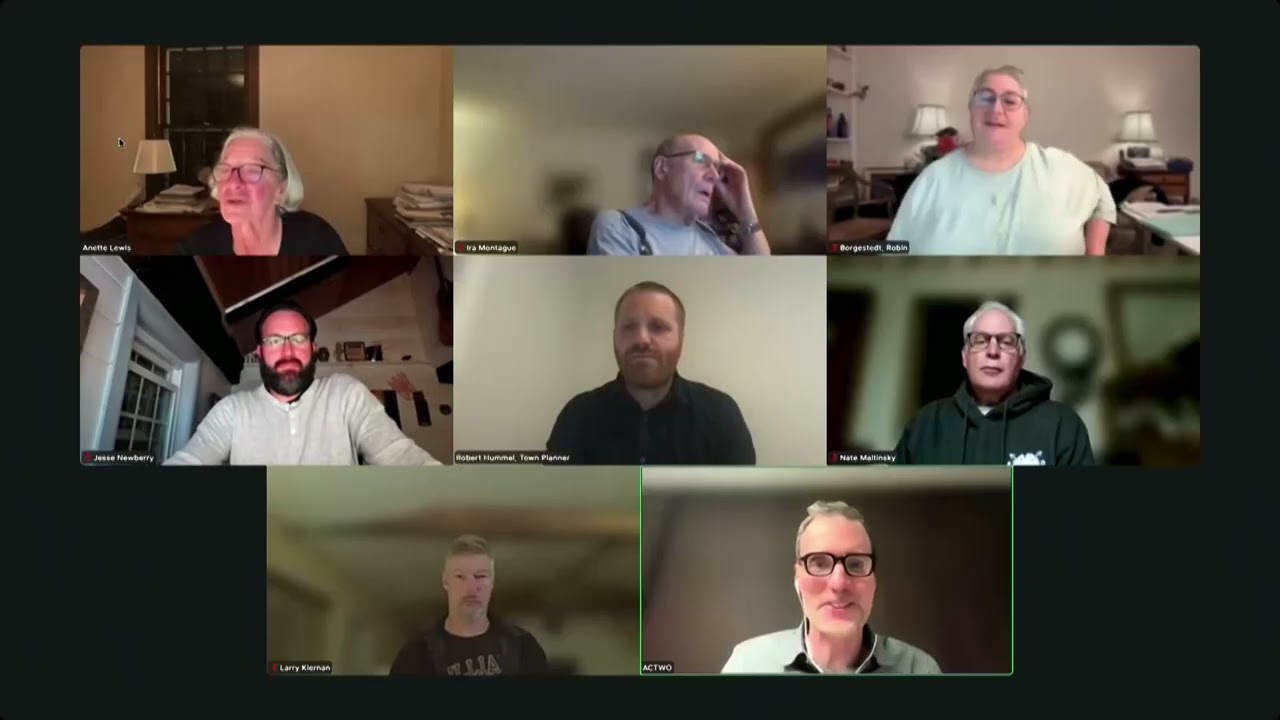
September 17, 2025 - Planning Board
Anette Lewis: This. This is
Wednesday. September the 17th.
2025 this is a meeting of the
Wayland planning board at seven
o'clock. and the meeting is
being held via zoom. I will call
them well. I'll call the meeting
to order and then do a rundown
of what's on the agenda. for
attendance. Oh. okay. I'd like
to Ira Montague.
Albert Ira Montague. Jr.: I am
here.
Anette Lewis: Jesse Newberry
Jesse Newberry: here.
Anette Lewis: Robin Borgestedt.
Robin Borgestedt: Here.
Anette Lewis: Anette Lewis here.
Larry Kiernan is not here.
Okay. I'm surprised to see Nate in. but that's fine. I thought we were just having people show up in the panel. in the attendees. and then we were going to elevate them. Robert. Robert Hummel: yes. I only said I send invites to only three will to Nate. Tom White of the ZBA and Bill Sterling. and that's it. Anette Lewis: Invites for a panelist. or invites for. Robert Hummel: a panelist. Anette Lewis: Okay. that's not what I wrote to them. and that's not what I was expecting. but that's fine. Robert Hummel: Well. especially for Bill. certainly he gets a little confused. so sometimes it's helpful for him to get the complete invite so he can actually log in. Anette Lewis: yeah. except that sometimes we're gonna want him not to necessarily be sitting on the panel. For the whole meeting. Larry Kiernan. are you here now? Larry Kiernan: I am now in the correct meeting. Robin Borgestedt: Okay. good
Anette Lewis: for the agenda this evening. We don't have any draft minutes to approve. We have a discussion of possible amendments to zoning bylaws with representatives. I expect. of the Zoning Board of Appeals and the Design Review Advisory board. The whole boards were invited to participate. but they We only heard back from the two chairs. and we're going to be talking especially about the signage by law 198. Dash 501 and 502 site plan approval by law. maybe section 198. 601 and following housekeeping. cleanup. things that Robert has been keeping track of that we need to deal with. and ground mounted solar and battery. battery. energy storage systems. which would be a new bylaw that Jesse Newberry has been working on. Then updates from the town planner with a brief overview of the Dover amendment parameters for exempt uses under the state law and our bylaw. and status of current peer reviews for the upcoming site plan reviews. then board comments and concerns. And I'm not aware of any matters that I didn't know about 48 hours in advance and then adjourn.
Okay. Bill Sterling is here and well. we have a few minutes before everyone is here. Robert. what is the status of the peer reviews? Robert Hummel: Sure. So I discussed this with Aneri before I went on vacation. and I came back on vacation. and she has officially resigned from the town. and she's given a two week notice. Is noted in. I believe. noted in the last Planning board meeting. I think that Nia mentioned that as one of the updates. and she has not been in since I started back on Monday. So I have the information-from so there's two projects we have. We'll look at the church. and then the Carroll School. So for the church. I we had three scope of works. and I think we have three. Pardon me. you have three. What we have through two projects that we're talking about? Yes. So we have the church the Coptic. the Coptic Church. and then we have the Carroll school. the education use. so for the for the Coptic Church. we have three peer review score works that we received back. And I think Believe. believe that me and Linda have agreed upon one of them. And then for the Carroll School. I have not received anything yet for that. Anette Lewis: have the RFPs has gone out? Robert Hummel: the RFP the RFP is also different. you mean the RFQ. whatever I believe so. but I would have to follow up with Aneri. when she gets back. Anette Lewis: she has somebody check her email to see ? Robert Hummel: she should be back tomorrow. Hopefully. okay. so we've been kind of itching to follow up with her on that. And then for. I believe that the board wanted transportation. traffic engine peer review. Is that correct for both of them? Anette Lewis: Not necessarily. the you need to make that determination under the Dover amendment. certainly for the parking and the circulation on site.
Robert Hummel: So did the board want peer reviews for that too. Anette Lewis: for what two? Robert Hummel: the two projects for a traffic engineer to that's what Anette Lewis: I just said. certainly for the on site traffic movement. And I you can do some on the approach way. but you have to be careful because of the requirements of the Dover amendment. as you'll recall from the Veritas project. Robert Hummel: So circulation and what was the other?
Anette Lewis: circulation and driveway approach. I mean. they can. I don't know. mmyou have to talk to the applicant about what they're willing to pay for. those things they would have to pay for. but for traffic review. didn't one of them send in a traffic review. They both did okay. So you could have somebody look at them. I guess. But I don't think we can do a major. major. do on those. Robert Hummel: I have. just today. because it wasn't. wasn't. I'm sure where near he was with we've seen those out. So I send. send them out for both of them. Anette Lewis: So okay Robert Hummel: but I've not received anything back. No scoreboard back yet for the writers. And I've not received anything yet back for the Carroll School for 503g but my understanding is probably in Aneri's mailbox. So if she's not tomorrow. then I will. I will request IT to take a look at their dept email box. because I we need. I need to move on this. Anette Lewis: Yeah. no. we do. And it would be good to have the peer at least preliminary peer review done before the October Robert Hummel: Yeah. that would be the goal. But I think this. 15 hearing.
this change in in uh. staffing. and her absence has had made. made a little harder to get this done. especially when I don't have all the information. And it also Anita us out so I don't have Anita was. I think she was an emailed on some of those emails. so she's also not there too. so I can't see what's going on. Anette Lewis: Yeah. she didn't have them either when I talked to her. Robert Hummel: So that's what we have now been trying to put pieces together since I since I was out on vacation for a week. Anette Lewis: Okay? So for the things that have gone out. it'll be consolidated with Board of Health. Planning board and Conservation. Robert Hummel: yep. So for the Board of Health. for people about the ground mounding analysis. That's what the Board of Health would like to see. Can think a lot of stuff septic is a little early for that stuff. but so mostly be ground mounding. But their stuff would be the chapter 193. I think of chapter 193 of storm warning. Anette Lewis: I just want to mention that the notice went out for the in the newspaper for both of those hearings. I didn't see it in advance. and it just said that it was going to be a Zoom meeting. So for the first meeting that we have for each of the hearings. they're going to be zoom. They're not going to be in person. as we discussed. but for those thereafter. they're going to be in zoom and in person. Robert Hummel: Yeah. I think it's. I think it's. it's easier for me to set up the first hearing. if it's just zoom. and then we can. we can go to a better Tran better to hybrid into next meeting. Anette Lewis: Okay. wait. I mean the reason that I'd like to have all the peer review guys lined up. is I'd like to be able to schedule hearings so that people know what the subject matter is that we're going to be dealing with at each of the hearings. And perhaps be able to consolidate then. when we're talking about storm water. perhaps be able to meet with the Conservation Commission at the same time so that it's not as disruptive for the applicant and for the residents. Yeah. so let's think about that. Thank you. Robert Hummel: And when was it that. when was a decision that you wanted to be hybrid was that? Was that last week's meeting? Yeah? Yeah. right. So good idea everything. I get everything done before they lost me. me because. no. Anette Lewis: well. and Anina thought that she could add it afterward. And I explained to her that she couldn't. because it was a legal notice. She thought that we could add the in person afterward. Robert Hummel: Yeah. it's fine. but we can just change it. We'll just move it to hybrid at the next main. yeah. Anette Lewis: okay. Robert Hummel: not big deal Anette Lewis: um. I don't see Tom here. Tom White Unknown: act. There's an ACTWO. I don't know who that is. Anette Lewis: unless somebody else came in. Robert Hummel: someone has a hand up in the in the audience. Anette Lewis: I just okay. that might be Tom. Robert Hummel: it's. don't recgonize the name. Thomas White: Sorry. That's me. That's my Anette Lewis: Oh. good. Thomas White: ACTWO. that's my company's name. Unknown: Terrific. Anette Lewis: So we have Bill Sterling. who I can't see. Bill. are you here? Robbie Bullard: I'll bring him over. Anette Lewis: Okay. I thought he was brought over already.
So this evening. we have Tom White Chair of the zoning board. Nate Maltinsky who is our zoning Commissioner. and not Susan Westerling. she's not to be brought over. She's the public. Bill Sterling got it. And Bill Sterling. who's the Chair of the Design Review Board. so I'm assuming for you. Tom and you. Bill. that you've discussed what we're going to be discussing tonight with your board. and you've got the authority to speak for each of your boards. because they're not posted. And Thomas White: yes. for me. that is. that is the case. Anette Lewis: Can't hear you. Bill. you're you're muted. William Sterling: I assumed our entire board would be invited to this meeting. Unknown: They were. but you're not posted. so that's okay. as long as you can represent. William Sterling: I assume that Robert knew that we were going to be having to post it. I don't know. Anette Lewis: Uh. um. I don't think he posts. I don't. You'll have to work that out with him. Robert Hummel: I don't make any assumptions. Do you need? If you need a postage just ask I I'm not. I just got back from vacation. so been trying to catch up so not was not paying for everything. Who posted what Anette Lewis: did the invitation out to everybody on your on your board. William Sterling: Oh. do you want me to sign off then? Anette Lewis: No. Robert. to start off.
Robert. have you spoken with these guys before you prepared the sign? Unknown: I did not. Anette Lewis: You did not. Okay. Robert Hummel: see. these are some ideas that have came from Well. in general. yes. So I have had talks with. with Bill Sterling about some part of the signage by law. about how we have one example be the Jersey Mike sign. how that's it's technically not allowed the back lit signs. and that'd be something we could potentially put into a zoning amendment. But in general. these are the things that I've picked up that we don't have today. and that would be kind of be cleaned up a little bit. and some of it is pretty much basic I can put on. I don't know if how you want to run this back and put on what I have so far? Anette Lewis: No. not yet. I don't think so. Let's hear. I don't know Who should go first. You Tom and Bill decide who wants. I assume the two of you have talked. right? Thomas White: Yeah. we've we've talked. We had a we had a discussion a couple weeks ago. in general. So I can just only. I can really only comment from our perspective. on the zoning board. right? Because we actually have to hear of the sign. the applications for signs and every single application. someone always wants to there's always a special reason why they need to do something slightly different from the bylaw. The most recent example was a pediatric clinic on old Connecticut path. right kind of in the center of town like to comply technically with this the bylaw like they wouldn't have been able to put a small sign on the rear of the building. sort of facing the parking lot. sort of advertising the doctors names. right? Because the sign on the front. when you combine it with all the other signs in the building. kind of exceeded the. The 30 square foot rule. right? So there hasn't been a single sign application that we get on the zoning board where there doesn't have to be some. I don't want to call it waiving. but some. some requests to somehow tweak something in the regulations. because they need for this reason. and they're usually always benign reasons. right? But I can my observation as an architect when working in other communities is I've seen other sign bylaws that I don't have any examples to share because I wasn't that well prepared for tonight. but I've seen examples where other communities have a bylaw that has different requirements for different districts. Now. maybe this is appropriate for Wayland. Maybe it's not. but I'll use the example of Waltham. Wait in Waltham. there are some districts where the signs are much larger because they're viewed from the highway. Maybe not appropriate for Wayland. right? Because we don't have a highway. but as a case of as an example. right? Certain buildings are allowed to have much larger signs. because the primary audience for the sign is vehicle traffic moving at 60 miles an hour. Other districts where it's more residential the signs. signs are sort of designed to be in keeping with that more residential district. So a possibility when thinking about how to consider revising the ordinance is that there could be slightly different requirements for different districts. right? And I'm coming at this from the perception that I'm hearing that in general. people are unhappy with the signs because we don't have a super strict way on the Zoning Board of Appeals. of interpreting the esthetic criteria of the signs. right? We had can only go by the by law. We might have personal opinions and say This sign is unattractive. like. I really don't like that. The blue color. I think the red lettering is tacky. We can't that can't be part of our hearing process. So we do get advisory opinions from the design review review board that can weigh in on the kind of quality level of the sign and sort of their compliance with the bylaw. But because of the structure of the Design Review Board and the way it is set up in the bylaw. these are kind of only advisory opinions. and a applicant with a strong legal case for why a sign needs to be larger. needs to be split into three parts. needs to have a certain geometry. Can easily say. well. like. you know. you have a signage by law. it consists of these five paragraphs. And there's. there's nothing in these five paragraphs. No one has said this to me. but there's nothing in those five paragraphs that says. like. you can kind of legislate or sign approval on do you think it's ugly? You think it's architecturally appropriate. etc? We can't do that anyway. really. no. so. so it's but other communities have done this. There are other communities you can see. I think people use um. Freeport Maine as an example. Like their signage ordinance in the center district. like all the signs are made out of wood. they've stipulated the material. They've stipulated the size. Can we stipulated the color? I don't know. in Unknown: Massachusetts that. I Robert Hummel: don't know you can do it depict historic districts. Anette Lewis: In a historic district. yes. and Nantucket. you can. but that's got special legislation for Nantucket. Thomas White: correct? You know. this is so I'm only I. again. as an architect. not a lawyer. I don't necessarily. I'm not great legal expert on what is permitted and not. I'm just sort of. you know. giving you examples of things that I both I think of. like the challenges we have on the zba right. enforcing the by law that we have right. and the fact that. you know. in crafting any bylaw right. you don't want to be so specific. because you then constrain options. and you might accidentally make something much worse. because you can't if you're too specific. you can't think of every instance that you want to legislate. So you've got to create something that that is the great balance between. you know. control and maximum flexibility. right? But hearing that people have been generally not pleased with the signs that that we wind up approving on the zba. we're sort of. we're happy if there is some. some way that we can either get a little more authority. kind of. architecturally. to to shape these signs within the bounds of. you know. Mass General zoning laws. or is there some other vehicle can can the Design Review Boards comments sort of include more kind of architectural critiques that we can kind of bring in to our hearing? Unknown: Systems and and sort of Thomas White: opine on. you know. within the context of of the by law. Anette Lewis: the way that the by law is written currently is relatively generic. It's 40 square feet. essentially. you know. you can figure out where you want to put it. how you want to put it. but it's 40 square feet. So that's and there are provisions. I think. in the by law. which you know about. that give you the ability to Unknown: make them bigger. Anette Lewis: Yes. the idea of having different districts becomes. this is just me speaking problematic. because we don't have that many different No. you don't. you know. yeah. and residential isn't supposed to have them at all. true. And the town center has its own zoning stuff under that. so it doesn't leave lots. no. Unknown: So if you could give us specific things Anette Lewis: that that we can try and work with that would help. I mean. it's 40 square feet too small. Does it need to be bigger? You know. on the lit dental building. that sign seems really large. I don't know. Thomas White: it seems like it's large. but it's not. It's like. because we. that was a that one we went through for a lot. and I mean. they did ask for. they did ask for an increase. but I want to say it's within 15% so I would say every universally. we are asked for increases. A lot of times it's because people want more than one sign. The most recent one was the approval for the Dunkin Donuts Jimmy John's facility that's going in where the um. Unknown: former Bank of America was like Thomas White: when you added this. I believe. and I could be mistaken. but I believe when you add they and they made the case. and when you added the square footage of the signs. I think it was four square feet or five square feet over. or something like that. It was a trivial amount. But again. the case was made. There needs to be signs on two faces. and they probably should be of equal scale. So for the most part. the request is to is to allow us to increase it. Which the bylaw. I don't know that necessarily need to change. We have the ability to increase it. I would. I would say that it's doesn't seem very well worded. It's horrendous. because when I read it. I and again. I'm not a lawyer. but I could read the sentence to I could read the ability for us to increase the signage size two different ways. So if I can do that. I can imagine someone who's a really skilled little gate would have a different opinion. So I it would probably be nice if it was maybe there was something a little more legally Anette Lewis: precise. Yeah. it would be nice if the whole thing were more legally there's a lot Thomas White: of ambiguity in the number of Anette Lewis: years ago. I was tasked with Susan Kaufman. who was a member of the zoning board. to come up with a news sign by law. and we worked for a week and came up with it and took it to the planning board. and the planning board then said. Oh. that's nice. And then put it aside. and maybe we can look at it again. And also. I mean. I understand what you're saying. and maybe it should say something like for two street facing sides of a building. or street facing and parking lot facing sides of a building. you can have a sign or something like that. Thomas White: Yeah. that wouldn't be that wouldn't necessarily be bad.
Anette Lewis: But aside from that. are there other things other than the faces that it needs to be on in the saw and for 40 square feet? Is that a bad number. or is that an okay one?
Thomas White: I think it's a reasonable number. I actually. you know. not withstanding all the things we're talking about. Unknown: The fact that you have Thomas White: a body in town that does have the ability to look at it and regulate it. that that does give us the ability to say what you're proposing is too large. right? So. like. I would be hesitant to say. you know. make it 60 square feet. Because I think if people's perceptions are the signs that we have now are on the large side. I wouldn't advocate increasing it. We have the ability to kind of constrain them to. you know. again. because we have the ability to allow the 40 square feet to be exceeded. It gives us the ability to make a determination of. What we think is reasonable. but this is where. this is where it becomes challenging. because I Unknown: think of an example like Thomas White: if someone asked for a 100 square foot sign on the face of a building the size of Stop and Shop. that's architecturally reasonable. because that might be proportional to the size of the building. but if someone asked for a 100 square foot sign on the lit dental building. it would be too large. So is there a way for us to bring in. in the bylaw. a discussion about sort of the architectural character of a sign and why it may be appropriate to allow for a larger one versus not. I think that would be the P that's. in a way. in my mind. the missing piece by just saying we can only go by the sentences in the bylaw. it implies that the zoning board doesn't have the ability to talk about the actual design merits of a sign. and yet. I mean. someone is coming to us to approve it. and this is why it's a little difficult Anette Lewis: a special permit. I think that you have that ability. I think we'd have to ask town council if we can bring in the architectural elements. I would say we probably can't. because we're supposed to be pretty much cut and dry. Yeah. the architectural elements are very subjective. Unknown: But could Robin Borgestedt: you tie the if they're coming for a special permit for a larger size? Could you tie an absolute maximum to the percentage of the face of the building that the sign is going to be on. you know. 40 square feet. but under no circumstances can a special permit be allowed that would permit the sign to take up more than. you know. 20% of the face of the building. Thomas White: And so I appreciate. I appreciate the idea there. I think it might be hard to do just because there are not a huge amount. but there are. there are enough buildings of differing sizes in town where it might be. might be hard to do. because what could look good at 20% on some building. might look better at 35% on another building. So it might be hard. I like the idea. but it might be difficult to actually implement something that tricky. Anette Lewis: also on the face of a building. depending on how the building is constructed. the top part might be smaller than the bottom part. And how do you know what the face is that you're counting Robin Borgestedt: from? Right? But is there some. you know. is there some similar way. some other measurement that you can take. that you can say there's a hard stop at this percentage. even for a special permit.
Thomas White: Right now. there's not. it just is up to us on the zoning board to say we don't. we don't agree that this is appropriate. And. you know. we have to. we have to find the language to say that it's not appropriate within the sentences of the signage. Anette Lewis: By law. no. you can also use the special permit. We can use Thomas White: a special permit language that it's. like. it's. it would derogate from the character. yeah. okay. Then. then we probably have enough. I mean. we haven't been presented with something like that. so it's it hasn't been an issue so far. But you know. if we're looking at understanding this. it's a possibility that Unknown: it could be so if there are other Anette Lewis: things that you think of. even as we're talking tonight. and even in other parts of our by law. I know that you've given us stuff over the years and never done anything with it. We're starting to try and and fix the so just pipe up. Bill. Do you want to talk? Unknown: Sure. I.
William Sterling: I looked at this from and I agree with all of Tom's concerns. having been on the zoning board myself for over 10 years. I do feel though that in those 10 years. even though it was frustrating. we did manage to get through coping with some very. you know. cryptic notes in the zoning by law about signage. I You may and I agree with Tom on this too. that you may regret getting more detailed about what you are going to require. because that will just make the zoning board's job probably more difficult. I think that let me get get into what I was thinking about. though. Robert Hummel: when we did the guidelines back in 2011
William Sterling: our committee. our working group. I believe we looked. At the Newton. city of Newton signage bylaws as an example. at the time. as a as a good example of signage
guideline. And we also looked at some others. several others. So this past week. when we were invited to join this meeting. I thought about what where we are today. and it appears that there's still a sentiment in Wayland Unknown: that that our town William Sterling: look to the town of Concord as an example of a town we'd like to look like. Anette Lewis: and I think that William Sterling: the first thing I did then was to check their bylaws out. They they rewrote their bylaws in 2020 and that date was encouraging to me. thinking that. well. they've fixed all the kind of problems that we may have faced. But as I scan through the signage
Robert Hummel: miles. I it was William Sterling: surprising to me that they actually allow signs that we would never want in Wayland. So what I wanted to do next was Robin and I talked about having the Design Review Board look at different towns. I was going to drive around Concord and and get a better idea of what the how the signage fits with their buildings and fits with the character of the town. It may not be as consistent as you were mentioning a historic district where you say all signs have to be wood. which I think they do in places like Beacon Hill. I think that it does. It may end up that we can use their recent sign by laws as a guide of how to organize the information. but we may not agree with all the decisions they made about what would be required. Unknown: That's where I am on that. Okay. Nate. do you want to weigh in? Well. Mr. White stole the show. So that was well. well. put together. Thomas White: Tom. I don't know Unknown: about that. No. no. really. you covered all the bases. I believe that maybe the style of lights that is more prevalent now. like the ones that were permitted for Jersey mics. where it's a it's got a rare illumination that's not obtrusive to to anyone is not glaring. I think we have to look at new styles of lighting that we can permit. that that is tasteful. that there's there's a lot of new designs. a lot of new technology that's out there that can be utilized. that I think we have to look at and address in the future here. I don't know if you've gone by Jersey Mike's at night. but it's. it's a well done light. And is there? Is there marquee is what they use for all their stores. And I I think that the zoning board has done a great job of adhering to the needs of the applicants and working with them to make the signage work. and nothing has been in my tenure so far that nothing's been out of control and within reason. So there are. there is some good language. and I did look at a few other towns. but I would like to see your. your work that you've done previously. Anette. that you presented to the planning board years ago. Okay. I'll look for it. Anette Lewis: So with a jersey Mike sign. What kind of lighting would you call that if we were going to draft something for that? Unknown: It is a low illumination. rare lighting. and it's more of the like a halo. It's a halo lighting. and William Sterling: as opposed to internally illuminated. That's that's not allowed. that's correct. and that's why we were material. then a backlight will shine through the sign material. and that's not allowed. yeah. Thomas White: And that's why we didn't flag this as a concern. because it seems to. it seems to not meet the requirement for the. you know. backlit right component. even though it is illuminated and it's got a halo effect. So this is an instance where I don't. I don't think they designed this to skirt the language of the bylaw. I think it's their it's their brand. But this is an unintended consequence of the. About the way the by law is worded. And I don't think anyone would have anticipated trying to come up with a definition of that style of sign lighting. because it's not it. Probably it's not very common. It's done more now. but it's not something that I think would have been anticipated. Anette Lewis: So when in our bylaws. we have that signs can't oscillate. They can't. I believe it says somewhere that they can't be neon signs and they can't be internally lit. Is my recollection. Is basically the three criteria. Unknown: Are they problematic for you to have those criteria? No. I don't think so. I would keep them too. Okay. they're fine.
Anette Lewis: So Robert has gone through and made some suggestions for us. Doesn't cover all of the things you're talking about. and I've read through them. and our bylaws are really confusing. I mean. I was even though he marked them up. they're still confusing. And I think that they need some assistance. Robert. do you want to put them up and take us through so that we can all see the kinds of things you're talking about and tell us. in an overview. what kinds of changes you were thinking that we should do. Robert Hummel: Yeah. so for the first paragraph. just really make it very easy to understand who has the Fay to approve signs and what. what can the zba or which special. special permit granted for you can do so first. Section five. oh. 1.11 is just cleaning it up. but it also takes away the lines that provided. However. the signs with moving parts or internal limited are prohibited to allow that internal lighting in limited signs like Jersey makes. And then another thing that that the pilot doesn't touch about is that is Dover amendment signs. So putting a section in that under five. oh. 1.2 to cover non profit. educational. our cultural. religious or child care uses says something that'd be something new. because we don't have a category for that today. Point three. oh. I skipped over this. Also adding three new definitions display area. sign and temporary sign. So actually given information. so setting. what does mean in in Section 104. and what display area means? Because that is also a discussion that people have. is. how you do. how do you actually measure display area? Is it the whole box? Is a drawing a box around it. or is just. you know. each. each one you have so be drawing a giant box around the sign. And that's that. that it will be the display area. so that would be not a a Unknown: just a disagreement. Robert Hummel: And then format to 550. 1.3 adding the word signs when you know upper casing it also adding a section about science cannot be illuminated longer than 30 minutes after before. before or after closing any signs just to kind of loosen. you know. close then close that there. One of the issues we're finding in this town. I've noticed. is people will just put up temporary signs up in it. We don't have. we don't have a section today about temporary signs. So a new company comes in. let's say. you know. Mike's clock. You know Clock Company. They come into town and they got. you know. a permit from the zba. and then they probably signs up. We have. it's. it's. it's our job is staff to enforce that. So one ideas would be to allow them to put up temporary signs for the. you know. the first 30 days. while they open up. and then for them to. you know. take that down once the 30 days is over. just so they can get that the new business in. But they're not about to give it a long term. because we've had that in the past where new businesses get their special. you know. their special power. For the zba. they put up the signs. and then they put up these. a phrase signs for up. and then we don't have. we don't have a section in a bylaw. And this is something I've discussed with needs. It's just giving them the grace period for 30 days. But one idea would be to allow for temporary sign. Allowed them to apply for a temporary sign with this with the building Commissioner. and then for them take it down after 30 days is over. just so they can get the new business in and people can find them. but then also give them the opportunity to actually Unknown: advertise. so that. Robert Hummel: I have to right now. I also wrote down.
potentially adding something into the first section about allowing signs on two faces of the wall. kind of we talked about the young donuts and Jimmy John about how they have a sign on the front of the building. and then they want to decide. and potentially allowing that. if it. if it's within the 40 square feet. and making. maybe being making that by right. so that businesses have to come in if they comply with the bylaw with 40 square feet. but they just have two signs because they. you know. are ones on the part driveway and one is on the road. That is a potential idea we could. we could add in there. So. but I do agree this time bar is Unknown: very small. but also there's Robert Hummel: places in this bylaw where it's very confusing. and I think it'd be helpful to clean that up at the same time. Anette Lewis: So when you talk about the faces of a building. this is for everybody. all of us that we've been talking about. One could say two faces. One could say faces facing on public areas. There's some buildings that might need three because of the way that they face. How would it be easiest for the zoning board? Thomas White: I guess if it was instead of. instead of specifying a number. you could say. you know. signs could be permitted on multiple faces. you know.
Unknown: with appropriate Thomas White: reviews. or something like that. Because if you say two faces. I think Anette makes an excellent point. Maybe there's a building that's an octagon at a corner that needs signs on three sides. So I wouldn't want to say only two. I like Robert's point that if there's a way to streamline this so someone. someone who has the need for something that's a little bit unusual. signs on two sides. but they're under the 40 square feet. maybe they could just be approved. you know. by the building Commissioner as of right? And it doesn't require a permit. That's an interesting idea as well. So I think you could say signs could be permitted on multiple phases. you know. subject to review. or some language like that Anette Lewis: when you're reviewing a project that clearly is going to need a sign. from my point of view. you should be approving the sign at the same time you shouldn't. They should not be walking away without having at least the size of the sign and the location of the sign approved and then come back for. you know. the final sign when they when they get it. because we have people who have done buildings with no signage. and they should have had a special permit for the building to begin with. And then they don't. they walk away with no sign permit. permit. and then they go back to you for the sign permit. It just doesn't seem Unknown: efficient. I Thomas White: Yes. So the last two restaurants. we actually we approved the signage permit and the restaurant use special permit at the same time. That is a little unusual. Most people bifurcate the process. I don't know why. and give us a sign. They come up. they say. this is. we're going to come back later with a signed permit. William Sterling: That's been my experience. too. It's. I'm not quite sure why. you know. Thomas White: So we combine them. William Sterling: They're building a building on spec. Yeah. they don't know Jesse Newberry: who's gonna Yeah. that could be so
Thomas White: we don't necessarily have a problem with it. but as I said. Where. where we can we like to streamline it and write one decision with both permits. So as I said. the last two. last two restaurants. we were able to do that and combine them. Robert Hummel: An interesting case is the terrain project. I believe that they came in front of the Zion view board already about for their signage plan and their science plan is is. of course. over 40 square feet. But when we. when me and Bill. looked at together. um. based on how many tenants I used to have in that Plaza. the number of signage was the number of proposed signage square footage was under the number of tenants that he if you took each tenant and occupied by 40 square feet. or it was a number. But I don't they don't believe they have applied Thomas White: for the zba yet. They have not applied to the zba for that the signage. they Robert Hummel: haven't closed in a property too. So they're not gonna apply for the sign. They're not gonna zba until they close on a property. Yeah. you haven't closed or the the property manager has not closed in property yet. so they haven't applied for it. So there are some scenarios where. yeah. would have been nice to rank him in. With their plan and approved it. but they also have to make sure that they're not wasting anybody's time and money by submitting a plan. And then it's me happening. Anette Lewis: So one of the areas that needs to be changed in the bylaw is it talks about per lot. and sometimes you will have three lots combined for one project. And sometimes you'll have one lot with. as you said before. five tenants. So we need to figure out probably more on. well. depending. I was going to say probably more on a per tenants. size per tenant. number of signs. the problem then becomes as and I don't know if these are all approved signs. but if you look at the office building at the corner of Boston Post Road and Pelham Island. there are signs that are showing up. I'm sure they're way over. They're 40. I don't know if those are even approved. Unknown: Does anyone know Thomas White: they haven't? We haven't seen any applications for Unknown: anything else
William Sterling: we when we were on it. Anette. a number of times. the zoning board. when I was in the zoning board. a number of times we basically. and it wasn't written in the bylaws. We basically had to wing it and say. Well. this is a multi tenant complex. You take what used to be donlins complex. and it had many tenants and many signs. and we basically just had to use our own judgment on how many you know. if you have at least one sign per tenant and send this. I know we have two entrances. one in the front and one in the back. so you have to use your judgment. And I think it would be hard to legis. you know. to get legislative about it. and to find every condition that you're going to face. but you may want to put some language in there that gives the zoning board level of comfort that they can do this make right value Unknown: judgment. Yeah. that makes sense. Thomas White: and that's as simple as you know. confirming with town council that we can use not only the signage by law. but every bit of the language in the 4201. for a special permits.
because typically. we've been given the guidance. whether it's correct or not. that we need to refrain from making kind of specific design you know. design comments you know. which are usually more for the planning board or the Design Review Board. But given the unusual circumstance we have here where we're in charge of enforcing this like. you know. I just want it would be great to just have confirmation that we have perhaps maybe more leeway than we have traditionally been thinking Robin Borgestedt: Roberts. Roberts draft that's on the screen does provide some language. right? The very first sort of section in that big paragraph. yeah. each business on a lot is entitled to one wall sign. and each lot is entitled to one freestanding sign to display all the businesses. So. you know. kind of taking that and maybe beefing that up and making it. you know. little more clear. The difficult situation is when each business also has. you know. a roadway facing facade. and. you know. their main entrance is on a different facade. kind of thing. William Sterling: Yeah. Donald's is another example of that. you know. they have a major road entrance from two different roads. So they need two kiosks with multi signs. maybe the third one on the intersection with the corner. you know. So they have multiple needs there.
Anette Lewis: Also talking about businesses. Sometimes we have not businesses. We have churches. we have social clubs. so we have to figure out how to word that kind of stuff. Thomas White: Well. that would be. there are provisions in the Dover amendment about religious uses. so that may be difficult to
Unknown: develop. or at least a little more challenging.
Robert Hummel: Are we? How do you feel about putting a provision about for free. saying sign to add Unknown: landscaping? I
Thomas White: think it's a good idea. I think it's hard. It's hard to enforce. because. say. they would put us in on the zoning board. in the position of telling them what they have to landscape with which we're happy to do. But like. you know. it's like you don't. you know. probably don't want us saying you have to use these kinds of shrubs. like. at this density. this. Right? I mean. that would be difficult for us to do from a design perspective. Robert Hummel: A good. a good zoning by law for signage is. is actually the town of Acton. And I worked at Town Acton for six years in the past. And they were. we were very. they had a very. very. very detail Zoning Bylaw. section by section. village districts. non village districts. and it is one section and about. they have to have landscaping for free. saying sign and space still not a landscaping is based on the height of the sign. So if you. if your height is the size six feet. you would multiply by it by two. and then you would square that so be 144 square feet of landscaping. And it just says that landscaping must be planted and maintained with suitable vegetation. shrubs and flower. It didn't say what kind of things. Okay. so there is provisions. I. I didn't put in this draft. But we. if you. if you want to beautify signage in the future. you could require landscaping. And that was also one of the things that the smart could go to the planning board of zba for in time of acting too. is if you wanted to reduce your landscaping. So if you had to put 144 but you. you came in. you're like. I can only put in 50 square feet. You can go to zba or planning board for for relief for that too. So there's a. if you look at that by law. there's a few other things you could. we could potentially do. I am not advocating for different sides of different districts. because we. we don't truly have. like. a real village district. like the town of acting does they have real districts that have a real village feel to it. Thomas White: But yeah. I agree. I think it's like. it's. I used it as an example. but yeah. it's. you're hard pressed to sort of make a case that Wayland has these kind of unique. unique districts that would require it. maybe. Robert Hummel: But the town of Acton had it had a very. very detailed temporary sign program too. where for getting new businesses. you if you want to advertise your business. you would apply for up to 45 days a year where you put up a temporary sign. So if you're doing like. you know. sales and stuff. you could you would pick your days. what days you want to do. But that's really. getting really detail into this by law. But I think the whole point of this was to make this simple. but also allow for. honestly. a lot for temporary science. because people are just putting up temporary science for new businesses. And it's hard to. it's really hard to. we don't have the staffing to police them all the time. or to bug them all time. to take down the science. So I think internally right now. we're just like allowing it for the first three days. just because we know them. that they are new. and they want to attract new businesses and new. you know. to the to the location. But we gotta figure a way to govern that so that people can. we can kind of administrate that in the future. Anette Lewis: Robert. in what you have in five. oh. 2.4 with temporary signs no bigger than 10 square feet in display area. and the sign. any sign that moves or a banner. is prohibited. So the kinds of things that we've been seeing are essentially banners. They're like flag things. Robin Borgestedt: flappy things Robert Hummel: we don't want. We want. we don't want the any moves. So I'm thinking more of like a sandwich board. a five by two sandwich board. or a one of the signs you kind of push into the ground Anette Lewis: right with the sandwich board. And I can't remember where I read it in here. but you talk. Okay. it's right underneath it. a temporary sign. shall neither be erected on a sidewalk. walkway or driveway. nor within five feet from the sideline of a street or right of way customarily used by the general public. The sideline of the street. to most people. is where the pavement ends. and it's really the lot line. because they can't put their signs on the public way. you know. in the unpaved right of way? Unknown: Yep. correct.
Robin Borgestedt: It seems like we have a lot of those flapping signs that are more or less permanent in town right now. Unknown: Yeah. agree.
Where do you have those? I
Robin Borgestedt: think the landscaper in the center of town has had one up and somewhere else maybe. is it this the convenience store somebody else has one up also further along on route 20.
Anette Lewis: Is that something that you please snake. Or does somebody have to tell you about it? Or how does it work? If we Unknown: see it. we will take care of the situation. And then we receive phone calls occasionally. okay? And we go out and enforce that and pull signs or ask the Ask the individuals to remove them if they don't. We take it upon ourselves. The last one was at 27 in old con up on the hill. up in the granite landscaper. he did not remove it. so I climbed the wall and took it down.
So we will have quite a few signs. So. 112 112 to 116 Main Street is going to be all new signs coming up here soon. I know terrain is going to be applying soon for signage. Josh Fox did come in last week and had mentioned that are actually got some paperwork to for their signage. so we'll have some things to consider here in the near future. And for your purposes. Anette Lewis: aside from the things that we've already talked about. are there other things that would make your life easier? Unknown: I think that if it helps that. like Tom alluded to. that most of your national or your well put together organizations have their signage in place when they present their plans. and that's very helpful. So you get a full imagery of what they're presenting. and they have design teams. you know to present that. so that's very helpful. and then your smaller venues typically don't. and that's okay. because that's what makes the world go round. So I think that if someone's presenting a project or remodel for a building that they we should ask them to have the signage as part of the package
so we can see the full concept of what's going on. Anette Lewis: So would that be in the by law that we would say that? Or would that be in the zoning boards regulations? Unknown: I think you could put the bylaw sounds reasonable. Thomas White: You also might be able to. you also might be able to put it in the zoning application. Like. when someone comes in for a business use. like a business use special permit. it should be. like. automatic and where's your sign application as well. Like. because that way we could. you can hear them in in the same case. I don't know if that has to be in the by law. or if that could be. maybe it could be in the zba regulations. because that could be easy. That's easier to change. And then. you know. you could just accept those as as permit applications. I would say Robert Hummel: regulations. I would say you because you can't. you can't require someone to to in the pilot. to to that. So I think regulations would be easy to to know to Anette Lewis: do that. Yeah. even if they don't have the full color or the full font. knowing the approximate size is kind of helpful. I think. Unknown: yeah. I would agree. Ira. Larry. Jesse. Larry Kiernan: I have two questions. One is Tom or Nate. how do you think our signs compare to neighboring towns? I honestly don't have an opinion on that. The other question is.
have you gotten feedback that is harder or easier or difficult to get signs in Wayland versus other towns. Any feedback Unknown: from folks?
Thomas White: I haven't received any feedback on the zba that there are problems or complaints with the delays or challenges getting signed permits. Larry Kiernan: normally one or two meetings. Thomas White: It's normally one meeting. We've very rarely had someone come back with a second permit. You know. really send someone away with a continuance to come up with a revised design? Yeah. I think qualitatively. No. when I drive around. I mean. I don't study this. but when I drive through Sudbury. like or Natick or Wellesley. I don't think the signs that I see in businesses there are. like. you know. being necessarily better than the ones in Wayland. They don't seem. they don't really seem all that different. you know. because these kinds of communities generally have the same types of businesses. you know. supermarkets. small strip shopping centers with. you know. multi tenants. You know.
Unknown: in my opinion. I think that the. The predecessors in Wayland have done a good job. as far as review of signs and what's been in place. and it's. I don't see really anything as obtrusive. As far as signage. um. there's a couple that has slipped through the cracks that have just done new signs. Um. but for the most part. I think it's. I think Wayland is very tasteful. and there's nothing that really sticks out that I would say. you know. I don't like that. I mean. there's a couple on route 20 that I noticed. But for the most part. I think that everyone's done a good job. and. you know. can only make it a little bit better and and more fluid transition to to get his new sign. I have a couple questions. Larry. you done? Albert Ira Montague. Jr.: Yeah. Unless I'm missing something here. all we seem to be talking about is that size of the sign. or how many signs there can be on the building. What I'm missing is is. how do you approve the design if there aren't specific design criteria. like size. font size. you know. what? A palette of background color. you know. we have the lighting. I don't hear any how. And some of you say. with an application comes in. of course. you take the tape measure to it. That's okay. but you're also talking about approving. It sounds like you're talking about the esthetics of does this sign fit into the community and yet. who's to guide them. except for their own personal taste.
Thomas White: that's challenging. For example. if Jersey Mike's has a standard sign that is. that is the same that every one of their locations. we can't. as a community. say. you know. you you can't. You have to use. like. our predetermined background colors. font size. etc. because the sign is part of the corporate brand. So I think that would be a very unfriendly way to proceed Albert Ira Montague. Jr.: with it. Maybe so. But I know on the cape. and in other situations. McDonald's. for example. they have not allowed them to use the arches with their. you know. backlit that they've required. You know. I if I remember the logos there. the typeface is there. but it's either. you know. Thomas White: I again. not an expert in it. but I believe I'm familiar with places that have done that. I believe. though those are specific kind of already legislated historic districts. you know. where I think that that. I think there has to be some other underlying legal structure in place that I think would allow that type of Unknown: regulation. Albert Ira Montague. Jr.: We should look into that. because I don't remember them that way. I remember them more like
strip mall. Of course not. But. you know. a number of different stores lined together that were in. what a more rural. or more. you know. I remember them being down on the Cape. where you kind of have these little. semi little malls. and they've required them to have all of those signs unified. but Robin Borgestedt: they could be roads that are designated scenic or something like that. They don't seem scenic anymore. but they may have been scenic roads or something Robert Hummel: possibly I still. Albert Ira Montague. Jr.: I know we had a conversation about the Dunkin Donuts at one point. and we had talked about somehow making them or suggesting to them that they don't use that logo. I mean. I think that's Anette Lewis: I agree. Again. I'm just looking at our bylaw for special permits. and it's taken exactly from the state bylaw. And at 198 203. it says. For a special permit. the applicant shall show to the satisfaction of the special permit granting authority that the use building or structure for which the application is made shall not be against the public interest. shall not derogate from the character of the neighborhood in which such use building or structure is to occur and shall not be detrimental or offensive because of noise. vibration. smoke. gas. fumes. odor. dust or other objectionable features. and that such use building or structure shall not otherwise be injurious to the inhabitants of the town or their property. or dangerous to the public health or safety. and I don't know for a fact. but I think that that's what they're using. because there are many places that won't let you use your corporate Unknown: logo kind of thing. right? Yeah.
William Sterling: Yeah. one in free Point Main a McDonald's is famous because they. McDonald's tried to sue them and lost. McDonald's has this little. teeny little. you know. McDonald's name on the side of the building. and that's all you got. Robert Hummel: Yeah. there's a really. there's a really cool one McDonald's. and I believe. is Arizona. It's. instead of a yellow local. is a turquoise blue. and it blends in with it. It blends in with the rest of the year in Arizona. It's really. really unique. But those. I mean. those are very extreme cases where there's very unusual cases. This thing like design islands already built in. and then Madonna's comes in and wants to do it so but Robin Borgestedt: sort of. that's one of my concerns. If we take out the prohibition on backlighting. because there are. there are backlight backlit signs that are offensive. and that would derogate the character. and maybe the jersey Mike sign is less. less of an affront. but William Sterling: I agree with you. Robin. yeah. the backlighting is fine. I think internally illuminated plastic signs. though. are still objectionable. Robin Borgestedt: yeah. so we have some language to to define that if we're going to take out the prohibition on internal lighting. You know. internal lighting. it doesn't shine through. How do we how do we say that? William Sterling: That's how I said it to them. I said. if it's the material is translucent. then it's not allowed. If it's opaque. then it's basically you're backlighting it.
Unknown: We could talk about backlighting. That's it. William Sterling: That's a sentence you need right there. Thomas White: Yeah. it could be the sentence an Albert Ira Montague. Jr.: example. Bill of what you're talking about.
William Sterling: An example of what I'm talking about would be. well. you were just talking about the one that just. is it? Duncan is putting in backlighting signage for their
Unknown: for their signs. and they allot it right. Tom. yeah. William Sterling: and the an example of an internally illuminated plastic sign. jeez. Anette Lewis: Lim. but like a mobile gas station sign. yeah. those William Sterling: are classic. That's a clean thing. and that's a very good example. The logo itself is a big plastic glob of blowing up. Yeah.
Thomas White: I am going to run out of time. I've got a gonna have to sign off in just a couple of minutes. But this has been a great discussion. We should probably aim to have a. you know. maybe set up something like this on a quarterly basis to kind of go through it doesn't necessarily just have to be on the signs. because there are a couple of other there's always some inconsistencies that we encounter in the by law. I would just say that that. if this group is looking at it. we've had several challenges recently with garages and side yards and sheds. there are some extremely conflicting languages in contained in the yards component of the by law one that we actually had to escalate up to town council for an application that we had. and she She gave us some great feedback and pointed out that. yes. there are some glaring like. legal inconsistencies. Anette Lewis: Can you share that with Robert and he can share it with Thomas White: Yes. I actually. I think. I think I had shared this one with Nathan and with Michael McCall. But yes. like. I can forward the email exchange with. with Carolyn Murray on. on some specific quirky problems we had with interplay between 401 point 1.2 and I think 703 on the yards. so. And. you know. there's always come up. you know. because people only come to the zba because they need to do something unusual. right? So I recognize that. like. we're the venue for the unusual projects. like no matter what. so it can't all be standard. So and then we're comfortable with that. We're that's what we're used to. But when. when we have when the bottom points us in two different directions. we sometimes struggle to accommodate what people are looking to do. And generally. most of the applications we get right. Are homeowners looking to do something like. I need to move my garage a foot closer. I need to do a screen porch. And. you know. we want to help these people. but sometimes the bylaw points us in kind of differing directions. And I think just some simple sentences could be cleaned up. but yeah. I'll. I can share that with Robert the. The exchange that I had with with Copeland and page several months ago. Anette Lewis: And if you want to set up sometimes and work it out with your board. yeah. we can just put it in the agenda. And I think that would be great idea. Thomas White: Yeah. I think it'd be. I think it'd be a wonderful idea. Because. as I said. we have some. we always have some quirky stuff. Anette Lewis: Can while you're here. though. can I just ask you a question? Um. I personally have had trouble reading the site plan. regular bylaw. Have you guys had issues with it? Unknown: Um. only. in as much as it's not. Thomas White: it's kind of worded. very convoluted as to who has the who is supposed to approve it. Sometimes we literally will spend 10 minutes in the meeting. I don't think you need to be here. I think you're supposed to be at the planning board. Because if this. if that. if this. if that. Anette Lewis: but also that whole first section about if you're this size. you're this. if you're that. so you're this. if you're this. and then if you've got parking. you're this. and it's very confusing. Thomas White: Yeah. I would agree. You know. yeah. it is. it is. It can be challenging just to figure all we're looking for is to make sure they're in the right regulatory venue and we're not accidentally taking on a case that we either shouldn't. we don't have the authority to. or we're sort of applying like the wrong provision of the bylaw. because the venue is not not the exact right Unknown: one. right? Okay. well. on that too. Thank you and Bill. do you want? Do you want to thanks. thanks. Thanks. Anette Lewis: You have other things that you want to talk about. William Sterling: Well. of course. I can tear up all your night with all kinds of things. but no. I think that we've discussed enough for one sitting. and I'm sure you have other things you need to get on to. Unknown: So Okay. terrific. Anette Lewis: Thank you so much. Anyone else have questions for Bill? Thank you for coming and thank you Nate very much for Unknown: joining as my first Planning Board meeting. It's been very. very fun. Anette Lewis: Well. you can come anytime.
Larry Kiernan: Thank you. All right. Good evening. Unknown: Thank you. In the signage Anette Lewis: bylaw. Robert. I have like. a gazillion comments. not just because of the changes you've made. but things that I see that have been in place forever. that are just Unknown: weird and hard to read. Anette Lewis: What do you think the best way and maybe others do too. I don't know. Do you guys have specific comments on what Robert shared with us? Robin Borgestedt: I was sort of waiting till tonight. Okay. no. that's fine. Unknown: I think you should pull up the commented version. Maybe we give it a look. Robin Borgestedt: Or do we circulate it now that we've listened to them and heard what they have? Jesse Newberry: Yeah. that's actually that's probably a better idea. Robin. Robert Hummel: yeah. just. I would just send the comments to me. and I can make a master list Unknown: of of it. Okay? Robert Hummel: I think. I think I worked on this a few months ago. So this is not the dates in my since September 4. but I because there's the more July. July main main notes to Anette Lewis: this. right? And some of the comments aren't really with your changes. They're with what's there already. yeah. Robert Hummel: in place. in one round of comments and and there wasn't. didn't like. keep digging into it. Anette Lewis: right? And for in one place you talked about commercial businesses. I wasn't sure if that was I don't think it's a defined term. and I wasn't sure if it was necessarily appropriate just for businesses. And there's another place where the bylaw. as written. refers to a state law that makes absolutely no sense. It refers to mgL 180 sections two and four. And 180 is creation of charitable and other corporations. and two is definitions. and four just lists. Who can be that kind of a court? What you can do if you're a corporation? So I'm not sure what they're trying to do. I can try and guess. but I don't think that we should leave something like that.
Unknown: It's in our section. pardon me. Anette Lewis: yeah. it's in your 501. Point. New three. Unknown: It's the very last line.
Anette Lewis: it says that you can have signs for any purposes that are set forth in the corporate section. And that's sort of weird. because. if not purposes there. what they're saying is you can create a corporation to do a B. C. D. E.
Unknown: So what they were trying to Robert Hummel: say was. Texas. it's in the existing today. Anette Lewis: yeah. I guess in the existing today. Oh. the Is this the Robert Hummel: NGO 180 Yeah. Robin Borgestedt: more sort of tacked on a sentence about religious celebration. signs. weird or devices that have been installed or erected pursuant to a special permit. Yeah. I
Robert Hummel: didn't know. I didn't really look into it. but yeah. that should probably be deleted. It's weird.
Anette Lewis: Um. okay. so we can get um comments to you. I'll send you mine in track changes. and they'll be mostly questions. Albert Ira Montague. Jr.: I think. Anette Lewis: And again. it's not your stuff. It's what's there already? Robert Hummel: No. it's this pilot is. should I retrieve and fix like years ago? Anette Lewis: Yeah. and I'll look at the one that we came up with a number of years ago and see if Unknown: it looks useful.
Anette Lewis: Has anybody looked at the site plan approval by Unknown: law. the little Jesse Newberry: bit in my ground mounted solar research. Albert Ira Montague. Jr.: revise that a number of years ago.
Unknown: no site approval. Anette Lewis: We just added a section that makes it even more confusing. We added.
Albert Ira Montague. Jr.: then let's change and take that out. We're done no Anette Lewis: that one made sense in the context that we did it in. It's just when you start reading. are you subject to site plan approval? Unknown: There are Anette Lewis: essentially. I think. three different places that you have to go to to see if you're subject to site plan approval. One of the first is.
Unknown: let's see.
Anette Lewis: you have to fit into different size categories. That's one thing. Then there's a thing that talks about number of parking spaces. and you have to answer yes and no and no and yes. and then you wind up with this thing at the end. and it seems like you shouldn't have had to go through all that. You should have been able to just say. Yep. I'm going to be subject to Site Plan Review. rather than having this four pages of back and forth and back and forth and back and forth when it probably can be condensed into something more easily understandable. and then you would know which board you had to go to. whether it was the planning board or the zoning board. Jesse Newberry: Yeah. you've got. like. an applicability section and then a Administration section.
Anette Lewis: But even the applicability section is pretty tough using Yeah. I had to do it with the salt shed when I was a road Commissioner. and we were doing the salt shed. and I had to read this. and I just went. Holy cow. And it took me forever. because I had to go through all the steps. even though some of them really weren't even applicable. yeah. Unknown: And then you've got. like. a communication section. or. like. how to how to interact with the town. And then you get into the actual application itself. right. who it needs to go to. and then another on what you need to put in there. And then another on the planning board. Procedures separately. Anette Lewis: yeah. and we have. I think. also regulations for site plan. So I don't know if we're ready to tackle it this year. but I would hope that people will think about it and think about how we might try and simplify it.
Unknown: all of us. including Robert.
Anette Lewis: Robert. do you want to do the ground mounted next or the housekeeping? Robert Hummel: Let's do housekeeping. because I can quickly discuss it. but it's not like a lot of the house giving. So I started off with housekeeping on the page. I started housekeeping. There's things I noticed that need be fixed. And then we got a me Anette got a humongous packet of information from town council. from E code. saying. These are the things that areas that the town should look at in the next few years to change or or modify or make no changes. So they just kind of from the town clerk. right? Not from Clark. but it came from E code. E code came of it so. but some are are valid. like some say. D. H. D. So on the first page. It should be changed to elocative Office of Housing liberal communities. So like how to go a whole about each change based on that and when. for all the changes. what we tackle this year and what changes. when can we tackle another year? And site plan was part of that. that one of those suggested changes. but it's too much to change right now. but then also. some of it has to do with zba too. and the first page with
Unknown: clarifying what Robert Hummel: variances and what what you can get a variance for. So there are other scenarios in this. in this nine page document. But a lot of the changes proposed changes have to do changes that were suggested. It is I did spend a lot of time. like. just some silly by the code people. Yeah. So. like. a lot of changes are just very silly changes. like changing the unlike wireless communication system changing into electric transmissions towers. like just some really. really silly changes. They're like. it just
Anette Lewis: need to be made because they conform to the other definitions and things. yeah. yeah. Robert Hummel: And just like. delete definitions that. like. were like. we don't in some sections already had the definition for his town and zba. like. you don't need to repeat it over again. That's it. It kind of felt like someone added definitions in and then didn't. Can cross reference over the years to make sure. like. oh. I don't have to use word DEP. They don't define zba in this section. It's already defined in the original definition section. It's just. like. Unknown: a lot of just overkill. but Robert Hummel: it and like mass housing. like things that just change over time. Eloc and just a lot is just just silly changes that are just Unknown: very silly. Robert Hummel: And then the things were like. we have the section where in the mixes overlay. where the underlying zoning district never went away. and we never bothered it to modify that. So like just getting rid of the underlying limited commercial district and and getting rid of it once for all. so it's over. So I don't want to burden you by going through this one by one. I think better if members of the board just kind of go for and if they have any comments on this. but I'll. you know. some of its marijuana was spelled wrong. like just. Ma. just fixing silly mistakes. And I keep saying it's. it's. and we don't. We can tackle some of this this year. We can say. you know. we said. oh. let's just do on all of this. But let's get. let's get the silly ones other way. E lock in and fix those. You know this. this document can be things can be taken out and put into another document for years in the future. like it doesn't have everything has to be done today. this this year. if you don't want Anette Lewis: to. but we should probably do the most important and then lump things together that are of a similar nature. maybe. Robert Hummel: yeah. I mean. I just said. sort of by by Article One to article right? Whatever it is. this is just the way it is easy to display. right? Anette Lewis: A suggestion on. how about you know. what should go first and. and. is there like a theme that we can use this theme next year? Robin Borgestedt: I wonder if it helps. If Robert goes through and sort of color codes them with highlighting. you know. the the green ones are the ones that we really need to do. and they should be simple. The yellow ones are things that. you know it would be helpful to do. and the red ones are ones that we can defer. or the opposite way around. if we can color code kind of what has to get done. what would be nice and what we should look at and think about in the future. I don't know. Robert Hummel: Yeah. I do you let me do I can go back and just and we kind of recover them and then send it back out. Green. Green is like no brainers. yellows. maybe about this. and then red. like you Anette Lewis: don't have to do it right now. Why don't you wait? Oh no. not right now. But I'll send it Unknown: out. and we give you comments. yeah. yeah. Robert Hummel: I'll send it out. I'll color it and reset it out. And so it's a little easier to understand.
Unknown: So that's housekeeping. I mean. Robert Hummel: it started out as like. two pages. three pages. and then it went down to. like. now nine. because we've always potential changes Unknown: that need to be done so.
Robert Hummel: and I believe Jesse worked on the ground mounting. So I. And for that on the on that page for him. if you like. Unknown: Yep. that sounds great. Yeah. So. I mean. Jesse Newberry: this is all new. right? And Robin sent a version over that has a bunch of comments on it that I think are all really good comments. I don't know if anybody else has comments since they had a chance to review it after last week's meeting.
Robert Hummel: I don't think I got a copy of that. that email and document. Robin Borgestedt: No. I meant to send it to you. and somehow it only went to Jesse. I meant to send it only to you. but it was just so that he'd have my comments after the meeting today. because I figured we'll discuss them all. so Larry Kiernan: I didn't review them. but I did watch a bunch of videos on how to set up your own 10 kilowatt solar system and 250 watts. So awesome. I need pictures and you know. a little explanation. It was quite interesting. Jesse Newberry: So how like? So when you were watching that. how big were the 10 kilowatt ones? Because. I mean. we Larry Kiernan: have 10 kilowatt is like the ones you see around town. The one I saw was 8.8 Unknown: but it's probably
Larry Kiernan: 30 feet by 10 feet. or 40 feet by 10 feet. could be in MA two slaps. but yeah. it was not trivial. kind of like a big shed in your backyard. What was interesting was. when you connected to your house. he had batteries. He was trying to be able to run his house on it. Explain very detailed. that you can't run a typical house on 10 kilowatts. you gotta really conserve what you use. But he had a room set up for the battery and the converter like its own shed. and he air conditioned the shed. Jesse Newberry: and defeats the purpose of the solar panels
wild. Larry Kiernan: It made me wonder what heat is being generated by he bought computers Jesse Newberry: from the batteries in the inverter. Maybe the Larry Kiernan: there was the batteries. the converter. and there was two computers that he. I call them computers that he used to manage the payload.
Unknown: So maybe Larry Kiernan: that's more complicated than normal. But anyway. so and 250 kilowatts is huge. huge. Jesse Newberry: yeah. gigantic. yeah. it's huge. yeah. yeah. Larry Kiernan: it's a Jesse Newberry: farm. yeah. yeah. yeah. yeah. And then that's why I kind of did that. that way. with the small. medium. large in that divided up by. like. you know. the kilowatt capacity. Larry Kiernan: And he did the 8.8 kilowatts himself. Unknown: It's 20 grand. Yeah. Anette Lewis: so Jesse with these numbers. if were we able to check those with the energy people or Unknown: No. not yet. Jesse Newberry: not yet. I didn't get a chance to do that. Okay? I did end up sending to Abigail. but of course. I didn't hear back. Unknown: Yeah. I can shakes. Robert Hummel: And you do know that she's that she's losing. yeah? Jesse Newberry: We heard that last meeting. Yes. So yeah. Robert. do you have another contact yet? Robert Hummel: I send you. I send you Olivia's contact information. Jesse Newberry: Okay. I was curious what that was. Yeah. I was gonna ask you Robert Hummel: about that. Thank you. Oh. that was. yeah. I thought that. yeah. Jesse Newberry: I didn't get the context. But Unknown: I was watching. I was watching a Robert Hummel: tape. and since it says Robert. we'll send. we'll send Jesse the information. Unknown: Okay. thank you. Thank you. So. yeah. I'll. I'll. I'll reach out. Jesse Newberry: And then I think. in the meantime. if everybody's got this doc. you know. go. go through it and add your thoughts. please. And then we'll. um. we'll come back with a version with everyone's comments in it and kind of talk it through. Robin Borgestedt: Do you have any questions about my comments? Jessa. no. Jesse Newberry: I think they were all like you pointed out some really good things. Robin. and things that I think we need to define a little bit better. For sure. Anette Lewis: you want to share those with us so that we have them in our heads as we're doing our own comments. Unknown: Yes. yep. So Robin Borgestedt: I'm just going to run through them quickly from the top to the bottom. In the very the first definition of ground mounted solar. it says ancillary equipment. And I added in other than the battery. energy storage system. because that has its own definition section with respect to the canopy and carport in the definition and elsewhere in the bylaw. we have to find a way to if canopies and carports are not allowed. I mean. well. they are allowed. but not as ground mounted solar. They have their own different right. So we have to find a way to differentiate that. Because if you can have this thing 12 feet high. you could park your car under it. or you could put a picnic table under it. And so then. when is it a carport? And when is it not a carport? When is it a canopy and not a canopy? You know. are you not allowed to park a car underneath it? So. yeah. so that I think isn't it Anette Lewis: is. does the state one deal with that? Jesse. do you know? Unknown: I will look this up now. Okay. yeah. Robin Borgestedt: But if one is regulated one way. and one's regulated another way. that we have to define where that line is in the definition section. Do we need to define what a kilowatt is and the AC? Because for a homeowner. they may not know exactly what that is if they're just starting to research this. So maybe we have to put a definition in. But then also. who gets to define if you're under 10 or if you're over 250 is it just. you know. the manufacturer's specifications. or Jesse Newberry: that's what I was thinking it would be. because. right. they're all going to get more efficient over time. So it's. it's. yeah. should be with the manufacturer. Robin Borgestedt: So we might need to specify who gets to say whether you're under 10 or over 250. or where you are on that
then on the article seven. going down number four. it says. after the adoption of this chapter. I think it should say by law. And then once you've put battery. energy storage system. and put the abbreviation best. You don't need to keep saying it. Jesse Newberry: yeah. thank you.
Robin Borgestedt: In the next session. the zoning district and use representations. One place you said and best. and the other one said it was and their best. So I just they should be the same. and then prohibited area. Should say all solar Institute installations and best are prohibited within the wetlands resources. again. the next thing. dimensional standards. that height thing just running into that canopy. carport thing
in setbacks. I think we should make it clear that all applicants have to meet all set back standards. regardless of the size and permit type. It's not something you get a variance on. It's not something you get waived. You have to be outside of the setback area. Don't even ask. I don't know. that's what I think. but maybe other people agree. Unknown: Disagree. Yep. Robin Borgestedt: And then in terms of the lot coverage section. it says they may cover up to 40% of the lot area. The applicant must demonstrate adequate previous surface blah. blah. blah for the medium and the large scale installations. I think they should have to demonstrate through expert analysis. We should be specific about how they demonstrate that. For smalls. it's not it's not that language isn't in there. but both medium and large say they have to demonstrate something. and we should require that it be through expert analysis. vegetative buffering. It's 10 feet wide. We discussed this at the last meeting. yeah. To me. wide means. you know. if you're looking at a fence. it's the width of the fence from as you're facing it. And I think we're really talking about the depth of the buffer. Yeah. So I don't know if there's a different word for that. but to me it seems like depth. I think Anette Lewis: something in the the
Unknown: MBTA zoning Anette Lewis: dealing with that kind of a buffer. there might be language in there. Unknown: Okay. yeah. I'll give that Larry Kiernan: a look. Question on the coverage. so is that corner to corner? So if you've got four of these things up. it's the furthest corner to the furthest corner. or is it literally looking down at it saying because these are all tilted right. so they may move. Fly. but it may be six feet of coverage as an example. Robin Borgestedt: right? So is it as the bird flies. right? Some Unknown: of them do move. so Anette Lewis: you would have to explain it. It's full. Unknown: yeah. horizontal depth or vertical. yeah? Larry Kiernan: They don't go beyond a certain angle. So I think we talked about this before. Is it the furthest corner of the whole thing? Because I'm a fine with the small but with the medium and large. I assume people doing these are hovering just through. just installing these things. I mean. you're not put in an apple orchard or something. So 40% may turn folks away. Why Why can't I do 100% within boundaries?
Jesse Newberry: Yeah. I think we say special permit on the large ones. but we don't say it on the on the medium scale.
Unknown: right? I Robin Borgestedt: think for the medium. we're assuming it's on a residential lot with a house there. And because if it weren't. you would do large scale. I would think so. Unknown: I don't know. 250 is huge. Yeah. yep. that have Larry Kiernan: to be seven. eight acres. You know. you've got your house. your driveway and your but 40% came from where Jesse. I think. Unknown: was borrowed from one of the other towns. Larry Kiernan: I assume we define the coverage
Jesse Newberry: area. yeah. so that's up further up top. It's between. so it's between one acre and five less than five acres
Unknown: page. and then large is anything over five acres. yeah. but Larry Kiernan: I'm sorry I'm missing the coverage. If I have a house and it's got 20 by 20. I know that's 400 square feet of you know that needs to be managed for water. How does it work with a 20 by 20 solar panel Anette Lewis: if you're doing it on a residential lot and there's a house there already. I haven't I haven't thought it through in reading what Jesse has. but I would think that it would be the lot coverage for structures. and that's. I believe. 20% of the lot. and you can't have more than 20% of the lot covered. Larry Kiernan: I'm wondering. do we count that as 400 square feet or something less. because they're tilted.
Albert Ira Montague. Jr.: I I think you're going to go crazy with this tilted thing. Jesse Newberry: Yeah. I'm thinking. you want to do it more footprint. if you could. Albert Ira Montague. Jr.: If you're talking about tilted. I would almost say that it's the footprint. like. let's say the going straight up. You know. what is? It's almost like. what is the shade of that whole unit? And call that the measurement of it. Robin Borgestedt: yeah. but you can't call that the footprint. because the footprint may be just the concrete right pad that has a leg on it. because they're generally a small ones on. like. a big on a post kind of thing. right? Albert Ira Montague. Jr.: So. so would you have it like. if it was completely vertical. and then. like a TV set. and then Robert Hummel: measure that. So the height should probably Jesse Newberry: be vertical at the highest point. yeah. yeah. yeah. And then the footprint should probably be measured with it. you know. horizontal. Unknown: yeah. not the footprint. Anette Lewis: but the span Robin Borgestedt: area. the area of the panel area. yeah. right. right. Well. that's kind of regardless of the angle it's at. Unknown: yeah. Jesse Newberry: I think we can make that come across in the language here. Yep.
Unknown: should I keep going? Yeah. yeah. Robin Borgestedt: you should. So performance standards. we've got glare and noise and and talking about needing to do analysis. and we had talked at the last meeting about trying to make this less intrusive for a small applicant. So do we want to have different standards for what that analysis looks Yeah. when it's a small person. a small applicant. can they use the manufacturer specifications and medium and large requires expert analysis? Jesse Newberry: Yeah. Yeah. I think. I think I got that in the stuff further down. but not necessarily for this one. Yeah. a little easier for the small Yep. So. yeah. we can. we can address that too. Robin Borgestedt: Yeah. And number three and number five. which are trails and wildlife and vegetation and pollinators. You know. who decides that is it? Is it the planning board. or is it ConCom? Because it's really a little outside of our wheelhouse. so it should have to go to ConCom for both of those when. when it's invoked. Jesse Newberry: I suppose we should talk to ConCom about that first before we try to put that in here. Anette Lewis: Herbicides are already prohibited under our bylaw. I believe we have a bylaw on herbicides. and probably look at that. and even with saying that we can't put it in wetlands. Unknown: is that our bailiwick to say that Anette Lewis: isn't that really more up to conservation if somebody for utilities. for example. you can do lots of work in wetlands. and you have to put down. What do you call it? Not raffia. but there's a woven mat. barrier material. not even a barrier. woven mat that you put down. and then you can ride across it and do what you need to do. And and somebody could claim that this is a utility.
Jesse Newberry: I think. I think I do think just having ConCom look at the whole thing is probably great idea. Robin Borgestedt: Yeah. and number four. that drainage and stormwater management again. do we want to create a different standard for small versus medium and large. and then seven. oh. 7.5 which is the application requirements. And it says right in this sort of subheading. applicants. applications for site plan review or special permits. And then number one. three and five all have sections that are about small scale. So small scale is by right. and so they they shouldn't be in here for in this section about site plan reviews and special permits. they should have their own section for applications. so that it's more clear and they're separated out.
Unknown: And then Robin Borgestedt: number four talks about cessation. there should be some provision that the the owner has to notify the town when they've when they've ceased operation of this array.
then the battery storage systems talking about when it's active and on site. Blah. blah We have. it has to comply with fire codes. It should probably also have say building codes. because some of these are actually in a structure Jesse Newberry: to Larry's point with air conditioning. right? So. Robin Borgestedt: And then number four there talks about a typical utility infrastructure. And again. how is typical defined? How is it measured. and how is it certified? So and then in that last site plan review and permit findings. there's some language there about disturbance of wetlands. wildlife habitat. again and again. yeah. we have to see what. how we're going to do that. So those were my comments. Jesse Newberry: Yeah. no. they were all good. I guess. um. for the site plan section. Do we think. like. I should address the small installations above that in like. its own little spot for buy right applications? Yeah? Or do I just take it out. Robin Borgestedt: Yeah. I think it should have its own section for buy. right. so that the building department has their marching orders as well. Yeah. okay. Jesse Newberry: all right. that's what I'll that's what I'll Anette Lewis: try to do there. Jesse in seven. Oh. 7.4 number one. the noise standard. Yeah. what? What is 130? Unknown: 9.2 what's Jesse Newberry: the it's basically just like. don't make too much noise in your yard. right? Robin Borgestedt: I thought you were gonna ask him to demonstrate with a yellow Anette Lewis: I think it's 198 then dash. But Jesse Newberry: I went looking for anything that talked about noise in a yard. And that's. that's right. Anette Lewis: And our state standards at the DEP on noise regulations. and I believe it says 55 dB at the boundary. So you might look at those and incorporate at least that reference to that section. or as as provided by the DEP. or something like that makes sense. Yeah. we don't for noise. We don't have good bylaw. Unknown: And every time we tried to do it. people have found that out. yeah. Robin Borgestedt: with one question. one issue with doing 55 decibels at the boundary for small applicants. that would be very difficult for them. To know if they're just using manufacturer specifications. So we may. Anette Lewis: yeah. it would be illegal anyway. yeah. Robin Borgestedt: law. right. So. but the small ones. if we do have a guideline. it could just say according to the manufacturer specifications. Anette Lewis: and DEP is requirement. because. Robin Borgestedt: yeah. well. we can use DEP is requirement. but instead of having them measure it at the boundary. they can measure it at the machinery where it's according to manufacturer specifications. Anette Lewis: no standard. Is the state standard. Robin Borgestedt: Okay? So that'll be difficult for a homeowner to assess what the noise level is at the boundary. Anette Lewis: If it's small. it shouldn't even get. yeah. I Jesse Newberry: mean. maybe it. maybe it should have a separate. Unknown: yeah. separate item for small. Jesse Newberry: What we're really Anette Lewis: concerned with 55 is. is high. okay? I mean. it's not insignificant. Unknown: yep. What is the set? Albert Ira Montague. Jr.: What is the noise you're talking about. the buzzing of the transformer someplace. Anette Lewis: It could be buzzing. Could be inverter arms. yeah. Robin Borgestedt: Could be the noise of the panels moving. you know. a motor like that. Anette Lewis: Okay. Albert Ira Montague. Jr.: I'm stuck on the size thing. If we can go back two seconds. what. what size. and if you're going to buy one of these things. does the manufacturer describe and do they say anything? You know. five by seven as measured by that kind of a thing or not? Jesse Newberry: It's really varied. IRA. unfortunately. I'm Robin Borgestedt: sure they provide a surface area of the panel. though. it Jesse Newberry: because a lot of it depends on. like. how efficient the panels are and what the and what the installation is going to give you. So. like. you can spend a ton of money and have a real small area and generate 10 kilowatts. or you can spend less money and have a larger area and still get 10 kilowatts.
Anette Lewis: And it depends on whether there are trees around or not trees. Jesse Newberry: Yeah. a lot of variables. right? And so that's why these towns haven't they. like. some of them haven't defined square footage or anything like that. They're just doing it like this. where. like. if you're less than an acre of land and your capacity is less than 10 kilowatts. here's your guidelines. Robin Borgestedt: Oh. but we have to have size. A way to measure size for our surface area requirements. right? And that's just the surface area of the panel it sounds like. Jesse Newberry: And that gets into the the Unknown: yard section below that. Jesse Newberry: And like I said before. I think we can do a better job of defining what the what the actual. like measured area should be. Unknown: So I'll try to get that in there too. This is great. Albert Ira Montague. Jr.: Jesse. yeah. it is really great. I'm just wondering. is there a peer review in the sense that someone who has. who installs these things that might have Jesse Newberry: an I would really like that. Ira.
Albert Ira Montague. Jr.: you're falling short of the one the work you've done. What's the wrong way he Anette Lewis: keeps trying to get the person who knows the most about this involved. and she's leaving so she's not getting involved. Jesse Newberry: Yeah. I mean. if we have to escalate up. or if we wanted to get somebody. even at the state level. to look at this from like. you know. DEP. or whoever. or energy. I should say we could probably do that too. Albert Ira Montague. Jr.: I'm just saying. And even thinking about a company that installs this stuff to have them come in for. you know. a quick overview. And so what kind of things do you run into. and that kind of stuff. that's all. Jesse Newberry: yeah. not a it's not a bad idea. Anette Lewis: And the Energy Committee has that kind of contact. and there are people on the Energy Committee who do this kind of installation. Unknown: Oh. great. perfect. Yeah. I think we should do that. See. do you want to reach out to them? Jesse Newberry: Jesse. yeah. by no means. Am I an expert in this area. but I would love their. yeah. expert opinion anyway. So. yeah. I'll reach out. Great.
Anette Lewis: Ira and not Ira Larry and Robert for this year. Do we have to do anything for the flood plain stuff Unknown: with the Conservation Commission? Larry Kiernan: I have not heard back from them from our last discussion. Robert. have you heard anything on I haven't Robert Hummel: heard of any changes at this time. Unknown: I think that. Anette Lewis: I think that the two of you somehow need to. Follow up and get specific instructions from Linda of what we have to do. Because my understanding was. and this isn't dealing with the 193 necessarily regulations. It's dealing with the federal flood plain stuff they made. They did something. Maybe it was in the 193 regulations. I can't remember where they did it. and they just put stuff in. And we had seen from somebody at the state what we had to have in a bylaw. and some of the stuff that they said is already in our bylaws. just not in one place. because we would do definitions in one place in our bylaw. and then we would have a separate section that dealt with the implementation. and they had all this stuff crammed together. So if we need to figure out what we have to do. then we should so that we don't wind up losing the ability to have homeowners get the flood plain insurance. I'll double check. Yeah. you're going to need to push to make sure that we really understand exactly what we have to do. And then. between you and Larry. if you could work on it. that would be great. Unknown: Yep. yeah.
Anette Lewis: Is there anything else that anyone wants to talk about of a zoning
as we work our way through these when we're doing projects. you will find places where you can't understand what the by law says. So write them down. make sure we all talk about them. But I don't think we're technically able to do a total rewrite. because I don't think people would accept it. We did do a sort of rewrite a few years ago. but it wasn't. It actually created some more problems that I've come across that don't make sense. And somehow. maybe section by section. over time. we can get it into something that you could read easily. that the public could handle and not make it so difficult for people.
Unknown: Okay? Robert. updates. You want me to explain over amendment Robert Hummel: stuff? Yeah. So you have two applications. Next actually. next meeting. next month. tomorrow. 15. So buckle in. because it's me. It's me. A really fun meeting. You take that right now. just based on now the comments are getting in. So a refresher. the Dover Moon we're talking about. the board can can reasonably regulate the bulk the height of the structures. the yard size. lot of area setbacks. open space. parking and building coverage. So we just would remember. we're just talking about the things that we can regular. reasonably regulate. We're not talking about the use. We're not talking about. does it fit in neighborhood? All that stuff that doesn't. that doesn't play a part in here. So under Section 63 there's it talks about the areas where we can look at so we can look at the bulk and the height of the proposed structures and session accessory structures. the open space. the building coverage. the site. the yard size. the physical layout. the structures. driveway. parking areas. utilities and other infrastructure. and then the accuracy of the original parking loading area relations to the proposed use Unknown: on the site. So I will Robert Hummel: most likely do refresher that again at the meeting. and I will put that into both memos for both projects for the 15th. and I'm still going through the both applications and reviewing them with a fine call and trying to explain or get more answers done before the 15th occurs Unknown: from the applicant. For the applicant. Robin Borgestedt: yes. with with regard to height. Can Can you explain how you know. we can review height. But how does that? How does the Belmont case
Unknown: change that Robert Hummel: on. I think that case. they allowed it because. Robin Borgestedt: yeah. so the town was not allowed to limit the height of the steeple. But is it? Does it depend on whether there's sort of occupancy dirt in that area where the height is. or does it not. or Unknown: doesn't that? We have to go back. shaking your head. Can you tell us? Anette noi. Something. Anette Lewis: I can tell you what I thought the decision said. but I think it's a little different than what I thought. My recollection at the time that it happened was Unknown: that you can't limit the height Anette Lewis: just to match what you've got in your bylaw. They can go higher than that as long as. and this is the part that I'm not sure is correct. I thought it was as long as there was really a religious type of reason that you needed to reach up to the sky. You needed whatever. Unknown: if. for example. Anette Lewis: you needed fire suppression and you couldn't do it because it was too high and you did no way of getting at it. I think that's a reasonable regulation. Okay. so it's not that we're totally prohibited. but we have to be reasonable. and it has to be not conflicting with their religious practices. okay? Robin Borgestedt: Because I know from the Design Review Board meeting that we had that that's an area where we should be prepared to.
Unknown: I don't know. address questions. and we should be prepared to. yeah. do many questions? Yeah. at some point. is it worth Robin Borgestedt: maybe not now. but at some point. is it worth the board having preparing comments or an article to go in the newspaper about what the Dover amendment does and doesn't allow us to do Anette Lewis: I don't think we need to do that. I think the newspaper will do it. yeah. and we will begin the first hearing with an explanation of what the Dover amendment is under state law. what we have in our bylaws. Then my proposal would be to open it up to the applicant to do the presentation. because we have two of these on the same night. then board questions and then public questions. okay. Unknown: but I mean. What I did for the Anette Lewis: Veritas was at each meeting. I said. this is what we can control this just so that it's out there each time. right? And Robert. when he puts together the document for us. he's going to have the language of the statute. the language of the bylaw. And then for each of the things that we're able to regulate. he's going to have them on the chart. And then what our standards are in the bylaw. so that at least we have a good match. And then what. what the applicant is proposing is it doesn't meet it. Does it not meet it. so that we have something clear in front of us as we're trying to make the decisions. Robin Borgestedt: Yeah. I just feel like it would be helpful in terms of. I don't want to say. reigning in. but focusing public comment if we do see something in the in the in the Wayland post. that will help Unknown: understand Anette Lewis: what I can call the Wayland post. If they do it. I'm sure they're following Robin Borgestedt: it. yeah. and make sure they attend the meeting. And they can ask for the minutes afterwards. or the. you know. watch the recording and make sure that they are Unknown: just my sense. okay. yeah. no. I think so too.
Anette Lewis: Um. and we did the peer review stuff. um. are there any comments and concerns of the board?
Unknown: Okay. anything else Anette Lewis: at our next meeting. we've got the the two applications. the Coptic Orthodox Egyptian Coptic Orthodox Church and the Carroll School. and hopefully Two sets of minutes for 910. Unknown: and right and 917. 17.
Larry Kiernan: Number one. you think we'll get the applications? We have them. Unknown: They're online. online. Robert Hummel: If you want. please take heart. If you want any Harcourt plants. please take them. Yeah. they have copies. Anette Lewis: I picked up my own so that I could read. Larry Kiernan: All right. they're in your office. Unknown: yeah. for the hard and otherwise. they're available online. yeah. How many extras Have you got? I think one for everyone. Regulations say. yeah. Robin Borgestedt: Is there a particular? A time. Robert. when it's not good to come to the office and when. like you're. you're out to lunch every single day. or Robert Hummel: I'll be. I'll be in the office tomorrow. and I'll be back on next week too. I mean. right now it's just me in the office. because it kind of need us on vacation for two weeks. Albert Ira Montague. Jr.: but. but. but the book is right there. right? You could see the pile and just grab it. Unknown: Well. the door is locked. Robert Hummel: Well. if you I also know if you're. if I know you're coming by. I can also put in the put outside the door. Robin Borgestedt: Okay. I'll see what my time looks like. Robert Hummel: Just email me. I'll let you know if I'm. if it's easier. that way they're valuable. you know. yeah. but yeah. they give me like 10 copies of each so it's. Unknown: it's a lot of. it's a lot of. there's a lot paper so Anette Lewis: and we also got an email today that said that there was a proposal from one of the consulting firms. but I think it's a virus. I'm not sure Robert Hummel: you should have received a following email. I got one as a follow up email from it saying. just to lead it. Anette Lewis: Oh. no. I didn't get one. Oh. is it from? I'm sorry it. oh. it was from MetroWest. Oh. the person. the person's name. was on Unknown: it. Don't click it. yeah. don't click it. Albert Ira Montague. Jr.: Went to the entire board. Yeah. It went to the planning Anette Lewis: board. We have issues. Ira. with things going through Unknown: to you. yeah. Albert Ira Montague. Jr.: a lot of a lot of places selling things that. you know we have nothing to do with. you know. like you can get Robert Hummel: rubber strips. Oh. yeah. those my spam. I always see my spam I see this all time my spam
Robin Borgestedt: email came in. The email came in at three o'clock today from Patrick Arno. so just don't Larry Kiernan: open it. My office. They email us regularly with phishing emails. and if you open it. they kind of wrap you on and they Robin Borgestedt: do that with us. Big Larry Kiernan: thumbs up.
Robert Hummel: They did that a few they did a year ago in Wayland. Only the IT director knew that MIMO was going out and didn't tell his staff. and he just he put it out on purpose as a phishing email to see what. just to test the water. to see how it was. I'm assuming he meant town manager knew that's it. Now that was when people who knew that the fishing email was going out. so I obviously caught it instead of Taiji. right away. like I could tell which when they're fishing. it's very Larry Kiernan: fun though you're now you're looking for not to get the thumbs down.
Anette Lewis: Okay.
Robert Hummel: I did the question for you. Anette. I had someone coming in my office. I'm asking about a subdivision. and they had a few questions. and they I suggested to me to talk to you about the potential of a subdivision and and if these. if these waivers. we could be granted. potentially. if Unknown: a waiver could be granted. yes. Robert Hummel: so she's gonna send me an email of the the of the subdivision. She is trying to list a piece of property. and she just wants to know. like. is it likely that a subject could be built or not? Just because they need. they need some a lot of waivers. It's not a developer. or she's not looking to build it. She's trying to list the property. but she also wants to do a little research to know how. how to less Anette Lewis: we go so far. though. because we would have to be approving it. I mean. she should really just hire somebody and. Robert Hummel: well. I don't think she they want sending money. I think this one now it really has to go down to like. one to two waivers that I think be pointed just Fay to you. to personally waving is. do you think it's likely or not? Unknown: You couldn't answer it for her. It's kind of gray. Anette Lewis: That's why. Okay. why don't you? And I talk about what's gray and what's not and then you can talk to her rather than Unknown: me talking to her
Anette Lewis: better. because I it'd be uncomfortable if we had to then make A decision on her application. Unknown: Yeah. it's fine. Okay. Okay. Okay. all right. everybody. it's been fun. May I have I'm sure. Jesse Newberry: yeah. we did good. Unknown: I may have to adjourn. Okay. second All in favor. Ira Montague. yes. Jesse Newbury. yes. Robin Borg stead. yes. Larry Kiernan. yes. Anette Lewis. yes.
Okay. I'm surprised to see Nate in. but that's fine. I thought we were just having people show up in the panel. in the attendees. and then we were going to elevate them. Robert. Robert Hummel: yes. I only said I send invites to only three will to Nate. Tom White of the ZBA and Bill Sterling. and that's it. Anette Lewis: Invites for a panelist. or invites for. Robert Hummel: a panelist. Anette Lewis: Okay. that's not what I wrote to them. and that's not what I was expecting. but that's fine. Robert Hummel: Well. especially for Bill. certainly he gets a little confused. so sometimes it's helpful for him to get the complete invite so he can actually log in. Anette Lewis: yeah. except that sometimes we're gonna want him not to necessarily be sitting on the panel. For the whole meeting. Larry Kiernan. are you here now? Larry Kiernan: I am now in the correct meeting. Robin Borgestedt: Okay. good
Anette Lewis: for the agenda this evening. We don't have any draft minutes to approve. We have a discussion of possible amendments to zoning bylaws with representatives. I expect. of the Zoning Board of Appeals and the Design Review Advisory board. The whole boards were invited to participate. but they We only heard back from the two chairs. and we're going to be talking especially about the signage by law 198. Dash 501 and 502 site plan approval by law. maybe section 198. 601 and following housekeeping. cleanup. things that Robert has been keeping track of that we need to deal with. and ground mounted solar and battery. battery. energy storage systems. which would be a new bylaw that Jesse Newberry has been working on. Then updates from the town planner with a brief overview of the Dover amendment parameters for exempt uses under the state law and our bylaw. and status of current peer reviews for the upcoming site plan reviews. then board comments and concerns. And I'm not aware of any matters that I didn't know about 48 hours in advance and then adjourn.
Okay. Bill Sterling is here and well. we have a few minutes before everyone is here. Robert. what is the status of the peer reviews? Robert Hummel: Sure. So I discussed this with Aneri before I went on vacation. and I came back on vacation. and she has officially resigned from the town. and she's given a two week notice. Is noted in. I believe. noted in the last Planning board meeting. I think that Nia mentioned that as one of the updates. and she has not been in since I started back on Monday. So I have the information-from so there's two projects we have. We'll look at the church. and then the Carroll School. So for the church. I we had three scope of works. and I think we have three. Pardon me. you have three. What we have through two projects that we're talking about? Yes. So we have the church the Coptic. the Coptic Church. and then we have the Carroll school. the education use. so for the for the Coptic Church. we have three peer review score works that we received back. And I think Believe. believe that me and Linda have agreed upon one of them. And then for the Carroll School. I have not received anything yet for that. Anette Lewis: have the RFPs has gone out? Robert Hummel: the RFP the RFP is also different. you mean the RFQ. whatever I believe so. but I would have to follow up with Aneri. when she gets back. Anette Lewis: she has somebody check her email to see ? Robert Hummel: she should be back tomorrow. Hopefully. okay. so we've been kind of itching to follow up with her on that. And then for. I believe that the board wanted transportation. traffic engine peer review. Is that correct for both of them? Anette Lewis: Not necessarily. the you need to make that determination under the Dover amendment. certainly for the parking and the circulation on site.
Robert Hummel: So did the board want peer reviews for that too. Anette Lewis: for what two? Robert Hummel: the two projects for a traffic engineer to that's what Anette Lewis: I just said. certainly for the on site traffic movement. And I you can do some on the approach way. but you have to be careful because of the requirements of the Dover amendment. as you'll recall from the Veritas project. Robert Hummel: So circulation and what was the other?
Anette Lewis: circulation and driveway approach. I mean. they can. I don't know. mmyou have to talk to the applicant about what they're willing to pay for. those things they would have to pay for. but for traffic review. didn't one of them send in a traffic review. They both did okay. So you could have somebody look at them. I guess. But I don't think we can do a major. major. do on those. Robert Hummel: I have. just today. because it wasn't. wasn't. I'm sure where near he was with we've seen those out. So I send. send them out for both of them. Anette Lewis: So okay Robert Hummel: but I've not received anything back. No scoreboard back yet for the writers. And I've not received anything yet back for the Carroll School for 503g but my understanding is probably in Aneri's mailbox. So if she's not tomorrow. then I will. I will request IT to take a look at their dept email box. because I we need. I need to move on this. Anette Lewis: Yeah. no. we do. And it would be good to have the peer at least preliminary peer review done before the October Robert Hummel: Yeah. that would be the goal. But I think this. 15 hearing.
this change in in uh. staffing. and her absence has had made. made a little harder to get this done. especially when I don't have all the information. And it also Anita us out so I don't have Anita was. I think she was an emailed on some of those emails. so she's also not there too. so I can't see what's going on. Anette Lewis: Yeah. she didn't have them either when I talked to her. Robert Hummel: So that's what we have now been trying to put pieces together since I since I was out on vacation for a week. Anette Lewis: Okay? So for the things that have gone out. it'll be consolidated with Board of Health. Planning board and Conservation. Robert Hummel: yep. So for the Board of Health. for people about the ground mounding analysis. That's what the Board of Health would like to see. Can think a lot of stuff septic is a little early for that stuff. but so mostly be ground mounding. But their stuff would be the chapter 193. I think of chapter 193 of storm warning. Anette Lewis: I just want to mention that the notice went out for the in the newspaper for both of those hearings. I didn't see it in advance. and it just said that it was going to be a Zoom meeting. So for the first meeting that we have for each of the hearings. they're going to be zoom. They're not going to be in person. as we discussed. but for those thereafter. they're going to be in zoom and in person. Robert Hummel: Yeah. I think it's. I think it's. it's easier for me to set up the first hearing. if it's just zoom. and then we can. we can go to a better Tran better to hybrid into next meeting. Anette Lewis: Okay. wait. I mean the reason that I'd like to have all the peer review guys lined up. is I'd like to be able to schedule hearings so that people know what the subject matter is that we're going to be dealing with at each of the hearings. And perhaps be able to consolidate then. when we're talking about storm water. perhaps be able to meet with the Conservation Commission at the same time so that it's not as disruptive for the applicant and for the residents. Yeah. so let's think about that. Thank you. Robert Hummel: And when was it that. when was a decision that you wanted to be hybrid was that? Was that last week's meeting? Yeah? Yeah. right. So good idea everything. I get everything done before they lost me. me because. no. Anette Lewis: well. and Anina thought that she could add it afterward. And I explained to her that she couldn't. because it was a legal notice. She thought that we could add the in person afterward. Robert Hummel: Yeah. it's fine. but we can just change it. We'll just move it to hybrid at the next main. yeah. Anette Lewis: okay. Robert Hummel: not big deal Anette Lewis: um. I don't see Tom here. Tom White Unknown: act. There's an ACTWO. I don't know who that is. Anette Lewis: unless somebody else came in. Robert Hummel: someone has a hand up in the in the audience. Anette Lewis: I just okay. that might be Tom. Robert Hummel: it's. don't recgonize the name. Thomas White: Sorry. That's me. That's my Anette Lewis: Oh. good. Thomas White: ACTWO. that's my company's name. Unknown: Terrific. Anette Lewis: So we have Bill Sterling. who I can't see. Bill. are you here? Robbie Bullard: I'll bring him over. Anette Lewis: Okay. I thought he was brought over already.
So this evening. we have Tom White Chair of the zoning board. Nate Maltinsky who is our zoning Commissioner. and not Susan Westerling. she's not to be brought over. She's the public. Bill Sterling got it. And Bill Sterling. who's the Chair of the Design Review Board. so I'm assuming for you. Tom and you. Bill. that you've discussed what we're going to be discussing tonight with your board. and you've got the authority to speak for each of your boards. because they're not posted. And Thomas White: yes. for me. that is. that is the case. Anette Lewis: Can't hear you. Bill. you're you're muted. William Sterling: I assumed our entire board would be invited to this meeting. Unknown: They were. but you're not posted. so that's okay. as long as you can represent. William Sterling: I assume that Robert knew that we were going to be having to post it. I don't know. Anette Lewis: Uh. um. I don't think he posts. I don't. You'll have to work that out with him. Robert Hummel: I don't make any assumptions. Do you need? If you need a postage just ask I I'm not. I just got back from vacation. so been trying to catch up so not was not paying for everything. Who posted what Anette Lewis: did the invitation out to everybody on your on your board. William Sterling: Oh. do you want me to sign off then? Anette Lewis: No. Robert. to start off.
Robert. have you spoken with these guys before you prepared the sign? Unknown: I did not. Anette Lewis: You did not. Okay. Robert Hummel: see. these are some ideas that have came from Well. in general. yes. So I have had talks with. with Bill Sterling about some part of the signage by law. about how we have one example be the Jersey Mike sign. how that's it's technically not allowed the back lit signs. and that'd be something we could potentially put into a zoning amendment. But in general. these are the things that I've picked up that we don't have today. and that would be kind of be cleaned up a little bit. and some of it is pretty much basic I can put on. I don't know if how you want to run this back and put on what I have so far? Anette Lewis: No. not yet. I don't think so. Let's hear. I don't know Who should go first. You Tom and Bill decide who wants. I assume the two of you have talked. right? Thomas White: Yeah. we've we've talked. We had a we had a discussion a couple weeks ago. in general. So I can just only. I can really only comment from our perspective. on the zoning board. right? Because we actually have to hear of the sign. the applications for signs and every single application. someone always wants to there's always a special reason why they need to do something slightly different from the bylaw. The most recent example was a pediatric clinic on old Connecticut path. right kind of in the center of town like to comply technically with this the bylaw like they wouldn't have been able to put a small sign on the rear of the building. sort of facing the parking lot. sort of advertising the doctors names. right? Because the sign on the front. when you combine it with all the other signs in the building. kind of exceeded the. The 30 square foot rule. right? So there hasn't been a single sign application that we get on the zoning board where there doesn't have to be some. I don't want to call it waiving. but some. some requests to somehow tweak something in the regulations. because they need for this reason. and they're usually always benign reasons. right? But I can my observation as an architect when working in other communities is I've seen other sign bylaws that I don't have any examples to share because I wasn't that well prepared for tonight. but I've seen examples where other communities have a bylaw that has different requirements for different districts. Now. maybe this is appropriate for Wayland. Maybe it's not. but I'll use the example of Waltham. Wait in Waltham. there are some districts where the signs are much larger because they're viewed from the highway. Maybe not appropriate for Wayland. right? Because we don't have a highway. but as a case of as an example. right? Certain buildings are allowed to have much larger signs. because the primary audience for the sign is vehicle traffic moving at 60 miles an hour. Other districts where it's more residential the signs. signs are sort of designed to be in keeping with that more residential district. So a possibility when thinking about how to consider revising the ordinance is that there could be slightly different requirements for different districts. right? And I'm coming at this from the perception that I'm hearing that in general. people are unhappy with the signs because we don't have a super strict way on the Zoning Board of Appeals. of interpreting the esthetic criteria of the signs. right? We had can only go by the by law. We might have personal opinions and say This sign is unattractive. like. I really don't like that. The blue color. I think the red lettering is tacky. We can't that can't be part of our hearing process. So we do get advisory opinions from the design review review board that can weigh in on the kind of quality level of the sign and sort of their compliance with the bylaw. But because of the structure of the Design Review Board and the way it is set up in the bylaw. these are kind of only advisory opinions. and a applicant with a strong legal case for why a sign needs to be larger. needs to be split into three parts. needs to have a certain geometry. Can easily say. well. like. you know. you have a signage by law. it consists of these five paragraphs. And there's. there's nothing in these five paragraphs. No one has said this to me. but there's nothing in those five paragraphs that says. like. you can kind of legislate or sign approval on do you think it's ugly? You think it's architecturally appropriate. etc? We can't do that anyway. really. no. so. so it's but other communities have done this. There are other communities you can see. I think people use um. Freeport Maine as an example. Like their signage ordinance in the center district. like all the signs are made out of wood. they've stipulated the material. They've stipulated the size. Can we stipulated the color? I don't know. in Unknown: Massachusetts that. I Robert Hummel: don't know you can do it depict historic districts. Anette Lewis: In a historic district. yes. and Nantucket. you can. but that's got special legislation for Nantucket. Thomas White: correct? You know. this is so I'm only I. again. as an architect. not a lawyer. I don't necessarily. I'm not great legal expert on what is permitted and not. I'm just sort of. you know. giving you examples of things that I both I think of. like the challenges we have on the zba right. enforcing the by law that we have right. and the fact that. you know. in crafting any bylaw right. you don't want to be so specific. because you then constrain options. and you might accidentally make something much worse. because you can't if you're too specific. you can't think of every instance that you want to legislate. So you've got to create something that that is the great balance between. you know. control and maximum flexibility. right? But hearing that people have been generally not pleased with the signs that that we wind up approving on the zba. we're sort of. we're happy if there is some. some way that we can either get a little more authority. kind of. architecturally. to to shape these signs within the bounds of. you know. Mass General zoning laws. or is there some other vehicle can can the Design Review Boards comments sort of include more kind of architectural critiques that we can kind of bring in to our hearing? Unknown: Systems and and sort of Thomas White: opine on. you know. within the context of of the by law. Anette Lewis: the way that the by law is written currently is relatively generic. It's 40 square feet. essentially. you know. you can figure out where you want to put it. how you want to put it. but it's 40 square feet. So that's and there are provisions. I think. in the by law. which you know about. that give you the ability to Unknown: make them bigger. Anette Lewis: Yes. the idea of having different districts becomes. this is just me speaking problematic. because we don't have that many different No. you don't. you know. yeah. and residential isn't supposed to have them at all. true. And the town center has its own zoning stuff under that. so it doesn't leave lots. no. Unknown: So if you could give us specific things Anette Lewis: that that we can try and work with that would help. I mean. it's 40 square feet too small. Does it need to be bigger? You know. on the lit dental building. that sign seems really large. I don't know. Thomas White: it seems like it's large. but it's not. It's like. because we. that was a that one we went through for a lot. and I mean. they did ask for. they did ask for an increase. but I want to say it's within 15% so I would say every universally. we are asked for increases. A lot of times it's because people want more than one sign. The most recent one was the approval for the Dunkin Donuts Jimmy John's facility that's going in where the um. Unknown: former Bank of America was like Thomas White: when you added this. I believe. and I could be mistaken. but I believe when you add they and they made the case. and when you added the square footage of the signs. I think it was four square feet or five square feet over. or something like that. It was a trivial amount. But again. the case was made. There needs to be signs on two faces. and they probably should be of equal scale. So for the most part. the request is to is to allow us to increase it. Which the bylaw. I don't know that necessarily need to change. We have the ability to increase it. I would. I would say that it's doesn't seem very well worded. It's horrendous. because when I read it. I and again. I'm not a lawyer. but I could read the sentence to I could read the ability for us to increase the signage size two different ways. So if I can do that. I can imagine someone who's a really skilled little gate would have a different opinion. So I it would probably be nice if it was maybe there was something a little more legally Anette Lewis: precise. Yeah. it would be nice if the whole thing were more legally there's a lot Thomas White: of ambiguity in the number of Anette Lewis: years ago. I was tasked with Susan Kaufman. who was a member of the zoning board. to come up with a news sign by law. and we worked for a week and came up with it and took it to the planning board. and the planning board then said. Oh. that's nice. And then put it aside. and maybe we can look at it again. And also. I mean. I understand what you're saying. and maybe it should say something like for two street facing sides of a building. or street facing and parking lot facing sides of a building. you can have a sign or something like that. Thomas White: Yeah. that wouldn't be that wouldn't necessarily be bad.
Anette Lewis: But aside from that. are there other things other than the faces that it needs to be on in the saw and for 40 square feet? Is that a bad number. or is that an okay one?
Thomas White: I think it's a reasonable number. I actually. you know. not withstanding all the things we're talking about. Unknown: The fact that you have Thomas White: a body in town that does have the ability to look at it and regulate it. that that does give us the ability to say what you're proposing is too large. right? So. like. I would be hesitant to say. you know. make it 60 square feet. Because I think if people's perceptions are the signs that we have now are on the large side. I wouldn't advocate increasing it. We have the ability to kind of constrain them to. you know. again. because we have the ability to allow the 40 square feet to be exceeded. It gives us the ability to make a determination of. What we think is reasonable. but this is where. this is where it becomes challenging. because I Unknown: think of an example like Thomas White: if someone asked for a 100 square foot sign on the face of a building the size of Stop and Shop. that's architecturally reasonable. because that might be proportional to the size of the building. but if someone asked for a 100 square foot sign on the lit dental building. it would be too large. So is there a way for us to bring in. in the bylaw. a discussion about sort of the architectural character of a sign and why it may be appropriate to allow for a larger one versus not. I think that would be the P that's. in a way. in my mind. the missing piece by just saying we can only go by the sentences in the bylaw. it implies that the zoning board doesn't have the ability to talk about the actual design merits of a sign. and yet. I mean. someone is coming to us to approve it. and this is why it's a little difficult Anette Lewis: a special permit. I think that you have that ability. I think we'd have to ask town council if we can bring in the architectural elements. I would say we probably can't. because we're supposed to be pretty much cut and dry. Yeah. the architectural elements are very subjective. Unknown: But could Robin Borgestedt: you tie the if they're coming for a special permit for a larger size? Could you tie an absolute maximum to the percentage of the face of the building that the sign is going to be on. you know. 40 square feet. but under no circumstances can a special permit be allowed that would permit the sign to take up more than. you know. 20% of the face of the building. Thomas White: And so I appreciate. I appreciate the idea there. I think it might be hard to do just because there are not a huge amount. but there are. there are enough buildings of differing sizes in town where it might be. might be hard to do. because what could look good at 20% on some building. might look better at 35% on another building. So it might be hard. I like the idea. but it might be difficult to actually implement something that tricky. Anette Lewis: also on the face of a building. depending on how the building is constructed. the top part might be smaller than the bottom part. And how do you know what the face is that you're counting Robin Borgestedt: from? Right? But is there some. you know. is there some similar way. some other measurement that you can take. that you can say there's a hard stop at this percentage. even for a special permit.
Thomas White: Right now. there's not. it just is up to us on the zoning board to say we don't. we don't agree that this is appropriate. And. you know. we have to. we have to find the language to say that it's not appropriate within the sentences of the signage. Anette Lewis: By law. no. you can also use the special permit. We can use Thomas White: a special permit language that it's. like. it's. it would derogate from the character. yeah. okay. Then. then we probably have enough. I mean. we haven't been presented with something like that. so it's it hasn't been an issue so far. But you know. if we're looking at understanding this. it's a possibility that Unknown: it could be so if there are other Anette Lewis: things that you think of. even as we're talking tonight. and even in other parts of our by law. I know that you've given us stuff over the years and never done anything with it. We're starting to try and and fix the so just pipe up. Bill. Do you want to talk? Unknown: Sure. I.
William Sterling: I looked at this from and I agree with all of Tom's concerns. having been on the zoning board myself for over 10 years. I do feel though that in those 10 years. even though it was frustrating. we did manage to get through coping with some very. you know. cryptic notes in the zoning by law about signage. I You may and I agree with Tom on this too. that you may regret getting more detailed about what you are going to require. because that will just make the zoning board's job probably more difficult. I think that let me get get into what I was thinking about. though. Robert Hummel: when we did the guidelines back in 2011
William Sterling: our committee. our working group. I believe we looked. At the Newton. city of Newton signage bylaws as an example. at the time. as a as a good example of signage
guideline. And we also looked at some others. several others. So this past week. when we were invited to join this meeting. I thought about what where we are today. and it appears that there's still a sentiment in Wayland Unknown: that that our town William Sterling: look to the town of Concord as an example of a town we'd like to look like. Anette Lewis: and I think that William Sterling: the first thing I did then was to check their bylaws out. They they rewrote their bylaws in 2020 and that date was encouraging to me. thinking that. well. they've fixed all the kind of problems that we may have faced. But as I scan through the signage
Robert Hummel: miles. I it was William Sterling: surprising to me that they actually allow signs that we would never want in Wayland. So what I wanted to do next was Robin and I talked about having the Design Review Board look at different towns. I was going to drive around Concord and and get a better idea of what the how the signage fits with their buildings and fits with the character of the town. It may not be as consistent as you were mentioning a historic district where you say all signs have to be wood. which I think they do in places like Beacon Hill. I think that it does. It may end up that we can use their recent sign by laws as a guide of how to organize the information. but we may not agree with all the decisions they made about what would be required. Unknown: That's where I am on that. Okay. Nate. do you want to weigh in? Well. Mr. White stole the show. So that was well. well. put together. Thomas White: Tom. I don't know Unknown: about that. No. no. really. you covered all the bases. I believe that maybe the style of lights that is more prevalent now. like the ones that were permitted for Jersey mics. where it's a it's got a rare illumination that's not obtrusive to to anyone is not glaring. I think we have to look at new styles of lighting that we can permit. that that is tasteful. that there's there's a lot of new designs. a lot of new technology that's out there that can be utilized. that I think we have to look at and address in the future here. I don't know if you've gone by Jersey Mike's at night. but it's. it's a well done light. And is there? Is there marquee is what they use for all their stores. And I I think that the zoning board has done a great job of adhering to the needs of the applicants and working with them to make the signage work. and nothing has been in my tenure so far that nothing's been out of control and within reason. So there are. there is some good language. and I did look at a few other towns. but I would like to see your. your work that you've done previously. Anette. that you presented to the planning board years ago. Okay. I'll look for it. Anette Lewis: So with a jersey Mike sign. What kind of lighting would you call that if we were going to draft something for that? Unknown: It is a low illumination. rare lighting. and it's more of the like a halo. It's a halo lighting. and William Sterling: as opposed to internally illuminated. That's that's not allowed. that's correct. and that's why we were material. then a backlight will shine through the sign material. and that's not allowed. yeah. Thomas White: And that's why we didn't flag this as a concern. because it seems to. it seems to not meet the requirement for the. you know. backlit right component. even though it is illuminated and it's got a halo effect. So this is an instance where I don't. I don't think they designed this to skirt the language of the bylaw. I think it's their it's their brand. But this is an unintended consequence of the. About the way the by law is worded. And I don't think anyone would have anticipated trying to come up with a definition of that style of sign lighting. because it's not it. Probably it's not very common. It's done more now. but it's not something that I think would have been anticipated. Anette Lewis: So when in our bylaws. we have that signs can't oscillate. They can't. I believe it says somewhere that they can't be neon signs and they can't be internally lit. Is my recollection. Is basically the three criteria. Unknown: Are they problematic for you to have those criteria? No. I don't think so. I would keep them too. Okay. they're fine.
Anette Lewis: So Robert has gone through and made some suggestions for us. Doesn't cover all of the things you're talking about. and I've read through them. and our bylaws are really confusing. I mean. I was even though he marked them up. they're still confusing. And I think that they need some assistance. Robert. do you want to put them up and take us through so that we can all see the kinds of things you're talking about and tell us. in an overview. what kinds of changes you were thinking that we should do. Robert Hummel: Yeah. so for the first paragraph. just really make it very easy to understand who has the Fay to approve signs and what. what can the zba or which special. special permit granted for you can do so first. Section five. oh. 1.11 is just cleaning it up. but it also takes away the lines that provided. However. the signs with moving parts or internal limited are prohibited to allow that internal lighting in limited signs like Jersey makes. And then another thing that that the pilot doesn't touch about is that is Dover amendment signs. So putting a section in that under five. oh. 1.2 to cover non profit. educational. our cultural. religious or child care uses says something that'd be something new. because we don't have a category for that today. Point three. oh. I skipped over this. Also adding three new definitions display area. sign and temporary sign. So actually given information. so setting. what does mean in in Section 104. and what display area means? Because that is also a discussion that people have. is. how you do. how do you actually measure display area? Is it the whole box? Is a drawing a box around it. or is just. you know. each. each one you have so be drawing a giant box around the sign. And that's that. that it will be the display area. so that would be not a a Unknown: just a disagreement. Robert Hummel: And then format to 550. 1.3 adding the word signs when you know upper casing it also adding a section about science cannot be illuminated longer than 30 minutes after before. before or after closing any signs just to kind of loosen. you know. close then close that there. One of the issues we're finding in this town. I've noticed. is people will just put up temporary signs up in it. We don't have. we don't have a section today about temporary signs. So a new company comes in. let's say. you know. Mike's clock. You know Clock Company. They come into town and they got. you know. a permit from the zba. and then they probably signs up. We have. it's. it's. it's our job is staff to enforce that. So one ideas would be to allow them to put up temporary signs for the. you know. the first 30 days. while they open up. and then for them to. you know. take that down once the 30 days is over. just so they can get that the new business in. But they're not about to give it a long term. because we've had that in the past where new businesses get their special. you know. their special power. For the zba. they put up the signs. and then they put up these. a phrase signs for up. and then we don't have. we don't have a section in a bylaw. And this is something I've discussed with needs. It's just giving them the grace period for 30 days. But one idea would be to allow for temporary sign. Allowed them to apply for a temporary sign with this with the building Commissioner. and then for them take it down after 30 days is over. just so they can get the new business in and people can find them. but then also give them the opportunity to actually Unknown: advertise. so that. Robert Hummel: I have to right now. I also wrote down.
potentially adding something into the first section about allowing signs on two faces of the wall. kind of we talked about the young donuts and Jimmy John about how they have a sign on the front of the building. and then they want to decide. and potentially allowing that. if it. if it's within the 40 square feet. and making. maybe being making that by right. so that businesses have to come in if they comply with the bylaw with 40 square feet. but they just have two signs because they. you know. are ones on the part driveway and one is on the road. That is a potential idea we could. we could add in there. So. but I do agree this time bar is Unknown: very small. but also there's Robert Hummel: places in this bylaw where it's very confusing. and I think it'd be helpful to clean that up at the same time. Anette Lewis: So when you talk about the faces of a building. this is for everybody. all of us that we've been talking about. One could say two faces. One could say faces facing on public areas. There's some buildings that might need three because of the way that they face. How would it be easiest for the zoning board? Thomas White: I guess if it was instead of. instead of specifying a number. you could say. you know. signs could be permitted on multiple faces. you know.
Unknown: with appropriate Thomas White: reviews. or something like that. Because if you say two faces. I think Anette makes an excellent point. Maybe there's a building that's an octagon at a corner that needs signs on three sides. So I wouldn't want to say only two. I like Robert's point that if there's a way to streamline this so someone. someone who has the need for something that's a little bit unusual. signs on two sides. but they're under the 40 square feet. maybe they could just be approved. you know. by the building Commissioner as of right? And it doesn't require a permit. That's an interesting idea as well. So I think you could say signs could be permitted on multiple phases. you know. subject to review. or some language like that Anette Lewis: when you're reviewing a project that clearly is going to need a sign. from my point of view. you should be approving the sign at the same time you shouldn't. They should not be walking away without having at least the size of the sign and the location of the sign approved and then come back for. you know. the final sign when they when they get it. because we have people who have done buildings with no signage. and they should have had a special permit for the building to begin with. And then they don't. they walk away with no sign permit. permit. and then they go back to you for the sign permit. It just doesn't seem Unknown: efficient. I Thomas White: Yes. So the last two restaurants. we actually we approved the signage permit and the restaurant use special permit at the same time. That is a little unusual. Most people bifurcate the process. I don't know why. and give us a sign. They come up. they say. this is. we're going to come back later with a signed permit. William Sterling: That's been my experience. too. It's. I'm not quite sure why. you know. Thomas White: So we combine them. William Sterling: They're building a building on spec. Yeah. they don't know Jesse Newberry: who's gonna Yeah. that could be so
Thomas White: we don't necessarily have a problem with it. but as I said. Where. where we can we like to streamline it and write one decision with both permits. So as I said. the last two. last two restaurants. we were able to do that and combine them. Robert Hummel: An interesting case is the terrain project. I believe that they came in front of the Zion view board already about for their signage plan and their science plan is is. of course. over 40 square feet. But when we. when me and Bill. looked at together. um. based on how many tenants I used to have in that Plaza. the number of signage was the number of proposed signage square footage was under the number of tenants that he if you took each tenant and occupied by 40 square feet. or it was a number. But I don't they don't believe they have applied Thomas White: for the zba yet. They have not applied to the zba for that the signage. they Robert Hummel: haven't closed in a property too. So they're not gonna apply for the sign. They're not gonna zba until they close on a property. Yeah. you haven't closed or the the property manager has not closed in property yet. so they haven't applied for it. So there are some scenarios where. yeah. would have been nice to rank him in. With their plan and approved it. but they also have to make sure that they're not wasting anybody's time and money by submitting a plan. And then it's me happening. Anette Lewis: So one of the areas that needs to be changed in the bylaw is it talks about per lot. and sometimes you will have three lots combined for one project. And sometimes you'll have one lot with. as you said before. five tenants. So we need to figure out probably more on. well. depending. I was going to say probably more on a per tenants. size per tenant. number of signs. the problem then becomes as and I don't know if these are all approved signs. but if you look at the office building at the corner of Boston Post Road and Pelham Island. there are signs that are showing up. I'm sure they're way over. They're 40. I don't know if those are even approved. Unknown: Does anyone know Thomas White: they haven't? We haven't seen any applications for Unknown: anything else
William Sterling: we when we were on it. Anette. a number of times. the zoning board. when I was in the zoning board. a number of times we basically. and it wasn't written in the bylaws. We basically had to wing it and say. Well. this is a multi tenant complex. You take what used to be donlins complex. and it had many tenants and many signs. and we basically just had to use our own judgment on how many you know. if you have at least one sign per tenant and send this. I know we have two entrances. one in the front and one in the back. so you have to use your judgment. And I think it would be hard to legis. you know. to get legislative about it. and to find every condition that you're going to face. but you may want to put some language in there that gives the zoning board level of comfort that they can do this make right value Unknown: judgment. Yeah. that makes sense. Thomas White: and that's as simple as you know. confirming with town council that we can use not only the signage by law. but every bit of the language in the 4201. for a special permits.
because typically. we've been given the guidance. whether it's correct or not. that we need to refrain from making kind of specific design you know. design comments you know. which are usually more for the planning board or the Design Review Board. But given the unusual circumstance we have here where we're in charge of enforcing this like. you know. I just want it would be great to just have confirmation that we have perhaps maybe more leeway than we have traditionally been thinking Robin Borgestedt: Roberts. Roberts draft that's on the screen does provide some language. right? The very first sort of section in that big paragraph. yeah. each business on a lot is entitled to one wall sign. and each lot is entitled to one freestanding sign to display all the businesses. So. you know. kind of taking that and maybe beefing that up and making it. you know. little more clear. The difficult situation is when each business also has. you know. a roadway facing facade. and. you know. their main entrance is on a different facade. kind of thing. William Sterling: Yeah. Donald's is another example of that. you know. they have a major road entrance from two different roads. So they need two kiosks with multi signs. maybe the third one on the intersection with the corner. you know. So they have multiple needs there.
Anette Lewis: Also talking about businesses. Sometimes we have not businesses. We have churches. we have social clubs. so we have to figure out how to word that kind of stuff. Thomas White: Well. that would be. there are provisions in the Dover amendment about religious uses. so that may be difficult to
Unknown: develop. or at least a little more challenging.
Robert Hummel: Are we? How do you feel about putting a provision about for free. saying sign to add Unknown: landscaping? I
Thomas White: think it's a good idea. I think it's hard. It's hard to enforce. because. say. they would put us in on the zoning board. in the position of telling them what they have to landscape with which we're happy to do. But like. you know. it's like you don't. you know. probably don't want us saying you have to use these kinds of shrubs. like. at this density. this. Right? I mean. that would be difficult for us to do from a design perspective. Robert Hummel: A good. a good zoning by law for signage is. is actually the town of Acton. And I worked at Town Acton for six years in the past. And they were. we were very. they had a very. very. very detail Zoning Bylaw. section by section. village districts. non village districts. and it is one section and about. they have to have landscaping for free. saying sign and space still not a landscaping is based on the height of the sign. So if you. if your height is the size six feet. you would multiply by it by two. and then you would square that so be 144 square feet of landscaping. And it just says that landscaping must be planted and maintained with suitable vegetation. shrubs and flower. It didn't say what kind of things. Okay. so there is provisions. I. I didn't put in this draft. But we. if you. if you want to beautify signage in the future. you could require landscaping. And that was also one of the things that the smart could go to the planning board of zba for in time of acting too. is if you wanted to reduce your landscaping. So if you had to put 144 but you. you came in. you're like. I can only put in 50 square feet. You can go to zba or planning board for for relief for that too. So there's a. if you look at that by law. there's a few other things you could. we could potentially do. I am not advocating for different sides of different districts. because we. we don't truly have. like. a real village district. like the town of acting does they have real districts that have a real village feel to it. Thomas White: But yeah. I agree. I think it's like. it's. I used it as an example. but yeah. it's. you're hard pressed to sort of make a case that Wayland has these kind of unique. unique districts that would require it. maybe. Robert Hummel: But the town of Acton had it had a very. very detailed temporary sign program too. where for getting new businesses. you if you want to advertise your business. you would apply for up to 45 days a year where you put up a temporary sign. So if you're doing like. you know. sales and stuff. you could you would pick your days. what days you want to do. But that's really. getting really detail into this by law. But I think the whole point of this was to make this simple. but also allow for. honestly. a lot for temporary science. because people are just putting up temporary science for new businesses. And it's hard to. it's really hard to. we don't have the staffing to police them all the time. or to bug them all time. to take down the science. So I think internally right now. we're just like allowing it for the first three days. just because we know them. that they are new. and they want to attract new businesses and new. you know. to the to the location. But we gotta figure a way to govern that so that people can. we can kind of administrate that in the future. Anette Lewis: Robert. in what you have in five. oh. 2.4 with temporary signs no bigger than 10 square feet in display area. and the sign. any sign that moves or a banner. is prohibited. So the kinds of things that we've been seeing are essentially banners. They're like flag things. Robin Borgestedt: flappy things Robert Hummel: we don't want. We want. we don't want the any moves. So I'm thinking more of like a sandwich board. a five by two sandwich board. or a one of the signs you kind of push into the ground Anette Lewis: right with the sandwich board. And I can't remember where I read it in here. but you talk. Okay. it's right underneath it. a temporary sign. shall neither be erected on a sidewalk. walkway or driveway. nor within five feet from the sideline of a street or right of way customarily used by the general public. The sideline of the street. to most people. is where the pavement ends. and it's really the lot line. because they can't put their signs on the public way. you know. in the unpaved right of way? Unknown: Yep. correct.
Robin Borgestedt: It seems like we have a lot of those flapping signs that are more or less permanent in town right now. Unknown: Yeah. agree.
Where do you have those? I
Robin Borgestedt: think the landscaper in the center of town has had one up and somewhere else maybe. is it this the convenience store somebody else has one up also further along on route 20.
Anette Lewis: Is that something that you please snake. Or does somebody have to tell you about it? Or how does it work? If we Unknown: see it. we will take care of the situation. And then we receive phone calls occasionally. okay? And we go out and enforce that and pull signs or ask the Ask the individuals to remove them if they don't. We take it upon ourselves. The last one was at 27 in old con up on the hill. up in the granite landscaper. he did not remove it. so I climbed the wall and took it down.
So we will have quite a few signs. So. 112 112 to 116 Main Street is going to be all new signs coming up here soon. I know terrain is going to be applying soon for signage. Josh Fox did come in last week and had mentioned that are actually got some paperwork to for their signage. so we'll have some things to consider here in the near future. And for your purposes. Anette Lewis: aside from the things that we've already talked about. are there other things that would make your life easier? Unknown: I think that if it helps that. like Tom alluded to. that most of your national or your well put together organizations have their signage in place when they present their plans. and that's very helpful. So you get a full imagery of what they're presenting. and they have design teams. you know to present that. so that's very helpful. and then your smaller venues typically don't. and that's okay. because that's what makes the world go round. So I think that if someone's presenting a project or remodel for a building that they we should ask them to have the signage as part of the package
so we can see the full concept of what's going on. Anette Lewis: So would that be in the by law that we would say that? Or would that be in the zoning boards regulations? Unknown: I think you could put the bylaw sounds reasonable. Thomas White: You also might be able to. you also might be able to put it in the zoning application. Like. when someone comes in for a business use. like a business use special permit. it should be. like. automatic and where's your sign application as well. Like. because that way we could. you can hear them in in the same case. I don't know if that has to be in the by law. or if that could be. maybe it could be in the zba regulations. because that could be easy. That's easier to change. And then. you know. you could just accept those as as permit applications. I would say Robert Hummel: regulations. I would say you because you can't. you can't require someone to to in the pilot. to to that. So I think regulations would be easy to to know to Anette Lewis: do that. Yeah. even if they don't have the full color or the full font. knowing the approximate size is kind of helpful. I think. Unknown: yeah. I would agree. Ira. Larry. Jesse. Larry Kiernan: I have two questions. One is Tom or Nate. how do you think our signs compare to neighboring towns? I honestly don't have an opinion on that. The other question is.
have you gotten feedback that is harder or easier or difficult to get signs in Wayland versus other towns. Any feedback Unknown: from folks?
Thomas White: I haven't received any feedback on the zba that there are problems or complaints with the delays or challenges getting signed permits. Larry Kiernan: normally one or two meetings. Thomas White: It's normally one meeting. We've very rarely had someone come back with a second permit. You know. really send someone away with a continuance to come up with a revised design? Yeah. I think qualitatively. No. when I drive around. I mean. I don't study this. but when I drive through Sudbury. like or Natick or Wellesley. I don't think the signs that I see in businesses there are. like. you know. being necessarily better than the ones in Wayland. They don't seem. they don't really seem all that different. you know. because these kinds of communities generally have the same types of businesses. you know. supermarkets. small strip shopping centers with. you know. multi tenants. You know.
Unknown: in my opinion. I think that the. The predecessors in Wayland have done a good job. as far as review of signs and what's been in place. and it's. I don't see really anything as obtrusive. As far as signage. um. there's a couple that has slipped through the cracks that have just done new signs. Um. but for the most part. I think it's. I think Wayland is very tasteful. and there's nothing that really sticks out that I would say. you know. I don't like that. I mean. there's a couple on route 20 that I noticed. But for the most part. I think that everyone's done a good job. and. you know. can only make it a little bit better and and more fluid transition to to get his new sign. I have a couple questions. Larry. you done? Albert Ira Montague. Jr.: Yeah. Unless I'm missing something here. all we seem to be talking about is that size of the sign. or how many signs there can be on the building. What I'm missing is is. how do you approve the design if there aren't specific design criteria. like size. font size. you know. what? A palette of background color. you know. we have the lighting. I don't hear any how. And some of you say. with an application comes in. of course. you take the tape measure to it. That's okay. but you're also talking about approving. It sounds like you're talking about the esthetics of does this sign fit into the community and yet. who's to guide them. except for their own personal taste.
Thomas White: that's challenging. For example. if Jersey Mike's has a standard sign that is. that is the same that every one of their locations. we can't. as a community. say. you know. you you can't. You have to use. like. our predetermined background colors. font size. etc. because the sign is part of the corporate brand. So I think that would be a very unfriendly way to proceed Albert Ira Montague. Jr.: with it. Maybe so. But I know on the cape. and in other situations. McDonald's. for example. they have not allowed them to use the arches with their. you know. backlit that they've required. You know. I if I remember the logos there. the typeface is there. but it's either. you know. Thomas White: I again. not an expert in it. but I believe I'm familiar with places that have done that. I believe. though those are specific kind of already legislated historic districts. you know. where I think that that. I think there has to be some other underlying legal structure in place that I think would allow that type of Unknown: regulation. Albert Ira Montague. Jr.: We should look into that. because I don't remember them that way. I remember them more like
strip mall. Of course not. But. you know. a number of different stores lined together that were in. what a more rural. or more. you know. I remember them being down on the Cape. where you kind of have these little. semi little malls. and they've required them to have all of those signs unified. but Robin Borgestedt: they could be roads that are designated scenic or something like that. They don't seem scenic anymore. but they may have been scenic roads or something Robert Hummel: possibly I still. Albert Ira Montague. Jr.: I know we had a conversation about the Dunkin Donuts at one point. and we had talked about somehow making them or suggesting to them that they don't use that logo. I mean. I think that's Anette Lewis: I agree. Again. I'm just looking at our bylaw for special permits. and it's taken exactly from the state bylaw. And at 198 203. it says. For a special permit. the applicant shall show to the satisfaction of the special permit granting authority that the use building or structure for which the application is made shall not be against the public interest. shall not derogate from the character of the neighborhood in which such use building or structure is to occur and shall not be detrimental or offensive because of noise. vibration. smoke. gas. fumes. odor. dust or other objectionable features. and that such use building or structure shall not otherwise be injurious to the inhabitants of the town or their property. or dangerous to the public health or safety. and I don't know for a fact. but I think that that's what they're using. because there are many places that won't let you use your corporate Unknown: logo kind of thing. right? Yeah.
William Sterling: Yeah. one in free Point Main a McDonald's is famous because they. McDonald's tried to sue them and lost. McDonald's has this little. teeny little. you know. McDonald's name on the side of the building. and that's all you got. Robert Hummel: Yeah. there's a really. there's a really cool one McDonald's. and I believe. is Arizona. It's. instead of a yellow local. is a turquoise blue. and it blends in with it. It blends in with the rest of the year in Arizona. It's really. really unique. But those. I mean. those are very extreme cases where there's very unusual cases. This thing like design islands already built in. and then Madonna's comes in and wants to do it so but Robin Borgestedt: sort of. that's one of my concerns. If we take out the prohibition on backlighting. because there are. there are backlight backlit signs that are offensive. and that would derogate the character. and maybe the jersey Mike sign is less. less of an affront. but William Sterling: I agree with you. Robin. yeah. the backlighting is fine. I think internally illuminated plastic signs. though. are still objectionable. Robin Borgestedt: yeah. so we have some language to to define that if we're going to take out the prohibition on internal lighting. You know. internal lighting. it doesn't shine through. How do we how do we say that? William Sterling: That's how I said it to them. I said. if it's the material is translucent. then it's not allowed. If it's opaque. then it's basically you're backlighting it.
Unknown: We could talk about backlighting. That's it. William Sterling: That's a sentence you need right there. Thomas White: Yeah. it could be the sentence an Albert Ira Montague. Jr.: example. Bill of what you're talking about.
William Sterling: An example of what I'm talking about would be. well. you were just talking about the one that just. is it? Duncan is putting in backlighting signage for their
Unknown: for their signs. and they allot it right. Tom. yeah. William Sterling: and the an example of an internally illuminated plastic sign. jeez. Anette Lewis: Lim. but like a mobile gas station sign. yeah. those William Sterling: are classic. That's a clean thing. and that's a very good example. The logo itself is a big plastic glob of blowing up. Yeah.
Thomas White: I am going to run out of time. I've got a gonna have to sign off in just a couple of minutes. But this has been a great discussion. We should probably aim to have a. you know. maybe set up something like this on a quarterly basis to kind of go through it doesn't necessarily just have to be on the signs. because there are a couple of other there's always some inconsistencies that we encounter in the by law. I would just say that that. if this group is looking at it. we've had several challenges recently with garages and side yards and sheds. there are some extremely conflicting languages in contained in the yards component of the by law one that we actually had to escalate up to town council for an application that we had. and she She gave us some great feedback and pointed out that. yes. there are some glaring like. legal inconsistencies. Anette Lewis: Can you share that with Robert and he can share it with Thomas White: Yes. I actually. I think. I think I had shared this one with Nathan and with Michael McCall. But yes. like. I can forward the email exchange with. with Carolyn Murray on. on some specific quirky problems we had with interplay between 401 point 1.2 and I think 703 on the yards. so. And. you know. there's always come up. you know. because people only come to the zba because they need to do something unusual. right? So I recognize that. like. we're the venue for the unusual projects. like no matter what. so it can't all be standard. So and then we're comfortable with that. We're that's what we're used to. But when. when we have when the bottom points us in two different directions. we sometimes struggle to accommodate what people are looking to do. And generally. most of the applications we get right. Are homeowners looking to do something like. I need to move my garage a foot closer. I need to do a screen porch. And. you know. we want to help these people. but sometimes the bylaw points us in kind of differing directions. And I think just some simple sentences could be cleaned up. but yeah. I'll. I can share that with Robert the. The exchange that I had with with Copeland and page several months ago. Anette Lewis: And if you want to set up sometimes and work it out with your board. yeah. we can just put it in the agenda. And I think that would be great idea. Thomas White: Yeah. I think it'd be. I think it'd be a wonderful idea. Because. as I said. we have some. we always have some quirky stuff. Anette Lewis: Can while you're here. though. can I just ask you a question? Um. I personally have had trouble reading the site plan. regular bylaw. Have you guys had issues with it? Unknown: Um. only. in as much as it's not. Thomas White: it's kind of worded. very convoluted as to who has the who is supposed to approve it. Sometimes we literally will spend 10 minutes in the meeting. I don't think you need to be here. I think you're supposed to be at the planning board. Because if this. if that. if this. if that. Anette Lewis: but also that whole first section about if you're this size. you're this. if you're that. so you're this. if you're this. and then if you've got parking. you're this. and it's very confusing. Thomas White: Yeah. I would agree. You know. yeah. it is. it is. It can be challenging just to figure all we're looking for is to make sure they're in the right regulatory venue and we're not accidentally taking on a case that we either shouldn't. we don't have the authority to. or we're sort of applying like the wrong provision of the bylaw. because the venue is not not the exact right Unknown: one. right? Okay. well. on that too. Thank you and Bill. do you want? Do you want to thanks. thanks. Thanks. Anette Lewis: You have other things that you want to talk about. William Sterling: Well. of course. I can tear up all your night with all kinds of things. but no. I think that we've discussed enough for one sitting. and I'm sure you have other things you need to get on to. Unknown: So Okay. terrific. Anette Lewis: Thank you so much. Anyone else have questions for Bill? Thank you for coming and thank you Nate very much for Unknown: joining as my first Planning Board meeting. It's been very. very fun. Anette Lewis: Well. you can come anytime.
Larry Kiernan: Thank you. All right. Good evening. Unknown: Thank you. In the signage Anette Lewis: bylaw. Robert. I have like. a gazillion comments. not just because of the changes you've made. but things that I see that have been in place forever. that are just Unknown: weird and hard to read. Anette Lewis: What do you think the best way and maybe others do too. I don't know. Do you guys have specific comments on what Robert shared with us? Robin Borgestedt: I was sort of waiting till tonight. Okay. no. that's fine. Unknown: I think you should pull up the commented version. Maybe we give it a look. Robin Borgestedt: Or do we circulate it now that we've listened to them and heard what they have? Jesse Newberry: Yeah. that's actually that's probably a better idea. Robin. Robert Hummel: yeah. just. I would just send the comments to me. and I can make a master list Unknown: of of it. Okay? Robert Hummel: I think. I think I worked on this a few months ago. So this is not the dates in my since September 4. but I because there's the more July. July main main notes to Anette Lewis: this. right? And some of the comments aren't really with your changes. They're with what's there already. yeah. Robert Hummel: in place. in one round of comments and and there wasn't. didn't like. keep digging into it. Anette Lewis: right? And for in one place you talked about commercial businesses. I wasn't sure if that was I don't think it's a defined term. and I wasn't sure if it was necessarily appropriate just for businesses. And there's another place where the bylaw. as written. refers to a state law that makes absolutely no sense. It refers to mgL 180 sections two and four. And 180 is creation of charitable and other corporations. and two is definitions. and four just lists. Who can be that kind of a court? What you can do if you're a corporation? So I'm not sure what they're trying to do. I can try and guess. but I don't think that we should leave something like that.
Unknown: It's in our section. pardon me. Anette Lewis: yeah. it's in your 501. Point. New three. Unknown: It's the very last line.
Anette Lewis: it says that you can have signs for any purposes that are set forth in the corporate section. And that's sort of weird. because. if not purposes there. what they're saying is you can create a corporation to do a B. C. D. E.
Unknown: So what they were trying to Robert Hummel: say was. Texas. it's in the existing today. Anette Lewis: yeah. I guess in the existing today. Oh. the Is this the Robert Hummel: NGO 180 Yeah. Robin Borgestedt: more sort of tacked on a sentence about religious celebration. signs. weird or devices that have been installed or erected pursuant to a special permit. Yeah. I
Robert Hummel: didn't know. I didn't really look into it. but yeah. that should probably be deleted. It's weird.
Anette Lewis: Um. okay. so we can get um comments to you. I'll send you mine in track changes. and they'll be mostly questions. Albert Ira Montague. Jr.: I think. Anette Lewis: And again. it's not your stuff. It's what's there already? Robert Hummel: No. it's this pilot is. should I retrieve and fix like years ago? Anette Lewis: Yeah. and I'll look at the one that we came up with a number of years ago and see if Unknown: it looks useful.
Anette Lewis: Has anybody looked at the site plan approval by Unknown: law. the little Jesse Newberry: bit in my ground mounted solar research. Albert Ira Montague. Jr.: revise that a number of years ago.
Unknown: no site approval. Anette Lewis: We just added a section that makes it even more confusing. We added.
Albert Ira Montague. Jr.: then let's change and take that out. We're done no Anette Lewis: that one made sense in the context that we did it in. It's just when you start reading. are you subject to site plan approval? Unknown: There are Anette Lewis: essentially. I think. three different places that you have to go to to see if you're subject to site plan approval. One of the first is.
Unknown: let's see.
Anette Lewis: you have to fit into different size categories. That's one thing. Then there's a thing that talks about number of parking spaces. and you have to answer yes and no and no and yes. and then you wind up with this thing at the end. and it seems like you shouldn't have had to go through all that. You should have been able to just say. Yep. I'm going to be subject to Site Plan Review. rather than having this four pages of back and forth and back and forth and back and forth when it probably can be condensed into something more easily understandable. and then you would know which board you had to go to. whether it was the planning board or the zoning board. Jesse Newberry: Yeah. you've got. like. an applicability section and then a Administration section.
Anette Lewis: But even the applicability section is pretty tough using Yeah. I had to do it with the salt shed when I was a road Commissioner. and we were doing the salt shed. and I had to read this. and I just went. Holy cow. And it took me forever. because I had to go through all the steps. even though some of them really weren't even applicable. yeah. Unknown: And then you've got. like. a communication section. or. like. how to how to interact with the town. And then you get into the actual application itself. right. who it needs to go to. and then another on what you need to put in there. And then another on the planning board. Procedures separately. Anette Lewis: yeah. and we have. I think. also regulations for site plan. So I don't know if we're ready to tackle it this year. but I would hope that people will think about it and think about how we might try and simplify it.
Unknown: all of us. including Robert.
Anette Lewis: Robert. do you want to do the ground mounted next or the housekeeping? Robert Hummel: Let's do housekeeping. because I can quickly discuss it. but it's not like a lot of the house giving. So I started off with housekeeping on the page. I started housekeeping. There's things I noticed that need be fixed. And then we got a me Anette got a humongous packet of information from town council. from E code. saying. These are the things that areas that the town should look at in the next few years to change or or modify or make no changes. So they just kind of from the town clerk. right? Not from Clark. but it came from E code. E code came of it so. but some are are valid. like some say. D. H. D. So on the first page. It should be changed to elocative Office of Housing liberal communities. So like how to go a whole about each change based on that and when. for all the changes. what we tackle this year and what changes. when can we tackle another year? And site plan was part of that. that one of those suggested changes. but it's too much to change right now. but then also. some of it has to do with zba too. and the first page with
Unknown: clarifying what Robert Hummel: variances and what what you can get a variance for. So there are other scenarios in this. in this nine page document. But a lot of the changes proposed changes have to do changes that were suggested. It is I did spend a lot of time. like. just some silly by the code people. Yeah. So. like. a lot of changes are just very silly changes. like changing the unlike wireless communication system changing into electric transmissions towers. like just some really. really silly changes. They're like. it just
Anette Lewis: need to be made because they conform to the other definitions and things. yeah. yeah. Robert Hummel: And just like. delete definitions that. like. were like. we don't in some sections already had the definition for his town and zba. like. you don't need to repeat it over again. That's it. It kind of felt like someone added definitions in and then didn't. Can cross reference over the years to make sure. like. oh. I don't have to use word DEP. They don't define zba in this section. It's already defined in the original definition section. It's just. like. Unknown: a lot of just overkill. but Robert Hummel: it and like mass housing. like things that just change over time. Eloc and just a lot is just just silly changes that are just Unknown: very silly. Robert Hummel: And then the things were like. we have the section where in the mixes overlay. where the underlying zoning district never went away. and we never bothered it to modify that. So like just getting rid of the underlying limited commercial district and and getting rid of it once for all. so it's over. So I don't want to burden you by going through this one by one. I think better if members of the board just kind of go for and if they have any comments on this. but I'll. you know. some of its marijuana was spelled wrong. like just. Ma. just fixing silly mistakes. And I keep saying it's. it's. and we don't. We can tackle some of this this year. We can say. you know. we said. oh. let's just do on all of this. But let's get. let's get the silly ones other way. E lock in and fix those. You know this. this document can be things can be taken out and put into another document for years in the future. like it doesn't have everything has to be done today. this this year. if you don't want Anette Lewis: to. but we should probably do the most important and then lump things together that are of a similar nature. maybe. Robert Hummel: yeah. I mean. I just said. sort of by by Article One to article right? Whatever it is. this is just the way it is easy to display. right? Anette Lewis: A suggestion on. how about you know. what should go first and. and. is there like a theme that we can use this theme next year? Robin Borgestedt: I wonder if it helps. If Robert goes through and sort of color codes them with highlighting. you know. the the green ones are the ones that we really need to do. and they should be simple. The yellow ones are things that. you know it would be helpful to do. and the red ones are ones that we can defer. or the opposite way around. if we can color code kind of what has to get done. what would be nice and what we should look at and think about in the future. I don't know. Robert Hummel: Yeah. I do you let me do I can go back and just and we kind of recover them and then send it back out. Green. Green is like no brainers. yellows. maybe about this. and then red. like you Anette Lewis: don't have to do it right now. Why don't you wait? Oh no. not right now. But I'll send it Unknown: out. and we give you comments. yeah. yeah. Robert Hummel: I'll send it out. I'll color it and reset it out. And so it's a little easier to understand.
Unknown: So that's housekeeping. I mean. Robert Hummel: it started out as like. two pages. three pages. and then it went down to. like. now nine. because we've always potential changes Unknown: that need to be done so.
Robert Hummel: and I believe Jesse worked on the ground mounting. So I. And for that on the on that page for him. if you like. Unknown: Yep. that sounds great. Yeah. So. I mean. Jesse Newberry: this is all new. right? And Robin sent a version over that has a bunch of comments on it that I think are all really good comments. I don't know if anybody else has comments since they had a chance to review it after last week's meeting.
Robert Hummel: I don't think I got a copy of that. that email and document. Robin Borgestedt: No. I meant to send it to you. and somehow it only went to Jesse. I meant to send it only to you. but it was just so that he'd have my comments after the meeting today. because I figured we'll discuss them all. so Larry Kiernan: I didn't review them. but I did watch a bunch of videos on how to set up your own 10 kilowatt solar system and 250 watts. So awesome. I need pictures and you know. a little explanation. It was quite interesting. Jesse Newberry: So how like? So when you were watching that. how big were the 10 kilowatt ones? Because. I mean. we Larry Kiernan: have 10 kilowatt is like the ones you see around town. The one I saw was 8.8 Unknown: but it's probably
Larry Kiernan: 30 feet by 10 feet. or 40 feet by 10 feet. could be in MA two slaps. but yeah. it was not trivial. kind of like a big shed in your backyard. What was interesting was. when you connected to your house. he had batteries. He was trying to be able to run his house on it. Explain very detailed. that you can't run a typical house on 10 kilowatts. you gotta really conserve what you use. But he had a room set up for the battery and the converter like its own shed. and he air conditioned the shed. Jesse Newberry: and defeats the purpose of the solar panels
wild. Larry Kiernan: It made me wonder what heat is being generated by he bought computers Jesse Newberry: from the batteries in the inverter. Maybe the Larry Kiernan: there was the batteries. the converter. and there was two computers that he. I call them computers that he used to manage the payload.
Unknown: So maybe Larry Kiernan: that's more complicated than normal. But anyway. so and 250 kilowatts is huge. huge. Jesse Newberry: yeah. gigantic. yeah. it's huge. yeah. yeah. Larry Kiernan: it's a Jesse Newberry: farm. yeah. yeah. yeah. yeah. And then that's why I kind of did that. that way. with the small. medium. large in that divided up by. like. you know. the kilowatt capacity. Larry Kiernan: And he did the 8.8 kilowatts himself. Unknown: It's 20 grand. Yeah. Anette Lewis: so Jesse with these numbers. if were we able to check those with the energy people or Unknown: No. not yet. Jesse Newberry: not yet. I didn't get a chance to do that. Okay? I did end up sending to Abigail. but of course. I didn't hear back. Unknown: Yeah. I can shakes. Robert Hummel: And you do know that she's that she's losing. yeah? Jesse Newberry: We heard that last meeting. Yes. So yeah. Robert. do you have another contact yet? Robert Hummel: I send you. I send you Olivia's contact information. Jesse Newberry: Okay. I was curious what that was. Yeah. I was gonna ask you Robert Hummel: about that. Thank you. Oh. that was. yeah. I thought that. yeah. Jesse Newberry: I didn't get the context. But Unknown: I was watching. I was watching a Robert Hummel: tape. and since it says Robert. we'll send. we'll send Jesse the information. Unknown: Okay. thank you. Thank you. So. yeah. I'll. I'll. I'll reach out. Jesse Newberry: And then I think. in the meantime. if everybody's got this doc. you know. go. go through it and add your thoughts. please. And then we'll. um. we'll come back with a version with everyone's comments in it and kind of talk it through. Robin Borgestedt: Do you have any questions about my comments? Jessa. no. Jesse Newberry: I think they were all like you pointed out some really good things. Robin. and things that I think we need to define a little bit better. For sure. Anette Lewis: you want to share those with us so that we have them in our heads as we're doing our own comments. Unknown: Yes. yep. So Robin Borgestedt: I'm just going to run through them quickly from the top to the bottom. In the very the first definition of ground mounted solar. it says ancillary equipment. And I added in other than the battery. energy storage system. because that has its own definition section with respect to the canopy and carport in the definition and elsewhere in the bylaw. we have to find a way to if canopies and carports are not allowed. I mean. well. they are allowed. but not as ground mounted solar. They have their own different right. So we have to find a way to differentiate that. Because if you can have this thing 12 feet high. you could park your car under it. or you could put a picnic table under it. And so then. when is it a carport? And when is it not a carport? When is it a canopy and not a canopy? You know. are you not allowed to park a car underneath it? So. yeah. so that I think isn't it Anette Lewis: is. does the state one deal with that? Jesse. do you know? Unknown: I will look this up now. Okay. yeah. Robin Borgestedt: But if one is regulated one way. and one's regulated another way. that we have to define where that line is in the definition section. Do we need to define what a kilowatt is and the AC? Because for a homeowner. they may not know exactly what that is if they're just starting to research this. So maybe we have to put a definition in. But then also. who gets to define if you're under 10 or if you're over 250 is it just. you know. the manufacturer's specifications. or Jesse Newberry: that's what I was thinking it would be. because. right. they're all going to get more efficient over time. So it's. it's. yeah. should be with the manufacturer. Robin Borgestedt: So we might need to specify who gets to say whether you're under 10 or over 250. or where you are on that
then on the article seven. going down number four. it says. after the adoption of this chapter. I think it should say by law. And then once you've put battery. energy storage system. and put the abbreviation best. You don't need to keep saying it. Jesse Newberry: yeah. thank you.
Robin Borgestedt: In the next session. the zoning district and use representations. One place you said and best. and the other one said it was and their best. So I just they should be the same. and then prohibited area. Should say all solar Institute installations and best are prohibited within the wetlands resources. again. the next thing. dimensional standards. that height thing just running into that canopy. carport thing
in setbacks. I think we should make it clear that all applicants have to meet all set back standards. regardless of the size and permit type. It's not something you get a variance on. It's not something you get waived. You have to be outside of the setback area. Don't even ask. I don't know. that's what I think. but maybe other people agree. Unknown: Disagree. Yep. Robin Borgestedt: And then in terms of the lot coverage section. it says they may cover up to 40% of the lot area. The applicant must demonstrate adequate previous surface blah. blah. blah for the medium and the large scale installations. I think they should have to demonstrate through expert analysis. We should be specific about how they demonstrate that. For smalls. it's not it's not that language isn't in there. but both medium and large say they have to demonstrate something. and we should require that it be through expert analysis. vegetative buffering. It's 10 feet wide. We discussed this at the last meeting. yeah. To me. wide means. you know. if you're looking at a fence. it's the width of the fence from as you're facing it. And I think we're really talking about the depth of the buffer. Yeah. So I don't know if there's a different word for that. but to me it seems like depth. I think Anette Lewis: something in the the
Unknown: MBTA zoning Anette Lewis: dealing with that kind of a buffer. there might be language in there. Unknown: Okay. yeah. I'll give that Larry Kiernan: a look. Question on the coverage. so is that corner to corner? So if you've got four of these things up. it's the furthest corner to the furthest corner. or is it literally looking down at it saying because these are all tilted right. so they may move. Fly. but it may be six feet of coverage as an example. Robin Borgestedt: right? So is it as the bird flies. right? Some Unknown: of them do move. so Anette Lewis: you would have to explain it. It's full. Unknown: yeah. horizontal depth or vertical. yeah? Larry Kiernan: They don't go beyond a certain angle. So I think we talked about this before. Is it the furthest corner of the whole thing? Because I'm a fine with the small but with the medium and large. I assume people doing these are hovering just through. just installing these things. I mean. you're not put in an apple orchard or something. So 40% may turn folks away. Why Why can't I do 100% within boundaries?
Jesse Newberry: Yeah. I think we say special permit on the large ones. but we don't say it on the on the medium scale.
Unknown: right? I Robin Borgestedt: think for the medium. we're assuming it's on a residential lot with a house there. And because if it weren't. you would do large scale. I would think so. Unknown: I don't know. 250 is huge. Yeah. yep. that have Larry Kiernan: to be seven. eight acres. You know. you've got your house. your driveway and your but 40% came from where Jesse. I think. Unknown: was borrowed from one of the other towns. Larry Kiernan: I assume we define the coverage
Jesse Newberry: area. yeah. so that's up further up top. It's between. so it's between one acre and five less than five acres
Unknown: page. and then large is anything over five acres. yeah. but Larry Kiernan: I'm sorry I'm missing the coverage. If I have a house and it's got 20 by 20. I know that's 400 square feet of you know that needs to be managed for water. How does it work with a 20 by 20 solar panel Anette Lewis: if you're doing it on a residential lot and there's a house there already. I haven't I haven't thought it through in reading what Jesse has. but I would think that it would be the lot coverage for structures. and that's. I believe. 20% of the lot. and you can't have more than 20% of the lot covered. Larry Kiernan: I'm wondering. do we count that as 400 square feet or something less. because they're tilted.
Albert Ira Montague. Jr.: I I think you're going to go crazy with this tilted thing. Jesse Newberry: Yeah. I'm thinking. you want to do it more footprint. if you could. Albert Ira Montague. Jr.: If you're talking about tilted. I would almost say that it's the footprint. like. let's say the going straight up. You know. what is? It's almost like. what is the shade of that whole unit? And call that the measurement of it. Robin Borgestedt: yeah. but you can't call that the footprint. because the footprint may be just the concrete right pad that has a leg on it. because they're generally a small ones on. like. a big on a post kind of thing. right? Albert Ira Montague. Jr.: So. so would you have it like. if it was completely vertical. and then. like a TV set. and then Robert Hummel: measure that. So the height should probably Jesse Newberry: be vertical at the highest point. yeah. yeah. yeah. And then the footprint should probably be measured with it. you know. horizontal. Unknown: yeah. not the footprint. Anette Lewis: but the span Robin Borgestedt: area. the area of the panel area. yeah. right. right. Well. that's kind of regardless of the angle it's at. Unknown: yeah. Jesse Newberry: I think we can make that come across in the language here. Yep.
Unknown: should I keep going? Yeah. yeah. Robin Borgestedt: you should. So performance standards. we've got glare and noise and and talking about needing to do analysis. and we had talked at the last meeting about trying to make this less intrusive for a small applicant. So do we want to have different standards for what that analysis looks Yeah. when it's a small person. a small applicant. can they use the manufacturer specifications and medium and large requires expert analysis? Jesse Newberry: Yeah. Yeah. I think. I think I got that in the stuff further down. but not necessarily for this one. Yeah. a little easier for the small Yep. So. yeah. we can. we can address that too. Robin Borgestedt: Yeah. And number three and number five. which are trails and wildlife and vegetation and pollinators. You know. who decides that is it? Is it the planning board. or is it ConCom? Because it's really a little outside of our wheelhouse. so it should have to go to ConCom for both of those when. when it's invoked. Jesse Newberry: I suppose we should talk to ConCom about that first before we try to put that in here. Anette Lewis: Herbicides are already prohibited under our bylaw. I believe we have a bylaw on herbicides. and probably look at that. and even with saying that we can't put it in wetlands. Unknown: is that our bailiwick to say that Anette Lewis: isn't that really more up to conservation if somebody for utilities. for example. you can do lots of work in wetlands. and you have to put down. What do you call it? Not raffia. but there's a woven mat. barrier material. not even a barrier. woven mat that you put down. and then you can ride across it and do what you need to do. And and somebody could claim that this is a utility.
Jesse Newberry: I think. I think I do think just having ConCom look at the whole thing is probably great idea. Robin Borgestedt: Yeah. and number four. that drainage and stormwater management again. do we want to create a different standard for small versus medium and large. and then seven. oh. 7.5 which is the application requirements. And it says right in this sort of subheading. applicants. applications for site plan review or special permits. And then number one. three and five all have sections that are about small scale. So small scale is by right. and so they they shouldn't be in here for in this section about site plan reviews and special permits. they should have their own section for applications. so that it's more clear and they're separated out.
Unknown: And then Robin Borgestedt: number four talks about cessation. there should be some provision that the the owner has to notify the town when they've when they've ceased operation of this array.
then the battery storage systems talking about when it's active and on site. Blah. blah We have. it has to comply with fire codes. It should probably also have say building codes. because some of these are actually in a structure Jesse Newberry: to Larry's point with air conditioning. right? So. Robin Borgestedt: And then number four there talks about a typical utility infrastructure. And again. how is typical defined? How is it measured. and how is it certified? So and then in that last site plan review and permit findings. there's some language there about disturbance of wetlands. wildlife habitat. again and again. yeah. we have to see what. how we're going to do that. So those were my comments. Jesse Newberry: Yeah. no. they were all good. I guess. um. for the site plan section. Do we think. like. I should address the small installations above that in like. its own little spot for buy right applications? Yeah? Or do I just take it out. Robin Borgestedt: Yeah. I think it should have its own section for buy. right. so that the building department has their marching orders as well. Yeah. okay. Jesse Newberry: all right. that's what I'll that's what I'll Anette Lewis: try to do there. Jesse in seven. Oh. 7.4 number one. the noise standard. Yeah. what? What is 130? Unknown: 9.2 what's Jesse Newberry: the it's basically just like. don't make too much noise in your yard. right? Robin Borgestedt: I thought you were gonna ask him to demonstrate with a yellow Anette Lewis: I think it's 198 then dash. But Jesse Newberry: I went looking for anything that talked about noise in a yard. And that's. that's right. Anette Lewis: And our state standards at the DEP on noise regulations. and I believe it says 55 dB at the boundary. So you might look at those and incorporate at least that reference to that section. or as as provided by the DEP. or something like that makes sense. Yeah. we don't for noise. We don't have good bylaw. Unknown: And every time we tried to do it. people have found that out. yeah. Robin Borgestedt: with one question. one issue with doing 55 decibels at the boundary for small applicants. that would be very difficult for them. To know if they're just using manufacturer specifications. So we may. Anette Lewis: yeah. it would be illegal anyway. yeah. Robin Borgestedt: law. right. So. but the small ones. if we do have a guideline. it could just say according to the manufacturer specifications. Anette Lewis: and DEP is requirement. because. Robin Borgestedt: yeah. well. we can use DEP is requirement. but instead of having them measure it at the boundary. they can measure it at the machinery where it's according to manufacturer specifications. Anette Lewis: no standard. Is the state standard. Robin Borgestedt: Okay? So that'll be difficult for a homeowner to assess what the noise level is at the boundary. Anette Lewis: If it's small. it shouldn't even get. yeah. I Jesse Newberry: mean. maybe it. maybe it should have a separate. Unknown: yeah. separate item for small. Jesse Newberry: What we're really Anette Lewis: concerned with 55 is. is high. okay? I mean. it's not insignificant. Unknown: yep. What is the set? Albert Ira Montague. Jr.: What is the noise you're talking about. the buzzing of the transformer someplace. Anette Lewis: It could be buzzing. Could be inverter arms. yeah. Robin Borgestedt: Could be the noise of the panels moving. you know. a motor like that. Anette Lewis: Okay. Albert Ira Montague. Jr.: I'm stuck on the size thing. If we can go back two seconds. what. what size. and if you're going to buy one of these things. does the manufacturer describe and do they say anything? You know. five by seven as measured by that kind of a thing or not? Jesse Newberry: It's really varied. IRA. unfortunately. I'm Robin Borgestedt: sure they provide a surface area of the panel. though. it Jesse Newberry: because a lot of it depends on. like. how efficient the panels are and what the and what the installation is going to give you. So. like. you can spend a ton of money and have a real small area and generate 10 kilowatts. or you can spend less money and have a larger area and still get 10 kilowatts.
Anette Lewis: And it depends on whether there are trees around or not trees. Jesse Newberry: Yeah. a lot of variables. right? And so that's why these towns haven't they. like. some of them haven't defined square footage or anything like that. They're just doing it like this. where. like. if you're less than an acre of land and your capacity is less than 10 kilowatts. here's your guidelines. Robin Borgestedt: Oh. but we have to have size. A way to measure size for our surface area requirements. right? And that's just the surface area of the panel it sounds like. Jesse Newberry: And that gets into the the Unknown: yard section below that. Jesse Newberry: And like I said before. I think we can do a better job of defining what the what the actual. like measured area should be. Unknown: So I'll try to get that in there too. This is great. Albert Ira Montague. Jr.: Jesse. yeah. it is really great. I'm just wondering. is there a peer review in the sense that someone who has. who installs these things that might have Jesse Newberry: an I would really like that. Ira.
Albert Ira Montague. Jr.: you're falling short of the one the work you've done. What's the wrong way he Anette Lewis: keeps trying to get the person who knows the most about this involved. and she's leaving so she's not getting involved. Jesse Newberry: Yeah. I mean. if we have to escalate up. or if we wanted to get somebody. even at the state level. to look at this from like. you know. DEP. or whoever. or energy. I should say we could probably do that too. Albert Ira Montague. Jr.: I'm just saying. And even thinking about a company that installs this stuff to have them come in for. you know. a quick overview. And so what kind of things do you run into. and that kind of stuff. that's all. Jesse Newberry: yeah. not a it's not a bad idea. Anette Lewis: And the Energy Committee has that kind of contact. and there are people on the Energy Committee who do this kind of installation. Unknown: Oh. great. perfect. Yeah. I think we should do that. See. do you want to reach out to them? Jesse Newberry: Jesse. yeah. by no means. Am I an expert in this area. but I would love their. yeah. expert opinion anyway. So. yeah. I'll reach out. Great.
Anette Lewis: Ira and not Ira Larry and Robert for this year. Do we have to do anything for the flood plain stuff Unknown: with the Conservation Commission? Larry Kiernan: I have not heard back from them from our last discussion. Robert. have you heard anything on I haven't Robert Hummel: heard of any changes at this time. Unknown: I think that. Anette Lewis: I think that the two of you somehow need to. Follow up and get specific instructions from Linda of what we have to do. Because my understanding was. and this isn't dealing with the 193 necessarily regulations. It's dealing with the federal flood plain stuff they made. They did something. Maybe it was in the 193 regulations. I can't remember where they did it. and they just put stuff in. And we had seen from somebody at the state what we had to have in a bylaw. and some of the stuff that they said is already in our bylaws. just not in one place. because we would do definitions in one place in our bylaw. and then we would have a separate section that dealt with the implementation. and they had all this stuff crammed together. So if we need to figure out what we have to do. then we should so that we don't wind up losing the ability to have homeowners get the flood plain insurance. I'll double check. Yeah. you're going to need to push to make sure that we really understand exactly what we have to do. And then. between you and Larry. if you could work on it. that would be great. Unknown: Yep. yeah.
Anette Lewis: Is there anything else that anyone wants to talk about of a zoning
as we work our way through these when we're doing projects. you will find places where you can't understand what the by law says. So write them down. make sure we all talk about them. But I don't think we're technically able to do a total rewrite. because I don't think people would accept it. We did do a sort of rewrite a few years ago. but it wasn't. It actually created some more problems that I've come across that don't make sense. And somehow. maybe section by section. over time. we can get it into something that you could read easily. that the public could handle and not make it so difficult for people.
Unknown: Okay? Robert. updates. You want me to explain over amendment Robert Hummel: stuff? Yeah. So you have two applications. Next actually. next meeting. next month. tomorrow. 15. So buckle in. because it's me. It's me. A really fun meeting. You take that right now. just based on now the comments are getting in. So a refresher. the Dover Moon we're talking about. the board can can reasonably regulate the bulk the height of the structures. the yard size. lot of area setbacks. open space. parking and building coverage. So we just would remember. we're just talking about the things that we can regular. reasonably regulate. We're not talking about the use. We're not talking about. does it fit in neighborhood? All that stuff that doesn't. that doesn't play a part in here. So under Section 63 there's it talks about the areas where we can look at so we can look at the bulk and the height of the proposed structures and session accessory structures. the open space. the building coverage. the site. the yard size. the physical layout. the structures. driveway. parking areas. utilities and other infrastructure. and then the accuracy of the original parking loading area relations to the proposed use Unknown: on the site. So I will Robert Hummel: most likely do refresher that again at the meeting. and I will put that into both memos for both projects for the 15th. and I'm still going through the both applications and reviewing them with a fine call and trying to explain or get more answers done before the 15th occurs Unknown: from the applicant. For the applicant. Robin Borgestedt: yes. with with regard to height. Can Can you explain how you know. we can review height. But how does that? How does the Belmont case
Unknown: change that Robert Hummel: on. I think that case. they allowed it because. Robin Borgestedt: yeah. so the town was not allowed to limit the height of the steeple. But is it? Does it depend on whether there's sort of occupancy dirt in that area where the height is. or does it not. or Unknown: doesn't that? We have to go back. shaking your head. Can you tell us? Anette noi. Something. Anette Lewis: I can tell you what I thought the decision said. but I think it's a little different than what I thought. My recollection at the time that it happened was Unknown: that you can't limit the height Anette Lewis: just to match what you've got in your bylaw. They can go higher than that as long as. and this is the part that I'm not sure is correct. I thought it was as long as there was really a religious type of reason that you needed to reach up to the sky. You needed whatever. Unknown: if. for example. Anette Lewis: you needed fire suppression and you couldn't do it because it was too high and you did no way of getting at it. I think that's a reasonable regulation. Okay. so it's not that we're totally prohibited. but we have to be reasonable. and it has to be not conflicting with their religious practices. okay? Robin Borgestedt: Because I know from the Design Review Board meeting that we had that that's an area where we should be prepared to.
Unknown: I don't know. address questions. and we should be prepared to. yeah. do many questions? Yeah. at some point. is it worth Robin Borgestedt: maybe not now. but at some point. is it worth the board having preparing comments or an article to go in the newspaper about what the Dover amendment does and doesn't allow us to do Anette Lewis: I don't think we need to do that. I think the newspaper will do it. yeah. and we will begin the first hearing with an explanation of what the Dover amendment is under state law. what we have in our bylaws. Then my proposal would be to open it up to the applicant to do the presentation. because we have two of these on the same night. then board questions and then public questions. okay. Unknown: but I mean. What I did for the Anette Lewis: Veritas was at each meeting. I said. this is what we can control this just so that it's out there each time. right? And Robert. when he puts together the document for us. he's going to have the language of the statute. the language of the bylaw. And then for each of the things that we're able to regulate. he's going to have them on the chart. And then what our standards are in the bylaw. so that at least we have a good match. And then what. what the applicant is proposing is it doesn't meet it. Does it not meet it. so that we have something clear in front of us as we're trying to make the decisions. Robin Borgestedt: Yeah. I just feel like it would be helpful in terms of. I don't want to say. reigning in. but focusing public comment if we do see something in the in the in the Wayland post. that will help Unknown: understand Anette Lewis: what I can call the Wayland post. If they do it. I'm sure they're following Robin Borgestedt: it. yeah. and make sure they attend the meeting. And they can ask for the minutes afterwards. or the. you know. watch the recording and make sure that they are Unknown: just my sense. okay. yeah. no. I think so too.
Anette Lewis: Um. and we did the peer review stuff. um. are there any comments and concerns of the board?
Unknown: Okay. anything else Anette Lewis: at our next meeting. we've got the the two applications. the Coptic Orthodox Egyptian Coptic Orthodox Church and the Carroll School. and hopefully Two sets of minutes for 910. Unknown: and right and 917. 17.
Larry Kiernan: Number one. you think we'll get the applications? We have them. Unknown: They're online. online. Robert Hummel: If you want. please take heart. If you want any Harcourt plants. please take them. Yeah. they have copies. Anette Lewis: I picked up my own so that I could read. Larry Kiernan: All right. they're in your office. Unknown: yeah. for the hard and otherwise. they're available online. yeah. How many extras Have you got? I think one for everyone. Regulations say. yeah. Robin Borgestedt: Is there a particular? A time. Robert. when it's not good to come to the office and when. like you're. you're out to lunch every single day. or Robert Hummel: I'll be. I'll be in the office tomorrow. and I'll be back on next week too. I mean. right now it's just me in the office. because it kind of need us on vacation for two weeks. Albert Ira Montague. Jr.: but. but. but the book is right there. right? You could see the pile and just grab it. Unknown: Well. the door is locked. Robert Hummel: Well. if you I also know if you're. if I know you're coming by. I can also put in the put outside the door. Robin Borgestedt: Okay. I'll see what my time looks like. Robert Hummel: Just email me. I'll let you know if I'm. if it's easier. that way they're valuable. you know. yeah. but yeah. they give me like 10 copies of each so it's. Unknown: it's a lot of. it's a lot of. there's a lot paper so Anette Lewis: and we also got an email today that said that there was a proposal from one of the consulting firms. but I think it's a virus. I'm not sure Robert Hummel: you should have received a following email. I got one as a follow up email from it saying. just to lead it. Anette Lewis: Oh. no. I didn't get one. Oh. is it from? I'm sorry it. oh. it was from MetroWest. Oh. the person. the person's name. was on Unknown: it. Don't click it. yeah. don't click it. Albert Ira Montague. Jr.: Went to the entire board. Yeah. It went to the planning Anette Lewis: board. We have issues. Ira. with things going through Unknown: to you. yeah. Albert Ira Montague. Jr.: a lot of a lot of places selling things that. you know we have nothing to do with. you know. like you can get Robert Hummel: rubber strips. Oh. yeah. those my spam. I always see my spam I see this all time my spam
Robin Borgestedt: email came in. The email came in at three o'clock today from Patrick Arno. so just don't Larry Kiernan: open it. My office. They email us regularly with phishing emails. and if you open it. they kind of wrap you on and they Robin Borgestedt: do that with us. Big Larry Kiernan: thumbs up.
Robert Hummel: They did that a few they did a year ago in Wayland. Only the IT director knew that MIMO was going out and didn't tell his staff. and he just he put it out on purpose as a phishing email to see what. just to test the water. to see how it was. I'm assuming he meant town manager knew that's it. Now that was when people who knew that the fishing email was going out. so I obviously caught it instead of Taiji. right away. like I could tell which when they're fishing. it's very Larry Kiernan: fun though you're now you're looking for not to get the thumbs down.
Anette Lewis: Okay.
Robert Hummel: I did the question for you. Anette. I had someone coming in my office. I'm asking about a subdivision. and they had a few questions. and they I suggested to me to talk to you about the potential of a subdivision and and if these. if these waivers. we could be granted. potentially. if Unknown: a waiver could be granted. yes. Robert Hummel: so she's gonna send me an email of the the of the subdivision. She is trying to list a piece of property. and she just wants to know. like. is it likely that a subject could be built or not? Just because they need. they need some a lot of waivers. It's not a developer. or she's not looking to build it. She's trying to list the property. but she also wants to do a little research to know how. how to less Anette Lewis: we go so far. though. because we would have to be approving it. I mean. she should really just hire somebody and. Robert Hummel: well. I don't think she they want sending money. I think this one now it really has to go down to like. one to two waivers that I think be pointed just Fay to you. to personally waving is. do you think it's likely or not? Unknown: You couldn't answer it for her. It's kind of gray. Anette Lewis: That's why. Okay. why don't you? And I talk about what's gray and what's not and then you can talk to her rather than Unknown: me talking to her
Anette Lewis: better. because I it'd be uncomfortable if we had to then make A decision on her application. Unknown: Yeah. it's fine. Okay. Okay. Okay. all right. everybody. it's been fun. May I have I'm sure. Jesse Newberry: yeah. we did good. Unknown: I may have to adjourn. Okay. second All in favor. Ira Montague. yes. Jesse Newbury. yes. Robin Borg stead. yes. Larry Kiernan. yes. Anette Lewis. yes.