
September 24, 2025 – Conservation Commission – Video & Transcript
September 24, 2025 - Conservation Commission
Sean Fair: All right. full house
tonight. Here we go. Everybody
ready? All right. let's do it.
632 and we've got a quorum like
to begin the Conservation
Commission meeting for
Wednesday. September 24 2025.
notices in agenda to be posted
at least 40 hours in advance the
meetings. excluding Saturday.
Sundays and legal holidays. One
may watch or may participate
remotely with a meeting link
that can be found the following
link. and pursuant to chapter
two of the acts of 2025 this
meeting will be conducted by
remote means in accordance with
applicable law. This meeting may
be recorded. which will be made
available to the public on
WayCAM as soon after the meeting
as practical. That said. we've
got Linda calling from
headquarters there. See Lisa op
and Barbara how Shannon Fisher.
Jenny Brown. myself and Luke
Legere are all dialing in
remotely
Unknown: with that said. open up
the public hearings.
Sean Fair: So we're one a this
is 108 Lakeshore drive DEP file
number 322. dash. 1042. this is
a continued Notice of Intent
file pursuant to Wayland
wetlands and water resource
protection Bylaw and the weather
protection act submitted by
Melissa Haley for the prior
unpermitted renovation work. And
said. Sorry. completion of said
work at 108 Lake Shore Drive and
Wayland mass. The proposed work
isn't with 100 feet of Dudley
pond. Dudley pond. The property
is shown on assessors map. 40 6b
partial. 35
Linda Hansen: Linda. the
applicant has requested to
continue. Emily. what date was
it the next meeting of the
following meeting?
Unknown: The one after the next
meeting? I think it's the 29th
Linda Hansen: Okay. continue to
October 29 after 630
Sean Fair: Alright. before we
get that motion. real quick.
What? What is just before that
one? What is our next meeting?
Do you have that date?
Linda Hansen: So I have it up
here. It would be the eighth. Is
it?
Unknown: Yeah. that's right.
Linda. the eighth.
Sean Fair: Okay. thank you. Then
can get a motion then please for
continuance to the 20th of
October. sometime after 630
Unknown: please.
Sean Fair: So moved. Thank you.
Luke. do I hear a second second?
Thank you. I think ocean Roll
call. please. Shannon Fisher.
yes. Luke Legere. yes. Arbor
how. yes. Kenny Brown. yes. Lisa
Aubin. Sean fair. yes. Thank
you. folks. Okay. on to 1b this
is 11 Cameron Road. DEP file
number 322. dash. 1054. Notice
of Intent file pursuant to
waylands wetlands and water
resource protection Bylaw and
the protection act submitted by
Adam eurodo for the construction
of an addition to a single
family home in 11 Cameron road
and Wayland mass property is
shown on assessors map. 38
parcel 149. and is located
within 100 feet of boring
vegetated Well. Linda.
Linda Hansen: I believe we have
everybody on board for this
which somebody like to present
the project to the commission?
Unknown: Yes. absolutely. For
the record. this is Andrew
Thibault. wetland scientist with
Goddard consulting. And we also
have the homeowner Adam euro on
the call as well.
I'm just going to share my
screen glee. Can you guys see
this? Okay. yep. perfect. So
this
is the site plan that was
submitted with the Notice of
Intent currently on site now. So
11 Cameron road is about a one
acre lot has an existing single
family house. driveway. detached
garage. porch. patio. and a
fenced in lawn space in the rear
of the property. So the Notice
of Intent that's before you is
just for a slight addition off
the front of the home. In
preparation of this Goddard
wetland. scientists were out on
July 9 of this year to delineate
the wetlands. The Wetland line
that we see here is in the dark
blue line. We have two lines
that we see here. They're
hydrologically connected. It's
further off site. So we see a
groundwater breakout with this B
series that captured some water
that comes out of a break in the
slope here. and it connects off
site and a border and vegetated
wetland system that comes up for
the remainder of the property.
It's a wooded deciduous swamp.
This property is bordered by on
the great Meadows National
Wildlife Refuge with the Sudbury
river somewhere about 500 feet
off site to the north. So once
we get to the shallower grades
on the property. we hit a wooded
swamp. So that was all done in
July of this year with a wetland
border report and data sheets
submitted this notice of intense
but that's before you is just
for an addition off the front of
the home. We see that shown in
red box here. The addition is
proposed to be about 14 and a
half feet by 18 feet. So it
measures 261 square feet total.
and the intention of the
addition was to site it so that
there is no encroachment towards
the resource area. whether that
be to the rear of the lot or
laterally. What we did was we
cited that off the front of the
house building away from the
wetlands. and we kept it flush
with what is currently there on
site. It's a. Occurs only over
the limits of existing lawn.
There is no native vegetation in
this area. no trees. anything
like that. So the intention is
just to build off with a slight
addition over lawn with no
impacts of vegetation. We have
added erosion controls around
it. although the grade is
generally pretty flat in this
area. we have a double erosion
control of a silt fence and a
straw bottle to make sure
everything is closed in. And we
also added a stockpile area up
the driveway. same thing
enclosed by erotic controls
within the limits of maintained
lawn. So the NOI is just for the
addition of the house. There's
no other site work occurring.
and we've been able to keep this
addition 86 feet from the
wetlands. And because the rear
of the house extends further
back. We're not encroaching any
closer than existing conditions.
Before I jump off this. I do
have one photo work sharing.
just to show the commission the
work area as well.
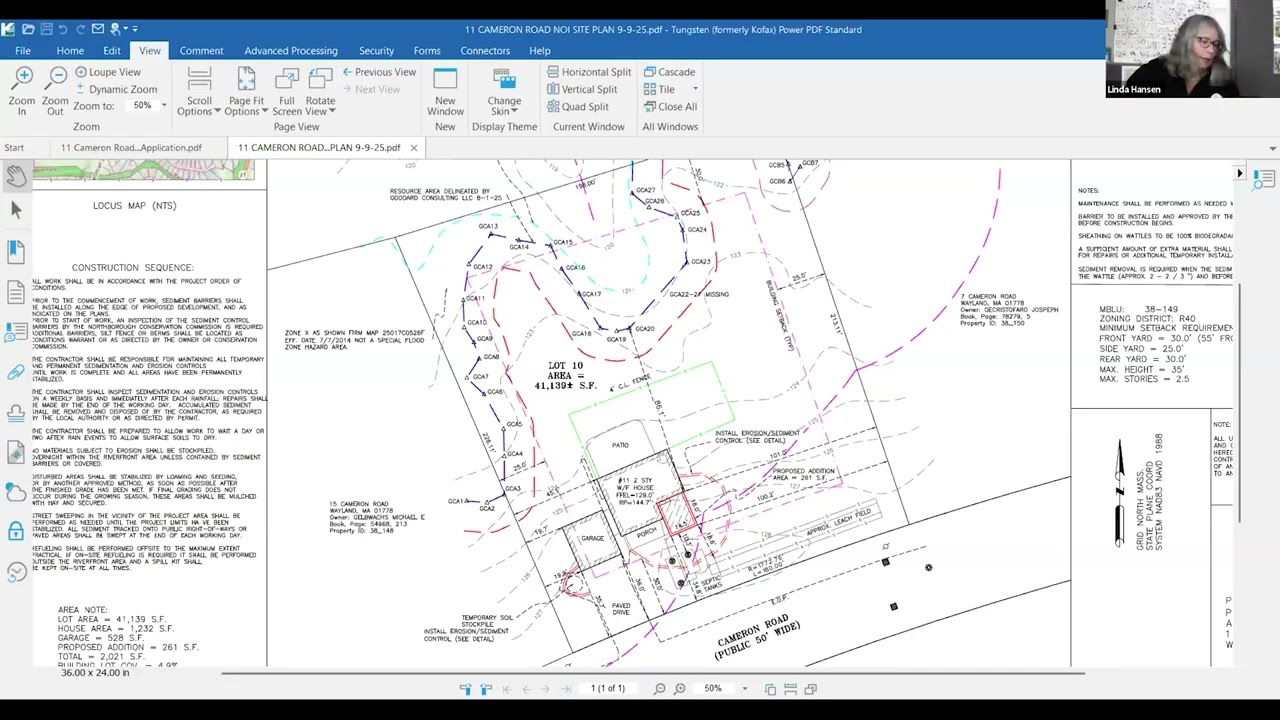
So as I mentioned. it's off the front of the house. over existing lawn. and we don't have any impacts to vegetation. So just to show the commission contextually. where this is this is that L shape in the front of the house we're building off of here. the addition would come out into the limits of the lawn meet with the porch up in this section here. Oh. it's only over lawn. No tree clearing. With that. I'm happy to turn it over to questions. and we have the homeowner here as well for already questions. Sean Fair: So thank you for your time. Thanks. Andrew. uh. Linda. start with Linda Hansen: you. please. Uh. there was a comment. I don't know if you saw that from the state on the on the wetlands portal. they stated that the lawn. where is that the plan? Should I detail the limit of lawn on the site? Because you do stay in your narrative that the lawn does extend into the 15 foot no disturb. So I'd be curious to know where the lawn is on the property. and how we can work with you guys to mitigate some of that. Unknown: Yeah. we appreciate that. So I can say it doesn't appear that a survey of the tree line was done when the property was surveyed. but having been on site. the lawn area extends a little bit behind the fence that we see here. and it cuts laterally across where we see my cursor here. So the vast majority of the property's 15 foot. Notice their buffer is unimpacted and forested. The area that you would see a little bit of encroachment would be the area that we see right here. where it runs across flat so there is not a free land survey done. but there are some some great aerial photos available for this property that could certainly be shown in. But it is a very small encroachment into this area right Linda Hansen: here. Okay. yeah. well. I mean that. that again. that was the state who was asking for that. DEP was asking for that. So next question is. who. who delineated the wetlands? It just says Goddard consulting. Unknown: yeah. so that was actually me personally out there. Linda Hansen: Okay. I appreciate if you guys put that information in there. because it's always good to know. like. if there's a somebody with a credentials. yes. exactly. Unknown: rather than someone who's going out there and throwing them up. yep. So I did it personally. and I my signature is on the report that you would have received. Linda Hansen: Oh. really. I didn't see any signature. did I? Unknown: It's usually buried at the bottom of the wetland border ports we produce. Okay. Linda Hansen: Oh. there it is. Yeah. okay. I see it. Never mind. Okay. I missed that. Also on the survey. it says on the site plan. it says it was delineated. eight. 125. but you're saying that was July 9. You did that. It's July 9. Unknown: So I'm just gonna have to update that on the site plans. It looks like there's probably an old label. We work with their bear quite a Linda Hansen: bit. Okay. okay. And I guess. I guess I wouldn't encourage you to address the DEP comment. Unknown: So. Yep. absolutely. And so I with that question with the Commission. I know. though the limit of lawn is typically pre existing in these areas. I know that there is typically the intent with these applications to take a look at the limit of law and in relation to the 15 foot notice there. So we're happy to add this into the plans just for us to work to make sure we get your questions and bring this to a close. Would the intention be to identify the limits of law and identify where it might be within that 15 foot zone. and then if it's in there. if we need to remove that. I apologize.
I can repeat that if maybe. Linda Hansen: yeah. no. I missed some of that. There was somebody talking over you. Unknown: Yeah. yeah. no problem. So what I'm what I'm getting at with the Commission is the limit a lot of this property is is pre existing. and so we had requested a waiver under the notice of intent to basically leave along where it is. knowing that we're not encroaching any closer. So my my question. Linda was. just. is the commission looking to evaluate if there is lawn within the 15 foot. It. or was there a request to remove it? Or is this just clarifying? DEP his Linda Hansen: comment. Was my clarifying. DEP his comments. and I think typically. we look on average that there's a 15 foot no disturb zone in the. you know. on the property. So if you can show that. on average. you have. you know. a 15 foot no disturb to the wetlands. I think that that would be important. Unknown: Perfect. Yeah. So what we can do is. there's. there's very. very high quality aerials available for this site. So I can take that. I can create a graphic that would show this resource area. the buffer zones over that. and we can look at that in relation to the Linda Hansen: lawn. Okay? And did you get. did you get health approval yet?
Unknown: That I do not know. Off the top my head. I would say. if the homeowner is on and knows the answer to that. he can certainly jump in. Otherwise we can find that out. I can talk to the team. yeah. Linda Hansen: because before you submit to the building department. they're going to ask for a building approve number. for health approval. because they just. you know. they need to address whether or not you've hit some sort of limits. And I don't ask me the details. but of floor space. I guess. and also. if you're far enough away from all the leech field and the septic tank with the new addition. So. you know. sometimes I hate to permit something only to find out it has to be changed later on. based on a review by the Health Department. So I would encourage you do that absolutely? Unknown: Yeah. I'll talk to the rest of the team. Our builder will know that answer. So I'll. I'll get that. and I'll clarify with you. Okay. yeah. I don't. I don't know. I don't know that. Okay.
any Island. Linda Hansen: no. I just. just when you when we do have Online Permitting now. and that's usually one of the you know. it's you have to take all that stuff off when you submit a permit. And like I said. it can hold up your permit if you have to go through a review by health department. So I always encourage people to do that sooner than rather than later. Unknown: Okay. Linda. just so I understand. and thank you. everybody for reviewing this. Just so I understand is. the question is that the lawn is too close to that back wooded area? Is that the question the Linda Hansen: law is too close to the wetlands. is what we're concerned about. So the health of the wetlands is. you know. is impacted if you're if you have very long. very close. you know. most homeowners are adding some sort of long. long supplements and chemicals. and then we know we really like to keep that out of the wetlands. So that's one of the reasons we've put in a 15 foot no disturb. And the other reason is. is that. you know. most. most of wildlife do not necessarily live in the wetlands. They you know. they benefit from the wetlands. so it's always nice to have a little bit of a vegetative strip for. you know. for wildlife protection also. Unknown: yeah. that sounds good. We haven't touched the we bought the house in 2018 and so we didn't install that lawn that's. that's just as as it existed when we bought it. so that that has nothing to do with with the project. or nothing to do with what we've ever done. I wasn't aware of that. I'm happy to keep the wetlands intact. I think that's an important goal. and have the wildlife have an important area there. But this was something that we didn't install this lawn in 2018 when we bought it. this is how it was. Linda Hansen: yeah. and that's fine. I mean. again. I know there's no there's no punitive. you know. I mean this. there's nothing wrong here. I'm just saying that the the state asked for just a delineation of the limit of lawn on this property. And then the second thing is that in our wetland bylaw. it states that you need an average 15 foot wetland. I mean a 15 foot no disturb area. And if you don't have lawn in areas. you know. towards the back there. then I think you would meet that. But I you know. without knowing where the limited lawn is. that's it's kind of a really hard calculation for us to make sure Unknown: we also. and I can provide that we also don't use chemicals on the lawn. I think my neighbors would wish we would use more chemicals Linda Hansen: on the law. We appreciate that. You know. we definitely appreciate that. Unknown: So no chemicals on the lawn.
Sean Fair: So those are all. all your questions. commission. thoughts. comments. concerns.
Unknown: No. I don't see anything really troubling Sean. I think I just. you know it's we're going to need that information. I guess so. It just seems like there are a couple of questions. Just get buttoned up here before we'll be able to be in a position to vote. It seems to me. yep. Sean Fair: Yeah. agreed. And so from our end. if we have any comments again. some of these little questions can get buttoned up in the calculations done. Make sure there's no like. big issues that next time we can't just something that we get. I think. taken care of passes. So I agree. You know. those little things buttoned up? Unknown: Yeah? All right. and we appreciate that. That's. that's our expectation is to come back next meeting and be able to answer the question. So you guys give us those now. That's very helpful. Thank you. And Andrew. Linda Hansen: in the meantime. will you at least just face touch base with the Health Department about what they need? Absolutely. Unknown: Yeah. well. it's in their best interest to make sure that's all buttoned up ahead of time. too. But we're good. And we want to look at your wetlands to see where you're going to give us back what you've what you're using. If you're using 10 feet of wetland. you're going to give us 20 feet some. So it's 20 someplace else. Know what I mean? I do not in the wetlands. Sean Fair: This project's not in the wetlands. though. Barbara. what this? This project's not in the wetlands. though.
Unknown: right? I'm in the micro the lawn is we just need a little bit less lawn and some area. Yeah. the lawn is not in the wetlands. It does go close in the rear yard. but hearing some of the comments. I believe that we do have the average. So what I was explaining to the commission is that lawn does run laterally across the 15 in a few sections. Majority of the lot has much greater than 15 feet. So there is a large portion of this lot that is naturally vegetated. So I expect this will be more of a clarification. Add some figures and some measurements. but we will absolutely make sure of that. Barbara. Okay. why don't you give us the figures? Sean Fair: Absolutely pushing anything else? All right. then. so it looks like we're just gonna couple things buttoned up between now and next meeting. and we should be good. So I guess this will be continuation then to the eighth of October. That Correct? Yes. after 630 Yep. Gotta get a motion to that effect. please. So moved. Thank you. Luke. Do I hear a second? Second? Need to sound like Shannon Roll call. please. Shannon Fisher. yes. Luke pleasure. yes. Barbara Hall. yes. Jenny Brown. yes. Lisa Aubin. yes. and Sean fair. yes. Did a few weeks. Unknown: Sounds great. Thank you all for your Sean Fair: time. Oh. go ahead. Good. Unknown: Do you need me on here for anything else? Nope. nope. okay. Thanks very much for all the work you guys do on the commission and thank you. Sean Fair: Andrew. no worries. Thanks. Andrew. thanks. Unknown: Adam. yeah. Take care. Okay. on to
1c 149 wood. Sean Fair: Woodridge road. DEP. no. Number here. no. 1055. Unknown: Oh. okay. 322. dash. 10. okay. Sean Fair: 149 Woodridge road DEP. file number 322. dash. 1055. it's a Notice of Intent file pursuant to waylands. wetlands and water resource protection by law and the wetland Protection Act submitted by Peter lavenson for the construction of a sunroom at 149 Woodridge road and Wayland mass property is shown on assessors map 45 partial 17. and is located within 200 foot riverfront area. Linda Hansen: Linda. well. it looks like we have a celebrity appearance by Vito. so I guess we'll let him take Unknown: over. Alright. it's gone. Vito. Hey. how's it going? Well? Are you good? Good? Just the record veto. Colonna Connor. stone engineering. we actually have the owners on the call to Nicholas had. Ad. yep. this is Peter Levinson. actually. Nicholas is the much younger. better looking version over there. Got it. thanks. Alright. I'm just going to share the screen to get it up there.
Okay. alright. So this site 149 Woodbridge road. We actually were in not that long ago for a septic replacement. So you might remember this property earlier this year. they had an order of conditions that installed the septic system right up in the front. Right in this location. They have not filed for their certificate compliance yet. we're intending to do that as part of this filing. we actually needed to record the order. It got overlooked. So that did get recorded now. so now we can file for the certificate coming up. But that work for the septic was completed. The existing site itself has a perennial stream. It runs down the side over here in blue that's fed under the road from the old reservoir up to the north of us. And the 100 foot buffer cuts through the middle. And then the 200 foot river front essentially encompasses the whole lot. There's also a BBW associated with that that extends out this green line. It went to 50. 1930 and 100 foot buffers are highlighted there. There's also a BW across the street. but that really doesn't impact what we're going to look at today. So what they're proposing is a addition off the rear side of the house. It's a 16 by 13 foot essentially a sunroom. They have an existing deck. It's kind of right in here that line. So the location was picked just to coordinate with the existing house. with the doors. with that deck in the basement entrance. which is over in here. it is close proximity to the buffer zone. The 15 foot buffer is right through here. The existing lawn area is shown by this kind of bubble line. That's the existing tree line. So the existing lawn is already fairly close. or basically right up to the edge of well. and in this corner right here. So we're looking to put that addition sort of in that kind of area. it would be 11.7 feet off the edge of the wetland. So they would be looking for some relief or requesting some waivers to the 15 foot buffer part of the construction. The foundation itself would be on piles of piers. so something like a son or two just to limit the disturbance. So wouldn't be a full foundation requiring extensive excavation. They could access the site around the side of the house. and we protected that with erosion barrier. just to allow that it's going to be pretty minimal excavation. localized stockpile and just immediately taken off after that excavation is done. anything excess that isn't used to spread underneath. and then just a couple numbers on like. say. the 15 foot buffer. I know we talked about it on the last or you talked about the last project. We do have an overall average greater than just the 15 foot on site. So that 15 foot buffer on site is 3900 square feet. but we have an overall average undisturbed buffer of 8100 square feet. So overall on the site. we have more buffer than you know. the minimum required. And then the only other thing just to tie will be the riverfront area. This as a existing developed lot. expansion of the existing home is allowed. provided you typically. they want to see it further from the edge of resource area. But in this case. where. you know. it really has to go to coordinate with the house and to meet the goals they want. of a sudden. off the rear house. they do have other provisions that could allow that within the riverfront area. you know. either restoration or some other form of mitigation that the board or commission seems appropriate. So it's a little open ended on these existing developed sites. as far as the riverfront. I do know they did look at potentially putting that room near the deck area. but this lot is a little odd. This is the lot line right here. that yellow. So in addition. over in this corner. yeah. it really would. it wouldn't meet any of the zoning setbacks. So really. to get it off the rear. this was the spot that they had to pick.
That's all I had. and hand it back over. Sean Fair: Thanks. Peter. Linda. start with you. please. You're
Linda Hansen: on mute and bank. Flags are those still visible from from the previous delineation. Unknown: I don't I don't know if all of them are up anymore. Yeah. okay. Linda Hansen: Again. remember. what do you guys there's. there's no details of the deck at all. which I think would be helpful for us. because we're not entirely sure what we're
permitting here. other than a description that says it's on sauna tubes. I don't think provided that. you No. Unknown: no. So. yeah. it's just this addition here. So it'd essentially be sonotubes. Like we could get a plan. I guess. showing the location of them. I don't. not sure. Maybe Peter. you might know if it's cantilevered at all. Yeah. the the couple of things I think that are noteworthy to that is that this is an elevated platform about eight feet off the ground on the first level of the home. so it's pretty much undisturbed underneath. And we use helical steel piles that screw into the ground with an auger so there's minimal disruption. There is actually no excavation. It's very precision like and allows for the right soil bearing capacity without the disruption of traditional sono tubes. And this is the existing deck is approximately seven foot off the house. and this would be two. 12 Foot 10. So that additional area would probably have three helical steel piles underneath that elevated deck. and there's a sun port as like a screen sun porch above it that would enclose the deck area that is delineated in the background. But I did want to mention that it is elevated off the deck. off the ground. that we use helical steel piles for minimum disruption. and that there was an extensive analysis of doing something onto the right on the deck. and it was not only extremely disruptive. but two to three times the cost. prohibitively expensive. and didn't really give them the opportunity to use the door off the back to have a view of their backyard. So that's gives you a little bit of idea of the of the reasoning for this location. Linda Hansen: So high. How far up is? I mean. how high is the deck above the ground surface? Eight feet. Eight feet. Okay. what do you plan on putting underneath them? Unknown: We weren't planning on putting anything. I think there might be some just gravel under part of the deck now. And I don't believe there's a lawn or any vegetation there right now. Linda Hansen: yeah. typically we do ask for like. a six inches of gravel underneath there to mitigate free storm water. you know. And so that might. that would probably be in the conditions of the permit. Okay. the other thing is. let's see the wire this in your plan. it says wire fencing. and that looks like it's in the wetlands. Unknown: Does that pick it up as existing from the survey? Is that still there? Yeah. I can speak to that. So the owner. sorry. Nick. had it that was there when we moved in. The old owners had dogs and put up that fence. and I've been kind of taking it down over time. There's still probably more 50 or 60% of it left. But so is there grass in the wetlands too? Then. no. that's ends where. that kind of. where the actually about three feet off the addition of off the proposal. yep. Linda Hansen: Okay. yeah. I mean. I think. I think we would all appreciate if conservation would appreciate if the wire fence can removed eventually. Unknown: So. yeah. happy to take it down as an eyesore for us. yeah? Linda Hansen: And also. Vito. the wetlands delineated for the septic who were not approved because they weren't done under the wetland Protection Act. I mean. they weren't done under the chapter 194 Yeah. So I you know. again. we're reusing wetland delineation that. again. was. was we had documented. is not not complying with the chapter 194 by law. So that's. that's just a statement to make. And I think. is there anything else? No. and again. well. we definitely need closure. though. with this. with the septic permit. there was some question about whether you guys were going to transplant a tree or something like that. And if not. there was supposed to be some sort of replacement for that. And then the second thing was. there is a condition of perpetuity about maintaining a 15 foot buffer. you know. along vegetative buffer. along the property. Unknown: So. yep. so that would come into question now on how that condition would get and forth. whether we could modify that to work with this permit. because it is within that 15 foot buffer. you know. without the other one. could get approved with the average buffer. Yeah. Linda Hansen: No. we. I mean. yes. we can modify that. It's say that. you know. average 15 foot buffer in the property. But. I mean. again. you know. it's hard for us to close something without having me to close this permit without. without understanding what's what's been done under the other one. Yep. since that was so recent.
Unknown: yeah. We can get that file now that everything's recorded. And also. Linda Hansen: okay. okay. and was there plantings that were required under that one? Unknown: There was that one tree that was right in the middle. yeah. I have to go over with Nick. whether that was moved or if we gotta do some plantings for that. And if they do. then what to get those in? Yep. okay. one tree. right? Yeah. lost that. We lost to Yep. We've right now that's all grass. yep. Linda Hansen: okay. so that didn't get transplanted. Unknown: Then it did not okay. We have to put some plantings in. Then. Part of that too. Yep.
That's actually. we have a. we're in process of that with a company. So we have. we have a plan for that we can probably share some point. yep. and we'll show. we can show that on the as built plan when we get that submitted as part of the Linda Hansen: start. if you gave us a plan that showed what you were planting. you know. as part of your COC. We can just. we can put that in as a condition under this permit too. Okay. so we can close one. keep the other one open and just and cut and paste that same condition. Okay. don't work. Unknown: and they need to put the datum on the plan that they're going to send in. okay. yeah. we'll make sure that's on there. I think it's on the 88 so. but we'll make sure that's noted on there. Find it. yep. on the plan that you sent. Oh. I got a little I got a note on the side over here. It's all hidden. but
so I just didn't find it. Yeah. that's a mission. Sean Fair: anything else? Thoughts. comments. concerns. I have a Shannon Fischer: couple questions. I'm just wondering. So this. this is a weirdly shaped property. isn't it? Who's mowing that lawn that goes right up to the river to the little bridge? Am I seeing this? Right? Like that. like. off your property. that your lawn kind of continues. right? But it's technically. maybe your neighbors. but somebody's mowing. like. right up to the to the creek. right? Unknown: Yeah. we mow. There's probably. like. a five or six foot section that's some plantings like. we've that's just stuff that's naturally nothing we planted so some whatever. natural. native stuff. And then we mow that section. even though that's technically our neighbor's property. Okay. Shannon Fischer: Is it as big. like. is it like just a pass of that bridge? Or is it like. the the whole buffer is just sort of gaps there. Unknown: It's kind of hard. So the. it's actually just this. It's a. it's a patch from the deck. You see there's some squiggly lines that's all. that's all trees. and that's all native. like. where the squiggly lines are all native. So it's just that little patch. Okay. okay. Shannon Fischer: my other question is that. like. this is a sunroom. but the south side is closest to all the trees. Like. there's no risk that you guys are going to be coming back in a few years wanting to cut trees down so you can have more sun in the sunroom or anything. Are you like? Unknown: No. no. definitely not. That gets plenty of light process for us. it's more about enjoying the evening. enjoying it in the evening. But my wife has a big she's very she attracts mosquitoes like crazy and so that and gets big welts and stuff. So that's so that's not we're not interested in cutting down trees. Shannon Fischer: Got it? She's got my sympathies. right? Sean Fair: Thank thanks. Jim. anybody else? All right. so. Linda. I'm saying it's a continuation things. We need a few more things here and close out the other permit. Unknown: right? That's up to you. Say again. that's up to you guys. Do
Sean Fair: you? Well. let me ask you before I'd ask commission. do you feel comfortable with what you've got and what you're coming in to permit this with a few last things. we'd like to see it again in front of us. Linda Hansen: Well. Linda. um. I mean. really the only outstanding issue is. is the. is the open permit for the subject that's. that's really the only issue I have. right? Sean Fair: So. so it sounds like that you're all comfortable with that. So I guess commission. are we okay with that? Probably just. let's say. basically. finish up with with Linda and don't need to come back. If that's all there is. Unknown: I'm comfortable with that. Sean. Sean Fair: awesome. Thanks. Luke. Good. great. All right. then. with that. need two motions. motion to close. and the perfect one who wants to make the first motion. Unknown: sure I move that we close the hearing under the state Wetlands Protection Act on chapter 194
Sean Fair: Thank you. Luke. We hear a second second. Thank you Shannon. Quick Roll Call. Shannon Fisher. yes. Luke Legere. yes. Barbara Howell. yes. Jenny Brown. yes. Lisa opine. yes. and Shawn Fay. yes. Thank you. Next motion. please. Unknown: I move that we issue an order of conditions approving the project under the state act and chapter 194 with conditions as discussed. Thank you. Luke Tom. Sean Fair: second. sound like Shannon again? Quick Roll call. please. Shannon Fisher. yeah. Luke Legere. you. Yes. Barbara. how? Jenny Brown. yes. Lisa opine. yes. And Sean fair. yes. all set. All right. Well. thank you. Good luck. Take care of you. Thank you Unknown: very much. All right. right.
Sean Fair: real quick. sorry. I should have mentioned that now we're kind of changing over my term again. as chair and then Shannon as the vice. just kind of playing open hand poker. right? So when we do these meetings. if they first close the hearing. the first motion is to close it under both and then you have the order of conditions with any conditions. So make sure everybody kind of knows. So we'll. let Luke do a few more of these. and we'll see we can't pass the baton a little bit for the motions. Not that I don't enjoy your voice. Luke. Unknown: No. that's fine. I'm happy to save my voice.
Sean Fair: All right. That brings us to 1d this is 13 Charena Road DEP file number 322. dash. 1041. to continue. Continued Notice of Intent file pursuant to waylands wetlands and water resource protection Bylaw and the wetland Protection Act submitted by Carol Seto and Patricia lozawiki for the demolition of an existing house and development of a new three house subdivision at 13 Charena Road in Wayland. Mass. the product is shown on assessors map. 38 lot 157. and is located within 100 foot buffer zone of aboard and vegetated wetland. Linda Hansen: Linda. yeah. we have. I think. the project team. here to go over the any changes. the revisions that have been done since the last time we spoke. Sean Fair: Thanks. Kevin O'Leary. right? Kevin O'Leary: Kevin. yes. I'm here. Hi. good evening. I can do a screen share and pull up a plan. but the subdivision road or the infrastructure. the last comments from the commission a few weeks ago were relative to the revised tree plan that we had submitted. Um. so we pulled back the limit of work and I can share screen if the Commission says. Okay. Unknown: sure. Thanks. okay. thanks. Just to
and the Commission see this. okay?
Yes. sir. thank you. Kevin O'Leary: You're welcome. I don't know why the reacting a little bit slow to the commands. There's a lag. But here is the revised tree plan. The lag is throwing me off a little bit. I'm trying to reduce it so I can see a little bit more. Anyway.
the the the tree plan. as I had briefly described. Here's the the new limit of work for the tree removal that's around the cul de sac area. Here's the retention basin in the the number of trees to be taken down is significantly less. and so is the replacement trees. which are itemized over here on the right side of the plan. There are also plantings that are proposed. The numbers generally 38 trees to come down. There are 22 trees outside the 100 foot buffer. and there were 16 trees within the 100 foot buffer on the plan. and there are 16 replacement trees beyond the 100 foot buffer. in 25 within the 100 foot buffer. So the total number of trees coming down is 38 and the replacement trees are 41 combination trees and shrubs. It's itemized over here in these tables. the replacement trees. If you look in the legend on this section of the plan. you'll see them kind of sprinkled around the cul de sac. And we kept the replacement trees in or outside the buffer zone as they're itemized in the detail on the right side of the plan. the ones inside you can see over here. these little light blue symbols. some of the replacement trees within the buffer zone. You can see them down the side of the road here also. So I think the the planting plan was the only outstanding item with the Conservation Commission on this notice of intent. And I think if the commission is comfortable. we like to ask that they consider closing the hearing in issuing an order.
Sean Fair: All right. Thanks. Kevin Linda. starting with. You please? Linda Hansen: Well. I'm confused what you submitted on the 17th is both Charena Farm and this is how everything's starting to blend together here.
So can you explain the storm water summary tables is that the one that says which includes lot one a
Unknown: well that Kevin O'Leary: those store summary tables are for the lot one a file. They don't have any crossover with the subdivision infrastructure. Notice of Intent. Linda Hansen: It says subdivision roadway watershed. which includes lot one a Kevin O'Leary: right. but they those computations in that summary table. if it's the one that was submitted last week. yeah. it pertains to DG T's comments on the lot a one submission. not the subdivision road. I'm just Linda Hansen: confused by your title. because it makes it sound like it kind of blends both of them together. So that's why I was wondering what it was. right? Kevin O'Leary: Well. in Bert Corey some of his peer review comments from lot a one he made a comment about the subdivision roadway drainage. with the comments on lot. a one. and that's why we're both filings were submitted to you. not filings. but both resubmissions were provided to you last week. I think. in this packet. Linda Hansen: So no. I know that. but I'm just. I'm just curious about the title of that particular table. because it made it sound like it was related to the roadway and to lot one A to the roadway?
Kevin O'Leary: No. no. It was that those summary tables were performed because of a peer review comment I got that. Linda Hansen: I'm just saying that the title makes it sound like it's roadway and Lot. one A. so I want to just get clarification. It's just one A. that's fine. I got it. Okay. Okay?
Sean Fair: With anything else? Linda Hansen: No. I mean. I anybody else has some comments about the tree replacement. Go right ahead. Sean Fair: Question. any thoughts. comments. concerns.
So is that the only outstanding thing for you? Linda Hansen: Linda? But there isn't. There isn't a list of what you're
Unknown: You're okay.
right now. I got it right. I don't Shannon Fischer: have the numbers at my fingertips. and I was just looking through the previous meetings to look for it. How many trees were we starting with originally? I'm just trying to wrap my head around the difference. Kevin O'Leary: You mean on the the on plan of the initial submission? Initial submissions. yeah. I make it was 96 I don't have the plan in front of me. No. I'm able to pull it up quickly. but I think it was 96 Shannon Fischer: Are you still planning to deal with some of the invasive trees. like. I'm especially thinking the Tree of Heaven. given the lantern fly that's there already. Kevin O'Leary: if it's within the limit of work. and you know. we're allowed to take it out. sure. we'll take it out. Shannon Fischer: I think I highly recommend. nevertheless. taking out the tree of Heavens at a minimum. I think they're even buried in there. But I'd still really like to see them. them out of there. because they're supporting a host of those of those flies.
Kevin O'Leary: Okay. what if they're outside the limit of work? Shannon. well. Shannon Fischer: I want. I would. I want to check with the rest of the commission about that before I start advocating too much solo here. but I did the we saw a number of those trees of Heaven supporting the lantern flies. So I'd be curious to know what my other commissioners think I won't push for something if they don't want to.
Linda Hansen: Well. you know. we always just go ahead. Unknown: So I was gonna say. I do get a little skittish when we start talking about doing things beyond the limit of work. because it can really be hard to. you know. keep track of exactly what's being done. That's just just a sort of observation or thought from us. Shannon Fischer: That's a great point. Luke. I'll go along with with that. Kevin O'Leary: Shannon. I think. I think that Tree of Heaven is in this location when we walked down there that day. I think right in this area is where the bee hive was. and I think we had already walked by the Tree of Heaven. and that's right about when you turned around to start walking back. I think is when you saw the lantern fly. So I think it's in this general area. I believe it's probably one of these trees in here. Yeah. that's. Shannon Fischer: that sounds good. yeah. And that way I definitely would not. don't. given Luke sage advice. I definitely would refrain from pushing for outside of the limit there.
Linda Hansen: And usually. you know. in our orders and conditions. we do give approval to remove invasive plants. not necessarily trees. but usually we identify invasive plants that can be done be removed with hand by hand or with hand tools. And typically we don't require a permit for that either. because. I mean. we always we look at it as doing as a benefit. So if the Tree of Heaven are small enough and they can be removed by hand or with hand tools. I don't have an issue with that. Unknown: So and something. you know. just to think about again. I agree with Luke. I think going outside of the limit of work. probably not going outside the limit of work makes sense. So I haven't had any experience until very recently. with those lantern flies and I guess Shannon. you would know better than me if Tree of Heaven is their host plant. But my sister in law. where they live. it's down in New York. about an hour outside of New York City. and they have a big infestation there. which is obviously coming our way. and even on their deck. like they're hopping all over the place. You go for a hike and a trail you're outside a restaurant. It's disgusting. So you know. if it's something to keep in mind for the future homeowners. you know if they can be removed. but I wouldn't require it here. but it's disgusting. Yeah. that's great Shannon Fischer: advice. So I'll stand by what they recommend. and I think it's the host plan. But I'm definitely not a lantern fly expert here. I just know what i We've all seen sort of here and there.
Sean Fair: Just thank you all three and so I guess I'll agree and try to summarize. Are we then saying. if it's outside of the scope of work. but it is. as Linda saying. an invasive this point. sapling or something where we can. you can yank it by hand. go for it. But if it's a grown tree. leave it. Is that what we're saying? Everybody. assuming. no responses. A Yes. Kevin O'Leary: Well. Sean. it is a grown tree. I think it's a. you know. probably six inches in diameter. at breast height. Sean Fair: Oh. thanks. gab. I appreciate so commission. Going back to you all. it was out of the scope of of work. We're saying leave it then correct. Shannon Fischer: I thought you mentioned that it was in the scope of work. that it was actually near that. near that thing. Linda Hansen: And. like I said. I mean. if it's in the limited work. take it out. and there will be a condition in the permit that says you are allowed to take invasives if you're using him by if you're using hand or hand tools. You know. we have. I have no interest in bringing equipment into well and wet and buffered areas to do that kind of work. But I guess. you know. if there's. again. we don't. you normally never have just one Tree of Heaven. Normally you have a whole crop of them. you know. So if there's a lot of little saplings down there. you know. next to this. the bigger one that you're taking out anyway. because it's within the Sukkot work. you're welcome to take it out with hand or hand tools. and that's. that's what you're limited to. Unknown: Okay. yes. perfect. Shannon Fischer: I think I have one more question. and this just regards to as this project continues. like. if you know. if we're saying we Okay. these trees now. there's. like. still multiple other lots that are going to be developed and turn into housing. Is like. every single one of them going to have. like. more and more trees coming out. And does that mean. like. like. if we take it piecemeal. like. this meant this might be one of my first kind of developments that have hit me this way. But like. if we take it piecemeal. are we running the risk of like. denuding a lot more. like. a lot more than just this.
Sean Fair: So I said. so. Shannon Fischer: so if we're saying okay to this. so. like. if we clear this. but there's still. like. all these other lots that are going to be developed into housing. and is each one of them also going to mean taking down more trees. Like. are we just. is this just like a first wave of tree. tree removal. or is this kind of like the main the main part? Kevin O'Leary: No. I would say it's the first wave. I mean. we had the prior plan we submitted had. you know. had a limited work that went out here. We're trying to do more of that upfront with the initial permit. but I think some of the additional information requested by the Commission just put the timeline way out there that we wouldn't be able to comply with it. you know. So we just pulled it in and said we'll have to deal with those on the individual lot filings. So we feel like the. Mission was. you know. was going to require a lot more study of the woods. Actually. that's what was verbalized at the site walk. So we decided after that. just to pull it in and limit the work. reduce the scope. you know. to something that's more manageable and could be acted on quicker. You
Unknown: uh. So then. just to clarify this scope of work is really just to build out the road and the the cul de sac at this time. right? There's. I think. three lots that are going to be developed. So this is just to get the road belt Kevin O'Leary: right. It's not the filings for the individual lots. Watts.
Unknown: Okay. mission. any other questions. So
Sean Fair: sound like we're we're good. then to to close this. okay. uh. can get a motion then please to close the hearing under both so moved. Thank you. Luke. Do I hear a second?
Second? Thank you. Babs. Roll call. please. Shannon Fisher.
uh.
Shannon Fischer: uh. sorry. I'm still thinking. I'm still studying this map. I guess. Can I go last can Sean Fair: Yeah? Luke was here. yes. Barbara Howell. yes. Jenny Brown. yes. Lisa Aubin. yes. Job Fairs. yes. Shannon Fisher. I guess. yes. Okey doke. thank you. And can a motion to issue the order of conditions with conditions? Please. under both? Unknown: Yeah. sure. I move to issue an order of conditions. approving the project with conditions as discussed under the state act and chapter one before. Sean Fair: Thank you. Luke. Do I hear a second? Second that was Babs. thank you. Roll call. please. Shannon Fisher. yes. Luke lueger. yes. Barbara Howell. yes. Jenny Brown. yes. Lisa oven. yes. And Sean fair. yes. all set. Thanks. Kevin. thanks. all I know we got to come up here in a second. Right.
Moving on public meetings to a 13 Charena Road lot. a 1d dash. 1044. is to continue to request for determination file pursuant to waylands wetlands and water resource protection by law and the wetland Protection Act submitted by Carol settle for the demolition of the existing single family house and the construction of a five bedroom. single family home and associated utilities. including a driveway. walkway. septic system and stormwater management system at lot one. a of 13 Charena Road subdivision in Wayland mass the project is shown on assessors map. 38 lot 157. and is located within 100 foot buffer zone of a bordering vegetated wetland. Linda Hansen: Linda. oh. we'll move to Kevin O'Leary again. discuss what's going on here. All right. Kevin O'Leary: thank you. I'm here with Carol Seto in my office. and we had submitted a revised plan packet last week to Linda and the Commission. And Bert Corey DGT had offered some comments yesterday. mid morning. and we haven't been able to respond to his comments. but I'd like to discuss the project with the Commission and just some of the circumstances and things that are going on with The plan. If I could screen share. Unknown: please. please. I
can the commission see that plan on the screen? Yes. sir. okay. Kevin O'Leary: The this plan is the site development plan that shows all the engineering and survey existing and proposed conditions. It's a pretty full plan with details and information. This plan was basically the septic design plan. but we relabeled it over here and calling it number one cedar wood Lane site development plan. The health department approved the septic design plan a couple of weeks ago in. And the applicant and project proponent has been filling out or completing the applications for building permit issuance. so that the need or the request is to try to move it as quickly as we can with this. because the building department has halted or has slowed the process of the permit review applications. because conservation hasn't signed off on it yet. So with that. here's the 100 foot buffer zone. this black dash line. and then over here is the erosion control barrier coming from the existing barn down to the frontage. Along the frontage. it crosses over into lot a two of the subdivision. which is known as number three. Seatle wood lane. and comes up in the front yard of the existing house and around the septic system. and then back to the lot line. back over here. down back into the barn. So the 100 foot buffer zone is about 54 5500 square feet of land area disturbance. And as noted on the plan. or as detailed on the plan. it's a portion of the septic system. It's a recharge basin. It's a proposed driveway. Other features that are on this plan that you really have to study it a little bit to realize that they're plotted here is the existing driveway. which is a large impervious area. and a portion of the existing house. So the area in the front. I brought this to the attention of the commission members are on the site walk for the subdivision roadway. I'm just going to scroll down a little bit here. This is the picture coming up Charena Road. the private way. the 15 foot private way. Here's the existing house. This is the area in here for the septic system and proposed driveway over here. Here's the existing driveway. The proposed house is going up here out of the buffer zone. Just a couple more pictures as we walk down the road. Look back at the barn. I also wanted to note that you'll see on the barn. there's a couple garage doors that face the roadway the 50 foot private way. This is one of the stakes for the limit of disturbance or erosion control barrier. And it goes from this stake. There's another stake right in here on there's a fence in here that's full of vines. and then it goes over here to the corner of the garage. So this area is the area of 100 foot buffer zone. The front lot line is approximately where the boulders are. So as the Commission can see. it's it's existing lawn. or existing grassed area. This again. just walking along the road taking some pictures. This is standing with my back to the path that walked down to the cul de sac. where we walked with the commission a few weeks ago. Looking back. here's the stakes for the 100 foot buffers on they come up here. cross over. Here's another one up in here. and it crosses over the driveway up here. So this is the area of disturbance. Here's a tree that's going to come down and be taken out on the revised number one. or should I say. on the new number one. Cedarwood Lane site development plan that's been submitted to the commission. This tree is detailed with the tree replacement information. and I'll scroll back just to point that out. On the site plan over here. on the right side of the plan is a tree replacement requirements inside and outside the buffer zone. This is a stormwater recharge basin that's in that's proposed in the driveway. It's going to handle the entire roof of the proposed house in front porch the driveway is not part of that recharge base. and it's been taken out. I think I'm just thinking out loud here the some of the comments from DGT pertain to the technical component of the stormwater runoff computations. and we haven't been able to finish it from just getting his review yesterday. I think that was the second time he looked at it. Is that right? Unknown: Linda. yes. yeah.
Kevin O'Leary: So we're trying to get back in contact with DGT. with. you know. through the commission to DGT with responses. Just a few more pictures. This is up up high. with the barn to my back. looking down at the trail. This is where we walked up. This is that the one tree that was dead. the birch trees that are being taken down. the clump of birds are right over here to the left. And I think that's it. One of the. one of the drainage concerns that Bert Corey has is. you know. just matching the pre and post development runoff computations in on the site plan. we show up basically a rectangular barn. And I. Did just a little bit of research on the GIS and you can see that over here is the property. Here's the existing house and driveway. Here's the existing barn. About three or four years ago when the cedos were first interested in this property. the barn has an addition on it. or it's got more features to it than what we show. I'm sorry. then what we show on the survey plan that's been submitted. because our survey was what was existing at the time that we did the survey. But there's about 750 square feet of impervious area of the barn that was taken off probably 2022 2023 when they were renovating the barn. In addition to that. you can see that there's a existing driveway that well. It's existing on the GIS. It doesn't exist in this fashion in this area anymore. but it still does exist down to old Connecticut path. but the garage doors in the picture. there's two on this wall the building. and there's two more on on this face. I think one of the two on here might have been closed in. but there's evidence that this used to be paved all the way down here. and this was located as a paved driveway at the time of the survey in 2023 and you'll see that paved area over here on the existing condition. This is a sub area map that was submitted with the drainage analysis. but we don't show it over here under existing conditions. nor do we show the barn addition over here. So we may include that area if needed to complete the drainage analysis with Burt Corey. which will take place on the next week or so. You know. we'll submit back to him. and then he'll get back to us with comments. Linda Hansen: So that's not existing conditions. I mean. we're looking at the condition. existing conditions now. while we're permitting this. you know. if there. if something was there or was at some point there. yeah. we never know that. You know. we're well. this is town information now. okay. the past history on this. all right. Kevin O'Leary: Well. I don't think that's justified. because this is an existing conditions four years ago. and they're not. I mean. this is something I'll address but. and we're not using this right away. We're trying not to use this additional impervious area. but we may have to if. if we get down to really squeezing the drainage calculations. And I think it's justified. because these features are. are or were in place a short time ago.
Unknown: So it was in place when we bought it in 2023 when we bought it in April. it was in place. We submit this application with the board in October. So it was still in place. Kevin O'Leary: So October. 2023 it was still in place. To prove. yeah. we can. we can come up with background information on it. But anyway. this rectangle here was what existed that at the time of the field survey for existing conditions. But I don't want to get delayed with the Commission's time on this. but I just wanted to bring it up to them that you know that this is something that we haven't addressed yet. but hopefully we won't need to. or won't need to bring it into our computations. but we may. because it existed. So I guess back to the site plan.
Unknown: And Kevin O'Leary: I guess the big point I'd like to. you know. impress the commission with is that existing grass area. and it's going to remain grass area in a better hydrological condition. And it's about 5500 square feet. it's buffer zone. as the commission knows. this is where the road work is going to take place. So there's a lot of added protection between the buffer zone work in here in the wetland resource area across the street to the north. What I'd like to ask the commission is that. because of the nature or because of the permits that are pending with building department. and as you can see. the house is outside the buffer zone. the existing driveway is going to be used for the main construction access. If the commission. you know. still has concerns about this. would they consider at least maybe a letter or something to the building commissioner to further process the building permit application and or issue the building permit application so they can get to the next step with their project and we can address these issues. which. you know. another week or two. I'm thinking with Bert Corey. It depends how many other concerns he brings up. or. you know. how the final numbers call you.
Yeah. so I'm okay. or I'm set with my presentation. If there are any questions. Linda Hansen: Well. the biggest outstanding issue we have right now is. is we have not resolved the drainage easement situation. And you know. that's why I'm hesitant to write any sort of letter. because before. with the first set of plans that you submitted. you were going to pick up the driveway runoff into that subsurface infiltration unit that you have at the base of the driveway. And now you've changed that to allow the runoff to go down the driveway. down the street and into a catch basin and discharge it to us. Fish and Wildlife property. And again. you know our you know. our opinion is that there is no drainage easement for the. you know. for picking up new construction on this lot. and including both the driveway of the the barn and the house. and until that's resolved. I mean. I'm not in. I don't think we're in a position to start. you know. giving. sending letters out that say it's okay for you to start building because. I mean. I think. I think that's a big issue. We have to figure out what. how we're managing the driveway runoff. Kevin O'Leary: Okay. yes. I understand the drainage easement does exist in the project. proponent and landowner have the rights to use that easement. Linda Hansen: No. they don't. It says. demanded to the town of Wayland. and that's the way. you know. that's the way we read it. at least. Okay. Anyway. stop sharing your screen. I can show you why there is drainage easement. okay. Unknown: Oh. stop sharing. You said. Yes. okay. Oh. let's see if I um.
I see if I can share the screen. as it was. the status with the town council.
Linda Hansen: I don't have Share Screen option. do I There it Unknown: is. sorry. Linda.
Kevin O'Leary: a couple weeks ago. you were going to send this to town council. Is there any update on on that? Linda Hansen: Something we have to decide right now whether we're going to take it to the title attorney and that. since the town has to pay for that. I mean. the commission has to pay for that. I needed a vote from them. So this is the drainage right here that. Can you see all this? I can Yeah. Okay. so this is Charena Road. okay. the main part of shrena Road. 11. 1815. there's a there's a drainage here. okay? That comes off oak ConCom path. It also picks up drainage from Charena Road. And there's a drainage easement between 15 and 19 or 19 and 21 right here. And this is a discharge location. And there's also it. This same pipe is connected to the drainage that goes underneath the private way. and it discharges here. So this is why the town was granted a drainage easement. because this is connected. This is connected right from Charena and the private section of Charena Road. And it does. again. pick up the drainage from the road itself. But again. if you read the. if you read the drainage easement. it says it grants to the town of Wayland the right to discharge here. And you know. it's. again. it's limited from pretty much. maybe some overflow from this side. but also just the runoff from the surface. run off from the street. So I think. you know. that's my understanding of why that was created. Kevin O'Leary: Yeah. Linda. the drainage easement is not exclusive. And did you say there's a pipe in the private way? There's a drain pipe in the private way? Well. it looks like there is. yeah. well. there's. it's not at the intersection. though. It's down where the catch basins are. And there's. there's a cross culvert near the willow tree that we've discussed with the Commission on previous hearings. But this. I'm not aware of any drain pipe coming from Charena road down the private way. Unknown: That's what it shows. No. it doesn't. It didn't show that. Pull your screen back up. There's no drain pipe down there. Yeah. Um.
Linda Hansen: what's this right here? Kevin O'Leary: That's the that's the GIS symbol for driveway or for pavement. That the drainage over here. Linda Hansen: Here's two catch basins. Oh. this right here. This is the drainage right Kevin O'Leary: here. That's the drainage in the 50 foot private way. It doesn't. It doesn't. There's no drain pipe from Charena Road. that the town of portion of Charena road down the 54 private way. There's no drain pipe to my knowledge. Linda Hansen: No. I'm sorry I misspoke. It's picking up water though. that's coming off of Charena Road. Okay. No. yeah. it is Kevin O'Leary: no high point right there. There's a relative high point that they're trying to keep. The intent was to keep Charena Road. the private the 50 foot private way at Charena Road. so there's no storm water runoff from the accepted way of Charena road going into the private Linda Hansen: way. Well. that's how. What was explained to me by by the highway department. So you know that they maintain a drainage easement for that. for for Charena road. you know. and have two discharge points. Unknown: Okay. so sounds like. Sean Fair: Linda. you're at. you're at some point. you're going to ask for a vote to send this to our town council to figure this out. And so based on that answer. obviously that's going to then affect Kevin and Miss CTOs calculation of stormwater runoff and how they're going to take right? So that's kind of what we're the sticking point right right now. to make sure we're all sitting from the same sheet of music that right? So before we take that vote and talk about assuming we were to get that. get you or get that answer back. is that something we would have to wait until next meeting to or that's something you could. you know. tell Kevin and Macedo. hey. by the way. here's the outcome of what our attorney says. and therefore change your plans or don't. But in other words. give them another opportunity before next meeting to get that answer so they can change anything. Is that from from a timeline? Is that? Is that fair to to get that answer before next time? Let them adjust or not adjust based on that answer? Yeah. Linda Hansen: I mean. that's fine if we. if the commission agrees to fund. you know. an opinion by the title attorney under our town council. and agrees to share that information when it's available to the to the applicant. I'm fine with that. Okay. so Sean Fair: just before we pick up. oh. so it's commission members. you know. before we take a vote. Are we all okay with that? Whatever answer we get back. obviously we're not going to know the answer. because we don't come back until a couple weeks. but we'll be okay with our town council and Linda to share that information with with Kevin. so they can make any adjustments beforehand. so we don't have to sit for another meeting just to get the answer that fair with
Unknown: everybody? Yeah. I'm. I mean. for what it's worth. Sean. I think that's fair. I I do think we need that opinion. because at this point it correct me if I'm wrong. But this. what this did go to KP. and essentially the response back was. I can't tell I can't answer this. You need to go to title attorney. Linda. can I make? Yeah. so I mean. to me. Sean. it's fuzzy enough that the town's attorney can't answer the question and is telling us. we need to kind of go to somebody who's going to dig in more deeply on it. So I I'm not satisfied at all that this issue is resolved. I think we should get to the bottom of it. But with that said. I also I'm not interested in. like. hiding the ball from the applicant. I think if the opinions ready. I have no I have no problems with sharing it before our next meeting. if it's available that quickly. Sean Fair: Yep. makes sense. Luke. I Linda Hansen: wish I would all with all of you. I mean. everybody would get a copy of that. you know. So. yeah. I just wanna Sean Fair: make sure that the the applicant can have some time to amend or change things beforehand. So you know. for sorry. before next meeting. there's say. based on whatever answer they get. Linda Hansen: no. no. I fully agree. I mean. this issue needs to be resolved. and we need you know if once the information is available. I'm happy to share it. as long as the commission is in agreement with Unknown: that. So any questions for my attorney. because
Sean Fair: So. I guess. well. let's start with that. I guess. So can we. I guess. make a motion then to allow Linda. it's coming. It's coming from our. you know. conservation law right to pay for a title attorney to follow up on KP laws opinion to figure out the drainage here. Unknown: Could I just ask another question Sean before we start? Yeah. have we asked the applicant if they're willing to pay for this? Because I think it's. I don't love the idea that we're being made to pay for this. I don't. you know. I maybe this falls outside the scope of a 50 3g request. But it's not clear to me that it does. Linda. I don't do Town Council. I forget. off the top of my head. I think there was a suggestion that we could inquire as to whether the applicant would be willing to pay for this. Yeah. Linda Hansen: I mean. they. their attorney has also weighed in. I think every I submit. I sent that to everybody. and so. you know. as in a condition. we're at the point where we're both in disagreement on this. and again. without having a clear opinion from our town council. I look at it as like something that we need to guide us into making a decision here.
Right? Unknown: No. I totally agree with all that. I guess I'm just I don't see a huge difference between this and a situation where I don't know the consultants. excuse me. the applicants. engineer. wetland consultant issues an opinion. and we're skeptical or not feeling qualified to. Be able to say we agree or not. and so we bring a peer review on. and it's at the applicant's expense. I just. I don't see that. I don't see how this is all that much different. And I'm just curious. I'm curious why we're bearing the cost of answering a question that's being raised by the applicants plans. Linda Hansen: Well. in this case. the Our Town Council represents us. You know. we're not it's not an independent peer review. That's why I look at it Unknown: so Linda. is it cape? Would KP be performing this work? Yes. okay.
Kevin O'Leary: I just have one more comment or a comment. if I could the drainage easement in question. It shows up on the Tom maps. on the GIS it's a record easement. It was approved by the planning board a couple times. I don't understand the assessors map right now. Yeah. it's on the assessor's map. Unknown: It's with all due respect. That's not definitive evidence of anything. I appreciate what you're saying. but I deal with this stuff all the time. I know. I just know from hard experience that that doesn't necessarily mean anything. So it's it might be a clue that you're right. maybe you're ultimately right. but I'm not confident in that. and I'm certainly not willing to to just accept that. So I thank you. Linda. that you now I sort of understand better what we're talking about. So I guess. speaking for myself. I think we need this work done. I think we. I would vote to to pay out of our funds to have town council perform this work. And you know. as we said before. I have no issue with sharing it with everybody once it's available.
Yep. makes sense. Luke. Kevin O'Leary: we don't really have a timeline. though. right for a title attorney to review this. It's still kind of open ended. Linda Hansen: No. I can send him an email tomorrow and ask him to get started. Unknown: So. okay. thank you.
Sean Fair: Okay. So. Commissioner. we all ask for someone to make that motion. but any other comments or thoughts before we essentially make a motion to allow Linda to move forward with a title attorney and give any relevant information or findings to the applicant before next meeting. if they're found during none of that I have a motion to that effect. please. Unknown: sure I move that we authorize Linda to proceed with working with KP law To have a title research done on this issue. and that we further authorize Linda to share that with the Commission and the applicant when it becomes available. Perfect. Sean Fair: Thank you. Luke. do I hear a second please? Becca. that sounds like Babs Roll call. please. Shannon Fisher. yes. Luke lueger. yes. Barbara Howell. yes. Jenny Brown. yes. Lisa Albin Yes. and Sean fair as a yes. All right. anything else on this one. Kevin O'Leary: well. I'd just like to is. are these the only two issues is to get squared around with DGT on their review of revised calcs. drainage calculations in this easement. Sean Fair: Get back to Linda. Linda Hansen: well. again. I don't know the drainage calcs that you're talking about. Is that. is that. because you can go back to the previous impervious surface that that we don't have any evidence of. is that what you're going to use in order to terminate Kevin O'Leary: I'm not sure yet. Linda. we we've got seven storms we've analyzed. We've got five of them that work so far. It's a small flow storms that we need to review further. and we may propose to use that impervious area. if it helps the project move along. and. excuse me. the drainage plan that you pulled up a few minutes ago that even shows the barn additions that I referred to earlier in that same or similar town map.
Linda Hansen: Well. that's just. that's just. you know. this is assessors map that's probably based on an old. an aerial photo from and we have no idea how long ago that was. So that's. that's. that's Unknown: 2023 it was 2023
Linda Hansen: I didn't pull I just pulled up the assessors map. But that has an an Israeli base map on it. Kevin O'Leary: Kevin. no. I'm saying is that when the cedos became interested in the property. that barn was that configuration that you show on that assessor's map. and it came down that section of the barn was demolished with approvals from the building department in 2023 that's all I'm saying. and it shows up on Tom maps Linda Hansen: we're working with existing. Conditions. Kevin. and that's existing is now. you know it's not. it's not what was previously done or previously built or previously demolished. Okay. that's not. that's not how we do our permitting. Here we're looking at the what is there now is existing conditions. Okay?
Unknown: I don't agree with that. but I don't agree with it. Well. if Sean. if I could just chime in. I mean. for what this is worth. it seems like we're sort of arguing about a hypothetical. because if I heard Mr. O'Leary correctly earlier. they may not need to include this in the calculations at all. But I just for what it's worth to put my cards on the table for the applicant. I agree entirely with Linda. To me. existing conditions is not a term that's ambiguous. It's existing conditions. Existing conditions means existing conditions. And I. I'm with Linda also. I don't recall any precedent for the idea of like. going back in time to use some former existing condition. So. you know. just for what that's worth. Mr. O'Leary. just one member of the commission trying to be straightforward with you here. I would avoid just in my eyes. if you can avoid doing that. I think it's worth avoiding it. because I'm not. I'm not sold at all on that argument. and I don't think I ever will be. Shannon Fischer: Yeah. I have to echo everything that Luke said. I don't like the idea of deciding after the fact which existing conditions are going to fit the numbers best. Existing is existing. I'm with you. Luke and
Unknown: Linda. Luke. Sean Fair: okay. thank you. Sure. something else commission. like we haven't made the motion. We're good. Unknown: So just a two items. right?
Okay. only two items.
Sean Fair: Linda. kick it back to you. Linda Hansen: No. I'm good. We're just gonna. we're just gonna wait to get some clarification from title attorney from KP law. Okay.
Sean Fair: sounds good. All right. I think we. should we motion. right? Unknown: Sure. I move we continue the hearing to are we doing October meeting? Sean Fair: It's a meeting you have to do. Sorry. that's right. it's your first meeting. I get it. Unknown: I'm new. I'm new at this Sean. I can tell Sean Fair: all right. so I think we'll hopefully hear back from the title attorney. and we'll kind of go from Unknown: there then. okay. I'm good. Sounds good? Thank you. Thanks. Kevin. Yep. good night. right.
Sean Fair: All right. On to Unknown: vote. sir the lawyer. Sean Fair: Yep. yeah. I wrote down. We voted for six. Oh. right. Unknown: I remember. I remember voting for it. Yeah. a few. Let's Sean Fair: write it down. No. I wrote it down. Okay? Could be jotting notes for fun. 1b. 3537 49 Waltham Road. D. dash. 1046. request for determination file pursuant to waylands wetlands and water resource protection Bylaw and the wetland Protection Act. spending by Carroll the Carroll School for the construction of a new school building with associated parking area. septic system and utilities at 3739 and 45 Waltham road and Wayland mass. The proposed work is partially within the 100 foot buffer zone of a boarding vegetated wetlands. Property is shown on assessors map. five lots. 1415. and 16. Linda Hansen: Linda. so we're going to merge. We have two number two twice on the agenda. the 2b which is the request for determination with a stormwater and Lane disturbance they filed under both. They have a very small section of the property that is within the 100 foot buffer that they're planning to do work. and then the rest of the site will be covered by the stormwater and Lane disturbance permit. So we're going to hear these. So we're going to talk about these all at the same time. Okay. does that make sense? Sean Fair: Yeah. and just shows the wall. That is the storm water. land disturbance. SW. LD. dash. 152. yes. for reference. yes. Our way. Linda Hansen: looks like we have a team here to to discuss that. I don't know who wants to start off. Unknown: Yes. I will. Good evening. everyone. For the record. I'm Sean Malone from Oak Consulting Group. the Civil Engineer for the project. We also have Chris Rennie from the Carroll School. who will speak briefly tonight. and also mark Warfel from Crowley Cottrell. our landscape architect. I don't believe he's on the panel. but if he could be promoted. I'd appreciate that.
Sean Fair: Sure. Mark. yep.
Unknown: Okay. there's Mark. if I may. share. My screen. I just want to give a real. real brief rundown of what we're here for tonight. and then turn it over to Chris for a little introduction to Carroll School and the overall plan. Please. Okay. thank you.
Okay. so quick overview of the site. This is the project site. It's three parcels. as indicated in the filing. We have 3739 and 45 Waltham road. These parcels occupy approximately 13 acres and bounded by Waltham road here to the north. residential property to the east. this is town conservation land to the west and south. there is a bordering vegetated wetland along this western border. and that wetland actually has a buffer that extends into this corner of the project. About half of the 13 acres is developed with the school building. which is located over here on the east side of the site. we have parking and access drives in the middle of the site. and another access over here on the east end of the site. and then a third access over on the west. west side of the site. This area is mainly used for maintenance and parking. And then we also have another building on the site. This is a formal pool house. used mostly for offices and then some other impervious area with the sports courts. etc. The
project is proposing a new building to be placed on the site in the area of the pool house. This is the new building. and with that. we'd have the new parking. drives. utility infrastructure. etc. This is the area subject to the RDA. This is about 90 feet from the bordering vegetated wetland. And what we're proposing here is some regrading of this area and removal of two trees. We believe this is a minimal impact. and really no impact to the wetland. so hoping to get a negative determination on that mark. Will talk about this a little bit more with the overall tree removal and mitigation package. but we do have this separated out under the 194 mitigation rules. So before I go into too much detail. I'd like to ask Chris to give us a little little discussion about Carol. Sure. Thank you everybody. Hi and thank you to the committee tonight for your time. I Carroll School. perhaps many of you know. but some may not. We are an independent day school serving students with language based learning differences. particularly dyslexia in grades K through nine. and we've always been a an elementary school and a middle school. we are not there's no plans to expand into a high school. We currently have around 450 students. and we're spread across three campuses in Waltham. Lincoln and here in Wayland. and we have students that come from over 80 communities. including Wayland. This is part of our our long term planning that the board has been engaged in for the for the last year. and it's sort of become more solidified right now with how we'd like to achieve grade reconfiguration. and that's a big part of the expansion in Wayland is to support the movement of classes from Waltham to Lincoln and Lincoln to Wayland. There. of course. there's some modest growth involved. but we're not looking to dramatically expand for new students. So at that point in time. I thank you for your time. and I'll hand it back over to Sean. All right. thanks. Chris. Now I'd like to just get into a little bit of the nuts and bolts here. if I may. And again. I try not to take too much of your time. So again. the the area being proposed for developments along the the northern edge of the property. which is predominantly developed with the academic administration building some parking as well as this used to be a single family residence. so there's still an existing garage here. a large gravel area where the existing home was. So we're we're really condensing our development into areas already. already developed with that. That we're going to be adding approximately one acre of impervious area to the site. Currently there's about 2.2 acres. Will be proposing approximately 3.2 acres of that additional acre of impervious about half of that is this new building. so essentially clean runoff. To mitigate the increase in runoff. we're proposing several infiltration basins. We have a pipe underground stone and pipe infiltration basin here. a second one here. and then a surface infiltration basin here at the center of the site. the net effect of this these infiltration basins is actually a reduction in the rate of runoff. as well as the volume of runoff to both Waltham road and the wetlands to the south. And will be depending on it varies with the storm a little bit. but looking on the order of 20 to 40% reduction in those those runoff numbers. the total area of disturbance here is going to be about 4.5 acres. And again. as I mentioned. we just have this seven. about 760 square foot area of disturbance within the 100 foot buffer. but again. close to 90 feet away from that bordering vegetative wetland. With that. I'd like to ask Mark to talk a little bit about the tree removal and mitigation plan.
Good evening all for the record. my name is Mark Warfel. I'm a landscape architect with Crowley Cottrell Landscape Architecture in Boston. So the plan before you is the tree removal plan. We've gone through and identified and tabulated all of the trees that are to be removed. The majority of these are evergreen forming hedges from the previous use and some buffer trees that were on the western edge of the middle parcel. So the large table on the left are the trees that pertain to chapter 193. and for 194. the trees within the buffer zone there are two. These are two specific trees. one which is. Thank you. Sean. One that's on the northern side of the buffer zone is an existing. large evergreen tree that we feel would be compromised due to the grading that we've discussed happening within the buffer zone. which that's tree number 43 and and then the second one is 53 which is a hemlock that's part of kind of a grouping of hemlocks. And. you know. we. we fear the Adelgid compromising that. although I wasn't able to identify any on that tree. but it's also just with that stand being removed. you know. we're concerned about it structurally.
if you want to go to the next sheet Sean. So this plan shows the tree protection for the trees that are to be to remain along the western boundary. We are proposing a fence that would go in at the beginning of construction and be maintained through construction that also will act as a protection to the wetland. and will include the erosion control. which which shows up on the civil drawings. Next. this is the proposed plan showing kind of overall materials and Sean. if you can just zoom into the path that's down by the wetland buffer I just want to note that the grading that we're talking about that's happening within the 100 foot buffer zone is for this path that's needed to provide accessible access to the basketball courts and the existing play field. So we had kind of studied this two different ways. which I think Sean mentioned or included in the application that that it'd be a retaining wall. kind. Right at the buffer line. or we could do a minor amount of grading within the buffer zone and provide a planted slope. Go to next plan on L 401. this is the proposed tree plan. So we've identified places or locations for proposed trees. as well as a plant list. If you can zoom into the table. Sean. that'd be helpful. So we've. I. we haven't identified the specific trees quite yet. of like where each tree is or where each species is going. but we've created a mix of trees that are both native and non invasive to be used on the project. We're totaling 27 trees. which meets the replacement need for the removals under 193 and 194 and on. on the next sheet is the overall kind of understory planting approach. So we're we're proposing some robust planting around the building itself. as well as rain garden plantings adjacent to the parking lot. And we've. we've shown this in by zone. So we've created. we've. we've indicated the different planting zones. and what the makeup of that is. We're not quite there yet to lay out individual plants. but I think this gives a indication of our approach and what we're hoping to do. as well as kind of quantities and species that that we are going to be using. Think that's what I have. Sean. I'll hand it back to you. Yeah. Great. Thanks. Mark. And just to clarify one thing and correct me if I'm wrong. mark on our tree removals. we did not include any of the shrubs as part of our mitigation calculation. The shrubs provided on this understory is beyond the trees required by the bylaw. correct. And so that really sums up our presentation and our project. just to fill the commission in on where we're at with the rest of the town boards. we have submitted to the planning board. We've also submitted formally to the Board of Health for the new septic system. We are going before the planning board. I believe. on October 15. and we have received from the planner a peer review estimate and proposal that we believe they're moving forward with storm water review is part of that proposal. So we believe that the Commission will be included in that peer review. or we certainly request that the the Commission's review under the 193 be included as part of that overall peer review. With that. I'd like to ask any any questions from the Commission. Sean Fair: Thanks. Sean Linda. start with you. please. Linda Hansen: Yeah. Sean. no that I was part of the scope for the peer review. So we're trying to do a joint one. so you don't have to do a simple one with us again later on. Couple of things. I can you point me where the test pit and soil data is? I was looking for that information in this packet. And. man. do you have a you have a monster of a storm water report. Unknown: So we do. we do and. yeah. so we did eight test pits in this this spring. we did two up in this area. to here. to here. Linda Hansen: where's the data? In in the Unknown: there's a soil section in the stormwater report. I want to say it's Appendix E perhaps. and those logs would be part of that appendix there should be so the the hydrologic soil group would be part of that. Linda Hansen: Okay. I saw it as sewage disposal. so I thought maybe that was just. that was just for the soil. the for the Unknown: septic area. It's it's the same. the same log is used the same and just to kind of further that thought. the soils out here were extremely good. very coarse sands. Generally up in this area. in the northern portion. we had groundwater down eight to 10 feet. and then as the topography drops. To the east here. it was about five to six feet. but again. very coarse. gravely sands that are extremely well draining. Linda Hansen: Yeah. no. I was looking for a justification for using sand as the infilt for infiltration rate. The other thing is. I looked at the ONM plant. I love to see that bulk up a little bit. I love to show. and I love to have technical information in there. A lot of times. people. especially maybe a property manager. might not be familiar with what you've put in. what kind of I always ask people to put. like. even go to the website of the manufacturer. put in some technical information in there. So people know. I mean. you just have a small thing that says. inspect. you know. three times a year. But. you know. I need give them. give them some details. like. what are they inspecting? Were they looking for? You know. that kind of thing. Because you just never know what's. you know. who's who's gonna. whose responsibility is going to end up landing on. I don't know. And that doesn't have to be now. that can be also. after the installation. And so in one of our meetings. I think I brought up that one of my concerns was the runoff to Waltham road. I've had numerous complaints about that in the years past. There's. there's a lot of water that runs off that parking lot into Waltham Road. causes huge puddles and flooding in that area. And you. I mean. I think this. this whole storm water management system has to be better at picking up the water. the runoff you generate. because that's part of that's part of the purpose of chapter 193. and infiltrate it or manage it somehow. I mean. you still have quite a bit. I mean. I'm looking at your rate of discharge from the site. and there's still quite a bit going off to Waltham road. and even though it shows a reduction. and I mean. I would expect that just because. again. I have seen. I have videos of the water coming off that that site. and the flooding that it's caused on Waltham. Waltham road. So please. you know. let's. let's. let's take a little bit more effort to not. not be sending water to Waltham. because that's exactly what one of the purposes of chapter 193 is. is to manage your own runoff and not be sending it to a butter abutting properties. including conservation property off to the side. and you know. Waltham road in front of you. That's. that's not what it's for. is for taking because I don't. do you know where the the catch basins are. I'm not even Waltham. Unknown: Yes. I believe there's one down here by the hydrant. Yeah. there's. there's one here. And then Waltham has a high point around this area. and it drains to the east. and I think just kind of sheds off the road into this. ultimately. this wetland over here. and maybe a little bit through the site. But I but I hear your comment. I understand your comment. and we'll see if we can do a little bit more to capture some of this that you know. already sheds to the street. See if we can capture that and bring that into our system. Linda Hansen: especially what you're saying. it sheds off the road. potentially on somebody else's property. you know. adjacent to you. That's. that's really the last thing we want to happen is. you know. a lot of that parking because that's a huge parking lot you guys are putting together or installing the front there? Unknown: Oh. absolutely. And we do have controls on that. on this parking area. curbing and everything. to prevent any runoff directly to that of butter from these parking areas. Yeah. So we'll see if we can capture a little bit more before it goes off to Waltham road as well. Linda Hansen: And again. what I noticed looked like that some of the runoff wasn't even getting captured by the catch or. you know. that where it was the drainage that you had in. you know. in the parking lot. and maybe that was just. you know. the grading wasn't done as it should have been. So I again encourage you to make sure that we know when you have engineered plans for construction that you make sure you put. you know. Spot elevations in and make sure those things are are complied with. you know. so that we're not having water that's just bypassing things that shouldn't be so and I think that appears to be maybe one of the issues. you know. The current design or the current situation. So understood.
Unknown: okay. Linda. anything else? Linda Hansen: No. again. you know. I think if we're in a holding pattern until the peer review comes back. yep. the Sean Fair: meet. DEP commission. Any other thoughts. comments. concerns. I know we got more work doing this. but
Linda Hansen: plant people to take a good look at the removal and compensation and see how if they're okay with that. Shannon Fischer: Yeah. I want to look at that even further. but I'll say like. I feel like I say this for every project these days. and it's a little soul crushing. I. After a while. but it's just so disappointing to see so many trees come down in the name of children who need trees for their future to mitigate against this climate change that looms catastrophically over them. And you know it's it's 87 trees. with just 27 going back in and the rest is all just shrubs which just don't have the same ecological benefits. It's. maybe it's the letter of our pretty inadequate bylaw at the moment. but it would be just really good to find ways to spare some trees. to plant more trees. like can. can. can something be shifted here there? Can roads be made a little bit smaller and like that. that hem lock that you singled out in the wetlands buffer? I mean. it sounded like you're doing that because it might get Adel did. but you're not sure if it has a del did yet. And the treatments for Adel jet are actually incredibly effective. Like. it can be a local soil drench. or just like a little trunk application. and the tree is good to go for years. And you do that now and then. and the tree is kept in good shape. And it. you know. adds to the genetic diversity that's out there. And so just. I would really love to see more trees. like trees for these children's future. because. you know. that's. that's why the school is happening. to help kids so like. help them at the ecological level with the services that will support them for the for the long term. and find ways to spare more trees and plant more trees. Is what I would really love to see.
Linda Hansen: Let me chime in on that too. I mean. that's why. it's why true removal is part of this bylaw is because they do. They do soak up so much water. you know. on every single property. and by losing a lot of trees. you're losing that absorption too. Shannon Fischer: So. and is there room to be creative. like. like. what about an outdoor classroom or a botanical garden to give kids. you know. some familiarity with the soils and teach them that instead of. you know. like. there could be really cool opportunities to integrate nature with kids. which can be incredibly positive. So. like. schools don't have to be. like. just a clear cut field. kind of. like. there's so many opportunities to teach kids about. like. the awesomeness of nature. And by having these trees. you're creating so much habitat for the wildlife. And there's. there's just cool opportunities that could be taken with more thought. Unknown: Shannon. if I can respond. we actually do have a program part of the school called our boundaries program. where students are outside in the woods. outside of and this is primarily in Lincoln. because we have woods around that we have access to. but that is part of our regular programming. But I'd also like to emphasize that I think the plans submitted don't reflect what our real desire is. and so as we this project is going to require a fair amount of fundraising through our advancement department. So as we see funds available. it is unequivocally our desire to be able to plant a lot more and to plant around the exterior of the property. as well as throughout the roadways. So that is. that is definitely our desire to Shannon Fischer: do that's great to hear. And you've got cool woods around there. I actually walk in the woods that's kind of behind that. like all the time. It's. it's very cool. It connects with Drumlin. all that cool stuff. So there's good opportunities there. Yeah. we love the area.
Unknown: I just had a general comment on the same theme. but I was appreciative that. you know. according to tree replacement policy. you're doing all tree replacements to meet that minimum. and not just shrubs. And the shrubs you're putting in are above and beyond that. And I saw it's all really a wonderful native mix for what you're doing. but I'm happy to hear that you're. you're hoping to do more. which would be absolutely great. but at least for the first pass. You know. I've only been doing this for a couple of weeks now. and. you know. I've already seen some plans where it's absolute minimum. or there's a lot more shrubs rather than trees. So. you know. I'm. I'm. you know. encouraged by the first pass.
Sean Fair: Yeah. thank you. Lisa. anybody else? Commission.
okay. so. and next step for both. uh. both of these. is waiting for the peer review before we may take any action. correct? Linda. yes. all right. Commission. no other comments. Concerns for the applicant. We'll. uh. we'll let them get on with their night. Unknown: Do we need to continue to a date certain? Sean Fair: Nope. we have a. we have a next meeting on the eighth. but we don't feel. you know. yeah. Unknown: no. And I'm not suggesting that we'd continue that early. I just didn't know if. procedurally. we have to set a date for when we'll be back. Linda Hansen: No. because this isn't a hearing Sean. so we can just. we'll touch base with you. you know. or we'll. we'll figure out the schedule based on how quickly a peer review can get turned around. Because I think again. there's probably nothing more to talk about until we have. we have that in that information in front. Of us. right. Unknown: agreed. yeah. yep. okay. great. excellent. Thank you very much for your time.
Sean Fair: All right. moving on to we're on three so three a lines for 96 lake shore. drive. D. Dash. 994. Unknown: Lindell. did we vote to continue? Sean Fair: No. no open meeting. It's not a public it's not a public hearing. It's just a. oh. sorry. it's your first meeting. too. You and Luke. Unknown: Barbara. yeah. I was with you. Barbara. I was thinking the same thing. Linda Hansen: We have Mark Cooperman here representing the client. or the applicant for 96 Lake Shore Drive. This was
invasive removal and replanting project. This is an interesting property. I don't know if you saw that. It's what? It's a house that lives kind of on an island in Dudley pond. Sean Fair: Houses of all time. I love that house. It's for sale. I know it is. My wife about it.
Linda Hansen: You already have your whole moat there for you. There Sean. Sean Fair: my kayak right out Unknown: front. Be fantastic. I'm also here promoting real estate for John tonight. Linda Hansen: So Well. I had a perspective by already in my office. Was that yesterday? I think it was so a lot of interest. I guess. Anyway. tell us. how did that? How did that project work out? For workout. Unknown: So we started Good evening. everyone. Mark Cooperman with eco terror design and consulting. thank you. Linda. We started this in the summer of 2022 and we were faced with the pretty much the entire perimeter of the island invaded with defaults Indigo. which is kind of a unique. invasive it's not one we see everywhere. but when it does occur. it occurs very. very. very prolifically. And I can pull up. if you want to share screen. I can pull up this guy here. Share All right. Everybody see the images here? Yeah. yes. sir. All right. thank you. So this is one of the original photographs from when we first arrived. and the False Indigo is seen here with the compound leaf pretty much covering everything just along the driveway entrance. Some close ups. you can see that it occupies the same environment. sort of as button Bush wants to right on. right on the edge of that bank in that shallow water. And here's a kind of large specimen there and growing into the edge of the law and some younger shoots. So we started with. we started by originally breaking the site up into two parts. kind of a concept I think Linda and I came up with when we looked at the whole of the project. and so. well. let's. let's sort of break it up so we can see what works and make modifications along the way. So we did. We sort of bisected the property down the middle into an A and a B. Think there might be a map of that in here to dump. These are the after. I don't think that made it into this report. In any event. it was all just the shoreline on either side of the peninsula. and we had great success. very right out of the gate by simply. you know. cutting cut stump treatments. removing all the brush. of course. and then applying the approved herbicide to the cut stump treatment. And we had. you know. very successful. very typical sort of 80% give or take knockdown initially and over the past couple of years. three years now. almost. yeah. three years now. we've sort of achieved near 100% eradication. There is the occasional shoot that starts to pop up. in which case. you know. usually the homeowner just goes and hunts it down. But the technique was extremely effective. And if we fast forward. there's the driveway now. which previously was. was completely covered. We also had as the areas. one of the reasons we we staggered them into sections A and B was so that we would allow time for the the die back. to ensure that we had control of the invasive. non native and subsequently come back with some plantings of native species. So you can see here some were existing. the hosta and such were were existing. the iris. they were existing in the garden. Uh. over on this side. we have a number of sedges and another native shrubs. azaleas. native swamp Azalea. things like that. inkberry. you can see over here by the dock in the sedges and these pockets once. once we were confident the the False Indigo had subsided. we prepared these pockets and followed up with these plantings. This is the back Peninsula. This is really the what makes the property this back little point. And this was completely. completely covered with the False Indigo. and now it's covered with these native plantings. as you can see here. mixed in with some of what was there for existing. So there is a mix of of cultivated plants which are working just fine. nothing. nothing noxious. Same thing over here on the cove as you pull in. as you pull in on the left. completely. completely gone. And this is looking out to the street. Here's the bridge at the driveway and looking out to the street. even around we continued around here to to the property line. which is right about here. and eradicated all of those. So overall. extremely successful. very successful. And I don't think we could ask for more. like any invasive species monitoring project. I'm sure the owners will pass that information along to the new owners. You know. certainly to keep an eye out to not let it ever get to that state again. But the plant. fortunately. did respond very well to a very. very targeted approach to eradicating it and then trying to get those natives to to fill in those areas. and even some of those non native cultivated plants to fill in those areas and just out compete the faults Indigo from coming back. And that's about it. If anyone has any questions. I'm happy to answer any questions. Sean Fair: Thanks. Mark. Linda. start with you. Please. Linda Hansen: Mark. so how many plants? How many? What did you install? The number of shrubs and stuff? Unknown: And if you give me one second. I can. I can tell you that there. there is a plant schedule. Sorry. I just didn't have that open. It's in the original
so that is.
Bear with me one second. please.
Oh. that's right. Include that here so we had. um.
all right. six foot on center. on the shrubs. and 12 to 18 on the on the herbaceous and the sedges. That's right. we did it by spacing so. Linda. I apologize. I don't remember where I know the contractor gave me numbers.
Let me think. is anybody living Linda Hansen: there right now. or Unknown: is it Yes? Yes. there is. Yeah. I believe. I believe there's. there's still. still there in between renovating their condo. Oh. okay. okay. so they are still living there. Linda Hansen: Okay. yeah. I'd love to make a quick site visit before I issue this. Just to. Oh. you haven't. okay. all right. I have to. I mean. as part of the the process. I really do need to. you know. document that I've been there and. Unknown: yeah. and I'm sorry. I thought you I thought we were going out ahead of time. I figured I just. I Linda Hansen: it's just been crazy busy. Unknown: You think I would take advantage of one of these nice days. but I feel like right night. trapped inside every day. So plants will be a little happier when you go there now after the rain. yeah. true. yeah. It looks like so there was between. There was area one. yeah. So shrubs were shrubs for each area ranged from like 15 to 30 and then plug numbers ranged from in each of the respective areas anywhere from like 150 to to one of the big areas. three. 350 Linda Hansen: Okay. yeah. so is John a good person get a hold of still for scheduling. Unknown: or Just yeah. you have his contact still directly. yeah? Or in the email. yeah. I did. He was tied up this evening. They were traveling. so he was not able to attend. But of course. just reach out to him and let him know you're going to pop by. Okay. thank you. All right. so. But other than that. I'd say extremely. extremely successful and very happy with the outcome. Sean Fair: Good mission. Any thoughts. comments. concerns. Shannon Fischer: you get a lot of turtles. All that lovely mulch looks like prime egg Lane habitat. and they wouldn't even have to cross the road. which. Unknown: yeah. no. the banks are so when you when you come up that so we use the leaf mulch to try and keep it pretty natural. and also keeping it in that way. If any did float out into the lake. it would just be leaf litter. But when you get under that. the bank is very rocky and steep there. so it's actually not great. Probably the middle of the lawn would be better nesting. Shannon Fischer: You know. if. if the it sounds like it. this is going to have new owners. but. like. a super cool project could be like. if you if someone wants to put a bug in their ear. just make a nice little mulch berm somewhere on that gorgeous sunny lawn. little sand and mulch. And it could be like. the most amazing turtle nesting habitat. and they could be hosted so many turtles who wouldn't get run over. And that could be just playing. I'm just planning. Unknown: I'm sure that. I'm sure they see them. I'm sure they see that the owners see them around a lot. They they have a large problem with Canada geese at certain times of the year. So in the past. they've had to put a wire and circling the peninsula and things like that. because the keys will just come up and destroy everything. So there's been various iterations of kind of makeshift fences around there they've had to do for the geese at certain times. Shannon Fischer: Maybe turtle awareness could help. But. yeah. that would be cool.
Unknown: Anything else? So
Sean Fair: it sounds like if we're okay. to issue the ship of compliance. Then approval when she goes out there looks like that'd be okay with that. Okay taking a motion to that effect. please. Unknown: sure I move that we issue a certificate of compliance for 96 Lake Shore Drive. contingent upon Linda performing a satisfactory site inspection.
Sean Fair: Thank you. Do I hear a second second? Babs and a quick roll call. please? Shannon Fisher. yes. Luke Legere. yes. Barbara Howell. yes. Jenny Brown. yes. Lisa Alvin. yes. And Sean fair. yes. all set. All right. thank you. Sean. appreciate it. Take care. Good night. Public comments. I didn't see any hands. Let me double check. Oh. i Li. there's one.
Steven. One second here. Unknown: Can you hear me? I can Yes. Okay. thank you. Steve Myro. on Red Barn Road in past meetings. you've touted the tree bylaws of ConCom Lexington. Wellesley and Newton as examples to create the policies for tree removal on the proposed chapter 193 regulations. But the actual policies that are in the regulations. at least the march version. are really unlike any of those communities. or. for that matter. any other town in the area for residential. private property. tree removal. In ConCom Lexington and Wellesley. the bylaws apply only when there's construction on a vacant lot. major construction on an occupied lot. or demolition. And in Newton. the ordinance applies only when this construction or for removal of trees larger than 40 inches. DBH and in Concord. Lexington and Wellesley. the bylaws also only regulate cream removals within setback areas along the perimeter of the property. So Furthermore. of the four communities. only Concord is really an environmental peer to Wayland. based on the amount of tree canopy. impervious surface and housing density. the other communities are much more urban. and their policies are less germane to Wayland. So for example. there are no environmental pier towns to Wayland in the area that use a one inch to one inch replacement ratio for tree removal. And during the past meeting. you'd stated that the chairman stated that you should be looking at the rules of similar towns nearby to Wayland. such as Sudbury. Weston and Lincoln. However. there have been no comparative discussion about the policies of these towns. Are other environmental. Pier towns during your meetings. So what I I'd like to suggest that I think you should become well versed in the policies of all these communities and have more discussions about what's germane to Wayland before proceeding further with the new regulations. And I'd like to make one other note is that of the four communities that you used. Concord. Lexington. Wellesley and Newton. all of them created separate tree bylaws for their tree preservation requirements. And and that was also recommended in the initial report from tie and bond. so I think you should really consider that. And. well. that's about it. I would. I would welcome a response. but thank you. Shannon Fischer: So I have a couple quick things. real quick. First. I I'm looking at the Newton. you know. Newton. mass government website. and it says. quote. as of March 1 2024 a permit is required to remove all trees that have a trunk diameter of six inches and greater. So I like they do have a tiered system in Newton. which isn't replicated elsewhere. where trees that are relatively smaller. so six inches to and I can't remember what six inches to. let's say 1012. inches. It's probably not that. but I'm guessing they have. like the one to one replacement. And then as you get larger. so like 40 inches diameter. breast height and larger. then it becomes like three to one. Now my numbers are not going to be completely correct on inches. you know. diameter. breast height. like. off the top of my head. but they but. like. it's tiered. So those larger legacy trees have much a much more stringent thing. And yes. I did put in. like. my original. like that little table that I made for you. Linda. like we. you know. I did point out that it has to do with those. like. setbacks and construction. But we decided that. like. simpler is the more straightforward way to go. So we sort of like acknowledge that. and we we went for something that we thought would be less confusing. So just to put that out there. and I will also just add that. like looking at some of the projects that have crossed our table recently. You know. Veritas. 300 something trees. The church application last week. or Lane a couple weeks ago. 500 something trees is their ideal. 80 something trees on the project tonight. we've got residential people taking down 50 trees. 70 trees. And if we look at what's being replaced. like. you can start to see like. how the tree canopy disappears piecemeal. you know. a dozen trees or several 100 trees at a time. and suddenly a town is losing that. you know. 1000 trees a year. or something or close to and so. yes. those towns are more urban than us. but you know. This is how this is how it starts. And so. you know. this gives us an opportunity. And. you know. we're not construction. So. you know. I think we're kind of looking at the bounds of what we have here. Unknown: Actually. I'd like to say that Newton. actually. if you're not doing construction in Newton. they have exemptions for all trees less than 40 inches. DBH. so on a residential private property. you have to submit the data. but you submit an exemption permit. and there are no mitigation requirements for trees in that case. if they're less than 40 inches. DBH. and Newton is so urban compared to Wayland. Newton only has about 300 acres of conservation land. and they have a bigger land mass than than Wayland. And in fact. Newton's conservation is only about two point. I think it's 2.6% of their land area. and we're about four times that. and their housing density is incredibly. a lot more dense than than Wayland. So So Newton's policies work for Newton. but they're not really something that can be compared to Wayland. Lexington and Wellesley are a little bit closer to Wayland. In fact. Lexington and Wellesley are environmental peers. but there's still a lot more suburban than than Wayland and and there were reasons why they these towns. These towns only regulate tree removal when there's construction. And in fact. in in in some of the towns conquer Lexington and Wellesley. it either has to be construction. On a on a vacant lot. which is probably accounts for the majority of removals. or at least large tree removals. or major construction on an occupied lot. which also would account for a large number of tree removals. But these town. those towns. don't regulate. in general tree removals when there's no construction involved. So they they really are a lot different. But I think if you look at environmental peers. to Wayland. and there are a number of pier towns that could be considered environmental pier towns to Wayland that would include like Western Sudbury act and could be considered one South borough Ashland. And of course. Concord. And Concord has very well developed three regulations. But they're. they're all very different than what was put into to the Wayland proposed regulations. And I don't know what's changed since March. but it's. but I'm only going on the march. march draft. but I think if you. if you looked at all these towns and other ones. like Lincoln and. I mean. you could even look at towns that have that are not even really peers. but have more tree canopy. I would include like Carlisle and Stowe and Sherborne. etc. You'd. you'd see a very different set of rules then. then what are in the draft regulations? So I and I think there are good reasons for that. financial reasons. environmental reasons. and in logistical reasons for that. I think there's all types of problems that could occur. and even there's some environmental reasons as well. So I really think. and some of these towns also have good mechanisms to collect data on their trees. and so they've refined them over a period of time based on actual data of tree removals and what's happening with their tree canopy. And I don't know that Wayland has has done that. but I would urge you to look at that. because if you really delve into the details of these policies. there's a lot of a lot of differences. and if you look at the reasons behind the differences. you you can really tell which ones have better policies based on knowing something about the towns and what their problems are.
Shannon Fischer: Well. I'll point out that. like even the more developed towns weren't always developed. They got there. right? Shannon. hold off a second. Oh. you weren't done. I cut you off. I'm so Linda Hansen: sorry. No. but I mean. I you know. we're going to have a hearing on this. and Sean Fair: yes. the public comment. we're not going back and forth on this tonight. Unknown: Okay. yeah. yeah. I'm sorry I just responding. So no. you're gonna way beyond the two minutes. Sean Fair: So no. you're good. and you seem I appreciate it. Just just verification. We've been doing this since 2020 I personally been the chair and been doing it. So we've. taken into account a lot of things. but we do have updated draft. and we got one more iteration coming out that's definitely more updated since March. but definitely take your points there. Okay. thank you. No. I appreciate that. Unknown: Thanks. We'll see any other hands. Nope. okay.
Sean Fair: So with that good segue. Linda going up or a was the update in the 193 Linda Hansen: regulations. Emily and I were supposed to have a call last Friday to go through some of the comments she had a lot of comments in in the draft that she prepared. like I said. she reorganized the whole thing. She she set it up a little bit differently. put in a lot of different you know. trying to help us resolve a lot of the comments and make it less complicated. make it read a little bit better. And I was. I was out sick on Friday. so I ended up canceling the team call that we had scheduled. so that one is now scheduled for this Friday. and hopefully we'll have something to report. and maybe. hopefully some. some draft coming up very. very soon. Okay. final draft. All right. Sean Fair: yeah. thank you. So I'm calling for a vote to pass this on the 29th it's not going to know. I'm not kidding. whatever's there. We're passing it right on here. Sean. what's that? I got other things to work on here. So no. I'm not saying you. I'm just saying everybody's trying to stop this. Is we've been doing this now for five years. We've shave this thing down nicely. I'm calling for voting the 29th so just be very clear. I. Um. that's. that's my intention. We're not kicking this into November. We said that we wouldn't kick us into 2024 then we said we 2025 and here we are. This is not going to November. be very clear. So I'm calling for voting 29th whatever has got to be done. I'm calling for a vote for acceptance. So that's my comment about this whole thing. I'm. I'm ready. We're ready. Towns ready. Let's get this done. So anybody else on the comments on that? Unknown: I just have a question. Like. how does that impact anything that's kind of submitted in in process now? Like. will it only impact new applications going forward. or any applications in process? Because we are. we are heading towards something much more stringent. right? So that's just a question I have. Is. what happens for things in process? Linda Hansen: Things in process are typically grandfathered. you know. so we can't force them to do something that we are we going to decide on in the future. Sean Fair: unless. unless I feel like they brought a case before when they shouldn't have to get ahead of this. then I would not allow that. So let's be very clear. someone who submits something that maybe shouldn't have come to us yet beforehand and try to jump to jumping ahead. just so we can do that. I'm not buying that. So that'll go to the lawyers if need be. But I'm not so. But this is. again. why we do this. because now we are now three four applications where hundreds of trees are coming down while we nitpick on DBH and this and that. and I'm done doing it. So that's kind of where my saying. But good. good question. Lisa. but this is what annoys me for the last five years. right? We're going through this. And so it's Linda. if I can ask your help and I can send an email out you make sure in your next meeting with Mike and the team. Michael and the team for land use. we've already heard all their comments. If they had anything else to say. they say it now they're not coming on the 29th to say. Wait a minute. We want one more time. So here's my shot. cross the bow for everybody in the public hearing me say this. I'm not doing this kicking the can anymore. So get your comments in that haven't already been in. We've already received comments three times now over five years. but it will not be last minute. Oh. we want one more. one more. Unknown: So there we are. Shannon Fischer: Well. Sean. this is going to make your head explode. but I kind of want to revisit the idea of. like. you know. the point five to one inch kind of thing. because. like. I don't. I don't want to be too stringent. Like. I want. like. I'm worried. Like. I think we would be in good shape with like. like. I guess I'm advocating for like. one inch diameter comes down. and point five goes back in. and it would still be head and shoulders by a million times what we've got now. And I think it might go down a little easier. Linda Hansen: Well. this way. and discuss that when we. when we have the final draft. Shannon Fischer: Okay. okay. so we're still allowed to. like. put our. put our thoughts in as we get to that final okay. I didn't know. Sean Fair: so we didn't have this final draft. It was well before the eighth. okay. any amendments. and we're passing it on the 29th Yes. yep. okay. We on this. The Commission will have thoughts. We're not holding any more open meetings for any you know. Very clear Shannon Fischer: on that. Got it. I thought this was my last chance to get a thought out. Unknown: No. no. okay. Sean Fair: This is me telling the other boards. okay. Now. had five years away and all this kind of stuff. and have all of a sudden Come on 29 saying. wait a minute. Hold on. And that's you watch. But so Linda. if you could please tell Michael and anybody else relevant to this conversation. talk to you now or forever. Hold your hold your tongue. Yeah. I'm so done with these 193 regulations. This is insane. How long we kick this Can Unknown: we probably to Shannon's point. add up all the trees that are proposed to be cut down. I mean. I've only been on the commission for like two meetings now. and I'm sure there's many others that I haven't seen that have been out there. I mean. it's a lot of canopy would be Shannon Fischer: a great exercise for us to do like. I have no bandwidth to do it now. but if we were able to show like we're a tree town now. but you don't stay a tree town. when you when this keeps happening on every like. every single piece of property. and that's. I think that's kind of our concern. and like the storm water damages that would come from that. and that's why we're starting to see flooding in various places. So
Linda Hansen: what we're not a tree town. the Arbor Day. Sean Fair: officially a tree you're talking about. officially a tree town? No. I mean. like. yeah. we. I know. I know. I understand what you're saying. But Linda saying officially a tree town is Arbor Day. Foundation designates you because of all these things we I tried that years ago that went over like a lead balloon. by the way. if anyone. Project by it's not that hard. You have to have a Arbor Day Foundation celebration on tree day. You have to have. like. a certain amount of trees plant every year. which is nothing. So it's super easy. But again. Shannon Fischer: over wealth. but I mean. people move out here for the trees. And I think that if. like. when I don't know me. or somebody come has a spare minute. like coming up with an exercise so that the town can see just how many trees we've lost and the paltry few that we've we've gained. I think that would be pretty eye opening. Unknown: There must be some aerial maps of the town. you know. from like. whether it's Google. I mean. I'm not. I'm a finance person. I would know. but like. here's where you were in 2020 when we started this process. and here's where we are five years later. Linda Hansen: the data. you know. the data is there. It's all in our files here. You know. what's been taken down. And you could probably focus on a lot of the bigger projects and come up with with a massive number without even call. including all the little baby projects. you know. all the little single family law projects. So. but let's. let's move on. because we got. we got more to talk about. And I think what you know. the intent was hire an engineer to put together this draft. somebody who's taking a fresh look. fresh eyes at it. and. you know. we'll have a chance to review it and decide if that's what we want to move. Go on with okay. you know
Sean Fair: minutes. Babs. how we looking on September 10. You like those fun love it. Anybody else want to challenge? Babs. good call. Never can I get a motion to approve the minutes of September 10. 2025 please. So moved. Thank you. Luke. do I hear a second? Second? That was Shannon. I think Roll call. please. Shannon Fisher. yep. Legere. yes. Barbara Howell. yes. Jenny Brown. yes. Lisa Aubin. yes. And Sean fair is a yes. thank you. Uh. anything else that we didn't anticipate need to know about? Linda Hansen: Well. the sticker dam is probably going out to bid. That bid is getting advertised hopefully tomorrow. yes combines legal that'll be put in. and we're giving them probably a good month to respond. Sean Fair: So perfect. All right. that taken care of. Shannon Fischer: All right? Anybody else? Watch out for turtle babies on the road and big turtles say that first part again. Shan. watch out for turtle babies and big turtles on the road. Sean Fair: Yep. yep. Save a little snapper the other day. Linda Hansen: Awesome. All right. Speaking of turtles. are you coming tomorrow? Shannon Fischer: Shannon. I didn't know that is. has the time been established yet? No. there's no time. I mean. I've hope I've got something like snack in the middle of the day. but if it's if I can make it work. either before or after. then I will be there. If not. I'm going to their picnic this weekend anyway. so I get to meet a lot of turtles. So the Linda Hansen: Turtle Rescue League came and took 25 eggs. Was it like 2027 eggs out of the sandbox and behind us here at The Children's Center sandbox. and they've been incubating them for the last three months. and they're going to deliver them back to us tomorrow. and we're going to release them into the wetlands. Shannon Fischer: So I want to be there if. if I can. if I can. if it's not exactly my appointment. I'll be there. Turtle Rescue people are the best people. Guys like. yeah. Linda Hansen: the minute we find out what time they're coming. we'll. we'll. you know. Okay. anybody else who's interested? Unknown: So that's great news. I love Shannon's. I love the newsletter she sent out and the video. Unfortunately. I'm one of the people that found the flattened baby turtles on sedge Shannon Fischer: meadow. Yeah. I still have to approach those owners and see if they'll let us put a sign up. It might be too late at this point. but for next year. it's always good to know I could even give them a sign. Unknown: Luckily. I haven't seen I've been by that way a couple times. I haven't seen anything new. I keep my head down
the dump road is where you often see turtles crossing. They have lots of signs. yeah. and I picked up turtles there.
Shannon Fischer: I've never seen a turtle on that road. I always thought that like they were using the corridors underneath. like. I guess you're getting to them all. First. Barbara. Linda Hansen: which is the corridors are pretty small though. Shannon. the Turtles are no way are going to fit in there. Unknown: Oh. that sucks. Okay. The I've seen painted turtles and crossing the street. dump road. I don't know it hasn't got a name. but Shannon Fischer: I should get them signs too Sean Fair: quick. little funnel. Animal story today. it freaked me out. I'm walking on the bike trail. doing a call. and I see a praying mantis in the middle of bike path. and like. oh. the dude's gonna get squished. And so I'm not sure y'all see any praying mantis up close. but they're freaky looking. So take a stick. try get underneath. so I can kind of help. you know. move it off. though. whatever. I promise you. this thing turned looked at me. and it ran after I was literally backpedaling. not fast. but like walking back. It came at me for a good 20 feet. And I mean. to imagine that thing inside of a dog. It was saved pregnant. but man. that was a freaky little you know. Shannon Fischer: they're actually all invasive here. really. really. yeah. praying mantises are invasive up here. like some of the native ones can be native down south. but most of the ones we have up here are either European or Chinese praying mantises. and they'll eat like hummingbirds. Sean Fair: I mean. it came after me. like Italy Sean. good lord. So watch out for praying mantis Um. all right. um. really else. and we want to call. or sorry. make a motion to adjourn for the evening. So moved. Thank you. Shannon do. hair. second. second. Thank you. Luke Roll call. please. Shannon Fisher. yes. Luke Legere. yes. Barbara Howell. yes. Jenny Brown. yes. Lisa Aubin Yes. and Sean fair. yes. all right?
So as I mentioned. it's off the front of the house. over existing lawn. and we don't have any impacts to vegetation. So just to show the commission contextually. where this is this is that L shape in the front of the house we're building off of here. the addition would come out into the limits of the lawn meet with the porch up in this section here. Oh. it's only over lawn. No tree clearing. With that. I'm happy to turn it over to questions. and we have the homeowner here as well for already questions. Sean Fair: So thank you for your time. Thanks. Andrew. uh. Linda. start with Linda Hansen: you. please. Uh. there was a comment. I don't know if you saw that from the state on the on the wetlands portal. they stated that the lawn. where is that the plan? Should I detail the limit of lawn on the site? Because you do stay in your narrative that the lawn does extend into the 15 foot no disturb. So I'd be curious to know where the lawn is on the property. and how we can work with you guys to mitigate some of that. Unknown: Yeah. we appreciate that. So I can say it doesn't appear that a survey of the tree line was done when the property was surveyed. but having been on site. the lawn area extends a little bit behind the fence that we see here. and it cuts laterally across where we see my cursor here. So the vast majority of the property's 15 foot. Notice their buffer is unimpacted and forested. The area that you would see a little bit of encroachment would be the area that we see right here. where it runs across flat so there is not a free land survey done. but there are some some great aerial photos available for this property that could certainly be shown in. But it is a very small encroachment into this area right Linda Hansen: here. Okay. yeah. well. I mean that. that again. that was the state who was asking for that. DEP was asking for that. So next question is. who. who delineated the wetlands? It just says Goddard consulting. Unknown: yeah. so that was actually me personally out there. Linda Hansen: Okay. I appreciate if you guys put that information in there. because it's always good to know. like. if there's a somebody with a credentials. yes. exactly. Unknown: rather than someone who's going out there and throwing them up. yep. So I did it personally. and I my signature is on the report that you would have received. Linda Hansen: Oh. really. I didn't see any signature. did I? Unknown: It's usually buried at the bottom of the wetland border ports we produce. Okay. Linda Hansen: Oh. there it is. Yeah. okay. I see it. Never mind. Okay. I missed that. Also on the survey. it says on the site plan. it says it was delineated. eight. 125. but you're saying that was July 9. You did that. It's July 9. Unknown: So I'm just gonna have to update that on the site plans. It looks like there's probably an old label. We work with their bear quite a Linda Hansen: bit. Okay. okay. And I guess. I guess I wouldn't encourage you to address the DEP comment. Unknown: So. Yep. absolutely. And so I with that question with the Commission. I know. though the limit of lawn is typically pre existing in these areas. I know that there is typically the intent with these applications to take a look at the limit of law and in relation to the 15 foot notice there. So we're happy to add this into the plans just for us to work to make sure we get your questions and bring this to a close. Would the intention be to identify the limits of law and identify where it might be within that 15 foot zone. and then if it's in there. if we need to remove that. I apologize.
I can repeat that if maybe. Linda Hansen: yeah. no. I missed some of that. There was somebody talking over you. Unknown: Yeah. yeah. no problem. So what I'm what I'm getting at with the Commission is the limit a lot of this property is is pre existing. and so we had requested a waiver under the notice of intent to basically leave along where it is. knowing that we're not encroaching any closer. So my my question. Linda was. just. is the commission looking to evaluate if there is lawn within the 15 foot. It. or was there a request to remove it? Or is this just clarifying? DEP his Linda Hansen: comment. Was my clarifying. DEP his comments. and I think typically. we look on average that there's a 15 foot no disturb zone in the. you know. on the property. So if you can show that. on average. you have. you know. a 15 foot no disturb to the wetlands. I think that that would be important. Unknown: Perfect. Yeah. So what we can do is. there's. there's very. very high quality aerials available for this site. So I can take that. I can create a graphic that would show this resource area. the buffer zones over that. and we can look at that in relation to the Linda Hansen: lawn. Okay? And did you get. did you get health approval yet?
Unknown: That I do not know. Off the top my head. I would say. if the homeowner is on and knows the answer to that. he can certainly jump in. Otherwise we can find that out. I can talk to the team. yeah. Linda Hansen: because before you submit to the building department. they're going to ask for a building approve number. for health approval. because they just. you know. they need to address whether or not you've hit some sort of limits. And I don't ask me the details. but of floor space. I guess. and also. if you're far enough away from all the leech field and the septic tank with the new addition. So. you know. sometimes I hate to permit something only to find out it has to be changed later on. based on a review by the Health Department. So I would encourage you do that absolutely? Unknown: Yeah. I'll talk to the rest of the team. Our builder will know that answer. So I'll. I'll get that. and I'll clarify with you. Okay. yeah. I don't. I don't know. I don't know that. Okay.
any Island. Linda Hansen: no. I just. just when you when we do have Online Permitting now. and that's usually one of the you know. it's you have to take all that stuff off when you submit a permit. And like I said. it can hold up your permit if you have to go through a review by health department. So I always encourage people to do that sooner than rather than later. Unknown: Okay. Linda. just so I understand. and thank you. everybody for reviewing this. Just so I understand is. the question is that the lawn is too close to that back wooded area? Is that the question the Linda Hansen: law is too close to the wetlands. is what we're concerned about. So the health of the wetlands is. you know. is impacted if you're if you have very long. very close. you know. most homeowners are adding some sort of long. long supplements and chemicals. and then we know we really like to keep that out of the wetlands. So that's one of the reasons we've put in a 15 foot no disturb. And the other reason is. is that. you know. most. most of wildlife do not necessarily live in the wetlands. They you know. they benefit from the wetlands. so it's always nice to have a little bit of a vegetative strip for. you know. for wildlife protection also. Unknown: yeah. that sounds good. We haven't touched the we bought the house in 2018 and so we didn't install that lawn that's. that's just as as it existed when we bought it. so that that has nothing to do with with the project. or nothing to do with what we've ever done. I wasn't aware of that. I'm happy to keep the wetlands intact. I think that's an important goal. and have the wildlife have an important area there. But this was something that we didn't install this lawn in 2018 when we bought it. this is how it was. Linda Hansen: yeah. and that's fine. I mean. again. I know there's no there's no punitive. you know. I mean this. there's nothing wrong here. I'm just saying that the the state asked for just a delineation of the limit of lawn on this property. And then the second thing is that in our wetland bylaw. it states that you need an average 15 foot wetland. I mean a 15 foot no disturb area. And if you don't have lawn in areas. you know. towards the back there. then I think you would meet that. But I you know. without knowing where the limited lawn is. that's it's kind of a really hard calculation for us to make sure Unknown: we also. and I can provide that we also don't use chemicals on the lawn. I think my neighbors would wish we would use more chemicals Linda Hansen: on the law. We appreciate that. You know. we definitely appreciate that. Unknown: So no chemicals on the lawn.
Sean Fair: So those are all. all your questions. commission. thoughts. comments. concerns.
Unknown: No. I don't see anything really troubling Sean. I think I just. you know it's we're going to need that information. I guess so. It just seems like there are a couple of questions. Just get buttoned up here before we'll be able to be in a position to vote. It seems to me. yep. Sean Fair: Yeah. agreed. And so from our end. if we have any comments again. some of these little questions can get buttoned up in the calculations done. Make sure there's no like. big issues that next time we can't just something that we get. I think. taken care of passes. So I agree. You know. those little things buttoned up? Unknown: Yeah? All right. and we appreciate that. That's. that's our expectation is to come back next meeting and be able to answer the question. So you guys give us those now. That's very helpful. Thank you. And Andrew. Linda Hansen: in the meantime. will you at least just face touch base with the Health Department about what they need? Absolutely. Unknown: Yeah. well. it's in their best interest to make sure that's all buttoned up ahead of time. too. But we're good. And we want to look at your wetlands to see where you're going to give us back what you've what you're using. If you're using 10 feet of wetland. you're going to give us 20 feet some. So it's 20 someplace else. Know what I mean? I do not in the wetlands. Sean Fair: This project's not in the wetlands. though. Barbara. what this? This project's not in the wetlands. though.
Unknown: right? I'm in the micro the lawn is we just need a little bit less lawn and some area. Yeah. the lawn is not in the wetlands. It does go close in the rear yard. but hearing some of the comments. I believe that we do have the average. So what I was explaining to the commission is that lawn does run laterally across the 15 in a few sections. Majority of the lot has much greater than 15 feet. So there is a large portion of this lot that is naturally vegetated. So I expect this will be more of a clarification. Add some figures and some measurements. but we will absolutely make sure of that. Barbara. Okay. why don't you give us the figures? Sean Fair: Absolutely pushing anything else? All right. then. so it looks like we're just gonna couple things buttoned up between now and next meeting. and we should be good. So I guess this will be continuation then to the eighth of October. That Correct? Yes. after 630 Yep. Gotta get a motion to that effect. please. So moved. Thank you. Luke. Do I hear a second? Second? Need to sound like Shannon Roll call. please. Shannon Fisher. yes. Luke pleasure. yes. Barbara Hall. yes. Jenny Brown. yes. Lisa Aubin. yes. and Sean fair. yes. Did a few weeks. Unknown: Sounds great. Thank you all for your Sean Fair: time. Oh. go ahead. Good. Unknown: Do you need me on here for anything else? Nope. nope. okay. Thanks very much for all the work you guys do on the commission and thank you. Sean Fair: Andrew. no worries. Thanks. Andrew. thanks. Unknown: Adam. yeah. Take care. Okay. on to
1c 149 wood. Sean Fair: Woodridge road. DEP. no. Number here. no. 1055. Unknown: Oh. okay. 322. dash. 10. okay. Sean Fair: 149 Woodridge road DEP. file number 322. dash. 1055. it's a Notice of Intent file pursuant to waylands. wetlands and water resource protection by law and the wetland Protection Act submitted by Peter lavenson for the construction of a sunroom at 149 Woodridge road and Wayland mass property is shown on assessors map 45 partial 17. and is located within 200 foot riverfront area. Linda Hansen: Linda. well. it looks like we have a celebrity appearance by Vito. so I guess we'll let him take Unknown: over. Alright. it's gone. Vito. Hey. how's it going? Well? Are you good? Good? Just the record veto. Colonna Connor. stone engineering. we actually have the owners on the call to Nicholas had. Ad. yep. this is Peter Levinson. actually. Nicholas is the much younger. better looking version over there. Got it. thanks. Alright. I'm just going to share the screen to get it up there.
Okay. alright. So this site 149 Woodbridge road. We actually were in not that long ago for a septic replacement. So you might remember this property earlier this year. they had an order of conditions that installed the septic system right up in the front. Right in this location. They have not filed for their certificate compliance yet. we're intending to do that as part of this filing. we actually needed to record the order. It got overlooked. So that did get recorded now. so now we can file for the certificate coming up. But that work for the septic was completed. The existing site itself has a perennial stream. It runs down the side over here in blue that's fed under the road from the old reservoir up to the north of us. And the 100 foot buffer cuts through the middle. And then the 200 foot river front essentially encompasses the whole lot. There's also a BBW associated with that that extends out this green line. It went to 50. 1930 and 100 foot buffers are highlighted there. There's also a BW across the street. but that really doesn't impact what we're going to look at today. So what they're proposing is a addition off the rear side of the house. It's a 16 by 13 foot essentially a sunroom. They have an existing deck. It's kind of right in here that line. So the location was picked just to coordinate with the existing house. with the doors. with that deck in the basement entrance. which is over in here. it is close proximity to the buffer zone. The 15 foot buffer is right through here. The existing lawn area is shown by this kind of bubble line. That's the existing tree line. So the existing lawn is already fairly close. or basically right up to the edge of well. and in this corner right here. So we're looking to put that addition sort of in that kind of area. it would be 11.7 feet off the edge of the wetland. So they would be looking for some relief or requesting some waivers to the 15 foot buffer part of the construction. The foundation itself would be on piles of piers. so something like a son or two just to limit the disturbance. So wouldn't be a full foundation requiring extensive excavation. They could access the site around the side of the house. and we protected that with erosion barrier. just to allow that it's going to be pretty minimal excavation. localized stockpile and just immediately taken off after that excavation is done. anything excess that isn't used to spread underneath. and then just a couple numbers on like. say. the 15 foot buffer. I know we talked about it on the last or you talked about the last project. We do have an overall average greater than just the 15 foot on site. So that 15 foot buffer on site is 3900 square feet. but we have an overall average undisturbed buffer of 8100 square feet. So overall on the site. we have more buffer than you know. the minimum required. And then the only other thing just to tie will be the riverfront area. This as a existing developed lot. expansion of the existing home is allowed. provided you typically. they want to see it further from the edge of resource area. But in this case. where. you know. it really has to go to coordinate with the house and to meet the goals they want. of a sudden. off the rear house. they do have other provisions that could allow that within the riverfront area. you know. either restoration or some other form of mitigation that the board or commission seems appropriate. So it's a little open ended on these existing developed sites. as far as the riverfront. I do know they did look at potentially putting that room near the deck area. but this lot is a little odd. This is the lot line right here. that yellow. So in addition. over in this corner. yeah. it really would. it wouldn't meet any of the zoning setbacks. So really. to get it off the rear. this was the spot that they had to pick.
That's all I had. and hand it back over. Sean Fair: Thanks. Peter. Linda. start with you. please. You're
Linda Hansen: on mute and bank. Flags are those still visible from from the previous delineation. Unknown: I don't I don't know if all of them are up anymore. Yeah. okay. Linda Hansen: Again. remember. what do you guys there's. there's no details of the deck at all. which I think would be helpful for us. because we're not entirely sure what we're
permitting here. other than a description that says it's on sauna tubes. I don't think provided that. you No. Unknown: no. So. yeah. it's just this addition here. So it'd essentially be sonotubes. Like we could get a plan. I guess. showing the location of them. I don't. not sure. Maybe Peter. you might know if it's cantilevered at all. Yeah. the the couple of things I think that are noteworthy to that is that this is an elevated platform about eight feet off the ground on the first level of the home. so it's pretty much undisturbed underneath. And we use helical steel piles that screw into the ground with an auger so there's minimal disruption. There is actually no excavation. It's very precision like and allows for the right soil bearing capacity without the disruption of traditional sono tubes. And this is the existing deck is approximately seven foot off the house. and this would be two. 12 Foot 10. So that additional area would probably have three helical steel piles underneath that elevated deck. and there's a sun port as like a screen sun porch above it that would enclose the deck area that is delineated in the background. But I did want to mention that it is elevated off the deck. off the ground. that we use helical steel piles for minimum disruption. and that there was an extensive analysis of doing something onto the right on the deck. and it was not only extremely disruptive. but two to three times the cost. prohibitively expensive. and didn't really give them the opportunity to use the door off the back to have a view of their backyard. So that's gives you a little bit of idea of the of the reasoning for this location. Linda Hansen: So high. How far up is? I mean. how high is the deck above the ground surface? Eight feet. Eight feet. Okay. what do you plan on putting underneath them? Unknown: We weren't planning on putting anything. I think there might be some just gravel under part of the deck now. And I don't believe there's a lawn or any vegetation there right now. Linda Hansen: yeah. typically we do ask for like. a six inches of gravel underneath there to mitigate free storm water. you know. And so that might. that would probably be in the conditions of the permit. Okay. the other thing is. let's see the wire this in your plan. it says wire fencing. and that looks like it's in the wetlands. Unknown: Does that pick it up as existing from the survey? Is that still there? Yeah. I can speak to that. So the owner. sorry. Nick. had it that was there when we moved in. The old owners had dogs and put up that fence. and I've been kind of taking it down over time. There's still probably more 50 or 60% of it left. But so is there grass in the wetlands too? Then. no. that's ends where. that kind of. where the actually about three feet off the addition of off the proposal. yep. Linda Hansen: Okay. yeah. I mean. I think. I think we would all appreciate if conservation would appreciate if the wire fence can removed eventually. Unknown: So. yeah. happy to take it down as an eyesore for us. yeah? Linda Hansen: And also. Vito. the wetlands delineated for the septic who were not approved because they weren't done under the wetland Protection Act. I mean. they weren't done under the chapter 194 Yeah. So I you know. again. we're reusing wetland delineation that. again. was. was we had documented. is not not complying with the chapter 194 by law. So that's. that's just a statement to make. And I think. is there anything else? No. and again. well. we definitely need closure. though. with this. with the septic permit. there was some question about whether you guys were going to transplant a tree or something like that. And if not. there was supposed to be some sort of replacement for that. And then the second thing was. there is a condition of perpetuity about maintaining a 15 foot buffer. you know. along vegetative buffer. along the property. Unknown: So. yep. so that would come into question now on how that condition would get and forth. whether we could modify that to work with this permit. because it is within that 15 foot buffer. you know. without the other one. could get approved with the average buffer. Yeah. Linda Hansen: No. we. I mean. yes. we can modify that. It's say that. you know. average 15 foot buffer in the property. But. I mean. again. you know. it's hard for us to close something without having me to close this permit without. without understanding what's what's been done under the other one. Yep. since that was so recent.
Unknown: yeah. We can get that file now that everything's recorded. And also. Linda Hansen: okay. okay. and was there plantings that were required under that one? Unknown: There was that one tree that was right in the middle. yeah. I have to go over with Nick. whether that was moved or if we gotta do some plantings for that. And if they do. then what to get those in? Yep. okay. one tree. right? Yeah. lost that. We lost to Yep. We've right now that's all grass. yep. Linda Hansen: okay. so that didn't get transplanted. Unknown: Then it did not okay. We have to put some plantings in. Then. Part of that too. Yep.
That's actually. we have a. we're in process of that with a company. So we have. we have a plan for that we can probably share some point. yep. and we'll show. we can show that on the as built plan when we get that submitted as part of the Linda Hansen: start. if you gave us a plan that showed what you were planting. you know. as part of your COC. We can just. we can put that in as a condition under this permit too. Okay. so we can close one. keep the other one open and just and cut and paste that same condition. Okay. don't work. Unknown: and they need to put the datum on the plan that they're going to send in. okay. yeah. we'll make sure that's on there. I think it's on the 88 so. but we'll make sure that's noted on there. Find it. yep. on the plan that you sent. Oh. I got a little I got a note on the side over here. It's all hidden. but
so I just didn't find it. Yeah. that's a mission. Sean Fair: anything else? Thoughts. comments. concerns. I have a Shannon Fischer: couple questions. I'm just wondering. So this. this is a weirdly shaped property. isn't it? Who's mowing that lawn that goes right up to the river to the little bridge? Am I seeing this? Right? Like that. like. off your property. that your lawn kind of continues. right? But it's technically. maybe your neighbors. but somebody's mowing. like. right up to the to the creek. right? Unknown: Yeah. we mow. There's probably. like. a five or six foot section that's some plantings like. we've that's just stuff that's naturally nothing we planted so some whatever. natural. native stuff. And then we mow that section. even though that's technically our neighbor's property. Okay. Shannon Fischer: Is it as big. like. is it like just a pass of that bridge? Or is it like. the the whole buffer is just sort of gaps there. Unknown: It's kind of hard. So the. it's actually just this. It's a. it's a patch from the deck. You see there's some squiggly lines that's all. that's all trees. and that's all native. like. where the squiggly lines are all native. So it's just that little patch. Okay. okay. Shannon Fischer: my other question is that. like. this is a sunroom. but the south side is closest to all the trees. Like. there's no risk that you guys are going to be coming back in a few years wanting to cut trees down so you can have more sun in the sunroom or anything. Are you like? Unknown: No. no. definitely not. That gets plenty of light process for us. it's more about enjoying the evening. enjoying it in the evening. But my wife has a big she's very she attracts mosquitoes like crazy and so that and gets big welts and stuff. So that's so that's not we're not interested in cutting down trees. Shannon Fischer: Got it? She's got my sympathies. right? Sean Fair: Thank thanks. Jim. anybody else? All right. so. Linda. I'm saying it's a continuation things. We need a few more things here and close out the other permit. Unknown: right? That's up to you. Say again. that's up to you guys. Do
Sean Fair: you? Well. let me ask you before I'd ask commission. do you feel comfortable with what you've got and what you're coming in to permit this with a few last things. we'd like to see it again in front of us. Linda Hansen: Well. Linda. um. I mean. really the only outstanding issue is. is the. is the open permit for the subject that's. that's really the only issue I have. right? Sean Fair: So. so it sounds like that you're all comfortable with that. So I guess commission. are we okay with that? Probably just. let's say. basically. finish up with with Linda and don't need to come back. If that's all there is. Unknown: I'm comfortable with that. Sean. Sean Fair: awesome. Thanks. Luke. Good. great. All right. then. with that. need two motions. motion to close. and the perfect one who wants to make the first motion. Unknown: sure I move that we close the hearing under the state Wetlands Protection Act on chapter 194
Sean Fair: Thank you. Luke. We hear a second second. Thank you Shannon. Quick Roll Call. Shannon Fisher. yes. Luke Legere. yes. Barbara Howell. yes. Jenny Brown. yes. Lisa opine. yes. and Shawn Fay. yes. Thank you. Next motion. please. Unknown: I move that we issue an order of conditions approving the project under the state act and chapter 194 with conditions as discussed. Thank you. Luke Tom. Sean Fair: second. sound like Shannon again? Quick Roll call. please. Shannon Fisher. yeah. Luke Legere. you. Yes. Barbara. how? Jenny Brown. yes. Lisa opine. yes. And Sean fair. yes. all set. All right. Well. thank you. Good luck. Take care of you. Thank you Unknown: very much. All right. right.
Sean Fair: real quick. sorry. I should have mentioned that now we're kind of changing over my term again. as chair and then Shannon as the vice. just kind of playing open hand poker. right? So when we do these meetings. if they first close the hearing. the first motion is to close it under both and then you have the order of conditions with any conditions. So make sure everybody kind of knows. So we'll. let Luke do a few more of these. and we'll see we can't pass the baton a little bit for the motions. Not that I don't enjoy your voice. Luke. Unknown: No. that's fine. I'm happy to save my voice.
Sean Fair: All right. That brings us to 1d this is 13 Charena Road DEP file number 322. dash. 1041. to continue. Continued Notice of Intent file pursuant to waylands wetlands and water resource protection Bylaw and the wetland Protection Act submitted by Carol Seto and Patricia lozawiki for the demolition of an existing house and development of a new three house subdivision at 13 Charena Road in Wayland. Mass. the product is shown on assessors map. 38 lot 157. and is located within 100 foot buffer zone of aboard and vegetated wetland. Linda Hansen: Linda. yeah. we have. I think. the project team. here to go over the any changes. the revisions that have been done since the last time we spoke. Sean Fair: Thanks. Kevin O'Leary. right? Kevin O'Leary: Kevin. yes. I'm here. Hi. good evening. I can do a screen share and pull up a plan. but the subdivision road or the infrastructure. the last comments from the commission a few weeks ago were relative to the revised tree plan that we had submitted. Um. so we pulled back the limit of work and I can share screen if the Commission says. Okay. Unknown: sure. Thanks. okay. thanks. Just to
and the Commission see this. okay?
Yes. sir. thank you. Kevin O'Leary: You're welcome. I don't know why the reacting a little bit slow to the commands. There's a lag. But here is the revised tree plan. The lag is throwing me off a little bit. I'm trying to reduce it so I can see a little bit more. Anyway.
the the the tree plan. as I had briefly described. Here's the the new limit of work for the tree removal that's around the cul de sac area. Here's the retention basin in the the number of trees to be taken down is significantly less. and so is the replacement trees. which are itemized over here on the right side of the plan. There are also plantings that are proposed. The numbers generally 38 trees to come down. There are 22 trees outside the 100 foot buffer. and there were 16 trees within the 100 foot buffer on the plan. and there are 16 replacement trees beyond the 100 foot buffer. in 25 within the 100 foot buffer. So the total number of trees coming down is 38 and the replacement trees are 41 combination trees and shrubs. It's itemized over here in these tables. the replacement trees. If you look in the legend on this section of the plan. you'll see them kind of sprinkled around the cul de sac. And we kept the replacement trees in or outside the buffer zone as they're itemized in the detail on the right side of the plan. the ones inside you can see over here. these little light blue symbols. some of the replacement trees within the buffer zone. You can see them down the side of the road here also. So I think the the planting plan was the only outstanding item with the Conservation Commission on this notice of intent. And I think if the commission is comfortable. we like to ask that they consider closing the hearing in issuing an order.
Sean Fair: All right. Thanks. Kevin Linda. starting with. You please? Linda Hansen: Well. I'm confused what you submitted on the 17th is both Charena Farm and this is how everything's starting to blend together here.
So can you explain the storm water summary tables is that the one that says which includes lot one a
Unknown: well that Kevin O'Leary: those store summary tables are for the lot one a file. They don't have any crossover with the subdivision infrastructure. Notice of Intent. Linda Hansen: It says subdivision roadway watershed. which includes lot one a Kevin O'Leary: right. but they those computations in that summary table. if it's the one that was submitted last week. yeah. it pertains to DG T's comments on the lot a one submission. not the subdivision road. I'm just Linda Hansen: confused by your title. because it makes it sound like it kind of blends both of them together. So that's why I was wondering what it was. right? Kevin O'Leary: Well. in Bert Corey some of his peer review comments from lot a one he made a comment about the subdivision roadway drainage. with the comments on lot. a one. and that's why we're both filings were submitted to you. not filings. but both resubmissions were provided to you last week. I think. in this packet. Linda Hansen: So no. I know that. but I'm just. I'm just curious about the title of that particular table. because it made it sound like it was related to the roadway and to lot one A to the roadway?
Kevin O'Leary: No. no. It was that those summary tables were performed because of a peer review comment I got that. Linda Hansen: I'm just saying that the title makes it sound like it's roadway and Lot. one A. so I want to just get clarification. It's just one A. that's fine. I got it. Okay. Okay?
Sean Fair: With anything else? Linda Hansen: No. I mean. I anybody else has some comments about the tree replacement. Go right ahead. Sean Fair: Question. any thoughts. comments. concerns.
So is that the only outstanding thing for you? Linda Hansen: Linda? But there isn't. There isn't a list of what you're
Unknown: You're okay.
right now. I got it right. I don't Shannon Fischer: have the numbers at my fingertips. and I was just looking through the previous meetings to look for it. How many trees were we starting with originally? I'm just trying to wrap my head around the difference. Kevin O'Leary: You mean on the the on plan of the initial submission? Initial submissions. yeah. I make it was 96 I don't have the plan in front of me. No. I'm able to pull it up quickly. but I think it was 96 Shannon Fischer: Are you still planning to deal with some of the invasive trees. like. I'm especially thinking the Tree of Heaven. given the lantern fly that's there already. Kevin O'Leary: if it's within the limit of work. and you know. we're allowed to take it out. sure. we'll take it out. Shannon Fischer: I think I highly recommend. nevertheless. taking out the tree of Heavens at a minimum. I think they're even buried in there. But I'd still really like to see them. them out of there. because they're supporting a host of those of those flies.
Kevin O'Leary: Okay. what if they're outside the limit of work? Shannon. well. Shannon Fischer: I want. I would. I want to check with the rest of the commission about that before I start advocating too much solo here. but I did the we saw a number of those trees of Heaven supporting the lantern flies. So I'd be curious to know what my other commissioners think I won't push for something if they don't want to.
Linda Hansen: Well. you know. we always just go ahead. Unknown: So I was gonna say. I do get a little skittish when we start talking about doing things beyond the limit of work. because it can really be hard to. you know. keep track of exactly what's being done. That's just just a sort of observation or thought from us. Shannon Fischer: That's a great point. Luke. I'll go along with with that. Kevin O'Leary: Shannon. I think. I think that Tree of Heaven is in this location when we walked down there that day. I think right in this area is where the bee hive was. and I think we had already walked by the Tree of Heaven. and that's right about when you turned around to start walking back. I think is when you saw the lantern fly. So I think it's in this general area. I believe it's probably one of these trees in here. Yeah. that's. Shannon Fischer: that sounds good. yeah. And that way I definitely would not. don't. given Luke sage advice. I definitely would refrain from pushing for outside of the limit there.
Linda Hansen: And usually. you know. in our orders and conditions. we do give approval to remove invasive plants. not necessarily trees. but usually we identify invasive plants that can be done be removed with hand by hand or with hand tools. And typically we don't require a permit for that either. because. I mean. we always we look at it as doing as a benefit. So if the Tree of Heaven are small enough and they can be removed by hand or with hand tools. I don't have an issue with that. Unknown: So and something. you know. just to think about again. I agree with Luke. I think going outside of the limit of work. probably not going outside the limit of work makes sense. So I haven't had any experience until very recently. with those lantern flies and I guess Shannon. you would know better than me if Tree of Heaven is their host plant. But my sister in law. where they live. it's down in New York. about an hour outside of New York City. and they have a big infestation there. which is obviously coming our way. and even on their deck. like they're hopping all over the place. You go for a hike and a trail you're outside a restaurant. It's disgusting. So you know. if it's something to keep in mind for the future homeowners. you know if they can be removed. but I wouldn't require it here. but it's disgusting. Yeah. that's great Shannon Fischer: advice. So I'll stand by what they recommend. and I think it's the host plan. But I'm definitely not a lantern fly expert here. I just know what i We've all seen sort of here and there.
Sean Fair: Just thank you all three and so I guess I'll agree and try to summarize. Are we then saying. if it's outside of the scope of work. but it is. as Linda saying. an invasive this point. sapling or something where we can. you can yank it by hand. go for it. But if it's a grown tree. leave it. Is that what we're saying? Everybody. assuming. no responses. A Yes. Kevin O'Leary: Well. Sean. it is a grown tree. I think it's a. you know. probably six inches in diameter. at breast height. Sean Fair: Oh. thanks. gab. I appreciate so commission. Going back to you all. it was out of the scope of of work. We're saying leave it then correct. Shannon Fischer: I thought you mentioned that it was in the scope of work. that it was actually near that. near that thing. Linda Hansen: And. like I said. I mean. if it's in the limited work. take it out. and there will be a condition in the permit that says you are allowed to take invasives if you're using him by if you're using hand or hand tools. You know. we have. I have no interest in bringing equipment into well and wet and buffered areas to do that kind of work. But I guess. you know. if there's. again. we don't. you normally never have just one Tree of Heaven. Normally you have a whole crop of them. you know. So if there's a lot of little saplings down there. you know. next to this. the bigger one that you're taking out anyway. because it's within the Sukkot work. you're welcome to take it out with hand or hand tools. and that's. that's what you're limited to. Unknown: Okay. yes. perfect. Shannon Fischer: I think I have one more question. and this just regards to as this project continues. like. if you know. if we're saying we Okay. these trees now. there's. like. still multiple other lots that are going to be developed and turn into housing. Is like. every single one of them going to have. like. more and more trees coming out. And does that mean. like. like. if we take it piecemeal. like. this meant this might be one of my first kind of developments that have hit me this way. But like. if we take it piecemeal. are we running the risk of like. denuding a lot more. like. a lot more than just this.
Sean Fair: So I said. so. Shannon Fischer: so if we're saying okay to this. so. like. if we clear this. but there's still. like. all these other lots that are going to be developed into housing. and is each one of them also going to mean taking down more trees. Like. are we just. is this just like a first wave of tree. tree removal. or is this kind of like the main the main part? Kevin O'Leary: No. I would say it's the first wave. I mean. we had the prior plan we submitted had. you know. had a limited work that went out here. We're trying to do more of that upfront with the initial permit. but I think some of the additional information requested by the Commission just put the timeline way out there that we wouldn't be able to comply with it. you know. So we just pulled it in and said we'll have to deal with those on the individual lot filings. So we feel like the. Mission was. you know. was going to require a lot more study of the woods. Actually. that's what was verbalized at the site walk. So we decided after that. just to pull it in and limit the work. reduce the scope. you know. to something that's more manageable and could be acted on quicker. You
Unknown: uh. So then. just to clarify this scope of work is really just to build out the road and the the cul de sac at this time. right? There's. I think. three lots that are going to be developed. So this is just to get the road belt Kevin O'Leary: right. It's not the filings for the individual lots. Watts.
Unknown: Okay. mission. any other questions. So
Sean Fair: sound like we're we're good. then to to close this. okay. uh. can get a motion then please to close the hearing under both so moved. Thank you. Luke. Do I hear a second?
Second? Thank you. Babs. Roll call. please. Shannon Fisher.
uh.
Shannon Fischer: uh. sorry. I'm still thinking. I'm still studying this map. I guess. Can I go last can Sean Fair: Yeah? Luke was here. yes. Barbara Howell. yes. Jenny Brown. yes. Lisa Aubin. yes. Job Fairs. yes. Shannon Fisher. I guess. yes. Okey doke. thank you. And can a motion to issue the order of conditions with conditions? Please. under both? Unknown: Yeah. sure. I move to issue an order of conditions. approving the project with conditions as discussed under the state act and chapter one before. Sean Fair: Thank you. Luke. Do I hear a second? Second that was Babs. thank you. Roll call. please. Shannon Fisher. yes. Luke lueger. yes. Barbara Howell. yes. Jenny Brown. yes. Lisa oven. yes. And Sean fair. yes. all set. Thanks. Kevin. thanks. all I know we got to come up here in a second. Right.
Moving on public meetings to a 13 Charena Road lot. a 1d dash. 1044. is to continue to request for determination file pursuant to waylands wetlands and water resource protection by law and the wetland Protection Act submitted by Carol settle for the demolition of the existing single family house and the construction of a five bedroom. single family home and associated utilities. including a driveway. walkway. septic system and stormwater management system at lot one. a of 13 Charena Road subdivision in Wayland mass the project is shown on assessors map. 38 lot 157. and is located within 100 foot buffer zone of a bordering vegetated wetland. Linda Hansen: Linda. oh. we'll move to Kevin O'Leary again. discuss what's going on here. All right. Kevin O'Leary: thank you. I'm here with Carol Seto in my office. and we had submitted a revised plan packet last week to Linda and the Commission. And Bert Corey DGT had offered some comments yesterday. mid morning. and we haven't been able to respond to his comments. but I'd like to discuss the project with the Commission and just some of the circumstances and things that are going on with The plan. If I could screen share. Unknown: please. please. I
can the commission see that plan on the screen? Yes. sir. okay. Kevin O'Leary: The this plan is the site development plan that shows all the engineering and survey existing and proposed conditions. It's a pretty full plan with details and information. This plan was basically the septic design plan. but we relabeled it over here and calling it number one cedar wood Lane site development plan. The health department approved the septic design plan a couple of weeks ago in. And the applicant and project proponent has been filling out or completing the applications for building permit issuance. so that the need or the request is to try to move it as quickly as we can with this. because the building department has halted or has slowed the process of the permit review applications. because conservation hasn't signed off on it yet. So with that. here's the 100 foot buffer zone. this black dash line. and then over here is the erosion control barrier coming from the existing barn down to the frontage. Along the frontage. it crosses over into lot a two of the subdivision. which is known as number three. Seatle wood lane. and comes up in the front yard of the existing house and around the septic system. and then back to the lot line. back over here. down back into the barn. So the 100 foot buffer zone is about 54 5500 square feet of land area disturbance. And as noted on the plan. or as detailed on the plan. it's a portion of the septic system. It's a recharge basin. It's a proposed driveway. Other features that are on this plan that you really have to study it a little bit to realize that they're plotted here is the existing driveway. which is a large impervious area. and a portion of the existing house. So the area in the front. I brought this to the attention of the commission members are on the site walk for the subdivision roadway. I'm just going to scroll down a little bit here. This is the picture coming up Charena Road. the private way. the 15 foot private way. Here's the existing house. This is the area in here for the septic system and proposed driveway over here. Here's the existing driveway. The proposed house is going up here out of the buffer zone. Just a couple more pictures as we walk down the road. Look back at the barn. I also wanted to note that you'll see on the barn. there's a couple garage doors that face the roadway the 50 foot private way. This is one of the stakes for the limit of disturbance or erosion control barrier. And it goes from this stake. There's another stake right in here on there's a fence in here that's full of vines. and then it goes over here to the corner of the garage. So this area is the area of 100 foot buffer zone. The front lot line is approximately where the boulders are. So as the Commission can see. it's it's existing lawn. or existing grassed area. This again. just walking along the road taking some pictures. This is standing with my back to the path that walked down to the cul de sac. where we walked with the commission a few weeks ago. Looking back. here's the stakes for the 100 foot buffers on they come up here. cross over. Here's another one up in here. and it crosses over the driveway up here. So this is the area of disturbance. Here's a tree that's going to come down and be taken out on the revised number one. or should I say. on the new number one. Cedarwood Lane site development plan that's been submitted to the commission. This tree is detailed with the tree replacement information. and I'll scroll back just to point that out. On the site plan over here. on the right side of the plan is a tree replacement requirements inside and outside the buffer zone. This is a stormwater recharge basin that's in that's proposed in the driveway. It's going to handle the entire roof of the proposed house in front porch the driveway is not part of that recharge base. and it's been taken out. I think I'm just thinking out loud here the some of the comments from DGT pertain to the technical component of the stormwater runoff computations. and we haven't been able to finish it from just getting his review yesterday. I think that was the second time he looked at it. Is that right? Unknown: Linda. yes. yeah.
Kevin O'Leary: So we're trying to get back in contact with DGT. with. you know. through the commission to DGT with responses. Just a few more pictures. This is up up high. with the barn to my back. looking down at the trail. This is where we walked up. This is that the one tree that was dead. the birch trees that are being taken down. the clump of birds are right over here to the left. And I think that's it. One of the. one of the drainage concerns that Bert Corey has is. you know. just matching the pre and post development runoff computations in on the site plan. we show up basically a rectangular barn. And I. Did just a little bit of research on the GIS and you can see that over here is the property. Here's the existing house and driveway. Here's the existing barn. About three or four years ago when the cedos were first interested in this property. the barn has an addition on it. or it's got more features to it than what we show. I'm sorry. then what we show on the survey plan that's been submitted. because our survey was what was existing at the time that we did the survey. But there's about 750 square feet of impervious area of the barn that was taken off probably 2022 2023 when they were renovating the barn. In addition to that. you can see that there's a existing driveway that well. It's existing on the GIS. It doesn't exist in this fashion in this area anymore. but it still does exist down to old Connecticut path. but the garage doors in the picture. there's two on this wall the building. and there's two more on on this face. I think one of the two on here might have been closed in. but there's evidence that this used to be paved all the way down here. and this was located as a paved driveway at the time of the survey in 2023 and you'll see that paved area over here on the existing condition. This is a sub area map that was submitted with the drainage analysis. but we don't show it over here under existing conditions. nor do we show the barn addition over here. So we may include that area if needed to complete the drainage analysis with Burt Corey. which will take place on the next week or so. You know. we'll submit back to him. and then he'll get back to us with comments. Linda Hansen: So that's not existing conditions. I mean. we're looking at the condition. existing conditions now. while we're permitting this. you know. if there. if something was there or was at some point there. yeah. we never know that. You know. we're well. this is town information now. okay. the past history on this. all right. Kevin O'Leary: Well. I don't think that's justified. because this is an existing conditions four years ago. and they're not. I mean. this is something I'll address but. and we're not using this right away. We're trying not to use this additional impervious area. but we may have to if. if we get down to really squeezing the drainage calculations. And I think it's justified. because these features are. are or were in place a short time ago.
Unknown: So it was in place when we bought it in 2023 when we bought it in April. it was in place. We submit this application with the board in October. So it was still in place. Kevin O'Leary: So October. 2023 it was still in place. To prove. yeah. we can. we can come up with background information on it. But anyway. this rectangle here was what existed that at the time of the field survey for existing conditions. But I don't want to get delayed with the Commission's time on this. but I just wanted to bring it up to them that you know that this is something that we haven't addressed yet. but hopefully we won't need to. or won't need to bring it into our computations. but we may. because it existed. So I guess back to the site plan.
Unknown: And Kevin O'Leary: I guess the big point I'd like to. you know. impress the commission with is that existing grass area. and it's going to remain grass area in a better hydrological condition. And it's about 5500 square feet. it's buffer zone. as the commission knows. this is where the road work is going to take place. So there's a lot of added protection between the buffer zone work in here in the wetland resource area across the street to the north. What I'd like to ask the commission is that. because of the nature or because of the permits that are pending with building department. and as you can see. the house is outside the buffer zone. the existing driveway is going to be used for the main construction access. If the commission. you know. still has concerns about this. would they consider at least maybe a letter or something to the building commissioner to further process the building permit application and or issue the building permit application so they can get to the next step with their project and we can address these issues. which. you know. another week or two. I'm thinking with Bert Corey. It depends how many other concerns he brings up. or. you know. how the final numbers call you.
Yeah. so I'm okay. or I'm set with my presentation. If there are any questions. Linda Hansen: Well. the biggest outstanding issue we have right now is. is we have not resolved the drainage easement situation. And you know. that's why I'm hesitant to write any sort of letter. because before. with the first set of plans that you submitted. you were going to pick up the driveway runoff into that subsurface infiltration unit that you have at the base of the driveway. And now you've changed that to allow the runoff to go down the driveway. down the street and into a catch basin and discharge it to us. Fish and Wildlife property. And again. you know our you know. our opinion is that there is no drainage easement for the. you know. for picking up new construction on this lot. and including both the driveway of the the barn and the house. and until that's resolved. I mean. I'm not in. I don't think we're in a position to start. you know. giving. sending letters out that say it's okay for you to start building because. I mean. I think. I think that's a big issue. We have to figure out what. how we're managing the driveway runoff. Kevin O'Leary: Okay. yes. I understand the drainage easement does exist in the project. proponent and landowner have the rights to use that easement. Linda Hansen: No. they don't. It says. demanded to the town of Wayland. and that's the way. you know. that's the way we read it. at least. Okay. Anyway. stop sharing your screen. I can show you why there is drainage easement. okay. Unknown: Oh. stop sharing. You said. Yes. okay. Oh. let's see if I um.
I see if I can share the screen. as it was. the status with the town council.
Linda Hansen: I don't have Share Screen option. do I There it Unknown: is. sorry. Linda.
Kevin O'Leary: a couple weeks ago. you were going to send this to town council. Is there any update on on that? Linda Hansen: Something we have to decide right now whether we're going to take it to the title attorney and that. since the town has to pay for that. I mean. the commission has to pay for that. I needed a vote from them. So this is the drainage right here that. Can you see all this? I can Yeah. Okay. so this is Charena Road. okay. the main part of shrena Road. 11. 1815. there's a there's a drainage here. okay? That comes off oak ConCom path. It also picks up drainage from Charena Road. And there's a drainage easement between 15 and 19 or 19 and 21 right here. And this is a discharge location. And there's also it. This same pipe is connected to the drainage that goes underneath the private way. and it discharges here. So this is why the town was granted a drainage easement. because this is connected. This is connected right from Charena and the private section of Charena Road. And it does. again. pick up the drainage from the road itself. But again. if you read the. if you read the drainage easement. it says it grants to the town of Wayland the right to discharge here. And you know. it's. again. it's limited from pretty much. maybe some overflow from this side. but also just the runoff from the surface. run off from the street. So I think. you know. that's my understanding of why that was created. Kevin O'Leary: Yeah. Linda. the drainage easement is not exclusive. And did you say there's a pipe in the private way? There's a drain pipe in the private way? Well. it looks like there is. yeah. well. there's. it's not at the intersection. though. It's down where the catch basins are. And there's. there's a cross culvert near the willow tree that we've discussed with the Commission on previous hearings. But this. I'm not aware of any drain pipe coming from Charena road down the private way. Unknown: That's what it shows. No. it doesn't. It didn't show that. Pull your screen back up. There's no drain pipe down there. Yeah. Um.
Linda Hansen: what's this right here? Kevin O'Leary: That's the that's the GIS symbol for driveway or for pavement. That the drainage over here. Linda Hansen: Here's two catch basins. Oh. this right here. This is the drainage right Kevin O'Leary: here. That's the drainage in the 50 foot private way. It doesn't. It doesn't. There's no drain pipe from Charena Road. that the town of portion of Charena road down the 54 private way. There's no drain pipe to my knowledge. Linda Hansen: No. I'm sorry I misspoke. It's picking up water though. that's coming off of Charena Road. Okay. No. yeah. it is Kevin O'Leary: no high point right there. There's a relative high point that they're trying to keep. The intent was to keep Charena Road. the private the 50 foot private way at Charena Road. so there's no storm water runoff from the accepted way of Charena road going into the private Linda Hansen: way. Well. that's how. What was explained to me by by the highway department. So you know that they maintain a drainage easement for that. for for Charena road. you know. and have two discharge points. Unknown: Okay. so sounds like. Sean Fair: Linda. you're at. you're at some point. you're going to ask for a vote to send this to our town council to figure this out. And so based on that answer. obviously that's going to then affect Kevin and Miss CTOs calculation of stormwater runoff and how they're going to take right? So that's kind of what we're the sticking point right right now. to make sure we're all sitting from the same sheet of music that right? So before we take that vote and talk about assuming we were to get that. get you or get that answer back. is that something we would have to wait until next meeting to or that's something you could. you know. tell Kevin and Macedo. hey. by the way. here's the outcome of what our attorney says. and therefore change your plans or don't. But in other words. give them another opportunity before next meeting to get that answer so they can change anything. Is that from from a timeline? Is that? Is that fair to to get that answer before next time? Let them adjust or not adjust based on that answer? Yeah. Linda Hansen: I mean. that's fine if we. if the commission agrees to fund. you know. an opinion by the title attorney under our town council. and agrees to share that information when it's available to the to the applicant. I'm fine with that. Okay. so Sean Fair: just before we pick up. oh. so it's commission members. you know. before we take a vote. Are we all okay with that? Whatever answer we get back. obviously we're not going to know the answer. because we don't come back until a couple weeks. but we'll be okay with our town council and Linda to share that information with with Kevin. so they can make any adjustments beforehand. so we don't have to sit for another meeting just to get the answer that fair with
Unknown: everybody? Yeah. I'm. I mean. for what it's worth. Sean. I think that's fair. I I do think we need that opinion. because at this point it correct me if I'm wrong. But this. what this did go to KP. and essentially the response back was. I can't tell I can't answer this. You need to go to title attorney. Linda. can I make? Yeah. so I mean. to me. Sean. it's fuzzy enough that the town's attorney can't answer the question and is telling us. we need to kind of go to somebody who's going to dig in more deeply on it. So I I'm not satisfied at all that this issue is resolved. I think we should get to the bottom of it. But with that said. I also I'm not interested in. like. hiding the ball from the applicant. I think if the opinions ready. I have no I have no problems with sharing it before our next meeting. if it's available that quickly. Sean Fair: Yep. makes sense. Luke. I Linda Hansen: wish I would all with all of you. I mean. everybody would get a copy of that. you know. So. yeah. I just wanna Sean Fair: make sure that the the applicant can have some time to amend or change things beforehand. So you know. for sorry. before next meeting. there's say. based on whatever answer they get. Linda Hansen: no. no. I fully agree. I mean. this issue needs to be resolved. and we need you know if once the information is available. I'm happy to share it. as long as the commission is in agreement with Unknown: that. So any questions for my attorney. because
Sean Fair: So. I guess. well. let's start with that. I guess. So can we. I guess. make a motion then to allow Linda. it's coming. It's coming from our. you know. conservation law right to pay for a title attorney to follow up on KP laws opinion to figure out the drainage here. Unknown: Could I just ask another question Sean before we start? Yeah. have we asked the applicant if they're willing to pay for this? Because I think it's. I don't love the idea that we're being made to pay for this. I don't. you know. I maybe this falls outside the scope of a 50 3g request. But it's not clear to me that it does. Linda. I don't do Town Council. I forget. off the top of my head. I think there was a suggestion that we could inquire as to whether the applicant would be willing to pay for this. Yeah. Linda Hansen: I mean. they. their attorney has also weighed in. I think every I submit. I sent that to everybody. and so. you know. as in a condition. we're at the point where we're both in disagreement on this. and again. without having a clear opinion from our town council. I look at it as like something that we need to guide us into making a decision here.
Right? Unknown: No. I totally agree with all that. I guess I'm just I don't see a huge difference between this and a situation where I don't know the consultants. excuse me. the applicants. engineer. wetland consultant issues an opinion. and we're skeptical or not feeling qualified to. Be able to say we agree or not. and so we bring a peer review on. and it's at the applicant's expense. I just. I don't see that. I don't see how this is all that much different. And I'm just curious. I'm curious why we're bearing the cost of answering a question that's being raised by the applicants plans. Linda Hansen: Well. in this case. the Our Town Council represents us. You know. we're not it's not an independent peer review. That's why I look at it Unknown: so Linda. is it cape? Would KP be performing this work? Yes. okay.
Kevin O'Leary: I just have one more comment or a comment. if I could the drainage easement in question. It shows up on the Tom maps. on the GIS it's a record easement. It was approved by the planning board a couple times. I don't understand the assessors map right now. Yeah. it's on the assessor's map. Unknown: It's with all due respect. That's not definitive evidence of anything. I appreciate what you're saying. but I deal with this stuff all the time. I know. I just know from hard experience that that doesn't necessarily mean anything. So it's it might be a clue that you're right. maybe you're ultimately right. but I'm not confident in that. and I'm certainly not willing to to just accept that. So I thank you. Linda. that you now I sort of understand better what we're talking about. So I guess. speaking for myself. I think we need this work done. I think we. I would vote to to pay out of our funds to have town council perform this work. And you know. as we said before. I have no issue with sharing it with everybody once it's available.
Yep. makes sense. Luke. Kevin O'Leary: we don't really have a timeline. though. right for a title attorney to review this. It's still kind of open ended. Linda Hansen: No. I can send him an email tomorrow and ask him to get started. Unknown: So. okay. thank you.
Sean Fair: Okay. So. Commissioner. we all ask for someone to make that motion. but any other comments or thoughts before we essentially make a motion to allow Linda to move forward with a title attorney and give any relevant information or findings to the applicant before next meeting. if they're found during none of that I have a motion to that effect. please. Unknown: sure I move that we authorize Linda to proceed with working with KP law To have a title research done on this issue. and that we further authorize Linda to share that with the Commission and the applicant when it becomes available. Perfect. Sean Fair: Thank you. Luke. do I hear a second please? Becca. that sounds like Babs Roll call. please. Shannon Fisher. yes. Luke lueger. yes. Barbara Howell. yes. Jenny Brown. yes. Lisa Albin Yes. and Sean fair as a yes. All right. anything else on this one. Kevin O'Leary: well. I'd just like to is. are these the only two issues is to get squared around with DGT on their review of revised calcs. drainage calculations in this easement. Sean Fair: Get back to Linda. Linda Hansen: well. again. I don't know the drainage calcs that you're talking about. Is that. is that. because you can go back to the previous impervious surface that that we don't have any evidence of. is that what you're going to use in order to terminate Kevin O'Leary: I'm not sure yet. Linda. we we've got seven storms we've analyzed. We've got five of them that work so far. It's a small flow storms that we need to review further. and we may propose to use that impervious area. if it helps the project move along. and. excuse me. the drainage plan that you pulled up a few minutes ago that even shows the barn additions that I referred to earlier in that same or similar town map.
Linda Hansen: Well. that's just. that's just. you know. this is assessors map that's probably based on an old. an aerial photo from and we have no idea how long ago that was. So that's. that's. that's Unknown: 2023 it was 2023
Linda Hansen: I didn't pull I just pulled up the assessors map. But that has an an Israeli base map on it. Kevin O'Leary: Kevin. no. I'm saying is that when the cedos became interested in the property. that barn was that configuration that you show on that assessor's map. and it came down that section of the barn was demolished with approvals from the building department in 2023 that's all I'm saying. and it shows up on Tom maps Linda Hansen: we're working with existing. Conditions. Kevin. and that's existing is now. you know it's not. it's not what was previously done or previously built or previously demolished. Okay. that's not. that's not how we do our permitting. Here we're looking at the what is there now is existing conditions. Okay?
Unknown: I don't agree with that. but I don't agree with it. Well. if Sean. if I could just chime in. I mean. for what this is worth. it seems like we're sort of arguing about a hypothetical. because if I heard Mr. O'Leary correctly earlier. they may not need to include this in the calculations at all. But I just for what it's worth to put my cards on the table for the applicant. I agree entirely with Linda. To me. existing conditions is not a term that's ambiguous. It's existing conditions. Existing conditions means existing conditions. And I. I'm with Linda also. I don't recall any precedent for the idea of like. going back in time to use some former existing condition. So. you know. just for what that's worth. Mr. O'Leary. just one member of the commission trying to be straightforward with you here. I would avoid just in my eyes. if you can avoid doing that. I think it's worth avoiding it. because I'm not. I'm not sold at all on that argument. and I don't think I ever will be. Shannon Fischer: Yeah. I have to echo everything that Luke said. I don't like the idea of deciding after the fact which existing conditions are going to fit the numbers best. Existing is existing. I'm with you. Luke and
Unknown: Linda. Luke. Sean Fair: okay. thank you. Sure. something else commission. like we haven't made the motion. We're good. Unknown: So just a two items. right?
Okay. only two items.
Sean Fair: Linda. kick it back to you. Linda Hansen: No. I'm good. We're just gonna. we're just gonna wait to get some clarification from title attorney from KP law. Okay.
Sean Fair: sounds good. All right. I think we. should we motion. right? Unknown: Sure. I move we continue the hearing to are we doing October meeting? Sean Fair: It's a meeting you have to do. Sorry. that's right. it's your first meeting. I get it. Unknown: I'm new. I'm new at this Sean. I can tell Sean Fair: all right. so I think we'll hopefully hear back from the title attorney. and we'll kind of go from Unknown: there then. okay. I'm good. Sounds good? Thank you. Thanks. Kevin. Yep. good night. right.
Sean Fair: All right. On to Unknown: vote. sir the lawyer. Sean Fair: Yep. yeah. I wrote down. We voted for six. Oh. right. Unknown: I remember. I remember voting for it. Yeah. a few. Let's Sean Fair: write it down. No. I wrote it down. Okay? Could be jotting notes for fun. 1b. 3537 49 Waltham Road. D. dash. 1046. request for determination file pursuant to waylands wetlands and water resource protection Bylaw and the wetland Protection Act. spending by Carroll the Carroll School for the construction of a new school building with associated parking area. septic system and utilities at 3739 and 45 Waltham road and Wayland mass. The proposed work is partially within the 100 foot buffer zone of a boarding vegetated wetlands. Property is shown on assessors map. five lots. 1415. and 16. Linda Hansen: Linda. so we're going to merge. We have two number two twice on the agenda. the 2b which is the request for determination with a stormwater and Lane disturbance they filed under both. They have a very small section of the property that is within the 100 foot buffer that they're planning to do work. and then the rest of the site will be covered by the stormwater and Lane disturbance permit. So we're going to hear these. So we're going to talk about these all at the same time. Okay. does that make sense? Sean Fair: Yeah. and just shows the wall. That is the storm water. land disturbance. SW. LD. dash. 152. yes. for reference. yes. Our way. Linda Hansen: looks like we have a team here to to discuss that. I don't know who wants to start off. Unknown: Yes. I will. Good evening. everyone. For the record. I'm Sean Malone from Oak Consulting Group. the Civil Engineer for the project. We also have Chris Rennie from the Carroll School. who will speak briefly tonight. and also mark Warfel from Crowley Cottrell. our landscape architect. I don't believe he's on the panel. but if he could be promoted. I'd appreciate that.
Sean Fair: Sure. Mark. yep.
Unknown: Okay. there's Mark. if I may. share. My screen. I just want to give a real. real brief rundown of what we're here for tonight. and then turn it over to Chris for a little introduction to Carroll School and the overall plan. Please. Okay. thank you.
Okay. so quick overview of the site. This is the project site. It's three parcels. as indicated in the filing. We have 3739 and 45 Waltham road. These parcels occupy approximately 13 acres and bounded by Waltham road here to the north. residential property to the east. this is town conservation land to the west and south. there is a bordering vegetated wetland along this western border. and that wetland actually has a buffer that extends into this corner of the project. About half of the 13 acres is developed with the school building. which is located over here on the east side of the site. we have parking and access drives in the middle of the site. and another access over here on the east end of the site. and then a third access over on the west. west side of the site. This area is mainly used for maintenance and parking. And then we also have another building on the site. This is a formal pool house. used mostly for offices and then some other impervious area with the sports courts. etc. The
project is proposing a new building to be placed on the site in the area of the pool house. This is the new building. and with that. we'd have the new parking. drives. utility infrastructure. etc. This is the area subject to the RDA. This is about 90 feet from the bordering vegetated wetland. And what we're proposing here is some regrading of this area and removal of two trees. We believe this is a minimal impact. and really no impact to the wetland. so hoping to get a negative determination on that mark. Will talk about this a little bit more with the overall tree removal and mitigation package. but we do have this separated out under the 194 mitigation rules. So before I go into too much detail. I'd like to ask Chris to give us a little little discussion about Carol. Sure. Thank you everybody. Hi and thank you to the committee tonight for your time. I Carroll School. perhaps many of you know. but some may not. We are an independent day school serving students with language based learning differences. particularly dyslexia in grades K through nine. and we've always been a an elementary school and a middle school. we are not there's no plans to expand into a high school. We currently have around 450 students. and we're spread across three campuses in Waltham. Lincoln and here in Wayland. and we have students that come from over 80 communities. including Wayland. This is part of our our long term planning that the board has been engaged in for the for the last year. and it's sort of become more solidified right now with how we'd like to achieve grade reconfiguration. and that's a big part of the expansion in Wayland is to support the movement of classes from Waltham to Lincoln and Lincoln to Wayland. There. of course. there's some modest growth involved. but we're not looking to dramatically expand for new students. So at that point in time. I thank you for your time. and I'll hand it back over to Sean. All right. thanks. Chris. Now I'd like to just get into a little bit of the nuts and bolts here. if I may. And again. I try not to take too much of your time. So again. the the area being proposed for developments along the the northern edge of the property. which is predominantly developed with the academic administration building some parking as well as this used to be a single family residence. so there's still an existing garage here. a large gravel area where the existing home was. So we're we're really condensing our development into areas already. already developed with that. That we're going to be adding approximately one acre of impervious area to the site. Currently there's about 2.2 acres. Will be proposing approximately 3.2 acres of that additional acre of impervious about half of that is this new building. so essentially clean runoff. To mitigate the increase in runoff. we're proposing several infiltration basins. We have a pipe underground stone and pipe infiltration basin here. a second one here. and then a surface infiltration basin here at the center of the site. the net effect of this these infiltration basins is actually a reduction in the rate of runoff. as well as the volume of runoff to both Waltham road and the wetlands to the south. And will be depending on it varies with the storm a little bit. but looking on the order of 20 to 40% reduction in those those runoff numbers. the total area of disturbance here is going to be about 4.5 acres. And again. as I mentioned. we just have this seven. about 760 square foot area of disturbance within the 100 foot buffer. but again. close to 90 feet away from that bordering vegetative wetland. With that. I'd like to ask Mark to talk a little bit about the tree removal and mitigation plan.
Good evening all for the record. my name is Mark Warfel. I'm a landscape architect with Crowley Cottrell Landscape Architecture in Boston. So the plan before you is the tree removal plan. We've gone through and identified and tabulated all of the trees that are to be removed. The majority of these are evergreen forming hedges from the previous use and some buffer trees that were on the western edge of the middle parcel. So the large table on the left are the trees that pertain to chapter 193. and for 194. the trees within the buffer zone there are two. These are two specific trees. one which is. Thank you. Sean. One that's on the northern side of the buffer zone is an existing. large evergreen tree that we feel would be compromised due to the grading that we've discussed happening within the buffer zone. which that's tree number 43 and and then the second one is 53 which is a hemlock that's part of kind of a grouping of hemlocks. And. you know. we. we fear the Adelgid compromising that. although I wasn't able to identify any on that tree. but it's also just with that stand being removed. you know. we're concerned about it structurally.
if you want to go to the next sheet Sean. So this plan shows the tree protection for the trees that are to be to remain along the western boundary. We are proposing a fence that would go in at the beginning of construction and be maintained through construction that also will act as a protection to the wetland. and will include the erosion control. which which shows up on the civil drawings. Next. this is the proposed plan showing kind of overall materials and Sean. if you can just zoom into the path that's down by the wetland buffer I just want to note that the grading that we're talking about that's happening within the 100 foot buffer zone is for this path that's needed to provide accessible access to the basketball courts and the existing play field. So we had kind of studied this two different ways. which I think Sean mentioned or included in the application that that it'd be a retaining wall. kind. Right at the buffer line. or we could do a minor amount of grading within the buffer zone and provide a planted slope. Go to next plan on L 401. this is the proposed tree plan. So we've identified places or locations for proposed trees. as well as a plant list. If you can zoom into the table. Sean. that'd be helpful. So we've. I. we haven't identified the specific trees quite yet. of like where each tree is or where each species is going. but we've created a mix of trees that are both native and non invasive to be used on the project. We're totaling 27 trees. which meets the replacement need for the removals under 193 and 194 and on. on the next sheet is the overall kind of understory planting approach. So we're we're proposing some robust planting around the building itself. as well as rain garden plantings adjacent to the parking lot. And we've. we've shown this in by zone. So we've created. we've. we've indicated the different planting zones. and what the makeup of that is. We're not quite there yet to lay out individual plants. but I think this gives a indication of our approach and what we're hoping to do. as well as kind of quantities and species that that we are going to be using. Think that's what I have. Sean. I'll hand it back to you. Yeah. Great. Thanks. Mark. And just to clarify one thing and correct me if I'm wrong. mark on our tree removals. we did not include any of the shrubs as part of our mitigation calculation. The shrubs provided on this understory is beyond the trees required by the bylaw. correct. And so that really sums up our presentation and our project. just to fill the commission in on where we're at with the rest of the town boards. we have submitted to the planning board. We've also submitted formally to the Board of Health for the new septic system. We are going before the planning board. I believe. on October 15. and we have received from the planner a peer review estimate and proposal that we believe they're moving forward with storm water review is part of that proposal. So we believe that the Commission will be included in that peer review. or we certainly request that the the Commission's review under the 193 be included as part of that overall peer review. With that. I'd like to ask any any questions from the Commission. Sean Fair: Thanks. Sean Linda. start with you. please. Linda Hansen: Yeah. Sean. no that I was part of the scope for the peer review. So we're trying to do a joint one. so you don't have to do a simple one with us again later on. Couple of things. I can you point me where the test pit and soil data is? I was looking for that information in this packet. And. man. do you have a you have a monster of a storm water report. Unknown: So we do. we do and. yeah. so we did eight test pits in this this spring. we did two up in this area. to here. to here. Linda Hansen: where's the data? In in the Unknown: there's a soil section in the stormwater report. I want to say it's Appendix E perhaps. and those logs would be part of that appendix there should be so the the hydrologic soil group would be part of that. Linda Hansen: Okay. I saw it as sewage disposal. so I thought maybe that was just. that was just for the soil. the for the Unknown: septic area. It's it's the same. the same log is used the same and just to kind of further that thought. the soils out here were extremely good. very coarse sands. Generally up in this area. in the northern portion. we had groundwater down eight to 10 feet. and then as the topography drops. To the east here. it was about five to six feet. but again. very coarse. gravely sands that are extremely well draining. Linda Hansen: Yeah. no. I was looking for a justification for using sand as the infilt for infiltration rate. The other thing is. I looked at the ONM plant. I love to see that bulk up a little bit. I love to show. and I love to have technical information in there. A lot of times. people. especially maybe a property manager. might not be familiar with what you've put in. what kind of I always ask people to put. like. even go to the website of the manufacturer. put in some technical information in there. So people know. I mean. you just have a small thing that says. inspect. you know. three times a year. But. you know. I need give them. give them some details. like. what are they inspecting? Were they looking for? You know. that kind of thing. Because you just never know what's. you know. who's who's gonna. whose responsibility is going to end up landing on. I don't know. And that doesn't have to be now. that can be also. after the installation. And so in one of our meetings. I think I brought up that one of my concerns was the runoff to Waltham road. I've had numerous complaints about that in the years past. There's. there's a lot of water that runs off that parking lot into Waltham Road. causes huge puddles and flooding in that area. And you. I mean. I think this. this whole storm water management system has to be better at picking up the water. the runoff you generate. because that's part of that's part of the purpose of chapter 193. and infiltrate it or manage it somehow. I mean. you still have quite a bit. I mean. I'm looking at your rate of discharge from the site. and there's still quite a bit going off to Waltham road. and even though it shows a reduction. and I mean. I would expect that just because. again. I have seen. I have videos of the water coming off that that site. and the flooding that it's caused on Waltham. Waltham road. So please. you know. let's. let's. let's take a little bit more effort to not. not be sending water to Waltham. because that's exactly what one of the purposes of chapter 193 is. is to manage your own runoff and not be sending it to a butter abutting properties. including conservation property off to the side. and you know. Waltham road in front of you. That's. that's not what it's for. is for taking because I don't. do you know where the the catch basins are. I'm not even Waltham. Unknown: Yes. I believe there's one down here by the hydrant. Yeah. there's. there's one here. And then Waltham has a high point around this area. and it drains to the east. and I think just kind of sheds off the road into this. ultimately. this wetland over here. and maybe a little bit through the site. But I but I hear your comment. I understand your comment. and we'll see if we can do a little bit more to capture some of this that you know. already sheds to the street. See if we can capture that and bring that into our system. Linda Hansen: especially what you're saying. it sheds off the road. potentially on somebody else's property. you know. adjacent to you. That's. that's really the last thing we want to happen is. you know. a lot of that parking because that's a huge parking lot you guys are putting together or installing the front there? Unknown: Oh. absolutely. And we do have controls on that. on this parking area. curbing and everything. to prevent any runoff directly to that of butter from these parking areas. Yeah. So we'll see if we can capture a little bit more before it goes off to Waltham road as well. Linda Hansen: And again. what I noticed looked like that some of the runoff wasn't even getting captured by the catch or. you know. that where it was the drainage that you had in. you know. in the parking lot. and maybe that was just. you know. the grading wasn't done as it should have been. So I again encourage you to make sure that we know when you have engineered plans for construction that you make sure you put. you know. Spot elevations in and make sure those things are are complied with. you know. so that we're not having water that's just bypassing things that shouldn't be so and I think that appears to be maybe one of the issues. you know. The current design or the current situation. So understood.
Unknown: okay. Linda. anything else? Linda Hansen: No. again. you know. I think if we're in a holding pattern until the peer review comes back. yep. the Sean Fair: meet. DEP commission. Any other thoughts. comments. concerns. I know we got more work doing this. but
Linda Hansen: plant people to take a good look at the removal and compensation and see how if they're okay with that. Shannon Fischer: Yeah. I want to look at that even further. but I'll say like. I feel like I say this for every project these days. and it's a little soul crushing. I. After a while. but it's just so disappointing to see so many trees come down in the name of children who need trees for their future to mitigate against this climate change that looms catastrophically over them. And you know it's it's 87 trees. with just 27 going back in and the rest is all just shrubs which just don't have the same ecological benefits. It's. maybe it's the letter of our pretty inadequate bylaw at the moment. but it would be just really good to find ways to spare some trees. to plant more trees. like can. can. can something be shifted here there? Can roads be made a little bit smaller and like that. that hem lock that you singled out in the wetlands buffer? I mean. it sounded like you're doing that because it might get Adel did. but you're not sure if it has a del did yet. And the treatments for Adel jet are actually incredibly effective. Like. it can be a local soil drench. or just like a little trunk application. and the tree is good to go for years. And you do that now and then. and the tree is kept in good shape. And it. you know. adds to the genetic diversity that's out there. And so just. I would really love to see more trees. like trees for these children's future. because. you know. that's. that's why the school is happening. to help kids so like. help them at the ecological level with the services that will support them for the for the long term. and find ways to spare more trees and plant more trees. Is what I would really love to see.
Linda Hansen: Let me chime in on that too. I mean. that's why. it's why true removal is part of this bylaw is because they do. They do soak up so much water. you know. on every single property. and by losing a lot of trees. you're losing that absorption too. Shannon Fischer: So. and is there room to be creative. like. like. what about an outdoor classroom or a botanical garden to give kids. you know. some familiarity with the soils and teach them that instead of. you know. like. there could be really cool opportunities to integrate nature with kids. which can be incredibly positive. So. like. schools don't have to be. like. just a clear cut field. kind of. like. there's so many opportunities to teach kids about. like. the awesomeness of nature. And by having these trees. you're creating so much habitat for the wildlife. And there's. there's just cool opportunities that could be taken with more thought. Unknown: Shannon. if I can respond. we actually do have a program part of the school called our boundaries program. where students are outside in the woods. outside of and this is primarily in Lincoln. because we have woods around that we have access to. but that is part of our regular programming. But I'd also like to emphasize that I think the plans submitted don't reflect what our real desire is. and so as we this project is going to require a fair amount of fundraising through our advancement department. So as we see funds available. it is unequivocally our desire to be able to plant a lot more and to plant around the exterior of the property. as well as throughout the roadways. So that is. that is definitely our desire to Shannon Fischer: do that's great to hear. And you've got cool woods around there. I actually walk in the woods that's kind of behind that. like all the time. It's. it's very cool. It connects with Drumlin. all that cool stuff. So there's good opportunities there. Yeah. we love the area.
Unknown: I just had a general comment on the same theme. but I was appreciative that. you know. according to tree replacement policy. you're doing all tree replacements to meet that minimum. and not just shrubs. And the shrubs you're putting in are above and beyond that. And I saw it's all really a wonderful native mix for what you're doing. but I'm happy to hear that you're. you're hoping to do more. which would be absolutely great. but at least for the first pass. You know. I've only been doing this for a couple of weeks now. and. you know. I've already seen some plans where it's absolute minimum. or there's a lot more shrubs rather than trees. So. you know. I'm. I'm. you know. encouraged by the first pass.
Sean Fair: Yeah. thank you. Lisa. anybody else? Commission.
okay. so. and next step for both. uh. both of these. is waiting for the peer review before we may take any action. correct? Linda. yes. all right. Commission. no other comments. Concerns for the applicant. We'll. uh. we'll let them get on with their night. Unknown: Do we need to continue to a date certain? Sean Fair: Nope. we have a. we have a next meeting on the eighth. but we don't feel. you know. yeah. Unknown: no. And I'm not suggesting that we'd continue that early. I just didn't know if. procedurally. we have to set a date for when we'll be back. Linda Hansen: No. because this isn't a hearing Sean. so we can just. we'll touch base with you. you know. or we'll. we'll figure out the schedule based on how quickly a peer review can get turned around. Because I think again. there's probably nothing more to talk about until we have. we have that in that information in front. Of us. right. Unknown: agreed. yeah. yep. okay. great. excellent. Thank you very much for your time.
Sean Fair: All right. moving on to we're on three so three a lines for 96 lake shore. drive. D. Dash. 994. Unknown: Lindell. did we vote to continue? Sean Fair: No. no open meeting. It's not a public it's not a public hearing. It's just a. oh. sorry. it's your first meeting. too. You and Luke. Unknown: Barbara. yeah. I was with you. Barbara. I was thinking the same thing. Linda Hansen: We have Mark Cooperman here representing the client. or the applicant for 96 Lake Shore Drive. This was
invasive removal and replanting project. This is an interesting property. I don't know if you saw that. It's what? It's a house that lives kind of on an island in Dudley pond. Sean Fair: Houses of all time. I love that house. It's for sale. I know it is. My wife about it.
Linda Hansen: You already have your whole moat there for you. There Sean. Sean Fair: my kayak right out Unknown: front. Be fantastic. I'm also here promoting real estate for John tonight. Linda Hansen: So Well. I had a perspective by already in my office. Was that yesterday? I think it was so a lot of interest. I guess. Anyway. tell us. how did that? How did that project work out? For workout. Unknown: So we started Good evening. everyone. Mark Cooperman with eco terror design and consulting. thank you. Linda. We started this in the summer of 2022 and we were faced with the pretty much the entire perimeter of the island invaded with defaults Indigo. which is kind of a unique. invasive it's not one we see everywhere. but when it does occur. it occurs very. very. very prolifically. And I can pull up. if you want to share screen. I can pull up this guy here. Share All right. Everybody see the images here? Yeah. yes. sir. All right. thank you. So this is one of the original photographs from when we first arrived. and the False Indigo is seen here with the compound leaf pretty much covering everything just along the driveway entrance. Some close ups. you can see that it occupies the same environment. sort of as button Bush wants to right on. right on the edge of that bank in that shallow water. And here's a kind of large specimen there and growing into the edge of the law and some younger shoots. So we started with. we started by originally breaking the site up into two parts. kind of a concept I think Linda and I came up with when we looked at the whole of the project. and so. well. let's. let's sort of break it up so we can see what works and make modifications along the way. So we did. We sort of bisected the property down the middle into an A and a B. Think there might be a map of that in here to dump. These are the after. I don't think that made it into this report. In any event. it was all just the shoreline on either side of the peninsula. and we had great success. very right out of the gate by simply. you know. cutting cut stump treatments. removing all the brush. of course. and then applying the approved herbicide to the cut stump treatment. And we had. you know. very successful. very typical sort of 80% give or take knockdown initially and over the past couple of years. three years now. almost. yeah. three years now. we've sort of achieved near 100% eradication. There is the occasional shoot that starts to pop up. in which case. you know. usually the homeowner just goes and hunts it down. But the technique was extremely effective. And if we fast forward. there's the driveway now. which previously was. was completely covered. We also had as the areas. one of the reasons we we staggered them into sections A and B was so that we would allow time for the the die back. to ensure that we had control of the invasive. non native and subsequently come back with some plantings of native species. So you can see here some were existing. the hosta and such were were existing. the iris. they were existing in the garden. Uh. over on this side. we have a number of sedges and another native shrubs. azaleas. native swamp Azalea. things like that. inkberry. you can see over here by the dock in the sedges and these pockets once. once we were confident the the False Indigo had subsided. we prepared these pockets and followed up with these plantings. This is the back Peninsula. This is really the what makes the property this back little point. And this was completely. completely covered with the False Indigo. and now it's covered with these native plantings. as you can see here. mixed in with some of what was there for existing. So there is a mix of of cultivated plants which are working just fine. nothing. nothing noxious. Same thing over here on the cove as you pull in. as you pull in on the left. completely. completely gone. And this is looking out to the street. Here's the bridge at the driveway and looking out to the street. even around we continued around here to to the property line. which is right about here. and eradicated all of those. So overall. extremely successful. very successful. And I don't think we could ask for more. like any invasive species monitoring project. I'm sure the owners will pass that information along to the new owners. You know. certainly to keep an eye out to not let it ever get to that state again. But the plant. fortunately. did respond very well to a very. very targeted approach to eradicating it and then trying to get those natives to to fill in those areas. and even some of those non native cultivated plants to fill in those areas and just out compete the faults Indigo from coming back. And that's about it. If anyone has any questions. I'm happy to answer any questions. Sean Fair: Thanks. Mark. Linda. start with you. Please. Linda Hansen: Mark. so how many plants? How many? What did you install? The number of shrubs and stuff? Unknown: And if you give me one second. I can. I can tell you that there. there is a plant schedule. Sorry. I just didn't have that open. It's in the original
so that is.
Bear with me one second. please.
Oh. that's right. Include that here so we had. um.
all right. six foot on center. on the shrubs. and 12 to 18 on the on the herbaceous and the sedges. That's right. we did it by spacing so. Linda. I apologize. I don't remember where I know the contractor gave me numbers.
Let me think. is anybody living Linda Hansen: there right now. or Unknown: is it Yes? Yes. there is. Yeah. I believe. I believe there's. there's still. still there in between renovating their condo. Oh. okay. okay. so they are still living there. Linda Hansen: Okay. yeah. I'd love to make a quick site visit before I issue this. Just to. Oh. you haven't. okay. all right. I have to. I mean. as part of the the process. I really do need to. you know. document that I've been there and. Unknown: yeah. and I'm sorry. I thought you I thought we were going out ahead of time. I figured I just. I Linda Hansen: it's just been crazy busy. Unknown: You think I would take advantage of one of these nice days. but I feel like right night. trapped inside every day. So plants will be a little happier when you go there now after the rain. yeah. true. yeah. It looks like so there was between. There was area one. yeah. So shrubs were shrubs for each area ranged from like 15 to 30 and then plug numbers ranged from in each of the respective areas anywhere from like 150 to to one of the big areas. three. 350 Linda Hansen: Okay. yeah. so is John a good person get a hold of still for scheduling. Unknown: or Just yeah. you have his contact still directly. yeah? Or in the email. yeah. I did. He was tied up this evening. They were traveling. so he was not able to attend. But of course. just reach out to him and let him know you're going to pop by. Okay. thank you. All right. so. But other than that. I'd say extremely. extremely successful and very happy with the outcome. Sean Fair: Good mission. Any thoughts. comments. concerns. Shannon Fischer: you get a lot of turtles. All that lovely mulch looks like prime egg Lane habitat. and they wouldn't even have to cross the road. which. Unknown: yeah. no. the banks are so when you when you come up that so we use the leaf mulch to try and keep it pretty natural. and also keeping it in that way. If any did float out into the lake. it would just be leaf litter. But when you get under that. the bank is very rocky and steep there. so it's actually not great. Probably the middle of the lawn would be better nesting. Shannon Fischer: You know. if. if the it sounds like it. this is going to have new owners. but. like. a super cool project could be like. if you if someone wants to put a bug in their ear. just make a nice little mulch berm somewhere on that gorgeous sunny lawn. little sand and mulch. And it could be like. the most amazing turtle nesting habitat. and they could be hosted so many turtles who wouldn't get run over. And that could be just playing. I'm just planning. Unknown: I'm sure that. I'm sure they see them. I'm sure they see that the owners see them around a lot. They they have a large problem with Canada geese at certain times of the year. So in the past. they've had to put a wire and circling the peninsula and things like that. because the keys will just come up and destroy everything. So there's been various iterations of kind of makeshift fences around there they've had to do for the geese at certain times. Shannon Fischer: Maybe turtle awareness could help. But. yeah. that would be cool.
Unknown: Anything else? So
Sean Fair: it sounds like if we're okay. to issue the ship of compliance. Then approval when she goes out there looks like that'd be okay with that. Okay taking a motion to that effect. please. Unknown: sure I move that we issue a certificate of compliance for 96 Lake Shore Drive. contingent upon Linda performing a satisfactory site inspection.
Sean Fair: Thank you. Do I hear a second second? Babs and a quick roll call. please? Shannon Fisher. yes. Luke Legere. yes. Barbara Howell. yes. Jenny Brown. yes. Lisa Alvin. yes. And Sean fair. yes. all set. All right. thank you. Sean. appreciate it. Take care. Good night. Public comments. I didn't see any hands. Let me double check. Oh. i Li. there's one.
Steven. One second here. Unknown: Can you hear me? I can Yes. Okay. thank you. Steve Myro. on Red Barn Road in past meetings. you've touted the tree bylaws of ConCom Lexington. Wellesley and Newton as examples to create the policies for tree removal on the proposed chapter 193 regulations. But the actual policies that are in the regulations. at least the march version. are really unlike any of those communities. or. for that matter. any other town in the area for residential. private property. tree removal. In ConCom Lexington and Wellesley. the bylaws apply only when there's construction on a vacant lot. major construction on an occupied lot. or demolition. And in Newton. the ordinance applies only when this construction or for removal of trees larger than 40 inches. DBH and in Concord. Lexington and Wellesley. the bylaws also only regulate cream removals within setback areas along the perimeter of the property. So Furthermore. of the four communities. only Concord is really an environmental peer to Wayland. based on the amount of tree canopy. impervious surface and housing density. the other communities are much more urban. and their policies are less germane to Wayland. So for example. there are no environmental pier towns to Wayland in the area that use a one inch to one inch replacement ratio for tree removal. And during the past meeting. you'd stated that the chairman stated that you should be looking at the rules of similar towns nearby to Wayland. such as Sudbury. Weston and Lincoln. However. there have been no comparative discussion about the policies of these towns. Are other environmental. Pier towns during your meetings. So what I I'd like to suggest that I think you should become well versed in the policies of all these communities and have more discussions about what's germane to Wayland before proceeding further with the new regulations. And I'd like to make one other note is that of the four communities that you used. Concord. Lexington. Wellesley and Newton. all of them created separate tree bylaws for their tree preservation requirements. And and that was also recommended in the initial report from tie and bond. so I think you should really consider that. And. well. that's about it. I would. I would welcome a response. but thank you. Shannon Fischer: So I have a couple quick things. real quick. First. I I'm looking at the Newton. you know. Newton. mass government website. and it says. quote. as of March 1 2024 a permit is required to remove all trees that have a trunk diameter of six inches and greater. So I like they do have a tiered system in Newton. which isn't replicated elsewhere. where trees that are relatively smaller. so six inches to and I can't remember what six inches to. let's say 1012. inches. It's probably not that. but I'm guessing they have. like the one to one replacement. And then as you get larger. so like 40 inches diameter. breast height and larger. then it becomes like three to one. Now my numbers are not going to be completely correct on inches. you know. diameter. breast height. like. off the top of my head. but they but. like. it's tiered. So those larger legacy trees have much a much more stringent thing. And yes. I did put in. like. my original. like that little table that I made for you. Linda. like we. you know. I did point out that it has to do with those. like. setbacks and construction. But we decided that. like. simpler is the more straightforward way to go. So we sort of like acknowledge that. and we we went for something that we thought would be less confusing. So just to put that out there. and I will also just add that. like looking at some of the projects that have crossed our table recently. You know. Veritas. 300 something trees. The church application last week. or Lane a couple weeks ago. 500 something trees is their ideal. 80 something trees on the project tonight. we've got residential people taking down 50 trees. 70 trees. And if we look at what's being replaced. like. you can start to see like. how the tree canopy disappears piecemeal. you know. a dozen trees or several 100 trees at a time. and suddenly a town is losing that. you know. 1000 trees a year. or something or close to and so. yes. those towns are more urban than us. but you know. This is how this is how it starts. And so. you know. this gives us an opportunity. And. you know. we're not construction. So. you know. I think we're kind of looking at the bounds of what we have here. Unknown: Actually. I'd like to say that Newton. actually. if you're not doing construction in Newton. they have exemptions for all trees less than 40 inches. DBH. so on a residential private property. you have to submit the data. but you submit an exemption permit. and there are no mitigation requirements for trees in that case. if they're less than 40 inches. DBH. and Newton is so urban compared to Wayland. Newton only has about 300 acres of conservation land. and they have a bigger land mass than than Wayland. And in fact. Newton's conservation is only about two point. I think it's 2.6% of their land area. and we're about four times that. and their housing density is incredibly. a lot more dense than than Wayland. So So Newton's policies work for Newton. but they're not really something that can be compared to Wayland. Lexington and Wellesley are a little bit closer to Wayland. In fact. Lexington and Wellesley are environmental peers. but there's still a lot more suburban than than Wayland and and there were reasons why they these towns. These towns only regulate tree removal when there's construction. And in fact. in in in some of the towns conquer Lexington and Wellesley. it either has to be construction. On a on a vacant lot. which is probably accounts for the majority of removals. or at least large tree removals. or major construction on an occupied lot. which also would account for a large number of tree removals. But these town. those towns. don't regulate. in general tree removals when there's no construction involved. So they they really are a lot different. But I think if you look at environmental peers. to Wayland. and there are a number of pier towns that could be considered environmental pier towns to Wayland that would include like Western Sudbury act and could be considered one South borough Ashland. And of course. Concord. And Concord has very well developed three regulations. But they're. they're all very different than what was put into to the Wayland proposed regulations. And I don't know what's changed since March. but it's. but I'm only going on the march. march draft. but I think if you. if you looked at all these towns and other ones. like Lincoln and. I mean. you could even look at towns that have that are not even really peers. but have more tree canopy. I would include like Carlisle and Stowe and Sherborne. etc. You'd. you'd see a very different set of rules then. then what are in the draft regulations? So I and I think there are good reasons for that. financial reasons. environmental reasons. and in logistical reasons for that. I think there's all types of problems that could occur. and even there's some environmental reasons as well. So I really think. and some of these towns also have good mechanisms to collect data on their trees. and so they've refined them over a period of time based on actual data of tree removals and what's happening with their tree canopy. And I don't know that Wayland has has done that. but I would urge you to look at that. because if you really delve into the details of these policies. there's a lot of a lot of differences. and if you look at the reasons behind the differences. you you can really tell which ones have better policies based on knowing something about the towns and what their problems are.
Shannon Fischer: Well. I'll point out that. like even the more developed towns weren't always developed. They got there. right? Shannon. hold off a second. Oh. you weren't done. I cut you off. I'm so Linda Hansen: sorry. No. but I mean. I you know. we're going to have a hearing on this. and Sean Fair: yes. the public comment. we're not going back and forth on this tonight. Unknown: Okay. yeah. yeah. I'm sorry I just responding. So no. you're gonna way beyond the two minutes. Sean Fair: So no. you're good. and you seem I appreciate it. Just just verification. We've been doing this since 2020 I personally been the chair and been doing it. So we've. taken into account a lot of things. but we do have updated draft. and we got one more iteration coming out that's definitely more updated since March. but definitely take your points there. Okay. thank you. No. I appreciate that. Unknown: Thanks. We'll see any other hands. Nope. okay.
Sean Fair: So with that good segue. Linda going up or a was the update in the 193 Linda Hansen: regulations. Emily and I were supposed to have a call last Friday to go through some of the comments she had a lot of comments in in the draft that she prepared. like I said. she reorganized the whole thing. She she set it up a little bit differently. put in a lot of different you know. trying to help us resolve a lot of the comments and make it less complicated. make it read a little bit better. And I was. I was out sick on Friday. so I ended up canceling the team call that we had scheduled. so that one is now scheduled for this Friday. and hopefully we'll have something to report. and maybe. hopefully some. some draft coming up very. very soon. Okay. final draft. All right. Sean Fair: yeah. thank you. So I'm calling for a vote to pass this on the 29th it's not going to know. I'm not kidding. whatever's there. We're passing it right on here. Sean. what's that? I got other things to work on here. So no. I'm not saying you. I'm just saying everybody's trying to stop this. Is we've been doing this now for five years. We've shave this thing down nicely. I'm calling for voting the 29th so just be very clear. I. Um. that's. that's my intention. We're not kicking this into November. We said that we wouldn't kick us into 2024 then we said we 2025 and here we are. This is not going to November. be very clear. So I'm calling for voting 29th whatever has got to be done. I'm calling for a vote for acceptance. So that's my comment about this whole thing. I'm. I'm ready. We're ready. Towns ready. Let's get this done. So anybody else on the comments on that? Unknown: I just have a question. Like. how does that impact anything that's kind of submitted in in process now? Like. will it only impact new applications going forward. or any applications in process? Because we are. we are heading towards something much more stringent. right? So that's just a question I have. Is. what happens for things in process? Linda Hansen: Things in process are typically grandfathered. you know. so we can't force them to do something that we are we going to decide on in the future. Sean Fair: unless. unless I feel like they brought a case before when they shouldn't have to get ahead of this. then I would not allow that. So let's be very clear. someone who submits something that maybe shouldn't have come to us yet beforehand and try to jump to jumping ahead. just so we can do that. I'm not buying that. So that'll go to the lawyers if need be. But I'm not so. But this is. again. why we do this. because now we are now three four applications where hundreds of trees are coming down while we nitpick on DBH and this and that. and I'm done doing it. So that's kind of where my saying. But good. good question. Lisa. but this is what annoys me for the last five years. right? We're going through this. And so it's Linda. if I can ask your help and I can send an email out you make sure in your next meeting with Mike and the team. Michael and the team for land use. we've already heard all their comments. If they had anything else to say. they say it now they're not coming on the 29th to say. Wait a minute. We want one more time. So here's my shot. cross the bow for everybody in the public hearing me say this. I'm not doing this kicking the can anymore. So get your comments in that haven't already been in. We've already received comments three times now over five years. but it will not be last minute. Oh. we want one more. one more. Unknown: So there we are. Shannon Fischer: Well. Sean. this is going to make your head explode. but I kind of want to revisit the idea of. like. you know. the point five to one inch kind of thing. because. like. I don't. I don't want to be too stringent. Like. I want. like. I'm worried. Like. I think we would be in good shape with like. like. I guess I'm advocating for like. one inch diameter comes down. and point five goes back in. and it would still be head and shoulders by a million times what we've got now. And I think it might go down a little easier. Linda Hansen: Well. this way. and discuss that when we. when we have the final draft. Shannon Fischer: Okay. okay. so we're still allowed to. like. put our. put our thoughts in as we get to that final okay. I didn't know. Sean Fair: so we didn't have this final draft. It was well before the eighth. okay. any amendments. and we're passing it on the 29th Yes. yep. okay. We on this. The Commission will have thoughts. We're not holding any more open meetings for any you know. Very clear Shannon Fischer: on that. Got it. I thought this was my last chance to get a thought out. Unknown: No. no. okay. Sean Fair: This is me telling the other boards. okay. Now. had five years away and all this kind of stuff. and have all of a sudden Come on 29 saying. wait a minute. Hold on. And that's you watch. But so Linda. if you could please tell Michael and anybody else relevant to this conversation. talk to you now or forever. Hold your hold your tongue. Yeah. I'm so done with these 193 regulations. This is insane. How long we kick this Can Unknown: we probably to Shannon's point. add up all the trees that are proposed to be cut down. I mean. I've only been on the commission for like two meetings now. and I'm sure there's many others that I haven't seen that have been out there. I mean. it's a lot of canopy would be Shannon Fischer: a great exercise for us to do like. I have no bandwidth to do it now. but if we were able to show like we're a tree town now. but you don't stay a tree town. when you when this keeps happening on every like. every single piece of property. and that's. I think that's kind of our concern. and like the storm water damages that would come from that. and that's why we're starting to see flooding in various places. So
Linda Hansen: what we're not a tree town. the Arbor Day. Sean Fair: officially a tree you're talking about. officially a tree town? No. I mean. like. yeah. we. I know. I know. I understand what you're saying. But Linda saying officially a tree town is Arbor Day. Foundation designates you because of all these things we I tried that years ago that went over like a lead balloon. by the way. if anyone. Project by it's not that hard. You have to have a Arbor Day Foundation celebration on tree day. You have to have. like. a certain amount of trees plant every year. which is nothing. So it's super easy. But again. Shannon Fischer: over wealth. but I mean. people move out here for the trees. And I think that if. like. when I don't know me. or somebody come has a spare minute. like coming up with an exercise so that the town can see just how many trees we've lost and the paltry few that we've we've gained. I think that would be pretty eye opening. Unknown: There must be some aerial maps of the town. you know. from like. whether it's Google. I mean. I'm not. I'm a finance person. I would know. but like. here's where you were in 2020 when we started this process. and here's where we are five years later. Linda Hansen: the data. you know. the data is there. It's all in our files here. You know. what's been taken down. And you could probably focus on a lot of the bigger projects and come up with with a massive number without even call. including all the little baby projects. you know. all the little single family law projects. So. but let's. let's move on. because we got. we got more to talk about. And I think what you know. the intent was hire an engineer to put together this draft. somebody who's taking a fresh look. fresh eyes at it. and. you know. we'll have a chance to review it and decide if that's what we want to move. Go on with okay. you know
Sean Fair: minutes. Babs. how we looking on September 10. You like those fun love it. Anybody else want to challenge? Babs. good call. Never can I get a motion to approve the minutes of September 10. 2025 please. So moved. Thank you. Luke. do I hear a second? Second? That was Shannon. I think Roll call. please. Shannon Fisher. yep. Legere. yes. Barbara Howell. yes. Jenny Brown. yes. Lisa Aubin. yes. And Sean fair is a yes. thank you. Uh. anything else that we didn't anticipate need to know about? Linda Hansen: Well. the sticker dam is probably going out to bid. That bid is getting advertised hopefully tomorrow. yes combines legal that'll be put in. and we're giving them probably a good month to respond. Sean Fair: So perfect. All right. that taken care of. Shannon Fischer: All right? Anybody else? Watch out for turtle babies on the road and big turtles say that first part again. Shan. watch out for turtle babies and big turtles on the road. Sean Fair: Yep. yep. Save a little snapper the other day. Linda Hansen: Awesome. All right. Speaking of turtles. are you coming tomorrow? Shannon Fischer: Shannon. I didn't know that is. has the time been established yet? No. there's no time. I mean. I've hope I've got something like snack in the middle of the day. but if it's if I can make it work. either before or after. then I will be there. If not. I'm going to their picnic this weekend anyway. so I get to meet a lot of turtles. So the Linda Hansen: Turtle Rescue League came and took 25 eggs. Was it like 2027 eggs out of the sandbox and behind us here at The Children's Center sandbox. and they've been incubating them for the last three months. and they're going to deliver them back to us tomorrow. and we're going to release them into the wetlands. Shannon Fischer: So I want to be there if. if I can. if I can. if it's not exactly my appointment. I'll be there. Turtle Rescue people are the best people. Guys like. yeah. Linda Hansen: the minute we find out what time they're coming. we'll. we'll. you know. Okay. anybody else who's interested? Unknown: So that's great news. I love Shannon's. I love the newsletter she sent out and the video. Unfortunately. I'm one of the people that found the flattened baby turtles on sedge Shannon Fischer: meadow. Yeah. I still have to approach those owners and see if they'll let us put a sign up. It might be too late at this point. but for next year. it's always good to know I could even give them a sign. Unknown: Luckily. I haven't seen I've been by that way a couple times. I haven't seen anything new. I keep my head down
the dump road is where you often see turtles crossing. They have lots of signs. yeah. and I picked up turtles there.
Shannon Fischer: I've never seen a turtle on that road. I always thought that like they were using the corridors underneath. like. I guess you're getting to them all. First. Barbara. Linda Hansen: which is the corridors are pretty small though. Shannon. the Turtles are no way are going to fit in there. Unknown: Oh. that sucks. Okay. The I've seen painted turtles and crossing the street. dump road. I don't know it hasn't got a name. but Shannon Fischer: I should get them signs too Sean Fair: quick. little funnel. Animal story today. it freaked me out. I'm walking on the bike trail. doing a call. and I see a praying mantis in the middle of bike path. and like. oh. the dude's gonna get squished. And so I'm not sure y'all see any praying mantis up close. but they're freaky looking. So take a stick. try get underneath. so I can kind of help. you know. move it off. though. whatever. I promise you. this thing turned looked at me. and it ran after I was literally backpedaling. not fast. but like walking back. It came at me for a good 20 feet. And I mean. to imagine that thing inside of a dog. It was saved pregnant. but man. that was a freaky little you know. Shannon Fischer: they're actually all invasive here. really. really. yeah. praying mantises are invasive up here. like some of the native ones can be native down south. but most of the ones we have up here are either European or Chinese praying mantises. and they'll eat like hummingbirds. Sean Fair: I mean. it came after me. like Italy Sean. good lord. So watch out for praying mantis Um. all right. um. really else. and we want to call. or sorry. make a motion to adjourn for the evening. So moved. Thank you. Shannon do. hair. second. second. Thank you. Luke Roll call. please. Shannon Fisher. yes. Luke Legere. yes. Barbara Howell. yes. Jenny Brown. yes. Lisa Aubin Yes. and Sean fair. yes. all right?