
September 29, 2025 – Select Board – Video & Transcript
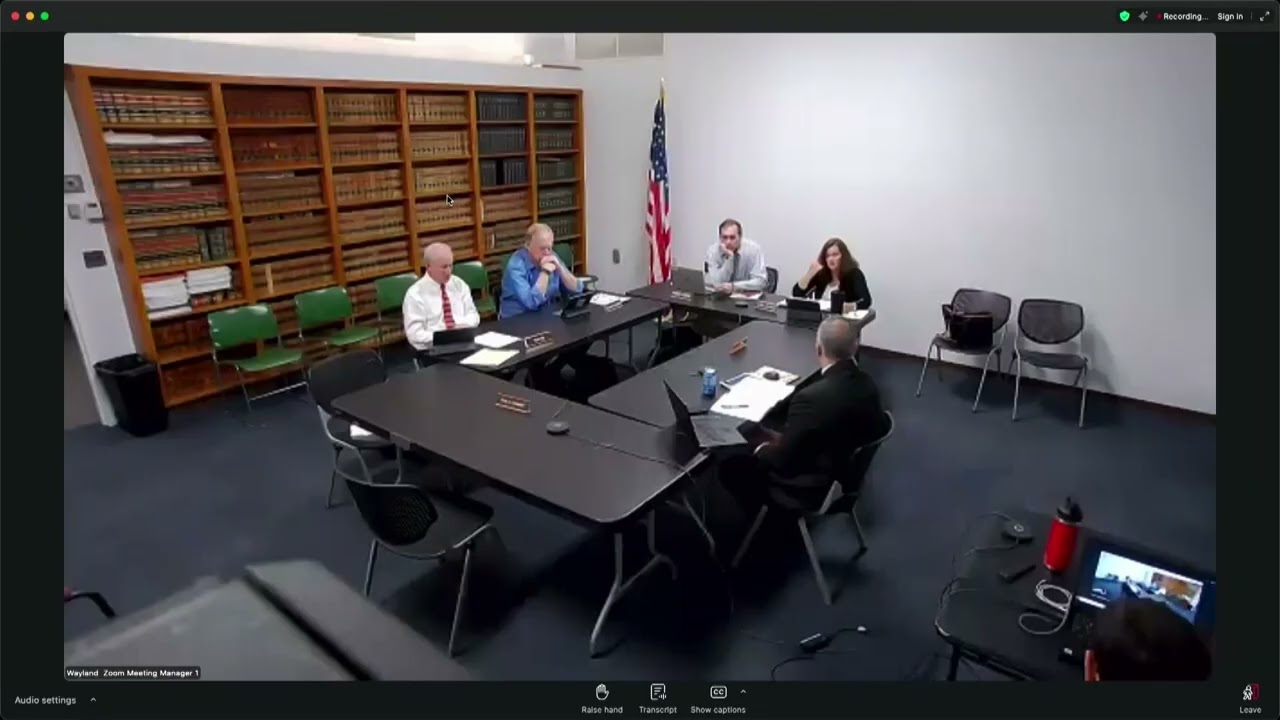
September 29, 2025 - Select Board
Carol Martin: Recording in
progress. Thank you. Good
evening. Carol Martin, chair,
select board. I'm calling the
meeting on the Select Board for
Monday, September 29 2025 to
order, this is a hybrid meeting.
We are in the Wayland town
building, and in particular the
Select Board meeting
Unknown: room. What do you want?
Cochituate road.
Carol Martin: One may want the
meeting with the meeting link
that can be found in our Wayland
calendar, pursuant to chapter
two of the acts of 2025 this
meeting will be conducted in
person and by remote means, and
in accordance with applicable
meeting may be recorded, which
will be made available to the
public on WayCAM as soon after
the meeting as is practicable,
when required by law or allowed
by the chair, persons wishing to
provide public comment or
otherwise participate in the
meeting may do so by in person
attendance or accessing the
meeting remotely through again,
the link on the Wayland calendar
on the web page request public
comment be limited to two
minutes per person evening. We
have a more reasonable agenda,
and then we've had so here we
go. We're going to have
announcements, public comment.
We will follow that with a
discussion potential, both to
purchase 14 West Lane Street. We
will have our follow up
discussion review and possible
vote to approve the Wayland
financial policies manual. We
will discuss with you and
potentially vote to issue bond
anticipation note versus bonds,
followed by a discussion review
and potential vote on DEP
reclassification of the Public
Works building 66 River Road,
the we will have a discussion
with you, a potential vote on
the proposed additional well
locations for the next iteration
of groundwater sampling at of
PFAS at 195 and 201, Main
Street. We will not be having
our full size license hearings,
even the applicant has asked
Unknown: to have it withdrawn.
Carol Martin: That will follow
up. We will then have a follow
up discussion on the MWRA joint
meeting, including, but not
limited to next steps, a
discussion review with advisory
boards and committees,
including, but not limited to
rules and responsibilities and
roles. We will review and
discuss the Select Board policy
on prop two and a half ballot
questions now, managers report
Consent Calendar minutes, I
believe, of September 2, review
correspondence board members
reports of concerns. There are
no topics not recently
anticipated 48 hours in advance,
and hopefully by 915 we will
ADU. So having said all that,
are there any announcement?
Saturday? Wayland fest? Yeah, this Saturday? Yeah, it's a Saturday. Wayland fast. Doug Levine: This Saturday, and Wayland fest from 10am to 6pm combining multiple events on a single day, including touch a truck, the multicultural festival and America's 250th celebration. Expect a robust turnout, and I hope most of us can make it as well. Carol Martin: Okay, any other announcements on the board, Robbie, could you check I don't think Miss Bratica. Oh goodness, I should have a sticker with me in the room is Mr. Fay, Mr. Whitney, Mr. Lane. And MWRA will be joining us, I believe, remotely, but later. And we are also joined by the Tom, the image of Michael Unknown: McCall, did I miss anyone? Okay, Carol Martin: Michael, did you have any announcements? Are you all set? I'll
Michael McCall: wait till I get to my town manager's announcement. Carol Martin: Comment. Do you have any public comment in the room? Unknown: Yes, yes. Carol Martin: Recognize ADU, please.
Unknown: You cannot hear me? No, I didn't hear you. It's yeah, it's the thing. I'm very sorry. Can you hear me? Sorry? Thank you. You know identify yourself. Thank you. Yep. Aida Jennings, Wayland Hills Road, Chair of the Board of library trustees. Thank you very much for the library is supportive of the purchase of West Lane Street, 14 West plain Street, and is ready and welcomes the opportunity to develop engaging programs and services for tweens and teens at this location, in partnership with other town boards, the building is in very good shape. Each of the two levels are ADA compliant with bathrooms, individual or small group spaces, the potential for a larger open space and a kitchen or kitchenette, and that's on each level. It's within walking distance of the middle school and your high school. Through bus routes, students can easily bike or walk with friends, grab an after school snack and get there without relying on other transportation the library. We can offer services mostly after school and during vacations, teaming with other departments to develop a variety of programs and activities for this age. We also envision satellite library services, a rotating collection of high interest books and materials and a dedicate with a dedicated librarian, study and meeting spaces. And we welcome input to develop additional creative ideas. A few have come our way already. The library has received some input from library users and parents with children in this age group. Many are excited about this concept. There is enthusiasm around providing services and programs at an easy to reach location. We welcome where young people can engage and connect. Two students have offered comments to our youth services director, which they'd like shared with you. So one is from a current Middle School seventh grader who said that's a really, really, really cool idea, from a current high school sophomore. When I was in middle school, I went to that part of town after school with my friends all the time. The building is near CVS, the baseball field, Hannah Williams, Park, Duncan, basically everything that's pretty genius.
Library appreciates your work paying the needs and costs of upcoming projects and how to fund possible purchases and costs of this building. And we thank you for your consideration again for this program that we are suggesting, if this comes to fruition and libraries is able to co site there. So the library welcomes the opportunity to partner with others to develop a third space, a vibrant, supervised space where young people can connect and engage. And we hope that this discussion will continue. Thank you, Carol Martin: Robert, do I have anyone online who wants to see Unknown: Yes? Richard Turner, okay, thank you, Carol Martin: Richard. I recognize you, please. Oh, Richard Turner: yeah. Richard Charena, Dave Hill Road, this is not the time to be purchasing real estate. You have no funding for this building. Granted. It is a nice building the previous speaker just mentioned, and make a good branch library. But how you going to fund this? Our taxes are high enough we don't need to add any more to the tax burden of the people. And also, I have another comment. Yesterday, I went to a wvn get together, recognizing the people that were involved with wvn, and a person came up to me and talked to me about the entrance to the COA that is very confusing up there. A lot of people are going in the wrong way off of Andrew Avenue when they should go up to the corner and go down Lillian way and come to the right entrance. There's no sign there telling them enter here. It's just the other ones say, Do not enter. You might want to look into that. Thank you. Unknown: Thank you. Richard, Dave, Carol Martin: do you have anyone else? I see no one else online. Thank you very much. So we will move to the discussion of 14 West Lane Michael McCall: have an announcement, waiting on clarification, but I just wanted to let people know that there will be a visioning workshop for the Sherman's Bridge Road project that's ConCom plated to be repaired jointly with the Tom Sudbury and with The Mass Department of Transportation that will be held on October 9, at 630 at the Fairbanks community center in Sudbury. Unknown: Yes, thank you for mentioning that
looks like a Thursday, Carol Martin: Thursday, October 9. Thursday, October 9. Thank you, ma'am. No, there's been some interest in that, so I'm glad we've announcing that. Thank you. So item number three on the agenda is to discuss the potential vote to purchase 14 West lane. We have had a number of discussions in executive session about this property. Over the course of the summer, we've looked at a number of things. We've gotten some input from staff members and from the town manager. We've commissioned an appraisal, and we held a forum on the 15th, you know, together ideas to make sure we hadn't missed something. Unknown: And there and there's no two Carol Martin: ways about it. I think everybody agrees. It's just a fabulous location and it's a nice building. So I'm not sure that there's agreement on where we go there, so I will. But the interesting thing about this is, indulge me for one more minute. Is that. But we the board, or we the board of the town, through the board, have committed to the owners to make a decision of whether we would purchase this building. And we said we would do it, you know, by the end of September, the beginning of October, which is why we have this vote on our agenda this evening. That doesn't mean that regardless of however this vote comes out tonight, somebody else from the town couldn't buy it, like there was an email to us responded. She said, maybe donor will come along and buy it, or something like that. So I think in one sense, I just want to be clear that those are listening to us regardless how we vote this evening, Unknown: that if, if we do not Carol Martin: support this, there is still, there's still the public is still on the market, so until someone purchases it. So I didn't mean to preserve everybody's thinking, but I have received that question, what happened? So I thought I would answer it. So anyway, Unknown: I'll open it to the floor over Tom. This building really does have great value. To build this structure from scratch would probably cost the town between 500 to $8 per square foot purchase. The structure be between maybe two to 300 per square foot, including the needed changes. As you've said, it's a great location. I think it would be a great town asset. It'd be a good spot for library use, record use and other town uses. Yeah, it's been parking nearby, not only on this property, but Tom property next door, but time means everything in life, and right now, the town is facing tight budget, tight capital, not tight, but significant capital expense relative to infrastructure, water needs and it really is a want versus the need. I would encourage this board to consider when it meets next for its goals next year to food in its on that list, this building you know, looking at maximizing space here. I also want to recognize planning board Charena Lewis' comment last week. I didn't attend the meeting, but I watched the meeting about the idea of a campus approach, and I think I don't favor building out green lanes for campus approach, certainly this time, the idea is to have many townhouses in one location. I think it has lot to be said for them, just for just for convenience sake. Having said that, I do think technology continues to develop so that our space needs to town will slowly be reduced. He got a mind 12 also, where the fact that we do have a second squad, believe additional town staff. I also noted in watching the hearing my couldn't attend meeting like Watkins online, lack of support from Cochituate presence. To me, that's that's significant. I think one of the residents comments mentioned taking the property off tech commercial tax roll. I think that's also the fact. I think the building really is ideal for private fundraising use, whether it be by arts supporters of the arts or other uses. But I just think timing of town purchasing the property now it's not good. I would not support its purchase. Just go down the line. I want to first express my appreciation to the property owners for their rooms to work with the town. Allow us to explore this possibility, some very interesting ideas come forward on the question of the building being taken off the tax roll. It's my understanding that under state law, if the building is owned by a not for profit or municipal money, and it's lease in part to a for profit that that portion of the building, least for profit, is subject to property taxes. But not withstanding, I would agree Tom I think that given me.
I fear this day would come.
Doug Levine: I was most excited about this opportunity, from the get go when it was brought to our attention, I toured the building in the summer with a representative from Arts Wayland and others, and obviously, as we've heard repeatedly from folks, including from Michael, who had the building examined closely, it's not only a great location in a phenomenal condition, but as Mr. Fay mentioned, we just wouldn't be able to create such a structure for the cost that they're asking. And it's unfortunate, because it would be a really nice asset for the town. I've found since serving on the Select Board, dating back to 2017 and this term, there's really never a great moment to take advantage of some of these opportunities. But unfortunately, we're in a particularly difficult set of financial straits right now, as we've been discussing for our last number of meetings. So I would feel uncomfortable going to town meeting and asking to borrow money for this what we would all classify as a want versus a need, when we are looking at potentially avoiding an override one more time, and more specifically, with a mass of water infrastructure ask, which is clearly a Need. So because of all that I am reluctantly unable to support Unknown: the project. Potential,
Carol Martin: perfect answer. So now it's back to me again. So I,
if you talk to my husband, he will tell you that my own animal lives in our house. I have great hope that we will have this incredible fundraising drive in town. And like I said, the property is still on the market, and maybe that will be a wonderful solution to this, because I think it'd be a great addition. And I had hoped, although they said they weren't capable to take it on at the time, that perhaps housing that was such a lovely it fixed the whole definition, you know, because it's walkable, aren't there? And so and I just, but anyways, it isn't. So I'm hoping that, and I hope folks don't think that this is the end of it, because not the end until it actually is sold. I think so. Anyway, all right, excuse me. One second, Mr. McCall, would you want to add anything? Unknown: Yes, anyone else said, I think the Michael McCall: board has put a lot of time and thought into this, as well as everybody you know, considering all the possibilities, it was an opportunity, as was mentioned by all and I think we have to evaluate every opportunity, but at the end of the day, you have to consider what's in the best interest of the town. And given everything that's going I think, is well thought out, answered by everyone on the board.
Unknown: Move that this board vote to purchase property at 14 West Lane Street, discussed as outlined in our agenda. Any further discussion? Carol Martin: So the motion is to purchase, and then we will vote accordingly. So since we're all here, I'm only going to be taking voice votes from the roll call. So all those in favor say, Unknown: I All those opposed no and Carol Martin: oh no and abstain. So the motion, the motion does not pass. Unknown: 040, look on everybody, right, yeah. Okay, great. Thank you very much.
Michael McCall: Madam Chair, I will send an email over to the parties at 14 West Point, informing Carol Martin: them of Kelsi. Thank you very much. And again, please echo what Clay said that we appreciate their willingness, you know, to wait and work with us, and knowing full well how sometimes it takes us to move a little more slowly than private industry. So okay, we're going to be looking at, we looked at these the last meeting, I think, and we're going to discuss with you and vote to approve the Wayland financial policies manuals prepared by the Division of local services that Michael talked about a couple times, and it's in the supplemental. Packet, starting on page five, quite a long, lengthy document. It is. A lot of work has gone into this. I do want to say that although it's important for us to have formalized policy, we did have them in place just anybody just thinking. We didn't have the policies we did now. We just now have a formalized and we want to have the goal. The first goal was to get them done. The second goal was to have them ready for the bond conversation meeting that's going to take place on October 7. So we've been asked to take a position on this tonight. We did revisit this a couple weeks ago, and there were some edits made. And if anyone has any further little edits on there, we will take them under advisement or questions. I'm sorry. Doug, you want to start no Billy,
Unknown: thank you, Carol, I am sort of a given that this is a financial policies, procedures, minimum, perspective, procedures, dense, it's a little bit of insight financial baseball, or financial insight baseball, frankly, don't feel competent to express an opinion about the procedures banner, but with respect To policies.
So I think
Carol Martin: I actually served on this, this, this Unknown: task force working group. Carol Martin: Even after the working group finished working with consultant, I still went into this was helping with some of the editing, and I am very familiar with a lot of the financial practices spent the town and not all the procedures, because I'm not on staff. So hopefully that will increase your uncle level when I at least recognized a lot of this.
Michael McCall: Go ahead, Michael, I just thought it would be worthwhile. Just to reiterate, for those that are at home watching that just started. We got in the queue with the financial Resource Management Bureau, which is part of the Department of Revenue's division of local services, where they would provide resources to the towns to develop financial policies and procedures. And after about, say, over six months, just shy of a year, they came out over a year ago to start helping us. They come out with a template of some of these policies that they've used in other communities. And then what they do is they work with staff, go through all of our standard operating procedures that we have that haven't really been documented, but through conversation with the staff. So Madam chair was involved. We have the assessor, the Treasurer, the finance director, who's also our accountant, and then we had me and the assistant town manager, who work on all these meet with these folks, and then brought back the draft, drew them together, and then I went through individually with each one of these department heads on their respective sections, and as questions and comments came in From the board and elsewhere, the finance director and I went through them and just did some fine tuning to ensure that it followed our current town code as well as any other state law, to ensure that we're doing exactly what we need to do. And this was also something we wanted on the books as we go into our meeting with the ratings agencies in the next couple of weeks, so to demonstrate to them that we have our financial house in order, they've asked for these types of policies and procedures in the past.
Carol Martin: Any other questions? My Doug Levine: only question for you, Michael, echoing a little bit about what Bill is saying, is it clear for folks, staff and boards you think, where this language is required and where it's more of a guideline that you can just use as a guiding light, versus you have to stay within the four corners of the page?
Michael McCall: Good question. Not sure if I have an exact answer. This indicated all the departments helped with the procedures. The document tries to break out some of the procedures from the policies. It's a work in progress. Yeah, it was recommended that we come back roughly once a year see if there's anything changed Doug Levine: just, I'm just thinking ahead to, you know, once we have this document in place, and it sounds like it's probably going to move forward, I'm just wondering will, will there be a time where it may potentially be too prescriptive and will need to work outside of it, and we'll we catch grief for that. But that said, you know, I know it's a balancing act, and Anette, it probably helps us, for example, with the ratings Unknown: agencies. Michael McCall: I think anytime there is a change in the law or change in code, we'll have to come back or trends in the industry, and I would have to defer to the. Finance Director in his reports, the assessor and the collector. Similarly, I rely on Town Council. I share the update. So if there's some major change, obviously we would have that bring it back to the board and say we need to incorporate, Carol Martin: yeah. So when I first, I may hop in here, when I first looked at the original Select Board manual, that's all this started. Bill looked at it, and then when I took over from Bill, he said, Carol, there have a go. Almost have like two documents going on, this one that we're getting from the consultant with best practices and a template. But my first observation was that was like three documents. It was like our policies, our Select Board policies that we make. There were procedures that are actually done by staff. And Michael is the operator of that Select Board. And I, I said several times, don't put them in our packet. We're happy to vote on things, but they're not really in our purview. And then the third of them was, I always call it rules of the world, just general governance, how we all are to operate. And I don't, we haven't gone back to that, but I think that in here to your a lot of these, particularly as you go down, they've even labeled now procedures. Those really are in front of you, but they're in the document just pulled up because if, let me just say, if I'm one of the staff members and I find an issue in one of the procedures, I'm going to say this doesn't work, and I'll work out a new procedure with the town manager, because he runs the day to day operation. We're the umbrella policy makers. Is that? Yeah, so we're going in that direction where we will have kind of governance, policies and procedures, but this is a huge undertaking, and before we have a move, I do want to say this, because Unknown: we're on on the tape. Let me say this Carol Martin: 20th Tom is huge undertaking, and there are certainly going to be things in here that need to be revisited. Unknown: However, I think everyone, Carol Martin: not particularly us, anyone listening or reviewing the doc, whether it's other committees, needs to recognize that we will come back on this, probably in a year, or after we come out of town meeting, we'll have a look of this. If there's any, you know, typos or words that need to be adjusted. I think that time wise, makes sense to me. It makes sense to the board, rather than it comes back in like three weeks or every time someone has an edit, right? So we're all on the same page, which is lovely. May I have a motion please? Or if there's no more edits,
Unknown: Wayland, Massachusetts, financial policies and procedures. Thank you second Thank Carol Martin: you. Further discussion. I'm sorry this was a couple things.
Unknown: Tom manager, I suspect the state may review the fives in this policy in and send out notices to municipalities. I was asked to maybe just board be ARPA finance committee that they be included case decisions made to substantively make changes to this on annual basis, even since treatment. And the second thing to Miss Lane question about the effect of these policies and procedures, to me, it's it's fine with that by statute which would impose an obligation, and then much of it is guidelines that can be followed or not followed based on the judgment of manager. So you're saying, just Carol Martin: for me to understand, too, you're saying that there can be regular updates from the state on these policies. I suspect it would be okay. That makes
sense, because they have a number of communities that have this template. So that's a good point. Michael McCall: I'm seeing it might be a good practice. We can discuss it either tonight or another meeting that we pick a date on our municipal calendar, maybe at the close of the fiscal year. And I solicit input from each of those individuals, the assessor, collector, treasurer, finance director, to see if they have any relative I should say, bulletins or updates relative to their particular area of expertise that they received from the dor or a change in a Massachusetts General law. And then we can bring that to you folks and then make our annual tweaks. But I think it's easier if we always. Say, Oh, the first or second week of July, when we have a July meeting, that's when we just go back and check to see if there's anything. Because if we say we'll just get to it, that's Unknown: when it gets lost. I will put a note in here to put it on our calendar for next year anyway. Carol Martin: No not putting it on the end of June, because Faia company will kill us. Busy time. Michael McCall: No, no, no, that work for everybody. Carol Martin: Yes, good. Like that too. All right, so we have a motion on the floor, and I do want to say thank you very much to Michael for before we vote, thank you for doing this big, big task. Said it about 10 times, and it's really nice that we are now on the list. So having sent out all those in favor say aye, motion passes 400. Great. Unknown: Thank you, Madam Chair, members of the board. Thank you. Michael, all right, so Anne, could Carol Martin: you check to see if Anne's coming? Because Anne thought she'd like to participate in this of the discussion, or Alison and Brantley haven't seen Bratica right now. You know what I'm you know what I'm going to do with the board's indulgence. I'm going to move to move to number seven,
Unknown: which is now the update on the agenda, the potential next Carol Martin: drilling sites we have received the map that's also in the supplemental packet, and I believe that's on page Unknown: one hand, what Carol Martin: he wants to get on to that page they can see it, and then I will turn this over to Michael. We received this information on Friday, Unknown: and so we decided to
Carol Martin: amend the agenda and include it so this could go forward. I will the floor is yours. Unknown: Michael, thank you, Madam Chair, as Michael McCall: Madam Chair indicated, towards the end of the week, I received correspondence from Mr. Gould, who is still working on our behalf on this particular issue at 195 main streets, and he provided me with the map that you have for you, which is the proposed well locations for the next iteration of sampling.
Unknown: So I believe he has six sites that are up gradient Michael McCall: from where the previous tests had been conducted. Unknown: As you may recall from previous interactions with Mr. Michael McCall: Gould, the prevailing wisdom is that the source may be up closer to the middle school. So if you notice, he has proposed well locations around the perimeter of the middle school. I think there's always been some concern that it may be from the leaching area, which I think is if you're looking at the map to the north side of the middle school, near that traffic circle of that back area. So he had just asked me to share this with the board, see if there was any concerns about where he would like to do the next iteration of testing, try and Unknown: identify the source, Michael McCall: the agenda for the Sean. If there's no opposition, I'll let him know, and he will proceed with the Doug Levine: digging and putting in a new wells and starting to test it. Did the Select Board approve the previous wells? Is that something the Select Board gets involved Michael McCall: in? I don't recall that we have, but he just because this has been such a high profile thing, I think he wanted to share with you what he was doing, just see if there was any concerns Unknown: in the part of the poor, how large a monitoring well is?
Carol Martin: I have the same question. I didn't remember doing them, but I think when it came forward, Michael and I conversation, decided, given the interest in this project, in this property that we would review this? Unknown: Yes, it's no more than four or six inches. Four or six inches in diameter. That's it. Yes, it's typically a PVC
as the drilling proceeds, and there is metal, that's what AI just told me, to two to four inch diameter PVC pipes surrounded by a filter pack.
Michael McCall: I also thought it would be prudent that just to share with the public that there is still ongoing work there, Unknown: because we have not had Mr. Pooled in, so Michael McCall: folks would at least know that he's still progressing, and that hopefully he would have another he would have new data for everyone Unknown: shortly thereafter, he drills any question this topic, was it? Carol Martin: So when the surface, I said, Let's revise the agenda which came out, when this up in the supplemental packet at this time, Unknown: I believe it was posted. So, yeah, oh, now, Tom, Carol Martin: did you think I will pay Unknown: back? Carol Martin: I'd wait till you were gone. So it looks like there's, is it? These turquoise blends, 1234, like six new wells. What he's looking at? Yeah, okay. I think the one question probably not answerable, but the one question that might be raised is, you know, Unknown: when Will the work be done? Do we Carol Martin: know, and then when would we have the report? I guess that's really a question that's really of interest to us. So do we have a sense? Would it be like three months from now? Unknown: I can ask Mr. Gould, I knew he said it could take Michael McCall: several iterations to try and locate the source of the PFAS. He did indicate he was filing for the extension of time Unknown: with the DEP. The goal Michael McCall: is to have that permanent solution, as he indicated before, of how we will deal with this doesn't necessarily mean we have to remove it. We just may have to mitigate it, but he has to locate it. So I can ask him, probably say standard It depends, you know, it may really depend on the outcome of this next iteration. Carol Martin: But I'm asking because, of course, the public will want to know. And so some we don't know at the moment what the what the time frame would be, but anticity to be about probably three or four months. Does that sound reasonable? Unknown: I'm looking at bill by fellow definitely. Take samples into the lab test come back. Yeah, all right, that sounds interesting. I think it's interesting that wells opposed, or I assume that groundwater is moving east to west, and so looking at both leaching fields, but also a further upgrading to see if the source might even be off site, that's consistent With what he suggested, even proposed, very thorough, just methodical evaluation. Anyone have anything else they want to add to this topic? Okay? Is Anne online, though? I think you should start the conversation we last some time, or we could go to consent
Michael McCall: doing anything with number seven. Is the board satisfied with those locations? Just let me know there was no concern, no opposition. Carol Martin: Okay, thank you. No concerns. I didn't hear any concerns. I didn't think you needed a formal vote, Unknown: but I just put it there. Happy to move the consent calendar for September 29 I have a second on consent and any further discussion. Okay? Carol Martin: Voice vote, all those in favor. Motion passes four zero. Do we want to look at the minutes?
Unknown: Minutes are going to be in the regular packet?
Carol Martin: Okay? It looks to me like page 15. Does that look right?
We want to have a motion, and then do we have some comments on that
Doug Levine: move? Approval of the September 2, 2025, minutes in our original packet as amended. Unknown: Have a second. Anyone? Have any edits on this? I have one on the Carol Martin: page, a first page. I think it is page two, eight. Six this was, obviously, was challenging to see who was there. But we don't normally like who's not in attendance when we're having
Unknown: joint meetings. However, I Carol Martin: will say this, that both IRS and Carl bonds were in attendance in the in the large hearing on this, and MWRA Lee was not a member of the finance committee at that time, so that we need to pitch them at the paragraph that goes out of public works, the last sentence on the next, first paragraph the next page. Mr. Be just was reporting and talking in blah, blah, blah, and it says the Finance Committee has not yet made any end that is on the matter. Well, they haven't been asked to make one highly yet. So I don't know if that sentence is relevant.
I'm here on a seven for last paragraph, the board discussed the two proposed strategies. Sentence that starts yes with D lane and goes all the way down, oh no, see, Martin encourage the board to support the band's approach. Ba NS Unknown: proposed because there were two. We were talking about the bands at the time, and if I skipped you Tom,
my only other Carol Martin: thing was a style issue on page four to a eight. We had the discussion, you know, started looking at the equity Unknown: audit, and Dr Ian Renee Hayes came. We normally don't list Carol Martin: things out, like in the second paragraph on the slide. And there's more than one slider recommendations there. I'm sorry. So we don't normally list out on page, on Section Eight. We don't normally list out things like the port. We recommended these five or six things like in a separate bullets and stuff into this industry pages of them. So it's misleading. I think we should just say that the report recommended a number of strategies or something like that. Something more of a summation makes more sense. Yeah, okay, just wanted Unknown: to check with you first. After that, I'm done. Who else has any edits? Carol Martin: No. All right. All those in favor say aye. Aye. Motion passes four zero. Unknown: Did Angela correspondence? Any conversations on comments on the correspondence? Tom may Mr. Carol Martin: Mayoral, come to visit us and spoke in person, and then he gave us the handout, and it was the general correspondence. I thought he had a very has a very thoughtful approach to his concerns about the regulations that the
Unknown: was the name of it done back to 193 193 and Carol Martin: I'm just wondering if it's something we should be following up on or finding out what's happening. He seems, he seems to think that's his opinion, that
Unknown: there is some
Carol Martin: variance to how others, other communities have interpreted this language.
Unknown: They say it right? Yeah, I asked Doug Levine: Michael for an update about it a couple of weeks ago, and he got in touch with Miss Hanson, and it sounds like they're still working through the 193 regulations. They're working with time bond, who is also working with DEP W on storm water issues. So it looks like they're supposed to have an revised draft out there for their October 8 meeting. But she also classified that as a somewhat optimistic timeline. Okay, that's the last as of two and a half weeks ago. Did you say the date was Unknown: October 8 meeting.
Carol Martin: I think I'll go back now. Hope Anne has joined us. Let's go back to item number four. Whoops. Unknown: Do I have to stop or so on? It's just Ron still. You continue. To sign up there to check out something Okay. Carol Martin: Item number four is discuss review and possible to approve, excuse me. Number five, discuss review and temporal vote to issue bond, antic note versus bonds. So Lewis had also a. Unknown: In the packet, the main packet, what we have in the packet here inside what
Carol Martin: we put into the fact that we really didn't put an awful lot of the materials that were from before them. And the week before, we printed Michael's memo, which was written on September 15, that does refer to a $2 million shortfall when we know it's 1.8 now, and also, we've gotten the grant money from the snake book for this this,
Unknown: and then I put in my little feet here for the steps Carol Martin: involved in each one of these to see if it helps, although I do have a mistake in one of them. So anyway, Michael, did you want to have the floor for this one. This is the bands versus the bonds proposal.
Michael McCall: Thank you, Madam Chair and members of the board. I may be familiar with this by now. We've talked about a couple times, and we had Mr. Kevin. He're not only for the joint meeting of the week, but on a different occasion in his memorandum. To go back a little bit for not only this agenda item, but the next one. These were products of our budget Working Group, which we started shortly after the beginning of this current fiscal year. In July, we started meeting, as I mentioned in the past, we have several members of the community staff and Madam Chair has been part of this working group, and we meet every almost every Wednesday, to discuss the upcoming fiscal year that the FY 27 and as was explained last week at our summit, we are looking at a Long term structural deficit just because of the funding that we no longer get from chapter 70, as well as our lack of new growth and several of the cost drivers in our budget, such as healthcare, pensions. And opine, just to recap, one of the strategies that the working group had was if we could postpone an override, or a multi year override, to FY 28 that would give us more time to plan, avoid any confusion or competition with the potential increase in costs for the MWRA project, which is 38 point 5 million, and would also lead us to allow us time to work on collective bargaining this year to firm up our numbers for future fiscal years. So this particular strategy was one that came from our finance director, Mr. Keaveney, and the thought was, rather than bonding all of the $16 million we would take the opportunity to do a portion of that and the others, we would use short term bond anticipation notes, although it would cost us some money and interest, it would net us approximately $800,000 of available levy to allow us to try and close the gap in FY 27 so the committee had asked us to put forward A memo to the board and ask for your consideration in supporting this endeavor. This is, my understanding, just a simple vote of the majority of the board. It doesn't go before the the electorate. It's just something that with the board's approval, Mr. Kevin is meeting with the rating agencies next week, he's all set to issue the bonds and and pursue the bands. He just needs direction from the board in the way of a vote, and then at some point, you would then sign off on on the documents, once they're all finalized.
Unknown: Well, originally we were Carol Martin: bonding 8 million and then we received the grant for snake book. So it's more like seven two. There was a question about just hopping in here for a second with some questions from last week. Top of my head, indulge me. There was a question about the cost. And then, you know, it went from the 160 down to about 145 because we were no longer borrowing the money for the snake book Dave project, encourage me, and I just want to confirm with Michael, is the variable there is the interest rate, and that 140 is predicated on our bonds, our bands, being issued at a 4% interest rate, if they came in at like three or three and a half or two and a half or something. And begin, this is where our AAA rating helps us slightly that 140 actually would be less so I think the 140 cost, you know, the float, the bonds before the before we get to the island, took the bands before we issue the bonds next November. Think that's a maximum number. I know that was a question you had. Yeah, to follow up on that song, just, I'm Doug Levine: trying to get my head around what Carol is asking, because that was my underlying question. And both these memos are helpful, if just, we're using the figure 140,000 for sake of argument, if, if we didn't go the band route, and we went the traditional bond route, then we're paying interest and principal on, on, on that number, so we would be spending at least that amount and then some. And so the question now then is, does this just add a year to the timeline, because we're then doing the full borrowing in 26 Michael McCall: essentially, we are deferring principal payments for one year by doing the interest only bond anticipation notes for one year. It buys us some time. And by not paying that principal out of the levy, you have that available levy capacity to Unknown: close the budget. So you just yeah, Carol Martin: we've done this. This isn't an unusual tap. Not only do other communities do it, but we've done it, which is great, because it's in our purview to do this, we've been authorized by town meeting to determine the funding source for those capital projects so that they can go forth, right? So we have funding to proceed with the projects. So we've done business. I think when I first joined, looking at Tom here, I first joined the board, Louise came in, and I think that was one of the first few times she recommended that or introduced it, because she spent quite a bit of time. Does a board have to vote on it? Well, we have to vote the funding source, just like when you see the Consent Calendar tonight, we're voting on funding sources. But Tom meeting has already approved the projects and has approved, authorized Select Board to determine the funding. So it'll say borrowing free cash, whatever. There's a phrase that uses, and then they come recommendation comes forth to us, and we, we are we also authorizing source and talent. Doug Levine: But if somebody asks, would we say this is costing us by converting the bonds demands for this one year and extra $140,000
Unknown: if it's a short term, No right should be between two, 2.2217 this is I right, but these are projected at four. Yeah, that's Carol Martin: why I'm saying to you, gone from the 160 to the 140 but I'm saying, well, we'll know after Brian has been about two to three weeks, we'll know what Unknown: when they come back, they come back, they'll tell us, this is what they're going to put them out as it does, I think it is an additional interest boost, yes, and we have done it though, just because we moved BNI out here, as you said, first year,
Doug Levine: and it will just be arranged depending on the interest rate. Unknown: Yes, I mean, and may I see this? Carol Martin: They just lowered the rates. They said, Oh, well, Wayland is going to do this. We've been alone, so I don't know. I mean, Brian or Michael would have a better sense of what they think on council, of a fairly good sense, but you do have to set the expectation that it could be 4% because it wouldn't most likely be more than
Unknown: that question discussion at the previous meetings, Lane, talked about, talked about one of the two strategies that's essentially an interest free loan, and the money gets refunded to the general fund. And there's a look at the minutes of that, it appears to pertain to the
issuance of the bonds. And I didn't understand, that's a good question, that notion of reimbursing the general fund. Carol Martin: Yeah, so Michael, he's like, I mean, we're only borrowing, we're only using someone else's money for five months. Michael McCall: I probably cannot do it justice, like board member with me, but my understanding would be that he would be you can make a transfer from the general fund. He's indicated there's forms that you can Unknown: sign at the. With Dor, Michael McCall: and you make yourself an interest free loan from the general fund, and then when you go out for the regular bonding, you would then reimburse the general fund. If you want clarification, because I can't explain it any better than that. Off the top of my head, I don't have memo in front of me, I could give him a quick call and have him log on that need him. Carol Martin: So Bill is right. Unknown: When we do that first half, it's a two step thing he's doing, because the first from December until the end of June, fiscal year, we're going to Carol Martin: use free cash, once we get certified, to support these projects. So where's the interest cost? It's an opportunity loss, because we won't earn interest on our investment. Unknown: If it pertains to when you're right bonds, there is an interest cost, right? Because you're borrowing money, Carol Martin: right? But when we're reimbursing ourselves. Unknown: But what? What is the general fund advancement needs to be paid?
Carol Martin: Isn't the entry you've actually hit it right on him. He needs to explain it better. Unknown: I'm not a finance looking at the minutes of the previous meeting pretty soon, and it appears to protect the issuance bonds, referring describe the strategy is temporary, no interest loan from the job fund, the various capital accounts, which I just don't Follow. Doug Levine: Well, I think that sentence is a little off that, because it's in the middle of paragraph, under a seven, because then it says, Unknown: noting that this could lower the Doug Levine: 1.9 million deficit to a more manageable 500,000 that's both together, right? Not just the van bonds to beans. Unknown: Oh, I don't know. Carol Martin: I got it in the middle. Yeah, yeah, that was part of the problem is that Brian was talking about both kind of into mail in which what led me to write this demo to you guys.
Doug Levine: Your question is about classifying this as a known interest loan from the general fund. What does that mean? Unknown: Where's the from originally? See, available. Yeah. And reached my problem. He know that in the view on the phone tonight.
Carol Martin: Could you bring over Nina
Unknown: textbook? I am Hey, have you guys done talked about the band yet?
Carol Martin: One second for the minutes. I'd like to note that mwranley has joined us at 728, and we are on Agenda Item number five, the bands versus the bonds proposal, we did some of the other things waiting for you to pop up. Okay, great. All right, so we now have a question, and Bill has raised a very good question, and Michael's trying to reach Brian, but
Unknown: that's where we're at at the moment. What is the question? Well, the quick go ahead, Bill, my question is, Brian made a reference during his presentation of there being a temporary no interest loan fund, which then gets reimbursed. But I was, I am unclear as to what that loan is, what it what's it applied to? How does it get reimbursed? Because I just didn't understand that in the context of the bans and bonds discussion, and also with respect to the reclassification of the DEP. Anne Brensley: Yeah, that's a great question, because it's actually my question because I did some research and looked at bands that were used in other towns, and they were always, they were always based on a specific use, so you knew what the what the loan was that was taking it out from the start. So I actually had that same question.
Unknown: I believe Carol Martin: Michael has has reached by him, and I don't believe he has a laptop, so he may just call in the lights or Emma to know if I thought that was okay. I said, Yes,
Unknown: we're just waiting to connect with O'Brien. Yeah. So. Know, where do I get
Carol Martin: we're just waiting. I'm talking because I don't want any of this. Unknown: That's supposed to be one, one, stand this shot at all. Mr. Kennedy, I lost him there, right again, connectivity, I think in this building, Carol Martin: I think Tom stepped the right ad. Maybe you could bring him over here, where you were next to the Michael Tom, and are you? Hopefully you'll be able to hear this. Yeah. Unknown: Brian, so Carol Martin: nice and Brian, Kevin, you the finance director who is on the phone, Brian. We're looking at, I'm sure Michael told you this. We're starting to have a deliberation on the bands versus the bonds. Proposal. And Bill has a question. We're actually, we're talking about the cost to the Tom to do this just pay interest only, which was reported as approximately 145 and now Bill has a question so Unknown: that we like So Brian, in your presentation at the joint meeting Finance Committee, you referred to an interest free loan to from the general fund that gets repaid. I would, I'm unclear as to where, where that loan is made. That is to say, what is that finance and how does that temporary loan get repaid?
Okay, so if i LUKE your question correctly, that you want to understand from the general fund, Brian, various capital accounts, I'm going to move you over. It's as loud as you can go on over here. Fortunately, we have this. I All right,
Carol Martin: Brian, I'm sorry. Go ahead. We couldn't hear you.
Unknown: All right, yes, go ahead and answer. So I think I put those question, if it was that transfer thing in various capital, is that correct? Michael McCall: He wants to know how the interest free loan works from the general fund transfer back Unknown: and forth. Okay, so dealer allows towns and cities to transfer from the general fund to capital accounts in periods of time when the capital accounts have not received funding from either free cash or from mostly borrowing. The way it would work, it would be that after the town's free cash is certified, then our town can transfer the multiple from the general fund to these capital accounts. It cannot be greater than the free cash certification. We're expecting a free cash certification to be around 12 million, and transfer that we're talking about would be 6 million. So if ti certifies the town's free cash in probably late December, mid December that time frame, we could then transfer approximately $6 million from the general funds to these capital accounts. Very similar transaction in our accounting system is if we were transferring free cash, which we do every single year, the stipulation is that the money does not change banks within the town. The money would stay within the existing banks, and they would simply be moved in our accounting system at the at noi that in June 30 of 2026 the money would have to be returned to the general fund. Interest is being earned on the money while it's in the bank. The capital accounts do not pay interest to the general fund. It is simply an accounting transfer of funds the bank. At the bank level, the treasurer will not be transferring any funds from all bank accounts or other accounts, and like I said, at June 30, the money must be returned to the general fund. At that point, we will be issuing three or four month bands to get us to November 2026 when we will issue long term DEP, Carol Martin: so then the question Brian is, is, what is the actual cost of the interest? Because we're can't be 145 for three month bands. Can it? Unknown: So I think the question on interest relates to the actual bond. So again, there's no interest on the quote, advancing the interest that you would be paying is the interest on the bands from the point we take them out in November of this coming year, this this coming November, we must we issue. Issue for the bands that we have in existence. There are other bands related to the water fund. We will not be reissuing those bands, and that money will be issued as long term bonds. So we're definitely going to issue about eight lane dollars in long term bonds related to the water capital accounts. But we still also have bands out on general fund projects we must, by national law, we issue those in November, so we'll pay about 12 months interest on those for that ban that covers four capital progress. Then in June, we'll be issuing a second ban, and that ban will be about four months, and it will cover, and I don't have it right in front of me, anywhere from six to eight other projects. So in terms of what the interest cost is, it's the interest on the ban that we're rolling over this coming November, which will be 12 months, and then the band that we're going to be doing in June performance. We're using 4% as our assumption at this point because, most recently, bonds and beans have been selling in the market around 4% so in total, we're expecting the cost of the interest that we're going to be paying to be around 140,000 round. And around that period, around 141 $50,000 that will be paying on banned interest, repayable in November. 2026
Doug Levine: and my question, Brian, before you hopped on and thank you for joining us, this is Doug, is if we, if we didn't do that and we just issued the bonds, and we didn't do the band move, we would not be paying that, that extra $140,000 is that correct? Unknown: That is correct. Okay, are you have another question? Noi. I am still confused. I know I don't understand how the interplay between the interest free loan from the general fund to the capital account relates to bands versus bonds and to DEP reclassification. We're not on DEP reclassification. That's that's another story. So don't mix it in. Don't let Brian mix Carol Martin: it in. We'll be here all night. Unknown: Is this just like a timing question that the town would once the free cash is certified, make a transfer, temporary transfer, to the capital accounts that only gets repaid by issuance of bands or bonds. Well, by Bill, by by law, we would have to return the advance. And by June 30, whether you issue bands or not, money, must come back on June 30 to the general fund, so that the general fund, a year from now, can have its free cash certified. So that is a must, and we would be issuing billions in June 2026 to cover us until November 26 when we issue long term bonds for the for these particular projects. Can I just add one thing? Carol Martin: So the interesting thing about it is, in order for us to be able to use free Unknown: cash. Carol Martin: Free cash anything including Unknown: next year's topic, it has to be in our June 30 and and mute.
Carol Martin: It has to be in our accounts by June 30, and then the do our certifies it in December, and then we're able to use it. So for money is come take that Unknown: money out, and don't ever use that money. That's why this, this double thing here. So in November of 25 we have to either issue debt or refinance, right, Carol Martin: yes, and we have to issue some new bands to cover better. Unknown: Yes, and then, but in the meat. But thereafter, it sounds like, once the free cash is certified, right, transfers can be made to the capital accounts. Yes? Is that, in addition to the refinancing of bands and the sale of the bonds we're Carol Martin: using, Brian Bill's question is, we're basically using our own money through June on this, Unknown: this proposal June of 26 Michael McCall: see, we have to have that money in that account, or we don't. We can't. It's not, not usable. They call it certified. But if we, but if we sold bands and bonds in November of 25 that we have to reissue certain bands. For water based projects in in November of 2025 Correct? Unknown: Brian, yeah. So what you have now is you have bands out state, bands for water funds in general, fund projects. All of the bands that are been issued are due November 10,025
if you do not issue bonds on bands, I'm sorry, when the bands expire, if you do not issue bonds, you must re issue bans. In other words, we, we cannot, we can't not reissue in November, right? And then wait a period of time, and then we issue them again. They have to be reissued upon expiration. So what's in front of the movement is basically this. We have the option to either issue $16 million in bands and terminate all outstanding, I'm sorry, issue $16 million in bonds and terminate all outstanding bands, or we can issue $8 million in bonds strictly related to the water funds. We must, in November 25 reissue the bands related to the four general fund projects. Those projects expire. Those I'm sorry, the band related to November 25 would expire in November 26 in December 2025 once free cash is certified, we do a transfer approximately $6 million to the over to the capital projects. That $6 million must be returned to the general fund no later than June 30, in June, 2026 we would then we issue brand new bands for four months covering the projects that the general fund transfer was covering. And those bands would be expiring in November 26 Michael McCall: Okay, I'm going to ask you to hold right there while I recap. We either do $16 million in bonds, or we bond half of that, then we have to reissue a certain set of bans this November. He would don't do that, then he can use from December to June, an interest free loan until June 30, at which time he would do an additional new set of bands to cover us. So there's actually two tracks of the band. One study has to be issued, and then the new ones. And then for the six months, he can use the free cash from June, from December of 25 to June and 26 before he has to issue the new bills. Unknown: Let me try it again. There's $16 million worth of finance, and it has to happen in June, 25 November. 25 the issue $8 million worth of bonds that finances. It's a 20 year term and a 30 year term. It's we just pay principal and interest going forward. Then there are the remaining $8 million worth of bands just refinanced. And what is the term of those bands? Is it until June of 26 or is it November 26 and Michael McCall: Brian, I'm going to try and answer this, and you correct me if I'm wrong. There's two different sets of bands, one that's being reissued from November of 25 up until November of 26 and then he's going to use the free cash for about half of the year, and then he's going to reissue newer bands, and then we will re bond all of it in November of 2026 is that correct? Unknown: Yes, that's correct. Category. Do we need to issue bands if we are having this interest frequently Michael McCall: you do because do our requires you to transfer that free cash back into the from the capital accounts, back to the general fund. But if Unknown: you're financing $8 million of bands,
Michael McCall: saves us the interest cost. For those six Carol Martin: months, we're using our own money, but we can only use it until the end of June if we don't put the money back, even though the money if we don't put it back by June 30, even though the money is there, we will not be able to use it because it won't be certified by the state. Unknown: So we're so are we not issuing the second set of bans in November 2025 because we're doing an interest free one, correct? That's my understanding, not until next year. Anne Brensley: Just a quick question so that I see if I understand this, I. The the November reissuing of the bands, that's for the the water expenses, water projects, is that, right? And then the December is for the general fund projects. Carol Martin: Actually the water projects that are being those are the wallets. They're being funded through fees. It's a water fund, and the wastewater that revenue, their expenses are supported by fees. Wait. Anne Brensley: Then he just said, he just, Brian, just said that the that the bands were used for the water, and I couldn't Carol Martin: are they going to issue bonds, and those bonds are going to be paid, not by the general fund. Anne Brensley: Noi, I understand that, but that was for the water projects. Carol Martin: $8 million of water and wastewater projects, Anne Brensley: and then the other, the December ones, are for the general fund projects. Yes, okay, just want to Unknown: make sure, okay, a person would find it. Somebody could do a chart, dollars in, dollars out timeline saying, here are the existing bands. Here's how they get refinance. 8 million of it goes, unfortunately, the remaining 8 million goes until June, it's an interest free loan, and the remaining portion of the 8 million goes to bans, which go to November 26
Doug Levine: Saturday. Are we? Are we able to kick this decision any further. Well, this is we have to decide, Anne Brensley: does everybody understand this? Or is Does everybody understand this? You? Unknown: I think so. Yeah, good. It's Anne Brensley: like, I think it's complicated. I think the thing that might make it complicated is that we talk about it in one from a rolling standpoint, we have to talk about it because it's a cash flow situation, but from a project standpoint, it's two different uses of funds, and I think that's where it gets confusing, because you're like, Wait, why did why are we all of a sudden using paying back the general fund and then taking out bands? And it's because that's part of the same transaction. So I think that's where it's getting confusing, because it's like, it's, you don't see this one linear process that's just being done twice. They're they're overlapping. So it's hard to keep track of it, but I get it, but I had to use like, Visa and MasterCard in my to keep it like, oh, we have to repay our MasterCard with
Unknown: I figured it out, but we're Borrowing a lot of money. Okay?
Carol Martin: Mr. Kevin Lee has asked if we and followers, asked if we would take a vote on this tonight. Do you think we could consider that and then maybe get this, dollars in, dollars out chart. You know, Unknown: for the next Carol Martin: meeting, they are meeting. They are meeting with the bond Council, I think, is the right phrase, on October 7 or eighth, and our next meeting is the sixth. And so there's not enough time, unless we want to have yet another meeting, which Fay I mentioned ARPA to think of that idea. So, but I don't want you to feel uncomfortable. So what do you What? What? What are you thinking? Your thoughts? Unknown: My confusion arose from the fact that I thought there was $16 million worth of bands coming through. 8 million is financed with bonds, and the remaining 8 million are financed with bands that go until November 26 that is apparently not the case, because some portion of the second ADU is financed with an interest free loan from the general fund, which has to be repaid by June, in which case we issue bands to go from June 26 to November 26 at which time, presumably issued bonds for the got it Doug Levine: goes right like, it would have been really nice to have a band slide like this is how the construction of this works. In this case that I agree. Do you think we could have that slide for the next meeting, or maybe even we have it sent to us like Unknown: in between the slide we've already seen in a prior meeting. Michael McCall: Yeah, I don't think we've seen a slide. Kevin, he put it in his August 27 memo as present
Doug Levine: to. Issue, but it didn't Unknown: explain.
I'm okay with Oh, I think you've got it. So guess what? Five more years on the Select Carol Martin: Board, you can go to Finance Committee event Municipal Finance is, is point Unknown: got a lot of arts, you know? Carol Martin: I mean getting certified and all this is just complicated. Unknown: What is the wording motion you need if our board would consider this
Michael McCall: time Mr. Kevin is there, but I think we need a majority of the vote to endorse the plan proposed by Mr. Keaveney that we go forward with doing $8 million borrowing, and that we would then reissue the bans in November of 2025 for a portion of the funding, and then we would do the interest free loan on the other portion of the debt until June of 2026 at which time we would get brand new bands to cover us up until November of 26 when we would do an additional borrowing with traditional bonds. That's the most, is that? Right? Yes, I can't Unknown: remember a little second we need to authorize rather than endorse, to authorize the finance director, we Michael McCall: would you hear, Mr. Whitney, I think they should just stay over there for the time being. Doug, we were no We Carol Martin: thought you were finished, and Unknown: I got it. Brian, my question was, do you need, should the board authorize you to issue these bans rather than endorse the plan? Well, I think you gotta give some decision on this, because however you choose to do it, if you choose to not go along with this plan by Island management in advance, if you choose to just simply issue $60 million in bonds independent of the next discussion on the levy to excluded, I need to do I need to follow through what the board decides to do. So if you often do the $8 million in bands and then go along with this plan, then that's exactly what I'll do. I need to follow. But just select what it decides you need authorization to issue bonds. Carol Martin: Yes, I think we have to approve. And then once they're issued, then we authorize some
Unknown: DEP to you and Michael, need to authorize him to proceed legally, to authorize him to proceed when the signature comes in to come Doug Levine: issue would be, isn't that the safer way to go? The Carol Martin: motion could be that we move to delay in the November 2025 bond issuance of $8 million of general fund bonds by issuing bond anticipation notes. Unknown: My close Go ahead, Michael McCall: or might be easy, unless Mr. Keaveney objects that the board authorized him to proceed as he's described in bullet points one through five of his memo of August 27 in which he explains the borrowing that he has to do in November, and then the order of the bands. Carol Martin: So where would that have been in our packet? Like September 2. Unknown: We're trying to find that.
Carol Martin: I Why, and may I ask this, why would we authorize Brian? Why wouldn't we be authorizing the town manager? Was all the financial CFO here. So when we because Michael was up Unknown: right here, authorized the issuance of bonds mid lines. Has anybody filed it yet? No second. Oh, you told me to check August 18
could be in the supplemental us, what meeting date? Budget working group. Carol Martin: This is the one that budget 50, September 2. It's enough page, Doug Levine: September to Carol Martin: September 2, and it's on, I think, the. 15 of the pack Michael McCall: of the regular packet, not the supplemental when I just
Unknown: five, right? Yeah. Do you move? Happy to move that this board authorized the Wayland town manager to adopt the option set forth in items one through five page 15 of the September 2 Select Board packet relative to bans. I think you need
Michael McCall: that be sufficient. Mr. Kevin, Michael, could Unknown: you rephrase that? I couldn't hear Tom, clearly.
Michael McCall: I'm recommending to the board that they refer to your August 27 memo. You have five bullet points in there, although the dollar amounts may have changed slightly due to the do we make mention of that the recent changes that you had mentioned, but it does lay out the five steps to do the long term borrowing the general fund, as well as the two separate bands. Would that be sufficient if they authorize, yes, yes, Unknown: yep, that's fine. I don't make the motion I did. I will draw it. Mr. Kevin, the numbers in items one through five in that memo you prepared. Are they different today than they were on September 2, only slightly, because we are not going to issue the ban of any debt on snakebrook. We had in that calculation that we were going to issue, you know, a ban to cover snake so it's noi, it's been taken off the table so it's no more than the numbers listed items one through five, right? Carol Martin: I knew 8.8 in long term debt, the snake book took off. 900 should we be authorized? Authorizing 8 million in long term? DEP, I think Michael McCall: Mr. Fay was going to say not to exceed the numbers listed in the August 27 memo. Okay, that Unknown: would be better. So I'll move that this board direct town manager to proceed with the items listed one through five within the Select Board main packet, September 2, page 15, relative to bans and monitoring DEP, the memo from mister Kevin in August 27 the memo from mister kevinny dated August 27 2025 again in the packet from September 2, 2025 Select Board, packet page, 50.
Carol Martin: Do I dare ask if there's any you got it all right, since Anne has joined us in his remote we now have to have a roll call vote. Anne? Yes, sir, yes. Okay, I didn't think that's what you said. Tom, yes, yes, yes. Thank you. Doug and Carol, Yes. Motion pass five zero, all right, before we go to item number six, thank you, Brian. I do want to say, just in case someone has turned, you know, tuned in to watch the item number seven. That was item seven, Wayland automotive license hearing that that has been pulled from the agenda. We received an email from the owner this morning asking us to that they would like ADU, ADU, they would like to withdraw, without prejudice, their request to increase the class due to this license. So that is why we are not having that hearing procedure. All right, so the next item of list is to reclassify the levy debt for 66 River Road, commonly known as the dew building.
Unknown: Again, turn the floor to Mr. McCall. Carol Martin: I think this one has got some moving parts. I will say that before I do that actually is one of the things we have to do in order to take a vote that involves that exclusion is we have to get a recommendation from the finance committee. And we voted last meeting to do that, and I reached out to the chair very next day, the next day, and they have confirmed our request and said their next meeting is. On October 6. So they will do that. They also have to put together presentation, and then they will advise us when they can give us that presentation then. And then, if I've got this correct the steps, we have to wait at least one week, preferably to but at least one week after the presentation before we take a vote by Correct. Michael McCall: Michael, vote that is in the policy that are
we discussing the policy now, or the vote? Carol Martin: Well process, because you can't vote this if we have to get a recommendation say, shall and say, Man says, Unknown: If we decided to consider a vote tonight, which I'm not sure we are, we could make it dependent on a report from the
Carol Martin: fact, As I will open this discussion, we also received offline, all sorts of information about the excluded debt process, you know, from the state. There was a link like I said that email. I read that, and was a lot of steps involved in that as well. So, all right, do you want to give us a summary of the house reclassified and Anette proposal Unknown: in two sentences or less. I'm hoping this. Michael McCall: I thought the other one was going to be easy.
This was part two of the strategies advanced by the budget working group. And when I say, advanced by the budget working group. I am spokesperson, because I'm making the recommendation the board, but they've been working together with me to help find ways to close the the gap for fiscal year 2027 as some of you may know, back in 2013 we acquired the property at 66 River Road at approximately $11 million at that time, there were not enough votes to put this on the ballot. To make it an excluded debt project. There's two types of debt, levy which is paid out of your annual operating budget and calculated against your levy capacity, and then excluded debt, which is outside that calculation. Best practice would be large capital projects are placed as excluded debt. Moody's has indicated that in the past, that we should take any large levy debt and move it out. So again, this is an idea that came up during discussion, that we spend approximately $700,000 a year the remaining years on this, this debt that we have for the acquisition of the property, and that there was, I believe, a slide that Mr. Kemeny previously provided the schedule, schedule principal and interest until the debt is retired, but that would free up approximately $700,000 in FY 27 if we were to convert it from levy debt to exclude as Madam Chair, it indicated I had shared a resource with everybody who attended the joint meeting a primer on Proposition two and a half ballot questions, and this is something that has to go to the voters to convert the debt from levy to excluded, and the Select Board would have to vote to place a ballot question on an upcoming election to do so, and the board would have to vote by two thirds of all the members and checked out the town council. So essentially, you would need four of the five members of the board to vote in the affirmative to place a ballot question on an upcoming election. I spoke to town council, and it can be two separate votes. The board can vote to put it on an election to be determined, and then a majority vote of the board could pick the date. I know initially in my memo, when we started talking about this four to six weeks ago, we had talked about a potential date in early November. The clerk has said another good date would be early December. For her, she needs roughly 45 days to put together an election, at a cost of approximately $8,000 to hold a special election. So what we would be asking the Board to do would be consider putting a ballot question on the A an election to be determined. It could be November, December, or you so chose. We could wait till the annual election, but that if we waited that long, it really wouldn't be. Do us much good in the planning phase of what to do in FY 2027 we really need to have a pretty good indication before the end of the year so we could plan accordingly. So I do have sample wording based on that primer that I did work on with Town Council, if the board was so inclined, but we would be asking, or I would be asking, along with the support of the budget Working Group and Mr. Keaveney, that you consider placing a ballot question on the upcoming, on an upcoming election to convert the remaining debt for the acquisition of 66 River Road from levy debt to excluded debt. And what that really does is, by moving it to excluded debt, it frees up capacity within our existing levy which would allow us to generate the funds necessary to make it through Fay 2027 27 without having to make drastic cuts or ask for operational override if the board was inclined to approve this, as it did with the other that doesn't mean that we're out of the woods, yet. I would have to work with Dr Fleischmann and our respective finance people to close an additional three to $500,000 in expenses in order to close the $1.8 million shortfall. So this isn't for anybody who thinks these two votes will just get me out of a hole and not having to make some tough decisions. No, I still will.
Unknown: Does anybody want to discuss this bill? Did you want to start sure I only hesitation I have is the timing of the election. I think that I appreciate the need for the town manager, finance director that had sufficient time to put together a budget based on
independent variables rather than dependent variables. But conversely, I think that we need time for people to for the voters to understand what is being proposed and produce some kind of a public education. So I'm concerned about doing an election first Tuesday of November, because they don't think my personal opinion doesn't give us enough time. I would defer to any other elected officials around the table and on the television to have all been through an election to disagree, or I'd appreciate their perspective on that question, but that's
Carol Martin: Anne, are you? I don't see you at the moment. Anne Brensley: Yeah, no, I'm I'm driving, but I don't. I didn't want to miss this, even though I really couldn't make it today. I appreciate Bill's concern, but for me, I just want to be able to get this on the ballot as soon as possible. So I don't share the concern of November. I do understand the need to educate the public, but I actually think this might not be as complicated to explain as, say, the bands. Unknown: So I think it'll be okay. I'll just start by saying how town, how fortunate we are to have so many talented people, putting those with finance backgrounds on our boards, in our staff. I can McCall and Brian Kevin proposed approaches to deal with our budget shortfall, creative and although complicated, they appear work. And I also agree with Mr. Whitney that it is important to educate the residents of what these ideas are in practice, for transparency, you know, they need to understand best they can what we're trying to achieve. I do think they also need to understand that the days of infrequent overrides, I think ARPA, we haven't had an override since 2013 I believe. But various factors, including the fact that property value is starting to stabilize, not going up significantly each year, that that's a huge factor as to why overrides are going to be more, more parable, I'm thinking, years ahead of. But that problem Carol Martin: is not unique to Wayland. We're going to see our peer towns and non peer towns Unknown: facing the same needs to have overrides. So again, I applaud the Town Manager and select board chair for bringing up these issues now so the town schools can develop accurate and proposed budgets. I do recommend public education perspective that we have a forum, public forum that would include information on the proposals, document, on the town website, maybe a chart that explains the proposal as far as dates, I don't have a strong opinion, but a favorite approach.
Doug Levine: Think that this one is definitely easier for me to get my head around than the bonds converted to bands. I do share Bill's hesitation, and that said I was looking around at what some other towns, as Tom mentioned, we're not going to be the only town that has issues with overrides. And I was looking at a website designed by native public officials to educate their voting resonance about the need for the override and the ramifications in the case that the override didn't pass. I think this would be kind of a scaled down version of that. So I think that between a maybe a one or two page document explaining the process, maybe a short FAQ document, if we get these up online, maybe some information goes into the Wayland post, which gets mailed to every household. I think we can get word out there. And that said, if Michael and others think that more time needs to happen before we hold that election, I think that's fine. I think we should not do it any later than early December, but I am supportive of the financial lever this time around.
Carol Martin: So I'm the loan hold out at the moment, Unknown: I am concerned Carol Martin: very much so of the timing, I'm not comfortable what strategy I've heard on this yet, because I'm hearing even at the end of the discussion of the meeting last week, someone asked, Oh, is this this in accounting, where you're moving this column A to column B? And the answer was yes, and technically, that is correct, but we're moving it from column A to Column B, so the funds are available to be used. And my other hesitation is, I know Michael will do everything he can, but I'm not sure that I'm 100% convince everyone he's thinking that we get this 15 1.5 million. There's only 3 million to cover the gap on a book ass budget. Yet. The guideline hasn't been issued yet. The guidelines not to be issued until December, when Michael says, this is the budget. We're going to have everyone this is the number, and we've got to get this thing. There are a number of levers that still haven't that we won't know when they are, but there are a couple that are going to probably bounce our way. I would feel much my comfort level would soar. I heard a strategy like, well, we're going to do everything we possibly can not to use the 700 and put that towards unused levy capacity if we do this. But I really believe we have to be clear to the residents that if you vote yes, yes, it's an accounting measure. That's step one. But step two is, you are you're making that money available to be used in the FY 27 budget. And the language on these you know, that you put on the ballot doesn't say anything about that. It's just, you know, a very basic language, are you authorizing the islands of exempt DEP so the question will Doug Levine: have to give background information with that ballot language, kind of what they do when you get your packet to go vote. But it's Michael McCall: strict information. Unknown: It can't look like, not on the ballot, not at all. Carol Martin: It said that I was reading a message to give us some self conditional organize. I thought, wow, I never heard of that before, which sounded interesting, much more interesting to me, but we missed the deadline on the ballot question. We cannot spend any town resources, including using Tom email or getting Tom people or town email addresses to yay or nay? Doug Levine: No, it's just more explanatory. When we go to vote questions from Massachusetts statewide, it's not just the language. They give you background information, don't they? Carol Martin: No, it's a book that comes out with the question. Here's the language, here's the explanation. Unknown: I'll link the ballot. Yes, I would just just Michael McCall: point out one thing that it it will impact future years. It's not just FY 27 that's once you move it over the principal and interest payments will go down over time. Right in the first year, it's about 700,000 and I think Mr. Kevin, he put a slide out showing over time, until it's paid off, it will get Carol Martin: 700 let's say 600 minutes. Well, okay, glad I didn't understand that. That's kind of an interesting thoughts to have. I just feel we need this. I just feel it's complicated and not I don't think too many other folks have done this. That doesn't mean something this is not going to become something folks do as we all face these challenges. And the one elephant in the room that has not been raised is part of our problem is this unfunded pension liability that we now got a bigger increase instead of 8% 6% whatever it is, we're now getting, you know, a larger, what was it? Eight or 900 more this year? So we got some. So you think we could put something else? Doug Levine: Yeah, like in the statewide ballot, they asked the question, and then there's a summary, and it's like a couple of paragraphs, but if it's more confusing and it's a much longer summary. Yeah, but I remember they did that. We wouldn't maybe, unless that's different for municipalities, I think it would be helpful to give them a summary for the people that don't look online or didn't read their Wayland posts, and they go into the ballot they want to vote and they really don't know what they're voting on Unknown: by saying correctly on the what can be included in a ballot with municipal election. More information about so I just want to make sure we were really clear that this is not just an accounting measure I know Anette Anne Brensley: Carol, what are you? But what are you proposing? Or what are you envisioning? How do you see this working Unknown: from a timeline standpoint? From a timeline Yes, so I said, you know, I'm not 100% Carol Martin: there yet on this proposal, so I haven't gotten to the timeline yet, but my these are my my hesitancy, because I also want an assurance that, as a representative of the taxpayers, that we will continue to look at other letters. For example, if the health insurance, by some miracle, comes in lower we don't turn around and say, Oh, well, you know, we're going to spend some of those funds as well. We'll use that to offset some of this cost. I think we need, I need an I'm just looking for some more strategy. I guess. Doug Levine: I asked that question of Brian at this point at this joint meeting, and my understanding was I wanted to get a range, because it sounded like the 1.8 and 1.9 million was kind of a worst case scenario. What was the best case scenario? And my understanding of his responses, even if we hit the best case scenario, we would still need both of these levers. And then to your point, you know, if we convert this debt, you don't necessarily need to use all of it, but it sounds like we're going to need at least some of it. If you get all the good news that you'd be hoping for, it still wouldn't be enough to get us there to close the gap. Carol Martin: Possibly, yes, I'm not sure. I haven't seen all the numbers, but I agree that's one of the scenarios. But I'm not hearing that, I know, but you didn't get a straight answer from when you were a clearer answer. You asked him, the answer was, we're going to use the 700 we're going to use the 800 and then we're going to cut the budgets by 300 to cover the 1.8 Unknown: gap. And I feel that,
Carol Martin: you know, I'm very fiscally responsive. This is my area. Comfort. Unknown: Carol, as you outlined, I think they've said, if we do these two things, they would still be a 300 to 500,000 Yeah, based on a set of assumptions. But if the assumptions prove a duly conservative, so the gap is smaller, or maybe there's no there. Are you looking for some kind of assurance that? I mean, what would make you feel more comfortable? Carol Martin: Yeah, I think you're right. I think I would like to hear a strategy where, if some of these Levers as Michael calls the levers come forward in our favor. Something bounces in our favor that we don't spend that whole 7000 that we take the like, for example, local receipt we think might come back two or 300,000 to our favor. That's not factored in here. Unknown: So why would we, Anne Brensley: Carol, can't we just saw. Of that by having the question be up to a certain amount.
Unknown: I'm sorry, could we solve the problem? I just use the language up to a certain amount, Doug Levine: up to you don't have to spend everything that is authorized. Yeah, I'm Carol Martin: just looking for some kind of a this. The one strategy is we're just going to spend it all. I guess I'm really looking for an assurance of what happens. I think this is the answer to the question. Thank you for asking it. What happens when one of the letters bounce in our favor? What are we going to do with our response? Are we going to say, Oh, we already took these other two and now we add on? Are we going to come back? Go ahead. Sorry, that's Michael McCall: my question. Mr. Kevin and I still have to produce a budget by the end of December to share with this board and hand to the Finance Committee, they still get to make a recommendation and presentation. Tom me, Unknown: they could say, No,
Michael McCall: this proposal that we have isn't the final say of what gets spent. We make a recommendation to this board and the Finance Committee. And people could, at that point in time, say, Listen, no. And the finance committee could say, you know, you're not going to use if safe health insurance breaks our way. They might say, we need the additional levy capacity. Mr. McCall, you, Mr. Kevin, you need to take this back, there's still mechanisms the way our code and the town manager act interact that allow for that. The finance committee still has a strong position at the end of the day, where they can make a recommendation, and then they make the presentation to town meeting, although we're Unknown: working closely Michael McCall: the I think the challenges, you know, I outlined this. This was one of the first strategies we came up with when we presented the board back in August, is that the closer we get to December, January, the harder it's going to be for us to pivot. We don't get our actual state aid numbers until January. We won't know our healthcare numbers until February, and we were making assumptions, worst case assumptions, if they come in that bad or even worse, we would still have to make additional cuts, even if we had this, Unknown: if board decides not to do this. Second strategy, Michael McCall: the amount of money that we may be looking to cut could be larger, and there could be levers. Some of them may not be best practices. Some of them may be not, say, contributing the full amount to OPEC, that's something we're not mandated to make, to make certain contributions. But you we passed policies earlier. We want to try and stick to trying to do things correctly, and we're just trying to get some ideas. If we don't, we can't rely on this. We have to look at what we can do with our budgets, and if can't seem to close that gap, either, the school committee, my office, along with Mr. Kevin, or say the Finance Committee may come back and say, Look, there's no way you're going to close that million dollars. Now we're looking at end of December, beginning of January. We have to put in ask for an operational override, and now we have about 90 days to plan for that. Unknown: So it's just, it's challenging. Carol Martin: That's my problem. It's my question. It's always what if it's worse, my question is never answered. What if some of the Levers bound our direction, and let's say we're going to get 250 from local receipts, which is probably a given Watch now, what won't happen? But anyway, if that happens, what happens to this this? Well, from the town side, I can tell you nothing, because I'm already not filling positions, and I've almost figured out how I'm going to save about $200,000 Michael McCall: right now in some of the the open positions I've had because I have a hiring freeze, and I did that to try and be a good steward of the town's money. I can't see that. We're just going to say, Oh, now we found this additional levy capacity, and let's just put more into the budget. And I don't receive Dr Fleishman doing that either. I think we realize that we're, you know, we're usually using the town's payers, town taxpayers money, and we have to be responsible for that. So I'm not looking to, I'm not looking for anything more than the taxpayers are willing to to afford me to make us through this fiscal year. Carol Martin: So what I'm hearing is, regardless of how things bounce in our favor or not, we're going to spend the whole 700 so that's that I'm not 100% comfortable with that, because I do think there are some things that will bounce. We're not going to get a million dollars a bounce in Anette. Unknown: Isn't this a an educated guess? Isn't this a. Educated. Guess you're part of the working group that made this recommendation. Actually, working group had Carol Martin: several meetings before I got there. When I first got there, the first week, they were talking about one of these recommendations. I never really participated. Unknown: Majority of the members of the working group in favor Carol Martin: of these accounts. They were very happy. And you'll you're less excited. Unknown: I'm less excited because because you want more predictability, sorry, because you want more predictability, right? I want Carol Martin: a full I want a strategy that says, if the stuff bounces in a way, you won't use all this money will increase. We'll have some money. We'll have some living capacity, although the 1.8 includes 200,000 of levy capacity Unknown: for the next year. Let me ask this, would it be Would you feel more comfortable if we asked the town manager to work with the school superintendent to provide for us the cuts, cuts that they anticipate making to address the three to 500 that is in third part of the equation, which made the unfair ask maybe couldn't for understood it's a bit Carol Martin: of an issue there. And I mean, he has explained, even in our meeting here last week, that when you start naming positions, you can create some problems because their positions are so specific, so that's really probably not good way to tackle it. I thought that wasn't what about suggestive. I'm just telling you I am. My comfort level is not great. That doesn't matter to me that the board might not support this. It's just sometimes you just like, get there, respectful board. So if I feel that way, Unknown: we're good, right. With respect to the reclassification of the debt. If that gets approved, then what happens is the, I guess, the assessor or the treasurer establishes a millage rate. That assumes that there'll be money for $700,000 of debt service, right? And that's, that's a fixed cost. That's a known quantity. So if things break our way, I don't, I don't know how mechanically you would devote less money to paying that debt. It's a good point,
Carol Martin: no, because it frees up 700,000 so by moving it over here, we're still paying the same bill. Yeah, you're paying principal and interest just out of it. We're still going to pay that over here regardless, even though it was here now or so, but now we're saying you have a hole in your budget of 700 that you can fill and another 700 or you could do 500 or you could do 629, or whatever. I guess my Unknown: punch is that if, if things, things broke our way, if instead of worrying about the worst case, you think about the best case, and there's this three to $500,000 gap is diminished or disappears, I don't think you can Carol Martin: apply that good news to the DEP, applying it to the debt, applying it to the operating budget. Yeah, exactly. It's not useful because you open up 700 you don't use the whole Unknown: server. You lose five or is your concern, Carol, that things break our way, instead of a $500,000 problem, you have a $500,000 surplus. Or is your concern that somebody's going to say, well, we can create seven new positions. Carol Martin: Yeah, that's part of it. I want a strategy here. You're asking for some unusual I just said I'm not going to do that. And he said he's not going to do that. So I have my answer already, so I'm back to my uncomfortableness. Unknown: That's okay, other members of the board comfortable, yeah, as a ballot question. Carol Martin: So would you like to make a motion? No, sure we can do it this way, because after you had me read all that other stuff, so they had to get we had to speak financial credit. Well, yeah, you probably got that, but Doug Levine: it's worded as it should, Michael McCall: but you could still, I don't want to put words in Select Board members Fay, but you could always say you could be conditioned upon a favorable recommendation from the finance committee. So you're still, you're advancing things, but still staying true to the policy to get a recommendation from the
FinCom. And I would say, I don't know if I gave a Date Specific, but Madam Clerk had said December 2, which is the first two things that December would work if the board was so inclined, Carol Martin: yeah, take a vote on these things now. To get a recommendation the finance committee before we set the date. So maybe we just do one thing at a time, because already on one should instead of ADU committee, and we'll go from Michael McCall: the map, but there's a 35 day notice report, I'll
Unknown: move that this board vote McCall special election, December 2, 2025 Shall we do that? Sending an outside deadline. He's not following a specific date. Carol Martin: He said, by December 2, Unknown: I'll withdraw the motion. Make a motion that this board vote to follow special election no later than December 15, 2025 for the, for the for the purposes to include, at a minimum, a ballot question relevant to proposition two and a half of which I'll make a second motion at the appropriate time, tonight, or another night.
Michael McCall: I say December 17, because that I think 16th, that would be another Tuesday, no later than 20 Unknown: December 20.
22nd All right? Carol Martin: Okay, so is there any further discussion on this? Is this Unknown: motion that there's a four fifths majority Michael McCall: this one, if you're just calling for a special election, it's my understanding, it's just the majority of the board to put a process in two and a half, either general override or excluded debt question that's going to require the four so as I understand it, Select Board Member Fay is making two separate motions, one to call a special election, and I anticipate he's going to make a second motion to ask for the proposition two and a half question Carol Martin: to be placed on Oh, no, we want the spoiler alert. Is that what you do? Okay, so you're asked you're calling for a special election. Is there any further discussion on this motion?
Holder: No, okay, then I'm going to have a roll call vote. Anne, yes. Tom, yes. Bill, yes. Doug, yes, okay. And Carol, I'm going to abstain. Unknown: 401401, okay. Mr. Fay, I'll move then that provided the Finance Committee provide a favorable report on the topic that this board include a ballot question special election that will occur for the end of 2025
that that includes literally or paraphrases, the following question, shall the town of Wayland be allowed to exempt from the provisions of Proposition two and one half, so called, the remaining amounts required to pay for the bond issued for the purpose of construction of The facility the Department of Public Works, located at 66 River Road, including accessory structures related access way and all incidental Lane expenses authorized on Article Two of November, 2013 special Tom meet second, Second. On this motion, I want to say, go ahead, and I want to say thank you. Want to say thank you to the board for Carol Martin: taking the time to listen to my concerns on this issue. I appreciate it, and I am going to say it again. I'm cheering up. But I think that this this board is probably a pretty terrific Select Board, and the Tom is really lucky to have us all working together, sharing our skills and our thoughts and being patient and respectful of one another. And I thank you very much. Unknown: So having said that, Tom Yes, Bill, yes and yes and Carol abstain passes 401,
Michael McCall: all right. Thank you, Madam Chair, members of the board for Michael indulgence on both of these issues. Again, I meant to be a good steward of the resources that this town has. I will work with the clerk. I I will double check, but the language, I think that this Select Board Member Fay wrote, would be sufficient McCall counsel. It captures everything that was in the guidance from Proposition two and a half. And I will work with staff to get back to. The recommended date on or before December 20 for Unknown: special election, which upward may need to further vote. But this gets the wheels moving right. Carol Martin: Yes, someone tweaking on his motions, I can do them on the steps. Unknown: Okay, next Monday. Yes, thank you. And I have to say Carol Martin: thank you that we're done with this. Because you know what? Because, you know, really, really enjoy meeting week, and Michael calls me almost every day. So sweet. So All right, so the next item is and Tom, we started this MWRA follow up from the joint meeting, you know what? Our next steps? We started discussing this a little bit last meeting, and then we said, You know what, let's just table this until the next meeting, because we don't really have to have a decision on this, probably till, I think, early November, so that we can communicate that to the Board of Public Works. But we didn't want to have a discussion and then, and then, not include you in that so. So on September 2, we met with water public works again and joint meeting. Essentially, they asked us for to consider funding all Well, I think they asked us to consider funding all of the the MWRA project, the 38 million project, Unknown: through the through DEP. DEP serves to carry some of that.
Carol Martin: I have reached out on this particular issue to the Finance Committee Chair as well, saying that we would want a recommendation from them as well, you know, and between us, we thought perhaps we should have a written request. So I have reached out to be the chair of the Board of Public Works and said that the Select Board would like the request in writing and we can pass it to the Finance Committee, who will give us their opinion. It's not the same as a debt exclusion that they have to do a whole major presentation, but that's that's where we stand on this anyway. That's where I think up to date, and so I'm going to open it to the floor. If anyone can remember that discussion was about three meetings ago. Bill,
would you like to start on this one? Unknown: Or Dave, I think I started Doug Levine: last he did Anette. And really stuck in my mind. Bill's point was that, why is this water infrastructure project different than any other water infrastructure project, and why aren't we starting from the place of having this be funded by the water rates, and thinking back to the discussion that we had in the large hearing room with the Finance Committee and the Board of Public Works and the numbers that they were throwing out then Was it sounded to me that if we stuck solely with water rates, we would be increasing those rates on the order of about 75% and so I'm I'm having a hard time moving off of the place where I would want to come to rest, which is a portion being excluded debt On the taxpayers and a portion on the water rates, and that is to give some relief of those 75% increase on the water rates and bring that down somewhat. But I also wouldn't want to go all the way over and fund this 100% Unknown: with excluded debt. Would note that I think a member Finance Committee pointed out that there's going to be a 30 plus percent anyway, the delegates 40s. Yeah, that's right. Add that chart now, I don't know Carol Martin: where it is, but you're right. It's 32% of some because the water commission is obviously have other capital projects in play, including one of the requirements for this, this admission, I believe that will come verify this, is that we have to have a separate belt, a tank, which we don't have in place, a $5 million project that I think is on our capital plan. So when you add in the current and potential continuing capital that we need to do. That's where the original company increases comes, and then the the other increase comes. Now I want to say this too, the DEP serves, and you should pop in here when you want. I don't see her. Could you put Anne up on the screen? Anne Brensley: I'm driving, I'm listening. Yeah, this is, like a very, very important meeting, so it was tough to miss us, but I'm hearing everything, and I'm observing everything. Okay, I Carol Martin: just want to make sure you Unknown: weren't being left out here. So, um. Carol Martin: And now I lost my thought, which was good, Unknown: yeah, you were talking about financing something. Go ahead, somebody else. I'll think of it.
Is there a difference in financing one version versus another, or is it still a 0% amortization on this button, no matter which rate? As I understand, the lion's share is a 0% interest amount from the MWRA, with the exception of
design fees, which have already been allocated by the Tom need, which borderline has a reward. So, so yeah, so I think it's, I think it's a principal payment for the most part, irrespective of how that's paid.
Carol Martin: I remember my point, the debt service from this construction, but we are going to this is going to go forward in a town meeting 26 but the construction period is a couple of years, and so the debt service does not have 2.1 million, does not hit the books, if you will, until FY 29 29 Unknown: so which actually Carol Martin: is good for us, because this problem from 27 and then if we have to do, start doing operating all the lines, we'll do it in 28 kind of thing. And then we have 29 to do this. But it is $2.1 million is the DEP service Unknown: for the project, $2.1
million per year. Carol Martin: I found this chart. This was a chart that they gave us that showed water rate increases. You see the first round disappears, 32 Tom right up. This
Unknown: is one of the charts that they gave us. It showed Carol Martin: Prince sensibly. Increases of 72 Unknown: there when it comes out. But anybody else have anything they want to share on this? Carol Martin: I also did mention to the Chair of the Board of Public Works that if they wanted us to co sponsor that Fay should this article. Tom meeting needs to promote that and let us know as well.
Unknown: For a second, yes, please, beg the majority of the board's indulgence Tom is subject to Opus Martin on this. But as Doug indicated, I kind of start from the perspective that you know we have this accepted practice of financing water related capital expenses, the associated debt service from the water Enterprise Fund. It's a dedicated revenue stream for the rate payers through their water rates water bills have finished capital projects through debt or basis financial planning policies and procedures that we just adopted states and pertinent part of the finance director will seek to ensure that each Enterprise Fund is self supporting. Therefore, the goal is to avoid or minimize any subsidy from the general fund by raising revenue through rates and fees necessary support all direct, indirect and capital related costs to run the operations for user fees and as indicated, the design cost Dave had been financed by enterprise fund DEP, at a couple of town meetings, water tank has been alluded to is being financed satellite. So this is infrastructure, but clearly it's a big lift. It's a lot of
if a portion or all of the debt service were to be borne by the general fund that will raise taxes. So I think that you know, the comparison of 70% or a 40% increase over the water rates is interesting. But in fact. Act. When someone gets their tax bill, they're not going to be happy about that either. The money has to be Fay in some fashion, and I think in terms of transparency and the fact that this is really a water related project, I think belongs in the enterprise fund. So that's one concern. Another concern I have is using this chapter, 5921 approach, the financing of the 351 municipalities in the Commonwealth. One used it in 1993 nobody else has used it. It's got to be a reason for that. Part of me thinks that it is given unpredictability ARPA, that the amount could change year to year, so you could have minor or elsewhere, is the amount that the Capital Fund has to pay versus the water would have to pay. Also, it really gives me pause that a five member board could exempt $38 million of debt without a town wide election. I understand it, apparently, that's what the statute provides. But just, I just can't reconcile a board doing that incurring, and, you know, exempting 20 or 30 years worth of debt of nearly $40 million without a vote. If it were the water rates that would be subject to neutral because there's an identified source of carbon, otherwise it's coming from the property taxes and public will not have had an opportunity to weigh in on that question, and the third concern it has is one that Michael has talked about, which is equity. We've read about two nonprofits that are proposing very substantial expansions, presumably will use more water, and one wouldn't pay any property taxes toward that. Maybe the negotiate a payment pool taxes, but maybe not. And also, how about the case of two houses that have identical assessed values and use significantly different amounts of water. The one is constructively subsidize the other, to some degree with respect to the pet service. So I appreciate that the Board of Public Works is looking to diminish the impacts, although I think our board has a broader responsibility, not merely to the great payers the most, but to the taxpayers. So my view is that it should be financed the way typically finance water related projects. It's through the water enterprise. Thank you. Carol Martin: I want to say one thing. I believe that the interest free loans that come from the it's not the MBTA, it's something on the volume fund. Say that something fun, and they are 2020, years which? Which is greater. It's a zero interest loan. Don't do that. But I'm thinking to myself, this is a lot of money to amortize over 20 years. And so one of my concerns was, could we spread it out, or could we do so much for 20 years? And you know that it's so much, you know, that would get your 2.1 million DEP on the other hand, and the other thing is, is that it's the salt. The salt consideration is what the Board of Public Works will mention to us, which is taxes, state and local, state. Currently, now you can Doug Levine: DEP it up to 10,000 and now it's the one big, beautiful bill. It goes to 40,000 for five years. Unknown: That's true, but I've never had the reaction when I opened my tax bill. Hey, this is great. My taxes are higher, and now I can deduct. It's money out of your pocket. It's it's yes, but it is not, all right. Carol Martin: And it may not that's true, and I do want to add one thing I remember, is that what a report? So this is where I think it's going to get challenging for us in this formula, this bill makes a lot of good points. Michael makes a lot of good points. Previously, the Tom is not currently paying for some of the water use that to have, and so the water commissioners, whoops, is going to have to take a hard look at raising that revenue. So if we say you're responsible to raise it all, we may, in fact, find that they place our water costs, you know, as a municipal level, schools in the fields and what have you. And we may end up funding some of this regardless. It's a thought in my head, you know, they raise our rates. We're basically funding some of it. And then how do we fund back? Do we put it into this cooperating budget that's our string at the Sean already? Or do we have to, do, you know, a separate DEP, Unknown: I'm sorry, well, manager, practically speaking, if the if the This
project was funded through water rates, there would be a separate line item of people's water bills for time for you that your vision, I've been told Michael McCall: that they couldn't put a debt service fee on there to ensure that All the rate payers are paying something so that Unknown: some people not just Michael McCall: start using less water to avoid so that would be an option to put it on the bill, to break out the water usage and the DEP service fees. Not sure how they would do it. I don't have intimate knowledge of the billing, but that is a way to do Unknown: my second question is the capital expense worn by each property owner based on their use, the amount of water that they use, or the value of the property or some other form
Michael McCall: is that for On the fees are on the other side the debt, I think, would be strictly based on the value of your property, because I don't think we would be factoring the water usage. That would be the fees. And I know it was brought up during the discussion that could you put in a debt service fee to separate that out, to avoid people from just shutting down because we have these tiered rates, you would still capture the water usage and get a minimum debt service fee. Unknown: That's one approach. And individuals who have wrong wells that would be addressed through filming individual. It's not based on use, but based on the property. Michael McCall: If we did the DEP, yes, the one thing I was told we don't do hybrid connections, so you're either all on town water or on your well. And the one thing that may dissuade people from doing that is we do have PFAS in our groundwater. If you're getting town water, we're going through all this trouble to treat the water you would in theory, we would have better quality water coming from the product delivered by the Board of Public Works than just going to a well. You might have to have that tested on your own expense, and then treat it at your own expense. So I'm not speculation, but I don't think everybody's going to round dig a well just to avoid the debt service fee. It's a lot of money to put a well. Unknown: And so far, the finance committee hasn't issued a preference Carol Martin: recommendation. Well, we asked our food. So they'll probably look at that in the next meeting as well. Excuse me, the way for me us to get a written request from the Board of Public Works, and they meet once a month, which is probably like a couple weeks. That's an interesting question. Just so when you have a well, you're not connecting any way, shape or form to any of the town Doug Levine: pipes, right? I think you could have a well for outdoor irrigation, but not get your drinking water from it. You can't Michael McCall: do that. May be the case, but I don't think we mix, Unknown: you know, the drinking water. Yeah, well, I think Mike is one from that fly. Carol Martin: I mean, you have to apply. The interesting thing is, a lot of people apply irrigation systems, and they say to them, you're spending all this money, but you're not going to be able to pump them up, because we're restricted. When we have a restriction, you know, we have a lot of demand thing you're not familiar with, a lot of lawn irrigation system or not. So it's kind of an interesting and do you have any questions or comments you want to go into this discussion? Anne Brensley: Please? No, I think I just, I. I got more comfortable with the fact that this isn't done this way, or the way that it was recommended. I got more comfortable with that I know Bill had mentioned that only one other town had done it, and it's true, but when I looked at the numbers that they gave us in that presentation, and how, over time, the water rates are reduced become less portion, or the debt exclusion becomes a less a smaller portion of the overall facility servicing the debt, I felt more comfortable with it, so that's all I'd say. I get it. I understand it. I went through it like eight times because I didn't understand it, even though it was brought up to us multiple times. I understand why they're recommending this. I
don't know it was a tough call, because there really is a transparency issue with the fact that we kind of can make the decision without we, yeah, it's that part's a tough the transparency is a concern of mine.
Carol Martin: Did you want to expound on the transparency? Anne Brensley: Just because we don't have to, we don't have to go through that entire process. What was it for the F versus the n of the chapter? I can try to pull it up. I had it up earlier today. Unknown: Oh, you mean approval, approval. Yeah, we don't have to go through the Oh, chapter 59 Anne Brensley: chapter 50 Wait, I have it, but it's the difference between the F and the N. I think Unknown: I had it.
Anne Brensley: I'm sorry say that again, it's gonna it's gonna take a second, because I just had to boot it all up. But I was concerned about the transparency of being able to kind of approve it on our own as a Select Board and not have to bring it for voters to decide. So that was my only concern. But I understand why they they formulated this way, even though it's like we would be only the second town. I think Bill mentioned that we'd be the only second town, second town that has really utilized this as a way to handle the infrastructure outside of just the Enterprise Fund, which is by far what the easiest way to understand this and explain our decision making on it as an enterprise fund. Unknown: Thank Anne Brensley: you. Sorry that those are just my thoughts that were coming out from earlier today. Unknown: No, no, that's good. Carol Martin: Thank you. So what I think we'll do is we've kind of batted this around a bit. I think we really need to have the official ask, and I think we have to have the recommendation from the finance committee school when we get those, maybe towards the end of October, we'll revisit this. And like I said, I think we should probably try to make a decision. Maybe one of our early November meetings asked if needed Tom in and put together some samples, two or three samples, from communities Unknown: that have chosen Luke said, Remember Whitney had mentioned versus Tom said, have a hybrid approach how the billing works and some mechanics. So we can appreciate that. That'd be helpful. I think it'd be interesting to hear the recommendation of the town manager, finance director as well the next right, okay, in addition to the finance, right, what I do? I think that's excellent. I can give a formal Michael McCall: opinion the next meeting, but I think I've alluded to it Unknown: all along, in the interest of time, certainly you're welcome to take a minute.
Carol Martin: All right, so to the next title on the agenda, which is discussion and review of advisory board committees, including limited rules, responsibilities and roles. This is going to be in the supplemental packet. We had a couple conversations with one with dog, and I had conversations with Michael and some of the other staff members and even some of the advisory committee members and some. Frustration on all ends, because we haven't really, but we haven't, I don't think we've done a great job of mapping out, you know, how we'd like to interact and maybe, then maybe, as welcoming as we we would like to be. So put this graph together to just kind of identify the rules, responsibilities, you know, Unknown: particularly, we would like proposals to Carol Martin: come to us first, rather than, you know, go different other boards, committees or kind of thing. Process for Warren, articles, consultations is always a question. You know, how do you get approval? Unknown: So, yes, this is a good, good proposal. Let me ask you questions. Madam Chair, could this issue be addressed by modifying the charges of each other by so that it's crystal clear charge? What did you do? How they actually handle themselves relative to our book? By doing that, it's a bit it's one less step otherwise, as opposed to, you've got a chart, and you've got to go to this Select Board Advisory guideline as well. Carol Martin: Suggestion. So maybe what we do is, then we wouldn't have this roles, because it's already in the mission statement, right? That's already in the mission statement, right? And then we take responsibilities, and maybe that just goes in every single one on the web page. Unknown: I would shorten it up
Carol Martin: this is really, this is a draft. But, you know, the other reason we put it together was, this is a joke. I drafted Doug to help me. He was thrilled when I hear you. Oh, no. Another thing to do, because we are now going to start meeting our advisor, you know, advisory committee. So I thought it was a good Unknown: fit to say, Hey, this is how we all should Carol Martin: interact. I mean, obviously we're willing to listen and hear when someone says, Well, that doesn't make sense, or something like Unknown: that, but you need to, possibly need to be a little clearer. I think you're possible to take this page making one paragraph, to attach that paragraph each of the advisory committees you're
Doug Levine: talking about the responsibility section, because each of the advisory committees would have a separate mission statement and purpose, right? Unknown: So this would be a one that not boiler plate, but a general Carol Martin: statement of how you handle yourself and how you deal with us. So we would call it responsibility, still on the mission, Unknown: whatever word achieves goal. I don't care that Carol Martin: idea or not having it separate.
Unknown: What do you think I didn't say? Carol Martin: What I do want to say is I reached out to the planning board chair as well, because they also had advisory committees and also an overlap on a couple, which is why I wrote on the top Select Board Advisory Committees, because I didn't want to be presumptuous that we were creating something for everybody. Unknown: I would suggest that we did work with the one paragraph, and we only apply to the ones that we have set up, not other other groups. They want to Carol Martin: do the same thing. Let me ask you. I'm going to ask Michael what he thinks about that one second. But am I probably, are we back to drafting Luke? Are we missing anything here? Doug Levine: I think the thing that we're potentially missing, and I don't know how to address this, is, you know, just using the EDC as an example. And they meet monthly, and they come up with various proposals. As they come up with these proposals, are we going to end up being the bottleneck? Because they're going to, they're going to want to run these by us, but we have several advisory committees that we can only meet with so often. How do we address that tension, where we want to encourage these advisory committees to be generating ideas, but at the same time they need some type of approval, and I know Carol wrote to be sure to communicate with the liaison, but maybe that, you know that's where some things are triaged through the liaison versus you'll be coming before our board six plus times a year, liaison for messages, Unknown: but not the DNA. So your point, maybe by a vehicle. I recommend that put together one page memo to play by the chair on these substantive issues that they want to pursue some road Ma is much more active enough, and that way that would be a first step to get feedback from us. Doug Levine: Yeah, like at a high level, this is what we're thinking proposal. Carol Martin: Because I think once we get to full fledged proposal things, we're a little bit too fine download. We have to reevaluate, we have to evaluate that versus the whole concept up front. So we think would be better for us to be in the beginning of the bus fund. Thank you.
Unknown: Mr. Lane,
Carol Martin: I like this idea. You're really good at condensing here. So do you think you can help me with that? And Michael, what do you think about this idea of putting on the mission statement, and that's actually all in one place, then
Unknown: this, but it's
Doug Levine: a paragraph that's for every that you add at the end of the year. Carol Martin: Sounds to do, blah, blah, and
Unknown: then the Tom, yeah. And you also include, by the way, folks don't go to departments before we before you see us. Michael McCall: I think that's my chief concern. It's somewhat selfish in terms of best use of town resources. A lot of times, some of these advisory committees will come to me and I'll say, Listen, your charge is to report to the Select Board. You should go there. And they have these ideas. They'll say to me, Well, you know, I love to speak to town council about this, or I'd like to speak to your engineer about this. Or I'll get a phone call from a couple of department heads say, Do you know anything about this project? I had somebody on an advisory committee, sit down with an hour, and then somebody goes, I have the same conversation. It'd be nicer if it started at a higher level, either with me or you folks, preferably you folks on a lot of these to get some buy in. You know, it might be something you want. Sport may not. But before we spend a lot of capital in terms of staff hours or going to our professionals like to know it's something that the board will ultimately support, or it fits with your goals and objectives.
Carol Martin: So we're generally supportive of the concept of trying to be have a clearer path for communication, and the path does not include automatically sending an email to Michael and every phone call to Michael invite you to every meeting. It's things to do like one. McCall right. All right. Thank you, everybody. MWRA, come up with something fabulous by Wednesday. I'll get in the packet Unknown: next week. Um, Carol Martin: I think we kind of did number 11, the Select Board propositions running up that would you like to Is there anything we missed on that? Would you like to point out? No, okay, and how about we go to the town manager report? Anne Brensley: Um, Carol, just one, just one thing, because I didn't get to read the supplemental. So I didn't get to read this role and responsibilities, but I just read it. And the only thing that I'd say is for and we talked about this, actually you and I on trying to get this more organized for exactly what you said, which is not having eight people involved in discussing something that may or may not even fit kind of some of the roles and responsibilities of the committees, but I would add communication, because that was something you and I also discussed when we talked about this, like the just roles responsibilities and some, some reference of communications, like, who are they supposed to talk to you? You mentioned it in here, but I would probably just look at it in more detail,
Unknown: right? So be clear on that. Anne Brensley: Yeah. So, because you have, you have a great one on their responsibilities, but some mode, because there's probably enough another level that makes sense. So, like, you bring it up in when, when you're talking about access to town council and so forth, yeah, but it says select board a lot. So like, you know, when is it that they come to select board in general to communicate with certain people versus the, you know, whoever their liaison or the town manager? When? When does that communication get shifted to the town manager or the liaison or the Select Board in general? Carol Martin: So I thought I wrote. In here that we're trying to get folks out of the habit of automatically going to Michael. So right here, it says where on proposals, for example, we'll consult with the Tom manager and evaluate and then determine the next steps. And one of our next steps might be okay go and meet with Michael or Kelsi or someone, as opposed to them going there for us, really, ADU, these are our committees. I think they should be. Everybody agrees they should be, kind of reporting to us, keeping us in the loop. That's why we put them in place to help us and advise us. So I tried to write this very low Anne Brensley: key? No, not. Like, no, it was. It's really good and it's really needed. So, like, I think it's awesome that you did it. Unknown: Thank you. All right, Carol Martin: help me with this. Great about the Tom manager's report. Michael McCall: Thank you. Thank you, Madam Chair, what you have on your agenda is the Collins center report. I this is just a cover of a draft that I had originally, but this goes back to the joint application with the school department for a community compact grant to do a operational review, a combined organizational operational review, and we got the money and we utilized the Collins center. And what I'm going to do, I'm going to put we just received the transmittal letter and the final draft last week, Dr Fleishman and I met with the staff at the Collins center. I'm going to put it up on the town website. Under the Select Board page, there's a section called external reports. And what I would like to do in the coming weeks is come back and give you a couple of slides, an overview of some of their recommendations. We have them looking at a couple areas, primarily human resources, facilities and payroll, but that brought in it as well, but I'm happy to say that my new hires, Mr. Faia, Mr. Lombardi, up in it, and the work that we've done with the school, the Administration, has already worked on the areas that they identified as problems, and we have started implementing some of the changes that they recommended, so I'm hoping this will result some efficiencies for the town and some cost savings. Again, everything that we're trying to do Unknown: is to, you know, maximize Michael McCall: the precious resources that were provided through tax dollars, so that we're not frivolously using your money. So we're hoping to implement a fair number of these strategies in the next fiscal year or two to help some savings. So I'll put that out, and I'll bring that back to you. Folks. Wanted to point out that we now have on board our CO response clinician. Her name is Lauren Keating. We're paying for her salary out of some of the opioid funds that we are receiving from the various settlements. We have an opioid working group that meets with residents and staff to discuss how to utilize these funds. And she's been on board for about six months now, and just this month, she started doing drop in hours at the library, from two to four on Fridays open to anybody. It's all anonymous, and there'll be Narcan available at the same time. And this is part of community outreach that she's doing. She also rides along with our first responders to calls. So it's, it's a service for the town paid through by the the settlement funds. And then just a couple items of note we did while we're waiting to hear back from FEMA, working with conservation, Miss Hanson, my staff is power. Spirlet did put up bid documents to get construction contractor for snake Brook dam. We're hoping to make good use of our time, so hopefully we can go through the ARPA and vetting process and have an answer. As I told you, we're going to have to make a decision whether or not to use the funds appropriated by town meeting if we don't get an answer from FEMA soon. So this is just moving forward, hoping you'll get good news by the time we get a contractor in line, as was mentioned earlier, there will be a visioning forum for the Sherman Bridge Road on Thursday, October 9, at 630 at the Fairbanks community center in Sudbury. I believe staff from both communities will be there to answer questions and talk about the project. It was already noted by Select Board Member lane. This Saturday will be the Wayland festival from 10 to six at Town Center, and I just want to commend a lot of. My staff have been working on it, and Mr. Reynolds been working with him and behind the scenes to ensure that we got our one day license from town center. And just mentioning Town Center, I will be having a meeting with the the new owners this week, just to get acquainted with them. We had a good relationship with Zurich and continue with the new owners as well. And that's Unknown: all I have, Madam Chair. Carol Martin: Thank you, sir. And I think that being a Select Board, reports and concerns,
Unknown: happy to start two items concerning the 212 Cochituate vote Advisory Committee will continue to meet thanks to fellow Select Board member, Whitney, who drafted RFI document that has been issued last Wednesday, but we hope to get some further feedback from organizations who are interested In the property and have ideas for the property. Luke, meeting at least twice in October and twice in November. Continue to keep you posted. Concerning the south landfill rule 20 south land provisioning committee, we haven't met in quite a while, but we are going to meet in September, in October. And the reason why we haven't met a while the two consultants that hired by the town to advise our committee on what these 13 acres can be used for, the work has been pretty involved. DEP has weighed in, so we hope to hear from them at our next meeting. I think of October 10, at 10am and I'll keep this water post. Go
ahead. I don't have anything.
Carol Martin: One thing, a few things the next, next meeting, we will start meeting with some of our advisory committees we are scheduled to meet with. We were scheduling me with the EDC, but now the BCC also wants to come in and present something. So we're going to have a couple of those. And some of the things
that we talked about this week. We don't have to do next week, but we got them all done. So take them off the list, which is great. I do want to comment on the on site insight report that was also commissioned by Michael Fuller, who believe another grant, and they have just about getting ready to give us a report, right, Michael, and that's going to be shared with the Capital Improvement Planning Committee, who, by the way, has already started meeting, which is great, and they basically give us like a road map for all of our Tom buildings. Now, you've raised the question about the Tom disability. Hope we have it tonight so with it, but we don't, and so when that becomes available in the next meeting or so, hopefully we'll put that on the agenda as well. I think it's good for us to have a fair understanding of where we stand on all the buildings, and you know what possibly needs to be done. Having said all that, I will take a motion to adjourn. I'm 19. Unknown: Thank you, oh yes, yes, yes, thank you. Carrie ADU, yes. Thank you very much, everyone. Thank you. Thank you. Recording stopped. You.
Saturday? Wayland fest? Yeah, this Saturday? Yeah, it's a Saturday. Wayland fast. Doug Levine: This Saturday, and Wayland fest from 10am to 6pm combining multiple events on a single day, including touch a truck, the multicultural festival and America's 250th celebration. Expect a robust turnout, and I hope most of us can make it as well. Carol Martin: Okay, any other announcements on the board, Robbie, could you check I don't think Miss Bratica. Oh goodness, I should have a sticker with me in the room is Mr. Fay, Mr. Whitney, Mr. Lane. And MWRA will be joining us, I believe, remotely, but later. And we are also joined by the Tom, the image of Michael Unknown: McCall, did I miss anyone? Okay, Carol Martin: Michael, did you have any announcements? Are you all set? I'll
Michael McCall: wait till I get to my town manager's announcement. Carol Martin: Comment. Do you have any public comment in the room? Unknown: Yes, yes. Carol Martin: Recognize ADU, please.
Unknown: You cannot hear me? No, I didn't hear you. It's yeah, it's the thing. I'm very sorry. Can you hear me? Sorry? Thank you. You know identify yourself. Thank you. Yep. Aida Jennings, Wayland Hills Road, Chair of the Board of library trustees. Thank you very much for the library is supportive of the purchase of West Lane Street, 14 West plain Street, and is ready and welcomes the opportunity to develop engaging programs and services for tweens and teens at this location, in partnership with other town boards, the building is in very good shape. Each of the two levels are ADA compliant with bathrooms, individual or small group spaces, the potential for a larger open space and a kitchen or kitchenette, and that's on each level. It's within walking distance of the middle school and your high school. Through bus routes, students can easily bike or walk with friends, grab an after school snack and get there without relying on other transportation the library. We can offer services mostly after school and during vacations, teaming with other departments to develop a variety of programs and activities for this age. We also envision satellite library services, a rotating collection of high interest books and materials and a dedicate with a dedicated librarian, study and meeting spaces. And we welcome input to develop additional creative ideas. A few have come our way already. The library has received some input from library users and parents with children in this age group. Many are excited about this concept. There is enthusiasm around providing services and programs at an easy to reach location. We welcome where young people can engage and connect. Two students have offered comments to our youth services director, which they'd like shared with you. So one is from a current Middle School seventh grader who said that's a really, really, really cool idea, from a current high school sophomore. When I was in middle school, I went to that part of town after school with my friends all the time. The building is near CVS, the baseball field, Hannah Williams, Park, Duncan, basically everything that's pretty genius.
Library appreciates your work paying the needs and costs of upcoming projects and how to fund possible purchases and costs of this building. And we thank you for your consideration again for this program that we are suggesting, if this comes to fruition and libraries is able to co site there. So the library welcomes the opportunity to partner with others to develop a third space, a vibrant, supervised space where young people can connect and engage. And we hope that this discussion will continue. Thank you, Carol Martin: Robert, do I have anyone online who wants to see Unknown: Yes? Richard Turner, okay, thank you, Carol Martin: Richard. I recognize you, please. Oh, Richard Turner: yeah. Richard Charena, Dave Hill Road, this is not the time to be purchasing real estate. You have no funding for this building. Granted. It is a nice building the previous speaker just mentioned, and make a good branch library. But how you going to fund this? Our taxes are high enough we don't need to add any more to the tax burden of the people. And also, I have another comment. Yesterday, I went to a wvn get together, recognizing the people that were involved with wvn, and a person came up to me and talked to me about the entrance to the COA that is very confusing up there. A lot of people are going in the wrong way off of Andrew Avenue when they should go up to the corner and go down Lillian way and come to the right entrance. There's no sign there telling them enter here. It's just the other ones say, Do not enter. You might want to look into that. Thank you. Unknown: Thank you. Richard, Dave, Carol Martin: do you have anyone else? I see no one else online. Thank you very much. So we will move to the discussion of 14 West Lane Michael McCall: have an announcement, waiting on clarification, but I just wanted to let people know that there will be a visioning workshop for the Sherman's Bridge Road project that's ConCom plated to be repaired jointly with the Tom Sudbury and with The Mass Department of Transportation that will be held on October 9, at 630 at the Fairbanks community center in Sudbury. Unknown: Yes, thank you for mentioning that
looks like a Thursday, Carol Martin: Thursday, October 9. Thursday, October 9. Thank you, ma'am. No, there's been some interest in that, so I'm glad we've announcing that. Thank you. So item number three on the agenda is to discuss the potential vote to purchase 14 West lane. We have had a number of discussions in executive session about this property. Over the course of the summer, we've looked at a number of things. We've gotten some input from staff members and from the town manager. We've commissioned an appraisal, and we held a forum on the 15th, you know, together ideas to make sure we hadn't missed something. Unknown: And there and there's no two Carol Martin: ways about it. I think everybody agrees. It's just a fabulous location and it's a nice building. So I'm not sure that there's agreement on where we go there, so I will. But the interesting thing about this is, indulge me for one more minute. Is that. But we the board, or we the board of the town, through the board, have committed to the owners to make a decision of whether we would purchase this building. And we said we would do it, you know, by the end of September, the beginning of October, which is why we have this vote on our agenda this evening. That doesn't mean that regardless of however this vote comes out tonight, somebody else from the town couldn't buy it, like there was an email to us responded. She said, maybe donor will come along and buy it, or something like that. So I think in one sense, I just want to be clear that those are listening to us regardless how we vote this evening, Unknown: that if, if we do not Carol Martin: support this, there is still, there's still the public is still on the market, so until someone purchases it. So I didn't mean to preserve everybody's thinking, but I have received that question, what happened? So I thought I would answer it. So anyway, Unknown: I'll open it to the floor over Tom. This building really does have great value. To build this structure from scratch would probably cost the town between 500 to $8 per square foot purchase. The structure be between maybe two to 300 per square foot, including the needed changes. As you've said, it's a great location. I think it would be a great town asset. It'd be a good spot for library use, record use and other town uses. Yeah, it's been parking nearby, not only on this property, but Tom property next door, but time means everything in life, and right now, the town is facing tight budget, tight capital, not tight, but significant capital expense relative to infrastructure, water needs and it really is a want versus the need. I would encourage this board to consider when it meets next for its goals next year to food in its on that list, this building you know, looking at maximizing space here. I also want to recognize planning board Charena Lewis' comment last week. I didn't attend the meeting, but I watched the meeting about the idea of a campus approach, and I think I don't favor building out green lanes for campus approach, certainly this time, the idea is to have many townhouses in one location. I think it has lot to be said for them, just for just for convenience sake. Having said that, I do think technology continues to develop so that our space needs to town will slowly be reduced. He got a mind 12 also, where the fact that we do have a second squad, believe additional town staff. I also noted in watching the hearing my couldn't attend meeting like Watkins online, lack of support from Cochituate presence. To me, that's that's significant. I think one of the residents comments mentioned taking the property off tech commercial tax roll. I think that's also the fact. I think the building really is ideal for private fundraising use, whether it be by arts supporters of the arts or other uses. But I just think timing of town purchasing the property now it's not good. I would not support its purchase. Just go down the line. I want to first express my appreciation to the property owners for their rooms to work with the town. Allow us to explore this possibility, some very interesting ideas come forward on the question of the building being taken off the tax roll. It's my understanding that under state law, if the building is owned by a not for profit or municipal money, and it's lease in part to a for profit that that portion of the building, least for profit, is subject to property taxes. But not withstanding, I would agree Tom I think that given me.
I fear this day would come.
Doug Levine: I was most excited about this opportunity, from the get go when it was brought to our attention, I toured the building in the summer with a representative from Arts Wayland and others, and obviously, as we've heard repeatedly from folks, including from Michael, who had the building examined closely, it's not only a great location in a phenomenal condition, but as Mr. Fay mentioned, we just wouldn't be able to create such a structure for the cost that they're asking. And it's unfortunate, because it would be a really nice asset for the town. I've found since serving on the Select Board, dating back to 2017 and this term, there's really never a great moment to take advantage of some of these opportunities. But unfortunately, we're in a particularly difficult set of financial straits right now, as we've been discussing for our last number of meetings. So I would feel uncomfortable going to town meeting and asking to borrow money for this what we would all classify as a want versus a need, when we are looking at potentially avoiding an override one more time, and more specifically, with a mass of water infrastructure ask, which is clearly a Need. So because of all that I am reluctantly unable to support Unknown: the project. Potential,
Carol Martin: perfect answer. So now it's back to me again. So I,
if you talk to my husband, he will tell you that my own animal lives in our house. I have great hope that we will have this incredible fundraising drive in town. And like I said, the property is still on the market, and maybe that will be a wonderful solution to this, because I think it'd be a great addition. And I had hoped, although they said they weren't capable to take it on at the time, that perhaps housing that was such a lovely it fixed the whole definition, you know, because it's walkable, aren't there? And so and I just, but anyways, it isn't. So I'm hoping that, and I hope folks don't think that this is the end of it, because not the end until it actually is sold. I think so. Anyway, all right, excuse me. One second, Mr. McCall, would you want to add anything? Unknown: Yes, anyone else said, I think the Michael McCall: board has put a lot of time and thought into this, as well as everybody you know, considering all the possibilities, it was an opportunity, as was mentioned by all and I think we have to evaluate every opportunity, but at the end of the day, you have to consider what's in the best interest of the town. And given everything that's going I think, is well thought out, answered by everyone on the board.
Unknown: Move that this board vote to purchase property at 14 West Lane Street, discussed as outlined in our agenda. Any further discussion? Carol Martin: So the motion is to purchase, and then we will vote accordingly. So since we're all here, I'm only going to be taking voice votes from the roll call. So all those in favor say, Unknown: I All those opposed no and Carol Martin: oh no and abstain. So the motion, the motion does not pass. Unknown: 040, look on everybody, right, yeah. Okay, great. Thank you very much.
Michael McCall: Madam Chair, I will send an email over to the parties at 14 West Point, informing Carol Martin: them of Kelsi. Thank you very much. And again, please echo what Clay said that we appreciate their willingness, you know, to wait and work with us, and knowing full well how sometimes it takes us to move a little more slowly than private industry. So okay, we're going to be looking at, we looked at these the last meeting, I think, and we're going to discuss with you and vote to approve the Wayland financial policies manuals prepared by the Division of local services that Michael talked about a couple times, and it's in the supplemental. Packet, starting on page five, quite a long, lengthy document. It is. A lot of work has gone into this. I do want to say that although it's important for us to have formalized policy, we did have them in place just anybody just thinking. We didn't have the policies we did now. We just now have a formalized and we want to have the goal. The first goal was to get them done. The second goal was to have them ready for the bond conversation meeting that's going to take place on October 7. So we've been asked to take a position on this tonight. We did revisit this a couple weeks ago, and there were some edits made. And if anyone has any further little edits on there, we will take them under advisement or questions. I'm sorry. Doug, you want to start no Billy,
Unknown: thank you, Carol, I am sort of a given that this is a financial policies, procedures, minimum, perspective, procedures, dense, it's a little bit of insight financial baseball, or financial insight baseball, frankly, don't feel competent to express an opinion about the procedures banner, but with respect To policies.
So I think
Carol Martin: I actually served on this, this, this Unknown: task force working group. Carol Martin: Even after the working group finished working with consultant, I still went into this was helping with some of the editing, and I am very familiar with a lot of the financial practices spent the town and not all the procedures, because I'm not on staff. So hopefully that will increase your uncle level when I at least recognized a lot of this.
Michael McCall: Go ahead, Michael, I just thought it would be worthwhile. Just to reiterate, for those that are at home watching that just started. We got in the queue with the financial Resource Management Bureau, which is part of the Department of Revenue's division of local services, where they would provide resources to the towns to develop financial policies and procedures. And after about, say, over six months, just shy of a year, they came out over a year ago to start helping us. They come out with a template of some of these policies that they've used in other communities. And then what they do is they work with staff, go through all of our standard operating procedures that we have that haven't really been documented, but through conversation with the staff. So Madam chair was involved. We have the assessor, the Treasurer, the finance director, who's also our accountant, and then we had me and the assistant town manager, who work on all these meet with these folks, and then brought back the draft, drew them together, and then I went through individually with each one of these department heads on their respective sections, and as questions and comments came in From the board and elsewhere, the finance director and I went through them and just did some fine tuning to ensure that it followed our current town code as well as any other state law, to ensure that we're doing exactly what we need to do. And this was also something we wanted on the books as we go into our meeting with the ratings agencies in the next couple of weeks, so to demonstrate to them that we have our financial house in order, they've asked for these types of policies and procedures in the past.
Carol Martin: Any other questions? My Doug Levine: only question for you, Michael, echoing a little bit about what Bill is saying, is it clear for folks, staff and boards you think, where this language is required and where it's more of a guideline that you can just use as a guiding light, versus you have to stay within the four corners of the page?
Michael McCall: Good question. Not sure if I have an exact answer. This indicated all the departments helped with the procedures. The document tries to break out some of the procedures from the policies. It's a work in progress. Yeah, it was recommended that we come back roughly once a year see if there's anything changed Doug Levine: just, I'm just thinking ahead to, you know, once we have this document in place, and it sounds like it's probably going to move forward, I'm just wondering will, will there be a time where it may potentially be too prescriptive and will need to work outside of it, and we'll we catch grief for that. But that said, you know, I know it's a balancing act, and Anette, it probably helps us, for example, with the ratings Unknown: agencies. Michael McCall: I think anytime there is a change in the law or change in code, we'll have to come back or trends in the industry, and I would have to defer to the. Finance Director in his reports, the assessor and the collector. Similarly, I rely on Town Council. I share the update. So if there's some major change, obviously we would have that bring it back to the board and say we need to incorporate, Carol Martin: yeah. So when I first, I may hop in here, when I first looked at the original Select Board manual, that's all this started. Bill looked at it, and then when I took over from Bill, he said, Carol, there have a go. Almost have like two documents going on, this one that we're getting from the consultant with best practices and a template. But my first observation was that was like three documents. It was like our policies, our Select Board policies that we make. There were procedures that are actually done by staff. And Michael is the operator of that Select Board. And I, I said several times, don't put them in our packet. We're happy to vote on things, but they're not really in our purview. And then the third of them was, I always call it rules of the world, just general governance, how we all are to operate. And I don't, we haven't gone back to that, but I think that in here to your a lot of these, particularly as you go down, they've even labeled now procedures. Those really are in front of you, but they're in the document just pulled up because if, let me just say, if I'm one of the staff members and I find an issue in one of the procedures, I'm going to say this doesn't work, and I'll work out a new procedure with the town manager, because he runs the day to day operation. We're the umbrella policy makers. Is that? Yeah, so we're going in that direction where we will have kind of governance, policies and procedures, but this is a huge undertaking, and before we have a move, I do want to say this, because Unknown: we're on on the tape. Let me say this Carol Martin: 20th Tom is huge undertaking, and there are certainly going to be things in here that need to be revisited. Unknown: However, I think everyone, Carol Martin: not particularly us, anyone listening or reviewing the doc, whether it's other committees, needs to recognize that we will come back on this, probably in a year, or after we come out of town meeting, we'll have a look of this. If there's any, you know, typos or words that need to be adjusted. I think that time wise, makes sense to me. It makes sense to the board, rather than it comes back in like three weeks or every time someone has an edit, right? So we're all on the same page, which is lovely. May I have a motion please? Or if there's no more edits,
Unknown: Wayland, Massachusetts, financial policies and procedures. Thank you second Thank Carol Martin: you. Further discussion. I'm sorry this was a couple things.
Unknown: Tom manager, I suspect the state may review the fives in this policy in and send out notices to municipalities. I was asked to maybe just board be ARPA finance committee that they be included case decisions made to substantively make changes to this on annual basis, even since treatment. And the second thing to Miss Lane question about the effect of these policies and procedures, to me, it's it's fine with that by statute which would impose an obligation, and then much of it is guidelines that can be followed or not followed based on the judgment of manager. So you're saying, just Carol Martin: for me to understand, too, you're saying that there can be regular updates from the state on these policies. I suspect it would be okay. That makes
sense, because they have a number of communities that have this template. So that's a good point. Michael McCall: I'm seeing it might be a good practice. We can discuss it either tonight or another meeting that we pick a date on our municipal calendar, maybe at the close of the fiscal year. And I solicit input from each of those individuals, the assessor, collector, treasurer, finance director, to see if they have any relative I should say, bulletins or updates relative to their particular area of expertise that they received from the dor or a change in a Massachusetts General law. And then we can bring that to you folks and then make our annual tweaks. But I think it's easier if we always. Say, Oh, the first or second week of July, when we have a July meeting, that's when we just go back and check to see if there's anything. Because if we say we'll just get to it, that's Unknown: when it gets lost. I will put a note in here to put it on our calendar for next year anyway. Carol Martin: No not putting it on the end of June, because Faia company will kill us. Busy time. Michael McCall: No, no, no, that work for everybody. Carol Martin: Yes, good. Like that too. All right, so we have a motion on the floor, and I do want to say thank you very much to Michael for before we vote, thank you for doing this big, big task. Said it about 10 times, and it's really nice that we are now on the list. So having sent out all those in favor say aye, motion passes 400. Great. Unknown: Thank you, Madam Chair, members of the board. Thank you. Michael, all right, so Anne, could Carol Martin: you check to see if Anne's coming? Because Anne thought she'd like to participate in this of the discussion, or Alison and Brantley haven't seen Bratica right now. You know what I'm you know what I'm going to do with the board's indulgence. I'm going to move to move to number seven,
Unknown: which is now the update on the agenda, the potential next Carol Martin: drilling sites we have received the map that's also in the supplemental packet, and I believe that's on page Unknown: one hand, what Carol Martin: he wants to get on to that page they can see it, and then I will turn this over to Michael. We received this information on Friday, Unknown: and so we decided to
Carol Martin: amend the agenda and include it so this could go forward. I will the floor is yours. Unknown: Michael, thank you, Madam Chair, as Michael McCall: Madam Chair indicated, towards the end of the week, I received correspondence from Mr. Gould, who is still working on our behalf on this particular issue at 195 main streets, and he provided me with the map that you have for you, which is the proposed well locations for the next iteration of sampling.
Unknown: So I believe he has six sites that are up gradient Michael McCall: from where the previous tests had been conducted. Unknown: As you may recall from previous interactions with Mr. Michael McCall: Gould, the prevailing wisdom is that the source may be up closer to the middle school. So if you notice, he has proposed well locations around the perimeter of the middle school. I think there's always been some concern that it may be from the leaching area, which I think is if you're looking at the map to the north side of the middle school, near that traffic circle of that back area. So he had just asked me to share this with the board, see if there was any concerns about where he would like to do the next iteration of testing, try and Unknown: identify the source, Michael McCall: the agenda for the Sean. If there's no opposition, I'll let him know, and he will proceed with the Doug Levine: digging and putting in a new wells and starting to test it. Did the Select Board approve the previous wells? Is that something the Select Board gets involved Michael McCall: in? I don't recall that we have, but he just because this has been such a high profile thing, I think he wanted to share with you what he was doing, just see if there was any concerns Unknown: in the part of the poor, how large a monitoring well is?
Carol Martin: I have the same question. I didn't remember doing them, but I think when it came forward, Michael and I conversation, decided, given the interest in this project, in this property that we would review this? Unknown: Yes, it's no more than four or six inches. Four or six inches in diameter. That's it. Yes, it's typically a PVC
as the drilling proceeds, and there is metal, that's what AI just told me, to two to four inch diameter PVC pipes surrounded by a filter pack.
Michael McCall: I also thought it would be prudent that just to share with the public that there is still ongoing work there, Unknown: because we have not had Mr. Pooled in, so Michael McCall: folks would at least know that he's still progressing, and that hopefully he would have another he would have new data for everyone Unknown: shortly thereafter, he drills any question this topic, was it? Carol Martin: So when the surface, I said, Let's revise the agenda which came out, when this up in the supplemental packet at this time, Unknown: I believe it was posted. So, yeah, oh, now, Tom, Carol Martin: did you think I will pay Unknown: back? Carol Martin: I'd wait till you were gone. So it looks like there's, is it? These turquoise blends, 1234, like six new wells. What he's looking at? Yeah, okay. I think the one question probably not answerable, but the one question that might be raised is, you know, Unknown: when Will the work be done? Do we Carol Martin: know, and then when would we have the report? I guess that's really a question that's really of interest to us. So do we have a sense? Would it be like three months from now? Unknown: I can ask Mr. Gould, I knew he said it could take Michael McCall: several iterations to try and locate the source of the PFAS. He did indicate he was filing for the extension of time Unknown: with the DEP. The goal Michael McCall: is to have that permanent solution, as he indicated before, of how we will deal with this doesn't necessarily mean we have to remove it. We just may have to mitigate it, but he has to locate it. So I can ask him, probably say standard It depends, you know, it may really depend on the outcome of this next iteration. Carol Martin: But I'm asking because, of course, the public will want to know. And so some we don't know at the moment what the what the time frame would be, but anticity to be about probably three or four months. Does that sound reasonable? Unknown: I'm looking at bill by fellow definitely. Take samples into the lab test come back. Yeah, all right, that sounds interesting. I think it's interesting that wells opposed, or I assume that groundwater is moving east to west, and so looking at both leaching fields, but also a further upgrading to see if the source might even be off site, that's consistent With what he suggested, even proposed, very thorough, just methodical evaluation. Anyone have anything else they want to add to this topic? Okay? Is Anne online, though? I think you should start the conversation we last some time, or we could go to consent
Michael McCall: doing anything with number seven. Is the board satisfied with those locations? Just let me know there was no concern, no opposition. Carol Martin: Okay, thank you. No concerns. I didn't hear any concerns. I didn't think you needed a formal vote, Unknown: but I just put it there. Happy to move the consent calendar for September 29 I have a second on consent and any further discussion. Okay? Carol Martin: Voice vote, all those in favor. Motion passes four zero. Do we want to look at the minutes?
Unknown: Minutes are going to be in the regular packet?
Carol Martin: Okay? It looks to me like page 15. Does that look right?
We want to have a motion, and then do we have some comments on that
Doug Levine: move? Approval of the September 2, 2025, minutes in our original packet as amended. Unknown: Have a second. Anyone? Have any edits on this? I have one on the Carol Martin: page, a first page. I think it is page two, eight. Six this was, obviously, was challenging to see who was there. But we don't normally like who's not in attendance when we're having
Unknown: joint meetings. However, I Carol Martin: will say this, that both IRS and Carl bonds were in attendance in the in the large hearing on this, and MWRA Lee was not a member of the finance committee at that time, so that we need to pitch them at the paragraph that goes out of public works, the last sentence on the next, first paragraph the next page. Mr. Be just was reporting and talking in blah, blah, blah, and it says the Finance Committee has not yet made any end that is on the matter. Well, they haven't been asked to make one highly yet. So I don't know if that sentence is relevant.
I'm here on a seven for last paragraph, the board discussed the two proposed strategies. Sentence that starts yes with D lane and goes all the way down, oh no, see, Martin encourage the board to support the band's approach. Ba NS Unknown: proposed because there were two. We were talking about the bands at the time, and if I skipped you Tom,
my only other Carol Martin: thing was a style issue on page four to a eight. We had the discussion, you know, started looking at the equity Unknown: audit, and Dr Ian Renee Hayes came. We normally don't list Carol Martin: things out, like in the second paragraph on the slide. And there's more than one slider recommendations there. I'm sorry. So we don't normally list out on page, on Section Eight. We don't normally list out things like the port. We recommended these five or six things like in a separate bullets and stuff into this industry pages of them. So it's misleading. I think we should just say that the report recommended a number of strategies or something like that. Something more of a summation makes more sense. Yeah, okay, just wanted Unknown: to check with you first. After that, I'm done. Who else has any edits? Carol Martin: No. All right. All those in favor say aye. Aye. Motion passes four zero. Unknown: Did Angela correspondence? Any conversations on comments on the correspondence? Tom may Mr. Carol Martin: Mayoral, come to visit us and spoke in person, and then he gave us the handout, and it was the general correspondence. I thought he had a very has a very thoughtful approach to his concerns about the regulations that the
Unknown: was the name of it done back to 193 193 and Carol Martin: I'm just wondering if it's something we should be following up on or finding out what's happening. He seems, he seems to think that's his opinion, that
Unknown: there is some
Carol Martin: variance to how others, other communities have interpreted this language.
Unknown: They say it right? Yeah, I asked Doug Levine: Michael for an update about it a couple of weeks ago, and he got in touch with Miss Hanson, and it sounds like they're still working through the 193 regulations. They're working with time bond, who is also working with DEP W on storm water issues. So it looks like they're supposed to have an revised draft out there for their October 8 meeting. But she also classified that as a somewhat optimistic timeline. Okay, that's the last as of two and a half weeks ago. Did you say the date was Unknown: October 8 meeting.
Carol Martin: I think I'll go back now. Hope Anne has joined us. Let's go back to item number four. Whoops. Unknown: Do I have to stop or so on? It's just Ron still. You continue. To sign up there to check out something Okay. Carol Martin: Item number four is discuss review and possible to approve, excuse me. Number five, discuss review and temporal vote to issue bond, antic note versus bonds. So Lewis had also a. Unknown: In the packet, the main packet, what we have in the packet here inside what
Carol Martin: we put into the fact that we really didn't put an awful lot of the materials that were from before them. And the week before, we printed Michael's memo, which was written on September 15, that does refer to a $2 million shortfall when we know it's 1.8 now, and also, we've gotten the grant money from the snake book for this this,
Unknown: and then I put in my little feet here for the steps Carol Martin: involved in each one of these to see if it helps, although I do have a mistake in one of them. So anyway, Michael, did you want to have the floor for this one. This is the bands versus the bonds proposal.
Michael McCall: Thank you, Madam Chair and members of the board. I may be familiar with this by now. We've talked about a couple times, and we had Mr. Kevin. He're not only for the joint meeting of the week, but on a different occasion in his memorandum. To go back a little bit for not only this agenda item, but the next one. These were products of our budget Working Group, which we started shortly after the beginning of this current fiscal year. In July, we started meeting, as I mentioned in the past, we have several members of the community staff and Madam Chair has been part of this working group, and we meet every almost every Wednesday, to discuss the upcoming fiscal year that the FY 27 and as was explained last week at our summit, we are looking at a Long term structural deficit just because of the funding that we no longer get from chapter 70, as well as our lack of new growth and several of the cost drivers in our budget, such as healthcare, pensions. And opine, just to recap, one of the strategies that the working group had was if we could postpone an override, or a multi year override, to FY 28 that would give us more time to plan, avoid any confusion or competition with the potential increase in costs for the MWRA project, which is 38 point 5 million, and would also lead us to allow us time to work on collective bargaining this year to firm up our numbers for future fiscal years. So this particular strategy was one that came from our finance director, Mr. Keaveney, and the thought was, rather than bonding all of the $16 million we would take the opportunity to do a portion of that and the others, we would use short term bond anticipation notes, although it would cost us some money and interest, it would net us approximately $800,000 of available levy to allow us to try and close the gap in FY 27 so the committee had asked us to put forward A memo to the board and ask for your consideration in supporting this endeavor. This is, my understanding, just a simple vote of the majority of the board. It doesn't go before the the electorate. It's just something that with the board's approval, Mr. Kevin is meeting with the rating agencies next week, he's all set to issue the bonds and and pursue the bands. He just needs direction from the board in the way of a vote, and then at some point, you would then sign off on on the documents, once they're all finalized.
Unknown: Well, originally we were Carol Martin: bonding 8 million and then we received the grant for snake book. So it's more like seven two. There was a question about just hopping in here for a second with some questions from last week. Top of my head, indulge me. There was a question about the cost. And then, you know, it went from the 160 down to about 145 because we were no longer borrowing the money for the snake book Dave project, encourage me, and I just want to confirm with Michael, is the variable there is the interest rate, and that 140 is predicated on our bonds, our bands, being issued at a 4% interest rate, if they came in at like three or three and a half or two and a half or something. And begin, this is where our AAA rating helps us slightly that 140 actually would be less so I think the 140 cost, you know, the float, the bonds before the before we get to the island, took the bands before we issue the bonds next November. Think that's a maximum number. I know that was a question you had. Yeah, to follow up on that song, just, I'm Doug Levine: trying to get my head around what Carol is asking, because that was my underlying question. And both these memos are helpful, if just, we're using the figure 140,000 for sake of argument, if, if we didn't go the band route, and we went the traditional bond route, then we're paying interest and principal on, on, on that number, so we would be spending at least that amount and then some. And so the question now then is, does this just add a year to the timeline, because we're then doing the full borrowing in 26 Michael McCall: essentially, we are deferring principal payments for one year by doing the interest only bond anticipation notes for one year. It buys us some time. And by not paying that principal out of the levy, you have that available levy capacity to Unknown: close the budget. So you just yeah, Carol Martin: we've done this. This isn't an unusual tap. Not only do other communities do it, but we've done it, which is great, because it's in our purview to do this, we've been authorized by town meeting to determine the funding source for those capital projects so that they can go forth, right? So we have funding to proceed with the projects. So we've done business. I think when I first joined, looking at Tom here, I first joined the board, Louise came in, and I think that was one of the first few times she recommended that or introduced it, because she spent quite a bit of time. Does a board have to vote on it? Well, we have to vote the funding source, just like when you see the Consent Calendar tonight, we're voting on funding sources. But Tom meeting has already approved the projects and has approved, authorized Select Board to determine the funding. So it'll say borrowing free cash, whatever. There's a phrase that uses, and then they come recommendation comes forth to us, and we, we are we also authorizing source and talent. Doug Levine: But if somebody asks, would we say this is costing us by converting the bonds demands for this one year and extra $140,000
Unknown: if it's a short term, No right should be between two, 2.2217 this is I right, but these are projected at four. Yeah, that's Carol Martin: why I'm saying to you, gone from the 160 to the 140 but I'm saying, well, we'll know after Brian has been about two to three weeks, we'll know what Unknown: when they come back, they come back, they'll tell us, this is what they're going to put them out as it does, I think it is an additional interest boost, yes, and we have done it though, just because we moved BNI out here, as you said, first year,
Doug Levine: and it will just be arranged depending on the interest rate. Unknown: Yes, I mean, and may I see this? Carol Martin: They just lowered the rates. They said, Oh, well, Wayland is going to do this. We've been alone, so I don't know. I mean, Brian or Michael would have a better sense of what they think on council, of a fairly good sense, but you do have to set the expectation that it could be 4% because it wouldn't most likely be more than
Unknown: that question discussion at the previous meetings, Lane, talked about, talked about one of the two strategies that's essentially an interest free loan, and the money gets refunded to the general fund. And there's a look at the minutes of that, it appears to pertain to the
issuance of the bonds. And I didn't understand, that's a good question, that notion of reimbursing the general fund. Carol Martin: Yeah, so Michael, he's like, I mean, we're only borrowing, we're only using someone else's money for five months. Michael McCall: I probably cannot do it justice, like board member with me, but my understanding would be that he would be you can make a transfer from the general fund. He's indicated there's forms that you can Unknown: sign at the. With Dor, Michael McCall: and you make yourself an interest free loan from the general fund, and then when you go out for the regular bonding, you would then reimburse the general fund. If you want clarification, because I can't explain it any better than that. Off the top of my head, I don't have memo in front of me, I could give him a quick call and have him log on that need him. Carol Martin: So Bill is right. Unknown: When we do that first half, it's a two step thing he's doing, because the first from December until the end of June, fiscal year, we're going to Carol Martin: use free cash, once we get certified, to support these projects. So where's the interest cost? It's an opportunity loss, because we won't earn interest on our investment. Unknown: If it pertains to when you're right bonds, there is an interest cost, right? Because you're borrowing money, Carol Martin: right? But when we're reimbursing ourselves. Unknown: But what? What is the general fund advancement needs to be paid?
Carol Martin: Isn't the entry you've actually hit it right on him. He needs to explain it better. Unknown: I'm not a finance looking at the minutes of the previous meeting pretty soon, and it appears to protect the issuance bonds, referring describe the strategy is temporary, no interest loan from the job fund, the various capital accounts, which I just don't Follow. Doug Levine: Well, I think that sentence is a little off that, because it's in the middle of paragraph, under a seven, because then it says, Unknown: noting that this could lower the Doug Levine: 1.9 million deficit to a more manageable 500,000 that's both together, right? Not just the van bonds to beans. Unknown: Oh, I don't know. Carol Martin: I got it in the middle. Yeah, yeah, that was part of the problem is that Brian was talking about both kind of into mail in which what led me to write this demo to you guys.
Doug Levine: Your question is about classifying this as a known interest loan from the general fund. What does that mean? Unknown: Where's the from originally? See, available. Yeah. And reached my problem. He know that in the view on the phone tonight.
Carol Martin: Could you bring over Nina
Unknown: textbook? I am Hey, have you guys done talked about the band yet?
Carol Martin: One second for the minutes. I'd like to note that mwranley has joined us at 728, and we are on Agenda Item number five, the bands versus the bonds proposal, we did some of the other things waiting for you to pop up. Okay, great. All right, so we now have a question, and Bill has raised a very good question, and Michael's trying to reach Brian, but
Unknown: that's where we're at at the moment. What is the question? Well, the quick go ahead, Bill, my question is, Brian made a reference during his presentation of there being a temporary no interest loan fund, which then gets reimbursed. But I was, I am unclear as to what that loan is, what it what's it applied to? How does it get reimbursed? Because I just didn't understand that in the context of the bans and bonds discussion, and also with respect to the reclassification of the DEP. Anne Brensley: Yeah, that's a great question, because it's actually my question because I did some research and looked at bands that were used in other towns, and they were always, they were always based on a specific use, so you knew what the what the loan was that was taking it out from the start. So I actually had that same question.
Unknown: I believe Carol Martin: Michael has has reached by him, and I don't believe he has a laptop, so he may just call in the lights or Emma to know if I thought that was okay. I said, Yes,
Unknown: we're just waiting to connect with O'Brien. Yeah. So. Know, where do I get
Carol Martin: we're just waiting. I'm talking because I don't want any of this. Unknown: That's supposed to be one, one, stand this shot at all. Mr. Kennedy, I lost him there, right again, connectivity, I think in this building, Carol Martin: I think Tom stepped the right ad. Maybe you could bring him over here, where you were next to the Michael Tom, and are you? Hopefully you'll be able to hear this. Yeah. Unknown: Brian, so Carol Martin: nice and Brian, Kevin, you the finance director who is on the phone, Brian. We're looking at, I'm sure Michael told you this. We're starting to have a deliberation on the bands versus the bonds. Proposal. And Bill has a question. We're actually, we're talking about the cost to the Tom to do this just pay interest only, which was reported as approximately 145 and now Bill has a question so Unknown: that we like So Brian, in your presentation at the joint meeting Finance Committee, you referred to an interest free loan to from the general fund that gets repaid. I would, I'm unclear as to where, where that loan is made. That is to say, what is that finance and how does that temporary loan get repaid?
Okay, so if i LUKE your question correctly, that you want to understand from the general fund, Brian, various capital accounts, I'm going to move you over. It's as loud as you can go on over here. Fortunately, we have this. I All right,
Carol Martin: Brian, I'm sorry. Go ahead. We couldn't hear you.
Unknown: All right, yes, go ahead and answer. So I think I put those question, if it was that transfer thing in various capital, is that correct? Michael McCall: He wants to know how the interest free loan works from the general fund transfer back Unknown: and forth. Okay, so dealer allows towns and cities to transfer from the general fund to capital accounts in periods of time when the capital accounts have not received funding from either free cash or from mostly borrowing. The way it would work, it would be that after the town's free cash is certified, then our town can transfer the multiple from the general fund to these capital accounts. It cannot be greater than the free cash certification. We're expecting a free cash certification to be around 12 million, and transfer that we're talking about would be 6 million. So if ti certifies the town's free cash in probably late December, mid December that time frame, we could then transfer approximately $6 million from the general funds to these capital accounts. Very similar transaction in our accounting system is if we were transferring free cash, which we do every single year, the stipulation is that the money does not change banks within the town. The money would stay within the existing banks, and they would simply be moved in our accounting system at the at noi that in June 30 of 2026 the money would have to be returned to the general fund. Interest is being earned on the money while it's in the bank. The capital accounts do not pay interest to the general fund. It is simply an accounting transfer of funds the bank. At the bank level, the treasurer will not be transferring any funds from all bank accounts or other accounts, and like I said, at June 30, the money must be returned to the general fund. At that point, we will be issuing three or four month bands to get us to November 2026 when we will issue long term DEP, Carol Martin: so then the question Brian is, is, what is the actual cost of the interest? Because we're can't be 145 for three month bands. Can it? Unknown: So I think the question on interest relates to the actual bond. So again, there's no interest on the quote, advancing the interest that you would be paying is the interest on the bands from the point we take them out in November of this coming year, this this coming November, we must we issue. Issue for the bands that we have in existence. There are other bands related to the water fund. We will not be reissuing those bands, and that money will be issued as long term bonds. So we're definitely going to issue about eight lane dollars in long term bonds related to the water capital accounts. But we still also have bands out on general fund projects we must, by national law, we issue those in November, so we'll pay about 12 months interest on those for that ban that covers four capital progress. Then in June, we'll be issuing a second ban, and that ban will be about four months, and it will cover, and I don't have it right in front of me, anywhere from six to eight other projects. So in terms of what the interest cost is, it's the interest on the ban that we're rolling over this coming November, which will be 12 months, and then the band that we're going to be doing in June performance. We're using 4% as our assumption at this point because, most recently, bonds and beans have been selling in the market around 4% so in total, we're expecting the cost of the interest that we're going to be paying to be around 140,000 round. And around that period, around 141 $50,000 that will be paying on banned interest, repayable in November. 2026
Doug Levine: and my question, Brian, before you hopped on and thank you for joining us, this is Doug, is if we, if we didn't do that and we just issued the bonds, and we didn't do the band move, we would not be paying that, that extra $140,000 is that correct? Unknown: That is correct. Okay, are you have another question? Noi. I am still confused. I know I don't understand how the interplay between the interest free loan from the general fund to the capital account relates to bands versus bonds and to DEP reclassification. We're not on DEP reclassification. That's that's another story. So don't mix it in. Don't let Brian mix Carol Martin: it in. We'll be here all night. Unknown: Is this just like a timing question that the town would once the free cash is certified, make a transfer, temporary transfer, to the capital accounts that only gets repaid by issuance of bands or bonds. Well, by Bill, by by law, we would have to return the advance. And by June 30, whether you issue bands or not, money, must come back on June 30 to the general fund, so that the general fund, a year from now, can have its free cash certified. So that is a must, and we would be issuing billions in June 2026 to cover us until November 26 when we issue long term bonds for the for these particular projects. Can I just add one thing? Carol Martin: So the interesting thing about it is, in order for us to be able to use free Unknown: cash. Carol Martin: Free cash anything including Unknown: next year's topic, it has to be in our June 30 and and mute.
Carol Martin: It has to be in our accounts by June 30, and then the do our certifies it in December, and then we're able to use it. So for money is come take that Unknown: money out, and don't ever use that money. That's why this, this double thing here. So in November of 25 we have to either issue debt or refinance, right, Carol Martin: yes, and we have to issue some new bands to cover better. Unknown: Yes, and then, but in the meat. But thereafter, it sounds like, once the free cash is certified, right, transfers can be made to the capital accounts. Yes? Is that, in addition to the refinancing of bands and the sale of the bonds we're Carol Martin: using, Brian Bill's question is, we're basically using our own money through June on this, Unknown: this proposal June of 26 Michael McCall: see, we have to have that money in that account, or we don't. We can't. It's not, not usable. They call it certified. But if we, but if we sold bands and bonds in November of 25 that we have to reissue certain bands. For water based projects in in November of 2025 Correct? Unknown: Brian, yeah. So what you have now is you have bands out state, bands for water funds in general, fund projects. All of the bands that are been issued are due November 10,025
if you do not issue bonds on bands, I'm sorry, when the bands expire, if you do not issue bonds, you must re issue bans. In other words, we, we cannot, we can't not reissue in November, right? And then wait a period of time, and then we issue them again. They have to be reissued upon expiration. So what's in front of the movement is basically this. We have the option to either issue $16 million in bands and terminate all outstanding, I'm sorry, issue $16 million in bonds and terminate all outstanding bands, or we can issue $8 million in bonds strictly related to the water funds. We must, in November 25 reissue the bands related to the four general fund projects. Those projects expire. Those I'm sorry, the band related to November 25 would expire in November 26 in December 2025 once free cash is certified, we do a transfer approximately $6 million to the over to the capital projects. That $6 million must be returned to the general fund no later than June 30, in June, 2026 we would then we issue brand new bands for four months covering the projects that the general fund transfer was covering. And those bands would be expiring in November 26 Michael McCall: Okay, I'm going to ask you to hold right there while I recap. We either do $16 million in bonds, or we bond half of that, then we have to reissue a certain set of bans this November. He would don't do that, then he can use from December to June, an interest free loan until June 30, at which time he would do an additional new set of bands to cover us. So there's actually two tracks of the band. One study has to be issued, and then the new ones. And then for the six months, he can use the free cash from June, from December of 25 to June and 26 before he has to issue the new bills. Unknown: Let me try it again. There's $16 million worth of finance, and it has to happen in June, 25 November. 25 the issue $8 million worth of bonds that finances. It's a 20 year term and a 30 year term. It's we just pay principal and interest going forward. Then there are the remaining $8 million worth of bands just refinanced. And what is the term of those bands? Is it until June of 26 or is it November 26 and Michael McCall: Brian, I'm going to try and answer this, and you correct me if I'm wrong. There's two different sets of bands, one that's being reissued from November of 25 up until November of 26 and then he's going to use the free cash for about half of the year, and then he's going to reissue newer bands, and then we will re bond all of it in November of 2026 is that correct? Unknown: Yes, that's correct. Category. Do we need to issue bands if we are having this interest frequently Michael McCall: you do because do our requires you to transfer that free cash back into the from the capital accounts, back to the general fund. But if Unknown: you're financing $8 million of bands,
Michael McCall: saves us the interest cost. For those six Carol Martin: months, we're using our own money, but we can only use it until the end of June if we don't put the money back, even though the money if we don't put it back by June 30, even though the money is there, we will not be able to use it because it won't be certified by the state. Unknown: So we're so are we not issuing the second set of bans in November 2025 because we're doing an interest free one, correct? That's my understanding, not until next year. Anne Brensley: Just a quick question so that I see if I understand this, I. The the November reissuing of the bands, that's for the the water expenses, water projects, is that, right? And then the December is for the general fund projects. Carol Martin: Actually the water projects that are being those are the wallets. They're being funded through fees. It's a water fund, and the wastewater that revenue, their expenses are supported by fees. Wait. Anne Brensley: Then he just said, he just, Brian, just said that the that the bands were used for the water, and I couldn't Carol Martin: are they going to issue bonds, and those bonds are going to be paid, not by the general fund. Anne Brensley: Noi, I understand that, but that was for the water projects. Carol Martin: $8 million of water and wastewater projects, Anne Brensley: and then the other, the December ones, are for the general fund projects. Yes, okay, just want to Unknown: make sure, okay, a person would find it. Somebody could do a chart, dollars in, dollars out timeline saying, here are the existing bands. Here's how they get refinance. 8 million of it goes, unfortunately, the remaining 8 million goes until June, it's an interest free loan, and the remaining portion of the 8 million goes to bans, which go to November 26
Doug Levine: Saturday. Are we? Are we able to kick this decision any further. Well, this is we have to decide, Anne Brensley: does everybody understand this? Or is Does everybody understand this? You? Unknown: I think so. Yeah, good. It's Anne Brensley: like, I think it's complicated. I think the thing that might make it complicated is that we talk about it in one from a rolling standpoint, we have to talk about it because it's a cash flow situation, but from a project standpoint, it's two different uses of funds, and I think that's where it gets confusing, because you're like, Wait, why did why are we all of a sudden using paying back the general fund and then taking out bands? And it's because that's part of the same transaction. So I think that's where it's getting confusing, because it's like, it's, you don't see this one linear process that's just being done twice. They're they're overlapping. So it's hard to keep track of it, but I get it, but I had to use like, Visa and MasterCard in my to keep it like, oh, we have to repay our MasterCard with
Unknown: I figured it out, but we're Borrowing a lot of money. Okay?
Carol Martin: Mr. Kevin Lee has asked if we and followers, asked if we would take a vote on this tonight. Do you think we could consider that and then maybe get this, dollars in, dollars out chart. You know, Unknown: for the next Carol Martin: meeting, they are meeting. They are meeting with the bond Council, I think, is the right phrase, on October 7 or eighth, and our next meeting is the sixth. And so there's not enough time, unless we want to have yet another meeting, which Fay I mentioned ARPA to think of that idea. So, but I don't want you to feel uncomfortable. So what do you What? What? What are you thinking? Your thoughts? Unknown: My confusion arose from the fact that I thought there was $16 million worth of bands coming through. 8 million is financed with bonds, and the remaining 8 million are financed with bands that go until November 26 that is apparently not the case, because some portion of the second ADU is financed with an interest free loan from the general fund, which has to be repaid by June, in which case we issue bands to go from June 26 to November 26 at which time, presumably issued bonds for the got it Doug Levine: goes right like, it would have been really nice to have a band slide like this is how the construction of this works. In this case that I agree. Do you think we could have that slide for the next meeting, or maybe even we have it sent to us like Unknown: in between the slide we've already seen in a prior meeting. Michael McCall: Yeah, I don't think we've seen a slide. Kevin, he put it in his August 27 memo as present
Doug Levine: to. Issue, but it didn't Unknown: explain.
I'm okay with Oh, I think you've got it. So guess what? Five more years on the Select Carol Martin: Board, you can go to Finance Committee event Municipal Finance is, is point Unknown: got a lot of arts, you know? Carol Martin: I mean getting certified and all this is just complicated. Unknown: What is the wording motion you need if our board would consider this
Michael McCall: time Mr. Kevin is there, but I think we need a majority of the vote to endorse the plan proposed by Mr. Keaveney that we go forward with doing $8 million borrowing, and that we would then reissue the bans in November of 2025 for a portion of the funding, and then we would do the interest free loan on the other portion of the debt until June of 2026 at which time we would get brand new bands to cover us up until November of 26 when we would do an additional borrowing with traditional bonds. That's the most, is that? Right? Yes, I can't Unknown: remember a little second we need to authorize rather than endorse, to authorize the finance director, we Michael McCall: would you hear, Mr. Whitney, I think they should just stay over there for the time being. Doug, we were no We Carol Martin: thought you were finished, and Unknown: I got it. Brian, my question was, do you need, should the board authorize you to issue these bans rather than endorse the plan? Well, I think you gotta give some decision on this, because however you choose to do it, if you choose to not go along with this plan by Island management in advance, if you choose to just simply issue $60 million in bonds independent of the next discussion on the levy to excluded, I need to do I need to follow through what the board decides to do. So if you often do the $8 million in bands and then go along with this plan, then that's exactly what I'll do. I need to follow. But just select what it decides you need authorization to issue bonds. Carol Martin: Yes, I think we have to approve. And then once they're issued, then we authorize some
Unknown: DEP to you and Michael, need to authorize him to proceed legally, to authorize him to proceed when the signature comes in to come Doug Levine: issue would be, isn't that the safer way to go? The Carol Martin: motion could be that we move to delay in the November 2025 bond issuance of $8 million of general fund bonds by issuing bond anticipation notes. Unknown: My close Go ahead, Michael McCall: or might be easy, unless Mr. Keaveney objects that the board authorized him to proceed as he's described in bullet points one through five of his memo of August 27 in which he explains the borrowing that he has to do in November, and then the order of the bands. Carol Martin: So where would that have been in our packet? Like September 2. Unknown: We're trying to find that.
Carol Martin: I Why, and may I ask this, why would we authorize Brian? Why wouldn't we be authorizing the town manager? Was all the financial CFO here. So when we because Michael was up Unknown: right here, authorized the issuance of bonds mid lines. Has anybody filed it yet? No second. Oh, you told me to check August 18
could be in the supplemental us, what meeting date? Budget working group. Carol Martin: This is the one that budget 50, September 2. It's enough page, Doug Levine: September to Carol Martin: September 2, and it's on, I think, the. 15 of the pack Michael McCall: of the regular packet, not the supplemental when I just
Unknown: five, right? Yeah. Do you move? Happy to move that this board authorized the Wayland town manager to adopt the option set forth in items one through five page 15 of the September 2 Select Board packet relative to bans. I think you need
Michael McCall: that be sufficient. Mr. Kevin, Michael, could Unknown: you rephrase that? I couldn't hear Tom, clearly.
Michael McCall: I'm recommending to the board that they refer to your August 27 memo. You have five bullet points in there, although the dollar amounts may have changed slightly due to the do we make mention of that the recent changes that you had mentioned, but it does lay out the five steps to do the long term borrowing the general fund, as well as the two separate bands. Would that be sufficient if they authorize, yes, yes, Unknown: yep, that's fine. I don't make the motion I did. I will draw it. Mr. Kevin, the numbers in items one through five in that memo you prepared. Are they different today than they were on September 2, only slightly, because we are not going to issue the ban of any debt on snakebrook. We had in that calculation that we were going to issue, you know, a ban to cover snake so it's noi, it's been taken off the table so it's no more than the numbers listed items one through five, right? Carol Martin: I knew 8.8 in long term debt, the snake book took off. 900 should we be authorized? Authorizing 8 million in long term? DEP, I think Michael McCall: Mr. Fay was going to say not to exceed the numbers listed in the August 27 memo. Okay, that Unknown: would be better. So I'll move that this board direct town manager to proceed with the items listed one through five within the Select Board main packet, September 2, page 15, relative to bans and monitoring DEP, the memo from mister Kevin in August 27 the memo from mister kevinny dated August 27 2025 again in the packet from September 2, 2025 Select Board, packet page, 50.
Carol Martin: Do I dare ask if there's any you got it all right, since Anne has joined us in his remote we now have to have a roll call vote. Anne? Yes, sir, yes. Okay, I didn't think that's what you said. Tom, yes, yes, yes. Thank you. Doug and Carol, Yes. Motion pass five zero, all right, before we go to item number six, thank you, Brian. I do want to say, just in case someone has turned, you know, tuned in to watch the item number seven. That was item seven, Wayland automotive license hearing that that has been pulled from the agenda. We received an email from the owner this morning asking us to that they would like ADU, ADU, they would like to withdraw, without prejudice, their request to increase the class due to this license. So that is why we are not having that hearing procedure. All right, so the next item of list is to reclassify the levy debt for 66 River Road, commonly known as the dew building.
Unknown: Again, turn the floor to Mr. McCall. Carol Martin: I think this one has got some moving parts. I will say that before I do that actually is one of the things we have to do in order to take a vote that involves that exclusion is we have to get a recommendation from the finance committee. And we voted last meeting to do that, and I reached out to the chair very next day, the next day, and they have confirmed our request and said their next meeting is. On October 6. So they will do that. They also have to put together presentation, and then they will advise us when they can give us that presentation then. And then, if I've got this correct the steps, we have to wait at least one week, preferably to but at least one week after the presentation before we take a vote by Correct. Michael McCall: Michael, vote that is in the policy that are
we discussing the policy now, or the vote? Carol Martin: Well process, because you can't vote this if we have to get a recommendation say, shall and say, Man says, Unknown: If we decided to consider a vote tonight, which I'm not sure we are, we could make it dependent on a report from the
Carol Martin: fact, As I will open this discussion, we also received offline, all sorts of information about the excluded debt process, you know, from the state. There was a link like I said that email. I read that, and was a lot of steps involved in that as well. So, all right, do you want to give us a summary of the house reclassified and Anette proposal Unknown: in two sentences or less. I'm hoping this. Michael McCall: I thought the other one was going to be easy.
This was part two of the strategies advanced by the budget working group. And when I say, advanced by the budget working group. I am spokesperson, because I'm making the recommendation the board, but they've been working together with me to help find ways to close the the gap for fiscal year 2027 as some of you may know, back in 2013 we acquired the property at 66 River Road at approximately $11 million at that time, there were not enough votes to put this on the ballot. To make it an excluded debt project. There's two types of debt, levy which is paid out of your annual operating budget and calculated against your levy capacity, and then excluded debt, which is outside that calculation. Best practice would be large capital projects are placed as excluded debt. Moody's has indicated that in the past, that we should take any large levy debt and move it out. So again, this is an idea that came up during discussion, that we spend approximately $700,000 a year the remaining years on this, this debt that we have for the acquisition of the property, and that there was, I believe, a slide that Mr. Kemeny previously provided the schedule, schedule principal and interest until the debt is retired, but that would free up approximately $700,000 in FY 27 if we were to convert it from levy debt to exclude as Madam Chair, it indicated I had shared a resource with everybody who attended the joint meeting a primer on Proposition two and a half ballot questions, and this is something that has to go to the voters to convert the debt from levy to excluded, and the Select Board would have to vote to place a ballot question on an upcoming election to do so, and the board would have to vote by two thirds of all the members and checked out the town council. So essentially, you would need four of the five members of the board to vote in the affirmative to place a ballot question on an upcoming election. I spoke to town council, and it can be two separate votes. The board can vote to put it on an election to be determined, and then a majority vote of the board could pick the date. I know initially in my memo, when we started talking about this four to six weeks ago, we had talked about a potential date in early November. The clerk has said another good date would be early December. For her, she needs roughly 45 days to put together an election, at a cost of approximately $8,000 to hold a special election. So what we would be asking the Board to do would be consider putting a ballot question on the A an election to be determined. It could be November, December, or you so chose. We could wait till the annual election, but that if we waited that long, it really wouldn't be. Do us much good in the planning phase of what to do in FY 2027 we really need to have a pretty good indication before the end of the year so we could plan accordingly. So I do have sample wording based on that primer that I did work on with Town Council, if the board was so inclined, but we would be asking, or I would be asking, along with the support of the budget Working Group and Mr. Keaveney, that you consider placing a ballot question on the upcoming, on an upcoming election to convert the remaining debt for the acquisition of 66 River Road from levy debt to excluded debt. And what that really does is, by moving it to excluded debt, it frees up capacity within our existing levy which would allow us to generate the funds necessary to make it through Fay 2027 27 without having to make drastic cuts or ask for operational override if the board was inclined to approve this, as it did with the other that doesn't mean that we're out of the woods, yet. I would have to work with Dr Fleischmann and our respective finance people to close an additional three to $500,000 in expenses in order to close the $1.8 million shortfall. So this isn't for anybody who thinks these two votes will just get me out of a hole and not having to make some tough decisions. No, I still will.
Unknown: Does anybody want to discuss this bill? Did you want to start sure I only hesitation I have is the timing of the election. I think that I appreciate the need for the town manager, finance director that had sufficient time to put together a budget based on
independent variables rather than dependent variables. But conversely, I think that we need time for people to for the voters to understand what is being proposed and produce some kind of a public education. So I'm concerned about doing an election first Tuesday of November, because they don't think my personal opinion doesn't give us enough time. I would defer to any other elected officials around the table and on the television to have all been through an election to disagree, or I'd appreciate their perspective on that question, but that's
Carol Martin: Anne, are you? I don't see you at the moment. Anne Brensley: Yeah, no, I'm I'm driving, but I don't. I didn't want to miss this, even though I really couldn't make it today. I appreciate Bill's concern, but for me, I just want to be able to get this on the ballot as soon as possible. So I don't share the concern of November. I do understand the need to educate the public, but I actually think this might not be as complicated to explain as, say, the bands. Unknown: So I think it'll be okay. I'll just start by saying how town, how fortunate we are to have so many talented people, putting those with finance backgrounds on our boards, in our staff. I can McCall and Brian Kevin proposed approaches to deal with our budget shortfall, creative and although complicated, they appear work. And I also agree with Mr. Whitney that it is important to educate the residents of what these ideas are in practice, for transparency, you know, they need to understand best they can what we're trying to achieve. I do think they also need to understand that the days of infrequent overrides, I think ARPA, we haven't had an override since 2013 I believe. But various factors, including the fact that property value is starting to stabilize, not going up significantly each year, that that's a huge factor as to why overrides are going to be more, more parable, I'm thinking, years ahead of. But that problem Carol Martin: is not unique to Wayland. We're going to see our peer towns and non peer towns Unknown: facing the same needs to have overrides. So again, I applaud the Town Manager and select board chair for bringing up these issues now so the town schools can develop accurate and proposed budgets. I do recommend public education perspective that we have a forum, public forum that would include information on the proposals, document, on the town website, maybe a chart that explains the proposal as far as dates, I don't have a strong opinion, but a favorite approach.
Doug Levine: Think that this one is definitely easier for me to get my head around than the bonds converted to bands. I do share Bill's hesitation, and that said I was looking around at what some other towns, as Tom mentioned, we're not going to be the only town that has issues with overrides. And I was looking at a website designed by native public officials to educate their voting resonance about the need for the override and the ramifications in the case that the override didn't pass. I think this would be kind of a scaled down version of that. So I think that between a maybe a one or two page document explaining the process, maybe a short FAQ document, if we get these up online, maybe some information goes into the Wayland post, which gets mailed to every household. I think we can get word out there. And that said, if Michael and others think that more time needs to happen before we hold that election, I think that's fine. I think we should not do it any later than early December, but I am supportive of the financial lever this time around.
Carol Martin: So I'm the loan hold out at the moment, Unknown: I am concerned Carol Martin: very much so of the timing, I'm not comfortable what strategy I've heard on this yet, because I'm hearing even at the end of the discussion of the meeting last week, someone asked, Oh, is this this in accounting, where you're moving this column A to column B? And the answer was yes, and technically, that is correct, but we're moving it from column A to Column B, so the funds are available to be used. And my other hesitation is, I know Michael will do everything he can, but I'm not sure that I'm 100% convince everyone he's thinking that we get this 15 1.5 million. There's only 3 million to cover the gap on a book ass budget. Yet. The guideline hasn't been issued yet. The guidelines not to be issued until December, when Michael says, this is the budget. We're going to have everyone this is the number, and we've got to get this thing. There are a number of levers that still haven't that we won't know when they are, but there are a couple that are going to probably bounce our way. I would feel much my comfort level would soar. I heard a strategy like, well, we're going to do everything we possibly can not to use the 700 and put that towards unused levy capacity if we do this. But I really believe we have to be clear to the residents that if you vote yes, yes, it's an accounting measure. That's step one. But step two is, you are you're making that money available to be used in the FY 27 budget. And the language on these you know, that you put on the ballot doesn't say anything about that. It's just, you know, a very basic language, are you authorizing the islands of exempt DEP so the question will Doug Levine: have to give background information with that ballot language, kind of what they do when you get your packet to go vote. But it's Michael McCall: strict information. Unknown: It can't look like, not on the ballot, not at all. Carol Martin: It said that I was reading a message to give us some self conditional organize. I thought, wow, I never heard of that before, which sounded interesting, much more interesting to me, but we missed the deadline on the ballot question. We cannot spend any town resources, including using Tom email or getting Tom people or town email addresses to yay or nay? Doug Levine: No, it's just more explanatory. When we go to vote questions from Massachusetts statewide, it's not just the language. They give you background information, don't they? Carol Martin: No, it's a book that comes out with the question. Here's the language, here's the explanation. Unknown: I'll link the ballot. Yes, I would just just Michael McCall: point out one thing that it it will impact future years. It's not just FY 27 that's once you move it over the principal and interest payments will go down over time. Right in the first year, it's about 700,000 and I think Mr. Kevin, he put a slide out showing over time, until it's paid off, it will get Carol Martin: 700 let's say 600 minutes. Well, okay, glad I didn't understand that. That's kind of an interesting thoughts to have. I just feel we need this. I just feel it's complicated and not I don't think too many other folks have done this. That doesn't mean something this is not going to become something folks do as we all face these challenges. And the one elephant in the room that has not been raised is part of our problem is this unfunded pension liability that we now got a bigger increase instead of 8% 6% whatever it is, we're now getting, you know, a larger, what was it? Eight or 900 more this year? So we got some. So you think we could put something else? Doug Levine: Yeah, like in the statewide ballot, they asked the question, and then there's a summary, and it's like a couple of paragraphs, but if it's more confusing and it's a much longer summary. Yeah, but I remember they did that. We wouldn't maybe, unless that's different for municipalities, I think it would be helpful to give them a summary for the people that don't look online or didn't read their Wayland posts, and they go into the ballot they want to vote and they really don't know what they're voting on Unknown: by saying correctly on the what can be included in a ballot with municipal election. More information about so I just want to make sure we were really clear that this is not just an accounting measure I know Anette Anne Brensley: Carol, what are you? But what are you proposing? Or what are you envisioning? How do you see this working Unknown: from a timeline standpoint? From a timeline Yes, so I said, you know, I'm not 100% Carol Martin: there yet on this proposal, so I haven't gotten to the timeline yet, but my these are my my hesitancy, because I also want an assurance that, as a representative of the taxpayers, that we will continue to look at other letters. For example, if the health insurance, by some miracle, comes in lower we don't turn around and say, Oh, well, you know, we're going to spend some of those funds as well. We'll use that to offset some of this cost. I think we need, I need an I'm just looking for some more strategy. I guess. Doug Levine: I asked that question of Brian at this point at this joint meeting, and my understanding was I wanted to get a range, because it sounded like the 1.8 and 1.9 million was kind of a worst case scenario. What was the best case scenario? And my understanding of his responses, even if we hit the best case scenario, we would still need both of these levers. And then to your point, you know, if we convert this debt, you don't necessarily need to use all of it, but it sounds like we're going to need at least some of it. If you get all the good news that you'd be hoping for, it still wouldn't be enough to get us there to close the gap. Carol Martin: Possibly, yes, I'm not sure. I haven't seen all the numbers, but I agree that's one of the scenarios. But I'm not hearing that, I know, but you didn't get a straight answer from when you were a clearer answer. You asked him, the answer was, we're going to use the 700 we're going to use the 800 and then we're going to cut the budgets by 300 to cover the 1.8 Unknown: gap. And I feel that,
Carol Martin: you know, I'm very fiscally responsive. This is my area. Comfort. Unknown: Carol, as you outlined, I think they've said, if we do these two things, they would still be a 300 to 500,000 Yeah, based on a set of assumptions. But if the assumptions prove a duly conservative, so the gap is smaller, or maybe there's no there. Are you looking for some kind of assurance that? I mean, what would make you feel more comfortable? Carol Martin: Yeah, I think you're right. I think I would like to hear a strategy where, if some of these Levers as Michael calls the levers come forward in our favor. Something bounces in our favor that we don't spend that whole 7000 that we take the like, for example, local receipt we think might come back two or 300,000 to our favor. That's not factored in here. Unknown: So why would we, Anne Brensley: Carol, can't we just saw. Of that by having the question be up to a certain amount.
Unknown: I'm sorry, could we solve the problem? I just use the language up to a certain amount, Doug Levine: up to you don't have to spend everything that is authorized. Yeah, I'm Carol Martin: just looking for some kind of a this. The one strategy is we're just going to spend it all. I guess I'm really looking for an assurance of what happens. I think this is the answer to the question. Thank you for asking it. What happens when one of the letters bounce in our favor? What are we going to do with our response? Are we going to say, Oh, we already took these other two and now we add on? Are we going to come back? Go ahead. Sorry, that's Michael McCall: my question. Mr. Kevin and I still have to produce a budget by the end of December to share with this board and hand to the Finance Committee, they still get to make a recommendation and presentation. Tom me, Unknown: they could say, No,
Michael McCall: this proposal that we have isn't the final say of what gets spent. We make a recommendation to this board and the Finance Committee. And people could, at that point in time, say, Listen, no. And the finance committee could say, you know, you're not going to use if safe health insurance breaks our way. They might say, we need the additional levy capacity. Mr. McCall, you, Mr. Kevin, you need to take this back, there's still mechanisms the way our code and the town manager act interact that allow for that. The finance committee still has a strong position at the end of the day, where they can make a recommendation, and then they make the presentation to town meeting, although we're Unknown: working closely Michael McCall: the I think the challenges, you know, I outlined this. This was one of the first strategies we came up with when we presented the board back in August, is that the closer we get to December, January, the harder it's going to be for us to pivot. We don't get our actual state aid numbers until January. We won't know our healthcare numbers until February, and we were making assumptions, worst case assumptions, if they come in that bad or even worse, we would still have to make additional cuts, even if we had this, Unknown: if board decides not to do this. Second strategy, Michael McCall: the amount of money that we may be looking to cut could be larger, and there could be levers. Some of them may not be best practices. Some of them may be not, say, contributing the full amount to OPEC, that's something we're not mandated to make, to make certain contributions. But you we passed policies earlier. We want to try and stick to trying to do things correctly, and we're just trying to get some ideas. If we don't, we can't rely on this. We have to look at what we can do with our budgets, and if can't seem to close that gap, either, the school committee, my office, along with Mr. Kevin, or say the Finance Committee may come back and say, Look, there's no way you're going to close that million dollars. Now we're looking at end of December, beginning of January. We have to put in ask for an operational override, and now we have about 90 days to plan for that. Unknown: So it's just, it's challenging. Carol Martin: That's my problem. It's my question. It's always what if it's worse, my question is never answered. What if some of the Levers bound our direction, and let's say we're going to get 250 from local receipts, which is probably a given Watch now, what won't happen? But anyway, if that happens, what happens to this this? Well, from the town side, I can tell you nothing, because I'm already not filling positions, and I've almost figured out how I'm going to save about $200,000 Michael McCall: right now in some of the the open positions I've had because I have a hiring freeze, and I did that to try and be a good steward of the town's money. I can't see that. We're just going to say, Oh, now we found this additional levy capacity, and let's just put more into the budget. And I don't receive Dr Fleishman doing that either. I think we realize that we're, you know, we're usually using the town's payers, town taxpayers money, and we have to be responsible for that. So I'm not looking to, I'm not looking for anything more than the taxpayers are willing to to afford me to make us through this fiscal year. Carol Martin: So what I'm hearing is, regardless of how things bounce in our favor or not, we're going to spend the whole 700 so that's that I'm not 100% comfortable with that, because I do think there are some things that will bounce. We're not going to get a million dollars a bounce in Anette. Unknown: Isn't this a an educated guess? Isn't this a. Educated. Guess you're part of the working group that made this recommendation. Actually, working group had Carol Martin: several meetings before I got there. When I first got there, the first week, they were talking about one of these recommendations. I never really participated. Unknown: Majority of the members of the working group in favor Carol Martin: of these accounts. They were very happy. And you'll you're less excited. Unknown: I'm less excited because because you want more predictability, sorry, because you want more predictability, right? I want Carol Martin: a full I want a strategy that says, if the stuff bounces in a way, you won't use all this money will increase. We'll have some money. We'll have some living capacity, although the 1.8 includes 200,000 of levy capacity Unknown: for the next year. Let me ask this, would it be Would you feel more comfortable if we asked the town manager to work with the school superintendent to provide for us the cuts, cuts that they anticipate making to address the three to 500 that is in third part of the equation, which made the unfair ask maybe couldn't for understood it's a bit Carol Martin: of an issue there. And I mean, he has explained, even in our meeting here last week, that when you start naming positions, you can create some problems because their positions are so specific, so that's really probably not good way to tackle it. I thought that wasn't what about suggestive. I'm just telling you I am. My comfort level is not great. That doesn't matter to me that the board might not support this. It's just sometimes you just like, get there, respectful board. So if I feel that way, Unknown: we're good, right. With respect to the reclassification of the debt. If that gets approved, then what happens is the, I guess, the assessor or the treasurer establishes a millage rate. That assumes that there'll be money for $700,000 of debt service, right? And that's, that's a fixed cost. That's a known quantity. So if things break our way, I don't, I don't know how mechanically you would devote less money to paying that debt. It's a good point,
Carol Martin: no, because it frees up 700,000 so by moving it over here, we're still paying the same bill. Yeah, you're paying principal and interest just out of it. We're still going to pay that over here regardless, even though it was here now or so, but now we're saying you have a hole in your budget of 700 that you can fill and another 700 or you could do 500 or you could do 629, or whatever. I guess my Unknown: punch is that if, if things, things broke our way, if instead of worrying about the worst case, you think about the best case, and there's this three to $500,000 gap is diminished or disappears, I don't think you can Carol Martin: apply that good news to the DEP, applying it to the debt, applying it to the operating budget. Yeah, exactly. It's not useful because you open up 700 you don't use the whole Unknown: server. You lose five or is your concern, Carol, that things break our way, instead of a $500,000 problem, you have a $500,000 surplus. Or is your concern that somebody's going to say, well, we can create seven new positions. Carol Martin: Yeah, that's part of it. I want a strategy here. You're asking for some unusual I just said I'm not going to do that. And he said he's not going to do that. So I have my answer already, so I'm back to my uncomfortableness. Unknown: That's okay, other members of the board comfortable, yeah, as a ballot question. Carol Martin: So would you like to make a motion? No, sure we can do it this way, because after you had me read all that other stuff, so they had to get we had to speak financial credit. Well, yeah, you probably got that, but Doug Levine: it's worded as it should, Michael McCall: but you could still, I don't want to put words in Select Board members Fay, but you could always say you could be conditioned upon a favorable recommendation from the finance committee. So you're still, you're advancing things, but still staying true to the policy to get a recommendation from the
FinCom. And I would say, I don't know if I gave a Date Specific, but Madam Clerk had said December 2, which is the first two things that December would work if the board was so inclined, Carol Martin: yeah, take a vote on these things now. To get a recommendation the finance committee before we set the date. So maybe we just do one thing at a time, because already on one should instead of ADU committee, and we'll go from Michael McCall: the map, but there's a 35 day notice report, I'll
Unknown: move that this board vote McCall special election, December 2, 2025 Shall we do that? Sending an outside deadline. He's not following a specific date. Carol Martin: He said, by December 2, Unknown: I'll withdraw the motion. Make a motion that this board vote to follow special election no later than December 15, 2025 for the, for the for the purposes to include, at a minimum, a ballot question relevant to proposition two and a half of which I'll make a second motion at the appropriate time, tonight, or another night.
Michael McCall: I say December 17, because that I think 16th, that would be another Tuesday, no later than 20 Unknown: December 20.
22nd All right? Carol Martin: Okay, so is there any further discussion on this? Is this Unknown: motion that there's a four fifths majority Michael McCall: this one, if you're just calling for a special election, it's my understanding, it's just the majority of the board to put a process in two and a half, either general override or excluded debt question that's going to require the four so as I understand it, Select Board Member Fay is making two separate motions, one to call a special election, and I anticipate he's going to make a second motion to ask for the proposition two and a half question Carol Martin: to be placed on Oh, no, we want the spoiler alert. Is that what you do? Okay, so you're asked you're calling for a special election. Is there any further discussion on this motion?
Holder: No, okay, then I'm going to have a roll call vote. Anne, yes. Tom, yes. Bill, yes. Doug, yes, okay. And Carol, I'm going to abstain. Unknown: 401401, okay. Mr. Fay, I'll move then that provided the Finance Committee provide a favorable report on the topic that this board include a ballot question special election that will occur for the end of 2025
that that includes literally or paraphrases, the following question, shall the town of Wayland be allowed to exempt from the provisions of Proposition two and one half, so called, the remaining amounts required to pay for the bond issued for the purpose of construction of The facility the Department of Public Works, located at 66 River Road, including accessory structures related access way and all incidental Lane expenses authorized on Article Two of November, 2013 special Tom meet second, Second. On this motion, I want to say, go ahead, and I want to say thank you. Want to say thank you to the board for Carol Martin: taking the time to listen to my concerns on this issue. I appreciate it, and I am going to say it again. I'm cheering up. But I think that this this board is probably a pretty terrific Select Board, and the Tom is really lucky to have us all working together, sharing our skills and our thoughts and being patient and respectful of one another. And I thank you very much. Unknown: So having said that, Tom Yes, Bill, yes and yes and Carol abstain passes 401,
Michael McCall: all right. Thank you, Madam Chair, members of the board for Michael indulgence on both of these issues. Again, I meant to be a good steward of the resources that this town has. I will work with the clerk. I I will double check, but the language, I think that this Select Board Member Fay wrote, would be sufficient McCall counsel. It captures everything that was in the guidance from Proposition two and a half. And I will work with staff to get back to. The recommended date on or before December 20 for Unknown: special election, which upward may need to further vote. But this gets the wheels moving right. Carol Martin: Yes, someone tweaking on his motions, I can do them on the steps. Unknown: Okay, next Monday. Yes, thank you. And I have to say Carol Martin: thank you that we're done with this. Because you know what? Because, you know, really, really enjoy meeting week, and Michael calls me almost every day. So sweet. So All right, so the next item is and Tom, we started this MWRA follow up from the joint meeting, you know what? Our next steps? We started discussing this a little bit last meeting, and then we said, You know what, let's just table this until the next meeting, because we don't really have to have a decision on this, probably till, I think, early November, so that we can communicate that to the Board of Public Works. But we didn't want to have a discussion and then, and then, not include you in that so. So on September 2, we met with water public works again and joint meeting. Essentially, they asked us for to consider funding all Well, I think they asked us to consider funding all of the the MWRA project, the 38 million project, Unknown: through the through DEP. DEP serves to carry some of that.
Carol Martin: I have reached out on this particular issue to the Finance Committee Chair as well, saying that we would want a recommendation from them as well, you know, and between us, we thought perhaps we should have a written request. So I have reached out to be the chair of the Board of Public Works and said that the Select Board would like the request in writing and we can pass it to the Finance Committee, who will give us their opinion. It's not the same as a debt exclusion that they have to do a whole major presentation, but that's that's where we stand on this anyway. That's where I think up to date, and so I'm going to open it to the floor. If anyone can remember that discussion was about three meetings ago. Bill,
would you like to start on this one? Unknown: Or Dave, I think I started Doug Levine: last he did Anette. And really stuck in my mind. Bill's point was that, why is this water infrastructure project different than any other water infrastructure project, and why aren't we starting from the place of having this be funded by the water rates, and thinking back to the discussion that we had in the large hearing room with the Finance Committee and the Board of Public Works and the numbers that they were throwing out then Was it sounded to me that if we stuck solely with water rates, we would be increasing those rates on the order of about 75% and so I'm I'm having a hard time moving off of the place where I would want to come to rest, which is a portion being excluded debt On the taxpayers and a portion on the water rates, and that is to give some relief of those 75% increase on the water rates and bring that down somewhat. But I also wouldn't want to go all the way over and fund this 100% Unknown: with excluded debt. Would note that I think a member Finance Committee pointed out that there's going to be a 30 plus percent anyway, the delegates 40s. Yeah, that's right. Add that chart now, I don't know Carol Martin: where it is, but you're right. It's 32% of some because the water commission is obviously have other capital projects in play, including one of the requirements for this, this admission, I believe that will come verify this, is that we have to have a separate belt, a tank, which we don't have in place, a $5 million project that I think is on our capital plan. So when you add in the current and potential continuing capital that we need to do. That's where the original company increases comes, and then the the other increase comes. Now I want to say this too, the DEP serves, and you should pop in here when you want. I don't see her. Could you put Anne up on the screen? Anne Brensley: I'm driving, I'm listening. Yeah, this is, like a very, very important meeting, so it was tough to miss us, but I'm hearing everything, and I'm observing everything. Okay, I Carol Martin: just want to make sure you Unknown: weren't being left out here. So, um. Carol Martin: And now I lost my thought, which was good, Unknown: yeah, you were talking about financing something. Go ahead, somebody else. I'll think of it.
Is there a difference in financing one version versus another, or is it still a 0% amortization on this button, no matter which rate? As I understand, the lion's share is a 0% interest amount from the MWRA, with the exception of
design fees, which have already been allocated by the Tom need, which borderline has a reward. So, so yeah, so I think it's, I think it's a principal payment for the most part, irrespective of how that's paid.
Carol Martin: I remember my point, the debt service from this construction, but we are going to this is going to go forward in a town meeting 26 but the construction period is a couple of years, and so the debt service does not have 2.1 million, does not hit the books, if you will, until FY 29 29 Unknown: so which actually Carol Martin: is good for us, because this problem from 27 and then if we have to do, start doing operating all the lines, we'll do it in 28 kind of thing. And then we have 29 to do this. But it is $2.1 million is the DEP service Unknown: for the project, $2.1
million per year. Carol Martin: I found this chart. This was a chart that they gave us that showed water rate increases. You see the first round disappears, 32 Tom right up. This
Unknown: is one of the charts that they gave us. It showed Carol Martin: Prince sensibly. Increases of 72 Unknown: there when it comes out. But anybody else have anything they want to share on this? Carol Martin: I also did mention to the Chair of the Board of Public Works that if they wanted us to co sponsor that Fay should this article. Tom meeting needs to promote that and let us know as well.
Unknown: For a second, yes, please, beg the majority of the board's indulgence Tom is subject to Opus Martin on this. But as Doug indicated, I kind of start from the perspective that you know we have this accepted practice of financing water related capital expenses, the associated debt service from the water Enterprise Fund. It's a dedicated revenue stream for the rate payers through their water rates water bills have finished capital projects through debt or basis financial planning policies and procedures that we just adopted states and pertinent part of the finance director will seek to ensure that each Enterprise Fund is self supporting. Therefore, the goal is to avoid or minimize any subsidy from the general fund by raising revenue through rates and fees necessary support all direct, indirect and capital related costs to run the operations for user fees and as indicated, the design cost Dave had been financed by enterprise fund DEP, at a couple of town meetings, water tank has been alluded to is being financed satellite. So this is infrastructure, but clearly it's a big lift. It's a lot of
if a portion or all of the debt service were to be borne by the general fund that will raise taxes. So I think that you know, the comparison of 70% or a 40% increase over the water rates is interesting. But in fact. Act. When someone gets their tax bill, they're not going to be happy about that either. The money has to be Fay in some fashion, and I think in terms of transparency and the fact that this is really a water related project, I think belongs in the enterprise fund. So that's one concern. Another concern I have is using this chapter, 5921 approach, the financing of the 351 municipalities in the Commonwealth. One used it in 1993 nobody else has used it. It's got to be a reason for that. Part of me thinks that it is given unpredictability ARPA, that the amount could change year to year, so you could have minor or elsewhere, is the amount that the Capital Fund has to pay versus the water would have to pay. Also, it really gives me pause that a five member board could exempt $38 million of debt without a town wide election. I understand it, apparently, that's what the statute provides. But just, I just can't reconcile a board doing that incurring, and, you know, exempting 20 or 30 years worth of debt of nearly $40 million without a vote. If it were the water rates that would be subject to neutral because there's an identified source of carbon, otherwise it's coming from the property taxes and public will not have had an opportunity to weigh in on that question, and the third concern it has is one that Michael has talked about, which is equity. We've read about two nonprofits that are proposing very substantial expansions, presumably will use more water, and one wouldn't pay any property taxes toward that. Maybe the negotiate a payment pool taxes, but maybe not. And also, how about the case of two houses that have identical assessed values and use significantly different amounts of water. The one is constructively subsidize the other, to some degree with respect to the pet service. So I appreciate that the Board of Public Works is looking to diminish the impacts, although I think our board has a broader responsibility, not merely to the great payers the most, but to the taxpayers. So my view is that it should be financed the way typically finance water related projects. It's through the water enterprise. Thank you. Carol Martin: I want to say one thing. I believe that the interest free loans that come from the it's not the MBTA, it's something on the volume fund. Say that something fun, and they are 2020, years which? Which is greater. It's a zero interest loan. Don't do that. But I'm thinking to myself, this is a lot of money to amortize over 20 years. And so one of my concerns was, could we spread it out, or could we do so much for 20 years? And you know that it's so much, you know, that would get your 2.1 million DEP on the other hand, and the other thing is, is that it's the salt. The salt consideration is what the Board of Public Works will mention to us, which is taxes, state and local, state. Currently, now you can Doug Levine: DEP it up to 10,000 and now it's the one big, beautiful bill. It goes to 40,000 for five years. Unknown: That's true, but I've never had the reaction when I opened my tax bill. Hey, this is great. My taxes are higher, and now I can deduct. It's money out of your pocket. It's it's yes, but it is not, all right. Carol Martin: And it may not that's true, and I do want to add one thing I remember, is that what a report? So this is where I think it's going to get challenging for us in this formula, this bill makes a lot of good points. Michael makes a lot of good points. Previously, the Tom is not currently paying for some of the water use that to have, and so the water commissioners, whoops, is going to have to take a hard look at raising that revenue. So if we say you're responsible to raise it all, we may, in fact, find that they place our water costs, you know, as a municipal level, schools in the fields and what have you. And we may end up funding some of this regardless. It's a thought in my head, you know, they raise our rates. We're basically funding some of it. And then how do we fund back? Do we put it into this cooperating budget that's our string at the Sean already? Or do we have to, do, you know, a separate DEP, Unknown: I'm sorry, well, manager, practically speaking, if the if the This
project was funded through water rates, there would be a separate line item of people's water bills for time for you that your vision, I've been told Michael McCall: that they couldn't put a debt service fee on there to ensure that All the rate payers are paying something so that Unknown: some people not just Michael McCall: start using less water to avoid so that would be an option to put it on the bill, to break out the water usage and the DEP service fees. Not sure how they would do it. I don't have intimate knowledge of the billing, but that is a way to do Unknown: my second question is the capital expense worn by each property owner based on their use, the amount of water that they use, or the value of the property or some other form
Michael McCall: is that for On the fees are on the other side the debt, I think, would be strictly based on the value of your property, because I don't think we would be factoring the water usage. That would be the fees. And I know it was brought up during the discussion that could you put in a debt service fee to separate that out, to avoid people from just shutting down because we have these tiered rates, you would still capture the water usage and get a minimum debt service fee. Unknown: That's one approach. And individuals who have wrong wells that would be addressed through filming individual. It's not based on use, but based on the property. Michael McCall: If we did the DEP, yes, the one thing I was told we don't do hybrid connections, so you're either all on town water or on your well. And the one thing that may dissuade people from doing that is we do have PFAS in our groundwater. If you're getting town water, we're going through all this trouble to treat the water you would in theory, we would have better quality water coming from the product delivered by the Board of Public Works than just going to a well. You might have to have that tested on your own expense, and then treat it at your own expense. So I'm not speculation, but I don't think everybody's going to round dig a well just to avoid the debt service fee. It's a lot of money to put a well. Unknown: And so far, the finance committee hasn't issued a preference Carol Martin: recommendation. Well, we asked our food. So they'll probably look at that in the next meeting as well. Excuse me, the way for me us to get a written request from the Board of Public Works, and they meet once a month, which is probably like a couple weeks. That's an interesting question. Just so when you have a well, you're not connecting any way, shape or form to any of the town Doug Levine: pipes, right? I think you could have a well for outdoor irrigation, but not get your drinking water from it. You can't Michael McCall: do that. May be the case, but I don't think we mix, Unknown: you know, the drinking water. Yeah, well, I think Mike is one from that fly. Carol Martin: I mean, you have to apply. The interesting thing is, a lot of people apply irrigation systems, and they say to them, you're spending all this money, but you're not going to be able to pump them up, because we're restricted. When we have a restriction, you know, we have a lot of demand thing you're not familiar with, a lot of lawn irrigation system or not. So it's kind of an interesting and do you have any questions or comments you want to go into this discussion? Anne Brensley: Please? No, I think I just, I. I got more comfortable with the fact that this isn't done this way, or the way that it was recommended. I got more comfortable with that I know Bill had mentioned that only one other town had done it, and it's true, but when I looked at the numbers that they gave us in that presentation, and how, over time, the water rates are reduced become less portion, or the debt exclusion becomes a less a smaller portion of the overall facility servicing the debt, I felt more comfortable with it, so that's all I'd say. I get it. I understand it. I went through it like eight times because I didn't understand it, even though it was brought up to us multiple times. I understand why they're recommending this. I
don't know it was a tough call, because there really is a transparency issue with the fact that we kind of can make the decision without we, yeah, it's that part's a tough the transparency is a concern of mine.
Carol Martin: Did you want to expound on the transparency? Anne Brensley: Just because we don't have to, we don't have to go through that entire process. What was it for the F versus the n of the chapter? I can try to pull it up. I had it up earlier today. Unknown: Oh, you mean approval, approval. Yeah, we don't have to go through the Oh, chapter 59 Anne Brensley: chapter 50 Wait, I have it, but it's the difference between the F and the N. I think Unknown: I had it.
Anne Brensley: I'm sorry say that again, it's gonna it's gonna take a second, because I just had to boot it all up. But I was concerned about the transparency of being able to kind of approve it on our own as a Select Board and not have to bring it for voters to decide. So that was my only concern. But I understand why they they formulated this way, even though it's like we would be only the second town. I think Bill mentioned that we'd be the only second town, second town that has really utilized this as a way to handle the infrastructure outside of just the Enterprise Fund, which is by far what the easiest way to understand this and explain our decision making on it as an enterprise fund. Unknown: Thank Anne Brensley: you. Sorry that those are just my thoughts that were coming out from earlier today. Unknown: No, no, that's good. Carol Martin: Thank you. So what I think we'll do is we've kind of batted this around a bit. I think we really need to have the official ask, and I think we have to have the recommendation from the finance committee school when we get those, maybe towards the end of October, we'll revisit this. And like I said, I think we should probably try to make a decision. Maybe one of our early November meetings asked if needed Tom in and put together some samples, two or three samples, from communities Unknown: that have chosen Luke said, Remember Whitney had mentioned versus Tom said, have a hybrid approach how the billing works and some mechanics. So we can appreciate that. That'd be helpful. I think it'd be interesting to hear the recommendation of the town manager, finance director as well the next right, okay, in addition to the finance, right, what I do? I think that's excellent. I can give a formal Michael McCall: opinion the next meeting, but I think I've alluded to it Unknown: all along, in the interest of time, certainly you're welcome to take a minute.
Carol Martin: All right, so to the next title on the agenda, which is discussion and review of advisory board committees, including limited rules, responsibilities and roles. This is going to be in the supplemental packet. We had a couple conversations with one with dog, and I had conversations with Michael and some of the other staff members and even some of the advisory committee members and some. Frustration on all ends, because we haven't really, but we haven't, I don't think we've done a great job of mapping out, you know, how we'd like to interact and maybe, then maybe, as welcoming as we we would like to be. So put this graph together to just kind of identify the rules, responsibilities, you know, Unknown: particularly, we would like proposals to Carol Martin: come to us first, rather than, you know, go different other boards, committees or kind of thing. Process for Warren, articles, consultations is always a question. You know, how do you get approval? Unknown: So, yes, this is a good, good proposal. Let me ask you questions. Madam Chair, could this issue be addressed by modifying the charges of each other by so that it's crystal clear charge? What did you do? How they actually handle themselves relative to our book? By doing that, it's a bit it's one less step otherwise, as opposed to, you've got a chart, and you've got to go to this Select Board Advisory guideline as well. Carol Martin: Suggestion. So maybe what we do is, then we wouldn't have this roles, because it's already in the mission statement, right? That's already in the mission statement, right? And then we take responsibilities, and maybe that just goes in every single one on the web page. Unknown: I would shorten it up
Carol Martin: this is really, this is a draft. But, you know, the other reason we put it together was, this is a joke. I drafted Doug to help me. He was thrilled when I hear you. Oh, no. Another thing to do, because we are now going to start meeting our advisor, you know, advisory committee. So I thought it was a good Unknown: fit to say, Hey, this is how we all should Carol Martin: interact. I mean, obviously we're willing to listen and hear when someone says, Well, that doesn't make sense, or something like Unknown: that, but you need to, possibly need to be a little clearer. I think you're possible to take this page making one paragraph, to attach that paragraph each of the advisory committees you're
Doug Levine: talking about the responsibility section, because each of the advisory committees would have a separate mission statement and purpose, right? Unknown: So this would be a one that not boiler plate, but a general Carol Martin: statement of how you handle yourself and how you deal with us. So we would call it responsibility, still on the mission, Unknown: whatever word achieves goal. I don't care that Carol Martin: idea or not having it separate.
Unknown: What do you think I didn't say? Carol Martin: What I do want to say is I reached out to the planning board chair as well, because they also had advisory committees and also an overlap on a couple, which is why I wrote on the top Select Board Advisory Committees, because I didn't want to be presumptuous that we were creating something for everybody. Unknown: I would suggest that we did work with the one paragraph, and we only apply to the ones that we have set up, not other other groups. They want to Carol Martin: do the same thing. Let me ask you. I'm going to ask Michael what he thinks about that one second. But am I probably, are we back to drafting Luke? Are we missing anything here? Doug Levine: I think the thing that we're potentially missing, and I don't know how to address this, is, you know, just using the EDC as an example. And they meet monthly, and they come up with various proposals. As they come up with these proposals, are we going to end up being the bottleneck? Because they're going to, they're going to want to run these by us, but we have several advisory committees that we can only meet with so often. How do we address that tension, where we want to encourage these advisory committees to be generating ideas, but at the same time they need some type of approval, and I know Carol wrote to be sure to communicate with the liaison, but maybe that, you know that's where some things are triaged through the liaison versus you'll be coming before our board six plus times a year, liaison for messages, Unknown: but not the DNA. So your point, maybe by a vehicle. I recommend that put together one page memo to play by the chair on these substantive issues that they want to pursue some road Ma is much more active enough, and that way that would be a first step to get feedback from us. Doug Levine: Yeah, like at a high level, this is what we're thinking proposal. Carol Martin: Because I think once we get to full fledged proposal things, we're a little bit too fine download. We have to reevaluate, we have to evaluate that versus the whole concept up front. So we think would be better for us to be in the beginning of the bus fund. Thank you.
Unknown: Mr. Lane,
Carol Martin: I like this idea. You're really good at condensing here. So do you think you can help me with that? And Michael, what do you think about this idea of putting on the mission statement, and that's actually all in one place, then
Unknown: this, but it's
Doug Levine: a paragraph that's for every that you add at the end of the year. Carol Martin: Sounds to do, blah, blah, and
Unknown: then the Tom, yeah. And you also include, by the way, folks don't go to departments before we before you see us. Michael McCall: I think that's my chief concern. It's somewhat selfish in terms of best use of town resources. A lot of times, some of these advisory committees will come to me and I'll say, Listen, your charge is to report to the Select Board. You should go there. And they have these ideas. They'll say to me, Well, you know, I love to speak to town council about this, or I'd like to speak to your engineer about this. Or I'll get a phone call from a couple of department heads say, Do you know anything about this project? I had somebody on an advisory committee, sit down with an hour, and then somebody goes, I have the same conversation. It'd be nicer if it started at a higher level, either with me or you folks, preferably you folks on a lot of these to get some buy in. You know, it might be something you want. Sport may not. But before we spend a lot of capital in terms of staff hours or going to our professionals like to know it's something that the board will ultimately support, or it fits with your goals and objectives.
Carol Martin: So we're generally supportive of the concept of trying to be have a clearer path for communication, and the path does not include automatically sending an email to Michael and every phone call to Michael invite you to every meeting. It's things to do like one. McCall right. All right. Thank you, everybody. MWRA, come up with something fabulous by Wednesday. I'll get in the packet Unknown: next week. Um, Carol Martin: I think we kind of did number 11, the Select Board propositions running up that would you like to Is there anything we missed on that? Would you like to point out? No, okay, and how about we go to the town manager report? Anne Brensley: Um, Carol, just one, just one thing, because I didn't get to read the supplemental. So I didn't get to read this role and responsibilities, but I just read it. And the only thing that I'd say is for and we talked about this, actually you and I on trying to get this more organized for exactly what you said, which is not having eight people involved in discussing something that may or may not even fit kind of some of the roles and responsibilities of the committees, but I would add communication, because that was something you and I also discussed when we talked about this, like the just roles responsibilities and some, some reference of communications, like, who are they supposed to talk to you? You mentioned it in here, but I would probably just look at it in more detail,
Unknown: right? So be clear on that. Anne Brensley: Yeah. So, because you have, you have a great one on their responsibilities, but some mode, because there's probably enough another level that makes sense. So, like, you bring it up in when, when you're talking about access to town council and so forth, yeah, but it says select board a lot. So like, you know, when is it that they come to select board in general to communicate with certain people versus the, you know, whoever their liaison or the town manager? When? When does that communication get shifted to the town manager or the liaison or the Select Board in general? Carol Martin: So I thought I wrote. In here that we're trying to get folks out of the habit of automatically going to Michael. So right here, it says where on proposals, for example, we'll consult with the Tom manager and evaluate and then determine the next steps. And one of our next steps might be okay go and meet with Michael or Kelsi or someone, as opposed to them going there for us, really, ADU, these are our committees. I think they should be. Everybody agrees they should be, kind of reporting to us, keeping us in the loop. That's why we put them in place to help us and advise us. So I tried to write this very low Anne Brensley: key? No, not. Like, no, it was. It's really good and it's really needed. So, like, I think it's awesome that you did it. Unknown: Thank you. All right, Carol Martin: help me with this. Great about the Tom manager's report. Michael McCall: Thank you. Thank you, Madam Chair, what you have on your agenda is the Collins center report. I this is just a cover of a draft that I had originally, but this goes back to the joint application with the school department for a community compact grant to do a operational review, a combined organizational operational review, and we got the money and we utilized the Collins center. And what I'm going to do, I'm going to put we just received the transmittal letter and the final draft last week, Dr Fleishman and I met with the staff at the Collins center. I'm going to put it up on the town website. Under the Select Board page, there's a section called external reports. And what I would like to do in the coming weeks is come back and give you a couple of slides, an overview of some of their recommendations. We have them looking at a couple areas, primarily human resources, facilities and payroll, but that brought in it as well, but I'm happy to say that my new hires, Mr. Faia, Mr. Lombardi, up in it, and the work that we've done with the school, the Administration, has already worked on the areas that they identified as problems, and we have started implementing some of the changes that they recommended, so I'm hoping this will result some efficiencies for the town and some cost savings. Again, everything that we're trying to do Unknown: is to, you know, maximize Michael McCall: the precious resources that were provided through tax dollars, so that we're not frivolously using your money. So we're hoping to implement a fair number of these strategies in the next fiscal year or two to help some savings. So I'll put that out, and I'll bring that back to you. Folks. Wanted to point out that we now have on board our CO response clinician. Her name is Lauren Keating. We're paying for her salary out of some of the opioid funds that we are receiving from the various settlements. We have an opioid working group that meets with residents and staff to discuss how to utilize these funds. And she's been on board for about six months now, and just this month, she started doing drop in hours at the library, from two to four on Fridays open to anybody. It's all anonymous, and there'll be Narcan available at the same time. And this is part of community outreach that she's doing. She also rides along with our first responders to calls. So it's, it's a service for the town paid through by the the settlement funds. And then just a couple items of note we did while we're waiting to hear back from FEMA, working with conservation, Miss Hanson, my staff is power. Spirlet did put up bid documents to get construction contractor for snake Brook dam. We're hoping to make good use of our time, so hopefully we can go through the ARPA and vetting process and have an answer. As I told you, we're going to have to make a decision whether or not to use the funds appropriated by town meeting if we don't get an answer from FEMA soon. So this is just moving forward, hoping you'll get good news by the time we get a contractor in line, as was mentioned earlier, there will be a visioning forum for the Sherman Bridge Road on Thursday, October 9, at 630 at the Fairbanks community center in Sudbury. I believe staff from both communities will be there to answer questions and talk about the project. It was already noted by Select Board Member lane. This Saturday will be the Wayland festival from 10 to six at Town Center, and I just want to commend a lot of. My staff have been working on it, and Mr. Reynolds been working with him and behind the scenes to ensure that we got our one day license from town center. And just mentioning Town Center, I will be having a meeting with the the new owners this week, just to get acquainted with them. We had a good relationship with Zurich and continue with the new owners as well. And that's Unknown: all I have, Madam Chair. Carol Martin: Thank you, sir. And I think that being a Select Board, reports and concerns,
Unknown: happy to start two items concerning the 212 Cochituate vote Advisory Committee will continue to meet thanks to fellow Select Board member, Whitney, who drafted RFI document that has been issued last Wednesday, but we hope to get some further feedback from organizations who are interested In the property and have ideas for the property. Luke, meeting at least twice in October and twice in November. Continue to keep you posted. Concerning the south landfill rule 20 south land provisioning committee, we haven't met in quite a while, but we are going to meet in September, in October. And the reason why we haven't met a while the two consultants that hired by the town to advise our committee on what these 13 acres can be used for, the work has been pretty involved. DEP has weighed in, so we hope to hear from them at our next meeting. I think of October 10, at 10am and I'll keep this water post. Go
ahead. I don't have anything.
Carol Martin: One thing, a few things the next, next meeting, we will start meeting with some of our advisory committees we are scheduled to meet with. We were scheduling me with the EDC, but now the BCC also wants to come in and present something. So we're going to have a couple of those. And some of the things
that we talked about this week. We don't have to do next week, but we got them all done. So take them off the list, which is great. I do want to comment on the on site insight report that was also commissioned by Michael Fuller, who believe another grant, and they have just about getting ready to give us a report, right, Michael, and that's going to be shared with the Capital Improvement Planning Committee, who, by the way, has already started meeting, which is great, and they basically give us like a road map for all of our Tom buildings. Now, you've raised the question about the Tom disability. Hope we have it tonight so with it, but we don't, and so when that becomes available in the next meeting or so, hopefully we'll put that on the agenda as well. I think it's good for us to have a fair understanding of where we stand on all the buildings, and you know what possibly needs to be done. Having said all that, I will take a motion to adjourn. I'm 19. Unknown: Thank you, oh yes, yes, yes, thank you. Carrie ADU, yes. Thank you very much, everyone. Thank you. Thank you. Recording stopped. You.