“Warrior Girl Unearthed” by Angeline Boulley, a member of the Sault Ste. Marie Tribe of Chippewa Indians, is a Tomaquag Museum Indigenous Author Book Club pick for teens and adults. The author dedicates the work to “the 108,328 ancestors still held by institutions, and those working to bring them home.”
The plot is not dissimilar: an Ojibwe teen fights to bring her ancestors home as Native women in her community go missing. While the story is fiction, the problems discussed are real. Since 1990, the Native American Graves Protection and Repatriation Act has required federally funded institutions to return Native ancestors and sacred objects to their tribes.
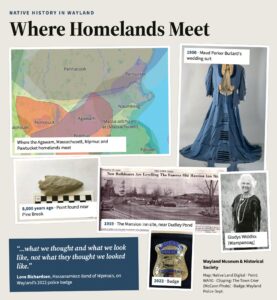
This is a Wayland story, too. Long before the Mansion Inn was built near Dudley Pond, the town notes that “the Marrs land served as a sacred burial site,” a cremation cemetery some 3,000 to 4,000 years old. In 1959, a bulldozer clearing land for new houses unearthed it, and locals carried off what they found before archaeologists arrived. The Wayland Archaeology Research Group (WARG) has worked with Andover’s Robert S. Peabody Institute of Archaeology to return those belongings. If you have something from the site, please email [email protected].
Sites like this are reminders of the landscape’s history. According to Native Land Digital, Wayland sits where the homelands of the Agawam, Massachusett, Nipmuc and Pawtucket peoples meet. People lived here for 10,000 years before anyone called it Sudbury (1638), East Sudbury (1780) or Wayland (1835). A bifurcated point in WARG’s care, found near Pine Brook, “dates to the Early Archaic period, some 8,000 years ago.”
When English colonists arrived, they followed Native trails like the Old Connecticut Path and settled along the Musketaquid (often translated as “grassy river”). The people whose land it was included Karto on Goodman Hill, Tantamous (called Jethro) at Nobscot, and Nataaus on today’s Reeves Hill.
As colonists took more land, tensions became King Philip’s War (1675–76), named for the Wampanoag leader Metacomet. In October 1675, Natick’s residents were interned on Deer Island, where more than half of about 500 people held there died. On April 21, 1676, Wampanoag, Nipmuc, and Narragansett fighters attacked Sudbury, reaching what is now Wayland. Thousands of Native people died in the war, and many others were sold into enslavement and shipped off to the West Indies. The Nipmuc Nation and the Praying Indians of Natick and Ponkapoag endure today.
Native history runs through the Revolution, too. Crispus Attucks, a sailor of African and Indigenous ancestry born in neighboring Framingham in 1723, is believed to have escaped enslavement there before becoming the first person killed in the Boston Massacre in 1770. His surname comes from the Natick word for “deer.”
In the last century and into this one, Native people have called Wayland home. In 1906, Maud Parker, daughter of Seneca leader Ely S. Parker (Ulysses S. Grant’s military secretary and the first Native American Commissioner of Indian Affairs), married Arthur Bullard of Wayland. The museum cares for her wedding suit and dresses. Decades later, Gladys Widdiss, who was Wampanoag, raised her family here and went on to lead her tribe to federal recognition. And in 2022, the Wayland Police Department unveiled a badge designed with citizens of the Hassanamisco Band of Nipmucs. Tribal council member Love Richardson spoke about being asked “what we thought and what we look like, not what they thought we looked like.”
This Thanksgiving, share “If You Lived During the Plimoth Thanksgiving” by Chris Newell, a Passamaquoddy citizen, with young readers.
Do you have corrections or historical stories to share? Send an email to info@ waylandmuseum.org. Thanks to Tonya Largy, Bobbie Robinson, Amanda Ciaccio, Royce Kahler, Jane Sciacca, Gretchen Schuler, Evelyn Wolfson, Kay Gardner-Westcott, and Rafael Abrahams, and to the Native communities who have always carried this history forward.