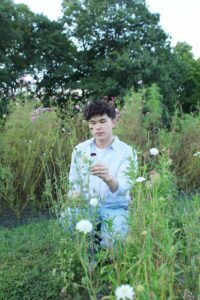
What started as a social media post about declining populations of monarch butterflies turned into a conservation project for Wayland High School senior Alex Tran, who hopes to inspire residents to protect the insects one plant at a time.
Tran, 17, founded Monarch Mosaic, an independent conservation effort focused on planting native milkweed to restore monarch butterfly habitats. He hopes it will educate the community about environmental conservation.
The project started about a year ago when Tran came across an Instagram post about decreased numbers of monarch butterflies. According to the nonprofit Xerces Society for Invertebrate Conservation, the population of eastern North American monarchs has declined by more than 80% since the 1990s. He was inspired to dig into the species’ migration practices, habitat loss and ways to protect them.
“I was quite profoundly astonished,” Tran said. “I was just like, ‘This can’t be true’.”
The research eventually led to whorled milkweed, a native plant species that serves as a host plant for monarch caterpillars and is listed as threatened in Massachusetts.
Milkweed plays a crucial role in the development of monarch butterflies because female monarchs lay their eggs on milkweed and the caterpillars feed on the plant.
Michael Nelson, an invertebrate zoologist with MassWildlife’s Natural Heritage and Endangered Species Program, said monarch caterpillars depend entirely on milkweed for food.
“The monarch butterfly, as a caterpillar, will only feed on milkweeds,” Nelson said.
Although monarch populations have declined across North America, Nelson said Massachusetts has not documented a significant long-term change in their numbers. However, he said, the state stands as an important part of the species’ larger breeding area.
“Every piece of it counts,” Nelson said. “That’s where people in Massachusetts can contribute breeding habitat to the bigger picture by doing things like planting milkweed.”
Jean Milburn, chair of the Wayland Garden Club’s Native Plant Committee, said interest in native plants and pollinator conservation has grown throughout the town in recent years.
She said local gardening retailers have also expanded their selection of native plants as more residents became interested in pollinator-friendly gardening.
“You can have a yard that is full of plants and full of flowers, and looks green and leafy and beautiful, and all your pollinators in it can be starving to death,” Milburn said.
Last summer, Tran began growing whorled milkweed from seed in his backyard garden in Wayland, experimenting with different planting techniques and recording observations in a journal. However, the process was not always successful.
Tran initially struggled with cold stratification, a process that exposes seeds to cold conditions to help prepare them for germination. Despite early setbacks, Tran continued experimenting with different planting techniques and documenting plant growth to improve future efforts.
“After all these months of trial and error and planting milkweed and failing, I finally got it to work,” Tran said.
The work eventually paid off when Tran spotted monarch butterflies visiting the backyard garden this summer.
“I was so happy, and it made me think, ‘wow’,” Tran said. “This is what I’ve been working for, and I’d say that was the most important part and most special moment to me.”
Every little bit helps
Nelson said even small patches of milkweed can help support monarch butterfly populations, particularly when similar conservation efforts are done across multiple communities.
He pointed to his own backyard where a small patch of milkweed planted five years ago has continued to attract monarch butterflies annually.
“In that way, all the small patches add up,” Nelson said.
As a part of building Monarch Mosaic, Tran has reached out to researchers and monarch butterfly specialists to learn about conservation efforts and ways to involve the Wayland community. It has encouraged Tran to focus on both planting milkweed and raising awareness about protecting native habitats.
“I want Wayland to know how they can take action and also learn about our environment and also how they can garden,” Tran said.
For residents looking to participate, Tran said autumn is an ideal time to plant milkweed seeds because cold, winter temperatures can naturally prepare them for germination in the spring. He recommends planting seeds in well-drained soil and allowing them to remain outdoors throughout the winter.
Expansion plans
As Monarch Mosaic continues to grow, Tran hopes to expand the project beyond his backyard by reaching out to Wayland High School teachers, the school’s Green Team gardening club, nursing homes and other local communities.
Tran said he hopes that Monarch Mosaic will eventually bring together volunteers, students and residents that are interested in conservation.
“I would like to see people working together, people volunteering, going to farms,” Tran said. “I would want to see curiosity.”
While Tran hopes Monarch Mosaic will eventually expand beyond Wayland and into other Massachusetts communities, the current priority is to raise awareness and encourage residents to take their first steps toward conservation.
“I would hope that people would understand that conservation doesn’t have to be abstract,” Tran said. “It’s very simple.”
For Tran, even a small patch of milkweed can represent the beginning of a larger effort to protect monarch butterflies.
“It starts plant by plant,” Tran wrote in the project’s submission. “Together, we can create a Monarch Mosaic.”