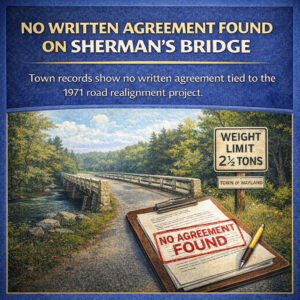
According to Town Manager Michael McCall, after an exhaustive review of town records, archival materials, and contemporaneous reporting, no evidence has been found that a formal written agreement existed between the Town of Wayland and Sherman’s Bridge Road landowners during the 1971–72 road realignment project.
The matter, commonly referred to as the “1971 Neighborhood Agreement,” arose during negotiations over a plan to straighten Sherman’s Bridge Road. According to contemporaneous accounts, residents expressed concern that straightening the road would increase vehicle speeds and lead to pressure to widen Sherman’s Bridge. Discussions between neighborhood landowners and town officials followed.
A June 24, 1971, article in the Wayland Town Crier reported that the impasse over road widening had been resolved through a compromise between residents and town officials, confirming that an agreement of some form had been reached. However, the article did not reference a written contract or vote adopting specific long-term restrictions on the bridge.
In 1972, Town Meeting approved the relocation and realignment of a portion of Sherman’s Bridge Road under Article 38 of the Annual Town Meeting warrant. The vote authorized the Road Commissioners to acquire land by purchase, eminent domain, gift, or otherwise, and appropriated $100 for the purpose. The article passed unanimously.
Supporting documentation shows that the town ultimately acquired 14,139 square feet of land from 14 separate landowners, all for no monetary consideration. Many of the affected properties changed ownership in subsequent decades, with most original owners having sold by 1990.
The most detailed description of the agreement’s terms appears in a November 6, 1991, letter written by Maurice H. Stauffer, a former Sherman’s Bridge Road resident, who participated in the 1971 negotiations. That letter, preserved in the Wayland Historical Commission archives, outlined what Stauffer described as conditions agreed to at the time of the land taking. These included maintaining the aesthetic character of the bridge, limiting pavement width on the road to 18 feet, preserving a 2½-ton weight restriction on the bridge, retaining the narrow bridge as a traffic-calming feature, and avoiding the use of state funding for the road or bridge.
While the Stauffer letter provides a detailed retrospective account, it was written two decades after the events and does not reference a signed agreement, recorded covenant, or Town Meeting vote adopting those conditions as binding terms. A review of town meeting warrants, minutes, recorded takings, and registry documents from the period similarly yielded no written contract, easement restriction, or other instrument memorializing such provisions.
Later summaries prepared by residents characterize the 1971 understanding as a set of “permanent restrictions” agreed to in exchange for land transfers. However, these summaries likewise do not cite a contemporaneous written agreement, and no such document has been located in town or registry archives.
Some residents have raised questions about whether an oral agreement could be legally enforceable. Legal experts note that while oral agreements can be enforceable in Massachusetts under certain circumstances, agreements involving land interests typically must be in writing to meet statutory requirements. No court ruling has addressed the Sherman’s Bridge matter, and town officials have not taken a formal position on the enforceability of any alleged agreement.
What the historical record clearly shows is that a negotiated compromise occurred, land was transferred to the town without payment, and the road was realigned as approved by Town Meeting. What remains unproven is the existence of a formal written agreement establishing binding, long-term restrictions on Sherman’s Bridge beyond what was explicitly voted and recorded in 1971–72.
As current discussions continue over the future of Sherman’s Bridge, the absence of a written contract has become a central point of debate, shaping how residents, boards, and committees interpret the legacy of decisions made more than five decades ago.