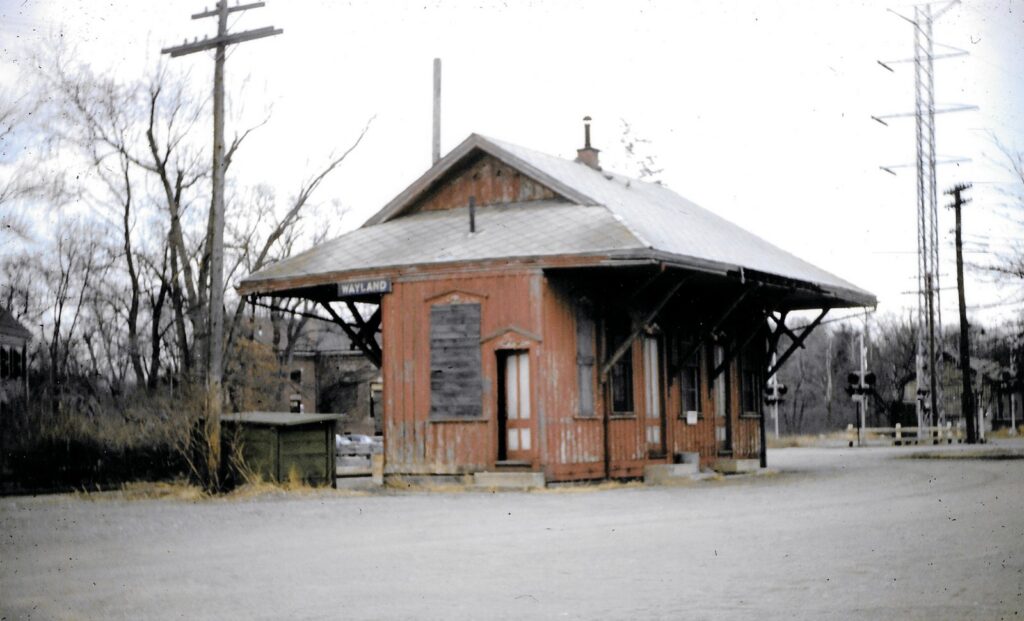
Residents can once again travel back to 1881 to gaze at the Wayland Depot’s late 19th-century Stick-style and Gothic Revival interior and peruse an array of colorful, handcrafted, unique items when the historic building reopens for the season on Sept. 16.
The Wayland Depot building has been recognized by the Massachusetts Historical Commission as one of the most complete, unique, and significant railroad buildings and foundations in Massachusetts.
The 145-year-old railroad depot on Cochituate Road is one of the few remaining in the country and is on the National Register of Historic Places. That’s why it was preserved through the joint effort of Wayland town officials and a group of women interested in preserving the historical building.
“Through everyone’s efforts, a historically significant site is maintained, local craftspeople are supported, and money is contributed to local charities,” Wayland Depot Board Secretary Margery Baston said.
The rail service, which offered a 37-minute ride to Boston, provided the fastest transport for Wayland residents during the early half of the century. However, because of highway improvements, more suburban employment opportunities, and new suburban shopping centers, train travel dwindled. By 1959, passenger service was reduced to one round trip a day and was finally discontinued in 1971. Freight service continued to pass through Wayland until 1980.
The Wayland Depot building was abandoned for most of the 1950s and 1960s, except for a taxi company occupancy in 1957. Appreciating its historical significance, the town purchased the building from the MBTA in 1970. The building was painted and used for community events until 1980, when a group of Wayland women approached the town with a proposal to rejuvenate the interior and convert the building to a nonprofit handicraft shop.
Baston explained that since the group of Wayland women supporters wanted to maintain a historically significant building, support talented people, and donate to charitable organizations in the community, they joined the Federation of Women’s Exchanges (FWE) to help them implement their idea. The goal of the group of volunteer, not-for-profit and nonprofit organizations is to aid and assist consignors and handcrafters who earn their living by their own industry and support charitable organizations within their communities.
Local items consigned at the depot include food items — honey, maple syrup, cocoa and salad dressing — as well as jewelry, pottery, paintings, photography, cards, wood boxes, bowls and walking sticks. The Wayland Free Public Library, Wayland Museum and Historical Society, and boosters also sell items directly (not as consignment) through the depot. Some of their items include books by local authors and Wayland High School and Wayland Middle School hats, sweatshirts, T-shirts, pants and umbrellas. The Wayland Depot is looking for new craft consignors and volunteers to serve at the depot, Baston said.
Approximately 20 volunteers currently staff the Wayland Depot, which is run by a board of directors elected annually by the membership, according to Baston.
The consignors pay an annual $10 fee to become a member and receive 60% of the retail price, with the Depot receiving the rest. Its share covers daily operations, routine maintenance, and refurbishing the building’s interior. The remainder is donated to local charities selected by the board.
The depot also pays $1 to the town to lease the building. The town maintains the building’s exterior. This is supported by the DPW, the Select Board, and the Wayland Community Preservation Committee, Baston said. The CPC trust fund, a statewide fund in Massachusetts administered by the Department of Revenue, provides annual matching funds to cities and towns that have adopted the Community Preservation Act. When a municipality adopts the CPA, it must levy a local property tax surcharge up to 3% and establish a local CPC.
The largest project sum granted by the CPC for the depot was approved on April 2, 2018, when Town Meeting authorized a one-time allocation of $90,000 in Historic Preservation CPA funds to restore and preserve the Wayland Depot’s exterior. That project included repairing and preserving the building’s exterior, restoring the historic train order signal, and upgrading the electrical service.
My Brother’s Table, Wayland Community Fund, Wayland Neighbor Brigade, and Wayland Habitat for Humanity are a few of the charities the Wayland Depot has supported, said Baston.
The Massachusetts Historical Commission recognized Wayland as having one of the most complete railroad collections because in most places, foundations of railroad engine terminals were obliterated by construction of industrial buildings on the site.
Although the Wayland Depot is well known, the freight house, next to the library parking lot, also remains. Both were built in 1881, the same year the Massachusetts Central Railroad began running trains between Boston and Hudson. In addition to passenger service, freight trains, which transported coal, livestock feed, fertilizer, manure, building materials, hardware, and leather for Cochituate shoe factories, traveled along that rail line. Tickets were sold at the depot. The freight house stored items shipped and received by rail in smaller quantities than a full carload. The town currently maintains the freight building where the DPW, library, and the museum store items.