BY JEAN MILBURN
Do you wake up hungry? Many of our pollinators do; and many have trouble when they hunt for food in late March through early May. Happily, Massachusetts is home to a diverse array of native plants, many of which are spring ephemerals—plants that take advantage of the short window of sunlight available before deciduous trees leaf out. These plants complete most of their life cycle within just a few weeks in early spring, making them a fleeting but essential part of the ecosystem. Spring ephemerals play a crucial role in forest biodiversity, providing early-season nectar for pollinators and enriching the soil as they decay.
Although spring ephemerals are typically found in rich, moist woodlands, where they bloom in early spring, much of it is in residential yards in Wayland. These early-blooming plants rely on stored energy in underground structures such as rhizomes, bulbs or tubers to quickly produce leaves and flowers once the ground thaws. Their
rapid growth allows them to take full advantage of the sunlight available before the canopy above fills in.
If you would like to see some early spring growth in your yard, nearby garden centers sell many of these wonderful early bloomers. Suggested species are: Bloodroot, Dutchman’s Breeches and Spring Beauty
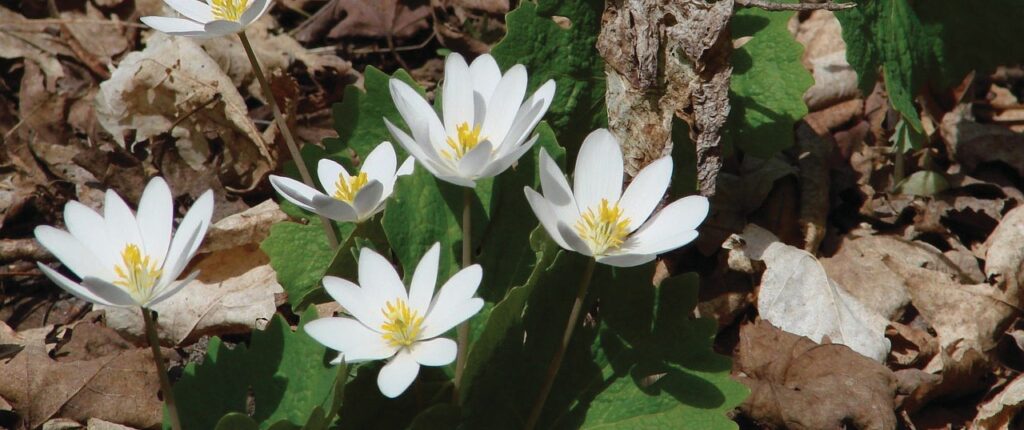
Bloodroot (Sanguinaria Canadensis) is a striking ephemeral known for its bright white flowers and distinctive lobed leaves. The plant gets its name from the red-orange sap in its rhizomes, which was historically used as a dye and for medicinal purposes by Indigenous peoples. Bloodroot’s flowers open on sunny days and close at night.
Dutchman’s Breeches (Dicentra Cucullaria) has flowers that look like baggy trousers and attract queen American Bumblebees (Bombus Pensylvanicus). Using their long tongues and powerful legs, these bulky bees find their way to pollen concealed within the adorable, pants-shaped flowers.
Spring Beauty (Claytonia virginica) is a delicate flower with five petals that are often white with pink veining. It grows in loose clusters and provides an important nectar source for native bees emerging in early spring. The plant’s underground tubers, known as “fairy spuds,” are edible and were historically consumed by Indigenous peoples and early settlers.
Spring ephemerals are essential for early-season pollinators, such as native bees, flies and beetles, which rely on them for
nectar and pollen. These plants also help prevent soil erosion by covering the forest floor early in the season. Additionally, many ephemeral species engage in mutualistic relationships with ants, fungi and other organisms that contribute to nutrient cycling in the forest ecosystem. A beautiful illustrated Guidebook to MA spring ephemeral wildflowers can be downloaded from https://www.mass.gov/doc/ ma-guide-to-spring-ephemeral-wildflowers/download