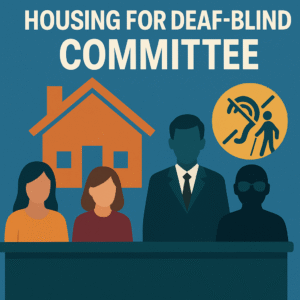
During the public comment session at the August 6 meeting of the 212 Cochituate Road Advisory Committee, DC Brazil introduced her daughter, Sydney Brazil Davis, who is deaf-blind and resides in a local group home, and urged the committee to address the unmet housing needs of deaf-blind adults.
The committee heard from Larry Oaks, president and CEO of Mainstay Supportive Housing and Home Care, who described the organization’s collaborative living model. Mainstay operates homes in Newton, Malden and Norwood for seven to eight residents, funded through a mix of subsidies, vouchers, private pay and philanthropy.
Approximately 60% of Mainstay’s 65 residents rely entirely on public subsidies, while fewer than 10% pay privately at a rate of roughly $3,500 per month. Homes include overnight staff and nutrition support and emphasize family involvement, with parents and siblings encouraged to share meals and activities. Homes are located within an hour of relatives to sustain families as both social and financial partners.
Oaks noted that although the state limits group homes to five residents, Mainstay has successfully accommodated larger houses with eight or more residents. He said the Wayland parcel could support either a mixed-income multifamily project with disability set-asides or a group home paired with affordable units. Committee members pressed Oaks on design, eligibility, and funding. In response to Katherine Provost, he said a local applicant preference applies only in the initial lottery.
The group then heard from Chris Canna, vice president of real estate development for the Corporation for Independent Living (CIL), a Hartford-based nonprofit that has developed roughly 250 group homes in Massachusetts since the late 1970s.
CIL owns the properties and leases them to nonprofit service providers under 30-year capital leases that transfer ownership at the end of the lease. Their homes typically serve three to five residents with 24-hour staff funded through Department of Developmental Services and MassHealth
(Medicaid) Home and Community-Based Services (HCBS) waivers — see tinyurl.com/hcbs-waivers.
Properties are acquired with initial KeyBank credit, refinanced with tax-exempt bonds, and supported by subsidies from the Community Economic Development Assistance Corporation (CEDAC) that offers Facilities Consolidation Funds, which can cover up to half of development costs as a forgivable loan up to about $1 million per home.
Service providers use HCBS waivers funded equally by Medicaid and the state to cover leases, staff, food and utilities, creating stable revenue. Canna called the model the most straightforward way to build homes, often in under a year, compared with the slower financing methods needed for mixed supportive housing.
Committee members asked about zoning protections under the Dover Amendment, the feasibility of building multiple homes on the parcel, and the balance between state regulations and neighborhood considerations.
Canna said state guidelines generally limit clustering to two homes per site, though local zoning may allow flexibility. Most homes use shift staff, with workforce housing added in high-cost areas. The committee then debated issuing a Request for Information; Whitney pushed for broad outreach, and Milburn and Thomas agreed. Whitney and Thomas will draft the RFI.
Canna inquired about the timeline, and Fay said the committee must recommend to the Select Board by February 15, 2026. Whitney noted that the Town Meeting has already authorized the board to dispose of the property, allowing an RFP as soon as Spring 2026.